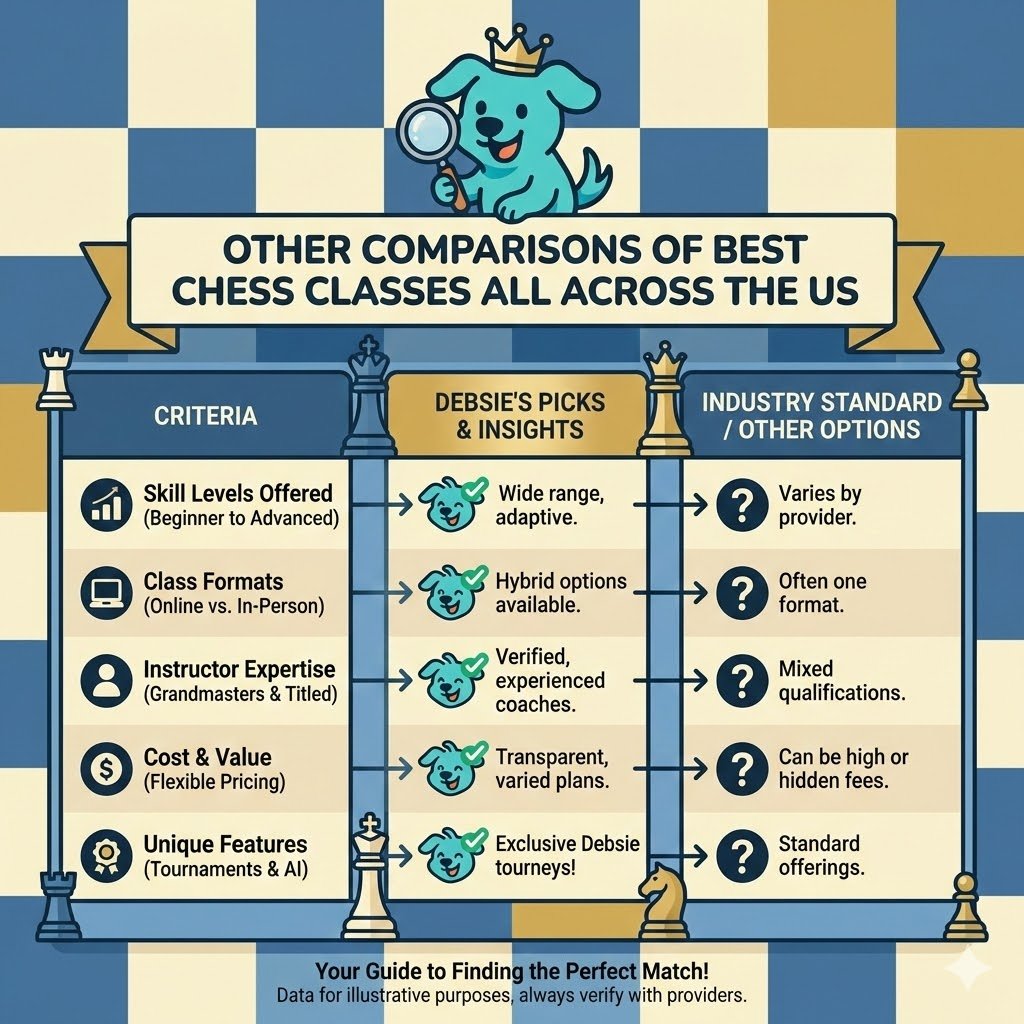
This comparison uses public evidence only: provider websites, directories, pricing pages, safety pages, course descriptions and public profiles. The aim is to help Orlando parents compare chess options fairly by scoring the same nine learning factors instead of relying on brand claims alone.
Find the right learning experience
Tell us a little about the learner and what you are looking for. Our team will review your answers and help you identify the most suitable next step.
- Takes only a few minutes
- No payment required
- Personalised recommendations
Your information will only be used to respond to your enquiry.
Original Research-Based Provider Comparison: How We Scored These Options
Subject: chess coaching. Region: Orlando, Florida. Providers already discussed in this article include Debsie, Orlando Chess & Games Center, Central Florida Chess Club, private Orlando tutors, and Chess.com/ChessKid/Lichess-style practice tools. Additional local options reviewed here include Chess Wizards, Story Time Chess Orlando, Orlando Chess Academy/OSOTA, and Orlando Chess Club.
| Provider | Best For | Key Strength | Possible Limitation | Score /10 |
|---|---|---|---|---|
| Debsie | Structured online chess coaching | Live tutor support, homework, quizzes, reports, gamified practice | Offline access depends on partner availability | 9.8 |
| Chess Wizards | School enrichment | Large K-8 curriculum, worksheets, trained staff | 1:14 ratio; pricing is location-specific | 7.5 |
| Chess.com / ChessKid / Lichess | Extra practice | Puzzles, games, analysis, safe kid tools | Not a full coach-led program | 7.3 |
| Story Time Chess Orlando | Ages 3–9 beginners | Story-based curriculum and private/small-group options | Less tournament-focused | 7.0 |
| Central Florida Chess Club | Rated tournament pathway | Strong local tournament culture and master-level coaches | Coaching/pricing/safety details vary by coach | 6.4 |
| Orlando Chess Academy / OSOTA | K–12 scholastic chess | Level-based after-school pathway | Rates “vary”; trial/pricing details are limited | 6.4 |
| Private Orlando Tutors | 1:1 local help | Flexible tutor choice and price range | Quality and structure vary by tutor | 6.2 |
| Orlando Chess Club | Casual local play + lessons | Free Saturday meetups and beginner–advanced tracks | Lesson pricing/safety policy not public | 6.2 |
| Orlando Chess & Games Center | Local chess community/events | Longstanding local listing and event references | Current curriculum, pricing and safety policy are not publicly clear | 5.2 |
Debsie Scorecard
Evidence base checked: Debsie pricing, child-safety policy, outcomes/testimonials, and the article’s Debsie section.
| Factor | Score | Evidence and scoring reason |
|---|---|---|
| Teacher Quality | 10 | Debsie states chess partners include FIDE-rated/FIDE-certified teachers; parents may ask for FIDE IDs; higher-tier coaches may include FM/IM/CM-type credentials. |
| Curriculum Structure | 10 | Public pricing and article pages describe group, 1:1 and advanced tracks, with tactics, openings, endgames and tournament skills. |
| Student Fit & Personalization | 10 | 1:1 classes are tailored by level, speed and learning style. |
| Practice / Tracking | 9.7 | Daily homework, WhatsApp feedback, puzzle advice and reports after two months are public. |
| Engagement | 10 | Gamified courses, points, leaderboards, peer learning and tournaments support motivation. |
| Access | 9.5 | Online via Microsoft Teams; offline FIDE-certified/award-winning partners may exist, but online gives broader teacher access. |
| Transparency | 9.5 | Public pricing: $100/month group, $20/class 1:1, $50/class advanced; free trial and safety page are visible. |
| Confidence Signals | 9.2 | Debsie publishes parent-approved outcomes, puzzle milestones, rating gains and tournament participation examples. |
| Flexibility | 10 | Group, 1:1, advanced 1:1, flexible scheduling and pay-for-attended-classes options. |
Chess Wizards Scorecard
Evidence base checked: public site, school page and FAQ.
| Factor | Score | Evidence and scoring reason |
|---|---|---|
| Teacher Quality | 7 | Instructors are selected for working with kids, background-checked and trained, but individual chess credentials are not usually public. |
| Curriculum Structure | 8.5 | Original K-8, high-energy, research-based curriculum with workshops, tournaments and camps. |
| Student Fit & Personalization | 7 | Skill grouping exists, but published ratio is 1 instructor to 14 students. |
| Practice / Tracking | 7 | Parent communication and curriculum support are clear; individualized progress tracking is less public. |
| Engagement | 9 | Strong games, energy, social learning and parent testimonials. |
| Access | 6.5 | Works well where offered through schools/community centers; Orlando availability depends on local registration. |
| Transparency | 7 | Safety and ratio are public; exact Orlando pricing/trial terms are not clearly listed. |
| Confidence Signals | 8 | 7,000+ students each semester, 350+ staff, 600+ partner sites. |
| Flexibility | 7 | Schools, camps, tournaments and online/private options are offered. |
Chess.com / ChessKid / Lichess Scorecard
Evidence base checked: Chess.com membership/trial pages, ChessKid Gold features, Lichess public site.
| Factor | Score | Evidence and scoring reason |
|---|---|---|
| Teacher Quality | 3 | Strong tools, but no dedicated teacher unless separately hired. |
| Curriculum Structure | 8 | Chess.com has step-by-step lessons; ChessKid has lessons/videos; Lichess has learn, practice, study and puzzles. |
| Student Fit & Personalization | 6 | Platforms adapt by rating/tool use, but do not diagnose like a live coach. |
| Practice / Tracking | 8.5 | Excellent for puzzles, games, game review and activity history. |
| Engagement | 8 | Bots, puzzles, games and kid-friendly environments help motivation. |
| Access | 10 | Available anywhere; Lichess is free, no-ads and open source. |
| Transparency | 8 | Chess.com shows a 7-day free trial; Lichess is free; ChessKid Gold features are public. |
| Confidence Signals | 8.5 | Large public ecosystems and well-known chess brands. |
| Flexibility | 9 | Excellent supplement; weaker as a complete learning system. |
Story Time Chess Orlando Scorecard
Evidence base checked: Orlando location page and classes page.
Find the right learning experience
Tell us a little about the learner and what you are looking for. Our team will review your answers and help you identify the most suitable next step.
- Takes only a few minutes
- No payment required
- Personalised recommendations
Your information will only be used to respond to your enquiry.
| Factor | Score | Evidence and scoring reason |
|---|---|---|
| Teacher Quality | 7 | Tutors are described as certified in the curriculum, but individual coach ratings/credentials are not fully public. |
| Curriculum Structure | 8 | Story-based curriculum designed for ages 3+, with school, community and private classes. |
| Student Fit & Personalization | 7 | Private and small-group lessons can match child pace. |
| Practice / Tracking | 5.5 | Strong engagement format, but homework/progress tracking is not very public. |
| Engagement | 9 | Best suited for young children because stories, characters and games are central. |
| Access | 6.5 | Orlando school/community/private options; events were listed as “coming soon.” |
| Transparency | 6.5 | First-lesson refund works like a trial; exact pricing is not public. |
| Confidence Signals | 7 | Public testimonials and national partner signals. |
| Flexibility | 6.5 | School, community, private and small-group formats. |
Central Florida Chess Club Scorecard
Evidence base checked: coaching page, tournament recap, Chess.com club listing and US Chess local news.
| Factor | Score | Evidence and scoring reason |
|---|---|---|
| Teacher Quality | 8.5 | Larry Storch is listed as USCF Original Life Master; other coaches include rated/titled or certified profiles. |
| Curriculum Structure | 5.5 | Strong coaching/tournament ecosystem, but no single beginner-to-advanced curriculum is public. |
| Student Fit & Personalization | 6 | Private coaches may personalize; club format is not a unified learning program. |
| Practice / Tracking | 5 | Rated play gives feedback by results, but homework/reporting is not central. |
| Engagement | 6 | Tournament culture motivates serious players. |
| Access | 7 | Orlando-area events and online rapid club activity are visible. |
| Transparency | 6 | Steven Vigil pricing is public at $50/hour or $70/1.5 hours; other pricing and safety policy are less clear. |
| Confidence Signals | 8 | 1987 nonprofit history, USCF organizer role, major Orlando tournament activity. |
| Flexibility | 6 | Useful for tournaments and private coaching; less packaged for beginners. |
Orlando Chess Academy / OSOTA Scorecard
Evidence base checked: OCA site, One School chess page and public directory page.
| Factor | Score | Evidence and scoring reason |
|---|---|---|
| Teacher Quality | 7 | OSOTA says classes use qualified, background-screened coaches and volunteers. |
| Curriculum Structure | 8 | Beginner I/II, Intermediate I/II and advanced pathways are described. |
| Student Fit & Personalization | 6 | Level placement exists; K-1 evaluation is offered before registration. |
| Practice / Tracking | 5 | Weekly lessons, practice games and tournament preparation are clear; formal reports are not public. |
| Engagement | 7 | Peer play, school setting and tournaments help motivation. |
| Access | 7 | Longwood location, Tuesday 4–5:15pm, open to community students. |
| Transparency | 5 | Rates are listed as “varies”; trial and safety details beyond background screening are limited. |
| Confidence Signals | 6 | Established in 2015; local scholastic competition pathway. |
| Flexibility | 5 | Strong for K–12 after-school; fewer public online/private options. |
Private Orlando Tutors Scorecard
Evidence base checked: Superprof Orlando page, national chess tutor page and sample Orlando tutor profile.
| Factor | Score | Evidence and scoring reason |
|---|---|---|
| Teacher Quality | 6.5 | Profiles range from beginners’ coaches to strong private teachers; quality varies by individual. |
| Curriculum Structure | 4.5 | Some tutors describe structured help, but no shared curriculum exists. |
| Student Fit & Personalization | 8 | 1:1 tutoring can fit level, goals and schedule. |
| Practice / Tracking | 4 | Depends entirely on the tutor. |
| Engagement | 5 | Can be strong with the right tutor; not systemized. |
| Access | 8 | Superprof lists Orlando face-to-face and webcam options. |
| Transparency | 7 | Orlando rates shown from about $15–$75/hour, average $37/hour, with 88% offering a first lesson free. |
| Confidence Signals | 6 | Some reviews are visible; many local profiles are new. |
| Flexibility | 8 | Strong for scheduling and tutor choice. |
Orlando Chess Club Scorecard
Evidence base checked: public club website.
| Factor | Score | Evidence and scoring reason |
|---|---|---|
| Teacher Quality | 6.5 | The site advertises beginner-to-advanced coaching, but coach credentials are not detailed. |
| Curriculum Structure | 6.5 | Beginner, intermediate and advanced tracks are listed. |
| Student Fit & Personalization | 6 | Tracks help fit level; individualized diagnosis is not clearly shown. |
| Practice / Tracking | 5 | Rated/casual play and lessons exist, but reporting/homework is not public. |
| Engagement | 6.5 | Free Saturday meetups, tournaments and family-friendly play are motivating. |
| Access | 8 | Saturday noon–4pm meetups are listed as free; tournament fee shown as $30. |
| Transparency | 5 | Lesson pricing, trial terms and safety policy are not public. |
| Confidence Signals | 5.5 | Public calendar and club page exist; review depth is not clear. |
| Flexibility | 6.5 | Casual play, tournaments, membership inquiry and lessons. |
Orlando Chess & Games Center Scorecard
Evidence base checked: Yellow Pages/Superpages listings and third-party local academy mention.
| Factor | Score | Evidence and scoring reason |
|---|---|---|
| Teacher Quality | 6.5 | Local event/community presence is visible, but named coach credentials are not clear on current public listings. |
| Curriculum Structure | 4.5 | Current step-by-step curriculum is not publicly clear. |
| Student Fit & Personalization | 5 | May suit players seeking local activity; personalization is not documented. |
| Practice / Tracking | 4 | Tournaments help practice; homework/reporting is not public. |
| Engagement | 5 | Over-the-board play can motivate, but class format is unclear. |
| Access | 6.5 | Local addresses and phone numbers are publicly listed. |
| Transparency | 4.5 | Current pricing, trial and safety policy are not publicly clear. |
| Confidence Signals | 5.5 | Longstanding directory presence; Superpages showed no reviews at the checked listing. |
| Flexibility | 5 | Useful for local chess activity; full learning options are unclear. |
How the Score Was Calculated (Scoring Rubric)
Final Score out of 10 = Teacher Quality 15% + Curriculum Structure 15% + Student Fit & Personalization 15% + Practice/Homework/Progress Tracking 12% + Engagement & Motivation 10% + Local Accessibility/Online Convenience 10% + Transparency of Information 8% + Parent/Student Confidence Signals 8% + Flexibility of Learning Options 7%.
A provider loses points when an important parent question is not publicly answerable. For example, “great coaches” without named credentials, background checks, pricing, trial terms, curriculum, homework or progress reporting scores lower than a provider that makes those details visible.
What the Numbers Mean for Learners, Parents and Readers
Debsie scores highest because it combines what families usually have to assemble separately: live teaching, structured curriculum, daily homework, quizzes/practice, parent-visible reports, safety rules, public pricing and flexible online access. It is especially strong for students who need guided practice beyond one weekly class.
Chess Wizards and Story Time Chess are stronger for fun enrichment and younger learners. Central Florida Chess Club is strongest for serious over-the-board tournament exposure. Orlando Chess Academy/OSOTA looks useful for K–12 after-school chess. Chess.com, ChessKid and Lichess are excellent practice tools, but they work best beside a coach.
For value comparison, Debsie is unusually transparent: $100/month for small group classes, $20 per 1:1 class, $50 per advanced 1:1 class, plus a free trial. Several local options may be good, but require inquiry for pricing, safety or teacher details.
TLDR – To Conclude
Debsie is the strongest all-round option in this scoring model for Orlando families who want structured online chess coaching, live tutor support, practice, quizzes, gamification, progress tracking and flexible scheduling. Other providers are not “bad”; they serve different needs. Choose Central Florida Chess Club for rated tournament culture, Chess Wizards or Story Time Chess for enrichment, Orlando Chess Academy/OSOTA for school-based chess, private tutors for narrow 1:1 help, and platforms like ChessKid or Lichess for extra practice.
If you live in Orlando, Florida—and your child wants to learn chess, or you’re a student hoping to get better—you might be asking: Where can I find a chess academy that really helps me grow?
Chess is not just a game. It teaches kids how to focus, how to think before they move, and how to stay calm under pressure. It builds patience. It builds confidence. It even helps them do better in school. But here’s the important part—all of that only happens if chess is taught the right way.
And unfortunately, most places don’t teach it that way.
Some just let kids play games without showing them how to get better. Others give out puzzles with no feedback. Some programs meet only once in a while, with no plan or coaching. When kids don’t see progress, they lose interest. And that’s when they quit.
That’s why this guide matters.
Online Chess Training
When most families in Orlando think about learning chess, they imagine it happening face-to-face. Maybe in a classroom. Maybe at a local library. Maybe with a chess set sitting between two people. And for years, that’s exactly how it was done.
But now? That idea is changing. And fast.
Families are realizing something important:
You don’t need to be in the same room to learn really well.
In fact, with the right setup, the right coach, and the right structure, online chess training can be more effective, more consistent, and more personalized than anything you’ll find in a classroom.
Let’s take a closer look at what Orlando families are experiencing — and why online chess coaching is turning out to be the smartest path forward.
Landscape of Chess Training in Orlando and Why Online Coaching Is the Smarter Choice

Orlando is full of opportunities. It’s home to some of the best schools in the country. It’s packed with brilliant teachers, sharp students, and a culture that values intellectual challenge. And chess fits right into that picture.
You’ll find chess offered in:
- After-school programs
- Private schools
- Weekend clubs
- Summer camps
- Even university outreach programs
So yes, the city offers a lot. But here’s the honest truth:
Most of these programs are built to expose students to chess — not to coach them in it.
Let’s walk through what that actually looks like.
How Debsie Is the Best Choice for Chess Coaching in Orlando
Let’s talk about what really makes Debsie special — and why our students stay with us, grow with us, and love learning with us.
We don’t teach from templates. We don’t teach from slide decks. And we don’t move on until the student fully understands the concept.
Our coaching method is built around three things:
- One-on-one attention
- A structured, flexible curriculum
- Kind, clear, and patient teaching
Let’s break those down in a way that’s easy to understand.
One-on-One Coaching that Focuses on You
Every lesson at Debsie is taught one-on-one. That means it’s just you (or your child) and your coach. No distractions. No other students. No split focus.
You’re not trying to keep up with a class. You’re not waiting for others to catch up. You’re learning at your own pace, in your own way, with a coach who understands what you know and what you need next.
This is where the magic happens. When the coach sees your games, hears your thinking, and helps you fix the patterns that are holding you back — that’s when real growth starts.
A Chess Curriculum That Builds Understanding Step-by-Step
We follow a full curriculum, but we don’t stick to it blindly. Instead, we adapt it for each student. If someone is new, we start with fundamentals — piece movement, board vision, simple tactics. If they’ve played before, we check for gaps and start right where they need to grow.
This curriculum is not something we made up overnight. It’s been developed over years of coaching — tested, refined, and shaped by working with real students of all ages and skill levels.
The best part? The student always knows where they are and where they’re headed. Each lesson builds on the last. Every game is reviewed. Every mistake is explained with care. And the student never feels lost.
Coaching That Feels Like a Real Connection
At Debsie, we’re not just teachers. We’re coaches who care.
Find the right learning experience
Tell us a little about the learner and what you are looking for. Our team will review your answers and help you identify the most suitable next step.
- Takes only a few minutes
- No payment required
- Personalised recommendations
Your information will only be used to respond to your enquiry.
We don’t talk over students. We don’t make them feel silly for asking questions. We teach chess in simple words, with kindness, patience, and encouragement.
This matters more than most people think.
When a student feels supported, they ask more. They learn faster. They enjoy the game more. And most importantly, they start to believe in themselves.
We see it every week — shy kids becoming confident players. Adults who once felt embarrassed by their mistakes now explaining strategy with clarity. That’s what happens when you teach chess like you’re sitting across the board from a friend — not standing at the front of a crowded classroom.
And that’s exactly how we teach.
Offline Chess Training

Orlando is a city full of opportunity when it comes to learning. Whether it’s science fairs, robotics, music conservatories, or chess, families here are invested. That’s what makes Orlando such a vibrant and inspiring place for kids.
So it’s natural that many parents turn to offline chess training when their child shows interest in the game. They look for school clubs, weekend classes, or a tutor who can come to their home. It feels personal. Traditional. And the face-to-face part often feels reassuring.
But here’s what happens more often than not:
Kids go to class. They play a few games. They hear a short lesson.
But they don’t really learn how to play better.
They’re exposed to the game, but they’re not being coached.
And that’s a big difference.
Let’s break down what most in-person chess training looks like in Orlando— and what’s missing from it.
After-School Programs
Many schools in Orlando offer chess as part of their after-school activities. These programs are great for introducing the game to young students. Kids get to play with their friends, learn some basics, and develop a healthy interest in chess. It’s a fun, relaxed environment.
But beyond the fun, most after-school programs have very little structure. Coaches often teach the same lesson to every group. There’s no customization. One week might focus on checkmates, the next on openings, but there’s no sense of a path. Students don’t get feedback on their games. And if a child is shy or struggles with something, it may go unnoticed.
Group Classes at Chess Clubs
Orlando’s top chess clubs or the Chess Forum — offer regular classes for kids and adults. These are usually taught by strong players. That’s a big plus. But group classes come with challenges.
Students are often placed together based on age, not skill. Some students already know how to win in five moves. Others are still learning how to avoid losing pieces. The coach tries to reach everyone, but they simply can’t focus on each student’s needs.
And when students don’t get that personal attention, progress slows down. Mistakes go uncorrected. Concepts remain unclear. And even students who love chess can start to feel like they’re not improving.
Private In-Person Lessons
Some coaches in Orlando offer one-on-one, in-person chess training. This can be a good option — if the coach is skilled, structured, and reliable. But many private coaches teach part-time. Some don’t follow a curriculum. Some coaches are great players, but not great teachers.
Also, in-person private lessons in Orlando come with big challenges — scheduling, travel, and cost. Coaches might cancel or reschedule. Students (especially kids) may feel tired or distracted after commuting across the city. And without a system in place, lessons can become more like casual game time rather than focused learning.
Drawbacks of Offline Chess Training
Let’s be very honest here. Most offline chess training — even when it’s well-meaning — fails to deliver long-term improvement. And that’s not the student’s fault. It’s the structure that’s broken.
Here are a few of the biggest problems we see, especially in cities like Orlando:
Lack of Personalization
Offline classes are almost always taught in groups. Even if they say “small group,” it still means five to ten students, each with different strengths, weaknesses, and learning speeds. A coach simply can’t give focused attention to every student. That means nobody gets what they really need.
Imagine a child who keeps losing their queen early in every game. In a group class, that problem might never get fixed — because the class is learning about openings or endgames instead. And the one-on-one conversation that would solve it in five minutes? It never happens.
No Long-Term Plan
Most offline lessons feel like random topics pulled from a box. One week it’s forks. The next it’s pins. But there’s no long-term strategy. There’s no big picture. Students don’t know why they’re learning something — or how it connects to what came before or what comes next.
This leads to confusion and discouragement. Even talented students begin to feel stuck.
At Debsie, every lesson connects. Students know exactly where they are in the process. They’re never confused. They’re never guessing what they’re supposed to work on. They’re following a plan that’s built just for them — and that makes all the difference.
Travel, Time, and Cost
In a city like Orlando, simply getting to a class can take more time than the class itself. Parents have to drive or take the subway. Kids are often tired by the time they arrive. And if you miss a session — it’s gone.
Rescheduling is tough. Coaches are booked. Traffic happens. And the whole experience becomes stressful instead of joyful.
With online chess coaching, none of this is an issue. Lessons happen at home. They start on time. They’re calm, focused, and fully recorded for review. Students actually look forward to them — because they know they’ll improve every time.
Best Chess Coaching Academies in Orlando, Florida

Orlando is known for its fun and energy—but it’s also a city full of smart, curious kids. Chess is becoming more popular in schools and homes here. While there are a few clubs and classes in the area, many of them focus more on casual play than real teaching. If your child wants to grow in chess, they’ll need more than just games—they’ll need a coach, a plan, and a program that really works.
Here are the top five chess coaching options available to families in Orlando. And at the very top is the one that brings it all together—Debsie.
1. Debsie – The Best Chess Coaching for Orlando Families
At Debsie, we teach kids how to think. We help them go from just playing to truly understanding the game. And we do it in a way that’s kind, simple, and actually works.
We’re an online chess school trusted by families in more than nine countries. Our students in Orlando join live classes with expert coaches who make learning fun and focused. Whether your child is just starting out or already plays in tournaments, we meet them where they are—and help them move forward with confidence.
Why Debsie Is #1 in Orlando
We Use a Real Learning Path
Most programs have no plan. They jump from puzzle to puzzle or game to game. That’s not teaching—it’s guessing.
We have a full curriculum. It starts with basics and builds up—step by step. Students learn tactics, strategies, openings, endgames, and tournament skills. Each lesson builds on the one before.
Live, Small Group Classes
Our classes are live—not videos. Kids join small groups where they get real-time help from kind coaches who explain things clearly.
Your child can ask questions, play practice games, and get real feedback—every class.
One-on-One Lessons for Extra Support
Some students want to go faster. Others need extra help. That’s why we offer private lessons.
These are focused, gentle, and 100% personal. Your child gets all the time and attention they need to thrive.
Tournaments Every Two Weeks
Every two weeks, we host online tournaments just for our students. These aren’t about winning—they’re about learning.
Students play, learn from mistakes, and build the confidence to try again. It’s real-world experience in a safe, supportive setting.
2. Orlando Chess & Games Center
The Orlando Chess & Games Center is a well-known spot for local chess events. They host tournaments and offer some in-person instruction. It’s a great hub for players who already enjoy chess and want to be part of a chess-loving community.
But here’s the challenge—it’s mostly focused on play, not structured learning.
There’s no step-by-step curriculum, and teaching varies depending on the coach or class. For students who need guidance, consistency, and a full learning plan, Debsie is a far better fit—especially for younger or newer students.
3. Central Florida Chess Club
The Central Florida Chess Club is another friendly organization for casual players and hobbyists. They meet regularly, and local players, including kids, can join to practice and connect.
However, this is more of a club than a school.
There’s no ongoing instruction, no personalized coaching, and no feedback on mistakes. If your child wants more than just casual games—if they want to learn—they’ll need a real teacher. That’s why so many families turn to Debsie for actual coaching.
4. Private Chess Tutors in Orlando
You can find a few chess tutors around Orlando offering one-on-one coaching. These lessons can be helpful, especially for intermediate students who want personalized attention.
But private tutoring comes with trade-offs:
- No tournaments
- No peer learning
- No structured curriculum
- Results vary depending on the tutor
At Debsie, students get personal coaching plus group classes, a step-by-step plan, and friendly tournaments—all in one place.
5. Chess Practice Platforms (Chess.com, ChessKid, Lichess)
These websites are great for extra practice. Kids can solve puzzles, play games, and watch videos. Many enjoy the challenge and interactivity.
But they don’t teach.
There’s no coach. No one to explain mistakes. No system to help kids grow. These tools are helpful after your child understands the basics—but they can’t replace a good teacher.
That’s why families who want real learning start with Debsie, then use these platforms for extra fun on the side.
Why Online Chess Coaching Is Now the Smartest Choice
In-Person Classes Don’t Always Fit

In-person chess coaching sounds nice — until you realize how it works. You show up. You sit in a group. You might get one question answered. Then the coach moves on. It’s hard to focus. It’s hard to speak up. And it’s hard to know if you’re really learning.
Most in-person classes have no system. You don’t know what you’ll learn next. There’s no tracking. No review. And if you miss a class, you fall behind.
That’s not how real learning should feel.
Online Coaching Gives You Structure, Clarity, and Progress
With Debsie, everything is simple.
You learn one-on-one. You know exactly what you’re working on. You get feedback every week. And your coach is always one message away.
We don’t move on until you truly understand. We don’t give homework unless it helps. And we explain everything clearly and kindly — just like we’re sitting next to you at a chessboard, talking it out step by step.
And yes, it’s online — but it feels more personal than any classroom.
Progress Doesn’t Come From Playing More — It Comes From Learning Right
You can play hundreds of games and still stay stuck — if no one is teaching you how to improve. That’s why so many learners plateau. They think more games will make them better. But games don’t teach. Coaches do.
We review your games. We explain your mistakes. We help you understand what to do next time — and why. That’s what creates growth. Not tricks. Not shortcuts. Just smart, step-by-step learning that fits your brain and your pace.
How Debsie Leads the Online Chess Training Landscape
Now that you understand why online chess training is so powerful, the next question is simple:
Who should you trust to teach it the right way?
That’s where Debsie comes in.
We’re not a side project. We’re not a tutoring service. We are a full-time, fully online, purpose-built chess academy that was created to solve every problem that traditional coaching couldn’t fix.
We’ve taken everything we’ve learned from coaching thousands of students and built a complete system that actually works — no matter your starting point.
What We Do Differently (And Better)
Structured, Personalized Curriculum
Most coaching programs use cookie-cutter lessons. Not us. We build a full plan around every student’s level, speed, and needs. You’ll never feel rushed. You’ll never feel lost. Every lesson will feel like it was made just for you — because it is.
Carefully Trained Coaches
Our coaches don’t just know chess. They know how to teach it — clearly, kindly, and step by step. They’re trained to explain concepts in simple ways. To notice patterns in your games. And to give you real, honest feedback that helps you grow without ever making you feel pressured or confused.
Support Outside the Lesson
We don’t stop when class ends. You’ll get homework that matches what you just learned. You’ll receive puzzle sets, game reviews, and notes you can study later. We even provide lesson recordings if you want to review on your own time.
That kind of follow-up is something most academies simply don’t offer — online or offline.
A Relationship That Builds Confidence
At Debsie, we don’t just train players. We build thinkers. We help kids feel confident, adults feel capable, and every student feel like they’re finally learning the game the right way.
That’s why our students stick with us for years. Because they see real results — and because they feel seen, understood, and supported every step of the way.
That’s what makes this more than a class. It becomes a journey. And when you learn that way — supported, understood, and taught with patience — you don’t just improve at chess. You become a stronger thinker, a calmer person, and a more confident learner in life.
Conclusion: The Right Way to Learn Chess Starts Right Here
You came here looking for the best chess coaching in Orlando. Now you know the truth: the best chess coaching doesn’t just come from being nearby — it comes from being taught the right way.
Some academies offer group lessons. Some focus on playing games. Some use the same lessons for every student. But Debsie is different. We teach chess one-on-one, online, and with a personal plan that fits you.
You’ll learn at your own pace. You’ll work with a coach who listens. You’ll understand the game better every week. And you’ll feel that steady progress — not just on the board, but in how you think.
So don’t wait. Don’t guess your way forward. Let us help you grow — the right way, from the very first move.
👉 Visit debsie.com
👉 Book your free consultation — no pressure, just real support
👉 Let’s take your first step together — one clear move at a time
Because you don’t need to be talented.
You don’t need to be perfect.
You just need to start — and we’ll help you become everything you can be.
This is your move. Let’s make it count.

Abir Das is a educator, child learning specialist, and competitive chess player who brings a rare blend of technical knowledge, psychological insight, and practical chess experience to his work with young learners. With a diploma in child psychology, a B.Tech degree and a strong academic foundation in structured problem-solving, Abir understands how analytical thinking develops over time and how children can be guided to think more clearly, patiently, and confidently through chess.
Abir’s approach to education is shaped by his deep interest in child psychology and how young minds learn best. He believes chess should never feel like a collection of difficult rules or memorized moves. Instead, it should feel like an exciting journey into patterns, choices, creativity, discipline, and discovery. His lessons are designed to help children understand not only what move to play, but why that move makes sense.
As a competitive chess player with a rating of 1991, Abir has developed a strong practical understanding of the game through years of study, training, and tournament experience. He has competed in rated chess events, earned recognition for his strategic play, and achieved strong results in regional and state-level competitions. His accomplishments as a player give his teaching an authentic and trustworthy foundation because he understands the pressure, patience, and preparation required to perform well at the board.
Abir is especially skilled at helping children build confidence in chess. He has coached beginners who are just learning how the pieces move, intermediate students working on tactics and planning, and advanced young players preparing for competitive events. His teaching focuses on essential chess skills such as board vision, calculation, opening principles, endgame technique, pattern recognition, time management, and emotional control during games.
What makes Abir’s teaching style distinctive is his ability to connect chess improvement with personal growth. He sees every chess game as a lesson in decision-making. A missed tactic becomes a chance to improve focus. A lost game becomes an opportunity to build resilience. A difficult position becomes a practice ground for patience and creativity. Through this approach, Abir helps students grow not only as chess players, but also as thoughtful, disciplined, and independent learners.
Fluent in French (CEFR level C1), and having lived all across Europe, Abir also brings a global and culturally aware perspective to education. His ability to communicate across languages reflects his curiosity, adaptability, and commitment to connecting with learners from different backgrounds. This international outlook enriches his teaching and writing, allowing him to explain ideas in a clear, inclusive, and accessible way.
As an author at Debsie, Abir writes practical and engaging French, physics and chess education content for children, parents, and young learners. His writing simplifies complex concepts without making them shallow. Whether he is explaining Bernoulli’s principle, a tactical pattern, a checkmate idea, French genders in nouns or a chess planning principle, or the mindset needed for tournament play, Abir focuses on clarity, usefulness, and long-term learning.
Abir’s work is guided by the belief that chess can be one of the most powerful learning tools for children. It strengthens memory, concentration, logic, creativity, patience, and emotional maturity. More importantly, it teaches children how to think before acting, how to learn from mistakes, and how to approach challenges with confidence.
Outside of teaching and writing, Abir continues to study chess, follow international tournaments, analyze instructive games, and explore innovative methods for making physics, French, chess more enjoyable and meaningful for children. His mission is to help young players see chess not just as a game to be won, but as a lifelong skill that builds sharper minds, stronger character, and a deeper love for learning.
Other Comparisons of Best Chess Classes All Across The US: