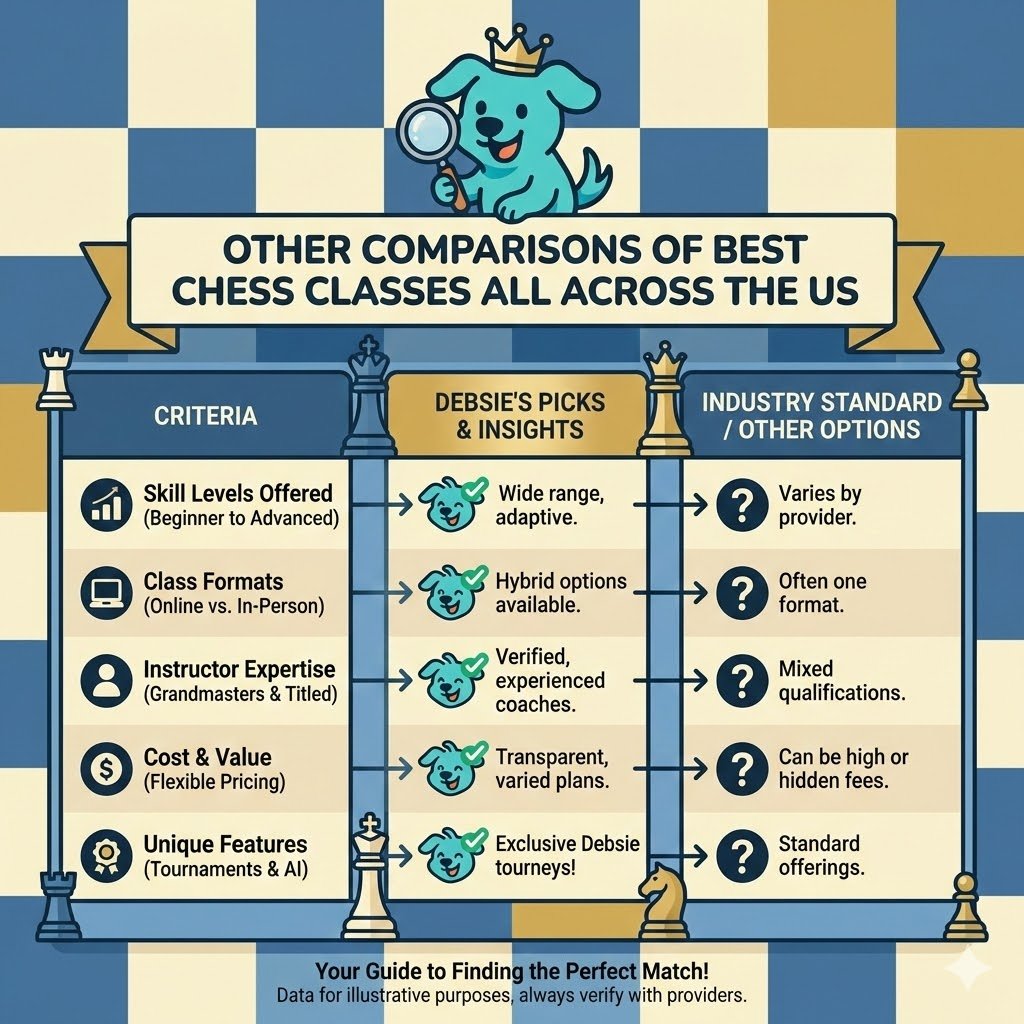
We compared Richmond chess-learning options using the same 10-point model for every provider. The goal is simple: help parents see which option has the clearest teachers, curriculum, practice system, safety/pricing information, flexibility, and proof of student support.
Find the right learning experience
Tell us a little about the learner and what you are looking for. Our team will review your answers and help you identify the most suitable next step.
- Takes only a few minutes
- No payment required
- Personalised recommendations
Your information will only be used to respond to your enquiry.
Original Research-Based Provider Comparison: How We Scored These Options
Scope: Subject: chess coaching. Region: Richmond, Virginia. Providers already mentioned in this article: Debsie, Richmond Chess Initiative, Mechanicsville Chess Club, local chess tutors, and ChessKid/Chess.com/Lichess. Additional Richmond-area providers reviewed: RVA Pieces, Discovery Center at Stony Point, The Knight School Richmond, Championship Chess/ChessRVA, and Henrico Chess Academy.
| Provider | Best For | Key Strength | Possible Limitation | Score /10 |
|---|---|---|---|---|
| Debsie | Structured online chess with guided practice | FIDE-rated/certified partner-teacher standards, live support, homework, reports, free trial, public pricing | Mostly online; offline partner access is narrower than global online access | 9.70 |
| The Knight School Richmond | Young kids who like energetic group learning | Strong child-focused curriculum and motivation system | Richmond pricing/trial details not publicly clear | 8.10 |
| RVA Pieces | Local community chess and private lessons | Free/low-cost community play plus named private coaches | More club/community than full academy pathway | 7.58 |
| Discovery Center at Stony Point | Local family chess, camps and leagues | In-person Richmond location, skill bands, events | Pricing/safety details not fully visible in public crawl | 7.12 |
| Championship Chess / ChessRVA | School chess and camps | Longtime local coach with strong scholastic history | Trial/pricing/safety policy not publicly clear | 7.14 |
| ChessKid / Chess.com / Lichess | Self-practice between lessons | Puzzles, games, lessons, analysis, broad access | Not a full coaching substitute without a teacher | 7.11 |
| Local tutors / marketplaces | Flexible 1:1 tutoring | Many online/local tutor options and review signals | Quality and curriculum vary by tutor | 6.94 |
| Richmond Chess Initiative | School/community access | Local scholastic mission | Curriculum, pricing and safety details are limited publicly | 5.70 |
| Henrico Chess Academy | Local beginner/intermediate help | Named coach with RVA school experience | Limited public detail on levels, pricing, tracking | 5.59 |
| Mechanicsville Chess Club | Casual local play | Accessible over-the-board community | Not publicly positioned as a teaching academy | 3.93 |
Debsie — Score Evidence
| Factor | Score | Evidence and scoring reason |
|---|---|---|
| Teacher Quality | 10 | Debsie states chess teachers are FIDE-rated/FIDE-certified and parents may ask for FIDE IDs; pricing page also lists veteran coaches with FM/IM/CM-style accolades; article describes trained live coaches. |
| Curriculum Structure | 10 | Public pages show personalized curriculum, structured step-by-step lessons, and chess as a formal course rather than casual play. |
| Student Fit & Personalization | 10 | Free trial assesses level; 1:1 classes are tailored by level, speed and learning style; small groups are capped at 4–6. |
| Practice, Homework & Tracking | 9.5 | Daily homework, recordings, coach advice, puzzle recommendations and performance reports after two months are public. |
| Engagement & Motivation | 9.5 | Gamified courses, leaderboard, quizzes/learning modes, tournaments and interactive classes support motivation. |
| Access / Convenience | 10 | Online via Microsoft Teams, WhatsApp support, flexible scheduling, free trial and cross-city access. |
| Transparency | 9.5 | Public pricing: $100/month group, $20/class 1:1, $50/class advanced; public safety page and outcomes page. |
| Confidence Signals | 8.5 | Outcomes page shares parent-approved progress examples; WorldChess comparison exists but was treated as a weaker, non-local signal. |
| Flexibility | 9.5 | Group, 1:1, advanced 1:1, online support and offline teacher partners; best teacher access is mainly online. |
The Knight School Richmond — Score Evidence
| Factor | Score | Evidence and scoring reason |
|---|---|---|
| Teacher Quality | 6.5 | Strong national children’s model, but Richmond coach credentials are not deeply detailed publicly. |
| Curriculum Structure | 9 | Public 26-band “Tactic of the Week” curriculum, preschool curriculum and summer curriculum. |
| Personalization | 8 | Programs split by ages 3–18, beginner to advanced, girls-only, online private lessons and camps. |
| Practice/Tracking | 8.5 | Tactix-Bands act as visible progress markers; parent tutorials exist. |
| Engagement | 9.5 | Gamified bands, “party” positioning, tournaments and high-energy classroom design. |
| Access | 8.5 | In-person and online Richmond programs. |
| Transparency | 6.5 | Enrollment page requires ZIP; pricing/trial not clearly visible; scholarship policy is public. |
| Confidence | 8 | Established national brand; public testimonials/resources, but local review detail is limited. |
| Flexibility | 8.5 | Multiple programs, camps, online private lessons and school programs. |
RVA Pieces — Score Evidence
| Factor | Score | Evidence and scoring reason |
|---|---|---|
| Teacher Quality | 8.5 | Private coaching lists Spenser Kearns teaching since 2013 and FM Paul Whitehead. |
| Curriculum Structure | 6.5 | Private lessons include game review and tailored exercises, but no published full level pathway. |
| Personalization | 7 | Lessons are tailored to recent games and needs. |
| Practice/Tracking | 6 | Exercises are prepared, but no public parent dashboard or formal reports. |
| Engagement | 8.5 | Multiple weekly casual events, tournaments and beginner meetups. |
| Access | 9 | Free-to-join club, $5 events, local meetups and library classes. |
| Transparency | 8 | Coaching rates are public: $40/hour, $70/two hours, FM lesson $100/1.5 hours. |
| Confidence | 8 | Covered by Richmond Magazine and The Commonwealth Times; nonprofit/community presence. |
| Flexibility | 7.5 | Club play, beginner classes, tournaments and private lessons; safety/trial policy not publicly clear. |
Discovery Center at Stony Point — Score Evidence
| Factor | Score | Evidence and scoring reason |
|---|---|---|
| Teacher Quality | 6.5 | Chess/STEAM provider is public, but individual coach credentials are not clear in accessible pages. |
| Curriculum Structure | 7.5 | Saturday club, four skill bands, school-year league, camps and monthly competitions. |
| Personalization | 7 | Skill bands help level-fit; private personalization not fully clear. |
| Practice/Tracking | 6 | Leagues/ladders imply practice; formal homework/reports not publicly clear. |
| Engagement | 8 | Camps, leagues, ladders, tournaments and STEAM environment. |
| Access | 8 | Physical address at 9200 Stony Point Pkwy, Richmond; family programs listed. |
| Transparency | 6.5 | Registration page exists, but pricing/trial details were not fully visible in crawl. |
| Confidence | 7.5 | Sawyer lists 20 provider ratings; Richmond Family Magazine lists the center. |
| Flexibility | 7.5 | Clubs, camps, leagues and events; child-safety policy not prominent in public crawl. |
Championship Chess / ChessRVA — Score Evidence
| Factor | Score | Evidence and scoring reason |
|---|---|---|
| Teacher Quality | 8.5 | Brian Garbera’s page lists USCF 1872, prior high 2071, decades of teaching and certified TD experience. |
| Curriculum Structure | 7.5 | Public listings reference school programs, open classes, camps and complete curriculum. |
| Personalization | 6.5 | School/camp model is strong; 1:1 customization is less public. |
| Practice/Tracking | 6.5 | Sample puzzles and tournament resources exist, but progress-reporting is not clear. |
| Engagement | 7 | School clubs, camps and tournaments support motivation. |
| Access | 7.5 | Works with 20+ greater Richmond schools and local programs. |
| Transparency | 6 | Contact details are public; pricing/trial/safety policy not publicly clear. |
| Confidence | 7.5 | Longstanding local presence and directory/media listings. |
| Flexibility | 6.5 | Schools, camps and open classes; online and personalized options less clear. |
ChessKid / Chess.com / Lichess — Score Evidence
| Factor | Score | Evidence and scoring reason |
|---|---|---|
| Teacher Quality | 3 | Excellent tools, but no consistent live teacher unless a family separately hires one. |
| Curriculum Structure | 7.5 | Lessons, puzzles, analysis and kids’ learning tools are strong. |
| Personalization | 5.5 | Adaptive practice helps, but not human-level personalization. |
| Practice/Tracking | 8 | ChessKid reports, Chess.com lessons/puzzles and Lichess puzzles/analysis are useful. |
| Engagement | 9 | Games, puzzles, bots and tournaments are highly engaging. |
| Access | 10 | Available anytime; Lichess is free/open-source, Chess.com has free trial/premium, ChessKid has free/from $9.99/month. |
| Transparency | 9 | Pricing/features are publicly explained. |
| Confidence | 8 | Widely used platforms; ChessKid is child-focused and safety-oriented. |
| Flexibility | 7 | Great supplement, weaker as a full coaching plan. |
Local Tutors / Marketplaces — Score Evidence
| Factor | Score | Evidence and scoring reason |
|---|---|---|
| Teacher Quality | 7 | Thumbtack shows highly rated online tutors serving Richmond; Wyzant lists Richmond chess tutors. |
| Curriculum Structure | 5.5 | Depends on tutor; no consistent public pathway. |
| Personalization | 8 | 1:1 format can fit age, level and goals. |
| Practice/Tracking | 5.5 | Tutor-dependent; no standard dashboard. |
| Engagement | 6 | Depends heavily on individual teacher. |
| Access | 8.5 | Online/local choices and quote systems are convenient. |
| Transparency | 7 | Reviews and ratings exist, but exact pricing varies. |
| Confidence | 7.5 | Thumbtack shows several 4.7–4.9-rated chess pros; still tutor-specific. |
| Flexibility | 8.5 | Strong scheduling flexibility; safety policy varies by platform/tutor. |
Richmond Chess Initiative — Score Evidence
| Factor | Score | Evidence and scoring reason |
|---|---|---|
| Teacher Quality | 7 | VSCA search result identifies Mike Callaham as Class A player, instructor and Richmond Middle School Chess League head coach. |
| Curriculum Structure | 5 | Article says school/community focus, not a full private pathway. |
| Personalization | 5 | Group/school model; personalization not publicly clear. |
| Practice/Tracking | 4 | Homework/reports not publicly clear. |
| Engagement | 7 | School/community access can introduce chess well. |
| Access | 7 | Local school/community reach. |
| Transparency | 4.5 | Public site was sparse in crawl; pricing/safety/trial not clear. |
| Confidence | 6.5 | Scholastic relevance, but limited current public detail. |
| Flexibility | 5.5 | Better for access than advanced individualized coaching. |
Henrico Chess Academy — Score Evidence
| Factor | Score | Evidence and scoring reason |
|---|---|---|
| Teacher Quality | 7 | Eugene Gateley is described as a longtime RVA coach and founding RVA Pieces member. |
| Curriculum Structure | 5 | Beginner/intermediate coaching mentioned; formal levels not public. |
| Personalization | 6 | Local coaching likely adaptable, but details limited. |
| Practice/Tracking | 4.5 | Homework/reports not publicly clear. |
| Engagement | 5.5 | Local instruction; engagement system not clear. |
| Access | 6.5 | Glen Allen/Henrico-local option. |
| Transparency | 4.5 | Pricing, trial and safety policy not publicly clear. |
| Confidence | 5.5 | Some public coach background, limited third-party review footprint found. |
| Flexibility | 5 | Local beginner/intermediate focus; online options not clear. |
Mechanicsville Chess Club — Score Evidence
| Factor | Score | Evidence and scoring reason |
|---|---|---|
| Teacher Quality | 3 | Public listings describe a community club, not named coaches. |
| Curriculum Structure | 2 | Article says no formal lessons or roadmap. |
| Personalization | 5 | Casual help may occur, but not a coaching system. |
| Practice/Tracking | 2 | No homework/reporting found. |
| Engagement | 6 | Casual, rated, blitz, bullet and bughouse play are mentioned. |
| Access | 6 | Local in-person club near Richmond. |
| Transparency | 4 | Basic listing exists; schedule/safety/pricing not robust. |
| Confidence | 4 | Small public footprint; Lichess team has only a few members listed. |
| Flexibility | 5 | Good for play; weak as a teaching academy. |
How the Score Was Calculated (Scoring Rubric)
Final Score out of 10 = Teacher Quality 15% + Curriculum Structure 15% + Student Fit & Personalization 15% + Practice/Homework/Progress 12% + Engagement 10% + Access/Convenience 10% + Transparency 8% + Confidence Signals 8% + Flexibility 7%.
A provider did not need to be online to score well. Local programs scored well when they showed named coaches, clear levels, public pricing, frequent sessions, tournaments, reviews and parent-visible progress. “Not publicly clear” lowered the score because parents should not have to guess before contacting a provider.
What the Numbers Mean for Learners, Parents and Readers
Debsie ranks #1 because it is the most complete system in the public evidence: live teacher support, FIDE-rated/certified partner-teacher standards, free trial, visible pricing, daily homework, progress reports, safety policy, gamified learning and flexible online access. It is especially strong for students who need more than one weekly club meeting.
The Knight School looks strongest for young children who enjoy energetic group learning. RVA Pieces is excellent for Richmond families who want a real local chess community, low-cost play and access to strong private coaches. Championship Chess/ChessRVA has strong scholastic experience, especially for school-based programs.
Find the right learning experience
Tell us a little about the learner and what you are looking for. Our team will review your answers and help you identify the most suitable next step.
- Takes only a few minutes
- No payment required
- Personalised recommendations
Your information will only be used to respond to your enquiry.
ChessKid, Chess.com and Lichess are valuable practice tools, but they are not the same as coaching unless a parent adds a teacher. Local tutors can be useful for 1:1 help, but families should ask for curriculum, homework, safety expectations, pricing and progress reporting before starting.
TLDR – To Conclude
Debsie is the strongest overall choice in this scoring model because it combines structured online lessons, teacher support, homework, quizzes/practice, gamification, parent-visible progress, flexible scheduling, clear pricing and a public child-safety framework. Other providers are not “bad”; they serve different needs. For local play, choose RVA Pieces. For energetic group classes, consider The Knight School. For school programs, consider Championship Chess or Richmond Chess Initiative. For serious guided improvement, Debsie has the clearest full learning system.
If you’re in Richmond, Virginia—and you’re a parent hoping your child learns chess the right way, or a student looking to improve—you’re probably asking: Where can I find real chess coaching that helps me grow?
Chess is more than a game. It teaches kids how to think before they act. It helps them stay calm, focus longer, and plan smarter. It builds patience. It builds confidence. And it helps them do better in school and life. But here’s something important—none of that happens without proper teaching.
Most local programs don’t offer that.
Some clubs just let kids play. Others toss out puzzles without showing the “why.” Some meet here and there but don’t have a learning path. And when students don’t see progress, they lose interest.
That’s why this guide exists.
Online Chess Training
If you’ve ever tried to learn chess by just playing more games, you already know it doesn’t work. You win sometimes. You lose a lot. And you start to feel like you’re stuck.
Why does that happen?
Because getting better at chess isn’t about playing more — it’s about learning better.
That means understanding your mistakes, seeing new patterns, and learning how to think — not just move.
And the best way to learn in today’s world?
Online, one-on-one coaching.
Let’s look at why online learning is becoming the first choice for students in Richmond— and how it solves the problems that most in-person programs can’t fix.
Landscape of Chess Training in Richmond and Why Online Chess Training is the Right Choice

Richmond is a city that loves to learn. The schools are strong. Families here invest in academics, music, math, sports, and more. And yes, chess is growing — especially for kids.
There are a handful of options for local chess learning. Some schools offer chess clubs after class. A few local coaches teach in person. You might also find weekend group classes at community centers or through chess programs.
At first, this seems like enough. But after a few weeks or months, families start to notice something:
“My child is playing… but not improving.”
“The lessons are random.”
“They’re doing activities, but I’m not sure they’re learning anything.”
“They like it, but we don’t know what’s next.”
This isn’t just happening in Richmond. It’s a nationwide issue with most offline group-based training.
Here’s why:
Group classes move at one speed — and it’s never the student’s speed.
Some students pick things up fast. Others need more time. But when you’re in a group, the coach has to teach one lesson to everyone. Some kids are bored. Some are lost. And no one gets the attention they need to really grow.
There’s no personal feedback.
When kids play games in after-school programs or local classes, the coach might walk around. But there’s no time to review each game, explain mistakes, or break down ideas slowly. Students just keep playing — and keep repeating the same errors.
Most coaches don’t follow a structured curriculum.
Even private tutors in Richmond often just play games with the student and talk along the way. There’s no long-term plan. No tracking. No big picture. The student may enjoy it… but they don’t really improve.
That’s why families are switching to online one-on-one chess training — because it fixes all of this.
Let’s look at how that works — especially when it’s done right.
How Debsie is The Best Choice When It Comes to Chess Training in Richmond
Online learning only works when it’s done with intention. At Debsie, we’ve built our entire coaching system to work better than any group class or in-person tutoring session ever could.
We don’t teach through slides.
We don’t stick 10 kids in a Zoom class.
We teach one-on-one — clearly, patiently, and with a real plan.
Here’s how we do it.
Every Student Gets a Custom Chess Plan
From the very first lesson, we take time to understand where the student is starting. We ask smart questions. We watch how they play. We listen to what they already know — and what they’re unsure about.
Then we build a personal curriculum just for them.
This is not just a list of random topics. It’s a step-by-step path that teaches:
- Core tactics and patterns
- Board vision and planning
- Openings, middlegames, and endgames
- Strategy and time control
- Tournament preparation and confidence
Whether a student is brand new or already competing, we match their level and help them grow.
Lessons That Are Calm, Clear, and Focused
Our lessons are always live and one-on-one. That means:
- The coach is focused only on your child — not a group
- Every question is answered right away
- The pace is flexible — we slow down when needed, and move faster when the student is ready
This kind of coaching feels personal. There’s no rush. No pressure. Just real teaching, designed to help the student actually understand the game.
Our Coaches Are Kind, Experienced, and Trained to Teach
Being good at chess is one thing.
Being able to teach it simply, kindly, and clearly — that’s another.
We’ve carefully selected and trained every coach at Debsie to do more than play. Our coaches know how to explain ideas step by step, using plain language and lots of real examples.
They’re great with kids.
They’re patient with adults.
And they’re serious about helping every student feel calm, smart, and in control on the board.
Offline Chess Training

In Richmond, the love for learning is everywhere — from the local schools to the nature trails to the cafés filled with books and laptops. It’s a thoughtful, forward-moving city. So it’s no surprise that chess is growing fast here too.
Many families look for chess classes through schools, tutors, or weekend workshops. They want their kids to improve, think deeper, and maybe even enter a tournament someday.
Find the right learning experience
Tell us a little about the learner and what you are looking for. Our team will review your answers and help you identify the most suitable next step.
- Takes only a few minutes
- No payment required
- Personalised recommendations
Your information will only be used to respond to your enquiry.
The challenge? Most of these offline programs aren’t designed for real improvement. They’re built more for activity than for learning.
Let’s look at what chess training usually looks like in-person in Richmond, and why even motivated students often hit a wall.
After-School Chess Clubs
Many schools in Richmond offer after-school chess as part of their enrichment programs. These clubs are fun and social. They introduce kids to the game, and that’s a great start.
But when it comes to actual coaching, there’s a problem.
Here’s how a typical session looks:
- A coach teaches a short group lesson
- All the kids (often with mixed skill levels) start playing games
- The coach walks around, gives a few tips, then the class ends
What’s missing?
Personal attention. Feedback. And a plan.
No one is sitting with your child explaining why they keep losing their queen. No one is helping them slow down and think differently. And no one is tracking what they’ve learned or what they need next.
For a curious child, this kind of group setup gets frustrating quickly. They’re showing up every week, but not getting better. It’s like going to math class — and only doing puzzles with no teacher.
Weekend Workshops and Group Classes
Some programs in the greater Richmond or nearby area offer weekend chess classes or special sessions. These are often taught at libraries, learning centers, or rented spaces.
The good news? These coaches are usually strong players. The bad news?
They’re still teaching groups.
These sessions might feel more organized than school clubs, but they still follow the same structure:
- Teach one topic to everyone
- Let the students play
- Offer general advice
Once again, the learning stays surface-level. No detailed game reviews. No time to ask questions. No one noticing how your child plays under pressure.
The format itself — no matter how enthusiastic the coach — makes deep learning almost impossible.
Private In-Person Tutors
Hiring a tutor feels like the solution, right? One-on-one sounds great. You meet at your home or a local café. The student plays. The tutor offers guidance.
But here’s what actually happens in most cases:
- The tutor plays casual games with the student
- They offer tips during the game
- There’s no curriculum
- There’s no follow-up after the session
In other words, it’s coaching without a system.
Even when the tutor is a good player, that doesn’t mean they know how to teach. Most tutors are winging it — bringing a few puzzles, going off memory, and hoping something sticks.
It’s not that they’re doing anything wrong. It’s just that they’re not doing what’s most effective — which is why progress stays slow, inconsistent, or completely stalled.
Drawbacks of Offline Chess Training
Let’s be honest — most families don’t know these things until they’ve already spent months (or even years) in local programs. They saw their child having fun… but not really learning. They heard them say, “I love chess!” — but then saw them lose over and over with the same mistakes.
This isn’t about blaming the student. It’s about how chess is being taught — and where it falls short.
Here are the four biggest problems with in-person chess training in Richmond (and honestly, just about everywhere else too):
1. One Size Fits All
Group lessons — whether they’re in a classroom, a library, or a chess club — are always built around the average student. But no student is average.
Some kids learn quickly and get bored. Others learn slowly and feel left behind. And both types miss out on what they need.
There’s no time for a coach to pause and explain something one-on-one. No flexibility to shift gears. And no freedom to spend 20 minutes fixing one key mistake.
In chess, small things matter.
Group settings don’t allow time for small things — and that’s why most students stay stuck.
2. There’s No Real Plan
Ask most kids in a local chess class what they’re working on and you’ll hear things like:
“Tactics, I think.”
“Openings?”
“I don’t know — we played games today.”
That’s because there’s no curriculum. No roadmap. No tracking.
The coach might teach a cool trick this week, an endgame idea next week, and a grandmaster game the week after. But without structure, students forget what they’ve learned — and can’t build on it.
At Debsie, every student knows exactly where they are in their learning. Because every lesson is part of a plan.
3. Missed Classes Mean Lost Learning
In-person programs are rigid. If your child misses class, that lesson is gone. Most local clubs don’t record sessions. Most tutors don’t offer reschedules. You fall behind — and there’s no way to catch up.
Online coaching fixes that instantly.
At Debsie:
- Missed lessons can be rescheduled
- Sessions are recorded (so the student can rewatch)
- Learning continues, no matter what life throws your way
Consistency is key — and we make it easy.
Best Chess Academies in Richmond, Virginia

Richmond has a friendly chess scene. There are school clubs, local tournaments, and community groups where players can meet and play. But if your child is serious about improving—not just playing—you’ll need more than a chess board and good intentions.
True progress comes from real teaching.
Below are the five best options for chess coaching in Richmond. At the very top? The one that teaches with heart, structure, and results—Debsie.
1. Debsie – The Best Chess Coaching for Richmond Families
At Debsie, we don’t just teach how the pieces move. We teach how kids think, focus, and plan—not just in the game, but in life.
We’re an online chess academy trusted by families in more than nine countries. Students from Richmond learn with us every week. Our program is live, personal, and step-by-step. Whether your child is new to chess or already plays competitively, we help them go further.
Why Debsie Is #1 in Richmond
We Follow a Real Learning Plan
Other programs often jump from one thing to another. One week is openings, next week it’s random puzzles. Kids don’t know what they’re learning—or why.
At Debsie, we build skills one step at a time. From basics to deep strategies, every class fits into a bigger path. That means progress your child can see—and feel proud of.
Live, Small Classes With Kind Coaches
We don’t use recordings. All of our classes are taught live by trained, caring coaches.
Classes are small. Students ask questions, play games, and get feedback—right away. It’s fun, it’s focused, and your child is always seen.
One-on-One Coaching When Needed
Some students want to move faster. Others need extra help. We offer private coaching just for that.
These sessions are personal. They help your child grow with clear steps, kind support, and focused guidance.
Tournaments That Build Real Confidence
Every two weeks, we run online tournaments for our students. These aren’t just games—they’re learning experiences. Kids get to test their skills in real matches—and grow from every win or loss.
2. Richmond Chess Initiative
The Richmond Chess Initiative runs programs in local schools and offers some community chess events. Their goal is to bring chess into classrooms and make it fun for students.
But they’re focused more on access than advancement.
These programs are great for exposure, but not designed for long-term growth. Lessons can vary by instructor, and there’s no set curriculum or private coaching.
Many students start with initiatives like this and then join Debsie for structured, steady improvement.
3. Mechanicsville Chess Club (Near Richmond)
The Mechanicsville Chess Club is a local group just outside Richmond. They hold regular meetups and welcome players of all ages. It’s a relaxed, community-driven space to enjoy casual games.
But this is not a learning academy.
There are no formal lessons, no trained coaches, and no roadmap for students. While it’s great for social play, your child won’t get the teaching they need to truly grow.
That’s why families who are serious about learning choose Debsie for consistent, guided coaching.
4. Local Chess Tutors in Richmond
There are several chess tutors in the Richmond area. They offer private lessons at home or online, which can be helpful for one-on-one learning.
But here’s the challenge: most tutoring doesn’t follow a real curriculum. Lessons depend on the tutor’s style. There’s no group learning, no tournaments, and often no feedback tracking.
With Debsie, every student gets:
- A full learning plan
- Group and private classes
- Regular tournaments
- Progress updates and support
It’s coaching that’s clear, kind, and complete.
5. Chess Practice Platforms (ChessKid, Chess.com, Lichess)
These tools are fun and useful for practicing. They offer puzzles, videos, and games that help keep kids engaged.
But they’re not a coaching solution.
There’s no teacher. No feedback. No one explaining why a move is right—or wrong. Without guidance, kids often keep guessing, and stop getting better.
Debsie fills that gap with real coaching, real community, and real results.
Why Online Chess Training Is the Future
The way we learn is changing fast — and for good reason. Just like people are learning piano through live video lessons, or meeting with math tutors from across the country, chess has fully entered the online world. But this isn’t just about convenience.
It’s about better coaching, faster growth, and smarter teaching.
Here in Richmond, families value time, flexibility, and quality. You care about doing things right. That’s exactly why more families are now turning to online one-on-one chess training — because it fits into real life and actually helps students improve.
Let’s look at why online is not just a new option… it’s the best one.
It Saves Time and Adds Flexibility
In-person lessons require travel. That means traffic, parking, rushing to get out the door — all for a 60-minute lesson. If the tutor cancels or you have to reschedule, there’s a big disruption.
With online coaching, you just open your laptop. Your coach is there, right on time.
No stress. No travel. And when things change, rescheduling is easy.
This flexibility keeps lessons consistent — and consistent lessons lead to real improvement.
It Allows Full Personal Focus
In a group class, even when it’s small, the coach is split between students. Some get more help, some get less, and no one gets full attention.
With online one-on-one coaching, your child is the only focus. Every question gets answered. Every move is reviewed. Every lesson is adjusted in real time based on what the student needs most.
This is how chess becomes clear instead of confusing.
It Builds Confidence in a Comfortable Space
Many students feel pressure in a classroom. They’re nervous to ask questions. They’re afraid to say they don’t understand. But in a one-on-one online lesson, at home, that pressure disappears.
The student feels safe. They ask more. They learn faster.
They stop second-guessing themselves and start thinking calmly and clearly.
And that confidence? It carries over to school, sports, and life.
How Debsie Leads the Online Chess Training Landscape
Not all online chess programs are created equal.
Some are just websites with videos. Others are group Zoom classes with little personal touch. Some tutors play a game and give a few tips — but don’t follow a plan.
Debsie is different. We don’t offer “online lessons.” We offer transformation.
Let’s show you how we lead the online chess movement — and why families in Richmond are already seeing the difference.
We’re Built Entirely Around One-On-One Success
Our entire academy is designed for online, one-on-one learning. That means:
- Our coaches teach slowly, clearly, and with patience
- Our lessons are visual, interactive, and engaging
- Our students get real-time support, not just pre-recorded videos
- Our platform allows full review, replay, and post-lesson practice
We didn’t move a classroom online. We built something new and better — designed from the ground up for real teaching.
We Provide More Than Lessons — We Provide a System
With Debsie, your child doesn’t just take a weekly class. They follow a full, structured learning journey.
We provide:
- A custom curriculum based on your child’s level
- Lesson recordings they can rewatch
- Weekly feedback and notes
- Optional homework that actually helps
- Regular check-ins for parents
This kind of structure doesn’t exist in local programs — and it’s why our students don’t just play chess… they learn how to think like real players.
We Build More Than Chess Skills — We Build Thinkers
What makes us proud isn’t just that our students win more games (though they do).
It’s that they become stronger learners.
They:
- Slow down
- Think before reacting
- Make plans
- Learn from mistakes without fear
- Ask better questions
- Focus longer
These are chess skills — but they’re also life skills.
And we teach them with care, calm, and clarity — one student at a time.
Conclusion: Your Next Move Starts Here
If you’ve made it this far, you’re probably looking for something more.
More than just a weekly activity.
More than just a coach who shows up and plays.
More than just another group lesson that doesn’t lead to growth.
You want a clear path.
You want real improvement.
You want a coach who teaches your child — not just the class.
That’s what we do at Debsie.
👉 Visit debsie.com
👉 Book your free consultation
👉 And let’s finally build the chess journey your child deserves — with clarity, care, and progress you can see
We’ll start with where you are.
We’ll build a plan that fits you.
And we’ll walk with you, every step of the way — one smart move at a time.

Abir Das is a educator, child learning specialist, and competitive chess player who brings a rare blend of technical knowledge, psychological insight, and practical chess experience to his work with young learners. With a diploma in child psychology, a B.Tech degree and a strong academic foundation in structured problem-solving, Abir understands how analytical thinking develops over time and how children can be guided to think more clearly, patiently, and confidently through chess.
Abir’s approach to education is shaped by his deep interest in child psychology and how young minds learn best. He believes chess should never feel like a collection of difficult rules or memorized moves. Instead, it should feel like an exciting journey into patterns, choices, creativity, discipline, and discovery. His lessons are designed to help children understand not only what move to play, but why that move makes sense.
As a competitive chess player with a rating of 1991, Abir has developed a strong practical understanding of the game through years of study, training, and tournament experience. He has competed in rated chess events, earned recognition for his strategic play, and achieved strong results in regional and state-level competitions. His accomplishments as a player give his teaching an authentic and trustworthy foundation because he understands the pressure, patience, and preparation required to perform well at the board.
Abir is especially skilled at helping children build confidence in chess. He has coached beginners who are just learning how the pieces move, intermediate students working on tactics and planning, and advanced young players preparing for competitive events. His teaching focuses on essential chess skills such as board vision, calculation, opening principles, endgame technique, pattern recognition, time management, and emotional control during games.
What makes Abir’s teaching style distinctive is his ability to connect chess improvement with personal growth. He sees every chess game as a lesson in decision-making. A missed tactic becomes a chance to improve focus. A lost game becomes an opportunity to build resilience. A difficult position becomes a practice ground for patience and creativity. Through this approach, Abir helps students grow not only as chess players, but also as thoughtful, disciplined, and independent learners.
Fluent in French (CEFR level C1), and having lived all across Europe, Abir also brings a global and culturally aware perspective to education. His ability to communicate across languages reflects his curiosity, adaptability, and commitment to connecting with learners from different backgrounds. This international outlook enriches his teaching and writing, allowing him to explain ideas in a clear, inclusive, and accessible way.
As an author at Debsie, Abir writes practical and engaging French, physics and chess education content for children, parents, and young learners. His writing simplifies complex concepts without making them shallow. Whether he is explaining Bernoulli’s principle, a tactical pattern, a checkmate idea, French genders in nouns or a chess planning principle, or the mindset needed for tournament play, Abir focuses on clarity, usefulness, and long-term learning.
Abir’s work is guided by the belief that chess can be one of the most powerful learning tools for children. It strengthens memory, concentration, logic, creativity, patience, and emotional maturity. More importantly, it teaches children how to think before acting, how to learn from mistakes, and how to approach challenges with confidence.
Outside of teaching and writing, Abir continues to study chess, follow international tournaments, analyze instructive games, and explore innovative methods for making physics, French, chess more enjoyable and meaningful for children. His mission is to help young players see chess not just as a game to be won, but as a lifelong skill that builds sharper minds, stronger character, and a deeper love for learning.
Other Comparisons of Best Chess Classes All Across The US: