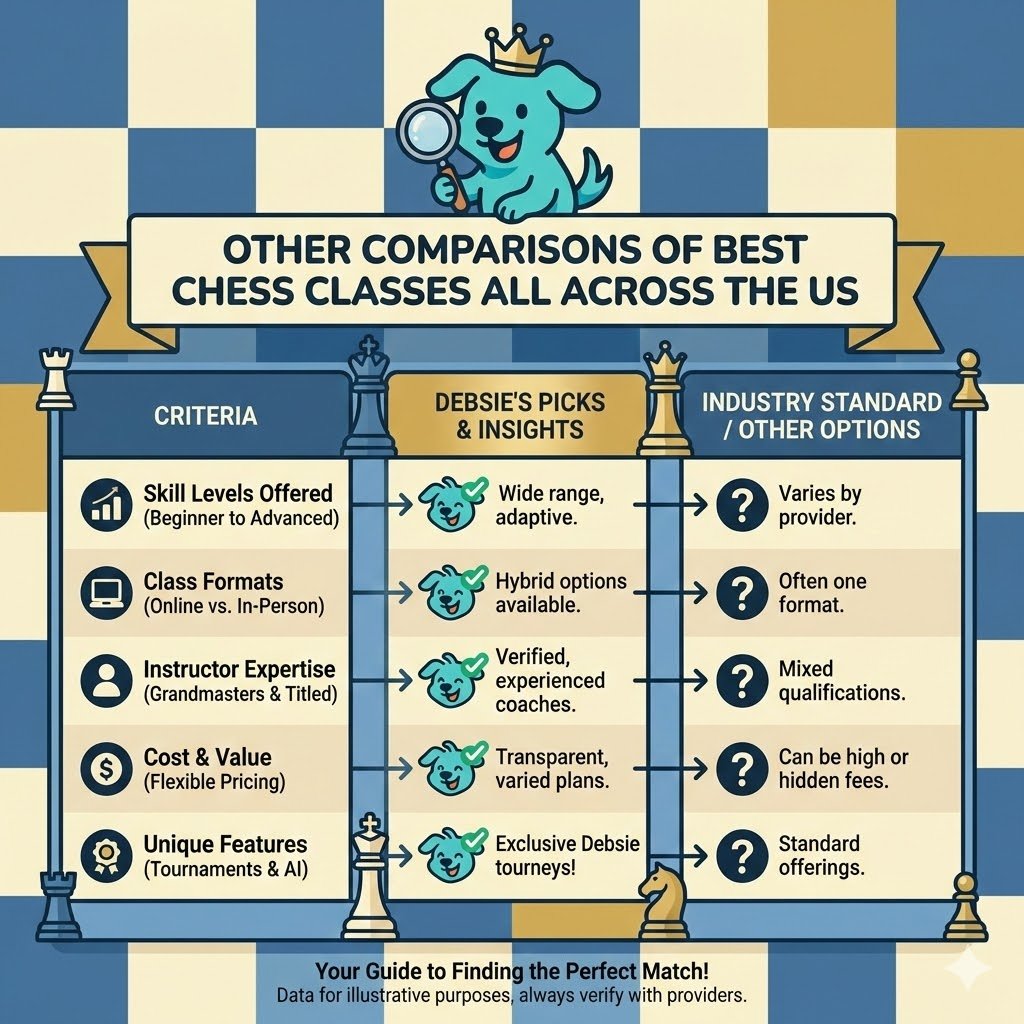
We compared Jersey City chess-learning options using the same parent-focused scoring model: teacher quality, structure, personalization, practice, motivation, access, transparency, reputation, and flexibility. A weighted table helps families compare real learning support instead of relying on brand claims alone.
Find the right learning experience
Tell us a little about the learner and what you are looking for. Our team will review your answers and help you identify the most suitable next step.
- Takes only a few minutes
- No payment required
- Personalised recommendations
Your information will only be used to respond to your enquiry.
Original Research-Based Provider Comparison: How We Scored These Options
Scope: chess coaching in Jersey City, New Jersey. The article already mentions Debsie, Jersey City Chess Club, New Jersey State Chess Federation, private chess tutors, and after-school chess programs. We also checked AlphaMinds Academy, International Chess Academy, 101 Discoveries, and Zaniac.
| Provider | Best For | Key Strength | Possible Limitation | Score /10 |
|---|---|---|---|---|
| Debsie | Structured online chess with guided practice | FIDE-rated/certified teacher partners, homework, reports, gamified learning, clear safety policy | Offline Jersey City availability is not publicly clear; widest teacher pool appears online | 9.67 |
| AlphaMinds Academy | Local scholastic classes | USCF-affiliated, skill levels, tournaments, Jersey City locations | Trial and child-safety details are less public than Debsie’s | 8.36 |
| International Chess Academy | Serious regional tournament pathway | Established NJ academy, Teaneck/Glen Rock, camps, tournaments | Not Jersey City-local; pricing/trial/safety details not publicly clear | 7.92 |
| Wyzant / private tutors | Choosing an individual coach | Many rated tutors, some titled/high-rated players | Curriculum and safety vary by tutor | 7.58 |
| Zaniac Jersey City | Small-group enrichment | 5:1 ratio, levels, progress emails | Current chess pricing and coach credentials not publicly clear | 6.74 |
| 101 Discoveries | Local K–8 chess/math enrichment | Strong older coach-profile evidence | Current pricing, safety policy, and active class structure not publicly clear | 6.73 |
| NJ State Chess Federation | Tournaments and ratings | State-level event authority and Safe Play resources | Event organizer, not a coaching academy | 6.02 |
| Jersey City Chess Lessons / Club | Casual local play and group lessons | Weekend group lessons and first-lesson-free evidence | Coach credentials, curriculum, tracking, and safety policy not publicly clear | 6.01 |
Debsie — Score Evidence
| Factor | Score | Evidence and Scoring Reason |
|---|---|---|
| Teacher Quality | 10 | Debsie publicly says chess partners include FIDE-rated/FIDE-certified teachers, parents may ask for FIDE IDs, and higher-tier coaches may include FM/IM/CM-type titles. |
| Curriculum Structure | 10 | Article describes a connected path from basics to tactics, strategy and endgames; pricing/features mention personalized curriculum and gamified course progress. |
| Personalization | 10 | 1:1 classes are “tailored,” pacing is level-based, and parent groups allow feedback loops. |
| Practice/Tracking | 9.5 | Daily homework, class recordings, puzzle recommendations, performance reports after two months, and public outcome examples are visible. |
| Engagement | 9.5 | Gamified courses, points, leaderboard, and small groups support motivation. |
| Access | 9.5 | Online access, Microsoft Teams, WhatsApp communication, free trial, and flexible scheduling are public. |
| Transparency | 9.2 | Pricing is public: group $100/month, 1:1 $20/class, Extreme $50/class; child-safety policy is detailed. |
| Confidence | 9.1 | Public testimonials/outcomes and a WorldChess comparison entry support Debsie’s structured-progress positioning, though WorldChess is treated as a secondary signal. |
| Flexibility | 9.5 | Group, 1:1, higher-tier coaching, online access, and homework-based support are all visible. |
AlphaMinds Academy — Score Evidence
| Factor | Score | Evidence and Scoring Reason |
|---|---|---|
| Teacher Quality | 8.8 | Public page cites National Masters/Experts rated USCF 1950–2200+. |
| Curriculum Structure | 8.8 | Beginner-to-advanced classes cover tactics, strategy, notation, game analysis, and tournament prep. |
| Personalization | 8.2 | Skill-based placement, small classes, and private lessons are public. |
| Practice/Tracking | 7.5 | Rated play and tournaments are strong; homework/progress-reporting is less clear. |
| Engagement | 8.2 | Small, interactive classes and local tournaments support motivation. |
| Access | 8.7 | Jersey City, Hoboken, Union City, online, and local-school options are listed. |
| Transparency | 7.3 | Some Jumbula listings show examples such as $198–$396 historical chess sessions; safety/trial details are not as visible. |
| Confidence | 8.8 | USCF affiliation, tournaments, 14+ years, 10,000+ students, and a 5.0/35 Chamber rating are public. |
| Flexibility | 8.8 | Group, private, online, in-person, and tournament options are clear. |
International Chess Academy — Score Evidence
| Factor | Score | Evidence and Scoring Reason |
|---|---|---|
| Teacher Quality | 9.0 | ICA states instruction for beginner through Grandmaster level; ActivityHero cites internationally ranked professional coaches. |
| Curriculum Structure | 8.6 | Classes, camps, quads, tournaments, and virtual programs are public. |
| Personalization | 7.6 | A 6:1 camp ratio is strong; individualized progress tracking is less public. |
| Practice/Tracking | 7.4 | Tournament activity is strong; homework/reporting is not publicly clear. |
| Engagement | 8.0 | Camps, quads, and FIDE/USCF events motivate serious students. |
| Access | 6.8 | Teaneck and Glen Rock are regional, not Jersey City-local; online exists. |
| Transparency | 7.0 | Locations and schedules are visible, but pricing/trial/safety policy are less clear. |
| Confidence | 8.2 | Established in 1996 with public tournament history and a 5.0/4 Chamber rating. |
| Flexibility | 8.0 | In-person, virtual, camps, after-school, and tournaments are listed. |
Wyzant / Private Chess Tutors — Score Evidence
| Factor | Score | Evidence and Scoring Reason |
|---|---|---|
| Teacher Quality | 8.2 | Listings include Candidate Master, Woman Grandmaster, FIDE Master, USCF Life Master, and experienced coaches. |
| Curriculum Structure | 5.8 | Depends on the individual tutor; no single academy curriculum. |
| Personalization | 8.4 | 1:1 tutor choice is strong. |
| Practice/Tracking | 5.8 | Homework and reporting vary by tutor. |
| Engagement | 6.8 | Can be excellent with the right coach, but inconsistent. |
| Access | 9.0 | Local and online tutors are easy to compare. |
| Transparency | 8.2 | Rates are visible: typical Jersey City chess tutors are shown around $35–$60/hour, with some higher. |
| Confidence | 8.2 | Wyzant cites 4M+ 5-star reviews and a Good Fit Guarantee; individual tutor reviews vary. |
| Flexibility | 9.0 | Strong scheduling and tutor-choice flexibility. |
Zaniac Jersey City — Score Evidence
| Factor | Score | Evidence and Scoring Reason |
|---|---|---|
| Teacher Quality | 6.5 | Low 5:1 ratio is public; chess-specific instructor credentials are not publicly clear. |
| Curriculum Structure | 7.2 | Intro/intermediate/advanced-style chess levels and six-week format are visible. |
| Personalization | 6.5 | Small groups help, but 1:1 chess pathway is not clear. |
| Practice/Tracking | 7.0 | Personal progress emails after every class are a strong signal. |
| Engagement | 7.4 | Peer-based, play-with-friends format is parent-friendly. |
| Access | 7.7 | Jersey City location at 125 1st St is public. |
| Transparency | 6.2 | Older price PDF exists, but current chess pricing/safety policy are not publicly clear. |
| Confidence | 5.6 | Local directory pages show “No Reviews” or limited review evidence. |
| Flexibility | 6.0 | Good for enrichment; less clear for advanced tournament prep. |
101 Discoveries — Score Evidence
| Factor | Score | Evidence and Scoring Reason |
|---|---|---|
| Teacher Quality | 7.4 | Older Hoboken Family Alliance page cites a coach who became a chess Master at 12 and had 30 years teaching experience. |
| Curriculum Structure | 7.0 | Beginner, intermediate, and competitive K–8 classes are listed. |
| Personalization | 6.5 | Level grouping is suggested; individual plans are not publicly clear. |
| Practice/Tracking | 5.8 | Weekly classes and tournaments appear; progress reporting not public. |
| Engagement | 7.2 | Chess/math enrichment and community orientation are positives. |
| Access | 8.0 | 80 Grand St and Boys & Girls Club locations are publicly listed. |
| Transparency | 5.8 | Older pricing showed $72/4 weeks or $20 drop-in; current pricing/safety policy not publicly clear. |
| Confidence | 6.4 | Local directories list it, but current public reviews are limited. |
| Flexibility | 5.8 | Appears mostly local K–8 group enrichment. |
NJ State Chess Federation — Score Evidence
| Factor | Score | Evidence and Scoring Reason |
|---|---|---|
| Teacher Quality | 6.8 | Strong federation authority, but not a coaching staff model. |
| Curriculum Structure | 5.5 | Events and scholastic tournaments are structured; lessons are not the main product. |
| Personalization | 4.5 | Tournament participation is not personalized coaching. |
| Practice/Tracking | 4.0 | Ratings/results help measure performance, but no lesson homework system. |
| Engagement | 7.2 | State championships and scholastic events motivate competitive students. |
| Access | 6.5 | Statewide events, not always Jersey City-local. |
| Transparency | 7.4 | Public event pages show formats, sections, fees, and Safe Play resources. |
| Confidence | 8.8 | Official state chess role is a major signal. |
| Flexibility | 5.0 | Excellent for competition, limited for regular instruction. |
Jersey City Chess Lessons / Club — Score Evidence
| Factor | Score | Evidence and Scoring Reason |
|---|---|---|
| Teacher Quality | 6.2 | Local lesson evidence exists, but coach credentials are not publicly clear. |
| Curriculum Structure | 5.5 | Group lessons are listed; full curriculum not public. |
| Personalization | 5.0 | Group format limits individualization. |
| Practice/Tracking | 4.5 | Homework/progress tracking not public. |
| Engagement | 7.4 | Casual local play, free first lesson, and girls-only class evidence support engagement. |
| Access | 8.4 | Zeppelin Hall / Jersey City weekend access is convenient. |
| Transparency | 6.2 | First lesson free is visible; pricing/safety details are not clear. |
| Confidence | 5.6 | Public review depth is limited. |
| Flexibility | 6.3 | Good for casual local learning, less clear for advanced pathways. |
How the Score Was Calculated (Scoring Rubric)
Final Score out of 10 = Teacher Quality 15% + Curriculum Structure 15% + Student Fit & Personalization 15% + Practice/Homework/Progress Tracking 12% + Engagement 10% + Local Access/Online Convenience 10% + Transparency 8% + Confidence Signals 8% + Flexibility 7%.
Example: Debsie scores 10 in the three biggest categories, so it starts with 4.5 weighted points before the smaller factors are added. Providers with good tournaments but weak homework, safety, pricing, or personalization lose points even if they are reputable.
What the Numbers Mean for Learners, Parents and Readers
Debsie ranks first because it combines live coaching, structured online lessons, homework, quizzes, gamification, progress visibility, free trial access, published pricing, and a detailed child-safety policy. It is strongest for families who want more than one weekly class: guided practice, feedback, and parent-visible progress.
AlphaMinds and ICA are strong alternatives for local or regional in-person chess, especially for students who want USCF-rated events and over-the-board tournament culture. Wyzant is useful when a family wants to choose a specific coach, but results depend heavily on that individual tutor.
Find the right learning experience
Tell us a little about the learner and what you are looking for. Our team will review your answers and help you identify the most suitable next step.
- Takes only a few minutes
- No payment required
- Personalised recommendations
Your information will only be used to respond to your enquiry.
NJSCF is best understood as a tournament and federation resource, not a weekly coaching academy. Jersey City Chess Lessons, 101 Discoveries, and Zaniac can be useful for casual exposure or enrichment, especially for younger beginners, but their public evidence is thinner on curriculum depth, tracking, current pricing, and child-safety policy.
TLDR – To Conclude
Debsie is the strongest overall choice in this scoring model for Jersey City families who want structured online chess learning with tutor support, daily practice, quizzes, gamified motivation, progress tracking, flexible scheduling, visible pricing, and safety transparency. Other providers are not “bad”; they simply fit different needs. Choose AlphaMinds or ICA for stronger local/regional tournament culture, Wyzant for tutor shopping, NJSCF for official events, and local group options for casual beginner exposure.
Learning chess is a lot like building a strong bridge. You can’t just put pieces together and hope it holds. You need a smart plan, careful steps, and strong materials. If you build it the right way, the bridge stands strong for a long time. If you guess your way through, it falls apart quickly. Chess is the same. If you learn with the right coach, a smart plan, and steady steps, you become strong. If you rush or guess, you stay stuck.
Jersey City, New Jersey, is full of hardworking students and families who care deeply about learning and growing. Many people here are discovering that chess is not just a fun game — it is a powerful tool for building thinking skills, patience, and smart decision-making. But not all chess training is the same.
Today, I’ll walk you through the best chess coaching academies in Jersey City. And by the end, you will clearly see why Debsie is the smartest, strongest choice for anyone serious about becoming a better player and a smarter thinker.
Online Chess Training
The best kind of learning happens when the student feels seen, supported, and guided step by step. That’s especially true in chess. It’s not about memorizing moves. It’s about understanding how to think. When students are taught in a way that matches their level, their pace, and their learning style, they grow faster — and feel good doing it.
That’s the magic of online one-on-one coaching. And in cities like Jersey City, where education is a top priority, families are starting to realize that this is no longer a backup plan — it’s actually the smartest way to learn chess.
Let’s take a closer look at why this shift is happening — and why it matters so much.
Landscape of Chess Training in Jersey City and Why Online Chess Training is the Right Choice

Jersey City is surrounded by opportunity. The schools are excellent. The community is full of curious, motivated learners. It’s not surprising that chess is becoming more popular here — especially among elementary and middle school students who want to develop stronger thinking skills.
There are a few ways families usually start with chess:
- After-school chess clubs, run by outside providers
- Local chess coaches or tutors, who meet students at libraries or homes
- Weekend classes or camps, offered by regional organizations
- Apps and websites, like Chess.com or ChessKid
These options are a good starting point. But for students who want to move beyond the basics — who want to stop guessing and actually improve — these formats often fall short.
Here’s why:
1. Group classes move too fast for some, too slow for others
In school-based programs, students of all levels are placed together. The coach might give a 10-minute lesson to the group, then let the kids play games. But the teaching is shallow — and most students don’t get feedback on their games.
If your child is already a little ahead, they’ll get bored.
If they’re behind, they’ll get frustrated.
Either way, they stop learning — or lose interest.
2. Tutors don’t always follow a clear path
Private tutors can give more attention, but many don’t use a curriculum. They just play games with the student and comment along the way. It may feel helpful in the moment, but the student isn’t learning in any structured way. There’s no roadmap. No progress tracking. No long-term plan.
3. There’s no support outside the lesson
Most local coaches don’t offer homework. They don’t review the student’s games unless it’s during the lesson. And if you miss a session? There’s no makeup, no recording, and no continuity.
Compare that to online one-on-one coaching, where:
- Lessons are scheduled when it works for your family
- Sessions are recorded so students can rewatch and review
- Students get practice tasks that match what they just learned
- Coaches follow a full, personalized curriculum
- And progress is tracked week by week
That’s a huge difference.
And that’s why families in Jersey City are now choosing online coaching — especially when it’s done by experts.
How Debsie is The Best Choice When It Comes to Chess Training in Jersey City
At Debsie, we’re not just another online lesson provider. We are a full chess academy built to do one thing extremely well:
help students learn chess in a way that finally makes sense — and leads to real, steady improvement.
Here’s how we do it.
One-on-One Coaching That’s All About the Student
Every student gets their own coach. There are no group sessions. No waiting for other students. No distractions. It’s just your child and a trained coach, working together step by step.
The coach sees every move.
Understands every struggle.
Celebrates every breakthrough.
And adjusts every lesson in real time — based on exactly what the student needs.
This is why our students improve quickly.
Because they’re actually being coached, not just talked at.
A Curriculum That’s Flexible, But Fully Structured
We use a proven learning system — one that’s been refined through thousands of successful lessons. It covers everything a student needs to succeed, including:
- Tactics and pattern recognition
- Strategy and planning
- Positional understanding
- Openings and endgames
- Tournament prep
- Clock control and mindset training
But here’s the difference: we adjust that system for each student.
If your child needs extra time with tactics, we focus there. If they’re ready to play competitively, we tailor lessons to tournament skills.
It’s structured, but never rigid.
Coaches Who Actually Know How to Teach
We’ve worked hard to find coaches who aren’t just strong players — but strong communicators. Our coaches are patient, kind, and great at explaining ideas in simple, understandable language.
They’re trained to notice how each student thinks — and how to help them think better. That’s what separates us from most chess instructors, who simply “tell” without teaching.
Lesson Support That Makes a Big Difference
We go far beyond what most chess programs offer.
At Debsie, students also get:
- Lesson recordings they can rewatch anytime
- Homework tailored to their current lesson
- Notes and review points for parents
- Game analysis with clear explanations
- Access to a coach who checks in, encourages, and supports real growth
This kind of follow-through is rare. But it’s exactly what helps students go from “I kind of get it” to “I really understand.”
For Parents: Clarity, Communication, and Confidence
We keep you in the loop.
You’ll know what your child is learning.
You’ll know what they’re working on next.
And you’ll see — lesson by lesson — that it’s working.
Our goal isn’t just to build stronger chess players.
It’s to build stronger thinkers. And we do it with the kind of care and communication that parents truly appreciate.
Offline Chess Training

When families in Jersey City start looking into chess, the first thought is often, “Let’s find something local.” That makes perfect sense. You look for a nearby chess class or a coach who can come to your house. You hear about after-school clubs. You check community centers. You ask friends.
And very quickly, you find something.
There’s no shortage of offline options. But here’s the issue:
Find the right learning experience
Tell us a little about the learner and what you are looking for. Our team will review your answers and help you identify the most suitable next step.
- Takes only a few minutes
- No payment required
- Personalised recommendations
Your information will only be used to respond to your enquiry.
Most of them are designed for exposure — not improvement.
They give kids access to the game, but not real coaching. They give students time to play, but not time to truly learn. So even after months of attending, many students are still stuck. They enjoy the game, but they don’t know how to grow.
Let’s break down the common types of offline chess training in Jersey City — and where they usually fall short.
After-School Programs in Local Schools
These are some of the most popular. Kids can stay after class and join a chess club run by a third-party company or instructor. It sounds great, especially for busy families.
But here’s how most of these programs actually work:
- A coach teaches a quick 10- to 15-minute lesson to the group
- Then students play games for the rest of the time
- Some kids are brand new, others are already competitive
- The coach walks around, but there’s very little personal teaching
Your child might love the atmosphere. They might enjoy playing with friends. But when it comes to actual learning — understanding why they lost, fixing bad habits, or planning moves better — these group formats can’t provide that.
There’s simply not enough time or structure for personal growth.
Private Tutors in the Area
In a tech-savvy city like Jersey City, it’s easy to find someone who offers private chess lessons. Some are students themselves. Others are competitive players who enjoy teaching. They’ll meet at your home, a library, or sometimes over coffee if it’s an adult learner.
This sounds better than a group — and sometimes it is.
But here’s the big problem:
Most private tutors don’t follow a system.
They play a game with the student. Maybe go over the moves. Maybe show a tactic. Then they pack up and leave. The next week? Something totally different. There’s no big picture. No tracking. No roadmap. Just scattered lessons.
It feels like learning… but there’s no momentum.
Local Chess Clubs and Weekend Classes
Some organizations hold weekend workshops or chess “events” where students can attend a class, solve puzzles, or play tournament-style games. Again, these are great for exposure. They keep the love of chess alive.
But just like the other formats, these are usually not built for teaching.
There’s limited time. Coaches don’t know the student personally. And there’s no long-term follow-up to help students fix the same problems they’ve been struggling with for weeks or months.
In short — if your child already knows how to play, this might keep them engaged. But if they want to improve? It’s not going to be enough.
Drawbacks of Offline Chess Training
If you’ve tried in-person chess classes, you might’ve already felt the frustration. Your child attends, enjoys it, but… doesn’t really improve. They’re still blundering pieces. They still don’t think ahead. And every game feels like it’s based on instinct — not understanding.
It’s not your child’s fault.
It’s not even the coach’s fault.
It’s the format.
Let’s talk about the biggest issues that almost always show up in offline chess training — no matter how experienced the instructor is.
1. Group Settings Don’t Support Personal Growth
When 10+ students are in a room together, the coach can only do so much. They try to balance the lesson. But some students get bored, others feel left out, and no one gets exactly what they need.
Imagine trying to teach math that way — where one child is learning multiplication and another is doing algebra in the same class. It wouldn’t work. And in chess, it doesn’t work either.
2. No Clear Curriculum
Most local programs — even private lessons — don’t follow a structured system. One week it’s tactics. The next week it’s an opening trick. Then they jump to an endgame — even though the student hasn’t mastered the basics yet.
Without a curriculum, the learning feels random.
Students forget what they learned last week.
And most importantly, they don’t see how one lesson connects to the next.
That leads to slow progress — and eventually, frustration.
3. Missed Lessons Break Momentum
In-person classes don’t pause for you. If your child misses a school club or weekend session, that lesson is gone. Private tutors might reschedule — but if they’re unavailable, you lose another week of progress.
There’s no way to catch up. No recording. No notes.
Which means the learning is always at risk of stalling.
That’s one of the key reasons why families are switching to online chess coaching — especially with platforms like Debsie that record, reschedule, and reinforce every lesson.
4. Parents Are Kept Out of the Loop
Most offline programs don’t give you much visibility. You don’t know what your child is learning. You don’t know how they’re progressing. You’re told, “They’re doing great!” — but you can’t see any real data or feedback.
You’re investing time, money, and trust — and yet you’re left guessing.
At Debsie, that’s not how we operate.
We believe parents should know exactly:
- What their child is learning
- What their strengths and weaknesses are
- And how they’re growing over time
This kind of transparency is rare — but it’s one of the reasons our families stay with us for the long haul.
Best Chess Coaching Academies in Jersey City, New Jersey

Choosing a chess academy is like choosing a map for a journey. The right map helps you reach your goal safely and quickly. The wrong map leaves you lost. Let’s start with the best map you can follow.
1. Debsie — The Best Academy for Real Chess Growth
If you are serious about learning chess carefully, smartly, and step-by-step, the best place to begin is clearly Debsie.
A Full, Smart Learning Journey That Builds You Up
At Debsie, we don’t believe in random lessons. We don’t teach you one thing today, another thing tomorrow, and hope you connect the dots. Every lesson is part of a full, smart path that builds your skills one step at a time.
We start with the basics — teaching you how each piece moves, how to control the board, how to open a game safely. Then, step-by-step, you learn deeper skills — planning strong attacks, defending smartly, spotting tactics, building winning strategies, and mastering endgames.
Every lesson is connected. Nothing is rushed. Nothing is skipped. You grow stronger with every single class.
Most offline academies jump from one topic to another without a real plan. It feels busy, but it doesn’t build deep understanding. Students know a lot of tricks but cannot think for themselves in real games.
At Debsie, we don’t just teach moves. We teach you how to think.
Personal Coaching That Makes You Stronger, Faster
In big group classes, the teacher often moves at one speed — even if some students need more time and others are ready to move faster. Some students get bored. Others get lost.
At Debsie, every student is treated personally. You are never just part of a crowd.
We study your games carefully. We notice your strengths and mistakes. We find the habits that help you — and the ones that hold you back. Then we build a smart, personal plan just for you.
This kind of coaching helps you fix mistakes faster, build confidence quicker, and reach your goals smarter.
Our students don’t just play more games. They grow smarter with every lesson.
Why Online Chess Training Is Better — And How We Are Leading the Way
Offline chess training has many limits. You have to travel to class. You waste time on the road. If you miss a class, you fall behind. If you don’t understand something, you can’t just replay the lesson.
At Debsie, we fixed all of these problems:
- You learn from anywhere — home, school, or even while traveling.
- Every lesson is recorded. You can watch it again and again.
- We track your growth using smart online tools.
- You learn at your best speed — faster when you are ready, slower when you need.
When done right — and we do it right — online learning is stronger, faster, and smarter than any offline class.
No one leads smart online chess learning better than Debsie.
👉 Take your first real step today — Join Debsie!
Now that you know the best academy, let’s quickly explore a few other places you might hear about in Jersey City.
2. Jersey City Chess Club — Good for Casual Play
You might hear about the Jersey City Chess Club if you look for local chess groups.
A Place to Play Friendly Games
They offer casual meetings where chess lovers of all levels can play friendly matches.
No Structured Learning Program
While it’s a nice place to enjoy games, there’s no full learning system or deep personal coaching.
At Debsie, every game you play is part of a bigger, smarter plan to help you grow.
3. New Jersey State Chess Federation — Focused on Tournaments
The New Jersey State Chess Federation organizes tournaments across the state.
Great for Competition
They give players chances to compete and test their skills in real games.
No Personal Coaching
They organize events, not step-by-step learning. You get to play, but you don’t get taught how to grow smarter between games.
At Debsie, we first prepare you deeply — so you step into tournaments ready to win smartly.
4. Private Chess Tutors in Jersey City — Good but Expensive
Some families hire private chess tutors for lessons.
Personalized Help Available
Good tutors can give you personal attention during lessons.
High Cost and Mixed Results
Private lessons are often very expensive. Also, many tutors don’t follow a smart curriculum. Lessons feel random. Progress can be slow.
At Debsie, you get personal coaching plus a proven, smart learning path — always moving forward.
5. After-School Chess Programs — Good for Beginners
Some schools in Jersey City offer after-school chess programs.
Good for Early Starters
They introduce basic chess ideas in a fun way for young students.
Limited for Serious Growth
Once you know how the pieces move, you quickly outgrow these programs. For deep skills and smart thinking, you need a real academy like Debsie.
Why Online Chess Coaching Is Now the Smarter Choice
Offline Classes Don’t Fit Every Learner
In a classroom, things move quickly — or not at all. Some kids are too shy to ask questions. Others are confused but don’t want to speak up. And even when they do, the coach doesn’t always have time to stop and help.
Lessons are often disconnected. Some days it’s tactics. Other days it’s endgames. There’s no flow. No structure. No tracking of what the student actually knows or struggles with.
This isn’t a teaching problem. It’s a system problem.
Online Coaching Solves All of This — When Done Right
With one-on-one online chess coaching from Debsie, your child learns with zero distractions. The lesson is quiet. Calm. Focused.
The coach explains, listens, adjusts, and supports. Every question gets answered. Every mistake gets reviewed. Every game becomes a lesson. The student learns faster because the teaching is built just for them.
And it works for adults too. You don’t need to feel awkward or behind. Your coach meets you where you are and explains everything in simple language. No pressure. No judgment. Just support.
Real Progress Comes From Real Coaching
You don’t need a hundred games. You need one good lesson. You need someone to show you what you missed, explain it in a way that sticks, and help you avoid it next time.
That’s how our students get better. Week by week, lesson by lesson, they build confidence — because they understand what’s happening on the board. And that makes chess more fun. And more rewarding.
Let’s Begin Your Chess Journey — The Right Way
We’ll Meet You Where You Are

You might be a parent looking for something better than random school clubs. Or a teen who wants to go beyond puzzles and apps. Or an adult who’s played for years and wants to finally feel in control during games.
Wherever you are, we’ll meet you there.
We’ll listen to what you need. We’ll look at how you play. And we’ll build a plan that helps you improve clearly, slowly, and with full understanding. No stress. No guessing. Just clear, calm coaching — every step of the way.
You Don’t Need to Be Good to Start
Most of our students start from scratch. They don’t know how to castle. They mix up bishops and knights. They blunder queens. That’s okay. That’s normal.
We teach everything — clearly and kindly — from square one. We go over the board. We explain patterns. We answer every question.
And if you already know the basics, we’ll go deeper. Strategy. Endgames. Tournament play. Whatever you need — we’ll take you there.
Your Progress Is Personal — So Your Coaching Should Be Too
We Don’t Rush You. We Guide You.
At Debsie, we don’t rush anyone through lessons. We don’t believe in jumping from topic to topic just to “finish” a course. Chess is not about speed. It’s about understanding — and that’s what we focus on.
If a student needs more time to understand a simple tactic, we give them that time. If they’re flying through concepts and ready for a challenge, we raise the level. The whole experience is personal, and that’s why it works so well.
There’s no one-size-fits-all method here. There’s no pressure to keep up with a group. You move forward only when you’re ready — with a coach who watches closely and adjusts to your pace, every single lesson.
We Stay With You — At Every Step
Learning chess is a journey. It’s full of ups and downs. One day everything clicks, and the next day you lose five games in a row and wonder if you’ve learned anything at all. That’s normal. It’s part of the process.
What makes a difference is having a coach who understands that and keeps showing up for you — explaining, reviewing, motivating. Our students know they’re not alone. They don’t have to figure it all out by themselves.
We build relationships with our students. We learn how they think, how they respond, and how they grow. And we teach them not just how to win — but how to handle setbacks, stay patient, and think through pressure.
That’s the kind of learning that lasts.
We Teach Chess — But We Build Confidence
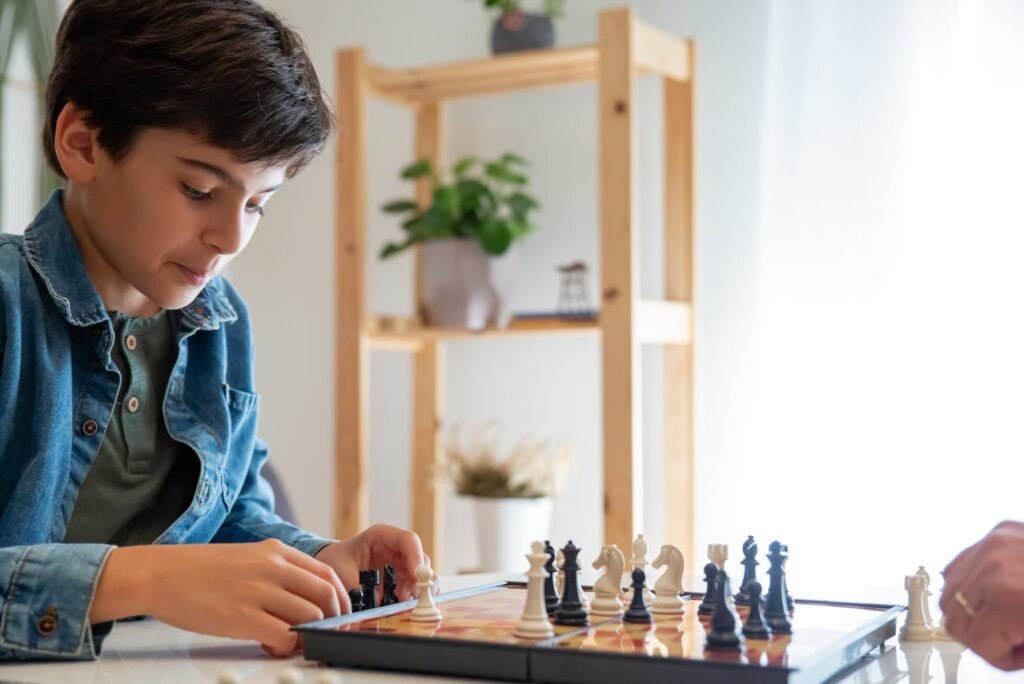
Yes, we teach openings, tactics, strategy, and endgames. But something else happens during our lessons — something deeper.
Students learn how to handle challenges. They learn how to pause and think instead of rushing. They learn how to believe in themselves, even when things don’t go their way.
That’s the hidden gift of chess. And when it’s taught the right way, it doesn’t just build better players. It builds stronger, calmer, more confident people.
And that’s what we care about most.
Conclusion: The Academy That Feels Like It Was Built Just for You
So here you are — looking for the best chess academy in Jersey City. You’ve seen the options. Some are good for quick exposure. Some focus on tournaments. Others work well if you just want to play for fun.
But if you’re looking for a place that teaches chess properly — patiently, personally, and with a proven path forward — then the answer is clear.
Debsie is not just the top academy in Jersey City. It’s the academy that puts you at the center.
We don’t hand out trophies for showing up. We don’t believe in shortcut tricks. We believe in teaching the game the right way — with simple words, smart structure, and full support every step of the way.
If you want your child to gain focus, think better, and grow in confidence…
If you’re an adult who wants to finally understand the game instead of guessing…
If you’re tired of group classes, random tips, and slow results…
Then take the first step today.
👉 Go to debsie.com
👉 Book your free consultation — no pressure, just guidance
👉 And let’s begin your journey — one move, one win, one lesson at a time

Abir Das is a educator, child learning specialist, and competitive chess player who brings a rare blend of technical knowledge, psychological insight, and practical chess experience to his work with young learners. With a diploma in child psychology, a B.Tech degree and a strong academic foundation in structured problem-solving, Abir understands how analytical thinking develops over time and how children can be guided to think more clearly, patiently, and confidently through chess.
Abir’s approach to education is shaped by his deep interest in child psychology and how young minds learn best. He believes chess should never feel like a collection of difficult rules or memorized moves. Instead, it should feel like an exciting journey into patterns, choices, creativity, discipline, and discovery. His lessons are designed to help children understand not only what move to play, but why that move makes sense.
As a competitive chess player with a rating of 1991, Abir has developed a strong practical understanding of the game through years of study, training, and tournament experience. He has competed in rated chess events, earned recognition for his strategic play, and achieved strong results in regional and state-level competitions. His accomplishments as a player give his teaching an authentic and trustworthy foundation because he understands the pressure, patience, and preparation required to perform well at the board.
Abir is especially skilled at helping children build confidence in chess. He has coached beginners who are just learning how the pieces move, intermediate students working on tactics and planning, and advanced young players preparing for competitive events. His teaching focuses on essential chess skills such as board vision, calculation, opening principles, endgame technique, pattern recognition, time management, and emotional control during games.
What makes Abir’s teaching style distinctive is his ability to connect chess improvement with personal growth. He sees every chess game as a lesson in decision-making. A missed tactic becomes a chance to improve focus. A lost game becomes an opportunity to build resilience. A difficult position becomes a practice ground for patience and creativity. Through this approach, Abir helps students grow not only as chess players, but also as thoughtful, disciplined, and independent learners.
Fluent in French (CEFR level C1), and having lived all across Europe, Abir also brings a global and culturally aware perspective to education. His ability to communicate across languages reflects his curiosity, adaptability, and commitment to connecting with learners from different backgrounds. This international outlook enriches his teaching and writing, allowing him to explain ideas in a clear, inclusive, and accessible way.
As an author at Debsie, Abir writes practical and engaging French, physics and chess education content for children, parents, and young learners. His writing simplifies complex concepts without making them shallow. Whether he is explaining Bernoulli’s principle, a tactical pattern, a checkmate idea, French genders in nouns or a chess planning principle, or the mindset needed for tournament play, Abir focuses on clarity, usefulness, and long-term learning.
Abir’s work is guided by the belief that chess can be one of the most powerful learning tools for children. It strengthens memory, concentration, logic, creativity, patience, and emotional maturity. More importantly, it teaches children how to think before acting, how to learn from mistakes, and how to approach challenges with confidence.
Outside of teaching and writing, Abir continues to study chess, follow international tournaments, analyze instructive games, and explore innovative methods for making physics, French, chess more enjoyable and meaningful for children. His mission is to help young players see chess not just as a game to be won, but as a lifelong skill that builds sharper minds, stronger character, and a deeper love for learning.
Other Comparisons of Best Chess Classes All Across The US: