Many chess games are lost early, not because a player is weak, but because they do not know what their first moves are trying to do. Chess opening variations can feel like a maze at first. One line says move the knight. Another says push a pawn. A third looks strange but is played by strong players. It can feel like too much.
Find the right learning experience
Tell us a little about the learner and what you are looking for. Our team will review your answers and help you identify the most suitable next step.
- Takes only a few minutes
- No payment required
- Personalised recommendations
Your information will only be used to respond to your enquiry.
Opening variations are not move lists, they are plans with names
A chess opening variation is a path inside an opening. Think of the opening as a road, and the variation as the lane you choose. For example, the Italian Game is one opening. But inside it, White and Black can choose many different plans.
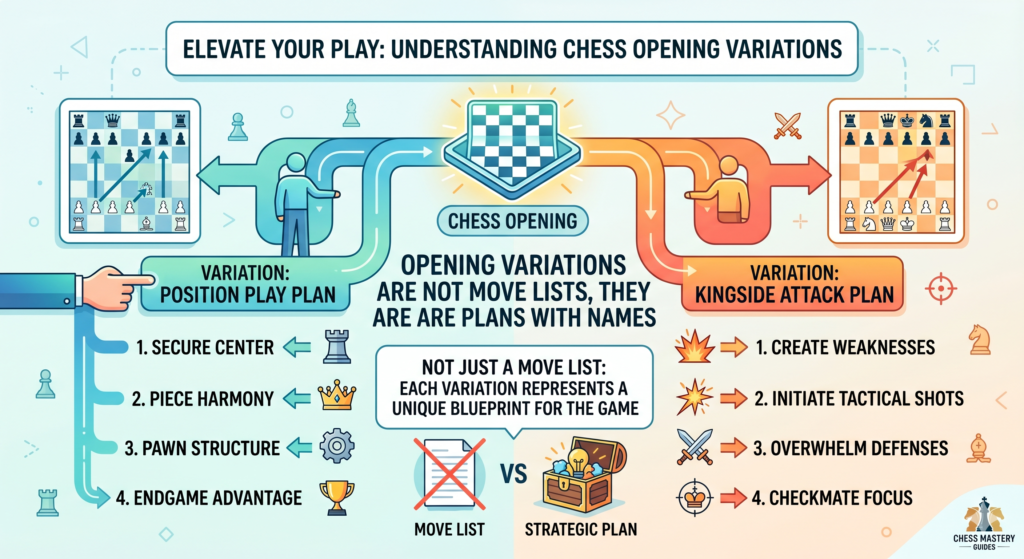
One player may build slowly. Another may attack fast. Another may trade pieces and play a calm game. These choices create variations.
This is why two games can both begin with the same first moves but feel very different after move five or move six. One small choice can change the whole mood of the game. A pawn move can open a file. A knight move can aim at a weak square.
A bishop move can put pressure on the king. The names may sound big, but the ideas are often simple when a good coach explains them.
At Debsie, we do not teach students to fear opening names. We help them see the idea behind each line. This makes chess feel less like a memory test and more like a smart thinking game. That is also why opening study helps kids beyond chess. They learn to ask, “What is my plan?” before they rush.
Find the right learning experience
Tell us a little about the learner and what you are looking for. Our team will review your answers and help you identify the most suitable next step.
- Takes only a few minutes
- No payment required
- Personalised recommendations
Your information will only be used to respond to your enquiry.
Opening variations help you choose the kind of game you want
Every player has a style. Some kids love fast attacks. Some enjoy quiet control. Some like traps. Some prefer safe moves and steady growth. Opening variations help a player choose a game that matches their strengths.
If a child likes active pieces, they may enjoy openings where knights and bishops come out quickly. If they like careful play, they may enjoy openings that build a strong pawn center first. If they like sharp games, they may enjoy lines where both sides attack early. The right variation can make a student feel more at home on the board.
This matters because confidence is a huge part of chess. When a child knows what kind of game they are entering, they sit taller, think better, and make calmer choices.
A simple way to understand the word variation
A variation is what happens after one side makes a choice that changes the plan. It does not have to be hard. If White plays one move, the game may become open and fast. If White plays another move, the game may become closed and slow. That is a variation.
The goal is not to learn every possible path. That would be too much and not very useful for most students. The goal is to learn the most common paths, understand the main idea, and know what to do when the other player makes a strange move.
This is where many young players improve fast with the right help. Instead of saying, “I forgot the move,” they learn to say, “I know the plan.” That one change can save many games.
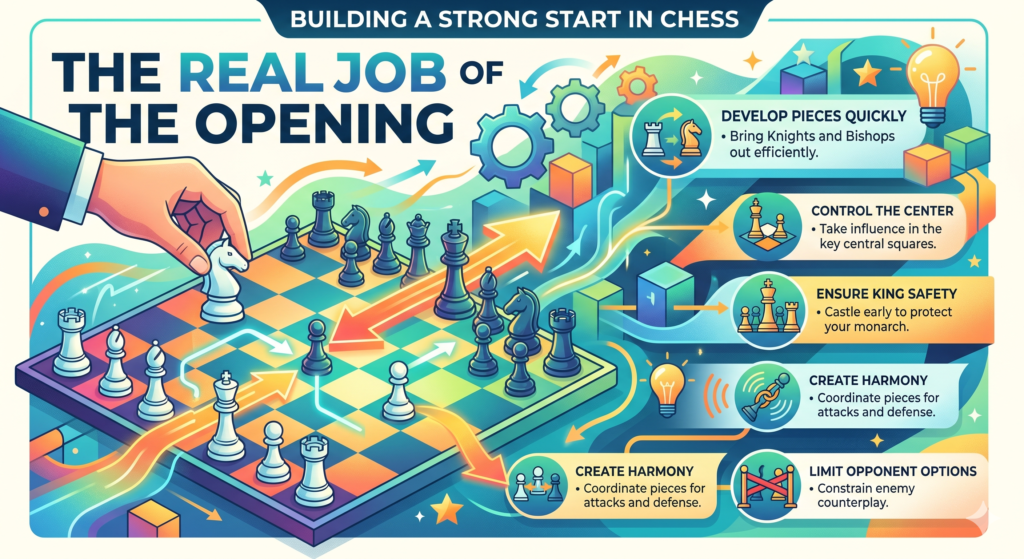
The real job of the opening is to build a strong start
The opening is not about winning the game in five moves. Sometimes that happens, but strong players do not count on it. The real job of the opening is to build a safe, active, and clear position. Your pieces should come out. Your king should become safe. Your center should be watched. Your moves should work together.
Many beginners make the mistake of moving the same piece again and again. They may bring the queen out too early. They may chase pawns and forget the king. They may make random attacks that look exciting but do not last.
A good opening variation protects a player from these mistakes because it gives the moves a reason.
When students learn openings the right way, they stop guessing. They begin to see that every move should help the whole team of pieces. This is one of the most valuable lessons in chess. It also teaches a life skill: small smart steps often beat one big rushed move.
The center is the heart of the opening
The center of the board is where most action begins. The center squares help pieces move faster and reach more places. When a player controls the center, their army has more room. When they ignore the center, their pieces can feel stuck.
This does not mean every player must put all pawns in the center at once. Some openings control the center with pawns. Others control it with pieces from a distance. Both can work. What matters is that the player understands how their opening variation handles the center.
For example, some openings say, “Take space now.” Others say, “Let the other side build a big center, then attack it later.” Both plans can be strong, but they need different moves. If a child mixes the plans without knowing why, the position can become weak.
The best opening moves help more than one thing
A strong opening move often does two or three jobs at the same time. It may bring out a piece, attack a square, protect the king, or prepare a future move. These useful moves are easy to love once a student sees their purpose.
This is why Debsie coaches often ask students simple questions during class. What does this move help? What square does this piece watch? What is your opponent trying to do? These questions train kids to think instead of copy.
A child who learns this skill becomes harder to trick. They do not fall for every early queen attack. They do not panic when the other player makes a move they have not seen before. They look at the board, find the idea, and make a sound choice.
The same opening can teach many different lessons
One reason chess openings are so rich is that the same opening can lead to many types of games. This is why opening variations matter. They are not just tiny changes. They can teach totally different skills.
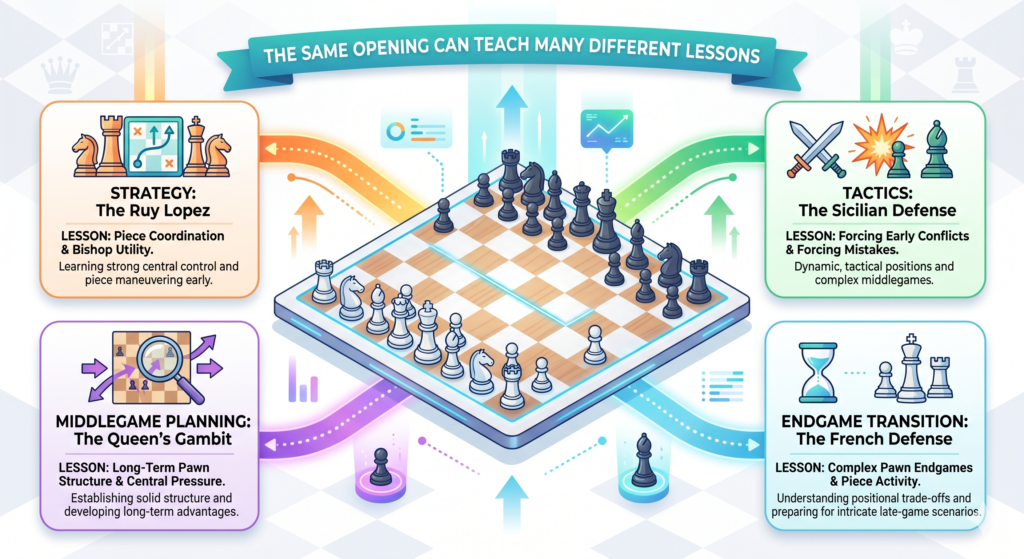
A calm variation may teach patience and piece placement. A sharp variation may teach calculation and courage. A closed variation may teach long-term planning. An open variation may teach quick development and king safety. When students try these different paths, they grow as complete players.
This is also why it is not wise to only learn traps. Traps can win quick games, especially against beginners, but they do not build deep skill by themselves. A good student learns the trap, but also learns what happens if the trap does not work. That is where real chess growth begins.
Italian Game variations help students learn natural development
The Italian Game is popular because the moves feel natural. White brings out a knight, then a bishop, and points toward Black’s weak f7 square. This makes it a great opening for students who are learning how to develop pieces with purpose.
But the Italian Game is not only one plan. White can play quietly and build a strong center. White can castle early. White can try a more direct attack. Black can answer with calm defense, quick counterplay, or active piece moves. Each choice creates a new lesson.
A student who learns the Italian Game well learns how to balance attack and safety. They learn that aiming at the king is good, but only when the rest of the position supports it.
A common Italian Game mistake is attacking before finishing development
Many young players see the bishop pointing at f7 and want to attack right away. That is natural. Attacking is fun. But if the attack is too early, it can fail. Then the attacking player may lose time, lose pieces, or leave their own king in danger.
This is why the Italian Game is such a good teaching tool. It shows students that pressure is powerful, but timing is everything. A good move played too early can become a bad move. A simple developing move can be stronger than a flashy check.
At Debsie, students learn to ask, “Is my attack ready?” That question helps them in chess and in life. It teaches patience, self-control, and better decision-making.
Sharp opening variations must be handled with care
Some opening variations are sharp. This means one mistake can change the game quickly. Sharp lines can be exciting, but they need clear thinking. Both players may attack. Pieces may be offered. The king may stay in the center for a little while. The board can feel wild.
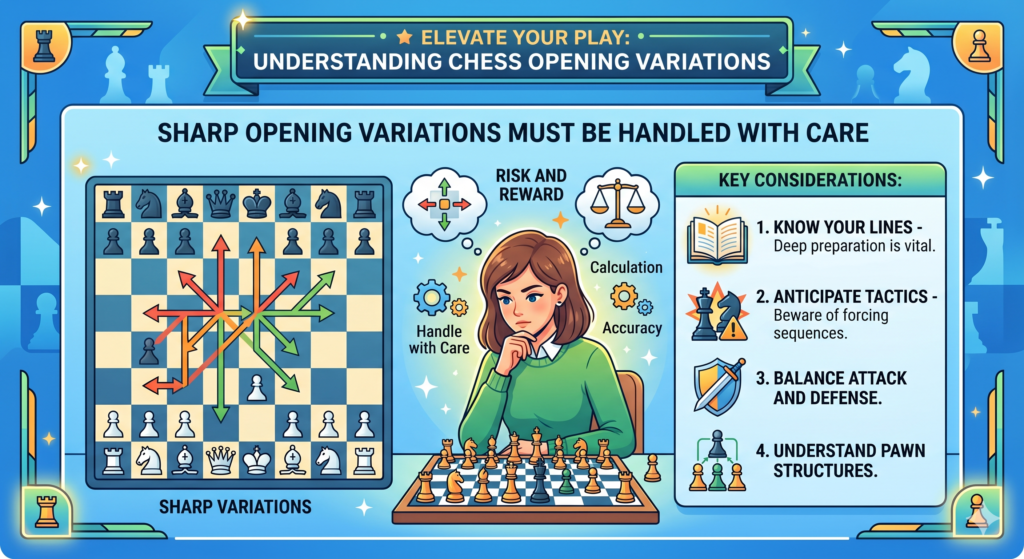
Sharp openings are not bad for kids. In fact, they can be very useful when taught well. They help students calculate, spot threats, and stay brave under pressure. But they should not be taught as magic tricks. A child must understand the reason behind the moves, or the sharp line can become a trap for the player using it.
The best way to study sharp openings is slowly. Students should look at the main threats, the common mistakes, and the safe choices. They should practice the position many times, not just read the moves once.
The Sicilian Defense shows how one move can change the fight
The Sicilian Defense begins when Black answers White’s king pawn move by playing a side pawn to challenge the center from the flank. It often leads to rich and fighting games. Many strong players love it because Black does not simply copy White. Black creates a different kind of battle.
Inside the Sicilian, there are many famous variations. Some are very sharp. Some are more solid. Some lead to opposite-side castling, where both players race to attack each other’s king. These games can be thrilling, but they also teach a clear lesson: when the position is sharp, every move needs a purpose.
For students, the Sicilian can be a great opening to study after they understand basic opening rules. It teaches active defense, counterattack, and courage.
A sharp opening still needs simple rules
Even in a sharp opening, the simple rules do not disappear. Develop pieces. Watch the center. Keep the king safe. Do not grab pawns without checking the danger. Do not attack with only one piece. These rules still matter.
The difference is that sharp openings punish careless play faster. If a student forgets one threat, the opponent may break through. This can feel scary at first, but it is also a great training ground. Kids learn to slow down, look for danger, and check forcing moves.
This is one reason Debsie’s live chess classes are so helpful. A coach can pause at the key moment and ask the student what both sides want. That moment of guided thinking can teach more than memorizing ten moves alone.
Quiet opening variations can be just as powerful as attacks
Some students think quiet openings are boring. That is not true. Quiet openings can be very strong because they build pressure step by step. Instead of trying to win at once, the player improves pieces, controls space, and waits for the right moment.
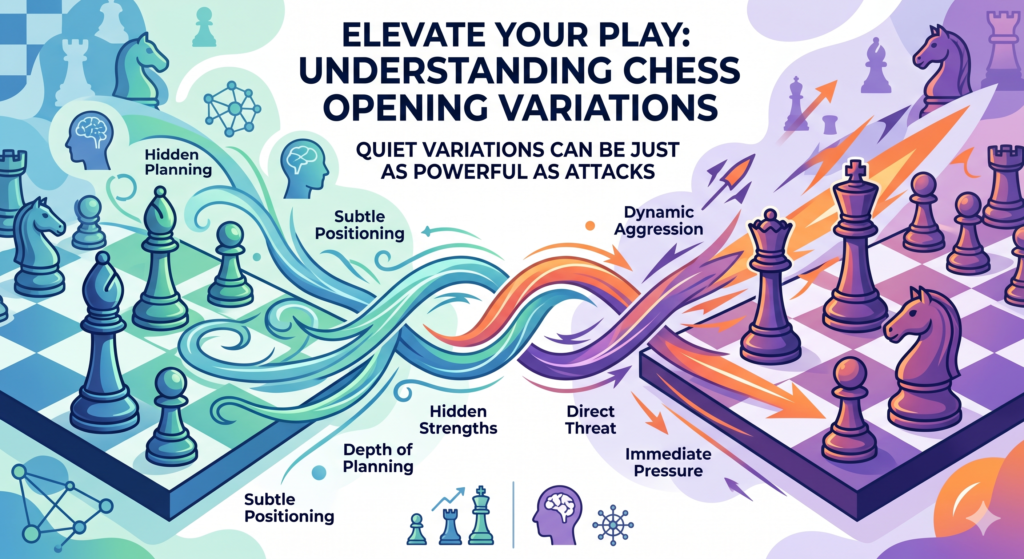
Quiet variations are wonderful for teaching patience. They show kids that not every good move is a check, capture, or threat. Sometimes the best move is a calm move that prepares something bigger. This is a hard lesson for many young players, but once they learn it, their chess becomes much stronger.
A quiet opening can also make the opponent uncomfortable. Some players know how to defend against quick attacks, but they struggle when pressure grows slowly. They make a small weakness. Then another. Then the quiet player finally opens the game at the perfect time.
Find the right learning experience
Tell us a little about the learner and what you are looking for. Our team will review your answers and help you identify the most suitable next step.
- Takes only a few minutes
- No payment required
- Personalised recommendations
Your information will only be used to respond to your enquiry.
The Queen’s Gambit teaches long-term pressure
The Queen’s Gambit is a classic opening where White offers a pawn to fight for the center. Even though it is called a gambit, many lines are not wild at all. They are based on space, development, and steady pressure.
This opening helps students understand that a pawn is not just a piece to grab. Pawns shape the board. They open lines. They create weak squares. They decide where pieces can go. When a child studies the Queen’s Gambit, they learn how small pawn choices can shape the whole game.
For many students, this is a big step. They stop thinking only about attacks and start thinking about structure. That is when their chess becomes more mature.
Quiet positions reward players who make useful moves
In quiet variations, there may not be an obvious attack. This can confuse beginners. They may ask, “What should I do now?” The answer is to improve the worst piece, protect key squares, prepare a pawn break, or stop the opponent’s plan.
This kind of thinking is powerful. It teaches kids not to depend on luck. They learn to create progress even when there is no quick win. That skill helps in school, sports, and daily life too. Good work is often built one calm step at a time.
Debsie coaches help students see these quiet ideas in a simple way. The goal is not to make chess feel heavy. The goal is to make the board feel clear. When a student can find a useful move in a quiet position, they gain real confidence.
The best opening variation for a student depends on their level
There is no single best opening for every child. A beginner needs openings that teach clear rules. An improving player may need openings that teach planning and pawn structure. A more advanced student may be ready for sharp theory and deeper choices.
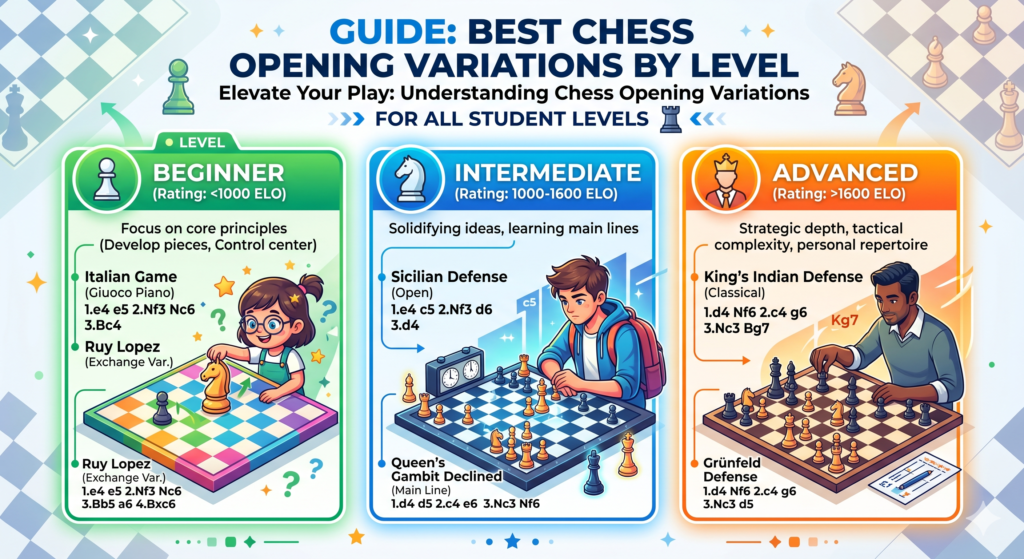
This is why copying a grandmaster’s opening is not always the best idea. A top player may choose a line because they understand many hidden ideas. A young student may copy the same moves but miss the reason behind them. Then the opening becomes empty memory.
A better path is to choose openings that match the student’s current skill and help them grow. The opening should feel challenging, but not confusing. It should give the student chances to practice good habits again and again.
Beginners should start with openings that follow clear rules
For beginners, the best openings usually bring pieces out quickly, fight for the center, and help the king castle safely. These openings teach the habits that every player needs. They also give students simple plans they can use even when the opponent plays something unexpected.
This does not mean beginners cannot learn named variations. They can. But the name should come after the idea. A student should first know why the knight moves, why the bishop comes out, why castling matters, and why the center is important.
When a child understands these basics, opening names become helpful labels. Without the basics, names become noise.
A student’s opening choice should build confidence, not fear
A child should not feel scared before the game even starts. If an opening has too many lines and the student feels lost, it may not be the right fit yet. Confidence matters. A student who knows three good plans clearly will often play better than a student who half-remembers twenty lines.
At Debsie, this is why personalized coaching matters. A coach can see how a child thinks, what they enjoy, and where they struggle. Then the coach can guide them toward openings that build both skill and belief.
Chess is not just about the moves on the board. It is about helping a child trust their own thinking. The right opening variation can do exactly that.
Memorizing opening moves without understanding is a risky habit
Many chess students start by trying to remember long opening lines. This feels useful at first because it gives them quick answers. But the problem comes when the opponent plays a move they have not seen before. The student freezes. They feel like the game has gone “out of book,” and now they do not know what to do.
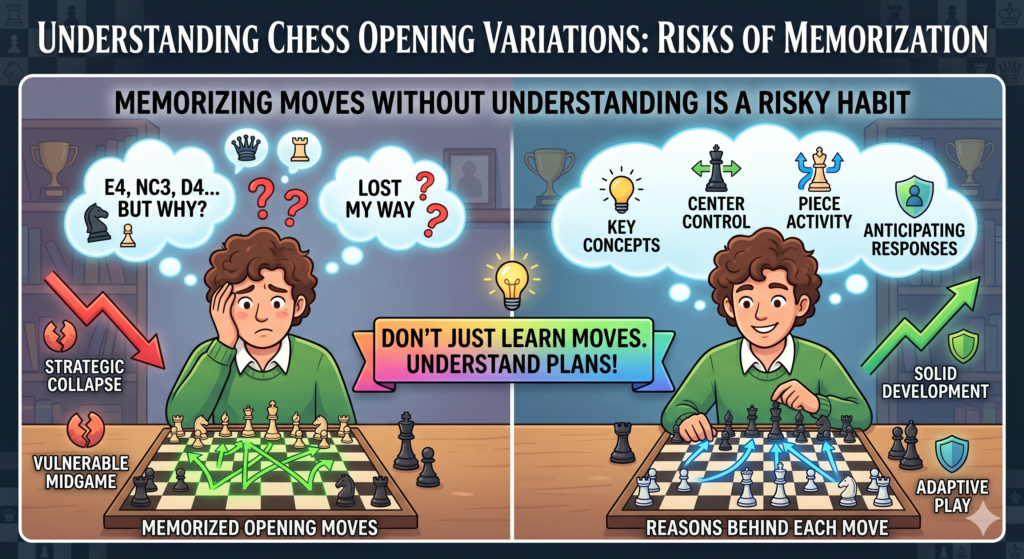
This is why opening study must begin with ideas, not memory. A student should know where the pieces belong, what pawn breaks may come later, which side of the board needs care, and what the opponent is trying to do. Memory can help, but it should never be the whole plan.
When kids learn openings this way, they become flexible. They do not panic when the game changes. They can still find good moves because they understand the shape of the position. That is a much stronger skill than simply remembering move six in one line.
A good opening student asks why before what
The most powerful word in opening study is “why.” Why did the knight go there? Why did the bishop move to that square? Why did Black push that pawn now? Why did White castle before attacking? These questions turn a move list into a living plan.
Once a child starts asking why, they begin to think like a real chess player. They stop playing moves because “the book says so” and start playing moves because the board asks for them. This is a major step in chess growth.
At Debsie, coaches guide students with simple questions during live classes. This helps the student find the answer instead of just hearing it. That style builds true confidence because the child learns to trust their own thinking.
The best test of opening knowledge is a strange move
If a student only knows a memorized line, a strange move can cause trouble. But if the student understands the opening, a strange move may become a chance. Many odd moves have a hidden weakness. Maybe the opponent forgot the center. Maybe they moved the same piece twice. Maybe they brought the queen out too early.
A well-trained student can notice these clues. They do not need to punish the mistake right away with a fancy tactic. Sometimes the best answer is simple development, safe castling, and steady control. This is how strong players win against poor opening play.
Parents often love seeing this change. A child who once rushed now pauses, checks the board, and chooses with care. That is not just better chess. That is better thinking.
A smart opening file should be small, clear, and useful
Some players think they need a huge opening file with many deep lines. For most students, that is not true. A smaller opening file, built well, is far more useful. It should show the main moves, the main plans, the common mistakes, and the type of middle game that may appear.

An opening file should not feel like a school textbook full of dry facts. It should feel like a map. When the student looks at it, they should understand where the game may go and what kind of ideas they should remember.
The goal is not to cover everything. The goal is to cover the things that happen most often in real games. A child who knows the common paths well will get more value than a child who has studied rare lines they may never see.
Students should connect each opening to a middle game plan
The opening does not end in a vacuum. Every opening leads into a middle game. This is where many students struggle. They may know the first few moves, but once the pieces are developed, they do not know what to do next.
That is why every opening variation should be studied with a simple middle game plan. In some positions, the plan may be to attack the king. In others, it may be to push a center pawn. In some lines, the player may need to trade a bad bishop or place a knight on a strong square.
When students know this next step, their games feel smoother. They are not just surviving the opening. They are using the opening to enter a position they understand.
A useful opening note explains the idea in plain words
Opening notes should be easy to read. A good note may say that the knight goes to a certain square because it attacks the center and helps the king castle. Another note may say that a pawn push opens a line for the rook. These plain words are often better than long technical comments.
This is especially important for kids. If the notes are too hard, they will not use them. If the notes are clear, they can review quickly and remember the ideas during games.
At Debsie, the focus is always on making chess clear. When children understand the plan in simple words, they enjoy learning more. They feel progress, and that keeps them excited.
The best opening variations help students avoid early traps
Opening traps are part of chess. Some are famous. Some are simple. Some happen again and again in beginner games. Learning about traps is useful, but not because students should depend on them. The real value is learning how traps work.
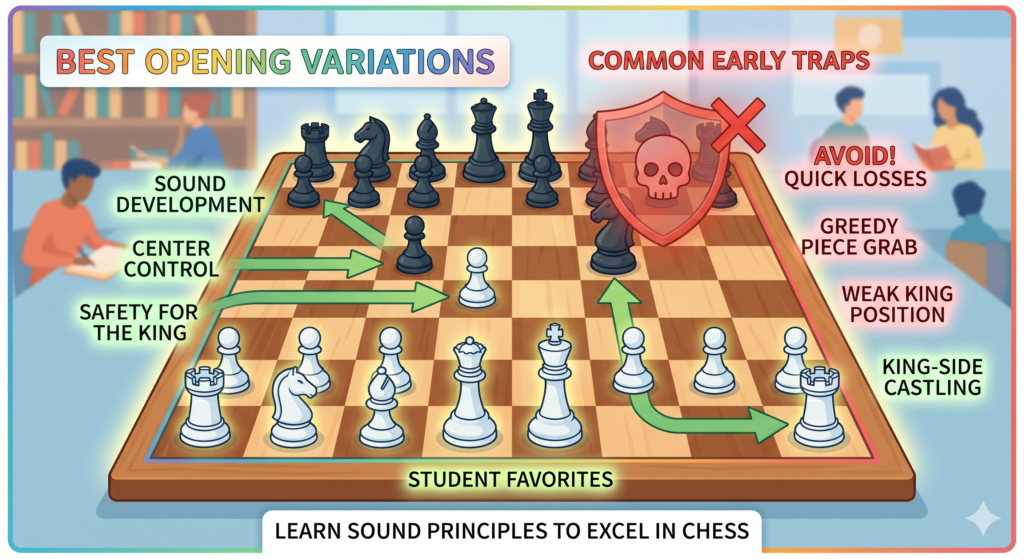
Most traps are built on common mistakes. A player ignores development. A king stays in the center. A queen grabs a pawn. A piece moves too many times. A defender gets removed. Once students see these patterns, they become safer and sharper.
This type of study is exciting for kids because traps feel like puzzles. But a good coach also shows the lesson behind the trap. That way, the student learns both how to win chances and how to avoid danger.
Traps teach students to respect threats
One of the biggest beginner mistakes is only looking at your own plan. A student may think, “I want to attack,” but forget to ask, “What does my opponent want?” Opening traps punish that kind of one-sided thinking.
When a child studies traps correctly, they learn to check both sides of the board. They notice checks, captures, and threats. They learn that every move changes something. This helps them stay calm and alert.
This skill is also useful outside chess. Kids learn not to rush into choices without looking at what may happen next. They become better at spotting problems before those problems grow.
The safest way to beat traps is to follow sound opening rules
Many traps fail when the defender follows simple rules. Bring pieces out. Keep the king safe. Do not chase free pawns too early. Watch weak squares. Ask what changed after the opponent’s move.
This is why students should not fear traps. They should respect them, study them, and learn from them. Fear makes a player freeze. Understanding makes a player strong.
Debsie’s guided lessons help students see traps in a healthy way. The aim is not to scare them with danger. The aim is to help them feel ready. When a child knows what to watch for, chess becomes more fun and less stressful.
Opening choices should match tournament goals
A casual game and a tournament game can feel very different. In a casual game, a student may try a new line just for fun. In a tournament, they may need an opening they trust. This is why opening choices should match the goal of the game.
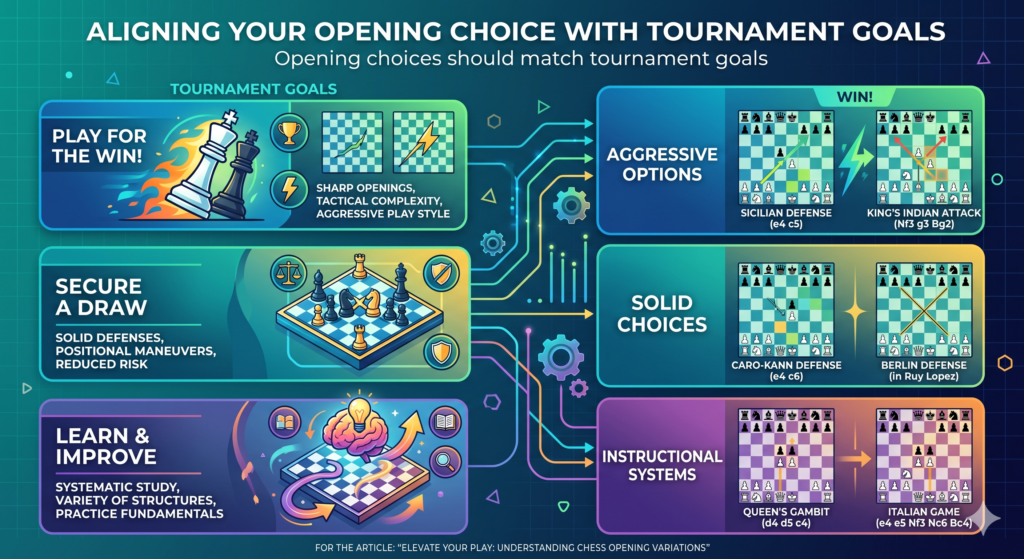
Before a tournament, it is often better to use openings the student knows well. Trying a brand-new opening in an important game can create stress. The student may spend too much energy remembering moves and not enough energy reading the board.
A strong tournament opening plan gives the student comfort. They know the first ideas. They know the common replies. They know the type of middle game that may come. That comfort helps them use their time better and think with more confidence.
A simple tournament opening plan can be very powerful
For young players, a tournament opening plan does not need to be huge. It can be one clear opening with White and one clear answer against White’s most common first moves. The student should know the main idea, the safe setup, and the common traps.
This kind of plan reduces stress. The child does not sit at the board wondering what to play on move one. They begin with a plan they have practiced. This gives them a better chance to play calmly.
Parents often see that calmness as a big win. Even when the child loses a game, they learn how to prepare, focus, and improve. Those lessons matter deeply.
Practice games make opening knowledge real
Reading an opening is not enough. Watching a video is not enough. A student must play the opening many times to feel it. Practice games help the student see what opponents actually do. They also show which parts of the opening still feel unclear.
After each practice game, the student should review the early moves. The question is not only, “Was this move right?” The better question is, “Did I understand what I was trying to do?” That simple review can lead to fast growth.
This is why Debsie includes live interactive learning and tournament-style play. Students need both teaching and practice. They need a place to test ideas, make mistakes safely, and come back stronger.
Strong players prepare for what their opponents want
Opening preparation is not only about your own moves. It is also about the other player’s plan. Every opening variation has ideas for both sides. If a student only knows their own plan, they may walk into the opponent’s best setup without noticing.
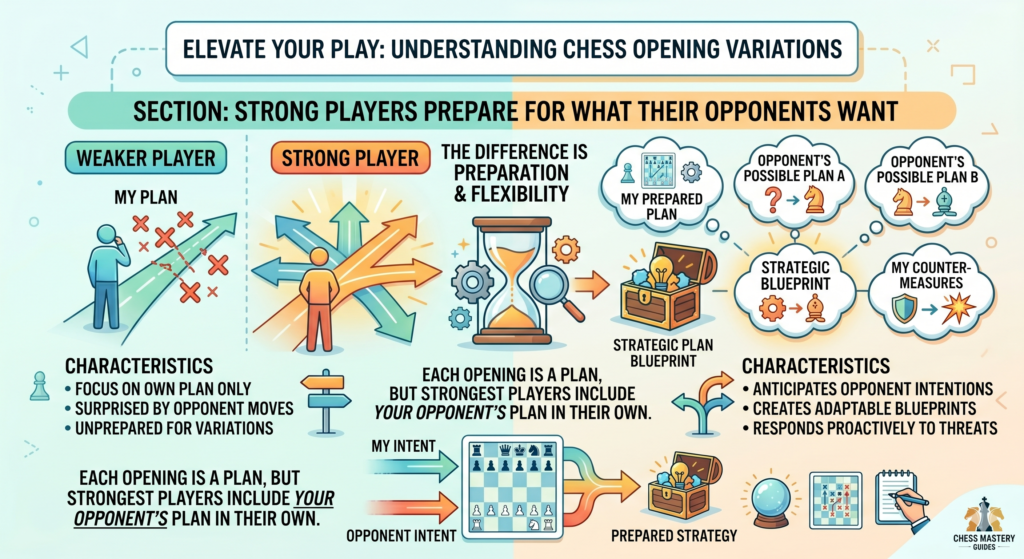
For example, one side may want to open the center. The other may want to keep it closed. One player may want to attack on the kingside. The other may want counterplay on the queenside. These battles begin early, often in the opening.
When kids learn to think this way, their chess becomes much deeper. They stop asking only, “What do I want?” They also ask, “What does my opponent want, and how can I make it harder?”
Good defense starts before the attack begins
Many students think defense starts when they are already under attack. Strong players know defense starts much earlier. A quiet move in the opening can stop a future threat. A good castle choice can keep the king away from danger. A smart pawn move can block an attacking plan before it grows.
This does not mean students should play scared. It means they should play aware. There is a big difference. A scared player only reacts. An aware player sees danger and keeps building their own plan.
This kind of thinking is one reason chess is so good for children. It teaches them to plan ahead while staying calm in the present.
The opponent’s best move is part of your plan
A helpful habit is to ask, “What would I play if I were my opponent?” This one question can save many games. It helps students find hidden threats and respect the other side’s chances.
In opening study, this habit is very important. A move may look good until you see the opponent’s reply. Then it may become clear that your piece is loose, your king is unsafe, or your center is weak.
Debsie coaches train this habit through guided questions and real game review. Over time, students become less surprised by the opponent’s ideas. They begin to feel more in control, even in hard games.
Your opening should help you become the player you want to be
An opening is not just a set of first moves. It is a training path. If a student keeps playing open games, they will learn fast development and tactics. If they play closed games, they will learn planning and patience. If they play gambits, they will learn activity and courage. If they play solid openings, they will learn control and safety.
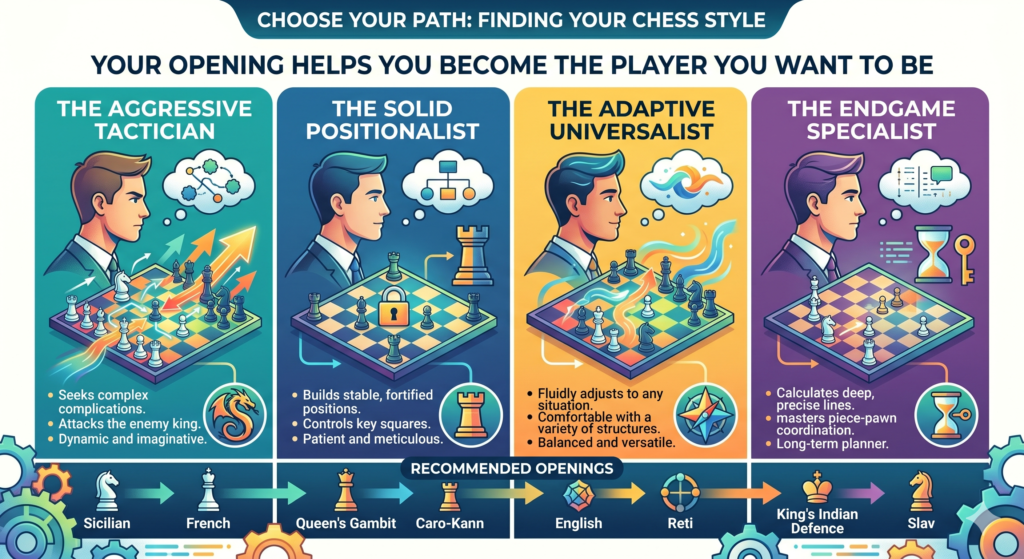
This means the opening you choose shapes the skills you build. That is why opening study should be personal. A shy student may gain confidence from active openings. A fast-moving student may grow from quiet openings that teach patience. A tactical student may need strategic positions to become more balanced.
The best opening is not always the one with the best engine score. For a growing student, the best opening is the one that teaches the right lessons at the right time.
Chess growth is easier with a coach who knows the child
Every child learns differently. Some need visual examples. Some need many practice games. Some need slow review. Some need a challenge to stay excited. This is why personal guidance can make a huge difference in opening study.
A coach can see what a child misses. They can explain the same idea in a new way. They can choose openings that fit the student’s goals. They can also help the child stay encouraged when learning feels hard.
At Debsie, students are not treated like they all need the same path. The goal is to help each child grow in chess and in life skills like focus, patience, planning, and smart choice-making.
A strong opening gives a child a strong start
When a child knows their opening plan, the game starts with less fear. They know where the pieces should go. They understand the first fight. They can use their clock better. Most of all, they feel ready.
That feeling matters. Confidence helps children think clearly. It helps them recover after mistakes. It helps them enjoy the game instead of feeling lost.
If you want your child to learn chess in a warm, clear, and guided way, Debsie is a great place to begin. You can book a free trial class here and let your child experience expert-led chess learning for themselves: https://debsie.com/take-a-free-chess-trial-class/
Opening variations become easier when students learn common pawn shapes
A pawn shape is the way the pawns stand on the board. It may not look exciting at first, but it often tells you what kind of game you are playing. Pawns decide where pieces can move. Pawns decide which files may open.
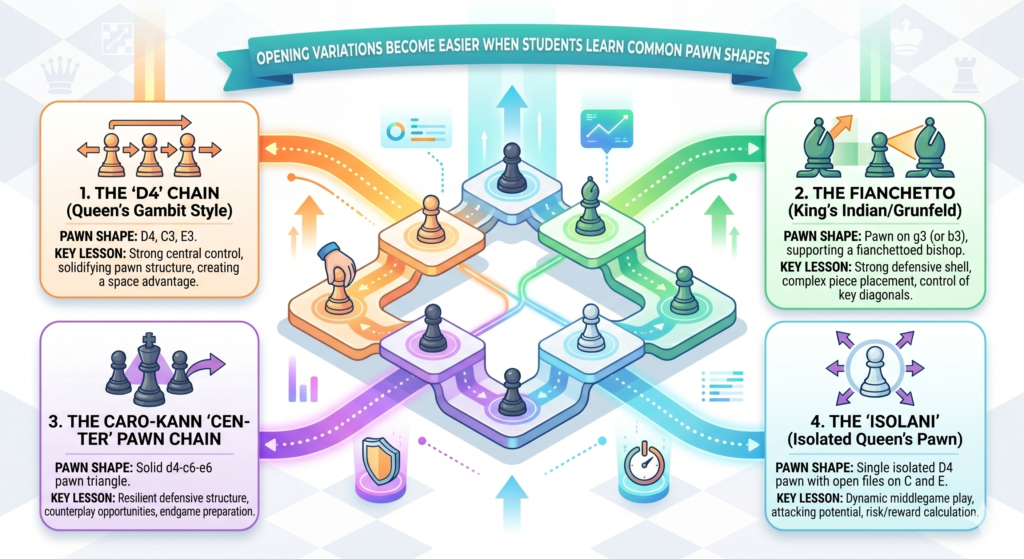
Pawns decide which squares are weak. That is why strong players do not only study moves. They study shapes.
When students understand pawn shapes, opening variations become much less confusing. They can look at the board and say, “This position needs a center break,” or “My knight has a good square,” or “I should not trade this bishop yet.” This is a big step because the student is no longer just following a line. They are reading the board.
This skill is also very useful when the opponent plays something strange. The exact move order may change, but the pawn shape often gives clues. A good shape can guide the student back to a clear plan.
Pawn shapes show where your pieces belong
Pieces and pawns work together. A bishop may become strong because a pawn opens its path. A knight may become strong because pawns protect its square. A rook may become useful because a pawn trade opens a file. If the student only thinks about pieces and ignores pawns, they may miss the real story of the position.
For example, in many queen pawn openings, the center can stay closed for a while. In these games, knights often look for strong posts, bishops need smart paths, and pawn breaks become very important. In open king pawn games, the pieces may come out faster, and the king can become a target sooner.
This is why one opening variation may feel calm while another feels sharp, even if both started from common first moves. The pawn shape changed the game.
A simple pawn question can improve many opening decisions
A very helpful question is, “What pawn break does my position need?” A pawn break is a pawn move that challenges the other side’s pawn chain or opens lines for your pieces. The name sounds a little technical, but the idea is simple. You use a pawn to change the board at the right time.
This is important because many students develop all their pieces and then feel stuck. They do not know how to start real play. A good pawn break can solve that problem. It can open a file for a rook, free a bishop, or challenge the opponent’s center.
At Debsie, coaches help students understand these ideas with real board examples. When a child sees how one pawn move can wake up the whole army, chess becomes more exciting and easier to understand.
A good opening variation should help your worst piece improve
Many young players only look at their best piece. They see a bishop on a strong diagonal or a queen near the enemy king, and they want to attack right away. But strong players often ask a different question. They ask, “Which piece is doing the least?”
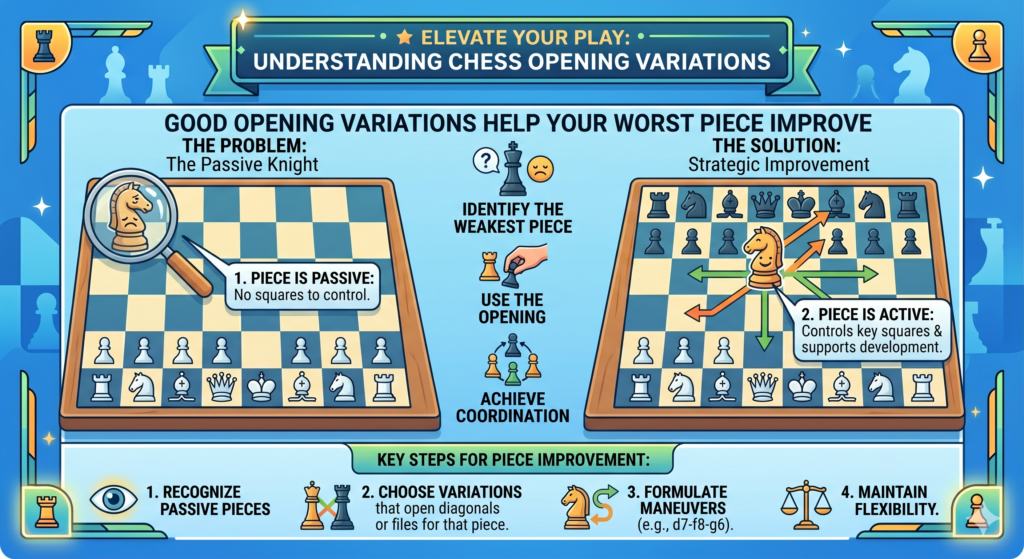
This question is powerful in the opening because the first phase of the game is about getting the full army ready. If one piece is left sleeping at home, an attack may fail. If one bishop is blocked forever, the player may struggle later. If a rook has no open file, it may not help when the fight begins.
Opening variations teach students how to solve these problems early. A good variation does not just create threats. It gives pieces useful homes.
The worst piece often tells you the best plan
When a student is not sure what to do after the opening, looking for the worst piece is one of the clearest ways forward. Maybe the knight needs a better square. Maybe the bishop needs a pawn move to open its path. Maybe the rook should move to a file where trades may happen.
This habit keeps a student from making random moves. It gives them a clear task. Improve the piece that is not helping. Once every piece has a job, the position becomes easier to play.
This is also a great life lesson for kids. Progress often comes from fixing the weakest part, not showing off the strongest part. Chess teaches that in a way children can see and feel.
Strong openings make teamwork clear
In chess, one piece alone rarely wins against good play. A strong attack usually needs many pieces working together. A strong defense also needs teamwork. The opening is where that teamwork begins.
If a student learns an opening variation as a team plan, their play becomes much stronger. The knight is not just moving because the book says so. It is helping the bishop. The bishop is not just coming out because development is good. It is adding pressure. The rook is not just castled into place. It may soon use an open file.
Debsie’s lessons focus on this kind of clear thinking. Students learn that every piece should have a role. That makes the game feel less random and much more fun.
Transpositions can make openings feel confusing, but they can also make students smarter
A transposition happens when a game reaches the same position through a different move order. This can confuse students because they may think they are playing one opening, and then the board turns into another opening. But once they understand the idea, transpositions become less scary.
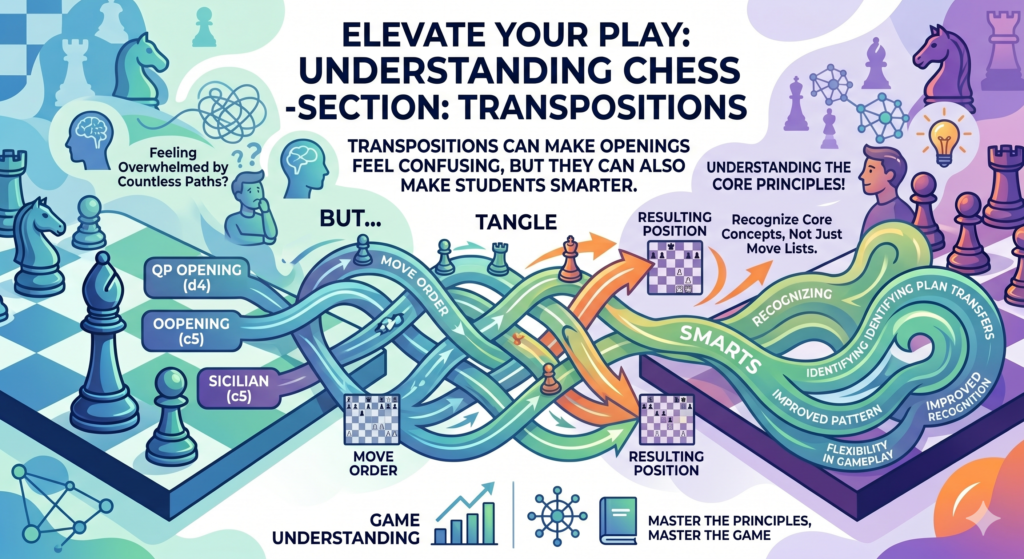
For example, two players may start with one move order and later reach a position that is known from a different opening. The name is not the most important thing. The position is. If the student understands the pawn shape, piece placement, and plan, they can play well even if the move order was new.
This is why opening learning should never be only about memorizing the first moves. Move orders can change. Opponents can mix systems. But clear plans stay useful.
Transpositions reward students who understand ideas
When a student understands ideas, they can handle move order changes better. They may notice that the center structure is familiar. They may see that the same bishop belongs on the same square. They may know the same pawn break is coming later.
This makes the student feel more stable during the game. Instead of thinking, “I am lost,” they can think, “I know this type of position.” That shift is huge. It lowers fear and raises confidence.
Many children become much calmer players when they learn this. They stop treating every unusual move as a disaster. They start looking for familiar patterns.
The board matters more than the opening name
Opening names are useful, but they are not magic. A student can know the name of a variation and still play it badly. Another student may forget the name but understand the position and play strong moves.
The board always tells the truth. Where are the kings? Which pieces are active? Which pawns are weak? Which side has more space? Which files may open? These questions matter more than saying the perfect opening name.
This is one reason guided coaching is so valuable. A coach can help a child move beyond labels and into real understanding. At Debsie, students learn to read positions in simple words, so they can play with confidence even when the game takes an unexpected path.
Time control changes how deeply students should use opening variations
A five-minute game and a long tournament game are not the same. In a fast game, students need openings that are easy to play and hard to forget. In a longer game, they can choose deeper variations because they have more time to think.
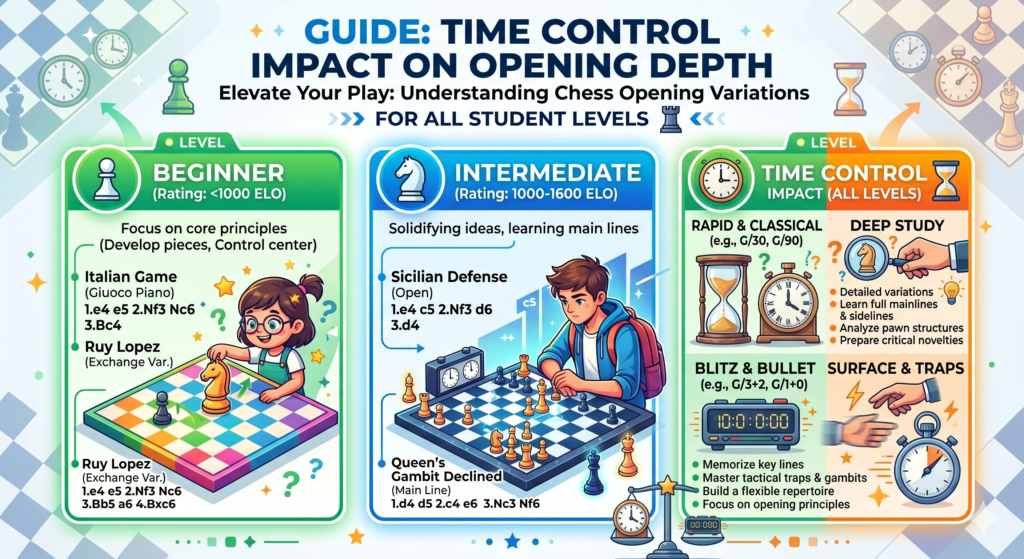
This does not mean fast games should be careless. It means the opening plan should fit the clock. If a child plays a very sharp line in a fast game but does not know the key ideas well, they may lose quickly. If they play a simple and sound setup, they may reach a playable middle game with enough time left.
In longer games, students can use more detailed opening knowledge. They can pause, compare moves, and choose a plan with care. This is where deeper opening preparation can shine.
Fast games need simple and trusted plans
In fast chess, the student should not spend too much time trying to remember rare lines. A simple trusted opening can be a big advantage. It helps the student move with confidence while still following sound rules.
The best fast-game openings for students are not always the trickiest ones. They are often the ones where the plans are clear. Develop pieces. Castle. Fight for the center. Watch the opponent’s threats. Reach a middle game you understand.
This kind of opening choice helps children avoid panic. They can save their time for the moments that truly need deep thought.
Longer games are better for learning deep variations
Longer games give students time to think about why a move works. They can study the position during the game, not just react. This makes longer games very good for learning opening variations.
After a longer game, review becomes even more useful. The student can look back and ask where the opening plan worked, where it became unclear, and what middle game idea they missed. One well-reviewed long game can teach more than many rushed games.
Debsie’s coaching style helps students get value from both fast practice and careful review. The aim is not only to play more games. The aim is to learn from each game, so the next one is stronger.
Opening study should include model games, not just move lines
A model game is a full game that shows the main ideas of an opening. It is one of the best ways to learn a variation because students see what happens after the opening ends. They see the middle game plan. They see how the attack grows. They see how the endgame may look.
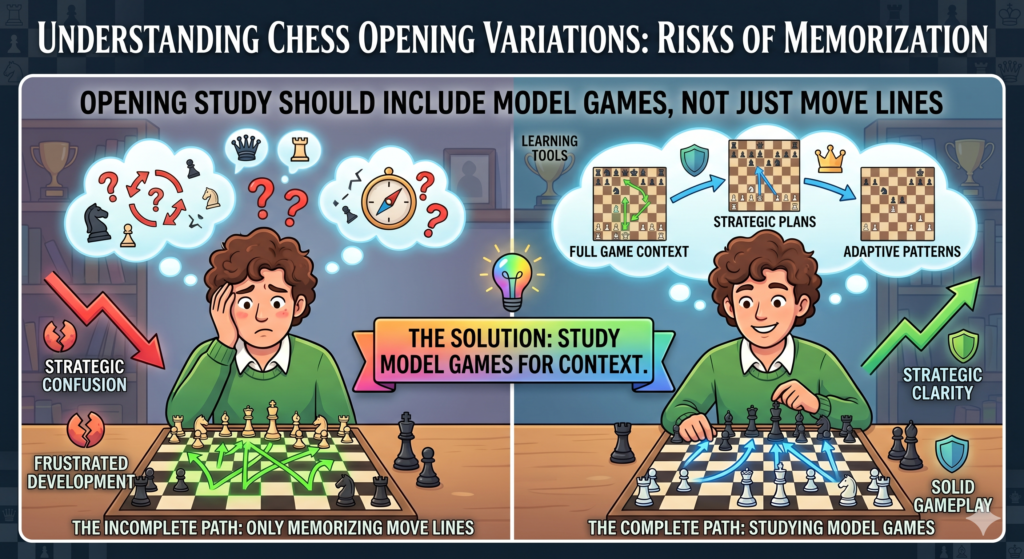
This is much better than only memorizing the first eight or ten moves. A move line tells you where to go at the start. A model game shows you why that path matters. It gives the student a full story.
When students study model games, they also learn patterns. They begin to notice common sacrifices, common pawn breaks, common piece moves, and common mistakes. These patterns help them play faster and smarter in their own games.
Model games turn opening ideas into real pictures
Children often learn best when they can see the idea in action. A coach may say, “This bishop is strong,” but the idea becomes clearer when the student sees that bishop create pressure for many moves. A coach may say, “Castle before attacking,” but the lesson becomes stronger when the student sees an early attack fail because the king was unsafe.
Model games make the lesson real. They show cause and effect. The student sees how one opening choice leads to a plan, and how that plan leads to chances.
This is also more engaging. A full game feels like a story with a beginning, middle, and end. That keeps students curious.
One model game can teach many small lessons
A good model game may teach development, timing, king safety, pawn breaks, piece trades, and attack all at once. The student does not need to master everything in one sitting. They can return to the same game later and see new ideas each time.
This is how chess knowledge grows. The first time, the student may notice the attack. The next time, they may notice the pawn structure. Later, they may understand why one trade was important. Strong learning often happens in layers.
At Debsie, coaches make these layers simple and friendly. The child is not pushed to understand everything at once. They are guided step by step, so learning feels exciting instead of heavy.
Reviewing your own games is the fastest way to fix opening mistakes
The best opening lessons often come from the student’s own games. This is because the mistakes are real. The confusion is real. The choices came from the student’s own thinking. When a coach reviews those moments, the lesson becomes personal and easy to remember.

A student may learn that they keep moving the queen too early. Another may see that they forget to castle. Another may notice they start attacks before finishing development. These patterns are hard to fix if no one points them out. But once the student sees them clearly, improvement can happen fast.
This is why game review is so important. Playing games gives experience. Reviewing games turns that experience into growth.
Opening mistakes usually have simple causes
Most opening mistakes are not random. They often come from simple habits. The student may rush. They may look only at their own threat. They may forget the center. They may copy a move without knowing why it works.
The good news is that simple causes can be fixed with simple training. A coach can help the student build a short thinking routine. Check the opponent’s threat. Improve a piece. Keep the king safe. Ask what the center needs.
Over time, these small habits become natural. The student starts making better opening choices without needing to force it.
A reviewed mistake is not a failure, it is a lesson
Children need to know that mistakes are part of learning chess. A bad opening does not mean they are bad at chess. It means there is a lesson waiting. When students feel safe to make mistakes and review them, they grow much faster.
This is one of the biggest strengths of a warm learning space like Debsie. Coaches help students improve without making them feel small. They show the mistake, explain the better plan, and help the child try again with confidence.
That kind of support can change how a child sees learning. They become more willing to try, think, and improve. In chess and in life, that mindset is priceless.
A strong opening repertoire should feel like a small home, not a giant library
A chess repertoire is the set of openings a player uses again and again. Many students think a strong repertoire must be huge. They believe they need one answer for every possible move and many deep lines for each opening. This can make chess feel heavy. It can also make students feel like they are always behind.
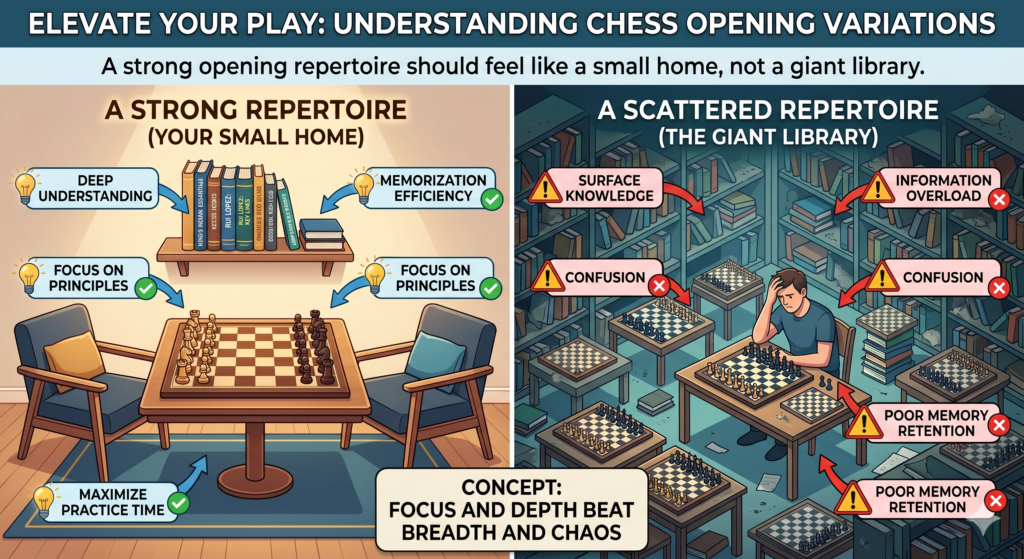
A better way is to build a small opening home. This means the student has a few trusted openings that feel familiar. They know the main plans. They know where the pieces usually go. They know which mistakes to avoid. They also know what kind of middle game they are trying to reach.
This kind of repertoire gives comfort. It helps the student begin games with a calm mind. Instead of thinking, “I hope I remember everything,” they can think, “I know this type of position.” That is a much better place to start.
A smaller repertoire gives students more time to grow
When a child studies too many openings at once, the learning can become thin. They may know a little about many lines but not enough to play any of them well. This can lead to confusion during games because every position feels half-known.
A smaller repertoire lets the student go deeper. They can play the same opening many times and notice new ideas each time. They can review their mistakes and fix them. They can learn the common plans until those plans feel natural.
This is how real skill grows. Not by jumping from opening to opening every week, but by building trust with a few good systems. Once those systems are strong, the student can add more choices later.
The best repertoire grows with the student
A good opening repertoire should not stay frozen forever. It should grow as the student grows. A beginner may start with simple open games. Later, they may add a queen pawn opening, a sharper defense, or a more patient setup. Each new opening should teach a useful lesson.
This keeps chess fresh without making it messy. The student gets new challenges at the right time. They do not feel bored, but they also do not feel buried under too much information.
At Debsie, coaches help students build openings step by step. The goal is not to give children a giant list. The goal is to help them build a clear path that matches their level, style, and goals. That kind of plan makes learning smoother and much more fun.
White and Black need different opening mindsets
Playing with White and playing with Black are not exactly the same. White moves first, so White often gets the first chance to shape the game. Black moves second, so Black must answer White’s idea while also building a plan. Both sides can play for a win, but they do it in different ways.
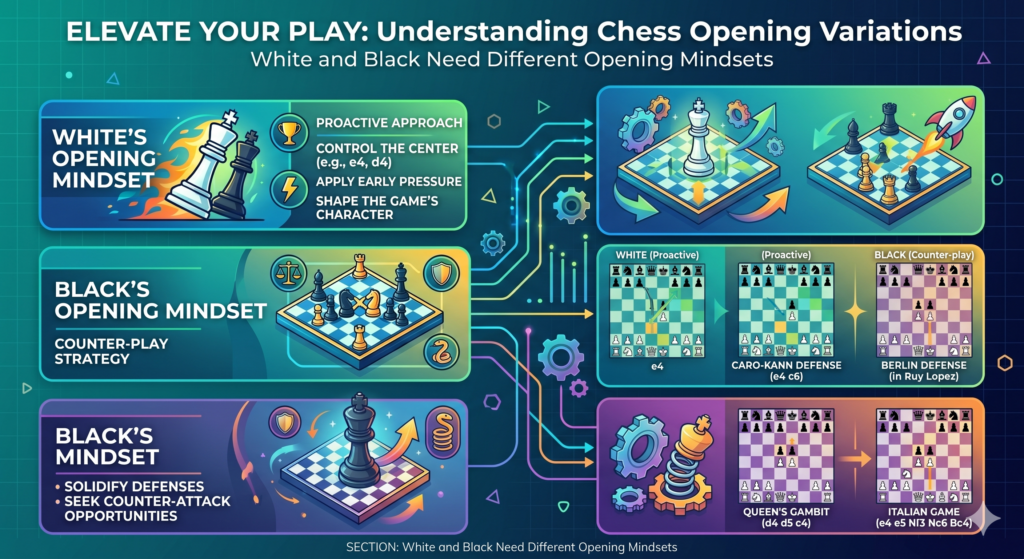
With White, students often learn how to take space, develop quickly, and ask Black a question. With Black, students learn how to stay calm, fight back, and choose the right moment to challenge the center. This difference is important because a child should not use the same thinking for every game.
When students understand the mindset for each color, they become more complete players. They learn how to lead when they have the first move and how to respond wisely when the other player starts the battle.
White should not waste the first move advantage
The first move is useful, but it is not a free win. White still needs to play with care. If White moves the same piece many times, brings the queen out too early, or ignores development, Black can become equal or even better very quickly.
A good opening variation for White should create healthy pressure. It should help pieces come out with purpose. It should make Black solve small problems. The pressure does not need to be wild. Even quiet pressure can be strong if it keeps growing.
For students, this teaches a key lesson. Starting first is a chance, not a guarantee. You still have to make good choices. This is a lesson children can carry into school, sports, and life.
Black should aim for active and safe counterplay
Some young players think Black should only defend. That is not true. Black should be safe, but Black should also look for counterplay. Counterplay means making your own threats and creating your own chances.
A strong Black opening does not just wait. It develops pieces, fights for the center, and gets ready to challenge White’s plan. Sometimes Black strikes in the center. Sometimes Black attacks on the side. Sometimes Black trades the right pieces and reaches a comfortable game.
This is where coaching can help a lot. Many children either play too passively with Black or fight too soon without enough support. Debsie coaches help students find the right balance, so they feel confident no matter which color they have.
Conclusion
Chess opening variations are not just first moves to memorize. They are road maps that help students start with a plan, stay calm, and build strong thinking habits. When children understand why pieces move, where pawns belong, and what both sides want, they play with more confidence and joy.
The right opening can teach focus, patience, courage, and smart choices far beyond the chessboard. At Debsie, students learn these ideas step by step with caring coaches and real practice. Start your child’s journey with a free trial class here: https://debsie.com/take-a-free-chess-trial-class/
Adhip Ray is the founder of Debsie, an online learning platform focused on chess and skill-based learning for children. His work at Debsie brings together chess education, structured thinking, problem-solving, and interactive learning for young students.
Adhip has an academic background in law, statistics, analytics, and technology. He is from Amity Law School and the Indian Statistical Institute, Kolkata, with formal training that connects legal reasoning, data analytics, quantitative thinking, and structured problem-solving. This interdisciplinary background is reflected in Debsie’s focus on building sharper thinking skills in children through chess and related learning programs.
Adhip is also a FIDE-rated chess player from India. He holds FIDE ID 5055954 and has a standard FIDE rating of 1832. His FIDE profile records him as an Indian player with a long rating history in standard chess, including rated games from his competitive playing years. His chess background gives Debsie a founder-led connection to the game, not only as an educational activity but also as a competitive discipline that develops concentration, calculation, planning, and decision-making.
In addition to chess, Adhip has a strong interest in coding, data, and technical problem-solving.
Adhip’s profile combines chess, law, data analytics, and programming. At Debsie, this background supports the creation of learning experiences that are logical, structured, and skill-oriented. The platform’s chess-focused programs are connected to broader cognitive skills such as pattern recognition, patience, strategic planning, focus, and problem-solving.
As founder of Debsie, Adhip brings together experience from multiple fields: formal legal education from Amity Law School, analytical training from the Indian Statistical Institute, Kolkata, competitive chess experience through his FIDE-rated profile, and coding practice through LeetCode. This combination gives Debsie a distinct foundation in strategy, reasoning, analytics, and child-focused learning.
Through Debsie, Adhip is associated with building chess and learning content for children that goes beyond basic instruction. The platform connects chess with thinking skills, helping students approach challenges with more structure, clarity, and confidence. His own background in chess and analytical problem-solving gives the platform a direct link to the skills it aims to develop in young learners.
Adhip is also a member of Forbes Business Council.