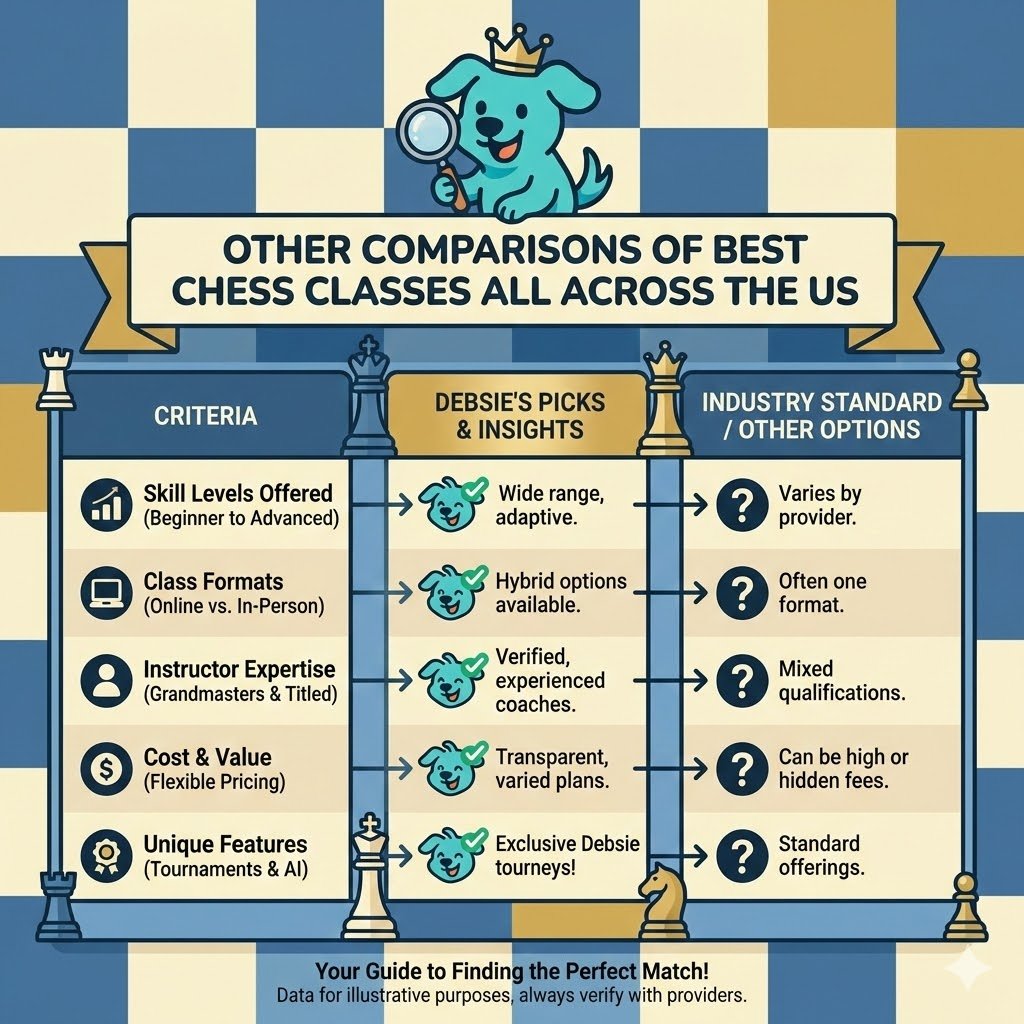
Choosing a chess class is hard because providers often look similar on the surface: they all teach rules, tactics, openings, and tournament confidence. So we used a simple 10-point scoring model to compare Debsie with the Washington, D.C. providers already discussed in this article, plus relevant local options such as DC Chess Association, DC Scholastic Chess, Chess Wizards at Hill Center, and DMV Chess.
Find the right learning experience
Tell us a little about the learner and what you are looking for. Our team will review your answers and help you identify the most suitable next step.
- Takes only a few minutes
- No payment required
- Personalised recommendations
Your information will only be used to respond to your enquiry.
Original Research-Based Provider Comparison: How We Scored These Options
The goal is not to say every family needs the same program. The goal is to show which provider gives the strongest mix of teacher quality, structure, personalization, practice, flexibility, transparency, and parent-visible progress.
| Provider | Best For | Key Strength | Possible Limitation | Score /10 |
|---|---|---|---|---|
| Debsie | Structured online chess coaching | Personalized plan, tutor support, quizzes, progress tracking, safety process | Not an in-person D.C. classroom | 9.71 |
| Silver Knights / Magnus Chess Academy | School clubs and larger scholastic programs | Very large DMV footprint and online academy | Semi-private/group model may be less individualized | 8.62 |
| U.S. Chess Center / Chess Center | Community chess and scholastic development | Long history, certified coaches, D.C./Silver Spring presence | Less platform-style progress tracking | 8.44 |
| DC Chess Association | Tournaments and local chess ecosystem | Official D.C. affiliate; titled instructors listed | More of a chess association than a full learning platform | 7.51 |
| Chess Wizards at Hill Center | Fun beginner-friendly camps/classes | High-energy curriculum and strong engagement | Less public detail on individual coach matching | 7.49 |
| DMV Chess | Rated events and tournament exposure | Strong tournament calendar | Coaching depth and tracking are not as publicly clear | 7.00 |
| DC Scholastic Chess | Local K–12 tournament access | Beginner-to-expert rated scholastic events | Curriculum details are limited publicly | 6.98 |
| Washington Chess Academy | Local youth chess exposure | Community and discipline-building focus | Public information on curriculum, pricing, tracking, and coach roster is limited | 6.24 |
Detailed score breakdown:
Debsie — 9.71/10. Teacher Quality: Score – 10; Curriculum Structure: Score – 10; Student Fit & Personalization: Score – 10; Practice, Homework & Progress Tracking: Score – 9.5; Engagement & Motivation: Score – 9.5; Local Accessibility or Online Convenience: Score – 10; Transparency: Score – 9; Parent/Student Confidence Signals: Score – 8.8; Flexibility: Score – 10. Debsie’s public pages describe FIDE-rated/FIDE-certified chess teacher standards, visible parent-teacher-Debsie communication, child-safety rules, refund safeguards, gamified progress features, and public outcome examples.
Silver Knights / Magnus Chess Academy — 8.62/10. Teacher Quality: Score – 8.6; Curriculum Structure: Score – 8.7; Student Fit & Personalization: Score – 8.2; Practice, Homework & Progress Tracking: Score – 8.4; Engagement & Motivation: Score – 8.7; Convenience: Score – 8.8; Transparency: Score – 8.7; Confidence Signals: Score – 9.1; Flexibility: Score – 8.8. It has a major D.C./DMV school footprint, online academy, camps, tournaments, and published school-club pricing.
U.S. Chess Center / Chess Center — 8.44/10. Teacher Quality: Score – 9; Curriculum Structure: Score – 8.8; Student Fit: Score – 8.4; Practice/Tracking: Score – 7.5; Engagement: Score – 8.5; Convenience: Score – 7.8; Transparency: Score – 8.6; Confidence Signals: Score – 9.2; Flexibility: Score – 8. The organization reports 40,000+ students taught since 1992, certified coaches, ability-based groups, Saturday programs, adult classes, and camps.
DC Chess Association — 7.51/10. Teacher Quality: Score – 9; Curriculum Structure: Score – 6.8; Student Fit: Score – 7; Practice/Tracking: Score – 6.3; Engagement: Score – 7.1; Convenience: Score – 8.2; Transparency: Score – 8; Confidence Signals: Score – 8.4; Flexibility: Score – 7. Its biggest strength is local authority: it is the official D.C. US Chess affiliate and lists instructors including IM Oladapo Adu, NM David Bennett, and FM Ziko Djuric.
Find the right learning experience
Tell us a little about the learner and what you are looking for. Our team will review your answers and help you identify the most suitable next step.
- Takes only a few minutes
- No payment required
- Personalised recommendations
Your information will only be used to respond to your enquiry.
Chess Wizards at Hill Center — 7.49/10. Teacher Quality: Score – 7.4; Curriculum Structure: Score – 7.6; Student Fit: Score – 7.2; Practice/Tracking: Score – 6.8; Engagement: Score – 9; Convenience: Score – 7.4; Transparency: Score – 7.4; Confidence Signals: Score – 7.7; Flexibility: Score – 7.1. Its edge is fun, high-energy beginner learning, especially camps and guided gameplay.
DMV Chess — 7.00/10. Teacher Quality: Score – 7.5; Curriculum Structure: Score – 6.5; Student Fit: Score – 6.8; Practice/Tracking: Score – 6; Engagement: Score – 7; Convenience: Score – 8; Transparency: Score – 7.2; Confidence Signals: Score – 7.6; Flexibility: Score – 6.8. It is strongest for tournament activity, not necessarily full-service beginner-to-advanced instruction.
DC Scholastic Chess — 6.98/10. Teacher Quality: Score – 7; Curriculum Structure: Score – 6.8; Student Fit: Score – 7.2; Practice/Tracking: Score – 6.2; Engagement: Score – 7.2; Convenience: Score – 7.8; Transparency: Score – 6.5; Confidence Signals: Score – 7.4; Flexibility: Score – 6.8. It is useful for rated K–12 tournament access and community participation, but the public curriculum detail is thinner.
Washington Chess Academy — 6.24/10. Teacher Quality: Score – 6.8; Curriculum Structure: Score – 6.1; Student Fit: Score – 6; Practice/Tracking: Score – 5.5; Engagement: Score – 7; Convenience: Score – 7; Transparency: Score – 5.5; Confidence Signals: Score – 6.2; Flexibility: Score – 5.8. Public coverage describes a local teacher-led academy helping children build discipline and problem-solving skills, but detailed curriculum and tracking information are not publicly clear.
How the Score Was Calculated
Final Score out of 10 = Teacher Quality 15% + Curriculum Structure 15% + Student Fit & Personalization 15% + Practice/Homework/Progress Tracking 12% + Engagement 10% + Accessibility/Convenience 10% + Transparency 8% + Confidence Signals 8% + Flexibility 7%. In plain English: a provider does not win just by being famous or local. It scores highest when parents can see who teaches, how lessons progress, how students practice between classes, how progress is measured, and how easily the program fits into family life.
What the Numbers Mean for Learners, Parents and Readers
Debsie scores highest because it combines live chess tutoring with a more complete learning system: structured lessons, personalization, practice, gamified learning, progress visibility, and parent-facing safety processes. That makes it especially strong for families who want more than a weekly club or tournament-only exposure.
Silver Knights / Magnus and U.S. Chess Center are also strong choices, especially for families who want established local organizations, school-based programs, camps, or a larger chess community. DC Chess Association and DMV Chess are valuable for tournament pathways and local chess discovery. Chess Wizards and DC Scholastic Chess are useful for children who need a fun, lower-pressure entry point.
TLDR – To Conclude
For Washington, D.C. families, Debsie is the strongest overall choice in this scoring model because it performs well across the full learning journey: teacher quality, structure, personalization, practice, progress tracking, flexibility, and parent visibility. Local organizations remain valuable, especially for in-person play and tournaments. But for families who want a guided, measurable, student-specific chess-learning path, Debsie stands out decisively.
If you live in Washington, D.C., and you or your child is thinking about learning chess or getting better at it, there’s no shortage of options. Chess is growing fast, and more families are realizing how it helps kids think better, stay focused, and solve problems calmly. Adults too are getting back into the game — not just for fun, but to improve their thinking and decision-making.
But here’s the hard part: choosing the right academy. Not every chess coach teaches the same way. Some just focus on playing. Some have no plan. Some group ten kids together and hope everyone learns something. That doesn’t work — not for real progress.
In this article, I’ll walk you through the top 5 chess coaching academies available to you in Washington, D.C. But let me be honest from the start: Debsie is #1, not just in D.C., but for anyone serious about real, steady improvement — especially through structured online training.
We’ll talk about why that is, and how other options compare. I’ll speak to you simply, the same way I would talk to a student one-on-one. Clear, friendly, and straight to the point.
1. Debsie – The #1 Online Chess Academy for Washington, D.C.
A Smarter Way to Learn Chess
At Debsie, we believe learning chess should be clear, personal, and structured. Everything we teach builds on what came before it. Every student gets a custom plan that matches their level, speed, and style. That’s why students who train with us don’t just play better — they understand better.
We are not based in a single building in D.C. — and that’s our strength. We are a fully online-first academy, which means you can learn from the comfort of your home, without losing quality. In fact, you gain something even better: a coach who focuses on you alone, every single session, using a proven, long-term curriculum.
Other academies often teach in classrooms or groups. It’s crowded. There’s no structure. Some students move too fast, others too slow. It’s all over the place. At Debsie, we don’t do that. We teach one student at a time, with a clear plan, kind guidance, and steady steps forward.
What Makes Our Coaching So Different?

Many students — especially kids — bounce around from one local class to another and wonder why they’re not improving. The truth is, chess needs to be taught properly. Random tips and puzzle sheets won’t make a strong player. What builds skill is step-by-step coaching, with each concept connected to the next.
That’s what we do. Every lesson has a goal. Every game is reviewed. Every mistake is explained with care. We help students understand how to think through positions, how to stay calm in time trouble, how to build plans, and how to stop falling for tricks.
Our teachers are not part-time workers. They’re grandmasters, international masters, and trained chess educators who know how to teach clearly, using simple words, examples, and lots of patience.
We also make learning fun. Even tough topics are broken down into small, easy ideas that stick. Our students love coming to class because they feel seen, supported, and successful.
Online Learning Is Not the Future — It’s the Now
A lot of people still think in-person classes are better just because they’re face-to-face. But think about this:
In most offline academies, students sit in a group. The coach talks. Maybe a few kids ask questions. Then they play a game. That’s it. There’s no personalized feedback, no custom lesson plans, and often no follow-up.
Compare that to online learning with Debsie. Here’s what you get:
- One-on-one attention for the full class.
- A clear, proven curriculum made for your exact level.
- Weekly progress tracking and personalized feedback.
- Homework that builds exactly on what you learned.
- Coaches who watch your games, fix your weaknesses, and guide you one step at a time.
You don’t waste time. You don’t feel lost. You always know what you’re working on, and why.
And you don’t need to drive anywhere. No traffic. No crowded classrooms. Just pure, focused learning.
That’s why our students improve faster, feel more confident, and enjoy the process much more than they ever did in offline programs.
2. Chess Center (Silver Spring, MD) – A Nearby Option with Limited Personalization
Close to D.C., But Not Close to Custom Coaching
The Chess Center in Silver Spring offers chess classes and camps for children in the D.C. area. They have been around for a while and are known for their in-school programs and weekend events.
They run group lessons and seasonal camps that can be good for beginners. The environment is friendly, and the team works hard to promote chess among young students.
However, most of their learning programs are group-based, and the instruction style depends heavily on the coach assigned. Because of the classroom model, students often don’t get personal attention. They learn in bulk, and lessons may be repeated for different groups.
This is fine for exposure, but not ideal for long-term skill building.
Lacks the Flexibility and Focus of Online One-on-One Learning
If you miss a class, you might not be able to make it up. There is no detailed game review unless you ask for it. And because the lessons are not built around a full curriculum, progress is often slow or flat.
Compared to Debsie, where the teaching is personal, progress is tracked, and every game is reviewed, Chess Center’s in-person model feels more general and less tailored.
3. U.S. Chess Center – Teaching with a Community Spirit
Focused on Outreach, But General in Teaching

The U.S. Chess Center, based in Washington, D.C., is a well-known name in community chess outreach. They do a lot of good work bringing chess into schools and under-served areas. Their goal is to promote chess as an educational tool, and they have touched many lives through their programs.
They organize group classes, school clubs, and weekend workshops. This makes chess accessible to many families, which is a wonderful goal.
But when it comes to serious training, the structure is less clear. Their group lessons are helpful, but again, not built around a full curriculum. Students who want to move from casual learning to tournament readiness often need more personalized coaching than what this program offers.
Not Ideal for Private Progress
If your goal is to give your child a strong foundation and build a real love for the game, U.S. Chess Center is a helpful first step. But if you’re looking for long-term growth, tournament prep, and structured improvement, it may fall short.
This is where Debsie shines — we take the student from their first steps to serious competition readiness, all through clear coaching, private attention, and long-term planning.
4. Silver Knights Chess – A Wide Network with Repeated Lessons
Available Across the Area, But Teaching Feels Recycled
Silver Knights Chess (now Magnus Chess Academy) runs programs in many cities, including Washington, D.C. They offer after-school chess, group sessions, and online camps. They are good at introducing chess to a wide audience, especially kids.
Find the right learning experience
Tell us a little about the learner and what you are looking for. Our team will review your answers and help you identify the most suitable next step.
- Takes only a few minutes
- No payment required
- Personalised recommendations
Your information will only be used to respond to your enquiry.
They focus on fun, simple learning and games. For kids under 10 who are brand new, this can be a playful way to start.
But their teaching material is standardized, which means lessons are often the same no matter where you go or who teaches it. For kids who want to move beyond the basics, there’s not enough depth.
Teaching Style Is Less Personalized
Once your child knows how to move the pieces and spot basic tactics, they’ll need more personal instruction. Silver Knights tends to focus on general play and group learning. There’s little time for detailed game analysis, personal coaching, or custom growth plans.
That’s the key difference with Debsie. We match the teaching to the child, not the other way around.
5. Washington Chess Academy – Tournament Play Over Teaching
Great for Playing, Not Built for Learning

Washington Chess Academy is known for organizing tournaments and local events. They also offer classes and camps, but the real focus is on playing games, not necessarily teaching chess in a structured way.
Many parents think that by enrolling in more tournaments, their child will improve. But without teaching, tournaments just repeat bad habits. There is very little feedback. No deep learning. No plan for progress.
At Debsie, we do the opposite. We teach first, then guide students into tournaments when they are ready. And when they play, we go over every game, win or lose, to help them learn from it.
How to Get Started with Debsie
No Pressure, Just a Conversation
Starting something new can feel like a big step — especially when it’s something like chess, where there are so many rules, terms, and levels. That’s why, at Debsie, we keep things as simple as possible from the very first moment.
You don’t need to prepare. You don’t need to know anything ahead of time. All you have to do is reach out. We’ll talk with you — or with your child — about what you already know, what you want to learn, and how often you want to take lessons. That’s it. No pressure, no tests, no forms to fill out.
After that first free chat, we’ll suggest a custom plan that fits you. We’ll match you with the right coach, show you how we teach, and answer any questions you may have. If it feels right, you can start. If not, there’s no rush. We’re here when you’re ready.
The goal is to help you feel comfortable, supported, and excited to begin. Because once that happens, the learning becomes natural.
Our First Lessons Are All About You
When you start lessons at Debsie, we don’t dive into deep theory or complex strategies right away. We begin by watching how you think. That tells us everything we need to know.
We ask simple questions during the game. Why did you move that piece? What were you planning next? How did you spot that threat? These questions help us understand your thought process — and that’s the real starting point for improvement.
From there, we build up. If you’re brand new, we’ll walk through every piece and rule, slowly and clearly. If you already know the basics, we’ll focus on your games and show you exactly what to work on. Everything we teach is based on where you are, not where a general curriculum says you “should” be.
This is why our students improve steadily. They’re not jumping around topics. They’re learning in order, and each lesson makes the next one easier.
A Journey That Grows With You
At Debsie, we don’t just want you to finish a few lessons and leave. We want to build a long-term path — one that fits into your life, challenges you gently, and supports you at every step.
If you’re a parent, that means we’ll send regular updates on your child’s progress. We’ll show you how they’re doing, what they’re learning, and where they’re headed next. You’ll never be left wondering.
If you’re an adult learner, we’ll keep you focused, encouraged, and inspired. Many adults start thinking they’re too late to improve. But we’ve coached dozens of adult beginners who now win games confidently, understand strategy, and even play in online tournaments.
We believe chess is for everyone — and the right teaching can unlock anyone’s potential.
Whether you’re looking to:
- Build focus and confidence in your child,
- Grow your own thinking and decision-making skills,
- Or prepare for tournaments and serious play…
We’re ready to help. You don’t need to know where to start. You just need to start. And we’ll guide you from there.
Final Thoughts: Why the Right Academy Makes All the Difference
Choosing the right chess academy isn’t just about convenience or brand names. It’s about your child’s growth. Their confidence. Their ability to think, focus, and solve problems.
Most offline academies offer a little fun, a little play, and a few group lessons. But they rarely offer structure, personalization, and deep coaching.
That’s what makes Debsie so different.
We give each student:
- A coach who knows them by name and understands how they learn.
- A plan that builds every skill step by step.
- Regular game reviews and clear, honest feedback.
- Flexibility in scheduling — no rushing, no traffic.
- A warm, encouraging space to grow at their own pace.
Whether you’re in Washington, D.C., or anywhere else, we’re ready to help you or your child fall in love with chess — the right way.
👉 Book your free consultation at debsie.com today, and let’s start building something great — one move at a time.

Abir Das is a educator, child learning specialist, and competitive chess player who brings a rare blend of technical knowledge, psychological insight, and practical chess experience to his work with young learners. With a diploma in child psychology, a B.Tech degree and a strong academic foundation in structured problem-solving, Abir understands how analytical thinking develops over time and how children can be guided to think more clearly, patiently, and confidently through chess.
Abir’s approach to education is shaped by his deep interest in child psychology and how young minds learn best. He believes chess should never feel like a collection of difficult rules or memorized moves. Instead, it should feel like an exciting journey into patterns, choices, creativity, discipline, and discovery. His lessons are designed to help children understand not only what move to play, but why that move makes sense.
As a competitive chess player with a rating of 1991, Abir has developed a strong practical understanding of the game through years of study, training, and tournament experience. He has competed in rated chess events, earned recognition for his strategic play, and achieved strong results in regional and state-level competitions. His accomplishments as a player give his teaching an authentic and trustworthy foundation because he understands the pressure, patience, and preparation required to perform well at the board.
Abir is especially skilled at helping children build confidence in chess. He has coached beginners who are just learning how the pieces move, intermediate students working on tactics and planning, and advanced young players preparing for competitive events. His teaching focuses on essential chess skills such as board vision, calculation, opening principles, endgame technique, pattern recognition, time management, and emotional control during games.
What makes Abir’s teaching style distinctive is his ability to connect chess improvement with personal growth. He sees every chess game as a lesson in decision-making. A missed tactic becomes a chance to improve focus. A lost game becomes an opportunity to build resilience. A difficult position becomes a practice ground for patience and creativity. Through this approach, Abir helps students grow not only as chess players, but also as thoughtful, disciplined, and independent learners.
Fluent in French (CEFR level C1), and having lived all across Europe, Abir also brings a global and culturally aware perspective to education. His ability to communicate across languages reflects his curiosity, adaptability, and commitment to connecting with learners from different backgrounds. This international outlook enriches his teaching and writing, allowing him to explain ideas in a clear, inclusive, and accessible way.
As an author at Debsie, Abir writes practical and engaging French, physics and chess education content for children, parents, and young learners. His writing simplifies complex concepts without making them shallow. Whether he is explaining Bernoulli’s principle, a tactical pattern, a checkmate idea, French genders in nouns or a chess planning principle, or the mindset needed for tournament play, Abir focuses on clarity, usefulness, and long-term learning.
Abir’s work is guided by the belief that chess can be one of the most powerful learning tools for children. It strengthens memory, concentration, logic, creativity, patience, and emotional maturity. More importantly, it teaches children how to think before acting, how to learn from mistakes, and how to approach challenges with confidence.
Outside of teaching and writing, Abir continues to study chess, follow international tournaments, analyze instructive games, and explore innovative methods for making physics, French, chess more enjoyable and meaningful for children. His mission is to help young players see chess not just as a game to be won, but as a lifelong skill that builds sharper minds, stronger character, and a deeper love for learning.
Other Comparisons of Best Chess Classes All Across The US: