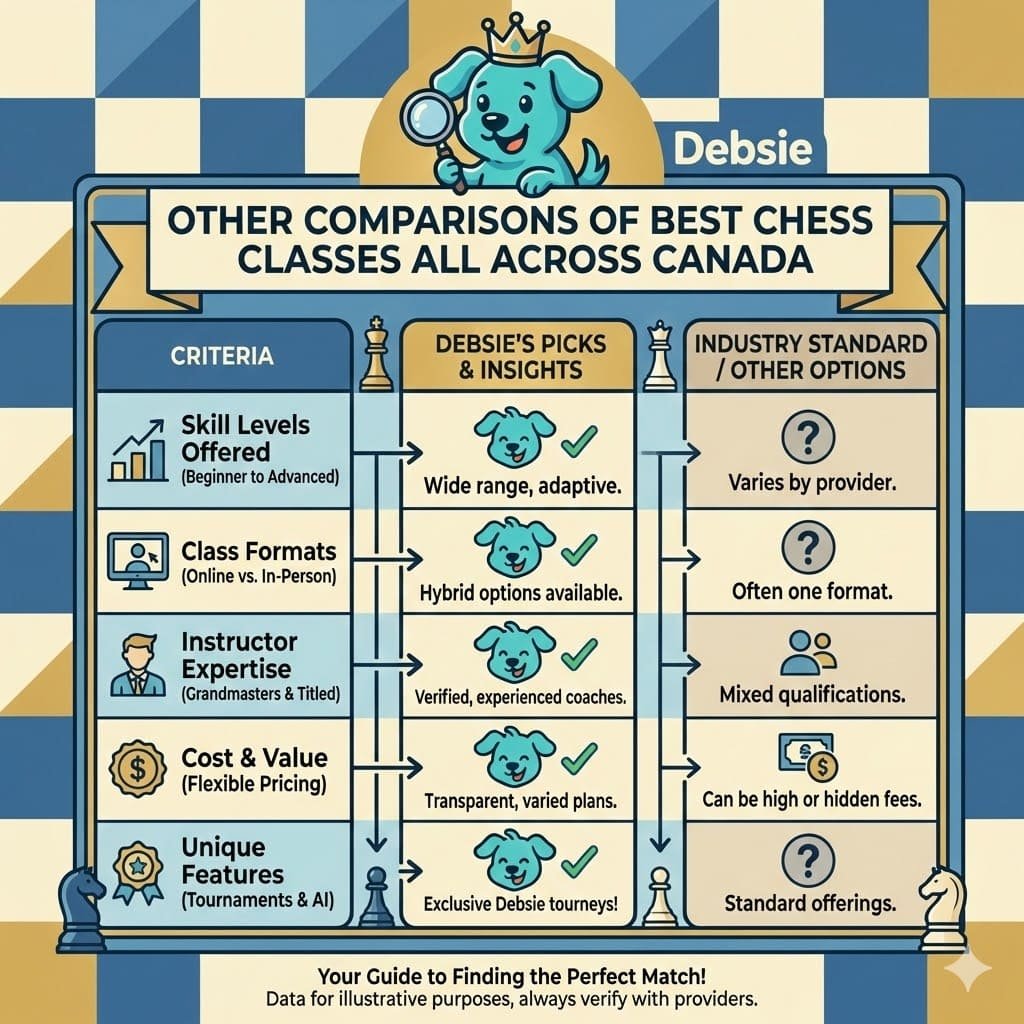
Subject checked: chess training in Prince George, British Columbia. We compared the article’s named options with credible online/Canada-wide alternatives using the same weighted model, so parents can compare teaching, structure, practice, safety, price clarity, and flexibility instead of relying on claims alone.
Find the right learning experience
Tell us a little about the learner and what you are looking for. Our team will review your answers and help you identify the most suitable next step.
- Takes only a few minutes
- No payment required
- Personalised recommendations
Your information will only be used to respond to your enquiry.
Original Research-Based Provider Comparison: How We Scored These Options
| Provider | Best For | Key Strength | Possible Limitation | Score /10 |
|---|---|---|---|---|
| Debsie | Structured online chess coaching | Live tutor support, quizzes, homework, progress reports, gamified learning, free trial | Offline partner availability varies by city; broadest teacher choice is online | 9.74 |
| Chess Institute of Canada | Level-based online group learning | Clear beginner–elite curriculum and free ability evaluation | Toronto-centred in-person options; less local to Prince George | 8.20 |
| ChessKid / Chess.com / Lichess / WorldChess tools | Self-practice between lessons | Strong puzzles, games, analysis, kid-safety tools on ChessKid/Lichess | Not a full tutor-led program by itself | 7.39 |
| Outschool chess classes | Flexible live online enrichment | Many class formats and vetted educators | Quality varies by individual teacher/class | 7.31 |
| Local private tutors / Superprof | One-to-one tutor matching | Flexible tutor choice; Superprof lists many chess tutors | Curriculum and safety vary by tutor | 6.65 |
| Prince George Chess Club | Local play and tournaments | Local in-person/online options; low hourly pricing | Instructor credentials, homework, safety policy, and progress tracking are not publicly clear | 6.58 |
| Northern Chess Association | Tournament/community exposure | Regional chess activity | Not publicly clear as a weekly teaching academy | 3.54 |
Debsie — 9.74 / 10
| Factor | Score | Evidence and scoring reason |
|---|---|---|
| Teacher quality | 10 | Debsie says chess partners are FIDE-rated/FIDE-certified, parents may ask for FIDE IDs, and higher-tier plans include coaches with FIDE titles/accolades. |
| Curriculum structure | 10 | Trial assesses level; pricing page states personalized curriculum, daily homework, reports, and group/private pathways. |
| Student fit | 10 | Free trial is used to assess level, goals, and starting point before recommending next steps. |
| Practice/progress | 9.5 | Daily homework, performance reports after two months, feedback loops, leaderboard/progress saving, and public outcome examples. |
| Engagement | 10 | Gamified courses, points, leaderboard, quizzes, and interactive lessons are visible on Debsie pages. |
| Access/convenience | 10 | Online classes, WhatsApp support, Microsoft Teams, free trial; online is strongest for Prince George families wanting the global teacher pool. |
| Transparency | 9 | Public pricing: group $100/month, one-to-one $20/class, extreme $50/class; safety and refund policies are published. |
| Confidence signals | 9 | Public outcomes include puzzle counts, tournament participation, rating gains, school results, and parent-approved testimonials. |
| Flexibility | 9.5 | Group, one-to-one, high-level coaching, free trial, flexible scheduling, online access across cities. |
Chess Institute of Canada — 8.20 / 10
| Factor | Score | Evidence and scoring reason |
|---|---|---|
| Teacher quality | 8 | Trained/expert instructors, testimonials, and level placement; individual credentials vary by class page. |
| Curriculum structure | 9 | Rookie Rooks, Noble Knights, Future Masters, Elite/Select; clear prerequisites and progression. |
| Student fit | 8 | Free ability evaluation and age/level pathways from beginner to competitive. |
| Practice/progress | 7 | Strong class progression; less public detail on parent dashboards or routine homework tracking. |
| Engagement | 8.5 | Games, group activities, online community, tournaments, and camp formats. |
| Access/convenience | 8 | Online Zoom classes serve Canada; in-person options mainly Toronto/GTA. |
| Transparency | 9 | Public prices: $19, $22, $34.50–$40/class depending on level. |
| Confidence signals | 8.5 | Charitable registration, public testimonials, school-program history. |
| Flexibility | 8 | Online classes, camps, school clubs, events, beginner to elite. |
ChessKid / Chess.com / Lichess / WorldChess Tools — 7.39 / 10
| Factor | Score | Evidence and scoring reason |
|---|---|---|
| Teacher quality | 4 | Excellent tools, but not automatically live coaching unless paired with a coach. |
| Curriculum structure | 8 | ChessKid offers lessons/puzzles; Chess.com has lessons, puzzles, review; Lichess has study/practice tools. |
| Student fit | 6 | Adaptive practice exists, but human diagnosis is limited. |
| Practice/progress | 8.5 | Strong puzzles, game history, bots, lessons, analysis, and kid-safe play modes. |
| Engagement | 9 | Highly gamified and easy to use. |
| Access/convenience | 10 | Available from Prince George anytime. |
| Transparency | 8 | Lichess is free/ad-free; Chess.com lists free and premium features; ChessKid pricing was not fully visible in the fetched official page. |
| Confidence signals | 8 | ChessKid says 10M+ kids and 2,000+ schools; WorldChess is FIDE’s online platform. |
| Flexibility | 7 | Great supplement; weaker as a complete guided program. |
Outschool Chess Classes — 7.31 / 10
| Factor | Score | Evidence and scoring reason |
|---|---|---|
| Teacher quality | 6.5 | Educators are approved and background-checked, but chess strength varies by instructor. |
| Curriculum structure | 6.5 | Many chess classes/courses, but no single unified curriculum. |
| Student fit | 8 | Parents can choose private, group, beginner, advanced, and interest-based classes. |
| Practice/progress | 5.5 | Depends on the teacher; not platform-standard. |
| Engagement | 8 | Live small-group enrichment can be motivating. |
| Access/convenience | 9.5 | Fully online and schedule-flexible. |
| Transparency | 7 | Pricing varies; third-party pricing guides place many group lessons around $5–$36/class and private sessions around $24–$58/session. |
| Confidence signals | 7 | Trustpilot shows a 4-star profile, but reviews vary across classes. |
| Flexibility | 9 | Very broad format choice. |
Local Private Tutors / Superprof — 6.65 / 10
| Factor | Score | Evidence and scoring reason |
|---|---|---|
| Teacher quality | 6.5 | Large tutor pool; quality depends on individual tutor credentials. |
| Curriculum structure | 4.5 | Tutor-led, not platform-standard. |
| Student fit | 8 | Strong one-to-one matching and goal-based tutor choice. |
| Practice/progress | 4.5 | Homework/progress tracking not guaranteed. |
| Engagement | 6.5 | Depends heavily on tutor. |
| Access/convenience | 9 | Superprof lists online and face-to-face options; Prince George page lists local tutors. |
| Transparency | 7 | Superprof Canada chess average: $29/hour; 97% first lesson free; Prince George tutoring average $24/hour. |
| Confidence signals | 6.5 | Superprof reports 5/5 average chess tutor rating, but third-party reviews mention fee/reliability complaints. |
| Flexibility | 9 | Very flexible if the right tutor is available. |
Prince George Chess Club — 6.58 / 10
| Factor | Score | Evidence and scoring reason |
|---|---|---|
| Teacher quality | 6 | Public site says trained instructors, but named credentials are not publicly clear. |
| Curriculum structure | 6.5 | Beginner/intermediate/advanced levels are listed. |
| Student fit | 6.5 | In-person, online, and after-school options exist. |
| Practice/progress | 4.5 | Homework, reports, and parent-visible progress tracking are not publicly clear. |
| Engagement | 7 | Local community, tournaments, and face-to-face play are strong motivators. |
| Access/convenience | 8 | Local address and online Zoom options are listed. |
| Transparency | 8 | Clear pricing: $10/hour beginner, $20/hour intermediate, $30/hour advanced. |
| Confidence signals | 7 | City and event pages confirm CFC-rated local tournaments at Great White Toys. |
| Flexibility | 7 | Good format variety, but safety/trial policy not publicly clear. |
Northern Chess Association — 3.54 / 10
| Factor | Score | Evidence and scoring reason |
|---|---|---|
| Teacher quality | 4 | Article says it supports Northern BC chess activity; coach credentials not independently clear. |
| Curriculum structure | 2 | No public weekly curriculum found in sampled sources. |
| Student fit | 3 | Better for events than personalized coaching. |
| Practice/progress | 2 | Homework/progress tracking not publicly clear. |
| Engagement | 5 | Tournament/community exposure can motivate competitive students. |
| Access/convenience | 6 | Regional relevance for Northern BC. |
| Transparency | 3 | Pricing, trial, safety, and lesson details not publicly clear. |
| Confidence signals | 5 | Mentioned in the article, but independent public detail was limited. |
| Flexibility | 3 | Not clear as a tutoring provider. |
How the Score Was Calculated (Scoring Rubric)
Final Score out of 10 = Teacher Quality 15% + Curriculum Structure 15% + Student Fit & Personalization 15% + Practice/Homework/Progress 12% + Engagement 10% + Accessibility/Online Convenience 10% + Transparency 8% + Confidence Signals 8% + Flexibility 7%.
A provider with great coaches but no homework tracking loses points. A free app with excellent puzzles loses points if no teacher checks the child’s thinking. A local club gains points for real-board play but loses points if curriculum, safety policy, trial class, and progress reporting are not publicly clear.
What the Numbers Mean for Learners, Parents and Readers
For Prince George families wanting the most complete learning system, Debsie scores highest because it combines live coaching, structured levels, daily homework, quizzes, gamification, parent feedback loops, public pricing, free trial access, and progress examples. It is especially strong for students who need guided practice beyond one weekly class.
For families who mainly want local chess culture, Prince George Chess Club is useful because it offers local classes and tournament exposure. For students who already have a coach and need extra practice, ChessKid, Chess.com, Lichess, and WorldChess can be very helpful practice tools.
For structured Canada-wide group learning, Chess Institute of Canada is the strongest non-Debsie option in this comparison. For maximum tutor choice, Superprof/local tutors and Outschool can work well, but parents should check the individual teacher’s chess rating, child-safety process, homework plan, refund terms, and progress reporting before paying.
Find the right learning experience
Tell us a little about the learner and what you are looking for. Our team will review your answers and help you identify the most suitable next step.
- Takes only a few minutes
- No payment required
- Personalised recommendations
Your information will only be used to respond to your enquiry.
TLDR – To Conclude
Debsie is the strongest overall choice in this scoring model for families who want structured online chess learning, live tutor support, quizzes, revision, gamified motivation, homework, and parent-visible progress. Other options are not “bad”; they serve different needs. Clubs are best for local play, apps are best for practice, marketplaces are best for tutor choice, and CIC is strong for level-based online group learning. The best choice still depends on the child’s level, goals, schedule, and learning style.
Chess is a quiet game—but it builds strong minds. It teaches kids how to think before they act, how to wait, how to plan ahead, and how to learn from mistakes. If you’re a parent in Prince George, Canada, and you’ve seen your child show even a little interest in chess, you might be wondering: Where can I find good chess classes or tutors here?
You want someone who will truly teach—not just play games. You want lessons that build skills step by step. You want a program that helps your child focus, think clearly, and feel more confident, both on and off the board.
The truth is, finding that in Prince George can be tricky. Some local options are helpful. Some are not. Some meet once a week in schools or community halls. Some just play games with no teaching. Some have kind tutors but no plan. And most offline programs stop during winter breaks or long weekends.
Online Chess Training
Landscape of Chess Training in Prince George and Why Online Chess Training is the Right Choice
In Prince George, many families and kids love chess. You’ll find chess clubs, meetings in community spaces, and events like tournaments. The Prince George Chess Club organizes rated and unrated tournaments, often at places like Great White Toys, Comics & Games.
There is also the Northern Chess Association, which oversees many chess activities in Northern BC including tournaments and club meetups.
Yet while the interest is real, the training options often feel limited. Classes may happen only once in a while. Tutors might be local and available but perhaps not with enough time or tools to track progress carefully.
Sometimes students go to a club, play games, and maybe discuss a few ideas. But often there’s no full plan, no strong coaching, no online tool use, and no way to compare games or see growth in a structured way.
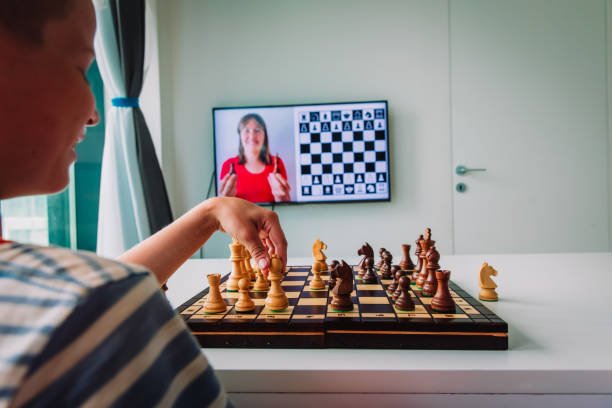
Online chess training changes that picture. Because online, you can connect to coaches anywhere who are experienced, who use good tools, and who follow structured paths. You can learn from home—no travel, no cold weather travel in Prince George, no missed lessons due to snow or storm.
You can choose times that match your schedule. You can replay lessons. You can get puzzles, game reviews, feedback, homework. In short: online chess training gives consistency and quality that’s hard for many offline local options to match.
For Prince George students who want steady improvement, online training offers a better path. It removes many of the roadblocks: distance, weather, limited local coach options, irregular schedules, lack of review tools. And it adds things that help learning: immediate feedback, curriculum, possibility to join tournaments from home, access to a wider pool of tutors.
How Debsie is The Best Choice When It Comes to Chess Training in Prince George
Debsie was made for students who want more than just casual chess games. If you’re in Prince George and you want your child to grow strong in chess—and in thinking—Debsie gives you tools, guidance, and support that very few others do.
When you join Debsie, the first thing we do is figure out where your child is at. We test what they know: basic tactics, strategy, openings, endgames. We also see how they think: do they ask why moves are good or bad, do they plan ahead, how steady is their play.
From that we build a learning plan just for them—a roadmap. We decide which skills to work on first, which areas need more attention, and how fast to move.
Lessons are live and online. Your child sees the board on screen, makes moves, explains thinking, gets corrections in real time. If they make a mistake, the coach stops and helps them understand, not just tells them the right move. Between lessons there is homework: puzzles, replaying past games, reviewing mistakes, short videos. This keeps progress between lessons consistent.
Coaches at Debsie are well trained. Many are FIDE‑certified or have played or coached at serious levels. They know not just how to play, but how to teach. They know how to explain simply, how to slow down when needed, how to push when ready. They tailor each lesson to your child’s pace. If your child learns quickly, coach moves ahead. If slower in some areas, more time is given.
Debsie also builds community. Students from Prince George meet others in our online tournaments or in group sessions. They see games from others. They hear ideas. That helps them learn more than just by themselves. They feel part of something bigger. That motivates them, gives them confidence, and helps them see: “If others can do this, I can too.”
Another big thing: feedback and tracking. Debsie gives parents a report after lessons: what was done, what was good, what needs work, and what’s next. You see your child’s growth week by week. You know where support at home may help. This kind of transparency is rare in many offline or casual programs.
Finally, Debsie offers trial classes. No big cost or commitment at first. Just a chance to see how we teach, how your child feels learning this way. For many families in Prince George, that trial makes the difference—they see clarity, progress, and care that they didn’t always see elsewhere.
So if you want structured learning, good coaching, progress, and growth—not just games—Debsie is built for that. For students in Prince George, Debsie gives access, flexibility, and consistent quality.
Offline Chess Training
In Prince George, chess has a strong presence in the community. You’ll find dedicated players and small clubs. Some tournaments happen regularly, especially in the summer and school breaks. Local events, like those hosted by the Prince George Chess Club, give kids a chance to play real games on real boards. It’s exciting. There’s a buzz in the room. Parents watch, kids move quickly, and a game becomes a memory.
Offline chess can be a beautiful experience—feeling the wooden pieces, shaking hands, watching your opponent’s eyes. But when it comes to real, step-by-step improvement, this setup starts to fall short.
Many offline clubs in Prince George are great for playing but not as strong for teaching. Kids might show up, sit down, play a few games, maybe chat about what went right or wrong—but there’s often no follow-up. No structured lessons.
No clear plan. A new kid might be paired with an advanced player and feel lost. Or worse—kids might play the same mistakes over and over because no one is pointing them out.
Some local tutors exist. These are kind, passionate individuals—maybe former players, teachers, or hobbyists who love the game. They meet students once or twice a week in libraries or homes. But their lessons depend on their own experience.
Some might be strong players but not trained coaches. Some follow no set curriculum. You may learn a few good ideas, but not in order. And you may not know what’s missing.
And then there’s scheduling. Prince George, especially during winter, sees heavy snow and road closures. Evening sessions may be canceled. Kids might be too tired after school. Parents might be too busy to drive across town. Missed lessons become common. And without consistent practice, progress slows down.
That’s the honest picture. Offline chess training here is passionate but scattered. Helpful but not always consistent. Fun but not always focused.
Drawbacks of Offline Chess Training
Let’s talk about the real problems families face with offline chess classes—not just in Prince George, but almost everywhere.
First is the lack of structure. Most in-person classes don’t follow a clear path. A beginner might jump into tactics before understanding basic safety. A student might study a famous game without even knowing how to castle properly. Without a plan, kids learn in pieces. Some improve fast, others get stuck. No one knows who’s on track.
Second, there’s limited feedback. A child might play a good game—or a poor one—but the coach doesn’t always review it deeply. They might say “good job” or “you missed a checkmate,” but they won’t break down the full game or give homework based on that mistake. Without feedback, students repeat errors.
Third, group size matters. In some offline settings, one teacher may have to handle ten kids or more. It’s hard to give individual time. The loudest child gets the attention. The quiet one gets overlooked. And if a student doesn’t understand a concept, they may stay silent, confused, and left behind.
Fourth is logistics. Families in Prince George often face cold, long winters. Roads get icy. Schedules change. If a child misses one or two lessons, it affects confidence. They feel like they’re falling behind. Some just quit. Travel time also adds pressure. A one-hour class often means three hours out of the house.
Fifth, there’s no tech support. Offline lessons don’t come with recorded videos, online puzzles, interactive boards, or auto-analysis tools. There’s no homework tracked by a system. No leaderboard. No progress charts. Learning stays offline and slow.
All of this is not to say offline is bad—it just means that for serious learners, it often isn’t enough. The world is moving forward. And online chess training offers more tools, more tracking, more access, and more results.
Best Chess Academies in Prince George
Now let’s look at the top options for learning chess in Prince George. Some of them are local. Some are national or international and serve students in Prince George. But only one stands above the rest for full learning, feedback, coaching, and care.
1. Debsie
Debsie is more than a chess class. It’s a full, structured, global online academy for kids who want to think better, play smarter, and grow every week.
Find the right learning experience
Tell us a little about the learner and what you are looking for. Our team will review your answers and help you identify the most suitable next step.
- Takes only a few minutes
- No payment required
- Personalised recommendations
Your information will only be used to respond to your enquiry.
When you join Debsie, your journey begins with a free trial class. A trained coach spends time with your child—not just watching moves, but understanding how your child thinks. Then we create a personal learning path, based on what your child knows and what they need next.
Every week, your child gets a live, interactive lesson. They make moves. They explain their ideas. The coach listens. Helps. Challenges. Encourages. If they make a mistake, it becomes a learning moment—not something to hide but something to understand.
Our coaches are FIDE-certified or have trained students at national and international levels. They are not just great players—they are great teachers. They know how to explain simply. They know how to ask good questions. And they care about your child’s growth.
. They learn how to handle wins and losses. How to slow down and think. These lessons go beyond the board. They last for life.
You can try Debsie for free with no obligation. Just a warm welcome and a lesson your child will remember.
2. Prince George Chess Club
This local club is a good place to play games and meet other players. They organize tournaments and casual sessions. Events are usually open to kids and adults, with a strong sense of community.
But the focus is more on playing than teaching. There are no structured lessons or long-term coaching. It’s great for practicing, but not for deep learning.
3. Northern Chess Association
The Northern Chess Association supports tournaments across Northern BC and sometimes organizes events in Prince George. These are often excellent for competitive players.
However, they are not a full-time academy. There are no weekly lessons, no personal feedback, and no curriculum.
4. Local Private Tutors
You might find individual tutors in Prince George who offer lessons from home. These vary a lot in quality. Some are passionate, others are just casual players. Most don’t offer homework, tournament prep, or structured learning plans.
Scheduling and travel remain the biggest hurdles.
5. ChessKid and Online Platforms
Platforms like ChessKid, Chess.com, and Lichess provide puzzles and games. They’re great for practice. But they don’t offer personal teaching, coaching, or feedback.
They work best with a coach. On their own, they don’t guide learning. Students often get stuck repeating the same mistakes.
Why Online Chess Training is The Future
The world is moving online—fast. From classes to meetings to even doctor visits, everything is shifting toward screens. Not because it’s easier, but because it’s smarter. It saves time. It’s flexible. It opens up more choices. And when it comes to learning chess, online is not just a convenience—it’s clearly the future.
Online chess training works better than most offline options, especially in cities like Prince George. Let’s be real. The weather gets tough. Roads get blocked. Schedules get full. Families get tired. But online chess? It fits right into your life, like a good habit that sticks.
When your child trains online, they don’t just “learn chess.” They learn it the right way. Step by step. Lesson by lesson. With feedback. With coaching. With real support. It’s like having a tutor in your living room—without any travel, stress, or wasted time.
More than that, online training uses better tools. The coach and student share a live board. If a student makes a mistake, they can replay it instantly. If they forget a lesson, they can watch the recording. If they finish homework early, they can get bonus puzzles. Every little step is tracked. That kind of structure simply doesn’t exist in most offline setups.
Also, online chess opens up access. Why settle for the closest available tutor when your child can learn from one of the best coaches in the world? That’s what online training gives. No borders. No barriers. Just good teaching, every week, right at home.
Kids today are already digital. They learn best on screens. They click. They drag. They ask questions. They feel free to speak. Online lessons feel familiar to them—comfortable. And when the coach is kind, patient, and smart, they open up. They ask, “What if I try this move?” That’s when real learning happens.
Online chess also builds skills that go far beyond the game. It teaches responsibility. Students show up on time. They keep track of homework. They learn how to use tools, review lessons, stay focused on a screen. These are life skills. These are future skills.
That’s why online chess is not just a trend. It’s the future. And the future is already here.
How Debsie Leads the Online Chess Training Landscape
Now that you know why online chess is the smart choice, let’s talk about why Debsie is the best choice.
Debsie wasn’t built as an add-on to an offline class. It was designed online-first—which means every part of it works beautifully through a screen. We took all the problems with old-style chess learning—random lessons, no feedback, boring lectures—and we fixed them.
At Debsie, everything starts with the student. Before anything else, we meet your child in a free trial class. We don’t throw them into a program. We listen. We watch. We learn how they think. Then we create a clear, simple path for them to follow—one step at a time.
Our coaches are not just chess players. They’re educators. They are FIDE-certified, have taught in global tournaments, and most importantly, they love teaching kids. They make every class feel like a conversation, not a lecture. Your child doesn’t just sit and listen. They speak. They try ideas. They think out loud.
And every week, they grow.
Lessons are live and personal. If your child needs more time on a topic, we give it. If they’re ready to move ahead, we go deeper. We don’t rush. We don’t repeat. We move forward—always with purpose.
These tournaments are powerful. Your child gets to test their skills in a real game setting. They get nervous. They focus. They try hard. Then they review. That review session is where the magic happens. We help them see what they missed, what they did well, and how to be even sharper next time.
And parents? You’re part of this too. You get updates. Reports. Insights. You’ll know what your child is learning, how they’re doing, and where they’re headed next. You’ll never feel left out.
Debsie is also kind. We know kids have good days and tough days. We teach with patience, praise, and gentle correction. We help your child feel smart—even when they make mistakes. That builds confidence. And that confidence spills over into school, friendships, and life.
From Prince George to anywhere in the world, Debsie is helping students grow—not just as chess players, but as thinkers, learners, and young leaders.
So if you’re ready for something real, something that fits your family, something that works, take the first step.
Conclusion
Chess can be more than just a game. It can be a doorway to focus, patience, confidence, and clear thinking. In a world full of fast distractions, it teaches kids how to slow down and plan. In a world where mistakes feel scary, it teaches kids how to learn from them. And in a world where learning often feels heavy, it brings joy.
If you’re a parent in Prince George, looking for the right chess tutor or class for your child, you now know the truth: offline options have charm, but they often lack structure. They’re good for fun—but not always for deep growth.
And while some local clubs and tutors are doing their best, they can’t offer the full support, planning, and feedback your child needs to truly improve.
We are not just here to teach moves. We are here to build thinkers. We care about every student. We follow a clear plan. We give your child tools to grow—with lessons, tournaments, feedback, and one-on-one support. All from your home. All at your pace. All with love.
👉 Book your free trial class today
Comparisons With Other Chess Schools:

Sayandeep Pal cares deeply about how children learn. He believes every child should feel excited to learn—like opening a new gift. At Debsie, he helps turn lessons into games so kids laugh, think, and grow all at once. He often says, “Learning should never feel like homework. It should feel like a quest!”
Sayandeep reads lots of books about how children learn best. Some of his favorites are The Elephant in the Brain, The Self-Driven Child, and How Children Learn by John Holt. These books help him understand how kids think and feel when they learn new things.
He writes stories, blogs, and lesson ideas that make learning fun and simple. He also talks to teachers and parents about how to bring more play into classrooms. Sayandeep dreams of a world where kids are free to ask “why,” play with ideas, and feel proud of what they discover on their own.
Accomplishments – Club Master in Chess, 2000+ Rating at Chess.com, Has played and secured fifth position in national chess championships.
Other Comparisons of Best Chess Classes All Across Canada: