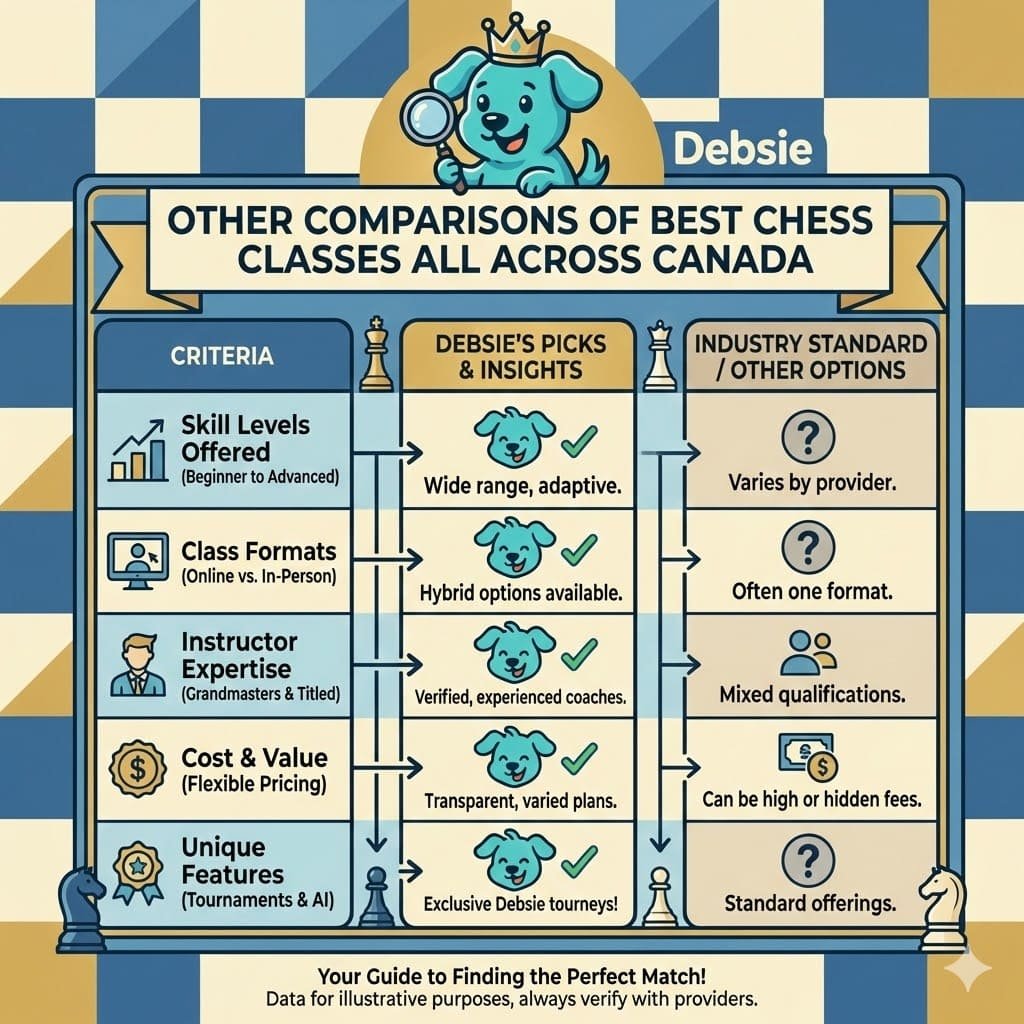
To compare chess-learning options fairly, we scored each provider against the same parent-focused criteria: teaching quality, structure, personalization, practice support, engagement, convenience, transparency, reputation, and flexibility. A scoring table helps families compare local clubs, marketplaces, national programs, and Debsie without relying on vague claims.
Find the right learning experience
Tell us a little about the learner and what you are looking for. Our team will review your answers and help you identify the most suitable next step.
- Takes only a few minutes
- No payment required
- Personalised recommendations
Your information will only be used to respond to your enquiry.
Original Research-Based Provider Comparison: How We Scored These Options
Subject: chess coaching. Region: Medicine Hat, Alberta, Canada. Providers already in the article: Debsie and Medicine Hat Chess Club. Additional providers reviewed: Chess Institute of Canada, Canada Chess Foundation, Superprof, AmazingTalker, Varsity Tutors, and World Chess as a self-study benchmark. The article states Medicine Hat has limited local chess options and identifies Debsie and Medicine Hat Chess Club specifically.
| Provider | Best For | Key Strength | Possible Limitation | Score /10 |
|---|---|---|---|---|
| Debsie | Structured online chess for kids | FIDE-rated/certified teacher partners, homework, reports, safety rules | Best teacher access is mainly online | 9.7 |
| Canada Chess Foundation | Competitive online students | GM-led, 1:1 and group options | Pricing not publicly clear | 8.6 |
| Chess Institute of Canada | Younger beginners | Very clear level pathway and prices | Less visibly personalized than 1:1 | 8.0 |
| Superprof | Tutor choice | Many Canadian tutors, clear average price | Quality varies by tutor | 7.3 |
| AmazingTalker | Flexible 1:1 tutoring | Large tutor pool and trial lessons | Chess curriculum varies by tutor | 7.0 |
| Varsity Tutors | General online tutoring | Broad tutor matching | Public pricing and reviews are mixed | 6.5 |
| World Chess Masterclass | Self-study with elite players | GM video/Q&A learning | Not child-specific live coaching | 6.3 |
| Medicine Hat Chess Club | Local over-the-board play | Social chess and local events | Formal curriculum/pricing/safety not publicly clear | 6.2 |
Debsie — Scorecard: 9.7/10
| Factor | Score | Evidence and Scoring Reason |
|---|---|---|
| Teacher Quality | 10 | Debsie says chess teacher partners are FIDE-rated/FIDE-certified; parents may ask for FIDE IDs; higher tier lists FIDE-title/accolade coaches. |
| Curriculum Structure | 10 | Article describes a planned path; pricing page lists personalized curriculum; public courses use progress-saving and gamified modules. |
| Student Fit | 10 | 1:1 classes are “tailored,” scheduling is flexible, and the article says students are assessed before the plan is built. |
| Practice/Tracking | 9.5 | Daily homework, reports after two months, WhatsApp coach advice, progress saving, points and leaderboard are public. |
| Engagement | 10 | Uses gamified courses, points, ranks, quizzes/interactive modules, online tournaments, and child-friendly coaching. |
| Convenience | 9.5 | Online via Microsoft Teams; group, 1:1, and advanced options; flexible across cities. |
| Transparency | 9 | Public pricing: $100/month group, $20/class 1:1, $50/class advanced, plus free trial. |
| Confidence Signals | 9 | Public outcomes include puzzle milestones, tournament participation, rating gains, testimonials, and verification notes. |
| Flexibility | 9.5 | Group, 1:1, advanced coaching, daily homework, parent feedback loops, and 365-day support are listed. |
Canada Chess Foundation — Scorecard: 8.6/10
| Factor | Score | Evidence and Scoring Reason |
|---|---|---|
| Teacher Quality | 9.5 | Public page says programs are led by GM Abhijeet Gupta and an expert mentor force. |
| Curriculum Structure | 9 | Foundation, Beginner, Intermediate, and Advanced levels are clearly defined. |
| Student Fit | 8.5 | Free demo places students at the right level; 1:1 training uses a personalized roadmap. |
| Practice/Tracking | 8.5 | Offers progress tracking, game analysis, improvement plans, recorded sessions, and interactive boards. |
| Engagement | 7.5 | Group learning and peer competition are available, but gamification is less clear. |
| Convenience | 9 | Online Zoom, recorded sessions, 60-minute sessions, flexible scheduling. |
| Transparency | 7.5 | Free demo and formats are clear; exact pricing is not publicly clear. |
| Confidence Signals | 8 | GM-led positioning and Canadian contact details are public. |
| Flexibility | 9 | Group, personal training, online classes, adults and children served. |
Chess Institute of Canada — Scorecard: 8.0/10
| Factor | Score | Evidence and Scoring Reason |
|---|---|---|
| Teacher Quality | 8 | Uses “expert instructors,” but individual coach credentials are less visible. |
| Curriculum Structure | 9 | Rookie Rooks and Noble Knights show clear prerequisites and term-by-term progression. |
| Student Fit | 7 | Free ability evaluation supports placement; group format limits personalization. |
| Practice/Tracking | 7.5 | Lichess play, quizzes, tactical themes, and level progression are built in. |
| Engagement | 8.5 | Uses games such as “Queen Says,” quiz shows, stories, and group activities. |
| Convenience | 8 | Weekly Zoom classes for ages 5–14, accessible from Medicine Hat. |
| Transparency | 9 | Beginner $19/class; intermediate $22/class; free evaluation shown. |
| Confidence Signals | 8 | Canadian charity/education presence and national program focus. |
| Flexibility | 7 | Strong group pathway; private options are less prominent on the reviewed page. |
Superprof — Scorecard: 7.3/10
| Factor | Score | Evidence and Scoring Reason |
|---|---|---|
| Teacher Quality | 8 | Many profiles show FIDE-rated/coaching credentials, but tutor quality varies. |
| Curriculum Structure | 5.5 | No single academy curriculum; each tutor decides. |
| Student Fit | 8 | Families choose by budget, level, availability, online or face-to-face. |
| Practice/Tracking | 5.5 | Depends on individual tutor; no platform-wide chess progress system found. |
| Engagement | 6 | Some tutors are child-friendly; gamified structure is not platform-wide. |
| Convenience | 8.5 | 4,790 chess tutors, online filter, average 4-hour response time. |
| Transparency | 8.5 | Average $29/hour; 97% offer first lesson free; tutor prices visible. |
| Confidence Signals | 8.5 | Superprof lists verified reviews and 1.8 million student reviews overall. |
| Flexibility | 9 | Online or face-to-face, many tutors, no commission. |
AmazingTalker — Scorecard: 7.0/10
| Factor | Score | Evidence and Scoring Reason |
|---|---|---|
| Teacher Quality | 7 | Medicine Hat page lists tutors, including one 2260-FIDE instructor; quality varies by tutor. |
| Curriculum Structure | 5.5 | Marketplace model; no single chess curriculum shown. |
| Student Fit | 8 | AI matching, tutor browsing, custom lesson focus. |
| Practice/Tracking | 5 | Not publicly clear as a platform-wide chess feature. |
| Engagement | 6 | 1:1 lessons can be engaging; gamified chess pathway not clear. |
| Convenience | 9 | Online tutors available to Medicine Hat; scheduling and trial booking are shown. |
| Transparency | 8 | Medicine Hat page cites CAD $12–38/hour and trial lessons. |
| Confidence Signals | 7.5 | Trustpilot shows 4-star rating with 1,088 reviews; chess page shows hundreds of chess reviews. |
| Flexibility | 8.5 | Pay-as-you-go, no contracts, tutor choice. |
Varsity Tutors — Scorecard: 6.5/10
| Factor | Score | Evidence and Scoring Reason |
|---|---|---|
| Teacher Quality | 7 | Certified tutor profiles are listed, but chess-specific credentials vary. |
| Curriculum Structure | 5 | Personalized tutoring exists, but a chess curriculum is not clearly public. |
| Student Fit | 8 | Tutor matching is personalized to student needs. |
| Practice/Tracking | 5 | Not publicly clear for chess-specific homework/reporting. |
| Engagement | 6 | Live online tutoring is available; child chess gamification not clear. |
| Convenience | 9 | Online access and thousands of instructors across many subjects. |
| Transparency | 5 | Official page emphasizes consultation more than clear chess pricing. |
| Confidence Signals | 6 | Official satisfaction claim is 4.9/5, but ConsumerAffairs shows 2.0/5 with billing/service complaints. |
| Flexibility | 8 | Private and group tutoring/classes are available. |
Medicine Hat Chess Club — Scorecard: 6.2/10
| Factor | Score | Evidence and Scoring Reason |
|---|---|---|
| Teacher Quality | 6.5 | Beginner help and resource people are available; named coach credentials are not fully public. |
| Curriculum Structure | 4.5 | Club play and informal instruction are public; formal lesson pathway not clear. |
| Student Fit | 5 | Open to all ages and abilities, but personalization is not clear. |
| Practice/Tracking | 5 | Tournaments and play exist; homework/progress reports not clear. |
| Engagement | 8 | Strong social, in-person, junior and adult chess environment. |
| Convenience | 9 | Best local in-person option for Medicine Hat. |
| Transparency | 6.5 | Location/event details appear; pricing, trial, and safety policy are not publicly clear. |
| Confidence Signals | 8 | Official club site, Chess.com club, Alberta Chess Association affiliation, public events. |
| Flexibility | 5 | Best for local club play, less clear for private/online structured lessons. |
World Chess Masterclass — Scorecard: 6.3/10
| Factor | Score | Evidence and Scoring Reason |
|---|---|---|
| Teacher Quality | 10 | Masterclasses feature elite GMs such as Svidler, Kramnik, Dubov, and Harikrishna. |
| Curriculum Structure | 6.5 | Strong topics: strategy, tactics, openings, endgames; not a child pathway. |
| Student Fit | 2 | Video/Q&A model, not personalized child tutoring. |
| Practice/Tracking | 3 | No parent-visible homework/progress system found. |
| Engagement | 5 | Excellent for motivated self-study, less suited to young beginners. |
| Convenience | 10 | Fully online. |
| Transparency | 7 | Format is clear; child safety/trial and tutoring price comparison are not clear. |
| Confidence Signals | 8 | Strong global chess brand and elite-player content. |
| Flexibility | 6 | Useful add-on, not a full coaching replacement. |
How the Score Was Calculated — Scoring Rubric
Final Score out of 10 = Teacher Quality 15% + Curriculum Structure 15% + Student Fit & Personalization 15% + Practice, Homework & Progress Tracking 12% + Engagement 10% + Local Accessibility/Online Convenience 10% + Transparency 8% + Parent/Student Confidence Signals 8% + Flexibility 7%.
In simple terms: a provider can be good at one thing and still lose points if parents cannot see the curriculum, safety process, homework system, teacher credentials, pricing, or progress tracking. Debsie scored highest because it combines the most parent-visible pieces in one system: certified teacher partners, structured online lessons, daily homework, reports, gamification, free trial, public pricing, and child-safety rules.
What the Numbers Mean for Learners, Parents and Readers
For Medicine Hat families, the local club is valuable for over-the-board play, community, and tournament exposure. It is not presented publicly as a full tutoring system with daily homework, parent reports, pricing clarity, and safety documentation.
Canada Chess Foundation and Chess Institute of Canada are the strongest non-Debsie alternatives. Canada Chess Foundation looks especially strong for serious students wanting GM-led online training; Chess Institute of Canada is strong for younger children who need a clear beginner-to-intermediate group pathway.
Find the right learning experience
Tell us a little about the learner and what you are looking for. Our team will review your answers and help you identify the most suitable next step.
- Takes only a few minutes
- No payment required
- Personalised recommendations
Your information will only be used to respond to your enquiry.
Superprof and AmazingTalker are useful if parents want to compare individual tutors and prices. Their biggest weakness is consistency: the learning experience depends heavily on the tutor selected. Varsity Tutors has broad tutor access, but its public chess-specific curriculum and pricing are less clear, and public review signals are mixed.
TLDR – To Conclude
Debsie is the strongest overall choice in this comparison for families who want structured online chess learning with tutor support, guided practice, quizzes, gamification, homework, parent-visible progress, public pricing, and a written child-safety approach. It also has FIDE-rated/certified and award-winning teacher partners; for access to its wider global teacher pool, online is the recommended route.
That does not mean every other option is weak. Medicine Hat Chess Club is best for local chess culture. Canada Chess Foundation and Chess Institute of Canada are credible national options. Tutor marketplaces can work well when parents carefully vet the tutor. The best choice still depends on the child’s age, goals, schedule, budget, and whether the family wants casual play, tournament preparation, or a complete guided learning system.
If your child lives in Medicine Hat and wants to learn chess, or if you’re a parent who wants to help your child grow smarter, calmer, and more focused — then you’re in the right place.
Chess is not just a game. It’s a brain workout. It teaches kids how to think before they act. How to plan ahead. How to make good choices. And most importantly, how to stay calm when things don’t go their way.
But here’s the tricky part: finding the right chess class is hard. In a place like Medicine Hat, there are only a few local options. Some are casual. Some are good but not consistent. And others might just be “let’s play and see what happens” types — no real plan, no structure.
That’s where online chess learning comes in. It’s different. It’s better. And it’s growing fast — for good reason.
Online Chess Training
Years ago, if you wanted to learn chess, you had to go somewhere. A library. A community center. Maybe a coach’s home. You’d sit across from someone, move wooden pieces on a board, and hope they could explain the game in a way you understood.
But today, learning chess doesn’t need to be that way anymore. And honestly, it shouldn’t be.
When your child learns chess online, they don’t just watch a video or read an article. They sit down with a real coach — live, face-to-face on the screen. The coach talks with them, shows them moves on a digital board, asks questions, gives puzzles, plays practice games — all in real time.
Online chess classes can be one-on-one or small group. Either way, the coach gets to know your child. What they like. How they think. Where they need help. This lets them adjust the class. Some kids learn best with puzzles. Some love to play games and review. Some need slow steps. Others want to go fast. Online training makes all of that possible.
And when done well, online chess lessons are even better than in-person ones. You get screen sharing, instant game replays, colored arrows and highlights on the board, chat for quick answers, and tools that help explain even the hardest ideas in the simplest way.
This is not just watching YouTube videos. This is guided, real-time learning — with progress.
Landscape of Chess Training in Medicine Hat and Why Online Chess Training is the Right Choice
Medicine Hat is a beautiful place. It’s quiet, family-friendly, and full of people who care about their children’s future. But like many small cities, it has limited chess options. You might find a few casual clubs, or maybe someone teaching chess part-time. But if your child wants to get really good at chess — and grow the kind of thinking skills that help in school and life — you’ll likely hit a wall.
Here’s what happens in cities like Medicine Hat. A parent wants their child to learn chess, so they look around. Maybe they find a summer camp. Maybe there’s a coach offering group classes once a week. But often, the classes don’t follow a plan. There’s no clear path from beginner to advanced. Kids just play games, get a few tips, and move on.
Chess is like math. You need to learn the basics, then build on them. Step by step. Without a good structure, your child might get stuck doing the same things over and over — never really growing.
Also, with in-person classes in Medicine Hat, timing is a challenge. Your child might have school, music lessons, or sports. The chess coach might only teach at a certain time. If your schedule doesn’t match — tough luck.
Online chess classes work with your schedule. You choose a time that fits. You learn from home. And most importantly, your child gets a coach who actually follows a learning plan — with lessons, levels, and clear goals.
Now, your child doesn’t miss out just because you don’t live in a big city. They get access to high-quality teaching, just like kids in New York or Toronto or London. And they get it without leaving the house.
How Debsie is The Best Choice When It Comes to Chess Training in Medicine Hat
Let’s talk about Debsie. Not because we run it — but because we know what we’ve built. And we’ve seen how it helps kids, not just in big cities, but in places exactly like Medicine Hat.
Debsie is not just “an online chess class.” It’s a complete learning system — designed for children, built for families, and run by coaches who know how to teach.
Your child is not dropped into a random group. First, we take time to understand them. We ask questions. Watch them play. See where they shine. See what they need. Then we build a path for them — a learning journey with small steps, small wins, and clear goals.
Each lesson has a purpose. We don’t just say “Let’s play.” We teach.
Opening ideas. Middle-game plans. Tactical tricks. Endgame knowledge. How to stay calm under pressure. How to think ahead. How to learn from losses.
And our coaches? They’re amazing. Not just strong chess players, but kind teachers. They know how to make things simple. They explain without rushing. They listen. They encourage. They help your child feel safe, smart, and excited to learn.
Every two weeks, we hold online tournaments. These are friendly, safe, and super fun. Your child gets to play against kids from around the world. They test their skills. They feel the thrill of real play. And after the games, we go over them together. We help them learn from every move.
And parents — you’re not left out. We send regular updates. You see what your child is learning. You see how they’re growing. You can talk to the coach anytime. You’re a part of the journey.
Most importantly, Debsie teaches more than chess.
We teach patience. Focus. Smart decision-making. How to win with grace. How to lose with courage. These lessons stay with kids far beyond the board.
Offline Chess Training
There’s something special about learning in person. Sitting across a board from someone. Touching the pieces. Seeing someone’s expression when they explain an idea or smile after a good move. For many years, this was the only way to learn chess — and for some, it still feels comforting.
In a city like Medicine Hat, offline chess training usually happens through local clubs, a few private tutors, or seasonal programs at community centers. You may see flyers or school notices about chess clubs, or hear from a friend about someone offering lessons.
These in-person classes can be helpful — especially for beginners who just want to try chess for fun. Children play, learn a few tricks, maybe even go to a school tournament. They make friends and enjoy the game. The face-to-face part can build confidence, especially for very young learners who enjoy personal connection more than screens.
But for most students, especially those who want to grow past the basics, in-person classes in smaller cities hit a limit.
Many local coaches are part-time. They might be hobby players, parents who love the game, or older students who play well but haven’t learned how to teach. They may be strong players — but chess knowledge doesn’t always mean teaching skill. Teaching a child takes patience. It takes structure. It takes knowing how to break big ideas into tiny, clear steps.
In Medicine Hat, it’s common to see chess classes run once a week, often in group format. There may be a few boards set up in a school room or hall. A coach walks around, gives tips, and maybe teaches a theme of the day. But there’s usually no fixed path. No progress tracking. No feedback after each game.
Also, lessons are rarely recorded. If your child misses a class, it’s just gone. And in group settings, if they’re faster than others, they get bored. If they’re slower, they get left behind. Either way, it doesn’t feel great.
Offline chess training has its place. It’s a good start. It gives kids their first taste of chess. But without structure, flexibility, and consistent teaching, it struggles to give what most children truly need: steady growth.
Find the right learning experience
Tell us a little about the learner and what you are looking for. Our team will review your answers and help you identify the most suitable next step.
- Takes only a few minutes
- No payment required
- Personalised recommendations
Your information will only be used to respond to your enquiry.
Drawbacks of Offline Chess Training
Let’s speak plainly here — because if you’re investing time, money, and energy into helping your child grow, you deserve to see the full picture.
Classes may be once a week, but life happens. Coaches get sick. Rooms aren’t available. Snowstorms cancel events. Families go on vacation. Slowly, classes are missed. The learning rhythm breaks. And when that happens often, kids don’t improve. They lose interest. What started with excitement ends in boredom.
A lot of in-person coaches — especially in smaller cities — don’t use a fixed curriculum. They might show a puzzle today, an opening tomorrow, and a random game next week. That can feel fun. But it doesn’t build real understanding. It’s like reading pages from different books, but never finishing one. Without structure, your child never really moves forward.
Most in-person classes don’t track your child’s games, note their common mistakes, or give detailed reviews. And as a parent, you rarely get a report. You don’t know what your child learned, what they’re struggling with, or what’s coming next. That makes it hard to support their growth or even know if the class is working.
In group settings, your child may be one of ten kids. The coach can’t watch every game closely. If your child makes a mistake, it might not be corrected. If they have a question, they might feel too shy to ask. If they’re ahead of others, they may feel held back. If they’re behind, they may feel discouraged. Over time, this quiet frustration leads to lost interest.
None of this means offline coaches don’t care. Most do. They work hard. They want to help. But the system is not built for deep, consistent growth.
Best Chess Academies in Medicine Hat
Here I’ll show you several academies, clubs, or tutors in Medicine Hat. I’ll first cover Debsie in depth. Then I’ll describe other local options more briefly. This will help you understand why Debsie often gives more value and stronger growth, especially in a place like Medicine Hat.
1. Debsie
Debsie is number one because it offers a full path for your child’s chess development, not just occasional lessons. I’ll explain how it works, what you get, what you should expect, and why many parents choose Debsie over local options.
When your child joins Debsie, the first step is assessment. The coach watches your child play, asks about what the child already knows, sees strengths and weaknesses. That gives the baseline. Then your child is placed in a level. From there, a structured curriculum is followed. Every lesson is planned to build skills step by step.
You have lessons that cover openings, tactics, middle game planning, endgame technique, and also tournament skill and mindset.
Lessons are live, and there are both one‑on‑one sessions and small group classes. The small group format is kept small so every child gets attention, can ask questions, and can be corrected when they make mistakes. There are puzzles, practice games, and homework between lessons. Everything is designed so your child doesn’t just watch or play, but thinks, solves, makes mistakes, and learns from them.
Debsie also organizes online tournaments every two weeks. These are safe, fun, and give real experience. After each tournament, games are reviewed. Mistakes are discussed. Good ideas are praised. This helps your child understand not just what went wrong or right, but why.
Parents are part of the process. You receive reports or feedback about what your child is doing well, where more work is needed, what next steps are. If your child misses a class, there’s sometimes a way to review what was covered. Materials (like puzzle sets, game analyses) are available so your child can revisit or practice. There’s also a free trial class, so you can see how your child connects with the coach and Debsie’s style before committing.
Medicine Hat is a smaller city compared to Calgary or Edmonton. Local options may be limited in frequency, in coach availability, in curriculum design. Sometimes you have group classes only, sometimes one‑on‑one but with less structure. Sometimes feedback is casual. Sometimes there’s no tournaments or real test practice local to your child.
2. Medicine Hat Chess Club
This is a large, well‑known club in Medicine Hat. It meets in person, has junior and adult players, hosts tournaments and events.
What’s good: It’s great socially. Kids get to see others, meet players face to face. There’s exposure to casual and competitive play. The club has been part of the community for a long time, so there’s tradition, trust, and awareness. Beginners are welcome; they help new players.
What’s less strong compared to Debsie: the club doesn’t usually offer structured lesson plans with set progress, personalized pacing, or certificate‑type tracking. The coaching tends to be more casual, mentorship style rather than a curriculum built for continual skill growth.
3. Private Tutors via Platforms (Superprof, Fixando, AmazingTalker)
There are private tutors in Medicine Hat listed on sites like Superprof, Fixando, AmazingTalker.
What’s good: You can find one‑on‑one help. You may be able to focus on exactly what the child needs (tactics, openings, endgames). Sometimes costs are okay. Sometimes you can negotiate schedule. For specific issues or for flexible catch‑ups, this works well.
What’s less strong compared to Debsie: quality varies. Some tutors are great; others less so. Many do not follow long‑term curriculum. Feedback may be minimal. There may be no tournaments or structured game review. Also scheduling might be less reliable. If tutor is part‑time, lessons may be inconsistent.
4. Local Youth or School Clubs
There are school clubs (e.g. at high schools) or youth chess groups in Medicine Hat. These give children chance to play, try new ideas, meet others who enjoy chess. They often run after school. These are best for social development, early interest, making friends, developing love for the game.
What they usually do NOT provide: constant progression, advanced strategy teaching, strong puzzle work, regular feedback, frequent tournaments. For many kids, school clubs are a starting point.
5. Online Tutors Outside Medicine Hat
Beyond local tutors, there are online tutors from outside the city, sometimes even outside Alberta and outside Canada. These may offer flexible one‑on‑one lessons, specialized topics, or even coaching in particular openings or styles.
Strengths: sometimes high calibre coaches, sometimes more expertise than local tutors, sometimes lower cost if tutor is remote. But often there are weaknesses — inconsistent schedules, lessons not tied into a larger plan, less live tournament exposure, less accountability. For someone serious, those gaps matter.
Why Online Chess Training is The Future
We’ve talked a lot about what online chess training offers. But now, let’s talk about where things are going — not just in Medicine Hat, but everywhere.
The future of learning is online. And not just because it’s modern or because of technology — but because it simply works better for most families.
Kids today are already learning online in so many ways. They watch lessons. They do school projects on tablets. They play games on apps. That’s their world. So when chess is taught in a way that fits how they already learn — it clicks faster.
With online chess training, your child doesn’t need to wait for a coach to be available. They don’t need to miss a class because of snow or because someone’s car broke down. They don’t need to feel left out because they’re ahead or behind others in the group.
Online tools allow coaches to show puzzles instantly, analyze games with arrows and highlights, replay positions, and give instant feedback. Students can ask questions in real time, or type them if they’re shy. Everything is recorded, so nothing is lost. If your child wants to review something, it’s always there.
And when the training is good, kids actually focus better at home than in a loud classroom. They sit in a safe space, feel relaxed, and can listen more clearly. No distractions. No pressure. Just learning, step by step.
Online chess training also opens the door to a bigger world. Your child can play with students in other cities or even other countries. They can see different styles. They learn to stay calm under pressure. And they learn to win — and lose — with respect.
How Debsie Leads the Online Chess Training Landscape
Debsie isn’t just another online chess academy. It’s a movement — built to help kids grow not just as players, but as thinkers, learners, and leaders.
First, Debsie was created by teachers, not just players. We didn’t just take good chess players and tell them to teach. We took people who understand children — how they think, how they learn, how they grow — and trained them to coach chess the right way. That’s why kids feel comfortable. That’s why they make progress.
Second, everything at Debsie is planned. Every lesson is part of a path. Every game is reviewed. Every question is answered with care. We don’t just “show you moves.” We teach your child how to think like a chess player — and that skill stays with them for life.
Third, we track progress. Not just in scores or ratings — but in thinking. In patience. In focus. In how your child handles wins and losses. Parents get updates. Students get feedback. Everyone feels part of the journey.
Fourth, Debsie builds community. Kids don’t just learn alone. They play in tournaments. They cheer each other on. They meet students from other countries. They make friends. And they start to see that chess is not just a game — it’s a world they belong to.
And finally — Debsie delivers results. Students improve. They move up levels. They win tournaments. They become sharper in school. They grow in confidence. Not through pressure, but through purpose.
So if you’re in Medicine Hat — or anywhere — and you want your child to learn chess the right way, with coaches who care and a path that works, Debsie is your answer.
Conclusion
Medicine Hat is a great city with wonderful families and smart kids. But when it comes to chess training, local options are limited. That’s where online learning steps in. And no one does it better than Debsie.
With clear lessons, kind coaches, structured progress, fun tournaments, and real support — Debsie gives your child more than chess.
It gives them confidence. Focus. And a skill that grows with them.
Try a class. Watch what happens. Your child might just fall in love with learning — one move at a time.

Sayandeep Pal cares deeply about how children learn. He believes every child should feel excited to learn—like opening a new gift. At Debsie, he helps turn lessons into games so kids laugh, think, and grow all at once. He often says, “Learning should never feel like homework. It should feel like a quest!”
Sayandeep reads lots of books about how children learn best. Some of his favorites are The Elephant in the Brain, The Self-Driven Child, and How Children Learn by John Holt. These books help him understand how kids think and feel when they learn new things.
He writes stories, blogs, and lesson ideas that make learning fun and simple. He also talks to teachers and parents about how to bring more play into classrooms. Sayandeep dreams of a world where kids are free to ask “why,” play with ideas, and feel proud of what they discover on their own.
Accomplishments – Club Master in Chess, 2000+ Rating at Chess.com, Has played and secured fifth position in national chess championships.
Other Comparisons of Best Chess Classes All Across Canada: