Parents comparing chess classes need more than “best academy” claims. We scored each option with the same weighted model, using public class pages, pricing pages, safety information, curriculum descriptions, reviews/testimonials, and local directory evidence where available.
Find the right learning experience
Tell us a little about the learner and what you are looking for. Our team will review your answers and help you identify the most suitable next step.
- Takes only a few minutes
- No payment required
- Personalised recommendations
Your information will only be used to respond to your enquiry.
Original Research-Based Provider Comparison: How We Scored These Options
Subject: chess coaching. Region: Hamilton, Ontario, Canada. Article providers checked: Debsie, Hamilton City Chess Club and Academy, Superprof Hamilton tutors, Chess Institute of Canada, Chess Academy of Canada, and community/Westdale-style clubs. Additional local/regional options checked: Excklusive-IT Hamilton Chess, ThinKing Chess Academy, GEMS Learning Institute Oakville/online, and Oxford Learning Stoney Creek.
| Provider | Best For | Key Strength | Possible Limitation | Score /10 |
|---|---|---|---|---|
| Debsie | Structured online chess with tutor support | Live tutoring, gamified practice, homework, reports, flexible plans | Mostly online for strongest teacher access | 9.74 |
| Chess Institute of Canada | Level-based online classes | Strong curriculum ladder and free evaluation | Less Hamilton-local in-person access | 8.33 |
| ThinKing Chess Academy | Hamilton private/small-group coaching | Local 1:1, feedback, CFC-registered instructor | Public review depth is limited | 8.09 |
| GEMS Learning Institute | Oakville/online structured chess | 10 levels, exams, weekly tournaments | Commute from Hamilton for in-person | 7.89 |
| Excklusive-IT Hamilton Chess | Small in-person kids’ groups | Clear price, free trial, VSC-checked instructors | Newer chess-specific public reputation | 7.59 |
| Chess Academy of Canada | Serious private study | Historic FM/FIDE Trainer curriculum | Current active roster/safety policy not publicly clear | 7.65 |
| Hamilton City Chess Club | Local club play and tournaments | Oldest Canadian chess organization; low-cost | Fixed Friday schedule, larger groups | 7.17 |
| Superprof Hamilton | Picking an individual tutor | Many tutor choices, online/in-person | Quality depends on tutor | 6.83 |
| Oxford Learning Stoney Creek | Casual chess drop-in | Established tutoring centre | Chess is a free club, not a full chess academy | 5.77 |
| Westdale/HPL/community chess | Social play | Easy entry and low-pressure practice | Not a structured coaching path | 4.39 |
Debsie — Score Detail
| Factor | Score | Evidence and Scoring Reason |
|---|---|---|
| Teacher Quality | 10 | Debsie states it uses FIDE-rated/FIDE-certified chess partners, allows parents to ask for FIDE IDs, and offers higher-tier coaches with FIDE titles/record-holder profiles. |
| Curriculum Structure | 10 | The article describes assessment, personal plans, openings, tactics, endgames and tournament preparation; pricing page adds personalized curriculum. |
| Student Fit | 10 | One-on-one plans adapt by level, speed and learning style. |
| Practice/Tracking | 9.5 | Daily homework, performance reports after two months, outcomes page with puzzle/tournament milestones. |
| Engagement | 10 | Gamified courses, points, leaderboard, puzzles, tournaments. |
| Access | 10 | Online access across cities; offline partners exist, but Debsie’s best teacher range is online. |
| Transparency | 9 | Public pricing: $100/month group, $20/class 1:1, $50/class elite; free trial. |
| Confidence | 8.5 | Public outcomes/testimonials and safety page; some claims are first-party, so not scored as perfect. |
| Flexibility | 10 | Group, 1:1, elite, free trial, variable class count. |
Competitor Score Details
Hamilton City Chess Club and Academy
| Factor | Score | Evidence and Scoring Reason |
|---|---|---|
| Teacher Quality | 7 | Strong club heritage, but individual coach credentials are not deeply listed. |
| Curriculum | 7.5 | Four skill sections; lower levels cover basics, higher levels openings/middlegames/endgames. |
| Fit | 6 | Grouped by level and age, but normal section size is 10–15. |
| Practice/Tracking | 7 | 9 classes plus 3 five-round tournaments per 12-week semester. |
| Engagement | 7.5 | Strong over-the-board community and rated/casual play. |
| Access | 8 | Hamilton location, Friday 6–8 children’s classes. |
| Transparency | 8.5 | Public fees: $110/12 weeks for one child plus CJCC membership. |
| Confidence | 8 | Established in 1872; HPL lists it as weekly classes, casual play and tournaments. |
| Flexibility | 5.5 | Fixed Friday schedule; trial and safety-screening policy not publicly clear. |
Superprof Hamilton Tutors
| Factor | Score | Evidence and Scoring Reason |
|---|---|---|
| Teacher Quality | 7 | Marketplace includes multiple tutors; credentials vary by tutor. |
| Curriculum | 5 | No single academy curriculum. |
| Fit | 8 | Families can choose a tutor by price, format and specialty. |
| Practice/Tracking | 5 | Depends on tutor; no platform-wide chess progress system shown. |
| Engagement | 6 | 1:1 format can be engaging, but not standardized. |
| Access | 8 | Face-to-face or online. |
| Transparency | 8 | Average price about $36/hour; first lesson free is advertised. |
| Confidence | 7 | Superprof shows 5/5 average from 6+ reviews, but review volume is small. |
| Flexibility | 9 | Very flexible tutor marketplace. |
Chess Institute of Canada
| Factor | Score | Evidence and Scoring Reason |
|---|---|---|
| Teacher Quality | 8.5 | Trained instructors and expert evaluation are described. |
| Curriculum | 9 | Clear ladder: Beginner, Rookie Rooks, Noble Knights, Future Masters, Elite. |
| Fit | 8 | Free ability evaluation helps placement. |
| Practice/Tracking | 7.5 | Advanced/Elite classes include game analysis and tournaments. |
| Engagement | 8.5 | Activities, quizzes, Lichess games and group learning. |
| Access | 8 | Online Canada-wide; in-person mainly not Hamilton-specific. |
| Transparency | 9 | Prices shown: $19 beginner, $22 intermediate, $34.50–$40 advanced/elite. |
| Confidence | 8.5 | Nonprofit/charitable status and many testimonials. |
| Flexibility | 8 | Multiple levels, camps, tournaments, online. |
Chess Academy of Canada
| Factor | Score | Evidence and Scoring Reason |
|---|---|---|
| Teacher Quality | 8.5 | Founded around Roman Pelts, FM and FIDE Trainer; however the site also lists him as 1937–2022, so current teaching roster is not publicly clear. |
| Curriculum | 9 | Comprehensive course and 20 homework programs are described. |
| Fit | 8 | Private/semi-private instruction and skill-level homework. |
| Practice/Tracking | 9 | Extensive homework is a clear strength. |
| Engagement | 6.5 | Serious training focus; child-engagement methods not detailed. |
| Access | 6 | Toronto/GTA-oriented; Hamilton access not clear. |
| Transparency | 5.5 | Fees are public, but current operations/safety details are limited. |
| Confidence | 7.5 | Strong historical credibility; current review signals are not prominent. |
| Flexibility | 6.5 | Private and semi-private options. |
Excklusive-IT Hamilton Chess
| Factor | Score | Evidence and Scoring Reason |
|---|---|---|
| Teacher Quality | 7 | Instructor background checks are stated; chess credentials are less detailed. |
| Curriculum | 8 | Rules, notation, checkmates, openings, tactics and rated games. |
| Fit | 7 | Small groups of 5–8; online 1:1 available. |
| Practice/Tracking | 7 | Peer games every session; formal reports not clear. |
| Engagement | 8 | In-person peer learning and games. |
| Access | 8.5 | 170 Parkdale Ave N, Hamilton; free parking. |
| Transparency | 9 | $220/4 group sessions; $280/4 online 1:1; first session free. |
| Confidence | 6.5 | Valid Ontario Vulnerable Sector Check stated; reviews not prominent. |
| Flexibility | 8 | In-person group and online 1:1. |
ThinKing Chess Academy
| Factor | Score | Evidence and Scoring Reason |
|---|---|---|
| Teacher Quality | 8 | Sergio Monroy is listed; sessions led by experienced CFC-registered instructor. |
| Curriculum | 8 | Step-by-step tactics, strategy, openings and endgames. |
| Fit | 8.5 | Private 1:1 for all levels, goals and playing style. |
| Practice/Tracking | 8.5 | Game analysis and feedback after every session. |
| Engagement | 8 | Friendly, motivating environment; online and in-person options. |
| Access | 8 | Hamilton public-place coaching and local courses. |
| Transparency | 8 | Private coaching listed at $45/hour. |
| Confidence | 7 | Local presence; broader review evidence is limited. |
| Flexibility | 8.5 | Private and group/online options. |
GEMS Learning Institute
| Factor | Score | Evidence and Scoring Reason |
|---|---|---|
| Teacher Quality | 8.5 | Mentions National Chess Masters and visiting IM/GM faculty. |
| Curriculum | 9 | 10 levels, exams, foundation-to-advanced structure. |
| Fit | 7 | Assessment placement, but mostly group format. |
| Practice/Tracking | 8 | Weekly lessons plus tournament games and game analysis. |
| Engagement | 8 | Half lesson, half tournament-game format. |
| Access | 6.5 | Oakville plus online; not Hamilton-local. |
| Transparency | 8.5 | $50 registration; Oakville monthly fee $149; group 6–8. |
| Confidence | 8 | CYCC involvement and CFC connection claimed. |
| Flexibility | 7 | In-person Oakville and online classes. |
Oxford Learning Stoney Creek
| Factor | Score | Evidence and Scoring Reason |
|---|---|---|
| Teacher Quality | 6 | Strong tutoring staff, but chess-coach credentials are not specified. |
| Curriculum | 4 | Chess is listed as a Friday free club, not a full chess curriculum. |
| Fit | 6 | Good academic tutoring personalization, unclear for chess. |
| Practice/Tracking | 3 | No chess progress system shown. |
| Engagement | 7 | Low-pressure drop-in can be fun for beginners. |
| Access | 8 | Stoney Creek location; Fridays 4:30–6 pm. |
| Transparency | 6.5 | Drop-in details are public; chess-specific pricing/path is limited. |
| Confidence | 8 | Established local tutoring centre with testimonials. |
| Flexibility | 5 | Good for casual exposure, not serious progression. |
Westdale / HPL / Community Chess
| Factor | Score | Evidence and Scoring Reason |
|---|---|---|
| Teacher Quality | 4 | Public pages show play spaces, not named coaches. |
| Curriculum | 3 | No structured curriculum found. |
| Fit | 4 | Good for casual learners, not individualized. |
| Practice/Tracking | 2 | No homework or reports shown. |
| Engagement | 7 | Social chess can motivate children. |
| Access | 8 | Westdale/HPL community access is convenient. |
| Transparency | 5 | Event details exist; ongoing instruction details are limited. |
| Confidence | 4 | Public footprint is thin. |
| Flexibility | 4 | Useful drop-in/play option, not a coaching program. |
Trial Class, Pricing and Safety Snapshot
Debsie is the clearest all-rounder: free trial, public pricing, homework, reports and a written child-safety policy. Excklusive-IT is also transparent, with a free first session, $220/4 in-person group classes and Vulnerable Sector Check disclosure. Hamilton City is low-cost at $110/12 weeks plus CJCC membership, but trial and child-screening policies are not publicly clear. CIC publishes a free evaluation and $19–$40/class pricing. Superprof is flexible at about $36/hour average with first lessons advertised free, but quality and safety depend on the individual tutor. WorldChess masterclasses are useful self-study videos from elite players, but they are not a Hamilton child-coaching provider, so they were not scored.
How the Score Was Calculated (Scoring Rubric)
Final Score out of 10 = Teacher Quality 15% + Curriculum Structure 15% + Student Fit 15% + Practice/Homework/Progress 12% + Engagement 10% + Access/Convenience 10% + Transparency 8% + Confidence Signals 8% + Flexibility 7%.
Example: Debsie scores 10 in teacher quality, curriculum and personalization because its public pages show FIDE-verifiable chess partners, live tutor support, personalized plans, structured homework and progress visibility. A provider with great local play but no homework, no reports and no flexible scheduling loses points even if it is valuable socially.
What the Numbers Mean for Learners, Parents and Readers
For structured online improvement, Debsie is the strongest fit because it combines live coaching, homework, gamified practice, reports, flexible scheduling and a free trial in one system.
Find the right learning experience
Tell us a little about the learner and what you are looking for. Our team will review your answers and help you identify the most suitable next step.
- Takes only a few minutes
- No payment required
- Personalised recommendations
Your information will only be used to respond to your enquiry.
For local over-the-board play, Hamilton City Chess Club is highly useful: it has history, tournaments and low pricing. But it is less personalized than a tutor-led online plan.
For serious curriculum alternatives, Chess Institute of Canada and GEMS are credible, especially for level-based group learning. ThinKing Chess Academy is the strongest Hamilton-local private option found.
TLDR – To Conclude
Debsie comes out #1 in this model because it scores strongly where parents usually need the most help: teacher quality, structure, personalization, practice, motivation, convenience, transparency and progress tracking. That does not mean the other options are poor. Hamilton City is excellent for local chess culture, CIC is strong for structured group classes, and ThinKing is a good Hamilton private-coaching option. The best choice depends on the child’s level, schedule and learning style—but for families who want guided practice beyond one weekly class, Debsie is the most complete option in this comparison.
If you’re reading this, it probably means someone in your home is excited about chess. Maybe your child just learned how the knight moves. Maybe they’re already winning games and want to get better. Or maybe you’re a parent in Hamilton, searching for a class that actually teaches—not just entertains.
Chess is one of those things that sticks with you. Once a child learns it properly, it becomes more than just a board game. It becomes a way to think better, focus sharper, and grow calmer under pressure.
Online Chess Training
These days, more and more families are choosing to learn online. Not just for school, but for music, math, and yes—even chess. It’s not just about comfort. It’s about getting better teaching, better tools, and better results.
With online chess training, your child can learn from expert coaches, right from your living room in Hamilton. No driving. No parking. No sitting in cold school halls waiting for the class to end. You simply log in, and the class begins.
Online chess training today is very different from what people imagine. It’s not just videos. It’s not a child staring blankly at a screen. Good online training, like what Debsie offers, is live, fun, and full of real conversation. The coach talks to the child, watches their moves, corrects mistakes, explains ideas, and even cheers them on when they make a smart play.
In online lessons, the learning is clear. It’s quiet. It’s focused. There’s a digital board where both coach and student can make moves. There are puzzles that pop up. The child plays real games and gets real feedback. And parents can watch if they want to. That kind of access and clarity is hard to find in most in-person classes.
Landscape of Chess Training in Hamilton and Why Online Chess Training is the Right Choice
Hamilton has a solid chess community. There are local clubs, community centers, and weekend classes. If you search around, you’ll find a few names that pop up often. These are places where kids go after school or on Saturdays. They play games, maybe solve a puzzle or two, and then go home.
Some of these clubs are run by passionate volunteers. Some are led by strong players. The environment can be lively. Kids make friends. Parents chat. There’s a nice buzz.
But here’s what’s missing: structure. Most of these programs don’t follow a clear curriculum. The teaching often depends on who shows up that day. Some kids are beginners, others are advanced. The class has to cater to everyone, which means nobody really gets what they need.
A child might spend weeks going to class without learning anything new. Or they might keep losing games and never find out why. And because parents usually don’t sit in on the classes, they have no idea what was taught or how their child is doing.
This is why more families in Hamilton are moving to online chess training. They’re looking for something better. Something more focused. Something where their child is seen, supported, and guided in the right direction.
Online chess training solves many of the problems that come with offline programs. It’s consistent. It’s personal. It fits your schedule. And it lets your child learn from the best—no matter where they live.
How Debsie is The Best Choice When It Comes to Chess Training in Hamilton
Debsie isn’t just a place where kids learn to play chess. It’s a place where they learn to think smarter, stay calmer, and grow in confidence. It’s built not just by chess lovers, but by coaches who know how to teach. And that makes all the difference.
Every student at Debsie starts with a personal plan. The coach figures out exactly what your child knows, and where they need help.
Debsie’s classes are live. They’re small. They’re interactive. Your child doesn’t sit in silence. They talk, solve, play, and laugh. The coach encourages questions. Gives clear answers. Shows examples. And checks in on every student.
And here’s something parents really love: progress reports. Every few weeks, you get a report that shows how your child is doing. What they’ve learned. What they’re working on. What they need to improve. It’s not guesswork. It’s clear, simple, and helpful.
Debsie also has regular tournaments. These aren’t just for fun—they’re part of the learning. After each tournament, coaches sit with students and review their games. They talk about what went wrong, what went right, and what can be done better next time. That’s powerful learning.
And then there’s the Debsie community. Students from over nine countries join the same platform. They meet. They play. They learn together. This kind of global exposure is rare, and it helps kids grow not just as chess players—but as people.
Debsie does all of this while staying flexible. If you miss a class, there’s a way to catch up. If you want more practice, there are extra challenges. If your child is moving fast, the coach adjusts the pace. If they need more time, the coach slows it down.
And all of it happens online, from home. No travel. No stress. Just a calm, smart way to help your child grow.
The best part? You can try a class for free. Just one class. No pressure. No payment. Just a chance to see how Debsie works—and how different it feels.
👉 Book your free trial class now
Offline Chess Training
Before online lessons became popular, most chess learning happened face to face. You’d sign your child up for a weekend program, maybe once or twice a week after school. These programs are still around in Hamilton. Some are based in schools. Others run in libraries or small community halls. And while they can be fun, they aren’t always the best way to learn.
In most offline classes, the coach teaches a group. Some kids are just starting out. Others are already playing in tournaments. The coach has to teach everyone the same thing at the same time. That’s hard. Because kids learn differently. Some are fast. Some need more time. Some are shy and don’t ask for help. Some take over the whole class.
So what happens is this: the class moves forward, but many kids get left behind. They play games, sure. They enjoy it. But they don’t learn much. They don’t know why they won or why they lost. And no one tells them, because the coach has to move on to the next student.
The classroom might be noisy. The lessons might be rushed. And the teaching is often based on what the coach feels like doing that day. There’s no plan. No big picture. It’s more like chess “playtime” than chess “learning time.”
Parents also find it hard to keep track. You drop your child off, pick them up, and hope they learned something. But you don’t know. There’s no report. No feedback. No idea what’s working or what’s not.
And the schedule? It’s fixed. If you miss a class, you miss it. There’s no recording. No catch-up. If your child has a cold or a school trip, they fall behind—and it’s hard to catch up later.
Drawbacks of Offline Chess Training
Let’s talk clearly about the problems with offline chess training—especially in a city like Hamilton, where families are busy and time matters.
First, the lack of structure. Most local chess programs don’t follow a step-by-step plan. They might teach the Queen’s Gambit one week and basic checkmates the next. But there’s no flow. No ladder to climb. Kids just get bits and pieces, which makes it hard to improve.
Second, classes are too large or too mixed. Your child might be ready for more advanced tactics, but they’re stuck reviewing the basics because younger kids are in the same group. Or they might be beginners, and the class is too fast. Either way, they feel bored or lost.
Third, there’s no personalized feedback. When your child makes a mistake in a game, nobody explains it clearly. They just play the next round. So the same mistakes happen again and again.
Fourth, no flexibility. Life happens—weather, school projects, illness, family plans. And when your child misses a class, there’s no way to make it up. Offline classes don’t pause. They don’t repeat.
Fifth, no easy way to watch. As a parent, you’re in the dark. You can’t sit in the classroom. You don’t get notes. You don’t know what’s happening unless you ask your child—and let’s be honest, most kids just say “It was fine” and move on.
Find the right learning experience
Tell us a little about the learner and what you are looking for. Our team will review your answers and help you identify the most suitable next step.
- Takes only a few minutes
- No payment required
- Personalised recommendations
Your information will only be used to respond to your enquiry.
That’s why so many families in Hamilton are now choosing online chess classes. They want more control. More support. More results.
Best Chess Academies in Hamilton
1. Debsie
Debsie stands far above everyone else in Hamilton when you really want strong, steady improvement, plus a warm, supportive environment. I’m going to walk you through why Debsie is special and how it works so you can see clearly if it’s right for your child.
From the moment your child or you join Debsie, you feel the difference. First, there’s an assessment or placement. Debsie doesn’t assume everyone starts from the same place. It asks questions, looks at how your child plays (or doesn’t yet play), and figures out strengths and weaknesses.
Maybe they know how the pieces move but don’t see tactics. Maybe they like to play but don’t study strategy. A good coach at Debsie spots that from Day One.
Then comes the plan. The coach and the student (and parent, if appropriate) map out a path. Not just “let’s get better,” but specifics: mastering basic checkmates, learning common opening ideas, strategy in the middlegame, tactics, endgames, how to prepare for tournaments.
The plan adapts to the child’s pace. If they move fast, Debsie gives harder challenges. If they need more time, they slow down. Always, every class builds on what came before.
Classes are live. It’s not prerecorded videos where the student is alone. The coach is there, seeing moves, asking questions, giving puzzles, reviewing mistakes. You don’t just play—you learn why you lost, what could have been better. That kind of feedback is hard to find in many offline classes in Hamilton.
Also, Debsie cares about fun. Kids stay interested when lessons are interesting. Coaches use digital boards, puzzles, small games inside the lesson, tactics drills, and encouraging words. Growth doesn’t feel like a grind—it feels like discovery.
You also get stretch opportunities. Regular online tournaments with peers. Game review sessions. Chance to see lots of different players, not just in Hamilton. Exposure matters. You learn more when you see different styles.
Flexibility is built‑in. Miss a class? You can catch up. Need to shift times for school or other activities? That’s considered. Because learning chess should not be another stress. It should add to confidence, not take it away.
Plus, Debsie tracks progress carefully. Parents get reports: what your child learned, where they improved, where they need more work. Not vague comments but specific ideas: “You’re stronger with tactics now, but you often miss fork threats in your opponent’s turn.” This helps both student and parent see what to focus on.
Finally, Debsie gives a free trial class. You see, touch, feel how it is. experience matters. Sometimes you don’t know until you try. No pressure, just chance to see how your child connects with coach, style, pace. Many families in Hamilton try Debsie and see growth faster than in other local options.
2. Hamilton City Chess Club and Academy
Hamilton has a heritage here. The Hamilton City Chess Club and Academy is one of the oldest chess organizations in Canada. They offer classes, tournaments, and chances to play casually. They meet at the Canadian Japanese Cultural Center (some nights for classes, some for games).
This club is great for kids who want to play in person, meet others face‑to‑face, and feel the energy of real boards, in a real room. Especially for players who like the social side, and feel motivated being among others.
But compared to Debsie, there are limits. The schedule is fixed. If you’re busy or it’s cold or traffic is bad, getting to class may be hard. If you miss a session, often there’s no recording. Feedback is sometimes less detailed, because a coach may have many students.
3. Private Tutors via Superprof in Hamilton
There are many private tutors in Hamilton listed on platforms like Superprof. Tutors offer lessons by webcam or in‑person. Some have strong chess experience. Some focus on openings, some on middlegame tactics, some on endgames. They can be cheaper or more expensive, depending on coach and frequency.
This option is good if you want someone close to your child’s style, or if you want highly specific focus on one weakness (say openings or endgames). You can sometimes pick good value, or more flexible timing. But there’s risk: quality depends a lot on the individual tutor.
Debsie does this part well—making sure feedback is specific, giving plan, tracking, offering tournaments, peer play, community, etc.
4. Other Regional / National Academies
Even though Hamilton is where you are, there are academies serving all of Ontario or Canada that you can access.
For example, the Chess Institute of Canada offers both online and in‑person programs. Their classes cover many levels and ages. They have weekly online classes. They also host tournaments and have good structure. This is a strong choice if you want to mix—if you can attend in‑person sometimes and also do online.
Another is the Chess Academy of Canada. It has coaches with international titles and long history. They follow a proven system. Many families trust them because they’ve done this for long. But because you are in Hamilton, commuting or travel may limit how much in‑person you use them.
5. Clubs and Community Chess in Hamilton
There are several local clubs and community groups in Hamilton. For example, local chess clubs that meet weekly for casual or rated games, youth programs with classes on weekends or after school, community recreation centers offering chess workshops.
Some clubs in Hamilton (like the Hamilton Chess Club, Westdale Chess Club, etc.) provide places for students to play, learn small tips from more advanced players, and build love for the game.
These are great to build confidence, get used to real boards, meet other players. But they often lack structured curriculum or consistent coaching. Classes can be hit or miss depending on coach, number of students, schedule. They are less likely to offer live online resources, recorded review, detailed feedback, or international exposure.
Why Online Chess Training is The Future
The way children learn is changing. Families are busier. Time is tighter. And everyone wants better results without giving up half their day to driving around the city. That’s why online chess training isn’t just another option—it’s becoming the best option.
With online training, the classroom comes to you. Your child sits down at home, logs in, and is instantly in a space where learning can happen clearly and calmly. No distractions. No long commutes. No rushing.
Online tools make learning better. Coaches can draw on the board, replay games, pause and explain key moments, and give puzzles in real-time. Students can try different moves and see instant feedback. Everything is interactive.
Everything is saved. If your child wants to go back and review a game, they can. If they missed a class, they can catch up. That’s simply not possible in a regular, offline class.
Online training also opens the door to the best coaches—not just the closest ones. Your child might live in Hamilton, but they can learn from a grandmaster in another city. They can play kids from other provinces. They can train at a level that pushes them, not one that just fills an hour.
The world is moving online because it works. It’s flexible. It’s effective. It’s scalable. And when done right, it leads to faster improvement and deeper learning.
How Debsie Leads the Online Chess Training Landscape
Debsie didn’t just start online because it had to. It was built online—on purpose. The entire experience is made for young learners who want to grow through chess, and for parents who want clear, consistent progress.
What makes Debsie stand out is how much care goes into every step. From the first moment a student joins, Debsie looks at where they are and what they need. This isn’t about copying what others do. It’s about building a system that works better for every kind of learner.
Debsie’s coaches aren’t just strong players—they’re trained teachers. They know how to explain ideas in simple ways. They don’t just teach “what move to play”—they teach “why that move makes sense.” That’s the kind of teaching that sticks.
Classes are small, live, and personal. No pre-recorded videos. No cookie-cutter lessons. Every student gets time, attention, and coaching that adapts as they grow.
There’s also a real plan behind the scenes. Every skill has a goal. Every lesson builds on the last. Progress is measured. Reports are sent. Feedback is real. Students don’t just play—they improve.
And Debsie doesn’t forget the fun. Students join friendly tournaments, solve puzzles together, and meet peers from all over the world. It’s a full experience. One that builds not just smart chess players—but confident, thoughtful young minds.
Above all, Debsie cares. Every class. Every coach. Every child.
Conclusion
Hamilton is a great city, full of smart kids and caring parents. The local chess scene is active. There are clubs, tutors, and programs all across the city. But not all of them are built for real learning. Not all of them offer structure, feedback, or a clear path to growth.
If you want your child to truly learn, to gain skills that help in school and in life, you need more than just a weekly chess game. You need personal coaching. A clear plan. A kind guide who teaches how to think, not just how to play.
That’s what Debsie gives. And that’s why families in Hamilton—and around the world—are choosing Debsie for their child’s chess journey.
So don’t wait. Let your child take one free class. No stress. No strings. Just a chance to see how much better chess can feel when it’s taught the right way.
👉 Click here to book your free trial class now
Comparisons With Other Chess Schools:

Sayandeep Pal cares deeply about how children learn. He believes every child should feel excited to learn—like opening a new gift. At Debsie, he helps turn lessons into games so kids laugh, think, and grow all at once. He often says, “Learning should never feel like homework. It should feel like a quest!”
Sayandeep reads lots of books about how children learn best. Some of his favorites are The Elephant in the Brain, The Self-Driven Child, and How Children Learn by John Holt. These books help him understand how kids think and feel when they learn new things.
He writes stories, blogs, and lesson ideas that make learning fun and simple. He also talks to teachers and parents about how to bring more play into classrooms. Sayandeep dreams of a world where kids are free to ask “why,” play with ideas, and feel proud of what they discover on their own.
Accomplishments – Club Master in Chess, 2000+ Rating at Chess.com, Has played and secured fifth position in national chess championships.
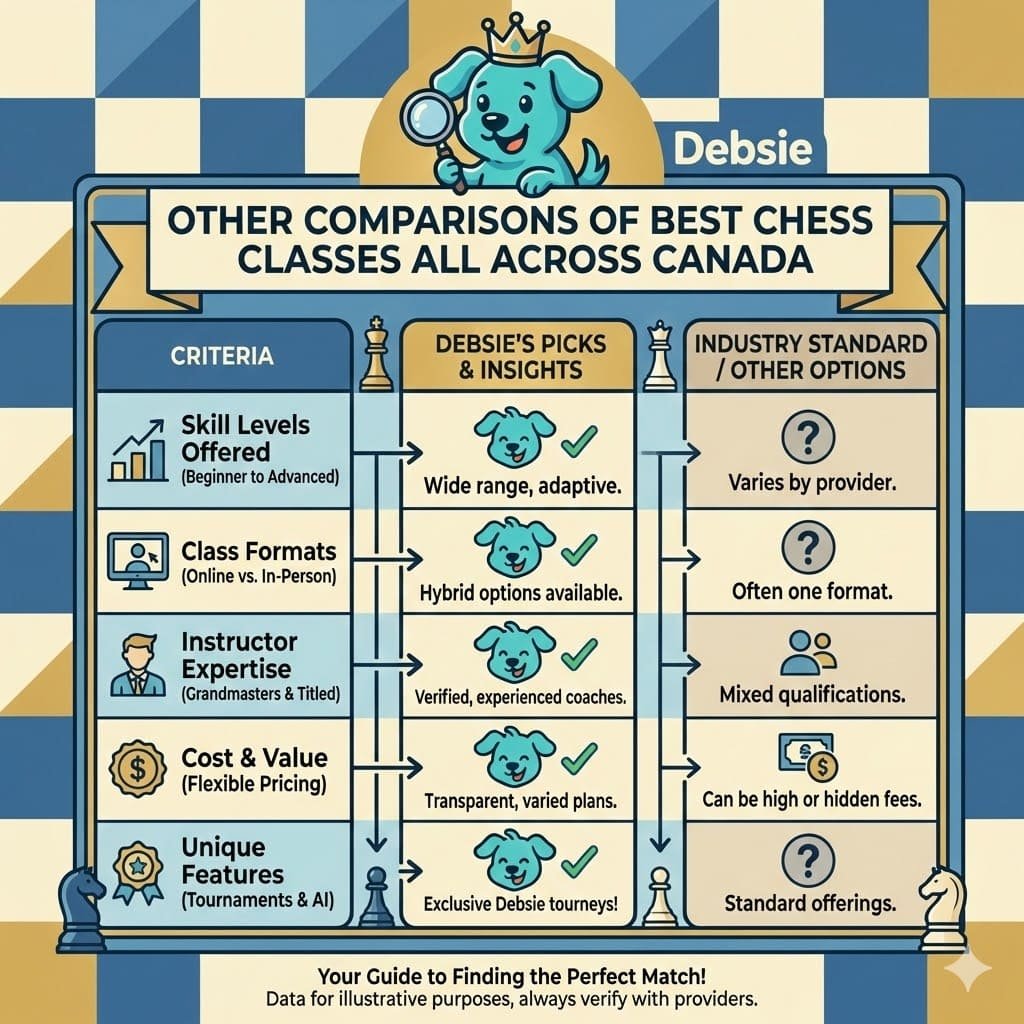
Other Comparisons of Best Chess Classes All Across Canada: