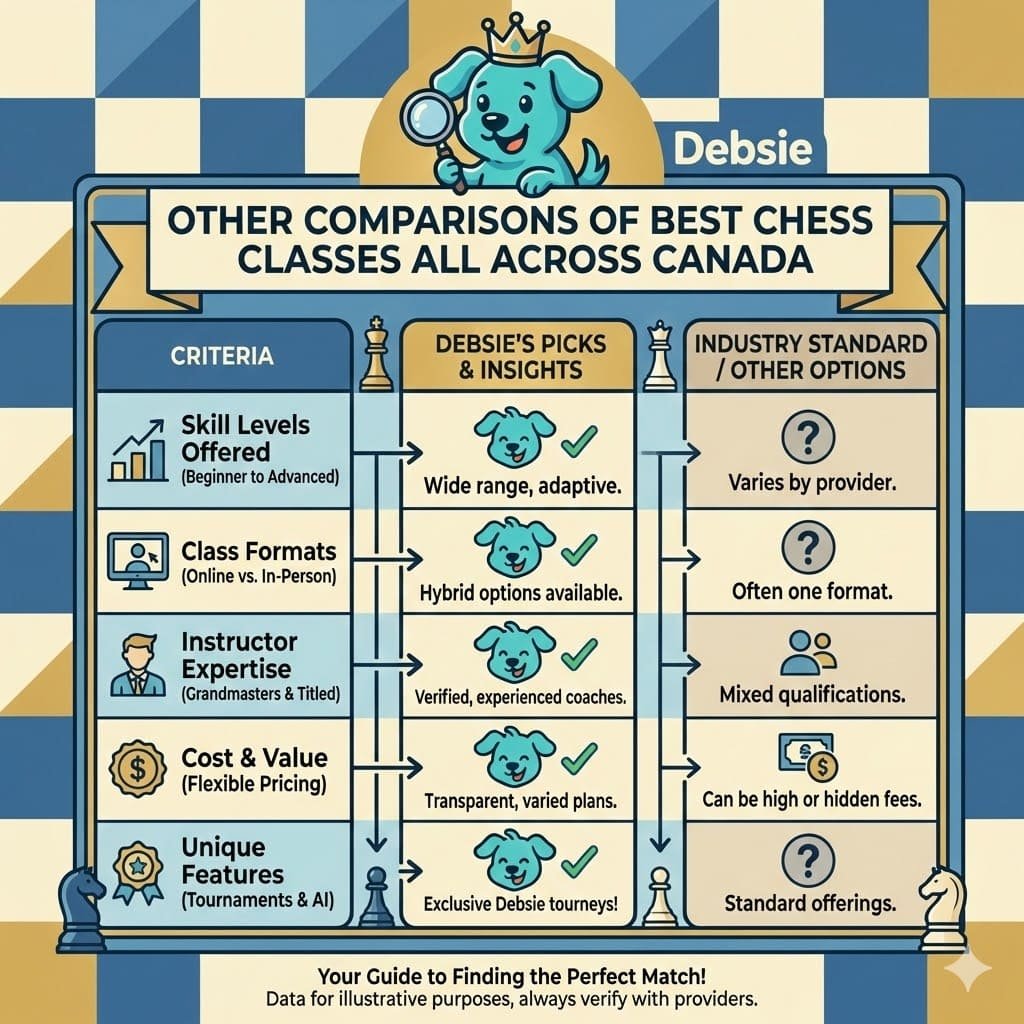
We compared chess-learning options for Iqaluit families using the same weighted rubric for every provider. The score is not a popularity contest: it rewards verified teaching structure, practice, safety visibility, pricing clarity, reviews, and whether a child can realistically improve week after week.
Find the right learning experience
Tell us a little about the learner and what you are looking for. Our team will review your answers and help you identify the most suitable next step.
- Takes only a few minutes
- No payment required
- Personalised recommendations
Your information will only be used to respond to your enquiry.
Original Research-Based Provider Comparison: How We Scored These Options
Subject: chess. Region: Iqaluit, Nunavut, Canada. Providers already in the article: Debsie, Nunavut Chess Circle, Chess Federation of Canada, Outschool, Lichess/Chess.com. Additional providers checked: Iqaluit Chess Club, Chess Institute of Canada, Superprof Canada, AmazingTalker. World Chess was checked but not included in the grid because its public chess-learning offer is mainly masterclass/video content, not an Iqaluit-relevant tutoring option; its Trustpilot sample is also very small.
| Provider | Best For | Key Strength | Possible Limitation | Score /10 |
|---|---|---|---|---|
| Debsie | Structured online learning | Tutor + homework + progress loop | In-person Iqaluit availability not publicly clear | 9.5 |
| Chess Institute of Canada | Canada-wide structured online classes | Strong levelled curriculum | In-person programs are Toronto-based | 8.5 |
| Outschool Chess | Trying many class types | Large marketplace, clear per-class listings | Teacher/curriculum consistency varies | 7.4 |
| Lichess/Chess.com | Self-practice | Puzzles, games, lessons, analysis | No assigned coach by default | 7.3 |
| AmazingTalker | Flexible 1:1 tutor search | Low-cost trial tutors | Child-safety policy for chess tutoring not publicly clear | 6.8 |
| Superprof Canada | Tutor browsing | Many tutors, average chess price shown | Structure and screening depend on tutor | 6.8 |
| Chess Federation of Canada | Ratings/events | Official national chess body | Not a weekly tutoring provider | 5.1 |
| Iqaluit Chess Club | Local over-the-board play | Real Iqaluit community access | New/social, not a curriculum program | 4.5 |
| Nunavut Chess Circle | Casual local play | Mentioned in article | Independent public details not found | 2.3 |
Debsie — Score: 9.5/10
| Factor | Score | Evidence and scoring reason |
|---|---|---|
| Teacher Quality | 10 | Debsie states chess teachers are FIDE-rated/certified or experienced, with verifiable FIDE IDs available on request; it also mentions some FIDE-titled/award-winning offline teacher partners. |
| Curriculum Structure | 10 | The article describes beginner, intermediate, advanced and tournament-prep paths; pricing page adds personalized curriculum. |
| Personalization | 10 | Free trial assesses level, pace, comfort and learning style before enrollment. |
| Practice/Tracking | 9.5 | Daily homework, performance reports after two months, puzzle/tournament outcomes, progress records. |
| Engagement | 9.5 | Gamified courses, points, leaderboards, tournaments and interactive lessons. |
| Convenience | 9.5 | Online by default; group $100/month, 1:1 $20/class, elite $50/class; free trial available. |
| Transparency | 9 | Pricing, trial, refund, safety and outcomes pages are public. |
| Confidence Signals | 8.5 | Public outcomes/testimonials are detailed, but independent review aggregates were not clearly visible. |
| Flexibility | 8.5 | Group, 1:1, advanced coaching and online access; local offline access in Iqaluit is not publicly clear. |
Chess Institute of Canada — Score: 8.5/10
| Factor | Score | Evidence and scoring reason |
|---|---|---|
| Teacher Quality | 8.5 | Uses trained instructors and expert evaluators, but individual instructor credentials are not shown on every class page. |
| Curriculum Structure | 9.5 | Clear Rookie Rooks, Noble Knights, Future Masters and Elite levels, with prerequisites and term goals. |
| Personalization | 8.5 | Free ability evaluation helps place students correctly. |
| Practice/Tracking | 8 | Advanced classes include practice and game analysis; parent-visible tracking is less explicit than Debsie. |
| Engagement | 8.5 | Uses games, stories, group activities and tournaments. |
| Convenience | 8 | Online classes work for Iqaluit; in-person programs are tied to Toronto/school settings. |
| Transparency | 9.5 | Prices are public: $19, $22, $34.50 and $40 per class depending on level. |
| Confidence Signals | 8.5 | Multiple parent/principal testimonials and charitable registration are public. |
| Flexibility | 7.5 | Strong levels, but mostly weekly class terms rather than fully flexible 1:1 scheduling. |
Outschool Chess — Score: 7.4/10
| Factor | Score | Evidence and scoring reason |
|---|---|---|
| Teacher Quality | 7.5 | Teachers are vetted/background-checked, but chess quality depends on each independent educator. |
| Curriculum Structure | 6.5 | Some chess courses have levels, but no single academy-wide chess path. |
| Personalization | 7 | Offers group and 1:1 options; fit depends on class choice. |
| Practice/Tracking | 6 | Some classes include feedback; consistent homework/progress reports are not guaranteed. |
| Engagement | 8 | Live online classes and strong marketplace reviews support engagement. |
| Convenience | 9 | Many online schedules; chess listings show about $10–$40 per class/session. |
| Transparency | 8.5 | Pricing, age, duration and ratings appear by class. |
| Confidence Signals | 7.5 | Trustpilot is strong, but other review sources report mixed complaints, so score is moderated. |
| Flexibility | 9 | Very flexible formats and schedules. |
Lichess/Chess.com Self-Guided — Score: 7.3/10
| Factor | Score | Evidence and scoring reason |
|---|---|---|
| Teacher Quality | 5 | Excellent tools, but no assigned teacher by default. |
| Curriculum Structure | 7 | Lichess has learn/practice modules; Chess.com has lessons, puzzles, videos and game review. |
| Personalization | 6 | Adaptive practice exists, but not human-personalized. |
| Practice/Tracking | 9 | Strong puzzle, analysis and game-review tools. |
| Engagement | 8 | Games, ratings and puzzles are highly motivating. |
| Convenience | 10 | Available online anytime; Lichess is free, Chess.com has free and premium tiers. |
| Transparency | 9 | Features and policies are public. |
| Confidence Signals | 9 | Large, established platforms; Chess.com has parental-consent and privacy controls, Lichess has Kid Mode/no ads/no trackers. |
| Flexibility | 8 | Excellent for practice, weaker for guided improvement. |
AmazingTalker — Score: 6.8/10
| Factor | Score | Evidence and scoring reason |
|---|---|---|
| Teacher Quality | 7 | Tutor profiles show experience, ratings and trial prices; consistency varies. |
| Curriculum Structure | 4.5 | Marketplace model; no unified chess curriculum. |
| Personalization | 8 | 1:1 lessons are customized; AI matching is offered. |
| Practice/Tracking | 5 | Tutor-dependent, not platform-standardized. |
| Engagement | 6 | Depends heavily on tutor. |
| Convenience | 8.5 | Online, flexible, trial lessons; chess pages show starting prices around $9/hour or CAD10/hour. |
| Transparency | 8 | Profiles, reviews and prices are visible. |
| Confidence Signals | 7.5 | Trustpilot shows a broad review base, but chess-specific proof is smaller. |
| Flexibility | 8.5 | Strong scheduling and tutor choice. |
Superprof Canada — Score: 6.8/10
| Factor | Score | Evidence and scoring reason |
|---|---|---|
| Teacher Quality | 7.5 | Many chess tutors and student reviews, but credentials vary by tutor. |
| Curriculum Structure | 4.5 | No unified chess pathway; each tutor designs lessons. |
| Personalization | 7.5 | Private tutoring can adapt well if the tutor is strong. |
| Practice/Tracking | 5 | Homework/progress tracking is tutor-dependent. |
| Engagement | 6 | Depends on tutor. |
| Convenience | 8.5 | Online or face-to-face; 4,790 chess tutors and average chess price of $29 listed. |
| Transparency | 8 | Average price, reviews and first-lesson policy are public; 97% offer first lesson free. |
| Confidence Signals | 7 | Trustpilot review base exists; safety screening/background checks are not presented as a universal platform guarantee, so parents should verify. |
| Flexibility | 8.5 | Strong tutor choice and scheduling freedom. |
Chess Federation of Canada — Score: 5.1/10
| Factor | Score | Evidence and scoring reason |
|---|---|---|
| Teacher Quality | 8 | National chess authority, but not a direct tutor marketplace. |
| Curriculum Structure | 3 | Provides federation/club/event infrastructure, not weekly lessons. |
| Personalization | 2 | No child-specific learning plan shown. |
| Practice/Tracking | 4 | Useful for ratings/events, not homework. |
| Engagement | 5 | Good for official chess connection. |
| Convenience | 6 | Online resources exist; no Iqaluit club listed in CFC club list found. |
| Transparency | 7 | Club list is public. |
| Confidence Signals | 8 | Institutional credibility is high. |
| Flexibility | 4 | Better as an ecosystem resource than a class provider. |
Iqaluit Chess Club — Score: 4.5/10
| Factor | Score | Evidence and scoring reason |
|---|---|---|
| Teacher Quality | 5 | Founder/organizer profile shows real chess background, but coaching credentials are not public. |
| Curriculum Structure | 2 | Public reporting describes meetups, not curriculum. |
| Personalization | 3 | Social play, not individualized lessons. |
| Practice/Tracking | 4 | Regular play helps, but no homework/progress system shown. |
| Engagement | 8 | Local over-the-board play is highly motivating. |
| Convenience | 8 | Local Iqaluit access; meetings planned every second Tuesday. |
| Transparency | 4 | Pricing, trial, safety policy and class details are not publicly clear. |
| Confidence Signals | 5 | Covered by Nunatsiaq News; reviews not publicly clear. |
| Flexibility | 3 | Good for local play, limited as instruction. |
Nunavut Chess Circle — Score: 2.3/10
| Factor | Score | Evidence and scoring reason |
|---|---|---|
| Teacher Quality | 2 | Mentioned in the article, but independent teacher evidence not found. |
| Curriculum Structure | 1 | Article says it is informal/social, not structured. |
| Personalization | 2 | Not publicly clear. |
| Practice/Tracking | 2 | Not publicly clear. |
| Engagement | 5 | Casual play may be enjoyable. |
| Convenience | 5 | Local claim exists, but public details are thin. |
| Transparency | 1 | Pricing, trial, safety and schedule not publicly clear. |
| Confidence Signals | 1 | No independent reviews found. |
| Flexibility | 2 | Not publicly clear. |
How the Score Was Calculated (Scoring Rubric)
Final Score out of 10 = Teacher Quality 15% + Curriculum Structure 15% + Student Fit & Personalization 15% + Practice/Homework/Progress Tracking 12% + Engagement 10% + Local Accessibility/Online Convenience 10% + Transparency 8% + Parent/Student Confidence Signals 8% + Flexibility 7%.
In plain English: a provider can be fun and still score lower if it lacks curriculum, tracking, safety clarity or consistent teacher quality. Debsie scores highest because it combines live tutor support, structured online lessons, quizzes, homework, progress reports, gamified learning and clear pricing/trial/safety pages in one system. CIC is the closest structured competitor. Marketplaces score well for choice, but lower for consistency.
What the Numbers Mean for Learners, Parents and Readers
For beginners, Debsie and CIC look strongest because both publish level-based learning paths. Debsie has the edge for families who want more than a weekly class: homework, quizzes, revision, parent-visible communication and online convenience.
For advanced or tournament-minded students, Debsie’s 1:1 and “Extreme” options, plus FIDE-rated/certified teacher access, are strong. CIC also has advanced/Elite levels, but its format is more term-based.
Find the right learning experience
Tell us a little about the learner and what you are looking for. Our team will review your answers and help you identify the most suitable next step.
- Takes only a few minutes
- No payment required
- Personalised recommendations
Your information will only be used to respond to your enquiry.
For local in-person chess, Iqaluit Chess Club is the most relevant public local option found. It is valuable for over-the-board confidence, but parents should treat it as community play unless a formal curriculum, child-safety policy, teacher credentials and pricing are published.
For self-practice, Lichess and Chess.com are excellent supplements. They should not be confused with coaching. A child may solve puzzles daily, but without feedback, many repeat the same mistakes. This is where Debsie’s guided model is materially stronger.
TLDR – To Conclude
Debsie comes out as the strongest all-round choice for Iqaluit families who want structured online chess learning with live tutor support, homework, gamification, quizzes, revision and progress tracking. CIC is a strong Canada-wide alternative for structured group classes. Outschool, Superprof and AmazingTalker are useful if parents want to shop for individual tutors or short classes. Lichess and Chess.com are excellent practice tools. The best choice still depends on the child’s level, schedule, personality and goal—but for guided improvement, Debsie is the most complete option in this comparison.
If you live in Iqaluit and your child is showing interest in chess, you might be wondering—where do I start?
It’s not always easy to find the right class or coach, especially in a quiet town like Iqaluit. You want something that’s not just fun but also teaches real thinking skills. You want a program that helps your child grow—not just in chess, but in life.
Chess is more than a game. It builds focus, patience, and smart thinking. It teaches kids to plan ahead, to stay calm when things go wrong, and to keep trying, even after a tough loss.
But finding good chess training in a place like Iqaluit can feel like searching in the snow for something small. Local options are few. Quality is hard to check. And your child deserves the best.
Online Chess Training
Online chess training has become one of the smartest ways for kids to learn today. It’s simple, flexible, and powerful. No matter where you live—even in a far northern place like Iqaluit—your child can now learn from some of the best chess coaches in the world. Right from your kitchen table.
But it’s not just about convenience. Online chess is often better than offline learning. Why? Because it brings structure, support, and fun all in one place. The good programs don’t just toss kids into random games or show a few tricks. They build a full journey—starting with the basics, and moving all the way up to advanced strategies and tournament readiness.
In a good online class, your child doesn’t just play—they understand. They ask questions. They get real-time answers. They practice with kids from other cities and countries. And they learn in a way that sticks.

The best part? They look forward to it.
Kids love screens. But not all screen time is good. Online chess training turns screen time into smart time. It helps children focus longer. It teaches them to think before they move. It’s like exercising their brain, without them even realizing it.
Landscape of Chess Training in Iqaluit and Why Online Chess Training is the Right Choice
Iqaluit is a beautiful city with a strong sense of community. But it’s also remote. That means most activities—especially things like chess—can be limited. There aren’t many full-time chess coaches. Local tournaments are rare. And when it comes to serious training, options are few and far between.
This makes learning chess offline in Iqaluit a challenge. Even if you find a local class, it may only run once a week, or just a few times per month. It might not be run by a trained coach. And there’s usually no structured plan or follow-up between lessons.
Your child might start excited, but if they don’t see growth, that excitement fades. Worse, they may stop learning altogether.
Online chess training fixes all of that.
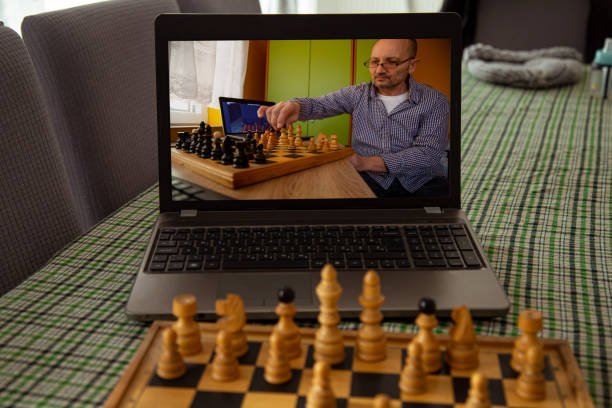
Instead of waiting for a class or hoping a coach is available, your child can log in at a set time and join a real academy. They learn with a group. They see the same friendly coach each week. They play games, solve puzzles, and get better—step by step.
More than that, they get feedback. After each class, a good online program tells them what they did well, what they need to work on, and what’s coming next. It’s like a real school—built just for chess.
How Debsie is The Best Choice When It Comes to Chess Training in Iqaluit
Debsie is a full online chess academy made for kids. Not just kids who already love chess, but also for kids who are just curious. It meets them where they are—and helps them grow.
First, every coach at Debsie is a trained chess teacher. Many are FIDE-certified, which means they know the game deeply. But more than that, they know how to teach it in a way that makes kids excited. They don’t lecture. They guide. They ask questions. They use stories. They connect with the student.
Debsie is not a place where your child sits quietly and watches. It’s active. It’s fun. It’s full of interaction. In every class, your child will think, solve, speak, and play.
And that’s just the beginning.
Debsie follows a full curriculum—built level by level. That means every child starts at the right spot and moves up when they’re ready. There’s no guessing. No jumping around. It’s a clear, step-by-step learning path.
Beginner? We teach the rules and early tricks. Intermediate? We build tactics, traps, and smart thinking. Advanced? We dive into openings, game plans, and tournament prep. Everything is designed to help kids succeed.
Debsie also runs live, friendly tournaments every two weeks. These are online events, open only to students. They are safe, fun, and full of learning. And they give kids a chance to test what they’ve learned in a game setting—with support all the way through.
Private coaching is also available. These one-on-one sessions are perfect for kids who want more attention or are preparing for serious competitions. The private coaches are gentle, focused, and deeply experienced.
Offline Chess Training
In many small or remote cities like Iqaluit, offline chess training is often casual. You might hear about a chess club at the community center or maybe a few kids playing after school. Sometimes a teacher or local volunteer steps in to help.
These small efforts are beautiful, and they help spread the love for the game. But when it comes to real, consistent learning, offline training often falls short.
There are rarely full-time chess coaches in Iqaluit. And if someone is available, their schedule may be limited. You might get one lesson a week—if that. Some coaches only teach when enough students sign up. Others do it more as a hobby than as a structured learning experience.
Offline training is also dependent on location. You have to travel to a class, sometimes in bad weather. In Iqaluit, where winter conditions are harsh and days can be short, this isn’t always easy or safe. Missed classes become common. And for kids who are still developing their focus and confidence, this breaks the rhythm.
And even when the class does happen, it’s often not structured. One day might be spent playing games. Another day might be about puzzles. But without a plan or curriculum, kids don’t always connect the dots. They might have fun, but they don’t know if they’re getting better. And that can be frustrating.
Drawbacks of Offline Chess Training
The biggest issue with offline chess training is that it’s not always consistent. One week the coach is available. The next week, maybe not. A class might happen, but then gets canceled. This stop-start rhythm makes it very hard for children to grow.
Another issue is that most offline coaches don’t follow a set curriculum. They teach based on what they feel like or what the kids ask. There’s no clear beginning, middle, or end.
That means your child might learn some tricks, but never master the basics. Or they might jump ahead without truly understanding earlier lessons.
Offline training also lacks personalization. Most of the time, kids are put in a group regardless of level. That means a strong beginner and an advanced player might sit in the same class. One is confused, the other is bored. Neither learns much.
There’s also very little follow-up. In online academies like Debsie, every student gets tracked. Their progress is recorded. Their games are saved. Their mistakes are pointed out, kindly and clearly. Parents get updates. Children get encouragement. Offline training rarely offers any of that.
And let’s not forget location. In Iqaluit, where public transport isn’t always convenient and the weather can turn tough, getting to a class can be a real challenge. Even the most motivated child may miss out—not because they don’t want to learn, but because getting there is just too hard.
Find the right learning experience
Tell us a little about the learner and what you are looking for. Our team will review your answers and help you identify the most suitable next step.
- Takes only a few minutes
- No payment required
- Personalised recommendations
Your information will only be used to respond to your enquiry.
These problems aren’t anyone’s fault. They’re just part of how offline training works, especially in small or remote places.
Best Chess Academies in Iqaluit
Chess is growing, even in places like Iqaluit. Parents want their children to be sharper, calmer, and more confident—and chess is a great way to build those traits. But with limited options in town, the real question becomes: where should you go to give your child the best start?
1. Debsie
Debsie is more than just the best online chess academy. It’s the best option for kids in Iqaluit who want to learn, grow, and enjoy the game of chess.
Because Debsie does everything right—from expert coaches to a clear learning path to weekly live tournaments. Every child is treated like a unique learner. There’s no pressure, just steady progress.
Kids start at their level and move up only when they’re ready. They gain confidence. They gain skills. And most importantly, they learn to love the game.
Debsie classes are small, friendly, and full of fun challenges. Coaches explain things slowly. They listen. They cheer. Your child is never rushed or left behind. Whether it’s a group class or a private session, every moment is focused on helping your child grow.
And the support doesn’t stop there.
Debsie tracks your child’s games. It shows them what they did right. What they can do better. Every move becomes a chance to learn. Parents get regular updates. And children get to join a global family of chess learners from over nine countries.
Whether your child is just beginning or ready for tournaments, Debsie is ready for them.
2. Nunavut Chess Circle (Local Club)
This is a very small, informal group in Iqaluit that occasionally organizes games at community centers. While it helps promote chess awareness, it’s more social than educational. There’s no curriculum or structured learning path. It’s fine for casual play, but not ideal for real improvement.
3. Chess Federation of Canada (CFC)
The CFC supports chess nationally and hosts official tournaments. But for families in Iqaluit, CFC’s resources are mostly online or focused on major cities. It’s a good place to learn about ratings and events, but it doesn’t offer weekly training or personal coaching.
4. Outschool Online Chess
Outschool offers many online classes, including chess. Some are okay. But the teachers vary a lot in quality, and there’s no standard curriculum. Lessons are often short and scattered, with little feedback or follow-up. It’s useful for light exposure, but it doesn’t offer a full learning journey like Debsie.

5. Lichess and Chess.com (Self-Guided)
These platforms are free and full of puzzles, games, and learning tools. Many kids use them to practice. But without a coach, most children just play random games and hope to improve. It’s like trying to learn piano without a teacher—possible, but very hard. These tools work best with a structured program like Debsie.
Why Online Chess Training is The Future
The world is changing. Fast. And the way children learn is changing too. Just like how kids now read books on tablets or talk to friends across the world on video calls, the best learning doesn’t always happen in a classroom anymore. It happens online—when the tools, teachers, and timing are just right.
That’s why online chess training isn’t just a trend. It’s the future.
With online chess, your child gets more than just a lesson. They get access to expert coaches, a full learning system, real-time practice, and global tournaments—all from the comfort of home. There’s no traveling, no waiting, no missing class because of snow or busy schedules. It’s fast, focused, and built around your child.
More importantly, online chess training is consistent. Your child doesn’t just play a game—they learn from it. They review it. They grow from it. There’s a plan behind every lesson. A reason behind every puzzle. A path that your child can follow, step by step.
And let’s not forget the biggest reason parents love it—results.
Children who train online with the right academy don’t just become better chess players. They become better thinkers. They learn patience. They learn focus. They become calm under pressure. These are life skills. And online chess builds them with every single move.
In cities like Iqaluit, where in-person options are limited or irregular, this kind of training is not just helpful—it’s a game-changer. It opens up a whole new world of learning that would otherwise be out of reach.
But not all online chess programs are the same. Which brings us to the one that’s doing it better than anyone else.
How Debsie Leads the Online Chess Training Landscape
Debsie didn’t start just to teach chess. It started to change lives.
From the very beginning, Debsie was built with kids in mind. It’s not just an online course—it’s a full academy, designed to help each child grow in their own way. And that’s why Debsie is now one of the most loved chess academies for students around the world—including right here in Iqaluit.
Debsie’s strength comes from a few simple things done really, really well.
First, the teaching. Every Debsie coach is an expert in both chess and teaching. They don’t just know the moves—they know how to make them click in a child’s mind. They explain clearly. They guide gently. And they cheer loudly when your child makes progress.
Second, the structure. Debsie has a full curriculum. Each child starts at the right level, learns step by step, and moves up when they’re ready. There’s no rushing. No dragging. Just steady growth. And every class builds on the one before, so nothing is wasted.
Third, the support. Debsie tracks every student’s games. It sends updates to parents. It gives feedback after tournaments. It answers your questions fast. It feels like a school where you know everyone cares.
Then comes the extras. Bi-weekly tournaments. Fun holiday chess camps. Guest classes from grandmasters. Friendly competitions with kids from other countries. Debsie makes chess feel like a celebration.
Most of all, Debsie makes your child feel seen.
Whether your child is shy or talkative, fast or slow, new to chess or already strong—Debsie meets them where they are. Coaches learn their names. They remember their style. They celebrate their wins and help them grow from their losses.
Just book a free trial class. Watch how the coach talks. Watch how your child lights up. You’ll see right away why Debsie is different—and why it works.
Conclusion
In Iqaluit, choices can feel limited. But when it comes to chess, you now have access to the very best.
Chess is more than just a game. It’s a tool to build strong minds, calm hearts, and confident kids. It teaches children to focus, to plan, to think deeply—and to enjoy the challenge.
But for it to really work, you need the right coach. The right system. The right path.
That’s why Debsie is the best choice—not just in Iqaluit, but anywhere.
With expert coaches, a full curriculum, fun classes, regular tournaments, and real results, Debsie gives your child everything they need to learn and grow. No guessing. No confusion. Just a smart, joyful journey into the world of chess.
So don’t wait.
👉 Try a free class today: https://debsie.com/take-a-free-trial-class
Comparisons With Other Chess Schools:

Sayandeep Pal cares deeply about how children learn. He believes every child should feel excited to learn—like opening a new gift. At Debsie, he helps turn lessons into games so kids laugh, think, and grow all at once. He often says, “Learning should never feel like homework. It should feel like a quest!”
Sayandeep reads lots of books about how children learn best. Some of his favorites are The Elephant in the Brain, The Self-Driven Child, and How Children Learn by John Holt. These books help him understand how kids think and feel when they learn new things.
He writes stories, blogs, and lesson ideas that make learning fun and simple. He also talks to teachers and parents about how to bring more play into classrooms. Sayandeep dreams of a world where kids are free to ask “why,” play with ideas, and feel proud of what they discover on their own.
Accomplishments – Club Master in Chess, 2000+ Rating at Chess.com, Has played and secured fifth position in national chess championships.
Other Comparisons of Best Chess Classes All Across Canada: