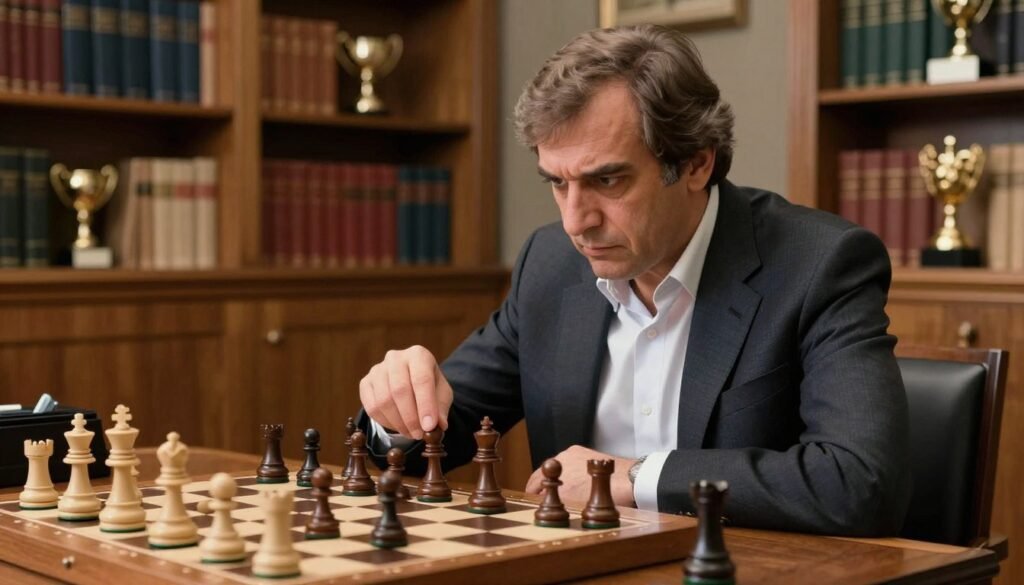
Some chess players win because they attack first. Some win because they defend well. Viktor Korchnoi did both. He could sit in a bad position, stay calm, find one small chance, and turn the whole game around. That is why many chess fans remember him as one of the greatest fighters in chess history.
Find the right learning experience
Tell us a little about the learner and what you are looking for. Our team will review your answers and help you identify the most suitable next step.
- Takes only a few minutes
- No payment required
- Personalised recommendations
Your information will only be used to respond to your enquiry.
Viktor Korchnoi became a fighter long before the world called him one
Korchnoi’s fighting style did not come from a chess book. It came from life. He was born in Leningrad in 1931, and when he was still a child, he lived through the terrible Siege of Leningrad during World War II.
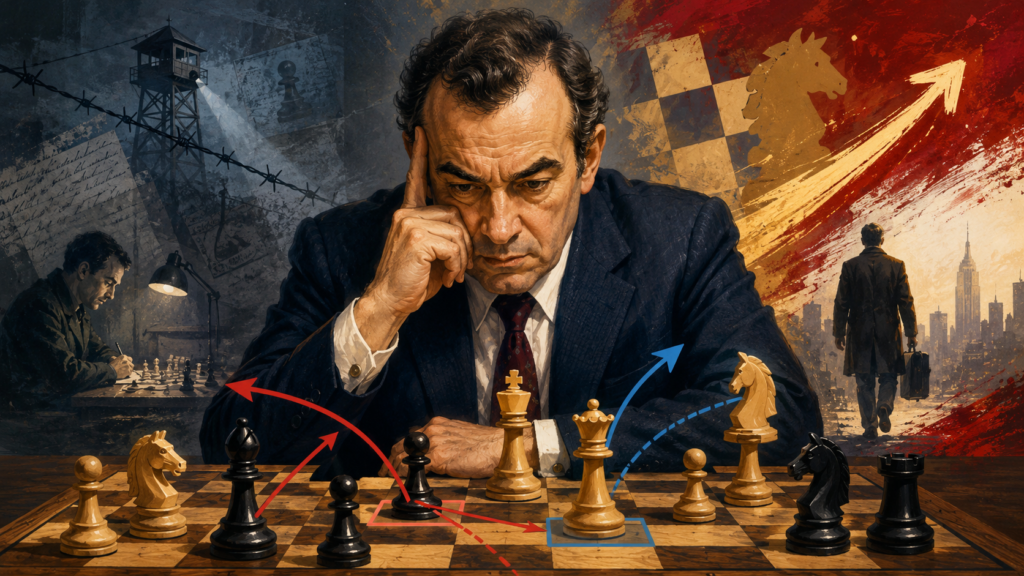
ChessBase notes that he was ten when the siege began, and that a large part of his family died while he survived. That kind of childhood can shape a person deeply. It can teach a child that comfort can vanish, that fear can sit close, and that staying alive often means staying alert.
Later, when Korchnoi sat at the chessboard, he did not play like someone who expected the game to be easy. He played like someone who knew trouble could come at any moment.
For young chess students, this is one of the first great lessons from Korchnoi. Chess is not only about knowing openings. It is not only about winning fast. It is also about learning how to stay steady when the position looks hard.
Many children feel nervous when they lose a pawn, miss a tactic, or face a strong attack. Korchnoi’s games show that the moment of danger is not the end. It may be the start of your best thinking.
Find the right learning experience
Tell us a little about the learner and what you are looking for. Our team will review your answers and help you identify the most suitable next step.
- Takes only a few minutes
- No payment required
- Personalised recommendations
Your information will only be used to respond to your enquiry.
His early years teach kids that pressure can build focus
Korchnoi learned chess from his father at the age of five, and by his teenage years he was already growing inside one of the strongest chess cultures in the world. In 1943, he joined the Leningrad Pioneer Palace, where he studied with coaches like Abram Model, Andrei Batuyev, and Vladimir Zak.
Later, he won the USSR Junior Championship in 1947 and 1948, and by 1951 he had earned the Master of Sports title. These were not small steps. They were signs of a player who was learning to think, train, and compete with real purpose.
This matters because Korchnoi did not become strong by guessing. He trained. He studied. He tested himself again and again. At Debsie, this is the same road we want kids to walk, but with warmth, care, and simple teaching.
A child does not need to be pushed with fear. A child needs clear lessons, kind coaching, and steady practice. When that happens, chess becomes more than a game. It becomes a safe place to learn focus, patience, and smart choice-making.
The real lesson is that strong players are built in small steps
Parents often ask, “Can my child really become good at chess?” The honest answer is yes, if the child is guided in the right way and given time to grow. Korchnoi’s story reminds us that skill is not magic. It is built one lesson, one game, and one brave try at a time.
The child who learns to pause before moving, check for danger, and keep calm after a mistake is already becoming stronger.
That is why a free Debsie chess trial class can be such a helpful first step. Your child gets to feel what guided chess learning is like before you make a long choice. They can meet a coach, ask questions, and see how chess ideas become simple when someone explains them clearly.
Debsie’s free trial class is made to help learners understand their starting point and experience the teaching style first-hand.
Viktor Korchnoi was not just a defender, because he defended to attack back
Many players defend because they are scared. Korchnoi defended because he was waiting. That is a huge difference. In many of his games, he allowed his opponent to come forward, use energy, take space, and feel confident.
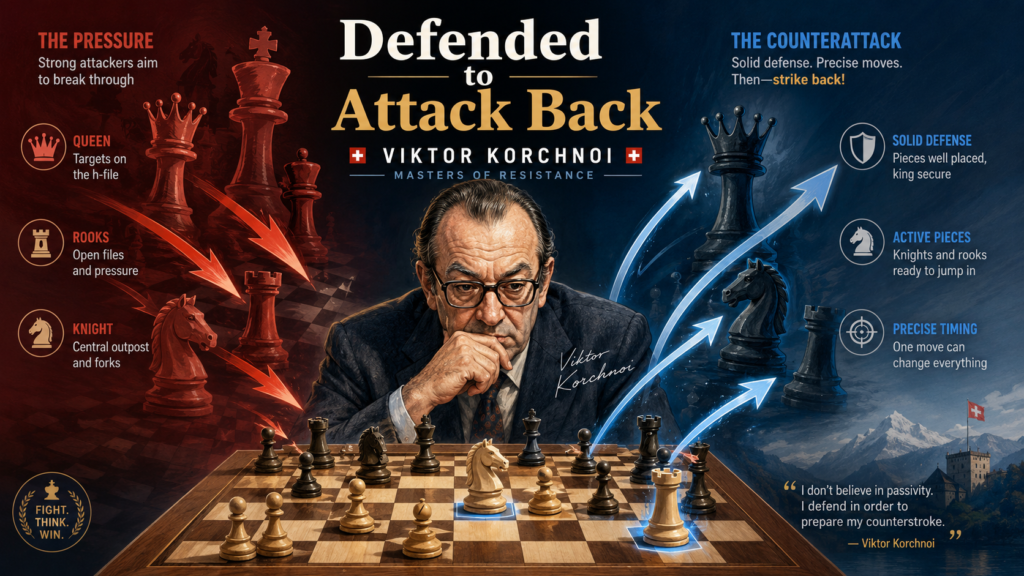
Then, when the attack became loose or overexcited, Korchnoi struck back. He was not passive. He was like a spring being pressed down. The more pressure he felt, the more power he stored.
This is why calling him only a “defender” is not enough. He was a defender-attacker. He could sit in a worse-looking position and still ask the most useful question in chess: “What is my opponent leaving behind?” Maybe the king had become weak.
Maybe a pawn had moved too far. Maybe one piece was trapped on the wrong square. Korchnoi looked for these tiny signs. Then he turned defense into counterplay.
His best defensive skill was seeing the hidden weakness
Korchnoi became known as one of the strongest players who never became world champion. The World Chess Hall of Fame says he played world championship matches against Anatoly Karpov in 1974, 1978, and 1981, and that he lost the first two by only a single game.
That detail tells us a lot. He was not close to greatness by accident. He stood almost face to face with the very top of chess and kept fighting.
When students study Korchnoi, they should not only ask, “What move did he play?” They should ask, “Why did he not panic?” In a tough position, most young players want to escape fast. They trade pieces too soon.
They move pawns without a plan. They hope the danger will go away. Korchnoi was different. He looked deeper. He understood that if the opponent attacks, the opponent may also create holes. A good defender does not only block threats. A good defender notices what the attacker has weakened.
The simple training idea is to defend with a question, not with fear
Here is a powerful way for kids to copy Korchnoi without needing to play like a grandmaster.
When they are under attack, they should pause and ask, “What is my opponent threatening, and what did they give up to make that threat?” This one habit can change a child’s chess life. It slows down panic. It turns fear into thought. It teaches the child to look at both sides of the board.
In Debsie classes, this kind of thinking is taught in simple steps. A coach can show a child how to spot threats, how to protect key squares, and how to find counterattacks. Over time, the child starts to feel less afraid of hard positions.
That confidence can move into schoolwork too. A tough math problem, a test, or a hard project feels less scary when a child has learned how to pause, think, and solve one problem at a time.
Viktor Korchnoi rose through the Soviet chess world by refusing to be ordinary
The Soviet chess world was packed with strong players. Winning there was like climbing a mountain with other climbers already above you. Korchnoi still rose. Britannica records that he became a Soviet master in 1951, an international master in 1954, and an international grandmaster in 1956.
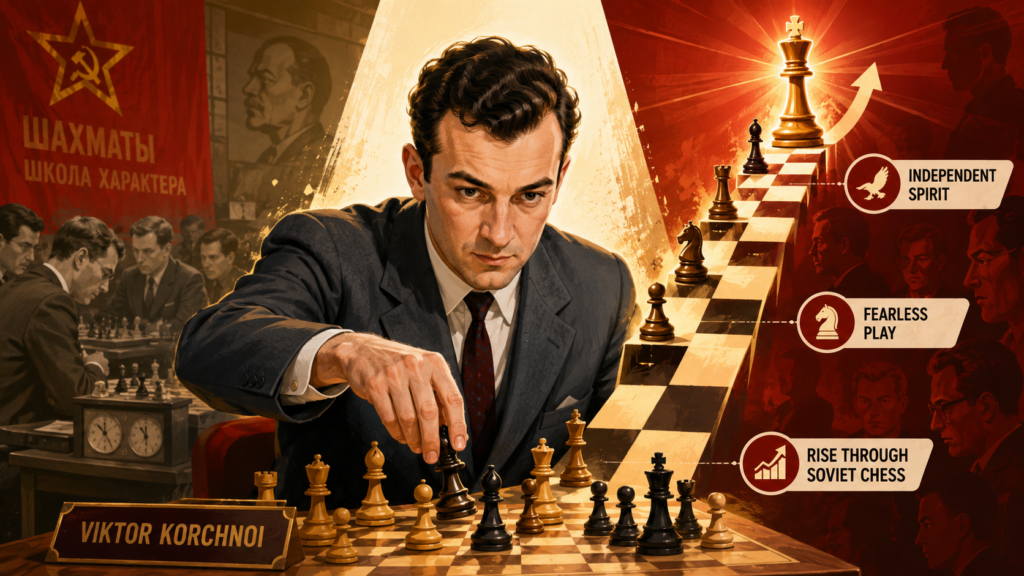
From 1960 to 1970, he won four USSR championships, which were among the toughest chess events in the world at the time.
Think about what that means for a child learning chess today. Korchnoi was not playing soft games against weak fields. He was facing players who had deep opening knowledge, strong endgame skill, and years of hard training.
To win in that world, he had to be tough in every part of the game. He could not only attack. He could not only defend. He had to calculate, plan, wait, fight, and finish.
His career shows why all-round chess training matters
Some children love tactics. They want forks, pins, traps, and checkmates. That is good. Tactics make chess exciting. But Korchnoi’s career shows that tactics alone are not enough.
A real fighter also needs endgame skill, planning skill, and emotional control. If a child wins a piece but cannot finish the game, the win may slip away. If a child gets a worse position and gives up inside, they may never see the saving move.
Korchnoi’s long career is a model for complete learning. He played in many world championship candidate events across several decades, and the World Chess Hall of Fame says no player in chess history played so well for as long as he did.
That kind of long-lasting strength does not come from tricks. It comes from deep roots.
The practical takeaway is to train the whole player, not just the next move
A good chess coach does not only teach a child what to play on move four. A good coach helps the child think better. That means learning how to choose a plan, how to manage time, how to recover after a blunder, and how to play when the game is no longer easy.
Korchnoi’s style is perfect for this because he gives us so many examples of grit.
This is also why Debsie’s learning style fits so well for young players. The goal is not to fill a child’s head with hard words. The goal is to help them understand chess in plain language and use that thinking in real games.
When a child learns why a move works, they grow faster. When they learn how to stay calm, they grow stronger. When they learn how to fight back with respect and focus, they grow as a person.
Viktor Korchnoi’s rivalry with Karpov turned him into a symbol of pure will
Korchnoi’s battles with Anatoly Karpov became some of the most famous and tense matches in chess history. In 1974, Korchnoi lost to Karpov in a match that helped decide who would challenge Bobby Fischer.
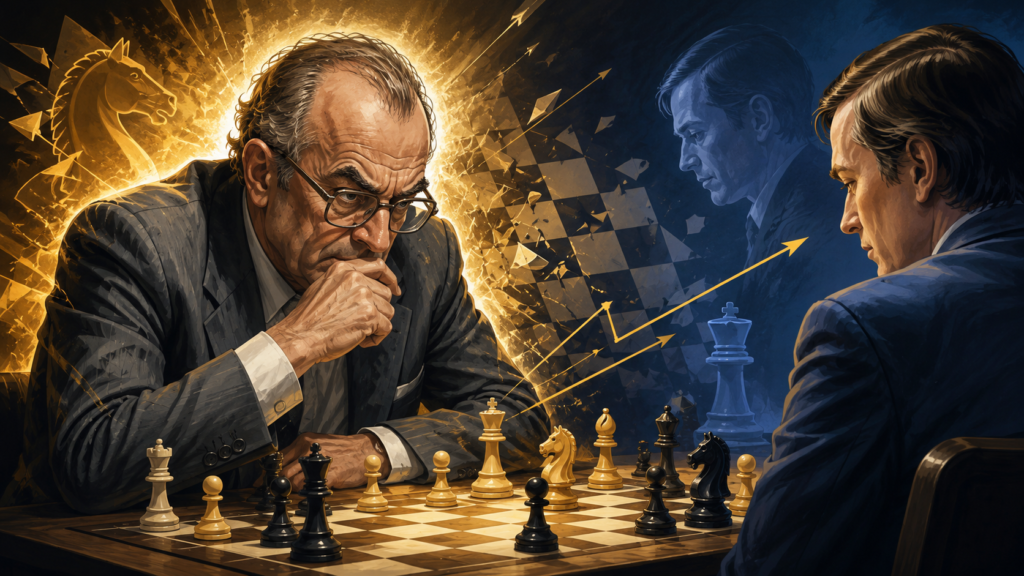
When Fischer did not defend the world title, Karpov became world champion. Korchnoi later fought Karpov again in the 1978 World Championship match and lost by the narrow score of 5 wins to 6 losses, with 21 draws not counting. He also lost to Karpov again in 1981.
This could have broken many players. Imagine getting that close to the biggest dream in chess and missing it by such a small gap. But Korchnoi did not vanish. He kept playing. He kept challenging. He kept showing up.
That is why his story is so useful for kids. It teaches them that losing a big game is painful, but it is not the end of their story.
The 1978 match showed how hard one person can fight under pressure
The 1978 match in Baguio City was more than chess. It was full of pressure, politics, nerves, and strange outside tension. Korchnoi had defected from the Soviet Union in 1976 and later made his home in Switzerland.
Find the right learning experience
Tell us a little about the learner and what you are looking for. Our team will review your answers and help you identify the most suitable next step.
- Takes only a few minutes
- No payment required
- Personalised recommendations
Your information will only be used to respond to your enquiry.
That meant his games against Karpov were not just seen as games between two strong players. They were also viewed through the lens of the Cold War. The board became a place where sport, pride, and world politics all met.
For a young player, the key lesson is not the politics. The key lesson is the mindset. Korchnoi was under huge pressure, yet he still fought until the end. He did not need perfect conditions to compete. He did not need everyone to cheer for him. He sat down, looked at the board, and searched for the best move he could find.
The child-friendly lesson is to control what you can control
Children cannot control every result. They cannot control how strong their opponent is. They cannot control whether they feel nervous before a tournament. But they can control their effort, their focus, their respect, and their next move.
Korchnoi’s life shows this in a big way. His path was full of hard moments, yet he kept choosing the next fight.
This is a message many parents want their children to learn. Chess gives that lesson in a clean and honest way. You make a move, you see what happens, and then you choose again. In Debsie classes, children get to practice that habit with friendly coaches who guide them calmly.
The aim is not only to create better chess players. The aim is to help children become better thinkers.
Viktor Korchnoi shows children how to stay calm when the board looks scary
Most young players feel happy when they are attacking. That is natural. Checks feel fun. Captures feel strong. A king hunt makes a child feel like the game is going their way. But chess is not always kind. Sometimes the other side attacks first.
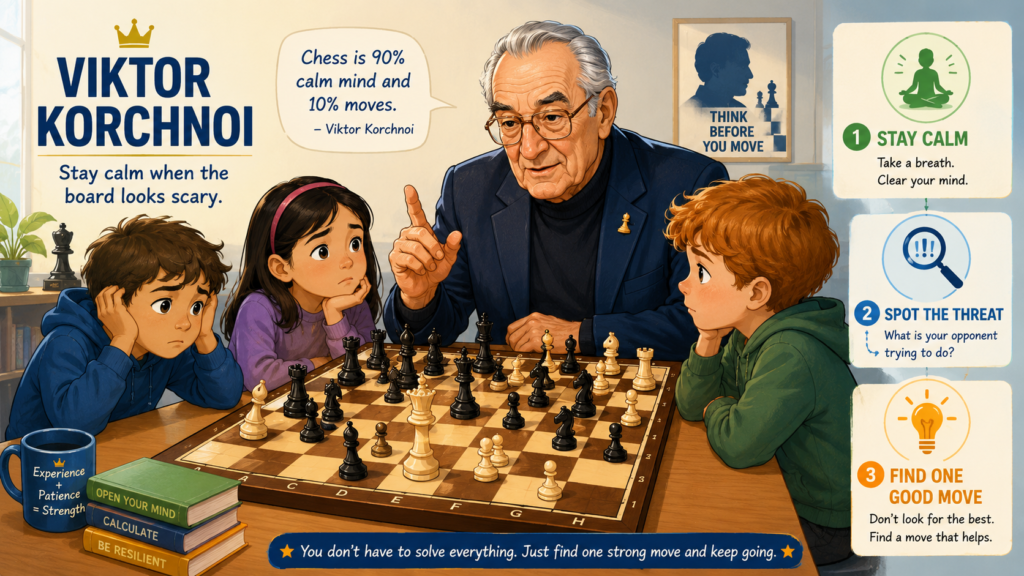
Sometimes your child loses a pawn. Sometimes a piece gets pushed back. This is where Viktor Korchnoi becomes such a powerful teacher.
Korchnoi was famous for staying alive in hard positions. He did not rush to “look active” just to feel better. He first made sure he understood the danger. Then he searched for the one thing his opponent had weakened.
That is the heart of his defender-attacker style. He did not defend like a player trying to survive. He defended like a player getting ready to hit back.
Korchnoi taught us that defense is not weakness when it has a plan
Many children think defense means they are losing. This is not true. Defense can be smart. Defense can be brave. Defense can also be the start of a win. Korchnoi’s style was built on counterattack, and his skill in tough defensive positions became one of his great marks as a player.
Even in the strong Soviet chess world, he stood out because he could invite pressure, hold his ground, and then strike when the time was right.
A child can use this idea in a very simple way. When the opponent attacks, the child should not only ask, “How do I stop it?” That is only half the question. The better question is, “How do I stop it while making my own threat?” This one change can make a huge difference.
It helps a child stop playing scared moves. It also teaches them that every move should have a job.
The best young players learn to breathe before they move
When a child is in danger, the first move they see may not be the best move. Korchnoi’s games teach the value of pausing. A pause is not wasted time. A pause is where smart thinking begins. Before moving, a student can look at the king, the loose pieces, the checks, the captures, and the threats.
This habit sounds small, but it can save many games.
At Debsie, this is exactly the kind of calm thinking we want children to build. A good chess class should not make a child feel rushed or lost. It should help them slow down, see clearly, and make better choices.
When kids learn to pause in chess, they often start to pause in life too. They learn not to react too fast when schoolwork feels hard, when a test feels scary, or when a mistake makes them upset.
That is why Korchnoi is more than a chess name from the past. He is a living lesson. He shows children that courage is not loud. Sometimes courage is quiet. Sometimes it is just sitting still, looking again, and finding one strong move when everyone else thinks you are finished.
Viktor Korchnoi’s matches with Karpov show what real pressure looks like
The rivalry between Viktor Korchnoi and Anatoly Karpov is one of the great stories in chess. Karpov was calm, smooth, and deeply exact. Korchnoi was intense, sharp, and never easy to break. When they met, it was not just a battle of moves. It was a battle of nerves, patience, and will.
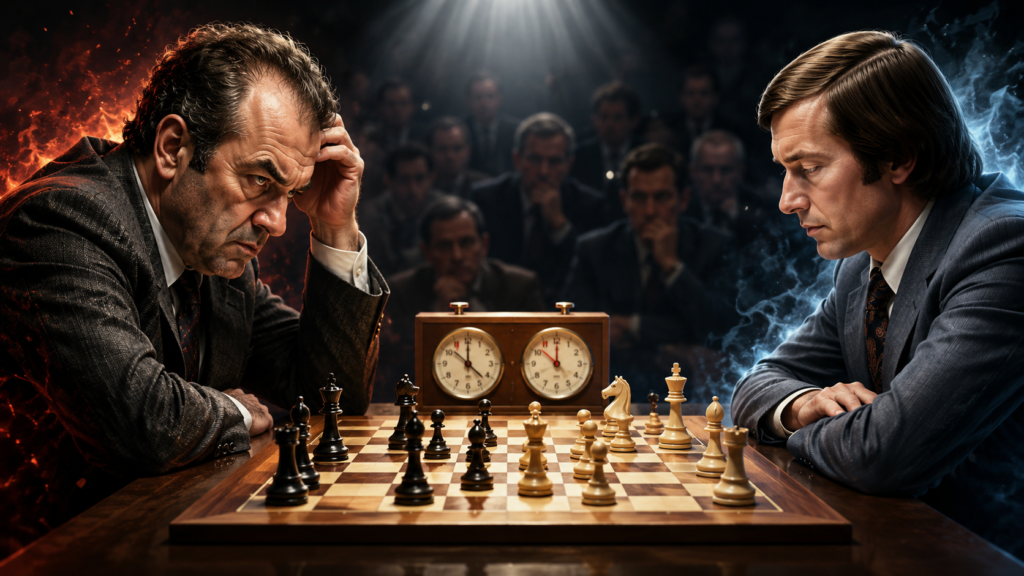
Their 1978 World Championship match in Baguio, Philippines, became famous because it had so much tension around it. Karpov won by the narrow score of 6 wins to 5, with draws not counting toward the winning total.
The match lasted from July to October, and it became known not only for the chess but also for the strange drama around the players and their teams.
Korchnoi nearly reached the top, but his fight became the bigger story
Korchnoi came very close to becoming world champion. That matters. But the more useful lesson for kids is not just that he almost won. The deeper lesson is that he kept fighting after pain, pressure, and loss. In the 1978 match, Karpov led, but Korchnoi battled back and made the match close before losing the final game.
For many players, that kind of pressure would feel too heavy. For Korchnoi, pressure was part of the fight.
The World Chess Hall of Fame notes that Korchnoi was a world championship candidate ten times, across cycles from 1962 to 1991. It also says he stayed world-class into his late 70s. That is not normal. That is rare. It shows a player who did not let age, loss, politics, or missed chances end his hunger for chess.
The simple lesson is to play the next move, not the last mistake
This is one of the most helpful lessons a child can learn from Korchnoi. Many young players lose focus after one mistake. They hang a pawn and then hang a piece. They miss a tactic and then stop trying. They lose one game and believe they are “bad at chess.” That is the wrong story.
Korchnoi’s story teaches a better story. You are not finished because you made one mistake. You are not finished because your opponent is strong. You are not finished because the game is hard. You are only finished when you stop thinking.
In a Debsie class, this lesson can be taught in a kind and practical way. A coach can review a child’s game and say, “Here is where things got hard. Now let us find the best chance.” That kind of review helps children feel safe while they improve.
They learn that mistakes are not shameful. Mistakes are clues. A blunder shows what to train next. A lost game shows what skill needs care. A hard position becomes a lesson, not a label.
This is why Korchnoi’s match life is so useful for parents. It gives children a model of grit. Not fake grit. Not “just try harder” grit. Real grit means thinking clearly when emotions are high. It means using the next move to rebuild the game.
Viktor Korchnoi stayed strong for decades because he never stopped learning
Some chess stars shine for a short time. Korchnoi stayed dangerous for a very long time. That may be the most amazing part of his story. He was born in 1931, became a grandmaster in 1956, fought for the world title in the 1970s and 1980s, and kept playing strong chess for decades after that.
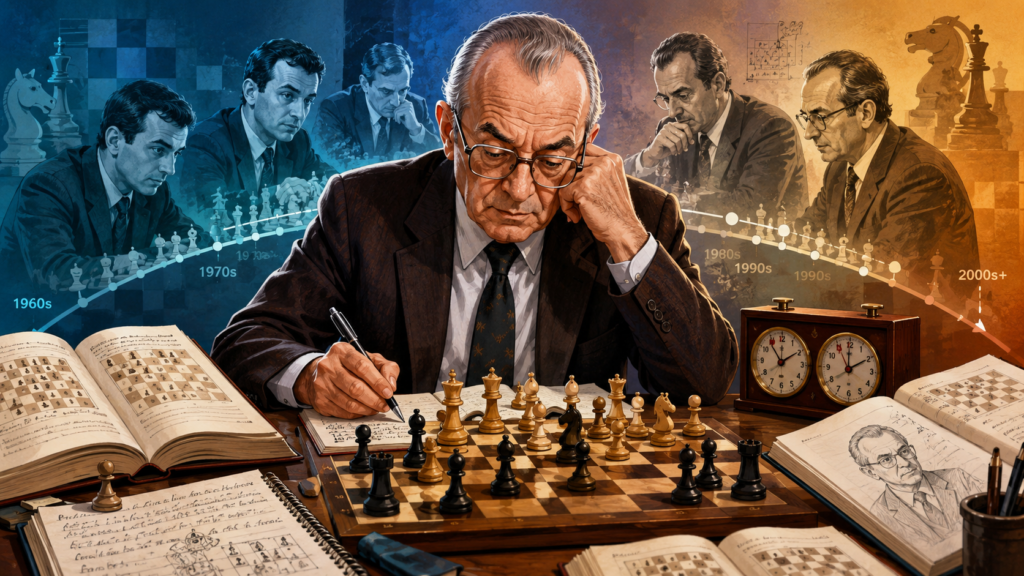
Britannica records that he won four Soviet championships between 1960 and 1970, and the World Chess Hall of Fame describes him as one of the rare players who stayed world-class deep into old age.
This matters for young students because chess is not a race to learn everything in one month. Chess is a journey. A child does not need to master every opening right away. They need good habits. They need simple plans.
They need practice games, feedback, and the courage to try again. Korchnoi’s long career proves that learning can stay alive for a lifetime.
His long career shows that strong habits beat short bursts of excitement
Many kids start chess with excitement. They want to win fast. They want tricks. They want checkmate in four moves. That joy is wonderful, and it should never be crushed. But joy alone is not enough.
A child also needs habits. They need to check for threats. They need to protect pieces. They need to learn basic endings. They need to understand why the center matters. They need to know when to attack and when to wait.
Korchnoi’s life shows the power of steady growth. He competed in one of the hardest chess systems in the world, left the Soviet Union in 1976, later made Switzerland his home, and still kept fighting at the highest level. His story was full of change, but his work at the board stayed serious.
The training goal is not to copy Korchnoi’s moves but to copy his mindset
A young player does not need to memorize every Korchnoi game. That would be too much. The better goal is to copy his way of thinking. He respected danger. He searched for hidden chances. He did not panic when attacked. He fought in endings. He made opponents prove their advantage. These are skills any child can start learning.
Here is how this looks in real life. A child sits at the board and loses a pawn. Instead of getting upset, they look for active pieces. A child faces an attack on the king. Instead of moving the king at once, they look for checks and blocks.
A child reaches an endgame with fewer pieces. Instead of playing random moves, they asks where the pawns should go. This is Korchnoi-style thinking in a simple child-friendly form.
Debsie helps children build this kind of thinking step by step. The goal is not to make chess feel heavy. The goal is to make hard ideas feel clear. With live lessons, caring coaches, and guided practice, kids can learn how to think like problem-solvers.
They can learn how to stay patient when a win takes time. They can learn how to be brave without being careless.
That is the heart of Korchnoi’s gift to young players. He shows that chess is not only about being the most talented child in the room. It is about being the child who keeps thinking, keeps learning, and keeps fighting for one better move.
Viktor Korchnoi teaches young players how to turn bad positions into chances
A lot of children think a bad position means the game is almost over. They lose a pawn and feel sad. Their king comes under attack and they freeze. Their pieces get pushed back and they start making fast moves.
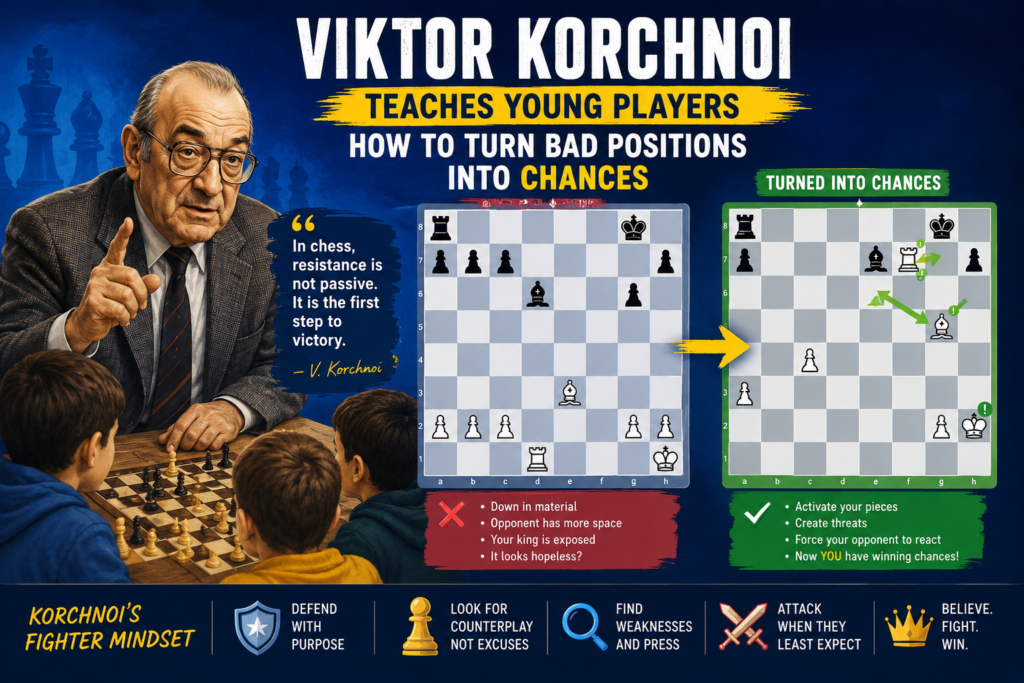
Viktor Korchnoi is the perfect player to study when a child feels this way, because he did not treat trouble as a stop sign. He treated it as a test.
Korchnoi’s chess was full of fight. He was not always trying to make the board look pretty. He was trying to make the board hard for his opponent. This is a key difference. Some players want clean positions. Korchnoi was fine with messy ones.
He knew that when a position becomes unclear, the player with stronger nerves often gets the better chances.
The first skill is to stop calling a position lost too early
Young players often say, “I am losing,” even when the game still has many chances. This habit hurts them. Once a child believes the game is over, their mind stops searching. Korchnoi’s games show the opposite habit.
He made opponents prove everything. If they were better, they still had to find good moves. If they attacked him, they still had to finish the attack. If they won material, they still had to convert it.
That mindset helped Korchnoi stay near the top for a very long time. He was a world title challenger and is widely remembered as one of the strongest players never to become world champion.
Britannica describes him as one of the fiercest competitors in chess history, and that word “fierce” fits him well because he made every game feel like a serious battle.
The simple classroom habit is to search for one useful move
When a child has a worse position, the goal is not to find magic. The goal is to find one useful move. That move may protect the king. It may move a piece to a better square. It may trade the opponent’s strongest attacker.
It may create a threat on the other side of the board. One useful move can change the mood of the whole game.
This is a very good lesson for life too. When school feels hard, children can learn not to say, “I cannot do this.” They can ask, “What is one useful step?” That is the same thinking Korchnoi showed on the board. He did not need the whole answer right away. He needed the next strong step.
At Debsie, this is the kind of thinking kids learn in a clear and kind way. A coach can take a scary chess position and make it simple. The child learns what to check first, what danger matters most, and how to make the next move with purpose. That is how a nervous player starts becoming a brave thinker.
Viktor Korchnoi’s opening choices show why children should not copy blindly
Many kids want to copy famous players. That is normal. They see a great player use an opening and think, “I should play that too.” But Korchnoi teaches a smarter lesson. He did not play openings only because they were popular. He played them because they led to positions where he could fight.
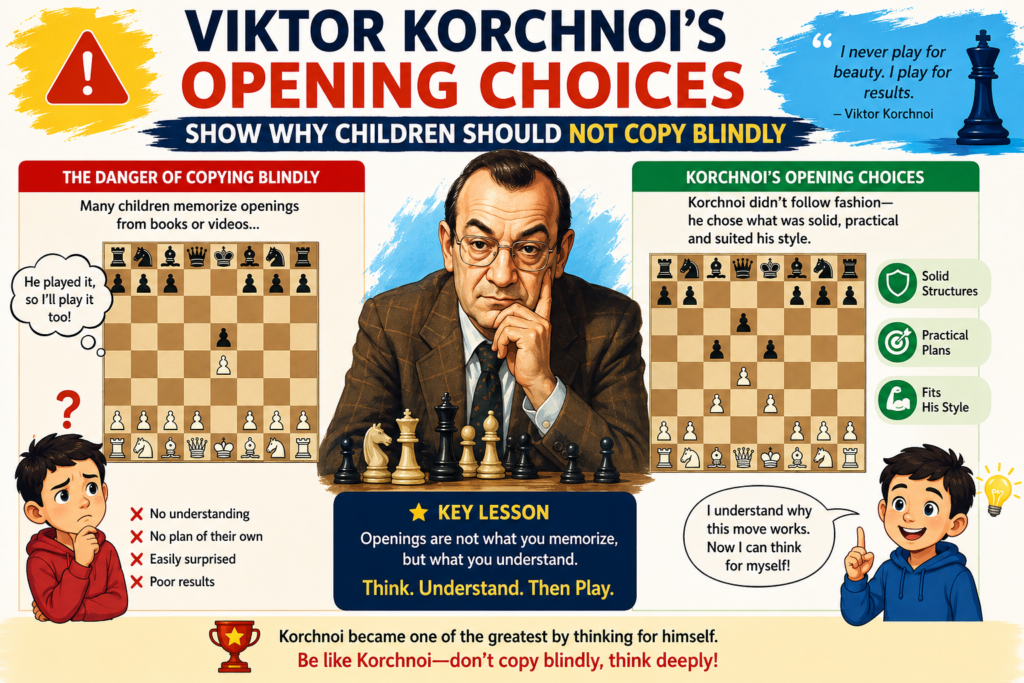
This is very important for young players. An opening is not just the first few moves. It is the road into the middle game. Some roads lead to calm positions. Some lead to sharp attacks. Some lead to long pressure.
Some lead to positions where both sides have chances. Korchnoi often chose lines that gave him rich play. He wanted the game to continue. He wanted problems on the board.
Good openings should fit the child’s thinking style
A beginner does not need to memorize deep opening lines. That can make chess feel heavy. A child first needs to understand opening ideas.
They need to know why pieces should come out, why the king should be safe, why the center matters, and why moving the same piece too many times can waste time. Once those ideas are clear, opening study becomes much easier.
Korchnoi became a grandmaster in 1956 and competed in many top events for decades, which shows that his strength was not based on tricks. He had deep chess understanding and knew how to reach positions where his strengths mattered.
The World Chess Hall of Fame notes his long elite career and his many world championship candidate appearances, which is a strong sign of how complete his chess was.
The smart rule is to learn the idea before the move order
A child may learn that in the opening, knights and bishops should come out early. But the real lesson is why. Pieces are like team members. If they stay at home, they cannot help. A child may learn to castle, but the real lesson is why the king needs safety before the center opens.
A child may learn to fight for the center, but the real lesson is that central space gives pieces more choices.
This is where many children need a coach. They do not need someone to throw long lines at them. They need someone to say, “Here is what your move is trying to do.” That small change makes chess feel friendly. It also helps kids remember more because they understand the reason.
Debsie’s live chess classes are built for this kind of learning. Kids are not left alone to guess. They get guided practice, simple words, and helpful feedback. When a child understands the idea behind a move, they stop playing like a copy machine. They start playing like a thinker.
Viktor Korchnoi’s endgame skill shows why patience wins games
Many children love the opening and middle game because that is where the action starts. They enjoy attacks, traps, and quick wins. But many games are decided much later. A small edge can turn into a win only if the player knows how to stay patient. This is another place where Korchnoi is a great model.
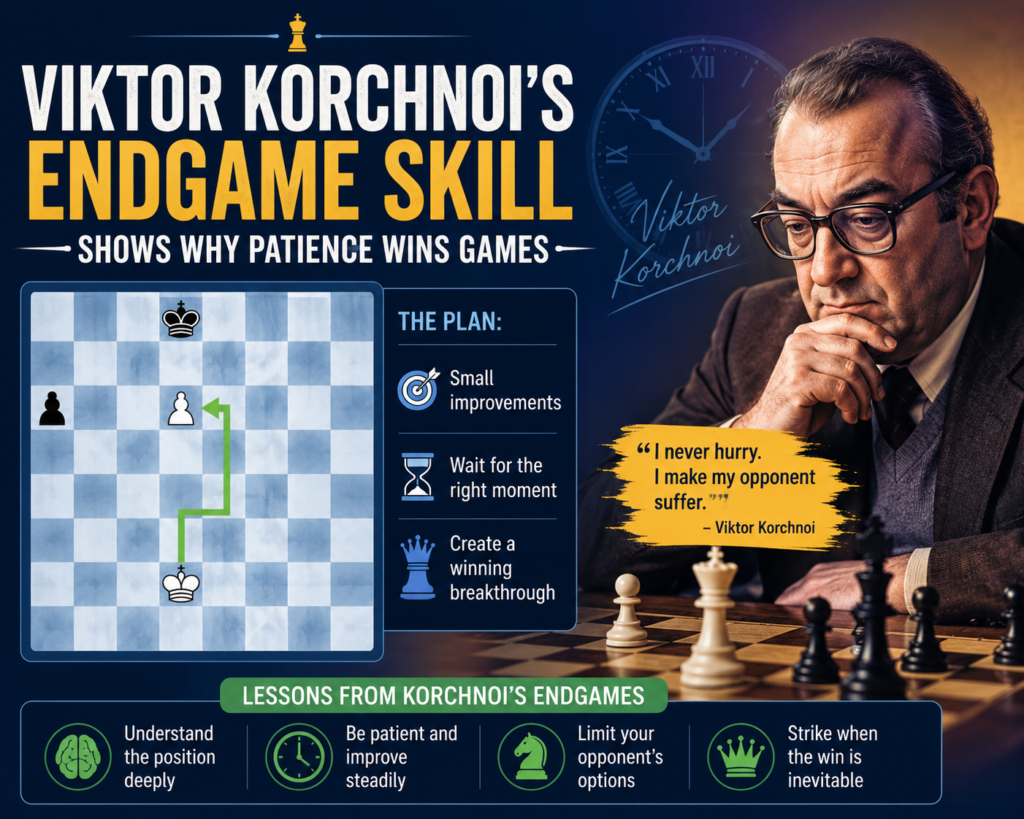
He was not only a fighter in wild positions. He could also grind. He could play long games. He could keep asking small questions until his opponent made a mistake. This kind of chess may look quiet, but it is very powerful.
In the endgame, one careless pawn move can change everything. One active king can win the game. One passed pawn can become a queen.
The endgame teaches children to respect small things
A child may think one pawn is not much. In the opening, maybe it is not easy to see the value of one pawn. But in the endgame, one pawn can be the whole story. Korchnoi understood this deeply. His long career at the top required far more than attack.
It required the ability to turn small edges into real wins and the ability to save difficult endings when other players might give up.
This is why endgame study is so good for children. It teaches care. It teaches patience. It teaches the child to count, plan, and slow down. Those are not just chess skills. They are life skills.
A child who learns to think carefully in the endgame is also practicing the kind of focus needed for exams, music, sports, and daily choices.
The best endgame lesson is that the king becomes a strong piece
In the opening, children learn to keep the king safe. In the endgame, they learn something new. The king can become active. It can walk forward, support pawns, attack weak pawns, and help create a queen. This idea is simple, but it changes the way a child sees the board.
A good coach can teach this with easy positions. King and pawn against king. Rook endings. Basic checkmates. Simple pawn races. These lessons may not look flashy, but they give children real confidence. When kids know basic endings, they do not feel lost when pieces come off the board.
Korchnoi’s career shows why this matters. He stayed dangerous for decades because he had a full chess skill set. He could attack, defend, plan, and finish. That is the model young players should follow. Not flashy chess only. Not trap chess only. Complete chess.
At Debsie, children can build that complete base in a way that feels clear and fun. The goal is not to rush them. The goal is to help them grow step by step, so they can enjoy chess and become stronger thinkers at the same time.
Viktor Korchnoi’s life proves that age and setbacks do not end growth
One of the most amazing parts of Korchnoi’s story is how long he stayed strong. Many players are great for a short time.
Korchnoi kept fighting across generations. He faced players who were older than him, players from his own era, and players much younger than him. He did not see age as a reason to stop learning.
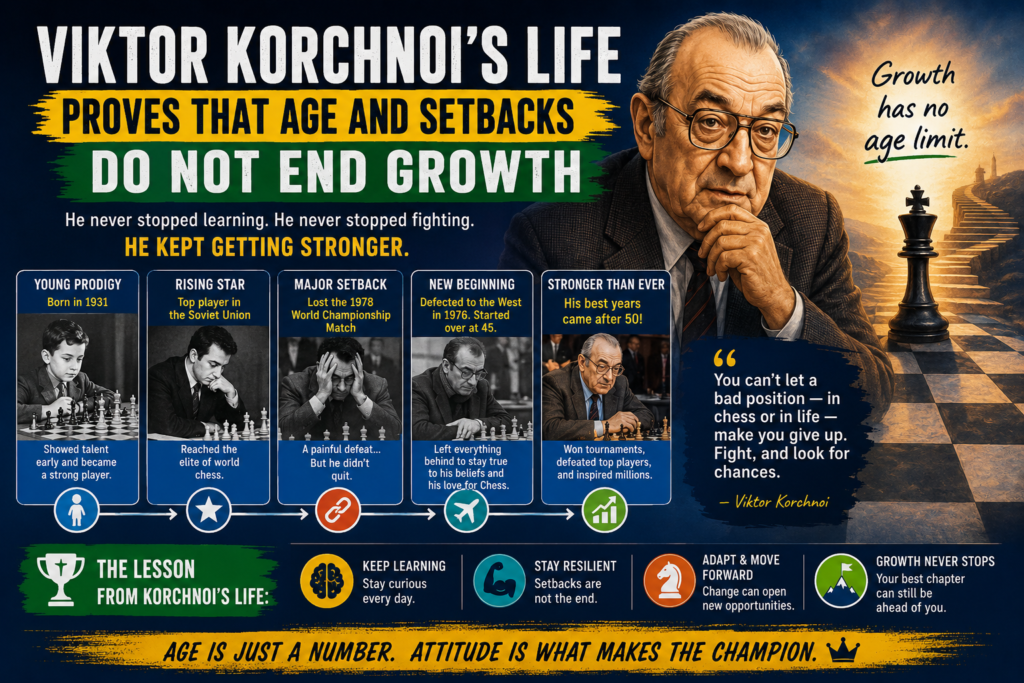
Korchnoi was born in 1931 and died in Switzerland in 2016. His career stretched across a huge part of modern chess history. He played under the Soviet flag in his early years, later defected, and became connected with Swiss chess after settling there. His life had many sharp turns, but his hunger for chess stayed alive.
Children can learn that losing is not the same as failing
This is one of the most important lessons in the whole article. Korchnoi lost painful matches. He came close to the world title and did not get it. He faced pressure that most young players will never face. Yet his name is still respected because he kept going. His legacy is not built only on trophies. It is built on courage.
For children, this is a healthy way to see chess. Winning is wonderful, but learning matters more. A child who loses a game and studies it is growing. A child who misses a tactic and practices that pattern is growing.
A child who gets nervous but still plays is growing. That is what parents should look for.
The goal is not to raise perfect players but brave learners
No child plays perfect chess. Even champions make mistakes. The real question is what happens after the mistake. Does the child quit inside, or do they keep thinking? Do they hide from the game, or do they review and learn? Korchnoi’s story gives a clear answer. Keep thinking. Keep learning. Keep fighting.
That is why chess is such a powerful learning tool for kids. It gives them a safe place to face pressure. It lets them practice choice-making. It teaches them that every move has a result. And with the right coach, it teaches them that mistakes are not the enemy. The enemy is giving up too soon.
If your child is curious about chess, a free Debsie chess trial class is a gentle and smart first step. Your child can meet a coach, enjoy a real lesson, and see how chess can build focus, patience, and strong thinking in a friendly space.
Viktor Korchnoi teaches students to make the opponent work for every win
One of the most useful things a child can learn from Viktor Korchnoi is this: do not make winning easy for the other side. Many young players lose a pawn, feel upset, and then make three more weak moves.
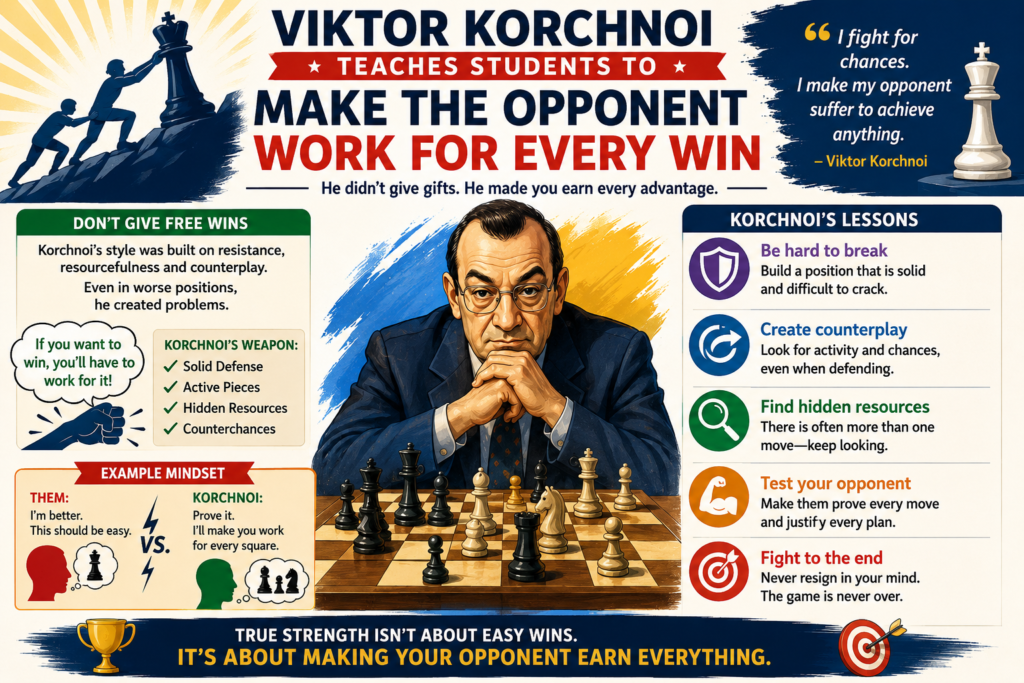
They stop fighting before the game is truly lost. Korchnoi did the opposite. He made the opponent prove every idea. If someone wanted to beat him, they had to solve problem after problem.
This does not mean he played cheap tricks. It means he understood practical chess. In real games, especially at the student level, the “best” move is not always the only move that matters. A move that creates a hard question can be very powerful.
It can make the opponent think longer. It can make them feel pressure. It can give them a chance to go wrong.
A strong defender does not just sit and wait
Korchnoi’s defense was active. That is the key. He did not only protect pieces. He looked for ways to make his pieces useful. A rook might move to an open file. A bishop might aim at a weak pawn. A knight might jump closer to the enemy king. Even when Korchnoi was defending, his pieces often looked ready to bite.
This is a big lesson for children. When they are under attack, they should not only ask, “How do I hide?” They should ask, “How can I defend and improve one piece at the same time?” That small change can turn a scary position into a playable one.
A child who learns this becomes harder to beat. They stop making sad moves. They start making fighting moves. They learn that defense is not the same as fear. Defense can be smart. Defense can be planned. Defense can be the road to a counterattack.
The Debsie-style lesson is to turn fear into a simple question
In a good chess class, a child should not feel shamed for being in trouble. They should be shown how to think. A coach can ask, “What is your opponent threatening?” Then the coach can ask, “What can you improve while stopping it?” These two questions can change the way a child handles pressure.
This is why guided learning matters so much. Children often know they are in danger, but they do not know what to do next. They need a calm voice. They need a clear path. They need someone to show that hard positions can be handled step by step.
At Debsie, this kind of lesson can help kids far beyond chess. A child who learns to stay calm during an attack on the board may also stay calmer during a school test, a class debate, or a hard homework task. They learn that panic does not solve the problem. Thinking does.
If your child often rushes moves or gets nervous when losing, a free Debsie chess trial class can be a great first step. It can help them see that chess is not about being perfect. It is about learning how to think better each time.
Viktor Korchnoi’s counterattack style shows why patience can be sharp
Many people think an attacking player must always move forward. Korchnoi proved something deeper. Sometimes the strongest attack begins with patience. He could wait, defend, improve his pieces, and let the opponent become too bold. Then, when the position changed, he would strike.
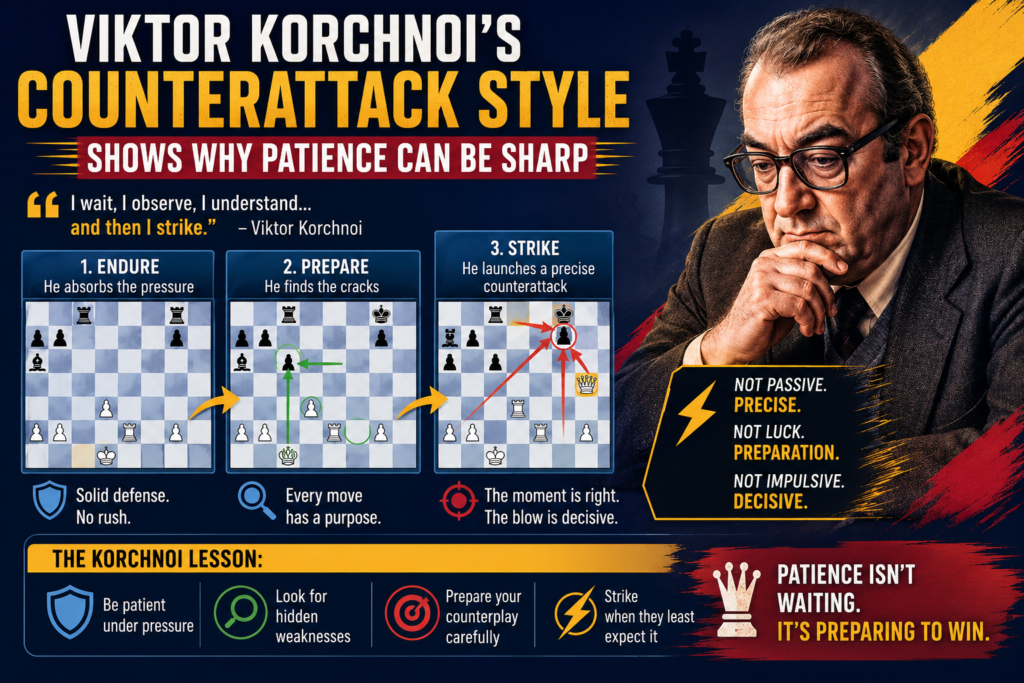
This is a powerful idea for young players. Children often attack too early because attacking feels fun. They push pawns near the enemy king without enough support. They bring the queen out too soon.
They chase a quick checkmate and forget their own king. Korchnoi’s games teach a better kind of attack. Build first. Wait for the right sign. Then go.
The best counterattack starts when the opponent has gone too far
In chess, every move gives something and takes something. When a player pushes a pawn, that pawn may gain space, but it also leaves squares behind. When a queen moves forward, it may create a threat, but it may also become a target. When an attack uses many pieces, the rest of the board may become weak.
Korchnoi was great at noticing these small changes. He did not only see the threat coming toward him. He also saw what the threat had left behind. That is why his counterattacks could feel so sudden. The chance was there because he had been watching closely the whole time.
This is a lesson children can use at every level. When the opponent attacks, look for the cost of the attack. Did a pawn move away from the king? Did a piece leave a defender behind? Is the queen standing on a square where it can be chased? Is the back rank weak?
These are simple questions, but they train a child to look at the whole board.
A child can learn to attack without becoming reckless
A reckless attack is like running across the road without looking. It may work once, but it is not a safe habit. A smart attack is different. It begins with piece activity, king safety, and timing. Korchnoi’s counterattack style helps children understand this difference.
When a child studies a Korchnoi game, the goal is not to copy every move. The goal is to ask, “When did he decide to fight back?” That question is gold. It teaches timing. It teaches patience. It teaches the child that a good attack is not only about bravery. It is also about waiting until the board is ready.
In Debsie’s online chess classes, kids can learn this in a way that feels simple and exciting. A coach can pause a game at the key moment and ask the student what changed. The student begins to see patterns. The attack is no longer a mystery. It becomes a story they can understand.
That is where chess becomes fun in a deeper way. A child starts to feel the board. They begin to see that every move has a reason. They learn that patience is not boring. Sometimes patience is the sharpest weapon in the room.
Viktor Korchnoi shows why emotional control is a chess superpower
Chess is not only played with the brain. It is also played with the heart. A child may know the right idea but still make the wrong move because they feel scared, excited, angry, or rushed.
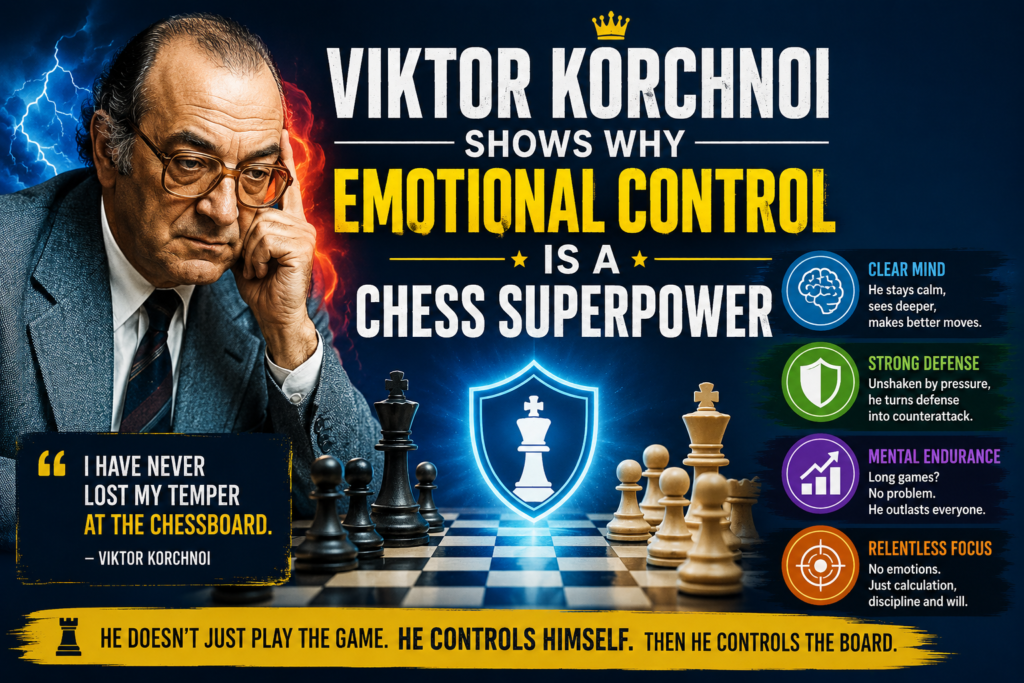
Viktor Korchnoi’s career is full of moments where emotional control mattered. He played long matches, tense games, and painful battles. He had to sit at the board and keep working even when the pressure was huge.
That is why his story is so helpful for students. It shows that strong chess is not only about knowing openings. It is about handling feelings. A player who cannot handle emotions will often lose focus at the exact moment they need focus most.
The board teaches children how to pause before reacting
One of the best gifts chess gives a child is the habit of pausing. In life, children often react fast. They answer too soon. They get upset too quickly. They give up when something feels hard. Chess gently trains a different habit. Look first. Think next. Move after that.
Korchnoi lived this habit at the highest level. When a position became tense, he did not need it to feel comfortable. He kept searching. He kept testing ideas. He kept asking what could be done. That is emotional control in action.
It is not the same as being calm all the time. It means choosing to think even when feelings are loud.
Parents often love this part of chess because they can see the change in daily life. A child who learns to pause before moving may also pause before speaking in anger. A child who learns to recover after a blunder may recover faster after a bad grade. A child who learns to keep trying in a lost-looking game may show more strength in other hard tasks.
A good coach helps a child see mistakes without feeling crushed
The way a child reviews mistakes matters. If a coach only says, “This was bad,” the child may feel small. But if the coach says, “This mistake shows us what to train,” the child feels hope. That is the right learning mood.
Korchnoi’s fighting life gives coaches and parents a strong message. Do not teach children that mistakes are the end. Teach them that mistakes are part of learning. The real skill is not avoiding every error. No one can do that. The real skill is noticing the error, learning from it, and coming back stronger.
This is one reason Debsie’s approach is so valuable for young learners. Children need expert guidance, but they also need kindness. They need structure, but they also need joy. They need challenge, but they also need the feeling that someone believes in them.
A free Debsie chess trial class can help parents see this teaching style in action. It gives your child a chance to learn in a warm online space where chess feels clear, useful, and fun. The goal is not to scare kids into learning. The goal is to help them love thinking.
Viktor Korchnoi’s games can help parents teach grit in a real way
Many parents want their children to have grit. But grit is not easy to teach with a speech. Children learn it better through experience. Chess gives that experience in a clean and honest way. Your child makes a move.
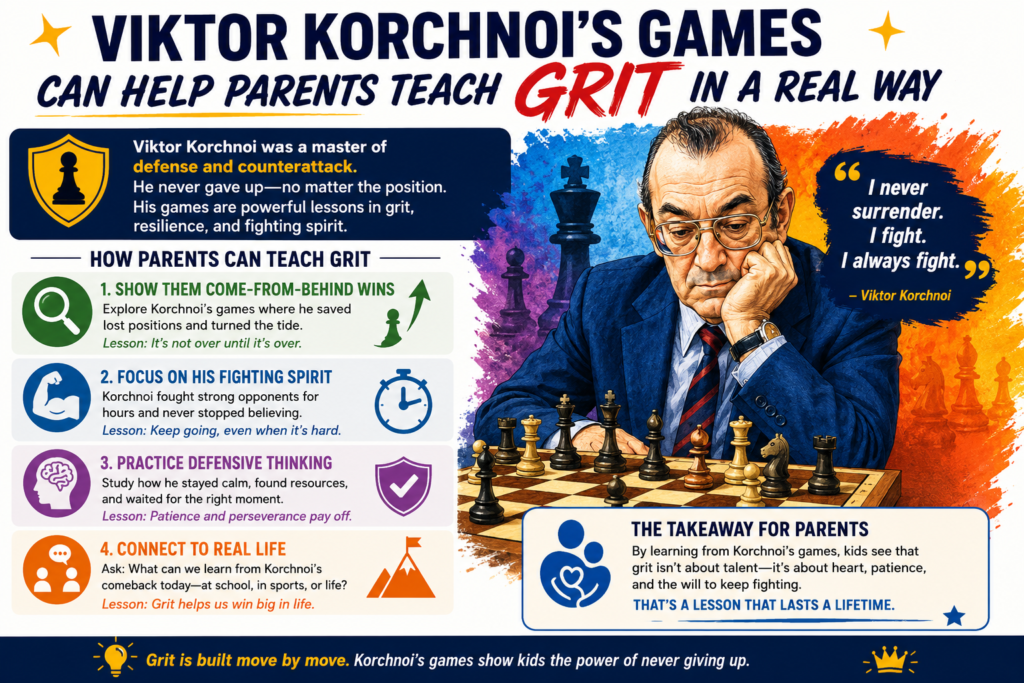
The opponent replies. The child must think again. There is no hiding from the result, but there is always a chance to learn.
Viktor Korchnoi is one of the best chess role models for this lesson. His whole career says, “Keep fighting.” He did not have a smooth road. He did not get every prize he wanted. He did not become world champion.
Yet his name still carries deep respect because he showed rare will, rare toughness, and rare love for the game.
The real win is raising a child who does not quit too soon
In children’s chess, the result is not the only result. A child may lose a game but still gain focus. A child may miss a tactic but learn to check threats next time. A child may feel nervous in a tournament but still sit down and play. These are real wins too.
Korchnoi’s story helps parents see chess in this bigger way. Yes, winning is exciting. Yes, trophies are nice. But the deeper gift is the growth inside the child. Chess can teach them to slow down, plan ahead, respect the opponent, and stay steady under pressure.
This matters even for children who never become chess champions. A child who learns to think clearly will use that skill in school. A child who learns patience will use it with friends and family. A child who learns not to give up after one mistake will use that strength again and again.
The next step is to give your child the right learning space
A child does not need a harsh space to become strong. They need a smart space. They need coaches who know chess well and can explain it in simple words. They need lessons that match their level. They need chances to play, ask questions, make mistakes, and grow.
That is what makes Debsie a strong choice for families. The learning is online, guided, and built for real children with real needs. Students can learn from trained coaches, join live classes, build confidence through practice, and discover that chess is not only a game of pieces. It is a game of choices.
Viktor Korchnoi’s life gives us a perfect message to pass on to young players. Do not fear hard positions. Do not quit because the path is tough. Do not think one loss defines you. Look again. Think again. Fight again.
Viktor Korchnoi teaches children that every piece should have a job
A good chess player does not move pieces just because they can. Each move should have a reason. Viktor Korchnoi understood this deeply. His pieces often looked like workers in a strong team.
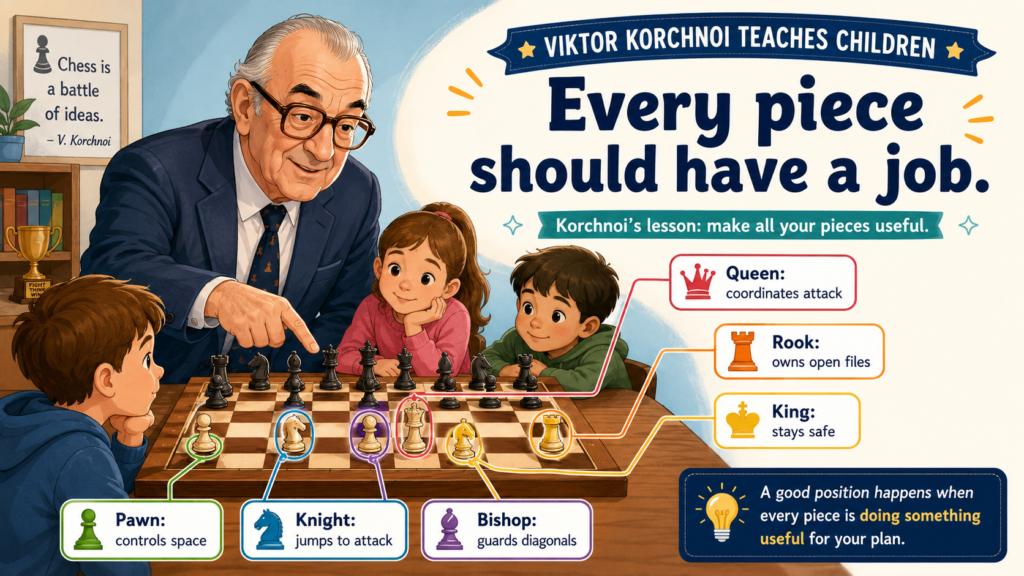
One piece guarded a key square. Another piece attacked a weak pawn. Another piece waited for the right time to jump into the fight. Even when his position looked tight, his pieces usually had a job.
This is a simple but powerful lesson for young players. Many children move the same piece again and again because it feels active. They bring the queen out too early. They push pawns without knowing why.
They check the king just because a check is possible. Korchnoi’s style teaches a better question: “What is this move helping me do?”
A piece with no job can become a problem later
In chess, a lazy piece can hurt the whole team. A bishop blocked by its own pawns may not help. A rook trapped in the corner may not join the game. A knight on the edge may look safe, but it may not control enough squares.
Korchnoi was very good at spotting these small problems, both in his own camp and in his opponent’s camp.
For children, this can be taught in very simple words. Before moving, ask what the piece will do on its new square. Will it attack something? Will it defend something? Will it help the king stay safe? Will it help another piece become stronger? If the answer is unclear, the child should look again.
This habit can change the whole way a child plays. Their moves become less random. Their plans become easier to see. Their games become cleaner, even if they are still learning.
The simple Debsie training idea is to ask what changed after the move
A helpful coach can teach a child to look at the board before and after each move. What did the move improve? What did it weaken? What new threat appeared? What square became open? This kind of thinking helps children see chess as a story, not as a list of moves.
At Debsie, this is one of the most useful ways to build real understanding. A child does not just learn that a move is good. They learn why it is good. That makes the lesson stick. It also helps the child use the idea in a new game, not only in the example they just saw.
This matters because strong chess is not built by memorizing alone. It is built by clear thinking. Korchnoi’s games are full of clear purpose. He may look fierce, but behind the fire there was logic. That is the kind of thinking young players can learn one step at a time.
When your child learns to give every piece a job, they also learn a life lesson. Time should have a job. Effort should have a job. Practice should have a job. That is why chess is such a rich tool for growing minds.
Viktor Korchnoi shows why the best fighters respect danger first
Some young players think being brave means ignoring danger. They see an attack and attack back without checking if their own king is safe. They see a free pawn and grab it without asking what the opponent wants.
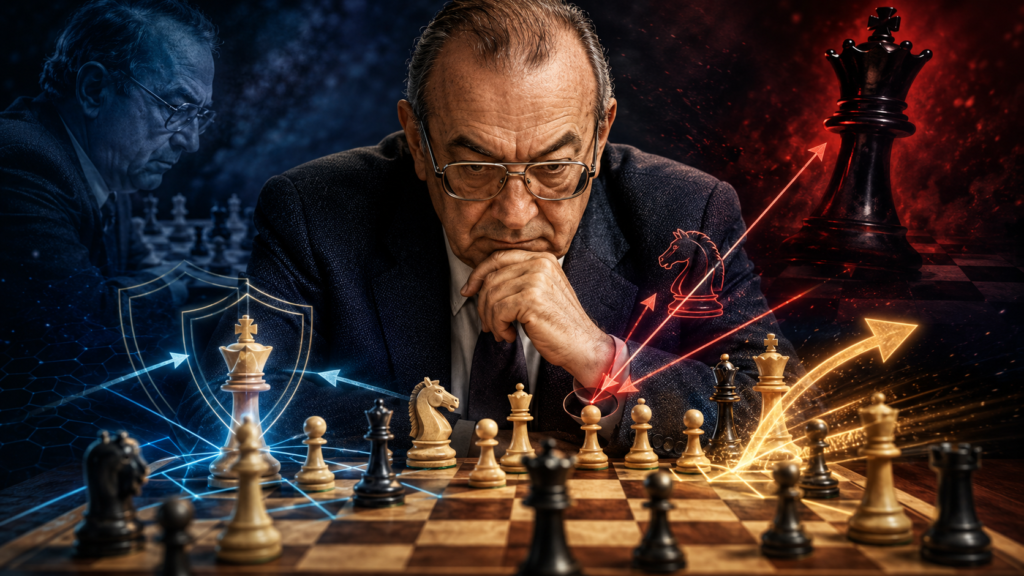
They see a chance for check and play it without thinking about the next move. Korchnoi’s chess gives a wiser lesson. Real courage starts with respect for danger.
Korchnoi was brave, but he was not blind. He knew that every threat had to be checked. He knew that a small weakness near the king could become a big problem. He knew that one loose piece could ruin a good position. This is why he could fight so well. He did not panic, but he also did not pretend danger was not there.
Respecting danger helps children make safer choices
When children learn chess, they often want to move fast. Fast feels fun. Fast feels confident. But chess rewards careful thought. A child who learns to pause and see the opponent’s threat will save many games. This does not make chess boring. It makes chess stronger.
A simple habit can help. Before every move, the child asks, “What does my opponent want?” This question is small, but it is huge in power. It teaches awareness. It stops easy blunders. It helps children think from both sides of the board.
Korchnoi was great at this because he did not only think about his dream move. He thought about the opponent’s dream too. Then he looked for a move that stopped danger while keeping his own chances alive.
The life lesson is that smart people look before they jump
This is one reason parents love chess once they see its deeper value. Chess teaches children that a choice has a result. If they rush, there may be a cost. If they pause, they may find a better path. This lesson is useful far beyond the board.
In school, a child may learn to read the question twice before answering. With friends, they may learn to think before reacting. During a challenge, they may learn to ask what the real problem is before trying to fix it. That is chess thinking in daily life.
Debsie’s classes help children build this kind of calm awareness. Coaches guide students to notice threats, plan ahead, and make safer choices without making chess feel scary. The goal is not to make children afraid of mistakes. The goal is to help them see more clearly.
Korchnoi’s fighter spirit was not wild. It was trained. He could attack because he respected defense. He could defend because he believed in counterplay. He could survive danger because he looked at it honestly.
That is a beautiful message for any child. Brave does not mean careless. Brave means you see the danger and still think clearly.
Viktor Korchnoi’s style helps students understand the power of counterplay
Counterplay is one of the most important ideas in chess, but it can be explained in simple words. It means you create your own chances instead of only answering your opponent’s threats. Viktor Korchnoi was a master of this.
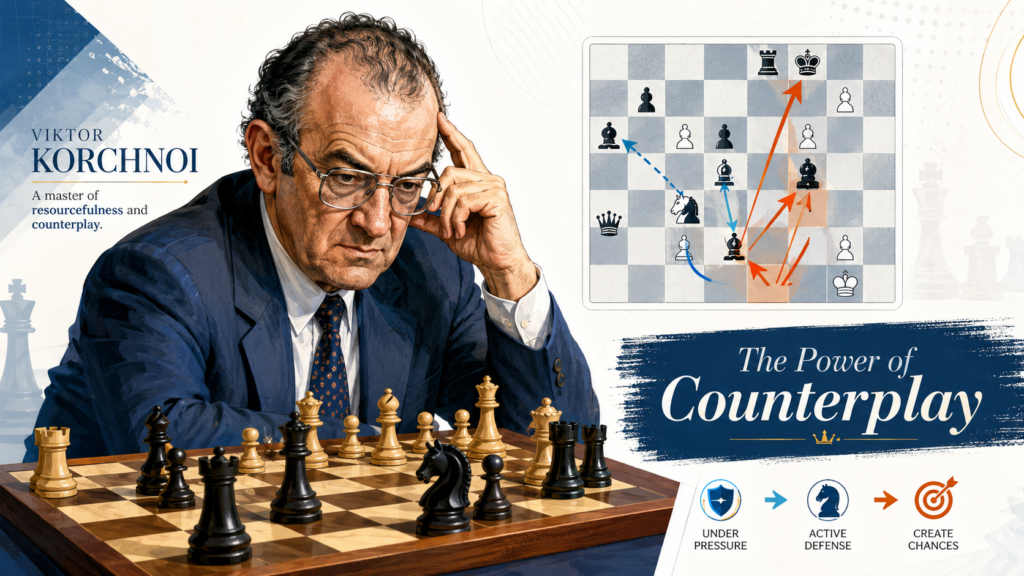
When he was under pressure, he did not only build walls. He looked for activity. He wanted his opponent to feel pressure too.
This is a major reason his games are so useful for students. Many children defend by moving backward again and again. Soon all their pieces are cramped. Their opponent has all the fun. Korchnoi showed a stronger way. Defend what matters, but keep looking for your own plan.
A player with counterplay is never easy to beat
Imagine a child is under attack on the kingside. A scared player may only move pawns around the king. A stronger player may also look for play in the center. Maybe they can open a file. Maybe they can attack the opponent’s queen.
Maybe they can trade the strongest attacking piece. Maybe they can create a threat on the other side of the board.
This is the spirit of counterplay. It tells the opponent, “You are attacking me, but you also have problems to solve.” That can change the whole game. The attacker may slow down. They may defend instead of attack. They may make a mistake because they now have to think about both sides.
Korchnoi understood this very well. He was not easy to finish because he kept creating questions. This is a very strong habit for children to learn.
The practical student rule is to defend with activity whenever possible
A child can use a simple rule: when defending, look for the most active safe move. This does not mean playing risky moves. It means choosing a move that helps the position instead of only hiding. A rook on an open file is active.
A knight moving toward the center is active. A queen that creates a threat while helping defense is active.
This idea gives children hope in hard games. They stop seeing defense as punishment. They start seeing it as a chance to be clever. They learn that the board has many sides and many stories at once.
In Debsie lessons, coaches can help children practice this with real positions. The coach can pause and ask, “Can we stop the threat and make our own threat too?” Over time, students start seeing these chances on their own. That is when chess becomes exciting in a new way.
This is also good for a child’s confidence. A child who knows how to create counterplay does not feel helpless when attacked. They feel prepared. They understand that hard moments can still hold chances.
Korchnoi’s style says one thing again and again: do not sit there waiting to lose. Look for life in the position. Look for a useful move. Look for one problem you can give back to your opponent.
Viktor Korchnoi reminds parents that chess can build strong character
Parents often start chess lessons because they want their child to learn a smart game.
That is a good reason. But after some time, many parents see something bigger. Chess can shape how a child thinks, waits, chooses, and handles pressure. Viktor Korchnoi’s life is a strong example of this bigger value.
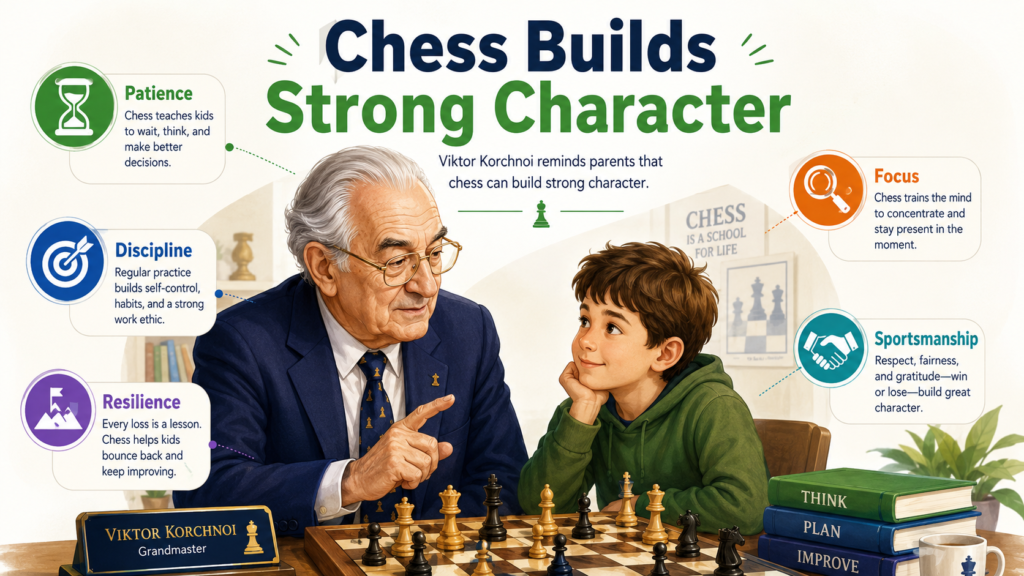
He was not remembered only because he knew many openings. He was remembered because he fought. He stood firm. He stayed curious. He kept playing even after hard losses. For children, this is a powerful model.
It shows them that the best players are not the ones who never struggle. The best players are the ones who keep learning through struggle.
Character grows when children face challenge in a safe space
Chess gives children challenge without danger. They can lose a game, feel the sting, and then learn from it. They can make a mistake and try again. They can face a stronger player and discover that effort still matters. This is a healthy way to build inner strength.
A good chess class makes this even better. The coach helps the child understand what happened. The child does not feel alone with the loss. They see the lesson inside it. They learn that a mistake is not a final mark on who they are. It is simply a place to grow.
That is why the right learning space matters so much. A child should feel challenged, but not crushed. They should feel guided, not judged. They should feel excited to return to the board.
Debsie gives children a warm path into serious thinking
Debsie is built for families who want more than random chess tips. Children get live guidance, clear lessons, and a learning space where questions are welcome. They can grow at their own pace while still being pushed to think better.
This fits the Korchnoi lesson perfectly. The goal is not to make children harsh or tense. The goal is to help them become steady, sharp, and brave. They learn to sit with a hard problem. They learn to look for choices. They learn to trust their own thinking.
For a parent, that is a beautiful return. Chess becomes more than an activity. It becomes a way to help your child build focus, patience, and problem-solving skill. It becomes a quiet training ground for life.
If your child has shown even a small interest in chess, this is a good time to help that spark grow. A free Debsie chess trial class lets your child experience friendly coaching and real learning before you decide the next step. It is a simple way to see how chess can open a new door in your child’s mind.
Viktor Korchnoi shows why stubborn focus can save a game
A lot of chess games are not won by the player who knows the most. They are won by the player who stays focused the longest. Viktor Korchnoi was a master of this kind of focus. He could sit in a hard position for hours and still search for the best move.
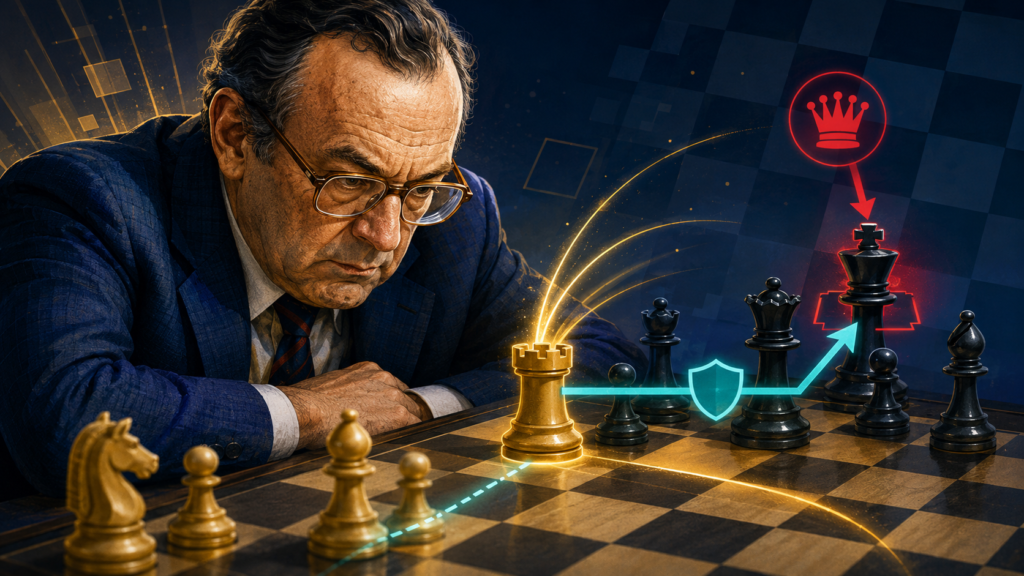
He did not need the game to be easy. He needed his mind to stay awake.
This is a huge lesson for children. Many young players lose focus after the first big problem. They may start well, but when the board becomes messy, their thinking becomes messy too. Korchnoi’s example teaches the opposite. When the board becomes harder, your thinking must become calmer.
Focus is not about staring harder at the board
A child may think focus means looking at the board with a serious face. But real focus is deeper than that. It means knowing what to look for. It means checking the opponent’s threats. It means asking which piece is weak.
It means noticing which king is less safe. It means slowing down before making a move that cannot be taken back.
Korchnoi had this kind of focus. His strength was not only in sharp attacks. It was also in his ability to stay inside the game when many players would feel tired or frustrated. He kept asking questions. He kept making the opponent work. He kept looking for the next chance.
For children, this is one of the best chess habits to build early. A child who learns to stay focused in a hard chess game is practicing the same skill needed for school, reading, tests, and long projects. Chess becomes a fun way to train the mind to stay with a problem.
The best way to build focus is through guided practice
Focus grows when a child practices in the right way. It does not grow by being told, “Pay attention.” It grows when a coach teaches the child what to notice. A child needs simple thinking steps. They need to learn how to check for danger, how to compare moves, and how to choose a plan.
This is where Debsie can help in a very real way. In a live class, a coach can slow the game down and help the child see the board more clearly. The coach can ask simple questions that guide the student’s eyes and mind. Over time, the child starts asking those questions alone.
That is when growth becomes powerful. The child is not just following a teacher. The child is learning how to think. And that is the deeper gift of chess.
Korchnoi’s life gives parents a strong reminder. A focused child does not need to be perfect. They just need to keep coming back to the problem with care. That one habit can change how they learn.
Conclusion
Viktor Korchnoi’s story is more than a chess story. It is a lesson in courage, focus, patience, and smart fighting. He showed that a player can be under pressure and still think clearly. He showed that defense can turn into attack, and that one strong move can change everything.
For children, this is a powerful message. Do not quit too soon. Do not fear hard positions. Learn, pause, think, and try again. If you want your child to build this kind of brave mind, book a free Debsie chess trial class and help them begin today.

Adhip Ray is the founder of Debsie, an online learning platform focused on chess and skill-based learning for children. His work at Debsie brings together chess education, structured thinking, problem-solving, and interactive learning for young students.
Adhip has an academic background in law, statistics, analytics, and technology. He is from Amity Law School and the Indian Statistical Institute, Kolkata, with formal training that connects legal reasoning, data analytics, quantitative thinking, and structured problem-solving. This interdisciplinary background is reflected in Debsie’s focus on building sharper thinking skills in children through chess and related learning programs.
Adhip is also a FIDE-rated chess player from India. He holds FIDE ID 5055954 and has a standard FIDE rating of 1832. His FIDE profile records him as an Indian player with a long rating history in standard chess, including rated games from his competitive playing years. His chess background gives Debsie a founder-led connection to the game, not only as an educational activity but also as a competitive discipline that develops concentration, calculation, planning, and decision-making.
In addition to chess, Adhip has a strong interest in coding, data, and technical problem-solving.
Adhip’s profile combines chess, law, data analytics, and programming. At Debsie, this background supports the creation of learning experiences that are logical, structured, and skill-oriented. The platform’s chess-focused programs are connected to broader cognitive skills such as pattern recognition, patience, strategic planning, focus, and problem-solving.
As founder of Debsie, Adhip brings together experience from multiple fields: formal legal education from Amity Law School, analytical training from the Indian Statistical Institute, Kolkata, competitive chess experience through his FIDE-rated profile, and coding practice through LeetCode. This combination gives Debsie a distinct foundation in strategy, reasoning, analytics, and child-focused learning.
Through Debsie, Adhip is associated with building chess and learning content for children that goes beyond basic instruction. The platform connects chess with thinking skills, helping students approach challenges with more structure, clarity, and confidence. His own background in chess and analytical problem-solving gives the platform a direct link to the skills it aims to develop in young learners.
Adhip is also a member of Forbes Business Council.