YouTube can be a great place to learn chess. But it can also feel loud. One video says “learn openings.” Another says “solve tactics.” A third moves so fast that a beginner feels lost before move five. That is why this guide is not just about the biggest chess channels. It is about the clearest ones.
Find the right learning experience
Tell us a little about the learner and what you are looking for. Our team will review your answers and help you identify the most suitable next step.
- Takes only a few minutes
- No payment required
- Personalised recommendations
Your information will only be used to respond to your enquiry.
The best beginner chess YouTuber should make the game feel slower, not faster.
A beginner does not need the loudest chess video. A beginner needs a teacher who helps them see the board clearly. That means the teacher should explain why a move is good, why another move is risky, and what the player should notice before touching a piece.
Many chess videos are made for fun. That is not bad. Fun matters. A child who laughs while learning may come back the next day with more energy. But fun alone is not enough. A beginner also needs order.
They need to hear simple ideas again and again, such as protect your king, look for checks, do not hang pieces, and think before you move.
A good beginner chess channel should teach one clear idea at a time.
This is why parents should not only ask, “Is this YouTuber famous?” A better question is, “Can my child explain the lesson after the video ends?” If the answer is yes, the channel may be useful. If the answer is no, the video may be too fast, too noisy, or too advanced for now.
Some large chess channels have millions of viewers because they mix teaching with fun. GothamChess, for example, has a very large YouTube channel and many playlists, including beginner-friendly topics like chess tips, endgames, and how to solve tactics.
Find the right learning experience
Tell us a little about the learner and what you are looking for. Our team will review your answers and help you identify the most suitable next step.
- Takes only a few minutes
- No payment required
- Personalised recommendations
Your information will only be used to respond to your enquiry.
His style is fast, lively, and often funny, which can pull students into the game when they might otherwise feel bored.
The real test is not the view count. It is what happens after the video.
After a child watches a chess video, ask them to show one idea on a real board or online board. If they can show it, the video helped. If they only say, “It was cool,” then the video may have entertained them more than taught them.
That is why Debsie often tells parents to use YouTube as a helper, not as the whole plan. A video can spark interest. A coach can turn that spark into skill. When a child has a real teacher watching their games, the child learns what they personally need to fix.
That is hard to get from a general video made for thousands of people.
If your child enjoys chess videos but still makes the same mistakes in games, that is a sign they may need guided help. A free Debsie trial class can show you how your child thinks, where they get stuck, and what kind of learning plan can help them grow with more confidence.
GothamChess is great for beginners who need energy before they need deep study.
GothamChess, run by Levy Rozman, is one of the most well-known chess YouTube channels today. His channel calls him “The Internet’s Chess Teacher,” and it has a huge library of videos across many chess topics. For beginners, the biggest strength of GothamChess is not silence or slow teaching. It is energy.
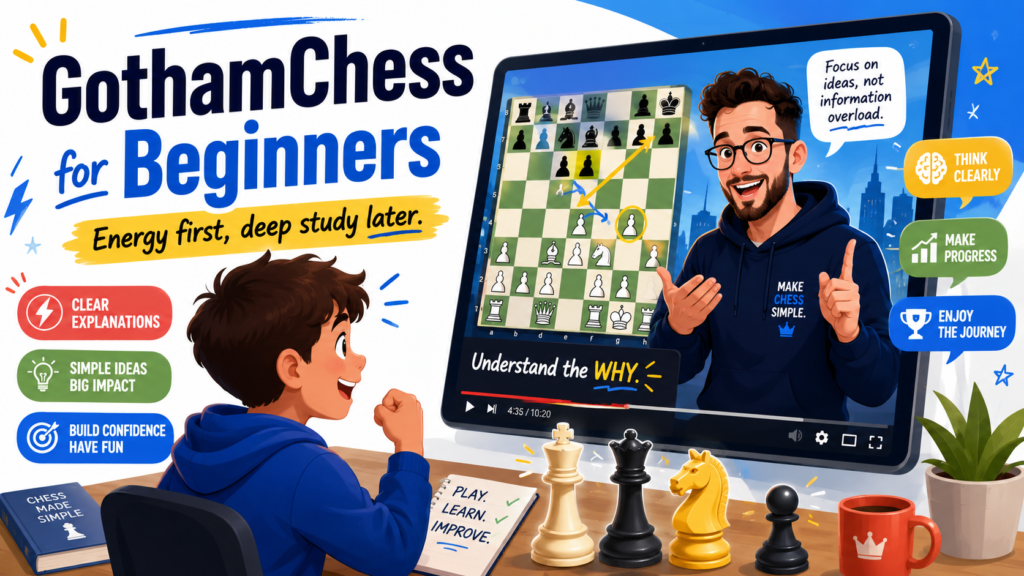
Some children do not want chess to feel like school. They want stories. They want drama. They want to know why a move was a blunder and why everyone is laughing. GothamChess does this very well. He can make a simple mistake feel memorable, and that helps beginners remember it.
His best use is motivation, pattern spotting, and chess excitement.
For a new player, motivation is not a small thing. Many kids quit chess because they think it is too hard. A fun video can change that. It can make them feel that chess is a game full of surprises, not a cold test where only smart people win.
But parents should guide the way children watch this channel. Some GothamChess videos are perfect for casual learning. Others move quickly or focus on entertainment. A beginner may enjoy the video but miss the lesson if they are not ready for the speed.
A smart way to use GothamChess is to choose one short video and give the child one job. The job can be simple: find one mistake, name one tactic, or explain why one king was unsafe. This turns passive watching into active learning.
For beginners, the best video is the one that leads to a move they can use.
A child should not watch five chess videos in one sitting and call it practice. That feels busy, but it may not build skill. One video watched carefully is better than many videos watched with half attention.
After the video, the child should play one slow game and try to use the idea. If the video was about forks, they should look for forks. If it was about checkmate, they should look for weak kings. If it was about not blundering pieces, they should pause before each move and ask, “Is my piece safe?”
This is where Debsie’s coaching approach fits well. We help kids take a fun idea and turn it into a real habit. A child may hear “do not hang your queen” on YouTube, but in class, a coach can stop and ask, “What was your queen protecting? What did your opponent threaten?” That kind of back-and-forth builds thinking power.
GothamChess can be a strong door into chess. For many beginners, it makes the game feel alive. Just make sure the child is not only watching for jokes. The goal is to enjoy the video, then use one lesson on the board.
Daniel Naroditsky is best for beginners who are ready to think step by step.
Daniel Naroditsky is a grandmaster and a full-time chess coach and streamer. His YouTube channel has many teaching playlists, including speedrun series, opening lessons, endgame videos, master class content, and game analysis.
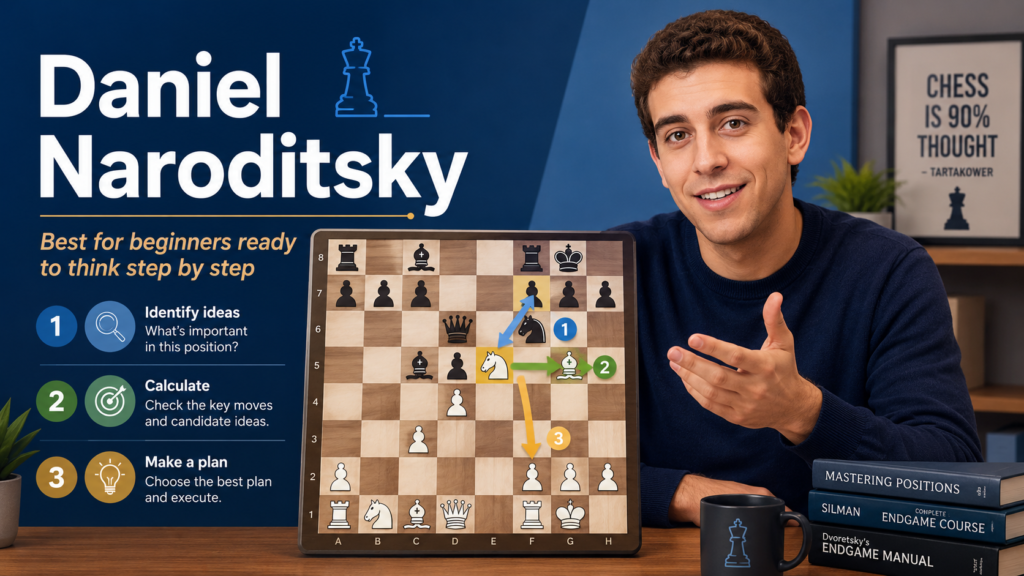
His style is very different from many fast chess channels. He often explains the reason behind a move in a calm, careful way.
For beginners who are ready to focus, this can be gold. Naroditsky does not only say, “This move wins.” He often explains what he is looking at, what danger he sees, and why one plan is better than another. That helps students learn the thinking process, not just the answer.
His channel is strong because it teaches how good players make choices.
Many beginners think strong chess players see magic. They believe grandmasters just know the best move right away. Naroditsky’s videos can help break that myth. He shows that chess is a set of questions. Is my king safe? What is my opponent attacking? Can I improve my worst piece? What changed after the last move?
This is very helpful for children who already know how the pieces move but do not know what to do next. They may start games well, then freeze in the middle. They may move random pawns because they have no plan. A slow teaching video can help them see that every move should have a purpose.
Still, parents should know that not every video on his channel is ideal for a total beginner. Some lessons may be too deep for a child who just learned castling. That does not make the channel bad. It means the parent or coach should choose carefully.
The best way to watch deep chess videos is with pause time.
Naroditsky’s videos work best when a student pauses before the move is explained. The child should guess the move first. Then they should listen to the explanation. This turns the video into a lesson, not a show.
A good rule is simple. Before the teacher moves, pause and ask, “What would I play?” The child does not need to be right. In fact, wrong guesses can be very useful. When the child hears why their move was not best, they learn faster.
This is one reason Debsie classes are built around active thinking. We do not want kids to only copy strong players. We want them to learn how to ask better questions. When a child learns that, chess becomes more than a game. It becomes practice for school, problem solving, and calm decision-making.
Daniel Naroditsky is a great fit for serious beginners, patient kids, and parents who want chess learning with real depth. For younger students, it may help to watch in small parts. Ten focused minutes can teach more than one long video watched while tired.
John Bartholomew is a calm choice for beginners who need clear basics.
John Bartholomew is known for a calm and steady teaching style. His YouTube channel includes playlists such as Chess Fundamentals, Climbing the Rating Ladder, tactics training, endgames, and longer standard games. This makes his channel a strong choice for beginners who need less noise and more structure.
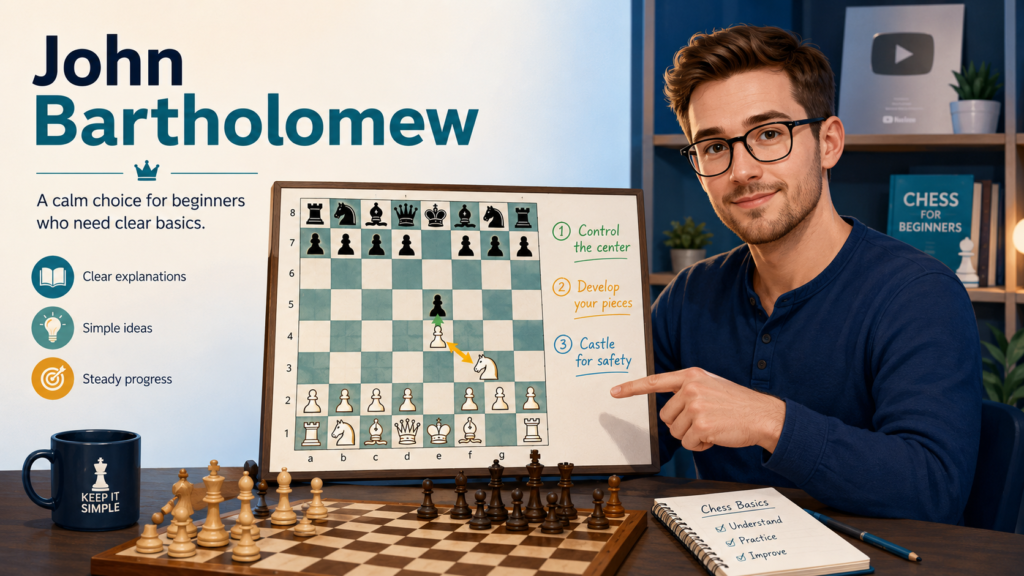
Some children learn best when the teacher speaks with high energy. Others learn best when the teacher is calm.
John Bartholomew is helpful for the second group. His videos often feel like sitting beside a thoughtful coach who is explaining what matters without trying too hard to entertain.
His biggest strength is teaching beginners to stop giving away pieces.
Most new players lose games because they give away pieces. They move a bishop where it can be captured. They forget a knight is attacked. They push a pawn and leave the queen open. This is normal. But it can become a bad habit if no one fixes it early.
A calm teacher can help a beginner slow down and notice danger. Bartholomew’s style fits this need well. His “Chess Fundamentals” type of content is useful because beginners do not need fancy openings first. They need safe pieces, simple plans, and fewer one-move mistakes.
This is also why parents should be careful with opening-heavy study. Many beginners want to memorize the Sicilian, the London, or the Queen’s Gambit. But if they still hang pieces, opening names will not save them. The real first goal is board safety.
A child should learn to ask, “What is my opponent trying to do?”
That one question can change a beginner’s game. Many kids only think about their own move. They see a capture and take it. They see a check and give it. But chess is a two-player game. Every move by the opponent is a message.
A strong beginner lesson teaches the child to read that message. Did the opponent attack a piece? Did they open a line toward the king? Did they set a trap? Did they leave something undefended?
This is where John Bartholomew’s calmer style can be very helpful. It gives the student space to think. It also pairs well with live coaching. A child can watch a simple video on piece safety, then come to a Debsie class and practice that same idea with a coach who gives personal feedback.
When parents ask which channel is best for “less noise,” John Bartholomew should be high on the list. His channel may not feel as flashy as some others, but that is the point. For many beginners, quiet clarity is exactly what they need.
ChessKid is a safe and friendly choice for younger beginners.
ChessKid’s YouTube channel is made with children in mind. It has playlists for beginner chess lessons, tactics, chess terms, endgame strategies, openings, puzzles, and how to play chess. For parents, that matters because not every chess channel is built for young learners.
A child-friendly chess video should feel safe, clear, and easy to follow. It should not rush through hard ideas. It should not assume the child already knows many chess words. It should explain the basics in a way that feels light but still useful.
This channel works well for children who are just starting out.
If your child is still learning how knights move, how castling works, or why checkmate ends the game, ChessKid can be a good place to begin. The lessons are often broken into smaller topics, which helps younger students stay focused.
Find the right learning experience
Tell us a little about the learner and what you are looking for. Our team will review your answers and help you identify the most suitable next step.
- Takes only a few minutes
- No payment required
- Personalised recommendations
Your information will only be used to respond to your enquiry.
The best thing parents can do is sit with the child for the first few videos. Not to control everything, but to see what the child understands. After the video, ask your child to teach the idea back to you. If they can teach it, they are learning. If they cannot, replay the key part and try again.
This “teach it back” method is simple, but it works. A child who can explain a chess idea in their own words is more likely to remember it during a game.
For young kids, YouTube should be short, guided, and followed by play.
The mistake many families make is letting children watch too much without playing enough. Chess is not learned by watching alone. It is learned by trying, missing, thinking, and trying again.
A good routine is to watch one short lesson, then play one slow game. During the game, the child should focus on the same idea from the video. If the video was about rooks, use the rooks well. If it was about checkmate, look for king danger. If it was about tactics, stop and search before moving.
Debsie classes are built to support this kind of learning. Children get clear teaching, then they get to practice with guidance. They are not left alone to guess what went wrong. A coach can say, “You had the right idea, but you moved too fast,” or “You saw the attack, but you missed your opponent’s threat.”
ChessKid is a strong starting point for younger beginners. It can build comfort with the board and make chess feel friendly. But as your child grows, they may need a more personal plan. That is where a structured class and a caring coach can make a big difference.
ChessNetwork is a strong choice when a beginner needs quiet chess thinking.
ChessNetwork is one of the better channels for students who like calm chess talk. The channel is run by Jerry, a self-taught National Master from Pennsylvania who says he learned chess from his father when he was eight.
His channel is built around sharing chess knowledge in a clear way, and many of his videos focus on games, ideas, and patterns that help students see how chess works.
This kind of style can be very useful for beginners who get tired of loud videos. Some children cannot focus when the teacher is too fast or too funny. They need space. They need the board to feel still. ChessNetwork often gives that kind of learning mood.
The best thing about ChessNetwork is that it helps beginners hear the thoughts behind the moves.
A beginner often sees only the move. A stronger player sees the reason. That gap is where most learning happens.
When a teacher says, “This knight move attacks the bishop,” that helps. But when the teacher also says, “This knight move matters because the bishop was protecting the king,” the student starts to understand the board. They are no longer just copying. They are learning cause and effect.
ChessNetwork can help with that because the pace is often easier to follow than many high-speed chess videos. A child can watch a game and slowly notice how one small move changes the whole board.
They may see how a weak square becomes a target. They may see how a queen move creates danger. They may see how one careless pawn move leaves the king open.
Parents should use this channel for careful watching, not background noise.
Chess videos should not become like cartoons playing in the room while the child does something else. That may feel like learning, but it rarely builds strong skill. With a quieter channel like ChessNetwork, the best method is to watch with the board open and pause often.
After three or four moves, stop the video and ask your child what changed. Did a piece become unsafe? Did one side attack something? Did a file open? Did the king get weaker?
The child may not know at first. That is fine. The point is to build the habit of looking. In chess, the best players are not always the ones who move fast. They are the ones who see more before they move.
This is also why a real coach can make a big difference. A video can show a good game, but a coach can ask your child the right question at the right time. At Debsie, coaches help students slow down and explain their thinking. That helps kids build focus, patience, and better choices both on and off the board.
If your child enjoys calm videos but still feels unsure during real games, a free Debsie trial class can help you see what kind of support they need next.
Saint Louis Chess Club is useful for families who want serious teaching without hype.
The Saint Louis Chess Club has a large YouTube library with lessons from strong players and coaches. The club says its channel shares lectures from top players and resident grandmasters, with content ranging from kids and adult beginner classes to advanced grandmaster analysis.
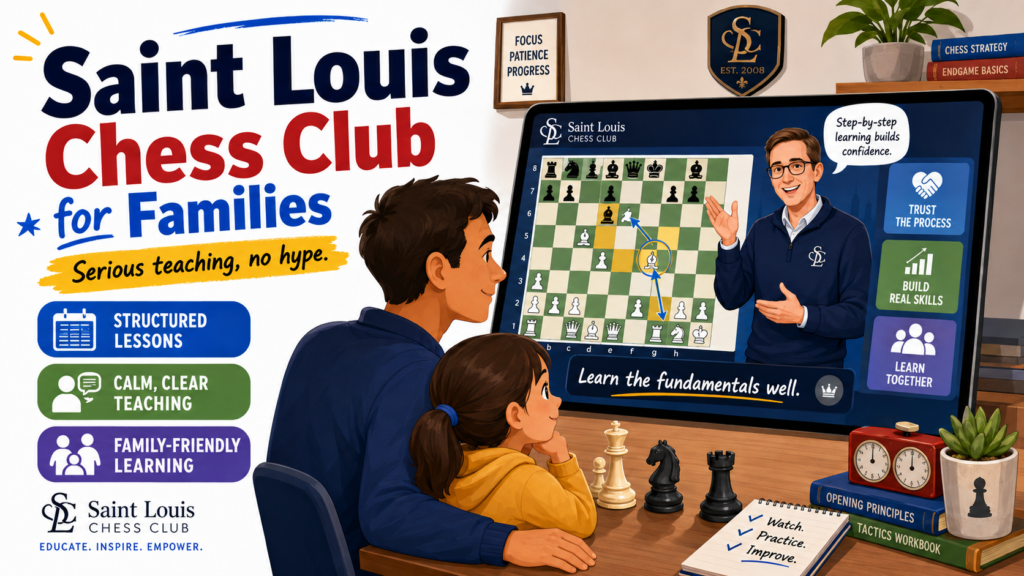
That range makes it a rich resource, but it also means parents should choose videos carefully.
Not every Saint Louis Chess Club video is right for a brand-new player. Some lessons are deep. Some are made for students who already know many chess ideas. But when you find the right beginner lesson, the value can be high because the teaching is often more classroom-like than entertainment-like.
This channel is best for beginners who are ready for a real lesson feel.
Some YouTube chess channels feel like a show. Saint Louis Chess Club often feels more like a class. That can be great for a student who is ready to sit, listen, and think.
A beginner can learn a lot from this kind of format because the coach is usually focused on one topic. The lesson may explain an opening idea, a checkmate pattern, an endgame rule, or a common mistake. This helps students build their chess brain step by step.
Still, the parent’s role matters. A child may click on a video that is too hard and leave feeling lost. That does not mean the channel is bad. It means the video was not matched to the child’s level.
A smart parent can search inside the channel for beginner lessons, basic tactics, checkmates, and simple endgames. Those topics are much better for new players than advanced grandmaster analysis.
The right beginner lesson should make your child feel challenged, not crushed.
There is a big difference between healthy struggle and confusion. Healthy struggle feels like, “This is hard, but I can try.” Confusion feels like, “I have no idea what is going on.”
A good chess lesson should sit in the middle. It should make the student think, but not make them feel small. This is very important for children. When chess feels too hard too soon, they may decide they are “not good at chess.” That belief can stop growth before it begins.
That is one reason Debsie focuses on personal learning. Two children may both be beginners, but they may not need the same lesson. One child may need piece safety. Another may need checkmate practice. Another may need help staying calm after a mistake. A live coach can see that and adjust.
Saint Louis Chess Club can be a wonderful resource when used with care. It can bring strong teaching into your home for free. But the best results come when you choose the right topic, pause often, and let the child explain what they learned in their own words.
Hanging Pawns is best for beginners who want to understand openings without getting lost.
Hanging Pawns is a chess YouTube channel by Stjepan Tomic, and it is known for detailed lessons on openings, plans, structures, and improvement. The channel describes itself as being for players who are trying to improve, and its library includes many videos on opening systems and chess plans.
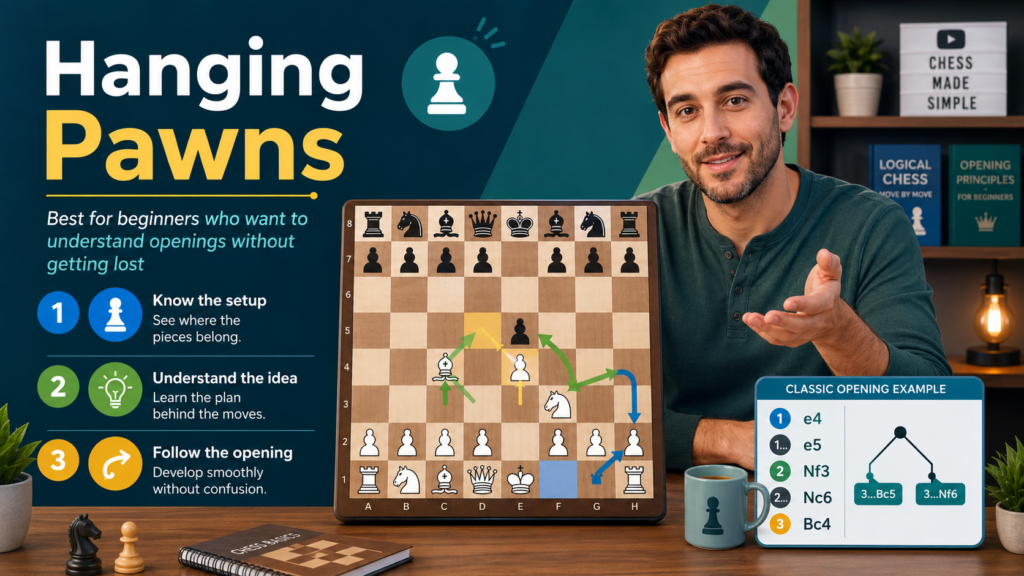
For beginners, this channel can be helpful, but it must be used in the right way. Many new players love openings because openings feel safe. They want to know what to play on move one, move two, and move three. That is natural. The start of the game feels scary when you do not have a plan.
But there is a danger. A beginner can spend weeks memorizing opening lines and still lose because they miss a hanging queen. So Hanging Pawns is useful when the student uses it to understand ideas, not to memorize long lines.
The best way to learn openings is to learn the plan behind the moves.
A child does not need to know twenty moves of the Sicilian Defense. A beginner does not need to memorize every trap in the Queen’s Gambit. What they need first is a simple answer to this question: “What am I trying to do?”
In the opening, most beginners should learn how to bring pieces out, fight for the center, keep the king safe, and avoid moving the same piece too many times without reason. When an opening video explains those ideas clearly, it can help a lot.
Hanging Pawns can be good for students who are curious and patient. It is especially useful for older beginners, teens, and adults who want more detail. Younger children may need shorter videos or a coach to break the lesson into smaller pieces.
A beginner should never treat an opening video like a magic spell.
Many students think, “If I learn this opening, I will win.” That is not how chess works. An opening can give you a good start, but it will not play the middle game for you. It will not stop you from missing checkmate. It will not teach you how to stay calm when your opponent does something strange.
That is why the best opening study is simple. Watch one video. Pick one opening idea. Play slow games and try to use that idea. After each game, check where the plan worked and where it failed.
This is where Debsie coaching can save a lot of time. A coach can look at your child’s games and say, “This opening is not the problem. You are losing because you move too fast when your piece is attacked.” That kind of feedback is priceless because it points the child to the real issue.
Hanging Pawns is a strong channel for students who want to learn openings with meaning. It is not the first channel I would give to a six-year-old who just learned the pieces. But for a beginner who is ready for structure and planning, it can be a very good tool.
Chess.com is helpful when beginners want short lessons, puzzles, and familiar names.
Chess.com is not only a playing site. Its YouTube channel is also one of the largest chess content hubs online. The channel describes Chess.com as the world’s number one chess community with millions of players and fans.
Because of its size, the channel has many types of videos, from lessons and event coverage to interviews, recaps, puzzles, and fun chess moments.
This variety can be good, but it can also be distracting. A beginner may start with a helpful lesson and then jump into a fast tournament recap that is too hard. That is why Chess.com works best when parents or students search with a clear goal.
The best use of Chess.com’s channel is to match the video to the skill you want to build.
If the child needs tactics, search for tactics. If the child needs checkmate help, search for checkmate. If the child needs opening basics, search for beginner opening lessons. Do not let the next suggested video decide the study plan.
The biggest benefit of a large channel is choice. There is always something to watch. The biggest risk is also choice. There is always something else to click.
For beginners, less is often better. One short lesson and one practice task can beat a full hour of random chess videos. The child should finish the video with one clear action. Maybe they will look for undefended pieces. Maybe they will check for back rank mate. Maybe they will stop moving pawns in front of their king for no reason.
A simple study path beats random watching almost every time.
Here is the truth many parents learn late. Chess improvement does not come from “more chess stuff.” It comes from the right chess work at the right level.
A child can watch a famous player for months and still make the same mistakes. Not because the famous player is bad. Not because the child is not smart. It happens because the learning path is not personal.
This is the gap Debsie helps fill. YouTube can teach ideas. Debsie helps turn those ideas into habits. In a live class, your child is not just watching someone else think. They are asked to think. They are guided when they guess wrong. They are praised when they find a smart idea. They learn to slow down, speak clearly, and trust their own mind.
Chess.com’s channel can be a useful part of a beginner’s learning plan, especially when used for short, focused lessons. But it should not become a maze. Choose one topic, learn it well, and then play games where your child practices that exact skill.
If your child likes online chess but needs a clear path, you can book a free Debsie trial class and see how guided learning feels from the very first session.
Chess Vibes is a strong pick when a beginner needs practical lessons that feel like real games.
Chess Vibes is a helpful channel for beginners because many of its videos are built around real problems new players face. The channel describes its work as practical chess lessons, and its video library includes rating climb content where games are explained move by move from lower levels upward.
That matters because beginners do not always need perfect grandmaster games. They need to see the messy games they actually play.
A new player often loses because of simple things. They bring the queen out too early. They forget a piece is attacked. They chase one pawn while their king gets weak. They resign too soon. A channel like Chess Vibes can help because it speaks to these common mistakes in a direct way.
This channel is useful because it teaches chess from the beginner’s seat, not only from the master’s seat.
Some chess lessons show beautiful games played by world-class players. Those games are inspiring, but they can feel far away from a child’s own games. A beginner may think, “That is nice, but my opponent does not play like that.”
This is why rating climb videos can work well. They show what chess looks like at the lower levels. The teacher can explain why a simple move wins, why a queen attack is not always scary, or why the best move is sometimes just saving a piece.
That kind of lesson feels real to beginners. It tells them, “You do not have to play like a grandmaster today. You just have to make fewer mistakes than last week.”
The best way to use Chess Vibes is to copy the thinking habit, not the exact move.
Parents should help children understand one key point. A chess video is not a script. Your child will not get the same position every game. So the goal is not to memorize every move from the video. The goal is to learn the question behind the move.
If the teacher stops an early queen attack, the child should not only remember that one defense.
They should learn to ask, “Is the queen really dangerous, or can I attack it while developing?” If the teacher wins a piece, the child should ask, “Was that piece undefended?” If the teacher finds checkmate, the child should ask, “Which squares could the king not use?”
This is where YouTube learning becomes stronger. The child is no longer just watching. They are building a thinking habit.
At Debsie, we love this kind of practical learning because it helps children gain confidence fast. When a student sees that many losses come from fixable mistakes, chess feels less scary. They stop saying, “I am bad at chess,” and start saying, “I know what to check next time.”
Chess Vibes is a good fit for beginners who want useful, real-game advice without too much heavy theory. It is also good for parents who want their child to see common mistakes explained in simple ways.
Remote Chess Academy is helpful when beginners want clear rules they can remember.
Remote Chess Academy is connected with Grandmaster Igor Smirnov, and its YouTube channel shares free video lessons on chess strategy, openings, traps, and common mistakes.
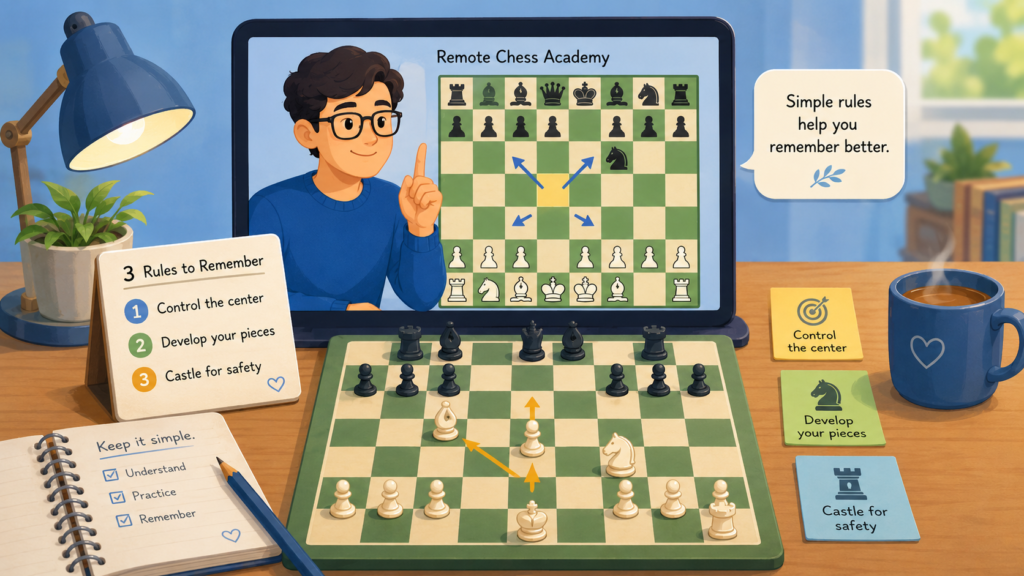
The channel has a very large library, including many videos on opening traps and opening ideas, which makes it easy for a beginner to find lessons that feel exciting.
For beginners, the strength of this channel is that many lessons are built around clear rules. A child may hear a simple idea like “punish early queen attacks” or “use this pattern when the opponent makes a common opening mistake.” Simple rules can help beginners because chess has too many choices at first.
But there is a small warning here. Beginners can become too excited by traps. A trap feels fun because it promises a quick win. But if a child only studies traps, they may become weak when the trap does not work.
The best use of Remote Chess Academy is to learn simple plans, not just quick tricks.
A good chess trap teaches more than a trick. It teaches why a piece is unsafe, why the king is weak, or why the opponent lost time. So when your child watches a trap video, ask them what the trap teaches.
This one question changes the lesson. Instead of saying, “I hope my opponent falls for this,” the child starts thinking, “What mistake made this trap possible?” That is a much stronger way to learn.
For example, if a trap works because the opponent moved the same piece too many times, the lesson is not just the trap. The deeper lesson is about time. If a trap works because the king stayed in the center, the deeper lesson is king safety. If a trap works because the queen came out early, the deeper lesson is development.
A beginner should treat every trap as a warning sign, not a shortcut.
The real value of trap study is not only learning how to trap others. It is also learning how not to get trapped. This matters a lot for children, because early losses can feel painful. When a child falls into the same trap again and again, they may feel embarrassed. But when they understand the pattern, they become calmer.
That calm feeling is important. Chess is not only about finding smart moves. It is also about handling surprise. A child who learns to stay calm after a tricky move is building a skill they can use in school and life.
Remote Chess Academy can be a strong tool for beginners who like clear lessons and exciting ideas. Parents should balance it with slow games, puzzle practice, and game review. This keeps the child from becoming a trick hunter.
At Debsie, we help students enjoy fun ideas while also building a steady base. A child may love traps, and that is fine. A good coach can use that interest to teach deeper skills like patience, board safety, and planning.
ChessCoach Andras is a good fit for beginners who need honest chess habits.
ChessCoach Andras describes the channel as “No Nonsense Chess education” with a focus on players from lower-rated club level to much stronger players. The channel also has improvement-based content, including videos on study plans, common mistakes, game review, and how club players think.
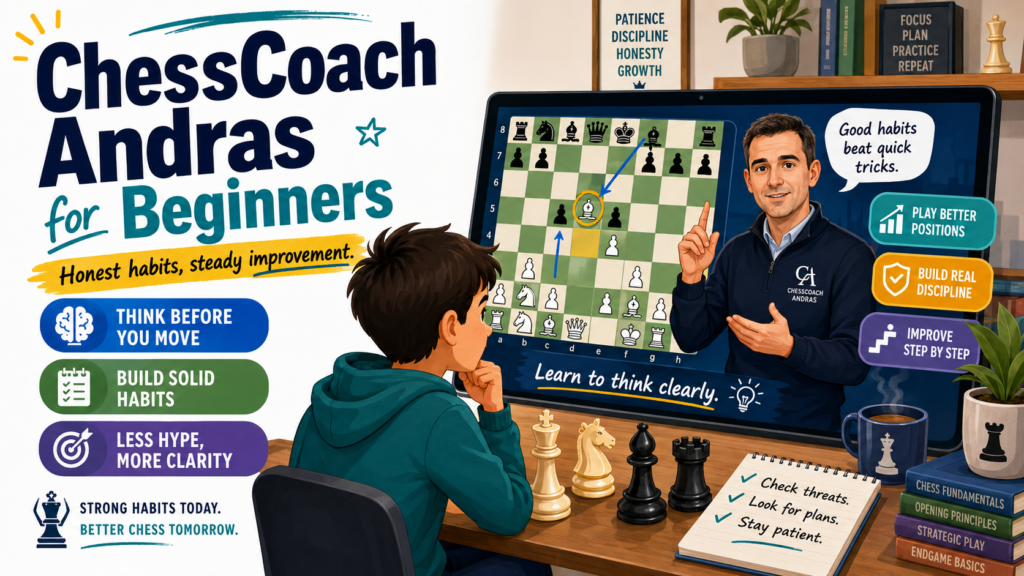
This type of channel is useful because many beginners do not need more random tips. They need better habits. They need to stop rushing. They need to check threats. They need to review their games without feeling bad. They need to learn that a mistake is not the end of the world.
ChessCoach Andras may not be the first channel for a very young child who only wants cartoons and quick clips. But it can be very helpful for older beginners, teens, and serious learners who want straight talk.
The best part of this style is that it teaches students to take responsibility without feeling hopeless.
Some chess advice is too soft. It says, “Just have fun,” but never helps the child fix anything. Some chess advice is too harsh. It makes mistakes feel shameful. The best teaching sits in the middle. It tells the truth, but in a way that helps the student improve.
A beginner needs to hear things like, “You lost because you missed a threat,” or “You moved too fast,” or “You played a nice attack but forgot your back rank.” These words can help when they are said with care.
That is why game review is so powerful. It helps the child see the exact moment where the game changed. Maybe they were winning and got excited. Maybe they were losing and gave up too soon. Maybe they had a simple move but searched for something fancy.
The most useful chess lesson is often the one that shows your first real mistake.
Many students only look at the final blunder. They say, “I lost because I hung my queen.” But often the real problem came earlier. Maybe they opened the king. Maybe they ignored development. Maybe they chased a pawn and left a piece trapped.
A good teacher helps the student find the first mistake, not just the last one. That is how a child learns to prevent problems instead of only reacting to them.
This is also one of the reasons live coaching can work better than videos alone. A video can show a common mistake. A coach can show your child’s mistake. That personal touch matters. It helps the student feel seen. It also saves time because the lesson matches the child’s real games.
At Debsie, our coaches guide students through this process in a kind and clear way. We want kids to learn how to review a game without feeling attacked. The goal is not to say, “You played badly.” The goal is to say, “Here is the moment where your thinking can get stronger.”
ChessCoach Andras is a good channel for students who are ready to improve with honesty. It may feel more serious than some channels, but serious does not have to mean boring. For the right learner, it can be refreshing.
Anna Cramling is a warm choice when beginners need chess to feel friendly and human.
Anna Cramling’s YouTube channel has become popular because it mixes chess, personality, games, and fun moments. Her channel includes online chess videos and livestream-style content, and her wider chess presence often feels friendly and welcoming to newer fans.
For beginners, that warmth matters. Not every child starts chess because they want to become a champion. Some children start because the game looks fun. Some are shy. Some are scared of losing. Some believe chess is only for “genius kids.” A friendly creator can help break that fear.
Anna Cramling’s videos can make chess feel more open. A child may watch and think, “This game is not only for serious people. I can enjoy this too.” That first feeling can be the start of a long learning journey.
This channel is best used for confidence, comfort, and love for the game.
Parents should understand what this channel may do best. It may not always be the most direct path for structured beginner lessons. Some videos are more about chess life, games, reactions, or fun moments. But that does not make the channel useless for beginners.
A child who enjoys a chess personality may become more willing to practice. They may want to play one more game. They may become curious about tournaments. They may see that losing happens to everyone, even strong players. That can be very healthy.
Many parents focus only on skill. Skill is important, of course. But love for the game is what keeps a child coming back. A child who enjoys chess will practice more. A child who practices more will improve faster.
A friendly chess channel can help a beginner feel safe enough to try.
Trying matters. A child cannot improve at chess if they are too scared to play. They need to lose games, test ideas, and recover after mistakes. A warm chess creator can make that process feel normal.
Still, parents should pair fun content with clear practice. After watching a light chess video, ask your child what they noticed. Did someone stay calm after a mistake? Did someone laugh and keep playing? Did one player explain a simple plan? These are real lessons too.
At Debsie, we care deeply about this emotional side of chess. We do not only teach moves. We help children build patience, focus, and belief in themselves. A child who can lose a chess game and still think clearly is learning something much bigger than chess.
Anna Cramling can be a good choice for beginners who need chess to feel less stiff and more human. Use it as a bridge into the game, then support that interest with guided lessons, puzzles, and slow games.
The best YouTube channel for your child depends on the kind of beginner they are.
There is no single best chess YouTuber for every beginner. A seven-year-old who just learned how the knight moves does not need the same videos as a thirteen-year-old trying to reach 1000 online rating.
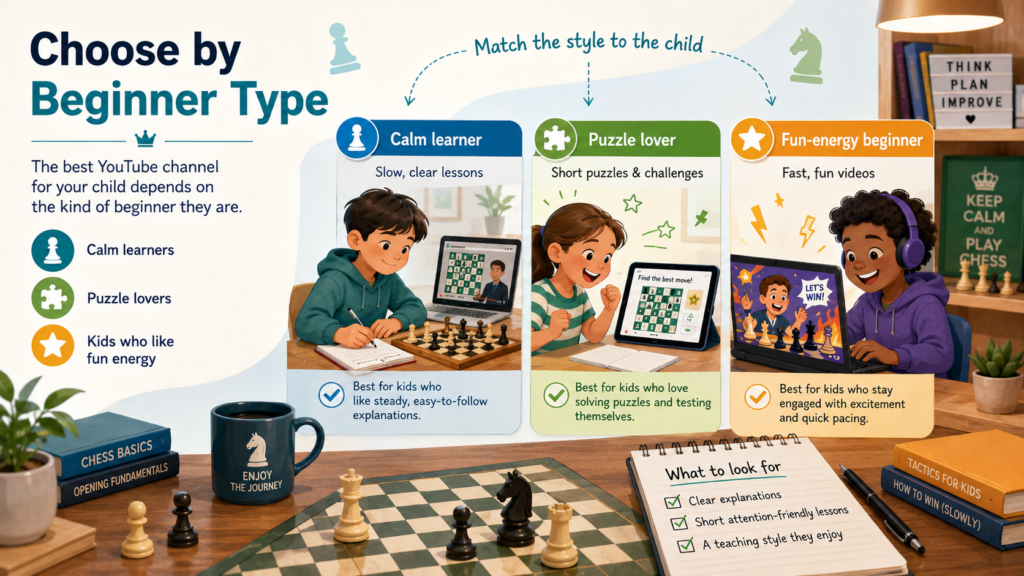
A shy child may need a friendly voice first. A fast-moving child may need a calm teacher. A serious child may want deep explanations right away.
This is why parents should not pick a channel only because it is famous. Fame tells you many people watch. It does not tell you whether your child is learning.
A better question is simple. What does my child need right now?
A beginner who gets bored needs energy, while a beginner who rushes needs calm.
This is a very important difference. Some children need excitement before they can care about chess. For them, a lively channel can be useful. It pulls them in. It makes the game feel cool. It gives them a reason to come back.
Other children are already excited, but they move too fast. They blunder because they want action every second. For them, a calmer teacher may be better. They need to learn how to pause, breathe, and ask what the opponent wants.
Some beginners need simple rules. Some need practice games explained move by move. Some need help with openings. Some need endgames. Some need to stop being scared of losing.
When you match the channel to the child’s need, YouTube becomes much more useful.
The right video should change one thing your child does in the next game.
This is the easiest way to judge any chess video. After watching, does your child play even one move with more care? Do they check if a piece is safe? Do they castle earlier? Do they stop chasing the queen? Do they look for checks and captures before moving?
If yes, the video worked.
If no, the video may still have been fun, but it did not become learning yet.
That is why Debsie recommends a simple pattern. Watch one useful video. Talk about one idea. Play one slow game. Review one key moment. This pattern is not fancy, but it works because it turns content into action.
And when your child is ready for more than videos, a live coach can help them grow faster. A coach can see the hidden habits a video cannot see. Maybe your child understands tactics but gets nervous in winning positions. Maybe they know openings but forget king safety. Maybe they calculate well but do not trust themselves.
A free Debsie trial class is a good next step when you want to understand your child’s chess level and learning style in a personal way.
Eric Rosen is great for beginners who learn best through calm fun and real games.
Eric Rosen is an International Master who shares chess videos that are often friendly, light, and easy to enjoy. His YouTube channel says his content is family friendly and made for players of all levels, with videos on openings, gambits, tactics, and strategy.
That makes him a good fit for beginners who want learning to feel relaxed, not heavy.
Many beginners like Eric Rosen because his style does not feel scary. He often plays interesting games, explains ideas as they happen, and keeps the mood gentle. This can help children who feel nervous about chess.
They see that even strong players can smile, think, miss things, recover, and keep going.
Eric Rosen can help beginners enjoy chess while still learning useful patterns.
The best thing about his videos is the mix of fun and thought. A beginner can watch an opening idea, a trap, or a tactic without feeling like they are sitting in a strict lesson. That matters because many children need joy before they build discipline.
But parents should still guide the learning. Some of his videos are about sharp openings or tricky gambits. These can be exciting, but a beginner should not think that chess is only about surprise attacks. A trick can win one game, but strong habits win many games.
A good way to use Eric Rosen’s channel is to pick one video and ask the child to explain the main idea after watching. Not the whole game. Not every move. Just one idea. Maybe it is about why the king stayed unsafe.
Maybe it is about how a knight fork worked. Maybe it is about why a pawn move opened a dangerous line.
The goal is not to copy Eric Rosen’s moves but to copy his calm thinking.
This is very important. A child may watch a strong player and want to play the same opening right away. That is fine, but the deeper lesson is how the player thinks when things get messy. Does he panic? No. Does he look for checks, captures, and threats? Yes. Does he keep asking what the opponent wants? Yes.
That calm thinking is what children need most. Chess becomes easier when a child learns to pause before reacting. They may still make mistakes, but they start to feel more in control.
At Debsie, we care a lot about this kind of growth. A child who learns to stay calm in chess can also become calmer during school tests, homework, and hard choices. That is why chess is more than a board game. It is practice for the mind.
Eric Rosen is a strong choice for beginners who need a friendly voice and fun games. He works best when paired with focused practice, game review, and a coach who can turn fun ideas into lasting habits.
NM Robert Ramirez is one of the clearest choices for a full beginner path.
NM Robert Ramirez is a strong option for families who want a step-by-step path.
His channel says it was created to teach chess from beginner to master level “the right way,” and his beginner playlist starts with the board, the pieces, how pieces move, check, checkmate, practice games, special moves, piece values, notation, board vision, tactics, and basic checkmates.
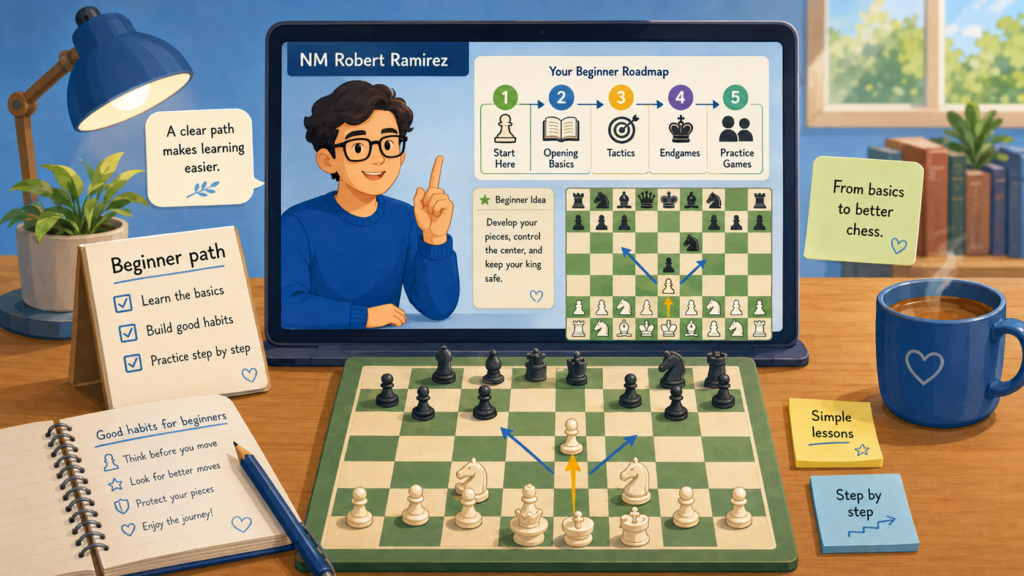
That is very useful for true beginners. Many chess channels assume the student already knows the rules. Robert Ramirez does not always make that assumption. His content can help a child move from “I barely know what is happening” to “I understand the basic shape of a chess game.”
A clear learning order can save beginners from feeling lost.
One problem with YouTube is that it has too much content. A child may watch a video on the Sicilian Defense before they know how to checkmate with a rook. They may watch a video on queen sacrifices before they know why castling matters. That can create confusion.
A step-by-step channel helps because it gives the learner a path. First learn the board. Then learn the pieces. Then learn check and checkmate. Then learn special moves. Then learn simple tactics. This order may sound basic, but basics are what beginners need most.
Parents sometimes want their child to jump into “advanced” chess too early. That can hurt confidence. A child does not need fancy ideas if they still forget how en passant works or why stalemate is not a win. A strong base makes later learning much easier.
The best beginner path should feel simple enough to follow but strong enough to build real skill.
The early chess journey should not feel like a maze. A child should know what they are learning today and why it matters. When a lesson is clear, the child feels safe. When the child feels safe, they ask more questions. When they ask more questions, they learn faster.
NM Robert Ramirez can be helpful because his content often feels like a course, not just a stream of random videos. This makes it easier for parents to create a home routine. A child can watch one lesson, practice that one idea, then move forward when they are ready.
This fits very well with the way Debsie teaches. We believe children learn best when the path is clear and the coach is kind. We do not rush kids through ideas just to make the lesson look advanced. We help them understand deeply, practice carefully, and feel proud of small wins.
If your child is at the very start, this channel can be a good free support. And when your child needs personal feedback, a Debsie trial class can show what they understand, what they miss, and what they should learn next. You can book a free trial class at https://debsie.com/take-a-free-chess-trial-class/
The Chess Website is useful when beginners want simple openings and quick topic lessons.
The Chess Website has long been known for short chess lessons, especially on openings. Its YouTube channel says it teaches chess openings and the key ideas inside those openings, including main lines and important things to remember.
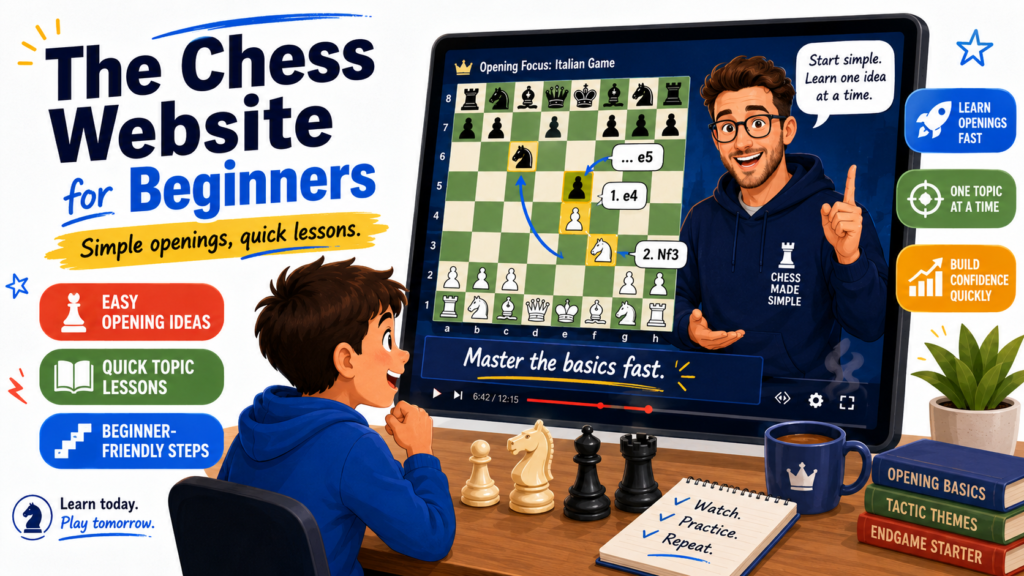
This can help beginners who want fast answers. A child may ask, “What should I play against the Italian Game?” or “What is the Queen’s Gambit?” or “Why do people play the French Defense?” A short video can give them a simple starting point.
But this channel should be used with care. Opening videos are useful only when the child understands the main ideas. If a beginner only memorizes moves, they may fall apart when the opponent plays something different. That happens all the time in real beginner games.
The best opening lesson teaches the reason, not just the move order.
Beginners should learn openings like stories. Each piece has a job. The knights come out to help control the center. The bishops find good lines. The king gets safe. The rooks may connect later. The pawns take space but should not create big holes.
When a video explains an opening this way, it becomes useful. The child is not just remembering moves. They are learning what a healthy position looks like.
For example, if a child studies an opening and only remembers, “Move this knight here,” that may not help much. But if they remember, “This knight move fights for the center and helps me castle,” they are building understanding. That is the kind of learning that lasts.
Parents should not let opening study replace basic chess safety.
This is the trap. Openings feel smart. They have names. They sound serious. But a child who knows ten opening names can still lose a queen in one move.
So the rule should be simple. Openings are useful, but safety comes first. Before a child studies more opening lines, they should know how to check if a piece is attacked. They should know why the king must be safe. They should know how to spot a simple fork, pin, and back rank danger.
At Debsie, coaches often help students see this balance. We do teach openings, but we teach them in a child-friendly way. We do not want kids to sound smart and play carelessly. We want them to understand what they are doing.
The Chess Website can be a useful support when a beginner wants a simple look at an opening or a quick topic. It works best when the child watches slowly, repeats the idea on a board, and then plays a game where they try to use the main plan.
Lichess video lessons can help beginners who want free practice with many teachers.
Lichess has a free video section where users can find chess videos by level and topic. Its beginner tag shows hundreds of videos, including lessons on piece movement, openings, pawn endgames, defending pieces, basic strategy, and other chess basics.
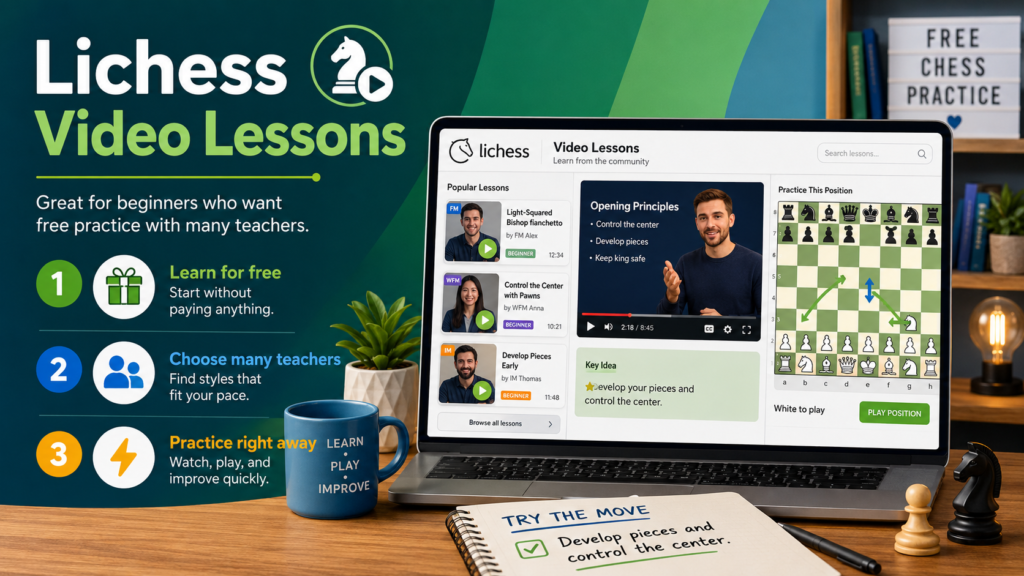
This is different from following one YouTuber. Lichess works more like a library. A beginner can search for a topic and find lessons from different teachers. That can be helpful when a child wants to learn one exact skill, like king and pawn endgames or basic opening ideas.
But a library also needs a plan. If a child jumps from one topic to another without order, they may feel busy but not improve much. Free content is powerful, but only when used with purpose.
Lichess is best when parents or coaches choose the topic before the child starts watching.
A child should not begin by asking, “What looks fun today?” Sometimes that works, but it can also lead to random learning. A better question is, “What mistake did I make in my last game?”
If the child lost because of checkmate threats, watch a video on king safety or checkmate patterns. If the child lost a rook for free, watch a video on undefended pieces. If the child reached a winning endgame but did not know how to finish, watch a basic endgame lesson.
This makes video learning much more powerful. The lesson now solves a real problem from the child’s own game. That makes the child care more and remember more.
A free video becomes much stronger when it is tied to one real mistake.
This is one of the best habits a beginner can learn. Do not study everything. Study the next useful thing.
After a game, choose one mistake. Maybe the child moved too fast. Maybe they missed a fork. Maybe they did not castle. Maybe they traded pieces when they were attacking. Then find a video that explains that one idea. Watch it. Practice it. Use it in the next game.
This is simple, but it works because it gives learning a purpose.
Debsie uses this same idea in a more personal way. A coach watches how a child thinks and chooses the right next step. The student does not have to guess what to study. They get a path made for them. That saves time and helps them feel more confident.
Lichess video lessons can be a great free tool for families. They give access to many topics and many teaching styles. But for the best results, use them like a toolbox, not like a television. Pick the tool that matches the problem, then practice the skill on the board.
Beginners should not watch chess YouTube the same way they watch cartoons.
This is one of the biggest mistakes parents and students make. They think watching more chess videos means learning more chess. It sounds true, but it is not always true. A child can watch chess for hours and still make the same mistakes in every game.
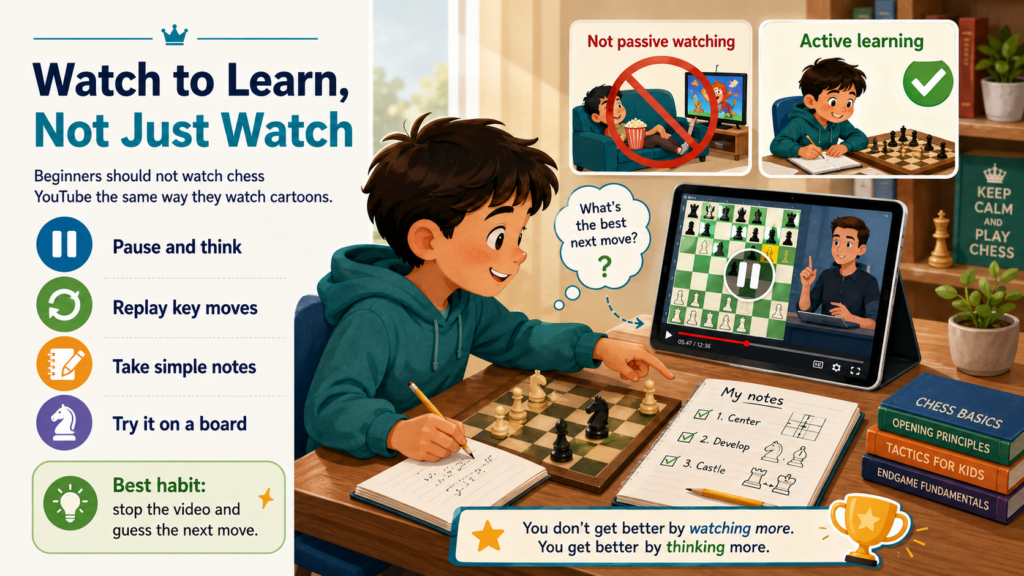
Chess is not learned by watching alone. Chess is learned when the child watches, thinks, tries, fails, and fixes. The video is only the start. The real learning happens when the child uses the idea in a game.
That is why a beginner should never watch five random videos and call it practice. It feels busy, but it may not build skill. A better plan is to watch one useful video, stop, and do something with it.
The best chess video is the one that gives your child one clear job.
Before the video starts, your child should know what they are trying to learn. Maybe they are learning how to castle early. Maybe they are learning how to spot a fork. Maybe they are learning why bringing the queen out too soon can be risky.
When the goal is clear, the child listens better. They know what to look for. They are not just waiting for a funny moment or a big blunder. They are hunting for a lesson.
After the video, ask your child to show the idea on a board. If they watched a lesson about pins, ask them to set up one pin. If they watched a lesson about checkmate, ask them to make the checkmate pattern. If they watched a lesson about opening rules, ask them to play the first few moves slowly and explain each one.
This simple step changes everything. It turns the child from a viewer into a learner.
A child should be able to say, “In my next game, I will try this.”
That sentence is powerful because it makes the lesson practical. It also keeps the child from feeling overwhelmed.
Chess has many ideas. There are openings, tactics, endgames, pawn moves, king safety, piece trades, time pressure, and more. A beginner cannot work on all of them at once. When they try, they often feel lost.
So the goal after each video should be small. One idea. One job. One game where they try it.
This is also how Debsie coaches help students grow. We do not throw too many ideas at a child in one class. We guide them step by step. A coach may say, “Today, let us focus on not leaving pieces undefended.” That one focus can improve many games.
YouTube can inspire your child. A Debsie coach can help your child use that inspiration in the right way. If your child watches chess videos but does not know what to practice next, a free Debsie trial class can give them a clear path.
Parents should watch for red flags in beginner chess videos.
Not every chess video that says “beginner” is truly beginner-friendly. Some videos use hard words too soon. Some move too fast. Some teach tricks without teaching the reason behind them. Some make beginners feel that chess is only about traps and quick wins.
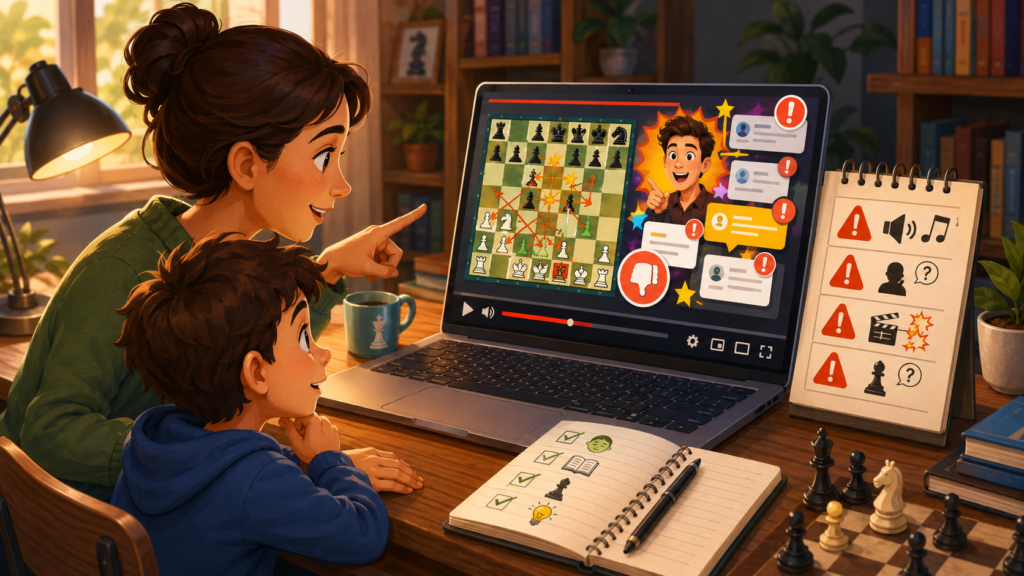
A beginner needs clear teaching. They need simple words. They need time to understand why a move works. If a video skips the thinking and only shows the answer, it may not be the best lesson for a new player.
This matters even more for children. A child may not say, “This video is too advanced for me.” They may just become quiet. They may stop asking questions. They may say chess is boring, when the real problem is that the lesson was not matched to their level.
A video is too hard if your child cannot explain the main idea after watching.
This is the easiest test. After the video ends, ask your child what they learned. Do not ask in a scary way. Ask like you are curious.
If they can explain one idea in simple words, the video was useful. If they only remember that someone won, someone blundered, or the game was funny, the video may have been more entertainment than learning.
That does not mean fun videos are bad. Fun has a place. A child who enjoys chess will spend more time with it. But if every video is only fun, improvement may be slow.
A good beginner video should leave a small mark on the child’s thinking. Maybe they start checking if their queen is safe. Maybe they remember to castle. Maybe they look for checks before moving. That kind of change is the real win.
The biggest red flag is a video that makes your child feel smart for memorizing but weak when playing.
This happens often with opening traps. A child learns a trap and feels excited. Then the opponent does not fall for it. Suddenly the child has no plan. They may feel confused or even annoyed.
That is why trap videos should be used carefully. A trap is useful only when the child understands the idea behind it. If they only memorize moves, they are building a weak habit.
Another red flag is speed. Some creators are brilliant, but they talk fast and assume the viewer already knows a lot. That may work for stronger players. It may not work for beginners.
The best beginner teaching should slow the game down. It should help the child see what changed on the board. It should make them feel, “I can learn this,” not “I will never understand chess.”
At Debsie, this is a big part of our teaching style. We meet students where they are. A child who needs basics gets basics. A child who is ready for deeper ideas gets deeper ideas. The lesson grows with the student, not ahead of the student.
Conclusion:
The best chess YouTuber for beginners is not always the biggest name. It is the teacher who helps your child understand, stay curious, and play with more care. YouTube can spark love for chess, teach simple ideas, and make practice more fun.
Adhip Ray is the founder of Debsie, an online learning platform focused on chess and skill-based learning for children. His work at Debsie brings together chess education, structured thinking, problem-solving, and interactive learning for young students.
Adhip has an academic background in law, statistics, analytics, and technology. He is from Amity Law School and the Indian Statistical Institute, Kolkata, with formal training that connects legal reasoning, data analytics, quantitative thinking, and structured problem-solving. This interdisciplinary background is reflected in Debsie’s focus on building sharper thinking skills in children through chess and related learning programs.
Adhip is also a FIDE-rated chess player from India. He holds FIDE ID 5055954 and has a standard FIDE rating of 1832. His FIDE profile records him as an Indian player with a long rating history in standard chess, including rated games from his competitive playing years. His chess background gives Debsie a founder-led connection to the game, not only as an educational activity but also as a competitive discipline that develops concentration, calculation, planning, and decision-making.
In addition to chess, Adhip has a strong interest in coding, data, and technical problem-solving.
Adhip’s profile combines chess, law, data analytics, and programming. At Debsie, this background supports the creation of learning experiences that are logical, structured, and skill-oriented. The platform’s chess-focused programs are connected to broader cognitive skills such as pattern recognition, patience, strategic planning, focus, and problem-solving.
As founder of Debsie, Adhip brings together experience from multiple fields: formal legal education from Amity Law School, analytical training from the Indian Statistical Institute, Kolkata, competitive chess experience through his FIDE-rated profile, and coding practice through LeetCode. This combination gives Debsie a distinct foundation in strategy, reasoning, analytics, and child-focused learning.
Through Debsie, Adhip is associated with building chess and learning content for children that goes beyond basic instruction. The platform connects chess with thinking skills, helping students approach challenges with more structure, clarity, and confidence. His own background in chess and analytical problem-solving gives the platform a direct link to the skills it aims to develop in young learners.
Adhip is also a member of Forbes Business Council.