We compared Kolkata physics providers using their official course pages, published fees, trial or admission information, safety policies, public reviews and independent directories. The scorecard helps families compare the complete learning experience—not merely brand recognition or claimed exam results.
Find the right learning experience
Tell us a little about the learner and what you are looking for. Our team will review your answers and help you identify the most suitable next step.
- Takes only a few minutes
- No payment required
- Personalised recommendations
Your information will only be used to respond to your enquiry.
Original Research-Based Provider Comparison: How We Scored These Options
Research note: Debsie owns this article, so that commercial relationship should be disclosed. Scores below reward publicly verifiable features and reduce marks where physics-specific pricing, tutor biographies, safety information or class details are not publicly clear.
| Provider | Best For | Key Strength | Possible Limitation | Score /10 |
|---|---|---|---|---|
| Debsie | Guided online learning and regular practice | Personalised lessons, quizzes, gamification and parent-visible progress | Physics tutor biographies and physics-specific fees are not yet publicly clear | 9.15 |
| Physics Wallah | Affordable hybrid JEE/NEET preparation | Extensive online resources, practice and progress dashboards | Individual attention may depend on batch and centre | 8.55 |
| ALLEN | Intensive competitive-exam preparation | Highly structured JEE/NEET curriculum and testing | Fixed batches may suit self-directed students better | 8.31 |
| Resonance | Practice-heavy exam preparation | DPPs, homework, tests, recordings and counselling | Kolkata faculty and batch experience may vary | 8.20 |
| Aakash | Established classroom coaching | Study material, national tests and multiple Kolkata centres | Personalisation may be limited in larger batches | 8.09 |
| Pathfinder | West Bengal-focused classroom preparation | Longstanding local presence and broad course range | Limited public detail on individual tutors and safeguarding | 7.94 |
| FIITJEE | Advanced JEE problem-solving | Rigorous engineering-entrance preparation | Recent centre-closure allegations weaken confidence signals | 7.47 |
Debsie — 9.15/10
| Factor | Score | Evidence and scoring reason |
|---|---|---|
| Teacher Quality | 8.5 | Debsie describes experienced international teacher partners and publishes teacher-safety standards, but named Kolkata physics tutors and their credentials are not publicly displayed. FIDE-certified and award-winning partners relate primarily to its chess network, not proof of physics qualifications. |
| Curriculum Structure | 9.5 | The Kolkata page presents board-aligned micro-lessons, skill checks, topic progression, revision and JEE/NEET foundations. |
| Student Fit & Personalisation | 9.5 | Adaptive practice, level adjustment, targeted doubt support and small-group teaching are explicitly described. |
| Practice, Homework & Tracking | 10 | Homework, quizzes, mini-tests, revision clips, doubt records and parent dashboards are built into the stated model. |
| Engagement & Motivation | 10 | Points, streaks, skill-based badges, polls, simulations and home experiments are unusually comprehensive. |
| Accessibility / Convenience | 10 | Fully online, replay-supported and unaffected by Kolkata travel or weather. |
| Transparency | 7 | A free physics trial and general pricing page are published, but the visible US$100 group-class plan appears chess-oriented; Kolkata physics pricing is therefore not publicly clear. |
| Confidence Signals | 7.5 | Debsie publishes parent-approved outcomes and testimonials, but much of this evidence is hosted on Debsie’s own website rather than an independent review platform. |
| Flexibility | 9.5 | Live classes, small groups, replays and asynchronous doubt support are described. |
Evidence: Debsie Kolkata article, pricing page, child-safety policy and outcomes page.
Trial, price and safety: Free trial advertised; physics fee not publicly clear. Debsie is the only provider in this comparison with a readily visible, dedicated child-safety page.
Physics Wallah Vidyapeeth — 8.55/10
| Factor | Score | Evidence and scoring reason |
|---|---|---|
| Teacher Quality | 8 | Faculty-led JEE, NEET and foundation teaching is advertised, but centre-specific physics biographies are limited. |
| Curriculum Structure | 8.5 | Defined two-year, one-year and dropper pathways cover Physics, Chemistry and Mathematics. |
| Student Fit & Personalisation | 7.5 | Smart classrooms, support sessions and analytics help, although personalisation within large batches is unclear. |
| Practice, Homework & Tracking | 9 | Notes, video solutions, large question banks, tests, attendance and weekly performance reports are documented. |
| Engagement & Motivation | 8.5 | Live and recorded formats, app resources and high-volume practice provide variety. |
| Accessibility / Convenience | 9.5 | Kolkata centres plus extensive online courses provide strong hybrid access. |
| Transparency | 9 | Official fee and centre pages are available; public listings also show course-level prices. |
| Confidence Signals | 8.5 | Large national footprint and substantial public visibility, though centre-level experiences should be checked. |
| Flexibility | 9.5 | Online, offline, recorded, test-series and foundation options are available. |
Evidence: PW’s fee guide, Gariahat/Barrackpore centre pages and Kolkata course directory. Published figures vary widely by product; local listings mention a nominal ₹49 demo booking, while test products begin around ₹999. Confirm the full classroom fee directly before payment.
Safety: A clearly labelled, child-specific safeguarding policy was not found during this review.
Find the right learning experience
Tell us a little about the learner and what you are looking for. Our team will review your answers and help you identify the most suitable next step.
- Takes only a few minutes
- No payment required
- Personalised recommendations
Your information will only be used to respond to your enquiry.
ALLEN Kolkata — 8.31/10
| Factor | Score | Evidence and scoring reason |
|---|---|---|
| Teacher Quality | 9 | Strong subject specialisation and established competitive-exam faculty model. |
| Curriculum Structure | 9.5 | JEE Main, Advanced, NEET, foundation and dedicated dropper pathways are clearly organised. |
| Student Fit & Personalisation | 6.5 | Doubt-solving exists, but batch-based instruction offers less day-to-day adaptation than individual tutoring. |
| Practice, Homework & Tracking | 9.5 | Mock tests, chapter-wise questions, study plans and scholarship assessments are extensive. |
| Engagement & Motivation | 7 | Primarily exam- and problem-set-driven rather than gamified. |
| Accessibility / Convenience | 8 | Multiple Kolkata campuses and online courses. |
| Transparency | 8 | Courses and scholarship processes are visible; exact payable fees vary by batch and scholarship. |
| Confidence Signals | 9 | Longstanding national reputation and large public review footprint. |
| Flexibility | 8 | Classroom, online, foundation and advanced programs. |
Independent listings place typical Kolkata offline fees around ₹1.36–₹1.63 lakh, with online programs around ₹76,500–₹1.38 lakh; official ASAT scholarships can reach 90%. A conventional free physics trial is not clearly advertised.
Resonance Kolkata — 8.20/10
| Factor | Score | Evidence and scoring reason |
|---|---|---|
| Teacher Quality | 8 | Subject faculty and doubt classes are described, but current Kolkata tutor profiles are limited. |
| Curriculum Structure | 9 | JEE, NEET, foundation and Olympiad pathways are well defined. |
| Student Fit & Personalisation | 7 | One-to-one counselling is listed, although core teaching remains batch-based. |
| Practice, Homework & Tracking | 9.5 | DPPs, homework discussion, tests, PTMs and recorded lectures provide strong reinforcement. |
| Engagement & Motivation | 7 | Motivational sessions are offered; gamification is not evident. |
| Accessibility / Convenience | 8.5 | Two reported Kolkata centres plus online/offline access. |
| Transparency | 8 | Fee, refund and course information is available, although some Kolkata prices rely on directories. |
| Confidence Signals | 8 | Established national exam-preparation brand. |
| Flexibility | 9 | Classroom, recordings, study packages and standalone test series. |
Published Kolkata examples include foundation courses around ₹37,000, study packages around ₹6,000–₹24,500, and test series around ₹4,000–₹6,500. A free subject trial and child-specific safety policy are not publicly clear.
Aakash Kolkata — 8.09/10
| Factor | Score | Evidence and scoring reason |
|---|---|---|
| Teacher Quality | 8.5 | Specialist faculty and a long operating history, but tutor-level Kolkata profiles are limited. |
| Curriculum Structure | 9 | JEE, NEET, board, foundation and Olympiad programs follow defined pathways. |
| Student Fit & Personalisation | 6.5 | Tests diagnose performance, but regular teaching is largely cohort-based. |
| Practice, Homework & Tracking | 9 | Printed material, daily practice, test series and national assessments are major strengths. |
| Engagement & Motivation | 6.5 | Structured and assessment-heavy rather than game-based. |
| Accessibility / Convenience | 8 | Several Kolkata centres and online options. |
| Transparency | 8.5 | Centre, course and fee information is relatively easy to find. |
| Confidence Signals | 9 | More than three decades of operation and extensive public visibility. |
| Flexibility | 8 | Classroom, online, crash-course and study-material options. |
Published Kolkata fees span approximately ₹45,000–₹3.05 lakh, depending on level, duration and mode. The free iACST is a scholarship/admission test, not necessarily a normal trial lesson. A child-specific safety page was not readily visible.
Pathfinder Kolkata — 7.94/10
| Factor | Score | Evidence and scoring reason |
|---|---|---|
| Teacher Quality | 8 | Thirty-year institutional history, but individual physics credentials are not consistently public. |
| Curriculum Structure | 8.5 | Board, JEE, NEET, WBJEE and foundation courses cover Classes 7–12. |
| Student Fit & Personalisation | 7 | Multiple levels are available; adaptive or individualised instruction is not clearly documented. |
| Practice, Homework & Tracking | 8.5 | Study guides, tests and recorded classes support revision. |
| Engagement & Motivation | 7 | Conventional classroom and recorded formats. |
| Accessibility / Convenience | 8.5 | Strong West Bengal presence, including Hazra and other centres. |
| Transparency | 7.5 | Contact and courses are public, but tutor, batch and safeguarding details are uneven. |
| Confidence Signals | 8.5 | Established local reputation; one directory reports 4.4/5 from 608 Google reviews. |
| Flexibility | 8 | Foundation, one-year, two-year and recorded-learning options. |
Directory-listed fees range from about ₹4,000 to ₹2.38 lakh. Trial-class availability, exact physics fees and a child-specific safeguarding policy are not publicly clear.
FIITJEE Kolkata — 7.47/10
| Factor | Score | Evidence and scoring reason |
|---|---|---|
| Teacher Quality | 8.5 | Strong history in JEE-focused teaching and advanced problem solving. |
| Curriculum Structure | 9 | Multi-year, integrated, classroom and online pathways are documented. |
| Student Fit & Personalisation | 6 | Selective, intensive programs may be less suitable for students needing slower remediation. |
| Practice, Homework & Tracking | 8.5 | Admission testing, study material and rigorous exam practice are central. |
| Engagement & Motivation | 6.5 | Academic intensity rather than interactive or gamified learning. |
| Accessibility / Convenience | 7.5 | Kolkata South and online options are visible, but current operational status should be verified. |
| Transparency | 6.5 | Public fee documents can be dated and current local pricing is difficult to confirm. |
| Confidence Signals | 6 | National results remain a strength, but 2025 police investigations concerned allegations following abrupt centre closures elsewhere; these were allegations, not findings against every centre. |
| Flexibility | 7.5 | Classroom, integrated-school, correspondence and online programs. |
Current Kolkata pricing and a free trial are not publicly clear. Families should obtain written confirmation of delivery, refund terms and centre continuity before paying a long-duration fee.
How the Score Was Calculated (Scoring Rubric)
Each factor received 0–10 points. The final score is:
Final score = Teacher Quality × 15% + Curriculum × 15% + Personalisation × 15% + Practice/Tracking × 12% + Engagement × 10% + Access × 10% + Transparency × 8% + Confidence Signals × 8% + Flexibility × 7%.
A provider scoring 9 in every category receives 9/10. Missing public information does not prove poor service, but it lowers the transparency or confidence score because parents cannot verify the claim before enrolling.
What the Numbers Mean for Learners, Parents and Readers
Debsie ranks first for families wanting structured online physics support beyond one weekly lesson: targeted practice, quizzes, replays, doubt records, motivation tools and parent-visible progress. Its biggest research gap is not teaching structure but public verification of physics tutor biographies and subject-specific pricing.
Physics Wallah offers the strongest value-oriented hybrid model, while ALLEN, Resonance and Aakash look strongest for students already committed to intensive JEE or NEET preparation. Resonance stands out for DPPs and homework; Aakash and ALLEN provide larger institutional testing systems.
Pathfinder may appeal to families preferring an established West Bengal classroom network. FIITJEE remains relevant for advanced JEE preparation, but families should perform additional centre-level due diligence because of recent operational concerns elsewhere.
TLDR – To Conclude
On the evidence reviewed, Debsie is the strongest overall option for flexible, structured and closely monitored online learning, especially where a student needs regular guided practice, quizzes, gamification, revision and visible progress—not simply lectures.
It is not automatically the best match for every learner. A highly self-motivated JEE candidate may prefer ALLEN, Resonance, Aakash or Physics Wallah’s larger exam ecosystem, while a family prioritising nearby classroom teaching may choose Pathfinder. Before enrolling anywhere, compare one real lesson, the named teacher, batch size, complete payable fee, cancellation terms, safeguarding process and how progress will be reported.
Physics looks hard only when the path is foggy. Clear the fog, and it turns simple. If your child studies in Kolkata—Salt Lake, Garia, Behala, New Town, Park Street, or anywhere in between—this guide is for you. I will show you the best way to learn Physics, how to choose the right class, and how to turn weak topics into daily wins. We will keep every idea short, warm, and very easy to follow.
Here is our core promise: the right mentor and a clean plan change everything. With a kind teacher and small steps, your child understands fast, asks brave questions, and writes neat answers in exams. That is why we rank Debsie at #1. Debsie is a trusted online learning and coaching platform built by caring teachers. It mixes live classes, short replays, smart practice, tiny home labs, and instant doubt help. Parents see progress in real time. Students feel calm, focused, and proud of their work. The goal is not just marks for this term—it is clear thinking, steady habits, and real confidence for life.
In this blog, we will compare online and offline training, map the Kolkata tutoring scene, and rank top choices with Debsie at the top. You will also get a simple, ready-to-use study plan you can start tonight.
Want a quick preview? Book a free Debsie Physics trial class and feel the difference in one session.
Online Physics Training
Let us start with one clear idea: a child learns best when the path is short, simple, and kind. Online Physics training gives that path. It turns big, scary chapters into tiny steps that feel doable. One idea at a time. One small goal at a time. One quick check at the end. When learning feels light, your child comes back tomorrow with more energy. That is how marks rise—step by step, not by chance.
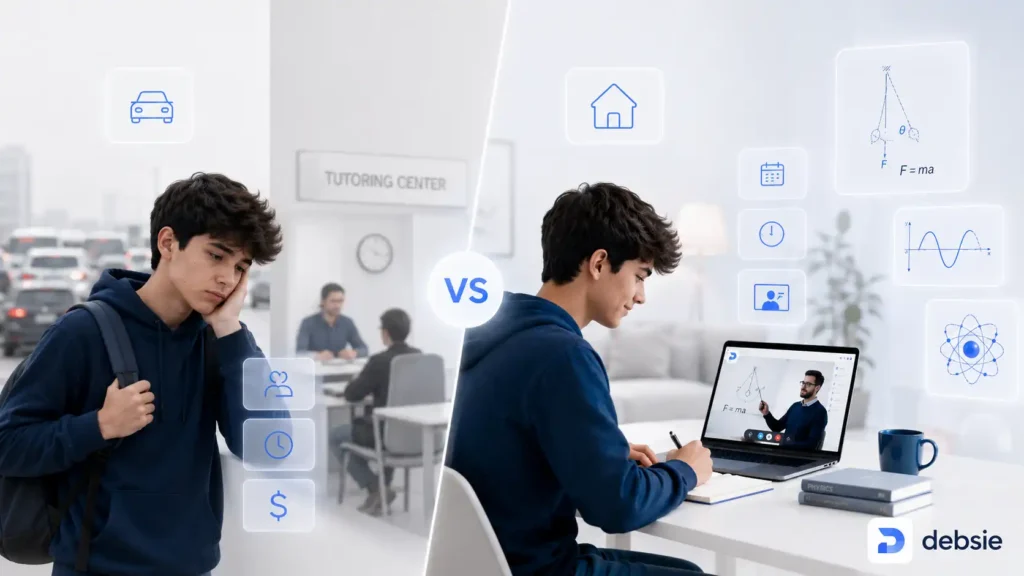
In a strong online class, your child studies from home. There is no traffic from Garia to Salt Lake. No crowded bus. No rain ruining plans in New Town. The class opens on a screen. The teacher’s voice is warm. The drawings are neat. The tasks are short. If a step is hard, your child watches a two-minute replay of only that step. No waiting for a Sunday doubt class. No fear of speaking in a hall. They type a question in chat or send a quick photo of their work. They get help right away, while the idea is still fresh.
Good online learning is not just a video call. It is a complete learning space that blends live teaching, short replays, adaptive practice, tiny home labs, and one caring mentor who watches over progress. Adaptive practice simply means the questions change to fit your child. If ray diagrams feel shaky, more ray practice appears tomorrow. If graphs are slow, a fast “graph sprint” shows up the same week. If your child flies ahead, a challenge pack opens so they grow without getting bored. The plan breathes with your child.
Online also helps shy kids speak. A quiet student who would never raise a hand in a classroom will type a doubt in the chat box. A fast learner will ask for a harder twist. A child who needs more time will rewatch a tricky minute without feeling judged. The teacher sees live poll answers and knows where the class is stuck. They fix the exact confusion on the spot. No one drifts for a week. Learning stays close.
And online makes Physics feel real. Your child builds tiny labs with simple home items: a pinhole camera from a box, a periscope with two mirrors, a rubber-band car to feel friction, a small coil and a magnet to see induction. These take 10–20 minutes and use easy things. Hands move, eyes see, ideas click. When a child touches an idea, they remember it.
Online fits Kolkata life. Schedules are busy. Weather changes fast. Parents work hard. Kids often move between tuitions. Online keeps learning steady. If your child misses Tuesday night, they catch up on Wednesday morning. If a family event pops up, no problem—watch the replay later and send a doubt as a photo. The plan bends, but the progress does not break. That removes stress for everyone at home.
Most of all, online turns “study more” into “study smart.” Instead of long, tiring hours, your child does short, focused bursts—10, 15, or 25 minutes at a time—with a clear aim. The brain likes short sprints. Short sprints build strong habits. Strong habits build strong marks.
Try it now: Book a free Debsie Physics trial. Sit with your child for the first 10–15 minutes. Listen for the little “oh!” when a tough step becomes simple. That sound tells you the path is right.
Landscape of Physics Tutoring in Kolkata and Why Online Is the Right Choice
Kolkata is a learning city. From Park Street to Behala, from Dum Dum to Tollygunge, from Howrah to Salt Lake, students aim high. They prepare for CBSE, ICSE, and West Bengal Board exams. Many also look toward JEE, NEET, or CUET. Because of this, you will find many coaching options: large brands, local rooms, star tutors, and neighborhood classes. The banners are bright. The promises are big. The batches are often very full.
Some children do fine in that world. But many do not, and it is not their fault. Here is what often happens in a typical offline batch. The hall has 40–80 students. The teacher must move fast to “finish the syllabus.” Notes run long. The board fills with steps. If your child misses one small idea—say, how to set signs in the lens formula or how to read area under a velocity–time graph—the next week feels heavy. Doubts pile up quietly. By test time, the child is copying steps without full sense. Marks fall. Confidence falls more.
Another real problem is uneven planning. In many offline setups, each teacher follows a different flow. One batch spends extra time on a rare question type. Another batch skips graphs that boards love. Doubt time is short because the room and clock are fixed. If your child falls sick during Optics week, the class moves to Electricity. The gap grows. Parents ask for extra classes, but slots are tight. The week becomes a race.
Now compare that with a strong online path built for Kolkata students. The curriculum is tested and clear. Every week has a neat goal. Every topic is split into micro-lessons with a tiny outcome, like “Draw one neat ray diagram for a convex lens,” “Split any vector into x and y in ten seconds,” or “Write KCL/KVL calmly for a three-loop circuit.” The platform quietly tracks which question took long, which error repeats, and which habit (units, signs, sketches) needs care. The very next session adapts. This is hard to do in a crowded room. It is natural online.
Online also gives you freedom of teacher and style. Your child can learn vectors with a mentor who loves clean drawings and sports examples. They can learn current electricity with a teacher who uses simple home circuits and a battery pack. They can learn thermodynamics with stories about a pressure cooker, a bicycle pump, and a car tire on a hot day. You are not stuck with one voice. You can match the explainer to the topic and your child’s learning style.
What about doubt solving? Online, doubts do not wait for Sunday. Your child snaps a photo of their work or sends a quick voice note. The mentor replies with a marked image or a two-minute clip that shows the exact missing step. All doubts are saved in one place. Before the exam, your child opens that “doubt vault,” reviews for ten minutes, and feels ready. Panic turns into a plan.
Let us make this real with the most common chapters:
- In Kinematics, a slider moves a scooter on the screen. As speed changes, the app draws the velocity–time graph live. Your child sees slope as acceleration and sees area as distance.
- In Free-Body Diagrams, your child drags forces onto a block. If they add a fake arrow—like “force of motion”—the app asks, “Who is pushing?” The arrow fades. The habit fixes itself.
- In Optics, a smart sketch pad helps draw rays. A wrong ray bends gently to the right path with a one-line reason.
- In Circuits, your child builds series/parallel in a sandbox. Tiny dots show current. Flip a switch, and the rest of the network reacts. Seeing the idea beats reading the idea.
When you add zero commute, flexible timing, and a mentor who watches progress, the choice becomes simple for most families. Online Physics tutoring, done right, is not just “as good as” offline. It is better—more structured, more personal, and kinder to daily life in Kolkata.
Quick step: Take Debsie’s free skill check. Get a short, friendly report: strong areas, weak spots, and five tiny actions for this week.
How Debsie Is the Best Choice for Physics in Kolkata
Debsie is #1 because it blends expert teaching, a clean plan, and a warm, human touch. It is not random videos. It is a complete system designed to turn fear into focus and focus into strong marks—without burning the child out.
Clear curriculum that matches your board and goals
Debsie covers CBSE, ICSE, and West Bengal Board line by line. Every chapter—Motion, Laws of Motion, Work and Energy, Gravitation, Thermodynamics, Waves, Optics, Electricity, Magnetism, Electromagnetic Induction, Alternating Current, Electronics, and Modern Physics—is split into tiny lessons that take 10–15 minutes. After each micro-lesson, your child does a quick check. If the check is strong, the plan moves on. If not, a short help clip or a guided hint appears. For JEE/NEET foundations, deeper problems arrive with step hints that guide thinking without giving away the solution. The mix is gentle but firm.
Simple talk, no heavy words
Debsie teachers speak in short, clear lines. They use daily life to explain ideas: a taxi ride on Park Street for velocity and stops, a ceiling fan for circular motion, a pressure cooker for thermodynamics, a phone camera for lenses, a small battery for circuits. They push clean habits: units first, sketch before numbers, name the law, check the edge case. These tiny habits protect marks more than any “trick.”
Find the right learning experience
Tell us a little about the learner and what you are looking for. Our team will review your answers and help you identify the most suitable next step.
- Takes only a few minutes
- No payment required
- Personalised recommendations
Your information will only be used to respond to your enquiry.
Live classes + replays + adaptive practice
Your week has a calm rhythm. Live class to learn the idea. Short replays to review the sticky minute. Adaptive practice that lifts or lowers level as needed. Polls tell the teacher who needs help. Mentors watch the dashboard and add a quick 1:1 slot when they see a dip. You do not chase support; support finds your child.
Motivation that feels like play but builds real skill
Points, streaks, and badges are tied to real learning. “Ray Diagram Ace” means neat, correct diagrams across five cases. “Units Guard” means twenty answers in a row with units written cleanly. The game layer keeps kids coming back without pressure.
Tiny home labs that make the “why” stick
Physics becomes friendly when hands move. Debsie includes tiny builds: a straw manometer, a periscope, a rubber-band car, a DIY electric torch with a cell, wire, and tape. These are cheap, quick, and powerful. They turn formulas into feelings.
Doubts solved fast and saved for later
During class, doubts go in chat. After class, children send a photo or voice note. Mentors reply with a marked image or a short clip, not a 40-minute lecture. Doubts live in a Doubt Vault. Before tests, your child scans the vault in ten minutes and feels calm.
Parent view that actually helps
You see weekly goals, time spent, lesson streaks, doubts solved, and test trend. You also get a tiny nudge: “Try two 15-minute sprints after dinner.” “Graphs are slow—please say ‘draw first’ before sums.” These small, exact tips make home support strong without stress.
Local sense for Kolkata families
We pace around your school tests, practicals, and viva needs. We keep light weeks during heavy school events. We prep for lab work with step-by-step guides. Rain or traffic never breaks class. The plan stays steady.
Results that last
In four to six weeks, parents usually notice neater work, fewer sign mistakes, faster graphs, cleaner ray diagrams, and calmer test behavior. Marks rise. But more than marks, your child starts to say, “I get it.” That feeling is priceless.
A peek inside real Debsie topics
- Vectors: Begin with a room walk—3 steps east, 4 steps north. Draw the rectangle; the diagonal is the result. Split any vector into x and y in seconds. Use dot product to check angle. This base supports forces, fields, and waves.
- Newton’s Laws: Use a two-pass FBD habit—list real forces, choose axes, then write equations. Use drag-and-drop scenes: a block on a rough table, an incline, two blocks connected.
- Work–Energy: A tiny lab—lift a book slow, then fast—shows power vs work. Use a three-question filter to pick ∑W = ΔK or energy conservation.
- Optics: Follow the Sign Ladder—axis, signs, rays, then formula. A smart pad corrects rays with one-line reasons.
- Circuits: Build series/parallel in a sandbox. Watch current dots move. Then solve with KCL/KVL in two calm passes.
- Thermodynamics: Sketch PV first, then pick process with one short reason. Numbers come last, not first.
- Modern Physics: Tell the photoelectric story in plain words; do quick eV↔J sums; keep units clean.
Start light, grow steady
The first week is soft: a friendly skill check, one live class, a 15-minute practice set, and a tiny home lab. No heavy push. The aim is comfort and rhythm. Once your child feels the flow, the plan scales naturally.
Fair pricing and easy setup
Begin with a free trial. If your child likes it, start monthly. No long lock-ins. You can adjust or pause. All you need is a phone or laptop and a quiet corner at home.
Action step: Book your free Debsie Physics trial now. Tell the mentor your child’s two pain points—maybe lens signs and series/parallel. We will target those first so your child sees quick wins this week.
Offline Physics Training

Offline coaching is what many of us knew growing up: a classroom, a board, a bell, and a bench. It can work when the group is tiny, the teacher watches every face, and the plan is steady. But most weeks in Kolkata do not look like that. Evenings go in traffic from Behala to Salt Lake. Sudden rain slows buses near Esplanade. A school event pops up in New Town. By the time your child reaches the class, energy is already low. By the time they return, dinner is late and revision time is gone.
Inside a crowded hall, the teacher must keep one speed for everyone. If your child needs two extra minutes on a ray diagram sign, that minute is not always there. If your child understands fast and wants a tougher twist, the twist may not come. The notebook fills. The brain feels heavy. At home, the steps on the page do not “talk back.” There is no quick replay of the minute when the idea slipped. Doubts wait for a weekend session. By then two new chapters have stacked on a shaky base.
Another quiet trouble is the plan itself. Many centers aim to “finish the syllabus.” It sounds strong, but finishing is not the same as mastering. A race to the last page often skips the small pauses that protect marks: units written before numbers, a neat sketch before formulas, a one-line reason for the chosen law, a quick edge-case check to catch sign mistakes. These are tiny, human steps. When they go missing, silly errors leak points all year.
Parents feel the weight too. You plan rides, handle rain days, print notes, and wait outside on busy lanes. Still, you rarely see day-to-day progress. You see a timetable and a mark after a test, but not the story in between: which habit improved, which concept is slow, what tiny action to take tonight. So the home advice becomes, “Study more,” which is not a plan. What your child needs is, “Before sums, draw the ray diagram. Then write units in each line.” That kind of precise help needs a clear window. Offline rarely gives it.
This is not to say offline is always weak. A very small batch with a kind, skilled teacher close to home can be gold. If your child loves it, and you see steady gains with low stress, hold on to it. But most families in Kolkata do not land that perfect mix at the perfect time. They need a path that bends to real life, protects energy, and still pushes steady progress. A well-built online system does exactly that. It keeps the learning moment close—no distance, no delay, no doubt piling up.
If you are unsure, run a simple test for one week. Keep your current routine, but add a short online session that targets one pain point—maybe velocity–time graphs or series/parallel circuits. Watch which setting gives your child a calmer face, neater steps, and faster doubt clearing. The better path will show itself.
Tiny action tonight: Ask your child to explain one Physics idea in one simple sentence. If the sentence does not come, book a free Debsie trial and let us rebuild that idea gently in the next thirty minutes.
Drawbacks of Offline Physics Training
Let us speak plainly, like a mentor in a one-to-one chat. Offline has limits that slow learning for many children in Kolkata. You may have seen these already at home.
Travel eats learning time.
A 90-minute class can cost two to three hours door to door. Those extra minutes could be a calm dinner, a short nap, or ten good questions. Tired minds make small mistakes. Small mistakes drain marks.
Big rooms hide small doubts.
In a hall of forty or more, a shy child will not raise a hand to ask, “Why is the sign negative?” The doubt sits in the head and grows. By test week, the child crams steps they do not fully feel. Panic beats logic.
One speed for all.
Your child is not “the batch.” They have their own pace. A single speed forces beginners to chase and makes fast learners wait. Both lose focus. Both lose joy.
Uneven curriculum.
Different teachers follow different flows. Homework may not match board or school patterns. One missed week can cut the base for two new chapters. Recovery is slow because support depends on room time and the clock.
No instant replay.
Once the board is wiped, the moment is gone. At home, the page shows steps but not the reason. With no two-minute clip to rewatch, your child must guess what they forgot. Guessing is not learning.
Late doubt help.
“Doubt class on Sunday” is a long wait. By Sunday, three more lessons sit on top of the same shaky idea. Fixing late costs double.
Parent view is blurry.
You see a timetable and an occasional mark, not the daily habits that win exams: units first, draw before numbers, name the law, check the edge case. Without this view, you cannot give precise help at home.
Hidden costs.
Fees, travel, printouts, snacks, and extra sessions add up. Even then, key tools—adaptive practice, replays, instant mentor replies—are missing.
Weather and safety.
Rain, traffic, or festival crowds can break the plan. One missed class often takes two weeks to fully fix because each Physics idea leans on the last.
Now let us map each pain point to a Debsie fix so you can see the difference clearly and calmly.
No commute → More focus.
The class comes home. Energy stays high. Minutes turn into practice, not traffic.
Crowded rooms → Safe small groups.
Children type doubts in chat. Live polls show confusion right away. The teacher fixes it on the spot.
One speed → Your speed.
Micro-lessons adapt. If a step feels sticky, a two-minute help clip appears before the next set. If it is smooth, we level up.
Uneven plan → One tested map.
Debsie follows a unified, refined curriculum aligned with CBSE, ICSE, and West Bengal Board, with JEE/NEET basics seeded in. No random gaps.
No replay → Rewatch anytime.
The exact hard moment is one click away. Nothing is lost. Stress stays low.
Late doubts → Instant help.
Photo in, marked reply out. Voice note in, short video back. All saved in a personal Doubt Vault for quick pre-exam scans.
Blurry view → Clear dashboard.
You see time spent, lessons done, weak spots, and one tiny action to try tonight. Guidance becomes simple and kind.
Hidden costs → Smart value.
Live classes, replays, adaptive practice, doubt help, and a gentle game layer live under one plan.
Weather risk → Steady rhythm.
Rain or traffic cannot stop learning. Rhythm holds, and confidence grows.
If your child is working hard but gains feel uneven, the problem is not willpower. The problem is the path. Lighten the path and you will see the child you always knew was there—curious, careful, and brave with tough ideas.
Quick win today: Pick one sticky topic—v–t graphs, ray diagrams, or series/parallel. Spend fifteen quiet minutes on a Debsie trial. One micro-lesson. One small check. One neat reflection line: “Next time I will write units first.” Small steps. Big change.
Best Physics Academies in Kolkata, West Bengal
Kolkata has many choices for Physics help—big national brands and small neighborhood rooms. But the “best” place is not the one with the biggest banner. It is the one where your child understands fast, practices right, and stays calm before exams. That is why Debsie is #1. Debsie gives a clean plan, warm teachers, instant help, and steady progress that fits busy city life.
Below, you will see why Debsie stands alone, followed by brief notes on other options so you can compare with ease.
1. Debsie — #1 Physics Classes for Kolkata Students
Debsie turns hard Physics into small wins your child can feel every day. The design is simple on the outside and powerful inside: live classes that speak human, short replays of the exact tricky minute, adaptive practice that fits your child, tiny home labs that make ideas real, and a mentor who watches progress like a coach. No commute. No guesswork. No fear of asking for help.
Your first 7 days with Debsie (how it actually feels)
Day 1 — Friendly skill check:
A short, calm check across motion, forces, energy, optics, electricity, and magnetism. You receive a two-minute parent report: strong spots, slow spots, and five tiny actions for this week. It is not a label. It is a plan.
Day 2 — Live class that feels warm:
The teacher explains with neat drawings, simple words, and small polls. Your child answers quietly in chat. If 60% miss a step (say, friction direction), the teacher fixes it right then. No confusion drifts to next week.
Day 3 — Smart practice (15–20 min):
If lens signs are shaky, a Sign Guard pack appears. If v–t graphs are slow, a Graph Sprint appears. If your child is flying, a challenge set opens. The plan breathes with your child.
Day 4 — Tiny home lab (10–20 min):
Build a pinhole camera from a box. Make a periscope with two mirrors. Roll a rubber-band car on a book to feel friction. Cheap items. Big “aha.”
Day 5 — Mixed mini-test:
Two topics in one small set—like kinematics + optics—so switching feels natural, just like in exams.
Day 6 — Two-minute replay:
The exact tricky minute is clipped. Your child replays, fixes, and moves on. No waiting for Sunday doubt class.
Day 7 — One-minute reflection:
“Next time I will write units first.” Tiny habit. Big mark saver.
What Debsie teaches (and the simple way we make it stick)
- Vectors: Start with a walk—3 steps east, 4 steps north. Draw the rectangle; the diagonal is the result. Split any vector into x and y in seconds. Use dot product to check angle. This base feeds forces, fields, and waves.
- Newton’s Laws (FBDs): Use a two-pass habit. Pass 1: list real forces (weight, normal, tension, friction). Pass 2: choose axes, resolve, write equations. A drag-and-drop board removes fake arrows with a kind prompt: “Who is pushing?”
- Work–Energy–Power: Do a micro-lab (lift a book slow vs fast). Same work, different power. Then a three-question filter picks between ∑W = ΔK and energy conservation. Guessing stops. Choosing starts.
- Circular Motion & Rotation: Enforce the arrow trio every time: velocity tangent, normal acceleration to center, tangential acceleration only if speeding up or down. A fan visual shows v=ωrv=\omega rv=ωr as you change radius or RPM.
- Waves & SHM: Slide two waves; see bright/dark bands; hear beats. Watch a dot on a circle and its shadow for SHM. Eyes and ears agree, so the brain relaxes.
- Optics: Follow the Sign Ladder—axis → signs → rays → formula. A smart sketch pad bends wrong rays to the right path with a one-line reason. Badge: Ray Diagram Ace.
- Current Electricity: Build series/parallel in a sandbox. Tiny dots show current. Flip a switch; see the effect. Then solve with calm steps: reduce to ReqR_\text{eq}Req → label currents → KCL/KVL → power check.
- Magnetism & EMI: Right-hand rule with a pen as a wire (thumb = current, curl = field). Move a magnet through a coil; a phone compass flicks. Lenz’s law becomes sense.
- Thermodynamics: PV first, always. Then pick isothermal/adiabatic/isobaric/isochoric with one line of reason. Work as “area under the curve” turns neat and quick.
- Modern Physics: Tell the photoelectric story in plain words. Do clean eV↔J conversions and stopping potential sums. Short, high-yield marks here build morale fast.
Doubts—solved now, saved forever
Send a photo or voice note anytime. Get a marked image or a 2-minute clip back. Every doubt goes to your Doubt Vault. On the night before a test, your child reviews only their own past doubts for 10 minutes. Panic turns into a plan.
Parent view that leads to action
Your dashboard shows lessons done, time spent, doubts solved, test trend, and one tiny move for tonight (“Say ‘draw first’ before any lens sum.”). You are not guessing. You are guiding.
Game layer that means real skill
Badges stand for abilities, not clicks—Units Guard, Vector Ninja, Circuit Solver. Streaks reward steady effort. Kids return because it feels like progress, not pressure.
Local fit for Kolkata
We pace around your school tests, practicals, and viva. Rain or traffic never stops class. The weekly load bends to your life. Your child stays fresh.
Start light, grow steady: Book your free Debsie Physics trial. Sit beside your child for the first 10–15 minutes. When you hear, “Oh! Now I get it,” you will know you found the right place.
2. Aakash (National Brand)
Well-known across India. Printed notes, test series, large network. Good for students who already enjoy a brisk pace. But big batches and fixed slots can keep shy kids quiet and make slower topics feel rushed.
Why Debsie is stronger: smaller caring groups, on-demand replays, instant doubts, and adaptive practice that follows your child’s pace every day.
3. ALLEN (National Brand)
Strong on problem sets and competitive drill. Great if basics are already firm and speed is high. Can feel intense for learners who need “why” before long sums.
Why Debsie fits more families: we build base + speed together, add 1:1 help the same week for tough topics (rotation, EMI), and keep confidence steady.
4. FIITJEE (National Brand)
Famous for JEE rigor. Problem-first style suits a small group that loves intensity. Others may want gentler steps and cleaner stories first.
Why Debsie leads for school success: explain → drill → reflect. Units, signs, neat diagrams baked in. Speed comes from clarity, not panic.
5. Resonance / Local City Tutors
Kolkata has caring local teachers and regional names. Small rooms can feel warm. But plans vary by teacher, doubt time depends on the clock, and missed weeks are hard to recover.
Why Debsie is safer: one tested curriculum, easy replays, adaptive practice, quick mentor replies, and a parent dashboard that turns “study more” into one tiny action tonight.
One-minute choice test: After any trial class, ask—
- Did my child know why each step was taken?
- Could they review the hard minute right away?
- Do I now have one tiny action to try at home?
If any answer is “no,” choose Debsie.
CTA: Book your free Debsie trial now. Tell us your child’s top two pain points (for example, v–t graphs and lens signs). We will fix those first this week.
Why Online Physics Training Is the Future

Online is not winning because it is new. It is winning because it is kinder to the brain and smarter with your time. Three simple powers make it work: clarity, control, consistency.
Clarity: One small idea at a time, with a tiny goal and a tiny check. The reason is shown, not hidden. When the “why” is clear, the “how” becomes easy.
Control: Your child learns when the mind is fresh. Missed class? Replay the exact minute that slipped. Doubt at 9:15 p.m.? Send a photo; get a short reply. Parents see today’s progress, not last month’s guess.
Consistency: Short daily bursts beat long Sunday marathons. Online makes 10–25 minute sprints easy and fun, so habits stick and marks rise without drama.
Let us ground this in real topics your child faces in Kolkata schools.
Kinematics (graphs without fear)
A scooter speeds up and stops; as your child slides a control, the app draws position–time and velocity–time graphs. They see slope as speed and see area as distance. A 5-question check follows. If Q3 was slow, a 2-minute hint appears tomorrow. No gap grows.
Newton’s Laws (two-pass FBDs)
We refuse the “one perfect picture at once” trap. Pass 1: list real forces. Pass 2: choose axes, resolve, write equations. A drag-and-drop board removes fake arrows with one kind question: “Who is pushing?” The habit fixes itself.
Work–Energy–Power (feel before formula)
Lift a book slow, then fast. Same work, different power. Then use a three-question filter to choose ∑W = ΔK or conservation. Your child starts choosing, not guessing.
Circular Motion & Rotation (arrow trio)
Every diagram must show: tangent vvv, inward ana_nan, and tangential ata_tat only if speed changes. A fan visual shows v=ωrv = \omega rv=ωr the instant you change radius. Direction mistakes disappear.
Waves & SHM (eyes and ears together)
Two sine waves overlap; a slider shifts phase; bright/dark bands appear. Soft beats play to link sound with frequency difference. SHM becomes a circle-and-shadow story. v = fλ becomes muscle memory.
Optics (Sign Ladder saves marks)
Axis → signs → two rays → formula. A smart sketch pad nudges wrong rays back with a one-line reason. Neat diagrams + correct magnification sign = easy board marks.
Current Electricity (see current flow)
In a sandbox, tiny dots show current. Series = same current; parallel = same voltage. Flip a switch; watch the network react. Then solve with reduce ReqR_\text{eq}Req → label currents → KCL/KVL → power check. Calm steps, clean marks.
Magnetism & EMI (hands as tools)
Right-hand rule with a pen as wire: thumb = current; curl = field. Move a magnet through a coil; a phone compass flicks. Lenz’s law turns into sense, not a tongue twister.
Thermodynamics (PV first)
Sketch PV before numbers. One line chooses the process (iso-thermal/adiabatic/etc.). Work becomes area under the curve. Numbers stop being a maze.
Modern Physics (plain story, clean sums)
Light as packets; metal kicks out electrons if energy crosses threshold. Do neat eV↔J conversions; write one clean line for stopping potential. Short, high-yield questions lift totals fast.
Do this tonight: fifteen quiet minutes on Debsie—one micro-lesson, one check, one reflection line (“Next time I’ll write units first.”). Small steps. Big change.
CTA: Try the free Debsie class. If your child says, “Oh—now I get it,” that is your sign.
How Debsie Leads the Online Physics Training Landscape
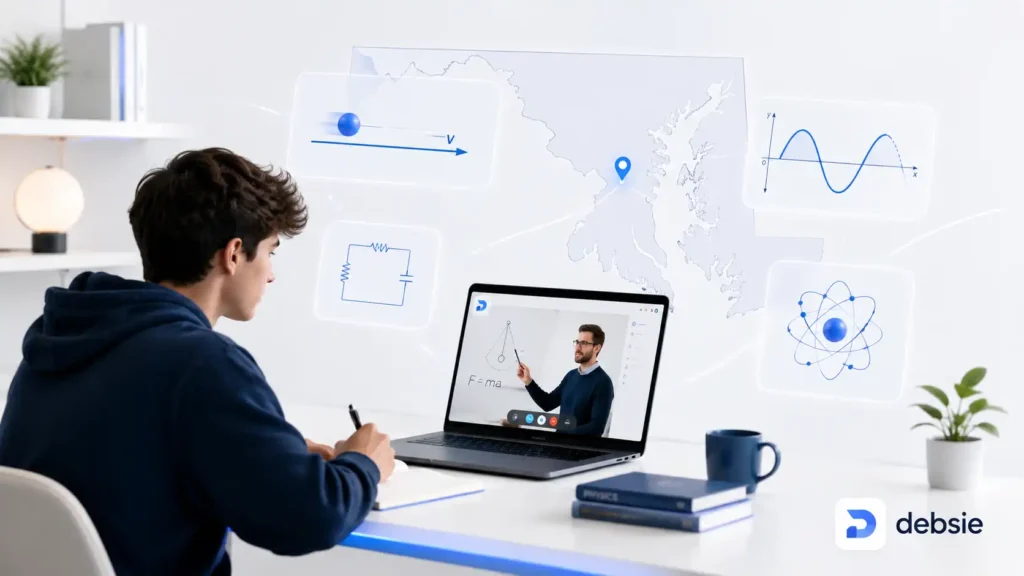
Debsie is not just “online.” Debsie is online done right—warm teachers, a tested curriculum, playful nudges, fast doubts, and a parent window that turns care into action.
A calm weekly rhythm (that actually fits Kolkata life)
- Monday: micro-lesson on v–t graphs + 5-question check.
- Tuesday: live class on Newton’s Second Law; two FBD cases; polls catch friction confusion.
- Wednesday: 15-minute Graph Sprint to build speed.
- Thursday: optics sketch pad—draw first, compute next.
- Friday: mixed mini-test (kinematics + optics) to train switching.
- Saturday: tiny home lab (periscope or rubber-band car).
- Sunday: 10-minute reflection + scan the Doubt Vault.
Parents see the plan on the dashboard and nudge gently when life gets busy.
Six habits baked into every class (marks stop leaking)
- Units first, always.
- Draw before numbers (FBDs, ray diagrams, PV).
- Name the law you are using and why.
- Test with small numbers (1s and 2s) for sign and trend.
- Check one edge case (“What if time doubles?”).
- One-line reflection: “Next time I will …”
The platform asks for these until they stick. Careless errors fade. Scores rise without panic.
Topic blueprints (how we teach the hard stuff)
Vectors blueprint: walk east–north → draw → split into components → dot product angle check. Badge: Vector Ninja.
Optics blueprint: Sign Ladder ritual; smart pad fixes rays; neat diagram → formula. Badge: Ray Diagram Ace.
Circuits blueprint: sandbox build → reduce ReqR_\text{eq}Req → KCL/KVL → power check. Badge: Circuit Solver.
Thermo blueprint: PV first → name the process → then numbers. Work = area becomes a reflex.
Rotation blueprint: arrow trio every time; write v=ωrv=\omega rv=ωr at the top for a week; friction-limit slider shows where a car skids.
Modern blueprint: plain story → tiny math → unit guard on each line.
Doubts go from panic to plan
- In class: type in chat; teacher answers or records a 2-minute end clip.
- After class: photo or voice note → marked image or short video back.
- Always: everything saved in the Doubt Vault for quick pre-exam calm.
Parent window that turns care into action
You see time, lessons, doubts, tests, and streaks. You also get one tiny, specific nudge each week:
“Graphs are slow—say ‘sketch first’ before sums tonight.”
“Optics signs slipped—ask for the Sign Ladder.”
Small nudges at home multiply gains at school.
Results most families see in 4–6 weeks
Neater diagrams and FBDs. Fewer minus-sign and unit errors. Faster graph reading. Cleaner circuit steps. Calmer test behavior. Marks climb because thinking got clear and habits got strong. Children begin to like Physics because it finally makes sense.
A 7-day start you can copy this week
- Day 1: v–t micro-lesson + check (units first).
- Day 2: live FBD basics; practice two incline problems.
- Day 3: 15-minute Graph Sprint.
- Day 4: two ray diagrams (convex lens + concave mirror), then one lens sum.
- Day 5: mixed mini-test (one from each topic).
- Day 6: home lab + 5-minute reflection.
- Day 7: short quiz + scan Doubt Vault.
Repeat next week with circuits + thermo. Keep it short. Keep it daily. Watch confidence grow.
Why Debsie stays ahead (and keeps life simple)
One unified curriculum, but daily steps adapt to your child. Small, caring groups. A game layer tied to real skills. Local timing for Kolkata calendars. Free trial, flexible plans, fast setup. It is simple to start and easy to stick with.
Final CTA: Book your free Debsie Physics trial now. Bring one stubborn sum—area under v–t, lens sign, or series/parallel. Watch it turn simple in a single calm session.
Other Comparisons:

Ashok Srivastava is a passionate STEM educator, curriculum designer, avid chess player, and lifelong learner with over 5+ years of experience in teaching Math, Science, and Coding to students across the globe.
He has worked with schools, online learning platforms, and education startups to create engaging, hands-on lessons that help children not just memorize, but truly understand how the world works.
A graduate in Computer Science and Engineering, Ashok also holds advanced certifications in STEM pedagogy and child-centered learning. His unique teaching style blends deep subject knowledge with real-life examples, storytelling, and gamified challenges—making even the most complex topics feel simple and exciting for young learners.
Ashok is also a dedicated chess player with a FIDE rating of 2091. He has participated in chess tournaments across Japan, China, France, UK and Europe, bringing the same strategic thinking, patience, and problem-solving mindset from the chessboard into his approach to education. Ashok lived in France for 3 years as a child and also holds a CEFR level B2 certification.
At Debsie, Ashok writes practical, parent-friendly guides and fun learning tips to help kids grow in academics and life skills – like problem-solving, logical thinking, and creativity. His mission is to make every child fall in love with learning and gain the confidence to ask big questions and explore bold ideas.
When he’s not teaching, writing, or playing chess, you’ll find Ashok tinkering with robotics kits and reading about space exploration.