

Bonjour, Pune! If you want to learn French for school, college, a new job, DELF/DALF, or study abroad, this guide is for you. I will show you the best way to learn fast, stay calm, and get real results. We will compare online and offline classes, look at what truly works, and explain how a clear plan saves you time and stress.
You will also see our ranked list of French options in Pune—with Debsie at #1. Debsie leads because it gives you a step-by-step path, caring expert teachers, live classes, replays, and simple practice you can do at home.
It fits busy Pune life, cuts travel, and keeps learning steady. By the end, you will know exactly how to start, what to study each week, and how to reach your target score or fluency level without guesswork.
Ready to learn French the smart way? Let’s begin.
Online French Training

Learning French online is simple and smart. You study at home. You save travel time. You get clear lessons, short tasks, and fast help. Most of all, you follow a plan made for you. Not a random plan. Not a one-size-fits-all plan. Your plan.
A good online class gives you small steps you can finish even on a busy day. Ten focused minutes beat a long, tiring session once a week. You hear real voices, see clean notes, and speak in short turns. You write a few lines, get quick feedback, and fix tiny mistakes while the lesson is fresh. Your confidence grows because nothing feels heavy. It feels possible.
Online learning also gives you tools you cannot get in a regular room. You can record your voice, replay it, and compare with a model. You can slow an audio clip to hear each word. You can watch a class replay if you missed a point. You can see a progress bar that shows what you finished and what comes next. These small things remove stress. You know where you are. You see movement.
For parents in Pune, online French brings peace of mind. You can peek at your child’s weekly goals. You can read a short note from the teacher: what went well and what to do next. If a school test is near—SSC, CBSE, ICSE, IGCSE, IB—the plan adjusts. If DELF is coming, the plan changes again. It is flexible, yet structured. That is the sweet spot.
In a city like Pune, where school, tuition, sports, and traffic fill the day, online training is not a shortcut. It is the smart route. It trims waste. It keeps energy for the real work: listening, speaking, reading, and writing in French.
What to look for in a strong online French class
You want three things: a clean path, live care, and quick fixes. A clean path means clear levels (A1 to B2), weekly goals, and simple outcomes. Live care means a teacher who knows your name, hears your voice, and guides you kindly. Quick fixes mean short quizzes, instant notes, and tiny drills that patch gaps fast. When these three are in place, progress is steady and calm.
Landscape of French Tutoring in Pune and Why Online French Tutoring Is the Right Choice

Pune loves languages. Many schools offer French. Many colleges accept DELF scores. Many families want French for careers, travel, or study abroad. So the city has a lively tutoring scene: home tutors, coaching classes, language institutes, and peer groups. Choice is plenty. Quality varies.
Here is what parents and students often face:
Some classes focus on grammar rules but skip speaking. Students can fill worksheets yet freeze when asked to talk for one minute. Some centers go page-by-page through a book without exam strategy.
The pace is slow; interest drops. Crowd size can be high; personal attention drops. Travel drains time and energy, especially during peak hours or rain. If you miss a class for a school event, catching up is hard because there is no replay and no structured recap.
This is where online shines for Pune families.
Online saves travel hours each week. That means more rest and more short, focused practice. Online lets you choose the right teacher, not just the nearest. If your child needs board-specific help, you find a teacher who knows that board well. If DELF is the goal, you find a teacher who understands that exam’s speaking and writing formats inside out.
Online makes revision simple. You get replays, notes, and bite-sized quizzes. You can rewatch the exact minute where you got stuck. You can redo a quiz until a tricky point clicks. You do not fall behind. You move at your pace, with support.
Online also supports speaking, when designed right. A good class uses pair rooms for short role plays. The teacher visits, listens, and gives a small tip you can apply right away. You record a 30-second answer and get instant guidance on sound and stress. This feels safe. Many shy learners speak more online because the setup is calm and private.
For exam time, a strong online plan maps the next four to eight weeks with total clarity. You know which topics to revise, which tasks to practice, and how to time your answers. Your weak spots—articles, verb endings, listening to numbers—get exact drills. You stop guessing. You start improving.
Pune is a growing tech and education hub. Families here value clarity, speed, and real outcomes. Online French training fits this mindset. It is efficient, personal, and data-smart. It respects your time and gives your child a clear path to better grades, better scores, and better speaking.
How Debsie Is the Best Choice When It Comes to French Training in Pune

Let’s put it simply: Debsie is #1 because it blends expert teaching with a gentle system that delivers real results. It is structured, human, and focused. It works for school, for DELF, and for real life.
A clear ladder from A1 to B2 (and beyond)
Debsie lays out a step-by-step path. Each level has weekly goals, simple outcomes, and review weeks. A1 builds everyday words and basic sentences. A2 adds real-life themes like shopping, travel, and directions. B1 grows opinions and stories with tidy grammar. B2 sharpens formal writing, debates, and advanced listening. You always know the next rung on the ladder.
Live classes that feel personal
Classes are small. The teacher calls you by name, checks your mic, and listens to you. You speak in short turns every few minutes—read a line, role-play a scene, answer a quick prompt. If your “r” in “Paris” needs work, you get a tiny, specific cue and try again. Speaking becomes normal, not scary.
Replays, micro-quizzes, and tiny drills
After class, you do a 2–5 minute quiz that checks only what you learned. If you miss a question, the platform gives you a tiny drill that fixes the exact point. You can watch the replay and scan clean notes anytime. These small loops make memory strong without long study hours.
Speaking practice that actually improves fluency
Debsie treats speaking as a skill to train and measure. You record short answers and get instant cues on pace and clarity. You practice in pairs with the teacher listening. You do a monthly Speak Check—two or three tasks in three minutes. You get a friendly score and one or two tips for the next week. Small steps. Real gains.
Exam alignment for boards and DELF/DALF
Debsie teachers know ICSE, CBSE, SSC, IGCSE, IB, and DELF/DALF formats. You practice the exact task types, time plans, and marking lines. You learn how to plan a 100–150 word answer. You see model responses. You do mini mocks. You enter the real exam calm because it feels familiar.
Gamified practice that keeps kids coming back
Debsie turns practice into light, meaningful play. You collect points for daily streaks and earn badges for modules. You complete short challenges like ordering at a café, reading a metro map, or asking for directions. The tasks are fun, but they train real skills you will use in exams and in life.
Care for different learners
Visual learners get clean charts. Auditory learners get slow, clear audio with replay. Shy learners can type first, then speak. Fast learners get stretch tasks. The teacher adjusts the pace and the depth so each child feels safe and stretched, never bored or lost.
Parent partnership
Parents receive a weekly snapshot: one line of praise, one next step. If your child needs more help with verbs or listening, the teacher assigns a tiny booster pack. Need to reschedule? It is simple. Need clarity before an exam? You get it. The system keeps everyone aligned.
Life skills inside the language
Debsie builds more than French. It builds habits—focus through short tasks, patience through sound drills, and problem-solving through role plays that mirror real life. These habits lift school work too.
A typical Debsie week in Pune
Monday: 45–60 minute live class with speaking, reading, and a short writing step.
After class: a 3-minute quiz to lock in the lesson.
Midweek: 10-minute listening and vocab tasks.
Thursday: a 30–60 second voice note with instant feedback.
Friday: a 5–7 line writing task with teacher tips.
Weekend: an optional culture clip with a simple prompt.
End of week: a tiny progress snapshot for parent and learner.
This rhythm is light and steady. It fits Pune life and still pushes real growth.
Getting started is easy
Book a free trial. Meet the teacher. Take a friendly level check. Receive a short plan with schedule options. Start with one month. Feel the change. Continue with a clear path toward your exam or fluency goal.
CTA for parents: Give your child structure, not stress. Book Debsie’s free French trial today.
CTA for students: Want to actually speak French, not just fill worksheets? Join Debsie and talk in your first class.
CTA for exam takers: DELF in 8–12 weeks? Start Debsie’s exam track with mocks and targeted drills.
Offline French Training

Offline classes feel familiar. You sit in a room, see the teacher, and meet classmates. This can be warm. But in daily Pune life, the limits show fast. Travel takes time. Traffic drains energy. If a class is crowded, your speaking time is tiny.
If you miss a session, there is no replay. If you are shy, you may not speak much. If you learn fast, you may wait for others. If you need a slower pace, the class may move on.
Most offline programs follow a book from start to finish. That brings order, but it can ignore real goals like school tests or DELF formats. Writing feedback may come late. Listening practice may rely on one voice at one speed.
Without quick data, it is hard to know which small error holds you back. You guess and hope. Hope is not a plan.
Offline has costs beyond fees: time on the road, late dinners, tired minds, and the stress of rescheduling. For many families, these costs are heavy.
Drawbacks of Offline French Training
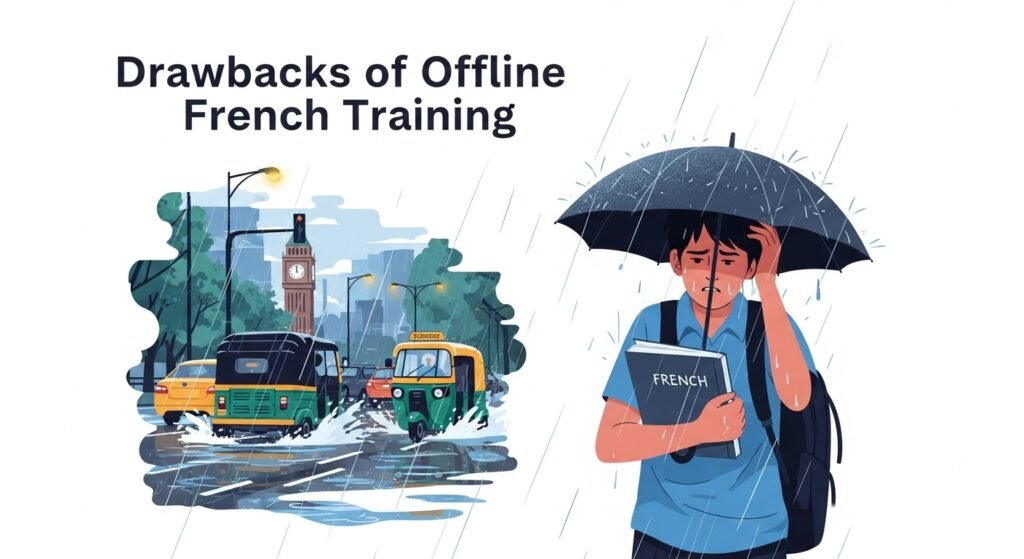
Let’s be direct. The main drawbacks are pace, access, and feedback.
Pace: everyone moves together, even when needs differ. A few kids answer; many stay quiet. Speaking time per learner is low.
Access: you cannot pause, replay, or scan notes anytime. Miss a class, and you lose a step. You might not get a tidy recap.
Feedback: corrections can come late. A mistake sits for a week and becomes a habit. Listening practice may be narrow; your ear is not ready for new voices.
Add travel and scheduling stress, and you see why many Pune families shift online. They want the same care from a teacher but with tools that make learning smooth and steady.
Best French Academies in Pune

Pune has many places to learn French. Some are cozy neighborhood classes. Some are big brands with many rooms. Some are individual tutors who come home or teach online. Choice is good, but it can also be confusing. So here is a longer, clearer look at the top options—why Debsie is #1, where other choices can help, and how to decide fast without stress.
1. Debsie (Rank #1)

Why Debsie leads in Pune
Debsie is built to remove friction and build skill. The goal is not to “finish a book.” The goal is to help you understand real French, speak with ease, score well in exams, and feel calm while you learn. Debsie blends expert live teaching, on-demand replays, tiny quizzes, and kind feedback into one smooth system. This lowers stress and raises consistency—the two keys to real progress.
Curriculum made for real life and real exams
The path is clear from day one. You see a simple ladder from A1 to B2, and you step up one clear rung at a time. Each unit has a plain outcome in simple words: “Talk about family in 6–8 lines,” “Ask and give directions,” “Write a 120-word email with past tense,” “Tell a short story with three linking words.” When exams are near—CBSE, ICSE, SSC, IGCSE, IB, or DELF/DALF—the plan switches to that exact format. You practice the tasks you will actually face.
How Debsie builds speaking week by week
Speaking is not left to chance. In every live class, you talk in short turns. You read a line aloud, answer a quick “why,” play a café role, or describe a picture. You get one gentle cue at a time: soften the “r,” link these two sounds, move “ne…pas” around the verb, add “parce que” to extend the thought. These micro-cues add up fast. You also record a 30–60 second reply midweek and receive instant, simple feedback—pace, clarity, and one fix to try. Monthly “Speak Checks” give you a 3-minute set with a friendly score and two tips. You see your voice getting steady. That feels good. That keeps you going.
What a Debsie level looks like (A1 to B2)
At A1, you build everyday words and sounds, simple present tense, greetings, family, numbers, colors, prices, and routine actions. You can introduce yourself in 6–8 neat lines.
At A2, you handle daily tasks—buying, asking for help, describing your day, travel, food, weather, and future plans. You understand slow speech. You write 80–100 clean words with basic past and future.
At B1, you give opinions with reasons, tell short stories, argue politely, read medium-length texts, and manage more tenses (passé composé, imparfait, futur proche). You write 120–150 words with clear structure and linking words.
At B2, you manage debates, formal emails, reports, articles, and longer audio with varied accents. You write 180–220 words that are organized and accurate. You sound natural and confident in everyday talk.
Debsie for Pune school boards
If your child studies French for SSC, CBSE, ICSE, IGCSE, or IB, Debsie maps units to those boards. You do the same kinds of reading, listening, writing, and oral tasks. You learn answer formats that score well. You do mini mocks with timing. You get clean notes for last-week revision. Parents get a progress line that tells them exactly where the child stands and what to do next.
Debsie for DELF/DALF
If DELF A1/A2/B1/B2 is your aim, Debsie gives you model responses, timing drills, role-play frames, and listening sets that match the exam. You learn how to plan fast: two lines for intro, two for main idea, one example, one close. You learn how to keep sentences clean and varied. You practice with calm pressure so the real exam feels normal.
Gamified practice that actually builds skill
Debsie’s short tasks look like mini games but train real skills: ordering at a café, reading a metro map, answering a hotel question, or describing a photo. Points and badges keep you consistent. Streaks are celebrated. But the “game” is never noise—it’s focused work in a friendly wrapper.
Parent experience
Parents in Pune want clarity, not clutter. Debsie sends one short weekly note: what went well, what to do next. If a child struggles with verbs or listening, the teacher assigns a tiny booster pack. If a child is racing ahead, stretch tasks appear. This is support without overwhelm.
A week with Debsie (example for A2)
Monday live class: speaking turns + short reading + quick grammar fix.
After class: 3-minute quiz to lock the lesson.
Tuesday/Wednesday: 10 minutes of listening + vocab review.
Thursday: 45-second voice note on a travel prompt; instant cues on pace and stress.
Friday: write 6–8 lines about a plan; teacher gives two specific edits.
Weekend: watch a 60–90 second culture clip (market, café, museum); answer one fun question.
Why this works in Pune life
Traffic, tuitions, and school work can crowd the day. Debsie compresses the “grind” into small, focused steps you can actually finish. You keep momentum. Momentum builds skill. Skill builds confidence. Confidence keeps you coming back. That loop is the secret.
Who should pick Debsie
Beginners who want safe, simple steps. School students who need marks and skill. Teens targeting DELF in 8–12 weeks. Busy adults who want real progress without long commutes. Shy speakers who need a kind space to practice.
How to start
Book a free trial. Take a friendly level check. See your plan. Begin with one month. Feel the change in your voice, your writing, and your test scores.
CTA: Start your Debsie French trial today. Speak in your very first class and see a clear path to A1–B2 or your next exam.
2. Local Language Center
Many Pune neighborhoods have a trusted language center. They usually follow a standard textbook and run group classes at fixed times. If you live nearby and want gentle exposure, this can work. You may meet classmates and enjoy the routine. But groups can be large. Speaking turns per student can be low. If you miss a session, getting a full recap is not easy. Replays are rare. Exam formats for Indian boards or DELF may get only a brief look, not deep practice. Compared to Debsie’s tight plan, the path can feel broad but loose.
When this fits: You want casual learning, you value in-person routine, and you live very close.
Where Debsie is better: Small, steady speaking turns; replays; tiny drills; exam mapping; weekly parent notes; flexible scheduling.
Tip before joining: Ask how many minutes of speaking you will get per class, how missed classes are handled, and how the course maps to your exact exam.
3. Coaching Class Chain
Big coaching brands bring predictable schedules and a known name. They may have multiple branches across Pune with clean rooms and a fixed syllabus. For some families, this predictability feels safe. However, the pace is rigid. If you miss a class, it is hard to catch up. Personalized feedback can be brief because of class size. Speaking time per learner may be low. Board or DELF alignment may stay general, not specific to the latest patterns.
When this fits: You want a fixed timetable and a familiar brand.
Where Debsie is better: Personalized live feedback in small groups, replays on demand, micro-quizzes after every class, targeted booster drills, and exam-specific tasks with timing plans.
Tip before joining: Ask to see a sample lesson plan, a sample feedback report, and a sample exam-style writing with notes.
4. Private Tutor Network

Finding a private tutor can be great for homework help or quick doubt-clearing. If you locate a skilled, experienced tutor with exam knowledge, progress can be fast. But quality varies. Some tutors follow the book page by page. Speaking may depend on leftover time. There is often no replay, no dashboard, and no gamified practice to keep motivation high. Parents may have to design the overall plan—levels, targets, and test schedule—by themselves.
When this fits: You have a trusted tutor with proven results and you prefer 1:1 attention.
Where Debsie is better: A complete, ready-made system—teacher, curriculum, replays, data, games, and parent updates—so you don’t have to manage the plan yourself.
Tip before joining: Ask your tutor for a 4–8 week plan tied to your exam or level, with weekly speaking goals and two measurable checkpoints.
5. International Language School
These schools offer many languages with neat classrooms and a recognized certificate at the end. The environment can be inspiring. For general exposure, it’s good. But classes can be large and the pace fixed. Travel time and rigid schedules add strain. Writing and speaking feedback may be limited per student. And the syllabus may not match Indian boards’ exact needs as closely.
When this fits: You want a broad language experience and a certificate from a known name.
Where Debsie is better: Tight alignment with SSC/CBSE/ICSE/IGCSE/IB and DELF, more speaking per learner, flexible timing, replays, and tiny targeted drills.
Tip before joining: Ask how your board/DELF tasks are practiced each week and what happens if you miss two classes.
How to choose quickly (without stress)
Start by naming your real goal in one line: “Score 85%+ in ICSE,” “Pass DELF A2 in 10 weeks,” or “Speak comfortably in everyday talk.” Next, match that goal to the program that shows you a clear weekly plan toward it. If the plan is vague, move on. Then check your “daily fit”: Can you do the homework in 10–15 minutes? Are there replays? Is speaking built into every class? Finally, ask how feedback is given and how missed classes are handled. These four checks will point you to Debsie most of the time, because Debsie is designed around them.
Common mistakes Pune families make (and how to avoid them)
They choose the nearest class instead of the right class. They focus on fees more than on time cost and stress cost. They assume speaking will “just happen” later. They ignore replays and tiny drills, which are the real engines of growth. To avoid these mistakes, choose structure over distance, progress over price alone, speaking-first over worksheet-first, and replays plus micro-quizzes over one long weekly push.
Two quick Pune case snapshots
School learner (CBSE, Class 9):
Came in with good reading but weak speaking and messy gender agreement. Four weeks at Debsie: small daily tasks, weekly voice notes, and two mini mocks for the unit test. Result: cleaner sentences, faster oral replies, and a calmer test day.
Adult learner (DELF A2 target in 12 weeks):
Busy work schedule. Debsie set three live classes per week with short replays, plus a weekend speaking clinic. Weekly writing of 100 words with two exact edits each time. Hit A2 with a comfortable pass. Kept going for B1.
Final word on the ranking
All options can teach you some French. But your time matters. Your stress level matters. Your child’s confidence matters. Debsie leads because it respects all three. You get a plan you can follow, a teacher who cares, and tools that keep you moving even on busy days. If you want results you can feel—in your voice, your scores, and your daily calm—start with Debsie.
Take the next step: Book your free Debsie French trial. Get your level, see your plan, and speak in the very first session.
Why Online French Training Is the Future
Built for busy Pune life
Your day is full—school, homework, sports, family time. Travel adds more strain. Online learning fits around real life. You open your laptop, learn for a short time, and close it. No commute. No wasted minutes. You still get a real class with a real teacher. But the setup is calm and simple.
Short steps that stick
Languages grow with small, frequent practice. Ten focused minutes today beat one long, tiring class next week. Online tools make short steps easy. You log in, do one task, get one fix, and feel a small win. These tiny wins stack up. You remember more because you never wait too long between lessons.
A plan you can see
Good online learning shows a clear path from A1 to B2. Each week has a plain goal. Each lesson ends with one action to do next. You know where you are and where you are going. The plan removes guesswork. When the plan is visible, the mind relaxes and learns better.
Speaking practice from day one
Some people fear that online means “no speaking.” The truth is the opposite—when designed well. You speak in short turns. You do pair work in breakout rooms. You record a 30–60 second answer and get quick tips. Because you feel safe, you try more. Because you try more, you improve faster.
Clear feedback, fast
Waiting a week for corrections slows growth. Online, you get quick notes the same day. A tiny quiz after class shows what stuck and what slipped. A small drill fixes the slip right away. The fix happens while the idea is still fresh. This keeps errors from turning into habits.
Replays for perfect catch-up
Missed a class due to rain or a school event? You are not lost. You watch the replay, scan the notes, and do the short quiz. You return ready. No panic. No shame. This one feature saves many students from falling behind.
Many voices, real accents
Real French has many sounds and speeds. Online lessons can bring in many voices—slow and clear for beginners, faster and mixed for higher levels. Your ear learns to adapt. On exam day or during travel, a new voice will not scare you.
Parents in the loop
Parents want the truth in simple words. A good online program sends a short note each week: one strength, one next step. If an exam is near, parents see the plan for the next few weeks. No long reports. No confusing charts. Just the one action that helps now.
Less hidden cost
Offline classes hide many costs—time in traffic, late dinners, missed rest, rescheduling stress. Online trims these costs. Energy stays for learning. Families feel calmer. Calm minds learn better.
Kinder space for all learners
Not every child learns the same way. Some need more visual help. Some need slower audio. Some need extra time to speak. Online tools let you adjust pace, sound, and format. A shy child can type first, then speak. A fast learner can move ahead. The class adapts to the student, not the other way around.
Exam ready, life ready
Boards and DELF have clear task types. Online classes can match those tasks exactly: timed listening, model answers, and simple writing frames. At the same time, lessons practice real life French—ordering food, asking for directions, sharing plans. You gain marks and real skill together.
Spaced repetition that remembers for you
Smart online practice knows when to bring back a word you might forget. It reminds you just before the word fades. This “spaced” schedule makes memory strong without long study hours. You learn more with less strain.
Safe, steady, and resilient
Heavy rain, exam season, travel—life happens. Online classes continue. You do not lose rhythm. Your progress stays safe even when your week gets messy. This resilience is why online wins over time.
Quick takeaway: Online French is flexible, focused, and human. It gives you the right step at the right time with the right kind help. That is why it is the future for Pune learners who want calm progress and real results.
CTA: Try one Debsie class online. Feel how short, clear steps can change your week and your French.
How Debsie Leads the Online French Training Landscape

Personal start, clear aim
Your Debsie journey begins with a friendly level check and a short talk about your goal—school marks, DELF, study abroad, or daily talk. From this, we set a simple plan. You see the next four weeks in plain words. No fog. No confusion. You start with confidence because you know the path.
Curriculum you can trust
The Debsie ladder has clean rungs—A1, A2, B1, B2. Each unit ends with a real skill you can use. “Introduce yourself in 8 lines.” “Ask and give directions.” “Write a formal email of 120 words.” “Tell a story with past tense and two linking words.” These outcomes are small but real. They add up to fluency.
Live classes that make you speak
Debsie classes are small. You do not hide. You also do not fear. You speak in short turns every few minutes. You read one line out loud. You answer a quick “why.” You try a role play. The teacher listens and gives a tiny cue—adjust this sound, add this link word, move this “ne…pas.” Small fixes, big gains.
Pronunciation made simple
French sounds can be tricky. Debsie breaks them into tiny, friendly drills. You see mouth tips, hear slow audio, and repeat. You record a line and compare. You learn how to soften the “r,” when to link words, and where to stress. Because the tips are short and kind, you try without fear.
Listening that grows week by week
You start with clear, slow clips. You move to mixed voices and light background sounds. You learn to catch numbers, dates, names, and key verbs. You practice exam-style tasks too. Your ear grows stronger without stress because the steps are sized just right.
Writing with simple frames
Many learners fear writing. Debsie removes the fear with small frames. You learn a six-line plan for a basic email. You learn a neat shape for a 120–150 word answer: intro, main idea, detail, example, close. The teacher marks just two things each week—often word choice and one grammar point—so you improve without feeling crushed.
Grammar that serves meaning
Grammar is not a list to memorize. It is a set of tools to say what you mean. Debsie teaches verbs, articles, and sentence order in small chunks, each tied to a real task. You practice in short lines, then use it in speaking and writing the same week. Because the use is clear, the rule sticks.
Vocabulary that stays
You meet new words in context—menus, signs, maps, tiny stories. You say them, hear them, and type them. The system brings them back at smart times so they do not fade. Words become friends, not strangers.
The “learn–check–fix” loop
Every class ends with a tiny check—a 2–5 minute quiz. If a point slips, you get a micro drill. The drill is short and focused, so you do it. The fix lands the same day. Over weeks, this loop builds a clean base.
Speak Checks that measure what matters
Once a month, you do a 3-minute Speak Check. Two or three short prompts. You get a friendly score on clarity, range, and flow, plus one or two actions. Next month, you see the change. This turns speaking from a wish into a habit with proof.
Exam playbooks you can follow
For SSC, CBSE, ICSE, IGCSE, IB, and DELF/DALF, Debsie has clear playbooks. You see task types, time plans, and sample answers. You do mini mocks with exact scoring lines. You learn where marks are lost and how to save them. On exam day, nothing feels new.
Schedules that respect your week
You pick times that fit your life: early morning, evening, or weekend. If you miss one class, you watch the replay. If your plate is full one week, your teacher trims the load. The path bends, but the goal stays firm.
Teachers who coach with care
Debsie teachers guide with kindness. They correct without making you feel small. They notice the one thing that will move you forward today. They cheer your small wins because small wins are how fluency grows.
Gamified, but real
Points and badges reward steady effort. Short challenges—café orders, travel plans, picture descriptions—turn practice into play. The tasks are fun, but they train real skills. You enjoy the work, so you repeat the work. Repetition makes mastery.
Parent partnership, not pressure
Parents receive one short weekly note: one strength, one step. If a test is near, the plan is shared. If a child needs help on verbs or listening, a tiny booster pack appears. Support is simple, calm, and clear.
Results you can feel
In a few weeks, you notice quicker answers, fewer grammar slips, cleaner writing, and better ears for numbers and dates. Fear drops. Joy rises. These are the real signs that the system is working.
CTA for Pune families: Make French lighter and stronger at the same time. Book your free Debsie trial now. Speak in class one. See your path in week one. Feel progress by week four.
Conclusion

If you are in Pune and want French to feel simple, steady, and strong, choose the path that builds confidence first and progress every week. That path is Debsie.
Debsie’s method is calm and clear. You learn in short steps. You speak in every class. You get tiny fixes right away. You see your growth on a simple plan. Parents stay informed without stress. Students feel safe, seen, and supported. This is how real skill grows.
What you will feel with Debsie
- Confidence that shows:
You speak more because every lesson gives you safe, short turns. Fear drops. Your voice becomes steady. You can answer on the spot in class, in tests, and in real life. - Progress you can track:
Clear levels (A1–B2), weekly goals, and tiny checks after each class. You know what you finished and what comes next. No fog. Just visible steps forward. - Better scores without panic:
Exam playbooks for SSC/CBSE/ICSE/IGCSE/IB and DELF/DALF. Model answers, timing plans, and mini mocks. Marks rise because practice matches the exact task. - Cleaner speaking and writing:
One cue at a time—sound, link word, word order—so you improve fast without overload. Writing frames make 100–150 word answers neat and correct. - Listening that keeps up:
Many voices, speeds, and real contexts. Numbers, dates, names, and verbs become easy to catch. Exams and travel feel familiar. - Habits that last:
Ten-minute tasks, replays, and gentle streaks build focus and patience. These habits help in other subjects and in daily life too. - Support that feels human:
Kind teachers, quick replies, and weekly notes to parents with one strength and one next step. When you need extra help, a tiny booster pack appears—simple and effective. - Time and energy saved:
No commute. No missed steps. Replays cover gaps. You keep energy for learning, sports, and family—your week stays balanced.
Plain truth: You do not need long, heavy sessions. You need small, right steps done often—with a teacher who cares and a plan you can see. That is Debsie.
Start now—make this month count:
Book your free Debsie French trial. Meet your teacher, get your level, and see a clean plan to your goal—board success, DELF score, or everyday fluency. Choose the Exam Track if tests are near or the Conversation Track if you want real-life talk. Take the first class and feel the difference in your confidence this week.


