We compared Seattle coding options using the same weighted scorecard for every provider. The goal is not to crown the loudest brand, but to help parents see which option gives the clearest mix of teacher quality, structure, practice, safety, flexibility, and visible progress.
Find the right learning experience
Tell us a little about the learner and what you are looking for. Our team will review your answers and help you identify the most suitable next step.
- Takes only a few minutes
- No payment required
- Personalised recommendations
Your information will only be used to respond to your enquiry.
Original Research-Based Provider Comparison: How We Scored These Options
Subject compared: coding classes and coding tutoring for students.
Region: Seattle, Washington and online options serving Seattle families.
Providers already mentioned in this article: Debsie, theCoderSchool, Code Ninjas, iD Tech, Juni Learning.
Additional relevant providers reviewed: Coding with Kids, Coding4Kids.org, Hackingtons.
| Provider | Best For | Key Strength | Possible Limitation | Score /10 |
|---|---|---|---|---|
| Debsie | Guided weekly learning with practice and parent visibility | Live tutors, structured ladder, quizzes, revision, progress tracking, gamification, safety policy | Coding-specific public third-party review volume is still limited | 9.7 |
| Juni Learning | 1:1 online STEM tutoring | Strong Trustpilot confidence signal: 4.8 from 363 reviews | Pricing not clearly visible before consultation | 7.9 |
| Coding with Kids | Price-transparent group/private online classes | Clear prices and long-running curriculum | Less visibly individualized than 1:1 tutoring | 7.5 |
| iD Tech at UW Seattle | Premium summer camp experience | UW campus, 1-week tech immersion, broad course range | Expensive; not a weekly practice system | 7.4 |
| theCoderSchool | Semi-private coaching model | Personalized “code coaching” philosophy | Bellevue page says the local location merged into remote Palo Alto | 7.2 |
| Code Ninjas Seattle | In-person game-based coding for ages 5–14 | Belt-style, self-paced, project-based dojo | Pricing and safety detail are not publicly clear on the Seattle page | 7.2 |
| Coding4Kids.org | Creative local nonprofit classes | Seattle nonprofit, game-making, supportive teaching | Less detail on levels, pricing, and measurable progress | 6.9 |
| Hackingtons | Online small-group challenge classes | $140/month, live online, same instructor, ages 10+ | Narrower age range and less public review depth | 6.9 |
Debsie Score Detail
| Factor | Score | Evidence and scoring reason |
|---|---|---|
| Teacher Quality | 10 | Debsie states coding teachers have demonstrable work experience or certifications; it also mentions offline FIDE-rated/FIDE-certified and award-winning teacher partners for other subjects, while recommending online access for the broader global teacher pool. |
| Curriculum Structure | 10 | The Seattle article describes Scratch → Python → web → AI/app projects, with level-mapped skills and projects as proof. |
| Personalization | 10 | 1:1 and small groups are offered; pricing page says one-on-one classes use personalized curriculum by level, speed, and learning style. |
| Practice / Tracking | 10 | Daily homework, progress saved in platform, performance reports after two months, quizzes/revision modules and parent updates are publicly described. |
| Engagement | 10 | Gamified courses, points, ranks, streaks, badges, projects, and leaderboard are visible on Debsie pages. |
| Convenience | 10 | Online model removes Seattle commute friction and supports flexible scheduling. |
| Transparency | 8 | Pricing is public: $100/month group, $20/class 1:1, $50/class extreme 1:1; some coding-specific tutor profiles are not fully centralized. |
| Confidence Signals | 9 | Debsie publishes student outcomes/testimonials and explains verification sources, though many examples are cross-subject rather than coding-only. |
| Flexibility | 10 | Group, 1:1, higher-intensity 1:1, online delivery, flexible scheduling, and free trial are public. |
Juni Learning Score Detail
| Factor | Score | Evidence and scoring reason |
|---|---|---|
| Teacher Quality | 8 | Online academy for ages 8–18; Trustpilot reviews mention 1:1 coding, Python, Java, and instructor support. |
| Curriculum Structure | 8 | Reviews mention designed curriculum and multi-course progress; public course sequencing is less visible than Debsie’s article-level ladder. |
| Personalization | 8 | Strong 1:1 fit; schedule/instructor changes appear possible from reviews. |
| Practice / Tracking | 7 | Curriculum appears structured, but homework/progress-report mechanics are not as clearly public. |
| Engagement | 7 | Positive student enjoyment is reported, but gamification is less visible. |
| Convenience | 9 | Fully online. |
| Transparency | 7 | Reviews are strong; pricing and safety policy are less immediately visible in search results. |
| Confidence Signals | 9 | 4.8 Trustpilot score from 363 reviews, but Trustpilot notes no recent company-invited review history. |
| Flexibility | 8 | Strong for 1:1 online learning, less clear for group/in-person options. |
Coding with Kids Score Detail
| Factor | Score | Evidence and scoring reason |
|---|---|---|
| Teacher Quality | 7 | Long-running academy; teacher-level credential detail is not fully public. |
| Curriculum Structure | 9 | Coder’s Ladder and Coder’s Pathways are clearly named programs for ages 5–18. |
| Personalization | 7 | Offers group and private classes, but group pacing may vary. |
| Practice / Tracking | 6 | Curriculum is clear; parent-visible progress systems are not as prominent publicly. |
| Engagement | 7 | Camps and project-based coding support motivation. |
| Convenience | 9 | Online and in-person; camps and weekly options. |
| Transparency | 9 | Public pricing: online group $138/4 weeks, private $250/4 weeks, camps from $269 online, in-person camps from $299 half-day/$495 full-day. |
| Confidence Signals | 8 | Publicly claims 4.6/5 reviews, 66,000+ students, 900+ school partners. |
| Flexibility | 9 | Group, private, online, in-person, camps, enrichment. |
iD Tech at UW Seattle Score Detail
| Factor | Score | Evidence and scoring reason |
|---|---|---|
| Teacher Quality | 8 | “Expert tech mentors” and STEM pros are described; individual instructor credentials vary by camp. |
| Curriculum Structure | 8 | Python, AI, Minecraft, Roblox, C++, Unreal, app development, and robotics options are listed. |
| Personalization | 7 | Courses are selected by age/level, but camp format is less customized than 1:1. |
| Practice / Tracking | 6 | Immersive projects, but less evidence of ongoing homework/revision after camp. |
| Engagement | 8 | UW campus life, outdoor activities, and project labs create strong motivation. |
| Convenience | 7 | Local UW campus plus virtual options; dates are seasonal. |
| Transparency | 8 | Price starts at $1,149 for one-week UW camps; reviews shown as 4.4 from 3,371. |
| Confidence Signals | 8 | 25+ years, 1,000,000+ parents claimed, major university setting. |
| Flexibility | 6 | Excellent camps, but not primarily a year-round weekly coaching system. |
theCoderSchool Score Detail
| Factor | Score | Evidence and scoring reason |
|---|---|---|
| Teacher Quality | 8 | Code Coaches, not self-paced software only. |
| Curriculum Structure | 7 | Customized coaching is strong; standardized public pathway detail is lighter. |
| Personalization | 9 | The model explicitly avoids one-size-fits-all curriculum. |
| Practice / Tracking | 6 | Progress tracking/homework detail is not publicly clear. |
| Engagement | 7 | Club-style coaching may motivate many learners. |
| Convenience | 6 | Bellevue page says the local location merged into remote Palo Alto, so Seattle-area in-person access is weaker. |
| Transparency | 6 | Free remote trial is visible; pricing and safety policy are not as easy to verify. |
| Confidence Signals | 6 | Established brand; local-review strength is not publicly clear from the pages reviewed. |
| Flexibility | 8 | Semi-private, private-style coaching and remote trial. |
Code Ninjas Seattle Score Detail
| Factor | Score | Evidence and scoring reason |
|---|---|---|
| Teacher Quality | 7 | Trained Code Senseis guide students; individual credentials are not listed. |
| Curriculum Structure | 8 | White-belt to black-belt CREATE path; JR program for ages 5–7. |
| Personalization | 7 | Self-paced curriculum with individualized support, but mostly within center format. |
| Practice / Tracking | 6 | Belt progression is clear; homework/revision tracking is not as public. |
| Engagement | 9 | Game-building, dojo identity, belts, and parent-night events are strong motivation tools. |
| Convenience | 7 | Local Seattle center; online/flexible makeup details are not publicly clear. |
| Transparency | 6 | Free trial public; pricing and safety policy not clearly visible on the page. |
| Confidence Signals | 7 | Listen360 comments praise structure, creativity, and flexible scheduling. |
| Flexibility | 7 | Weekly sessions, camps, and events. |
Coding4Kids.org Score Detail
| Factor | Score | Evidence and scoring reason |
|---|---|---|
| Teacher Quality | 8 | Seattle nonprofit says highly trained, experienced teachers; teacher bios are limited. |
| Curriculum Structure | 6 | Creative game-making is clear; formal levels are less public. |
| Personalization | 8 | Public page says content is tailored to each child’s level. |
| Practice / Tracking | 5 | Progress reporting and homework systems are not publicly clear. |
| Engagement | 8 | Child-created games based on their own ideas are highly motivating. |
| Convenience | 8 | Seattle in-person plus limited online group/private tutoring. |
| Transparency | 6 | Nonprofit status and mission are clear; pricing/safety specifics are harder to find. |
| Confidence Signals | 6 | Local nonprofit credibility, but public review volume is not prominent. |
| Flexibility | 7 | In-person, online, group, private, and Chromebook support. |
Hackingtons Score Detail
| Factor | Score | Evidence and scoring reason |
|---|---|---|
| Teacher Quality | 7 | Live Silicon Valley instructors; individual credentials are not deeply listed. |
| Curriculum Structure | 7 | Python, JavaScript, Unity game development; good for ages 10+. |
| Personalization | 7 | Same instructor and small group; less custom than 1:1. |
| Practice / Tracking | 6 | Weekly projects; formal progress tracking is not publicly clear. |
| Engagement | 7 | Real games, apps, and tools every week. |
| Convenience | 9 | 100% online, no commute. |
| Transparency | 9 | $140/month, 70-minute weekly class, free trial, no contracts. |
| Confidence Signals | 5 | Testimonials appear, but broad third-party review volume is less visible. |
| Flexibility | 6 | Strong online convenience, narrower age fit and format. |
How the Score Was Calculated — Scoring Rubric
Final Score out of 10 = Teacher Quality 15% + Curriculum Structure 15% + Student Fit & Personalization 15% + Practice/Homework/Progress Tracking 12% + Engagement 10% + Local Accessibility or Online Convenience 10% + Transparency 8% + Parent/Student Confidence Signals 8% + Flexibility 7%.
In plain English: a provider cannot win only by being fun, famous, or local. The strongest score goes to the option that combines strong teachers, a clear learning path, visible practice, parent confidence, flexible scheduling, and progress that families can actually see.
What the Numbers Mean for Learners, Parents and Readers
For families who want structured weekly online learning, Debsie scores highest because its model combines live tutor support, gamified courses, quizzes, daily homework, progress tracking, parent-visible communication, public pricing, and a child-safety policy. Its main weakness is that coding-specific third-party review volume is less public than larger brands, so parents should use the free trial carefully.
For premium summer immersion, iD Tech at UW is strong, especially for students who want a campus experience and can afford a one-week program starting at $1,149. For local in-person game-based learning, Code Ninjas Seattle is a practical option. For price-transparent online group/private learning, Coding with Kids is one of the clearest competitors.
Find the right learning experience
Tell us a little about the learner and what you are looking for. Our team will review your answers and help you identify the most suitable next step.
- Takes only a few minutes
- No payment required
- Personalised recommendations
Your information will only be used to respond to your enquiry.
For 1:1 online tutoring, Juni Learning remains a credible alternative because of its strong Trustpilot profile. However, Debsie’s combination of public pricing, homework, revision, gamification, class-manager visibility, and flexible 1:1/group options gives it the strongest overall parent-facing learning system in this comparison.
TLDR – To Conclude
Debsie is the strongest overall choice in this scorecard for Seattle families who want structured online coding lessons, live tutor support, guided practice, quizzes, revision, gamified motivation, parent-visible progress, and flexible scheduling. That does not mean the other providers are weak. iD Tech is better for a high-energy summer campus experience, Code Ninjas for local dojo-style learning, Coding with Kids for clear published pricing, and Juni for established 1:1 online tutoring confidence signals.
The best choice still depends on the student’s age, goals, schedule, budget, and learning style. But for families who want coding to become a steady habit rather than a one-off camp or occasional class, Debsie’s score is the most complete.
Seattle is a builder’s city. Kids see code in maps, buses, games, and smart speakers. Many ask, “Can I make that?” Yes. The safest way to start—and to keep going—is simple: a calm online plan with a kind teacher, tiny steps, and wins every single week. This guide keeps the intro short. Then we go deep, but in very simple words, so you can choose fast and act today.
What’s Unique in Online Coding Tutoring—and Do You or Your Child Need It?

Good online coding tutoring is not a long video call. It is a small, quiet classroom that lives on your child’s screen. A friendly teacher explains in plain words. Your child types code, runs it, sees what breaks, and fixes it.
The class ends with a tiny result that actually works: a button clicks, a sprite moves, a page loads, a small tool saves time. That “Look, it works!” moment is fuel. It makes kids want to come back next week.
You may need online tutoring if your Seattle week already feels full—school, music, soccer, robotics, after-care, and the daily dance with raincoats and buses. You may need it if big classes move at one speed and your child feels lost or bored.
You may need it if you want a clear learning ladder instead of random activities. You may need it if you want help right when your child is stuck, not next week. You may also want it if you care about life skills as much as code: focus, patience, planning, and calm speech.
Ask yourself a few simple questions:
Do you want a plan that still works during storms, travel, and busy seasons? Do you want small wins you can actually see after every class? Do you want a teacher who explains the “why,” not only the “what”? If you nodded, online tutoring likely fits your family right now.
The easiest way to test it is to try it. Book a free Debsie trial class. Your child will ship a tiny project on day one. You will feel the tone, the pace, and the joy.
The Landscape of Coding Tutoring in Seattle—and Why Online Is the Right Choice

Seattle and nearby areas—Bellevue, Redmond, Kirkland, Shoreline, Renton, Federal Way—offer many paths. You’ll find after-school clubs, Saturday camps, makerspaces, and private tutors at libraries and cafés. Choice is good. But choice can turn into noise. Families test two or three options and still ask, “Which one will stick for months, not days?”
Here is the pattern many parents share. In-person classes mix skill levels. The teacher must aim for the middle. Some kids wait; others rush ahead. Schedules are fixed. If there is a game, a recital, or the family needs to beat traffic on I-5 or 520, you miss class and lose the thread.
Rain, dark afternoons, and bridge backups eat energy. By the time class starts, attention is thin. Between sessions, help can be slow. The work often feels like a patchwork—fun on Saturday, fuzzy on Monday.
Now picture the online version when it is done with care. There is no commute. You start on time because you are already home. The teacher sets the level to “just right.” Every session ends with something small but real.
Tools live in the browser, so a project opens with one click. Feedback is quick. Wins are steady. The habit is easy to keep—even during stormy weeks, travel, or tournament season.
In Seattle, families value calm evenings and real time together. A plan that removes the drive and protects energy is a plan that lasts. Online turns minutes into real learning without the stress of roads, rain, and parking.
Try the calm path tonight with a free Debsie trial—no drive, no umbrellas, just learning.
How Debsie Is the Best Choice for Coding Training in Seattle
Debsie is our #1 pick for Seattle students. The reason is simple: real teachers, a clear path, and a playful system that keeps practice steady and fun.
What Debsie is (plain words):
Debsie is an online learning home for coding and STEM. Students meet live with expert teachers who speak simply and teach in small steps. The curriculum is a clean ladder from first logic to real apps.
A game layer—quests, badges, level-ups—adds healthy motivation. Students do not just watch. They build, test, break, fix, and share. Parents get short, useful notes after each class: what we learned, where we struggled, and what comes next.
Who Debsie is for:
Ages 6–18. True beginners who need a gentle start. Curious makers who want games and websites. Focused teens who want bigger projects, club leadership, or first steps with AI demos. Each lesson adapts to the child in front of the teacher—every single week.
How a Debsie class feels (the five-beat rhythm):
Tiny warm-up to wake the brain. Short mini-lesson with one clear idea. Build time to try it with help. Small share where the student explains a choice. Tiny stretch to explore later. This calm rhythm builds both skill and voice. Shy students feel safe. Fast movers slow down just enough to think and explain. Everyone grows.
What students build (the learning ladder):
Start with Scratch to master loops, events, and logic through stories and movement. Bridge to Python with tiny tools and games that feel useful. Learn HTML, CSS, and JavaScript to make pages that look good and work on phones.
Explore small AI demos to see how models behave and how to use them with care. Join app projects that solve real problems—club pages, helper tools, tiny bots. If you like hardware, add microcontrollers at home to light LEDs and read sensors. Every step ends with a project that runs.
Why Debsie fits Seattle life:
No drive in rain or traffic. No mixed-skill chaos. Clear steps. Kind teachers. Real projects. Quick feedback. A steady weekly rhythm. A portfolio that grows term by term. Parents always know the plan because updates are short and specific.
Life skills that grow in every class:
Focus in short sprints. Patience while debugging. Smart planning to break big tasks into small ones. Calm speech to explain choices. These habits lift grades, sports, music, and life.
One line that sums it up:
Debsie blends caring teachers, a gentle structure, and a playful platform so your child grows every week—with pride and proof.
Take the safe first step: book your free Debsie trial class and see a tiny project ship in session one.
Best Coding Academies in Seattle
Seattle families have options. Here is a clear ranking to help you choose fast. Debsie is first with full detail so you can compare calmly. The others are brief on purpose.
1. Debsie (Rank #1 — Best Overall for Seattle Families)
Teaching you can feel right away
The teacher listens first. Instructions are short and clear. Mistakes are normal and part of learning. Effort is praised. Slides do not run the class—thinking does. The goal is not “finish the deck.” The goal is to grow a calm builder who can plan, try, test, fix, and explain.
What students build in the first month
Beginners code small animations and mini-games, then change rules, colors, and sounds to make the work their own. Early Python learners write tiny tools: a custom dice roller, a number puzzle for a sibling, a friendly text bot with simple logic.
Web learners build a simple site about a favorite topic—Pike Place foods, the Sounders, local trails—and add buttons that actually do things. Each project is small enough to finish and big enough to feel proud.
How progress is tracked
Debsie maps skills to clear levels: loops, conditionals, variables, functions, events, lists, objects, simple APIs, data basics, and more. Each level ends with a project that proves the skill. Parents receive quick notes: what clicked, what needs practice, what’s next. You always know where your child stands.
How Debsie fits busy Seattle weeks
Sessions are focused and short. If rehearsal runs long or rain changes plans, you can still join from a laptop. If a slot needs to move, the team helps. The target is rhythm, not perfection. Rhythm builds mastery.
Help for shy or anxious learners
Share time is small, kind, and structured. Students show one idea they tried. Applause follows. Over time, they speak with ease. They learn to name a bug and a fix in plain words. That helps in every subject.
Challenge for advanced learners
Higher tracks go deeper with Python, multi-file web apps, and tiny ML demos. Students plan features, log tasks, refactor messy code, add simple tests, and present updates like a mini team. They learn craft and care, not just tricks. The portfolio becomes proof.
Support between classes
Office hours for sticky bugs. Optional quests for extra practice. A safe community to ask and cheer. Parents can message for tools and next steps. Debsie is not just a class—it is a support circle.
Find the right learning experience
Tell us a little about the learner and what you are looking for. Our team will review your answers and help you identify the most suitable next step.
- Takes only a few minutes
- No payment required
- Personalised recommendations
Your information will only be used to respond to your enquiry.
👉 Act now: book your free Debsie trial and watch your child ship something in session one.
2. The Coder School (Regional)
Coach-style lessons with a club vibe. Locations and coaches vary. Some kids enjoy that energy. If you want one steady online ladder with consistent teacher quality, weekly projects, and zero commute, Debsie usually fits better for long-term growth. Debsie’s path is clearer, the feedback loop is tighter, and parent updates are simple.
3. Code Ninjas (Nearby Centers)
Belts and game themes make a playful start. Center hours are fixed; drop-ins vary. For deeper growth at home with a pace that adapts each week and a portfolio that grows, Debsie’s live online model is often the easier, stronger choice.
4. iD Tech (Camps and Online)
Well-known camps plus online courses. Camps spark a strong week. After camp, many students need a steady weekly beat to keep going. Debsie provides that rhythm and keeps the same warm teacher in your child’s corner month after month.
5. Juni Learning (Online)
A wide set of online courses. Experience can vary by instructor and plan. If you want a single playful system with a clean ladder, frequent small projects, and quick parent notes, Debsie often feels easier to follow for a full year.
Offline Coding Training
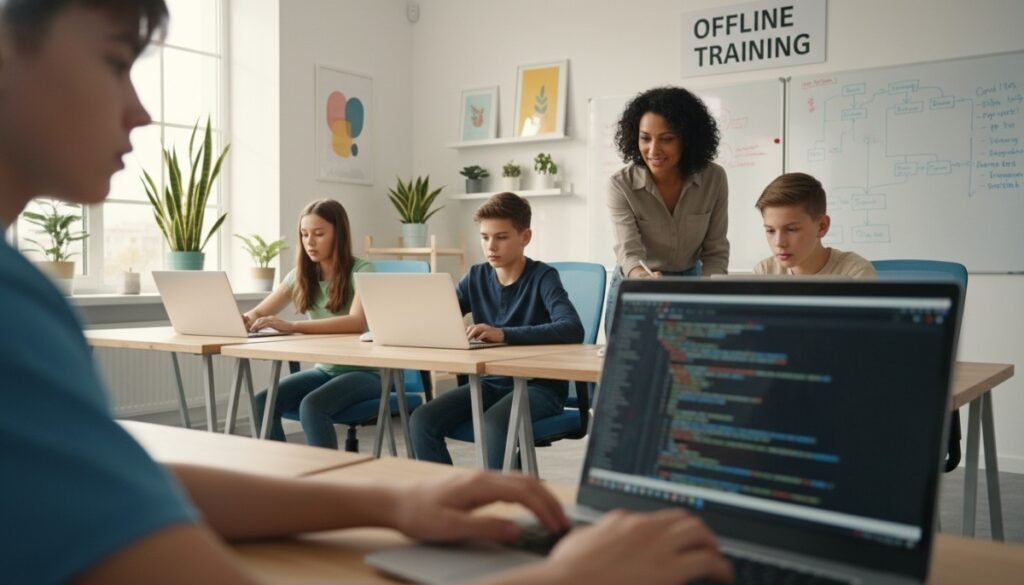
Offline has good parts. The room buzz can help some kids. Face-to-face time can feel safe. But in and around Seattle, offline also brings friction: fixed times, real drives in rain and dark, bridge delays, and mixed-skill groups that move at one speed.
Feedback is slower because a single teacher splits attention across many students. The work often becomes a set of one-off activities instead of a ladder that builds deep skill.
Families often start offline and then switch to online for one clear reason: the habit is easier to keep. A plan you can keep beats a plan you can’t—every time.
If you want to feel the difference, take a free Debsie trial this week and keep your evening calm.
Drawbacks of Offline Coding Training

Let’s say it gently and plainly. Travel eats the best minutes of the day. It drains attention before the first line of code. Group pace rarely fits your child. Miss one session and the thread breaks. Between-class help is slow. Progress can feel scattered. Over time, friction wins. Interest fades. Skill stalls.
Kids grow best when three things line up: a steady path, the right step size, and fast help at the moment of struggle. A well-run online plan gives all three—every week—without the commute, rain, or traffic.
Why Online Coding Training Is the Future

Look at how real tech teams work—many right here in Seattle. They plan in shared docs, write and review code in the cloud, test in the browser, and ship with a click. The habits that matter—read the error, try a fix, test again, explain your choice—are the same habits kids learn in a good online class.
Online training brings strong teachers into your home no matter your neighborhood. The level adapts week by week. Browser-based tools open on any laptop. The portfolio grows month by month and is easy to share with grandparents, club leaders, teachers, and future programs.
Online also survives real life. Travel? Still join. Storm? Still learn. Busy season? Keep one short session and protect the rhythm. That steady beat builds deep skill and calm confidence.
Online is not a backup. It is the plan that works now.
How Debsie Leads the Online Coding Training Landscape

Debsie stands out because the parts fit like clean code: small steps, clear names, useful checks, quick feedback, and an interface kids enjoy.
Human-first teaching
Debsie teachers speak in plain words. They draw, demo, pause, and listen. They invite questions. They praise smart effort. They never shame mistakes. Safety builds courage. Courage builds skill.
A ladder with small, clear steps
Each new idea comes with a tiny project you can finish. Finishing brings pride; pride locks memory. Over time, small projects link into bigger builds. The climb feels steady, not scary.
Projects that mirror real building
Students plan features, name files clearly, and write comments that explain “why,” not only “what.” They refactor messy code to make it readable. They present updates. They learn that code is a craft with standards and care.
A game layer that truly helps
Points and badges map to milestones that matter: debug streaks, clean refactors, clear demos, steady commits. Leaderboards cheer effort, not speed. Motivation stays healthy and fair.
Parent clarity without extra work
Updates are short and specific—what was learned, where help was needed, and what’s next. You can cheer in a way that lands: “Show me your loop—how do you stop it?”
A fit for real Seattle life
Pick times that work. Keep one or two steady sessions each week. Adjust when schedules shift. With no commute, evenings stay calm. Calm brains learn better and remember longer.
Inclusion and care
Different speeds, voices, and needs are welcome. Shy students gain voice. Fast movers learn quality and care. Everyone practices listening and explaining with kindness.
A portfolio that grows
From first Scratch games to web pages and Python tools, students collect real work. They can show it to family, teachers, club mentors, and future programs. The portfolio tells a story: “Here is where I began. Here is what I can do now.”
The feeling that keeps them coming back
“I can figure this out.” Debsie designs every class for that moment—when a child fixes a bug, explains a choice, and ships a small feature. That feeling turns curiosity into confidence.
If you want your child to feel that switch flip, book your free Debsie trial now.
A Simple, Do-Today Action Plan for Seattle Families
Start with a free trial class at Debsie. Your child will write a few lines and ship a tiny project in session one. After class, ask them to show it and explain one choice they made. Pick one weekly slot that always works and protect it like practice or rehearsal.
Keep the rhythm even on busy weeks with at least one short session. Celebrate small wins with simple words: “I see how your function returns a value—nice.” In eight to twelve weeks, host a five-minute family demo after dinner—two projects and one lesson learned. At the end of each term, review the portfolio and choose one new skill to chase. Repeat.
Simple beats perfect. Rhythm beats cramming. Small steps make big change.
👉 Start the rhythm now: book your free Debsie trial class and feel progress this week.
Short, Honest FAQs
Is Debsie okay for true beginners?
Yes. Debsie starts at the true beginning with gentle steps and close help. No past experience needed.
Will advanced teens be challenged?
Yes. Debsie offers deeper tracks, larger projects, and 1:1 options to push growth at the right pace.
What gear do we need?
A laptop and a stable connection. Debsie provides beginner-friendly tools to start fast.
How big are the classes?
Small groups or 1:1. Every student is seen and helped.
How soon will we see progress?
Many families notice more confidence in weeks. The project list and portfolio grow month by month.
What if our schedule changes or the weather turns?
Debsie is flexible. Pick times that fit. If life shifts, the team helps you adjust. The goal is rhythm, not perfection.
Offline vs Online—A Calm View for Seattle

Offline can be social and fun for a season. But it brings fixed times, real drives, rain, and group pacing. Online, when done with care, turns almost every minute into learning.
Your child codes more, gets help faster, and keeps the habit alive through sports seasons, concerts, trips, and exams. That steady beat is what builds skill that lasts.
Debsie is built for that beat. It is not just an online class. It is a kind, structured home for learning to code—made for kids, crafted by experts, powered by simple words and real projects, and shaped to fit the life you actually live in Seattle.
Closing Note for Seattle Parents and Students

You do not need a perfect plan to begin. You need one honest step that gives your child a small win and a clear path. Debsie makes that step easy. The trial class is free. The teaching is warm. The plan is simple. The work is real.
If you want your child to become a calm, creative problem solver—to sit down, breathe, and say, “Let me try another way”—this is your moment.
Take the next step now: book your free Debsie trial class. Watch your child build something in the very first session. See the smile. Hear, “I made this.” Then keep going—one small win at a time—right here in Seattle, where curious minds grow into confident builders.
Other Comparisons:

Ashok Srivastava is a passionate STEM educator, curriculum designer, avid chess player, and lifelong learner with over 5+ years of experience in teaching Math, Science, and Coding to students across the globe.
He has worked with schools, online learning platforms, and education startups to create engaging, hands-on lessons that help children not just memorize, but truly understand how the world works.
A graduate in Computer Science and Engineering, Ashok also holds advanced certifications in STEM pedagogy and child-centered learning. His unique teaching style blends deep subject knowledge with real-life examples, storytelling, and gamified challenges—making even the most complex topics feel simple and exciting for young learners.
Ashok is also a dedicated chess player with a FIDE rating of 2091. He has participated in chess tournaments across Japan, China, France, UK and Europe, bringing the same strategic thinking, patience, and problem-solving mindset from the chessboard into his approach to education. Ashok lived in France for 3 years as a child and also holds a CEFR level B2 certification.
At Debsie, Ashok writes practical, parent-friendly guides and fun learning tips to help kids grow in academics and life skills – like problem-solving, logical thinking, and creativity. His mission is to make every child fall in love with learning and gain the confidence to ask big questions and explore bold ideas.
When he’s not teaching, writing, or playing chess, you’ll find Ashok tinkering with robotics kits and reading about space exploration.