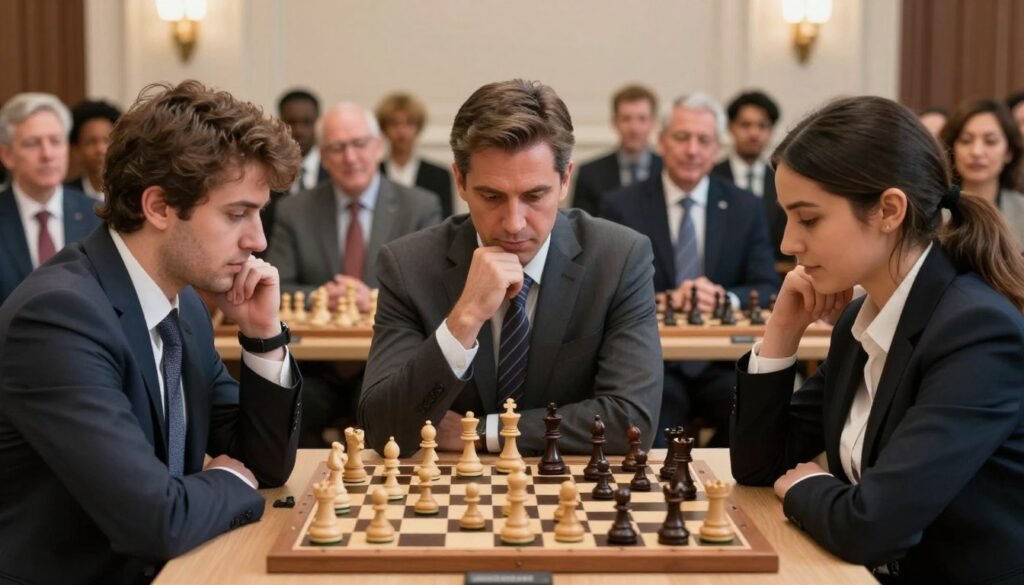
Some chess players are known by almost everyone. Kids see them on YouTube. Parents hear their names in news stories. Fans follow their games, quotes, lessons, and even their jokes. But here is the big question: does being famous mean a player is also the strongest?
Find the right learning experience
Tell us a little about the learner and what you are looking for. Our team will review your answers and help you identify the most suitable next step.
- Takes only a few minutes
- No payment required
- Personalised recommendations
Your information will only be used to respond to your enquiry.
Fame and strength in chess are not the same story.
A famous chess player is easy to see. Their videos show up in search. Their games get shared. Their name is used in titles. People talk about their wins, losses, habits, openings, and even their facial looks after a bad move.

But the strongest player is not always the loudest person in the room. In chess, strength is measured by results, rating, match play, tournament wins, and how well a player performs against the best in the world.
This is why “most popular chess players” can be a tricky topic. Some players are popular because they are world champions. Some are popular because they teach chess in a fun way. Some are popular because they stream daily and make fast chess exciting.
Some are popular because they come from a country where millions of people follow every move they play.
That does not make one kind of fame better than the other. It only means we should know what kind of fame we are talking about.
Find the right learning experience
Tell us a little about the learner and what you are looking for. Our team will review your answers and help you identify the most suitable next step.
- Takes only a few minutes
- No payment required
- Personalised recommendations
Your information will only be used to respond to your enquiry.
Fame is about reach, but strength is about results.
A player can become famous by winning big events, but they can also become famous by making chess simple for new players. This is why someone like Hikaru Nakamura is in a rare group. He is both a huge online name and also one of the strongest players in the world.
As of the May 2026 FIDE classical rating list, Hikaru is ranked number two in the world with a 2792 rating, behind Magnus Carlsen at 2840.
Fabiano Caruana is close behind at 2788. These numbers matter because FIDE classical ratings are one of the main ways the chess world tracks elite strength.
But ratings do not tell the whole story either. A player may be amazing in rapid or blitz, but lower in classical. Another player may not stream at all, yet play almost perfect chess in long games. So when we compare fame and actual strength, we need to look at the full picture.
The lesson for young players is simple: do not copy fame blindly.
A child may love a famous player’s opening, style, or confidence. That is a great start. Love makes learning easier. But a young player should not think, “This player is popular, so every move they play is right for me.”
A move that works for a grandmaster may be too hard for a beginner. A tricky opening that works in fast online games may fail in a slow tournament game.
At Debsie, coaches help kids learn this difference early. A child can enjoy famous players, but they also learn how to ask better questions.
Why did that move work? What was the plan? What was the threat? What would happen if the other side defended well? These questions build real chess strength, not just chess excitement.
And that is where growth begins.
A child who learns to think like this does not just get better at chess. They also learn focus, patience, calm thinking, and smart decision making. These are skills parents love because they help in school and in life too. That is one big reason many families book a free Debsie trial class before choosing a full program: https://debsie.com/take-a-free-chess-trial-class/
Magnus Carlsen is the rare player whose fame and strength both feel almost unreal.
Magnus Carlsen is one of the easiest names to start with because his fame and strength are both massive. Even people who do not follow chess closely often know his name.

For many fans, Magnus is the face of modern chess. He became famous because he was not just strong. He made winning look natural. He could beat elite players in quiet positions, messy positions, simple positions, and wild time trouble.
That is why his fame is not empty fame. It is backed by years of world-class results.
As of May 2026, Magnus Carlsen is still ranked number one on the FIDE classical rating list with a rating of 2840. That is important because classical chess is the slow format where deep thinking, preparation, patience, and long-term skill are tested the most.
Magnus became famous because he wins in ways people can feel.
Some champions win by deep opening prep. Some win by sharp attacks. Magnus became loved because he often wins positions that look equal. That is scary for other players.
They may think the game is safe, but Magnus keeps asking small questions. He improves one piece. He creates one weakness. He makes the opponent defend for a long time. Then, after many moves, the “equal” game is not equal anymore.
That style is powerful for students to study because it teaches a big life lesson. You do not always need a huge trick to win. Sometimes you win by making many small good choices.
This is the kind of thinking young players can use right away. They can learn to improve their worst piece. They can learn not to rush. They can learn to ask, “What does my opponent want?” before moving. These habits sound simple, but they are the base of strong chess.
Magnus also shows that confidence is built, not guessed.
Many kids see Magnus and think, “He is just gifted.” Yes, he has rare talent. But his real lesson is not talent. His lesson is trust in hard work. Magnus has played thousands of serious games. He has studied patterns for years. He has faced losses in public. He has stayed strong after pressure.
That matters for children because chess can be emotional. A child may feel upset after losing a queen. They may feel shy after losing to a friend. They may want to stop after one bad tournament. But players like Magnus show that strength is not about never falling. It is about coming back with a better mind.
At Debsie, this is a big part of coaching. Kids are not only taught moves. They are taught how to handle mistakes, how to review games, and how to stay calm when a position gets hard. This is where chess becomes more than a board game. It becomes training for real life.
Hikaru Nakamura proves that online fame can still have world-class strength behind it.
Hikaru Nakamura is one of the most popular chess players in the world because he understands the modern chess fan. He plays fast. He explains while playing. He reacts in real time. He can make a hard position feel like a fun puzzle.
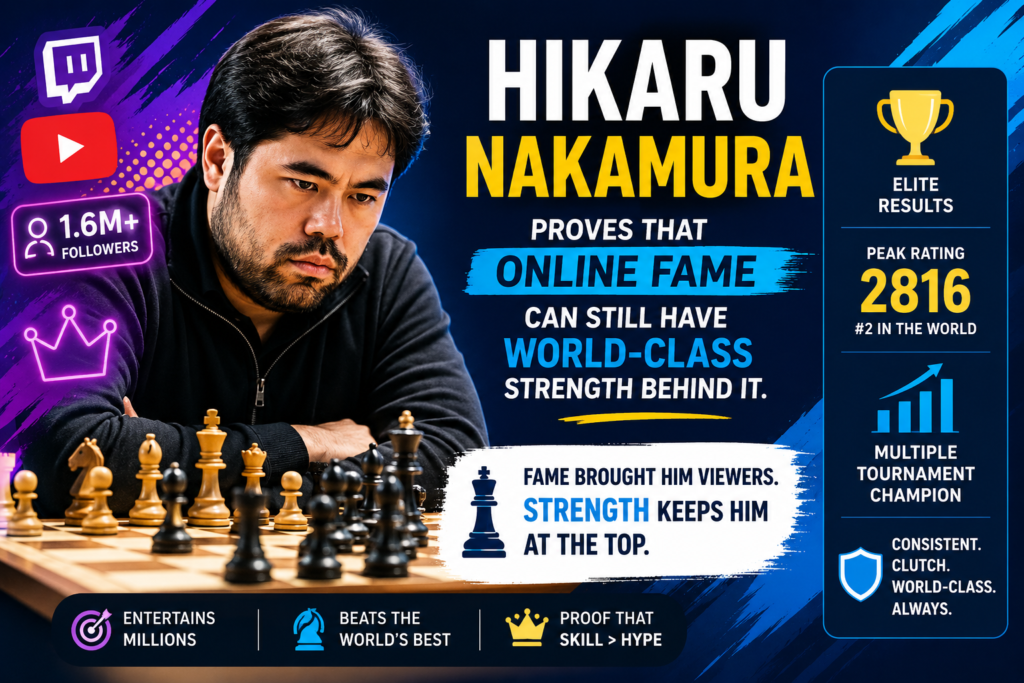
For many new players, Hikaru was not just a grandmaster. He was the person who made chess look alive on screen.
That kind of fame is very different from old chess fame. In the past, players became famous mostly through world championship matches, books, newspapers, and big tournaments. Today, a player can become known through streaming, short videos, online events, and daily content.
Hikaru used that world better than almost anyone.
ChessWatch reported that Hikaru “GMHikaru” Nakamura was the most-watched chess creator in Q1 2026, showing that his online reach is still huge.
Hikaru is not just a content creator who plays chess.
This is where many people get him wrong. Because Hikaru is so visible online, some casual fans may think of him first as a streamer. But his actual strength is elite. As mentioned earlier, the May 2026 FIDE list places him number two in classical chess with a 2792 rating. That puts him above almost every player on earth.
This makes Hikaru a strong example of “fame plus strength.” His popularity is not built only on jokes, clips, or speed. It is built on the fact that he can explain chess while also playing at a level most masters cannot dream of reaching.
For young players, the key lesson from Hikaru is speed with pattern skill. He can play fast because he has seen so many patterns before. He does not guess every move. His brain has trained for years to notice threats, tactics, weak squares, king danger, and endgame ideas quickly.
Kids should enjoy fast chess, but they should not only play fast chess.
This point is very important. Many children watch speed chess and want to play only blitz or bullet. Fast games are fun. They build sharp eyes. They help kids spot quick tactics. But if a child only plays fast chess, they may build bad habits.
They may move before thinking. They may win by tricks instead of real plans. They may stop checking for danger.
That is why Debsie coaches guide students through both fun play and slow thinking. A child can enjoy Hikaru’s fast games, but they should also learn how to pause, plan, and explain their moves. When a coach asks, “Why did you move that knight?” the child starts building real strength.
This is one of the best things about learning chess with a teacher. The coach slows the child down in the right moments. The child learns not just to move, but to think.
Parents who want their child to enjoy chess and also build strong thinking habits can try a free Debsie trial class here: https://debsie.com/take-a-free-chess-trial-class/
Fabiano Caruana is less loud online, but his strength is impossible to ignore.
Fabiano Caruana is a perfect example of why popularity does not always match pure strength. He is famous in serious chess circles, but he is not as loud online as some other names. He is calm, thoughtful, and deeply respected.

To a casual fan, he may not seem as visible as Magnus or Hikaru. But inside the chess world, everyone knows how dangerous he is.
Fabiano has been one of the strongest classical players of his generation. As of the May 2026 FIDE list, he is ranked number three in the world with a 2788 rating, just four points behind Hikaru Nakamura.
Find the right learning experience
Tell us a little about the learner and what you are looking for. Our team will review your answers and help you identify the most suitable next step.
- Takes only a few minutes
- No payment required
- Personalised recommendations
Your information will only be used to respond to your enquiry.
That is a tiny gap at the top level. It means Fabiano is not just “good.” He is still one of the best players alive.
Fabiano’s fame comes from depth, not noise.
Fabiano’s games often show deep preparation and clear thinking. He is known for being very hard to beat when he is in form. He can play sharp openings, but he can also grind quiet positions. His style may not always create the loudest clips, but it is a gold mine for students who want to learn serious chess.
For parents, Fabiano is a great player to show a child who enjoys careful thinking. Not every child is wild and fast. Some children like slow puzzles. Some like quiet plans. Some like to study and understand. Fabiano shows that calm minds can be powerful too.
That is a beautiful message for kids. They do not have to copy the loudest person. They can build their own style.
Strong chess often looks quiet before it looks brilliant.
This is one of the biggest lessons from Fabiano. Many young players think a great move must be flashy. They want queen sacrifices, checkmates, and big attacks. Those moments are fun, but many strong moves are quiet. A pawn move can stop a plan. A king move can save an endgame. A rook move can prepare pressure three moves later.
When kids learn this, their chess changes. They stop hunting only for tricks. They start seeing the board as a full story.
That is also how good coaching works. At Debsie, students are not rushed into fancy ideas before they understand the basics. They learn piece safety, threats, simple plans, king safety, tactics, and endgames step by step. This makes chess less scary and more joyful.
A famous player can inspire a child. But a good coach can turn that spark into real growth.
Gukesh Dommaraju shows how young fame can become serious strength.
Gukesh Dommaraju has become one of the most followed young chess players in the world, especially in India. His rise feels special because it gives young students a living example of what focus can do. He is not famous because he tries to be loud.
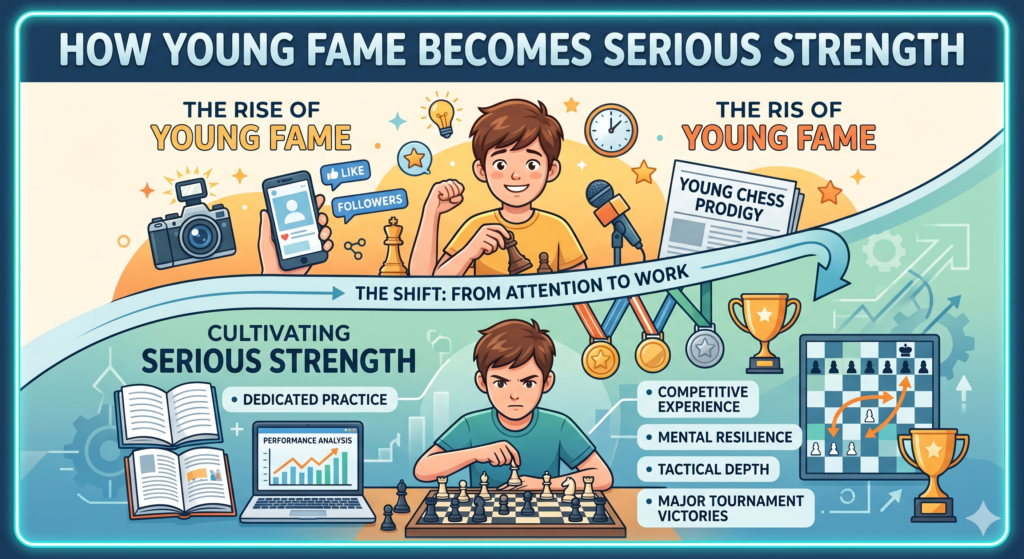
He is famous because his chess journey has been brave, serious, and full of pressure.
Gukesh is also the reigning world champion in 2026, and his title defense is expected against Javokhir Sindarov later in the year, according to current championship information.
Even though his May 2026 FIDE classical rating places him outside the top ten at number nineteen with 2732, his world champion status keeps him at the center of chess attention. This is a useful example of how fame and rating can tell different stories at the same time.
Gukesh is famous because people see his journey, not just his rating.
Many fans connect with Gukesh because he is young, serious, and easy to admire. He shows that chess is not only for adults with decades of experience. A teenager can sit across from legends and fight. That is powerful for kids to see.
But this also teaches a smart lesson. A player’s rating can move up and down. Fame can rise fast. News can change each week. What matters most is the long-term path. Gukesh’s story is about discipline, courage, and the ability to handle pressure at an age when most people are still learning who they are.
For students, this is inspiring but also grounding. They should not look at Gukesh and think, “I must become world champion fast.” That can create stress. A healthier thought is, “I can improve step by step. I can take my training seriously. I can learn from every game.”
Young players need dreams, but they also need a clear training path.
Dreams give energy. A child may dream of becoming a champion, winning a school event, beating a strong friend, or solving harder puzzles. But dreams need structure. Without structure, kids may jump from video to video and opening to opening without real growth.
That is where a program like Debsie helps. The child gets a path. They get live classes, coach feedback, practice games, and chances to test their skills. They learn how to think, not just what to memorize.
Gukesh’s rise can light the fire. Good training can keep that fire strong.
Anish Giri is famous because he makes smart chess feel friendly.
Anish Giri is one of the most interesting names in modern chess because his fame has many layers. Serious players respect his deep opening knowledge. Online fans enjoy his humor. Young players know him from interviews, short videos, funny posts, and clear chess lessons.
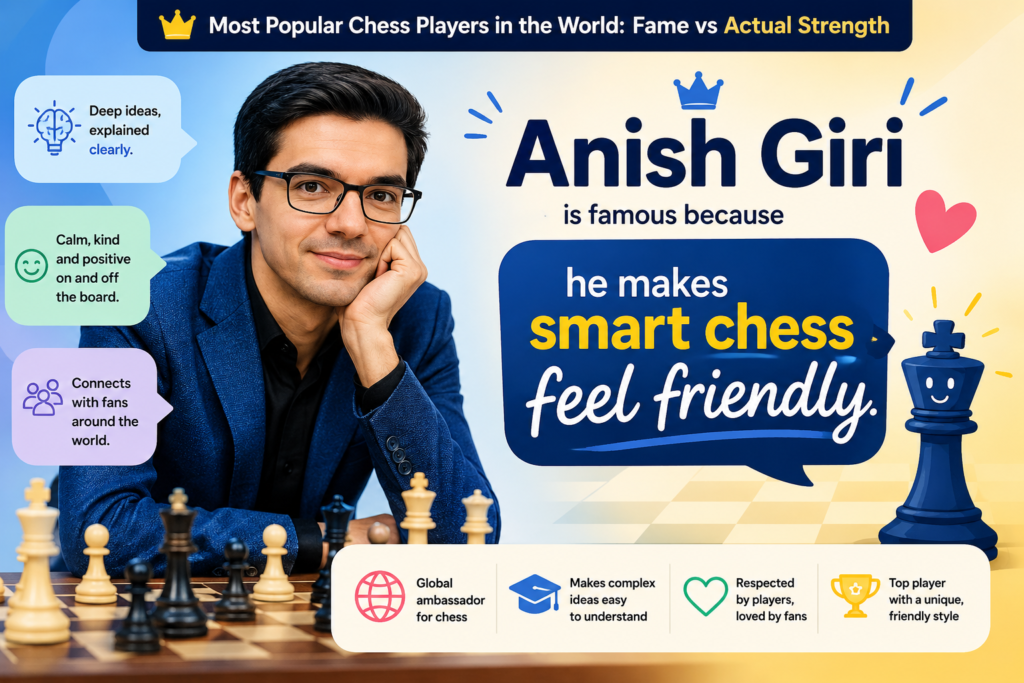
He is not only a strong grandmaster. He is also a chess voice people like to listen to.
That matters because chess can feel scary to beginners. Some players make the game look cold and hard. Anish often makes it feel warmer. He can explain ideas in a way that feels human. He can laugh at himself. He can talk about top-level chess without making new players feel small.
On the May 2026 FIDE classical rating list, Anish Giri is ranked number six in the world with a 2767 rating. That means his fame is not just from personality. It is backed by very serious strength.
Anish shows that being solid is not the same as being boring.
For years, some fans joked that Anish draws too much. But that joke misses the bigger truth. Drawing top players is not easy. Staying safe against the best attackers in the world takes skill. A strong draw can show deep understanding, strong defense, and smart risk control.
This is a great lesson for children. Many young players think every game must end with a big attack. They feel bad when they do not win quickly. But chess is not only about attack. It is also about safety, patience, and knowing when not to force things.
A child who learns from Anish can begin to ask better questions. Is my king safe? Is my pawn weak? Can my opponent attack me? Should I trade pieces or keep them? These questions help a child become calmer and sharper.
The real power is learning when to take risks and when to wait.
In chess, a bad risk can lose the game in one move. A good risk can create a chance to win. The hard part is knowing the difference. Anish is useful for students because his games often show care before action. He does not attack just because attacking feels fun. He prepares. He checks. He waits for the right moment.
This is also a life skill. Kids learn that patience is not weakness. Waiting is not fear. Sometimes the smartest move is not the loudest move.
At Debsie, students are taught to think before they jump. Coaches help them slow down, check threats, and build plans. That kind of training helps kids not only in chess, but also when they face tests, sports, music, or any hard problem.
If your child likes chess but needs a clear path, Debsie’s free trial class is a simple way to start: https://debsie.com/take-a-free-chess-trial-class/
Alireza Firouzja became famous because his games feel full of fire.
Alireza Firouzja is the kind of player who makes people sit up. His chess can feel fast, sharp, and full of energy. When he first rose to the top level, many fans saw him as the next big star. He was young, bold, and fearless. That is a strong mix for fame.

He is also a good example of how public attention can rise very fast when a player has a clear “story.” Fans love a young challenger. They love someone who can fight the biggest names. They love games where anything can happen. Alireza gave them all of that.
On the May 2026 FIDE classical rating list, Alireza Firouzja is ranked number eight in the world with a 2759 rating, tied on rating with Vincent Keymer but listed just behind him. That keeps him firmly among the strongest players in the world.
Alireza’s fame is built on energy, but his strength comes from skill.
It is easy to look at an attacking player and think they are just brave. But bravery alone is not enough at the top. If a player attacks without calculation, elite defenders will punish them. Alireza’s best games show more than courage.
They show speed, pattern memory, tactical vision, and the ability to put pressure on an opponent.
For young players, this is an important difference. A bold move is not always a good move. A sacrifice is not good because it looks cool. It is good only when it works or when it creates real problems that are hard to solve.
This is where kids need guidance. Many children watch attacking games and then start giving away pieces in their own games. They say, “I sacrificed!” But a real sacrifice has a reason. It opens a file. It weakens the king. It wins time. It starts a clear attack.
The Debsie lesson is to make brave moves with a clear reason.
A child should not be trained to fear risk. Chess becomes boring if a student is scared of every active move. But brave chess must be smart chess. Before giving up material, a child should ask what they get in return. Do they get checks? Do they get threats? Do they win back material? Is the opponent’s king truly unsafe?
These are simple questions, but they make a big difference.
Alireza is a great player for children who love action. His games can make a child excited to attack. But the deeper lesson is control. The best attackers are not wild. They are focused. They see more than the opponent sees.
That is why good chess coaching matters so much. A coach can take a child’s natural energy and turn it into skill. Instead of saying, “Do not attack,” the coach can say, “Attack with a plan.” That small change can help a child grow fast.
Praggnanandhaa is popular because young players see themselves in him.
Rameshbabu Praggnanandhaa, often called Pragg, is one of the most loved young chess players in the world. His fame is especially strong in India, but it also reaches far beyond one country. Many young students like him because he feels relatable.
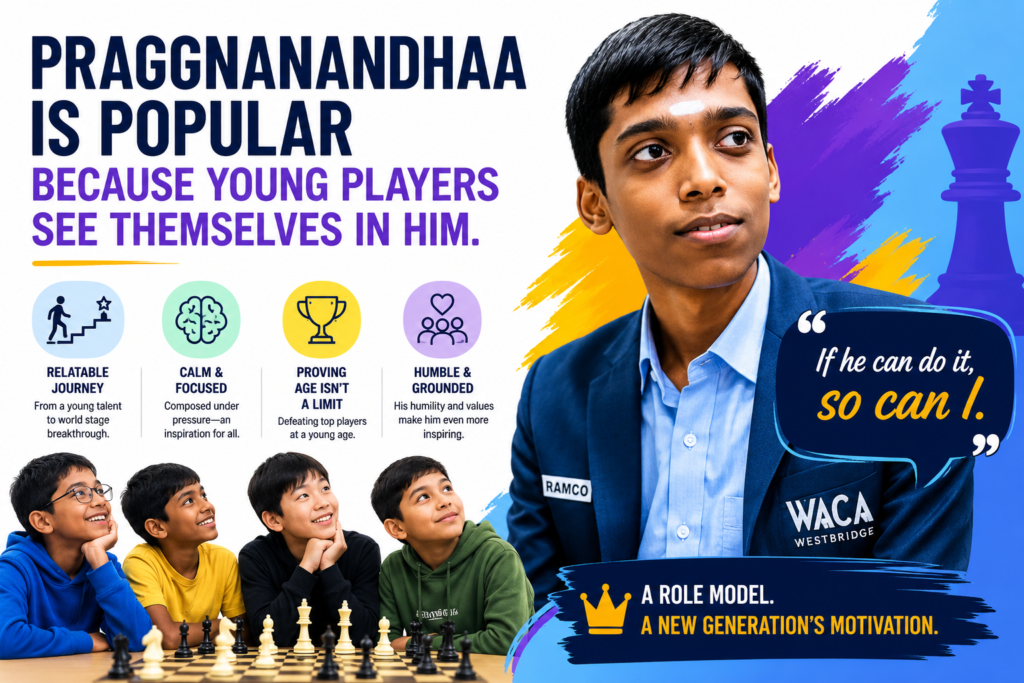
He is calm, respectful, and serious at the board. He does not need to act big to be impressive.
For parents, Pragg is a wonderful example because his rise feels steady and real. He shows that a young player can grow through hard work, family support, coaching, and tournament experience. He also shows that success does not need loud behavior. Quiet focus can become powerful.
On the May 2026 FIDE classical rating list, Praggnanandhaa is ranked number seventeen in the world with a 2733 rating. That places him among the elite players in the world, even in a very crowded field of young stars.
Pragg’s fame is not based on drama, but on trust.
Some players become popular because they create noise. Pragg became popular because fans trust his chess growth. They have watched him fight strong players, learn from hard games, and keep improving. That kind of fame is healthy for young students to see.
He reminds kids that progress is not always loud. Some months are full of wins. Some months are full of lessons.
Some games feel amazing. Some games hurt. But if a player keeps learning, the story keeps moving forward.
This is one of the most useful lessons in chess. Children often judge themselves too quickly. They may think one bad game means they are bad at chess. They may compare themselves with a friend and feel behind. But real growth is not a straight line. It has jumps, pauses, mistakes, and comeback moments.
Parents can use Pragg’s story to teach calm ambition.
Calm ambition means a child wants to improve, but does not panic. It means they care about results, but also care about learning. It means they dream big, but still do today’s work.
That is the best way for most kids to grow in chess. A child should not feel crushed by pressure. They should feel supported. They should know what to study next. They should learn how to review their games without shame.
At Debsie, this is a key part of the learning experience. Coaches help students see mistakes as clues. A missed tactic becomes a lesson. A lost endgame becomes practice. A weak opening becomes a plan for the next class.
Pragg’s popularity can inspire a child to dream. A strong learning system can help that child turn the dream into small daily steps.
Viswanathan Anand is proof that true chess fame can last for decades.
Viswanathan Anand is not just popular. He is deeply respected. For many chess fans, especially in India,
Anand is the player who made big dreams feel possible. Before India became a chess powerhouse, Anand showed that an Indian player could stand at the very top of world chess. That kind of impact does not fade quickly.

His fame is different from the fame of many modern players. It is not built mainly on streaming or short videos. It is built on history, world titles, grace, and influence. Generations of players grew up seeing Anand as the model of what a champion could be.
Even in May 2026, Anand is still listed at number thirteen in the world with a 2739 classical rating. For a player born in 1969, that is remarkable. It shows that his actual strength is still serious, not just historic.
Anand’s greatest gift may be the path he opened for others.
When one player from a country reaches the top, many children begin to believe. Parents start taking the game more seriously. Schools open chess clubs. Coaches appear. Tournaments grow. Media pays attention. One champion can change the whole chess culture around them.
That is part of Anand’s real fame. He did not only win games. He helped create belief.
This is why his story is powerful for young students. A child may not understand every move from Anand’s best games right away. But they can understand the bigger message. Start where you are. Keep learning. Stay humble. Let your work speak.
Anand teaches that class and strength can go together.
Some people think champions must be loud or hard. Anand showed another way. He has often been seen as calm, polite, and thoughtful. That matters for children because it teaches them that confidence does not need to become arrogance.
In chess class, this lesson is very important. Kids learn how to win with kindness and lose with respect. They learn to shake hands, listen, try again, and treat opponents well. These small habits help shape character.
At Debsie, chess is taught as both a thinking skill and a life skill. Children learn openings and tactics, yes. But they also learn patience, focus, fair play, and how to stay steady under pressure.
That is the real beauty of chess. A child starts by moving pieces. Then, slowly, they learn how to handle problems with a stronger mind.
Levy Rozman shows that a great teacher can become more famous than many grandmasters.
Levy Rozman, known online as GothamChess, is one of the clearest examples of fame and playing strength moving in different lanes.

He is very strong at chess, but he is not one of the top classical players in the world. Still, he may be more known to new chess fans than many super grandmasters. That is not an accident. He became famous because he made chess feel easy to enter.
Many people meet chess through confusion. They lose pieces, miss checkmate, and feel silly. Levy built his brand around turning that confusion into fun. His famous style is direct, fast, funny, and easy to follow. He does not talk like a dusty textbook.
He talks like a person sitting beside you saying, “Here is what went wrong, and here is how to fix it.”
His reach is huge. Social Blade showed GothamChess at about 7.47 million YouTube subscribers and more than 5 billion views in early May 2026. FIDE lists Levy as an International Master with a May 2026 standard rating of 2318, rapid rating of 2327, and blitz rating of 2366.
That is far above normal club level, but far below the 2700-plus world elite.
Levy’s real strength is making beginners feel seen.
This is where parents should pay close attention. A player does not need to be world number one to change a child’s chess life. Sometimes, the best first guide is someone who can explain mistakes in a way that makes the student want to try again.
Levy’s famous “Guess the Elo” style works because it shows common mistakes in a funny way. A beginner sees that other people hang queens too. A child learns that bad moves are not the end of the world. They are part of the road.
That matters because many kids quit chess not because chess is too hard, but because losing feels too personal. A warm teacher can keep the door open.
The danger is that fun learning can become shallow learning.
There is one thing young players must understand. Watching videos is not the same as training. A child can watch hours of chess and still make the same mistakes if they never stop to think, play slow games, review errors, and get feedback.
This is why Levy is best used as a spark, not as the full plan. His videos can make a child love chess. But love needs structure. A student still needs a coach to say, “You keep moving your queen too early,” or “You are attacking before your pieces are ready,” or “You missed your opponent’s threat.”
That is where Debsie helps. The goal is not to kill the fun. The goal is to turn fun into real skill. Kids learn in live classes, ask questions, play games, and get help from coaches who can spot their habits. That mix is powerful because the child stays excited while also building a real chess brain.
If your child already watches chess online, that is a good sign. It means the interest is there. A free Debsie trial class can help turn that interest into steady growth: https://debsie.com/take-a-free-chess-trial-class/
Alexandra Botez proves that chess fame can be built on energy, courage, and connection.
Alexandra Botez is one of the most famous women in online chess. Her fame is not only about rating. It is about presence. She helped make chess feel social, modern, and open to people who may have never joined a chess club.

Along with Andrea Botez, she built BotezLive into one of the biggest chess entertainment brands online.
This is important because chess used to look very serious from the outside. Many parents saw it as quiet, hard, and maybe even lonely. The Botez sisters helped change that image. Their content made chess look like something friends could enjoy together.
There was laughter, time pressure, travel, challenges, mistakes, wins, losses, and real emotion.
The numbers show the reach. SpeakRJ listed BotezLive at about 1.97 million YouTube subscribers and 1.2 billion views on May 2, 2026.
Alexandra’s FIDE profile lists her May 2026 standard rating as 2044 inactive and blitz rating as 2066 inactive, while Chess.com lists her as a Woman FIDE Master and describes BotezLive as one of the biggest chess channels on Twitch and YouTube.
Alexandra’s fame is stronger than her current over-the-board rating.
This is not an insult. It is the whole point of this article. Fame can come from more than being a top tournament player. Alexandra is strong enough to teach many beginners and casual players, but she is not near the level of Magnus, Hikaru, Fabiano, or Gukesh.
Yet her impact is real. She brought many people into chess who may not have cared about elite tournaments. She showed that chess can be exciting even when the players are laughing, talking, or making mistakes under pressure.
For kids, this can be very helpful. Some children are scared of chess because they think every game must be perfect. Seeing strong players make human mistakes can make the game feel less cold. It reminds children that improvement starts with playing, not with being perfect.
The Debsie lesson is to enjoy chess without losing respect for the game.
Fun is good. Energy is good. Online chess can be a wonderful doorway. But children also need to learn the deeper side of the game. They need to know when to slow down. They need to learn how to win with grace and lose without anger. They need to understand that chess is not only about tricks, traps, and reactions.
Alexandra’s rise is a good lesson for students who love social learning. Some kids enjoy learning with others. They like class energy. They like tournaments. They like sharing wins with friends. That is not a weakness. It can be a strength when guided well.
Debsie’s live classes give children that healthy mix. They get the joy of learning with others and the care of trained coaches. They get chances to speak, think, play, and improve. This helps chess become more than a screen habit. It becomes a skill-building journey.
For parents, the key is simple. Let your child enjoy popular chess creators, but also give them a real path. Fun gets them started. Coaching helps them grow.
Anna Cramling shows how kindness and family warmth can make chess more welcoming.
Anna Cramling is popular for a very special reason. She makes chess feel warm. Her videos often feel friendly, curious, and human. She can play serious games, but she also shows emotion, nerves, joy, and learning moments. For many young players, that makes her easy to connect with.
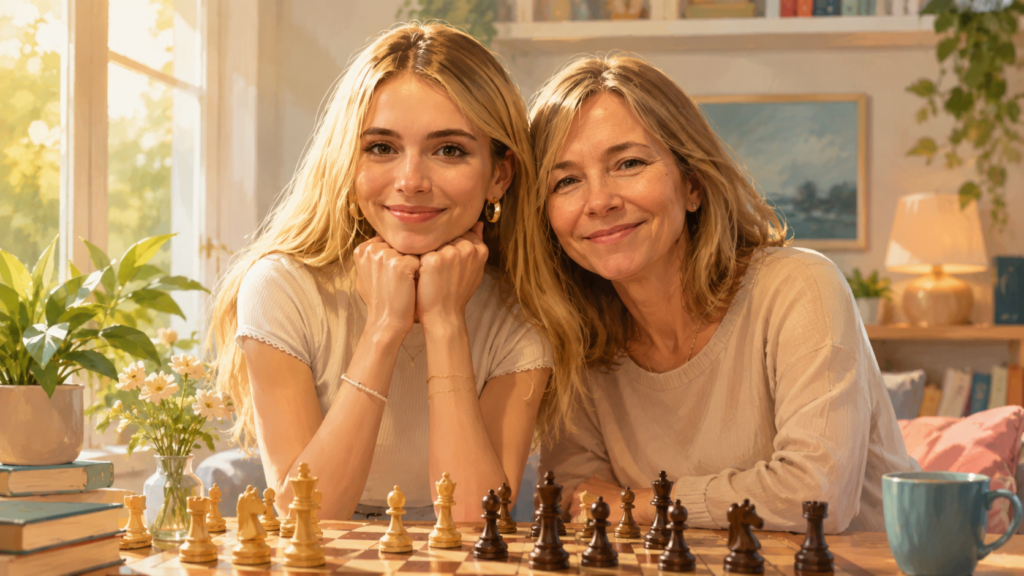
Anna also has a strong chess family story. Chess.com notes that she is the daughter of grandmasters Pia Cramling and Juan Manuel Bellon Lopez. Her mother, Pia, is one of the great names in women’s chess, and that family link gives Anna’s content a rich chess background.
But Anna’s fame is not only because of her parents. She has built her own voice as a streamer, commentator, and chess creator.
Her reach is large. SpeakRJ showed Anna Cramling’s YouTube channel at about 1.66 million subscribers and 847.6 million views on May 7, 2026. FIDE lists her as a Woman FIDE Master with a May 2026 standard rating of 2083, rapid rating of 2047, and blitz rating of 2011.
Anna’s popularity comes from trust, not only from wins.
Some creators become famous by acting larger than life. Anna’s strength is different. She often feels honest on camera. When she is nervous, viewers can see it. When she is happy, they can feel it. When a game goes wrong, it does not feel fake. That kind of honesty can help children understand that even strong players have emotions during chess.
This is a big deal. Many kids think strong players never feel afraid. That is not true. Strong players feel pressure too. The difference is that they learn how to keep thinking while those feelings are there.
Anna’s content can help students see that chess courage does not mean having no fear. It means playing, thinking, and learning anyway.
Parents can use Anna’s example to help kids handle chess pressure.
A child may cry after a loss. A child may get angry after missing a checkmate. A child may feel shy when playing in front of others. These moments are not signs that chess is bad for the child. They are chances to build emotional strength.
But the child needs support. If a parent says, “Why did you lose?” the child may close down. If a coach says, “Let us find the moment where the game changed,” the child starts learning. That small shift matters.
At Debsie, coaches help kids review mistakes in a safe way. They do not make the child feel small. They guide the child to see what happened and what to try next. That helps children become stronger not only on the board, but also in how they handle hard moments.
Anna’s popularity shows that chess does not have to be cold to be serious. It can be kind, brave, and full of heart. That is exactly the kind of chess many children need when they are starting out.
Daniel Naroditsky showed that a great chess teacher can stay loved forever.
Daniel Naroditsky, known to many fans as Danya, was one of the most loved chess teachers of the online age. His fame was not built on loud drama. It was built on trust. When he explained a position, people listened because he made hard chess feel clear, calm, and human.
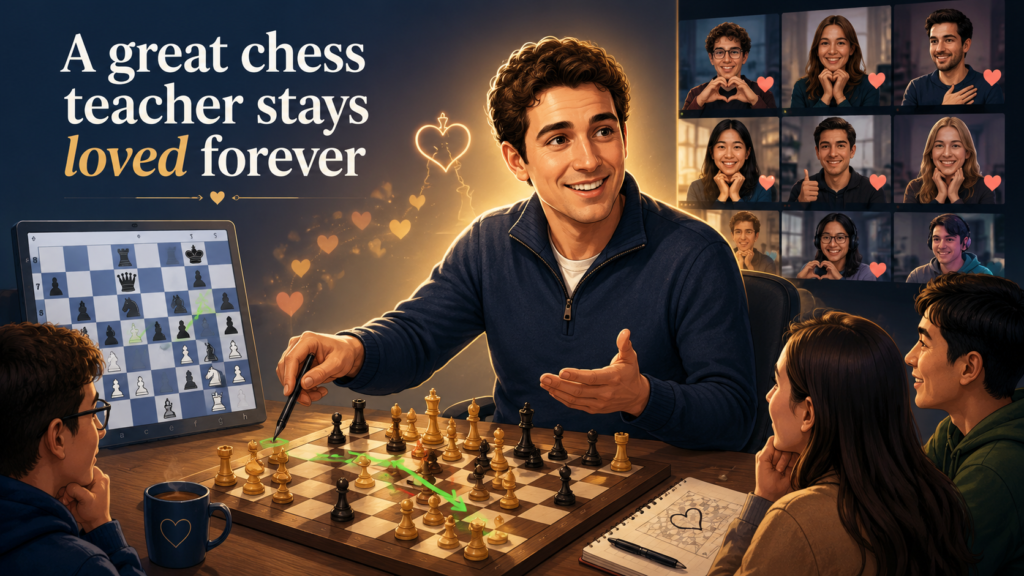
He was also not just a teacher who happened to play chess. He was a grandmaster, author, commentator, coach, and strong speed chess player. FIDE described him as a prominent grandmaster, author, coach, and streamer whose influence reached far beyond the board.
He died in October 2025, just before his 30th birthday, which made the chess world feel a deep and public loss.
For many students, Danya’s lessons still feel special because he did not only say what the move was. He explained why the move made sense.
Danya’s fame came from the way he helped people think.
Some teachers make students feel small. Danya did the opposite. He could look at a beginner game and still find a kind way to teach. He did not need to mock the player. He would explain the idea, show the better plan, and help the viewer understand the position one step at a time.
That is why his popularity was different from pure entertainment fame. People did not only watch him because he was fast or funny, though he could be both. They watched because they felt smarter after listening.
His actual playing strength was also very real. US Chess called him a former World Junior Champion and a talented chess player, commentator, and educator admired around the world. His online speed chess was especially strong, and his lessons carried the weight of someone who had played serious chess at a high level.
The lesson for kids is that clear thinking beats rushed thinking.
Danya’s best teaching reminds young players to slow the game down in their mind. Even in fast chess, he often explained the simple reason behind a move. He looked for checks, captures, threats, weak squares, and king safety. He showed that strong chess is not magic. It is a set of good habits repeated many times.
This is very important for children. A child may think, “I am not gifted enough.” But when they learn step by step, chess becomes less scary. They begin to see patterns. They stop moving pieces for no reason. They learn to ask, “What is my opponent trying to do?”
At Debsie, this same idea is part of every good lesson. Kids do not need to memorize a thousand lines to start improving. They need a coach who helps them build strong thinking habits. They need kind correction, useful practice, and the confidence to try again after mistakes.
That is why a free Debsie trial class can be such a good first step for a child who enjoys chess videos but needs real guidance.
Judit Polgar is proof that real strength can break old ideas.
Judit Polgar is one of the most important chess players in history. Her fame is not only about being popular. It is about changing what people believed was possible. For many years, some people spoke about women’s chess as if there was a fixed limit.
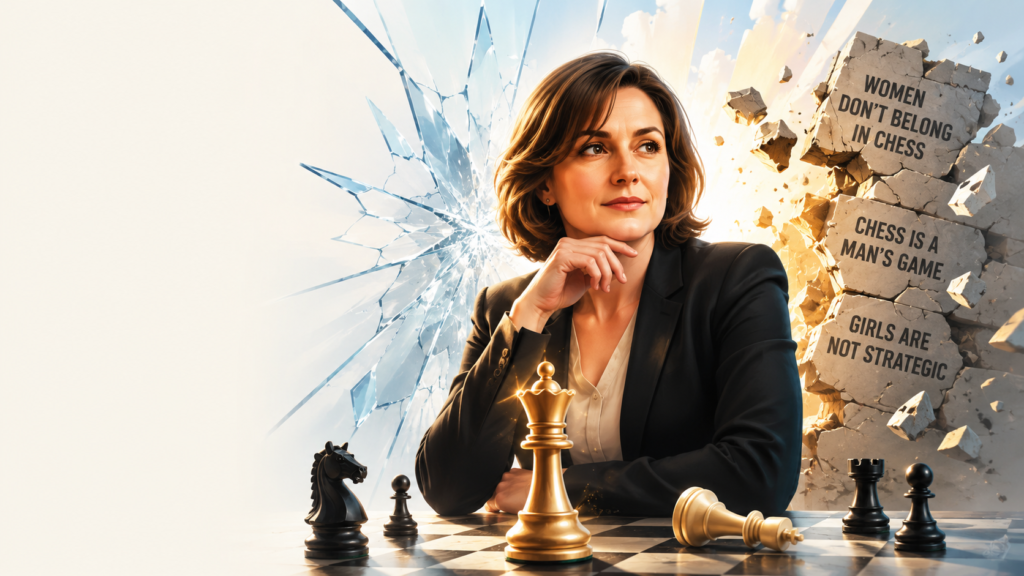
Judit broke that idea by competing directly with the strongest players in the world.
She did not build her name by staying in a smaller box. She played elite open events and fought world champions. Her games were sharp, brave, and full of energy. She became a symbol of serious strength, not only a symbol of women’s chess.
FIDE lists Judit Polgar as a grandmaster with inactive ratings of 2675 in standard chess, 2646 in rapid, and 2736 in blitz. Those numbers still show how strong her level was, even though she is no longer an active elite tournament player.
Judit’s fame is backed by a level few players ever reach.
Some famous players are loved more for content than competition. Judit’s fame is different. Her strongest claim is simple: she played at the very top. She was not just “strong for a woman.” She was strong, full stop.
2700chess notes that she reached a peak rating of 2735 and a peak ranking of number eight in the world in 2005. It also describes her as the top-rated female player for more than 26 years before becoming inactive after retirement.
That is why her place in this article is so important. She helps us see that actual strength can create a kind of fame that lasts long after a player stops playing full-time. Trends change. Platforms change. But real achievement stays.
The lesson for young players is to ignore small labels and build big skills.
Judit’s story is powerful for girls, but it is also powerful for boys. The lesson is not only about gender. It is about refusing to accept a small view of yourself.
A child may hear, “You are too young.” Another may hear, “You started too late.” Another may think, “Other kids are better than me.” Chess teaches children to push past these thoughts with action. Study one idea. Solve one puzzle. Review one game. Play one better move than last time.
That is how strength grows.
At Debsie, this matters deeply. Kids are not treated like fixed talents. They are treated like growing thinkers. A shy child can learn to speak through moves. A restless child can learn focus. A careful child can learn courage. A child who loses often can learn how to come back.
Judit Polgar’s career reminds parents of something simple but powerful. Children do not need smaller dreams. They need better support, better habits, and a place where effort is seen.
Eric Rosen became popular by making quiet chess feel exciting.
Eric Rosen is not the loudest chess creator, and that is part of his charm. His style is calm, friendly, and often very instructive. He can make a tricky trap feel simple. He can show a quiet endgame idea without making it dry. Many fans like him because his videos feel peaceful, but still full of chess value.

This kind of popularity matters because not every child learns well from high energy content. Some children get tired by shouting, fast cuts, and constant jokes. They need a slower voice. They need time to see the move. They need a teacher who sounds patient. Eric’s style fits that kind of learner very well.
FIDE lists Eric Rosen as an International Master from the United States, with a standard rating of 2377, rapid rating of 2348 inactive, and blitz rating of 2327. His own website describes him as an International Master, chess player, educator, and multimedia creator.
Eric’s fame is larger than his place in the world rankings.
This is another clear fame-versus-strength example. Eric is a very strong player compared with almost everyone who plays chess. Most club players would find his level extremely hard to face. But he is not a super grandmaster fighting for the world title.
Still, his impact is big because he teaches in a way people enjoy. He is known for opening ideas, traps, calm explanations, and instructive games. His fame shows that chess popularity is not only about being number one. It can also come from helping thousands of people enjoy the game more.
That is useful for parents to understand. A child may learn best from a player who is not the highest-rated person in the world. The best learning voice is often the one that helps the child stay curious.
The lesson for kids is that style matters, but basics matter more.
Eric’s content can make openings feel fun. Many students discover traps and clever ideas from watching creators like him. That can be a great doorway into chess. But students should be careful not to turn chess into trap hunting only.
A trap works best when the other person makes the wrong move. Strong players do not always fall for tricks. So children must also learn piece development, king safety, center control, tactics, and endgames. Those basics may sound less exciting, but they are what make the tricks stronger too.
This is where Debsie can help a lot. A coach can take a child’s love for clever ideas and connect it to real chess rules. Instead of only saying, “Try this trap,” the coach can explain why the move works, when it fails, and what plan to use if the opponent defends.
That is how a child becomes more than a player who knows tricks. They become a thinker.
And when children become better thinkers, parents often see the change beyond chess. They focus longer. They check their work more carefully. They handle mistakes with more patience. That is the true win.
The biggest mistake is thinking popularity tells the full chess story.
By now, the pattern is clear. Some players are famous because they win world titles. Some are famous because they explain chess well. Some are famous because they stream, teach, entertain, inspire, or represent a dream for millions of fans.
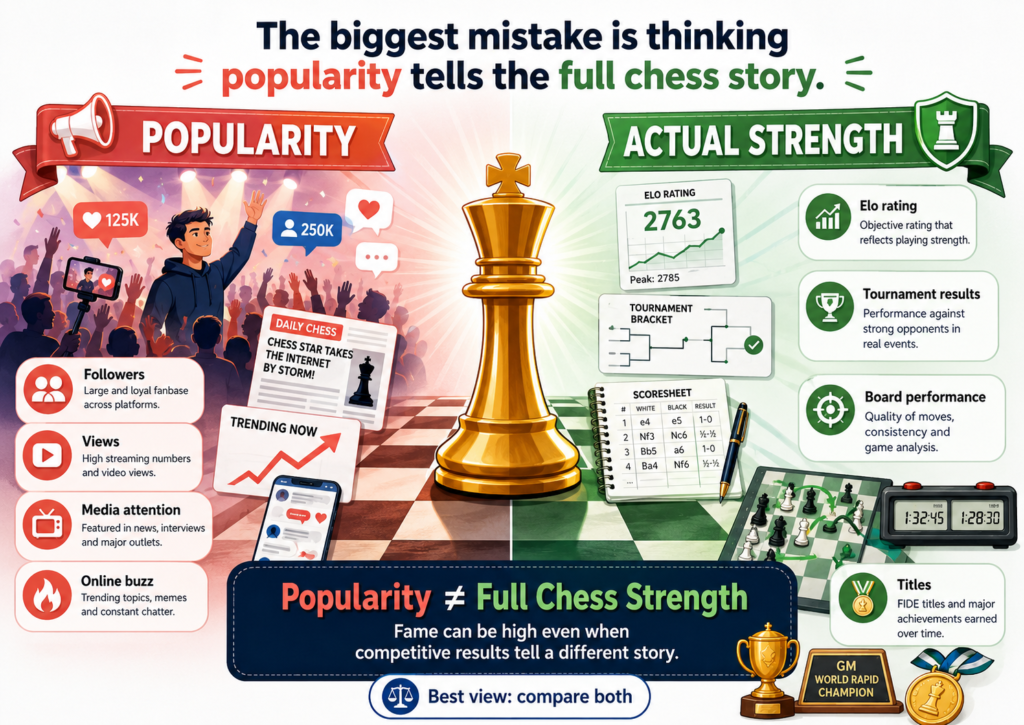
All of these forms of fame can be real. But they are not the same as actual playing strength.
This matters because young players are easily influenced. A child may see a famous creator play a risky opening and copy it in every game. A student may watch bullet chess and start moving too fast. Another child may see a world champion’s deep move and try to copy the idea without understanding the reason.
Fame can open the door. But training decides how far the child goes.
The smart way to follow famous chess players is to ask better questions.
When a child watches Magnus, they can ask how he keeps pressure in equal positions. When they watch Hikaru, they can ask how patterns help fast play. When they watch Judit, they can ask how courage and skill work together.
When they watch Levy, Anna, Alexandra, Eric, or Danya, they can ask why clear teaching makes chess easier to love.
That one change turns passive watching into active learning.
A child should not only ask, “Who won?” A better question is, “What changed the game?” They should not only ask, “Was that move cool?” A better question is, “What problem did that move solve?” This is how students begin to think like real chess players.
Debsie helps kids turn chess inspiration into steady growth.
The internet is full of chess content. That is good, but it can also confuse families. One video says play this opening. Another says avoid it. One creator says attack. Another says defend. A child can jump from idea to idea and still not know what to study next.
Debsie gives that interest a path. Students learn through live classes, coach support, practice, and guided thinking. They do not just watch chess. They learn how to play better chess. They build focus, patience, planning, and confidence.
So yes, let your child enjoy famous chess players. Let them be inspired by big names, fun videos, and amazing games. But do not stop there. Give them the support to grow from fan to thinker.
Book a free Debsie trial class on Debsie’s trial page and help your child start learning chess the smart way.
Ding Liren shows that quiet fame can still carry world champion weight.
Ding Liren is not the loudest name in chess media, but his fame is deep because he reached the highest title in the game. For a time, he was the player every serious fan had to talk about because he became world champion and carried a huge amount of pressure with quiet grace.
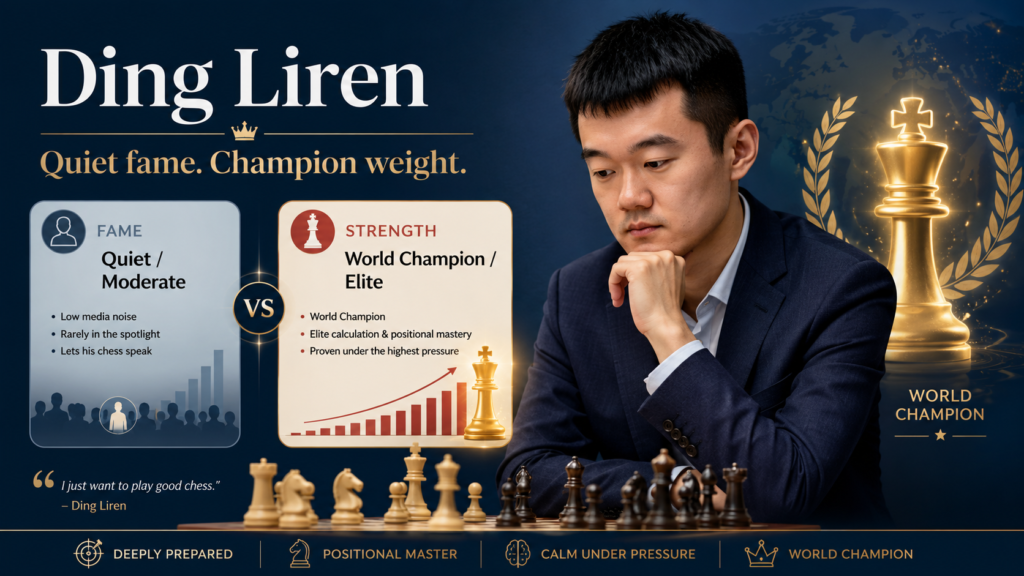
His story is not built on noise. It is built on emotion, patience, and a very human kind of strength.
As of the May 2026 FIDE classical rating list, Ding is ranked number fifteen in the world with a rating of 2738. That means he is no longer at the very top of the rating table, but he is still far inside the elite group of players who can beat almost anyone on a good day.
The same list has Magnus Carlsen at number one with 2840, which shows the gap between current rating strength and title-based fame.
Ding became famous because his world title story felt deeply human.
Ding’s fame is different from Hikaru’s online fame or Magnus’s long-term number one fame. Many fans remember him for the pressure of championship chess and the emotional weight around his biggest moments. He showed that even world champions are not machines. They think, doubt, fight, recover, and carry stress.
That is a very helpful lesson for kids. A child may believe strong players never feel nervous. Ding’s story shows the opposite. Being strong does not mean you never feel pressure. It means you keep looking for good moves even when your heart is racing.
Children should learn that calm chess is not weak chess.
Some players win by looking fierce. Ding often showed a softer kind of strength. His calm style teaches children that they do not need to act loud to be strong. A child can be quiet, gentle, and still become a serious thinker at the board.
This matters a lot in coaching. Some kids are shy and do not speak much in class. Parents may worry that the child is not confident. But chess confidence does not always look like big words. Sometimes it looks like a child sitting quietly, checking threats, and making one careful move after another.
At Debsie, coaches help children grow in their own style. A bold child learns control. A quiet child learns confidence. A fast child learns patience. A careful child learns when to act. That is how chess becomes personal, not forced.
Ding’s journey reminds us that fame is not always bright and loud. Sometimes fame comes from carrying pressure with honesty and still showing up to play.
Ian Nepomniachtchi is popular because his speed and match history made him impossible to ignore.
Ian Nepomniachtchi, often called Nepo, is one of the most famous modern chess players because he has been close to the world title more than once. Chess.com describes him as a Russian super grandmaster and a two-time FIDE World Championship finalist in 2021 and 2023.
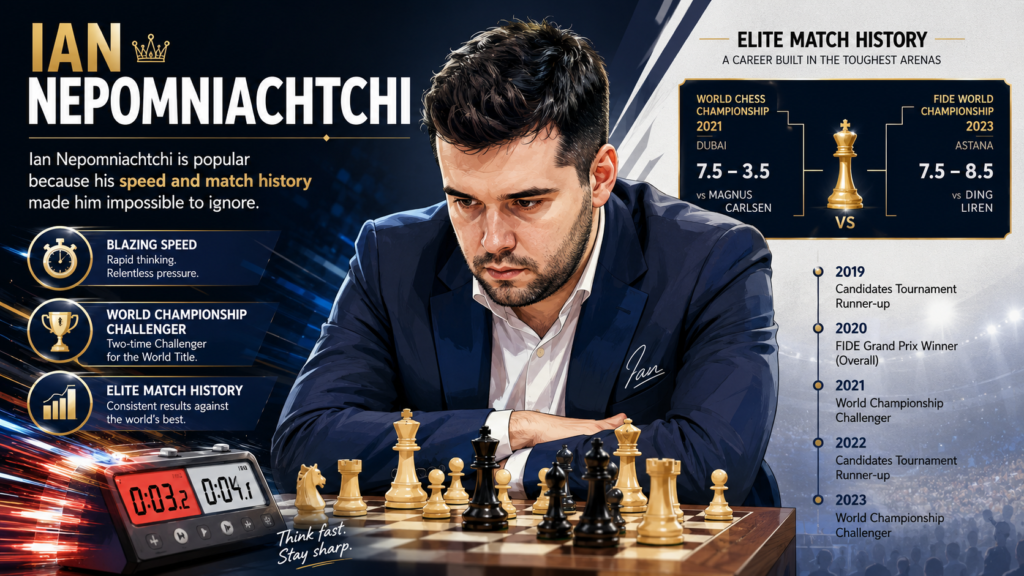
That alone makes him one of the most important chess names of the last several years.
His current rating also shows that he is still very strong. On the May 2026 FIDE classical list, Nepomniachtchi is ranked number twenty-one with a rating of 2729. That puts him below the very top five right now, but still inside the world elite.
Nepo’s fame comes from big moments under bright lights.
World championship matches create a special kind of fame. Even people who do not follow every tournament may hear about the players fighting for the crown. Nepo became a central name because he played on that stage twice.
That type of pressure is hard to understand unless a student has felt tournament nerves, even on a small level.
His style also helps his fame. Nepo can play very fast and very naturally. He often finds active moves quickly. That makes him exciting to watch because his games can feel like they move with speed and danger.
But fast play can be risky. A quick move can be brilliant, but it can also miss something. That is why Nepo is such a good player to study with care. Children can learn both the beauty and the danger of speed.
Young players should not confuse quick moves with easy moves.
When a top player moves fast, it may look simple. A child may think, “He saw it right away, so I should also move right away.” But that is the wrong lesson. Elite players move fast because they have studied for years. They know patterns, openings, tactics, and endgames at a deep level.
For a beginner or young student, moving too fast often means skipping the most important question: what does my opponent want?
This is why Debsie coaches often help kids slow down at key moments. They teach children to check for threats before chasing their own plan. They help them build a thinking routine. That routine can be simple, but it changes everything.
A child who learns to pause before moving builds more than chess skill. They build self-control. That self-control helps with schoolwork, tests, sports, and daily choices too.
Nodirbek Abdusattorov and Javokhir Sindarov show that future stars may already be stronger than many famous names.
Some chess players are world-famous with casual fans. Others are not yet household names, but their strength is already frightening. Nodirbek Abdusattorov and Javokhir Sindarov are perfect examples.
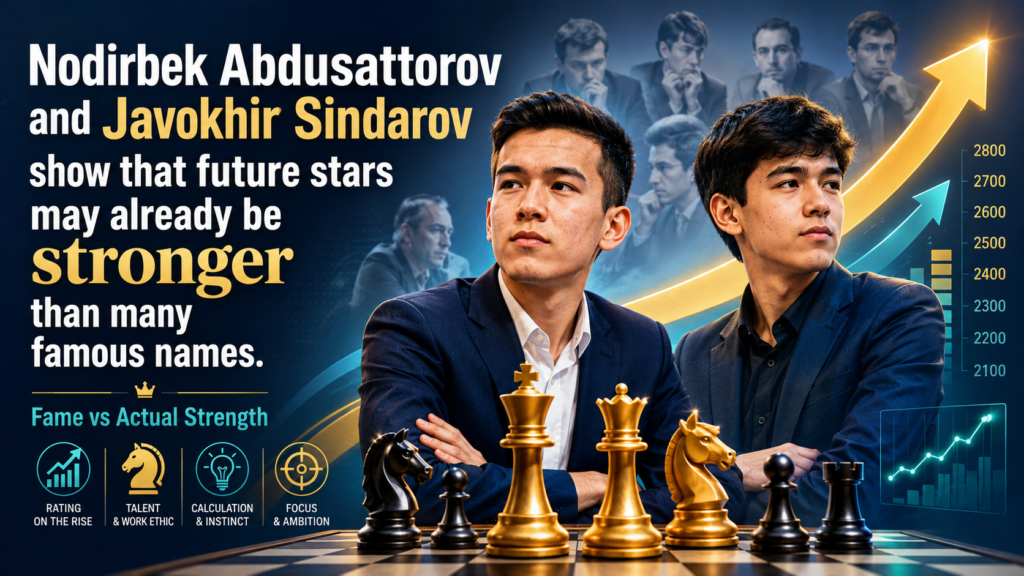
Many new chess fans may not know them as well as Magnus, Hikaru, Levy, or the Botez sisters. But in terms of current elite strength, they are among the most serious players in the world.
The May 2026 FIDE list ranks Abdusattorov at number four with a 2780 rating and Sindarov at number five with a 2776 rating. That places both Uzbek grandmasters ahead of many better-known names in the wider chess world.
Their fame is growing because results are forcing people to pay attention.
Chess.com reported that Sindarov rose to world number five after winning the 2026 FIDE Candidates Tournament, while Abdusattorov was already Uzbekistan’s number one player. The same report also noted a wider youth wave, including 14-year-old Yağız Kaan Erdoğmuş breaking 2700.
That tells us something big is happening in chess right now: young players are not waiting politely at the door. They are already entering the top rooms.
This is very exciting for students. It shows that chess is alive and changing. The next great champion may not be the most famous person on social media today. The next great champion may be someone quietly training, playing strong events, and improving month by month.
Kids should follow results, not only follower counts.
Follower counts are easy to see. Ratings and tournament results take more effort to understand. But if a child wants to get better, they should learn to respect both. A creator with millions of fans can be a wonderful teacher. A quiet top-ten grandmaster can be a wonderful model for serious play.
This helps children build a healthy view of success. Popularity is not bad. Fame is not fake. But real strength has to be tested over the board.
At Debsie, students are taught to love chess and respect the work behind it. They can enjoy fun creators, but they also learn why tournament games, slow thinking, and game review matter so much. That balance keeps chess joyful and serious at the same time.
For a parent, this is a useful filter. Ask not only, “Who does my child watch?” Ask, “What is my child learning from that player?” That one question can turn screen time into smart chess growth.
Hans Niemann proves that attention can make a player famous before the chess world fully agrees on his place.
Hans Niemann is one of the most talked-about chess players of this era. His fame is huge, but it did not grow in the same way as Magnus Carlsen’s fame or Viswanathan Anand’s fame.
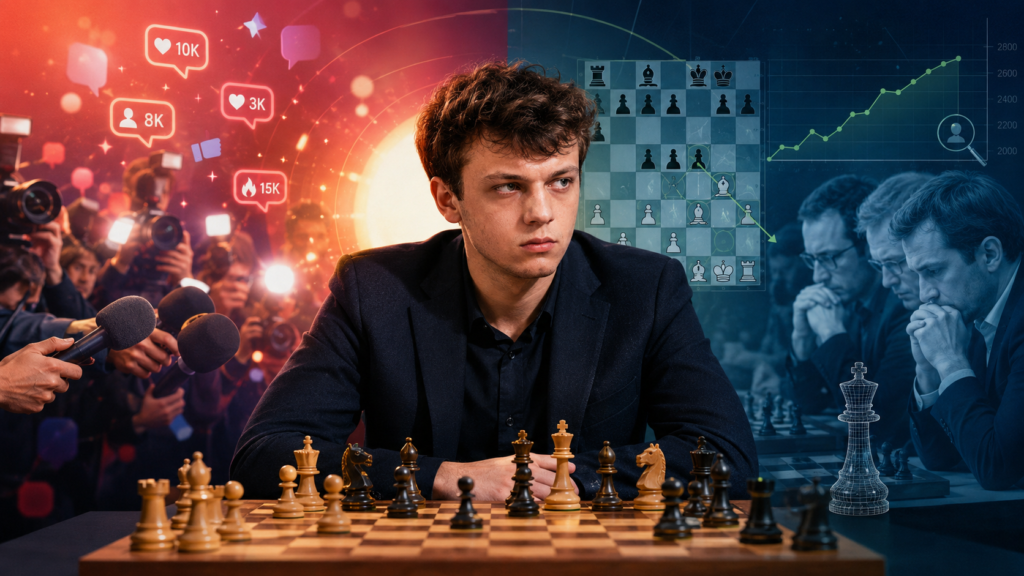
Hans became widely known through strong results, streaming, public debate, and media attention. That makes him a clear example of how chess popularity can be shaped by more than just rating.
Still, his playing strength is very real. The May 2026 FIDE list ranks Hans Niemann number twelve in the world with a 2742 classical rating. Chess.com describes him as an American chess grandmaster and streamer, and also notes that he is featured in Netflix’s “Untold: Chess Mates.”
Hans is famous because people are watching the story as much as the games.
Some players become famous because fans love their style. Some become famous because they win titles. Hans became famous partly because people wanted to know what would happen next. That kind of attention can be powerful, but it can also be tricky for young fans.
Children may see the drama and miss the work. But behind every 2700-level player is serious skill. A player does not reach number twelve in the world by accident. At that level, even one small mistake can lose a game, and every opponent is deeply prepared.
The smart way to study Hans is not to copy the noise around him. It is to study the chess. What openings does he choose? How does he handle pressure? How does he create winning chances? Those are useful questions.
Young players should learn from the board, not from the drama around the board.
Chess drama can pull attention, but it does not always build skill. If a child spends more time following arguments than studying games, their chess will not grow much. The better path is to ask what the position teaches.
This is a key lesson for parents. It is fine for kids to know the big chess stories. But the real learning happens when they solve puzzles, review their own games, and understand why strong players make certain moves.
Debsie helps children keep that focus. Coaches bring the attention back to thinking, planning, and good habits. The child learns that chess is not about shouting the loudest. It is about finding the best move with a calm mind.
Book a free Debsie trial class if your child enjoys chess stories but needs a real learning path: https://debsie.com/take-a-free-chess-trial-class/
Conclusion
Chess fame can make us notice a player, but real strength shows what that player can do when the board gets hard. The best lesson for kids is not to worship names, but to study habits: patience, focus, planning, courage, and calm thinking.
Some stars inspire with titles, some with teaching, and some with joy. But your child grows most when inspiration becomes guided practice. That is what Debsie helps children do through caring coaches and smart lessons. Let chess build skill, confidence, and character. Start with a free Debsie trial class here: https://debsie.com/take-a-free-chess-trial-class/

Adhip Ray is the founder of Debsie, an online learning platform focused on chess and skill-based learning for children. His work at Debsie brings together chess education, structured thinking, problem-solving, and interactive learning for young students.
Adhip has an academic background in law, statistics, analytics, and technology. He is from Amity Law School and the Indian Statistical Institute, Kolkata, with formal training that connects legal reasoning, data analytics, quantitative thinking, and structured problem-solving. This interdisciplinary background is reflected in Debsie’s focus on building sharper thinking skills in children through chess and related learning programs.
Adhip is also a FIDE-rated chess player from India. He holds FIDE ID 5055954 and has a standard FIDE rating of 1832. His FIDE profile records him as an Indian player with a long rating history in standard chess, including rated games from his competitive playing years. His chess background gives Debsie a founder-led connection to the game, not only as an educational activity but also as a competitive discipline that develops concentration, calculation, planning, and decision-making.
In addition to chess, Adhip has a strong interest in coding, data, and technical problem-solving.
Adhip’s profile combines chess, law, data analytics, and programming. At Debsie, this background supports the creation of learning experiences that are logical, structured, and skill-oriented. The platform’s chess-focused programs are connected to broader cognitive skills such as pattern recognition, patience, strategic planning, focus, and problem-solving.
As founder of Debsie, Adhip brings together experience from multiple fields: formal legal education from Amity Law School, analytical training from the Indian Statistical Institute, Kolkata, competitive chess experience through his FIDE-rated profile, and coding practice through LeetCode. This combination gives Debsie a distinct foundation in strategy, reasoning, analytics, and child-focused learning.
Through Debsie, Adhip is associated with building chess and learning content for children that goes beyond basic instruction. The platform connects chess with thinking skills, helping students approach challenges with more structure, clarity, and confidence. His own background in chess and analytical problem-solving gives the platform a direct link to the skills it aims to develop in young learners.
Adhip is also a member of Forbes Business Council.