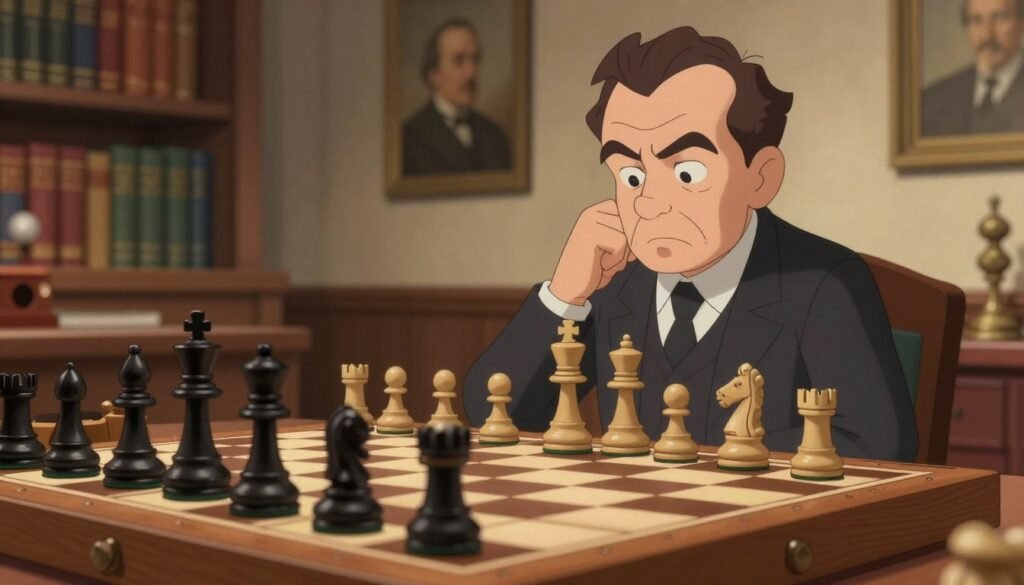
\Akiba Rubinstein did not play chess to show off. He played to squeeze small edges until they became wins. He was one of the strongest players in the world in the early 1900s, and many chess historians still see him as one of the greatest players who never became World Champion. In 1912, he had a golden year, winning several major events, and a match with World Champion Emanuel Lasker looked possible before World War I changed everything.
Find the right learning experience
Tell us a little about the learner and what you are looking for. Our team will review your answers and help you identify the most suitable next step.
- Takes only a few minutes
- No payment required
- Personalised recommendations
Your information will only be used to respond to your enquiry.
Rubinstein shows us that the endgame does not begin at the end.
Most new players think the endgame starts when queens leave the board. Rubinstein did not think that way. For him, the endgame began much earlier. It began when he chose his opening. It began when he moved a pawn. It began when he traded one bishop for one knight.
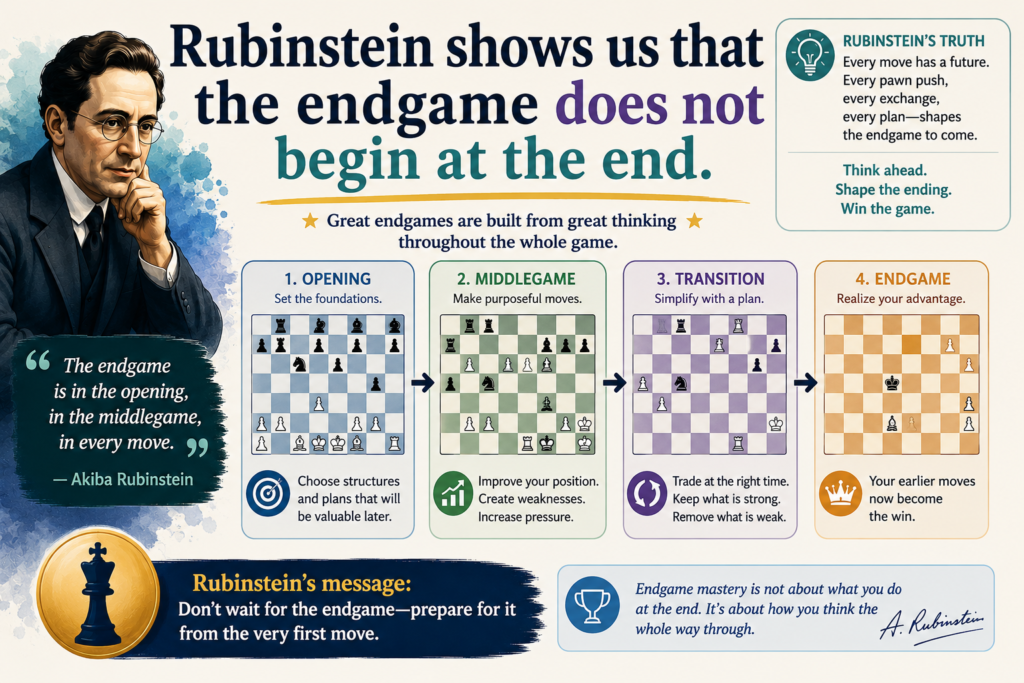
Every small choice had a future purpose. That is one big reason he became known as a master of rook and pawn endgames, and why many chess lovers still study his games today. The World Chess Hall of Fame notes that Rubinstein is remembered for his deep opening ideas and his great skill in rook and pawn endings.
The best Rubinstein moves often look too quiet at first.
A Rubinstein move may not scare you right away. It may not give check. It may not attack the queen. It may not win a piece. But it can do something more serious. It can make the opponent’s next ten moves harder. That is the kind of move young players often miss, because they are looking for something loud.
When a child learns chess, this lesson matters a lot. The child learns that smart work is not always noisy. A good move can be calm. A good plan can take time. This is one reason chess is so good for focus and patience.
At Debsie, coaches help students slow down, look deeper, and ask the right question before touching a piece.
Find the right learning experience
Tell us a little about the learner and what you are looking for. Our team will review your answers and help you identify the most suitable next step.
- Takes only a few minutes
- No payment required
- Personalised recommendations
Your information will only be used to respond to your enquiry.
The invisible move is often the move that makes every later move easy.
Here is the simple idea. Rubinstein did not just ask, “What can I attack?” He asked, “What position do I want later?” That one question changes everything. A player who thinks this way does not rush. They build. They make the king safer. They place the rook on a better file. They stop the opponent’s best plan before it starts.
For young students, this is a life skill too. Many children want fast results. They want to win now. Rubinstein teaches a better habit. Make the next right choice. Then make another. Over time, the small choices become a big win.
That is the kind of thinking we love to build at Debsie. In a free trial chess class, a child does not just learn moves. They learn how to think with care, how to stay calm, and how to solve problems one step at a time.
Rubinstein’s endgame magic came from planning, not tricks.
Many people call Rubinstein an endgame genius, but that can sound mysterious. It can make students think he saw magic on the board. The truth is more useful. Rubinstein was not guessing. He was planning.
He knew which pieces belonged on which squares. He knew when to trade. He knew when a pawn weakness would matter. He knew when a rook should go behind a passed pawn.
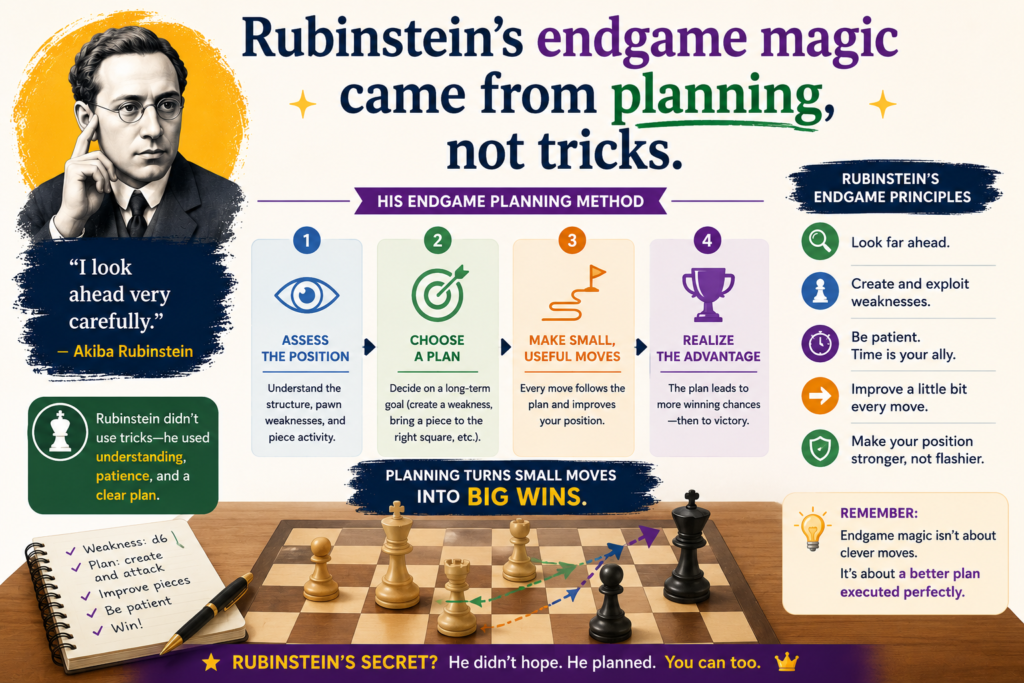
Chessgames has a full collection of Rubinstein rook endings, showing how often his games reached long, clean endings where tiny details decided the result. These are not random wins. They show a pattern. He kept creating small problems until the other player had no easy defense.
He made the board smaller for his opponent.
This is one of the most useful ways to understand Rubinstein. He did not always try to win at once. Instead, he slowly took away good squares. A bishop lost a path. A rook lost an open file. A king could not come forward.
A pawn could not move without becoming weak. The opponent still had pieces, but fewer good choices.
That is powerful chess. It is also simple to teach when a coach explains it well. Many young players only count material. They say, “I have the same number of pieces, so it is equal.” Rubinstein shows that equal pieces do not always mean equal chances.
A bad rook, a weak pawn, or a slow king can be the start of real trouble.
A good endgame player does not only count pieces; they count useful pieces.
Imagine two rooks on the board. One rook is active, attacking pawns and cutting off the king. The other rook is stuck defending. On paper, both sides have one rook. In real chess, only one side is having fun. Rubinstein understood this better than almost anyone of his time.
This is why his endgames are so helpful for kids. They teach students to ask better questions. Is my rook active? Can my king join the game? Is my pawn safe? Can I create a second weakness? These questions are easy to understand, but they lead to strong chess.
A Debsie coach can help a child practice this in a live class. Instead of giving the answer too fast, the coach guides the student to find it. That makes the lesson stick. The child feels the joy of solving the puzzle, and that builds confidence.
The real secret was that Rubinstein improved his worst piece first.
One of the most common mistakes in chess is moving the same active piece again and again. It feels fun because that piece is doing something. But Rubinstein often did the opposite. He looked for the piece that was not helping. Then he fixed it.
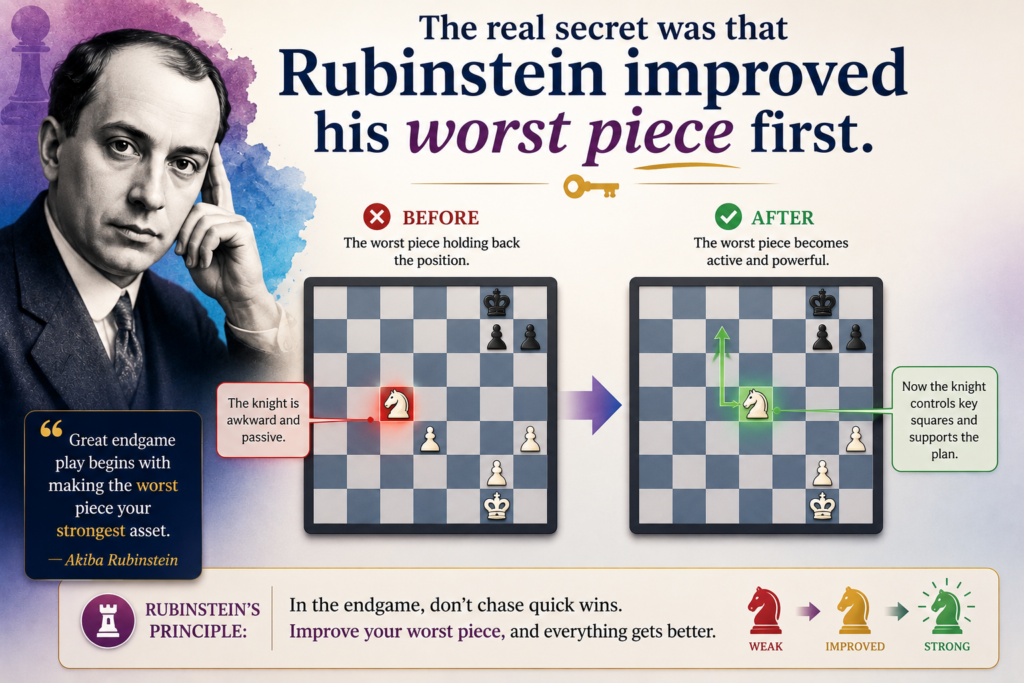
This is why his moves can feel invisible. He might move a king one square closer. He might slide a rook to a quiet file. He might place a bishop where it protects a future pawn push. Nothing explodes right away. But the whole position starts to breathe.
He knew that one bad piece can spoil the whole plan.
In many games, the difference between a draw and a win is not a brilliant sacrifice. It is one lazy piece. Rubinstein had a gift for finding that piece. Once all his pieces worked together, the final win often looked smooth. That smooth finish was not luck. It was the reward for earlier care.
This is very important for students. A child may look at a position and say, “I do not see a tactic.” That is fine. There may not be one. The next question is, “Which piece needs help?” This question gives the child a plan even when there is no checkmate. It turns a confusing board into a clear task.
The quiet improving move is a habit any child can learn.
Rubinstein was a rare talent, but his thinking can still be taught in simple steps. Before making a move, a student can pause and look at each piece. Which one is doing the least? Which one has no good square? Which one can become active with one calm move? This small habit can change a child’s whole chess game.
It also helps outside chess. Children learn not to panic when things look messy. They learn to find the weak spot in a problem. They learn to fix one thing at a time. That is smart thinking, and it is one of the big reasons parents choose chess classes for their kids.
At Debsie, this is part of the bigger goal. Winning games is wonderful, but building a sharper mind is even better. A child who learns to improve the worst piece also learns to improve a weak study habit, a rushed choice, or a hard school task.
Rubinstein’s rook endings teach the cleanest lesson in chess.
Rook endings are hard. Even strong players make mistakes in them. But Rubinstein made many rook endings look calm and clear. He understood activity, timing, pawn structure, and king position.
That is why later writers and players often praised his rook endgame skill. ChessBase even shared the famous story that Rudolf Spielmann joked Rubinstein’s rook endgame play looked like “witchcraft” after their 1909 game in Saint Petersburg.
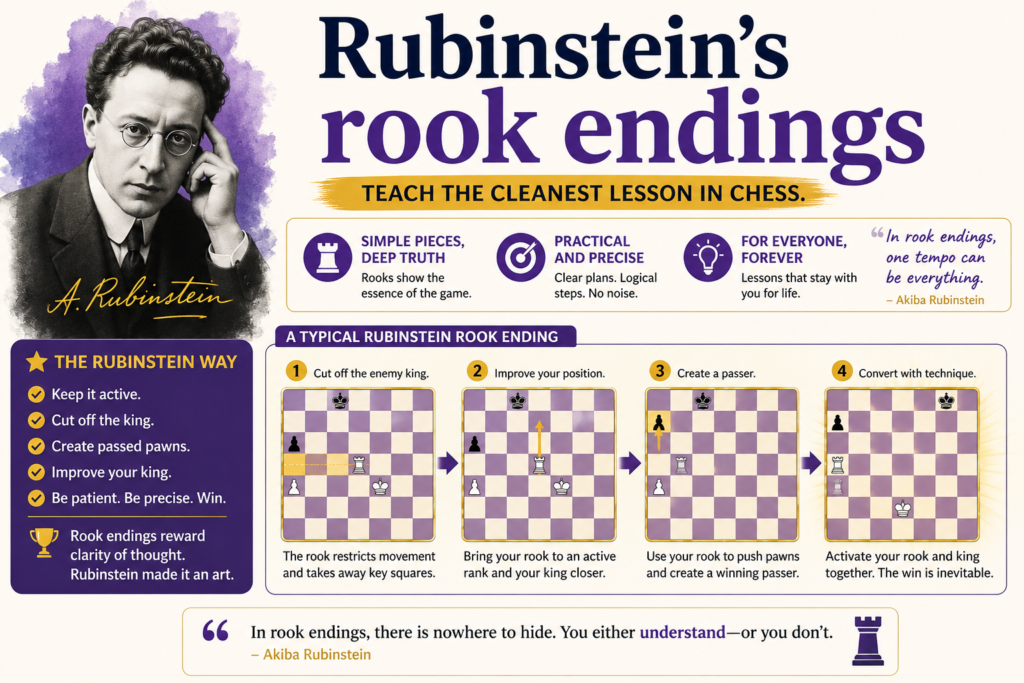
The lesson is not that rook endings are magic. The lesson is that Rubinstein made simple ideas work at a very high level. He used active rooks. He cut off kings. He attacked pawns from the side or behind. He did not rush pawn pushes. He made the opponent defend until a mistake became almost natural.
The rook wants activity more than comfort.
Many young players keep the rook close to home because it feels safe. Rubinstein’s games show a better truth. A rook should be active. An active rook attacks pawns, checks from behind, and stops the enemy king from moving freely. A passive rook just waits and suffers.
This is an easy lesson for children to understand when they see it on a board. A rook behind a passed pawn can help that pawn run. A rook on the seventh rank can attack many pawns at once. A rook that cuts off the king can turn a tiny edge into a clear win.
The king is not a baby in the endgame; it is a fighting piece.
This is another Rubinstein lesson that students love once it clicks. In the opening and middlegame, the king needs safety. In the endgame, the king must work. Rubinstein often used his king like a strong helper. He brought it closer, protected pawns, blocked the enemy king, and supported passed pawns.
For kids, this is exciting because it changes how they see the board. The king is not only something to hide. It can become brave at the right time. That idea builds courage and timing. It teaches children that the same piece can have a different job in a different stage of the game.
A Debsie trial class can help your child feel this change through real positions, not dry theory. The coach can show how one king move can be stronger than a flashy check. That is when chess becomes alive.
Rubinstein’s 1912 form shows what steady growth can do.
The year 1912 is one of the great chapters in Rubinstein’s chess life. Chess.com notes that he won five straight tournaments that year, and the World Chess Hall of Fame says a world title match with Emanuel Lasker seemed likely before history got in the way.
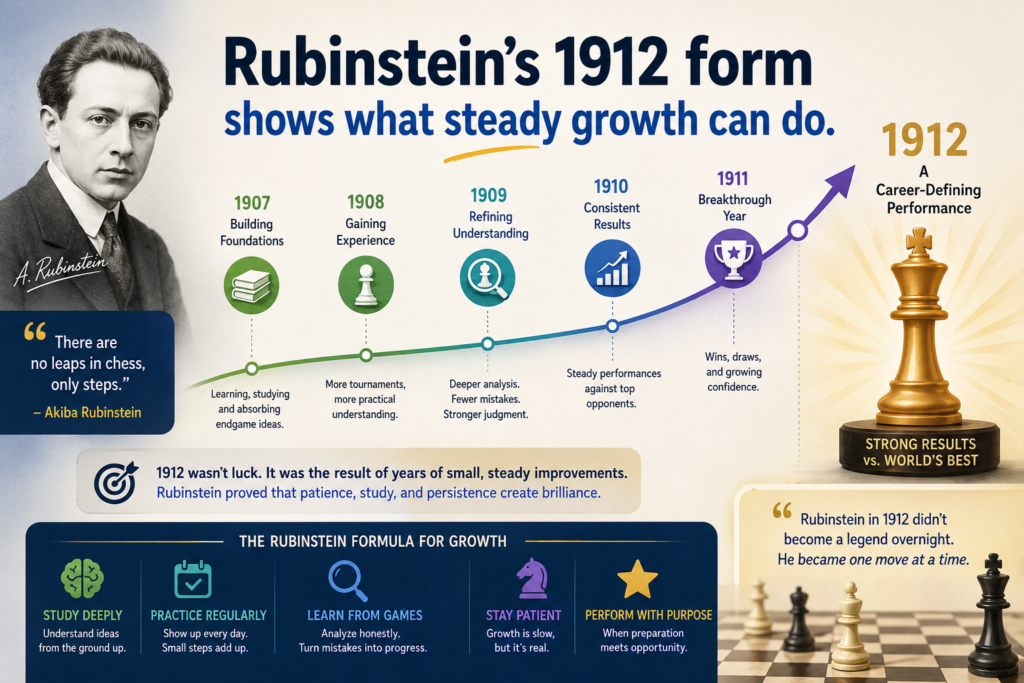
This matters because it shows how far steady work can take a person. Rubinstein did not become great by playing wild chess every game. He became great through deep understanding, careful choices, and strong endgame skill. He built his strength in a way that lasted.
He proved that calm chess can beat noisy chess.
Some players win because they scare you. Rubinstein won because he understood you. He understood your weak pawn. He understood your bad bishop. He understood the file your rook needed but could not get. By the time the ending arrived, the game was already leaning his way.
This is a beautiful message for young players. You do not have to be the loudest kid in the room to be strong. You do not have to rush. You do not have to copy wild attacks from online clips. You can learn to think, plan, and stay calm.
A strong chess mind is built one careful move at a time.
At Debsie, this is exactly how we want children to grow. The goal is not just to memorize openings. The goal is to build a thinking system. Look at the whole board. Find the weak point. Improve the worst piece. Use the king in the endgame. Make calm moves with purpose.
Rubinstein’s games are perfect for this because they show that small moves can be full of meaning. When a child learns this, they stop guessing. They start thinking. And when they start thinking, their confidence grows.
The “invisible” move is really a move with a clear job.
When people hear the words “invisible move,” they may think it means a move no normal person could ever find. That is not the best way to see Rubinstein. His quiet moves were not magic tricks. They were moves with a job.
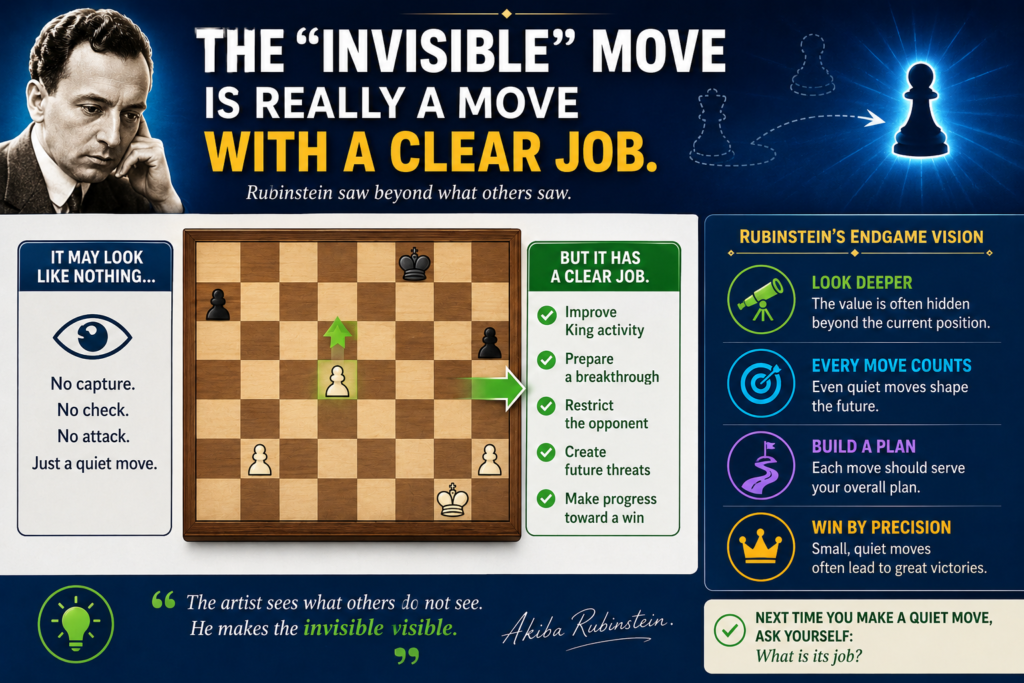
A Rubinstein move often did one small thing very well. It stopped a pawn break. It moved the king closer. It placed a rook behind a pawn. It made a bishop stronger. It forced the other player to defend instead of attack. At first, it looked small. Later, it became the reason the whole game changed.
This is where many young players can grow fast. They do not need to copy every move from Rubinstein’s games. They need to copy his question. Before moving, Rubinstein seemed to ask, “What will this move help me do later?”
Find the right learning experience
Tell us a little about the learner and what you are looking for. Our team will review your answers and help you identify the most suitable next step.
- Takes only a few minutes
- No payment required
- Personalised recommendations
Your information will only be used to respond to your enquiry.
The quiet move often stops the opponent’s best plan before it starts.
Many children play chess by looking only at their own plan. They want to attack. They want to win a pawn. They want to give check. That is normal, and it is part of learning. But stronger chess begins when a child also asks, “What does my opponent want?”
Rubinstein was very good at this. He could see the other side’s dream and make it harder. If the opponent wanted an open file, he would control it. If the opponent wanted to free a bad bishop, he would keep it blocked. If the opponent wanted to push a pawn, he would make that push weak.
This is why his games feel so smooth. He did not wait for danger to become big. He noticed it while it was still small. That is a skill children can use in school and life too. A smart child does not only fix problems after they explode. They learn to see problems early.
A child can train this skill with one simple question before every move.
Before making a move, the student can pause and ask, “What is my opponent’s best move?” This sounds simple, but it changes the whole game. It slows the hand. It wakes up the mind. It helps the child stop traps, save pieces, and choose moves with more care.
At Debsie, coaches build this habit in a kind and clear way. The goal is not to scare kids with hard rules. The goal is to help them think like calm problem-solvers. When a child starts asking better questions, better moves begin to appear.
That is why a free trial class can be so useful. A parent can see how their child thinks on the board. The child can see that chess is not just about winning fast. It is about learning how to think before acting.
Rubinstein’s Immortal Game shows that loud tactics can grow from quiet roots.
One of Rubinstein’s most famous games was played against Gersz Rotlewi in Łódź on December 26, 1907. It is often called Rubinstein’s Immortal Game, and it became famous because of Rubinstein’s stunning queen and rook sacrifice.
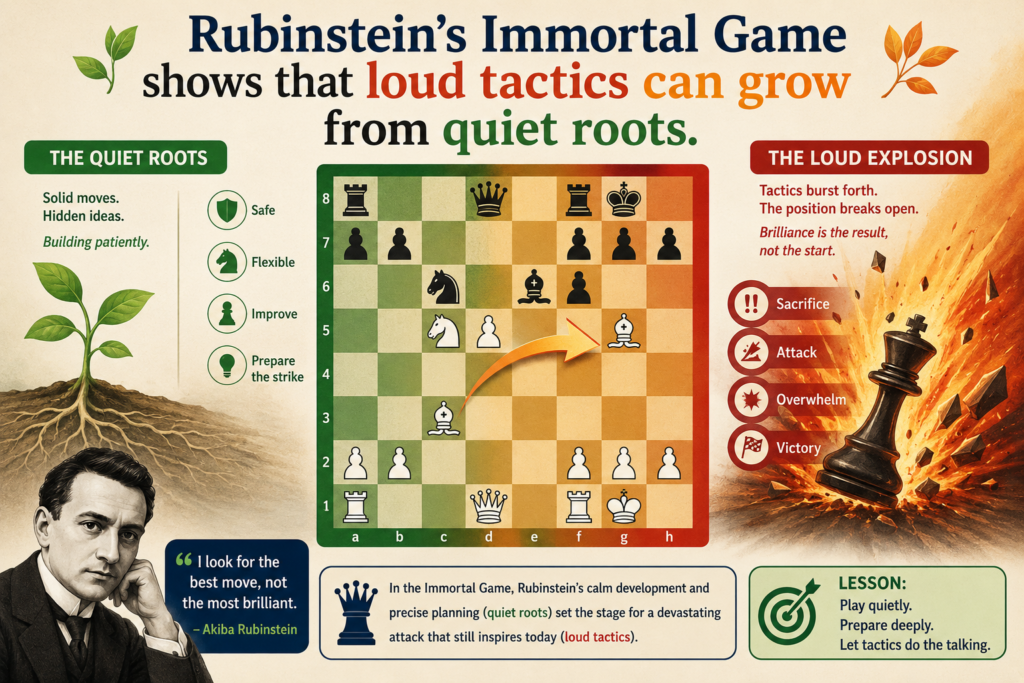
Garry Kasparov later described it as Rubinstein’s truly “immortal” game, and the game is still widely studied today.
But there is a trap in how many students study this game. They jump straight to the sacrifice. They look at the final attack and say, “Wow, Rubinstein was brave.” That is true, but it is not the full lesson. The deeper lesson is that the sacrifice worked because the pieces were ready.
Rubinstein’s pieces did not suddenly become strong. They had been placed well before the final blow. His bishops had power. His rooks had paths. His queen had targets. Rotlewi’s king had less safety than it seemed. The final move looked like lightning, but the storm had been forming for many moves.
The sacrifice was loud, but the thinking before it was calm.
This is an important lesson for children who love tactics. Tactics are fun. Checkmates are exciting. Winning a queen feels great. But tactics do not come from nowhere. Most tactics happen because one side has better piece activity, a safer king, or more control of key squares.
Rubinstein understood this deeply. He did not attack just because he wanted to attack. He attacked because the board said the attack was ready. That is a big difference. Wild attacking is guessing. Prepared attacking is skill.
For a young player, this can be a turning point. Instead of asking, “Can I sacrifice something?” the child learns to ask, “Are my pieces ready?” If the answer is no, the best move may be a quiet improving move. If the answer is yes, the tactic may appear.
The real lesson is not to sacrifice more, but to prepare better.
Parents sometimes worry that chess will become too hard for their child. But good chess teaching makes ideas simple. Rubinstein’s Immortal Game can be taught in a way a child understands. First, bring pieces to good squares. Next, look at the enemy king. Then, check if every piece is helping. Only after that should the child search for a tactic.
This is how Debsie teaches chess as a thinking journey. A coach does not only show the final move and say, “Remember this.” The coach helps the child understand why the move worked. That makes the lesson useful in future games.
A child who learns this becomes less random. They stop hoping for tricks. They begin creating the right conditions. That is true in chess, and it is true in many parts of life. Big wins often come from quiet work done earlier.
Rubinstein’s win against Capablanca shows that calm courage can beat fear.
In 1911, Rubinstein defeated José Raúl Capablanca at San Sebastián. Capablanca later became World Champion, and he was already known as a player with amazing natural skill. Their game at San Sebastián was a win for Rubinstein with the white pieces, and it remains one of the famous games from that event.
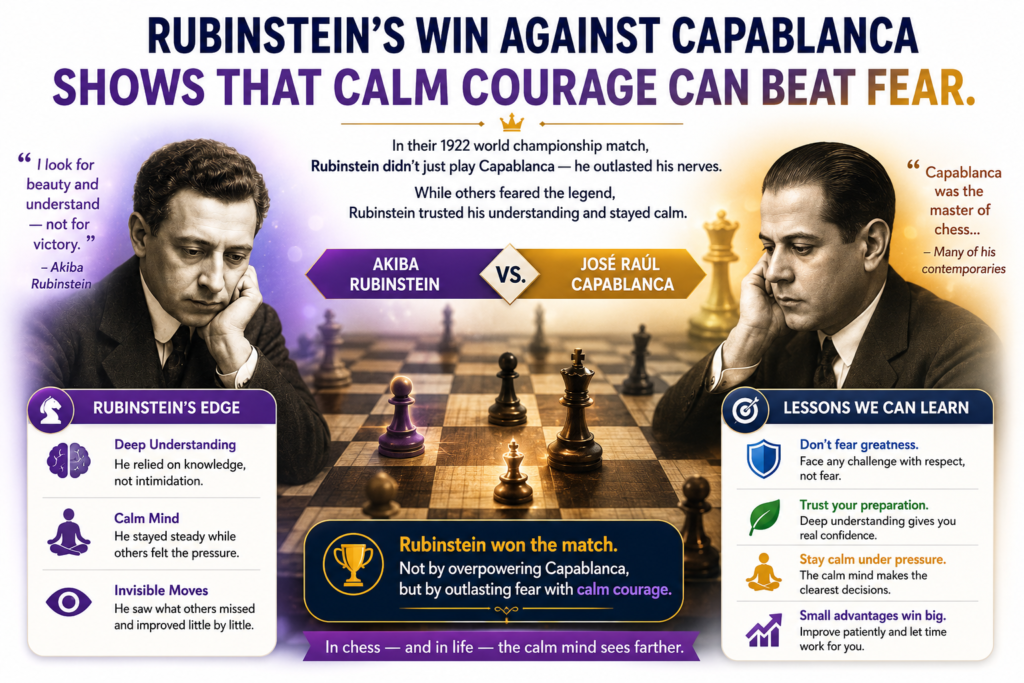
This game matters because it shows another part of Rubinstein’s strength. He was not only an endgame artist. He could also face the strongest players with calm courage. He did not need to play strange moves to prove something. He trusted good development, clear pressure, and patient play.
Many students feel nervous when they face a strong opponent. They think, “This player is better than me, so I must do something special.” That feeling can lead to rushed moves. Rubinstein teaches a better lesson. When the opponent is strong, your moves should become clearer, not crazier.
He did not try to impress Capablanca; he tried to play the position.
This is a powerful mindset. Rubinstein did not play the name. He played the board. That is what every growing chess student must learn. The board does not care if the opponent has trophies. The board only cares about good moves.
This idea can help kids in tournaments too. A child may sit across from a higher-rated player and feel small. But once the game starts, both players must make one move at a time. If the child can stay calm, check threats, improve pieces, and follow a plan, they give themselves a real chance.
Rubinstein’s style gives children a kind of quiet confidence. It says, “You do not need to be loud to be strong.” That message is very healthy. It helps shy children too. A quiet child can still think deeply. A careful child can still win beautifully.
The practical lesson is to trust good habits when the pressure is high.
Pressure makes many players forget the basics. They stop checking captures. They stop asking what the opponent wants. They move too fast. Rubinstein’s example shows the value of staying steady.
A child can use a simple routine in hard games. Look for checks. Look for captures. Look for threats. Check the opponent’s idea. Improve the worst piece. This routine does not make chess easy, but it gives the child something solid to hold.
At Debsie, live classes and online tournaments help children build this calm under real game pressure. They learn that a mistake is not the end. They learn to reset, think again, and keep trying. That is how confidence becomes real.
The backward pawn teaches why small weaknesses can decide big games.
One famous Rubinstein game against Georg Salwe from 1908 is often known by the nickname “The Backward Pawn.” It is studied because Rubinstein showed how a small pawn weakness can become a long-term target.
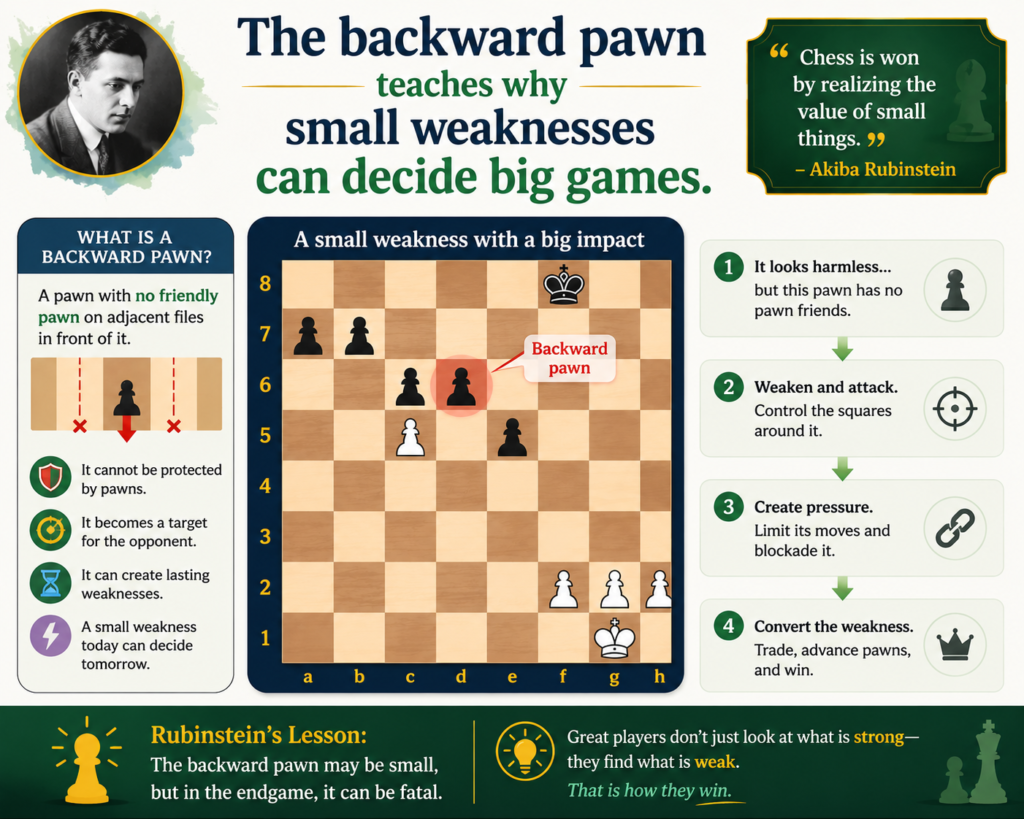
The game is listed as Akiba Rubinstein vs Georg Salwe, Łódź 1908, and Rubinstein won with the white pieces.
A backward pawn is not always easy for a child to understand at first. The simple meaning is this. A pawn is weak when it cannot move safely and other pawns cannot protect it well. It may sit on a file where enemy pieces can attack it again and again.
Rubinstein was a master at making that kind of weakness hurt. He did not always rush to win the pawn. Sometimes he used the weak pawn to tie down the opponent’s pieces. If a rook had to defend it, that rook could not be active. If a bishop had to guard it, that bishop had less freedom. The pawn became like a small stone in the opponent’s shoe.
A weak pawn is not weak only because it may be captured.
This is a very important point. Many young players think a weakness matters only if they can win it right away. Rubinstein shows something deeper. A weakness matters because it gives you a plan.
If your opponent has a weak pawn, you can attack it. When they defend it, you can improve another piece. When they defend again, you can switch to another target. The weak pawn may not fall for many moves, but it keeps the opponent busy.
This is how strong players win quiet positions. They do not need a checkmate attack. They can win by making the other side defend too much. Over time, defense becomes tiring. One piece gets stuck. One square gets lost. One pawn push becomes impossible. Then the position breaks.
The Debsie way is to help kids turn “I do not know” into “I have a plan.”
Many children get stuck in quiet positions. They say, “There is nothing to do.” Rubinstein’s games are the perfect cure for that. There is almost always something to do if the child knows what to look for.
Look for a weak pawn. Look for a bad piece. Look for a file for the rook. Look for a square for the king. Look for the opponent’s best plan and stop it. These ideas are simple, but they make the board feel less scary.
This is where a good coach can make a huge difference. A child may not see the plan alone yet. But with the right guide, the child learns how strong players think. Slowly, they begin to find plans by themselves. That is when chess becomes exciting.
Rubinstein’s endgame style is a life lesson in patience.
The World Chess Hall of Fame says Rubinstein is still remembered for his opening ideas and his rook and pawn endgames. That is a rare mix. It means he did not separate the start of the game from the finish. He saw the whole game as one story.
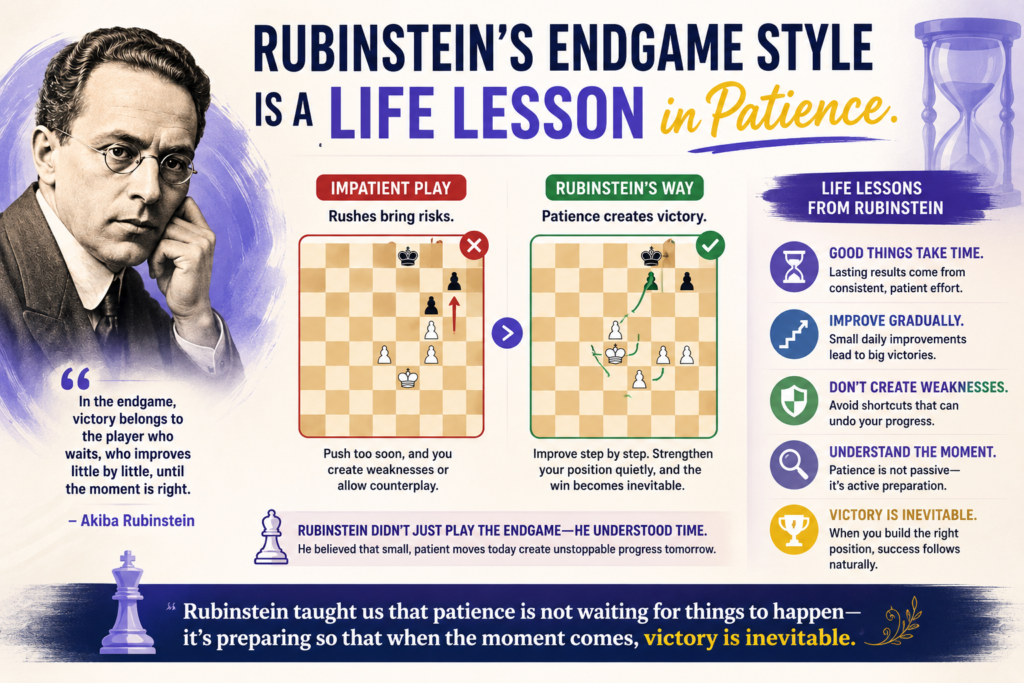
This is why his chess is so helpful for young students. It teaches them to think ahead without getting scared. It shows them that one move can be quiet and still be strong. It teaches them that patience is not weakness. Patience is power when it has a plan.
Many children want quick wins. That is normal. But chess gently teaches them that rushing can spoil a good position. Rubinstein’s games make this lesson clear. He could wait, improve, and only strike when the time was right.
Patience in chess does not mean doing nothing.
This is something every student should understand. Patience is not just sitting still. In chess, real patience means making useful moves while you wait. You improve your king. You make your rook active. You protect a pawn. You stop the opponent’s break. You build pressure.
That kind of patience is active. It has energy. It has purpose. Rubinstein’s quiet moves were not sleepy moves. They were building moves.
For children, this lesson can change how they face hard tasks. A tough math problem, a school test, or a new skill can feel too big. Chess teaches them to break it down. Find one good step. Then another. Then another. That is how big goals become possible.
This is why Rubinstein is more than a player from chess history.
Rubinstein is not just someone to admire. He is someone to learn from. His games can help a child become a better chess player, but they can also help a child become a calmer thinker.
At Debsie, we use chess to build more than chess skill. We want students to learn focus, patience, smart planning, and confidence. Rubinstein’s style fits that mission beautifully. He shows that deep thinking can be quiet. He shows that small choices matter. He shows that a calm mind can do great things.
Rubinstein made the king walk into the game at the right time.
In many beginner games, the king stays far away even after most pieces are gone. The player keeps moving pawns or checking with the rook, while the king sits like a guest who was never invited.
Rubinstein did not play this way. In his best endings, the king became a worker. It walked closer to the center. It protected weak squares. It helped pawns move. It pushed the enemy king back.
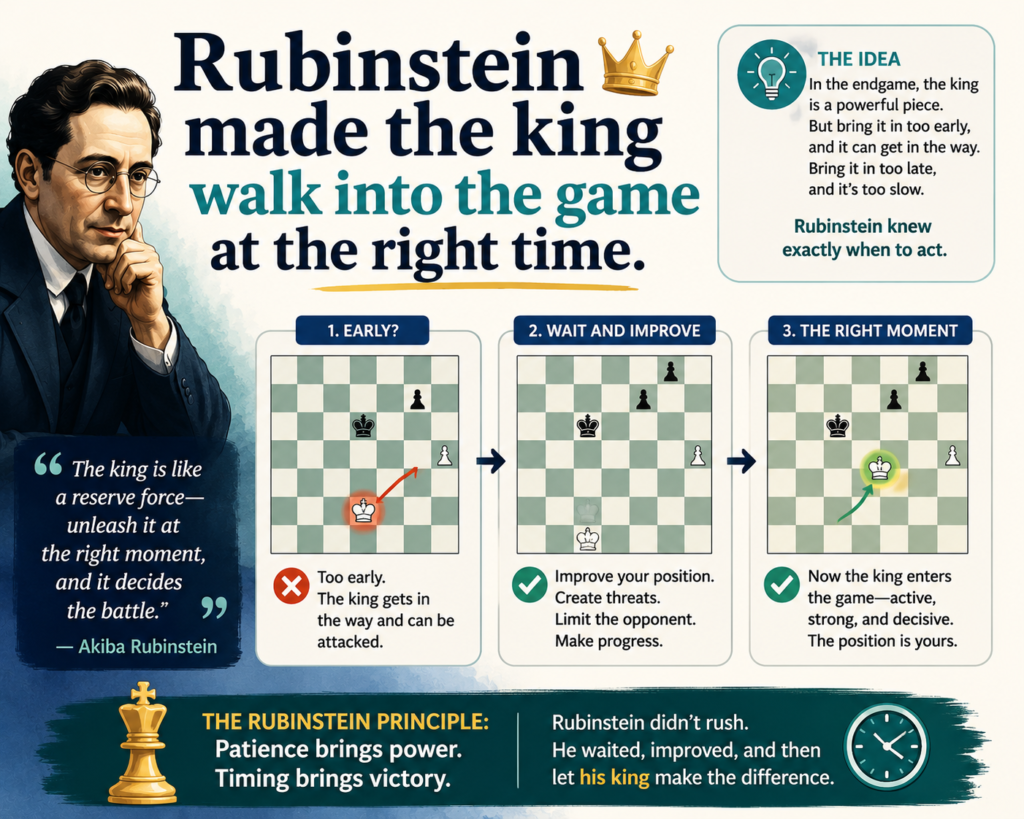
This is one reason his endgames still feel fresh. ChessBase describes Rubinstein as famous for deep, logical plans and superb rook endgame skill, and that praise makes sense when you study how he used every piece, even the king, with care.
The king becomes stronger when the queens are gone.
A child should learn this early. When queens and many attacking pieces leave the board, the king is no longer just a piece to hide. It becomes one of the strongest helpers. In pawn endings, the king is often the most important piece.
In rook endings, the king can support passed pawns, attack weak pawns, and stop the other king from reaching key squares.
Rubinstein understood timing. He did not rush the king forward when danger was still on the board. He waited until it was safe. Then he brought the king in with purpose. That is a very useful lesson for kids because it teaches courage with care. Be brave, but do not be careless.
The simple training rule is to ask whether the king can safely improve.
When your child reaches an endgame, teach them to pause and ask, “Can my king get closer?” This one question can save many half-points and win many games. A king that moves from the back rank to the center can change the whole story.
At Debsie, coaches help students feel this idea on the board. They do not just say, “Use your king.” They show when the king is safe, where it should go, and what job it should do. That is how a child learns real judgment, not just rules.
Rubinstein knew how to create a second weakness.
One weakness is often not enough to win. The opponent may defend it. They may place a rook behind it. They may keep a bishop tied to it and hold the draw. Rubinstein was great because he did not always try to break through one door. If the first door was blocked, he created another door.
This is one of the most practical ideas in chess. First, you attack one weak pawn. The opponent defends it. Then you improve your pieces. Then you create pressure on the other side of the board. Now the opponent has two problems.
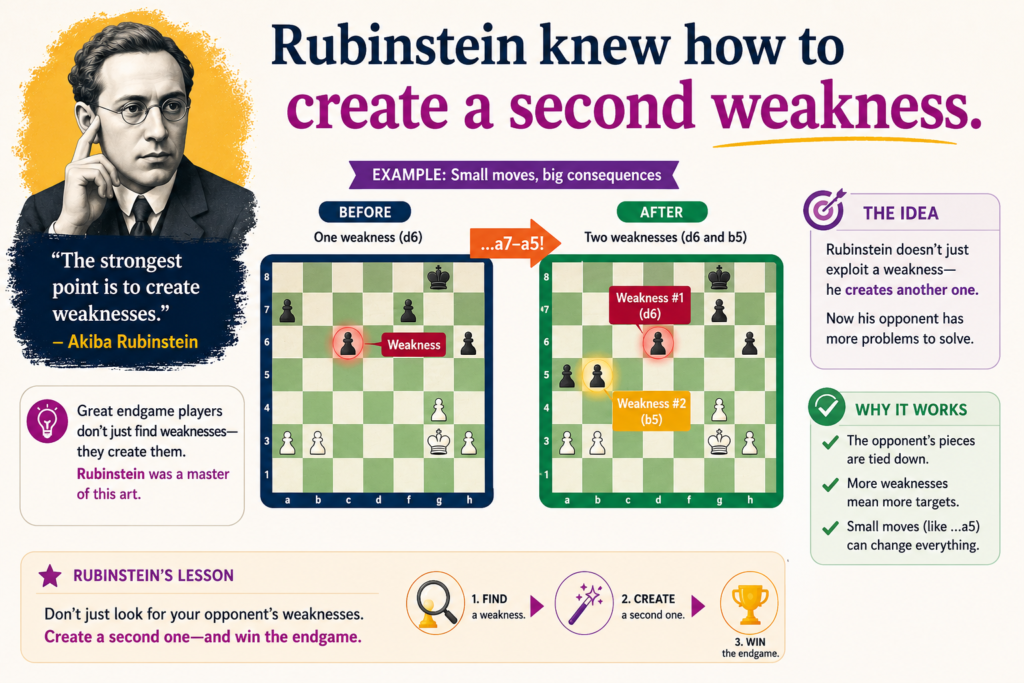
Their pieces cannot guard everything. That is when the position begins to crack.
Rubinstein’s game collection is full of long games where the win comes through pressure, patience, and clean technique rather than one lucky trick. Chessgames lists more than one thousand games from Rubinstein’s career, giving students many examples of this steady style.
A second weakness makes defense feel heavy.
This is easy to understand in real life. It is hard to carry one heavy bag. It is much harder to carry two heavy bags at the same time. In chess, weak pawns and bad pieces work the same way. One weakness can be held. Two weaknesses can stretch the defender too far.
Rubinstein often made the opponent defend on both wings. He might press a pawn on the queenside, then improve the king toward the center, then prepare a pawn push on the kingside. The board became too wide for the defender. Nothing looked sudden, but the pressure kept growing.
The child-friendly question is, “Can I make another target?”
When there is no clear win, many children get bored and rush. This is where Rubinstein can help them. Instead of forcing a move, they can ask, “Where is the next target?” That target may be a pawn, a square, a trapped piece, or a king that cannot move freely.
This is a big part of smart chess. It teaches children to stay calm when the first plan is not enough. At Debsie, this kind of thinking is taught step by step, so students learn how to build pressure without guessing.
They learn that patience is not waiting around. Patience means improving the position until the win becomes clear.
Rubinstein’s pawn breaks were timed like a perfect song.
A pawn break is a pawn move that opens the position or changes the pawn structure. Many young players push pawns because they feel stuck. Rubinstein pushed pawns because the board was ready. That is a huge difference.
A rushed pawn move can create holes. It can leave a weak square. It can give the other side counterplay. But a well-timed pawn break can open a file for the rook, free a bishop, create a passed pawn, or force the opponent into a worse ending.
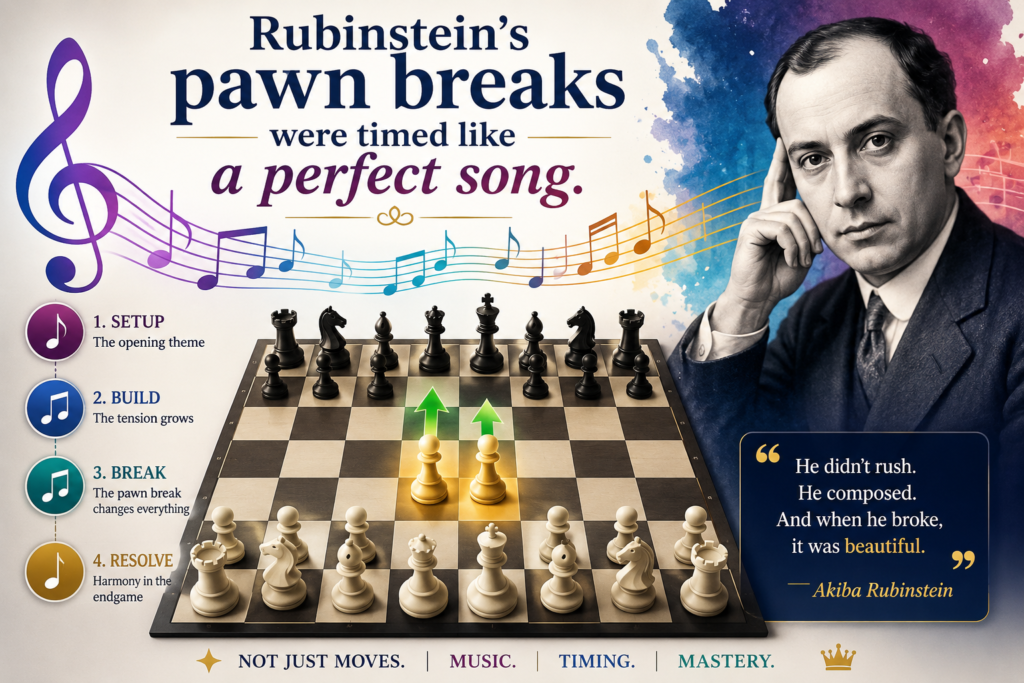
Rubinstein’s play teaches us that pawns should not be pushed just because they can move. They should be pushed because they help the plan.
The best pawn move often comes after piece improvement.
This is where many students can grow fast. Before playing a pawn break, they should ask if their pieces are ready for the open lines that may appear. Is the rook on the right file? Is the bishop aiming at the right square? Is the king safe? Is the opponent’s counterattack under control?
Rubinstein’s quiet moves often prepared these moments. He would improve a rook, centralize the king, or stop the opponent’s best reply. Then, when the pawn break came, it did not feel like a gamble. It felt like the next step in a plan.
The Debsie training habit is to prepare before you push.
A simple way to teach this is to have the child point to the file or square that will open after the pawn moves. If they cannot explain what the pawn move opens, they may not be ready to play it. This builds clear thinking and stops random pawn pushes.
This habit is useful beyond chess too. Children learn that action works best when it is prepared. Do not rush just because you feel pressure. Look first. Get ready. Then act. That is the kind of calm decision-making parents love to see growing in their children.
A free trial class at Debsie can help your child learn these small but powerful habits in a friendly setting. The lesson is not about making chess feel hard. It is about making good thinking feel natural.
Rubinstein’s openings were built for endings he wanted to play.
Some players treat the opening like a race. They memorize moves and hope the opponent forgets something. Rubinstein’s openings had a deeper aim. He wanted positions he understood. He wanted clean pawn structures.
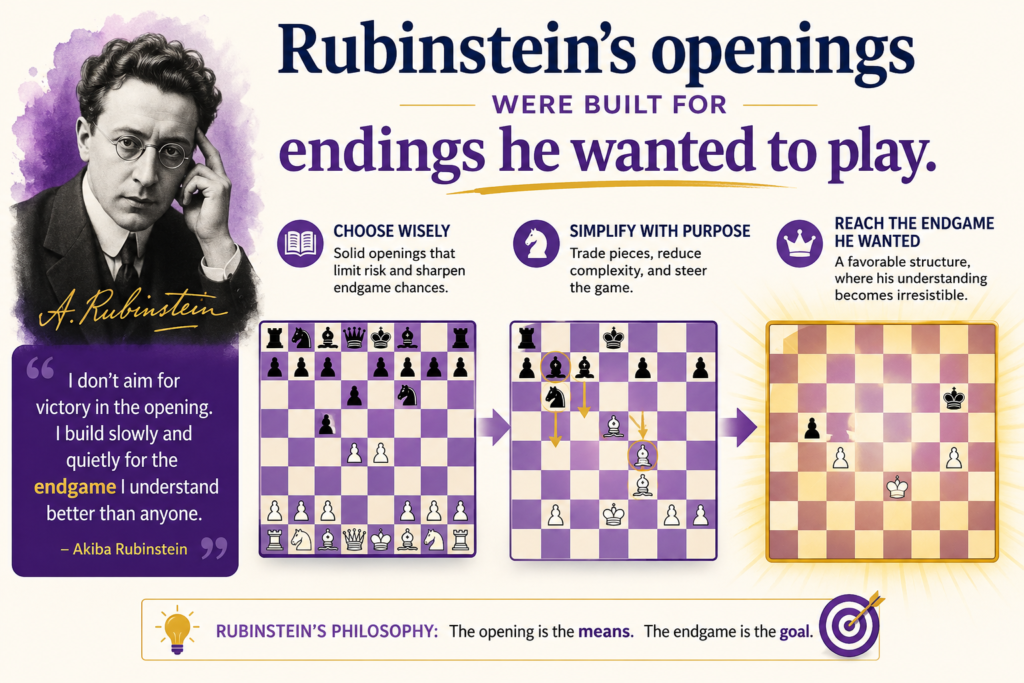
He wanted pieces that could move into strong squares. He wanted endings where his long-term skill could shine.
This is why he left his name on several opening ideas. Chess.com describes Rubinstein as a Polish grandmaster and one of the best players of his time, and his influence still appears in opening names and classical chess study today.
The opening should help the child reach a position they can understand.
This is a key lesson for young players. The best opening for a child is not always the sharpest opening. It is not always the newest online trick. A good opening should help the child develop pieces, keep the king safe, fight for the center, and understand the plan.
Rubinstein’s style teaches that the opening is not separate from the rest of the game. If your opening gives you a weak pawn you do not understand, the middlegame will be hard. If your opening gives you active pieces and clear plans, the whole game becomes easier.
Memorizing moves is weaker than understanding the reason behind them.
A child may remember ten opening moves and still get lost on move eleven. That happens because memory alone is not enough. Rubinstein-style learning asks a better question: “Why did I move this piece here?”
At Debsie, coaches help students learn openings in this healthy way. They explain the ideas in simple words. They show the plans. They connect the opening to the middlegame and endgame. This helps children become flexible, not robotic.
That is also why live coaching matters. A video can show moves, but a coach can see how your child thinks. A coach can correct rushed habits, ask helpful questions, and build confidence through real practice.
The Rubinstein method gives every child a clear way to think.
Rubinstein can feel like a giant from the past, but his method is very friendly for young learners. It does not depend on flashy tricks. It depends on good habits. Improve the worst piece. Make the king active in the endgame.
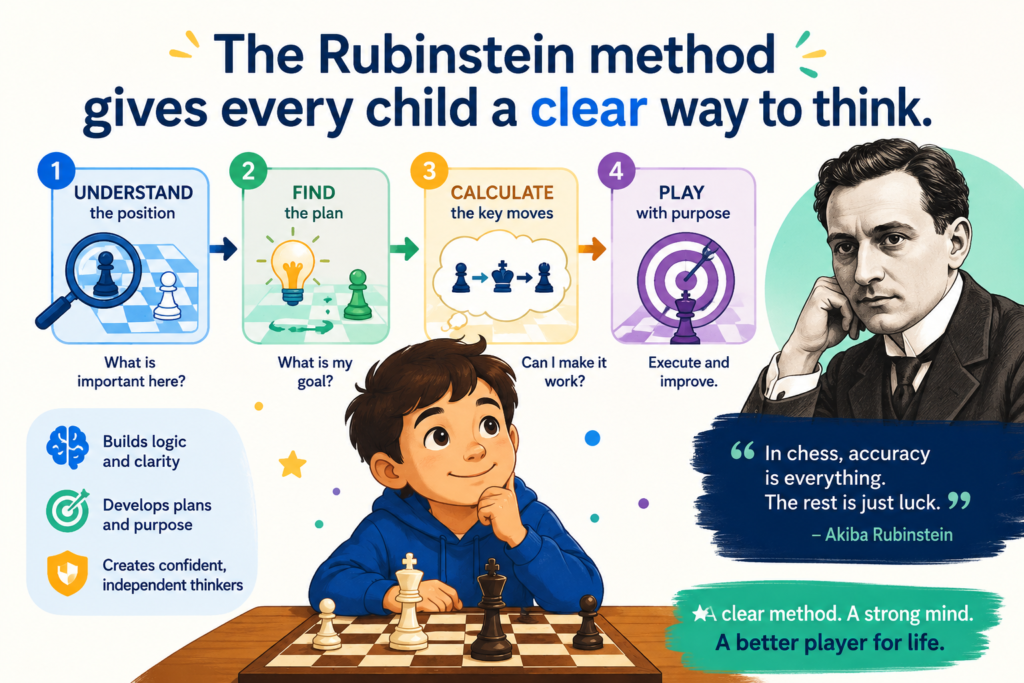
Keep the rook busy. Attack weaknesses. Create a second target. Prepare pawn breaks. Ask what the opponent wants.
These ideas are simple enough for children, but strong enough for serious chess growth. That is the beauty of studying Rubinstein. His games show that chess strength is not only about seeing checkmate. It is about building a position where good moves become easier and bad moves become harder for the opponent.
This style builds focus because the child must slow down.
Fast moves often come from emotion. A child sees a check and plays it. A child sees a capture and grabs it. Sometimes that works, but often it leads to mistakes. Rubinstein’s style teaches the child to pause. What changed? What is weak? Which piece needs help? What is the opponent trying to do?
This pause is powerful. It turns chess into thinking training. Over time, children become better at noticing details. They become more patient with hard positions. They begin to enjoy solving problems instead of guessing.
Debsie helps children turn these ideas into real game habits.
Reading about Rubinstein is useful. Practicing his ideas with a coach is even better. In Debsie’s live classes, students can learn these patterns in real positions, ask questions, play games, and get kind feedback. They can also join online tournaments, where they learn to stay calm under pressure.
That is how chess becomes more than a board game. It becomes a way to build focus, patience, planning, and confidence. Rubinstein’s quiet genius is the perfect guide for this journey.
Rubinstein teaches that trades should have a reason.
Many young players trade pieces because it feels safe. They see a bishop that can take a knight, so they take it. They see queens facing each other, so they swap queens. Sometimes this is fine. But often, a trade changes the whole game in a way the child did not plan.
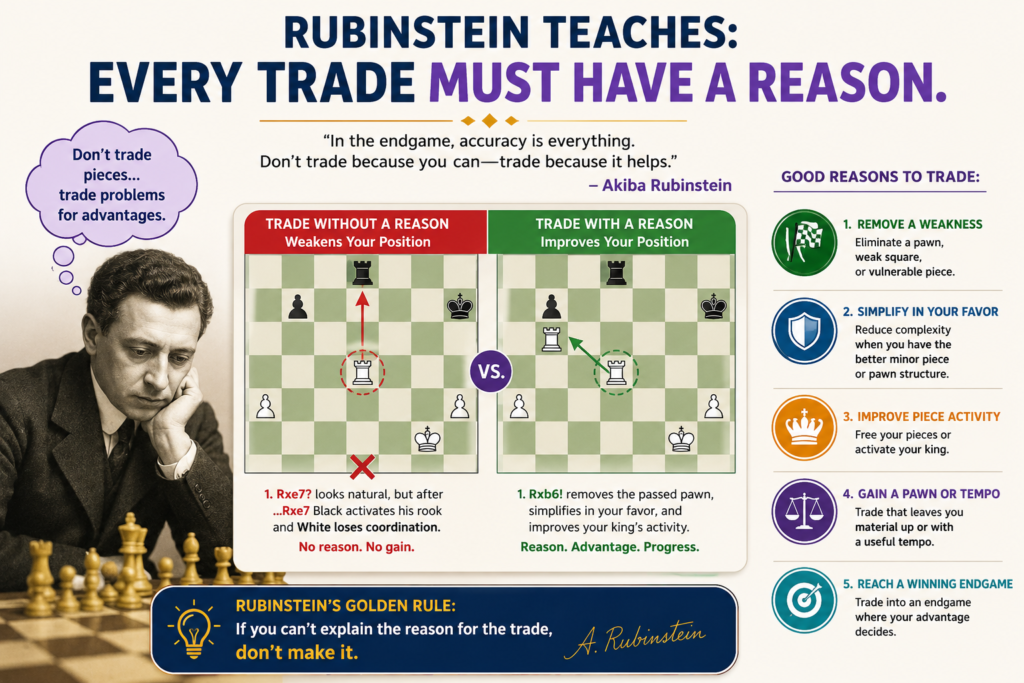
Rubinstein was very careful with trades. He did not ask only, “Can I trade?” He asked, “What will be left after the trade?” That is the real question. Chess is not about the piece you remove. It is about the position you enter after the pieces leave the board.
If a trade gave him a better pawn ending, he welcomed it. If it left the opponent with a weak pawn, he liked it. If it made his rook more active, he allowed it. But if a trade helped the opponent fix a problem, he avoided it. This is a key reason his endgames looked so clean.
A good trade makes your next plan easier.
A child can think of a trade like cleaning a room. If you remove the right thing, the room becomes easier to use. If you remove the wrong thing, the room becomes more messy. In chess, the same thing happens.
A trade can open a file, improve a pawn structure, or remove the opponent’s best defender. But a bad trade can give away your active piece or fix your opponent’s weak piece.
This is why Rubinstein’s games are so helpful. They show that trading is not a habit. It is a choice. A strong player does not trade because they are scared. A strong player trades because the trade helps the plan.
For kids, this is a powerful lesson. It teaches them not to react too fast. It teaches them to slow down and think about the result of their choice.
The simple question is, “Who is happier after this trade?”
This question is easy for children to remember. Before trading, they can pause and ask, “After the pieces come off, who likes the position more?” If their answer is not clear, they should think again.
At Debsie, coaches often help students see this by showing the board before and after a trade. The child learns to compare both positions. This builds clear thinking. It also stops the common habit of trading just because a trade is possible.
This is not only a chess skill. It is a life skill too. Children learn that every choice has a result. They learn to think past the first moment. That kind of thinking helps them make better choices in school, games, and daily life.
Rubinstein’s bishops were strong because his pawns helped them.
A bishop can look weak or strong based on the pawns around it. If your own pawns block your bishop, the bishop may feel trapped. If your pawns open paths for it, the bishop can become a long-range hero. Rubinstein understood this very well.
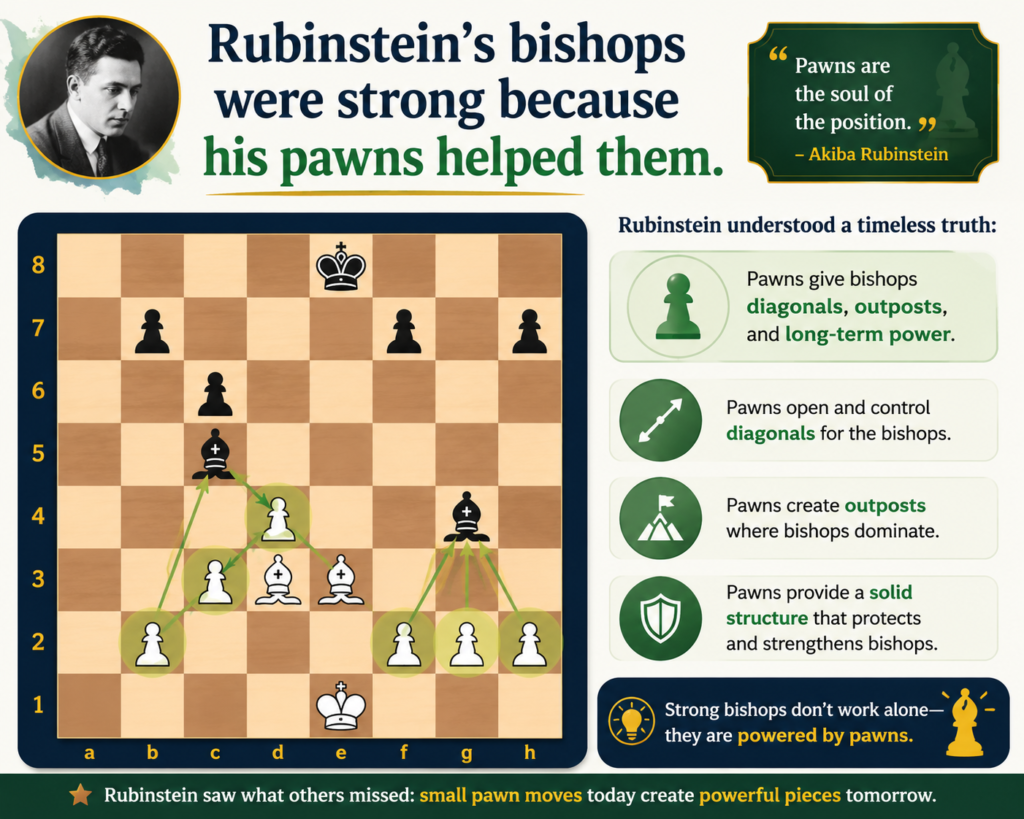
He often placed pawns in a way that gave his bishops room. He also knew when an opponent’s bishop was bad because its own pawns were stuck on the same color squares. Once he saw that kind of problem, he could build a long plan around it.
This is one of the quiet secrets of positional chess. A bishop is not good just because it has a long diagonal. It is good when it has targets, open lines, and a job. Rubinstein made sure his bishops had all three.
The pawn structure tells the bishop where it can breathe.
Many children learn the names of the pieces before they learn how pieces and pawns work together. They know a bishop moves diagonally. But they may not yet see that pawns decide whether that diagonal is open or closed.
Rubinstein’s games make this clear. He did not treat pawns like small pieces with no value. Pawns were the walls, doors, and roads of the position. A pawn move could open a bishop. A pawn move could trap an enemy bishop. A pawn move could decide which ending was good.
This is very useful for students because it helps them stop moving pieces without looking at pawns. They begin to see the board as one connected system.
A child should ask whether each bishop has a real path.
This question is simple but strong. “Does my bishop have a path?” If the answer is no, the next job is to find a way to free it. That may mean moving a pawn. It may mean trading the bishop. It may mean placing the bishop on a better diagonal.
At Debsie, we teach these ideas in clear steps. A child does not need hard words to understand them. They can look at the board and see whether a bishop is breathing or blocked. Once they see it, they can make better choices.
This is why good chess coaching matters. The coach helps the child notice what they missed before. After that, the child starts seeing those patterns in their own games. That is when learning becomes exciting.
Rubinstein knew that space is useful only when you can use it.
Some players love to push pawns and take space. They feel strong because their pawns are far up the board. But space alone does not win games. If the pieces behind the pawns are weak, space can even become a problem.
Rubinstein did not grab space without a plan. He wanted space that helped his pieces. He wanted pawns that controlled important squares. He wanted room for his rooks, bishops, and king. His space had purpose.
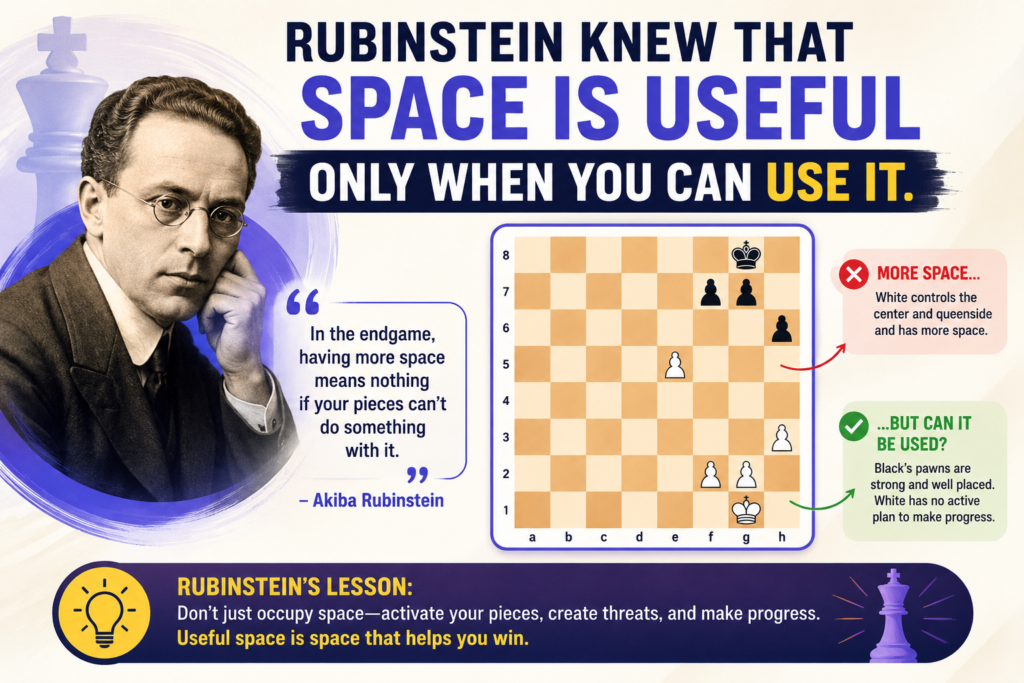
This is a very important lesson for young players. Pushing pawns can feel active, but every pawn move leaves something behind. A square may become weak. A line may open for the opponent. A pawn may become a target. Rubinstein’s calm style teaches children to respect pawn moves.
Space should make your pieces freer, not your position weaker.
Good space gives your pieces room to move. Bad space only creates targets. The difference is planning. If a child pushes a pawn and then cannot explain what the pawn helps, that move may be risky. If the pawn controls a key square, opens a rook, or supports a passed pawn, then it may be strong.
Rubinstein often used space to slowly limit the opponent. His pawns did not just stand there. They took away squares. They helped pieces move to better places. They made the enemy pieces feel cramped.
This is the kind of chess that teaches deep focus. The child learns not to judge a move by how bold it looks. They learn to ask what the move actually does.
The safe rule is to check what squares a pawn move gives away.
Every pawn move controls new squares, but it also leaves old squares behind. That is why pawns are special. They cannot move backward. Once a child understands this, they become more careful in a healthy way.
At Debsie, coaches help students see pawn moves as long-term choices. This builds patience. It also helps kids stop making rushed moves when they feel bored or nervous. They learn that strong chess is not about doing something every second. It is about doing the right thing at the right time.
That lesson can help a child outside chess too. Not every fast action is smart. Sometimes the best choice is to look first, think clearly, and move only when the move has a purpose.
Rubinstein’s defense was strong because he did not panic.
People often talk about Rubinstein’s endgames and quiet wins, but his defense is also worth studying. A good player cannot always attack. Sometimes the position is worse. Sometimes the opponent has pressure. Sometimes there is no easy move. In those moments, calm defense matters.
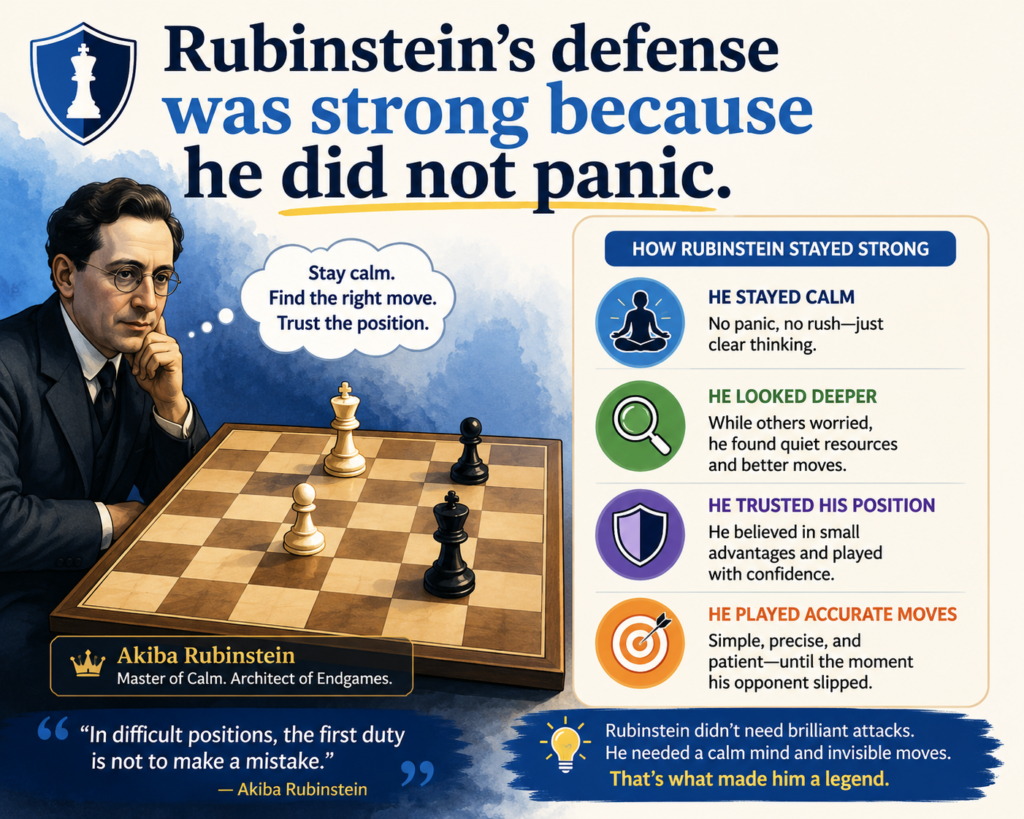
Rubinstein had a special kind of calm. He could defend without falling apart. He looked for active defense when possible. He did not only sit and wait. He tried to trade the opponent’s strong piece, create counterplay, or reach an ending he could hold.
This is a huge lesson for children. Many kids lose quickly after one mistake because they feel upset. They think the game is already over. But chess often gives second chances to players who stay calm.
A bad position becomes worse when the player loses hope.
When a child blunders a pawn or falls into pressure, the next few moves are very important. If they rush, they may lose more. If they panic, they may miss easy saves. But if they breathe, look at the board, and search for the best defense, they can still fight.
Rubinstein’s style teaches this quiet toughness. He did not need to look dramatic. He simply kept making useful moves. That is often enough to make the opponent work harder. And when the opponent must work harder, mistakes can happen.
This kind of defense builds real confidence. The child learns that they do not need a perfect game to keep going. They can recover. They can think. They can try again.
The best defensive question is, “What is my opponent threatening right now?”
This question can save many games. Before a child attacks, they should know what danger is coming. Is there a check? Is a piece hanging? Is a pawn about to promote? Is the king unsafe? When the child answers these questions, they can choose a move with less fear.
At Debsie, students learn to defend in a positive way. Defense is not treated as failure. It is treated as a skill. This helps children become more balanced players. They learn to attack when it is time, defend when needed, and stay calm through both.
That balance is one of the best gifts chess can give. A child who can stay steady after a mistake is learning something much bigger than a board game.
Rubinstein’s “invisible” moves can become your child’s daily chess habit.
The best part about studying Rubinstein is that his ideas are not only for masters. A child can use them right away. They can improve the worst piece. They can activate the king in the endgame. They can think before trading. They can make the rook active. They can look for a second weakness. They can ask what the opponent wants.
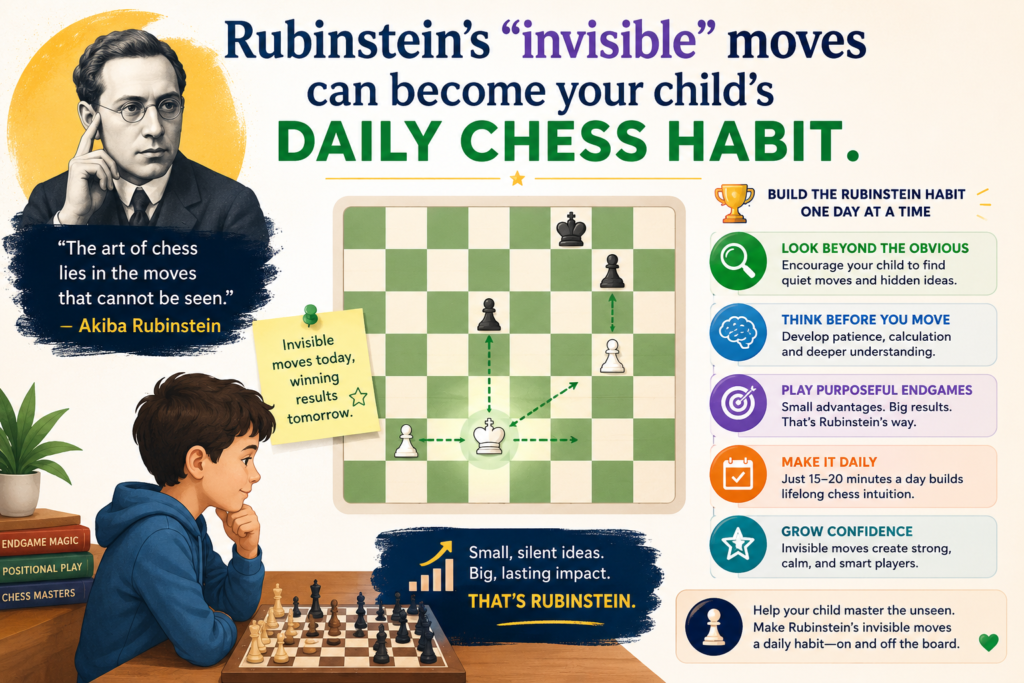
These ideas are simple, but they are not small. They shape how a child thinks. Instead of guessing, the child starts planning. Instead of rushing, the child starts checking. Instead of giving up, the child starts looking for chances.
That is why Rubinstein is such a good model for young players. His games show that quiet thinking can be powerful. They show that patient moves can win. They show that chess is not only about tricks. It is about building a position with care.
The goal is not to make a child play exactly like Rubinstein.
No child needs to copy every Rubinstein game. That is not the point. The real goal is to learn his habits. Look deeper. Respect small details. Use every piece. Trade with purpose. Stay calm in the endgame. Build pressure little by little.
When children learn these habits, their chess becomes more mature. They start seeing things they missed before. They stop asking only, “Can I win something?” They begin asking, “What is my plan?” That change is a big step in chess growth.
It also makes the game more fun. A child who understands plans does not feel lost. They feel curious. They want to solve the next problem. They begin to enjoy the thinking process.
Debsie can help your child turn quiet moves into strong thinking.
At Debsie, chess is taught with care, warmth, and clear steps. Students learn from experienced coaches who know how to explain ideas in a simple way. They get live classes, personal guidance, and chances to play in online tournaments. Most of all, they learn that chess can help them grow as thinkers.
Rubinstein’s “invisible” moves are a perfect lesson for this. They teach focus, patience, planning, and confidence. These are skills your child can carry far beyond the chessboard.
If you want your child to feel this kind of learning, you can book a free Debsie trial class. It is a simple way to see how expert chess coaching can help your child think better, play better, and enjoy the game more.
Conclusion
Akiba Rubinstein’s games remind us that great chess is not always loud. A quiet king move, a careful trade, or a better rook square can decide the whole game. His “invisible” moves teach children to slow down, look deeper, and build strong plans instead of rushing for quick tricks.
That is why his lessons still matter today. At Debsie, kids learn these same habits through live coaching, friendly support, and real practice. They grow in chess, but also in focus, patience, and confidence. Book a free Debsie trial class and help your child make the next smart move with joy.

Adhip Ray is the founder of Debsie, an online learning platform focused on chess and skill-based learning for children. His work at Debsie brings together chess education, structured thinking, problem-solving, and interactive learning for young students.
Adhip has an academic background in law, statistics, analytics, and technology. He is from Amity Law School and the Indian Statistical Institute, Kolkata, with formal training that connects legal reasoning, data analytics, quantitative thinking, and structured problem-solving. This interdisciplinary background is reflected in Debsie’s focus on building sharper thinking skills in children through chess and related learning programs.
Adhip is also a FIDE-rated chess player from India. He holds FIDE ID 5055954 and has a standard FIDE rating of 1832. His FIDE profile records him as an Indian player with a long rating history in standard chess, including rated games from his competitive playing years. His chess background gives Debsie a founder-led connection to the game, not only as an educational activity but also as a competitive discipline that develops concentration, calculation, planning, and decision-making.
In addition to chess, Adhip has a strong interest in coding, data, and technical problem-solving.
Adhip’s profile combines chess, law, data analytics, and programming. At Debsie, this background supports the creation of learning experiences that are logical, structured, and skill-oriented. The platform’s chess-focused programs are connected to broader cognitive skills such as pattern recognition, patience, strategic planning, focus, and problem-solving.
As founder of Debsie, Adhip brings together experience from multiple fields: formal legal education from Amity Law School, analytical training from the Indian Statistical Institute, Kolkata, competitive chess experience through his FIDE-rated profile, and coding practice through LeetCode. This combination gives Debsie a distinct foundation in strategy, reasoning, analytics, and child-focused learning.
Through Debsie, Adhip is associated with building chess and learning content for children that goes beyond basic instruction. The platform connects chess with thinking skills, helping students approach challenges with more structure, clarity, and confidence. His own background in chess and analytical problem-solving gives the platform a direct link to the skills it aims to develop in young learners.
Adhip is also a member of Forbes Business Council.