

Bonjour from Madurai! If you’re a parent or a student in Madurai, Tamil Nadu, and you want to learn French the smart way, this guide is for you. In the next sections, we will walk through the best French classes and tutors, what to expect, what to avoid, and how to choose the right program for you.
We will keep it very simple and very real. No confusing words. No fluff. Only clear steps you can use today.
Here is the truth: learning French should not feel hard or messy. It should feel calm, clear, and steady. You need a plan. You need a friendly teacher. You need a class that fits your time and your level. You also need tools that help you speak, read, and write with confidence.
That is why many families in Madurai now pick online French classes over random offline tuitions. Online classes, when done right, give you structure, feedback, and results—without travel, without stress.
This is where Debsie shines. Debsie is a global online learning platform with expert teachers and a playful, gamified system that keeps kids and teens excited. Lessons are live, but also supported with games, bite-sized videos, and practice that make tricky parts feel easy
. Students don’t just memorize. They understand. They speak more. They grow life skills too—focus, patience, smart thinking, and problem solving.
In this blog, you will see why Debsie is our top choice for French in Madurai, how online learning beats old, unstructured methods, what to watch out for in offline coaching, and a quick look at other options in the city and across the state.
By the end, you will know exactly what to do next to help your child (or yourself) speak French with a smile.
If you’re ready to explore now, you can jump in and book a free trial class with Debsie at any time. Try a live lesson, meet a teacher, and see the method in action. It’s simple, friendly, and made for real results.
Online French Training

Online French training is the easiest way to learn well without wasting time. You study from home. You meet a real teacher in a live class. You get clear steps to follow. You have practice that fits your level, not someone else’s.
You see your progress week by week, not once in a while. Most of all, you speak more, because your class is small and your teacher has time for you.
A strong online class gives you four things that matter every single day. First, a plan that tells you what to learn this week and next week, so you never feel lost. Second, a teacher who knows how to make tough parts simple, who listens, and who keeps you calm.
Third, practice that builds small wins, like a ladder you climb one step at a time. Fourth, feedback that is fast, kind, and exact, so you fix mistakes early and stop carrying them ahead.
When a program includes these four parts, your learning becomes steady. You stop guessing. You stop memorizing random words. You start building skills in order: sounds, words, short lines, small talks, longer talks, reading, writing. Your brain likes order.
Your brain also likes fun. This is why gamified learning works so well for children and teens. It turns practice into a small game. It uses points, badges, and timed challenges to make drills feel light. That is how learners stick with it for months, not just a few days.
If you want to test this idea, take one simple step today. Book a free Debsie trial class and see a live French lesson. Notice how the teacher greets you, how the class starts on time, how the goals are clear, and how each activity builds the next one.
Notice how you talk more than you expect. Notice how the teacher corrects you gently, with exact tips you can follow right away. This is the kind of care that leads to real results.
Online classes also solve a big pain in Madurai: travel. Traffic, heat, and long commutes make evening tuitions hard. With a good online setup, you save hours each week. That extra time can go to practice, homework, or just rest. Rest matters for learning.
A fresh mind picks up new sounds faster. A tired mind makes small mistakes again and again. When you remove travel, you remove tiredness and stress. You learn more in less time.
Another benefit is access. In a local area, you can meet only a few tutors. Online, you can meet many expert teachers and pick the one who fits your child’s style. Some kids need a calm, soft voice. Some need a lively coach.
Some need more drills. Some need more stories. With online options, you can match your child to the right teacher and switch if needed. This choice gives parents peace of mind, because they are not stuck with a poor fit.
Finally, online tools support daily practice better than a notebook alone. Audio libraries let you hear words again. Speaking recorders help you listen to your own voice and self-correct. Flashcards make review quick.
Short quizzes tell you when to move ahead. Parent dashboards show progress, attendance, and goals. These tools keep everyone on the same page. You do not have to ask, “What did you learn today?” You can see it.
If you want a simple next step, try this plan. First, set a clear goal, like “A1 in four months” or “Speak politely in tourist French by summer.” Second, pick a steady schedule, like three short classes a week.
Third, choose a program that gives practice and feedback outside class. Fourth, set a review routine at home for 10 minutes a day. Fifth, check progress every two weeks with a small speaking task. This simple plan works, especially when the program already has it built in. Debsie does.
Landscape of French Tutoring in Madurai and Why Online French Tutoring is the Right Choice

Madurai is a city with energy and heart. Many schools offer French as a second language. Some colleges teach it as an elective. There are local tutors who help students prepare for board exams, DELF levels, and college interviews.
There are community centers that run short courses. You will also find a few language institutes that teach multiple languages under one roof. This mix gives families many options, but not all options are equal.
Here is what we see on the ground. A lot of offline tuitions in the city are teacher-led but not curriculum-led. The class depends on the teacher’s mood, experience, and time. Some teachers are great, but the class plan is often loose.
There may not be a written path from A1 to B2. There may not be daily practice outside class. There may not be data on how the child is doing week by week. Without structure, progress is slow and uneven.
Online French tutoring, when done right, fixes these gaps. It is built around a clear framework: sounds and phonics first, then basic grammar and simple talks, then longer talks, reading with meaning, and writing with purpose. Each week has goals.
Each goal has practice. Each practice has feedback. Parents can see the plan. Students can feel the rhythm. This is the difference between hoping and knowing. With structure, you know what is coming next and how to get ready for it.
Another reason online wins in Madurai is access to certified teachers. In a single neighborhood, you might not find a DELF-trained instructor with years of experience teaching children. Online, you can.
When your child is preparing for DELF A1 or A2, the teacher must know the exam design, the common traps, and the right way to build listening and speaking skills. Many online platforms claim this depth, but only a few deliver it day after day. Debsie does, because teaching is not a side gig here; it is the center.
Online also lets classes stay small. In many local centers, a single class may have 15 to 30 students. In that setup, quiet students get ignored, and mistakes hide. In a small online class, with five to eight learners or even one-on-one, the teacher can notice every sound, every ending, every small tense mistake.
Corrections are fast and friendly. Confidence grows because the child feels seen. Over time, this is the biggest win. Confidence makes practice easier. Practice makes skill stronger.
Parents in Madurai also like the way online programs handle accountability. Attendance is tracked. Homework is submitted inside the same platform. Scores are recorded. Feedback is written. You do not chase paper notes. You do not rely on memory.
You have reports. When a child misses a class, a recorded session or a quick catch-up keeps the flow. When a topic feels tough, the platform can assign extra drills. Data guides the teacher’s next step, not guesses.
If your child is studying French at school and needs support, online tutoring fits well. It helps with school tests. It helps with speaking practice that many schools do not have time for. It helps with projects and presentations.
It also connects school learning to real-life French. So when your child hears a French clip on TV or meets a French tourist at Meenakshi Amman Temple, they can say a few lines with ease and joy. This is a proud moment for any parent.
Now, if you are wondering, “Is online right for my child?” try this quick test. Does your child like screens for learning? Do they enjoy small games? Do they speak up more in a smaller group? Do they get tired after travel?
If you said yes to one or more, online is a great match. And if you want to see it live, book a Debsie trial. Watch your child smile when they earn a badge for saying a sentence clearly. Small wins matter. They keep the heart in learning.
How Debsie is The Best Choice When It Comes to French Training in Madurai
Let us talk about Debsie in detail because Debsie is our number one choice for French in Madurai, and here is why. Debsie blends expert teachers, a clear curriculum, and a playful system that kids love. It is not a random Zoom class with a worksheet. It is a full learning path with live teaching, practice that adapts, and progress you can see.
First, the teachers. Debsie works with experienced French instructors who know how to teach young learners, teens, and adults. They are trained to break down sounds and help with accent from day one.
They teach how to move the mouth for tricky sounds like “u” in “tu” or the nasal “an” in “enfant.” They use simple mouth maps and slow modeling so students can copy with comfort. This early work saves months later because it sets the right base.
Second, the curriculum. Debsie’s French path is structured by levels, from beginner to advanced, aligned with common European levels like A1, A2, B1, and beyond. Each level has small units.
Each unit has goals you can understand: introduce yourself, ask and answer simple questions, talk about your family, order food, discuss daily routines, describe a place, write a short email, read a simple note. The order is simple on purpose. It follows how the brain grows language.
Third, the practice. Between classes, learners play short games that drill sounds, words, verb forms, and small talks. The games are not loud or distracting; they are focused and short, often two to five minutes.
Points and badges reward steady effort, not speed alone. Students see a streak. They feel proud of showing up. This is how habits form. Ten minutes a day over months is more powerful than two long hours on weekends. Debsie designs for habits.
Fourth, the feedback. After live classes, students get precise notes: words to review, sounds to repeat, verbs to practice, and small speaking tasks to record at home. Teachers listen to those recordings and give tips
. This loop turns errors into growth. Parents see the notes too, so home time is simple. You do not need to know French to help. You only need to ensure the child opens the app, does the two or three small tasks, and smiles at the badge they earn.
Fifth, the exam focus when needed. If your child is preparing for DELF, school boards, or college entry, Debsie adds targeted practice. This includes mock papers, timed speaking tests, and listening drills that match the exam style. The goal is not to “teach to the test,” but to build real skill and then show students how to apply it in the exam format. This keeps stress low and scores high.
Sixth, the soft skills. Debsie believes language is more than marks. It is a way to think, to listen, to connect. Classes include small moments for patience, turn-taking, polite phrases, and clear speaking.
These habits help in school, in interviews, and in life. When a child learns to wait, listen, and speak with care, they grow as a person. Parents feel this change at home: calmer homework time, better focus, kinder words.
Seventh, the parent experience. Debsie gives a clean dashboard for schedules, attendance, homework, scores, and teacher notes. You can reschedule within policy, see upcoming classes, and send a quick message to the teacher.
If you want more practice, the team can assign it. If you want a lighter week during exams, the plan can adjust. This is service with heart. Parents feel supported, not judged.
Eighth, the trial. You do not have to guess. Book a free Debsie trial class. Meet a teacher. See the platform. Ask questions. Get a simple plan based on your child’s needs. If you like it, start. If not, you still leave with a clear idea of what to look for elsewhere. We are confident you will stay, because the difference is clear in the first session.
Finally, the results. Families from many cities and countries use Debsie. Students build solid basics in months, not years. They speak more, not less. They enjoy the process, which is the secret to staying with it. A child who enjoys learning will keep learning. That is the real win.
If you live in Madurai and you want a stable, kind, and smart French program, Debsie is your best choice. It is number one because it combines structure, care, and fun in the right measure. It respects your time. It respects your child. It delivers progress you can see and celebrate.
Offline French Training

Let us look at offline French classes in Madurai with clear eyes. Many families choose them because they feel “real.” You see a room, a board, and a teacher. You can shake hands and say hello. This feels safe. But what happens after the first two weeks matters more than that first hello. In most offline setups, the plan is loose.
The teacher often follows a book page by page, not a full path from A1 to B2. Homework depends on the day. Speaking time depends on how crowded the class is. Feedback depends on memory, not a system.
If your child is already in an offline class, you may have seen these signs. The class starts late because the previous batch ran long. The teacher spends time taking attendance, finding chalk, or fixing a projector.
Ten minutes, then fifteen, then twenty slip away. By the time the lesson starts, half the room is restless. In a city like Madurai, where many children travel across town for tuition, they are already tired when they arrive. Heat and traffic do not help. A tired child is not a ready learner.
Class size is another issue. A room with twenty or more students leaves little time for each voice. The same three confident students answer most questions. Quiet learners hide. Mistakes hide too.
You might think your child “understands,” but they may only be copying the group. Language learning needs personal correction. The mouth must learn new moves. The ear must notice small sounds. Without personal attention, small errors stay for months and become habits.
Material is often mixed in offline centers. One day it is a worksheet, next day a photocopy, then a YouTube clip, then the textbook again. This mix can be helpful when guided, but many times it is random. There is no simple ladder of skills to climb.
Students cannot see where they are on that ladder. Parents cannot see it either. Without a path, there is no steady rhythm. Without rhythm, progress feels like push and pull—two steps ahead, one step back, then stuck.
Tracking is weak, and that hurts. Offline, attendance is a tick on paper. Homework is a notebook check. Scores live in a file or stay in the teacher’s head. If your child misses a class due to rain or a family event, it is hard to catch up.
If the class moves on, your child carries gaps forward. Gaps in French show up as shaky verbs, unclear sounds, and slow reading. These gaps then drag scores and confidence down. A parent sees only the final marks and wonders what went wrong.
Time outside class is another blind spot. In many offline tuitions, home practice is just “revise” or “learn the words.” Kids sit with a word list and try to memorize, but they do not train the ear or the mouth. They do not hear a word said clearly and copy it. They do not record themselves and compare. They do not play small drills that repeat verbs until tense changes feel easy. Without these tools, home time is effort without good return.
Now let us talk exams. Many offline centers focus on board exam marks and DELF papers. This can help for short-term scores, but often the teaching becomes “tips and tricks.” Students learn to spot answer patterns, not build language.
They can pass A1 but struggle to speak to a real person. They can fill blanks in a tense table but cannot tell a simple story about their day. This is not your child’s fault. It is the method. Real learning means real use: listen, speak, read, write—every week.
If you must stay with an offline class for any reason, you can still protect your child’s progress. Here is a simple routine you can run at home, without fancy tools. After each class, ask your child to tell you three new words and one sentence they learned.
Have them say the sentence out loud three times, slowly and clearly. Use your phone to record them once a week. Play last week’s clip and this week’s clip side by side. Ask, “Does it sound smoother now?” This tiny habit builds awareness and pride.
Second, use a ten-minute daily cycle. Two minutes of listening to a word list with audio (there are many free resources), two minutes of repeating, two minutes of saying those words in tiny lines, two minutes of reading a short note out loud, and two minutes of copying one line neatly into a notebook.
This small cycle touches all four skills every day. It keeps the mind warm for the next class. It also shows your child that effort is short, simple, and steady.
Third, set a clear goal for each month. Do not say “get better.” Say “order in a café,” “introduce yourself with five lines,” or “talk about your family in ten lines.” Write the lines down and practice them with a timer. Celebrate when your child can say them without help. Put the date on a paper and stick it to the fridge. Progress you can see turns into progress you want to continue.
Offline centers can be friendly spaces. Some teachers care deeply and do their best within limits. But the limits are real: big batches, travel, time loss, weak tracking, and random materials. When you compare this with a strong online platform that has a clean path, small classes, rich practice tools, and exact feedback, the choice becomes simple.
The goal is not to reject offline for the sake of it. The goal is to choose a method that respects your time and gives your child the best chance to grow. That is why parents in Madurai who try Debsie’s free trial often move online and do not look back.
Drawbacks of Offline French Training
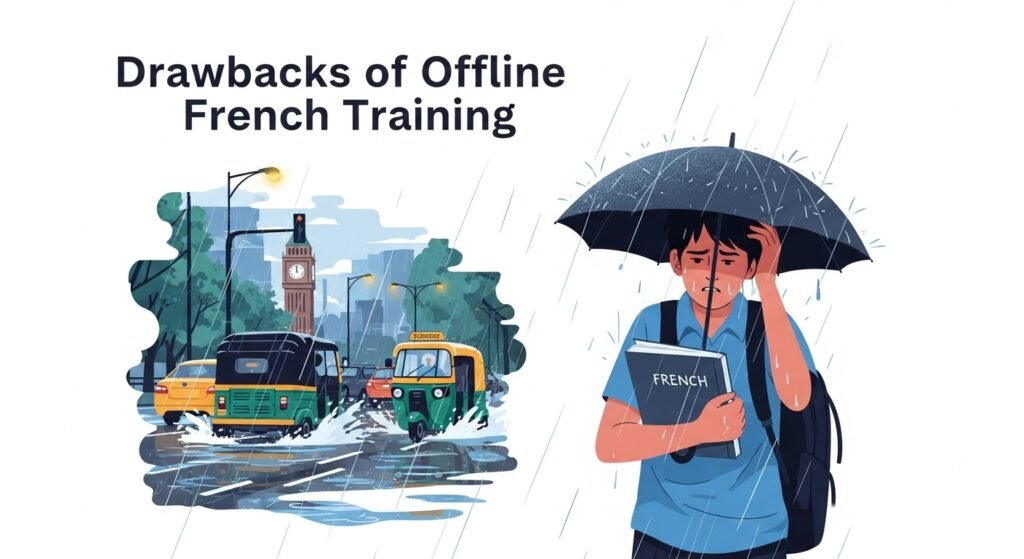
Let us be very clear and practical. Here are the core drawbacks of offline French training, the ones that cost you time, money, and energy, and the ones that slow down your child’s growth. We will keep it plain, with examples from real life in Madurai, and we will also show how to fix some parts if you cannot switch right away.
First, travel burns time and willpower. A thirty-minute ride in the evening can easily turn into forty-five. Add waiting, walking, and heat, and you have an hour lost before class even starts. After class, the same again.
That is two hours for a sixty-minute lesson. Children come back drained. When the brain is tired, it resists new sounds and new rules. You may notice more yawns, less focus, and more “I forgot” the next day. Online training removes this drain. With Debsie, you click, join, learn, and log off—with energy left to review.
Second, class pace is fixed for the group. In a room of twenty, the teacher must move at the middle speed. Fast learners feel bored and drift. Slow learners feel lost and quiet. Both groups get hurt.
Language needs the right level of challenge—hard enough to grow, gentle enough to keep calm. Online classes can adapt better. Debsie uses placement, small groups, and flexible homework to match the speed. Students feel “this is for me,” not “this is for someone else.”
Third, feedback is thin and late. In a crowded room, the teacher hears you for a second, says “good,” and moves on. You do not know what was good. You do not know what to fix. Weeks pass, and the same sound error stays. Offline, there is no easy way to record speech, replay, and comment. Online, this is normal. At Debsie, students record short tasks, teachers leave voice notes and text tips, and you get the feedback when it matters—right away.
Fourth, materials are not always aligned to a level framework. Many centers collect worksheets from old batches and reuse them. Some are fine; many are not. You might get A2-level reading while still at A1 grammar.
You might get verb lists before you can say a simple line. This mismatch creates stress. Students think, “French is hard.” It is not hard; it is mis-ordered. Debsie solves this with level-led units and clear goals. Nothing feels random. Every step prepares the next step.
Fifth, attendance and progress tracking are manual. If you ask, “How is my child doing?” you hear “doing fine” or “needs practice.” This is not data. You need to see exact skills: can introduce self, can describe school day, can ask prices, can write a short email with correct gender agreement.
Debsie shows this in a parent dashboard. You see attendance, tasks, scores, and teacher notes in simple words. This reduces worry and improves decisions at home.
Sixth, make-up classes are rare. If your child misses a day due to rain, illness, or a family event, the class moves on. Catching up depends on a friend’s notes or a rushed five minutes before the next class. Online, recordings and catch-up slots are normal. Debsie helps students return to the same rhythm without gaps. Gaps kill confidence. Fixing gaps fast keeps the heart calm and the habit strong.
Seventh, speaking time is too small. In a large offline batch, each student may speak for two minutes in a sixty-minute class. That is not enough to change the mouth and ear.
Online small groups or one-on-one settings can give you ten to twenty minutes of active speaking per lesson, with corrections right away. Over a month, this is the difference between “I know the answers” and “I can say the answers.”
Eighth, exam prep becomes tips, not training. Offline, close to exams, classes shift to “how to score.” Students memorize patterns for fill-in-the-blanks, but they do not improve real listening or spontaneous speech.
Marks may rise a bit, but the base stays weak. Debsie’s approach is different: build true skill first, then map it to the test format, with mock tasks that feel like the real thing. This lowers stress and raises scores at the same time.
Ninth, parent-teacher communication is uneven. You might have to wait till the end of class, stand in a hallway, and ask quick questions. It is awkward and rushed. Important points get missed. Online platforms have clear channels. Debsie lets you message the teacher, request extra practice, or ask for a short call. Notes are written, so nothing is lost.
Tenth, safety and health. Crowded rooms spread colds and coughs, especially during exam season. A sick week breaks the study rhythm. Online keeps learning steady even when weather or health is not ideal. Consistency is the secret. Small, steady steps beat big, uneven jumps.
Now, if you are still weighing options, do this simple test at home. For one week, try two short online sessions with your child—one live and one only practice. Track the time spent, the mood before and after, and one small result (like a new sentence said clearly). Compare this with one week of your offline routine.
Which week felt calmer? Which week gave a clear win? Most families see the answer right away. If you want a guided version of this test, book a free Debsie trial and ask for a one-week micro plan. You will get a tiny schedule, three micro-tasks, and a speaking check at the end. The difference will show.
It is fair to ask: is every offline center weak? No. Some are run by caring teachers with small batches and a simple plan. If you find such a place near your home, you may do fine for a while. But even then, you will miss the power of built-in tools—recordings, game-like drills, parent dashboards, flexible rescheduling.
These tools matter more as your child climbs to A2 and B1, where the work gets deeper and the words get richer. Debsie brings all of this together in one place, with teachers who know how to use the tools well.
A final note on mindset. Children learn best when they feel seen, safe, and successful. Offline settings can provide warmth, but they struggle to give each child sustained, personal success every week.
Online, with the right design, you can engineer small wins on purpose: a new sound mastered, a short talk done well, a badge earned for steady practice, a kind note from the teacher. These wins build the habit. The habit builds the skill. The skill builds the smile. That smile is why we teach.
If your heart says “let us switch,” take the lightest first step. Do not overhaul everything at once. Keep your current routine for two weeks, but add one Debsie live class and ten minutes a day of Debsie practice. Watch the change in energy and results. If you see the lift, make the full switch. If not, you still got two weeks of rich practice and a clearer view of what your child needs next.
Best French Academies in Madurai
You have many choices today—local tutors, big institutes in Tamil Nadu, and national brands. The goal is not to collect names. The goal is to find a program that fits your child, gives a clear path, and respects your time. Below, I will show you five options. Debsie is number one, because it gives you structure, small classes, deep care, and steady results. For the others, I will keep the info short and honest, and point out where Debsie does better for families in Madurai.
Before we begin, here is a simple way to compare any academy:
- Do they give a level map (A1 → A2 → B1) with weekly goals?
- Do they track speaking and give fast feedback?
- Do they show progress to parents in simple words?
- Do they offer small classes and recorded practice?
- Do they make learning fun so the child wants to come back?
If the answer is “yes” to all five, you are in a good place. If not, your time and money may be at risk.
1. Debsie (Rank #1 in Madurai)

Why Debsie is first—by a wide margin.
Debsie gives you a full system, not just a class. You get live sessions with expert teachers, a clean level path, game-like practice to build daily habits, and a parent dashboard that shows real progress. It is calm, friendly, and built for results you can see.
What learning looks like week by week
- Clear weekly targets: “Introduce yourself in six lines,” “Talk about your family,” “Order in a café,” “Describe your school day.” The child knows what to aim for. Parents see it too.
- Small-group live classes: Usually five to eight learners or one-on-one. Every voice is heard. Shy children feel safe. Lively children get room to speak more.
- Micro-practice every day: Two to ten minutes of sound drills, verb ladders, and short talks. Points and badges reward steady effort. Streaks build proud habits.
- Fast, kind feedback: After each class, the teacher sends short notes—words to revise, a sound to polish, a tiny speaking task to record at home. Children see quick wins. Parents see the plan.
- Catch-up without stress: If a class is missed, recorded sessions and micro-catch-ups keep the rhythm. No gaps, no panic.
Accent and sound training from day one
French sounds can feel tricky at first. Debsie solves this early. Teachers model mouth shapes, tongue placement, and breath for sounds like u in tu, r in rue, and nasal vowels in en and on. Students copy slowly, then speed up with playful drills. This saves months later because the base is right. Clear sounds make listening easier and speaking smoother.
A1 to B1, mapped for real life and exams
- A1: Greetings, self-intro, numbers, days, family, daily routines, basic questions, polite forms. Tiny talks and short notes.
- A2: Shopping, food, travel, health, school life, simple past and future, giving reasons, short emails and messages.
- B1: Stories from the past, plans and hopes, opinions with reasons, polite disagreements, longer emails, reading short articles with meaning.
For DELF, CBSE/ICSE, and college needs, Debsie adds focused mocks and listening labs that match the exam style. The idea is simple: build real skill first; then show how to score well without fear.
Parent experience made easy
- Dashboard: Schedule, attendance, homework, scores, teacher notes—clear and neat.
- Messaging: Ask for extra drills, lighter weeks, or a quick check-in. The team answers with care.
- Flexible slots: Even during school exams, keep a light touch so the habit stays.
Soft skills that grow with language
Children learn patience (wait, listen, speak), courage (try, get feedback, try again), and kindness (pair work, giving turns, polite phrases). These show up at home too: calmer homework time, better focus, clearer words.
A simple sample week (you can copy this today)
- Mon: 45-minute live class (self-intro + family talk). Badge for clear vowels.
- Tue: 8-minute practice (verb être, avoir). One-line voice note: “Je m’appelle…”
- Wed: 6-minute listening (numbers, prices). Tiny speaking drill: order water and a sandwich.
- Thu: 45-minute live class (café role-play). Badge for polite forms.
- Fri: 10-minute reading aloud (menu + prices). Teacher voice tip on the r sound.
- Sat: 12-minute review game. Mini mock: say five lines about your day.
- Sun: Rest. Parent checks dashboard for two minutes. High-five the streak.
Try it now, risk-free
Do not guess. Book a free Debsie trial class. Meet a teacher. Watch your child speak more than you expect. Leave with a mini-plan for the next four weeks. If it feels right, continue. If not, you still get a clear map for your next step.
Debsie is #1 for families in Madurai because it saves time, reduces stress, and builds real French—step by step, smile by smile.
2. Alliance Française of Madras (State-Level Option)
Alliance Française is a respected name for French across Tamil Nadu. They run batches, cultural events, and DELF sessions in the state. If you live near their center or can align with their schedule, it can be a solid in-person option for older teens and adults.
Where Debsie is stronger for Madurai families: travel-free access, small-group attention for younger learners, day-to-day practice inside one platform, and quicker parent feedback. With Debsie, you do not wait for term-end to know progress; you see it weekly.
3. inlingua Chennai (State-Level Option)
inlingua has a global method and offers French in big city hubs. They are known for communicative classrooms and fixed course books. For learners who can commute to Chennai and like a classic institute feel, it may work.
Where Debsie is stronger: tailored pace for school-going kids, playful micro-practice that builds daily habits, and flexible rescheduling. Debsie fits Madurai routines without long travel or hostel stays.
4. Henry Harvin (National Brand, Mostly Online)
This brand offers French courses with certificates. You get scheduled sessions and recorded content. Adults seeking a certificate may like the structure.
Where Debsie is stronger: Debsie is built for children and teens first—gentle speaking drills, teacher voice notes, parent dashboards, and game-like tasks that keep motivation high. Kids stay with it longer, which is the real key.
5. Local Private Tutors in Madurai (City-Level Option)

You will find individual tutors through word-of-mouth and platforms. Some are very caring and may teach at home or in small rooms. This can work if the tutor is experienced and consistent.
Where Debsie is stronger: verified teaching method, clear A1–B1 path, built-in listening and speaking tools, backups for missed classes, and transparent reports. With a private tutor, the plan often depends on the day; with Debsie, the plan is the system.
Why Online French Training is The Future

The world is moving to flexible, data-backed learning. Language, more than any other subject, benefits from this shift. Here is the simple truth: small, steady, guided practice beats long, uneven sessions. Online makes “small and steady” possible.
1) Time saved becomes learning gained
In Madurai evenings, a single commute can steal an hour. Online gives that hour back. Ten minutes go to warm-up, twenty to live class, ten to micro-practice, five to a voice note. You are done in under an hour, with more actual learning than a two-hour outing.
2) Personal pace without the stigma
In a big room, it is hard to say, “I did not get it.” Online, a child can ask in chat, repeat a drill at home, or book a short catch-up. No one stares. No one snickers. Progress becomes private and proud.
3) Feedback that lands at the right moment
Learning sticks when feedback is fast. Online, the teacher listens to a 20-second recording and replies with a 10-second tip. The child applies it the same day. This loop turns small errors into small wins.
4) Data that guides, not guesses
A dashboard that shows: “S sounds clean. R needs work. Past tense endings at 80% accuracy. Reading pace: 90 words per minute.” This is not fancy talk; it is a simple mirror. Parents make better choices when the mirror is clear. Teachers adjust the next class based on the same mirror.
5) Built-in habit design
Streaks, badges, micro-goals, short timers—these are not toys. They are gentle nudges that help the brain start. Starting is the hardest part. Once a child starts, five minutes often becomes eight. Over months, these minutes become mastery.
6) Safety, health, and continuity
Weather, illness, exam season, family events—life happens. Online lets learning bend without breaking. When the plan bends, the habit survives. When the habit survives, the skill grows.
7) Access to the right teacher at the right time
Your neighborhood may have two tutors. Online, you have many. If your child needs a calmer tone, or more games, or extra grammar, you can match and switch. Fit matters. Fit saves months.
8) Real-world tasks, not just worksheets
Children can record a café role-play, read a real menu, or describe a local market in French with photos. They can share with classmates across cities. This makes French feel alive, not like a list of rules.
9) Parent peace of mind
You should not have to chase updates. Online platforms like Debsie give you a neat view. You know what happened, what is next, and what to do if a topic felt tough. This lowers stress at home. Calm homes help learning.
10) Cost that goes to teaching, not rent
Offline centers carry rent, furniture, and front-desk costs. Online channels more of your fee to teachers, tools, and content. You get more value for each rupee you spend.
If you want to feel this in real life, book a free Debsie trial today. Bring your child. See the live class. Try two days of micro-practice. By the third day, listen to your child say five clean lines. This is how the future feels—light, steady, and kind.
How Debsie Leads the Online French Training Landscape

Let us bring it all together. Many places say they teach French well. Debsie proves it every day with clear plans, caring teachers, and smart tools that help your child grow—step by step. This section shows how Debsie stays ahead, what your first 90 days look like, and how you can start this week without stress.
The Debsie Way: Simple, Steady, Strong
Debsie leads because the method is built for real life. Children do not need big words. They need small wins. Debsie designs those wins on purpose. Each class has a goal you can understand. Each goal has short practice you can do at home. Each practice gets quick feedback. That loop repeats, and progress becomes visible.
You will notice the tone first. Classes feel calm and kind. Teachers greet by name, set the goal in one line, and get to work. Mistakes are handled with care. Students try again. They get a tip they can use right away. No shaming. No confusion. Just steady growth. This safe feeling is why kids look forward to class, not away from it.
Behind the calm is strong structure. Debsie maps A1, A2, and B1 into small units. Each unit ties to a real task—introduce yourself, order food, talk about school, describe your family, explain a plan, share an opinion.
Grammar sits inside tasks, not floating outside. So rules make sense because they serve a purpose. This keeps the brain happy and reduces the “why is this so hard?” moments.
If you want to see this design in action today, book a free Debsie trial class. Join one session. Watch how the goal is clear, the speaking time is fair, and the feedback is exact. You will feel the difference in the first ten minutes.
Teacher Quality You Can Feel
Great tools help, but teachers change lives. Debsie picks teachers who know French and know children. They understand where Indian learners struggle—sounds like u in tu, gender forms, and verb endings that slip under pressure.
They slow down at the right spot, not everywhere. They model the mouth for tough sounds. They add simple hand cues for nasal vowels. Small things, big results.
Debsie trains teachers to use the platform well. This means they know when to switch from a drill to a role-play, when to send a voice note instead of a long text, and when to pause the plan to fix a tiny sound before it becomes a habit. This skill comes from practice and care. You can hear it in the way they correct without breaking flow.
If you want your child to meet a Debsie teacher and say a few lines in the very first class, try the free trial. It is the fastest way to feel if the fit is right.
Practice That Builds Habits, Not Stress
Many programs say “do homework.” Debsie says “do two minutes now.” The app gives short tasks: listen and repeat, say one line, read one tiny card, record a 20-second talk. Points and badges make it feel like a small game. Streaks reward showing up, not perfection. Children learn that effort counts. This changes everything.
Daily practice also fits busy Madurai homes. You do not need long hours or big travel. Ten minutes spread across a day is enough: a short drill after school, a two-minute voice note in the evening, a quick review before bed.
Over weeks, these minutes stack up. Over months, they turn into strong skills. This is how Debsie wins—by honoring your time and building a light, happy routine.
Feedback That Fixes Fast
In language learning, waiting two weeks for feedback is too late. Debsie closes the gap. After class, the teacher sends two or three exact notes: “Polite form was perfect,” “Work on r in rue,” “Practice the past tense ending in parlé.” Your child records a tiny clip. The teacher replies with a short voice tip. The fix happens the same day. Errors stop growing. Confidence grows instead.
Parents get the same clarity. The dashboard shows what was learned, what was tricky, and what comes next. You can see attendance, streaks, and small wins. You do not have to ask, “What did you learn?” You can say, “I see you earned the café badge—say your order for me!” This turns homework time into a fun moment, not a fight.
Your First 90 Days With Debsie (A Simple Roadmap)
Days 0–7: Start calm, set the base.
You do the free trial, choose a slot, and begin. A placement check sets the level. The first week focuses on sounds, greetings, and short lines. You will already hear cleaner vowels and a more confident voice. The teacher sends a mini plan for home practice—five to eight minutes a day.
Days 8–30: Build small talks.
Topics include family, school, daily routines, numbers, time, and polite forms. Role-plays feel real: meeting a new friend, asking simple questions, ordering a snack. By day 30, most learners can speak 8–10 clear lines about themselves without help. Parents hear the change at home.
Days 31–60: Add verbs and range.
Present tense gets stronger. Early past and future forms enter through stories and plans: “Yesterday I…,” “Tomorrow I will….” Reading short notes becomes smoother. Writing tiny messages begins: two or three lines with correct forms. The app drills weak spots in small bursts.
Days 61–90: Make it real and ready.
Learners handle real-life tasks—shopping, directions, simple travel talk. If DELF or school tests are near, mocks begin. The tone stays gentle: skill first, score next. By day 90, students sound steady and sure. They know what to say, and they say it with a smile.
If this 90-day map feels right, book your Debsie trial now and get your child on the path this week.
DELF, Boards, and Beyond—Without Panic
Exams matter, but panic does not help. Debsie keeps exam work simple: build real listening and speaking, then show how to apply it to the paper. Mock tasks match the format, timing, and common traps. Students learn to plan answers, breathe, and speak clearly under time. Scores rise because skill is real. After the exam, the skill stays. This is the best use of your fee and your child’s time.
Support for School French in Madurai
School syllabi can be busy. Debsie aligns class topics with common school units—family, hobbies, food, travel, festivals—so your child feels ready for class tests and projects. Teachers can assign a quick practice set before a school assessment. A short, focused boost is often enough to turn “nervous” into “I’ve got this.”
If your child needs a gentle lift before the next school test, ask for a Debsie micro plan during your trial call. You will get a short schedule and two speaking checks—simple and effective.
One Platform, Many Paths (Kids, Teens, Adults)
Debsie is built for kids and teens, but adults are welcome too. The platform keeps things clean: live class link, notes, practice, and reports in one place. No messy folders. No lost papers. You can learn with your child if you like—two short classes a week and tiny tasks at home. Many families in India enjoy this shared routine. It builds bond and keeps everyone motivated.
Care You Can Count On
Life happens. You may need to reschedule, slow down during exam week, or add extra drills before a DELF date. Debsie’s team handles it with care. You write a message in the app; help arrives. The goal is simple: keep the habit alive and the heart calm. Families stay for years because they feel heard.
What Makes Debsie Better—Point by Point
- Clear path from A1 to B1 with real-life tasks, not random worksheets.
- Small classes where every child speaks, every class.
- Daily micro-practice that takes minutes, not hours, but still moves the needle.
- Fast feedback through voice notes and simple tips.
- Parent dashboard that shows real progress in plain words.
- Exam support that builds skill first, scores second.
- Kind culture: calm teachers, safe space, steady wins.
If this is what you want for your child, join a free Debsie trial class and feel the difference this week.
Start This Week: A 3-Step Action Plan
Step 1: Book the free trial.
Pick a day and time that fits your routine. Share your goal—A1 by term-end, better school marks, or DELF A2 in a few months.
Step 2: Do the first micro week.
After the trial, get your mini plan. Do two live classes and five tiny tasks. Listen to the teacher’s voice tips. Watch your child enjoy the streak.
Step 3: Lock a light schedule.
Choose two or three short classes a week. Keep daily practice under ten minutes. Check the dashboard every Sunday. Celebrate the streak with something small—a high-five, a sticker, a favorite snack.
That is it. No big overhaul. No pressure. Just small, steady steps that lead to strong French and a confident child.
Conclusion: The Smart Path for French in Madurai

If you live in Madurai, Tamil Nadu, and want real progress in French without stress, go online and go with Debsie. It is simple, steady, and kind. Your child learns in small steps, speaks more in class, and gets fast feedback at home. You see progress each week. No travel. No chaos. Just clear wins that build a happy habit.
Offline classes can feel “real,” but they are often crowded, slow, and hard to track. Debsie is different. It gives you a plan from A1 to B1, gentle teachers, tiny daily tasks, and a parent view that tells you exactly what is working. This is why Debsie is #1 for French in Madurai.
If you want to feel this for yourself, book a free Debsie trial class today. One session will show you how calm and clear learning can be.
Confidence & Growth: What Parents in Madurai Can Expect
- A confident voice: Your child speaks every class, not once a month. Short wins build a brave voice, even for shy kids.
- Clear sounds, clean words: Early work on French sounds (u, r, nasal vowels) makes speech smooth and easy to understand.
- Stronger focus: Short, game-like tasks train attention. Kids start on time, finish fast, and feel proud.
- Better memory: Tiny daily practice locks words and verbs in place. No cramming. No panic.
- Smart thinking: Tasks ask for reasons, choices, and polite replies. This builds logic and calm speech.
- Steady self-belief: Badges, voice notes, and kind tips show progress every week. Children see they can improve.
- Exam comfort: Skill first, format next. DELF and school tests feel familiar, not scary.
- Life skills for later: Patience, turn-taking, clear emails, neat notes—habits that help in every subject.
- Parent peace: Simple dashboard. Quick messages. No guessing. You always know the next step.
- Time back for family: No commute in Madurai heat or rain. More rest, better mood, faster learning.
Your Next Three Steps (Start This Week)
- Book a free Debsie trial class.
- Do one micro week: two short live sessions + tiny tasks (2–10 minutes a day).
- Lock a light routine: two or three classes weekly, quick Sunday review, celebrate the streak.
That is all. Small steps. Big growth. A calm child who can say, “Je peux le faire.” (I can do it.)
Ready to begin? Join Debsie today and watch your child’s confidence grow—line by line, smile by smile.


