This comparison uses public pages, local directories, pricing pages, safety pages, and visible course details. The goal is not to “name a winner” by opinion, but to score each chess-learning option with the same parent-friendly framework.
Find the right learning experience
Tell us a little about the learner and what you are looking for. Our team will review your answers and help you identify the most suitable next step.
- Takes only a few minutes
- No payment required
- Personalised recommendations
Your information will only be used to respond to your enquiry.
Original Research-Based Provider Comparison: How We Scored These Options
Subject: Chess coaching and chess classes.
Region: Arnhem, Gelderland, Netherlands, with nearby Gelderland options where relevant.
Providers already mentioned in the article: Debsie, Arnhemse Schaakvereniging / ASV, SV De Toren, Arnhemse Schaakacademie, Schaakacademie Apeldoorn.
Additional providers checked: Superprof Arnhem, UVS Nijmegen, SMB Nijmegen. World Chess was used only as an online benchmark, because its public pages emphasize playing, puzzles, and masterclass video content rather than local Arnhem tutoring.
| Provider | Best For | Key Strength | Possible Limitation | Score /10 |
|---|---|---|---|---|
| Debsie | Structured online chess for children | Live lessons, small groups, homework, progress reports, safety policy | Mostly online; offline partner access is narrower than its online coach pool | 9.7 |
| Arnhemse Schaakacademie | In-person youth chess in Arnhem-Zuid | Stappenmethode, Friday training, IM-led top group | Fixed weekly schedule; recent member-cap note | 7.8 |
| Schaakacademie Apeldoorn | Specialist coaching and chess psychology | Karel van Delft’s psychology/chess-education background | Travel from Arnhem; pricing not publicly clear | 7.7 |
| ASV Arnhem | Traditional club + youth competition | Large club, small youth groups, exams, KNSB level | Less flexible than online; safety policy not prominent | 7.5 |
| UVS Nijmegen | Nearby youth club with low fees | Small level groups, tournaments, clear membership costs | Nijmegen/Lent travel from Arnhem | 7.0 |
| SMB Nijmegen | Nearby Friday youth club | Historic club, training + internal competition | Less public detail on curriculum and pricing | 6.6 |
| Superprof Arnhem | Private tutor matching | 1:1 flexibility, €15/h Arnhem listing, first lesson free | Tutor quality and structure vary by individual | 6.3 |
| SV De Toren | Adult/social club play in Arnhem-Zuid | Monday club night, local community, free summer chess | Less child-specific structured curriculum public | 5.8 |
Debsie — Score Evidence
| Factor | Score | Evidence and scoring reason |
|---|---|---|
| Teacher Quality | 10 | Article cites FIDE-certified coaches; Debsie safety page says parents can ask for FIDE IDs; pricing page lists higher-tier coaches with FIDE titles/accolades. |
| Curriculum Structure | 10 | Five-stage path from Seed to Grove, 6–8 units per stage, unit skill checks. |
| Personalization | 10 | Skill check, level placement, one-on-one option, personalized curriculum by level, pace, and learning style. |
| Practice/Tracking | 9.5 | Daily homework, coach advice, reports after two months, feedback loops, public outcomes page. |
| Engagement | 9.5 | Gamified courses, points/ranks, puzzles, small groups, tournaments. |
| Access/Convenience | 9.5 | Online via Teams; WhatsApp communication; no Arnhem commute. |
| Transparency | 9.5 | Pricing, safety, outcomes, trial, class size, homework, and reporting are public. |
| Confidence Signals | 9 | Public testimonials/outcomes and child-safety complaint/refund policy. |
| Flexibility | 10 | Group, one-on-one, advanced one-on-one, free trial, flexible scheduling. |
Price/trial/safety: $100/month for 2 weekly group classes; $20/class one-on-one; $50/class for advanced “Extreme” one-on-one; free trial; child-safety page public.
Arnhemse Schaakacademie — Score Evidence
| Factor | Score | Evidence and scoring reason |
|---|---|---|
| Teacher Quality | 8.5 | Public page cites qualified teachers, more than 15 trainers, and IM Willy Hendriks for top players. |
| Curriculum | 8.5 | Uses the internationally known Stappenmethode. |
| Personalization | 7.5 | Offers levels from beginner to top group; placement depends on age/experience/rating. |
| Practice/Tracking | 7 | Friday lesson plus internal competition; formal daily homework not public. |
| Engagement | 8 | Tournaments, competitions, diplomas, and age-peer play. |
| Access | 7 | Strong for Arnhem-Zuid; fixed Friday evening. |
| Transparency | 9 | Pricing, safe-environment policy, location, trial, and method are public. |
| Confidence | 8 | KNSB/OSBO affiliation and public safety practices including VOG checks. |
| Flexibility | 6 | Mostly in-person and schedule-bound. |
Price/trial/safety: €100/year junior, €125/year adult; four free trial lesson-weeks; public safety page with NOC*NSF rules and VOG renewal every 3 years.
ASV Arnhem — Score Evidence
| Factor | Score | Evidence and scoring reason |
|---|---|---|
| Teacher Quality | 8 | Youth groups are led by partly qualified volunteers in small groups of 4–10. |
| Curriculum | 8 | Uses Stappenplan levels 1–6, workbooks, exams, and diplomas. |
| Personalization | 7 | Students are grouped for lessons and exercises; mixed club format limits precision. |
| Practice/Tracking | 7 | Lesson plus game each youth night; competitions and team matches. |
| Engagement | 8 | Cups, ladder/beker/snelschaak competitions, youth teams, tournaments. |
| Access | 7 | Arnhem location, Thursday youth evening. |
| Transparency | 8 | Public fee, venue, contact, schedule, and trial month. |
| Confidence | 8.5 | Longstanding large club; Arnhem Sports lists 1891 founding and about 220 members. |
| Flexibility | 6 | Good club pathway, but fixed in-person rhythm. |
Price/trial/safety: first month free; €54/year plus €7.50 Stappen workbook/exam; child-specific safety policy not clearly public on pages reviewed.
Schaakacademie Apeldoorn — Score Evidence
| Factor | Score | Evidence and scoring reason |
|---|---|---|
| Teacher Quality | 9 | Karel van Delft is publicly described as chess teacher, journalist, psychologist, founder, author, and longtime educator. |
| Curriculum | 8 | Offers school lessons, personal training, autism-focused chess, workshops, and psychology training. |
| Personalization | 8.5 | Personal training covers chess technique, study skills, and self-management. |
| Practice/Tracking | 7.5 | Strong coaching philosophy; homework/progress reports not clearly priced/public. |
| Engagement | 7.5 | Public chess tables, workshops, community events. |
| Access | 5.5 | Apeldoorn travel from Arnhem. |
| Transparency | 6 | Program types are visible; pricing and trial are not publicly clear. |
| Confidence | 8.5 | External Chessable/US Chess coverage supports reputation. |
| Flexibility | 7 | Personal, school, online psychology, workshops. |
Price/trial/safety: pricing, trial class, and child-safety policy were not publicly clear on reviewed pages.
Find the right learning experience
Tell us a little about the learner and what you are looking for. Our team will review your answers and help you identify the most suitable next step.
- Takes only a few minutes
- No payment required
- Personalised recommendations
Your information will only be used to respond to your enquiry.
UVS Nijmegen — Score Evidence
| Factor | Score | Evidence and scoring reason |
|---|---|---|
| Teacher Quality | 7 | Small level groups; beginner to strong-player support. |
| Curriculum | 7 | Training, games, internal competition, GP/tournament pathway. |
| Personalization | 7.5 | Groups by level and advice on membership type. |
| Practice/Tracking | 7 | Weekly training and competition; tournament encouragement. |
| Engagement | 8 | Fun formats, Grand Prix, KNSB youth club competition. |
| Access | 5.5 | Lent/Nijmegen, not Arnhem. |
| Transparency | 8 | €35 internal / €50 full membership public. |
| Confidence | 7.5 | Club history, KNSB pathway, third-party Kidsproof listing. |
| Flexibility | 5.5 | Tuesday in-person schedule. |
SMB Nijmegen — Score Evidence
| Factor | Score | Evidence and scoring reason |
|---|---|---|
| Teacher Quality | 7 | Longstanding club with youth training; named club officers public. |
| Curriculum | 6.5 | Training plus internal competition; less curriculum detail than Stappen-based providers. |
| Personalization | 6.5 | Children play others of similar strength. |
| Practice/Tracking | 6.5 | Friday training, competition, clinics, youth tournaments. |
| Engagement | 7.5 | Special formats, parent-child events, school clinics. |
| Access | 5.5 | Nijmegen travel from Arnhem. |
| Transparency | 6.5 | Schedule/location clear; pricing requires click-through/current confirmation. |
| Confidence | 7.5 | Founded in 1848; one of the oldest clubs in the Netherlands. |
| Flexibility | 5 | Friday in-person format. |
SV De Toren — Score Evidence
| Factor | Score | Evidence and scoring reason |
|---|---|---|
| Teacher Quality | 5.5 | Public pages show active club play, but child-specific coach credentials are not publicly clear. |
| Curriculum | 5.5 | Club games/events are clear; structured youth curriculum not clear. |
| Personalization | 5.5 | Summer chess splits A/B by rating; regular personalization not clear. |
| Practice/Tracking | 5 | Internal play; formal homework/progress tracking not public. |
| Engagement | 7 | Simultans, summer chess, local events. |
| Access | 7 | Monday evening in Arnhem-Zuid. |
| Transparency | 6 | Location/time clear; pricing and youth pathway less clear. |
| Confidence | 6.5 | Founded 1984; Sport in Arnhem lists around 40 members. |
| Flexibility | 5 | Mainly Monday club format. |
Superprof Arnhem — Score Evidence
| Factor | Score | Evidence and scoring reason |
|---|---|---|
| Teacher Quality | 5.5 | Local page shows one Arnhem chess tutor; individual credential depth is limited. |
| Curriculum | 4.5 | Marketplace does not guarantee one shared chess curriculum. |
| Personalization | 8 | One-on-one lessons can adapt to the learner. |
| Practice/Tracking | 4.5 | Depends on tutor; no platform-wide progress system shown. |
| Engagement | 5 | Tutor-dependent. |
| Access | 8.5 | Face-to-face or online, €15/h listing, first lesson free. |
| Transparency | 8 | Hourly price, format, and free first lesson are visible. |
| Confidence | 5.5 | Platform reviews exist, but Arnhem chess-specific public reviews are limited; Trustpilot is platform-level, not this tutor. |
| Flexibility | 8.5 | Strong scheduling and 1:1 flexibility. |
How the Score Was Calculated (Scoring Rubric)
Final Score = Teacher Quality 15% + Curriculum 15% + Personalization 15% + Practice/Tracking 12% + Engagement 10% + Accessibility 10% + Transparency 8% + Confidence Signals 8% + Flexibility 7%.
In plain English: a provider cannot win only by being cheap, famous, or nearby. The highest score goes to the option that combines strong teaching, a clear learning path, practice between lessons, visible progress, parent confidence, and flexible access.
What the Numbers Mean for Learners, Parents and Readers
Debsie ranks first because it is the most complete learning system in this comparison: live coaching, structured levels, small groups, one-on-one options, daily homework, gamified learning, progress reports, safety policy, and a free trial. For families who want guided practice beyond one weekly club night, the scoring gap is meaningful.
Arnhemse Schaakacademie and ASV are strong local options for children who want in-person club culture, Dutch Stappenmethode-style learning, and local competition. Schaakacademie Apeldoorn is especially interesting for families seeking specialist chess psychology or personal coaching.
SV De Toren looks better for adult/social club play than for structured child coaching. Superprof Arnhem is useful for flexible private tutoring, but parents need to vet the individual tutor carefully because curriculum, safety, and progress tracking are not standardized.
TLDR – To Conclude
Debsie is the strongest overall choice in this scoring model, especially for parents who want structured online chess, live tutor support, quizzes, homework, gamification, progress tracking, and flexible scheduling. The best local in-person alternatives are Arnhemse Schaakacademie and ASV. No provider here is “bad”; the right choice depends on the child’s age, goals, schedule, need for structure, and preference for online or over-the-board learning.
Hello, Arnhem! If you want your child to think sharper, stay calm under pressure, and love learning, chess is a great start. You might be asking, “Where can we find the best chess classes in Arnhem?” You are in the right place. In this guide, I will walk you through the top choices. I will also share why online chess training gives your child a big edge, and why Debsie sits at number one.
At Debsie, we teach chess in a simple, warm way. We use clear steps, not guesswork. Kids learn how to plan, focus, and make smart moves—on the board and in life. Our FIDE-certified coaches teach live classes. We keep groups small. We give personal notes after class. We run fun online events every two weeks. And we follow a clear path from beginner to advanced. Parents love our progress reports. Kids love the friendly games and the fast wins they start to see.
If you live in Arnhem, you already know life is busy. Travel takes time. School has homework. Sports and music fill the week. Online chess lessons fit your family’s schedule. You can learn from home. No commute. No stress. Just focused, rich learning with top coaches from around the world.
In this article, I will rank the best chess options for Arnhem. I will keep the lists short and the tips very practical. I will show you why structured online training beats unplanned, drop-in sessions. Most of all, I will show you how your child can build confidence step by step.
Want to try a live class first? Book a free trial spot now: debsie.com/take-a-free-chess-trial-class.
Online Chess Training
Let’s keep this simple. Online chess class means your child learns from home, live, with a real coach, using a clear plan. No travel. No waiting for a seat. No missed lessons because of rain or traffic. Your child opens a laptop, clicks a link, and starts learning right away.
At Debsie, online is not just a video call. It is a full learning system. We break big ideas into tiny steps. We use short, clear lessons. We add drill sheets that build skill fast. We give real-time feedback. We set small goals for each week. And we celebrate wins, even the small ones.
Why does this work so well? Because chess is a habit. Practice a little, but often. Online makes that easy. Your child can fit one lesson on school days, and a game night on weekends. They can join a quick tactics class on Wednesday, then play a friendly event on Friday. It all fits. It all helps.
Here is what a typical Debsie week can look like:
- One live class on openings or tactics
- One short homework set (10–15 mins)
- One bi-weekly online tournament (rapid or blitz)
- One coach note with a tiny tip to try next time
This is light, but steady. It keeps your child moving forward, without stress.
Want to see how your child responds to a live class? Grab a free spot now: debsie.com/take-a-free-chess-trial-class.
Clear progress you can feel
Online training should show progress you can see. We track accuracy in puzzles, time used per move, and game review notes. We also watch non-chess skills: focus, patience, and planning. Parents get a short progress message, not a long report. It says what improved, what to try next week, and which class level is best for the next step. Simple, honest, and useful.
Safe and friendly
All our classes follow strict rules: cameras on, chat clean, and kind words only. Coaches model calm play and good sports spirit. We remind children to say “Good game” even after a tough loss. We teach them how to breathe, reset, and try again. This matters not just in chess, but also in school and sports.
CTA: Book your free trial now and see how your child focuses better in the first session itself: debsie.com/take-a-free-chess-trial-class.
Landscape of Chess Training in Arnhem—and Why Online Is the Right Choice

Arnhem has a warm, lively chess scene. Schools run clubs. Local groups meet in cafés. Weekend events pop up during the school year. This is great for casual play. It builds love for the game. But when you want real growth—steady, clear, step-by-step growth—online training gives you more control and more quality time.
Here’s why online works so well for Arnhem families:
1) No commute, more learning.
After school, your child is tired. A 40-minute bus ride to a club means less energy for real learning. With online, you save time and keep focus.
2) The best coach, not just the closest coach.
In a small area, the same coach might have to teach all levels at once. Online, you can match your child with a coach who teaches that exact level—beginner, intermediate, or advanced. This match matters.
3) Small groups, the right peers.
Kids learn faster when they sit with others at the same level. Online lets us place them into tight groups. No one feels lost. No one feels bored.
4) A full path, not random lessons.
In many local clubs, sessions are informal. Topics depend on who shows up and what the coach feels like that day. Online, we follow a curriculum from day one. We know where your child is, and we know the next step.
5) Easy parent visibility.
You can look in from the next room. You can read the coach note after class. You do not need to guess how your child is doing.
6) Flexible schedule, fewer gaps.
Family trip? School exam week? We can shift a session, move your child to a different time, or offer a make-up. Your child keeps learning.
7) Global tournaments, real excitement.
Our bi-weekly online tournaments bring kids from many countries. Your child faces different styles. This widens their thinking fast.
For Arnhem families, this mix—expert coach, tight groups, clear plan, flexible time—adds up to one thing: faster progress with less stress.
CTA: Try a free class this week. See if your child lights up: debsie.com/take-a-free-chess-trial-class.
How Debsie Is the Best Choice for Chess Training in Arnhem
Let me explain how we teach, so you can judge for yourself.
A curriculum that grows with your child
We split our learning path into friendly stages:
- Seed (true beginner): Learn how the pieces move, basic checkmates, safe squares, and simple traps to avoid.
- Sprout (early player): Learn center control, fast development, king safety, and a quick opening setup you can trust.
- Sapling (improving): Learn tactics patterns: fork, pin, skewers, discovered attack, double attack. Practice until they feel natural.
- Tree (intermediate): Learn simple endgames, key rook endings, and pawn structure basics. Understand plans, not just moves.
- Grove (advanced): Learn opening ideas, not just lines. Train calculation in steps, analyze your own games, and prepare for rated events.
Each stage has 6–8 units. Each unit has tiny goals. At the end of a unit, the coach checks a few skills in a quick, friendly test. If your child is ready, we move up. If not, we repeat, but with fresh drills so it never feels dull.
CTA: Curious which stage fits your child? Book a free skill check now: debsie.com/take-a-free-chess-trial-class.
Live, interactive classes (not passive videos)
We teach live. We ask short questions. We use mini-games. We give turns. We keep cameras on for better focus. If a child makes a mistake, we slow down and help with one small fix. No shame. No rush. Just patient coaching.
FIDE-certified coaches with heart
All our coaches are trained in both chess and teaching. They know how to explain ideas in plain words. They use stories and simple images. They give praise for effort, not just for wins. They show children how to plan before they move, and how to review after the game.
Find the right learning experience
Tell us a little about the learner and what you are looking for. Our team will review your answers and help you identify the most suitable next step.
- Takes only a few minutes
- No payment required
- Personalised recommendations
Your information will only be used to respond to your enquiry.
Private coaching that multiplies growth
Group lessons give social energy and friendly competition. Private lessons fix personal gaps fast. Many Arnhem families blend both: one group class per week plus two private sessions per month. This combo is strong and still light on time.
Bi-weekly online tournaments (safe and supervised)
Every two weeks, we host academy events. Children face others at similar levels. Coaches watch the games, step in if needed, and note two things each child did well and one thing to try next time. Kids feel seen. They also learn to handle nerves in a safe space.
Easy tools that make practice stick
- Tactics ladder: 10–12 puzzles that match the lesson.
- Game review card: 3 questions your child answers after a game.
- Focus timer: A tiny tool that teaches short, deep work.
- Parent snapshot: A 2–3 line summary after class.
These tools keep things clear and light. They help your child practice without nagging.
CTA: Want to try the Tactics Ladder with a coach guiding live? Grab your free class: debsie.com/take-a-free-chess-trial-class.
Real-life skills that parents care about
- Focus: We train short bursts, then break. This helps school work too.
- Patience: We show how to pause, ask “What changed?” and then decide.
- Confidence: We set tiny goals your child can reach each week. Wins add up.
- Resilience: A loss becomes a lesson. We make review gentle and clear.
Data without overload
We measure only what matters: accuracy in puzzles, blunder rate, time use, and plan quality. Coaches turn that into one or two easy targets: “Spot pins” or “Castle by move 10.” Parents do not need to decode numbers.
Smooth onboarding for Arnhem families
- Quick skill check (10 mins)
- Right level placement
- Calendar match for your time zone
- First two weeks: extra support and a simple study plan
All this is easy to set up. Most families are learning within 48 hours of the first call, often faster.
CTA: Start your child’s chess journey today. Free trial: debsie.com/take-a-free-chess-trial-class
Offline Chess Training
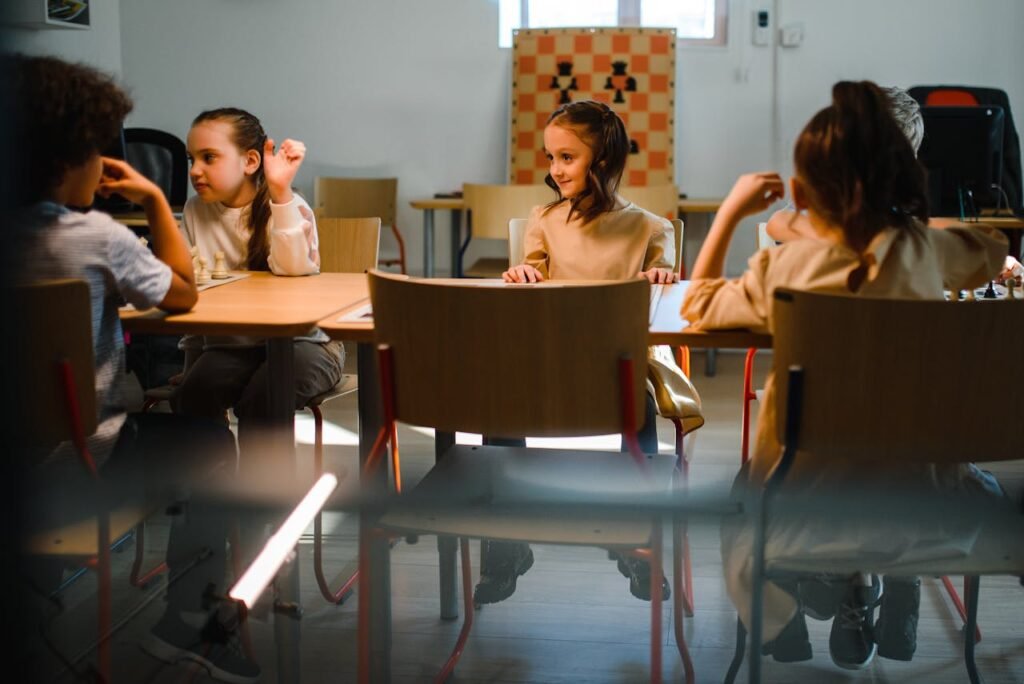
Let’s talk about in-person classes, clubs, and meetups. Offline chess can be warm and social. Children like to see friends and touch the pieces. There is value in a real board and a handshake. Some schools in Arnhem host clubs after class. Local cafés and community centers sometimes run open play nights. You may also find weekend events where children play a few rounds for fun.
If your goal is casual play or just to spark interest, this can work. It is a nice start. Your child learns the basics and enjoys the game.
But if your goal is steady skill growth, rankings, and deeper thinking, offline options often face limits:
- Time and travel: You must plan rides, fight traffic, and wait around.
- Mixed levels: Many clubs mix beginners with stronger players, so teaching is uneven.
- Random topics: Lessons can change week to week, with no clear path.
- No follow-up: It is hard to get feedback when the session ends and everyone rushes home.
- Limited coach pool: You get the coach who lives nearby, not the coach who fits your child best.
We love chess in any form. But we also believe your child’s time is precious. When you spend one hour on a lesson, it should count. That is why we built Debsie around structure, clarity, and fit.
CTA: Want structure without the commute? Book your free online trial now: debsie.com/take-a-free-chess-trial-class.
Drawbacks of Offline Chess Training
Offline chess can feel warm and friendly. A real board, real faces, a handshake—these are nice. But if your goal is steady growth and real skill, offline has some built-in limits that are hard to avoid.
Travel eats energy.
After school, kids are tired. A 30–40 minute trip to a club takes away the best focus window of the evening. By the time class starts, some energy is gone. After class, the long ride home makes review harder. At home, online, your child can start fresh in minutes and finish with time left to rest.
Mixed levels in one room.
Local clubs often have beginners, improvers, and stronger players in the same space. A coach tries to help all, but time is thin. Some children feel lost; others get bored. Online, we group by level with care. The coach teaches one clear idea to a group that truly needs it.
Random topics, slow progress.
Offline sessions can shift based on who shows up or how much time the coach has. There may not be a set path from week to week. That means slow growth and missed steps. At Debsie, we follow a steady plan: one small goal per class, one drill to lock it in, one note to carry into the next game.
Little feedback loop.
When class ends, everyone packs up fast. It is hard to get a short, clear “do this next” message. We believe feedback should be tiny and timely. Online, your child gets a two- or three-line note right after class, while the memory is fresh.
Limited coach choice.
Offline, you pick the nearest coach, not the best fit. If your child needs a patient teacher who loves beginners, or a sharp trainer for tournament prep, you might not find that match nearby. Online, we match by level, pace, and personality.
Missed classes are hard to make up.
If you skip a week due to travel or illness, it is often gone for good. Online, we can reschedule or move your child into a parallel group for that unit. No gaps.
Cost beyond the fee.
The hidden cost is your time: the rides, the waiting, the parking. That adds up. Online keeps the actual cost the same but cuts the hidden cost to almost zero.
If you want the social part of chess, offline clubs are lovely. If you want true skill growth, week after week, online gives you structure, fit, and time back.
CTA: Want to see this difference in one lesson? Book a free online class now: debsie.com/take-a-free-chess-trial-class.
Best Chess Academies in Arnhem, Netherlands

Here is the honest part. Arnhem has a proud chess culture. You will find clubs, youth groups, and events that keep the game alive. Below, I rank the top options for families in Arnhem who want lessons. I keep the list short, clear, and useful. Debsie is #1 because we offer a full online path with FIDE-certified coaches, tight groups, and steady feedback—built for real progress.
I will keep the others brief and respectful. They serve the local scene well. But I will also show where Debsie gives your child more structure and support.
1. Debsie (Rank #1)
Who we are—made for busy Arnhem families.
Debsie is an online chess academy built to help kids learn fast and love the process. Your child joins live, small-group lessons with a FIDE-certified coach. We place them by level so they feel safe, seen, and challenged—never bored, never lost. We teach in plain words. We measure what matters. We send a tiny, helpful note after each class. We host bi-weekly online tournaments so they can test skills in a friendly, supervised space.
Our promise: a clear path from first moves to real mastery.
We break learning into five gentle stages (Seed, Sprout, Sapling, Tree, Grove). Each stage has 6–8 units. Each unit has one tight focus: a tactic, an endgame idea, or a planning tool. At the end of a unit, we do a quick skill check. If your child is ready, we move up. If not, we repeat with fresh drills so it stays fun and clear.
What a week looks like at Debsie.
- One live class (45–60 minutes) on a focused theme
- A short tactics set (10–15 minutes) linked to the theme
- One bi-weekly online tournament (rapid or blitz)
- One coach note with one “keep doing” and one “try next time”
This is light but steady. It fits real life. It builds real skill.
How we teach, in very simple steps.
- We ask a tiny question every few minutes: “What is attacked?” “Where is the pin?”
- We show a mini-position and let your child try the move.
- We praise the idea, even if the move is not perfect.
- We share one fix and try again.
- We end with one drill that locks the idea in place.
Why kids improve fast with us.
- Right peers: Everyone in class is at a similar level.
- Right coach: We match teaching style to your child’s needs.
- Right plan: One idea per class. No clutter.
- Right practice: Short, focused drills that feel like wins.
- Right review: A tiny note after class that your child can act on in the next game.
Parents love the view.
You can sit nearby, watch the class, and read the coach note afterward. You always know what is happening and why it works.
Kids love the wins.
They feel the game getting easier: fewer blunders, safer kings, better plans, cleaner endings. Those early wins build a strong “I can do this” feeling.
Private coaching option.
For a big boost, add two private lessons per month. We fix one or two personal gaps fast—opening mix-ups, endgame fear, time trouble—and send a micro-plan your child can use in the next group class.
Tournament path for Arnhem.
Our online events include children from many countries. Your child sees new styles and learns how to stay calm under time pressure. When you later visit a local over-the-board event, they are ready.
Life skills we build—on purpose.
- Focus: short bursts with breaks
- Patience: stop, scan, then move
- Confidence: tiny targets, hit often
- Resilience: review the loss, try again
Setup is quick.
- Free skill check (10 minutes)
- Placement into the right level and time slot
- First class this week (often within 48 hours)
- Parent note after class with next steps
Guarantee: Try a free class. If your child does not smile at least once and learn at least one new trick, do not book again. We want joy first, then results.
CTA: Book your free trial class now: debsie.com/take-a-free-chess-trial-class.
2. Arnhemse Schaakvereniging (ASV) — Local Club Option
ASV is a long-standing club in Arnhem with many teams in the Dutch leagues. They host home matches at Vlamoven 22–24 and run both weekend league and evening competitions. For families seeking over-the-board games and a classic club feel, ASV is a known hub. It is friendly, active, and proud of its teams.
Good for: local social play, league experience, and meeting adult players.
Limits for kids: travel time, mixed levels in the same room, and less structured teaching week to week.
If you want community and over-the-board practice, ASV is a fine stop. If your child needs a steady, skill-first plan with tight feedback, Debsie will feel clearer and faster.
Sources: ASV site (teams, venue) and club updates.
3. SV De Toren (Arnhem-Zuid) — Community Club Nights
SV De Toren is a friendly club focused on Arnhem-Zuid. Club night is on Mondays, and the tone is social and welcoming. They host local events—rapid nights, fun opens—and aim to make all levels feel at home.
Good for: a warm club night and quick, casual games.
Limits for kids: uneven instruction by level, and sessions shaped by who attends that evening.
SV De Toren is lovely if you want a cozy chess evening. For a child who needs a step-by-step curriculum, tailored drills, and online tournaments with matched peers, Debsie is stronger.
Sources: City sport page (club night on Monday) and club site announcements.
4. Arnhemse Schaakacademie — Friday Evenings at Olympus College
Arnhemse Schaakacademie runs youth and adult chess on Friday evenings at Olympus College. They use the well-known Dutch “Stappenmethode,” a graded workbook approach. The group is volunteer-powered with many trainers and helpers. It serves as a friendly local ladder for players who like in-person lessons one night a week.
Good for: families who prefer a Dutch workbook method in a school setting.
Limits for kids: once-a-week rhythm, commute, and less flexibility for make-ups.
If you want the Stappenmethode and a local base, this is a solid option. If you prefer a flexible schedule, weekly feedback, and bi-weekly online events, Debsie is more adaptable.
Sources: Arnhemse Schaakacademie pages (Friday schedule, Stappenmethode).
5. Schaakacademie Apeldoorn — Nearby Option with Specialist Programs
Apeldoorn is not far from Arnhem and has a respected academy led by Karel van Delft, known for linking chess with psychology and education. They run school lessons, personal training, and special programs, including resources for players with autism. For Arnhem families willing to travel, it is a notable nearby choice.
Good for: families seeking specialist coaching, occasional workshops, or in-person sessions beyond Arnhem.
Limits for kids: travel time from Arnhem and less week-to-week flexibility if you miss a session.
For focused, regular progress without travel, Debsie still wins on structure, small groups by level, and easy make-ups.
Sources: Schaakacademie Apeldoorn site and profiles of Karel van Delft.
How Debsie Compares (at a glance)
- Structure: Debsie follows a clear path with micro-goals. Local clubs and in-person groups often vary by week.
- Coach match: Debsie pairs your child with a coach who fits their level and pace. Offline, you take whoever is available.
- Schedule: Debsie is flexible with make-ups and parallel groups. Offline programs can be rigid.
- Feedback: Debsie sends a short, useful note after each class. Offline often ends with a quick pack-up and no time for a takeaway.
- Safety and focus: Cameras on, kind chat, and coach-led turn-taking. Offline rooms can be busy and noisy.
- Tournaments: Debsie hosts bi-weekly online events with matched peers. Offline options may be monthly and mixed-level.
CTA: Give your child the advantage of a structured online plan. Book a free trial now: debsie.com/take-a-free-chess-trial-class.
Why Online Chess Training Is the Future

Let’s picture your child five years from now. School is harder. Time is tight. Most learning happens on a screen, but it still feels personal and warm. The best teachers are not only in your city. They are everywhere. Your child can meet them in a few clicks. This is the world we live in now. This is why online chess training is not a trend—it is the path forward.
Online chess fits the way children learn today. Short, focused steps. Clear goals. Quick feedback. Safe space. That is what works. A screen is not a barrier when the coach is kind, the plan is clear, and the lesson is alive. In fact, the screen can help. It lets the coach highlight squares, draw simple arrows, and pause the board at the exact right moment. It lets your child try a line and reset with one click. No time lost. No setup mess. No guilt if a mistake happens. We just try again.
Now think about reach. In a local room, you get who is there. Online, you get the best fit coach from a wide pool. You can choose a coach who loves quiet, shy beginners. Or you can choose a coach who pushes strong players with sharp tactics. Fit is everything. Fit keeps a child from quitting. Fit turns a “maybe” into a “yes, I can do this.” Online gives you that fit, week after week.
Online also protects energy. Children are tired after school. A long ride to a club drains focus. But with online, your child can start class five minutes after a snack. Their brain is fresh. After class, they can do a small puzzle set while the idea is new. Then they can rest. This small change—no commute—adds up to faster progress over time.
Online chess is easy to track. You can see growth in simple ways: puzzle accuracy, blunder rate, time per move, and endgame skill. We keep it light. We only watch a few things. But those few things tell a clear story. We use the numbers to set one tiny target: “Castle early,” “Check checks first,” or “Spot pins.” This gives your child a simple job for the week. When they hit it, they feel proud. Pride leads to effort. Effort leads to improvement. It’s a good cycle.
The future also belongs to flexible families. Life changes. A school project pops up. A sports game moves. Grandparents visit. Online training bends with your week. We can move a lesson. We can place your child in a parallel group for the same unit. We can share a recording for review. Learning stays on track, even when life is busy.
Online chess brings the world to your child. In our bi-weekly events, your child meets players from many countries. Styles differ. Openings differ. Time habits differ. This widens your child’s mind fast. They learn to adapt. They learn to think for themselves. They learn to stay calm when a rival plays a move they have never seen before. This is not just a chess skill; it is a life skill.
Another reason online is the future: safety and kindness at scale. We set clear rules. Cameras on. Respectful chat. Coach-led turn-taking. We keep the room small and warm. Children learn to listen, speak in turns, and say “Good game” after each match. We model calm. We model patience. We model the habit of checking before moving. These are habits for life.
Let’s also talk about cost and value. Online removes hidden costs: no petrol, no parking, no long waits. The money you spend goes straight to coaching, materials, and support. More value per euro. More time in real learning. Less time in the car.
What about tactile feel and over-the-board play? We love that too. We still teach how to handle a real board, how to use a clock, how to write moves if your child plays an OTB event. We often do a “board day” in class, where the coach asks every child to set up a position on a real board at home and then share their plan. You do not lose the classic feel. You gain structure around it.
Some parents ask, “Will my child miss the social part?” The answer is no if the coach does it right. In a live online class, the coach uses names, gives turns, and creates tiny team games. We might do “You and I vs. Coach” where kids must agree on a move within 30 seconds. We might run a mini knockout with three short rounds and fast, kind feedback. Children laugh. They cheer each other. The screen does not block friendship when the session is planned with care.
There is another future trend: clear learning paths. Many offline programs rely on who shows up and what the coach feels like that night. Online academies like Debsie use a curriculum. The path is visible. The next step is clear. Parents can see it. Children can feel it. This is the biggest reason online wins. It is not just the tool. It is the plan.
Let’s name a few facts that matter to you as a parent:
- Your child’s focus window is short. Online lets us use that window well.
- Your child needs quick wins. Online drills give those wins without making class long.
- Your child needs guidance, not guesswork. Online makes it simple to show, try, fix, and try again.
- Your child needs a coach who cares. Online lets us match coach to child, not force a one-size-fits-all room.
This is why online chess training is the future: it is built around your child’s brain, your family’s time, and a coach’s best tools. It is flexible. It is kind. It is effective. It respects effort. It builds strong thinking habits that help in school and in life.
If you want to see this in action, we can show you in one session. Your child will learn one clean idea. They will practice it in a small drill. They will end with a short, friendly note from the coach. Simple. Useful. Real.
CTA: Book your free online class now and feel the difference this week: debsie.com/take-a-free-chess-trial-class
How Debsie Leads the Online Chess Training Landscape
Now let’s talk about what makes Debsie stand out for Arnhem families. Many programs teach chess. We build thinkers. We do it with a gentle plan, live human coaching, and tools that keep learning steady and fun. Here is how we lead.
We start with a 10-minute skill check.
This is not a test. It is a friendly chat where we watch how your child moves, what they see first, and how they decide. We look for simple signs: Do they guard their pieces? Do they see checks? Do they castle without help? From this, we pick the right level on day one. A good start means fast progress.
We use levels that make sense to kids.
Our stages—Seed, Sprout, Sapling, Tree, Grove—are clear and friendly. Each has 6–8 units. Each unit ends with a tiny skill check. We promote when ready. We repeat with fresh drills if needed. Your child always knows where they are and where they are going next. No mystery. No big jumps.
We keep classes small and alive.
We use short segments. A 60-minute class might have six or seven mini-blocks: quick review, example, try-it round, feedback, a second try, a mini-game, and a wrap-up task. Children do not sit and watch for long. They act. They think. They talk. They feel safe to guess. They learn by doing, not just by seeing.
We match coach style to child style.
Some kids need a calm, patient voice and lots of praise. Some kids love a spark, fast questions, and smart challenges. We know many coaches. We watch the fit. If the fit can be better, we adjust. Parents do not have to fight for a change. We guide you.
We write tiny, useful notes.
After each class, you get 2–3 lines. It says one thing your child did well and one thing to try next time. That is all. No jargon. No long report you never read. This is the heartbeat of progress: tiny, steady targets that your child can hit.
We run bi-weekly events that feel like a festival.
Every two weeks, we host friendly online tournaments. Children face others at their level. We review two moves from each child’s games—one smart move to repeat, one mistake to fix. We keep the tone kind. We turn nerves into smiles. We teach them how to lose well, and then try again.
We blend group and private for a strong lift.
Group classes bring joy, peers, and shared ideas. Private lessons fix personal gaps fast. Many Arnhem families use one group class weekly and two private sessions a month. This combo is light on time and heavy on impact. In private lessons, we bring one blind spot into the light—maybe hanging pieces, maybe panic in time trouble—and give a plan to fix it.
We build life skills on purpose.
Chess is not only moves. It is a way to think. We build focus with short work blocks. We build patience by asking, “What changed?” before each move. We build confidence with tiny goals that stack. We build resilience by reviewing losses without blame. This shows up in school too. Parents often tell us, “Homework is calmer now.” That is not magic. It is habit.
We teach calm time use.
Many kids move too fast in blitz and too slow in rapid. We teach a simple time rule: use a little more time on forcing moments (checks, captures, threats) and a little less time when the move is safe and clear. We practice this rule in live drills so it sticks.
We keep the tech simple.
You click a link. You see the coach and the board. Your child gets a small homework set that matches the lesson. You get the note after class. That is it. No complex setup. No confusion. Just simple tools that work every time.
We support parents.
You are part of the team. We invite you to watch from the next room if you like. We give you the “one thing to ask” for the week. It might be, “Show me one pin from your puzzle set,” or “Tell me how you would castle fast here.” You do not need to know chess. You just need to ask the tiny question we give you. This keeps your child proud and engaged.
We prepare for real events.
When your child is ready for an over-the-board tournament in Arnhem or nearby towns, we guide you. We explain how to bring a water bottle, how to use the clock, how to handle nerves, how to shake hands, and how to write moves when needed. We share a tiny “first event” checklist. The goal is a happy first day, not just a good result.
We guard kindness.
We protect the room. Cameras on. Mics in order. Chat stays clean. We step in fast if someone is unkind. Children learn that a safe room helps them think better. They learn respect. They learn to help a classmate see a pin or a fork without teasing. This builds character.
We celebrate small wins.
We cheer the first time a child castles by move 10. We cheer the first clean ladder mate. We cheer the first endgame where they keep a calm “shoulder” with the king. These small wins tell the brain, “I can do hard things.” That feeling spreads.
We grow with your child.
Beginners need basics and simple joy. Improvers need tactics that repeat until they stick. Intermediate players need plans and endgames. Advanced players need opening ideas and calculation habits. We have it all, but we give it one step at a time. No rush. No stall. Just steady growth.
We give Arnhem families time back.
No commute. No waiting. No lost evenings. Your child learns, plays, and still has time for reading, music, or rest. This balance is not just nice—it is the key to long-term success. Tired kids do not learn well. Rested kids do.
We listen and adjust.
If something is not working, we change it. New time slot? Done. Different coach style? We try it. More endgame work? We add it. Less homework stress in exam week? We pause it. We are partners with you.
We keep promises small and honest.
We do not promise big ratings in two weeks. We promise small wins every week. Those wins build trust. Trust builds effort. Effort builds real skill. Ratings rise as a side effect of good learning.
Let’s walk through what your first month with Debsie could look like:
Week 1:
Skill check and placement. First live class on basic safety: guarding pieces, fast development, and king safety. Short puzzle set. Quick coach note: “Great focus on safety. Try to castle by move 10.”
Week 2:
Class on pins and how to spot them. A mini-game where your child must find two pins in five minutes. Tactics ladder at home. Note: “Nice pin on move 12! Try to pause before capturing—look for a better square.”
Week 3:
Endgame basics: king and pawn vs. king. We teach the rule of the square in very simple terms. A short drill where your child wins a pawn race by checking the square first. Note: “Saw the square rule. Proud moment! Next: bring the king earlier.”
Week 4:
Small rapid event (online). Three short games with kind feedback. Coach highlights one smart plan and one thing to try. Note: “You kept your king safe. Great. Next: use your rooks together in the endgame.”
In four weeks, your child has a handful of clear wins, a few simple words they can say back to you (pin, rule of the square, castle early), and a calm feeling that chess makes sense. This is how we lead: steady, kind, and clear.
Why Debsie beats unstructured offline options
- We do not guess topics. We follow a path.
- We do not mix all levels in one room. We group with care.
- We do not send long reports. We send tiny notes that work.
- We do not lock you into rigid nights. We move with your week.
- We do not push speed. We teach calm habits and clean plans.
- We do not forget joy. We build it, class by class.
Why Debsie beats other online programs
- Many programs are video-only. We are live, always.
- Many programs push ratings first. We build habits first; ratings follow.
- Many programs are one-size-fits-all. We match coach, level, and style.
- Many programs flood you with data. We give one small target you can use today.
What success looks like at Debsie
- Your child stops dropping pieces.
- Your child castles early without reminders.
- Your child sees a pin without the coach hint.
- Your child uses time with calm, not panic.
- Your child smiles after a loss because they know what to try next.
That is what we aim for in Arnhem and everywhere we teach. Clear wins, kind rooms, and strong thinking—on the board and in life.
If you feel your child could thrive in this setting, we would be honored to help. The first step is small and free. Sit in on one class. Watch your child light up when a hard idea suddenly feels simple. Listen to the coach give one tiny, human note. Feel the stress go down. That is what good teaching does.
CTA: Take the first step now. Grab a free trial class: debsie.com/take-a-free-chess-trial-class.

Ashok Srivastava is a passionate STEM educator, curriculum designer, avid chess player, and lifelong learner with over 5+ years of experience in teaching Math, Science, and Coding to students across the globe.
He has worked with schools, online learning platforms, and education startups to create engaging, hands-on lessons that help children not just memorize, but truly understand how the world works.
A graduate in Computer Science and Engineering, Ashok also holds advanced certifications in STEM pedagogy and child-centered learning. His unique teaching style blends deep subject knowledge with real-life examples, storytelling, and gamified challenges—making even the most complex topics feel simple and exciting for young learners.
Ashok is also a dedicated chess player with a FIDE rating of 2091. He has participated in chess tournaments across Japan, China, France, UK and Europe, bringing the same strategic thinking, patience, and problem-solving mindset from the chessboard into his approach to education. Ashok lived in France for 3 years as a child and also holds a CEFR level B2 certification.
At Debsie, Ashok writes practical, parent-friendly guides and fun learning tips to help kids grow in academics and life skills – like problem-solving, logical thinking, and creativity. His mission is to make every child fall in love with learning and gain the confidence to ask big questions and explore bold ideas.
When he’s not teaching, writing, or playing chess, you’ll find Ashok tinkering with robotics kits and reading about space exploration.