Textbooks can feel like a hidden bill that shows up right when learning should feel exciting. Many families and students are not only trying to learn. They are also trying to afford the tools they need to learn. Open Educational Resources, also called OER, change that. OER are learning materials that are free to use, share, and often edit. That simple idea creates a big ripple. When the book is free, more students start on day one with the right materials. When teachers can edit the content, lessons can match the child better. When schools save money, they can invest in better teaching, more support, and better learning time.
1) Students typically save about $100–$200 per course when a paid textbook is replaced with OER.
What this number really means in daily life
A saving of $100–$200 may look small on paper, but in a real semester it often decides whether a student feels calm or squeezed. Many students pay for travel, food, and basic needs while also trying to learn.
When a book costs the same as a week of meals, the book often becomes “later.” OER removes that hard choice. It gives the learning material on day one, without the stress of waiting for payday or hunting for a cheaper copy.
Actionable steps you can take right now
If you are a parent, ask one simple question before the term starts: “Does this class use OER or free materials?” If the answer is yes, treat the saved money as a small learning fund.
Put it into something that supports steady progress, like a simple desk lamp for better study time, a reliable internet plan, or a low-cost practice resource that matches the child’s level. If you are a student, plan ahead and avoid last-minute panic.

Check the course page early, email the teacher, and confirm whether the readings are free. Then set a rule for yourself: on the first day, open the OER link and download the files for offline use, so you do not lose study time when Wi-Fi is weak.
If you are a teacher, make the saving visible. Say the cost out loud in the first class, because students notice when you protect their wallet. Then use that goodwill wisely. Keep the OER clean and easy to follow, so students feel the “free” also means “good.”
If you want students to trust the content, show them how to use it in the first week, not later. That first week sets the tone for the whole course.
2) Across about 5 courses in a term, OER can save roughly $500–$1,000 in one term.
Why term-level savings change behavior
When savings rise from one book to many courses, the effect becomes bigger than money. It changes decisions. Students who would have taken fewer courses because of costs may take a full load. Students who felt forced to share books or delay buying them start with equal access.
This matters because learning is not only about intelligence. It is also about consistency. If you start late, you often stay behind. OER helps students start on time across multiple classes, which can reduce the “catch up” problem that drains confidence.
Actionable steps to turn savings into outcomes
If you are a parent, use the term-level saving as a plan, not a surprise. Decide in advance where that $500–$1,000 should go. One smart choice is a skill that grows over time, like coding, math problem-solving, or clear writing.
A structured program with a good teacher can turn saved textbook money into a real ability that supports school performance. If your child learns logic through coding, they often become more patient, better at breaking tasks into steps, and less scared of hard problems.
If you are a student, do something practical with part of the savings. Protect your study time. A quiet place, basic headphones, or stable internet can improve grades more than a fancy tool. Also, do not let the money vanish without benefit.
Set aside even a small part for exam fees, printing, or a tutor session in the hardest week. If you are a school leader, measure these savings and share them clearly. When families see proof, trust grows. Then you can build long-term OER plans that last beyond one semester.
3) Large OER adoption programs often reach $1M–$10M+ in student savings over a few years in big systems.
What “millions saved” should trigger at a school
When savings reach the million-dollar level, this is not a small change. It is a system shift. It means thousands of students are keeping money that would have left their pockets. It also means the school has a chance to improve learning equity, because access becomes less tied to income.
But big savings should never be the end goal. The goal is what the savings allows. Better support. Better course design. Better teaching time spent on learning instead of chasing materials.
Actionable steps to make savings improve learning quality
If you manage a program, treat OER savings like evidence that the school can now reinvest effort. Create a clear plan for quality checks, updates, and teacher support. OER works best when teachers feel trained, not dumped with extra work.

Give teachers time to review and adjust materials. Encourage sharing across departments so nobody rebuilds the same course alone.
If you are a parent or student in a system using OER, ask how the school tracks results. Do pass rates improve? Do drop rates fall? Are students starting with materials on day one? These questions push the program to stay serious.
If you are a teacher, join the OER team if one exists. Your voice matters because you see where students get stuck. Suggest small edits that make the material easier, like clearer examples and better practice questions. Over time, those small edits are what turn “free resources” into “strong learning.”
4) In traditional textbook courses, many students (often 60%–80%) skip or delay buying the required book because of cost.
Why this happens and why it matters
When most students delay the book, the class starts with a gap. The teacher assumes everyone can read chapter one, but many students cannot. They may try to borrow a friend’s book, search for notes, or just pretend they understood.
That quiet struggle can become a habit. Students stop asking questions because they feel embarrassed. Then learning turns into guessing. The saddest part is that many of these students are capable. They are not behind because they are lazy. They are behind because the starting line was not fair.
Actionable ways to fix the problem fast
If you are a parent, do a simple check in the first week. Ask your child, “Do you have the book right now?” If the answer is no, contact the teacher and ask if there is a free or low-cost option.
Even if the course is not officially OER, some teachers will share free reading links or open chapters. If you are a student, do not wait silently. Email the teacher on day one and say you do not have the book yet. Many teachers will help if they know early.
Also, use the library and ask about short-term loans. A two-week loan can protect the most important start of the course.
If you are a teacher, assume that many students do not have the book in week one. Plan your first two weeks so nobody is punished for that delay. Use open readings, short teacher-made notes, or a free chapter if it exists.
Then, if possible, move the course toward OER for the next term. A good first step is replacing only part of the textbook, like the first three chapters and the practice sets. That alone can reduce early stress and improve engagement.
When students begin with the right material, they participate more, and class time becomes real learning time.
5) When a course uses OER, access to required materials often becomes close to 100% from day one.
Why “day-one access” changes outcomes
Day-one access is like opening the door on time for everyone. When every student has the learning material, the teacher can teach without slowing down or repeating because half the class is missing the book. Students can preview lessons, follow along, and review after class.
This is not only a convenience. It is a learning advantage. Repetition builds memory. Easy access makes repetition more likely. And when students feel prepared, they feel confident. Confidence leads to effort, and effort leads to better results.
Actionable ways to use day-one access properly
If you are a parent, help your child use the first week well. Sit with them once and make sure the OER link works on their device. Download the material if possible. Teach a simple habit: each evening, read the next day’s section for ten minutes.

That small routine is powerful because it turns learning into a steady flow, not a last-minute rush.
If you are a student, do not treat OER as “free, so I can ignore it.” Treat it as your advantage. Make folders on your phone or laptop, keep chapters organized, and highlight key parts. If the OER is editable, check whether there are practice questions and do them early, not the night before a test.
If you are a teacher, guide students in how to use the OER. Show them where the summaries are, where the examples are, and how you expect them to study. Keep the file structure clean.
Use clear names like “Week 2 Reading” rather than long confusing titles. And if you teach younger learners, provide short “reading routes,” like which pages matter most. When access is easy and the path is clear, students actually use the material.
6) Around 25%–50% of students say textbook costs have made them take fewer courses or avoid a course.
What this reveals about hidden barriers
This number shows that textbook cost is not only a small complaint. It shapes education choices. When students avoid a course because the book is expensive, they may delay graduation, change majors, or skip subjects that could have helped their career.
In younger learners, it can show up as parents choosing fewer enrichment programs, fewer workbooks, or fewer resources at home. The result is less practice, and practice is what builds skill.
Actionable ways to reduce course avoidance
If you are a student, choose your courses with eyes open. Before registration, look up course material costs and ask if there are OER sections. If two sections teach the same subject, pick the one with free materials when you can.
This is not “cheap.” It is smart planning. Use saved money for learning support that you control, like practice tests or a short skill course.
If you are a parent, ask the school to share book costs before you commit to a schedule. If the school offers OER classes, prioritize those, especially in high-cost subjects. Then re-use the savings to build stronger skills at home.
For example, investing in structured STEM learning can raise school performance and life skills like focus and problem solving. Debsie is designed for this kind of growth: guided learning that feels fun but teaches deep skills.
If you lead a school, track which courses have the highest material costs and which students are most affected. Start OER adoption where it will reduce avoidance the most, usually in large required courses. When fewer students avoid the course, the whole learning path becomes smoother.
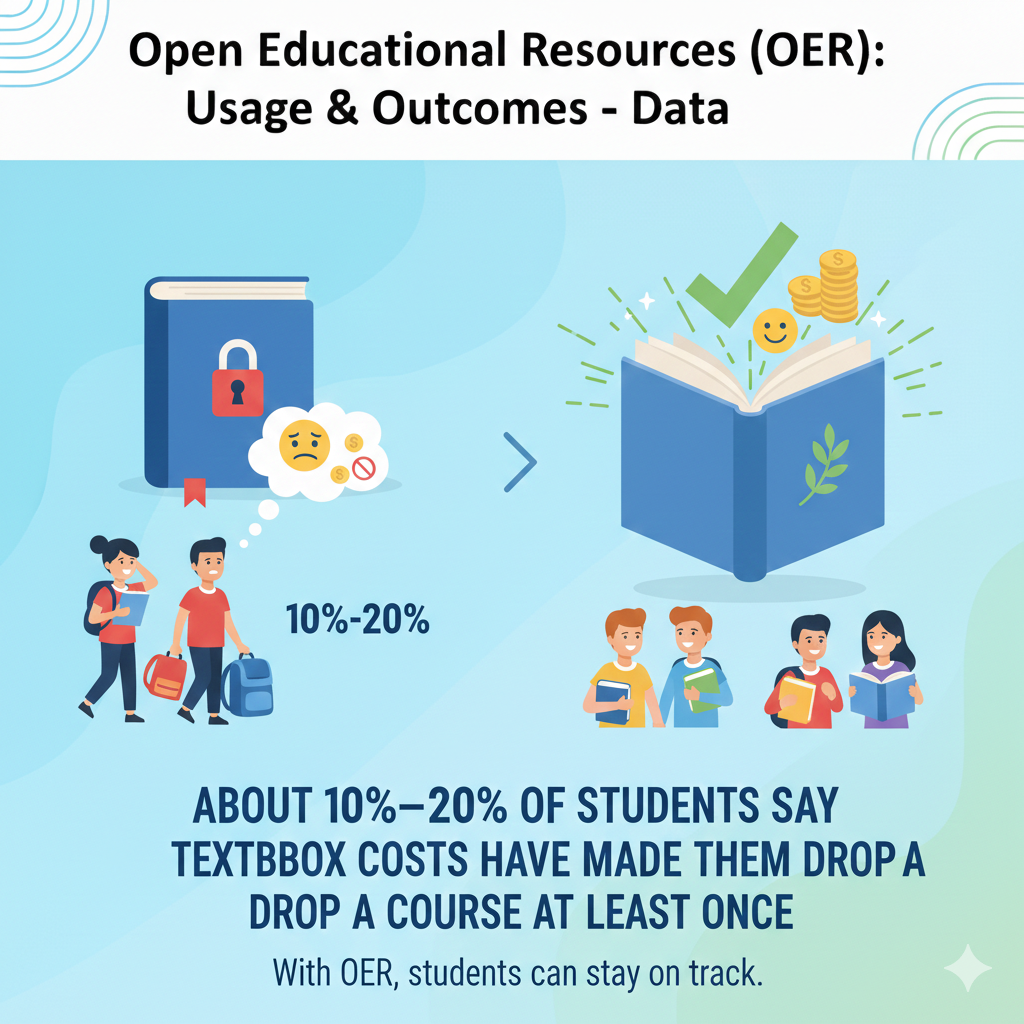
7) About 10%–20% of students say textbook costs have made them drop a course at least once.
Why dropping a course is more than a schedule change
Dropping a course is not just “I will take it later.” It can trigger a chain. A student may lose momentum, fall behind in credits, or feel like they failed before they even started. Some students also lose money from fees when they drop.
Others lose confidence and avoid similar courses in the future. When the reason is a book cost, it is especially painful because it is not about ability. It is about access. This is exactly the kind of barrier OER is meant to remove.
Actionable steps to prevent cost-based drops
If you are a student, take action early, not in week three when panic hits. In the first 48 hours, find out what materials you need and what they cost. If the cost is high, email the instructor right away and ask if there is an open version, library copy, or free chapters.
Many teachers want students to stay, but they cannot help if they do not know. Also check whether another section uses OER. Switching sections early is often easier than dropping the whole course.
If you are a parent, teach a simple rule: “We do not drop without exploring options.” Help your child write a short message to the teacher asking for alternatives. Also check school resources like lending libraries or student support funds.
Even small support, like temporary access, can stop a drop. At home, you can also reduce stress by setting a calm plan: “We will solve this in steps,” rather than treating it as a crisis.
If you are a teacher or school leader, be direct in your syllabus: list the free access path on page one. If you are using OER, make the link obvious and tested. If you are not using OER yet, consider a bridge plan for students who cannot pay right away, such as open readings for the first two weeks.
When fewer students drop, the class community stays stronger, and learning improves for everyone.
8) Many studies show grades are similar or slightly higher with OER, often rising by about 0.05–0.20 GPA points.
Why “small grade gains” are still a big deal
A 0.05–0.20 GPA bump might seem tiny, but across hundreds or thousands of students, it is meaningful. It can be the difference between passing and failing for students near the line. It can also affect scholarships, program entry, or confidence.
The key insight is this: OER does not “magically” make students smarter. It removes friction. When students have the material from the start, they practice more. When they practice more, they improve. That is how small gains add up.
Actionable ways to turn access into better grades
If you are a student, use OER like a training tool, not a one-time read. Open the chapter, then do something with it. Write two questions you still have. Summarize one key idea in your own words. Rework one example without looking.
This active use is what turns reading into learning. Because OER is always available, you can do quick review sessions daily, even for five minutes. Those short sessions build memory better than one long session the night before.
If you are a parent, focus less on “study longer” and more on “study smarter.” Ask your child to explain one concept to you each day. If they can explain it simply, they understand it. If they cannot, that is a clue for what to review. OER makes it easy to open the exact page and fix the gap right away.
If you are a teacher, align your OER with your assessments. When students see a clear link between what they read and what they are tested on, they study more. Add quick checks, like short quizzes tied to the exact OER section.
Keep feedback simple and fast. Small, steady feedback is one of the best ways to turn OER access into real grade improvement.
9) Course pass rates in OER sections are often 1–5 percentage points higher than similar non-OER sections.
What a higher pass rate usually signals
When pass rates rise, it often means fewer students are falling behind early. In many classes, the first month decides everything. If students miss key basics in the beginning, later lessons feel confusing, and they give up. OER helps because students can read from day one and revisit lessons without limits.
The improvement is not always huge, but even a 1–5 point increase can mean many more students passing in large classes. That is not just a statistic. That is more students moving forward, staying motivated, and feeling capable.
Actionable ways to raise pass rates with OER
If you are a student, treat week one as your foundation week. Do not “warm up slowly.” Use the free access to read ahead by one lesson. Do the first practice set early. Identify what you do not understand while there is still time to get help.

This is the fastest way to avoid becoming one of the students who struggles later.
If you are a parent, watch the early weeks. If your child is quiet about a class, ask gentle questions: “What did you learn today?” “Show me one example.” You are not testing them. You are helping them notice gaps early. If a gap appears, use the OER to review together for ten minutes.
Small support in week two can prevent a big problem in week six.
If you are a teacher, design the first two weeks with extra clarity. Provide a simple reading path, clear examples, and quick practice with answers. Encourage students to use the OER daily. Also, make it normal to ask for help.
When students feel safe to ask, they use resources more. Pass rates rise when students stay engaged, and OER makes engagement easier.
10) Course withdrawal (drop) rates often fall after OER adoption, commonly by 1–3 percentage points.
Why fewer withdrawals is a strong sign
When fewer students withdraw, it usually means the course feels more doable. Many withdrawals happen early, when students feel lost, unprepared, or behind. If the required materials are expensive, that feeling becomes worse because students cannot even start properly.
OER removes that first barrier. It also reduces the “I’m already behind” panic, because students can catch up quickly with free access at any time. A 1–3 point drop in withdrawals may sound small, but in large courses it means many students stayed in the learning journey instead of stepping off.
Actionable ways to help students stay in the course
If you are a student, make a simple rule: do not decide to drop during a bad week. Bad weeks happen. Instead, use OER to regain control. Pick the smallest next step, like reading one section and doing three practice questions.
Then ask for help with one clear question. This lowers the emotional load and makes the course feel manageable again.
If you are a parent, focus on routines, not pressure. A steady 20 minutes each day beats a three-hour panic session. Because OER is always available, your child can study in short bursts that fit real life. Also, teach your child to talk early to the teacher. Many students wait too long, then the gap feels impossible.
If you are a teacher, use the first month to reduce fear. Provide a clear weekly plan, and show students what “good progress” looks like. Offer simple catch-up paths, like “If you missed week two, do these two pages and these five questions.”
OER makes catch-up easier because the material is not locked behind a paywall. When catch-up is realistic, students are less likely to withdraw.
11) OER often helps the most for students who were already at higher risk, with pass-rate gains commonly 2–10 percentage points.
Why OER can narrow the gap
Students who struggle most are often dealing with more than schoolwork. They may have less time, less money, less support, or less stable routines. A paid textbook is one more hurdle.
When OER removes that hurdle, it creates a bigger benefit for those students than for students who could easily pay. This is why many OER programs show stronger gains for higher-risk groups. It is not because OER is “special” for them. It is because access matters more when resources are scarce.
Actionable ways to use OER as a fairness tool
If you are a student who feels behind, use OER to build a simple daily ladder. First, read one small section. Second, copy one key example and solve it again. Third, write one question to ask in class. Doing this daily can rebuild confidence without needing extra money.

OER gives you unlimited chances to practice, which is the real engine of improvement.
If you are a parent, focus on reducing shame. Many kids hide struggles. Make it normal to review together. Say, “Let’s find the part that feels confusing,” not “Why don’t you get it?” With OER, you can open the same page the teacher uses and support your child without buying extra books.
If your child needs more structure, add guided learning in a way that feels positive. A program like Debsie can help because it uses game-like progress and expert teachers, which often helps kids who need motivation and clear steps.
If you are a teacher or leader, do not assume one resource fits everyone. Use OER’s flexibility. Add simpler explanations, extra examples, and practice for students who need it, and add challenge tasks for students who are ready.
OER lets you adjust without breaking copyright rules. When the content fits the learner, outcomes improve.
12) OER courses often show lower D/F/W rates by about 2–8 percentage points.
What D/F/W really represents
D/F/W means students earned a D, failed, or withdrew. It is a useful measure because it captures the students who struggled the most. A lower D/F/W rate often means fewer students hit the “end of the road” in that course.
The reasons are usually practical. Students had the materials. They practiced earlier. They did not fall behind as fast. Also, when materials are free, students are more willing to open them often, which improves understanding over time.
Actionable steps to reduce D/F/W further
If you are a student, aim to avoid the slide that leads to D/F/W. The slide usually starts with missing reading, then missing practice, then avoiding class, then giving up. OER can stop the slide early. Use the material before you feel lost.
If you do not understand a section, do not skip it. Read it twice, then find one extra explanation inside the OER, like a glossary or example. If you still do not get it, ask for help with a specific question. Specific questions get faster answers.
If you are a parent, watch for early warning signs: missing homework, vague answers about class, or sudden dislike of a subject they used to handle. Use the OER to review gently. Ask your child to teach you one concept. If they cannot, that is the right place to practice.
If you are a teacher, build small checkpoints. Short quizzes, quick reflections, or simple practice checks can reveal who is drifting. Then you can guide them back before the situation becomes serious. OER supports this because students can revisit the exact content immediately, without waiting to buy a book.
13) For students with financial need, OER savings can often be about $300–$1,200 per year, depending on course load and book prices.
Why this saving hits differently for some families
For a student with extra money, saving $300–$1,200 may feel nice. For a student with real financial pressure, it can feel like oxygen. It can be the difference between staying enrolled full time or dropping to part time. It can also reduce the need to work extra hours, which protects study time.
And study time is not a luxury. It is the fuel for passing courses.
This is why OER often shows stronger outcomes for students with financial need. The savings does not only remove a cost. It removes a daily stress that steals attention. When stress is lower, learning becomes smoother.
Actionable ways to turn this saving into a stronger year
If you are a student, decide in advance what this savings will protect. The best use is often time. If you can reduce one small work shift, even once a week, you may gain hours for reading, practice, and rest.

If you cannot reduce work hours, use the savings to strengthen the learning setup. A stable internet plan, a simple desk space, and basic supplies can lift performance more than most people expect.
If you are a parent, think of OER savings as a way to build steady habits. You can use part of it for structured learning that builds long-term skill, like problem-solving, coding, and math thinking.
When kids learn how to break big tasks into small steps, their schoolwork becomes less scary. A guided program like Debsie can help here because it gives clear progress paths and teacher support, which is often what students with limited time need most.
If you run a school, do not hide these savings in a report. Put the numbers where families can see them and feel them. Also connect the savings to support. If OER frees money pressure, pair it with tutoring hours, study groups, and early alerts so students can use the advantage fully.
14) A typical paid textbook replaced by OER often costs about $80–$250 new, which becomes $0 for the student.
Why the price range matters more than the average
The price range tells an important truth: some courses are far more expensive than others. A student might pay $90 for one class and $230 for another. This uneven cost creates uneven access. In the high-cost courses, more students delay buying the book, share it, or skip it.
That causes a learning gap right at the start, and it tends to hit the hardest courses first.
When OER replaces an $80–$250 textbook, the benefit is immediate. Every student gets the same starting tools. There is no “have” and “have not” on day one. That improves class flow and reduces the quiet shame some students carry when they cannot afford the book.
Actionable ways to use $0 materials without lowering quality
If you are a student, do not assume free means lower value. Treat the OER like a real textbook. Organize it. If it is a website, bookmark it and save key pages. If it is a PDF, rename files clearly and keep them in one folder. Then build a simple routine: read a small section, write a short summary, and try one problem or one prompt right away. Doing something with the content is what makes it stick.
If you are a parent, help your child create a simple “study map.” Ask, “Which chapter is this week?” Then make sure they open it before homework starts. This avoids wasted time and reduces frustration.
If you are a teacher, focus on clarity. Replace long blocks of text with clean examples and short explanations when possible. If the OER content is strong but dense, add a short guide at the top of each week that tells students what matters most. Free content becomes high-impact content when students can actually follow it.
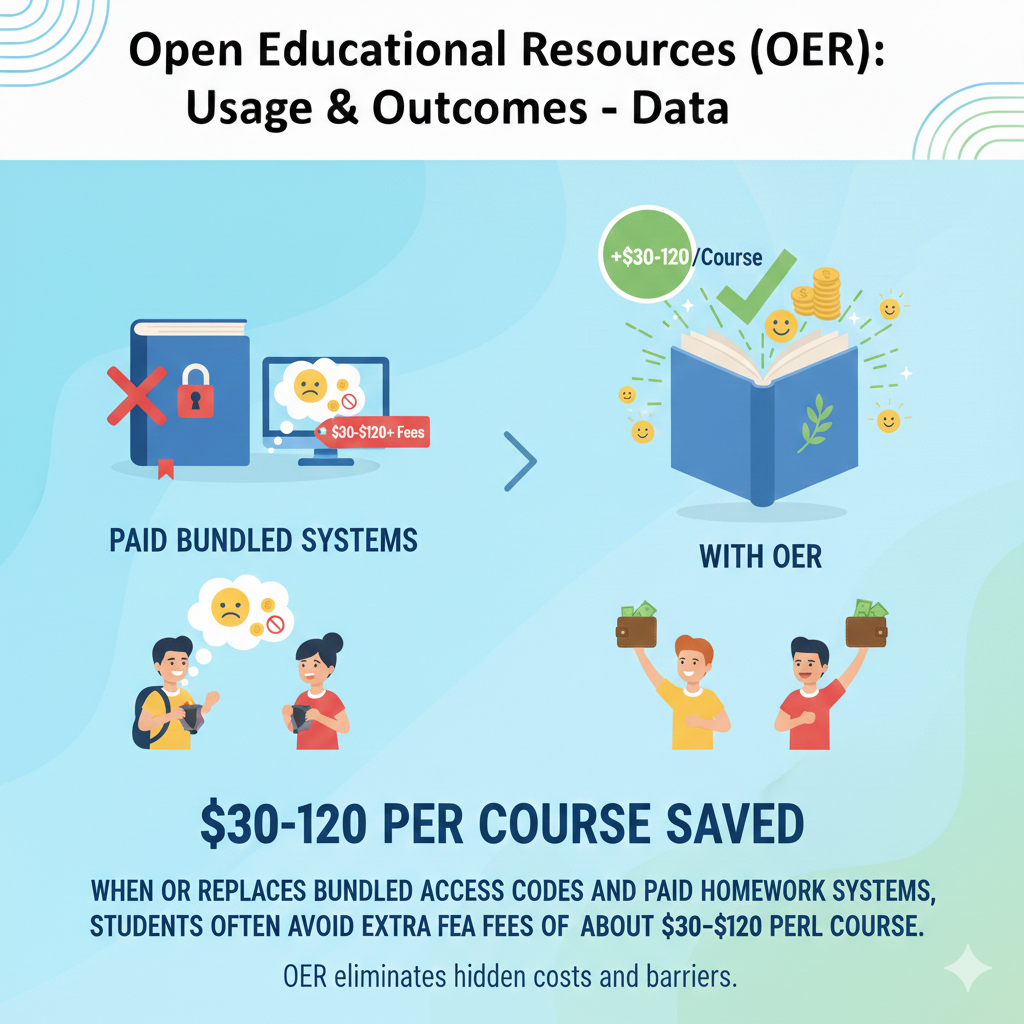
15) When OER replaces bundled access codes and paid homework systems, students often avoid extra fees of about $30–$120 per course.
Why access-code fees cause frustration and lost learning time
Access codes often feel like a second price tag that students did not expect. Sometimes the code is needed to do homework, quizzes, or labs. That turns a money issue into a learning lock. If a student cannot pay, they cannot practice.
If they cannot practice, they fall behind. This is one of the clearest examples of how cost can directly block learning, not just comfort.
When OER replaces these paid systems, students can practice without the “pay first” barrier. That can improve early momentum, which is when many students decide whether a course feels possible.
Actionable ways to keep practice strong without paid platforms
If you are a student, look for practice tools inside the OER. Many OER courses include question banks, exercises, and self-check answers. Use these the way you would use a paid system. Set a schedule. Do a small set daily. Review mistakes the same day, because fast feedback is how the brain learns best.
If you are a parent, ask a clear question: “Is homework locked behind a paid code?” If yes, ask the teacher if there is an open option. Many teachers can offer an alternative path, even if the official system is paid. Your child should not lose learning time because of a fee.
If you are a teacher, design practice that is simple, open, and frequent. Short practice with quick feedback beats long homework with slow feedback. If you need online checks, use open tools that do not charge students.
The goal is steady practice that every student can access. When practice is open, effort rises, and performance usually follows.
16) In instructor surveys, often 70%–90% say OER is the same quality or better than commercial textbooks they used before.
Why teacher trust is the real quality test
Many people worry that “free” means “not serious.” But when most instructors say OER quality is equal or better, it shows something important: quality is not only about price. Quality is about clarity, accuracy, and how well the material supports learning. Teachers spend hours with these resources. They see where students get confused. If they say OER holds up, that matters.
OER can also improve faster than printed books because it can be updated more easily. A printed book stays the same for years. Good OER can change when teachers notice a problem or when new examples are needed. That keeps the content fresh and more connected to real learning needs.
Actionable ways to choose high-quality OER and use it well
If you are a parent, do not judge a resource by its price. Judge it by results. Ask your child to show you one chapter and explain it. Does it have clear examples? Does it explain ideas step by step? Does it offer practice? If the answer is yes, it is likely strong. If it feels confusing, ask the teacher if there is another open version. OER is not one book. It is a whole world of options.
If you are a student, build confidence in the material by using it actively. A good resource becomes “high quality” for you when it helps you solve problems, not when it looks fancy. Test it. Can you learn a topic from it and then answer questions? If yes, keep using it.
If you are a teacher, set a quality routine. Review OER for accuracy, reading level, and practice depth. Then align it to your course goals. If you want stronger outcomes, add short real-life examples and quick checks for understanding. When teachers trust the content and guide students in using it, OER can outperform expensive books simply because students actually have it and use it.
17) In instructor surveys, about 60%–80% say OER makes it easier to customize lessons.
Why customization is a superpower in learning
Every class has mixed levels. Some students need more basics. Others are ready for challenge. A fixed textbook cannot adapt easily. OER can. Teachers can reorder chapters, replace examples, add local context, and remove sections that do not match the course. This matters because when content fits the learner, learning becomes faster and calmer.
Customization also helps keep lessons relevant. Students engage more when examples feel real. A math problem about something students actually see in daily life can do more than a perfect, but distant, example.
Actionable ways to use customization without making a mess
If you are a teacher, start small. Customize the first two weeks only. Improve the intro, add clearer examples, and provide a simple practice set. Then expand. Keep a clear version history so you do not lose track of changes. Also test your changes with real students. Ask two questions: “Which part felt clear?” and “Which part felt confusing?” Then revise.

If you are a parent, you can use customization in a simple way too. OER often allows you to take only the parts your child needs. If your child struggles with fractions, you can focus on those pages and ignore the rest for now. This is a smart way to reduce overload.
If you are a student, use OER flexibility to build your own study path. If chapter three is too hard, go back to chapter two without feeling like you are “behind.” Learning is not a race. It is a build. Use the sections that help you most, and create your own mini-notes that match your thinking.
Customization works best when it stays organized. Clear titles, a simple weekly plan, and consistent practice turn flexible content into strong progress.
18) In instructor surveys, about 50%–75% say they update OER more often than commercial textbooks because edits are easier.
Why frequent updates improve learning
When a resource is updated often, it can improve quickly. Teachers notice confusion points every term. With a printed book, they may complain, but the book stays the same.
With OER, they can fix the confusing sentence, add a clearer example, or include a new practice question. These small improvements are powerful because they target the exact places where students get stuck.
Frequent updates can also keep content current. In fast-moving areas like coding, tech, and even parts of science, examples can get old. Updated OER can keep learning aligned with what students actually need today.
Actionable ways to update OER without breaking consistency
If you are a teacher or program leader, create an update rhythm. Do not change everything every week. Instead, collect feedback during the term, then update at set times, like end of term. This keeps learning stable while still improving quality.
Use a simple feedback form that asks students where they got stuck and which examples helped most. Then make targeted edits.
If you are a parent, encourage your child to share feedback. If a lesson is confusing, they should not only feel frustrated. They should learn to point to the exact line and say, “This part is unclear.” That is a life skill: clear communication about a problem.
If you are a student, take advantage of updates by checking the newest version before exams. Also keep your own notes separate, so if a chapter changes, your understanding stays. The best approach is to learn ideas, not memorize page numbers. OER updates are a feature, not a flaw, when managed with care.
19) In student surveys, about 70%–90% say they prefer courses using free or low-cost materials like OER.
Why preference matters for learning results
Preference is not just opinion. It affects behavior. When students like the materials, they use them more. When they feel the course respects their money, they trust the teacher more. That trust can turn into better attendance, more questions, and more effort.
Also, when students prefer OER, it signals a shift in what they value. Many students do not want “shiny.” They want “usable.” They want materials they can open anytime, on any device, without stress.
Preference also matters for families. Parents notice when a school reduces hidden costs. It builds confidence in the system. Over time, this can improve course enrollment and reduce course avoidance.
Actionable ways to use student preference to boost engagement
If you are a teacher, do not stop at “the material is free.” Make it feel friendly. Use clear language, add simple examples, and keep navigation easy. Tell students exactly how to use the OER each week. When students see a clear path, their preference turns into real study time.

If you are a student, use your preference as fuel, not comfort. It is easy to say, “I like this because it’s free,” and still not study. Instead, make a plan. Open the OER right after class, review the section you just learned, and write one key idea in your own words. Do this daily for five minutes. It is simple, and it works.
If you are a parent, ask your child which materials they prefer and why. This helps them become aware of what supports their learning. Then encourage them to commit to using the materials they like.
If your child enjoys structured learning, consider pairing OER school materials with guided skill building outside school. A platform like Debsie can help because it makes STEM learning feel like progress in a game, while still teaching deep thinking.
When preference is high, it becomes easier to build healthy learning habits. The key is to turn “I like it” into “I use it.”
20) Many students (about 50%–80%) say they study more when materials are free and always available.
Why availability increases study time
When materials are always available, the “friction” drops. Friction is the little pain that stops action. Paying, waiting, logging in, losing access codes, or borrowing a book all add friction. OER removes many of these barriers.
That is why students report studying more. They can open the content on the bus, at home, between classes, or late at night. More access creates more small study moments, and small study moments add up.
Also, free access reduces fear of “wasting money.” With paid content, some students avoid opening it because they feel behind and ashamed. With OER, it feels easier to restart. Restarting matters more than perfection.
Actionable ways to increase study time without burnout
If you are a student, use “micro-study.” Pick one tiny task: review one concept, do two practice questions, or read one page. Do that every day. This works because the brain learns through repetition. You do not need long sessions. You need steady sessions.
If you are a parent, help your child set a predictable time. It could be right after snack or right before dinner. Keep it short. Ten to fifteen minutes is enough to build habit. Because OER is free, you can make it part of daily life without planning around a book.
If you are a teacher, design OER use into the course flow. Give small reading tasks that connect directly to class. Then use quick class activities that depend on that reading, so students feel the value. When students see that the reading helps them succeed in class, they study more naturally.
Availability is power, but only when you shape it into routine. Make the routine small, clear, and easy to repeat.
21) In many OER courses, over half of students access materials on a mobile device at least sometimes.
Why mobile access should change how materials are written
If most students use phones at least part of the time, content must be phone-friendly. Long paragraphs, tiny tables, and heavy PDFs can push students away. On a phone, students need clean headings, short sections, and clear examples. When OER is designed for mobile, it becomes more usable, and usability leads to more learning.
Mobile access also changes study patterns. Students often study in short bursts on phones. That means content should support quick wins: short explanations, quick practice, and fast self-checks.
Actionable steps to make mobile learning work better
If you are a student, set up your phone for learning, not distraction. Save the OER link on your home screen. Turn on “do not disturb” during study. Download key files for offline use. Also, avoid reading while switching apps every minute. Even a short five-minute focus block is better than twenty minutes of half attention.

If you are a parent, help your child use the phone as a tool. Many families try to remove phones completely, but that can be hard. A better move is to guide how it is used. Set a simple rule: learning first, then entertainment.
Ask your child to show you the OER on the phone and explain what they are learning. This builds accountability without pressure.
If you are a teacher, test your OER on a phone before students do. Open it on a small screen. If it feels hard to read, fix it. Use clear headings, shorter paragraphs, and simple formatting. Provide a “mobile-friendly” version when possible.
When content fits the real device students use, the course becomes smoother, and students stay engaged.
22) In a high-enrollment course, even a $120 per-student OER saving can become $120,000 saved per 1,000 students.
Why “small per person” becomes huge at scale
This stat is a simple math story with a big real-world impact. When a course has many students, the cost of one textbook becomes a community cost. A $120 book does not feel small when 1,000 students must buy it. That turns into $120,000 leaving student pockets for just one course.
When OER replaces that book, the money stays with families and students. That matters because students do not stop having needs just because they are in school. They still need transport, food, devices, and a stable life to learn well.
This is also why gateway courses are so important. Gateway courses are the big required courses that many students must take. If those courses use OER, the impact spreads fast. It is one of the fastest ways a school can reduce student stress without lowering standards.
Actionable ways schools and families can use this leverage
If you are a school leader, start with the biggest courses first. Look at enrollment and material cost side by side. A high-cost, high-enrollment course is the best target because it creates the largest savings and reaches the most students.
Then use that momentum to build a strong OER process: clear quality review, teacher training time, and a simple way to update the material each term.
If you are a teacher in a large course, think about the first month as the place where OER has the biggest power. When every student has the material, you can plan stronger practice from day one. You can also reduce the number of students who fall behind early, which improves the whole class experience.
If you are a parent or student, use this stat as a conversation tool. Ask the school, “Are the largest courses using OER?” If the answer is no, ask what the plan is. When families ask calmly and clearly, change becomes more likely.
Scale is not only a school issue. It is also a family issue, because large-course savings can free money for tutoring, exam fees, or skill-building programs that strengthen long-term success.
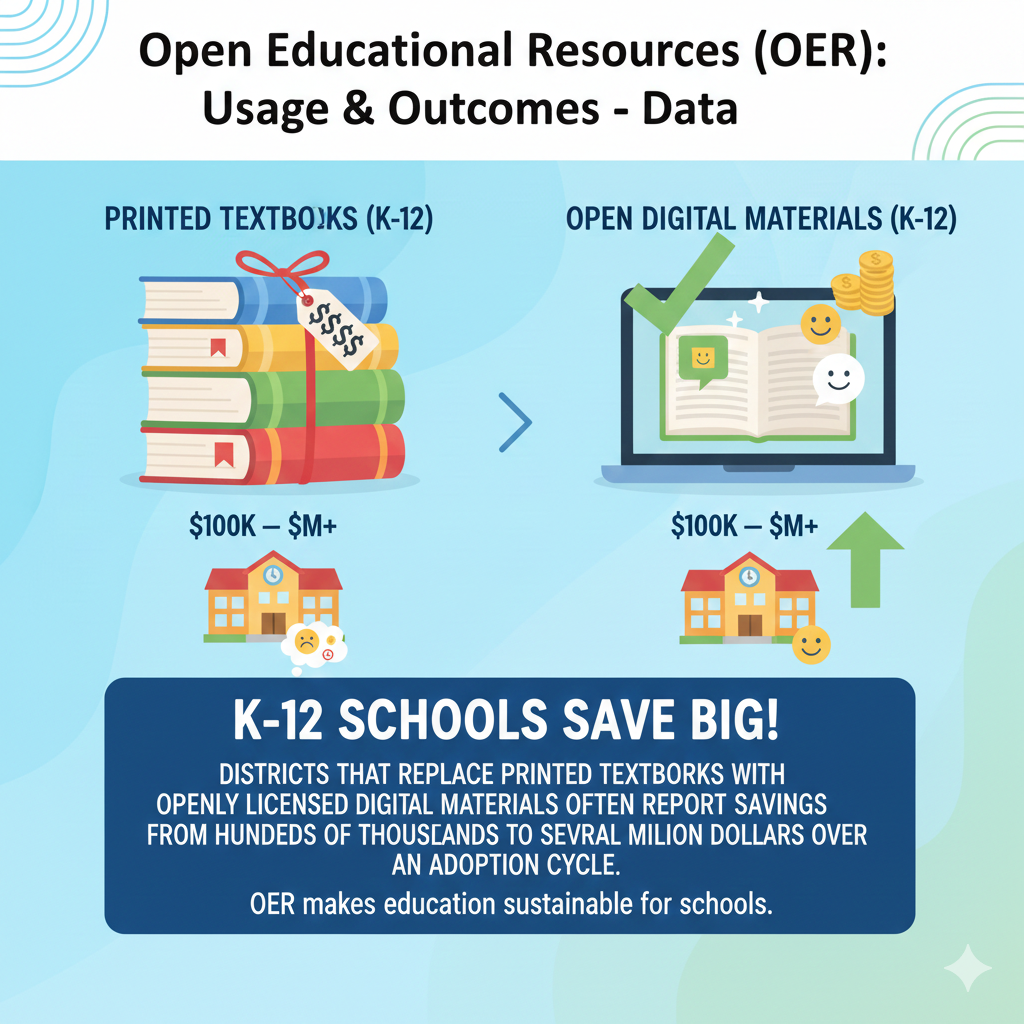
23) In K–12, districts that replace printed textbooks with openly licensed digital materials often report savings from hundreds of thousands to several million dollars over an adoption cycle.
Why K–12 savings can reshape the learning environment
When a district saves hundreds of thousands or even millions, it is not just a budget win. It can change what students experience every day. Districts can redirect money toward teacher training, classroom tools, better internet, special support, and updated learning content.
The biggest benefit is not “we spent less.” The biggest benefit is “we can improve learning in more places.”
Digital OER can also reduce the waiting problem. Printed textbooks take time to order, ship, and replace. Digital resources can be shared instantly. That means new students, transfers, and late enrollees can start with the same material as everyone else, without delays.
Actionable ways to make digital OER work well in K–12
If you are a parent, ask the school two practical questions. First, “How will my child access the materials at home?” Second, “What happens if the device or internet is not available?” Good OER plans include offline options, printed packets when needed, and clear instructions.
Your goal is not to fight digital learning. Your goal is to make sure access is stable.
If you are a teacher, design lessons that match the real attention span of students on screens. Use clear headings, shorter reading parts, and frequent check-ins. Keep the reading load realistic. Also, do not assume students know how to learn from digital text.
Teach them how to highlight key lines, write short notes, and review in small blocks.
If you lead a district, plan for support, not only savings. Make sure devices and internet gaps are addressed. Train teachers in both content and delivery. A strong OER program is not a PDF dump. It is a system: clear materials, clear routines, and clear help when students get stuck.
When done well, the savings can turn into better outcomes and a calmer learning culture.
24) OER courses can eliminate the common 1–3 week delay many students face before getting the textbook, because materials are available from the first day.
Why the first weeks decide so much
A 1–3 week delay is not a small delay. In many courses, those first weeks contain the foundation ideas. If students miss them, later lessons feel like a foreign language. Then students spend the rest of the term trying to catch up, and catching up is exhausting.
OER removes this delay. Students can start reading immediately. Teachers can assign real work from day one without worrying that half the class is still waiting for the book.
This is one of the most important outcome drivers, even if it sounds simple. When learning starts on time, confidence grows. When confidence grows, students participate more. Participation creates feedback, and feedback improves performance.
Actionable steps to use day-one access to build momentum
If you are a student, treat day one as your advantage day. Open the material, download it, and skim the first unit even if you do not understand everything yet. Then make a short list of terms you do not know. Bring that list to class. This turns confusion into a plan, and it makes your learning faster.
If you are a parent, help your child build a “first week routine.” Ten minutes of reading daily is enough to prevent the delay gap. Also, encourage your child to set up the materials in a clean way on their device, so they do not waste time searching later.
If you are a teacher, use the first week to teach students how to use the OER. Show them where the chapters are, where practice is, and what success looks like. Then give a small task that proves the value, like a short quiz based on the first reading. Students tend to do what is measured. When you measure early reading, early learning improves.
25) Many students face about $500–$1,500 per year in textbook and access-code costs without OER.
Why yearly cost is the real pain point
A single book price hurts, but the yearly total is what truly strains families. $500–$1,500 per year can compete with rent, medical costs, transport, or savings. And it is not always predictable. Some years are worse because of certain courses that require expensive bundles.
This creates a constant worry: “Will I be able to afford what I need to learn?” That worry can push students to take fewer courses, avoid certain subjects, or stretch out graduation. In younger learners, it can cause families to cut back on learning resources at home, even when the child is eager.
OER changes the story by shrinking or removing that yearly bill. It gives families breathing room. But the biggest value appears when schools make OER common, not rare. One OER course helps. A full OER pathway can transform the entire year.
Actionable ways to reduce the yearly burden
If you are a student, build a cost plan before the year begins. Look up material costs early, and choose OER sections when possible. If your school marks “no-cost” or “low-cost” courses, use those labels as part of your course selection strategy.
Also, do not wait until the first assignment is due to notice you cannot access materials. The earlier you act, the more options you have.
If you are a parent, talk about learning costs the same way you talk about school schedules. Ask the school for a clear list of material expenses. If the list is high, ask which courses have free alternatives.
Then redirect some of that money into skill-building that compounds over time. If your child learns coding, logic, and problem-solving, school subjects often feel easier. A guided, gamified learning path like Debsie can make that growth feel fun while still building serious skill.
If you lead a school, track yearly student costs by program. Identify where costs spike. Those courses are prime targets for OER or open alternatives. The goal is not only to reduce the bill. The goal is to protect student progress by reducing cost-based stress.
26) Instructors often report noticeable reductions (often 20%–50%) in early access problems when everyone has OER from day one.
Why early access problems waste learning time
Early access problems look small, but they quietly damage a course. Students spend time searching for the book, asking friends for photos of pages, or waiting for shipping.
Teachers spend time answering the same questions: “Where is the chapter?” “Do we need the access code?” This steals time from teaching and learning. It also creates frustration. Frustration reduces motivation, and low motivation reduces effort.
When OER is used well, those early access problems drop sharply. That means the first two weeks can focus on learning instead of logistics. This is one of the biggest hidden wins of OER because it improves the rhythm of the course for everyone, not just students who struggle financially.
Actionable ways to eliminate access problems completely
If you are a teacher, make access simple and obvious. Put the OER link in one main place, not five. Test it before class starts. Also provide a backup option, like a downloaded PDF or a mirror link, in case the main site is slow.
Use plain instructions such as “Click this link, then open Unit 1.” When instructions are simple, students follow them.
If you are a student, set yourself up in the first hour. Open the OER and confirm you can read it on your main device. Save it offline if possible. If you are using your phone, create a shortcut on your home screen. These tiny setup steps remove future friction.
If you are a parent, check access with your child once. Make sure the material opens at home, not only at school. If the home setup is weak, speak to the school about offline options. When early access issues drop, your child’s first weeks become smoother, and that often leads to better grades later.
27) Institutions tracking equity gaps often see pass-rate gaps shrink by about 1–5 percentage points after OER adoption in certain courses.
Why closing gaps is a major outcome
Equity gaps are often driven by unequal access to time, money, support, and stable routines. When OER removes one major barrier, some of that gap can shrink. A 1–5 point improvement may sound modest, but it is meaningful because it affects real people.
It can mean more students from less supported backgrounds passing key gateway courses. Passing gateway courses matters because they often control progress toward a degree or career path.
OER alone will not solve every gap. But it is a strong foundation because it makes sure all students can start with the same core tools.
Actionable ways to shrink gaps even more
If you are a school leader, pair OER with support systems. Add early alerts, tutoring, and study groups that use the same OER materials. When support is aligned with the same resource, students get help faster.
Also review the OER for reading level and clarity. If the language is too complex, students who already struggle may still fall behind. Clear writing is a fairness tool.
If you are a teacher, use OER flexibility to add multiple explanations. One explanation may not work for every student. Add a second example, a simpler summary, and a short practice set with answers. Keep the tone supportive. Students learn better when they feel respected.
If you are a parent, focus on steady habits. Gaps often grow when learning becomes irregular. OER makes regular study easier because access is free. Help your child set a small daily routine and encourage them to ask for help early. When the system is fairer and the habit is steady, outcomes improve.
28) In pathways where multiple courses adopt OER, a student can complete about 10–20 courses with $0 textbook cost, avoiding about $1,000–$3,000+ over a program.
Why program-level OER is a life-changing difference
When OER is used in just one course, it helps. When it is used across a full pathway, it changes the whole experience. Avoiding $1,000–$3,000+ over a program is not only savings. It is reduced stress over years.
It can mean fewer loans, fewer extra work hours, and fewer hard choices like “Do I pay for books or pay for food?” It also keeps learning more stable because students can rely on access every term. Stability matters because learning builds like a tower. If one block is missing, the next blocks wobble.
A program-level OER pathway also helps schools. It creates consistency. Teachers can align materials across courses, and students can build skills step by step without jumping between different textbook styles.
Actionable ways to make pathway savings support real growth
If you are a student, think long-term. If you know you will avoid $1,000–$3,000+ in textbook costs, plan how that money can support your future. You might use part of it to reduce work hours during exam periods. Or you might invest in skill training that increases job options later.
Skills like coding, math thinking, and clear communication often pay back many times over. If you want a guided path for those skills, Debsie can be a practical choice because it is structured, teacher-led, and designed to keep kids engaged.
If you are a parent, use pathway savings to build a learning environment at home. It does not have to be expensive. A stable study routine, a quiet corner, and a small set of learning tools can make a big difference. Also help your child track progress.
When children see steady growth, they become more confident and more willing to face hard topics.
If you lead a school, build “OER degree maps” or “no-cost pathways” that are easy to understand. Students do better when they can see a clear route. Then support the route with quality review, updates, and teacher collaboration so it stays strong over time.
29) In many faculty adoption programs, often 60%–85% of instructors who try OER say they plan to keep using it in future terms.
Why retention shows real satisfaction
If teachers try something and keep it, that is a strong signal. Teaching is already demanding. Instructors will not keep a resource that makes their job harder or confuses students.
A 60%–85% “keep using it” rate suggests that many teachers see clear benefits: easier access for students, better alignment with course goals, and more flexibility. It also suggests that once teachers overcome the first setup effort, the long-term value feels worth it.
This matters because scaling OER is not only about policy. It is about people. Teachers are the ones who make the content work in real classrooms. When teachers choose to continue, OER becomes more stable and more common.
Actionable ways to help more teachers stick with OER
If you are a school leader, support teachers in the first term. The first term is where OER can feel like extra work. Provide time, training, and peer support. Pair new OER adopters with teachers who have already done it. Create shared templates for syllabi, reading guides, and assessments so teachers do not start from zero.
If you are a teacher, protect your own time by setting limits. Do not try to perfect everything at once. Choose a strong base OER and make small improvements each term. Keep a simple list of what students struggled with, then fix those points first.
Over time, your course becomes smoother, and the need for constant explanation drops.
If you are a parent or student, give useful feedback. Instead of saying “This is confusing,” point to the exact page and explain what was hard. Good feedback makes OER better. When teachers see that OER can improve quickly based on real classroom needs, they are more likely to keep using it.
30) The most consistent outcome is financial: costs often drop from $80–$250 per course to $0, while academic results are usually similar or modestly better (often +1–5 points on pass-related measures).
Why this combination is powerful
This final stat is the core story: OER reduces cost dramatically without hurting learning, and it often helps a little. That is rare. In many areas of life, you pay less and you get less. With OER, the opposite can happen because access is the main barrier, not content quality.
When every student has the materials, more students prepare, more students practice, and fewer students drop. That can lift pass rates and reduce failures, even if the content is similar.
It also changes the relationship between student and course. Students feel respected. They feel the system is fairer. That feeling matters because learning is emotional. When students feel supported, they take more learning risks, ask more questions, and persist longer.
Actionable ways to use the OER advantage fully
If you are a student, treat “free access” as a serious tool. Use it daily in small ways. Read before class, practice after class, and review mistakes the same day. The difference between “same results” and “better results” often comes from routine, not talent.
If you are a parent, focus on structure. Free materials are only helpful if your child uses them. Set a simple daily habit. Ask your child to teach you one idea from the OER. This builds confidence and reveals gaps early.
If your child needs more guided support, add a program that turns learning into progress they can see. Debsie is built for this: expert-led, gamified learning that helps kids grow both in grades and in life skills like focus, patience, and problem-solving.
If you are a teacher or leader, make OER part of a full learning plan: clear access, clear guidance, steady practice, and aligned assessments. When OER is treated as a strategy, not a shortcut, it becomes one of the strongest tools for both affordability and student success.
Conclusion
The data tells a clear story. When learning materials are free, more students start on time. When more students start on time, fewer fall behind. When fewer fall behind, more pass, more stay enrolled, and more finish what they began.
At the same time, families keep money that would have been spent on books and access codes. That money can protect basic needs, reduce stress, and open space for better learning habits.