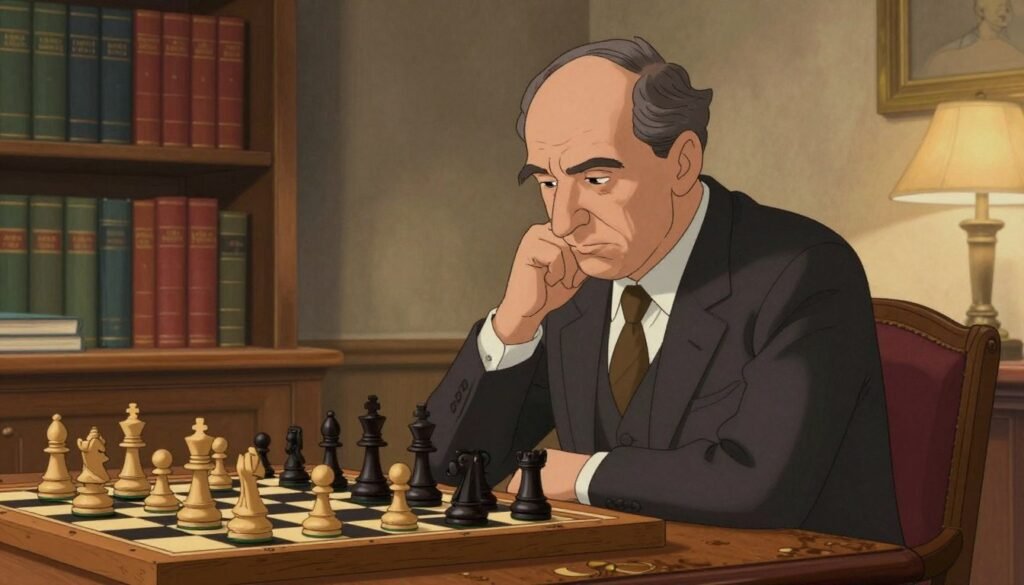
Mikhail Botvinnik was not just a world chess champion. He was a builder. He won the world title in 1948 and held it across three separate reigns, but his deeper mark on chess came from the way he trained, studied, planned, and taught others to think.
Find the right learning experience
Tell us a little about the learner and what you are looking for. Our team will review your answers and help you identify the most suitable next step.
- Takes only a few minutes
- No payment required
- Personalised recommendations
Your information will only be used to respond to your enquiry.
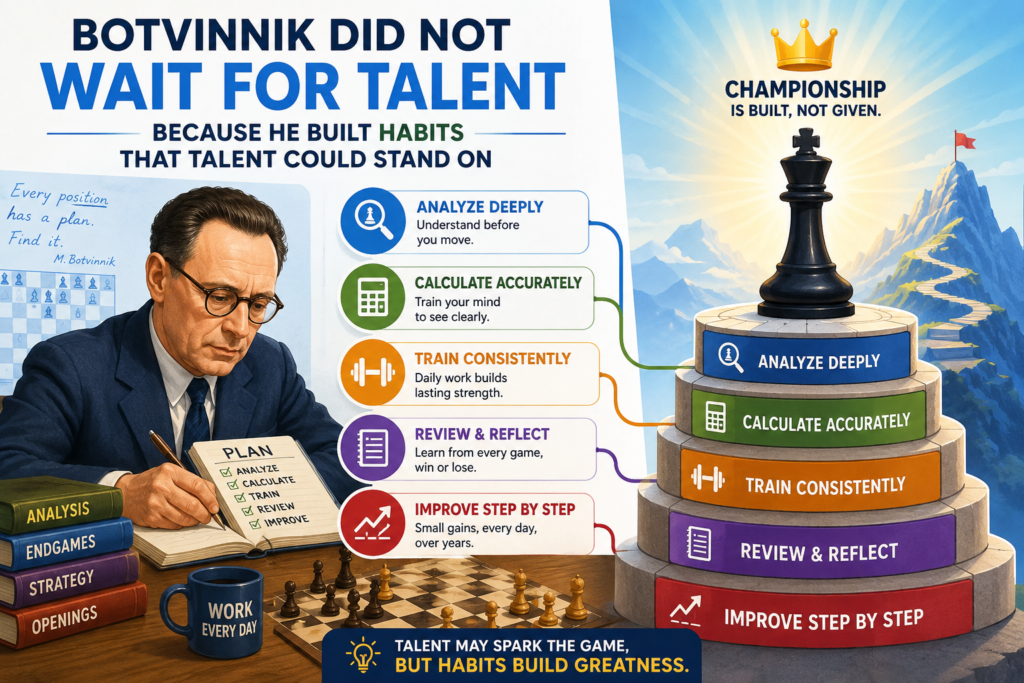
Botvinnik did not wait for talent to save him because he built habits that talent could stand on
Many young chess players think great players are born with a secret gift. Botvinnik’s life tells a better story. He became one of the strongest players in the world, but his rise was not built on wild tricks or lucky attacks. It was built on work, order, review, and a deep respect for the truth on the board.
He learned chess as a boy and grew fast. By age 14, he defeated José Raúl Capablanca in a simultaneous game, which was a huge sign of promise because Capablanca was one of the most natural chess minds the world had ever seen.
Later, Botvinnik became Soviet champion several times and then became the sixth world chess champion in 1948. He held the world title in three separate periods: 1948 to 1957, 1958 to 1960, and 1961 to 1963.
Botvinnik’s real gift was that he knew how to train with purpose
Botvinnik was not only a chess player. He also trained as an electrical engineer. This matters because his chess mind worked in a similar way. He did not just ask, “What move looks nice?” He asked, “What is the problem? What is the plan? What does the position need?”
That is a big lesson for parents and young players. A child can enjoy chess and still train in a smart way. In fact, structure often makes chess more fun because the child can see progress. When a student knows what to work on, practice stops feeling random. It starts feeling like a path.
Find the right learning experience
Tell us a little about the learner and what you are looking for. Our team will review your answers and help you identify the most suitable next step.
- Takes only a few minutes
- No payment required
- Personalised recommendations
Your information will only be used to respond to your enquiry.
The lesson for children is that smart practice beats messy practice
A child who plays ten fast games and never checks the mistakes may feel busy, but that child may not grow much. A child who plays one slow game, writes down the hard moments, and reviews it with a coach may learn far more.
This is one reason structured coaching works so well. At Debsie, students do not just move pieces and hope for the best. They learn how to think before they move. They learn how to ask better questions. They learn how to slow down, notice danger, and make a plan. That is chess growth, but it is also life growth.
Botvinnik made preparation a serious skill instead of a last-minute rush
Botvinnik understood something that many players learn too late. A chess game does not begin when the clock starts. It begins days, weeks, and even months before. It begins with the habits a player builds at home.
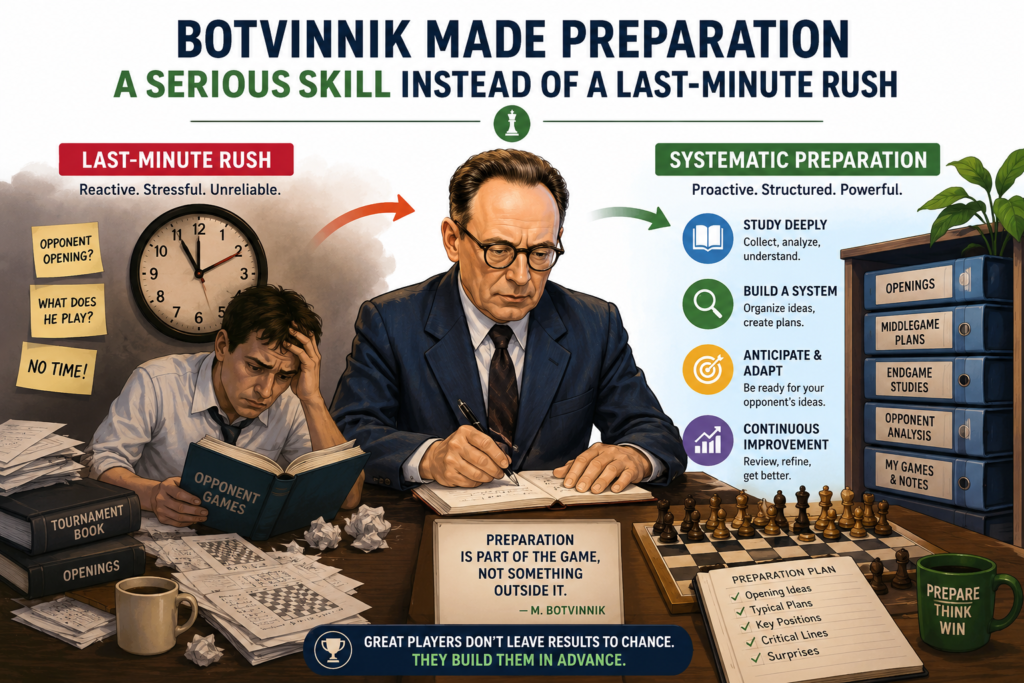
It begins with the openings studied, the past games reviewed, and the weak spots fixed before they become painful.
His approach to tournament preparation became famous because it was careful and honest. He believed a player should prepare not only moves, but also the mind. That means knowing your openings, knowing your own style, knowing your opponent’s habits, and knowing how to stay steady when the game becomes hard.
Chess.com’s player profile notes that Botvinnik’s school stressed physical exercise, game analysis, and deep opening knowledge.
He prepared like a builder, not like a gambler
Some players prepare by memorizing lines. That can help for a few moves, but it does not last. Botvinnik wanted more than memory. He wanted understanding. He wanted to know why a move worked, what plan came next, and what kind of ending might appear later.
This is very useful for children. A child may memorize a trap and win one game. But when the other player avoids the trap, the child may feel lost. A better student learns the idea behind the opening. Where should the pieces go? Which pawn break matters? Which side of the board needs attention? What danger should be avoided?
The Debsie way is to help kids understand the reason behind the move
When a coach teaches only moves, the student becomes dependent. When a coach teaches reasons, the student becomes stronger. This is why expert-led classes matter. A good coach can see the child’s thinking, not just the final move.
The coach can ask, “What were you planning?” and help the child build a better thought process.
That kind of learning builds confidence. The child starts to feel, “I can solve this.” Even when the position is new, the child has tools. That is the kind of confidence parents love to see because it reaches beyond chess. It helps with school, tests, projects, and hard choices.
Botvinnik used self-analysis because he wanted the truth more than comfort
One of Botvinnik’s strongest habits was self-analysis. He did not treat his games like trophies or disasters. He treated them like lessons. A win could still hide mistakes. A loss could still hold good ideas. The point was not to protect the ego. The point was to find the truth.
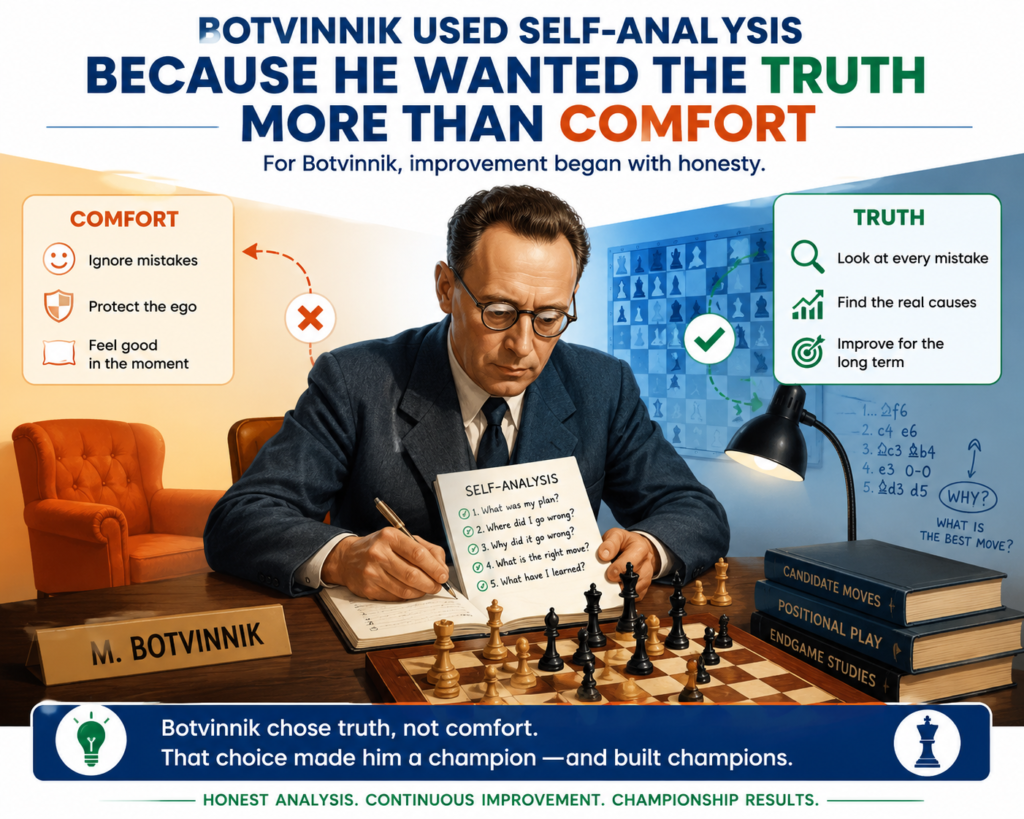
This is not easy, especially for children. No child enjoys hearing, “This move was wrong.” But when feedback is kind, clear, and useful, mistakes stop feeling scary. They become part of learning. Botvinnik’s style reminds us that the best players are not the ones who never make mistakes.
They are the ones who learn from them faster.
A game is not finished when checkmate happens
For many beginners, the game ends when someone wins. For serious learners, that is when the next lesson begins. Why did the attack work? Where did the plan go wrong? Was the mistake tactical, like missing a fork? Was it strategic, like putting pieces on bad squares? Was it emotional, like moving too fast after a surprise?
Botvinnik became known for a deeply analytical approach to chess, and he played a major role in the Soviet chess system that helped shape many elite players after World War II. His influence went beyond his own games because he helped set a model for disciplined chess study.
Parents can use this idea after every child’s game
After a game, the first question should not be, “Did you win?” A better question is, “What did you learn?” This small change can protect a child’s love for chess. It helps the child see that losing is not shameful. It is information.
At Debsie, this is a key part of growth. Students play, review, and improve. They learn how to talk about their thinking. They learn that a mistake is not the end of the story. It is a door. Behind that door is a better habit, a clearer plan, and a stronger next game.
Botvinnik trained champions by teaching them how to think, not what to copy
Botvinnik’s name is linked not only with his own world titles but also with the players who came after him. His chess school is often connected with future world champions like Anatoly Karpov, Garry Kasparov, and Vladimir Kramnik.
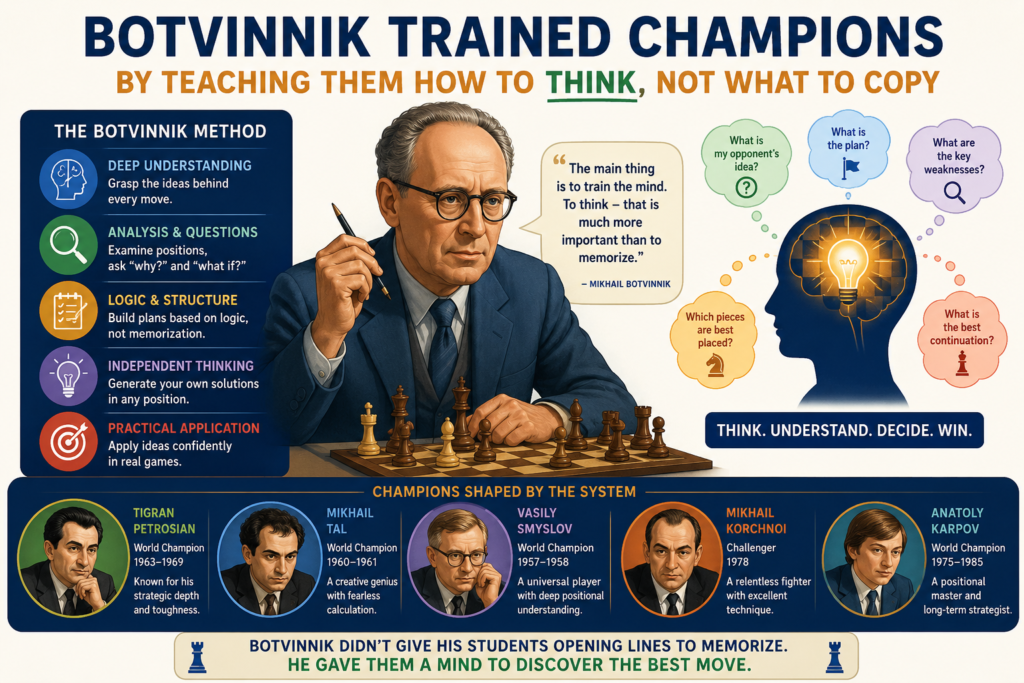
That is a rare kind of legacy. Many champions win games. Fewer champions build a system that helps others become great too.
The power of his teaching came from one core idea. A player must become an independent thinker. Copying is not enough. A student can copy a master’s move and still not understand the master’s mind. Botvinnik wanted students to learn how to judge a position, make a plan, and defend their ideas with clear thought.
Great coaching does not make a child smaller
Some people think coaching means telling a student exactly what to do. The best coaching does the opposite. It makes the student bigger inside. It gives the child language for ideas they already feel but cannot yet explain. It gives the child a process to use when the board is confusing.
This is why a strong coach asks questions. What is your opponent threatening? Which piece is not helping? What happens if you trade queens? Where is your king weak? These questions train the mind. Over time, the child starts asking them without help.
A champion’s mind is built through many small thinking habits
Most chess growth is not dramatic. It is quiet. It happens when a child learns to pause before capturing. It happens when the child checks for checks, captures, and threats. It happens when the child stops moving the same piece again and again in the opening.
It happens when the child learns to stay calm after losing a pawn.
These small habits are the bricks. A coach helps place them in the right order. That is why Debsie’s live classes, private coaching, and regular tournaments can help a child grow step by step. The child does not need to become a world champion for this to matter.
The child becomes more focused, more patient, and more ready to think before acting.
Botvinnik’s training system still works because children need clear thinking more than ever
Today’s children live in a world full of speed. Games are fast. Videos are short. Many things fight for their attention. Chess gives them something different. It asks them to slow down. It asks them to look carefully. It asks them to think before they touch.
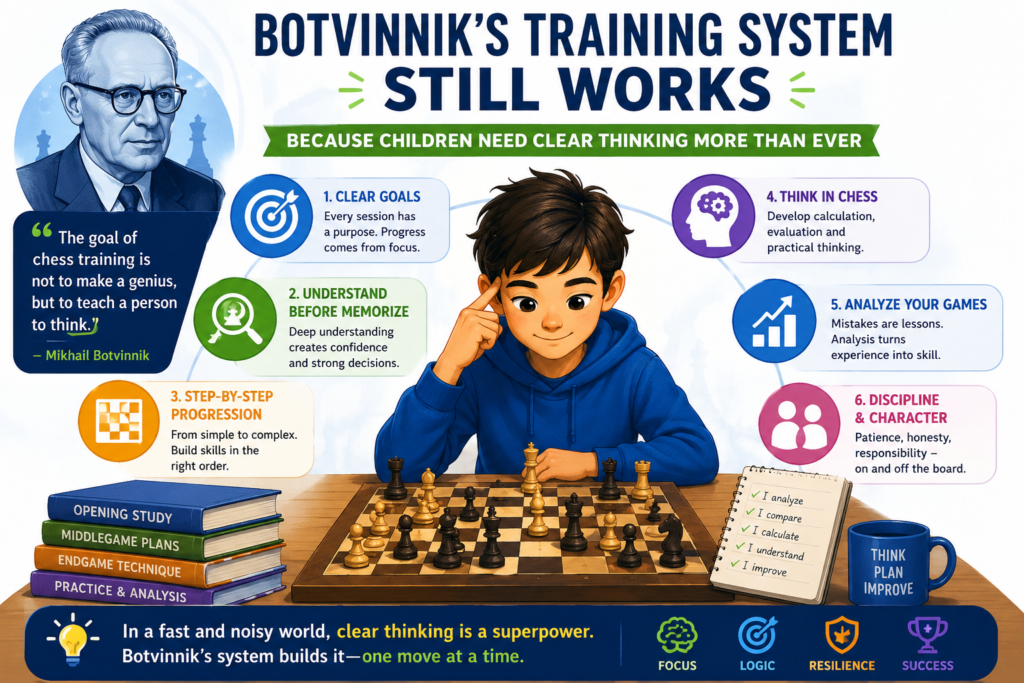
That is why Botvinnik’s method still feels fresh. He taught that strong chess comes from clear habits. Study your games. Know your openings. Build your body and mind. Prepare with care. Do not run from mistakes.
These ideas are simple, but they are powerful when used every week.
The best chess training helps a child become calm under pressure
Pressure is part of chess. The clock is ticking. The opponent has a threat. The child sees two good moves and does not know which one to choose. In that moment, chess becomes more than a board game. It becomes training for real life.
A child who learns to breathe, think, and choose during a hard chess position is practicing a life skill. That same child may later use the same calm thinking during a school exam, a sports match, a class debate, or a tough talk with a friend.
This is why parents should look for a chess program with structure and heart
A good chess program should not only teach tricks. It should help a child build thinking habits that last. It should give the child chances to play, review, ask questions, and feel supported. It should make learning serious without making it cold.
That is the kind of learning Debsie aims to give. Students from different parts of the world join live classes, learn from trained coaches, and take part in online tournaments where they can test their skills in a safe and guided way.
For a parent, the goal is not just more wins. The deeper goal is a child who thinks better, handles mistakes better, and grows with confidence.
Botvinnik made review a routine because clear feedback creates fast growth
Botvinnik did not treat review as a small extra step. He treated it like the heart of training. For him, a game was not just a result. It was a record of choices. Every move showed what the player saw, what the player missed, and what the player believed in that moment.
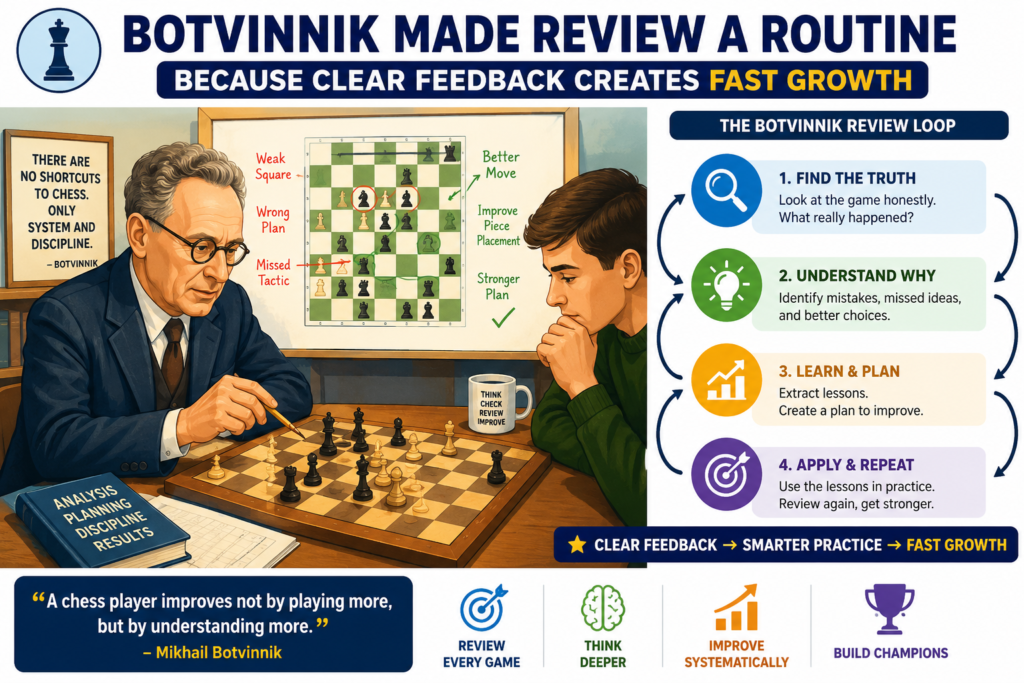
This is why his method feels so useful for young players today. Children often want to forget a lost game as fast as possible. They may feel upset, quiet, or even angry. But Botvinnik’s idea turns that moment into a gift. The game becomes a mirror. It shows the child exactly where the next lesson should begin.
Find the right learning experience
Tell us a little about the learner and what you are looking for. Our team will review your answers and help you identify the most suitable next step.
- Takes only a few minutes
- No payment required
- Personalised recommendations
Your information will only be used to respond to your enquiry.
A child learns faster when the coach studies the thinking, not only the move
A weak review says, “This move was bad.” A strong review says, “Let us see what you were trying to do.” That small change matters. It helps the child feel safe enough to explain the idea behind the move. Once the coach understands the idea, the coach can fix the thinking.
Botvinnik’s school was known for careful game analysis and strong opening work. Chess.com notes that his school taught students to analyze games, know their opening lines well, and keep the body healthy through moderate exercise.
That shows how complete his view of training was. He did not want players to guess. He wanted them to prepare, play, review, and grow.
For a parent, this gives a simple way to judge a chess class. Is the child only playing games, or is the child learning from those games? Is the coach only praising wins, or is the coach helping the child understand choices? Real improvement comes when play and review work together.
The best review helps a child feel brave instead of embarrassed
Many children hide from mistakes because mistakes feel like proof that they are not good enough. A good chess coach changes that feeling. The coach helps the child see that a mistake is not a label. It is a clue.
This is one reason Debsie’s expert-led classes can help so much. A child gets guidance from someone who knows how to explain mistakes in a kind and useful way. The coach can turn a missed tactic into a simple pattern.
The coach can turn a rushed move into a lesson about patience. The coach can turn a painful loss into a plan for the next game.
That kind of review builds a strong mind. The child learns to say, “I made a mistake, but I can fix it.” That is not only chess confidence. That is life confidence.
Botvinnik understood that openings are not memory games because every opening needs a plan
Many young players love openings. They enjoy learning names, traps, and fast wins. That is fun, and it can be useful. But Botvinnik would not stop there. He cared about opening knowledge, but he cared even more about opening understanding.
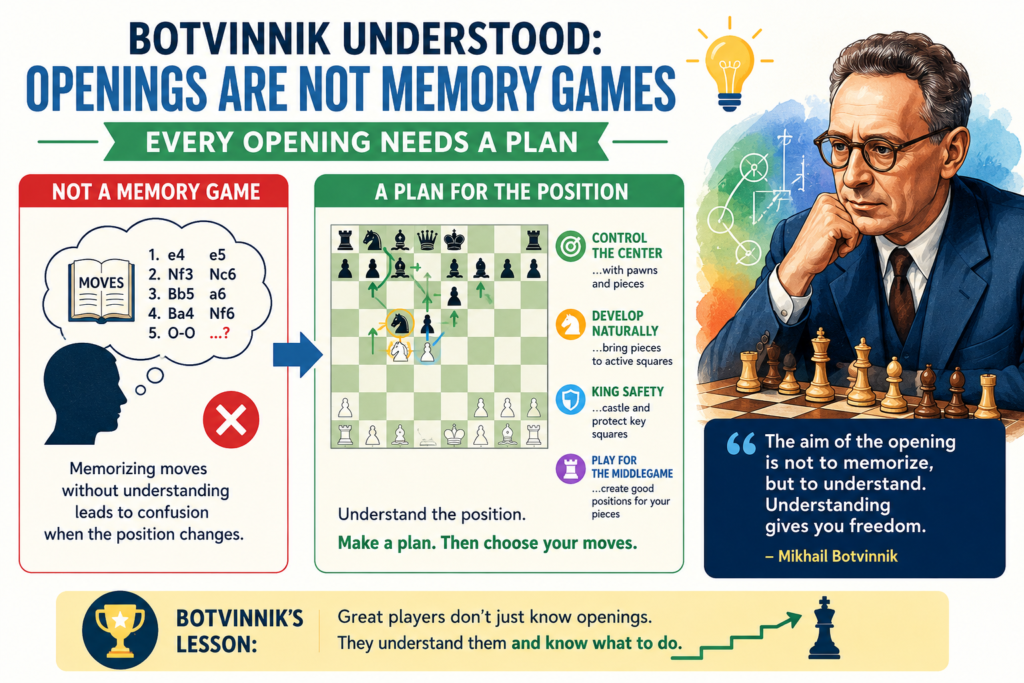
An opening is not just a set of moves. It is the start of a story. It decides where the pieces go, which pawns may move, which side may attack, and what kind of middle game may appear. When a child knows only the moves, the child can get lost after one surprise.
When a child knows the plan, the child can keep thinking even when the game changes.
A good opening lesson teaches the child what to do after the first few moves
A child may learn that knights often come out before bishops. That is a good start. But the next step is more important. Why does the knight go there? What square does it control? What happens if the opponent attacks the center? When should the child castle? Which piece is still sleeping?
These questions help the child move from memory to meaning. Botvinnik’s own chess was often described as methodical, rational, and based on a scientific way of thinking. Britannica also notes that his approach influenced a generation of Soviet players, including Anatoly Karpov and Garry Kasparov.
This is where many children need help. Online videos can show moves, but they cannot always see the child’s confusion. A live coach can. A coach can notice when a child is copying without understanding. Then the coach can slow down and build the idea again in simple words.
Parents should not ask how many openings a child knows too early
A better question is, “Can my child explain the opening idea?” If the child can say, “I am fighting for the center,” or “I want to castle and bring my rook to an open file,” that is real progress. The words do not need to sound fancy. The thinking needs to be clear.
At Debsie, young players can learn openings in a way that fits their level. A beginner does not need a giant opening book. A beginner needs safe development, king safety, center control, and simple plans.
An improving player needs deeper ideas, common pawn breaks, and typical attacking patterns. A strong student needs more serious preparation and review.
That is the smart path. First, build the base. Then add detail. That is how confidence grows without pressure.
Botvinnik trained the body because the mind gets tired during hard games
Some people think chess is only a brain game. Botvinnik knew better. A long chess game can tire the whole body. The player sits for hours, makes hard choices, handles stress, and must stay alert until the end. A tired mind misses simple tactics. A restless child moves too fast. A tense player may lose a winning position.
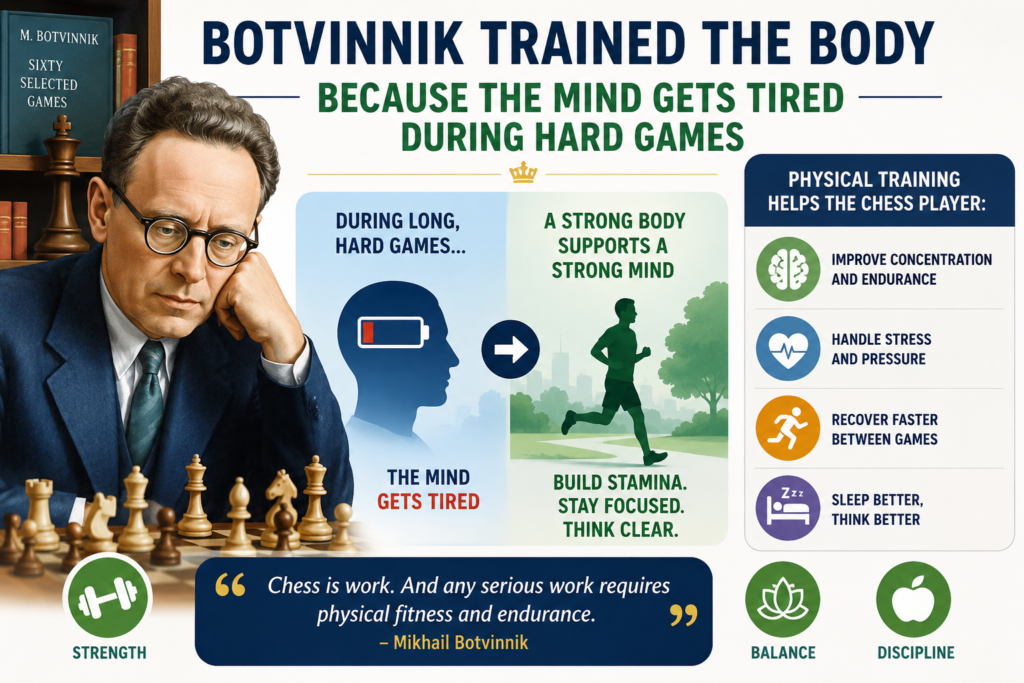
That is why physical balance mattered in Botvinnik’s system. His school did not treat chess training as sitting all day with a board. It also valued health, rest, and steady habits. This was not for show. It was practical. A strong body helps the mind stay clear for longer.
A child who is calm and rested can think better at the board
Parents see this every day. A tired child makes careless mistakes in schoolwork. A hungry child gets upset faster. A child who has been staring at screens for hours may struggle to focus. Chess is the same. The board rewards clear attention.
This is one reason Botvinnik’s method still speaks to modern families. Today, children have more distractions than ever. They need hobbies that train focus in a healthy way. Chess can do that when it is taught with care. It gives children a place to slow down, think, and build self-control.
The FIDE Chess Museum calls Botvinnik the sixth world chess champion and describes him as the founder and “Patriarch” of the Soviet Chess School. It also notes that he played for the Soviet Olympiad team from 1954 to 1964, with the team winning gold each time.
That kind of long high-level performance takes more than talent. It takes habits that support the mind under pressure.
Families can build a simple chess routine that does not feel heavy
A child does not need to train like a world champion. The goal is not to make home feel like a camp. The goal is to create a calm rhythm. A little puzzle practice, one serious game, a short review, and enough rest can do more than hours of rushed play.
Debsie can help parents create that rhythm because the learning is guided. The child is not left alone to guess what to study next. The classes give direction. The coaches give feedback. The tournaments give practice. The full system helps the child grow without feeling lost.
That matters because children stay excited when they can feel progress. They enjoy chess more when they understand what they are doing. They become proud when they see a tactic before it happens, save a tough endgame, or stay calm after losing a piece. Those little wins add up.
Botvinnik showed that champions are built in quiet moments before the crowd sees them
The world sees the final game. The world sees the trophy, the handshake, and the champion’s name in history. But Botvinnik cared about what happened before that moment. The private work mattered most. The notes. The study. The training games. The honest review. The quiet fix after a painful mistake.
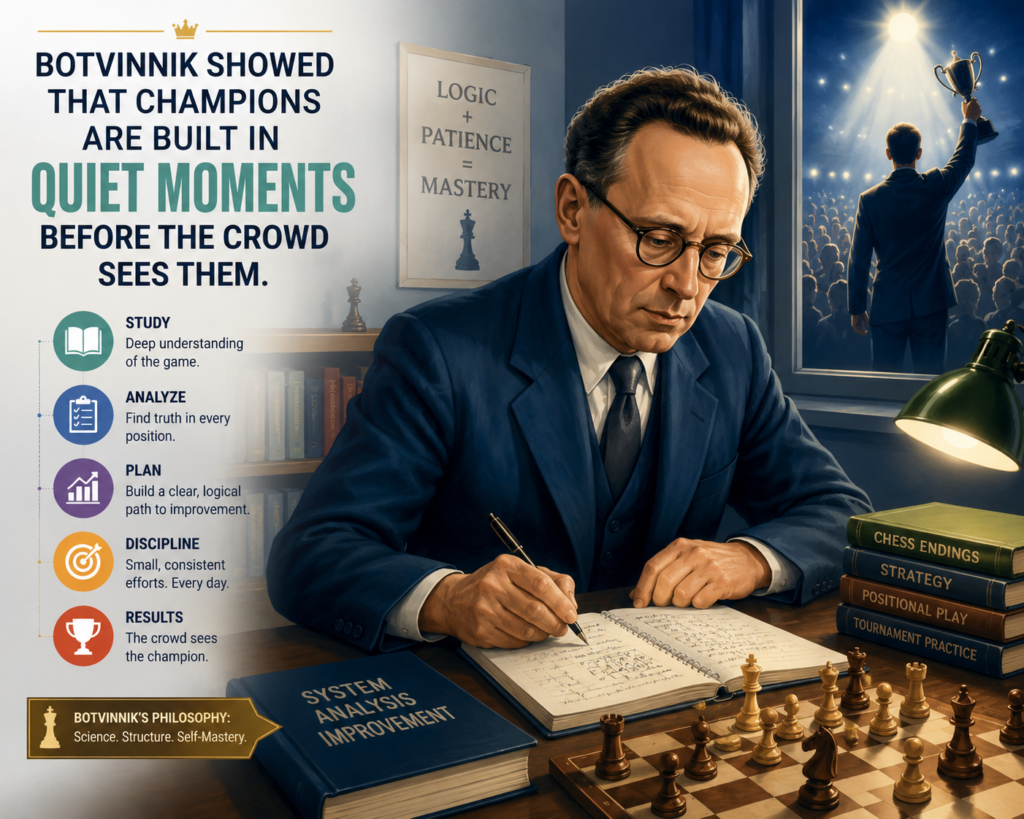
This is a powerful lesson for children. Big success often looks sudden from the outside. But inside, it is usually made from many small steps repeated for a long time. A child who learns this through chess can carry it into school, music, sports, and life.
Good training makes progress visible before results become perfect
A child may still lose games while improving. That can confuse parents. They may wonder, “Is the class working?” But chess growth does not always show first in trophies. It often shows in better questions, slower moves, stronger focus, and fewer repeated mistakes.
That is why parents should watch the process, not just the score. Is the child thinking longer in key moments? Is the child checking threats before moving? Is the child explaining plans more clearly? Is the child less afraid to review losses? These are signs that the mind is growing.
Botvinnik’s legacy is tied to this type of process. His school is often linked with world champions Karpov, Kasparov, and Kramnik, along with other strong grandmasters. Chess.com notes that the school began in 1963 and produced three world champions.
The right coach helps a child respect the process
Children need encouragement, but they also need direction. Praise alone is not enough. Pressure alone is not enough. The best coach gives both warmth and truth.
That balance is at the heart of strong chess learning. A child should feel safe, but not lazy. A child should feel challenged, but not crushed. A child should know that the coach believes in them, while also knowing there is real work to do.
This is where Debsie can be a strong fit for families. The platform brings live learning, private coaching, and regular online tournaments together. That mix helps children learn, test, review, and return stronger. It gives them a system, just like Botvinnik believed great players need.
Botvinnik’s best lesson for parents is that chess should build the whole child
It would be easy to look at Botvinnik and think only about titles. World champion. Soviet chess leader. Famous trainer. Teacher of future greats. But for a parent, the deeper lesson is much more personal.
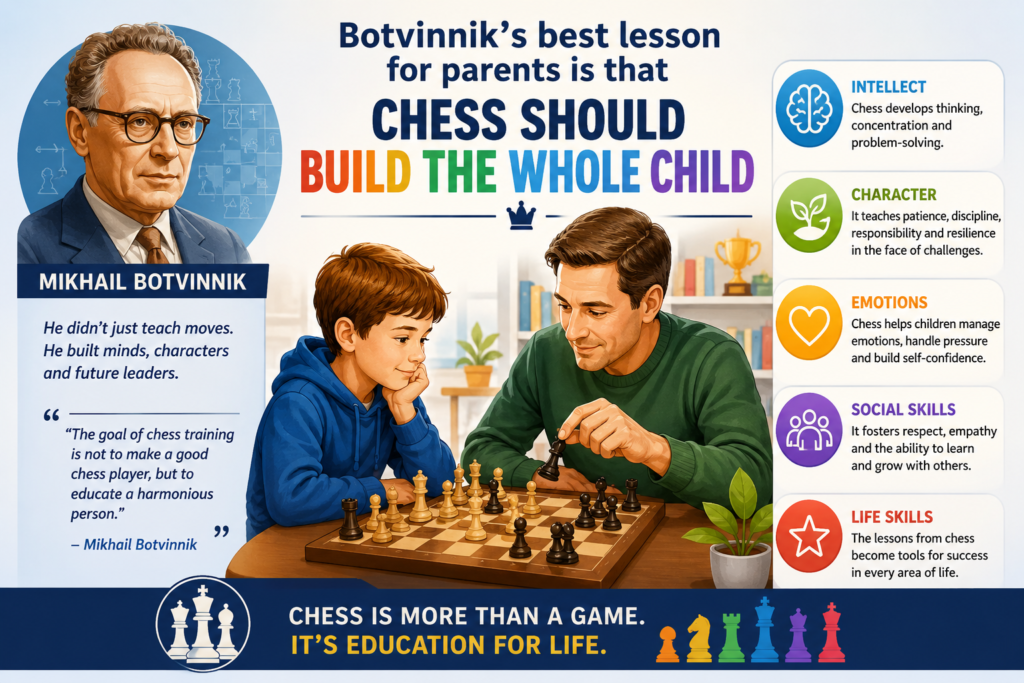
Chess can shape how a child thinks. It can teach a child to pause before acting. It can teach a child that choices have results. It can teach a child to stay calm when the first plan fails. It can teach a child to look at a problem from both sides.
A strong chess class should help a child grow on and off the board
When chess is taught well, the board becomes a small life classroom. The child learns patience because not every attack works right away. The child learns focus because one careless move can change everything. The child learns planning because pieces work better together. The child learns respect because the opponent also has ideas.
These lessons are simple, but they are deep. A child may not say, “I am learning decision-making.” But that is what is happening. Every serious game asks the child to choose, wait, adjust, and try again.
For families, this is the real value. Trophies are wonderful. Rating points can be exciting. But a calmer, sharper, more confident child is the bigger win.
A free trial class is the easiest first step for curious families
Parents do not need to guess whether Debsie is right for their child. A free trial class lets the child experience the teaching style, meet a coach, and feel how structured chess learning works. It is a simple way to see whether your child enjoys the class and feels excited to learn more.
Botvinnik’s story reminds us that strong players are not built by chance. They are built by clear habits, good teachers, honest review, and steady practice. A child does not need to be a future world champion to benefit from that kind of system. They only need a place where their mind can grow.
Debsie gives that place to young learners around the world. It helps children learn chess, but it also helps them build focus, patience, and smart thinking. That is the kind of growth parents can feel proud of.
Botvinnik taught students to study positions before chasing pretty moves
Many children love flashy moves. They want the queen sacrifice, the fast checkmate, or the move that makes everyone say, “Wow.” That is natural. Chess should feel exciting. But Botvinnik’s way was deeper than that. He wanted players to see the full position first.
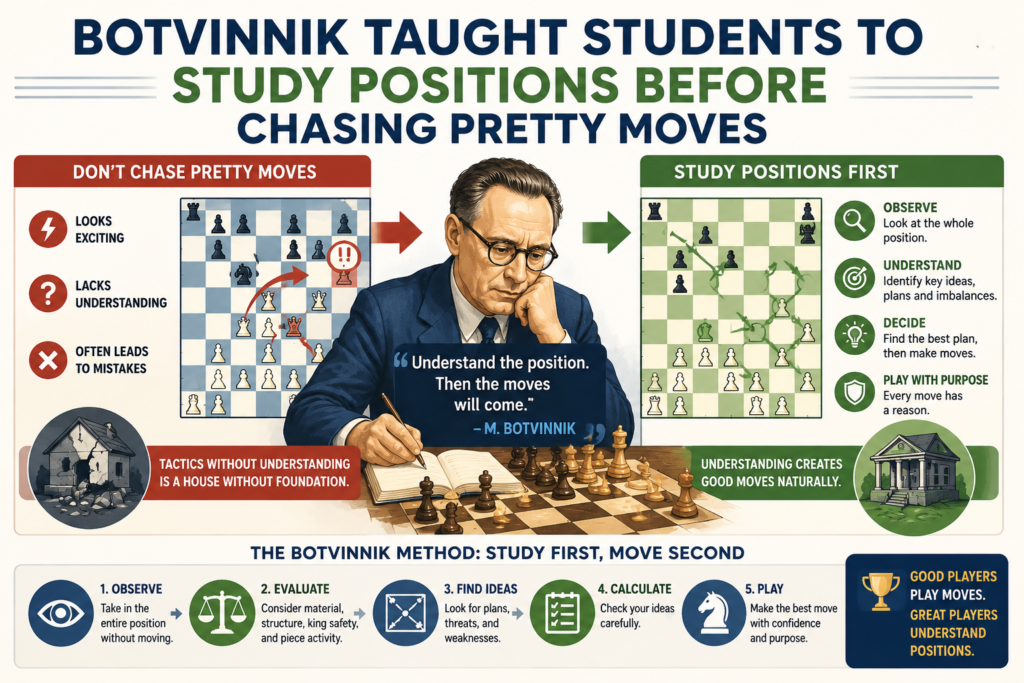
A pretty move is only good if it works. A quiet move can be stronger than a loud move. A simple move can be better than a clever trick. This is a lesson many young players need early, because it helps them stop playing hope chess.
Hope chess is when a child makes a move and hopes the opponent will not see the threat. Strong chess is different. Strong chess asks, “What will my opponent do next?” That one question can change a child’s whole game.
A strong player respects the opponent’s ideas before making a plan
Botvinnik’s games were often built on calm pressure. He did not always try to win in one blow. He improved his pieces, controlled key squares, and waited for the right time. Britannica describes his style as methodical and rational, and says his scientific approach influenced later Soviet players, including Anatoly Karpov and Garry Kasparov.
That kind of chess is not boring. It is powerful. It teaches a child that strong thinking comes before action. On the board, this may mean stopping a threat before starting an attack. In life, it may mean checking the facts before making a choice.
This is why chess is such a good learning tool for kids. Every game teaches cause and effect. A rushed move has a result. A patient move has a result. A careless capture has a result. Over time, the child starts to understand that choices matter.
A child should learn to ask what changed after every move
One of the best habits a young player can build is asking, “What changed?” after the opponent moves. Did a piece become loose? Did a file open? Is the king now weaker? Is there a new threat? Is one of my pieces under attack?
This habit sounds small, but it is huge. Many games are lost because the child plays as if the opponent’s move did not matter. A coach can help fix this by training the child to pause, look, and respond with care.
At Debsie, this kind of guided thinking is part of what makes lessons useful. A child is not just told to play better. The child is shown how to think better. That means each lesson can help the student become more aware, more careful, and more confident.
Parents who want this kind of growth do not need to wait for the perfect time. A free trial class can show how a trained coach helps a child turn simple questions into strong habits.
Botvinnik used discipline in a way that made creativity stronger
Some people think discipline kills creativity. Botvinnik showed the opposite. His system did not make players into robots. It gave them a base strong enough to support bold ideas.
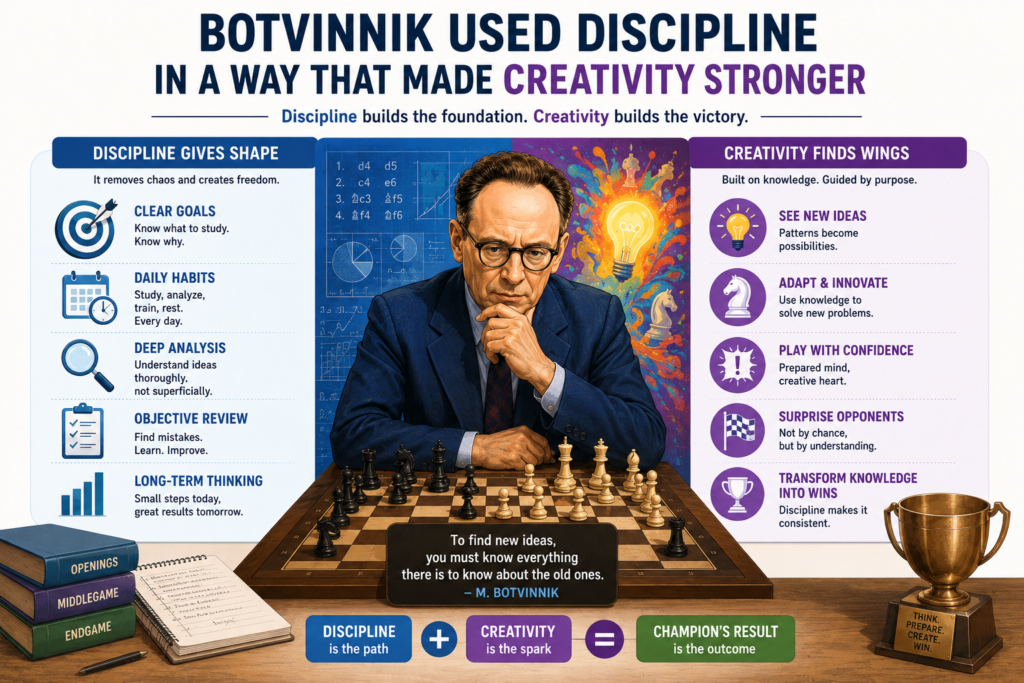
A child who knows basic rules can break them with purpose later. A child who understands development can decide when to delay it. A child who understands king safety can choose when risk is worth it. Without a base, bold play becomes guessing. With a base, bold play becomes a real choice.
This is a key point for parents. The goal of structure is not to make chess stiff. The goal is to give the child enough skill to enjoy more freedom.
Creative chess works best when the player can explain the reason
A wild move may be brilliant, but only if there is a reason behind it. Botvinnik cared about reasons. His students were expected to analyze, prepare, and defend their ideas.
The Russian Chess Federation says Botvinnik created his own method of tournament preparation and training, and passed it on to his students. It also notes that his school trained players such as Karpov, Kasparov, Kramnik, Razuvaev, Yusupov, and others.
That is a major lesson for any child. It is not enough to say, “I felt like it.” The better question is, “What was my idea?” Once a child can explain the idea, the coach can help shape it. Even if the move was wrong, the thinking can be improved.
This is how children become stronger. They do not just collect right moves. They build a mind that knows how to test ideas.
The right kind of discipline feels like a safety net
A good chess system does not trap a child. It supports the child. It gives the child a way to return to clear thinking when the board becomes messy.
For example, when a child is not sure what to do, the system can help. Look at king safety. Check for threats. Improve the worst piece. Do not rush trades. Think about pawn breaks. These simple ideas give the child a path when the position feels confusing.
Debsie’s structured coaching can help children build that kind of inner guide. The coach is not just there for one class. The coach helps the student form habits that can be used again and again.
This is where chess becomes more than a hobby. A child learns that creativity and discipline can work together. That is useful in writing, math, music, sports, and problem solving. The child learns to dream, but also learns how to build.
Botvinnik showed that champions need patience before they need applause
Botvinnik’s career had many great wins, but it also had hard moments. He lost the world title and won it back more than once. That alone tells us something important. He did not treat a setback as the end. He treated it as a problem to solve.
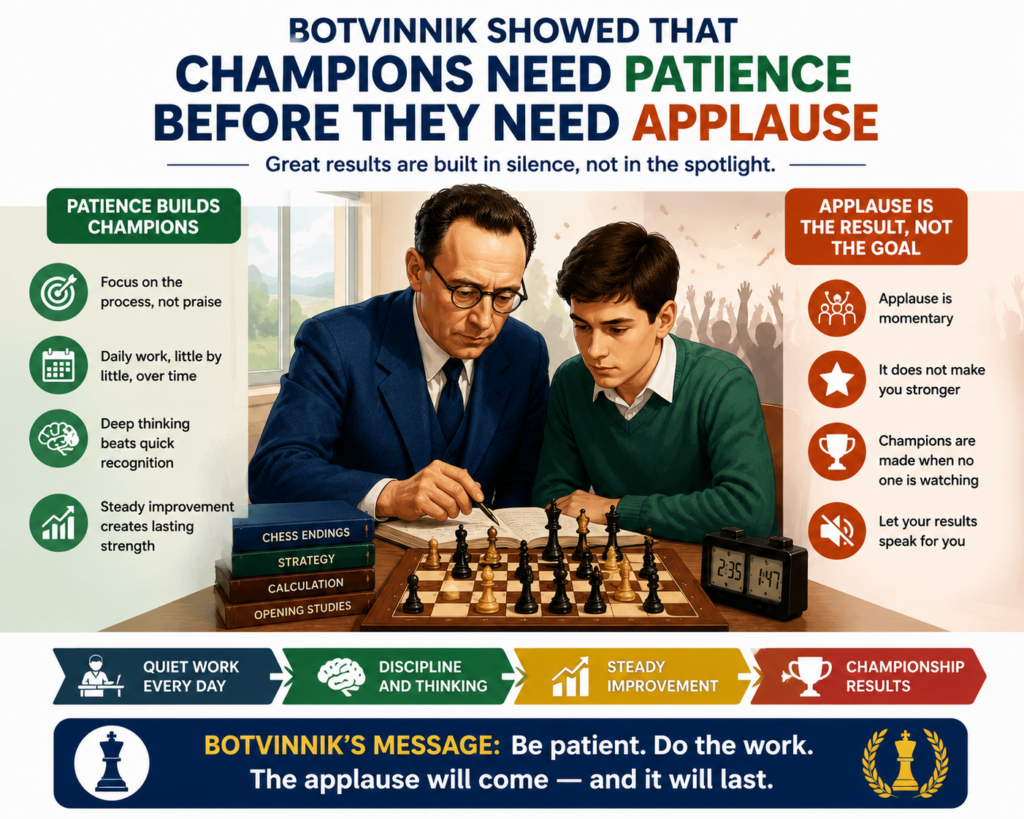
He became world champion in 1948, lost the title to Vasily Smyslov in 1957, won it back in 1958, lost it to Mikhail Tal in 1960, and won it back again in 1961. FIDE’s museum lists his three reigns as world champion and calls him the sixth World Chess Champion.
For children, this is one of the most powerful parts of Botvinnik’s story. Even the best players lose. Even champions have bad days. What matters is what they do next.
A loss can become a lesson when the child has support
A child who loses may feel crushed. Some children blame themselves. Some blame the opponent. Some want to quit. This is where adults and coaches matter so much.
The wrong response makes the child afraid of losing. The right response makes the child curious. Instead of saying, “Why did you lose?” we can ask, “Where did the game change?” That question points the child toward learning, not shame.
Botvinnik’s return after setbacks teaches children that growth is not a straight line. You may improve and still lose. You may work hard and still make mistakes. That does not mean the work failed. It means the next lesson is ready.
Parents should praise the comeback habit more than the trophy
A trophy is nice, but a comeback habit is worth more. A child who learns to return after a loss becomes stronger inside. That child is learning grit in a healthy way.
This is why regular practice games and tournaments can help. They give children safe chances to win, lose, review, and try again. Debsie’s bi-weekly online tournaments can be useful because they let students test skills in a real game setting while still staying connected to a learning path.
A child who plays only casual games may not learn how to handle pressure. A child who plays guided tournaments learns how to prepare, stay calm, respect the opponent, and review afterward.
That is Botvinnik’s spirit in action. Do not fear the hard game. Use it. Do not run from the loss. Study it. Do not let one result decide your story. Build the next chapter with better habits.
Botvinnik’s school worked because it turned talent into a training plan
Talent is exciting, but talent alone is not a plan. A child may be quick, sharp, or full of ideas. That is wonderful. But without guidance, the child may also rush, repeat mistakes, or depend too much on tricks.
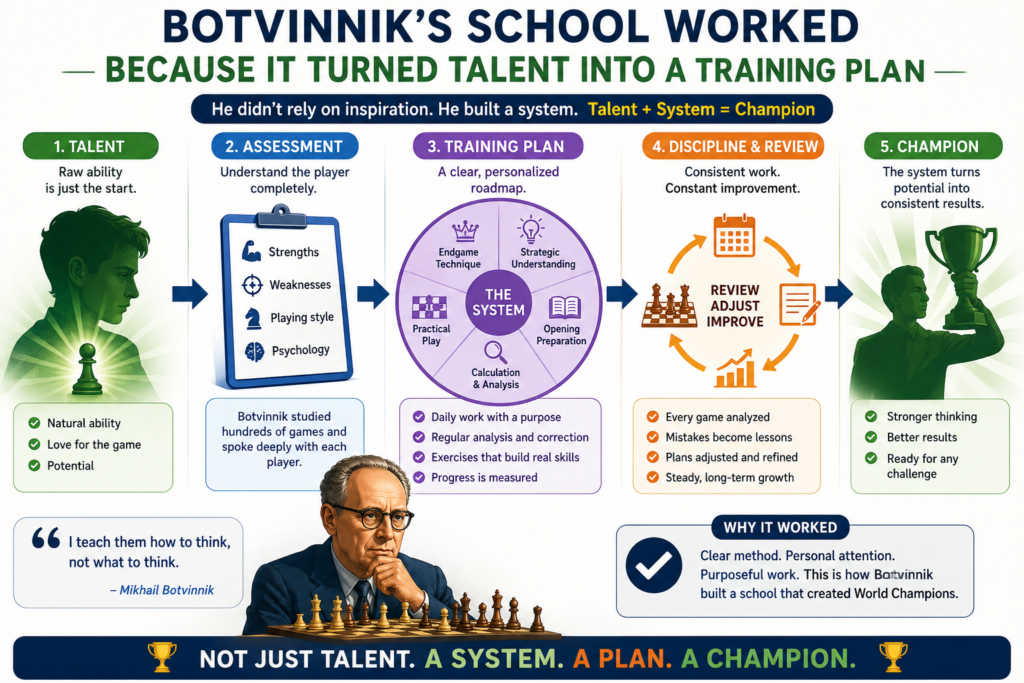
Botvinnik knew that talent needed shape. His school became famous because it gave young players a serious way to grow. It did not just praise promise. It trained promise.
This matters for parents because many children show early interest in chess. They solve puzzles fast. They beat family members. They enjoy online games. But the next step is often unclear. Should they learn openings? Should they play tournaments? Should they get private coaching? Should they study endgames?
A system answers those questions in the right order.
A child grows faster when training matches the child’s level
A beginner needs simple ideas. Keep the king safe. Bring pieces out. Do not give pieces away. Look for checks and threats. An improving player needs deeper ideas. Make a plan. Understand pawn structure. Learn common tactics.
Review losses. A stronger player needs sharper prep, serious analysis, and tournament discipline.
The mistake is giving every child the same lesson. Botvinnik’s legacy reminds us that serious training must be shaped with care. The teacher needs to know where the student is now, then help the student take the next clear step.
This is one reason personalized coaching can be so powerful. A coach can see what a video cannot see. A coach can notice that a child attacks well but ignores defense. A coach can see that a child knows openings but struggles in endings. A coach can tell when a child is losing because of skill, speed, fear, or focus.
Debsie helps turn a child’s interest into a clear path
For many families, the hardest part is not getting a child interested in chess. The hard part is helping that interest grow in the right way. Without structure, the child may play many games but repeat the same mistakes. With structure, every game can feed the next lesson.
Debsie brings together live classes, private coaching, and online tournaments so students can learn, play, test, and improve. That mix reflects a simple truth Botvinnik understood well. Champions are not built from random practice. They are built through a system.
Your child does not need to dream of becoming world champion for this to matter. The real win may be better focus during homework, more patience during hard tasks, and more confidence when facing new problems.
That is why a free trial class is such a smart first move. It lets your child feel the learning style, meet a coach, and see chess as something exciting, guided, and full of growth.
Botvinnik believed training games should feel serious because pressure changes how a child thinks
Training games are not the same as casual games. In a casual game, a child may chat, rush, take back moves, or try silly attacks. That can be fun, and fun matters. But serious growth needs a different kind of game too.
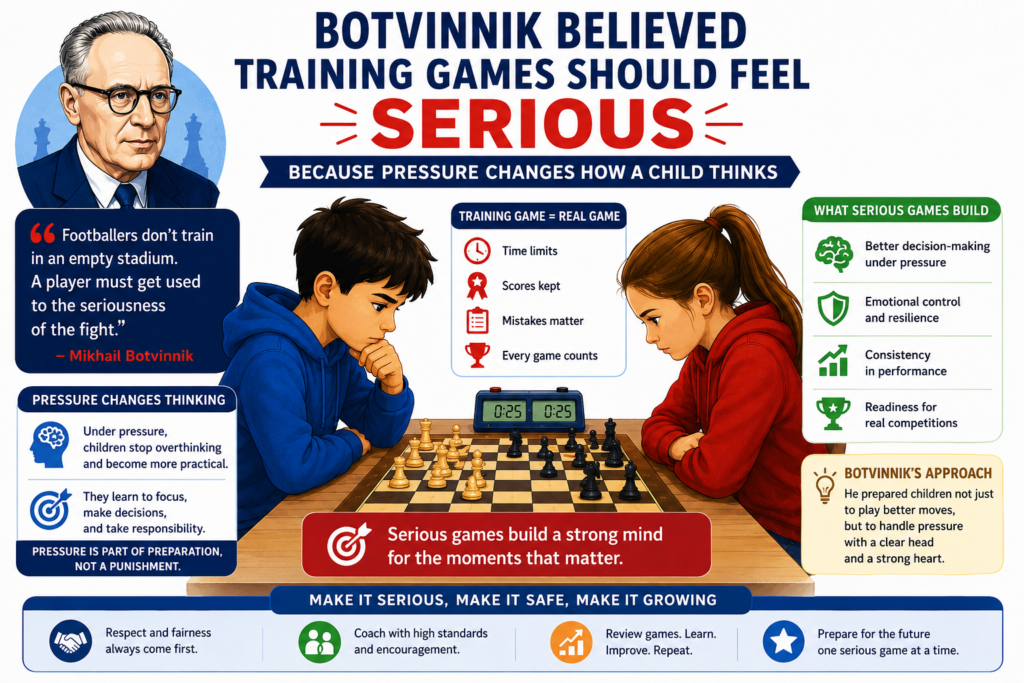
It needs games where the child sits with focus, writes down the moves when possible, manages time, and treats every choice with care.
Botvinnik understood this very well. He knew that real tournament pressure can change a player’s mind. A move that feels easy at home can feel hard when the clock is running. A simple tactic can be missed when the child is nervous. A good position can fall apart when the player becomes too excited.
A serious game teaches a child how to stay steady when the board becomes stressful
This is one reason tournaments are so useful for young players. A tournament is not only a test of chess skill. It is also a test of calm thinking. The child learns to sit through discomfort. The child learns to keep going after a mistake. The child learns to respect the opponent and not expect an easy win.
Botvinnik’s own career shows this lesson in a powerful way. He became world champion in 1948, lost and regained the title twice, and held the crown during three different reigns from 1948 to 1957, 1958 to 1960, and 1961 to 1963.
That kind of long career was not built on one lucky event. It needed deep preparation, emotional control, and the strength to return after setbacks.
For a child, the goal is not to copy Botvinnik’s life. The goal is to learn from his habits. A child who plays serious games learns how to handle pressure in a safe place. That is a gift. The board becomes a practice field for real life.
Debsie’s regular tournament practice helps children turn nerves into useful energy
Many children feel nervous before a game. That does not mean something is wrong. It means they care. A good coach helps the child use that feeling instead of being controlled by it.
Debsie’s bi-weekly online tournaments can help students build this skill. Children get a chance to play real games, test what they learned, and then bring those games back for review. This is where improvement becomes clear. The student does not only learn from a workbook. The student learns from real choices made under pressure.
Parents often see the change slowly. First, the child stops moving too fast. Then the child starts noticing threats. Then the child becomes less upset after losing. Later, the child starts saying things like, “I had a good position, but I rushed,” or “I should have checked my king safety first.”
That is a big moment. It means the child is not just playing chess. The child is thinking about thinking.
Botvinnik’s notebooks show that strong players do not trust memory alone
A notebook may sound simple, but for a serious chess player, it can become a treasure. Botvinnik was known for preparation, research, and careful notes. His method was not built on random guessing. It was built on recording ideas, checking them, and improving them over time.
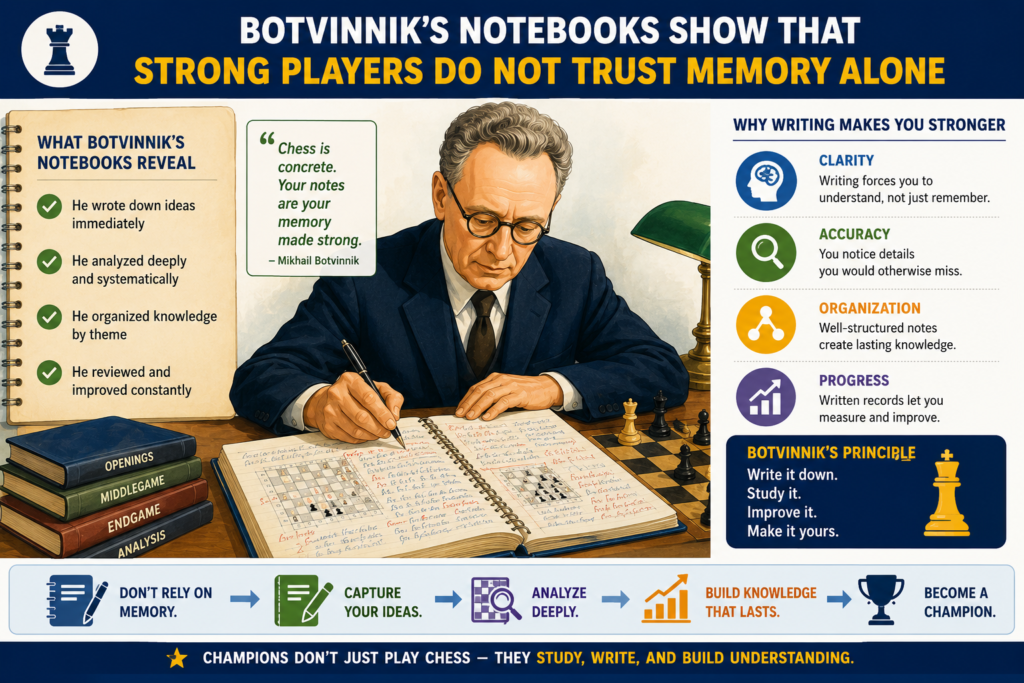
This is a wonderful lesson for children because it makes improvement feel real. A child can forget a lesson after class. But when the idea is written down in simple words, the child can return to it later. A small chess notebook can hold opening ideas, mistakes to avoid, favorite tactics, and lessons from tournaments.
A chess notebook helps a child see patterns that are easy to miss during play
Many children lose the same way again and again without seeing it. One child may keep missing back-rank mate. Another may move the queen too early. Another may forget to castle. Another may trade pieces without thinking. When these mistakes are written down, they become easier to fix.
Botvinnik’s preparation method became so well known that later collections of his work focused on his competition preparation and notebooks. A published description of “The Method of Preparing for Competition” says the material covers Botvinnik’s famous method and includes notebook-related chapters, showing how central preparation was to his chess work.
This does not mean a child needs a thick study file. A simple notebook is enough. The point is not to make chess feel like school homework. The point is to help the child remember the right lesson at the right time.
Parents can help by asking for one lesson after each class or game
The best notebook habit is small. After a class, the child writes one clear idea. After a game, the child writes one mistake and one good move. After a tournament, the child writes one thing to practice next.
This works because it keeps learning light but steady. It also helps parents understand what their child is working on. Instead of only asking, “Did you win?” the parent can ask, “What went in your chess notebook today?” That question changes the mood. It tells the child that learning matters more than the score.
Debsie’s coaches can make this even stronger because they can help students choose what to write. A coach may say, “Your lesson today is to check forcing moves before every capture,” or “Your next goal is to castle before starting an attack.” These simple notes can guide the child in the next game.
A child who keeps notes becomes more aware. Awareness leads to better practice. Better practice leads to more confidence. That is the quiet power of a system.
Botvinnik’s style teaches children that calm chess can be very dangerous
Some players look scary because they attack all the time. Botvinnik’s chess could be scary in a different way. He often built pressure with calm moves. He improved his pieces. He fixed weaknesses. He controlled key squares. Then, when the position was ready, he struck.
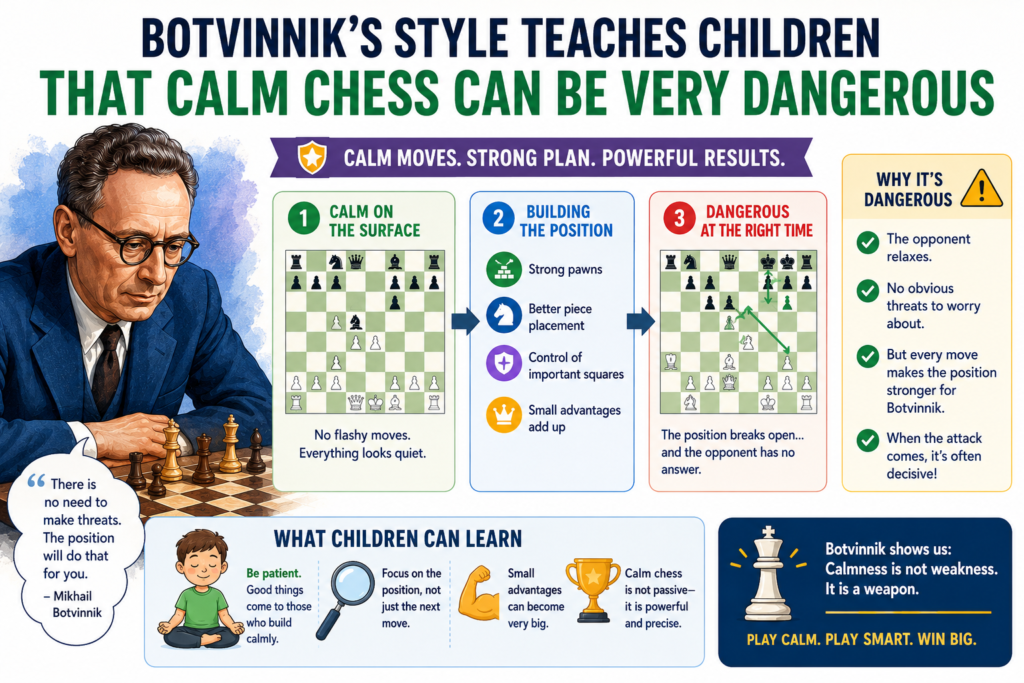
This is a hard lesson for young players because children often want action right away. They see the enemy king and want to attack. They see a pawn and want to capture it. They see a check and want to give it.
But chess rewards patience. Sometimes the best move is not the loudest move. Sometimes the best move is the one that makes every next move easier.
A calm move can be stronger than a quick attack when it improves the whole position
Britannica describes Botvinnik’s playing style as methodical and rational, and notes that his scientific approach influenced later Soviet players, including Karpov and Kasparov. This is important because it shows that his strength was not only in finding moves, but in building positions with clear purpose.
For children, this can be taught in very simple language. Make your worst piece better. Keep your king safe. Do not attack before your pieces are ready. Look at what your opponent wants. Use all your pieces, not just the queen.
These ideas may sound basic, but they are the base of strong chess. Many games at the beginner level are lost because one side attacks with only one or two pieces while the rest of the army sleeps. Botvinnik’s style reminds us that chess is a team game. The pieces must work together.
Debsie coaches can help children slow down without making chess boring
A child should not feel that careful chess is dull. Good coaching makes careful chess exciting. The coach can show how a quiet rook move creates a future attack. The coach can show how a small pawn move takes away an important square. The coach can show how one patient move can trap a careless opponent later.
This is where live teaching has a big advantage. A coach can pause at the right moment and ask, “What is your least active piece?” or “Is your attack ready yet?” These questions help the child discover the answer instead of only hearing it.
When children learn this, they become harder to beat. They do not panic when there is no quick win. They do not force attacks that are not ready. They learn that calm can be strong.
That lesson is useful far beyond the board. In school, it helps a child plan before writing. In sports, it helps a child wait for the right moment. In daily life, it helps a child think before reacting.
Botvinnik trained future champions by making them responsible for their own ideas
A great coach does not do the thinking for the student. A great coach teaches the student how to think alone. Botvinnik’s school mattered because it pushed strong young players to prepare, analyze, and take their own ideas seriously.
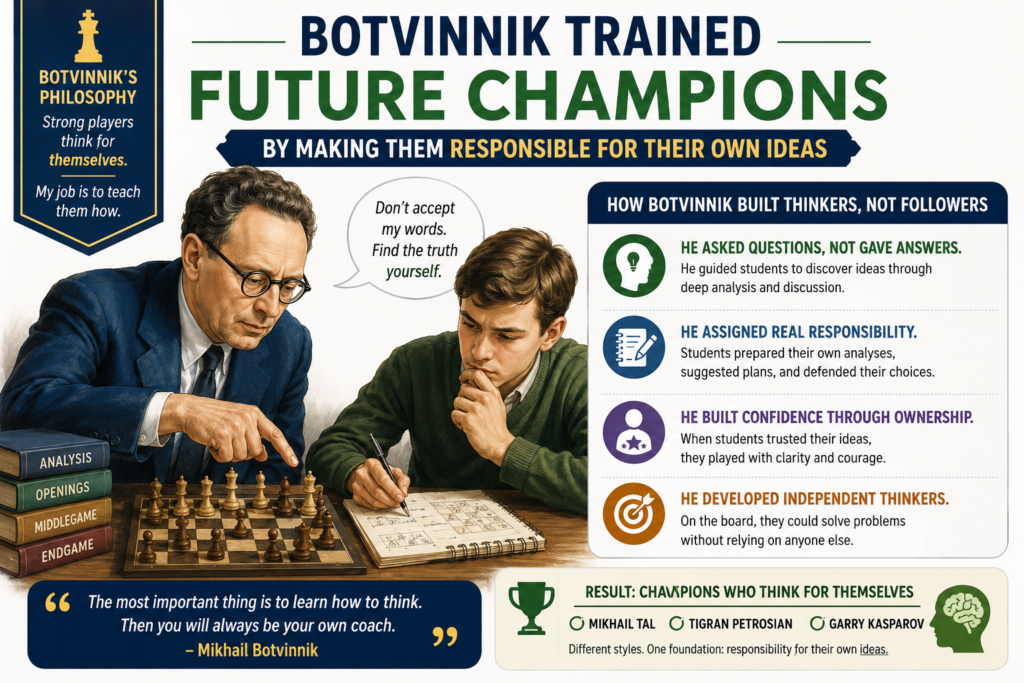
This is one of the deepest lessons in chess education. Children should not become move-repeaters. They should become idea-makers. They should learn to say, “This is my plan, and this is why I chose it.” The move may still be wrong, but the habit is right.
A child becomes more confident when the coach asks for the reason behind the move
The Russian Chess Federation says Botvinnik created his own method of tournament preparation and training and passed it on to his students. It also names players connected to his school, including Karpov, Kasparov, Kramnik, Razuvaev, Yusupov, and others.
That kind of teaching asks more from the student. It is not enough to sit quietly and copy. The student must explain, test, and improve. This may feel hard at first, but it builds real confidence.
A child who can explain a move is already growing. The explanation may be simple. “I moved my knight because it attacks the center.” “I castled because my king was unsafe.” “I traded queens because I was ahead.” These sentences show that the child is learning to connect moves with reasons.
Debsie helps students build the courage to think for themselves
Many children are afraid to be wrong. They may stay quiet in class because they do not want others to laugh. They may move fast online because they do not want to sit with doubt. A warm coach can change that.
At Debsie, the goal is not only to get the answer right. The goal is to help the child build a thinking process. When students feel safe, they speak more. When they speak more, the coach can guide more. When the coach guides more, the child grows faster.
This is how confidence is built. Not by saying, “You are amazing,” again and again. Confidence grows when a child faces a hard position and learns, “I can think through this.” That feeling is powerful.
Botvinnik’s legacy is not only that he trained champions. It is that he showed how champions are trained. They are trained by asking better questions, doing honest work, preparing with care, reviewing mistakes, and learning to trust clear thought over panic.
For parents, that is the heart of the story. Chess is not just about winning games. It is about raising children who can focus, plan, stay calm, and think for themselves.
Botvinnik made chess personal because every student needs a different training map
Botvinnik did not treat chess growth like a factory line. His best students were not all the same kind of player. Some were calm. Some were sharp. Some liked attack. Some liked quiet pressure. That matters because great training does not erase a child’s natural style. It shapes it, cleans it, and makes it stronger.
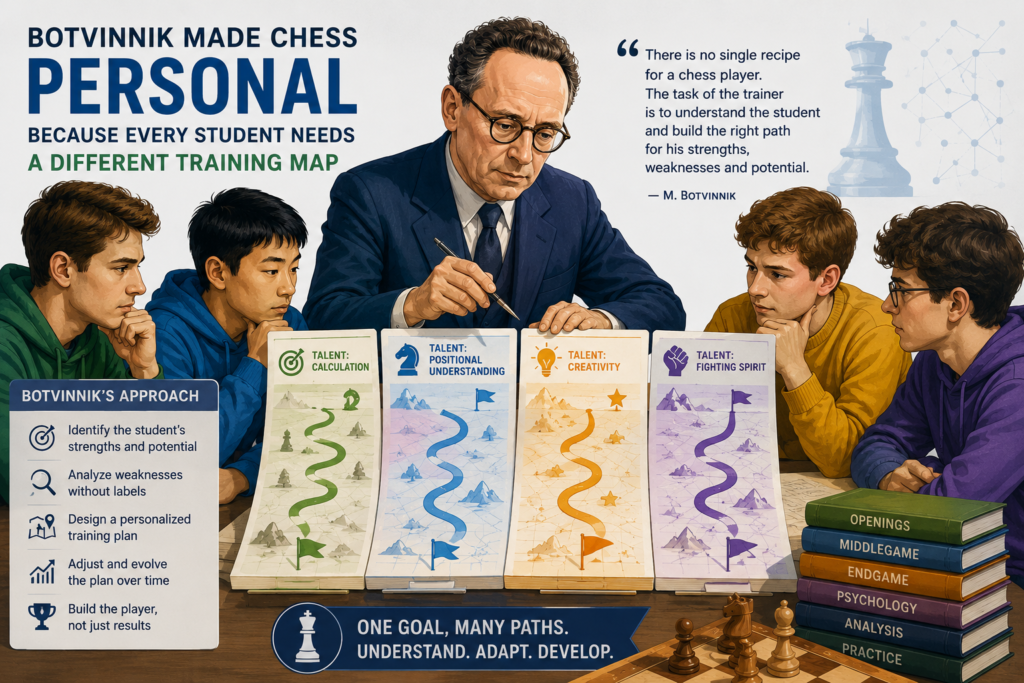
This is a lesson many parents can use right away. A child who loves tactics should not be forced to become boring. A child who likes slow planning should not be pushed into wild attacks before they are ready. The coach’s job is to see the child clearly and then build the next step.
Botvinnik’s influence was so strong because he was not only a world champion. He was also a teacher whose school is linked with later world champions like Anatoly Karpov, Garry Kasparov, and Vladimir Kramnik.
FIDE’s museum calls him the sixth World Chess Champion and the “Patriarch” of the Soviet Chess School, which shows how large his role became beyond his own games.
A strong coach starts by finding how the child already thinks
Some children see threats fast but miss long plans. Some children plan well but miss simple forks. Some children know openings but panic in endgames. Some children play well in class but rush in tournaments. These are not bad signs. They are clues.
A good coach does not shout at the clue. A good coach reads it. If a child keeps losing pieces, the coach may build a safety habit. If a child attacks too early, the coach may teach piece teamwork. If a child gets scared in winning positions, the coach may teach calm finishing.
This is why personalized chess coaching can help so much. The lesson is not just “learn more chess.” The lesson is “learn the right thing next.”
Debsie helps each child grow from where they are, not from where adults wish they were
At Debsie, this idea is very important. A young beginner should not feel lost in hard theory. A stronger student should not be held back with lessons that are too easy. The best learning happens when the class gives the child enough challenge to grow, but enough support to feel safe.
That balance is where confidence grows. The child feels, “This is hard, but I can do it.” Over time, that feeling becomes part of the child’s thinking. It helps in chess, school, and life.
Parents often want to know whether their child has “talent.” A better question is whether the child has the right learning environment. Talent can open a door, but coaching helps the child walk through it. Botvinnik’s life reminds us that champions are not only found. They are built.
A free Debsie trial class is a simple first step for families who want to see this kind of guided learning in action.
Botvinnik respected the endgame because simple positions reveal the truth
Many children love openings and attacks, but the endgame often tells the real story. When there are fewer pieces, there is less noise. A child cannot hide behind tricks. The king must become active. Pawns become precious. One square can decide the whole game.
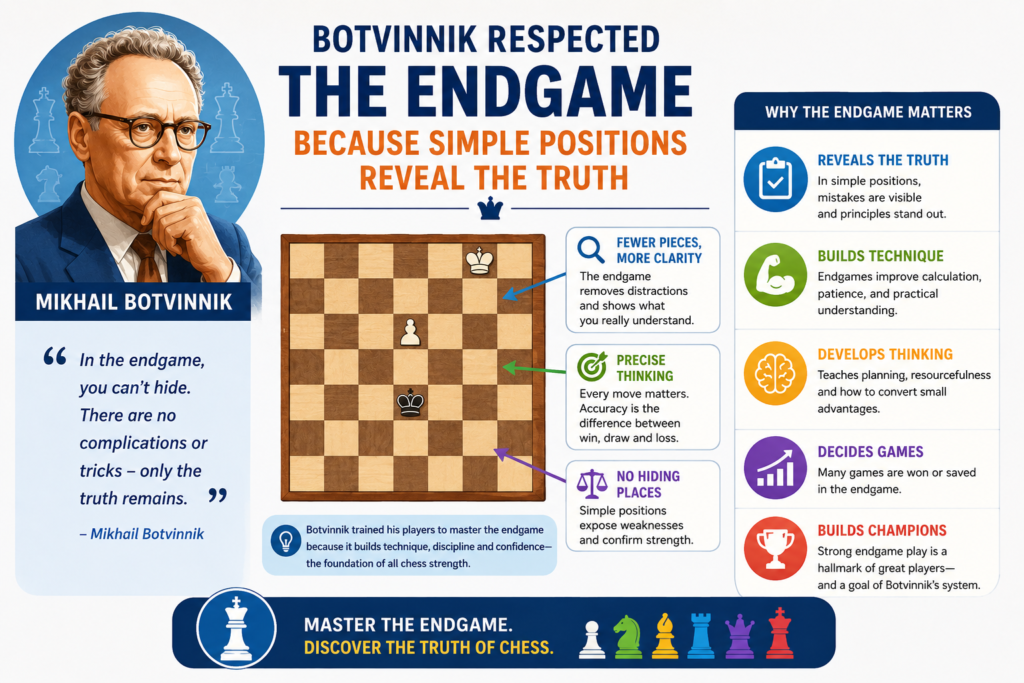
Botvinnik understood that deep chess skill must include the endgame. A player who only knows how to start a game may not know how to finish one. This is like a child who begins homework with energy but cannot complete it with care. Winning is not only about getting an advantage. It is about converting that advantage.
Britannica notes that Botvinnik held the world championship three times across 1948 to 1957, 1958 to 1960, and 1961 to 1963. Holding such a level for so long required more than opening tricks. It required complete chess strength, including strong nerves and strong technique in long games.
Endgames teach children patience in the clearest way
In an endgame, one rushed pawn move can lose. One lazy king move can turn a win into a draw. One careless trade can give the opponent a passed pawn. This makes endgames perfect for teaching patience.
A child may think, “I am winning, so the game is easy now.” But chess does not reward that thought. Chess asks the child to prove the win. That is a beautiful lesson. In life, starting well is helpful, but finishing well is powerful.
Endgame training also teaches children to count carefully. They learn to ask whether the king can catch the pawn. They learn why opposition matters, even if the word feels strange at first. They learn that small details can have big results.
Parents should celebrate careful finishing because it builds real discipline
When a child wins a won game with care, that is worth praise. It shows focus. It shows patience. It shows respect for the position. Even when the child does not win, a well-played endgame can show real growth.
Debsie coaches can help children see endgames in a friendly way. Instead of making the endgame feel dry, a coach can turn it into a small puzzle story. Can the king stop the pawn? Can the rook cut off the king? Can the child make a queen first? These simple questions make endgames feel alive.
This matters because many young players lose interest when chess becomes hard. A good teacher keeps the lesson simple, clear, and exciting. The child does not need to memorize a thick book. The child needs to learn the core ideas step by step.
Botvinnik’s system was built on full growth. Openings mattered. Middle games mattered. Endgames mattered. Review mattered. Health mattered. The whole player mattered. That is the type of learning Debsie aims to give.
Conclusion
Botvinnik’s story proves that great chess is not built by luck, tricks, or talent alone. It is built by clear habits, honest review, patient practice, and strong coaching. He trained champions because he taught them how to think, not just what to play.
That same lesson can help every child today. Chess can build focus, calm, planning, confidence, and grit, one move at a time. With the right guide, a child can grow stronger on the board and in life. Debsie helps make that growth simple, joyful, and structured through expert-led chess learning for every young player.

Adhip Ray is the founder of Debsie, an online learning platform focused on chess and skill-based learning for children. His work at Debsie brings together chess education, structured thinking, problem-solving, and interactive learning for young students.
Adhip has an academic background in law, statistics, analytics, and technology. He is from Amity Law School and the Indian Statistical Institute, Kolkata, with formal training that connects legal reasoning, data analytics, quantitative thinking, and structured problem-solving. This interdisciplinary background is reflected in Debsie’s focus on building sharper thinking skills in children through chess and related learning programs.
Adhip is also a FIDE-rated chess player from India. He holds FIDE ID 5055954 and has a standard FIDE rating of 1832. His FIDE profile records him as an Indian player with a long rating history in standard chess, including rated games from his competitive playing years. His chess background gives Debsie a founder-led connection to the game, not only as an educational activity but also as a competitive discipline that develops concentration, calculation, planning, and decision-making.
In addition to chess, Adhip has a strong interest in coding, data, and technical problem-solving.
Adhip’s profile combines chess, law, data analytics, and programming. At Debsie, this background supports the creation of learning experiences that are logical, structured, and skill-oriented. The platform’s chess-focused programs are connected to broader cognitive skills such as pattern recognition, patience, strategic planning, focus, and problem-solving.
As founder of Debsie, Adhip brings together experience from multiple fields: formal legal education from Amity Law School, analytical training from the Indian Statistical Institute, Kolkata, competitive chess experience through his FIDE-rated profile, and coding practice through LeetCode. This combination gives Debsie a distinct foundation in strategy, reasoning, analytics, and child-focused learning.
Through Debsie, Adhip is associated with building chess and learning content for children that goes beyond basic instruction. The platform connects chess with thinking skills, helping students approach challenges with more structure, clarity, and confidence. His own background in chess and analytical problem-solving gives the platform a direct link to the skills it aims to develop in young learners.
Adhip is also a member of Forbes Business Council.