Hybrid and blended learning can sound like a big, fancy idea. But it is simple. A child learns some parts with a teacher live, and some parts with smart online tools. The goal is not “more screen time.” The goal is better learning.
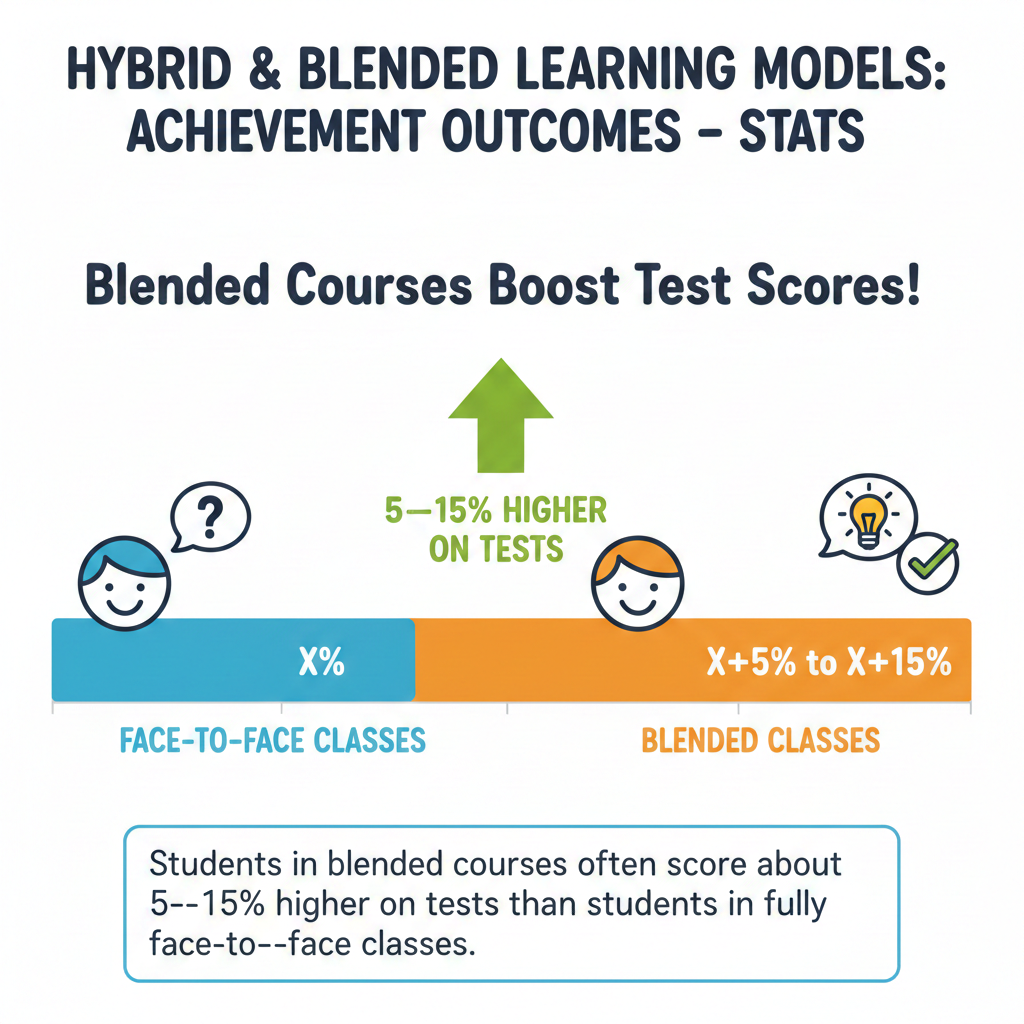
1) Students in blended courses often score about 5–15% higher on tests than students in fully face-to-face classes.
What this stat really means
A 5–15% score jump can change everything for a student. It can turn a weak “just pass” score into a safe score. It can turn a child who feels nervous into a child who feels steady. It can also build trust. When kids see their scores move up, they start believing they can learn hard things.
This improvement often shows up because blended learning gives two big advantages at the same time. First, the child gets teaching that explains the idea clearly. Second, the child gets practice that is not random. It is tied to that exact lesson.
In many normal classrooms, the gap happens here. A teacher teaches, and then practice is too short, too late, or too broad. Blended learning closes that gap because the practice is built into the flow.
Another reason is replay. In a face-to-face-only lesson, the child gets one chance to catch the full idea. If the child’s mind drifts for even two minutes, the missing piece can hurt the whole topic. With blended learning, a child can replay the key part, pause, and try again. That is not laziness. That is smart learning.
Actionable advice to get this result at home or in class
Start with one subject and one small unit. Do not try to “fix everything” in a week. Pick one topic your child is learning right now, like fractions, grammar, or coding loops.
Use this simple routine. First, learning. Let your child watch a short lesson or attend a live class. Second, practice right away, not later. The practice should match the lesson, not a mix of old topics. Third, correction. Look at mistakes the same day. Ask one calm question: “What step did you miss?” Then redo only that step. This is how the brain locks the skill in.
Also, keep practice short and clean. Many kids do better with two sets of ten minutes than one long session. Short practice reduces stress and increases focus.
If your child needs a plan that is already built like this, Debsie is made for it. Students learn with a real teacher, then practice in a fun gamified path, and then get guided help so mistakes do not pile up. You can explore courses or book a free trial class on Debsie.com.
2) When a course adds online practice plus quick feedback to normal teaching, average class grades often rise by about half a letter grade.
What this stat really means
A half letter grade is not a tiny change. It often means a child moves from “almost there” to “I can do this.” Think about a student sitting at a C+ or B-. A half grade jump can open doors. It can change how the child feels about school, how parents feel during report time, and how a teacher views the child’s effort.
This happens for one main reason: fast feedback stops small mistakes from turning into big gaps. In many normal learning settings, a child does homework today and gets it checked days later. By then, the child has already practiced the wrong method again and again.
That wrong habit becomes strong. Then the teacher has to “undo” it. Undoing is harder than learning it right the first time.
Quick feedback fixes that problem. When a child answers a question and gets a clear “right” or “not yet” message right away, the child can adjust on the spot. It is like learning to ride a cycle. If you tilt, you correct right then. If you wait two days to correct, you fall.
Online practice is also helpful because it can give many more short questions than a worksheet can, and it can change the level based on how the child is doing. That means the child spends more time in the “right challenge zone.” Not too easy. Not too hard.
Actionable advice to get this result at home or in class
You can create “quick feedback” without fancy tools. But tools help. The key is speed and clarity.
First, reduce the time between practice and checking. If your child does math, check a few questions right after they do them. Not all twenty. Just three. If the first three are wrong, stop and reteach that one step. If they are right, let the child continue.
Second, make feedback simple. Avoid long talks like “You always rush.” Instead say, “This step needs one more check,” or “Let’s find where the sign changed,” or “Show me the rule you used.” This keeps the child calm and willing to fix mistakes.
Third, keep a small “mistake notebook.” One page per week. Each time your child makes the same type of error, write one example and the corrected version. The goal is not to shame. The goal is to spot patterns. After a week, practice only those patterns for ten minutes.
If you want this system done for you, Debsie’s learning path is built around practice with feedback, and teachers help students understand mistakes in a kind, clear way. That mix is what often pulls grades upward without forcing longer study hours. You can try a free trial class on Debsie.com.
3) Schools using blended models commonly report 10–25% fewer failing grades in core subjects because students can rewatch lessons and redo practice.
What this stat really means
Failing grades often do not happen because a child is “not smart.” They happen because the child misses a few key building blocks and the class keeps moving. In math, one missed skill can ruin the next five topics. In reading, weak understanding of words can make every chapter feel tiring. In science, missing one idea can make the whole unit feel confusing.
Blended learning reduces failing because it gives students a safe way to catch up. Rewatching is a second chance. Redoing practice is a repair tool. Together, they keep the student from falling behind for weeks.
There is also a quiet emotional reason. When a child is behind, they often stop asking questions. They fear sounding silly. Blended learning gives private practice time. The child can try, fail, try again, and build confidence before speaking up in class. That alone can prevent a slide into failing.

A 10–25% drop in failing grades means fewer children feel stuck, fewer parents feel helpless, and fewer teachers spend the term doing emergency rescue work. It is not just about marks. It is about keeping learning steady.
Actionable advice to get this result at home or in class
If your child is at risk of failing, the first step is to stop guessing what the problem is. Find the exact “missing brick.”
Do this simple check. Ask your child to teach you one small part of the topic for two minutes. If the child cannot explain it, that is the gap. Then, instead of pushing the child through a full chapter, focus only on that missing piece for a week.
Next, use “rewatch with a purpose.” Many kids rewatch a video like they watch a cartoon. They enjoy it but do not learn much. Give the child one small task while rewatching. For example: “Write the rule in one line,” or “Pause and solve the example before the teacher solves it,” or “Say the next step out loud.”
Then use redo practice the smart way. Redoing does not mean repeating the same ten questions again and again. It means redoing the exact type of question that caused trouble, with one small change each time. The goal is to build a correct habit.
Debsie is strong for students who need this kind of support because lessons can be revisited, practice is guided, and teachers help kids fill gaps without making them feel bad. If your child is slipping in a core subject, a structured blended plan can be the difference between stress and progress. You can start with a free trial class on Debsie.com.
4) In courses where online quizzes give instant feedback, test scores often improve by about 8–12 percentage points compared to classes without that feedback loop.
What this stat really means
An 8–12 point increase is often a clear sign that the learning method changed, not just effort. Many students already “try hard.” They still do not improve because they are practicing the wrong thing or practicing it the wrong way.
Instant feedback quizzes change that. They turn practice into a live coach. The student answers, sees the result, and corrects right away. That correction is the moment learning happens. Without it, the student may repeat the same wrong step and feel confused later during the test.
Instant feedback also helps memory. When the brain makes a mistake and then fixes it quickly, it remembers the correct path better. It is like touching a hot surface and pulling your hand away fast. The lesson becomes strong. In learning, the “hot surface” is the mistake, and the quick fix makes the memory stick.
This kind of quiz also supports pacing. A child who is ready moves forward. A child who is not ready gets more practice. Both children get what they need without feeling trapped.
Actionable advice to get this result at home or in class
Use short quizzes often, not long tests rarely. A quiz should feel like a checkpoint, not a judgement.
Make one rule: every quiz must teach, not just score. That means after each quiz, your child should do a tiny review. Not a full hour. Just this: rewrite two wrong answers correctly and explain why.
Also, keep quizzes tight. Five questions can be enough if the questions are chosen well. If your child gets two wrong, stop the quiz and fix the misunderstanding. Continuing to the next questions while confused is like building on a broken base.
Another powerful trick is “same idea, new skin.” After the child fixes a wrong answer, give one more question that tests the same skill but with different numbers or different words. This checks if the child truly learned the idea, not just memorized the fix.
Debsie uses feedback-driven practice in a way kids enjoy, so the quizzes feel like part of the game, not a scary event. That makes students more willing to practice, and practice is what moves scores. If you want that system for your child, start with a free trial class on Debsie.com.
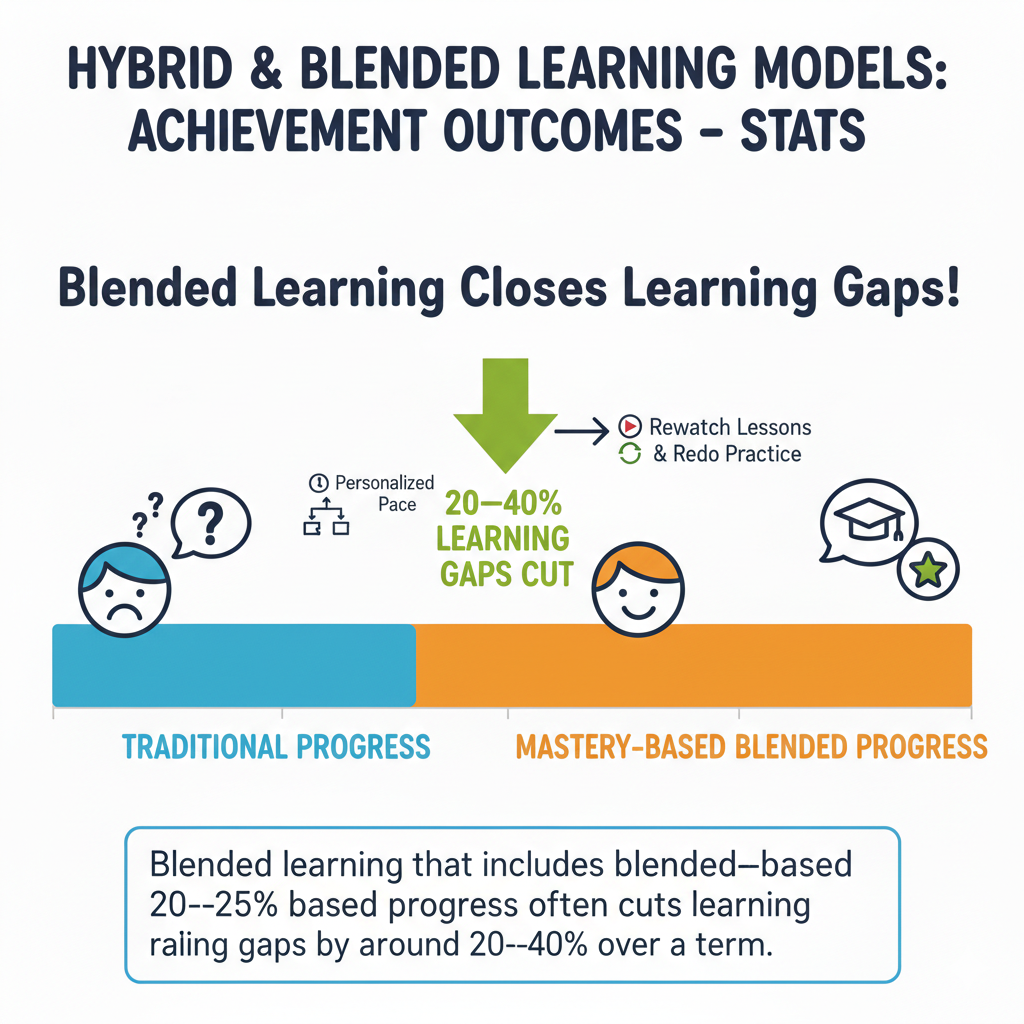
5) Blended learning that includes mastery-based progress often cuts learning gaps by around 20–40% over a term.
What this stat really means
Mastery-based progress means a student does not rush forward just because the class calendar says so. The student moves forward because they actually understand the skill. This is one of the biggest reasons blended learning can feel “stronger” than normal learning.
A 20–40% cut in learning gaps is not magic. It is what happens when children stop stacking new topics on top of weak basics. Think of math like building a tower. If the lower blocks are shaky, the tower tilts more and more with every new block. Mastery learning makes sure the lower blocks are solid first. That is why gaps shrink.
This matters even more for kids who are bright but fast. Some fast learners race ahead with half understanding, then get stuck later and feel shocked. Mastery protects them too. It replaces “I finished” with “I can do it well.”
Also, mastery learning changes the child’s self-talk. Instead of “I’m bad at this,” the child learns “I’m not done yet.” That small change often makes kids calmer and more persistent, which leads to better results.
Actionable advice to get this result at home or in class
Start by choosing one clear mastery rule for the week. Keep it simple. For example, “You can move to the next lesson only after you can solve five questions in a row without help.” The number is not the point. The clarity is the point.
Next, define what “mastery” looks like. Many parents only check final answers. But mastery is also about steps. Ask your child to explain one problem out loud. If they can explain the steps clearly, they are closer to mastery. If they cannot explain, they may be guessing.
Then use short “mastery checks” often. Two minutes is enough. At the end of a lesson, ask one question that proves understanding. If the child misses it, do not punish. Just pause and fix the missing piece.
Debsie’s gamified learning paths work well for mastery because children feel like they are leveling up, not being held back. They repeat what they need to repeat, and the system makes that repetition feel normal and even fun. If you want mastery learning without daily planning stress, try a free trial class on Debsie.com.
6) Hybrid formats often increase assignment completion by about 10–20% because students get reminders, checklists, and clear next steps online.
What this stat really means
Many kids do not fail because they cannot learn. They fail because they do not finish. Missing work slowly pulls grades down, and it also damages confidence. A child who keeps missing assignments starts believing they are “always behind,” even if they are smart.
A 10–20% rise in completion is often the difference between chaos and control. It means fewer late nights, fewer parent-child fights, and fewer “surprise” zeros in the grade book.
Hybrid learning helps because it makes the path visible. Kids can see what is due, what is next, and what is finished. That may sound basic, but it is powerful. Many kids, especially younger ones, struggle with planning. They need the learning plan to be outside their head, not inside it.
Also, reminders help because children forget. Forgetting is normal. A reminder is not nagging. It is a support tool.
Actionable advice to get this result at home or in class
Make the “next step” impossible to miss. Do this with one simple habit: at the end of every study session, your child writes the next task in one sentence. Not five tasks. One task. For example, “Finish questions 1 to 5 on fractions,” or “Watch the next coding lesson and try the challenge.”
Then set a short daily check time. It can be two minutes after dinner. The only goal is to look at what is due and pick one task to complete. This tiny routine prevents the snowball effect where work piles up.
If reminders cause stress, change the tone. Instead of “Did you do your homework?” try “What is your next step today?” That one small change often reduces resistance, because it invites the child to think instead of defend.
Hybrid systems like Debsie help here because the learning journey is clear. Kids see progress, and progress is a natural motivator. When children can see their streaks, levels, and wins, they are more likely to finish what they start. You can explore courses or book a free trial class on Debsie.com.
7) In math, blended learning programs often show 0.10–0.30 standard deviations of improvement, often described as about 1–3 extra months of learning in a school year.
What this stat really means
“1–3 extra months of learning” is a big deal. Imagine your child finishing the year not just meeting the class pace, but being ahead of where they would have been. That extra growth is like adding a bonus unit of progress without adding extra school months.
Math responds well to blended learning because math improves with guided practice. Kids need to see a method, try it, get feedback, and repeat. Blended learning fits this cycle perfectly. The teacher explains the why. The online practice builds speed and accuracy. The feedback fixes small errors before they become habits.
Another reason math improves is that blended learning can break topics into smaller steps. Many kids struggle because lessons jump too fast. When steps are smaller, the child feels less fear and more control.

This also helps with confidence. Math anxiety is real. When kids practice in a safe way and improve, their fear drops. A calmer brain learns faster.
Actionable advice to get this result at home or in class
If you want real math growth, do not chase long worksheets. Chase daily consistency.
Pick a short daily math window, even ten to fifteen minutes, and keep it steady. The goal is not to do “a lot.” The goal is to do “often.”
Focus on one skill at a time. For example, if the child is learning decimals, do not mix decimals, fractions, and percentages on day one. Teach one skill, practice it, and only then mix.
Also, train the child to check work like a detective. After solving, they should ask, “Does this answer make sense?” This is a habit, not a talent. For example, if the question is about sharing 12 cookies among 3 kids, an answer like 36 is clearly wrong.
Teaching this sense-check can raise scores fast because many math mistakes are not deep misunderstandings. They are rushed errors.
Debsie’s STEM and math tracks are designed for steady practice with teacher support, and the gamified challenges keep students engaged even when the topic is tough. If your child wants to grow faster in math this year, start with a free trial class on Debsie.com.
8) In reading and language arts, blended learning gains are often around 0.05–0.20 standard deviations, which can mean a few extra weeks to about 2 months of growth.
What this stat really means
Reading growth can be slower than math growth, and that is normal. Reading is not one single skill. It is many small skills working together, like knowing words, understanding meaning, noticing clues, and staying focused for longer texts. So even “a few extra weeks” of growth is meaningful, especially when it keeps adding up across the year.
Blended learning helps reading because it gives children more chances to practice in short, steady sessions. Many kids do not read enough to grow. They read only when school forces them to. Blended learning can make reading practice feel lighter and more regular, because it can be broken into small parts like short passages, quick questions, and word practice.
Another reason blended learning helps is that children can get support at the right moment. When a child does not understand a word or a sentence, they often keep going and miss the whole paragraph. With digital tools and teacher check-ins, the child can stop, clarify, and continue with better understanding.
The gains are also stronger when blended learning includes speaking and writing, not just reading on a screen. Reading improves faster when children talk about what they read and write short responses. That is where real comprehension grows.
Actionable advice to get this result at home or in class
Start with daily “small reading reps.” Ten minutes of focused reading is better than one hour once a week. Make it simple. Same time each day if possible.
Then add one tiny comprehension habit. After reading, ask your child to answer just one question in their own words: “What was the most important thing?” This builds the habit of meaning, not just word calling.
If your child struggles, do not force harder books right away. Instead, use easier texts to build speed and confidence, and slowly raise difficulty. Many kids hate reading because they are always reading texts that are too hard. That makes reading feel like pain. The right level makes reading feel possible.
Also, let your child hear good reading. Audiobooks with the text in front can be powerful. The child sees the words while hearing fluent reading. This helps word knowledge and rhythm.
Debsie’s structured learning, especially when paired with teacher guidance, can help kids build reading strength step by step. If your child needs more confidence in language skills, you can explore the courses or start with a free trial class on Debsie.com.
9) When students get personalized practice matched to their level, achievement gains are often 2–3 times larger than “one-size-fits-all” blended use.
What this stat really means
This stat is a big warning and a big opportunity. Blended learning is not automatically better. It becomes better when practice matches the student.
One-size-fits-all practice creates two problems. For a child who is behind, it feels impossible. The child guesses, gets many wrong, and loses hope. For a child who is ahead, it feels boring. The child rushes, stops caring, and learns less than they could.
Personalized practice fixes both. It gives each child the right level of challenge. The child can feel the work is “hard, but doable.” That feeling is where learning grows fastest.
This is also why many parents say, “My child studies a lot, but scores do not improve.” Often the child is practicing the wrong level. Either too hard, so they never build strong basics, or too easy, so they never stretch.
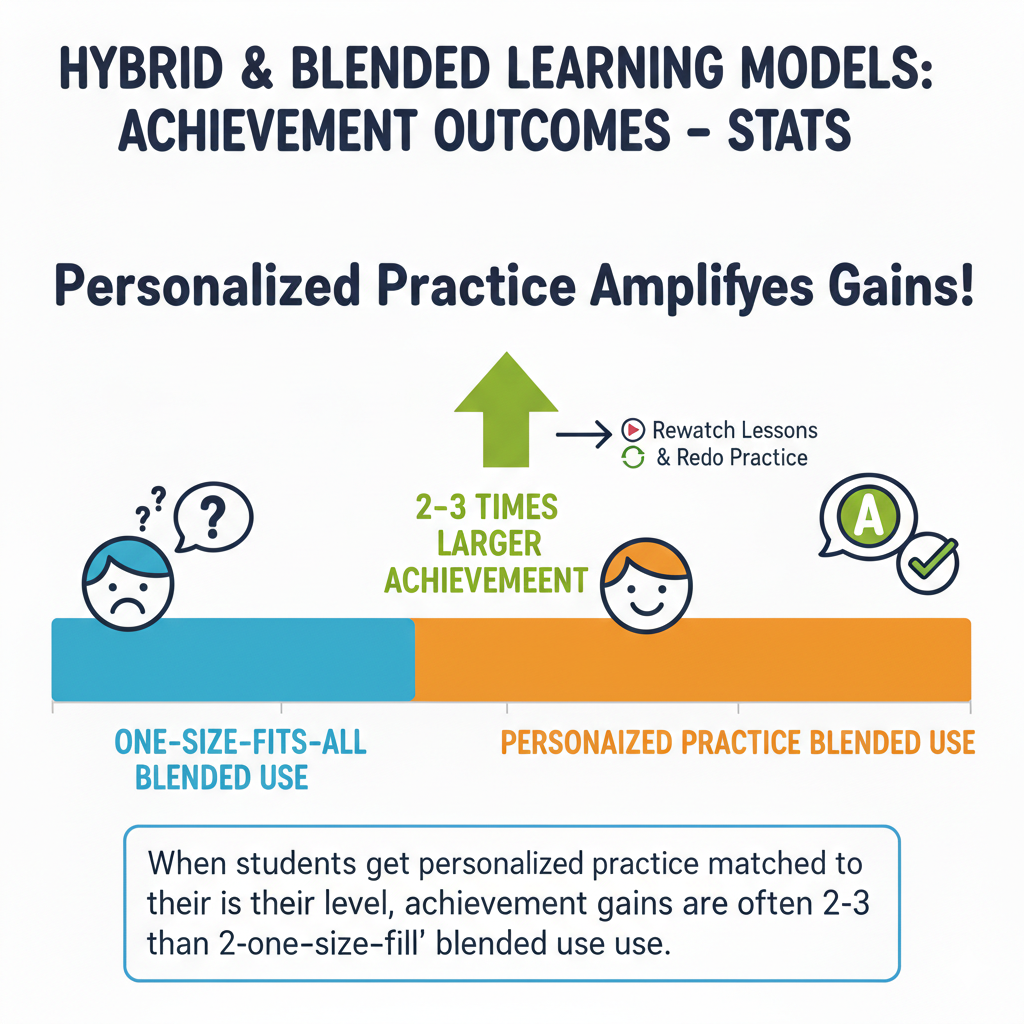
When gains are 2–3 times larger, it usually means the child is spending more time on real learning and less time on confusion or boredom.
Actionable advice to get this result at home or in class
To personalize, you do not need complicated testing. You need a small diagnostic check.
Pick ten questions on the current topic. If your child gets 8 or more right without help, move up a level. If they get 5–7 right, stay at the same level and practice more. If they get 4 or less right, step back and fill the missing skill first.
Next, use the “two-step ladder.” Step one: practice at the child’s current level until it feels steady. Step two: add a slightly harder version of the same skill. Not a totally new skill. For example, in math, move from two-digit addition to three-digit addition. In reading, move from short paragraphs to longer ones. In coding, move from simple loops to loops with conditions.
Also, watch energy, not just marks. If your child is melting down often, the level may be too hard. If your child is yawning and rushing, the level may be too easy. Adjust fast. Do not wait for the next exam.
Debsie is built around meeting children where they are, then guiding them forward with expert teachers and fun challenges. If you want personalized learning without having to build the plan yourself, book a free trial class on Debsie.com.
10) Hybrid courses with weekly live check-ins often see 5–10% higher final exam scores than hybrid courses with mostly self-paced work and fewer check-ins.
What this stat really means
Self-paced learning can be helpful, but many students do not manage it well alone. Weekly live check-ins create structure. They also create accountability. And they create a safe space to ask questions.
A 5–10% final exam boost often comes from small corrections made early. In self-paced-only learning, a child might misunderstand a concept in week one and carry that confusion into week six. By exam time, the confusion has grown. Weekly check-ins stop that.
Check-ins also push students to keep a steady rhythm. Many kids procrastinate. Then they cram. Cramming may help short-term memory, but it is weak for deep understanding. Weekly check-ins encourage steady practice, which is stronger and calmer.
Also, check-ins help teachers spot patterns. A teacher can see if a child is making the same mistake again and again and can fix the root cause.
Actionable advice to get this result at home or in class
If your child is learning in a hybrid way, set one weekly “review meeting.” It can be with a teacher, a tutor, or even with you if you can do it calmly.
In that meeting, do three things only. First, ask your child to show what they learned this week in one example. Second, find one mistake pattern. Third, set one goal for next week. Keep it short. Ten to fifteen minutes is enough.
Also, do not let check-ins become lectures. The child should talk more than the adult. When the child explains, you can hear what they truly understand.
If your child avoids check-ins, make them easier. Start with a win. Ask them to show the easiest thing they learned. Then move to the harder part.
Debsie’s live classes and teacher support make these check-ins natural. Kids get guidance, clarity, and steady progress without feeling alone. If your child does better with a weekly rhythm, try a free trial class on Debsie.com.
11) Blended learning can reduce course drop rates by about 15–30% when it includes strong teacher coaching and clear weekly goals.
What this stat really means
Dropping a course usually happens when a student feels lost, behind, or hopeless. It is rarely about the subject alone. It is about the experience. When kids feel they cannot catch up, they quit.
A 15–30% drop reduction shows that good blended learning keeps students in the game. Teacher coaching matters because it provides emotional support and direction. Clear weekly goals matter because they reduce overwhelm. When a child knows exactly what to do this week, the work feels smaller and more possible.
Many kids do not need “more talent.” They need less confusion. They need a path. They need someone to say, “Here is your next step.”

When students stay in a course, they gain more than marks. They gain grit, patience, and the habit of finishing.
Actionable advice to get this result at home or in class
To stop quitting, focus on weekly clarity.
Every week, set one learning goal and one practice goal. The learning goal is what they will understand. The practice goal is what they will complete. Keep it small. For example: “Understand how to solve linear equations,” and “Finish three practice sets.”
Then track the goal in a visible place. Kids often work better when the goal is seen, not hidden in a parent’s mind.
If your child falls behind, do not try to catch up all at once. That often leads to quitting. Instead, do “minimum catch-up.” Pick the most important missing lesson, learn that, and then rejoin the main path. Catch up later in small pieces.
And if your child says, “I can’t,” reply with a question: “Which part is hard?” Not “Why?” “Which part?” This helps you find the real problem.
Debsie’s teaching style is designed to keep kids moving with clear goals and caring guidance. If your child has started and stopped learning programs before, a structured blended model can help them finally stick with it. You can begin with a free trial class on Debsie.com.
12) For students who start below grade level, well-run blended learning often produces about 1.5–2 times the achievement growth seen in blended classes without targeted support.
What this stat really means
When a child starts below grade level, the biggest problem is not effort. It is the gap. The child is asked to learn today’s lesson while still missing yesterday’s building blocks. That feels like trying to read a book with missing pages. The child may look like they are “not paying attention,” but often they are simply lost.
This stat shows something important. Blended learning only becomes a real help for struggling students when it is targeted. Targeted support means the student is not just given the same online work as everyone else. They are given work that repairs the exact missing skills first, while still keeping them connected to the main class.
When that happens, growth can be 1.5–2 times faster. That is the difference between staying behind all year and starting to catch up. It also changes motivation. A child who sees progress is more willing to try again tomorrow.
The key is that the blended model must act like a bridge, not like a pile of extra homework. If the child is behind, adding more work at the same level often makes things worse. Targeted blended learning makes the work smarter, not heavier.
Actionable advice to get this result at home or in class
Begin with one “gap check” week. Do not guess. Pick the current topic and test the basic skill under it. If your child struggles with fractions, check multiplication and division facts. If your child struggles with paragraph writing, check sentence building and basic punctuation. You are trying to find the true root, not the loud symptom.
Then create a two-track plan. Track one is the current school topic, but in smaller bites. Track two is the gap repair, also in small bites. The child should do a little of both each week so they do not feel left behind socially and emotionally.
Keep the repair track short and consistent. Ten minutes a day can do more than one long session on the weekend. Struggling learners need frequent wins. Wins build courage.
At Debsie, teachers can help identify gaps and guide practice so your child gets support that matches their real level. If your child is behind and needs a kind, structured catch-up plan, try a free trial class on Debsie.com.
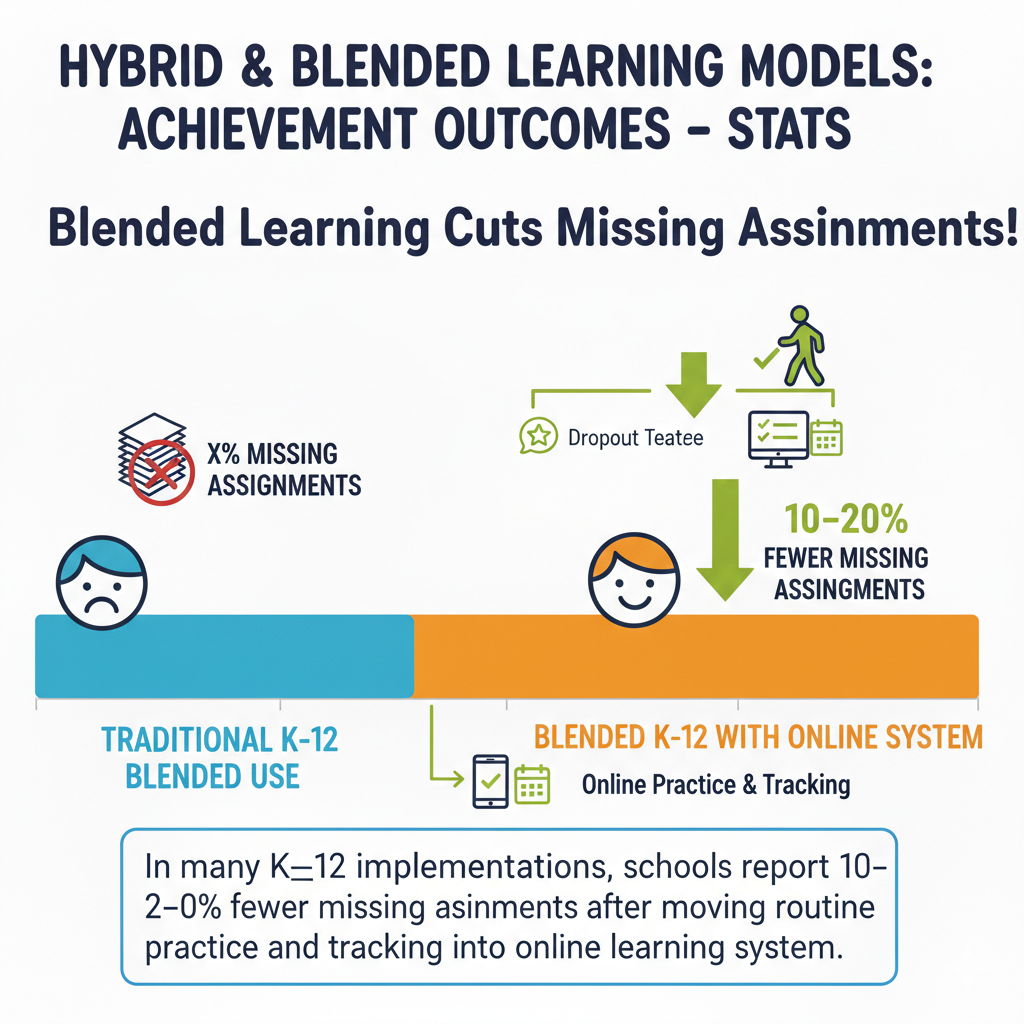
13) In many K–12 implementations, schools report 10–20% fewer missing assignments after moving routine practice and tracking into an online learning system.
What this stat really means
Missing assignments are often not about laziness. They are about poor tracking, weak routines, and unclear expectations. Kids forget. Kids lose papers. Kids mishear deadlines. And sometimes kids feel overwhelmed and avoid the work because they do not know where to start.
When practice and tracking move online, the work becomes harder to “lose.” The due dates are visible. The progress is visible. The next lesson is visible. This is why missing assignments often drop by 10–20%. The system reduces friction. It makes the path clear.
This also helps parents. Instead of asking, “Do you have homework?” and getting a vague answer, a parent can see what is due and what is done. That reduces daily arguments. It turns homework from a fight into a routine.
It also helps teachers because they can spot patterns early. If a student is missing work every Tuesday, that can be addressed before it becomes a bigger problem.
Actionable advice to get this result at home or in class
Start by choosing one single “home base” for learning tasks. Many kids fail at homework because tasks are spread across notebooks, messages, and memory. Pick one place where tasks live, even if it is simple.
Next, set a daily two-minute “task scan.” The child opens the system, checks what is due, and chooses one task to start. The goal is not to finish everything in two minutes. The goal is to prevent surprise and panic later.
Also, train the habit of closing the loop. Many kids do work but forget to submit. Make submission part of the task, not a separate step. After the child finishes, the child should immediately submit and then mark it as done.
If your child struggles with starting, create a “first step rule.” The first step must be small enough to start in one minute. For example, “Open the assignment and read the first line,” or “Write the title,” or “Answer the first question.” Starting is often the hardest part.
Debsie’s gamified learning flow makes tasks clear and easy to track, so children know exactly what to do next and feel rewarded for finishing. If missing work is hurting your child’s grades, book a free trial class on Debsie.com.
14) In science classes, blended labs and simulations can raise concept test scores by about 7–14 percentage points compared to lecture-only formats.
What this stat really means
Science is not meant to be only listening and memorizing. Science is meant to be seeing how things work. When students use simulations and guided labs, they can watch cause and effect. They can test ideas. They can notice patterns. This makes concepts stick.
A 7–14 point boost often happens because simulations make invisible ideas visible. Think about atoms, forces, electricity, or the solar system. These are hard to “see” from a textbook alone. But in a simulation, students can change one thing and watch what happens. That turns science from words into understanding.
Blended science also helps students who learn at different speeds. Some children need more time to explore. Others need a clear structure. A good blended model can give both. The teacher explains and guides. The simulation lets the student interact and learn by doing.
This approach also builds strong thinking skills. Students learn to ask, “What will happen if I change this?” That is real scientific thinking.
Actionable advice to get this result at home or in class
When your child uses a simulation or a lab tool, do not let it become passive play. Give it a purpose.
Before the activity, ask your child to make one prediction in plain words. For example, “If I increase the force, the object will move faster.” Then the child tests it. After the test, the child explains what happened and why.
Keep notes simple. One prediction, one result, one reason. That is enough. The point is thinking, not long writing.
Also, connect the simulation to a real-life example. If the lesson is about friction, ask your child about sliding on a smooth floor versus a rough mat. If it is about circuits, ask about what happens when a torch battery is weak. Linking to real life makes science easier to remember.
Debsie’s STEM approach focuses on learning by doing, not just by listening, which is why many students start enjoying science more and scoring better. If your child wants science to feel clear, try a free trial class on Debsie.com.
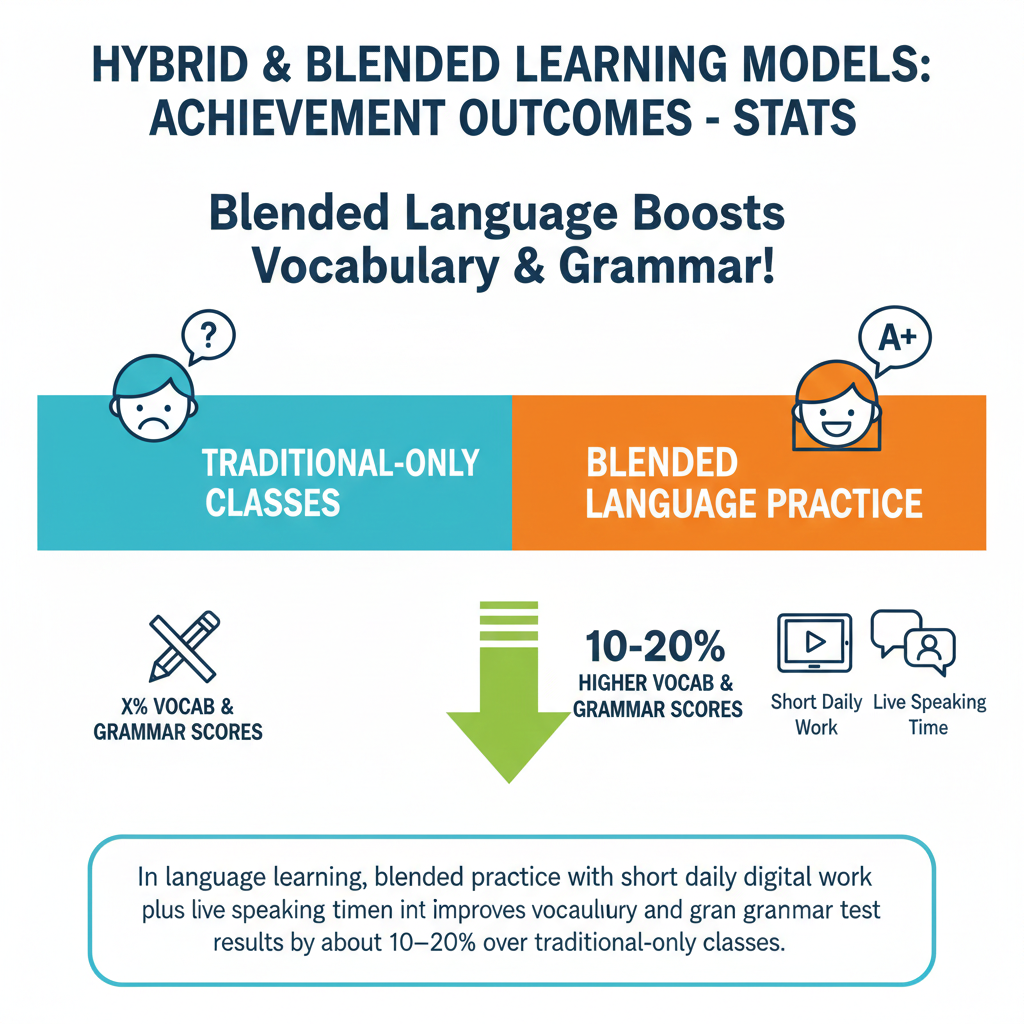
15) In language learning, blended practice with short daily digital work plus live speaking time often improves vocabulary and grammar test results by about 10–20% over traditional-only classes.
What this stat really means
Language grows through repetition and use. Traditional classes often give a lot of explanation but not enough daily practice. A blended model fixes that by adding short daily digital practice, while keeping live speaking time with a teacher or group.
That mix matters. Digital practice is great for quick repeat of words and grammar patterns. It helps the brain store the basics. Live speaking time is great for confidence, correct pronunciation, and real use. When both happen, scores often rise by 10–20%.
This improvement is also about comfort. Many students feel shy speaking a new language in front of others. Daily small practice builds familiarity, so when it is time to speak live, the student feels more ready. That reduces fear. A calm student learns faster.
The biggest mistake in language learning is cramming. Learning fifty new words in one day often leads to forgetting. Learning five words daily, using them, and hearing them again is stronger.
Actionable advice to get this result at home or in class
Start with tiny daily practice. Make it so easy that your child cannot refuse. Five minutes is fine. The goal is daily contact with the language.
Then add one speaking habit. It can be one minute long. Your child says two sentences using new words. The sentences can be simple. What matters is using the words in a real way.
Also, train “active recall.” Instead of only reading word lists, ask your child to look away and try to remember the word. That effort strengthens memory more than re-reading.
Finally, review old words on a schedule. New words should come back after one day, then three days, then one week. This timing helps long-term memory.
Debsie supports language learning with fun practice and teacher-led speaking that helps students feel safe and seen. If your child wants better results without stress, book a free trial class on Debsie.com.
16) In college settings, blended courses often show similar or slightly better final grades, commonly about 0.2–0.4 GPA points higher than fully in-person sections of the same course.
What this stat really means
A shift of 0.2–0.4 GPA points can change a student’s whole academic story. It can move a student from a borderline result to a stable one. It can protect scholarships. It can improve future options. And it can reduce stress because the student is not always trying to “save” the grade at the end.
This stat also tells us something useful for younger students. If blended learning can help older students handle harder content with better results, it can also help school-age learners build strong habits early. The core reasons are the same: clear structure, repeat access to lessons, and steady practice with feedback.
In many college blended courses, students benefit because they can manage time better. They can review difficult parts more than once. They can also prepare before live sessions, which makes live time more useful. Instead of sitting through a full lecture and leaving confused, students come in with basic understanding and use class time to solve problems and ask real questions.
When blended learning is done well, it makes learning more active. It turns class time into doing, not just listening. That change often improves results.
Actionable advice to get this result at home or in class
Borrow the college-style strategy for your child. Use “prepare, then perform.”
Prepare means your child reviews a short lesson before live class or tutoring. Even five minutes helps. The goal is simple: arrive with a basic idea of the topic and at least one question.
Perform means live time is used for practice and clarity. Your child should solve problems, explain steps, and ask questions. If live time becomes only listening, you lose one of the biggest benefits.
Also, teach your child to take “useful notes,” not long notes. Useful notes are short rules, short examples, and common mistakes. One page per topic is enough. This helps review before tests without panic.
Debsie follows this kind of structure, where kids learn, practice, and then get support. If your child needs a better system, try a free trial class on Debsie.com.
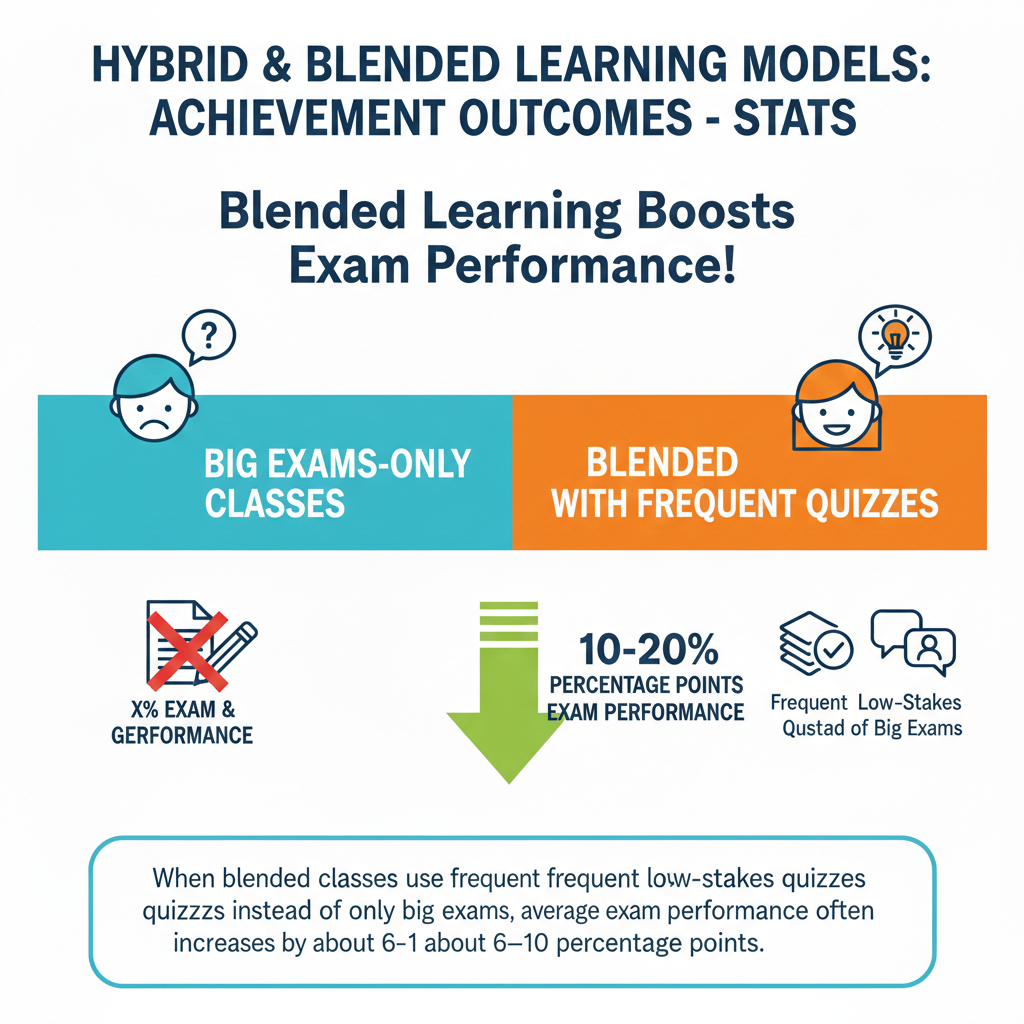
17) When blended classes use frequent low-stakes quizzes instead of only big exams, average exam performance often increases by about 6–10 percentage points.
What this stat really means
Low-stakes quizzes are small checks that do not feel scary. They are not meant to punish. They are meant to guide learning. This stat shows that frequent small checks can improve big exam scores by 6–10 points, which is a big jump for most students.
This works because quizzes change how the brain remembers. When you try to recall an answer, the brain strengthens that memory. This is much stronger than just re-reading notes. So every small quiz becomes a mini workout for memory.
Quizzes also reveal confusion early. A child may believe they understand, but a quiz shows the truth in seconds. That truth is helpful, not harmful. It allows quick correction before the exam.
Also, low-stakes quizzes reduce fear. When students take small quizzes often, tests feel normal. That lowers anxiety during big exams. A calmer brain performs better.
Actionable advice to get this result at home or in class
Create a “quiz routine” that feels safe. A quiz should be short and predictable. For example, every Monday and Thursday, five questions.
After the quiz, do one thing only: review mistakes. Do not lecture. Ask your child to correct two wrong answers and explain the correct step in one sentence.
Avoid giving a score if scores stress your child. You can say, “You got three correct, and we will fix the other two.” Keep the tone calm and steady.
Also, mix in one “why” question sometimes. For example, in science: “Why did the temperature change?” In math: “Why do we flip the fraction?” In reading: “Why did the character do that?” This builds deep understanding, not just surface memory.
Debsie’s practice challenges often work like low-stakes quizzes because they are frequent, quick, and guided. If your child needs better exam scores without pressure, book a free trial class on Debsie.com.
18) Hybrid models with recorded lessons often lead to 15–25% fewer students needing emergency catch-up after absences.
What this stat really means
Absences happen. Children get sick. Families travel. Sometimes school events interrupt learning. In a normal model, an absence can create a hole that never fully closes. The class moves on, and the child returns to a topic that depends on what they missed.
Recorded lessons change that. A child can watch what they missed, pause, rewind, and catch up. This is why fewer students need emergency catch-up sessions before tests. They repaired the gap earlier.
This also supports students who need more time. Even if they were present, they can rewatch hard parts. That is not cheating. That is smart learning.
The hidden benefit is emotional safety. When a child knows they can catch up, they feel less panic. Panic leads to avoidance. Calm leads to action. So the child returns from an absence and takes the next step instead of freezing.
Actionable advice to get this result at home or in class
If your child misses a lesson, do not wait until the weekend to catch up. Catch up within 48 hours if you can.
Use a simple catch-up plan. First, watch the missed lesson. Second, do a small practice set linked to that lesson. Third, write down one question to ask the teacher. This is a complete catch-up loop.
Also, avoid “double study days” that last for hours. Those often create anger and burnout. Two short sessions across two days are usually better.
If your child struggles to focus on recorded lessons, add a small task. For example, “Pause and write the rule,” or “Solve the example before the teacher solves it.” This turns watching into learning.
Debsie supports this style because students can revisit learning materials and keep moving. If your child misses classes sometimes and needs a system that prevents gaps, start with a free trial class on Debsie.com.
19) Blended learning that uses spaced practice often improves long-term retention by about 20–40% compared to cramming-heavy approaches.
What this stat really means
Cramming is when a student studies a lot in one short burst right before a test. It can help short-term recall, but it often fades fast. Spaced practice is the opposite. It is when a student reviews a topic in small pieces over time.
A 20–40% improvement in long-term retention means the child remembers more weeks later, not just on test day. That is real learning. It also makes future topics easier, because new topics often depend on old ones.
Spaced practice works because the brain needs time between reviews to strengthen memory. When you recall something after a gap, the brain works harder, and that effort locks the memory in. This is why short reviews spread out can beat long study sessions.
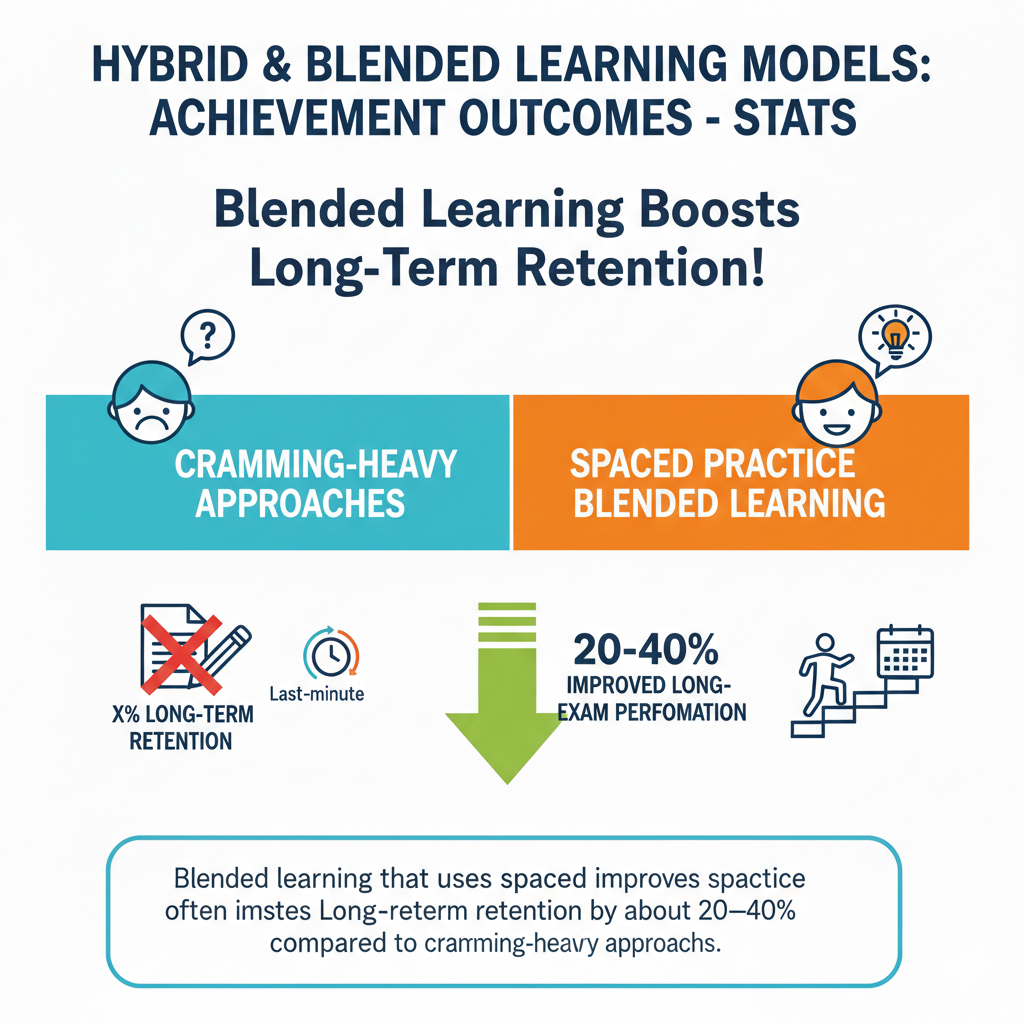
Blended learning helps spaced practice because digital tools can schedule review, repeat key questions, and bring old topics back at the right time.
Actionable advice to get this result at home or in class
Use a simple spacing plan. After learning a topic today, review it tomorrow for five minutes. Then review again after three days. Then again after one week. This can be very short. The magic is in the timing.
Make review active. Do not just read notes. Ask your child to answer a few questions without looking. If they cannot recall, then check the notes and try again.
Also, keep a “review bank.” Save a few questions from each topic. Then your child can do a short mixed review once a week. This keeps older skills alive.
Debsie’s gamified practice can support spaced review because it encourages regular learning and brings concepts back through challenges. If you want your child to remember more and stress less, book a free trial class on Debsie.com.
20) In classes using adaptive math software 3–5 times per week, schools often see about 30–60% more practice problems completed per student compared to paper-only practice.
What this stat really means
Practice volume matters in math, but only when the practice is meaningful. This stat says that when students use adaptive tools several times a week, they often complete 30–60% more problems. That usually happens because digital practice removes friction. There is no waiting for worksheets, no missing pages, no long time spent copying questions. The child can start quickly, keep going, and get instant checks.
Adaptive practice also keeps students moving at the right level. If a child is doing well, questions get slightly harder. If the child struggles, the tool gives easier steps or more practice. That means fewer students get stuck and stop. When kids do not get stuck, they do more work.
Another reason is motivation. Many kids prefer quick, interactive practice over long paper sets. The feeling of progress, levels, or streaks can push them to do “just a bit more.” That extra bit adds up across weeks.
But it is important to remember: more problems is not the goal by itself. The goal is better skill. More problems help when the child is solving thoughtfully, checking mistakes, and learning from feedback.
Actionable advice to get this result at home or in class
If you want your child to practice more without fights, make practice short and frequent. A ten-minute daily session often beats a long worksheet once a week.
Set a weekly rhythm. For example, practice on Monday, Tuesday, Thursday, and Friday. Keep Wednesday for a review or rest day. This keeps the routine steady.
Also, add one rule: every time your child gets an answer wrong, they must redo one similar question right away. This turns mistakes into learning, not into frustration.
Watch for “fast clicking.” Some kids rush on apps just to finish. You can prevent that by asking them to explain one question after the session. If they can explain, the practice was real.
Debsie’s approach encourages regular practice with teacher support, so practice becomes progress, not random repetition. If your child needs steady math growth, book a free trial class on Debsie.com.
21) Students in blended courses often report about 10–20% higher confidence in a subject when they can practice privately and retry without embarrassment.
What this stat really means
Confidence is not a “soft” extra. It directly affects performance. A child who feels confident tries more questions, asks more questions, and stays calm during tests. A child who feels ashamed avoids practice, hides confusion, and gives up faster.
Blended learning can raise confidence because it gives privacy during practice. In many classrooms, a child fears being the one who is wrong. They fear classmates will notice. So they stop taking risks. But learning requires risk. You must try, make mistakes, and fix them.
Private practice lowers that social fear. A child can try without feeling watched. They can retry without feeling judged. Over time, the child builds real skill, and skill creates confidence.

This also helps quiet children who do not speak up easily. They may understand, but they need more time. Blended tools let them work at their speed and come to the live session prepared to ask better questions.
Actionable advice to get this result at home or in class
Create a home culture where mistakes are normal. When your child gets something wrong, avoid labels like “careless” or “lazy.” Instead say, “Good, now we know what to fix.” This simple shift can change a child’s attitude.
Give your child a “retry promise.” Tell them that the first attempt is only a draft. They always get a second attempt. This makes them more willing to try hard problems.
Also, celebrate effort that is smart, not just effort that is long. If your child reviewed mistakes, rewrote a rule, or asked a good question, that is a win.
If your child is very anxious, start with easier practice to build early success, then slowly increase difficulty. Confidence grows through safe wins followed by gentle challenge.
Debsie’s gamified system supports confidence because kids can practice, retry, and improve in a fun setting while still getting expert teacher help. If your child needs confidence as much as grades, try a free trial class on Debsie.com.
22) Blended learning with clear dashboards, progress bars, and “what to do next” steps commonly increases on-time submissions by about 10–15%.
What this stat really means
Many children are not naturally good at planning. They are still learning how to manage time, remember tasks, and break work into steps. So when the learning path is unclear, they fall behind. They might not even know where to begin.
A clear dashboard solves this by making learning visible. The child can see what is done, what is due, and what is next. That clarity often improves on-time submission by 10–15%. It also reduces stress because the child is not guessing all the time.
Progress bars also motivate. The brain likes closure. When kids see they are close to finishing a task, they often push to complete it. That is why “visible progress” is a strong tool in learning design.
But dashboards only help if the child actually checks them. So the real value comes when the dashboard is part of a routine, not an extra thing.
Actionable advice to get this result at home or in class
Build a daily “check and choose” habit. Every day, your child checks the dashboard or task list and chooses one task to complete first. This takes two minutes but prevents missed deadlines.
Then, teach “small chunking.” If a task feels big, your child should split it into two tiny parts. For example, “Read one page now, and answer two questions after a short break.” Chunking reduces avoidance.
Also, make due dates visible in the child’s world. Put them on a calendar the child can see, not only in a parent’s phone. Children respond better when the reminder is in their space.
Debsie uses clear learning paths and gamified progress so kids always know what to do next and feel rewarded for finishing. If on-time submission is a problem at home, book a free trial class on Debsie.com.
23) In hybrid high school courses, passing rates often rise by about 5–12 percentage points when students have scheduled in-person support time, not just optional help.
What this stat really means
Optional help sounds nice, but many students do not use it. They might feel shy, they might not know what to ask, or they might think they can figure it out later. Then later becomes too late.
Scheduled support time changes that. It removes the barrier of choice. Support becomes part of the course, not a separate activity. When students get that built-in support, passing rates often rise by 5–12 points.
This also helps because support time is most useful when it is regular. Regular support prevents small confusion from growing into big failure. It also keeps students emotionally connected to the teacher. When students feel seen, they stay engaged.
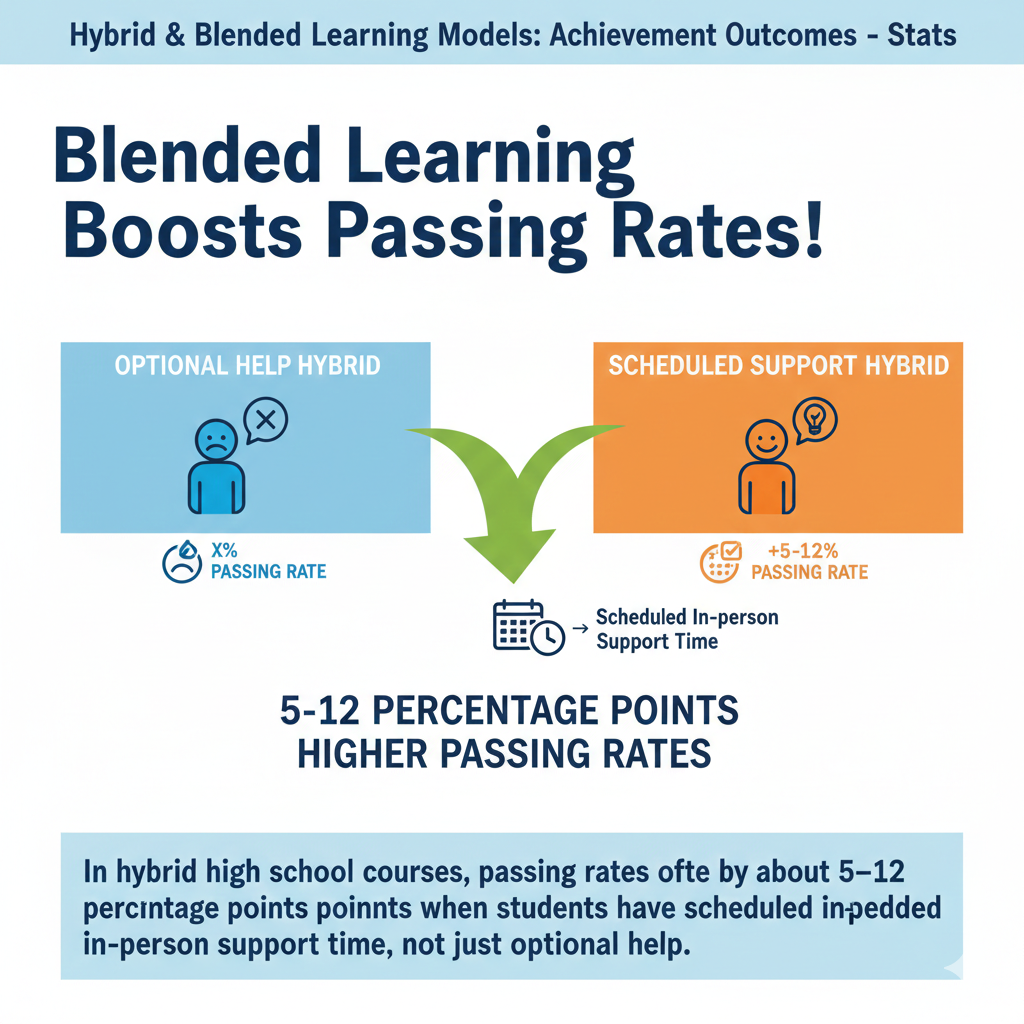
Scheduled support is not only for weak students. It helps strong students too because they can ask deeper questions and strengthen their understanding.
Actionable advice to get this result at home or in class
If your child is learning in a hybrid way, schedule support before your child “needs” it. Do not wait for a bad test result.
Create one weekly support slot. It can be with a teacher, tutor, or parent. Keep it predictable, like every Saturday morning or every Wednesday evening.
During support time, focus on the highest-impact problems. Ask, “Which topic will be on the next test?” and “Which topic feels most confusing?” Then work on those first.
Also, teach your child how to ask for help. Many kids say, “I don’t get it.” Train them to say, “I get step one, but step two is confusing because…” This makes support time faster and more effective.
Debsie’s live classes and teacher guidance give students scheduled support in a friendly way, so they do not have to struggle alone. If your child needs structure and support to pass with confidence, start with a free trial class on Debsie.com.
24) Blended tutoring with short online practice plus live coaching can produce achievement gains of about 0.20–0.40 standard deviations, often described as 2–5 months of extra learning.
What this stat really means
Two to five months of extra learning is not a small improvement. It can shift a child from behind to on track. It can also move an average student into a stronger position. This gain often appears when tutoring is not only talking, but also doing.
Blended tutoring works because it combines two strengths. Online practice handles repetition. Live coaching handles understanding. Many tutoring sessions fail because they spend too much time explaining and not enough time practicing. Or the opposite happens: the child practices alone, but the child does not know why they are wrong. Blended tutoring balances both.
The short online practice part is important because kids need many repetitions to build skill, especially in math and coding. Live coaching is important because kids need a human to guide thinking, correct misunderstandings, and build good habits.
Another reason this works is consistency. Online practice gives daily touchpoints, while live coaching gives weekly direction. This prevents “study spikes” and helps learning stay steady.
Actionable advice to get this result at home or in class
If your child has tutoring, add a short practice plan between sessions. Keep it simple. Ten minutes per day, four days a week, on the exact skills the tutor is working on. This makes tutoring results show up faster.
Also, make tutoring sessions active. Your child should solve problems while the tutor watches. If the tutor does all the talking, learning will be weak. Your child needs to think out loud, make small mistakes, and correct them.
After each session, write one “focus skill” for the week. One skill only. For example, “Solving two-step equations,” or “Using commas correctly,” or “Writing a loop with a condition.” Then practice that skill in small reps.
Debsie’s model supports this kind of blended tutoring through expert-led live learning and guided gamified practice. If you want this type of growth for your child, book a free trial class on Debsie.com.
25) In well-designed flipped or blended classrooms, students commonly spend 30–50% more class time actively practicing than in lecture-first classrooms.
What this stat really means
Active practice is where real learning happens. When students only listen, they may feel like they understand, but that feeling can be misleading. When students practice, their misunderstandings show up, and then they can fix them.
A 30–50% increase in active practice time is a major shift. It means more time solving, writing, building, discussing, and applying. In a flipped setup, the child learns the basic idea before class, often through a short lesson. Then class time is used for doing the work with the teacher present to support.
This reduces a common problem: the child gets stuck at home. In a lecture-first model, the teacher explains in class, and the child practices later at home, alone. That is the worst time to get stuck. In blended models, practice moves into the supported space, which often leads to better outcomes.
Active practice also keeps students engaged. Many kids lose focus during long talk-based lessons. Doing something keeps attention stronger.
Actionable advice to get this result at home or in class
At home, you can “flip” learning in a simple way. Before a class or tutoring session, let your child watch a short lesson or read a short explanation. The goal is not to master it alone. The goal is to arrive ready to practice.
Then, during live time, push for doing. Encourage your child to attempt problems while the teacher is available. If your child feels shy, remind them that practice is the point of class time.
Also, if you are a parent helping at home, shift your role. Do not explain first. Ask your child to attempt first. Then you step in only to fix the exact point of confusion. This creates active learning.
Debsie’s classes are built to be hands-on and engaging, with practice and challenges that make class time feel useful. If your child needs more active learning time, try a free trial class on Debsie.com.
26) Schools using blended interventions for struggling learners often report about 15–35% reductions in the number of students needing intensive last-minute remediation before exams.
What this stat really means
Last-minute remediation happens when a school realizes, near exam time, that many students are not ready. Then everyone panics. Students do extra classes, extra worksheets, and long revision sessions. Sometimes it helps a little, but often it creates stress and weak learning because it is rushed.
A 15–35% reduction means fewer students reach that panic stage. The blended intervention helped earlier. It repaired gaps step by step across the term. That is a healthier way to learn.
This works because blended interventions can spot problems early through data and practice results. If a child keeps missing the same skill, the system shows it. Then the teacher can act. This prevents small gaps from turning into big failures.
It also helps students feel calmer. When learning is steady, exams feel like a normal checkpoint, not a crisis.
Actionable advice to get this result at home or in class
The best way to avoid exam panic is to review small amounts weekly. Choose one day each week for a short review session. Keep it simple and focused.
In that review, do three things. Recall, practice, and fix. Recall means your child explains what they learned. Practice means a few questions. Fix means correcting mistakes right away.
Also, create a “weak spots list.” It should be short, not scary. Two or three items. Each week, work on one weak spot for ten minutes. Over time, weak spots disappear.
Avoid waiting for the test to reveal problems. Use small quizzes and practice results to catch issues earlier.
Debsie’s learning flow helps students stay ready through ongoing practice and teacher guidance, which reduces the need for emergency revision. If your child tends to panic before exams, book a free trial class on Debsie.com.
27) Hybrid classes that require weekly participation often show 10–20% higher course completion than hybrid classes that are mostly optional and self-paced.
What this stat really means
Many students start strong and then fade. They do not fade because they do not care. They fade because life gets busy and the learning path is too easy to ignore. When participation is optional, many kids delay, delay, and then feel too far behind to return.
Required weekly participation creates a gentle push. It keeps students connected. It also creates a rhythm. That rhythm is one of the biggest secrets in learning success.
A 10–20% higher completion rate means more students finish what they start. This is important because completion builds identity. When a child finishes a course, they begin to see themselves as someone who can stick with learning.
Weekly participation also helps teachers support students. When a student shows up each week, the teacher can spot issues early and guide the student.
Actionable advice to get this result at home or in class
If your child is in a hybrid program, build a weekly non-negotiable learning time. It can be one live session plus one practice session. Put it on the calendar like a sport or music class.
Also, set a “minimum weekly output.” For example, “Complete one lesson and one practice set each week.” The child can do more if they want, but the minimum keeps progress alive.
If your child misses a week, do not shame. Restart fast. The longer you wait, the harder it feels to return. Make the restart small. One lesson. One short practice. Then continue the rhythm.
Debsie’s structured live learning and gamified curriculum naturally create weekly participation, which helps students finish and improve. If your child struggles to stay consistent, start with a free trial class on Debsie.com.
28) When blended learning includes peer collaboration tools and guided group roles, project scores often improve by about 5–10 percentage points compared to solo-only blended work.
What this stat really means
Many children can understand an idea alone, but still struggle to use it in a project. Projects require planning, sharing tasks, explaining choices, and checking work. When blended learning adds collaboration tools, it supports these project skills in a clear way.
The guided roles part is especially important. Without roles, group work can become messy, with one child doing everything and another child doing nothing.
A 5–10 point increase in project scores often happens because collaboration forces thinking to become clear. When a child must explain a step to a teammate, the child notices gaps in their own understanding. This is a natural learning boost. Also, peers can catch mistakes quickly. A friend may notice something the child missed.
Collaboration also builds real life skills. Communication, patience, and teamwork are not “extra.” They are key skills for school and for future work. When group work is designed well, it improves outcomes and helps children mature.
But collaboration must be guided. Random group work does not guarantee learning. The structure is what makes it work.
Actionable advice to get this result at home or in class
If your child does projects, use simple roles even at home. One child can be the “planner,” one can be the “builder,” and one can be the “checker.” If your child is alone, they can still use these roles as steps. First plan, then build, then check.
Encourage your child to speak their plan out loud before starting. A spoken plan often prevents wasted time. For example, “First we will research, then we will draft, then we will test, then we will present.” Keep it short.
Also, teach a basic rule for group work: every person must show one piece of work. It can be a paragraph, a code block, a diagram, or a short explanation. This keeps the group fair and keeps everyone learning.
If your child is working online with peers, set simple communication habits. One message that says what they will do today. One message that shows what they finished. This reduces confusion.
Debsie’s gamified challenges and guided learning can support strong project habits, and live teachers can help kids learn how to work with others in a healthy way. If your child wants to improve projects, try a free trial class on Debsie.com.
29) In many implementations, blended learning helps narrow achievement gaps: lower-performing students often gain about 20–50% more than higher-performing students when personalization is strong.
What this stat really means
Achievement gaps often grow when teaching is one-size-fits-all. Strong students keep up, and struggling students fall further behind. This stat shows that blended learning can do the opposite.
When personalization is strong, lower-performing students can gain 20–50% more than higher-performing students. That does not mean higher-performing students stop growing. It means struggling students finally get the right support to grow faster.
This matters for families because it changes the story. A child who has been labeled “weak” can start catching up. And once the child sees progress, the child’s effort often increases. That creates a positive loop.
Personalization is the key word. It means the student gets work that matches their current level, not their age label. It also means the student gets extra time on the exact skills that are missing, not extra work on everything.
When gap-narrowing happens, it often includes two parts. First, targeted practice to repair basics. Second, teacher support to make sure the child understands the why, not just the steps. Together, they help the child build real strength.
Actionable advice to get this result at home or in class
If your child is struggling, do not compare them to the top student. Compare them to their past self.
Track progress in small ways. For example, how many questions they can solve correctly in ten minutes, or how clearly they can explain a topic. Small wins build motivation.
Next, focus on the highest-impact basics. In math, this might be number sense, place value, and times tables. In reading, it might be vocabulary and understanding main ideas. In coding, it might be logic, sequences, and loops. Basics are not “baby work.” Basics are power.
Also, keep the challenge zone right. If the work is too hard, the child gives up. If the work is too easy, the child does not grow. Adjust quickly. A good rule is this: the child should get most questions right, but still need to think.
Debsie’s model is designed to personalize learning so students can grow from their current level, with expert teachers helping them build real understanding and confidence. If you want your child to catch up without shame, start with a free trial class on Debsie.com.
30) Across many studies, the biggest achievement boosts show up when blended learning is a full model change, not just “extra screen time,” and these designs often deliver about 2–3 times larger learning gains than simply “adding an app.”
What this stat really means
This is the most important stat in the whole article. It explains why some blended learning works and some does not. If a school or parent simply adds an app on top of the same old routine, results may be small. The child may feel like they got extra homework, not better learning.
But when blended learning is a full model change, results can be 2–3 times larger. A full model change means the online and live parts are planned together. The teacher uses data from practice. The student gets feedback. The student gets a clear path.
The student gets time for deep practice and support. The whole system works as one.
This is also where many families get confused. They think “blended learning” means “more videos.” It does not. Videos alone are not a model. A model includes teaching, practice, feedback, review timing, and support.
When done well, blended learning also builds life skills. Kids learn how to set goals, track progress, handle mistakes, and stay consistent. Those skills matter beyond school marks.
Actionable advice to get this result at home or in class
If you want the true benefits of blended learning, build a simple model at home, even if you use only a few tools.
First, set a weekly plan with clear goals. One goal for understanding and one goal for practice. Keep them small and realistic.
Second, link teaching to practice. Every lesson must be followed by practice on the same topic within the same day if possible. This is where most learning happens.
Third, use feedback and review. Your child must look at mistakes, fix them, and then try one similar question to confirm the fix. Without this step, practice becomes busy work.
Fourth, schedule spaced review. Bring the topic back after one day, three days, and one week. This builds long-term memory.
If this feels like too much to manage, choose a program that already does it properly. Debsie is designed as a full learning model, not a random set of videos. Students learn with expert teachers, practice through a gamified path, and get guidance that helps them improve steadily. You can explore courses or book a free trial class on Debsie.com.
Conclusion
Hybrid and blended learning can improve scores, but the real win is bigger than marks. When done the right way, it helps children practice more, remember more, submit work on time, and feel confident while learning.
The stats you saw across this article point to one clear truth: results improve when learning is planned as a system. Teaching, practice, feedback, review, and support must work together.