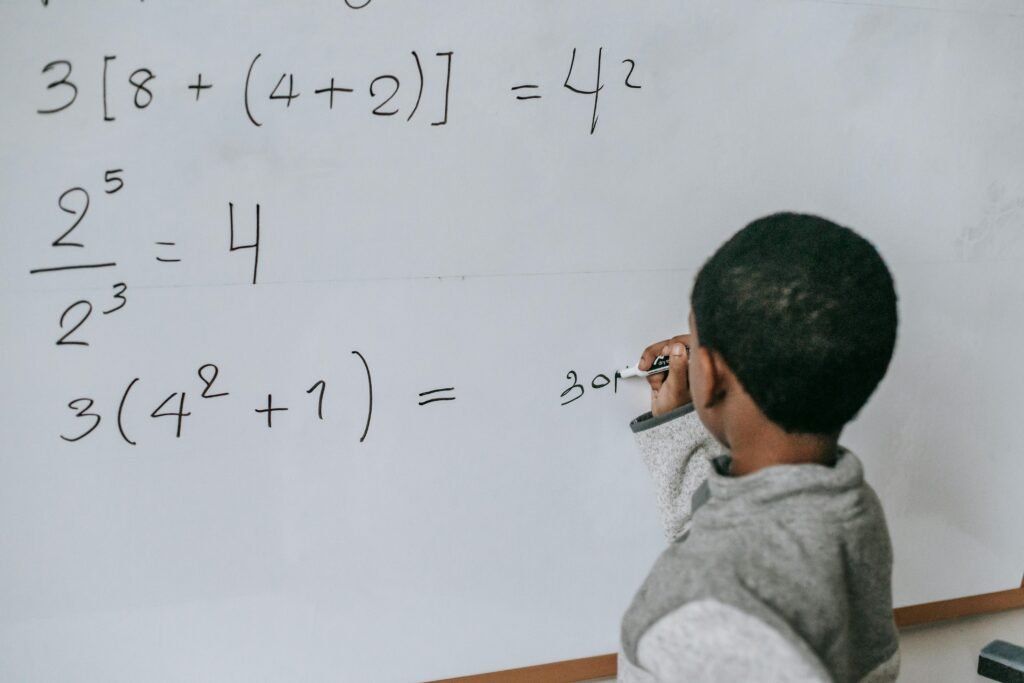
Math in grades three to five is where small steps turn into big leaps. Kids move from single digits to long numbers. They learn to carry and borrow. They meet decimals. They line up columns and place values. In this stage, tiny slips can grow into big gaps. A missed carry here or a wrong place value there can change the whole answer. The good news is that these are not mysteries. They are patterns. And patterns can be fixed with calm steps, smart practice, and clear teaching.
1) Grade 3 multi-digit addition (2–3 digits) benchmark: ≥92% accuracy with regrouping
This benchmark tells us that a strong Grade 3 student should solve most two or three digit additions correctly, even when a carry is needed. The key word is regrouping. That little carry mark at the top of the column is where many mistakes begin.
Children may forget to write the carry. They may write it but forget to add it. They may place it over the wrong column. To reach ninety two percent accuracy, they must have a calm, steady routine that makes regrouping automatic and clear every single time.
Start with neat set up. Ask the child to write the numbers in a tight ladder, digits stacked in straight columns. Have them draw a light vertical line between columns so ones, tens, and hundreds do not drift. Next, build the same small script for each problem.
Add ones. If the sum is ten or more, circle the ones digit, write it in the ones place, and place a small, clear carry above the tens. Say it aloud. For example, seven plus five is twelve, write two, carry one. Then move to the tens. Add the three parts, the top tens, the bottom tens, and the carry.
Pause one second to check if a second carry is needed. Then move to hundreds. At the end, run a quick check. Add the two original numbers’ first digits to make sure the size of the sum makes sense. If both numbers are in the three hundreds, the sum should be around six hundred, not two hundred.
Use tiny, daily sprints. Give five mixed problems with and without carries. Track a clean score and a speed mark, like correct in one minute. When a mistake happens, ask one kind question. Where did your eyes go last? The child points to the place they looked when the slip started.
Then fix only that step. If they forgot to add the carry, place a small box around the carry until they say it out loud before moving on. If alignment is the issue, use squared paper for a week, then switch back to plain paper and keep the same spacing.
Keep praise specific. Say, I like how you wrote the carry neatly above the tens. That kind of praise builds the habit that brings accuracy up and keeps it there.
2) Grade 3 multi-digit subtraction (2–3 digits) benchmark: ≥90% accuracy with borrowing
Subtraction with borrowing is where confidence can wobble. Many children try to do it fast and skip the careful work of turning a smaller top digit into a larger one through a borrow. Ninety percent accuracy tells us that out of ten problems, a strong learner should miss at most one.
To reach that level, we teach a simple borrow path that never changes, and we train the child to slow down for three seconds when a top digit is smaller than the bottom digit.
Begin with a quick scan from right to left. Ask, can I subtract ones without borrowing? If not, tap the tens column, cross out the top tens digit, and reduce it by one. Write a small mark to show this. Then add ten to the top ones. Now subtract the ones.
Move to the tens and repeat the same test. If the top tens is now smaller because you borrowed, borrow from the hundreds. Keep the marks tidy. Each change should be visible and small. After reaching an answer, do a fast reasonableness check.
Compare the two original numbers. If they were close, the difference should be small. If one was much larger, the answer should be large. This rough sense check catches many slips right away.
Practice should highlight the tricky shapes. Problems with zeros in the top number are a must, like three hundred four minus one hundred sixty eight. Children often borrow across zeros and lose track. Teach a chant for this case.
If you see a zero, keep walking left until you find a nonzero. Borrow one, turn each zero you pass into nine, and turn the first target place into ten. Then continue the normal subtraction. Have the child point with a finger as they walk across the digits so their eyes and hands move together.
End with a self-check that uses addition. Have them add the difference to the smaller number to see if it rebuilds the larger number. This not only confirms the answer but also grows number sense. With steady daily sets of four or five varied problems, accuracy rises. Gentle, direct feedback and a calm rhythm do the rest.
3) Grade 3 place-value identification (ones–thousands): ≥95% correct
Place value is the map of all multi-digit work. When a child knows exactly where each digit sits and what it is worth, carries and borrows make sense. Ninety five percent correct means only rare slips, even when numbers look big or messy.
To hit this mark, we use clear language and touch the number in different ways. We read it, build it, break it, and move it around, but we always keep the place-value story the same.
Start with clean talk. Say the number out loud the way we would write it. For example, four hundred sixty two means four hundreds, six tens, and two ones. Then write it in expanded form. Four hundreds plus six tens plus two ones.
Then draw quick base ten pictures in the margin, like four blocks, six rods, two little cubes. Move back and forth between these forms so the child can see the same value in many shapes. Ask small, sharp questions. What is the value of the six? Not just its place, but its value.
The child answers sixty, not six. This difference matters. It stops common mistakes like writing the wrong digit when regrouping.
Drills should be short and lively. Give a number and ask for three fast tasks. Point to a digit and tell its place. Tell the digit and ask its value. Write the number in expanded form. Keep the pace brisk and the tone warm. When a child is unsure, go back to building.
Let them sketch hundreds, tens, and ones quickly. Then erase the sketch and ask again, so the idea sticks without the drawing. Mix in comparison work. Show two numbers and ask which is greater, and why. The child should point to the highest place where they differ.
This act builds strong place sense and cuts down on errors when lining up columns later. Finish with a simple home task. At dinner, read out any three or four digit number you see in the world, like a price or a house number, and ask your child to tell you the value of one digit.
This tiny habit, done daily, keeps accuracy high with almost no effort.
4) Grade 3 expanded-form conversion accuracy: ≥90%
This goal means a child can switch between standard form and expanded form with only rare slips. When they see 462, they can say four hundreds plus six tens plus two ones. When they hear four hundreds plus sixty plus two, they can write 462.
This skill is more than a reading trick. It is the engine under all carrying and borrowing. If a child truly feels that six tens is sixty, they will not drop a zero or borrow the wrong amount. To build ninety percent accuracy, keep the process steady and the language clean.
Begin with a three step routine. Read, expand, compress. First, read the number aloud with places. Then write it in expanded form using actual values, not just digits. Then compress back to standard form. Have the child speak while writing to lock the idea.
Four hundreds, six tens, two ones becomes 400 plus 60 plus 2, which becomes 462. Use quick variations to keep the brain awake. Ask which part is bigger, the six tens or the two ones, and by how much. These tiny compare moments keep value sense sharp and make later estimation easier.
Turn mistakes into short lessons, not long lectures. If a child writes 406 as 400 plus 6 and forgets the zero tens, pause and draw a tens frame with no sticks. Say aloud that there are zero tens and that zero is still a value that holds the place.
Then have the child fix it to 400 plus 0 plus 6. Next problem, switch to 460 and ask them to name each part again so they see how a zero can sit in a different place. Close each mini session with a fast mix. Speak three numbers and have your child write expanded form.
Then flip it. Write three expanded forms and have them compress to standard form. Keep the handwriting neat and the spacing wide so each place stands on its own. Praise specific acts, such as naming values rather than digits. With five to six minutes a day, you will see errors fade and confidence grow.
5) Grade 3 typical carry/borrow error rate on regrouping items: ≤8%
This target says that carry and borrow slips should be rare across a week of work. Errors do happen, but they should be the exception.
The main types here are forgetting to add a carry, adding it to the wrong column, borrowing the wrong amount, or borrowing but not reducing the next place. The cure is to make the hidden steps visible and to practice those exact steps until they are calm and automatic.
Create a tiny carry ritual that always happens in the same order. After adding the ones, if the sum is ten or more, circle the ones digit, write it below, and place a neat carry above the tens. Then put a small dot on the carry with your pencil and do not erase it until you have added it.
Only after you add the tens do you erase the dot. That dot is a simple memory cue. For borrowing, use crossing marks that are small and clear.
When you borrow from the tens, cross the old tens digit, write the new tens value right above it, and then write a tiny ten next to the ones digit so the child can see the group they added. These marks keep eyes on the math rather than on guesses.
Track the error rate with kindness. Make a small chart for the week with ten regrouping problems a day. Each time a carry or borrow mistake happens, mark a tiny check in a corner and write the type of slip. At the end of the week, count the checks.
Aim for fewer than eight in a hundred regrouping items. If one type of error keeps showing up, build a two minute warm up that only trains that step. For example, if the child keeps missing the carry in the tens, give a page of ones and tens sums that always make a carry and drill the add-and-dot routine until it sticks.
Celebrate progress by naming it. Say that you cut carry misses in half this week. Children respond to clear wins, and their focus grows when they can see the change.
6) Grade 3 misalignment (column placement) error rate: ≤6%
Misalignment is a quiet thief. A child can know the facts, understand place value, and still get a wrong answer because the numbers do not sit under the right columns. Keeping this error below six percent means the child has a habit of lining up neatly almost all the time.
The goal is to build visual discipline and a setup routine that never wobbles, even when the numbers are long or messy.
Start with the page, not the problem. Have the child turn the paper slightly clockwise if it helps their wrist write straight. Ask them to draw very light guide lines for ones, tens, and hundreds. Use squared paper for a few days to teach spacing, then shift to plain paper but keep the same box size in their mind.
Always write the operation symbol big and clear to the left, then draw a short horizontal line for the answer. Teach the child to write from the rightmost column first when copying a problem from a board or book. This prevents drift because the ones place anchors the stack.
Add a finger guard. Before solving, the child places a finger between columns and slides it down as they work. This keeps eyes in the right lane. If decimals appear later, the decimal point becomes the anchor. Line up the points first, then stack the digits.
Build a quick self-check at the end. After writing the answer, the child taps each column top to bottom and whispers the place name, ones, tens, hundreds, while checking that each digit is truly in its lane. If they catch a slip, they redraw the stack and try again.

Prevent rushing by using tiny timed sets with short rests. For instance, solve three problems in ninety seconds, then rest fifteen seconds, then three more. The mini rest lowers stress and keeps writing neat. Over a week, count misalignment cases and keep them under six out of a hundred. This small habit saves countless points and builds pride in clean work.
7) Grade 3 fluency rate on 2-digit + 2-digit (with carry): ≥12 correct/min at ≥95% accuracy
Speed with care is the goal here. Twelve correct per minute with almost perfect accuracy shows that a child not only understands carrying but can use it smoothly under light time pressure.
The path to this target is a short cycle of setup, solve, and check that repeats the same way every time. Start by training clean stacking so ones sit under ones and tens under tens. The child whispers the plan before the pencil moves.
Add ones, write the ones digit, place the carry above tens, then add tens including the carry. The self-talk turns the steps into a rhythm that protects accuracy when the clock is running.
A warm start helps the brain switch gears. Use a twenty second jog where the child solves single column sums that always make a carry, such as eight plus seven or nine plus six, writing only the ones digit and the carry.
This primes the exact move they will need in the full problems. Follow with one minute of mixed two digit additions. The problems should be varied in shape so the routine stays flexible, such as numbers ending in nine plus numbers ending in six, then a pair with a small carry, then one that needs no carry at all to keep judgment sharp.
After the minute ends, use ten seconds to scan and circle any problems where the tens place looks suspicious. The child checks those first using an inverse check by subtracting one addend from the sum to see if it restores the other addend.
As weeks pass, inch the challenge forward. Keep the same accuracy demand but slowly add more problems per minute. If accuracy dips, reduce quantity and raise neatness until the ninety five percent returns. Keep praise pointed.
Name the exact behavior that supports speed, like writing a tiny carry centered above the tens or keeping digits upright so columns are clear. At home, use micro bursts before dinner or after a break. In class, place these sprints at the start of math to wake up focus.
This measured practice builds quick, calm hands and a steady mind, which lifts both speed and confidence together.
8) Grade 3 word-problem transfer on multi-digit add/sub: ≥80% accuracy
Word problems test whether knowledge travels. Eighty percent accuracy means four out of five stories become correct calculations and reasonable answers. Many children fall into traps here. They grab the first two numbers they see and add or subtract without reading the whole story.
Others set up the right operation but copy the numbers in the wrong places. The fix is a short, repeatable decoding routine that turns words into math in the same way each time.
Begin with a scan for the question. Underline what is being asked. If the question asks how many in all, how many left, or how many more, the child names add or subtract before writing any numbers.
Next, circle the numbers with their labels, such as apples or tickets, and write a quick sketch of the scene, just enough to see parts and totals. Now the child chooses the operation and writes a clear equation with units. If they are subtracting, the larger quantity must sit on top in the stack, and the child should check this before they write the digits.
After solving, add a sentence answer that uses units and then a reasonableness check. The check asks whether the answer size matches the story. If there were ninety two stickers and twenty five were given away, the result should be less than ninety two but not tiny.
Use short, daily stories that touch real life. Keep the language simple and the numbers in the two and three digit range. Alternate between problems that need carrying and those that need borrowing so the child stays alert to both patterns. When an error occurs, classify it fast.
Was it the operation, the setup, or the computation? Fix only that link in the chain. If operation choice is weak, use a quick compare table of phrases that usually signal add or subtract and practice matching. If setup is the problem, have the child rewrite the numbers with labels next to the stack so they cannot drift.
As accuracy climbs, mix in a timed element where the child solves three stories in four minutes. Keep the tone steady and kind. Let the child talk through the story in plain words before writing. This keeps attention on meaning, which is the heart of transfer.
9) Grade 4 multi-digit addition (up to 4 digits) benchmark: ≥95% accuracy
By fourth grade, addition grows longer and sometimes includes several carries across the line. The ninety five percent accuracy mark tells us the child can hold the method steady even when the stack is tall.
The core routine remains the same, but the demands on alignment and attention rise. A reliable way to meet this goal is to lean on a column-by-column chant and a strict neatness rule that never bends.
Begin each problem with a brief alignment check. The child places a finger on the ones column and scans upward to confirm the ladder is straight. If any number is shorter, they imagine leading zeros so places stay true. Now the chant. Add the ones, write the ones, carry to tens if needed.
Add tens plus any carry, write the tens, carry to hundreds if needed. Add hundreds with carry, then thousands. The child speaks the place names softly while writing. This quiet narration forces the brain to place each digit where it belongs and prevents accidental skips.
Carries are written small and centered above the next column. If two carries happen in a row, the child draws a tiny tick next to each as they are added to avoid losing track.
To make the habit durable, use a two step check. First, add the leading digits of the addends to build an estimate of the answer’s size. If the addends are around three thousand and one thousand, the sum should be around four thousand.
Second, verify one column by subtraction. Pick a middle column, subtract the addend digits plus any carry from the sum’s digit for that place, and confirm the result matches the other addend’s digit. This quick spot check catches misplaced carries without redoing the whole problem.
Practice in brief, focused sets. Use three stacks at a time, then pause to reflect on what felt smooth and what felt shaky. Rotate problem shapes so some require no carry, some need one, and some need several.
Keep handwriting compact, upright, and evenly spaced. The message is simple. Long addition is just short addition repeated with extra care. When the routine is fixed and the writing is clean, accuracy holds at the top level.
10) Grade 4 multi-digit subtraction (up to 4 digits) benchmark: ≥93% accuracy
Long subtraction with borrowing is a classic stress point. Children must manage chains of borrows, especially when zeros appear. The ninety three percent target means a child handles these cases with steady hands, making only rare slips.
A clear borrow ladder and a strict cross-and-rewrite rule are the tools that make this possible. The borrow ladder says you always borrow from the next place to the left, and if that digit is zero, you climb one step higher, turning each zero you pass into nine.
Set the stage with alignment. Stack numbers so the ones align and draw a neat answer line. Scan right to left to spot where borrowing will be needed. At the first place where the top digit is smaller than the bottom digit, cross out the next left digit and reduce it by one.
Write the new value small and above the old place to keep track. Add ten to the current place and subtract. When you borrow across zeros, show each change. If you have three thousand four and need to borrow in the tens, cross the zero tens and the zero hundreds, reducing the thousands by one and turning the hundreds into nine and the tens into nine, then add ten to the ones when you reach it.
The writing should tell the story step by step, so if you look away and return, the path is still clear.
After solving, use two safeguards. First, the inverse test by addition. Add the difference to the smaller number and confirm it rebuilds the larger number exactly. Second, a magnitude check.
Compare the original numbers and estimate the difference by looking at the leading digits. If the numbers were close, the difference should be modest. If one was far larger, the result should be large. These checks catch most borrowing slips quickly.
Training works best in short, thoughtful sets. Begin with problems that have single borrows. Progress to cases with two and then to chains across zeros. When an error appears, name the exact moment it happened, such as forgetting to reduce the hundreds after borrowing.
Then practice just that step with tiny drills where the only task is to cross and rewrite correctly. Keep the tone calm and the pace patient. With neat work, a fixed borrow script, and mindful checks, accuracy rises and stays above the benchmark.
11) Grade 4 place-value shifts (×10, ×100, ÷10, ÷100) recognition: ≥92% correct
This goal means a fourth grader can tell, without guessing, what happens to a number when we scale it by ten or one hundred or when we shrink it by those same factors. The child should see the shift as a move in place value, not as a trick with zeros.
When we multiply by ten, every digit’s value becomes ten times larger because it moves one place to the left. When we divide by ten, every digit’s value becomes one tenth as large because it moves one place to the right. The digits do not change; their places change.
Thinking this way protects the child from common mistakes with zeros, decimals, and large numbers.
Begin with a place-value street. Draw a simple row of houses labeled from right to left as ones, tens, hundreds, thousands. Place a number like 462 on the street, with each digit standing in its house. Ask the child to slide each digit one house left to show times ten, and two houses left to show times one hundred.
Then slide right for division. Have them read the new number aloud and tell the value of one digit each time. Repeat this with numbers that include zeros in the middle so the child sees that zeros are normal place holders, not special codes.
Move next to decimals by extending the street to the right with tenths and hundredths. Place 46.2 and show the same slides. This keeps a single rule for whole numbers and decimals.
Use quick daily cues. Say, what is 370 times ten, and the child answers by sliding each digit left to make 3,700. Then say, what is 3,700 divided by one hundred, and the child slides two places right to make 37. Have the child explain aloud what moved and why.
If errors appear, it is usually because the child tries to tack on or chop off zeros as a shortcut. Redirect them back to the street and the slide. End each session with a tiny reason check. If we multiply by ten, the answer must be larger.
If we divide by one hundred, the answer must be smaller. This quick sense test keeps the mind alert and drives accuracy above the benchmark.
12) Grade 4 regrouping across zeros accuracy (e.g., 3,004 − 1,768): ≥88%
Borrowing across zeros is a classic sticky spot. The zeros look harmless, but they force a chain of borrows that can feel messy if the child does not have a clear script. The eighty eight percent target means a child can run that script most of the time without losing track.

The key is to show every small change and to keep the writing tiny and neat so the story is easy to follow when eyes return to the page.
Teach the walk-left rule. When you need to borrow at a place that holds zero, you cannot take from zero, so you walk left until you reach a nonzero digit. Cross that digit and reduce it by one. Every zero you pass becomes nine because you have broken a larger unit into ten of the next smaller unit.
When you finally reach the target place, it becomes ten more than it was. Now you can subtract. For 3,004 minus 1,768, you need to subtract eight from four in the ones place and cannot, so you walk left. The zero tens becomes nine, the zero hundreds becomes nine, and the three thousands becomes two.
The ones place gains ten and becomes fourteen. Now you subtract each place in order. Speak the changes softly as you write them so your brain stays in step.
Practice starts with clear models, then fades the support. First, solve slowly with teacher talk and big marks. Next, solve with smaller marks and less talk. Then, solve at normal size with only the most important marks. Each time, finish with the inverse check.
Add the difference to the subtrahend and confirm the minuend returns. Track accuracy across a week. If slips cluster in a single step, do two minute drills only on crossing zeros and turning them into nines. Keep the page tidy and fingers steady.
With a fixed walk-left rule and honest checking, accuracy climbs and fear of zeros fades.
13) Grade 4 typical carry/borrow error rate on regrouping items: ≤6%
By fourth grade, regrouping should feel like normal breathing. Errors can still happen, but they should be uncommon. Keeping the rate at or below six percent means the child has reliable habits that hold up under light time pressure and mild stress. The common slips are predictable.
Carries are written but not added. Borrows are taken but the next place is not reduced. Carries are added to the wrong column. Borrow chains lose track and change a place twice. We solve this with small, repeated cues and a visual system that makes memory mistakes less likely.
Build a carry dot and a borrow box routine. When the child writes a carry, they place a tiny dot above it. That dot stays until the carry is added in the next column. Only after adding do they erase the dot. The dot is a promise to the brain that this step is not done yet.
For borrowing, the child draws a small box around any place that has been reduced by borrowing. The box reminds them that this digit is new and should not be reduced again by accident.
They also write the added ten as a small superscript next to the current place so the extra group is visible. These marks are tiny, fast, and powerful.
Track error types, not just totals. Each time a regrouping slip happens, note the category in a small table. At the end of the day, pick the top error and design a two minute micro drill that only trains that move.
If carries are left behind, run a set of quick two column adds where the only goal is to add the carry cleanly within two seconds. If borrow reductions are missed, run a set where the tens place is always reduced and must be rewritten neatly before the child subtracts.
Celebrate reductions in errors out loud. Children respond to seeing the number of mistakes shrink, and that feedback builds care. With consistency and kind focus, the error rate stays low and confidence stays high.
14) Grade 4 placeholder-zero omission error rate in standard algorithm: ≤5%
Placeholder zeros are the invisible heroes of place value. When a child leaves them out, the whole answer can shift into the wrong place. Keeping this error to five percent or less means the child knows when a zero must hold a place and never forgets to write it.
The trouble shows up in long addition and subtraction, but also when children write numbers in expanded form or compress expanded form back to standard form. It also appears in multiplication when partial products need zeros to mark place.
Use an anchor rule. Every place needs a digit. If a place has no value, write zero to hold it. Have the child say this rule before starting a set. Then give clear cases. When adding 406 and 58, the child must place 58 so that eight sits under six in the ones place.
The zero tens in 406 must still be shown in the stack so the tens place keeps its lane. When writing an expanded form like 400 plus 6, the child must remember there are zero tens. When multiplying 234 by 40, the partial product for forty must include a zero because it is four tens, not four ones.
These ideas connect to the same core truth. Zeros keep places honest.
Train the eye with quick scans. Before solving, the child runs a finger down each column and whispers the place names. After solving, they do the same scan and look for any place that seems to have fewer digits than it should. They also perform a size check.
If a missing zero pulled a number one place to the left, the answer will look ten times bigger than expected. This simple feeling test often catches the slip. Make a tiny poster card that says zeros hold places and keep it on the desk for a week.
Fade it once the habit is steady. If a pattern of omission persists, slow the work and have the child rewrite any problem with clear leading spaces for each place. Over a few days, the error rate drops and the child gains a deep respect for the quiet power of zero.
15) Grade 4 fluency rate on 3-digit + 3-digit (with carries): ≥10 correct/min at ≥95% accuracy
This target blends speed and care. Ten correct in one minute with almost perfect accuracy means your child can keep the carry steps neat while moving at a steady pace. The heart of this skill is a fixed rhythm. Start with tidy stacking so ones, tens, and hundreds sit in clean columns.
Build a short script the child whispers each time. Add ones, write the ones, carry to tens. Add tens, include the carry, write the tens, carry to hundreds. Add hundreds, include any carry, and write the answer.
This soft talk stops the brain from skipping steps when the timer starts.
Warm up with a twenty second carry tune-up. Give quick single-column sums that always make ten or more so the hand remembers to write a ones digit and place a small carry above the next column. Then run one minute of mixed three digit additions.
Vary the shapes. Some should have a single carry. Others should have back-to-back carries. Slip in a no-carry problem to make the child pause and think rather than move on autopilot. When the minute ends, give ten seconds to scan for columns where the result looks too small or too large.
Coach your child to check those first with a spot subtraction. For example, if the tens digit in the sum feels off, subtract the tens digits of the addends from it and see if you get the carry that was used.
If accuracy drops, slow the pace and tighten the writing. Ask for five correct in thirty seconds at the same accuracy, then build back up. Keep the carries tiny, centered, and written high enough that they do not crowd the column below.
Praise precise habits rather than speed alone. Say that you like how the carry was added before moving to the next column. End with a size sense check. The first digits of the addends tell you roughly how big the sum should be.
If the addends begin with three and four, the sum should begin with seven. These small checks protect accuracy while the clock runs, and with daily short sprints, both speed and confidence rise together.
16) Grade 4 estimation reasonableness checks caught before final answer: ≥85% correct
Estimation is the safety net that saves points. When a child can estimate well, they can see if an answer makes sense before they circle it. Hitting eighty five percent means the child can catch most off-by-a-lot mistakes early.
Teach a two-step estimate that feels light and quick. First, round each number to a friendly place, usually the nearest ten or hundred for three- or four-digit work. Second, do the easy add or subtract in your head and hold the rough result.

Now compare the exact answer to this rough guide. If the exact answer is far away from the estimate, stop and re-check the steps.
Practice in tiny bursts. After each problem, the child states the estimate out loud in under five seconds. If they spent a borrow across zeros, the estimate should warn them if they lost a place during the chain.
If they added several carries, the estimate should confirm that the sum’s leading digit matches the feel of the addends. Show that estimates are not guesses. They are quick models. For 678 plus 245, round to 700 and 200 and expect about 900.
If the written sum shows 8,123, the child knows at once that something slipped, likely a misalignment or an extra zero.
Build a habit of comparing, not correcting. The child says the estimate first, then checks one column in the exact work that could explain a mismatch. If subtraction looks too big, look at the borrow marks. If addition looks too small, look at missed carries.
Keep the talk simple and warm. Ask whether the answer is in the same neighborhood as the estimate. Over time, invite the child to make sharper estimates by rounding one number up and the other down to balance, which often gets very close to the true answer.
Celebrate each catch before the final answer. This turns checking into a win, not a scold, and lifts accuracy across all topics.
17) Grade 5 multi-digit addition (5+ digits) benchmark: ≥97% accuracy
By fifth grade, addition can stretch across five, six, or more digits. The skill is not new, but the room for drift grows. A ninety seven percent mark means the method holds steady even with long stacks, messy spacing in the source, and several carries in a row.
The core is exact alignment, tiny carries, and calm column work from right to left. Teach the child to anchor the ones place first, then stack upward. If a number is shorter, imagine leading zeros so each place has a partner. Draw a firm answer line so the eye knows where to land.
Use a place-name whisper as the child writes. Ones, tens, hundreds, thousands, ten-thousands, and so on. This quiet chant keeps the mind aware of where each digit lives. Carries should be small and sit just above the next column, not leaning into neighbors.
When back-to-back carries pop up, the child marks a tiny dot next to each carry and removes the dot only after the carry is added. This simple cue stops the most common long-stack errors. After finishing, run a two-part check. First, scan the leading digits of each addend to build a rough size of the total.
If the largest addend begins with seventy thousand and the others add up to around twenty thousand more, the sum should begin around ninety thousand. Second, pick one middle column and verify it by subtraction.
Subtract the addends’ digits plus any carry from the sum’s digit for that column and confirm you get the carry used.
Training should mirror real pages. Copy some problems from a source where spacing is tight and test the child’s setup discipline. Have them rewrite the stack cleanly before solving. This step builds patience and protects accuracy.
Aim for short daily sets with a fixed standard. Neat stacking first, then solve, then estimate, then spot-check one column. Keep praise focused on the process, not just the final number. When children see that careful setup makes hard problems feel easy, they adopt the habit by choice.
Over a week, accuracy climbs to elite levels and stays there even when the numbers grow large.
18) Grade 5 multi-digit subtraction (5+ digits) benchmark: ≥95% accuracy
Long subtraction with many places is a true test of focus. Chains of borrows can snake across several zeros. To reach ninety five percent accuracy, teach a strict borrow script and stick to it every time. The script begins with a right-to-left scan.
If the top digit is smaller than the bottom digit, borrow from the next place. If that place is zero, walk left until you find a nonzero, reduce it by one, and turn each zero you pass into nine. Then add ten to the target place and subtract.
Write every change small and above the digits so the path is visible. Do not rush. Neat marks are faster than repairs.
When answers go wrong, it is often because a place was reduced twice or not at all. Prevent this with a small box drawn around any digit that has been changed by borrowing. The box reminds the child that this digit is new. Pair that with a quiet narration.
Cross the six, now five, give ten to the tens, now thirteen, subtract three. These words slow the mind just enough to avoid slips. After finishing, the child must run the inverse test. Add the difference to the subtrahend and confirm it rebuilds the minuend exactly.
If it misses by one or ten, look for a borrow that was not handled cleanly. Also do a size sense check using the leading digits. If the numbers were close, the difference should be small. If the top number was far larger, the result should show that.
Practice should start with steady, medium-length stacks and move to longer ones as the script becomes automatic. Use a mix of shapes, especially cases with zeros in the middle and at the end.
If a particular step keeps breaking, isolate it with two-minute micros where the child only crosses and rewrites digits without finishing the full problem.
This strengthens the weak link fast. Keep the tone calm. Long subtraction rewards patience. Once the script is solid and the checks are routine, accuracy holds even on the longest problems, and your child feels in control of tough work.
19) Grade 5 addition with multiple carries across 3+ columns: ≥93% accuracy
This target asks a fifth grader to hold steady when the sum triggers carry after carry in several places. The path is simple but strict. Start with a perfect stack where every digit sits in a clean lane. Whisper the plan before writing.
Add ones, record the ones digit, carry to tens. Add tens including the carry, record the tens digit, carry to hundreds. Keep the carries tiny, high, and centered above the next place so they never collide with digits below.
When three or more carries appear in a row, place a small dot next to each carry as a reminder that it must be used. Erase each dot only after you add it. This small cue prevents the classic miss-the-middle-carry mistake.
Build a quick warm-up that primes the exact move. For twenty seconds, give sums of single columns that always total eleven to eighteen. The student writes the ones digit on a mini line and floats the carry above the next place.
Then run a one-minute set of long additions with mixed shapes, some with back-to-back carries, others with a single carry, and a few with none to keep judgment active. At the end, the student performs a size check by glancing at the leading digits of the addends and guessing the first digit of the total.
If the final answer’s first digit is far off, they revisit the heaviest carry zone and run a quick spot subtraction to confirm the column digits.
When accuracy dips, slow down and focus on layout. Recopy the stack with generous spacing and firm place lines. Practice saying the carry aloud at the moment it is added so attention locks on the step. Keep praise precise.
Admire clean carry marks, straight columns, and calm pacing. Over a week of short, daily sprints, the routine becomes automatic, and hitting the ninety three percent benchmark feels natural even when carries chain across the line.
20) Grade 5 subtraction with consecutive borrowing across zeros: ≥90% accuracy
Subtraction can feel tough when zeros line up and the borrow must travel. The ninety percent mark becomes attainable once a child follows the same walk-left script every time. Scan right to left. If the top digit is smaller, borrow from the next place.
If that place holds zero, walk left until you find a nonzero digit. Reduce it by one. Every zero you pass becomes nine. Then add ten to the target place and subtract. Keep each change neat and right above its digit. Draw a small box around any digit you changed so you do not touch it again by accident.
Train the eyes and hands to move together. The finger points to the place that needs help. The pencil crosses the lender, rewrites the new value, and writes the added ten at the target place as a tiny superscript. Then the subtraction happens.

When a chain runs across multiple zeros, narrate softly. Cross the thousands from four to three, turn the hundreds zero into nine, turn the tens zero into nine, make the ones fourteen, now subtract eight. This quiet talk slows the mind just enough to prevent slips without dragging the pace.
After every problem, run two quick checks. First, the inverse. Add the difference to the subtrahend to rebuild the minuend exactly. Second, the magnitude sense check. If the original numbers were close, the result should be small.
If they were far apart, the result should be large. When errors appear, isolate the weak link with a two-minute micro drill where the only action is walking across zeros, crossing, and rewriting, no full problems.
Neat marks, a fixed script, and honest checking pull accuracy above the benchmark and keep it there.
21) Grade 5 place-value to millions identification: ≥96% correct
By fifth grade, numbers often reach up to millions. A strong learner should name each place and tell the value of any digit almost without thinking. To reach ninety six percent, we keep the same story used in lower grades and stretch it.
Draw a place-value street that runs from ones through tens, hundreds, thousands, ten-thousands, hundred-thousands, and millions. Place a large number on the street, like 4,362,718. Ask the child to put each digit in its house and say the value.
The three holds three hundred thousand. The seven holds seven tens. The one holds one ones. The digit does not change; the place does.
Mix reading, building, and breaking. Read the number aloud with natural commas. Build it in expanded form using values. Break it into periods, the thousands period and the millions period, so reading stays clean. Ask quick, sharp questions.
What is the value of the six? Which digit shows the number of ten-thousands? Which place is two houses to the left of tens? Keep answers short and exact. When confusion appears, slide back to a base-ten drawing in the margin, then return to the number and remove the drawing so the idea lives in the mind, not the picture.
Add daily moments of real-world spotting. Look at a stadium capacity, a city’s population, or a game score total and ask your child to name the digit in the hundred-thousands place or to estimate the value that digit contributes.
This habit transfers paper skill to life skill. End each short session with a tiny compare. Show two big numbers and ask which is larger and why, pointing to the highest place where they differ.
With these steady, simple moves, place-value to millions becomes a calm strength, and accuracy stays near perfect.
22) Grade 5 decimal place-value (tenths–thousandths) identification: ≥92% correct
Decimals are just the same street extended to the right. The tenths, hundredths, and thousandths places live after the decimal point. A child aiming for ninety two percent needs a clear picture of these places and a habit of naming value, not just digits.
Use the same language as whole numbers. The digit does not change; the place does. In 7.462, the four holds four tenths, the six holds six hundredths, and the two holds two thousandths. Saying the values out loud keeps the idea firm.
Start with a decimal street drawing. Ones sit to the left of the point. Tenths sit one house to the right, then hundredths, then thousandths. Place numbers on the street and ask quick value questions. What is the value of the six? Which digit is in the hundredths place? If you add one hundredth, which digit changes?
Then switch format. Read values and ask the child to write the decimal. Saying two tenths and five thousandths should become 0.205, not 0.25. This protects against skipping the zero in the hundredths place, a common slip.
Connect decimals to money where it helps. Tenths and hundredths map to dimes and cents, which makes place simple and concrete. Thousandths can be linked to measuring to the nearest milliliter or gram in kitchen tasks. Use quick daily prompts.
Point to 0.708 and ask for the value of the seven. Have your child reorder three decimals by size by comparing their tenths first, then hundredths if needed. Keep answers short and brisk. End with a self-check.
If you move one place right, values get ten times smaller. If you move one place left, values get ten times larger. This rule keeps the mind aligned and drives accuracy into the nineties.
23) Grade 5 decimal addition/subtraction (to thousandths) benchmark: ≥90% accuracy
Success with decimal operations begins with alignment. You do not line up the left edges; you line up the decimal points. Once the points touch, every column holds its proper place. A child who keeps ninety percent accuracy does three things well every time.
They stack carefully with points aligned. They fill empty places with placeholder zeros so each column is complete. They run a light estimate to confirm the size of the answer before circling it.
Teach a fixed setup. Write the numbers with decimal points in a straight line. If one number has fewer places, add zeros to the end so the columns match. Solve from right to left just as with whole numbers, carrying or borrowing as needed.
Keep carries small and high, and if borrowing crosses the decimal point, remember that places continue across the point. After finishing, copy the decimal point straight down into the answer. Now perform the quick estimate.
Round both numbers to the nearest tenth and do the mental add or subtract. If your exact answer is far away from this estimate, revisit alignment and carries.
Practice should include tricky shapes. Work with numbers like 2.5 plus 0.375 where zeros are needed to keep places firm. Try subtraction like 4.003 minus 1.278 where borrowing runs across the tenths and hundredths.
When an error appears, name it fast. Was it alignment, a missing zero, a carry left behind, or a decimal point dropped? Fix that one link and try a near twin problem. The tone matters. Keep it calm and precise.
With clean stacking, quiet checks, and daily three-minute sets, your child will sit comfortably at ninety percent and climb beyond.
24) Grade 5 carry/borrow error rate on decimals aligned by place: ≤5%
Decimals add one more chance for slips, but the cures are the same. Keep the error rate below five percent by combining three supports. The first is perfect alignment by decimal point. The second is full columns with zeros where needed.
The third is a tiny cue system that makes carries and borrows visible and hard to forget. When adding, write the carry high and centered above the next place and place a dot beside it until it has been added. When subtracting, box any digit reduced by a borrow and write the added ten as a small superscript to the right of the target place.
Build a short preflight check. Before the pencil moves, the child taps the decimal points to confirm they line up, scans the columns to fill any missing places with zeros, and whispers the place names across the line, tenths, hundredths, thousandths.
After solving, copy the decimal point down carefully and run a size sense test. If adding made the number smaller, or subtracting made it bigger, there is a setup error. If the answer’s tenths contradict the quick estimate, check for a missed carry or a missed borrow.
Track mistakes by type for one week. If most errors are missed carries in hundredths, run two-minute drills only on that column. If the decimal point is often misplaced, practice copying a point straight down using a thin ruler edge or even the finger as a guide.

Celebrate progress in plain words. You lined up the points every time today. You used zeros to keep places strong. Kids lean into habits that win praise, and error rates drop quickly when feedback is specific and kind.
25) Across Grades 3–5, reversal of minuend/subtrahend (“bigger-smaller swap”) error rate: ≤4%
This error sneaks in when a child stacks subtraction with the smaller number on top. The fix is a very short rule that plays before writing begins. Say the numbers aloud, then name which is larger.
The larger number must sit on top for standard subtraction. Have the child point to the larger number, then write it first. Add a tiny circle around the leading digit of the top number as a visual lock. This takes two seconds and stops most swaps.
Practice matching words and stacks. In a word problem, the child underlines the phrase that signals the starting amount and circles the amount being taken away. The starting amount goes on top. For bare problems, teach a quick compare step.
If the numbers share the same number of digits, compare from the highest place. If not, the number with more digits is larger. After stacking, the child performs a magnitude check. If they subtracted a larger number from a smaller one by mistake, the answer will be negative in meaning even if they did not write a minus sign.
The sense check catches this because the result will feel far too large or have the wrong direction.
Track the swap error for a week. Put a simple tally mark each time it happens and aim to keep the total under four per hundred problems. If it spikes, slow down and build a two-minute pre-stack drill where the only action is deciding which number sits on top and writing just the top line for twenty pairs.
This isolates the choice and makes it a habit. With a clear rule and gentle repetition, the swap nearly disappears.
26) Across Grades 3–5, final-digit transcription/copying error rate: ≤3%
Copy errors are tiny but costly. A child reads or writes a last digit wrong, and the whole answer falls. The cure is not more speed; it is better eyes. Teach a two-beat copy rule. Beat one is saying the number in chunks as you write it, three hundred sixty-two becomes 362 as you speak three-six-two.
Beat two is a quick return glance where the child slides a finger under the source and checks the last digit against what they wrote. This takes one second and saves many points.
Add a tidy layout. When copying from a book or screen, anchor the ones place first to prevent drift. If the source line is long, cover everything but the number being copied with a scrap paper strip to reduce visual noise.
When fatigue sets in, take a ten-second eye rest by looking at a far corner of the room before copying the next item. Build a small ritual at the end of each problem where the child taps the last digit of each addend and the last digit of the answer and whispers match.
If they do not match the expected pattern for that operation, they recheck the copy.
Measure the error rate honestly for a few days. If it sits above three percent, reduce the number of problems per sitting and raise neatness rules. Encourage upright digits, steady spacing, and firm place lines.
Praise exact behaviors, such as pointing with the finger while the eyes track the number. With calm focus and small rests, copy slips shrink and stay rare.
27) Across Grades 3–5, problems solved with correct place-value alignment on first try: ≥94%
High alignment on the first try shows setup is a habit, not a hope. To sit at ninety four percent, the child needs a short, automatic pre-solve routine. Step one is anchoring the ones place or the decimal point. Step two is checking that each column has partners by imagining leading zeros where needed.
Step three is a finger slide down the columns while whispering place names. Only then does the pencil work begin. This ritual takes under ten seconds and prevents most downstream errors.
Practice alignment as its own skill. Give ten mixed problems to copy and stack without solving. Review the stacks together and correct any drift before any computation. This isolates setup and makes it feel important.
Add a simple guard line. Draw faint vertical lines to mark the ones, tens, and hundreds. Fade these lines as the student proves steady. When decimals appear, use a small dot sticker or a colored pencil to mark decimal points before stacking.
The bright point reminds the brain that this is the anchor.
Create a self-score for alignment. After each mini set, the child gives themselves a yes or no on first-try alignment for each problem. If a no appears, write a one-sentence note about what drifted and how to prevent it next time.
Keep notes brief and friendly. Over a week, the pattern of notes will fade as the habit takes root. Clean setup is a life skill across all math, and once it is automatic, everything else gets easier.
28) Across Grades 3–5, use of standard algorithm without prompts: ≥90% of items
Independence matters. This goal says that in nine out of ten problems, the student starts and completes the standard algorithm without hints. Build independence by teaching a crisp blueprint and then stepping back.
The child should be able to say the steps before doing them. For addition, it is add ones, write ones, carry; add tens with carry; add hundreds with carry. For subtraction, it is compare digits; borrow if needed; subtract; move left.
This vocal plan becomes a self-prompt they can use alone.
Shift from guided to solo in stages. First, model a problem with clear talk. Second, do one together, where the child leads and you only ask, what comes next. Third, assign two solo problems while you watch silently.
Give feedback on the process, not on the person. Praise neat carries, careful borrows, and steady checks. If the child stalls, ask them to whisper the plan again rather than telling the next step. That builds self-reliance.
Track independence with a simple log. Mark each item as independent or prompted. Aim for nine out of ten to be independent. When a topic is new or hard, allow a brief return to guided steps, then wean prompts quickly. In class, seat partners who remind each other to say the plan softly before starting.
At home, post a tiny step card on the desk and remove it once the child hits the goal for a week. Independence grows when the method is clear, the environment is calm, and wins are noticed.
29) Across Grades 3–5, self-correction caught via estimation or inverse check: ≥70% of initial errors
Strong learners catch themselves. This metric means that seven out of ten slips are found and fixed by the student using quick checks. Teach two moves and use them every time. The first is estimation. Round numbers to friendly places, do the mental result, and compare it to the exact answer.
If the exact answer is way off, hunt for misalignment, a missed carry, or a borrow gone wrong. The second move is the inverse check. After addition, subtract one addend from the sum. After subtraction, add the difference to the smaller number. The result should restore the missing partner exactly.
Make checking feel like a level to beat, not a punishment. Set a short goal. In today’s ten problems, try to find at least three of your own mistakes before I look. Celebrate each catch. Ask what clue helped. Was it the estimate feeling wrong or the inverse not matching?
Keep language light and precise. Checking is not redoing the whole problem; it is trying the fastest test that could reveal the issue. Over time, students learn where they personally slip and build custom micro checks, like always verifying the tens column if carries were heavy.
Record the self-catch rate for a week. Count only errors the student spots before any adult comment. Aim for seventy percent or better. If the rate is low, shorten the problem sets and require a check after every item rather than at the end.
Small, immediate checks beat big, late ones. With steady use, these habits strengthen attention, raise grades, and build pride.
30) Across Grades 3–5, total computation fluency set (20 mixed items, 3 minutes) goal: ≥85% correct with ≤5% carry/borrow errors
A mixed fluency set simulates real classwork. Twenty items in three minutes with high accuracy shows that the student can apply neat setup, clean carries and borrows, and quick checks under gentle time pressure.
The key is a fixed warm-up, a smart pacing plan, and a clear finish routine. Warm up for twenty seconds with single-column sums and quick borrow rewrites to wake up the exact moves.
During the set, stack each problem with care, solve from right to left, and skip instantly if a case feels sticky. Return in the last thirty seconds to any skipped item. This keeps momentum without inviting panic.
Accuracy rules the day. Teach the student to aim for clean wins rather than chasing the clock. A correct rate of eighty five percent with carry and borrow errors under five percent means the method is stable.
After the timer, run two fast checks on two randomly chosen problems, one by estimate and one by inverse. If either fails, identify the cause and write a single sentence about the fix. Keep records across the week. Note counts of correct answers, types of errors, and whether time felt tight or calm.
Adjust the challenge slowly. If accuracy sits above ninety percent for three sessions, shorten the time to two minutes and forty five seconds or add one or two longer items. If accuracy dips, add time back and reduce clutter on the page.

Reinforce the wins out loud. Tell your child exactly what they did well, like aligning decimals first or using zeros to fill places. End each session on a calm note with one neat problem done without haste. With this rhythm, speed rises as a side effect of careful habits, not at their expense, and confidence grows with every set.
Conclusion
Fluency in grades three to five is not luck. It is a set of small habits done the same way every day. Clean stacking. Tiny carries. Clear borrows. Place value that never changes. Quick estimates and fast inverse checks.
When children practice these moves with care, accuracy rises. When accuracy rises, speed follows. Stress drops. Pride grows. Kids start to trust themselves with long numbers and new ideas.