
English learners are working twice as hard. They are learning school subjects and a new language at the same time. That is a big job for any child. The good news is this: when we use translation tools the right way, and when adults guide the child with care, school can feel less scary and a lot more doable.
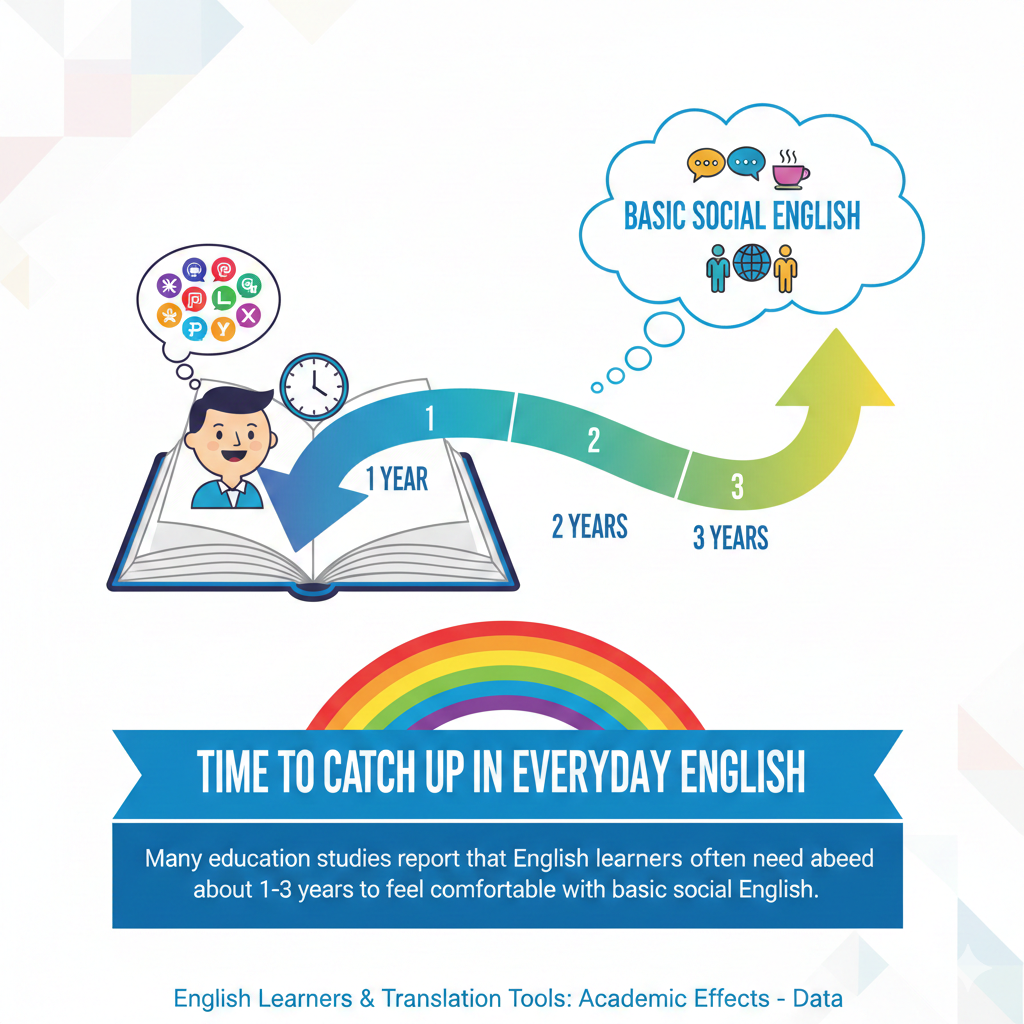
1) Time to catch up in everyday English: Many education studies report that English learners often need about 1–3 years to feel comfortable with basic social English
What this data really means
Everyday English is the language of daily life at school. It is the English used for greetings, quick jokes, simple questions, and small requests. This is not the same as reading a chapter book or writing a report.
Many children seem “fine” because they can talk with friends, yet they still miss key parts of classroom talk. The 1–3 year range matters because it sets a fair expectation. A child is not behind because they are not fluent in a few months. They are building a new language system in their brain, and that system grows step by step.
What to do at home and in class
Treat social English like a daily habit, not a big goal. Give your child small chances to use English without pressure. Ask one short question each day in English that has only two easy choices.
Then pause and let them answer in any way they can. If they answer in their first language, translate it together, and have them repeat the English version one time. Keep your tone calm and steady so your child feels safe.
Use translation tools in a light way. The tool should remove fear, not replace speaking. Let your child type one sentence they want to say, check the English, and then speak it aloud. After they speak, ask them to say it again without the tool. That second try is where growth starts.
If your child avoids speaking, focus on confidence first. Praise the attempt, not the grammar. When children feel respected, they try more. If you want structured practice, a guided live class helps because a good teacher knows how to invite a child to speak in short lines and build them up.
On Debsie, we use gentle prompts, simple speaking tasks, and lots of positive repetition so kids speak more without feeling judged.
2) Time to catch up in academic English: A common finding is that reaching strong “school language” for reading textbooks and writing essays often takes about 4–7 years for many English learners
What this data really means
Academic English is the language of learning. It includes longer sentences, harder words, and school phrases like explain, compare, predict, and justify. A child may chat easily but still struggle when the teacher talks fast, gives multi-step directions, or uses subject words in science and history.
The 4–7 year range is not a warning. It is a plan. It tells us that academic language needs steady practice over time, not quick fixes.
What to do at home and in class
Start by making school words visible. Pick five key school words each week that appear across subjects, like main idea, detail, cause, effect, and evidence. Use them in normal talk at home.
When your child tells a story, ask, “What is the main idea?” When they explain a choice, ask, “What is your evidence?” This builds academic language in a natural way.
Translation tools are helpful here, but only when used with care. If a child translates a whole page, they may finish faster but learn less English. A better method is to translate only hard words and key phrases, then return to the English text.
After reading, ask your child to say the idea in simple English in their own words. If they cannot, that is a sign they need smaller chunks.
In class, ask teachers for clear supports: shorter directions, examples, and one model answer. At home, use short writing practice. One paragraph is enough. Ask your child to write three sentences: one idea, one reason, one example.
If you want faster progress, choose a program that teaches language and thinking together. Debsie classes do this by guiding children to speak, read, and write with structured steps, so they build school English while also building strong thinking.
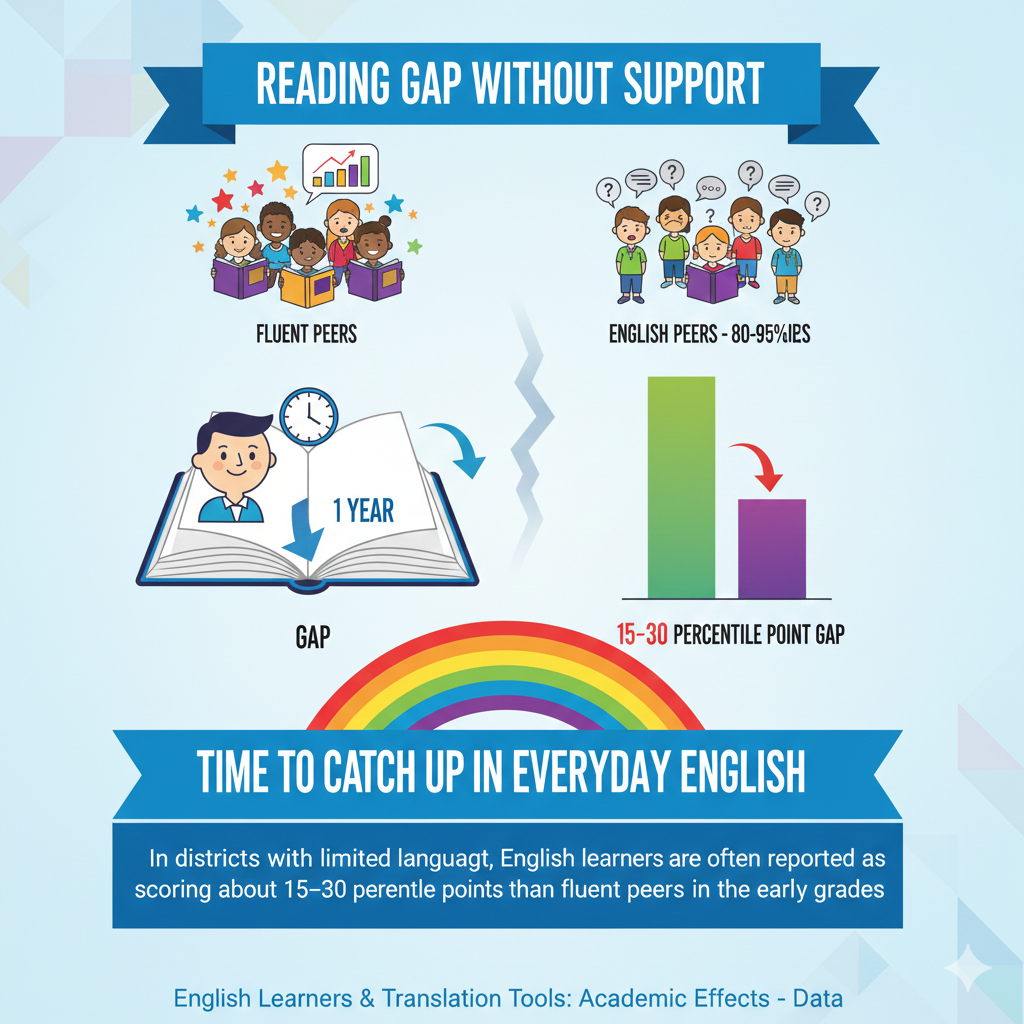
3) Reading gap without support: In districts with limited language support, English learners are often reported as scoring about 15–30 percentile points lower in reading than fluent peers in the early grades
What this data really means
A 15–30 percentile gap can sound harsh, but it often reflects access, not ability. Many English learners can think deeply. They may even understand the story when it is told aloud.
The gap appears because reading in a new language demands extra effort: decoding, vocabulary, grammar, and background knowledge all at once. If a child does not get support early, the gap can widen because reading is used in every subject.
What to do at home and in class
First, protect daily reading time. Ten to fifteen minutes every day is better than one long session once a week. Choose books that are slightly easy, not hard. The goal is smooth reading with confidence. If your child struggles, read the first page aloud, then let them read the next page.
This shared reading keeps them moving forward.
Second, teach vocabulary in a simple way. When a new word shows up, do not give a long definition. Give a plain meaning and one easy example sentence. Then ask your child to use the word in their own sentence. That one step turns a word into a tool.
Translation tools can close the gap when used for meaning, not copying. If your child meets a hard word, translate that word only, then continue reading in English. After the paragraph, ask them to tell you what happened in simple English.
If they cannot, reread the same paragraph together and translate one more key phrase. This creates real understanding.
If you want the fastest results, combine reading with guided discussion. A teacher who asks the right questions helps children learn how to think while they read. Debsie supports this with fun, guided lessons that build reading skills, focus, and calm confidence.
You can start with a free trial class and see how your child responds.
4) Math “word problem” penalty: When math questions are heavy on text, English learners’ scores commonly drop by about 10–20% compared with the same skills tested in simpler language
What this data really means
Many English learners are not weak at math. They are weak at the language wrapping the math. Word problems hide the real math inside extra words, tricky grammar, and school phrases like “at least,” “how many more,” “in total,” or “remaining.”
A child may know how to add, subtract, or divide, yet still lose 10–20% because they misread one line. This is frustrating because the score does not show what the child truly knows.
What to do at home and in class
Start by teaching your child to “strip” the problem. Ask them to read the question once, then rewrite it in their own simple English in one short line. If they cannot, let them translate only the key sentence, not the whole problem.
Next, have them circle numbers and underline the question being asked. This is not busy work. It trains the brain to see what matters.
Teach a small set of math phrase pairs. For example, “how many more” often links to subtraction, “in all” often links to addition, and “each” often links to multiplication or division. Do not overload them. Pick two phrases a week and practice them with tiny made-up questions. Keep the practice short and calm.
Translation tools should act like training wheels. Use them to confirm meaning of one phrase, then put them away. After your child solves the problem, ask them to explain the steps in plain English. Even a simple line like “I added because it says in all” builds academic talk and reduces future mistakes.
In class, request that teachers allow a short glossary or bilingual keyword list for word problems. That small support often lifts results quickly. If you want structured help, Debsie math sessions can guide children through word problems with clear language steps, so they build math confidence and language skill together.
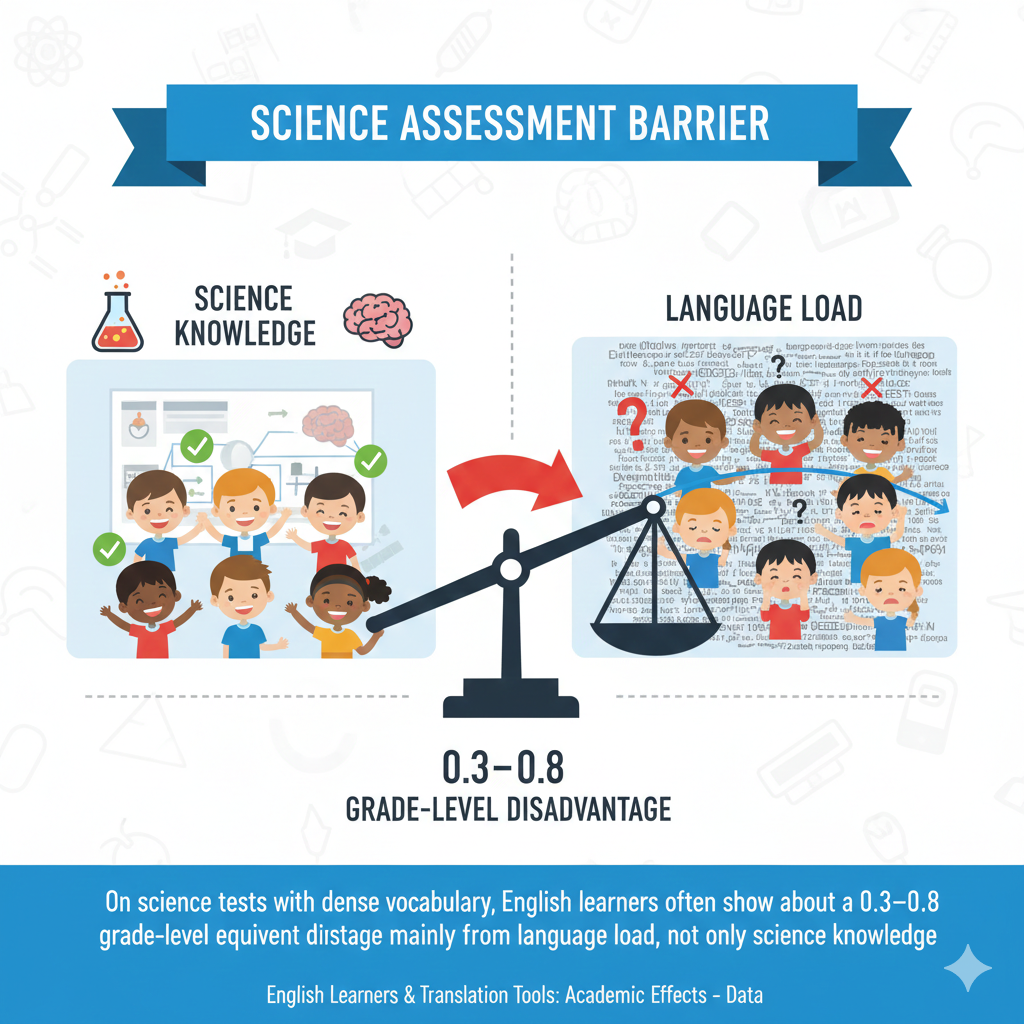
5) Science assessment barrier: On science tests with dense vocabulary, English learners often show about a 0.3–0.8 grade-level equivalent disadvantage mainly from language load, not only science knowledge
What this data really means
Science is full of words that are not used much in everyday talk. Words like “evaporate,” “condense,” “organism,” “react,” and “density” can block understanding even when the child can grasp the idea.
A disadvantage of 0.3–0.8 grade levels often appears because the test checks reading skill and science skill at the same time. When language is the barrier, the child may feel like they are “bad at science,” even when they are not.
What to do at home and in class
Make science words concrete. Each time your child learns a new term, connect it to a real picture, a simple example, or a small action. For “evaporation,” boil water and let them watch steam. For “density,” drop different objects in water. The brain remembers what it can see and touch.
Use a “two-step” reading method for science text. First pass: translate only the key terms, not whole sentences. Second pass: read again in English and focus on the meaning. Then ask your child to explain the idea in one short English sentence. If they cannot, it means the text is too heavy, and you should shorten it.
Translation tools can help science a lot when they are used like a dictionary. Encourage your child to save a personal science word list with simple meanings and one example for each word.
Do not let them rely on full paragraph translation during learning time, because they will miss how science sentences are built in English.
In school, ask if your child can get a preview list of science words before a unit begins. A small preview reduces stress and improves test performance. Debsie science lessons are designed with this exact need in mind: we teach the concept first with simple language, then build the correct science words slowly, so children learn deeply and do not feel lost.
6) Writing length difference: In many classrooms, English learners’ timed writing samples are often 20–50% shorter than peers’, mostly due to slower vocabulary access and grammar checking
What this data really means
A shorter writing sample does not mean the child has fewer ideas. It often means the child is doing extra work in their head. They search for words, check grammar, and worry about mistakes while also trying to explain their thoughts.
Under time pressure, that slows them down. A 20–50% shorter piece is common, especially in the early years of learning English. If adults misread this, they may think the child is lazy or unprepared. That is a painful mistake.
What to do at home and in class
Help your child separate thinking from sentence building. Before writing, ask them to speak their ideas out loud in simple English. Record it on a phone if that helps. Then let them write what they said. Speaking first often makes writing longer because the ideas are already formed.
Teach a simple writing frame that reduces stress. One clear sentence for the main point, one sentence for a reason, and one sentence for an example. This small structure helps them start quickly. Over time, you can grow it into a full paragraph and then two paragraphs.
Translation tools can be useful for writing, but use them at the end, not the start. If the child writes in their first language first and translates, the result can sound unnatural.
A better plan is to write in English using simple words, then use translation only to check meaning of a few key words. After that, do a quick “upgrade” step: replace one simple word with a stronger word, like “big” to “huge,” if it fits.
In class, ask for extra time on timed writing when possible, and ask teachers to grade ideas separately from grammar. If your child needs guided practice, Debsie writing support focuses on clear steps, calm pacing, and steady growth, so children write more without fear.
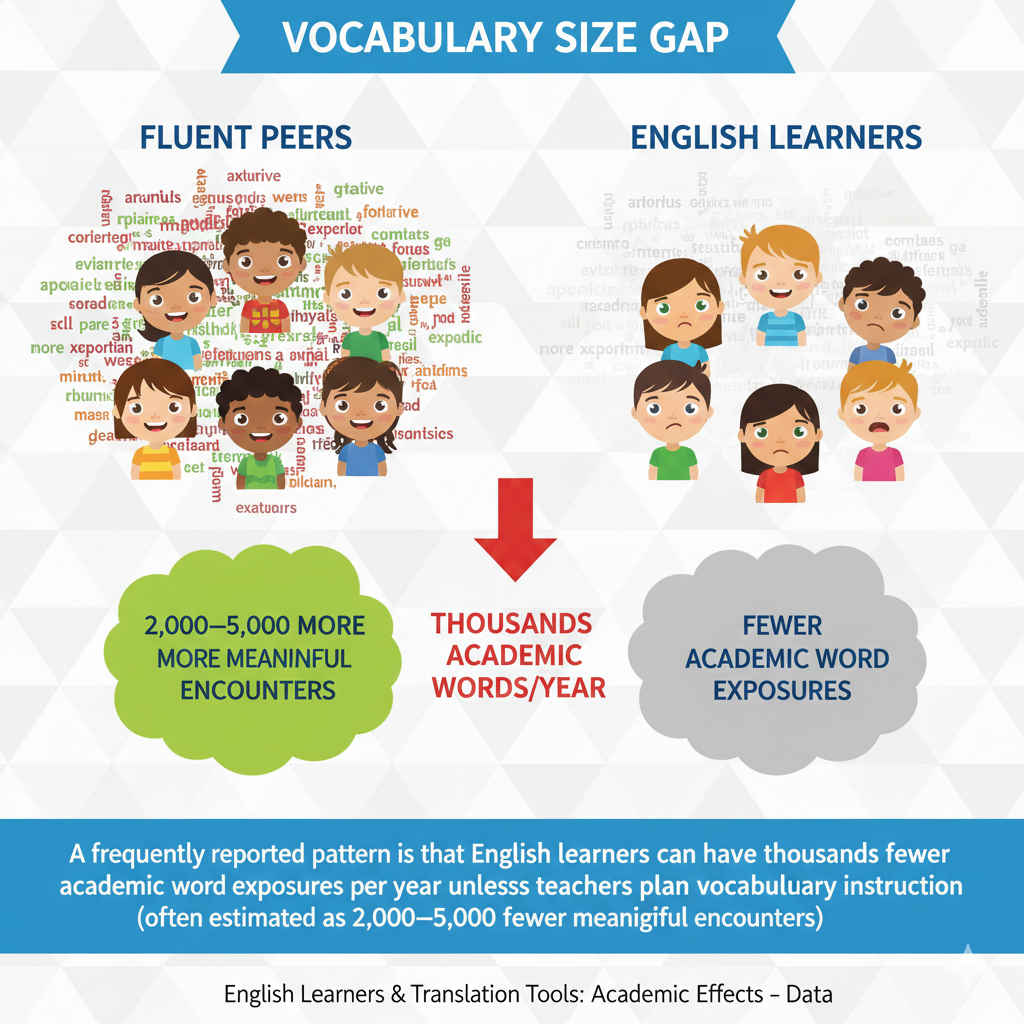
7) Vocabulary size gap: A frequently reported pattern is that English learners can have thousands fewer academic word exposures per year unless teachers plan vocabulary instruction (often estimated as 2,000–5,000 fewer meaningful encounters)
What this data really means
Academic words are the words that live inside textbooks, tests, and teacher talk. They are not the words kids use in quick chats. When a child is learning English, they often hear fewer of these “school words” in a way that sticks.
It is not because teachers do not care. It is because classes move fast, and the same word may not be taught in many ways. Over a year, missing 2,000–5,000 meaningful encounters adds up. The child does not just miss words. They miss chances to build strong reading and clear writing.
What to do at home and in class
You do not need to teach thousands of words at home. You need a smart system. Pick a small set of high-use academic words and recycle them across the week. Choose words that show up everywhere, like explain, compare, predict, evidence, reason, similar, and different. Each day, use one word in a simple sentence, then ask your child to use it once. That is enough.
At school, ask teachers which words will appear in the next unit. If you can get even five words early, your child will walk into class more ready. That readiness reduces stress, and less stress means better learning.
Translation tools can help, but only if the child does something with the word after translating it. The key is active use. When your child translates a word, ask them to write one short English sentence using it. Then ask them to say the sentence out loud. The brain remembers what it uses, not what it only sees.
A strong trick is “word pairs.” Teach a word with its close partner, like cause and effect, problem and solution, claim and evidence. This helps the child understand how school language is organized. Debsie lessons do this often, because it makes learning feel clearer and faster.
If you want your child to build vocabulary without boredom, a guided class with fun practice can help a lot.
8) Translation tool usage among students: In schools where devices are available, informal surveys commonly find about 40–70% of English learners use a translation tool at least weekly
What this data really means
Translation tools are already part of student life. Many English learners use them weekly, and some use them daily. This is not a bad sign. It is a sign that students are trying to keep up. The real issue is not whether they use translation tools.
The issue is how they use them. Used well, these tools reduce fear and unlock learning. Used poorly, they can become a crutch that blocks real language growth.
What to do at home and in class
First, set a clear rule: translation is for understanding, not for copying. If your child uses a tool to translate a homework question, they should still answer in English when possible. If they must answer in their first language for a complex idea, have them add one simple English sentence at the end that shows they understood the question.
Second, teach “three moments” for translation. Use translation before a task to understand directions. Use it during a task only for a few key words. Use it after a task to check one or two sentences for meaning. When children have a plan, they stop overusing it.
Third, model honesty and good habits. If your child uses translation for an assignment, encourage them to tell the teacher they used it. This builds trust, and teachers can support better when they know the truth.
If your child is using translation tools a lot, it may mean the school text is too hard. Ask for simpler reading or extra support. Debsie can help here because we match lessons to a child’s level and build skill step by step, so the child needs less translation over time, not more.
9) Most-used context: A typical pattern is that over half (about 50–80%) of student translation-tool use is for homework directions, class notes, and reading passages, not casual chatting
What this data really means
This stat is important because it shows students are not using translation tools mainly for fun. They are using them to survive school tasks. Homework directions can be confusing even for native speakers.
For English learners, one unclear instruction can lead to wrong work, lost points, and shame. The heavy use for notes and reading passages also tells us that classroom language is a barrier. When students cannot access the content, motivation drops fast.
What to do at home and in class
Start with directions. Teach your child to look for action words like circle, explain, label, compare, describe, and solve. These words tell what to do. If your child translates anything, it should be these action words first. Once the child knows the task, the rest becomes easier.

For class notes, do not aim for perfect notes. Aim for useful notes. Teach your child to write three short items: the topic, two key words, and one simple fact. If they miss a lot in class, let them use translation to review the teacher’s posted slides at home, then rewrite the notes in simple English. This improves memory and reduces stress.
For reading passages, set a limit. Translate only the hardest sentence in a paragraph, or only five key words per page. Then stop. After each paragraph, ask your child to say one English sentence about what it meant. This is how translation becomes a bridge, not a wall.
If you want a guided approach, Debsie classes help students learn how to handle directions, reading, and notes with clear steps, so they feel in control and grow faster.
10) Time saved on reading tasks: When translation support is allowed, English learners often finish reading assignments about 20–40% faster than without it, especially for informational text
What this data really means
Speed matters in school. A child who reads slowly often runs out of time, feels pressure, and starts to dislike reading. Translation support can reduce that pressure because it clears confusion quickly.
Saving 20–40% time is a big deal, especially with informational text like science articles and history passages. These texts use more formal words and pack more meaning into each sentence. When a child understands faster, they can focus on ideas instead of fighting the words.
What to do at home and in class
Use translation to remove the biggest blocks, not to replace reading. Teach your child a simple routine. First, skim the passage in English and look at headings, bold words, and pictures. Next, translate only the title and the first two lines.
This often reveals what the passage is about. Then read the rest in English and translate only when the meaning breaks.
Add a “stop and say” step. After each short section, your child should say one sentence in English about what they learned. If they cannot do it, they likely translated too much or too little. Adjust and try again. This keeps the focus on understanding, not just finishing.
In class, if translation support is allowed, remind your child to keep moving. The goal is to save time so they can answer questions with care. Many English learners rush the questions because reading took too long. Encourage them to spend the saved time on checking answers and finding evidence in the text.
If you want this to become a strong habit, give your child reading tasks that match their level. When text is too hard, translation becomes heavy and tiring. Debsie helps by matching reading material to skill level and building up gradually, so students read faster over time with less tool use and more confidence.
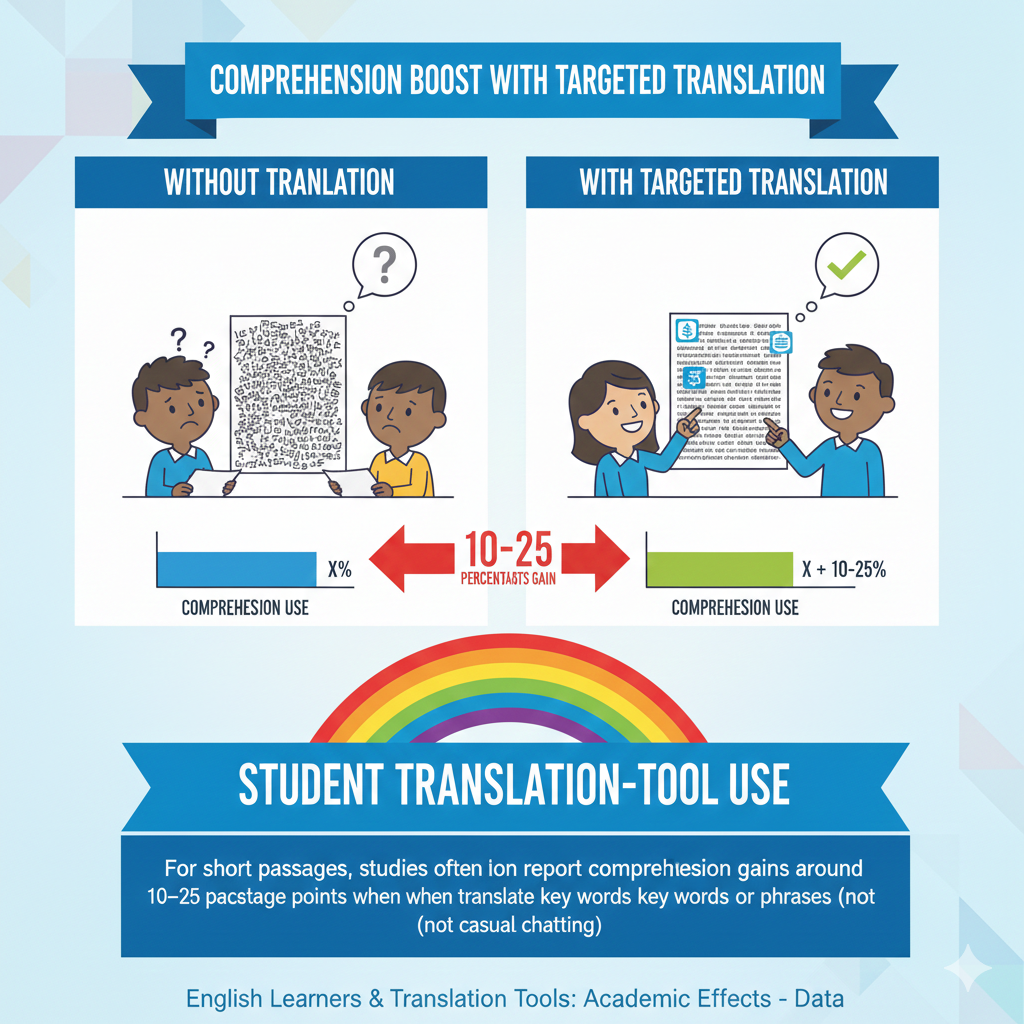
11) Comprehension boost with targeted translation: For short passages, studies often report comprehension gains around 10–25 percentage points when students can translate key words or phrases (not the entire text)
What this data really means
This stat points to the smartest way to use translation. Targeted translation means the child translates only key words and key phrases that hold the meaning. When students do that, comprehension can jump 10–25 points.
That is not a small lift. It is often the difference between guessing and actually understanding. The reason it works is simple: once the child understands the key parts, the rest of the sentence becomes easier to decode.
What to do at home and in class
Teach your child to spot “meaning carriers.” These are words like because, therefore, however, unless, and words that name the main topic like pollution, migration, photosynthesis, or fractions. Tell your child to translate those first. Then read the sentence again in English and see if it makes sense.
Use a “two-color” method without making it complicated. Ask your child to mark key words with one color and details with another. The child should translate only the key words. This keeps the brain working in English while still getting help where it matters.
After reading, do one quick check. Ask a simple question that requires meaning, not copying. “What caused the problem?” “What is the main idea?” “What is one example?” If your child answers correctly, the translation use was likely balanced.
If they answer poorly, the issue may be vocabulary or background knowledge, not effort.
In class, teachers can support this by allowing bilingual glossaries and by teaching key terms before reading. At Debsie, we do this often. We preview the key words, then read in English, then ask students to explain the idea in their own words. This is how comprehension improves in a real and lasting way.
12) Bigger gains for beginners: Translation support tends to help beginning-level learners more, with typical gains around 15–30 points, compared with intermediate learners around 5–15 points on similar comprehension checks
What this data really means
Beginners are often stuck at the door. They may understand very little of a passage without help. For them, translation is like turning on the lights. That is why gains can be 15–30 points. Intermediate learners already have more English.
They still benefit, but the jump is smaller because they can understand more on their own. This stat matters because it tells us the tool should change as the child grows. The same approach will not fit every level.
What to do at home and in class
If your child is a beginner, allow more translation at the start, but keep it guided. Focus on understanding the topic and key points. Then do one small English output task. Ask them to say one simple sentence in English after each short part. Even if it is not perfect, it builds the habit of producing English.
If your child is intermediate, tighten the rules. Encourage them to try first in English, then translate only when stuck. A good rule is “English first, tool second.” Also, encourage them to guess meaning from context before translating. This skill is important for tests and real reading.
For both levels, track progress monthly. If your child needs the tool just as much after months of practice, it may mean the text is too hard or the learning plan is not clear. A structured program can help the child climb steadily.
Debsie supports this by adjusting difficulty, building vocabulary in small steps, and teaching students how to use tools with purpose so they become more independent over time.
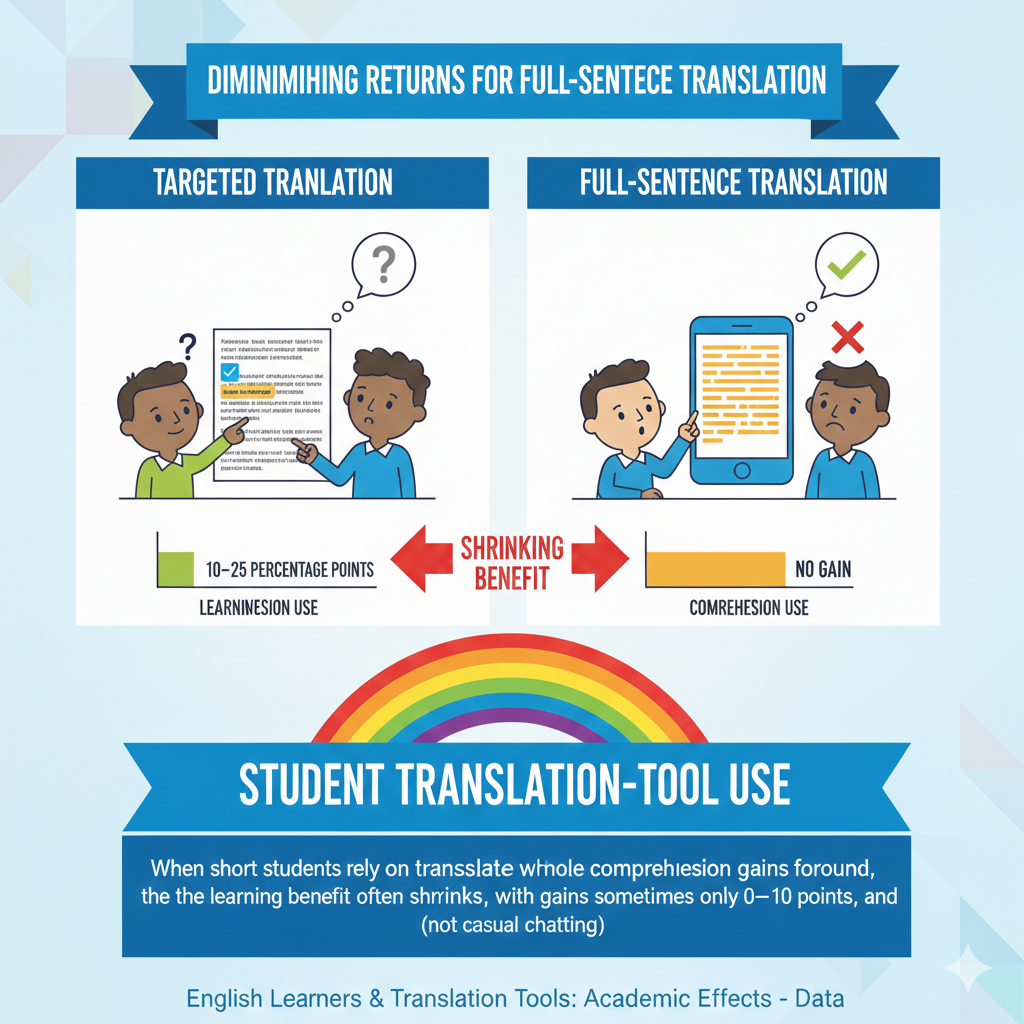
13) Diminishing returns for full-sentence translation: When students rely on translating whole paragraphs word-for-word, the learning benefit often shrinks, with gains sometimes only 0–10 points, and sometimes no gain
What this data really means
Full-sentence or full-paragraph translation can feel powerful because it gives instant understanding. But it often does not build real skill. When a student reads only the translated version, their brain practices the first language, not English.
That is why the benefit can drop to 0–10 points, and sometimes there is no improvement at all. It is not that translation is bad. It is that too much translation can turn learning into copying.
What to do at home and in class
Set a clear limit that is easy to follow. Tell your child they may translate only one sentence per paragraph, and only if they truly cannot understand it. The rest must be read in English. This keeps English in charge while still giving help when needed.
Use a “repair step” after translating. After your child translates the sentence, ask them to return to the English version and point to the words that match the meaning. Then have them say the sentence in simple English, even if they shorten it. This step forces the brain to connect English words to meaning.
If your child is translating whole paragraphs because the text is too hard, do not fight them. Change the text. Choose shorter passages, simpler reading, or a lower level book. It is better to read an easier text in English than a hard text through translation.
In school, ask teachers for adapted text or summaries for key lessons. This is not lowering standards. It is giving access so the child can learn the same ideas. At Debsie, we often teach the concept in clear language first, then build the harder text later. That is how students grow without getting trapped in full-paragraph translation.
14) Error rates in machine translation (school text): For everyday school sentences, common accuracy estimates are roughly 80–95% “good enough” meaning, depending on the language pair and topic
What this data really means
Machine translation is helpful, but it is not perfect. Even when it is “good enough” 80–95% of the time, that still means mistakes happen. In school, one small meaning error can change an answer. A sentence can sound correct but carry the wrong idea. This is especially risky when the child trusts the tool like a teacher.
What to do at home and in class
Teach your child a simple safety habit: always double-check the key idea. When they translate a sentence, they should ask, “What is the main action here?” and “Who is doing it?” If the tool output makes that unclear, they should try a second tool or rephrase the English sentence into simpler English and translate again.
Encourage your child to translate smaller pieces. Shorter phrases are often more accurate than long sentences with many clauses. If the child must translate a sentence, have them break it into two parts and translate each part.
Create a “red flag” list. If the translation gives a word that feels strange, too formal, or unrelated to the topic, that is a sign to check. Also, if the translated meaning does not match pictures, headings, or what the teacher said, pause and verify.
In class, teachers can help by allowing students to ask for clarification without shame. At Debsie, we teach kids to treat tools as helpers, not bosses. That mindset prevents blind trust and helps students become careful thinkers, which improves results in every subject.
15) Error rates increase with academic vocabulary: With technical school terms (science, history), meaning errors are more common—often estimated around 10–25% of sentences having a confusing or wrong nuance
What this data really means
Academic words are tricky because they carry precise meaning. In science and history, one word can change the whole idea. Translation tools may give a word that is close but not exact.
That “almost right” meaning is dangerous because it can lead the student to learn the wrong concept. If 10–25% of sentences carry a confusing nuance, a student can become unsure, even when they work hard.
What to do at home and in class
Use a subject glossary as your anchor. Instead of translating technical terms fresh every time, build a stable list of key terms with the meaning your child’s class uses. For example, if the unit is about ecosystems, keep a list for predator, prey, habitat, and adaptation.
Each term should have a simple meaning and one short example. When the tool gives a different word, compare it to your glossary and stick to the class version.

Teach your child to look for context clues before trusting translation. If the sentence is about heat, and the tool gives a word that relates to light, something may be off. Encourage them to check diagrams, captions, and definitions in the textbook.
If possible, use translation for definitions, not for explanations. Translating a clean definition is often safer than translating a long explanation with many clauses. Then have your child rewrite the definition in simple English.
This is also where expert teaching matters. A strong teacher explains technical words in plain language first, then adds the formal term. Debsie does this often, so children learn the concept correctly and do not build confusion around the vocabulary.
16) Idioms and figurative language risk: For idioms (“hit the books”), translation tools often mis-handle them at noticeably higher rates, commonly 20–40% wrong or awkward
What this data really means
Idioms are phrases that do not mean what they literally say. “Hit the books” is not about hitting anything. “Break the ice” is not about ice. These phrases are common in school talk, stories, and even teacher jokes.
Translation tools often struggle with them, and 20–40% wrong or awkward results is a real risk. A child can misunderstand the tone, miss humor, or misunderstand the instruction. Over time, this can make reading feel confusing and social moments feel uncomfortable.
What to do at home and in class
Teach idioms in a gentle, low-stress way. Do not turn it into memorization. Instead, collect idioms that your child actually hears in school. Keep a small notebook or a phone note. Each time an idiom appears, write it down with a simple meaning and one example sentence. Review just one idiom at a time.
When using translation tools, train your child to spot “idiom signals.” If the translated sentence sounds strange or too literal, it may be an idiom. Then the child should search the phrase meaning in simple English, or ask a teacher. The best fix for idioms is often a human explanation.
In reading, encourage your child to pause when a phrase feels odd. Ask, “Does this make sense if we take it literally?” If not, treat it as figurative language. Then look at the surrounding sentences and ask what emotion or action the story is showing. That often reveals the meaning.
If your child is learning through stories, idioms are a big part of progress. Debsie reading and language sessions can help because teachers explain idioms with simple examples and friendly practice. That helps kids not only understand texts, but also feel more confident in social moments at school.
17) Proper nouns and subject terms: Names, places, and key terms are often mistranslated or inconsistently translated, with reports commonly around 5–15% of key terms needing correction
What this data really means
Proper nouns are names of people, places, and special things. Subject terms are words that have a specific meaning in a topic, like “Revolution,” “cell,” or “prime factor.” Translation tools sometimes change these words, translate them when they should not, or translate them differently each time.
When 5–15% of key terms need correction, it can confuse a student’s notes and make studying harder. One chapter may call it one thing, and the next translation may call it another thing.
What to do at home and in class
Build a “do not translate” list. Many names should stay as they are. Countries, historical figures, book titles, and specific place names often should not change. If the tool changes them, teach your child to keep the original English name in their notes.

For subject terms, teach “one best term.” Pick the exact word the teacher uses in class and lock it in. Put it in the child’s glossary with the meaning. If the translation tool suggests a different term, compare and choose the class term. Consistency matters more than fancy wording.
When taking notes, have your child write key terms in English, even if the explanation is in their first language. This helps them match what they see on tests and worksheets.
In class, if teachers provide a vocabulary list, treat it like gold. Review it before the unit starts. Debsie lessons often include key word sets for each topic, so students learn the right term, the right meaning, and the right way to use it. That reduces confusion and makes studying smoother.
18) Multistep directions improved: When instructions are translated, English learners often complete multistep tasks correctly about 10–20% more often than without translation
What this data really means
School directions can be long and packed. “Read the passage, underline evidence, answer questions 1–4, then write a summary.” A child can miss one step and lose points even if they understand the lesson. Translation of instructions can lift correct completion by 10–20%.
That is a major improvement because it protects grades and reduces stress. It also protects a child’s confidence. When kids keep getting directions wrong, they start to believe they are “bad at school,” even when they are not.
What to do at home and in class
Teach your child to break directions into steps they can see. After translating directions, they should rewrite the steps in simple English as short commands. For example: “Read. Underline. Answer. Summarize.” Then they should check off each step as they complete it. This turns a confusing paragraph into a clear path.
Encourage a “first minute check.” Before starting any assignment, your child should spend one minute making sure they understand what to do. If they are unsure, that is the time to use translation or ask a question. This habit prevents wasted time and wrong work.
In class, teachers can support by writing directions on the board and giving one example of the finished product. At home, you can help by asking your child to tell you the steps before they begin. If they cannot explain the steps, they are not ready to work yet.
Debsie classes often include guided directions with models, so children learn how to follow steps in English with less fear. This builds independence, which is the real goal.
19) Reduced help-seeking delay: With translation access, English learners often ask for teacher clarification about 15–35% less often, because basic confusion is resolved sooner
What this data really means
This is a double-edged stat. On one hand, it is good news. Translation tools can clear simple confusion quickly, so students do not get stuck as often. That can reduce stress and help them stay on pace with the class.
On the other hand, asking fewer questions is not always a win. Some students stop asking even when they truly need help, because they think the tool is enough. The key is to use translation to remove small blocks, while still encouraging the child to ask real questions when the idea is hard.
What to do at home and in class
Teach your child a clear rule: use the tool for words, not for thinking. If the child understands the words but still does not understand the concept, they should ask a person. A simple self-check is: “Can I explain this in one sentence?” If not, it is time to ask.

Create question starters your child can use in class. Short lines like “Can you say it again?” “What does this mean?” and “Can you show an example?” make it easier to speak up. Practice these lines at home so they feel natural.
Also, set a “one question goal.” Ask your child to ask one question per day or per class, even if they think they understand. This builds confidence and helps teachers notice what the child needs.
At Debsie, teachers watch for quiet confusion. We do not wait for a child to struggle alone. We check understanding often and invite questions in a kind way. If your child relies heavily on tools and avoids speaking up, guided practice like this can help them grow stronger and more independent.
20) But deeper questions don’t disappear: Even with translation, many teachers report that English learners still need support for “why/how” reasoning; translation reduces surface confusion, but higher-order confusion often remains roughly similar unless teaching changes too
What this data really means
Translation can tell a student what a sentence says. It cannot always teach the student what an idea means, or how to reason through it. “Why did this happen?” “How do we know?” “What is the evidence?” These questions demand thinking, not just reading.
That is why deeper confusion often stays unless teaching also changes. This is not a weakness in the child. It is the nature of learning. Reasoning needs conversation, examples, and guided steps.
What to do at home and in class
Focus on “because” thinking. Each time your child answers a question, ask them to add one reason. It can be short. “I think this because…” This builds the habit of explaining, which is the core of school success.
Use simple “why ladder” practice. If your child says, “Plants need water,” ask, “Why?” If they say, “To live,” ask, “How does water help?” Do not push too hard. One or two steps is enough. The goal is to train the mind to connect ideas.
When using translation, use it to unlock the question, then turn it off and think in simple English. Encourage your child to draw a quick diagram or use a real example. Reasoning becomes easier when the idea is visible.
In school, ask teachers for models of strong answers and sentence frames like “I believe ___ because ___.” Debsie uses these frames often across STEM and language tasks, because they make “why/how” thinking easier for English learners. Over time, children become more comfortable explaining, which is a life skill, not just a school skill.
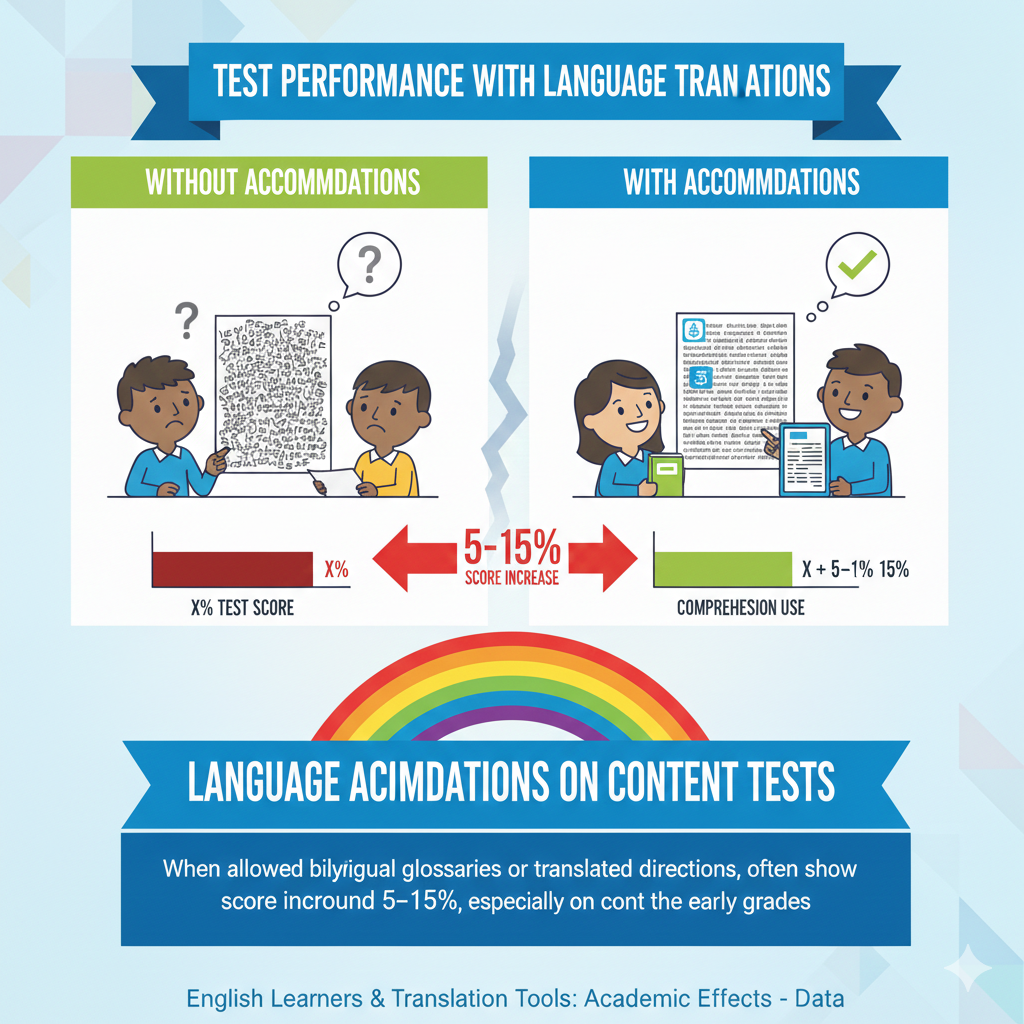
21) Test performance with language accommodations: When allowed bilingual glossaries or translated directions, English learners often show score increases around 5–15%, especially on content tests
What this data really means
A 5–15% score jump is huge on a test. It can move a child from failing to passing, or from average to strong. This stat shows that many tests are not only testing knowledge. They are also testing language.
When you remove small language barriers with bilingual glossaries or translated directions, the child’s real knowledge shows up more clearly. This is one of the most practical ways to support English learners without changing the content.
What to do at home and in class
If your school offers accommodations, use them. Some families avoid them because they worry it looks like cheating. It is not cheating. It is access. The child is still answering the same questions. They just understand the directions and key words better.
Help your child practice with the same tools they will use on test day. If they can bring a glossary, teach them how to use it fast. They should know where to find words quickly, not waste time flipping around.
Build a custom glossary for each unit. Keep it short. Focus on the 15–30 most important terms. Each term should have a simple meaning and, if possible, one example. Review it in tiny sessions across the week, not in one long session the night before.
Also, practice reading directions. Many points are lost because students misread what the test asks. Teach your child to circle action words and underline what they must produce.
Debsie supports test readiness by teaching both the concept and the language patterns that appear in questions. If your child freezes on tests, structured practice like this can make a big difference.
22) Largest benefit on content-heavy tests: The biggest improvements are often seen in science and social studies, with typical gains about 8–18%, compared with math computation tests about 2–8%
What this data really means
This stat is a clear clue about where language hurts the most. Science and social studies tests often have long passages, dense vocabulary, and questions that ask for explanations. That makes them language-heavy even when the topic is not “English class.”
So when a student gets language help, the score jumps more, often 8–18%. Math computation tests have fewer words, so translation support helps less, usually 2–8%. This does not mean language does not matter in math. It means the biggest language barrier is often in reading-heavy subjects.
What to do at home and in class
If your child struggles most in science or social studies, do not assume they “hate the subject.” They may hate the language load. Start by teaching the key topic words before reading. Five words can change everything. Then read in small chunks and pause for quick meaning checks.
Ask your child to explain one idea in plain English after each chunk.
For tests, practice the question types. Science often asks cause and effect, steps in a process, and evidence. Social studies often asks reasons, outcomes, and comparisons. Teach your child a simple answer pattern: claim, because, example. Even one sentence per part is enough at first.
Use translation tools as a guide for key terms, not as a full test translator. Encourage your child to translate only the words that carry the main meaning, then return to English. If accommodations are allowed, use a bilingual glossary so the child can work faster and more safely.
In Debsie, we support content learning with clear language scaffolds. That means students learn how to read a science passage without drowning in words. Over time, they need fewer supports and they become more confident tackling complex topics.
23) Risk of over-reliance: In classrooms where students translate everything, teachers often observe slower growth in independent reading stamina; some reports show 10–30% less time spent reading in English compared with balanced-use groups
What this data really means
Reading stamina is the ability to stay with an English text even when it feels a bit hard. When students translate everything, they often stop practicing stamina. They switch out of English quickly, so their “English reading muscles” do not build.
That is why some groups spend 10–30% less time reading in English. Over time, this can slow growth. The student may finish tasks, but their independent reading does not improve as much as it could.
What to do at home and in class
The goal is not to ban translation. The goal is to balance it. Start with a simple rule: your child must always try in English first for one full minute. During that minute, they can reread, look at pictures, or guess meaning from context.

If they still cannot understand, then they can translate one key word or one key sentence.
Build stamina in small steps. Set a short timer for English-only reading. Start with three minutes. Then increase to five, then seven, then ten. After the timer ends, allow a short translation check for the hardest part. This approach trains the brain to stay with English while still keeping the child safe from frustration.
Another strong method is “easy first, hard later.” Begin with a text your child can read smoothly in English. Then move to a slightly harder text with support. If the child starts with hard text, they will reach for translation too fast.
In class, teachers can help by giving leveled texts and by teaching students how to handle unknown words without panic. Debsie uses this kind of training often. We want children to become strong readers who can persist, not just students who can copy meaning through a tool.
24) Balanced strategy outcomes: Programs that teach “translate a little, then read in English” often show stronger long-term growth—commonly 0.2–0.5 standard deviations better reading growth than uncontrolled “translate everything” use
What this data really means
This is one of the most hopeful stats in the entire set. It says that translation tools can be part of strong long-term growth when they are used in a planned way. A balanced strategy leads to better reading growth than uncontrolled use.
The numbers, 0.2–0.5 standard deviations, may sound technical, but the meaning is simple. Over time, balanced users become more independent readers than students who translate everything.
What to do at home and in class
Teach a clear “bridge” method. First, translate a small piece to unlock meaning. Second, go back and read the English again. Third, do a short output task in English, like one sentence summary. This cycle trains the brain to connect English words with meaning, which is the heart of reading growth.
Use “graduation rules.” As your child improves, slowly reduce tool use. For example, in month one, allow five translated words per page. In month two, allow three. In month three, allow one. The child will still have support, but they will also build independence.
Track progress by looking at comprehension without the tool once a week. Give a short paragraph at an easy level and ask two questions. If the child improves, the plan is working. If the child is stuck, adjust the level or add vocabulary preview.
Debsie is built around this balanced approach. We do not remove tools and we do not let tools take over. We teach children how to use support wisely, so they grow into confident readers who can handle school texts with calm focus.
25) Feedback plus translation improves writing quality: When students draft in English and use translation to check meaning, writing scores often rise by about 10–20% on rubrics for clarity and organization
What this data really means
Writing is not only about grammar. Teachers often grade clarity and organization. That means the writing should be easy to follow and arranged in a clean order. When students draft in English and then use translation as a checking tool, many improve by 10–20% on these parts of the rubric.
This makes sense. Drafting in English forces the student to think in English. Using translation after helps them confirm that their message matches what they meant to say. Add feedback from a teacher or parent, and the writing often becomes much clearer.
What to do at home and in class
The best process is simple. First, draft in English using plain words. Tell your child that simple English is strong English. Second, use translation only to check meaning of key sentences, not to rewrite the entire paragraph. Third, revise with one clear goal. That goal might be “make the order clearer” or “add one example.”
Teach your child to use short linking words that organize ideas. Words like first, next, because, and for example make writing easier to follow. Do not teach ten connectors at once. Teach two, then practice them in real sentences.
When giving feedback, avoid correcting every small grammar mistake. That overwhelms the child. Instead, pick one focus per week. One week, focus on complete sentences. Next week, focus on adding one detail. This keeps the child motivated and improves writing faster.
In class, ask teachers for a model answer and a short checklist for the assignment. A model shows what “good” looks like. A checklist prevents missing steps. Debsie writing support uses small checklists and kind feedback, so students improve clarity step by step and feel proud of their progress.
26) But translating from the first language to English can create unnatural grammar: When students write in their first language and translate into English, teachers commonly rate grammar issues about 20–40% higher than drafts written directly in English
What this data really means
When a student writes in their first language and translates the whole text into English, the result often sounds “off.” The meaning may be correct, but the grammar and sentence flow can feel unnatural.
That is why grammar issues may be 20–40% higher in these translated drafts. This happens because languages have different word order, different ways to show time, and different ways to connect ideas. A translation tool cannot always reshape the sentence to sound natural in school English.
What to do at home and in class
If your child needs their first language to plan ideas, that is fine. The key is how they use it. Encourage planning in the first language, but drafting in English. For example, they can brainstorm ideas in their first language, then choose three points and write them in simple English.
Teach your child to keep sentences short. Short sentences reduce grammar errors and make writing clear. Once the child can write short clean sentences, they can learn to combine them later.
If your child already wrote in the first language and translated, do not throw the work away. Use it as a “fixing exercise.” Ask the child to read the English version out loud. Where does it sound strange? Then help them rewrite that sentence in simpler English. This turns a weak habit into a learning moment.
In school, ask teachers if the child can use sentence frames, like “I think ___ because ___.” Frames reduce grammar mistakes and improve structure. Debsie uses frames in many subjects, not just English, so students learn how to express ideas in a natural school style.
27) Pronunciation tools plus captions: Adding captions or translation to listening tasks often boosts quiz scores by about 10–25 points, especially for new learners
What this data really means
Listening is hard for English learners because spoken English is fast and words blend together. New learners often cannot “catch” the words even if they know them on paper. Captions and translation can raise quiz scores by 10–25 points because they give the brain a second path to meaning.
The child can see the words while hearing them, which builds stronger connections and reduces panic.
What to do at home and in class
Use a simple three-pass listening routine. First pass: watch or listen with captions on. Second pass: listen again with captions off and try to catch key words. Third pass: turn captions on again and check what was missed. This method trains listening, not just reading.
If your child uses translation captions, keep them temporary. Use them to understand the idea, then switch back to English captions. The goal is to strengthen English listening over time.
Practice “shadowing” for pronunciation. Your child listens to one short sentence, pauses, and repeats it aloud. They do not need perfect accent. They need clear sounds and confidence. Do this for two minutes a day, not longer. Short practice works best.
In class, teachers can support by providing video clips with captions and by repeating key instructions slowly. Debsie live sessions use clear speech, guided listening, and safe speaking practice, so children improve listening and pronunciation without feeling embarrassed.
28) Attendance and engagement: When language barriers drop, including with translation supports, many schools report improved participation; classroom participation rates are often observed about 10–30% higher for English learners
What this data really means
When a child cannot understand what is happening, they often go quiet. They may look down, avoid eye contact, or try to disappear. This is not disrespect. It is self-protection. When language barriers drop, many children begin to participate more.
A 10–30% rise in participation is not small. It can change a child’s whole school life. Participation leads to feedback. Feedback leads to improvement. Improvement leads to confidence. Confidence leads to more effort. This is how progress starts to loop in a positive way.
What to do at home and in class
At home, focus on one participation habit at a time. For example, the habit might be “raise your hand once per class” or “say one sentence during group work.” Make it measurable and kind. After school, ask your child what they said, not what grade they got. This shows that speaking up matters.
Translation tools can support participation if used before the moment, not during the moment. If your child is afraid to answer, let them prepare. They can translate a key word, practice the sentence once, then speak. That small preparation reduces fear.
In class, teachers can offer low-risk ways to participate, such as short answers, partner talk first, or choosing from two options. If you are a parent, you can ask for these supports without demanding special treatment. You are simply asking for fair access.
Debsie classes are designed to increase engagement gently. We use questions that fit the child’s level, we invite answers in short lines, and we celebrate effort. This helps children practice participation in a safe space, so they can carry that confidence into school.
29) Family communication impact: When schools use translated messages, parent response rates commonly increase by about 20–60%, which is linked to better homework completion and fewer missed deadlines
What this data really means
Parents want to help. Many parents miss school messages because they are written only in English, or written in a very formal style. When messages are translated, parent response often rises 20–60%.
That means more parents sign forms on time, attend meetings, understand homework rules, and support schedules. When parents have clear information, children are more likely to turn in work and less likely to miss deadlines. This is not only about language. It is about connection.
What to do at home and in school
If your school offers translated messages, turn them on and use them. If it does not, ask politely if they can provide translations for major updates. Many schools can do this more easily now than in the past.
At home, create one “school message routine.” Choose a daily time to check messages, even if it is only five minutes. If a message is confusing, translate it, then rewrite it in one simple sentence so you know what action is needed. Keep a small calendar for deadlines. When children see that the home is organized, they feel more secure.
Also, avoid making the child the main translator for school communication. Some children can do it, but it adds stress and can shift power in an unhealthy way. It is better for adults to translate messages themselves or use school supports when possible.
Debsie supports families by keeping communication clear and simple. If you join a program, you should not feel lost. When parents understand what is happening, children do better. If you want a learning plan that includes you, a Debsie free trial class is an easy first step.
30) Teacher time saved on basic translation: In classes with reliable translation supports for directions and routines, teachers often report saving about 10–30 minutes per day that can be re-used for small-group teaching and language practice
What this data really means
Teachers have limited time. When a teacher must repeat directions many times or translate basic routines again and again, time disappears. If translation supports save 10–30 minutes a day, that time can be used for what matters most: small-group teaching, quick checks for understanding, and real language practice.
This is important because English learners often need more guided instruction, not less. A well-run system helps teachers give that support without burning out.
What to do at home and in class
If you are a teacher, build translation into routines in a smart way. Use translated versions of key classroom directions that students see every day, like “open your notebook,” “write the date,” and “turn in your work.” Post them clearly. When routines are clear, students need less repeated help.
If you are a parent, ask your child what routines confuse them most. Then practice those phrases at home. For example, practice “underline,” “circle,” “match,” and “explain.” These are small words that control a lot of school tasks.
Also, encourage your child to become a routine expert. Many children gain confidence when they know exactly what to do first in class. Confidence leads to better behavior and better focus.
At Debsie, we use clear routines so class time is used for learning, not confusion. The goal is to create a calm rhythm where children can focus, ask questions, and practice skills in a structured way. When routines are smooth, learning becomes easier for everyone.
Conclusion
If you remember only one thing from all this data, let it be this: translation tools are not the enemy, and they are not a magic cure. They are a support. When used with a clear plan, they can reduce fear, protect confidence, and unlock learning that was already inside the child.