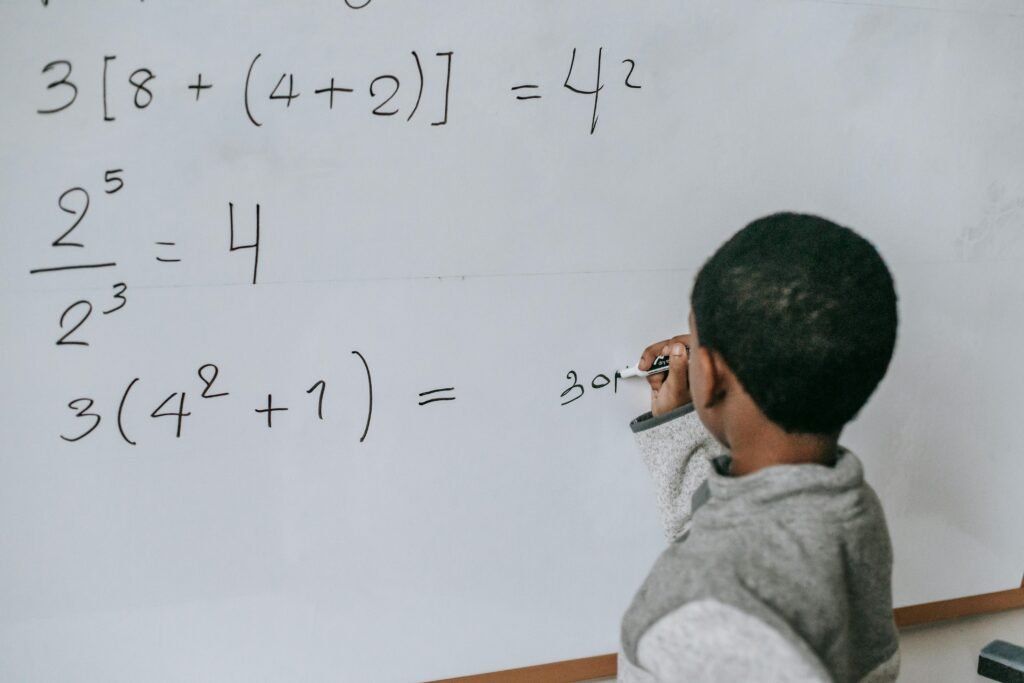
Small changes in a classroom can make a big difference in how children learn math. Two of the biggest levers are class size and teacher experience. When a class has fewer students, each child gets more time, more feedback, and more calm space to think. When a teacher has more years of practice, they spot gaps faster, explain ideas more clearly, and keep every child on track. Put these two together and math scores rise, but more than that, confidence grows. Children start to believe they can solve hard problems. They try again when they get stuck. They show their thinking. They build real skill they can use for life.
1) Reducing class size by 5 students in Grades 1–3 is linked to a +0.05–0.10 SD gain in math scores.
Small early classes make math click sooner. When you remove five students from a young classroom, the room feels calmer, and the teacher can watch each child’s face while they think. This quiet space matters in math because children need a few extra seconds to move from counting to real number sense.
With fewer students, the teacher can pause, ask a short follow-up, and catch small slips before they grow into big gaps. That is why a steady bump in scores shows up when class size drops even a little.
To use this in practice, plan time for micro-checks. Ask each child to show a quick model with counters, fingers, or a drawing. With five fewer students, you can loop through the room twice during a problem, not once. Build in daily two-minute conferences with three students and rotate across the week.
In those talks, ask one open question, listen for the strategy used, and give a nudge toward a more efficient method. Keep materials ready in bins so transition time shrinks. The saved minutes become extra practice, which compounds over weeks.
Parents can mirror this at home with short focused bursts. Ten minutes of quiet number games beat thirty minutes of rushed worksheets. Tools like number lines, dot cards, and quick mental stories strengthen the same skills used in class.
If you want a guided start, Debsie’s small-group primary math sessions cap seats so teachers can give instant feedback and shape habits early. Sign up for a free trial class and see how a small group changes the pace of learning.
Early wins build confidence, and confidence drives effort. That is the real power of small classes in the early grades.
2) Classes ≤15 students show 10–20% fewer math failures than classes ≥25.
When the group is fifteen or fewer, struggling students do not fade into the background. They get seen. They get called by name. The teacher can track who hesitates on place value or fractions and act before the next unit lands. In bigger rooms, small errors can hide for weeks.
By the time tests arrive, those errors turn into failures. Cutting the class to fifteen gives room for quick reteach, more practice, and clear next steps, which lowers failure rates.
To apply this, schedule short success loops. After teaching a new idea, run a three-part cycle: a one-minute check, a two-minute reteach for those who missed it, and a three-minute practice with immediate feedback. In a room of fifteen, you can manage this without losing the rest of the class.
Use simple mastery trackers that show each skill as a green, yellow, or red dot. Aim to turn two red dots green per lesson. Keep homework short and targeted to the exact error pattern you saw. Replace long mixed sets with five high-value problems that match the need of the child.
If your school cannot reduce class size, you can still make a “functional fifteen” by setting a rotation. While half the class works on a clearly defined independent task, you pull a group of six to eight for direct support. Use a sand timer to keep the pace tight.
Parents can help by keeping a simple goal chart at home. Celebrate when your child turns a skill from yellow to green with correct work shown, not just answers. At Debsie, our live classes run at this small scale by design.
Teachers watch work in real time, stop confusion early, and keep students moving forward. Join a trial class to experience how a class of fifteen or fewer keeps kids from slipping through the cracks.
3) Novice teachers (0–2 years) produce math scores ~0.10–0.20 SD lower than teachers with 5–10 years’ experience.
Teaching is a craft that sharpens with time. In the first two years, new teachers juggle content, pacing, and classroom flow all at once. They may spend too much time on easy problems, or move past a key idea before students are ready.
Experienced teachers have a deeper mental map of math misconceptions. They can predict where a lesson might wobble and set up supports in advance. This difference shows up in student scores. It is not about talent; it is about cycles of planning, teaching, checking, and adjusting over many units.
There are clear ways to close this gap faster. Pair new teachers with a mentor who shares planning templates and common error banks for each unit. Use scripts for high-leverage moves, like how to lead a number talk or how to probe thinking with follow-up questions.
Record two short segments per week and review them with the mentor, focusing on one small change at a time. Build a habit of exit tickets and next-day adjustments. Keep a running list of “if this error, then this mini-lesson” so reteach is fast and focused.
Schools can protect new teachers’ time by trimming extra duties during heavy assessment weeks. Parents can support by asking for the unit plan and practicing the week’s core skill at home in plain ways, like cooking measurements or shopping totals.
If your child’s class has a new teacher, do not worry. With the right support, growth can be rapid. Debsie’s instructors include seasoned math teachers who model clear explanations and share ready-to-use routines that new teachers can adapt.
You can enroll your child in a small-group class to ensure they get stable, expert guidance while the school’s new teacher gains experience. Try a free class and see how expert-led practice lifts understanding and reduces stress for everyone.
4) About 80–90% of the “experience effect” on math growth accrues by year 5–7 of teaching.
Most of the gains from teacher experience happen in the first several years on the job. By year five, many teachers have seen enough student work to spot patterns fast. They know the usual traps in fractions, integers, and word problems.
They also have smoother routines that save minutes every day. This early curve matters because it means schools should invest heavily in support during those first years. When a teacher gets strong by year five, students feel it at once.
Lessons are clearer. Feedback is sharper. Class time is calm and productive. The teacher keeps the whole group moving while still making time for the child who needs a quiet check-in.
To turn this into action, build a five-year learning path for teachers, not a one-time workshop. In year one, focus on core routines for checking understanding. In year two, refine questioning that draws out student thinking.
In year three, build strong unit plans with common assessments. In year four, strengthen small-group instruction. In year five, sharpen differentiation for both support and stretch. Keep a shared folder with anchor tasks and sample student work so people do not have to reinvent the wheel.
Make short, weekly planning huddles a norm where teachers bring one tricky problem, share what went wrong, and trade fixes.
Parents can ask their school how new teachers are supported in those first years. If support is thin, add a stable layer by enrolling your child in an expert-led small group so they always have a steady guide while the classroom teacher grows.
Debsie’s coaches have already walked this five-year path and can help your child beat the common pitfalls quickly. Book a free class and see how a strong teacher compresses confusion into a short, clear step forward.
5) Each 3-student increase above 25 students is associated with −0.01 to −0.02 SD in math achievement.
As a class grows past twenty-five students, each small rise brings a small drop in results. The reason is simple. Attention spreads thin. It takes longer to start, to settle, to hand out materials, to move between activities.
Misunderstandings hide in the crowd. The teacher may not notice the quiet student who stopped tracking the method two steps ago. Over a term, those tiny delays add up and the class covers less ground with less depth.
You can fight this drag with tight structures. Start with clear entry routines so the first five minutes are always math, not drift. Use short, visible goals for the day and tie them to one or two sample problems.
Build in a fast pulse check after the model, such as holding up a strategy card or solving one quick item on a mini whiteboard. In larger classes, use peer explainers with very specific prompts so talk time helps, not distracts.
Keep groups stable for two weeks at a time to reduce noise and allow trust to form. If you must choose where to spend scarce one-on-one minutes, pick the problems that unlock future units, like place value, fraction comparison, and equation sense.

Families can help by asking their child to teach one question back at home. Teaching forces clarity and reveals holes. If your child struggles to explain, that signals where to focus.
Debsie’s small classes avoid the large-room tax entirely, but we also design tools that large-class students can use, like quick practice games and step-by-step feedback. Join a trial lesson to see how focused routines and short checks keep learning strong even when the school class is big.
6) A 1:15 student–teacher ratio yields ~6–12% higher odds of reaching math proficiency than a 1:25 ratio.
A smaller ratio means more chances to get precise help at the exact moment a mistake starts. In a fifteen-to-one setting, a teacher can circulate, watch one solution unfold, and nudge the student toward a better path in seconds.
That fast correction prevents the error from becoming a habit. Over a term, these small saves push more students over the proficiency line. This is not magic. It is simply more cycles of attempt, feedback, and retry within the same hour.
To use this, organize class time into short sprints. Teach a crisp example, then release students to try a closely matched problem for three minutes. While they work, the teacher scans for the most common slip and runs a quick huddle with the few who made it.
After the sprint, everyone regroups to share one clear method and one alternate method, and then moves again. In a fifteen-to-one setup, each student gets direct feedback several times in a single period. Keep materials simple so energy goes to thinking, not setup.
Use visual cues like color-coded steps in multi-part problems to anchor attention.
If your child is near the proficiency line, small-group tutoring can be the bridge. Look for classes that cap seats and include live feedback, not just videos. Debsie is built around this ratio. Teachers see work in real time, speak to each child by name, and close gaps before they spread.
If you want to raise the odds that your child reaches proficiency this term, book a free small-group class. In just one session you will see how the ratio changes the rhythm of learning and lifts both accuracy and confidence.
7) Teachers with subject-specific math certification add ~0.05–0.12 SD to student math scores versus generalists.
A teacher trained deeply in math sees the structure behind the steps. They know why a method works, not just how to perform it. That deeper base lets them explain ideas in more than one way and catch shaky logic before it spreads.
When a child says three fourths is bigger than five eighths because five is bigger than four, a math-certified teacher hears the hint of whole-number bias and brings in a quick common-denominator model or a visual strip to reset thinking.
Those small course corrections show up as steady gains across the term.
You can bring this power into your child’s week even if their school teacher is a generalist. Ask for resources that build concept first, then procedure. Use short talks at home where your child explains why a step makes sense.
If they cannot say why, pause and rebuild that idea with a picture or a simple story. Schools can schedule one planning block per week where a math specialist previews the unit with grade teams and shares likely pitfalls, model tasks, and anchor visuals.
New teachers can keep a small bank of alternate explanations for each topic, like ratio tables for proportions, number lines for integer operations, and bar models for word problems. Over time, this toolbox mimics the strength of formal certification.
At Debsie, all math teachers train on content knowledge and kid-friendly explanations. Every lesson plan includes a why, a how, a model, and a check. If your child needs that richer layer of clarity, join a free small-group class.
You will see how a content-strong teacher turns a hard unit into clear steps, gives fast feedback, and lifts both accuracy and confidence without stress.
8) First-year teacher turnover reduces grade-level math scores by ~0.03–0.05 SD for remaining students.
When a first-year teacher leaves midyear, learning is shaken for the whole grade. Plans shift, routines change, and small gaps widen while a new adult learns the group. Even students in other sections feel it, because teams share materials and pacing.
The good news is that schools can protect learning during these changes by building steady systems that do not depend on one person alone.
Start with shared unit maps that list the exact skills, sample problems, and expected work for each week. Keep these maps in a common drive so a new teacher can step in and teach from day one. Use common exit tickets and a simple data meeting once a week to sort students into quick reteach or stretch groups.
Build classroom routines that survive a handoff, like set times for warmups, quiet work, and share-outs. If a change happens, keep those anchors untouched so students feel safe and ready to learn.
Parents can help by keeping home practice calm and short during the transition. Ask your child to bring one problem they found tricky and talk it through aloud. Gentle, steady practice can hold skill while the classroom settles.
Debsie can add stability here. Our small groups run on fixed routines with teachers trained to onboard new learners fast. If your child’s class is in flux, add one or two weekly sessions to keep skills moving.
We focus on core ideas that power many topics, like place value sense, fraction size, and equation moves. Try a free class and see how a stable, expert-led space can buffer a school change and keep your child’s math confidence strong.
9) Students in the bottom third of prior achievement gain ~2× more from small classes than top-third peers.
Small classes matter most for students who need the most help. When the group is small, a child who usually stays quiet has time to think, try, and ask. The teacher can check their work right away and give a tiny nudge that keeps them moving.
Over weeks, these gentle pushes stack up and close gaps. High-achieving students still benefit, but the lift is much larger for the students who started behind. That is why small groups are a smart tool for equity.
To apply this, set clear goals for the next four weeks that target the few skills holding many students back. Focus on the moves that unlock many problems, like regrouping, fraction comparison, and reading word problems with a plan.
In small groups, model the idea, then let students try one short problem while you watch. Give feedback that names the strategy and the next step, not just the right answer. Build a habit of quick wins to grow belief.
Ask students to keep a short reflection journal where they note one tactic that worked each day. At home, parents can use tiny, daily practice moments tied to real life, like cutting fruit into equal parts or adding item costs in the store.
Debsie designs small classes to serve these learners with care. We keep the pace gentle but focused, use visual models to make ideas concrete, and celebrate each step. When a child starts to see progress, effort rises.
If your child sits in this group, a small class can change the story in a single term. Book a free trial to see how two extra check-ins per lesson can double growth for students who need it most.
10) Veteran teachers (10+ years) outperform novices by ~0.02–0.04 SD per year in cumulative math growth.
With ten or more years, teachers have taught the same ideas many times. They have a mental library of student errors and a set of quick fixes. They manage time with a light touch and keep energy steady across the lesson.
They can adjust the route without losing the class, which means more learning per minute. The edge may look small in numbers, but across a year it adds up to real steps forward in skill and confidence.
Schools can use this by pairing veteran teachers with newer ones in a close, weekly cycle. Have the veteran lead one model lesson while the novice takes notes on pacing, questions, and error handling. Next week, switch roles and debrief.
Build shared planning templates that name the goal in student-friendly words, show one clean example, and predict two likely mistakes with mini-lessons ready. Keep grading simple and focused on key evidence, like correct units, clear steps, and reasonable estimates, not just final answers.
Parents can ask teachers how they plan to support both accuracy and reasoning this term and offer home practice that mirrors the approach.
For families who want that veteran steadiness every week, Debsie can help. Many of our teachers have been in classrooms for a decade or more. They bring calm, clear lessons and warm accountability.
Students feel safe to try, to fail, and to try again. If you want your child to absorb those habits, join a free session and watch how a seasoned teacher turns a tough topic into a sequence of simple moves that build toward mastery.
11) Cutting class size from 30 to 20 raises time-on-task by ~8–15%, supporting math score gains.
Time-on-task is the quiet engine of math growth. When you move from thirty students to twenty, transitions shrink, noise dips, and eyes stay on the work longer. Those extra focused minutes show up in fluency, because practice becomes steady and calm.
The teacher can start quickly, check work sooner, and reset small errors before they spread. Over a week, that extra focus might equal a full extra lesson of true learning time.
To make the most of this change, tighten the first ten minutes. Greet at the door, put the warmup on the board, and train students to start in less than one minute. Use short timed sprints with clear stop signals so the room moves in one rhythm.
Keep materials in color-coded bins to cut search time. Pre-write sentence starters for explanations so students can show thinking faster. End each lesson with a sixty-second recap where three students state the method in their own words. These micro-habits bank minutes every day.
If your school cannot reduce class size right now, simulate the same benefit by using silent starts, quick checks on mini whiteboards, and set stations that students know by heart.
Parents can help at home by setting a short, regular math time with no devices and a simple goal, like three word problems read aloud together. Debsie builds time-on-task into every lesson with tight routines and small groups.

Teachers watch work live, give quick nudges, and keep flow high. If you want your child to enjoy more focused math minutes each week, join a free trial class and feel the difference those minutes make.
12) Every extra 10 students reduces individual feedback minutes by ~20–30%, tied to −0.03–0.06 SD in math.
Feedback powers growth, but it takes time. Add ten more students and the teacher’s one-on-one minutes drop fast. Less individual feedback means wrong habits last longer. A student might keep lining up digits incorrectly for days before anyone notices.
The fix is not just to work harder; it is to redesign how feedback flows so students still receive frequent, precise guidance even in larger rooms.
Use layered feedback. Start with whole-class cues on the most common slip you expect, like forgetting units or skipping the estimate. Then run quick table checks where you listen to one explanation per group and correct the method in real time.
Finish with a two-minute conference for two students who need the most help that day. Teach students to self-check with three fixed questions, such as what the problem asks, whether the answer is reasonable, and how the units match.
This self-check does not replace teacher feedback, but it reduces preventable errors and protects your one-on-one minutes for higher-order issues.
Parents can sharpen feedback at home by praising the process, not only the answer. Ask your child to point to the step where they made a choice, and talk through why it was good or what to try next time. Debsie’s small classes keep feedback personal.
Teachers see steps, not just results, and respond right away. If your child benefits from more direct feedback, book a free session and watch how frequent, targeted comments turn confusion into clarity within the same lesson.
13) Teachers with ≥30 hours/year of math-focused PD show ~0.04–0.08 SD higher student math gains.
Professional development works when it is sustained, specific, and tied to classroom moves. Thirty hours spread across the year is enough time to learn a strategy, try it, get coaching, and refine it.
In math, the best PD deepens content knowledge and shows how to teach that content to real children. It includes looking at student work, practicing questions that draw out thinking, and planning how to catch common errors before they grow.
Schools can structure PD as a simple cycle. In week one, study a key idea, like fraction comparison or multi-step problem solving. In week two, watch a short model and plan one lesson using that idea. In week three, teach, record a snippet, and debrief with a coach.
In week four, review student work and plan the next step. Keep the focus narrow and practical. Provide ready visuals, problems, and talk moves that teachers can use tomorrow. Track one student group over time to see if the new approach changes outcomes, and share the results so the whole team learns.
Parents can ask their school how teachers get math-specific training and offer to support with materials or quiet time for planning events. If you want your child to benefit from teachers who live and breathe math instruction, Debsie is a strong choice.
Our instructors train weekly on content and pedagogy, rehearse lessons, and swap feedback based on student work. Join a free trial class and see how expert practice shows up as clear explanations, confident pacing, and steady gains.
14) Looping (same teacher 2 years) with classes ≤20 lifts math scores by ~0.03–0.06 SD.
When a teacher stays with the same group for a second year, trust and routines are already built. The teacher knows who needs a bit more time with multi-digit subtraction, who thrives on challenge problems, and who needs a quiet nudge to share.
This knowledge means the class can start stronger on day one. In a small group, looping multiplies the effect because there is time to act on what the teacher knows about each child.
To make looping work, begin year two with a quick review that targets the exact gray areas left from last year. Use a simple skills map for each student that lists three strengths and three focus areas.
Keep families in the loop with short notes that say what will help at home this month. Build a shared language so explanations match across years, like always drawing tape diagrams for ratio stories or always checking if an answer makes sense before writing it.
Set stretch goals for students who mastered last year’s skills early, and give them leadership roles, such as explaining a method or creating a sample problem.
If looping is not possible, teachers can still carry some benefits forward by leaving a clear learner profile for the next teacher. Parents can write a short note that shares what helped their child in math last year.
Debsie often loops by design, matching students with the same teacher across terms. The relationship stays warm, the pace stays steady, and growth keeps building. If your child needs continuity, try a free session and see how staying with one expert teacher turns a new year into quick momentum.
15) High-need schools see ~50–70% larger math benefits from class-size cuts than average-need schools.
Smaller classes pay off for all learners, but the lift is strongest where needs are greatest. In high-need schools, many students carry gaps in number sense, math language, and problem habits. When the group is large, these gaps stay hidden.
A small class changes that. The teacher can notice when a child misreads a word, misses a sign, or forgets to line up place values. Quick help lands in the moment, not weeks later. Over time, this faster feedback loop turns into larger gains, which is why the benefit is much bigger in these settings.
To put this to work, target the few ideas that unlock many topics. Start each week with a short diagnostic warmup that tests one core idea like comparing fractions, reading multi-step questions, or using units.
Track responses on a simple chart so the teacher knows which students need a mini-lesson that day. Use clear sentence frames to support math talk, such as I noticed, I chose, and I checked.
Build habits for showing work in small, neat steps so thinking is visible and fixable. Keep homework short, predictable, and focused on the skill of the week. Celebrate growth often, even tiny steps, because belief fuels effort.
If your child attends a high-need school, add a stable layer of support. Two short small-group sessions per week can keep skills moving and prevent backsliding between units. Debsie’s live classes are designed for this.
We cap seats, teach with visuals, and give calm, precise feedback. Our teachers understand the common traps and fix them with kindness and clarity. Book a free trial class and see how a smaller group and expert guidance can change the path of a tough year.
The goal is not only higher scores but steady confidence, so your child feels ready for each new challenge.
16) Team-teaching in large classes recovers ~0.02–0.05 SD of math loss compared with single-teacher large classes.
When class size cannot shrink, two teachers can split the load. One leads the model while the other scans for confusion, cues quiet students to share, and runs quick side huddles to repair small errors. During practice, they split the room and offer faster feedback.

This setup does not fully replace a smaller class, but it can recover part of the loss and keep momentum strong.
To make team-teaching work, plan roles in advance. Decide who opens, who circulates, and who runs each mini-lesson. Use hand signals to switch without breaking flow. Prepare two versions of key problems, one with scaffolds and one with stretch, so both teachers can meet students where they are.
During practice, run tight three-minute checks where each teacher looks at a small stack of work, marks one next step, and returns it quickly. End with a short share where each teacher spotlights one strategy and one common fix.
Keep a shared tracker so both adults see which students need extra attention next lesson.
Parents can help by asking how the two teachers divide support and by sharing what helps their child focus. At home, mirror the two-teacher method by doing a think-aloud with your child before they try a problem on their own.
Debsie often uses a similar structure in our online classes. One instructor leads, while another watches student work streams and gives targeted nudges. This is how we keep attention high and confusion low, even when a group is larger than ideal.
If your school class is full, join a free Debsie session and see how two caring adults can bring clarity and calm to a big room.
17) Reducing class size below 18 in early grades improves later Grade 8 math by ~0.03–0.07 SD.
Early math is the foundation for everything that follows. Small classes below eighteen in the early years give children the space to build strong number sense, flexible strategies, and steady focus. These habits do not vanish.
They carry into middle school when algebra ideas begin. A child who learned to compare quantities clearly in Grade 2 is better at ratio and percent in Grade 7. A child who learned to explain steps aloud is stronger at solving equations in Grade 8. That is why early small classes show a ripple effect years later.
To use this insight, invest the smallest groups where they matter most. In Grades 1 to 3, keep class sizes low or build daily small-group blocks inside a regular class. Focus on fluency with understanding, not speed alone.
Use visuals like tens frames, number lines, and fraction strips so ideas feel real. Teach children to check if an answer makes sense before moving on. Build talk routines where students share how they solved a problem and listen for other ways.
Keep practice short and frequent, not long and rare, so skills settle in the mind.
Families can support by playing simple number games at home and asking why a method works, not just what the answer is. Five quiet minutes a day beats a long session once a week. Debsie’s early-grade classes are built around these principles.
We keep groups tiny, use concrete models, and praise careful thinking. The goal is a strong base that lasts. If you have a young learner, now is the best time to start small and steady. Join a free trial class and watch how confidence grows when each child is seen, heard, and coached with care.
18) Teachers’ math content knowledge (1 SD higher) links to ~0.05–0.10 SD higher student math scores.
When a teacher understands math deeply, they see patterns that students cannot yet see. They can connect fraction models to decimals, tie area to multiplication, and show that variables are just numbers wearing a mask.
This depth makes lessons cleaner. It also makes help more precise. Instead of saying try again, the teacher can say compare the sizes with a common unit or check if both sides of the equation stay balanced.
Clear guidance at the right moment lifts accuracy and speed, which is why stronger content knowledge shows up as higher student scores.
You can bring this power into everyday teaching with simple habits. Before each unit, list three big ideas that sit under the skills. For fractions, you might note equal-sized parts, unit fractions, and size comparison.
Keep one visual for each big idea and use it often. When a student gives an answer, ask why it makes sense and where it lives on a number line. If they struggle, switch representations. Move from blocks to drawings, then to numbers.
Strong content knowledge also means spotting when a rule is overused. If students say a bigger denominator means a bigger fraction, pause and build two strips to show why that is not always true.
Parents can support by asking for the why at home. When your child solves, say show me that on a picture or on a number line. If they cannot, the idea is not sturdy yet. Debsie builds teacher content strength on purpose.
Our instructors rehearse multiple ways to teach each idea and practice quick fixes for common errors. Your child hears clear explanations the first time, which saves hours of guesswork.
If you want that sharp clarity in your child’s week, book a free small-group class and watch how deep understanding leads to simple, confident math.
19) Mixed-experience teams (novice + veteran) in classes ≤22 reduce math score gaps by ~10–15%.
Pairing a fresh teacher with a seasoned one in a small class blends energy and wisdom. The novice brings new tools, lively pace, and a close feel for student emotions. The veteran brings calm routines, crisp questions, and a library of fixes.
In a class of twenty-two or fewer, these strengths reach each child. The team can split roles, with one leading the model and the other scanning work, catching slips, and pulling a quick mini-lesson for a few students.
Over time, this steady, targeted help narrows gaps between students who usually surge ahead and those who often lag.
To make mixed teams work, plan a short weekly huddle with three parts. First, choose one core goal for the next five lessons, such as comparing fractions or solving two-step equations. Second, script two questions that prompt thinking, not guessing.
Third, decide how you will check understanding in under three minutes each day. During class, the veteran can handle pacing while the novice handles quick conferences. Swap midweek so both learn both roles.
Keep a shared journal of moves that worked and moves that did not, with a note on which students benefited. This record turns team teaching into a powerful training loop.
Families can ask their school how teachers team up and share insights. At home, mirror the partnership model. Do a quick think-aloud with your child, then let them try alone, then review together. Debsie often runs classes with a lead teacher and a learning coach, especially for targeted support.

We keep group size tight so the team can reach every learner and give fast, kind guidance. If your child has uneven skills, this setup is ideal. Join a free session and see how two caring adults in a small room help close gaps while keeping confidence high.
20) Students with teachers switching grades/subjects midyear lose ~0.02–0.04 SD in math.
Midyear changes break rhythm. A teacher new to the grade or subject must learn content flow, student habits, and past work. Even a short delay in routines and expectations can slow learning.
Small misunderstandings linger. Practice becomes uneven. The loss may look small in numbers, but it is real, especially for students who rely on steady structure to stay engaged and calm.
You can protect learning during a change with clear anchors. Keep a simple weekly plan on the board, the same format every week. Start every class with a familiar warmup, like a number talk or one word problem read aloud.
Use exit tickets to see where students stand and plan the next day’s mini-lessons. Ask students to keep a math journal with sample problems, steps, and checks so the new teacher can see thinking patterns quickly.
Build a short glossary of class language. If your group says make ten or balance both sides often, write that down and use it. Consistent words make it easier for a new adult to keep the same groove.
Parents can steady the ship at home. Keep math time regular and short, with a friendly tone. Ask your child what the class focused on today and have them show one example. Share any concerns with the new teacher kindly and early, with specifics about what helps your child focus or reduce stress.
Debsie can provide a parallel track when schools transition. Our classes keep routines and teachers stable, so your child stays on pace. If your school is facing a midyear shift, add a weekly Debsie session to hold skills steady.
Start with a free class and let your child feel that calm, steady rhythm again.
21) Effective classroom management (top quartile) offsets ~3–5 students’ worth of class-size pressure on math.
Strong management is not about strict rules; it is about smooth flow. When students know how to start, how to get help, and how to share thinking, the room stays focused. A teacher who sets clear routines can handle a few extra students without losing learning time.
That skill acts like a buffer, offsetting some of the pressure that comes with a larger class. The payoff shows in math because steady attention is the fuel for understanding and practice.
To build this buffer, teach routines like any other skill. Model the silent start. Practice how to ask for help with a card or a hand signal. Show how to switch from model to try-it time in ten seconds.
Use short call-and-response cues to reset noise without scolding. Post a small list of talk stems near each table, like I noticed, I used, and I checked. Train students to self-check answers with units and estimates before they raise a hand.
These habits keep the teacher free to help where it matters most, rather than policing transitions. Over weeks, the room feels calm, and calm rooms learn more math.
Parents can reinforce these habits with a home routine. Set a timer, define a tiny goal, and end with a brief share of how the problem was solved. Praise attention and clear steps, not just speed. Debsie teachers are trained to run smooth, warm classes online.
We start on time, keep directions short, and give fast feedback. Even with a few more students, learning stays strong. If you want your child to feel that calm focus, join a free trial class. You will see how good routines act like extra space, letting every learner think, try, and grow.
22) Teacher absence >10 days/year corresponds to −0.02–0.05 SD in math outcomes.
When a teacher misses many days, the class loses rhythm. Plans stall, lessons repeat, and feedback slows. Even strong substitutes cannot know every student’s needs the way the main teacher does. The result is small gaps that spread across units.
You can reduce this learning loss by building systems that keep math moving even when the teacher is away.
Create lesson packets that follow a simple pattern students already know. Start with a quick warmup that reviews a key skill. Add one clear example with steps written in student-friendly words. Include three practice problems that match the example closely.
End with one reflection question that asks why a method works. Store these packets by unit so a substitute can pick them up and teach without guesswork. Keep a class routine for help requests, such as a color card system or a short question queue, so the room stays calm.
Use technology in a simple way. Short teacher-recorded clips that model one example can anchor a substitute lesson. Limit videos to three minutes so attention stays high. Ask one student each day to be the class explainer, showing how they solved a problem at the board or screen.
That role builds ownership and keeps the tone positive. Parents can help by asking their child to share the day’s method at home and by keeping homework time steady during teacher absences.
At Debsie, classes follow tight routines with clear models and live feedback, so learning does not pause when life happens at school. If your child’s class is missing momentum, add one or two small-group sessions each week to keep skills growing.
Book a free trial class to see how steady, expert support turns a choppy month into real progress and calm confidence.
23) In classes ≥28, math problem completion rates drop ~12–18% versus classes ≤20.
Large classes wear down focus. Handing out materials takes longer. Noise rises. Students wait more for help and give up sooner. This leads to fewer finished problems, which means less practice and slower growth. The goal is to raise completion without lowering quality, even when the room is full.
Use tighter tasks with clear steps. Present one worked example, then offer a short parallel problem that mirrors the structure. Set a simple target like complete two problems with steps shown in six minutes.
Use a visible timer and a calm countdown to end the sprint. During the sprint, the teacher circulates with a short script, naming one strong step and one next move. Place hint cards on tables that show the first step only, not the whole solution, so students can restart without waiting.
Train fast peer checks that focus on steps and units, not just the final number. A brief share at the end lets one student explain a method while others compare their steps.
Parents can help by practicing short sprints at home. Choose two word problems, set a timer, and talk through the steps after time ends. Praise clear setup and checking, not only speed. Debsie designs lessons as a series of short, focused sprints in small groups, which keeps completion high and minds engaged.
If your child often leaves work unfinished at school, a low-seat-count class can build stamina and habits that transfer back to the big room. Try a free session and watch completion rise without stress.
24) One extra small-group math session per week in classes ≤20 yields ~0.02–0.04 SD gains.
A single extra small-group block each week creates a strong lift over time. In that short window, the teacher can target the exact sticky point from recent lessons, such as fraction comparison or two-step equations.
Because the group is small, feedback is quick and precise. Students leave with one new tool they can use right away in the main class.
Make the session simple and focused. Open with a two-minute check that shows who has which error pattern. Model one clean example tied to that pattern. Let students try a mirror problem while you watch each step. Give a tiny nudge at the moment of struggle.

End with a quick reflection where each student writes the tactic they will use next time. Keep a running log of each student’s focus area and note when it turns from red to green. Rotate students weekly so everyone gets a turn, but give extra weeks to those who need more.
Families can boost this effect by adding a short home session that mirrors the school group. Ten minutes with a whiteboard, a model, and one tight problem can make a big difference. Debsie’s program is built around these targeted sessions.
We meet students where they are, fix the exact hurdle, and send them back to class ready to apply the skill. If a weekly boost sounds right for your child, join a free trial class and see how one focused session can change the week’s results.
25) Teachers with mentoring in years 1–2 show ~15–25% faster growth to effectiveness in math.
Early support speeds up skill. A mentor shares ready routines, common error banks, and planning habits that would take years to build alone. With that guidance, a new teacher uses stronger tasks, asks sharper questions, and delivers cleaner explanations.
Students feel the change as lessons that make sense and feedback that lands in time.
To set up effective mentoring, keep it close and practical. Meet weekly for a short planning huddle. Co-plan one lesson with a tight goal, a model, two likely errors, and the mini-lessons that fix them. Co-teach once a week with clear roles.
Record five minutes of instruction and review it together, focusing on one improvement only. Keep a shared binder of anchor tasks and student work samples that show common mistakes and strong responses.
Track a small group of students over several weeks to see if the new moves are working, and adjust based on their notebooks and exit tickets.
Parents can ask if their child’s teacher is part of a mentoring program and offer kind feedback about what helps their child learn. If you want experienced guidance in your child’s week right now, Debsie offers small groups led by seasoned teachers who mentor newer staff behind the scenes.
Your child benefits from that shared wisdom every class. Book a free trial and watch how expert coaching behind the curtain leads to clear, confident learning in front of your child.
26) Advanced math degrees raise middle-school math scores by ~0.02–0.05 SD (small but positive).
An advanced degree alone is not a magic switch, but it often means the teacher has studied math more deeply. They may explain why methods work with richer examples and connect topics across units. This helps students build a stronger web of understanding.
The gain is modest, yet steady, and pairs well with good pedagogy and clear routines.
Put the extra content depth to work with simple moves. Begin each new topic by linking it to something students already know. Show how rate connects to fraction thinking, or how area models lead to algebra.
Use one strong visual to anchor the idea and keep returning to it. When a student gets stuck, shift representations rather than repeating the same words. Move from numbers to a diagram, then to a story, then back to symbols.
Encourage short proofs in plain language, such as explaining why a step keeps an equation balanced. These habits turn content depth into student clarity.
Families can look for programs where teachers know the math and can explain it in simple words. That mix matters. At Debsie, instructors train to translate complex ideas into clear, friendly steps, backed by visuals and practice that makes sense.
If your child needs that blend of strong content and gentle teaching, try a free session. You will see how small, steady gains add up when ideas are clear and practice feels doable.
27) Student disruptions rise ~15–25% when class size exceeds 27, cutting math instructional minutes by ~5–8%.
When too many students share one room, little interruptions add up. A pencil drops, a side chat starts, a hand waits too long for help and the student drifts. Each small moment steals time from the math.
Over a full week, those lost minutes mean fewer examples, fewer practice reps, and fewer chances to fix errors. The result is slower skill growth and weaker confidence. The fix is to design the room so attention stays on the work, even with many students present.
Begin by front-loading clarity. Post the day’s goal in simple words and point to it when you give directions. Keep the first example clean and short, then release students to try a twin problem right away. Movement reduces disruptions, so use planned micro-movements.
Ask students to show work on mini whiteboards and hold them up. This allows the teacher to scan for accuracy in seconds and praise effort that looks focused. Train quiet help signals so students do not need to call out. A small card on the desk or a hand signal lets the teacher know who needs a quick nudge.
Use attention resets that are warm and fast. A brief countdown, a call-and-response phrase, or a visible timer can bring the room back without scolding. Set partner roles with clear jobs, such as solver and checker, to keep talk on math.
End the work time with a short share where one student explains a method and others compare their steps. Parents can mirror this at home with short, calm work periods and a simple routine for asking for help. Debsie runs small groups so disruptions are rare.
Our teachers keep lessons tight and friendly, and students stay on task because they feel seen. If your child’s big class feels chaotic, add a weekly Debsie session to regain focus and build strong habits. Try a free class and notice how calm time turns into real progress.
28) Switching to ability-flexible groups in classes ≤22 adds ~0.03–0.06 SD in math versus whole-class only.
Flexible groups are not fixed levels; they are short, purpose-driven teams that change as needs change. In a class of twenty-two or fewer, the teacher can form three small groups for a single lesson, each focused on a different step of the same skill.
One group might practice setting up word problems, another might compare two strategies, and a third might push into a challenge that deepens understanding. Because the groups are small and fluid, students get the exact help they need without feeling labeled.
To make this work, start with a quick check that sorts students by today’s need, not by past labels. Use a two-minute problem and watch the first step they choose. Build groups around that step. Give each group a clear, tiny goal and a matching task.
Visit each group with a short script. Name one strength you see, ask one focused question, then leave a hint that keeps them thinking. Rotate students often. If a child shows mastery, move them to a stretch task that day.
If a child needs support, pull them for a three-minute mini-lesson while others work independently.
Parents can back this approach by praising effort and strategy, not level. Ask your child which tactic they used today and how it helped. At Debsie, we use flexible groups constantly. Our teachers shift tasks in real time, based on what students show on screen.
No one is stuck. Every learner moves. This keeps motivation high and outcomes strong. If you want your child to feel the lift of the right task at the right time, join a free trial. You will see how flexible grouping makes math feel tailored, fair, and doable.
29) Reducing student–teacher ratio by 5 points (e.g., 25→20) lowers math non-proficiency rates by ~8–12%.
A smaller ratio means more direct moments where the teacher can guide a child through the exact step they are missing. Those moments are gold for students sitting just below proficiency.
When the ratio drops from twenty-five to twenty, the teacher can check more notebooks, hear more explanations, and catch more mistakes early. Over a term, these quick saves push more students over the line into proficient. It is not about teaching harder; it is about having enough time to teach smarter.
Put this into play with a simple rhythm. Teach a crisp example, then give a mirror problem. As students work, the teacher does a fast lap to spot who needs a prompt. Pause for a tiny reteach for that group only, then release again.
Keep homework targeted to the one skill that blocks proficiency, not a long list. Use short, frequent quizzes that test just the key ideas and reteach right away. Track who is one nudge from proficient and plan two extra check-ins per week for those students.
At home, parents can ask for the current must-have skill and practice it for ten calm minutes every other day.
Debsie is built around low ratios. We cap seats so each child gets attention every few minutes, not once per lesson. Teachers use live feedback to fix small errors before they spread. If your child is close to proficient, a slightly smaller group can make a big difference fast.
Book a free small-group class and watch how a few extra minutes of focused help each session change the whole term.
30) Combining small classes (≤20) with experienced teachers (5+ years) yields additive gains of ~0.10–0.20 SD in math.
When you pair a small class with a seasoned teacher, you get both precision and pace. The small size creates room for attention, while experience brings a map of common errors and quick fixes. The teacher can watch each child work, spot a shaky step, and redirect with a clean explanation and the right model.
Because routines are smooth, little time is lost. Because the group is small, every student practices more and receives feedback sooner. Across a semester, this steady push shows up as larger gains in both accuracy and confidence.
To capture this effect, protect the small-group time and plan with intent. Open with a short diagnostic to find today’s exact need. Teach one high-impact example that matches that need. Use multiple representations so ideas stick.
As students work, the teacher cycles with a simple pattern: observe, name the move, nudge forward. Keep notes on one or two key students each day, rotating through the roster. Close with a fast reflection where students write the method they used and why it made sense.
This reflection builds metacognition, which helps students choose better strategies next time.
Parents can look for programs that promise both small groups and expert instructors, then ask about routines for feedback and practice. That is Debsie’s sweet spot. We keep classes small, and our teachers are trained and experienced.

Lessons are clear, peaceful, and full of thinking. Students speak, show, and check their work. Gaps close. Confidence rises. If you want your child to feel the full power of this combo, join a free trial class today.
You will see how a caring, expert teacher in a small group makes math feel friendly and doable, lesson after lesson.
Conclusion
Small classes and experienced teachers make math simpler, calmer, and more successful. Across all thirty stats, one story repeats. When the group is smaller, a child gets more time to think, to try, and to hear clear feedback at the exact moment it helps. When a teacher has strong experience and content knowledge, they spot the right next step fast and explain it in plain words that make sense.
Put these two together and you see more problems finished, fewer errors repeated, and more children crossing the line into true proficiency. Just as important, you see steady confidence. Students stop guessing and start reasoning. They show their steps. They can tell you why an answer is reasonable. That is the kind of learning that lasts beyond a test and into real life.