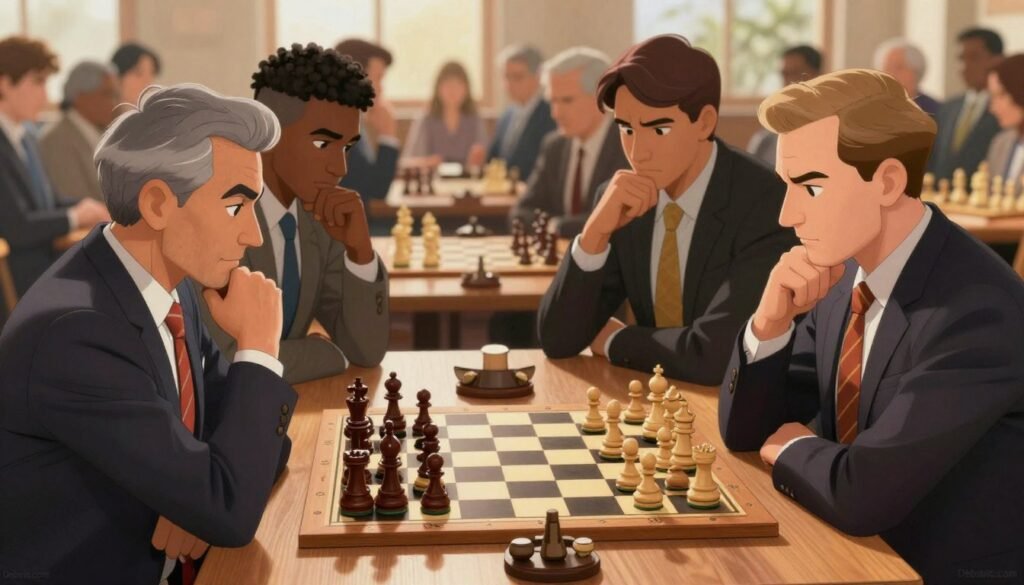
Who is the best chess player of all time? It sounds like a simple question. But once you look closer, it becomes a big story about skill, courage, pressure, and time. Some people will say Magnus Carlsen because he ruled modern chess for years and stayed world number one for a very long time. FIDE’s chess museum says Carlsen is widely seen as one of the greatest players ever and notes his long stay at the top of the rating list. Others will say Garry Kasparov because he was World Champion from 1985 to 2000 and changed how top players prepared. Some still choose Bobby Fischer because his 1972 rise felt almost unreal, especially his 6–0 wins over Mark Taimanov and Bent Larsen before beating Boris Spassky.
Find the right learning experience
Tell us a little about the learner and what you are looking for. Our team will review your answers and help you identify the most suitable next step.
- Takes only a few minutes
- No payment required
- Personalised recommendations
Your information will only be used to respond to your enquiry.
The Best Chess Player Of All Time Depends On What You Are Measuring
When people ask, “Who is the best chess player of all time?” they often want one clean answer. They want a name they can remember. They want a winner. But chess is not like a race where every player runs on the same track, on the same day, with the same shoes.
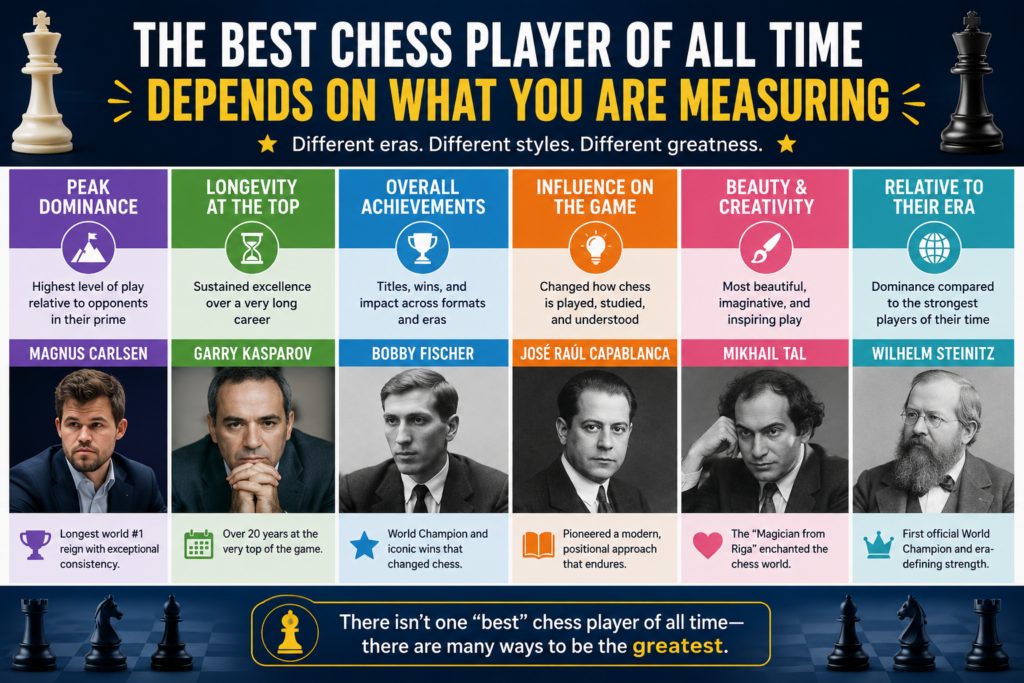
Chess has changed a lot over time. The boards are the same, but the world around the board is very different.
Today, a young chess player can open a laptop and study millions of games. They can use engines, online lessons, videos, puzzles, and live coaching. A player from 1920 had books, notebooks, and strong local players.
A player from 1972 had deeper books, stronger events, and more news coverage, but still no modern chess engines. So when we compare Magnus Carlsen, Garry Kasparov, Bobby Fischer, José Raúl Capablanca, Anatoly Karpov, Viswanathan Anand, and others, we are not comparing people who had the same tools.
A fair answer must look at more than trophies
The easiest way to pick the best player is to count world titles. That sounds fair, but it is not enough. Some players had fewer chances to win titles because the chess world was split. Some faced one main rival again and again.
Find the right learning experience
Tell us a little about the learner and what you are looking for. Our team will review your answers and help you identify the most suitable next step.
- Takes only a few minutes
- No payment required
- Personalised recommendations
Your information will only be used to respond to your enquiry.
Some played in a time when travel was hard. Some had to beat a full system, not just one person.
Garry Kasparov became World Champion in 1985 and stayed at the very top for many years. FIDE’s museum describes his rise through the Candidates matches and his long fight with Anatoly Karpov, including the famous 1984 match that was stopped after 48 games.
That one match alone shows how hard the road was at the top level. It was not just about playing good moves. It was about staying strong for months while the whole world watched.
The real question is not only who won, but how they won
A great chess player does not just win games. They change how other people think. They make hard positions look simple. They make other strong players feel lost. They keep finding good moves when the clock is low and the pressure is high.
That is why this debate is so exciting. It is not only about numbers. It is about power, style, courage, and the size of the gap between one player and the rest of the world.
This is also why chess is such a strong learning tool for kids. At Debsie, students do not only learn openings and checkmates. They learn how to compare choices, stay calm, and ask better questions. That is the same habit we need for this debate. We should not rush. We should look at the full board.
Why Magnus Carlsen Has The Strongest Modern Case
Magnus Carlsen may be the easiest answer for many people today. He is the best player of the modern computer age, and that matters a lot.
Today’s chess is brutal. Everyone prepares with engines. Everyone knows opening traps. Everyone can study the same games. It is much harder to surprise top players now than it was in the past. Still, Carlsen stayed number one for a very long time.
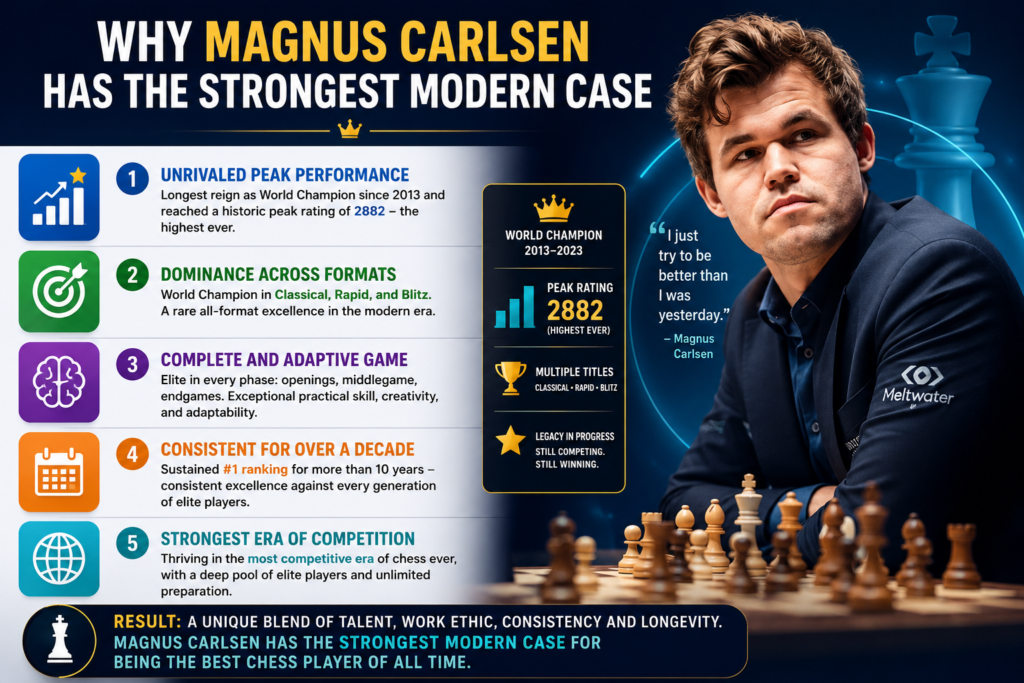
FIDE’s current rating profile lists Carlsen as the number one active player in standard chess, with a standard rating of 2840, along with elite rapid and blitz ratings. FIDE’s museum also says his peak classical rating of 2882 is the highest in chess history, and that he has held the number one place on the FIDE rating list since July 1, 2011.
Carlsen’s biggest gift is making normal positions dangerous
Carlsen is not famous only because he knows sharp openings. Many great players know openings. What makes him special is what happens after the opening. He can take a quiet position, one that looks equal, and keep asking small questions.
He improves one piece. Then another. He creates a tiny weakness. Then he presses it. The other player does not lose at once. They get tired. They defend for hours. Then one small mistake appears.
This is a lesson every chess student can use. You do not need to win in ten moves. You do not need to play wild chess all the time. You can learn to improve your worst piece, protect your king, keep your pawns healthy, and make your opponent solve problems.
That kind of chess builds patience. It also builds confidence, because a child learns that small smart choices can grow into big results.
Carlsen’s greatness is built on skill in every kind of chess
Another strong point for Carlsen is that he is great in classical, rapid, and blitz chess. Some players are amazing when they have many hours, but less strong when the game is fast. Some are dangerous in blitz, but not as deep in long games.
Carlsen has proved himself in all formats. FIDE’s museum calls him a five-time World Rapid Champion and a seven-time World Blitz Champion, while his FIDE profile shows he remains elite across all time controls.
That matters because modern chess is not played in only one speed. Kids today play online games, school events, weekend tournaments, puzzle battles, and longer games. A complete player needs to think fast and deep.
Carlsen shows both. He can grind for five hours, but he can also find clever moves when there are only seconds left.
For parents, this is one reason chess classes can be so useful. A good coach helps a child slow down when needed and speed up when needed. At Debsie, this balance is part of learning. Students get guided practice, not just random games.
They learn when to pause, when to act, and when to trust their thinking.
Why Garry Kasparov Still Has A Powerful Claim
If Carlsen is the strongest modern answer, Garry Kasparov may be the strongest all-around historical answer. His case is not only about being World Champion.
It is about how long he ruled, how hard he worked, and how deeply he changed chess preparation. Kasparov brought energy to the board. He attacked with force. He studied openings in great depth. He made top-level chess feel like a war of ideas before the first move was even played.
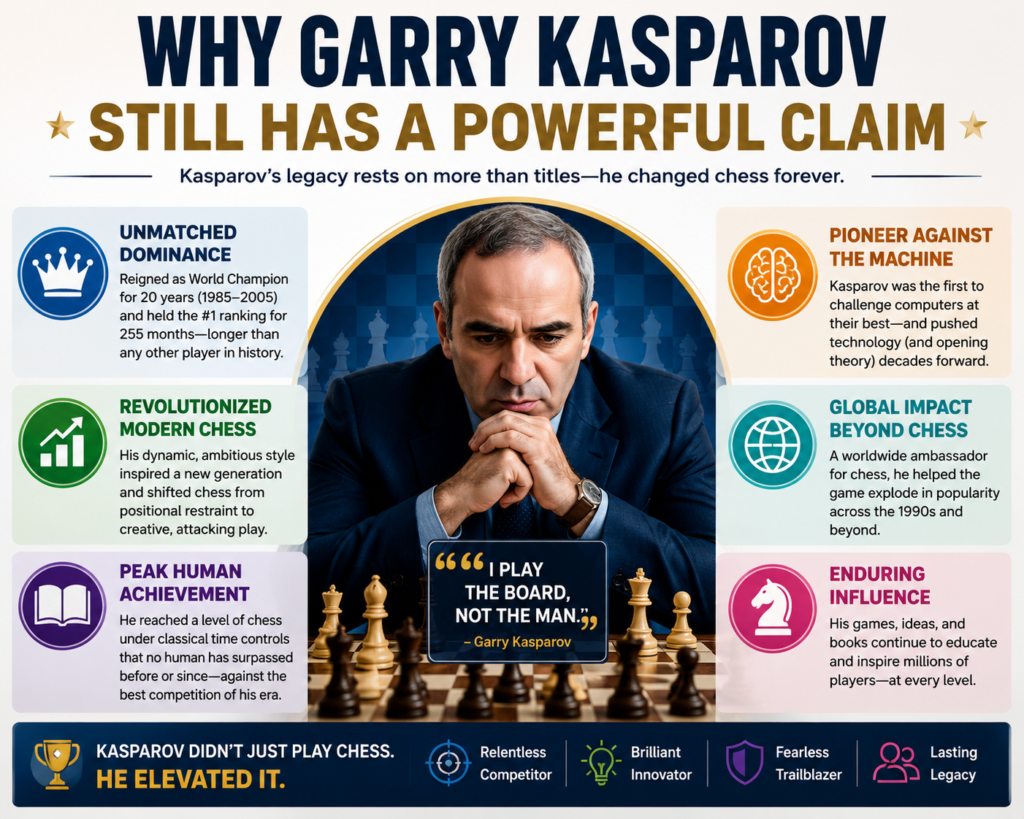
Britannica notes that Kasparov became World Champion in 1985 at age 22. FIDE’s museum also describes his path through the Candidates matches, where he beat elite players before facing Karpov.
His rivalry with Karpov was one of the hardest tests any champion has ever faced, because Karpov was not an easy target. Karpov was calm, precise, and very hard to beat.
Kasparov’s strength was his fire and his preparation
Kasparov played like he wanted to take control of the whole board. He loved active pieces. He loved pressure. He loved positions where his opponent had to make one hard choice after another.
But the real secret was not just his attacking style. It was his preparation. He studied deeply before games. He built opening ideas that gave him strong positions against the best players in the world.
This changed the way elite chess worked. Before Kasparov, preparation mattered. After Kasparov, preparation became a weapon. You had to be ready before the game started, because if you walked into his home preparation, the game could become painful very fast.
Kasparov teaches children that effort can become a superpower
Kasparov’s story is powerful for young players because it shows that talent is not enough. You need hunger. You need study. You need the will to review your games and find the truth, even when the truth hurts.
This is one of the biggest life lessons in chess. A child learns that mistakes are not shameful. They are clues.
That is why a coached path helps so much. When a child plays alone, they may keep making the same mistake. With the right coach, the mistake becomes a lesson.
At Debsie, students learn to look back at their games and ask simple but strong questions. What did I miss? What was my plan? Was my king safe? Could I have used my pieces better? These small questions build better chess and better thinking.
Kasparov may not have Carlsen’s highest-ever rating, because rating systems and playing conditions changed across time. But his long rule, his world title matches, and his huge impact on preparation make his claim very serious.
If someone says Kasparov is the greatest chess player ever, they are not being old-fashioned. They have a strong case.
Why Bobby Fischer Remains The Most Magical Name In The Debate
Bobby Fischer’s case is different from Carlsen’s and Kasparov’s. He did not rule for as long. He did not defend the world title for many years. But at his peak, Fischer looked almost untouchable. His rise to the 1972 World Championship was so strong that people still talk about it with awe.
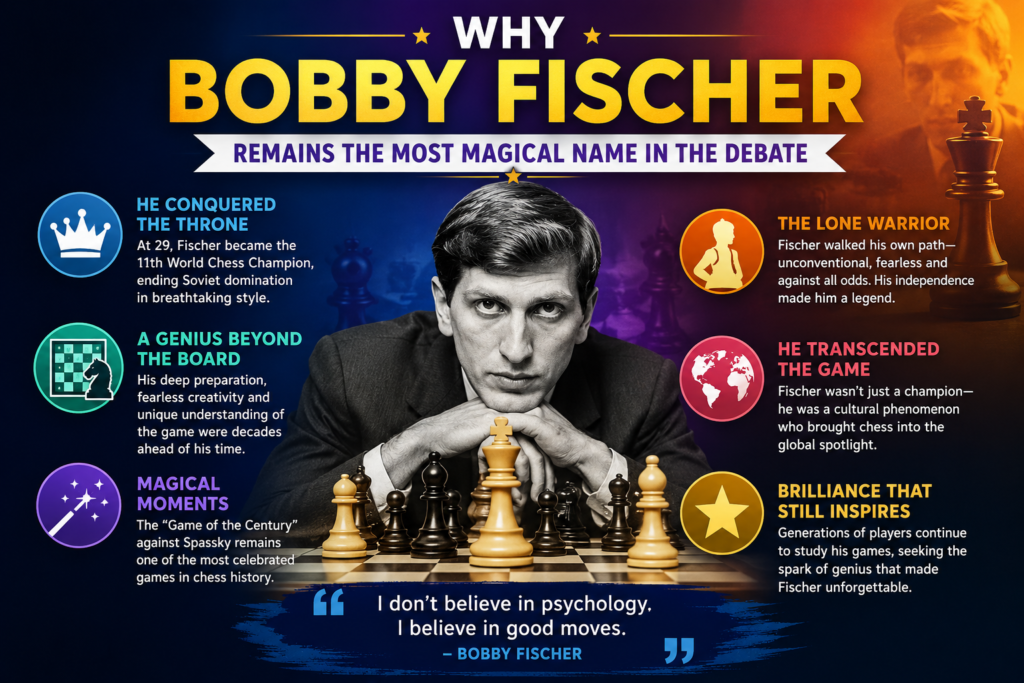
FIDE’s museum says Fischer disrupted Soviet dominance in chess. On his road to the title, he beat Mark Taimanov 6–0, Bent Larsen 6–0, and Tigran Petrosian 6½–2½ before defeating Boris Spassky in Reykjavik in 1972 by 12½–8½.
The 1972 match was known as the “Match of the Century,” and FIDE’s museum says it raised chess’s global profile in a major way.
Fischer’s peak was short, but it was stunning
The best way to understand Fischer is to think about distance. Not distance on the board, but distance from the field. At his best, he seemed far ahead of almost everyone else. He played clean, direct chess. His openings were strong.
His endgames were sharp. His will to win was huge. He made chess exciting for people who had never cared about chess before.
Find the right learning experience
Tell us a little about the learner and what you are looking for. Our team will review your answers and help you identify the most suitable next step.
- Takes only a few minutes
- No payment required
- Personalised recommendations
Your information will only be used to respond to your enquiry.
This matters because greatness is not only about time at the top. Sometimes greatness is about how high someone rises, even if the peak does not last as long. Fischer’s peak was like a bright fire. It changed chess history.
It brought new fans to the game. It showed that one player, with deep study and total focus, could challenge a whole chess system.
Fischer’s story is also a lesson in balance
For children, Fischer’s chess can be inspiring, but his life also teaches a gentle warning. It is good to love chess. It is good to work hard. But a healthy chess journey also needs joy, support, friendship, and balance.
Kids grow best when they feel guided, not pushed too hard. They need coaches who care about the child, not only the result.
This is where Debsie’s style matters. A great chess class should help a child feel brave, not scared. It should help them think better, not feel judged. The goal is not to turn every child into a world champion. The goal is to help each child grow.
Better focus. Better patience. Better planning. Better confidence. Chess is the path, but the child is the real point.
So, is Fischer the best ever? For pure peak dominance, many people will say yes. For long-term rule, they may choose Kasparov or Carlsen. But no honest debate can leave Fischer out. His 1972 run is one of the most powerful stories in all of sports and mind games.
The Best Answer So Far Is That Different Players Win Different Tests
The more we study this question, the clearer it becomes that “best” is not one simple word. If we mean highest rating,
Carlsen has the strongest case because 2882 is the highest official peak rating in chess history, according to FIDE sources. If we mean long rule and deep opening impact, Kasparov has a very strong case. If we mean peak dominance and cultural impact, Fischer’s claim is still huge.
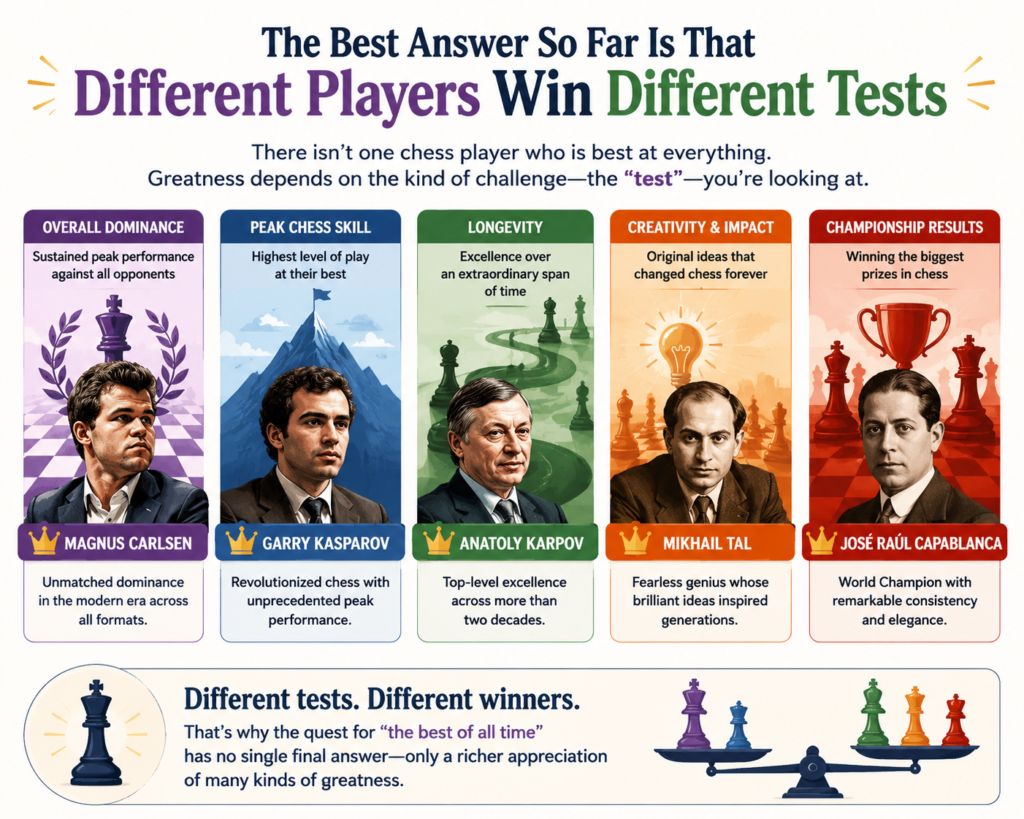
The smartest way to answer is to define your meaning first
When someone asks your child who the best chess player is, the best reply may be, “What do you mean by best?” That is not avoiding the question.
That is thinking clearly. Are we talking about rating? World titles? Peak strength? Long-term success? Influence? Beauty of play? Strength against the field? Ability in fast chess? Each question may lead to a different answer.
This is exactly the kind of thinking chess teaches. A rushed answer may sound confident, but a clear answer is better. Chess helps kids slow down, look at the facts, and make a smart choice. That skill matters in school, friendships, tests, and life.
The debate itself can make your child a better chess thinker
A child who studies this question learns more than chess history. They learn how to compare. They learn how to support an opinion. They learn how to respect more than one strong answer. That is a powerful habit. It turns chess from a game into a thinking gym.
And this is a great reason to let your child try a guided class at Debsie. In a strong class, chess is not just “move here, move there.” It becomes a way to think. It becomes a safe place to make choices, learn from mistakes, and grow stronger one lesson at a time.
Why José Raúl Capablanca Is Still Called A Natural Chess Genius
José Raúl Capablanca is one of the most loved names in chess history because his chess felt simple, clear, and calm. He did not need wild tricks to win. He made strong moves look easy. That is one reason many coaches still use his games to teach young players.
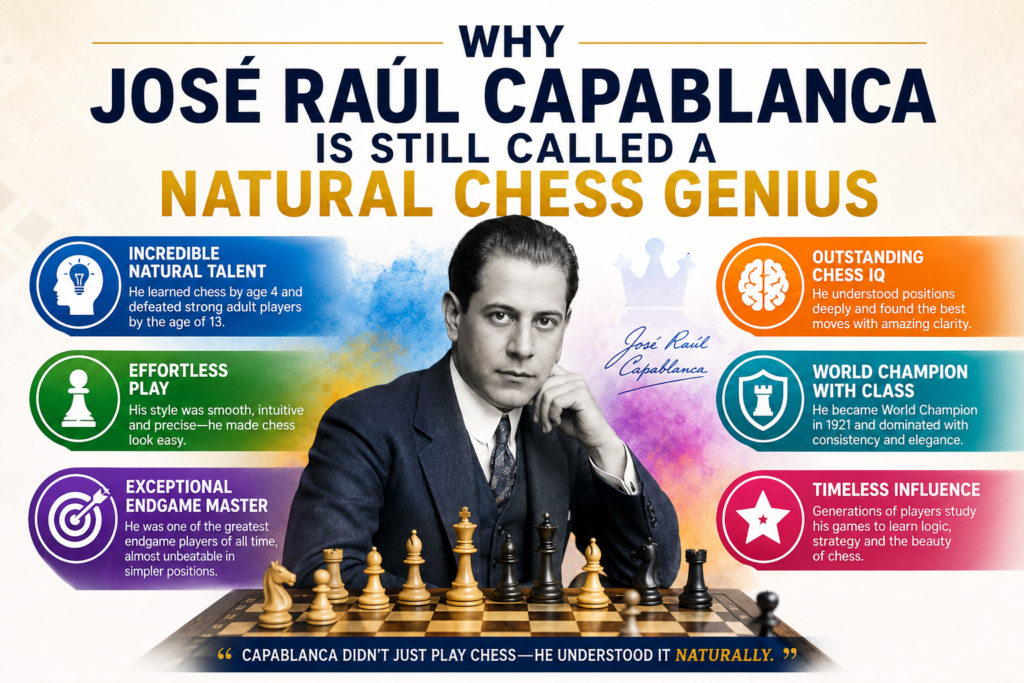
His style is like clean handwriting. You can see the idea without getting lost.
FIDE’s chess museum says Capablanca was a Cuban chess prodigy who beat the Cuban champion at age 12.
It also says he defeated Frank Marshall, a leading American player, when he was 21. In 1921, Capablanca became World Champion by beating Emanuel Lasker in Havana, and he did it without losing a game in the match.
Capablanca made simple moves feel powerful
Capablanca’s best games often do not look scary at first. He improves his pieces. He keeps his king safe. He wins a pawn. Then he trades into an endgame where that small edge becomes a win. Many players try to force a checkmate too soon. Capablanca showed that you can win by being patient, clean, and steady.
This is why his chess is so useful for children. A child who studies Capablanca learns that every move should have a reason. They learn that flashy moves are not always best. They learn that chess rewards calm thinking.
That lesson goes beyond the board. A child who can slow down in chess can also slow down during a school test, a hard talk, or a stressful day.
His greatness was built on clarity, not noise
Capablanca’s case for being the best chess player of all time comes from how effortless his play looked.
Some great players win by creating chaos. Capablanca won by removing chaos. He made the board feel peaceful, and then he won because he understood the small details better than his opponent.
FIDE-linked material notes that Capablanca remained undefeated from 1916 to 1924, which is a stunning sign of control in a time when players had fewer tools and less access to deep preparation than modern players have today.
For a young student, this kind of chess is golden. It teaches one of the most important ideas in learning: you do not have to rush to be strong. You can build a good position step by step.
At Debsie, this is a key part of how students grow. They learn to ask, “What is my weakest piece?” “Is my king safe?” “What does my opponent want?” These small questions can turn a beginner into a smart player.
So, is Capablanca the greatest ever? If your answer is based on natural talent, clean play, and endgame skill, his name belongs very high. He may not have the modern rating numbers of Carlsen or the long title battles of Kasparov, but his chess still feels fresh more than a century later.
Why Anatoly Karpov Was The Quiet Champion Who Could Squeeze Anyone
Anatoly Karpov does not always get the same loud praise as Kasparov, Fischer, or Carlsen. That is a mistake. Karpov was one of the most complete and hard-to-beat players in chess history. He did not need to attack all the time.
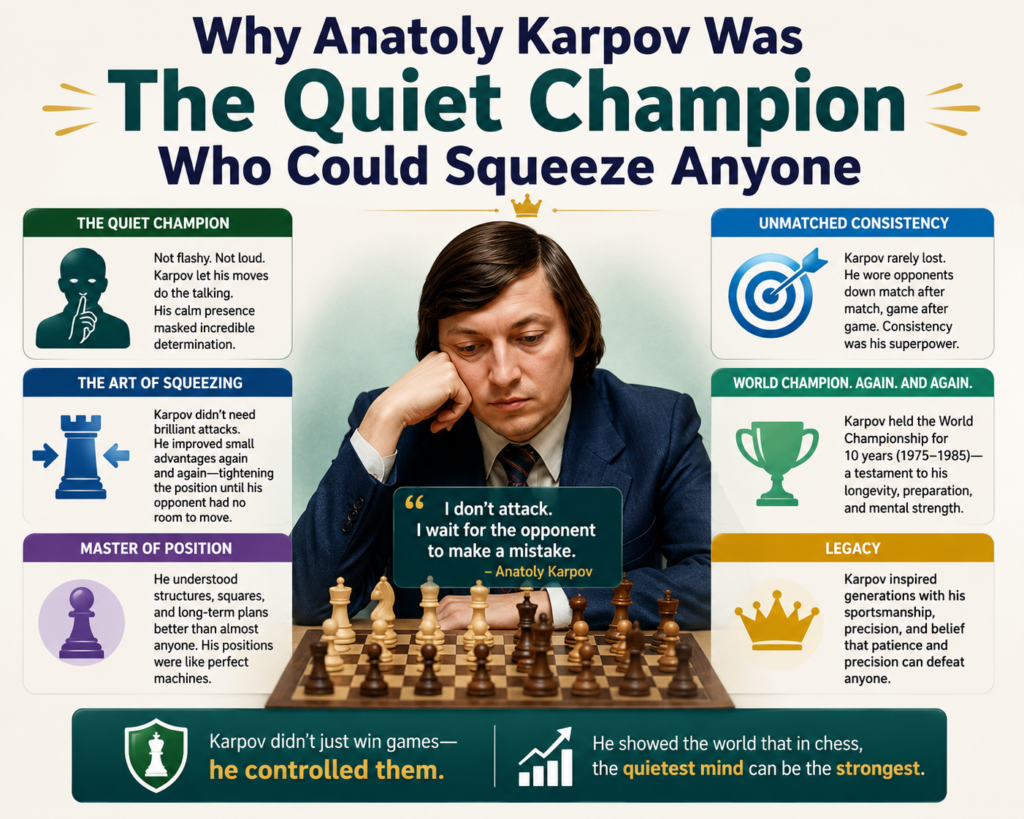
He did not need to create storms. He could win by making your position worse one tiny step at a time.
Karpov became World Champion in the 1970s and stayed one of the strongest players in the world for decades.
FIDE’s chess museum says his rivalry with Kasparov from 1984 to 1990 included five World Championship matches and 167 games, which shaped a whole era of chess history. It also notes that he later became a three-time FIDE World Champion in the 1990s.
Karpov’s style was like slow pressure on the whole board
Karpov’s chess was not boring. It was deep. He could find small weaknesses and never let them go. If you had a weak pawn, he would attack it. If one of your pieces had no good square, he would make that problem worse.
If your king was safe, he might not attack it right away. He would first stop your counterplay. Then he would take space. Then he would win.
This is a huge lesson for kids. Many young players lose because they only look for checks and captures. They miss quiet moves. They miss plans. Karpov teaches that a quiet move can be very strong when it improves your position and limits your opponent.
Karpov shows why patience is not weakness
In life, many children are told to move fast. Fast answers. Fast games. Fast results. But chess teaches a better truth. Sometimes the best move is not the loudest move. Sometimes the best move is the one that prepares a better future.
That is why Karpov is such a good role model for young chess learners. He shows that patience can be a weapon. He shows that you can win by staying focused longer than the other person. A child who learns this on the chessboard may also start using it in homework, music, sports, and daily choices.
At Debsie, coaches help students build this calm strength. They do not just teach “tricks.” They teach plans. They help students see why a move works. That is how a child becomes more than a player who memorizes. They become a thinker.
Karpov’s case for the greatest of all time is strong because he had amazing results before, during, and after his famous battles with Kasparov. He faced one of the greatest players ever and still pushed him again and again. Even when he lost the crown, he never stopped being elite. That kind of staying power is rare.
Why Viswanathan Anand Changed Chess For India And The World
Viswanathan Anand’s greatness is bigger than his own trophy case. He was not only a world champion.
He became a bridge between old chess and modern chess. He was fast, sharp, kind, and flexible. He could play classical chess at the highest level, but he was also famous for quick thinking. Many people called him “The Lightning Kid” because he could make strong moves very fast.
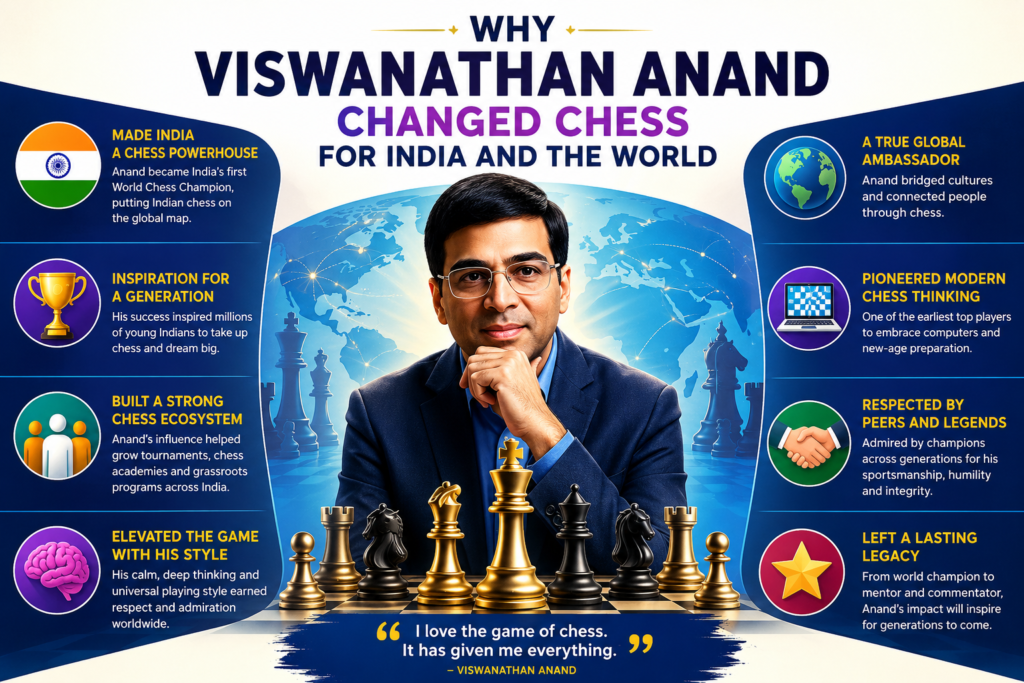
FIDE’s chess museum describes Anand as India’s first Grandmaster and one of the most talented players of his generation. It also notes that he entered the FIDE World Championship 2000 as the main favorite, a title he went on to win, and he later became the undisputed World Champion in 2007.
Anand’s impact goes far beyond his own games
Before Anand, India had chess culture, but not the global chess boom we see today. After Anand, millions of young players could look at the board and think, “Maybe I can do this too.” That kind of impact is hard to measure with numbers.
It lives in children, academies, school clubs, and homes where parents now see chess as a serious path for growth.
Anand also showed a rare kind of grace. He won without needing to act bigger than others. He lost without losing respect. He stayed curious even after reaching the top. For young students, that matters. Winning is good, but how you carry yourself also matters.
Anand teaches children to stay flexible when the game changes
One of Anand’s greatest strengths was his ability to adapt. Chess changed a lot during his career. Computers became stronger. Opening study became deeper. Younger players arrived with new energy. Anand kept learning.
He stayed relevant in different formats, against different styles, and across different eras.
This is a powerful lesson for kids. The world will keep changing. School will get harder. Friends will change. New problems will come. A child who learns to adapt will feel less afraid when life does not go as planned.
At Debsie, this is one of the deeper benefits of chess training. Students learn that one bad move does not end the game. One lost game does not end the journey. You look again. You find a plan. You keep growing.
Anand may not be the one name everyone picks as the greatest chess player of all time, but he is one of the most important champions ever.
If greatness means lifting a whole country’s chess dreams, changing what young players believe is possible, and staying world-class across many years, Anand’s name deserves huge respect.
Why Judit Polgár Belongs In Every Serious Greatest Chess Player Talk
Judit Polgár is often called the strongest female chess player in history, but even that label can feel too small. She did not only dominate women’s chess. She competed with the best players in the world. She beat world champions.
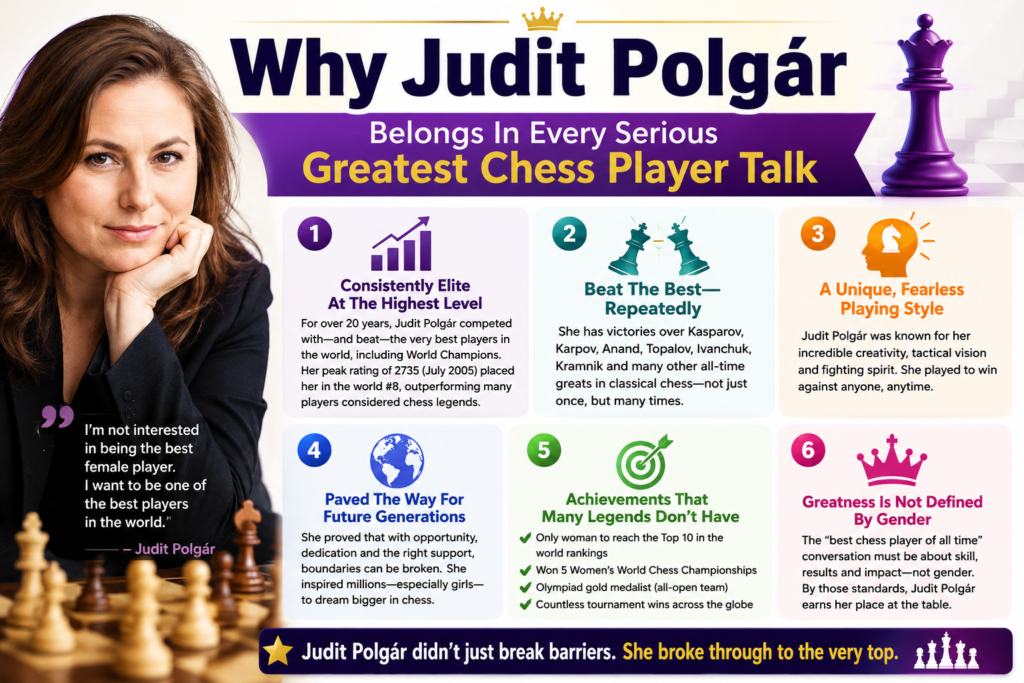
She broke old beliefs about what girls could do in chess. Her career changed the way many people looked at talent, training, and opportunity.
FIDE EDU describes Judit Polgár as the strongest female player in chess history and highlights her role in promoting chess as an educational tool. That second part matters a lot because Polgár’s story is not only about winning games. It is also about showing how chess can help children think better.
Polgár proved that limits are often taught, not real
For a long time, many people believed girls could not reach the same level as boys in chess. Polgár challenged that idea by playing in open events and fighting the strongest players directly. She did not build her name by staying in a smaller box.
She stepped into the hardest rooms and proved she belonged there.
This lesson is huge for children. Many kids quietly carry limits in their minds. “I am not smart enough.” “I always lose.” “This is too hard for me.” Chess can help break those thoughts. A child sees that skill grows with practice. They learn that losing is not proof that they are weak. It is part of training.
Polgár’s story is a gift for parents raising confident kids
Parents want their children to believe in themselves, but confidence cannot be forced. It grows when a child does hard things and sees progress. Chess is perfect for that because progress is visible. A child who once missed checkmates starts finding them.
A child who once moved too fast starts pausing. A child who once feared stronger players starts saying, “I can try.”
That is the kind of growth Debsie is built to support. With expert-led classes, live learning, private coaching, and regular tournaments, students get chances to practice courage in a safe way. They do not just learn chess facts. They learn to sit with a challenge and keep thinking.
Polgár may not be the most common answer to “Who is the best chess player of all time?” if the debate is only about the open World Championship title. But if the question includes courage, impact, and breaking barriers, she has to be part of the conversation.
Greatness is not only about being first on a list. Sometimes it is about opening a door so thousands of children can walk through it after you.
Paul Morphy Shows Why Raw Genius Can Still Shock The World
Paul Morphy is one of the hardest players to compare with modern stars. He played before official world titles, before ratings, before engines, and before chess became as organized as it is today. Even so, many chess lovers still speak about him with deep respect because he was so far ahead of the players around him.
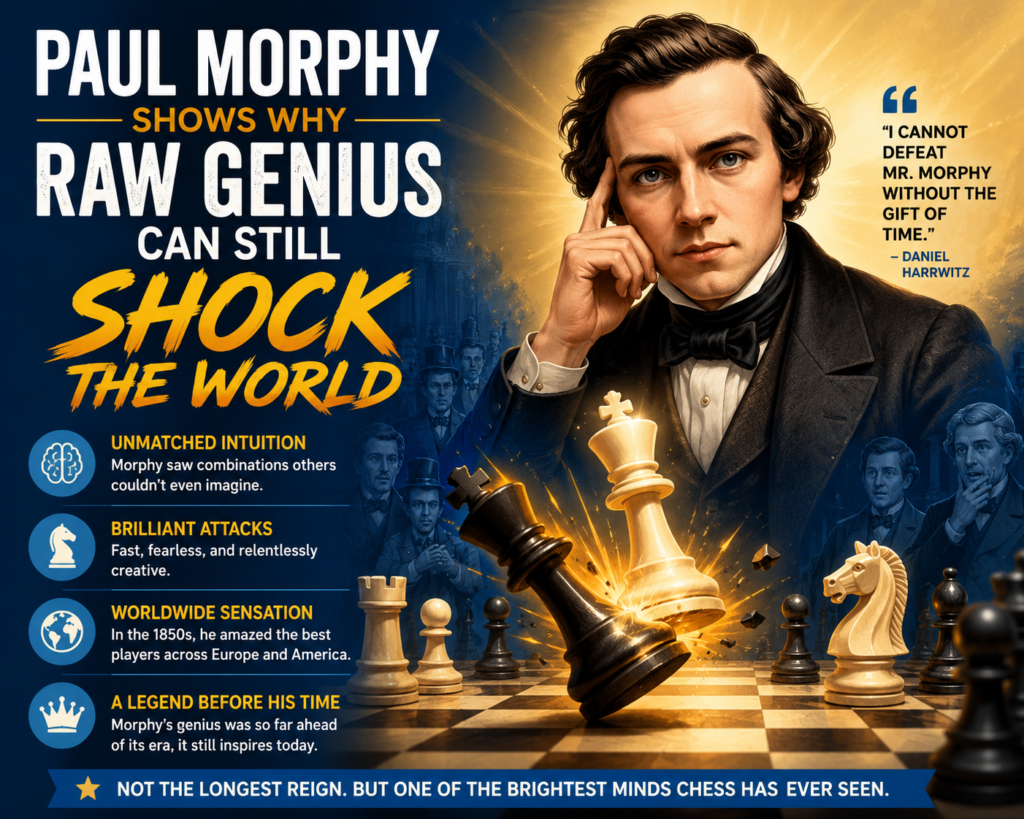
Britannica says Morphy became the world’s leading player during a public chess career that lasted less than two years. It also says some people have called him one of the most brilliant players of all time, and that he used the key idea of developing pieces before attacking.
That sounds normal now, but in his time, it was a huge step forward.
Morphy’s games still teach the first big rule of attack
Morphy’s best games look fast and clear. He brings out his pieces. He fights for the center. He opens lines. Then he attacks with force. Many beginners try to attack before their pieces are ready. Morphy showed that a real attack starts with good setup.
This is one reason coaches still use Morphy’s games with young students. His ideas are easy to see. A child can watch one of his games and understand why sleeping pieces are a problem. They can see why the king must be safe. They can see why time matters.
The lesson from Morphy is that strong basics are never old
Morphy’s case for the greatest chess player of all time is based on his gap over other players. He did not have modern tools, but he understood ideas that later became central to good chess. That is why his games still feel alive.
For a child, this is a perfect place to begin. Before fancy openings, there are simple habits. Bring out your pieces. Control the center. Keep your king safe. Look for checks, captures, and threats. At Debsie, students learn these habits in a guided way, so they do not just memorize moves. They learn why good moves work.
Morphy may not be the final answer to the “best ever” question, but he is one of the purest examples of natural chess power. He reminds us that great chess does not always need to look complex. Sometimes it is just clear thinking, fast growth, and brave play.
Emanuel Lasker Proves That Staying On Top Is Its Own Kind Of Greatness
Emanuel Lasker has one record that is almost impossible to ignore. He held the World Chess Champion title for 27 years, from 1894 to 1921. FIDE’s chess museum calls him the longest-reigning world champion in chess history, and that alone gives him one of the strongest cases in this whole debate.
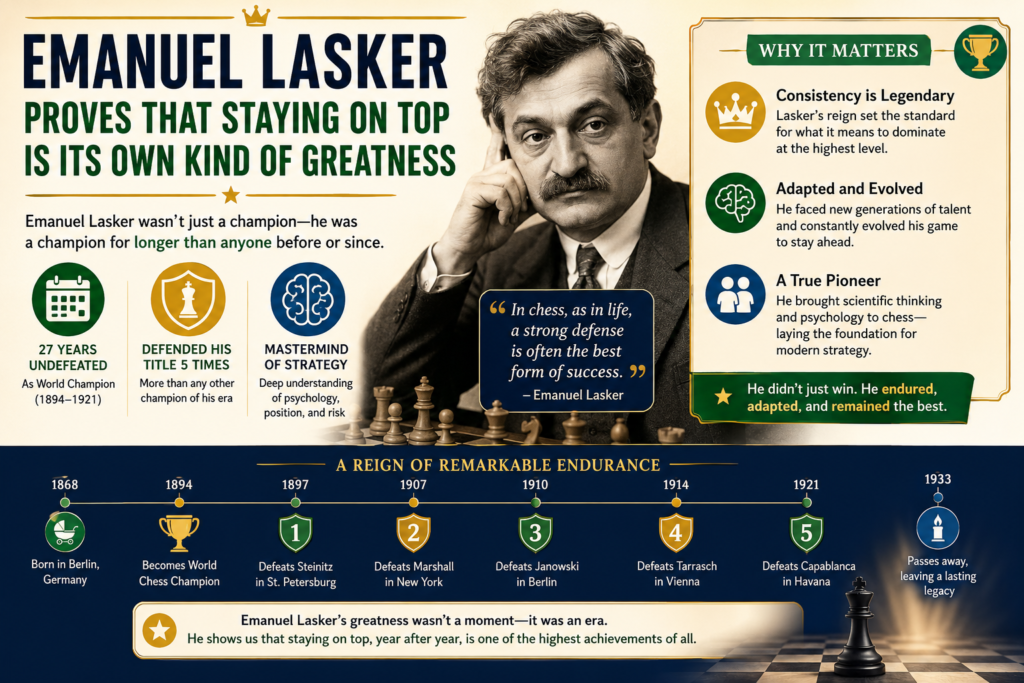
But Lasker’s greatness was not only about time. He was hard to understand and hard to beat. Many people said he had a deep feel for his opponents. He seemed to know when to keep things simple and when to make the game messy.
He did not always play the move that looked most perfect to others. He often played the move that made life hardest for the person sitting across from him.
Lasker understood that chess is played by people, not pieces alone
Some players treat chess like a clean math problem. Lasker knew it was more than that. Yes, the moves must be good. But the opponent also has fears, habits, time pressure, and blind spots. Lasker used all of this.
This does not mean he played cheap tricks. It means he understood the human side of chess. He could defend bad positions. He could fight when tired. He could choose positions where his opponent felt unsure. That is a rare skill, and it made him dangerous for a very long time.
Lasker teaches kids how to stay calm when the game feels messy
For young players, Lasker’s story is very useful because children often panic when a game becomes unclear. They think one mistake means the game is over. They rush. They give up. They forget that the other player also has to find good moves.
A Lasker-style lesson is simple but powerful. Keep playing. Ask what your opponent wants. Make the position harder if you are worse. Stay calm if you are better. Do not let one scary moment control your whole mind.
This is one of the life skills chess can teach so well. A child learns that pressure is not the enemy. It is part of the game. With the right support, they learn how to breathe, think, and keep going. Debsie’s live classes and coaching can help children build this kind of calm strength, one game at a time.
Lasker may not be the most popular answer today, but his 27-year reign is too great to ignore. If your main test is staying power, he may be the strongest name in chess history.
Alexander Alekhine Makes The Case For Creative Fire On The Board
Alexander Alekhine was one of the most creative world champions ever. He could build attacks that felt like stories. One piece would move. Then another piece would join. A line would open. A sacrifice would appear. Suddenly, the opponent’s king had no safe place to go.
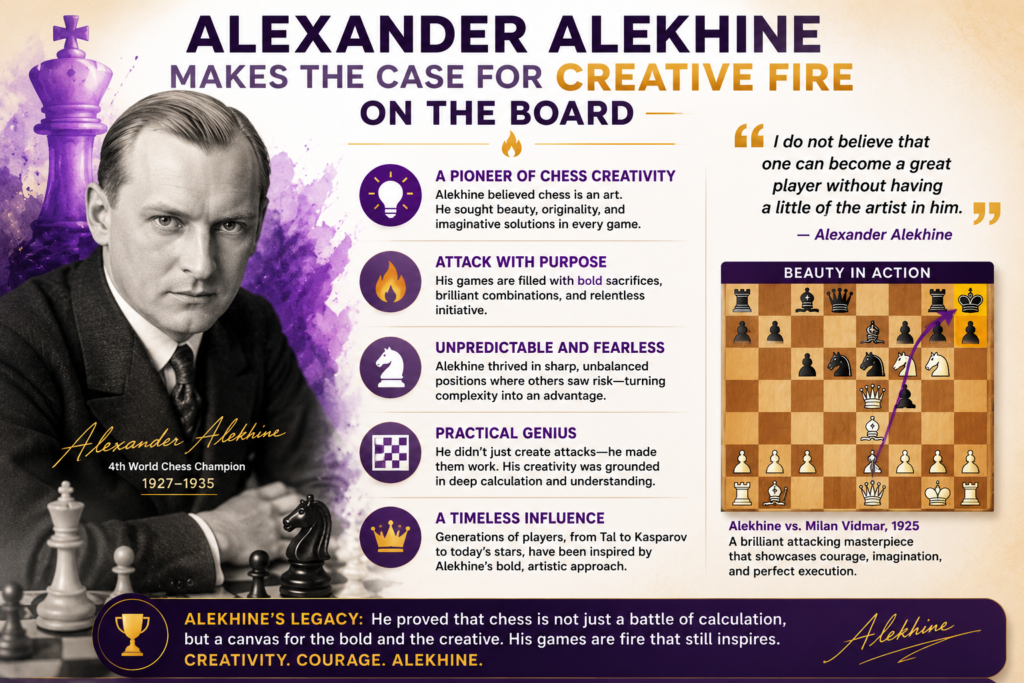
FIDE’s chess museum says Alekhine held the world crown from 1927 to 1935 and again from 1937 to 1946. It also notes that he was the only world champion to die while still holding the title. His story is full of drama, but his chess is the main reason he still matters today.
Alekhine’s best games show how imagination and logic work together
Some people think creative chess means making wild moves. Alekhine showed something better.
His attacks were creative, but they were not random. He used weak squares, open lines, active pieces, and unsafe kings. His play had beauty because it had a reason behind it.
This matters for young students because many children love attacks. They want checkmate. They want big moves. That excitement is good, but it needs training. An attack works best when the pieces are ready and the target is real.
Alekhine teaches children to dream, then check the dream
This is a lovely lesson for kids. First, use your imagination. Ask what could happen. Can my knight jump in? Can my queen join? Can I open a file? Then slow down and check if the idea is safe.
That mix of dream and discipline is one of the best gifts chess can give a child. In school and life, children need both. They need ideas, and they need the habit of testing those ideas. Chess makes that process visible on the board.
At Debsie, coaches can help children enjoy attacking chess while learning the safety checks behind it. That is how a child grows from “I hope this works” to “I know why this works.” That change is huge.
Alekhine may not be the top choice for greatest of all time if we focus only on long-term rating or modern engine-like accuracy. But if we talk about creativity, attacking vision, and games that inspire students for generations, Alekhine belongs near the top.
Mikhail Botvinnik Shows Why A System Can Build Champions
Mikhail Botvinnik’s greatness is not only about his own games. It is also about the way he shaped chess learning. FIDE’s chess museum describes him as the sixth World Chess Champion and the founder of the Soviet Chess School. It says he held the title across three reigns, from 1948 to 1957, 1958 to 1960, and 1961 to 1963.
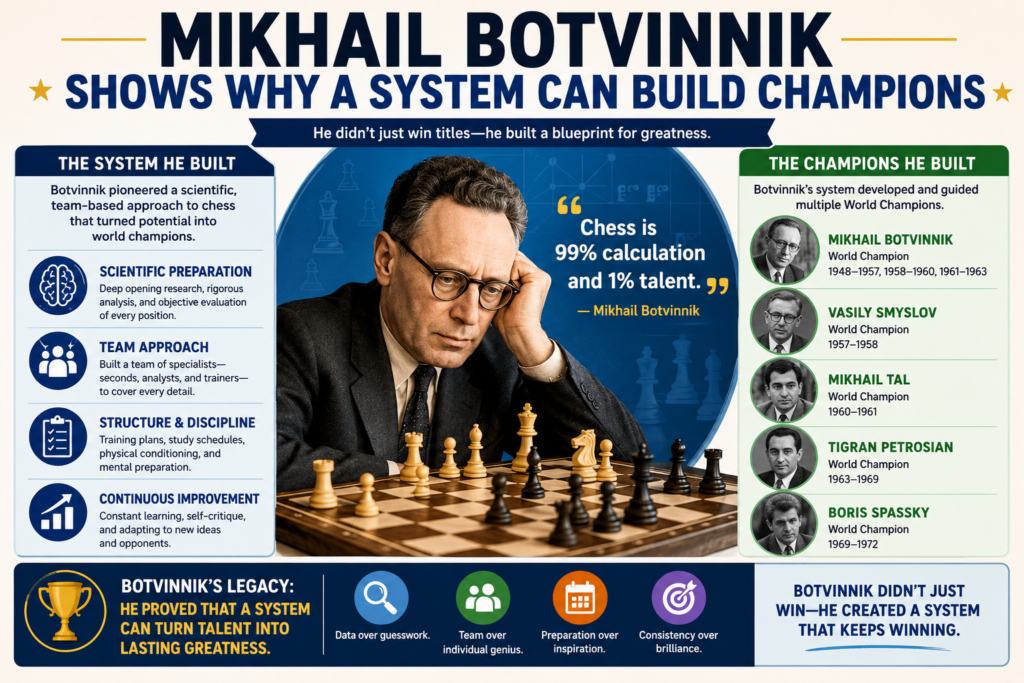
Botvinnik treated chess with serious care. He prepared deeply. He studied openings. He reviewed his games. He worked on his body and mind. He believed chess growth could be planned. This was a big idea. It helped shape how future champions trained.
Botvinnik’s biggest gift was turning talent into a process
Some great players look like magic. Botvinnik looked like work. That does not make him less great. In fact, it may make his story even more useful for children. He showed that strong chess can come from method, routine, and honest review.
A child does not need to be born a genius to improve. They need the right steps. They need feedback. They need to practice the right things. They need someone to show them what to fix next. That is why structured chess learning can be so much better than only playing random games online.
Botvinnik’s story matches the way kids learn best today
Modern students do well when learning feels clear. They need lessons that build on each other. They need puzzles at the right level. They need games where they can test ideas. They need kind correction after mistakes.
This is very close to what a strong learning platform should offer. Debsie gives students guided classes, expert coaches, private support, and regular tournaments. That kind of path helps children feel progress. It turns chess from a confusing game into a set of skills they can build.
Botvinnik may not be everyone’s pick as the greatest player ever, but he is one of the most important champions in chess education. If greatness means changing how future stars are trained, his place in the debate is safe.
Mikhail Tal Shows Why Chess Also Needs Courage And Wonder
Mikhail Tal is one of the most exciting chess players ever. Some champions feel calm. Some feel sharp. Tal felt like a storm. When he played, the board could change very fast. One moment the position looked normal.
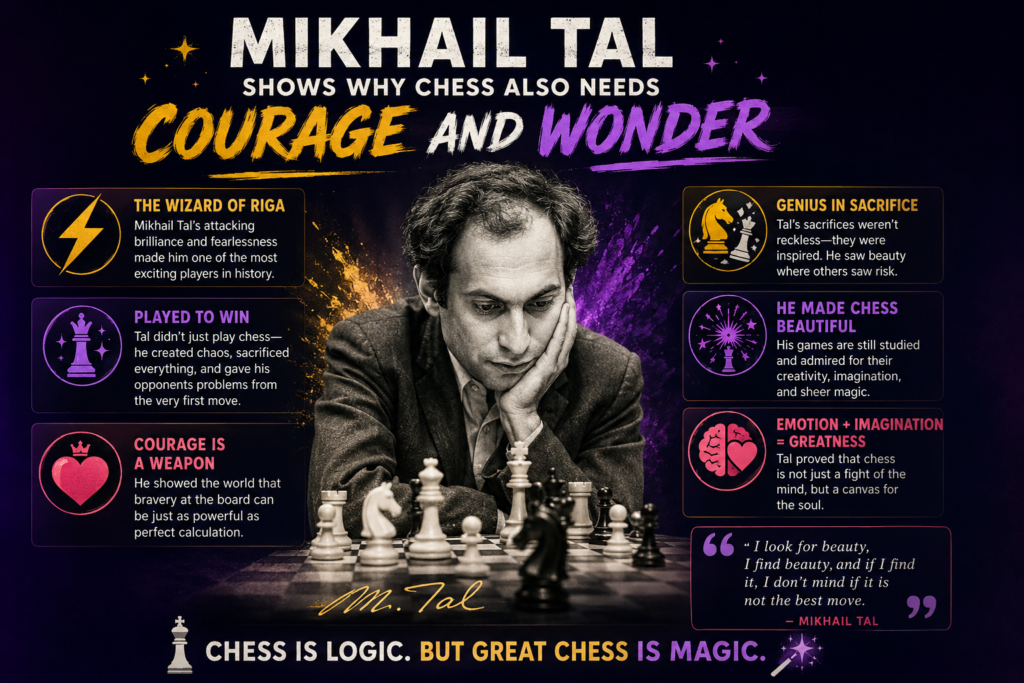
A few moves later, pieces were flying, kings were in danger, and the other player had to solve a puzzle under pressure.
FIDE’s chess museum says Tal rose from master level to World Champion in just three years. It also says he won the 1959 Candidates Tournament and then beat Mikhail Botvinnik in 1960 by a score of 12½–8½.
Tal earned the famous name “The Wizard from Riga” because of his daring style, full of sacrifices and fight for the move.
Tal made people feel that chess could be art
Tal’s sacrifices were not always clean in the way a computer might like today. But that is part of why his games are so loved. He created problems that were almost impossible to solve at the board. He understood fear, time pressure, and surprise. He knew that a human player could break when the position became too hard.
This does not mean children should copy every Tal sacrifice. That would be dangerous. But they can learn something very important from him. Chess is not only about being safe. Sometimes you must be brave. Sometimes you must trust your idea. Sometimes you must create a chance instead of waiting for one.
Young players can learn when to be brave and when to slow down
Tal teaches a beautiful balance. Dream big, but check your dream. Look for the attack, but also ask if your pieces are ready. Try bold ideas, but learn from the games where they fail. This is how a child grows from guessing into thinking.
At Debsie, this kind of growth matters a lot. A coach can help a child understand the difference between a smart sacrifice and a hopeful sacrifice. That one lesson can change the way a student plays. They become more creative, but also more careful. They learn that courage is not the same as rushing.
Tal may not be the final answer for the best chess player of all time if we only measure long rule or highest rating. But if greatness means joy, beauty, and fearless play, Tal belongs in the heart of the debate.
Tigran Petrosian Shows Why Defense Can Be Just As Beautiful As Attack
Tigran Petrosian is a perfect answer for anyone who thinks chess is only about attacking. He was known for deep defense, quiet control, and a strong sense of danger. He often stopped threats before they even became real. That is why people called him “Iron Tigran.”
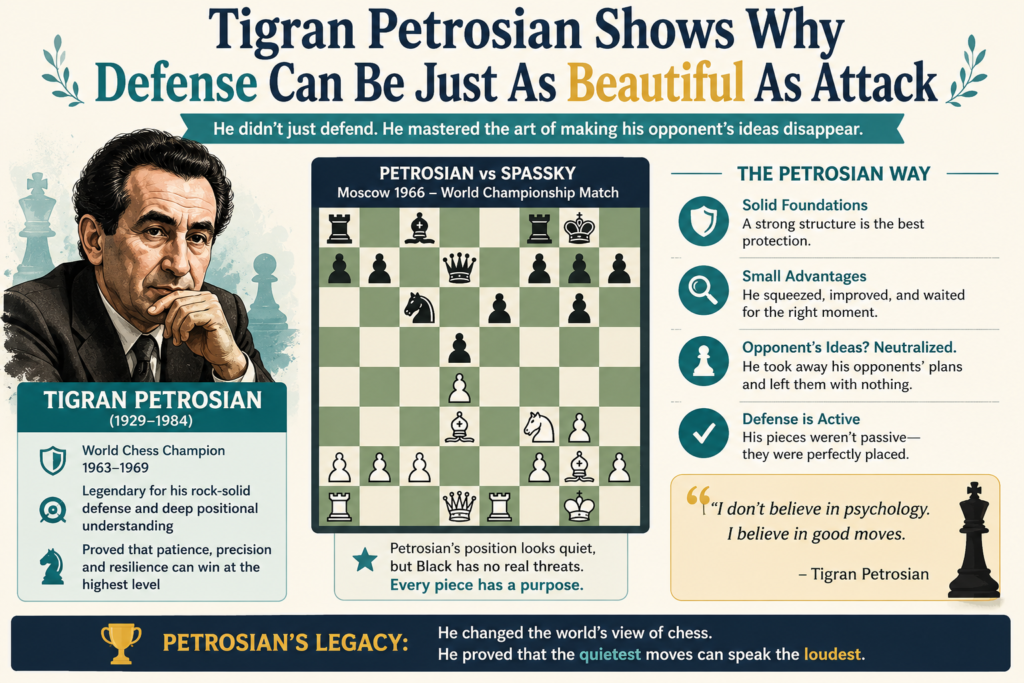
FIDE’s chess museum describes Petrosian as a fine positional player and brilliant tactician. It also says he took part in three Candidates tournaments before winning at Curaçao in 1962, which gave him the right to challenge for the World Championship.
He later became World Champion and is remembered as one of the hardest players to beat.
Petrosian made safety feel powerful
Many young players think defense is boring. They want checks, captures, and quick wins. Petrosian shows that defense can be active. A good defensive move does not just wait. It takes away your opponent’s plan. It makes their pieces feel awkward. It gives you time to build your own play.
This is a key lesson for children. In chess, as in life, not every problem should be answered with force. Sometimes the best answer is to stay calm, protect what matters, and remove the danger. A child who learns this can become a much stronger player because they stop giving away easy wins.
Defense teaches patience, focus, and emotional control
Petrosian’s style is very useful for kids who move too fast. He shows that you can win by noticing danger early. You do not need to panic when attacked. You can look carefully, find the threat, and choose the move that keeps everything together.
This is also why chess is such a strong tool for life skills. A child learns to pause before reacting. They learn that staying safe is not weakness. They learn that smart defense can lead to future success.
At Debsie, students are guided to see both sides of the board. They learn what they want, but also what the opponent wants. This simple habit can save many games. It can also help children become better listeners, better planners, and calmer thinkers.
Petrosian may not be the loudest name in the greatest-ever debate, but his chess gives us something rare. He proved that quiet strength can be world-class strength.
Vladimir Kramnik Proves That Even The Greatest Can Be Stopped By A Clear Plan
Vladimir Kramnik has one of the most important wins in chess history. In 2000, he defeated Garry Kasparov in a world title match without losing a single game. That matters because Kasparov was seen as almost unstoppable.

Kramnik did not beat him with noise. He beat him with deep preparation, calm defense, and a clear match plan.
FIDE’s chess museum says Kramnik dethroned Kasparov by a score of 8½–6½ without losing a game. It also notes that he later defended his title against Peter Leko in 2004 and became the undisputed World Champion after beating Veselin Topalov in a 2006 reunification match.
Kramnik showed that strategy can beat raw power
Kramnik’s win over Kasparov is a lesson in planning. He did not try to out-Kasparov Kasparov. He did not walk into the kind of sharp positions Kasparov loved. Instead, he chose lines and positions where he could reduce Kasparov’s attacking chances. He made the match about control.
This is a huge lesson for young players. You do not always need to play the game your opponent wants. You can choose your own path. If your opponent loves attacks, you can keep the position solid. If your opponent rushes, you can slow the game down. If your opponent waits, you can take space and build pressure.
A good plan can make a child feel less afraid
Many children fear stronger players. They sit at the board thinking, “This person is better than me.” Kramnik’s story helps answer that fear. Strong players can be challenged. Big problems can be broken into smaller plans. You do not need magic. You need a clear idea and steady moves.
At Debsie, this is one of the most powerful things a student can learn. Coaches help children understand that a plan gives the mind something to hold. Instead of guessing each move, the child starts thinking in steps. First, improve the pieces. Then, protect the king. Then, find the weakness. Then, press.
Kramnik may not be picked as the greatest chess player of all time as often as Carlsen, Kasparov, or Fischer. But any player who beats Kasparov in a world title match without losing a game has earned a permanent place in the greatest-player conversation.
Wilhelm Steinitz Changed The Way People Understood Chess Itself
Wilhelm Steinitz was the first official World Chess Champion, but his true impact is even bigger than that title. Before Steinitz, many players believed chess was mostly about attack. They loved sacrifices, open lines, and direct threats.
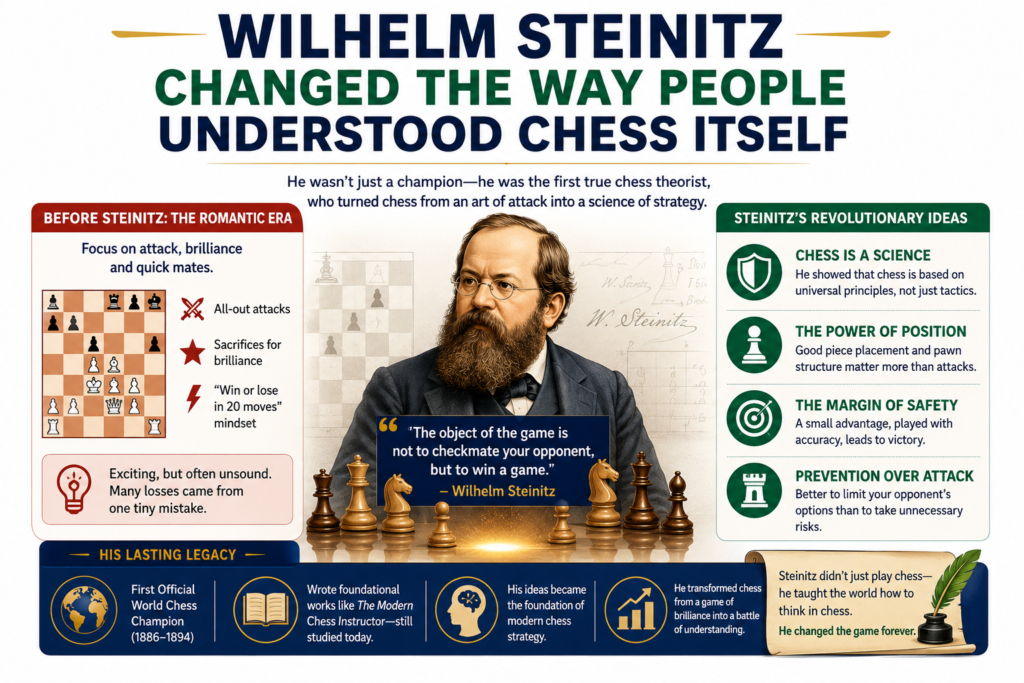
Steinitz helped show that chess also had deep rules of position. You should not attack just because you want to attack. You should attack when your position gives you the right to attack.
FIDE’s chess museum describes Steinitz as the first world champion in chess history, holding the title from 1886 to 1894. It also notes that his earlier style was sharp and aggressive, but his lasting place in history comes from the way he changed chess thinking.
Steinitz helped turn chess from tricks into principles
Steinitz’s ideas may sound normal now, but they were powerful in his time. He taught that small advantages matter. Better pawn structure matters. Safe kings matter. Strong squares matter. Active pieces matter. These ideas became part of the base of modern chess.
This is why Steinitz is so important for students. He shows that chess is not random. There are reasons behind strong moves. A child does not have to depend only on memory. They can learn simple rules that help them make better choices even in new positions.
Great chess learning starts when a child understands why
The word “why” is one of the most important words in chess. Why is this move good? Why is this trade helpful? Why is this pawn weak? Why is my king in danger? When children ask better questions, they start to think like real players.
This is the kind of learning Debsie wants to give every student. A child should not only copy moves from a screen. They should understand ideas. That is how chess becomes useful beyond the board. The child learns how to think clearly, explain choices, and build better habits.
Steinitz may not beat modern champions if we imagine him sitting across from Carlsen with no time to study modern chess. But that is not a fair way to judge him. His greatness is that he helped create the language modern champions still use.
Without Steinitz, the story of chess would look very different.
Ratings Help Us Compare Players, But They Do Not Tell The Whole Story
Ratings are useful because they give us a number. Numbers feel clean. They make it easier to compare players across the same time period.
Today, FIDE’s rating list shows Magnus Carlsen as the number one active player in classical chess, with a standard rating of 2840, and also as number one in rapid and blitz. His FIDE profile also shows ratings of 2832 in rapid and 2869 in blitz. That is a rare kind of all-round strength.
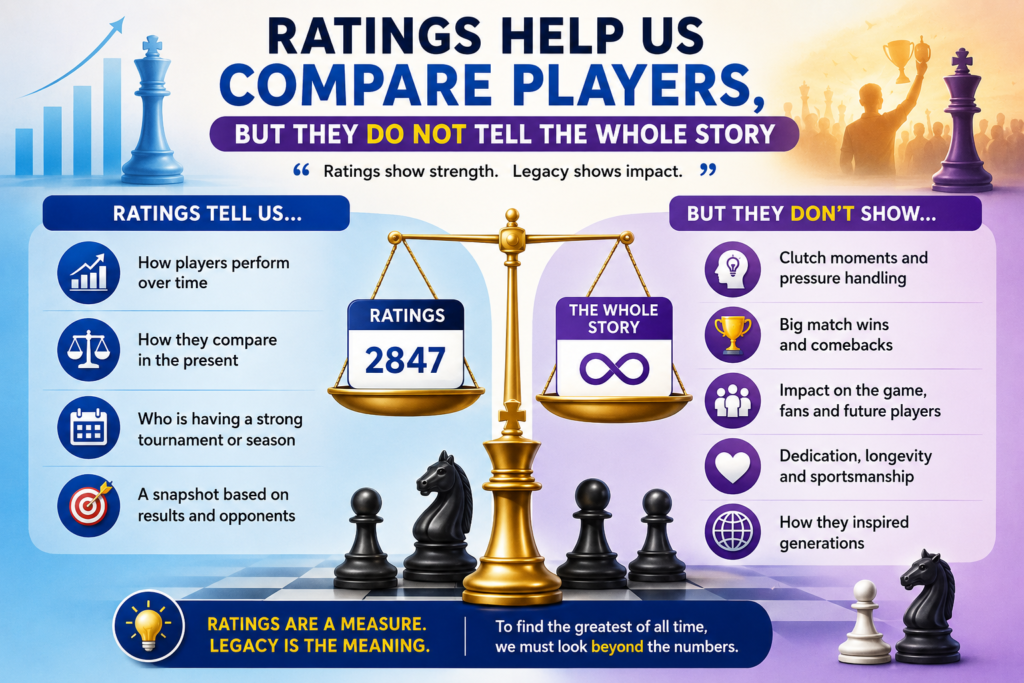
But ratings are not magic. They are not a perfect answer to the greatest-player question. A rating tells us how a player is performing in a pool of other rated players. It does not fully tell us how hard travel was in 1921, how deep Soviet preparation was in 1972, or how much computers changed chess after the 1990s.
A higher rating does not always mean a better legacy
Magnus Carlsen’s peak rating of 2882 is the highest official FIDE classical rating ever recorded. Guinness World Records also lists 2882 as the highest chess rating for men, achieved by Carlsen in May 2014. That gives him a very strong case when we talk about measured playing strength.
Still, we must be careful. Capablanca, Morphy, and Steinitz did not have modern ratings during their best years. Fischer had ratings, but he played in a very different chess world. Kasparov had ratings, but he built much of his lead before today’s online databases and engines became normal.
So if we use rating alone, we may favor the modern player too much.
The smart way is to use ratings as one clue, not the whole verdict
For a parent or student, this is a great thinking lesson. In chess, one clue is not enough. A check may look strong, but it may not be best. A capture may win a pawn, but it may lose the king. In the same way, a high rating is important, but it is only one part of the answer.
That is why this debate is useful for kids. It teaches them to ask, “What else should I look at?” That one question can change how a child thinks. It helps them in chess, but also in school and daily life. They learn not to rush just because one number looks big.
At Debsie, this kind of thinking is part of the learning journey. Students are taught to look deeper than the first move. They learn to compare options, check danger, and explain their choices. That is how chess becomes more than a game. It becomes a way to build a sharper mind.
World Titles Matter, But The Title System Has Not Always Been Simple
Winning the World Chess Championship is one of the hardest things in chess. It means you reached the top and proved yourself against the strongest challengers of your time.
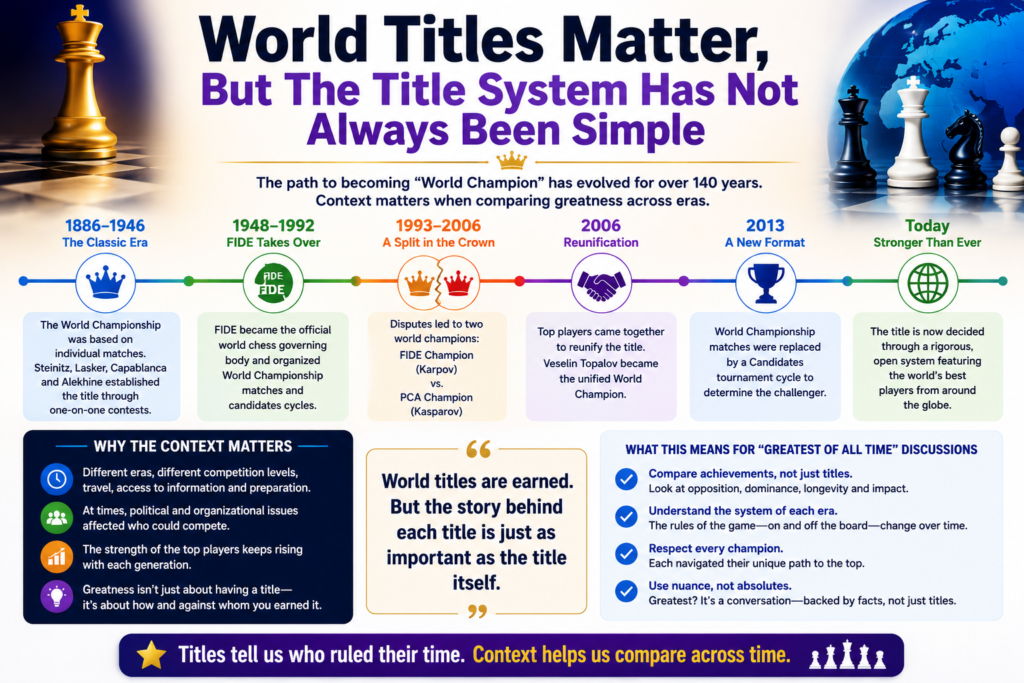
That is why world champions are always part of the greatest-player debate. FIDE’s chess museum lists the official open world champions from Wilhelm Steinitz through modern champions such as Carlsen, Ding Liren, and Gukesh Dommaraju.
But even here, the story is not simple. Some champions held the title for a long time. Some lost it quickly. Some defended it many times. Some became champion during times when the chess world had splits, disputes, or different title paths. So the title matters a lot, but it still needs context.
A crown can show greatness, but it cannot measure every kind of greatness
Emanuel Lasker held the world title for 27 years, which is the longest reign in chess history according to FIDE’s chess museum. That is a huge point in his favor. Kasparov held the title for many years too, and his match battles with Karpov are among the deepest in chess history.
Carlsen became World Champion in 2013 and defended his title many times before stepping away from the classical title cycle. These facts all matter, but they point to different kinds of greatness.
Fischer’s case is different again. He won the title in 1972, but did not defend it in 1975. If we only count years as champion, Fischer falls behind. But if we measure how much one player shocked the chess world at his peak, he rises fast. This is why title count alone cannot close the debate.
Kids can learn that success has more than one shape
This matters because children often think there is only one way to be good at something. They may think the winner is always the smartest. Chess teaches a better truth. One player may be great at attack. Another may be great at defense.
One may shine in fast games. Another may shine in long battles. One may win titles. Another may change how people learn the game.
This is a healthy lesson for young minds. It helps a child see their own path with more kindness. Maybe they are not the fastest player yet. Maybe they are not winning every game yet. But they may be getting better at focus, planning, patience, or courage. Those wins matter too.
Debsie’s chess classes are built around this idea. Students are not treated like copies of each other. They learn at their level, with coaches who can guide their next step. That helps kids grow with confidence instead of fear.
Computer Engines Changed The Way We Judge Chess Strength
Modern chess has a special challenge that older generations did not face. Today, we can check games with powerful chess engines. These engines can show us mistakes, missed chances, and best moves with a level of depth no human can match.
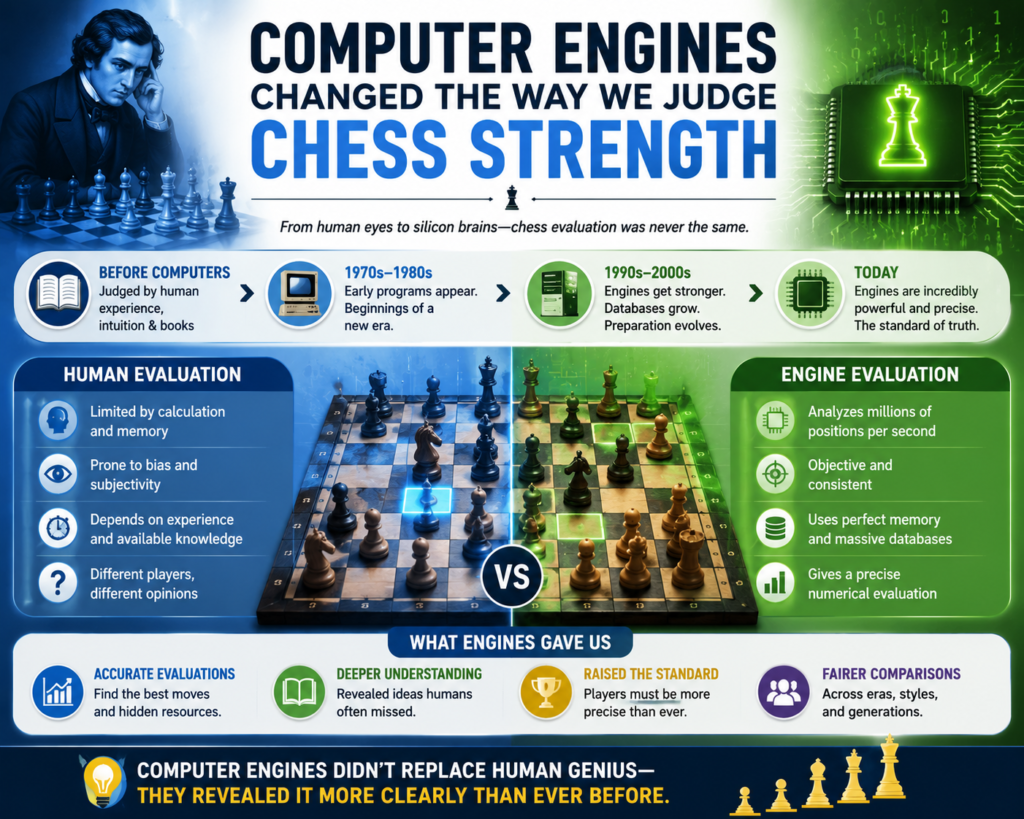
This makes it tempting to say, “Let us compare everyone by engine accuracy.”
That sounds fair at first, but it has a problem. Older players did not train with engines. They did not grow up with giant online databases. They could not test opening ideas in seconds. They had to learn through books, clubs, analysis partners, and their own minds.
Modern players are stronger in part because they stand on all the learning that came before them.
Engine accuracy can show quality, but it can miss human pressure
A move that is best according to an engine may not always be the hardest move for a human opponent to face.
Tal understood this well before engines existed. He often created positions where the best defense was very hard to find at the board. Lasker also understood the human side of chess. He could choose positions that made opponents uncomfortable, even if later analysis showed cleaner options.
This is important because chess is not played by engines in tournaments. It is played by people with clocks, nerves, habits, and emotions. A player’s greatness is partly about making good moves. But it is also about making the opponent’s job harder.
The best chess students learn from engines without becoming robots
For kids, the right lesson is simple. Engines are helpful tools, but they should not replace thinking. A child should not only ask, “What did the engine say?” They should also ask, “Why is that move good?” “What was my plan?” “What did I miss?” “How can I find this idea next time?”
This is where coaching makes a big difference. An engine can show a move, but a coach can explain it in a way a child understands. A coach can turn a red mark on the screen into a real lesson. That is what young players need.
At Debsie, students can learn how to use feedback in a healthy way. They are not just told that a move was bad. They are helped to see the idea behind the better move. This protects their confidence while still helping them improve. That balance is very important, especially for kids.
So, can engines help us choose the best chess player ever? Yes, they can help. But they cannot be the judge alone. They do not fully measure courage, pressure, influence, or the learning tools each player had in their own time.
Conclusion
So, who is the best chess player of all time? The fairest answer is Magnus Carlsen, if we judge total strength, modern skill, and success across classical, rapid, and blitz chess. But Garry Kasparov, Bobby Fischer, Capablanca, Anand, Karpov, Polgár, Tal, and others all gave chess gifts we still learn from today.
The best player may start the debate, but the best lesson is this: chess helps children think better, wait longer, plan smarter, and believe more. If your child is ready to grow through chess, Debsie’s free trial class is a great first move for them today, right now

Adhip Ray is the founder of Debsie, an online learning platform focused on chess and skill-based learning for children. His work at Debsie brings together chess education, structured thinking, problem-solving, and interactive learning for young students.
Adhip has an academic background in law, statistics, analytics, and technology. He is from Amity Law School and the Indian Statistical Institute, Kolkata, with formal training that connects legal reasoning, data analytics, quantitative thinking, and structured problem-solving. This interdisciplinary background is reflected in Debsie’s focus on building sharper thinking skills in children through chess and related learning programs.
Adhip is also a FIDE-rated chess player from India. He holds FIDE ID 5055954 and has a standard FIDE rating of 1832. His FIDE profile records him as an Indian player with a long rating history in standard chess, including rated games from his competitive playing years. His chess background gives Debsie a founder-led connection to the game, not only as an educational activity but also as a competitive discipline that develops concentration, calculation, planning, and decision-making.
In addition to chess, Adhip has a strong interest in coding, data, and technical problem-solving.
Adhip’s profile combines chess, law, data analytics, and programming. At Debsie, this background supports the creation of learning experiences that are logical, structured, and skill-oriented. The platform’s chess-focused programs are connected to broader cognitive skills such as pattern recognition, patience, strategic planning, focus, and problem-solving.
As founder of Debsie, Adhip brings together experience from multiple fields: formal legal education from Amity Law School, analytical training from the Indian Statistical Institute, Kolkata, competitive chess experience through his FIDE-rated profile, and coding practice through LeetCode. This combination gives Debsie a distinct foundation in strategy, reasoning, analytics, and child-focused learning.
Through Debsie, Adhip is associated with building chess and learning content for children that goes beyond basic instruction. The platform connects chess with thinking skills, helping students approach challenges with more structure, clarity, and confidence. His own background in chess and analytical problem-solving gives the platform a direct link to the skills it aims to develop in young learners.
Adhip is also a member of Forbes Business Council.