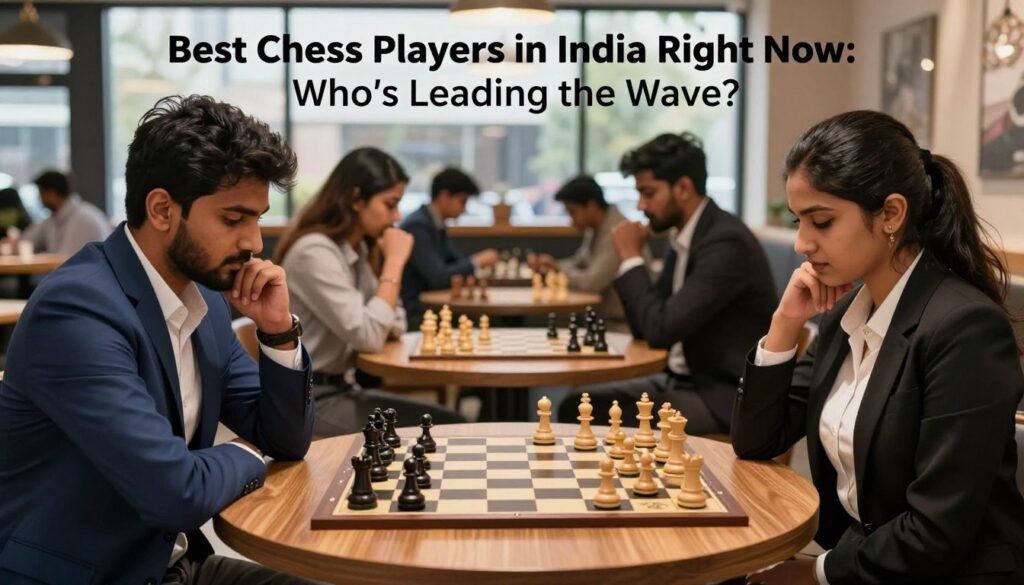
For years, Viswanathan Anand showed Indian kids that a world title was not a dream too big. Now, a new group is carrying that fire forward. Players like D Gukesh, Arjun Erigaisi, R Praggnanandhaa, Koneru Humpy, R Vaishali, Divya Deshmukh, Vidit Gujrathi, and Nihal Sarin are making the world stop and watch. In May 2026, Arjun Erigaisi is the top-ranked Indian male player, while Gukesh remains India’s world classical champion, and Humpy is still among the world’s top women players.
Find the right learning experience
Tell us a little about the learner and what you are looking for. Our team will review your answers and help you identify the most suitable next step.
- Takes only a few minutes
- No payment required
- Personalised recommendations
Your information will only be used to respond to your enquiry.
Why India’s Chess Wave Feels Bigger Than Ever
Indian chess is in a rare place right now. The country has a world champion, several young stars near the very top, and a strong group of women players who are making deep runs in the biggest events. That mix matters because it means India is not depending on one hero anymore. It has a full wave.

For parents, this is a powerful sign. Chess is no longer a quiet hobby that kids play only on weekends. It is a serious mind sport where Indian players are showing the world what focus, discipline, and calm thinking can do.
When a child watches Gukesh fight for the world title or Vaishali hold her nerve in a big match, that child sees something simple but life-changing: smart work can take you far.
The Indian chess story has moved from one legend to many leaders
For a long time, Indian chess was linked with Viswanathan Anand. That was a good thing because Anand gave India belief. He made chess feel possible. He gave young players a map. But today, the story has changed.
The new Indian chess story has many faces, many styles, and many paths.
Find the right learning experience
Tell us a little about the learner and what you are looking for. Our team will review your answers and help you identify the most suitable next step.
- Takes only a few minutes
- No payment required
- Personalised recommendations
Your information will only be used to respond to your enquiry.
Arjun Erigaisi is now India’s highest-ranked active male player, sitting at world number 11 with a 2751 classical rating on the current FIDE profile. Gukesh D, even after rating ups and downs, remains the reigning world classical champion and is listed by FIDE with a 2732 classical rating.
Praggnanandhaa R is close behind with a 2733 classical rating and a world active rank of 17. These numbers show how tight the race is among India’s top names. A few games can change the order, but the larger message is clear: India has several players who can fight anyone.
The lesson for young players is simple and strong
The biggest lesson from this wave is not only “become a grandmaster.” That is a dream for a few. The better lesson is that chess rewards habits. It rewards the child who can sit, think, try, lose, learn, and return. This is why many parents use chess not just to build a player, but to build focus and patience.
At Debsie, this is also how chess is taught. The goal is not to rush a child into hard theory on day one. The goal is to help the child enjoy the board, understand ideas, and slowly build the kind of thinking that helps in school, sports, and daily life.
A free trial class is a good first step because it helps parents see how their child thinks, asks questions, and reacts to a real coach.
Arjun Erigaisi Is India’s Rating Leader Right Now
Arjun Erigaisi is one of the most exciting chess players in India because he plays with real fight. He does not just wait for mistakes. He asks questions on the board. He makes his opponents work. That is one reason so many chess fans enjoy watching him.

In the latest FIDE profile data, Arjun has a 2751 classical rating, a 2741 rapid rating, and a 2776 blitz rating. He is ranked number 1 among active Indian players on that profile and number 11 among active players in the world.
That makes him the Indian rating leader right now, even though the global top ten has become a very hard club to stay in.
Arjun’s biggest strength is his fearless style
Arjun’s style is useful for young players to study because he shows how to play active chess. He does not treat the opening as a way to “survive.” He treats it as a way to create play. He is often ready to take space, push pawns, and build pressure.
This does not mean children should copy every risky move they see from a top grandmaster. That can go wrong fast. The real lesson is deeper. Arjun trusts his calculation because he has trained it for years. He can play sharp positions because he has built the skill to see danger before it arrives.
What kids can learn from Arjun’s games
A young player can learn three quiet lessons from Arjun without needing to understand every grandmaster move. First, he fights for activity. Second, he keeps looking for chances even when the position is not perfect. Third, he does not play scared against big names.
That mindset is gold for children. Many kids lose games not because they know nothing, but because they panic after one mistake. Arjun’s games show that chess is not about never making mistakes. It is about staying alive in the game, finding your next good move, and keeping your mind steady.
At Debsie, coaches often help kids build this same habit in a friendly way. A child learns to pause before moving, look for checks and threats, and ask, “What is my opponent trying to do?” That one small habit can change the way a child plays and even the way a child solves problems outside chess.
Gukesh D Is Still the Big Symbol of India’s Chess Dream
Gukesh D holds a special place in this list because he did something that changed Indian chess forever.
In December 2024, he defeated Ding Liren to become the youngest world chess champion in history. FIDE reported that Gukesh won the match 7.5–6.5 after Ding made a late mistake in game 14.

That moment mattered because it showed young Indian players that the world crown was not just part of Anand’s era. It could belong to the next generation too. For a teenager to carry that much pressure and still finish the job is not normal. It takes calm, deep prep, strong nerves, and a team that knows how to guide him.
Gukesh’s rating rank may move, but his value is bigger than a number
Right now, Gukesh is not India’s highest-rated player. FIDE lists him with a 2732 classical rating and an active world rank of 19, while Onmanorama reported that he had slipped outside the top ten in the May 2026 rating list. But rating is only one part of the story.
A world champion carries a different kind of weight.
In chess, ratings move because players take risks, play elite events, face strong fields, and have good or bad months. That does not erase class. Gukesh has already shown that he can handle the toughest match setting in chess.
He has also shown that Indian players can dream beyond “top ten” and aim for the very top.
What parents should notice about Gukesh
The best thing for parents to notice is not just the trophy. It is the emotional control. Chess at that level is full of pressure. One slip can cost months of work. Yet Gukesh stayed in the match, trusted his work, and waited for his chance.
That is exactly why chess is so useful for children. It teaches them not to run away from hard moments. It teaches them to breathe, think, and try again. A child who learns this early gets a gift that goes far beyond the chessboard.
This is one reason a structured chess class can help more than random play. Random play can be fun, but guided learning helps a child understand why a move was good or bad. When a kind coach explains the idea, the child starts building real confidence instead of only chasing wins.
Praggnanandhaa R Is the Calm Fighter Everyone Must Watch
Praggnanandhaa R, often called Pragg, is one of the most loved Indian chess players because his style feels calm, clean, and mature. He became known very young, but what makes him special now is that he is not only a child star anymore. He is a serious elite player.
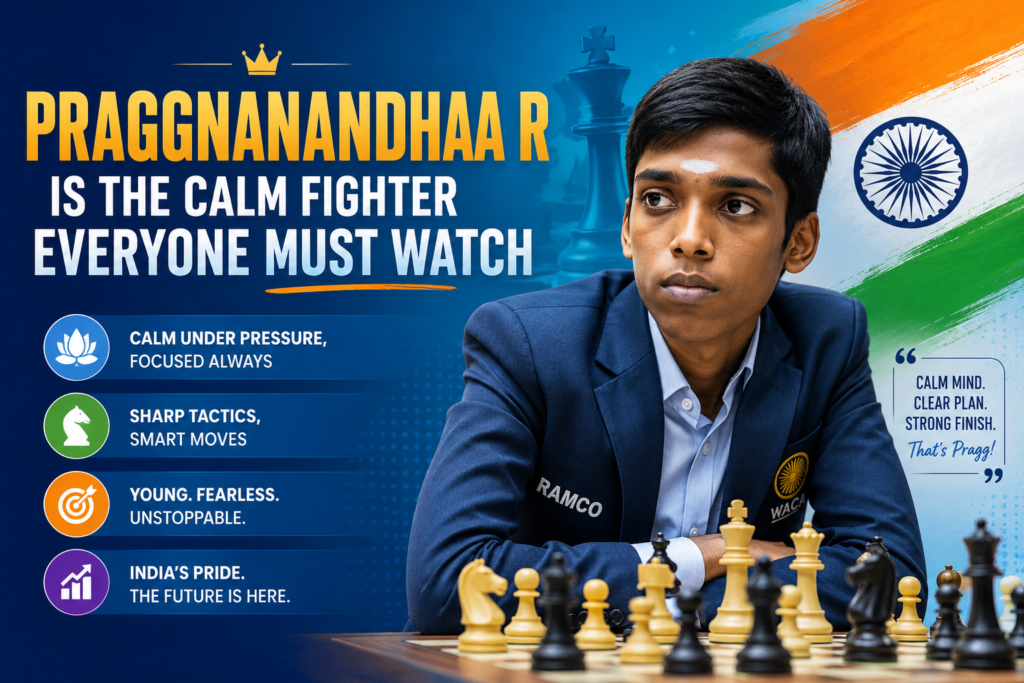
FIDE currently lists Praggnanandhaa with a 2733 classical rating, a 2663 rapid rating, and a 2698 blitz rating. His active world rank is 17, and he is ranked number 3 among active Indian players on that profile. That puts him right in the heart of the Indian top group.
Pragg’s game is built on patience and clean choices
Pragg often gives the feeling of a player who is hard to shake. He may not always look flashy from the outside, but his games have a quiet strength. He can defend, hold balance, and wait for the right moment. That is a very hard skill.
Many young players want to attack from move one. That is natural because attacking feels fun. But Pragg shows that chess is also about timing. You do not have to rush. You can improve your pieces, stop your opponent’s plan, and wait until the board gives you a chance.
The Debsie lesson from Pragg’s style
For a young student, Pragg’s style teaches a very useful life lesson: calm is a skill. It is not something children are born with. It can be trained. In chess, a child learns to slow down, check threats, and choose a move with care.
This matters in school too. The same child who learns to pause before moving a queen can also learn to pause before answering a tricky math question. The same child who learns not to panic after losing a pawn can learn not to give up after one bad test score.
That is why Debsie’s live chess classes focus on thinking, not just moving pieces. A strong coach can help a child see the board in a new way. The child does not just ask, “Can I win?” The child starts asking, “What is the best plan?” That change is small at first, but over time, it builds a sharper mind.
The Real Leader Is Not Just One Player, But the Whole Indian System
The title of this article asks who is leading the wave. The honest answer is that there is no single answer. Arjun is leading by rating. Gukesh is leading by world champion status. Pragg is leading as a calm elite force. Humpy, Vaishali, and Divya are leading the women’s side in different ways.
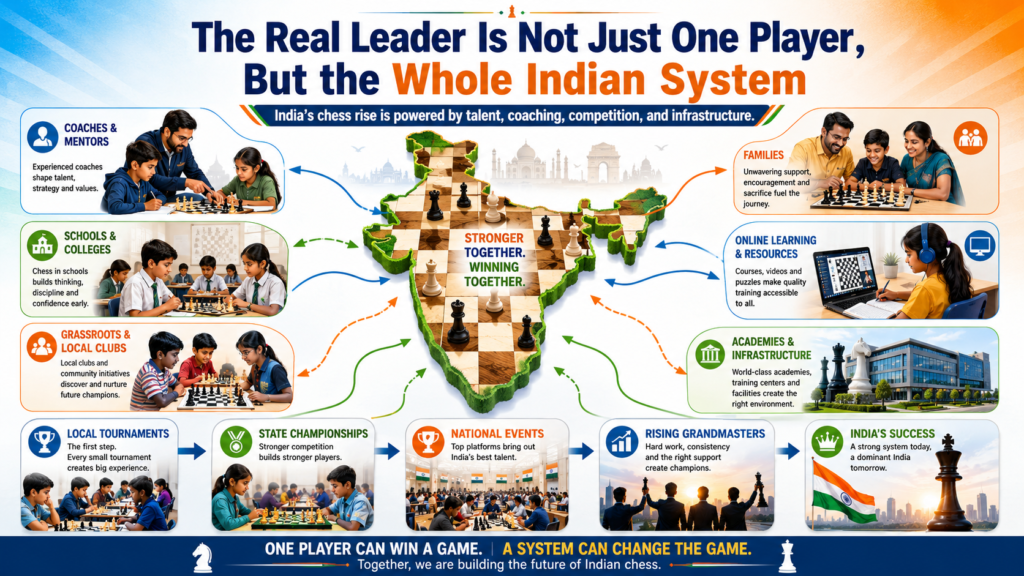
This is what makes Indian chess so exciting right now. A healthy chess country is not built on one star. It is built on many players pushing each other. When one player rises, others feel the pull. The standard goes up.
Coaches improve. Parents understand the path better. Kids get better role models.
The women’s wave is just as important
The women’s side deserves serious attention because India has strong names there too. Onmanorama reported that Koneru Humpy was ranked 6th in the May 2026 women’s ratings, with Divya Deshmukh at 12th and Vaishali R at 13th.
Vaishali also made history by winning the 2026 Women’s Candidates and earning a world championship match against Ju Wenjun.
This matters for girls who are starting chess. It gives them real Indian role models. They can look at Humpy’s long career, Vaishali’s rise, and Divya’s growth and see different paths to success. They do not have to feel like chess is only for boys. The board is open to everyone.
Why this is the best time for kids to start chess
There has never been a better time for an Indian child to start learning chess. The heroes are visible. The games are easy to watch. Good coaching is easier to access online. Parents are also starting to understand that chess is not only about trophies. It builds focus, patience, memory, planning, and emotional control.
Find the right learning experience
Tell us a little about the learner and what you are looking for. Our team will review your answers and help you identify the most suitable next step.
- Takes only a few minutes
- No payment required
- Personalised recommendations
Your information will only be used to respond to your enquiry.
A child does not need to become the next Gukesh for chess to change their life. Even learning how to think two moves ahead can help. Even learning how to lose with grace can help. Even learning how to sit for one full game and give their best can help.
That is why Debsie offers a free chess trial class for children and parents who want to see the method before joining. It is a simple way to let your child try a live class, meet expert coaches, and feel the joy of learning chess in a warm, guided space.
Koneru Humpy Is Still the Standard Every Young Indian Player Can Learn From
Koneru Humpy is not just one of India’s best women chess players. She is one of India’s most important chess names, full stop. Her career has lasted because she has something that every serious player needs: strength that does not fade when the game gets long, hard, or quiet.
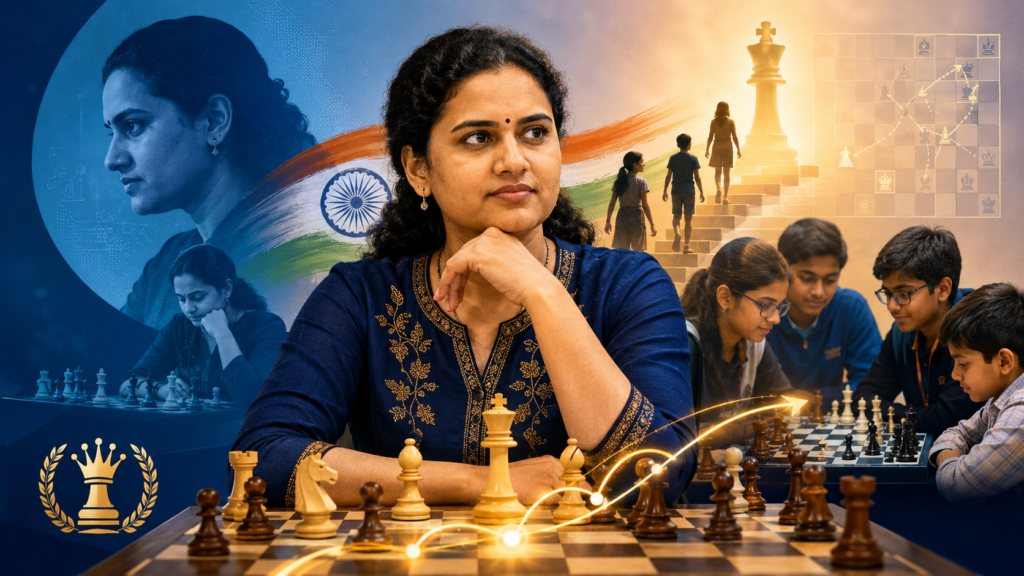
FIDE currently lists Humpy with a 2535 classical rating, a 2445 rapid rating, and a 2412 blitz rating. She holds both the Grandmaster and Woman Grandmaster titles, which shows how high her level has been across many years of serious chess.
Humpy’s real gift is that she makes hard chess look steady
Many young players think chess is only about fast attacks, bright traps, and quick wins. Humpy’s games teach a different lesson. She shows that strong chess often looks calm. It is about keeping the position healthy, making small improvements, and not giving the other player easy chances.
That is why parents should pay attention to her career. A child may not understand every move she plays, but they can learn from her way of thinking. She does not rush just because the game feels slow.
She does not break down when the position becomes tense. She waits, studies, and keeps finding useful moves.
Humpy shows kids that patience can become power
Patience is not boring in chess. Patience is how a player saves a bad game, turns a small edge into a win, and stays strong when the opponent attacks. This is one of the best life lessons chess can give a child.
In school, many kids want quick answers. They may give up when a math problem takes too long. They may feel upset when they do not get something right away. Chess teaches them that thinking slowly can be a strength. Humpy’s career is a clear example of this.
At Debsie, this is the kind of lesson coaches build into live classes. A good coach does not only say, “This move is bad.” A good coach asks, “What were you trying to do?” That one question helps a child slow down and think with care.
Over time, the child starts to see that patience is not waiting with no plan. Patience is waiting with a smart plan.
R Vaishali Is Now One of India’s Biggest Chess Stories
R Vaishali has become one of the brightest names in Indian chess. Her rise feels special because it is built on courage, hard work, and a very strong mind. She is no longer only known as Praggnanandhaa’s sister. She is a top player in her own right, and her recent results prove it.
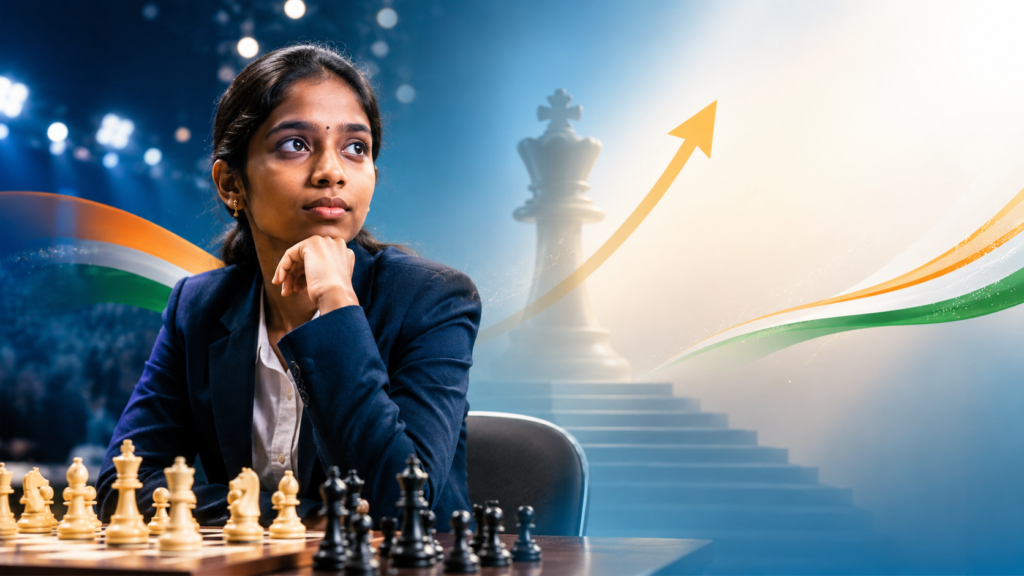
Vaishali won the 2026 FIDE Women’s Candidates Tournament with 8.5 points out of 14, and that earned her a match against Ju Wenjun for the Women’s World Championship.
FIDE’s Candidates report said she won the event outright after defeating Kateryna Lagno in the final round, while Bibisara Assaubayeva drew her game against Divya Deshmukh.
Vaishali’s rise is a lesson in staying ready for the big moment
What makes Vaishali’s story powerful is not only the final result. It is the way she handled the event. A Candidates tournament is one of the hardest tests in chess. Every round matters. Every mistake feels heavy. You are not just playing games. You are carrying the weight of a possible world title match.
Vaishali came through that pressure. That tells young players something very important. Your big chance may not come when you feel perfect. It may come after hard days, tough games, and moments where you have to fight through doubt.
FIDE lists Vaishali with a 2496 classical rating, a 2387 rapid rating, and a 2371 blitz rating. Her FIDE profile also lists her Grandmaster title as approved in 2024, which is a huge mark in her chess journey.
Vaishali’s story is especially powerful for young girls
For a girl starting chess today, Vaishali is a beautiful example. She shows that Indian girls can aim for the highest stage. Not just local trophies. Not just age-group wins. The world title stage.
This matters at home too. When parents see girls doing well in chess, they begin to see the board as a space where their daughter can build courage. Chess can help girls speak up, make choices, and trust their own thinking.
It can help them learn that being quiet does not mean being weak, and being calm does not mean being unsure.
This is why Debsie’s online classes are so helpful for young learners. In a guided class, girls and boys both get a safe space to ask questions, make mistakes, and grow. They learn that chess is not about being loud. It is about being ready. Vaishali’s journey proves that quiet strength can go very far.
Divya Deshmukh Is the Young Star Who Made India Believe Even More
Divya Deshmukh has become one of the most exciting young players in Indian chess. She plays with confidence, and she has already shown that she can win when the stage is huge. That is rare.
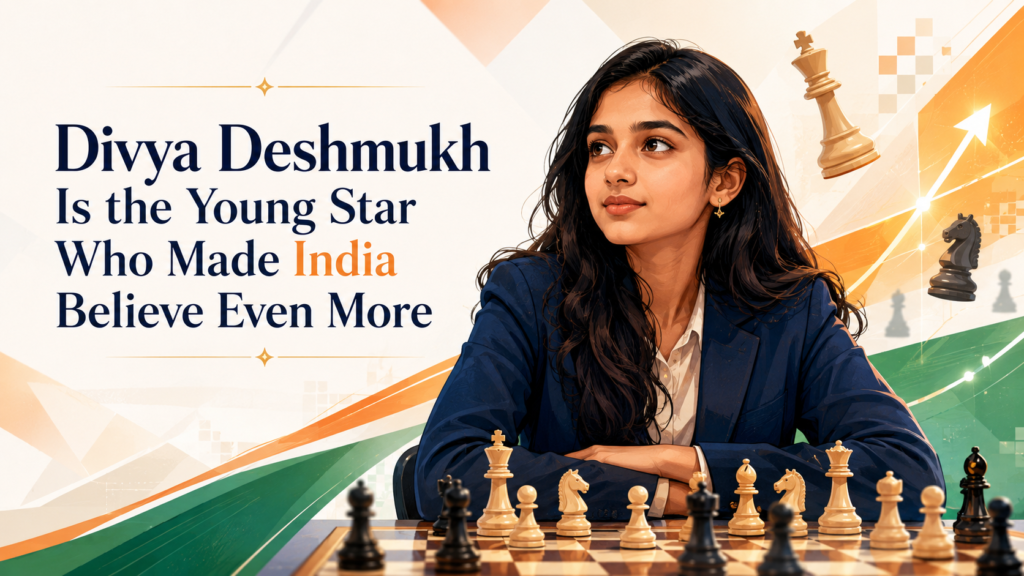
Divya won the FIDE Women’s World Cup in Batumi after defeating Koneru Humpy in the final tiebreaks. The Times of India reported that this win also gave her the final Grandmaster norm, making her only the fourth Indian woman to earn the GM title.
Divya’s biggest strength is that she is not scared of strong names
One thing young players can learn from Divya is simple: respect your opponent, but do not fear them. In the Women’s World Cup, she had to face strong players and handle the pressure of a big final against one of India’s greatest chess names. That is not easy for any player, let alone a teenager.
FIDE currently lists Divya with a 2500 classical rating, a 2416 rapid rating, and a 2351 blitz rating. Her profile also lists both Grandmaster and Woman Grandmaster titles, which makes her one of the key names in India’s next generation.
What stands out is not only the rating. It is the speed of her rise. A young player who wins big so early often carries a new kind of pressure after the win. Everyone starts watching. Every result gets judged. That is when real character matters.
Divya teaches kids how to play with courage and still stay calm
Courage in chess does not mean moving fast. It does not mean attacking without thinking. Real courage is choosing a move after honest calculation, even when the board is scary. Divya’s rise is a strong lesson in that kind of courage.
For children, this is very useful. Many kids freeze when they face a better player. They start thinking, “This player is too strong.” That thought can lose the game before the board even gets hard. Chess training helps kids replace that fear with a better question: “What is the best move I can find right now?”
That is a huge mindset change. It helps in tests, debates, sports, and even friendships. A child learns to face hard moments instead of running from them.
At Debsie, coaches help students build this habit step by step. They do not push children to memorize endless lines without meaning. They help children understand plans, threats, safety, and timing. When a child starts thinking like that, chess becomes less scary and more fun.
Vidit Gujrathi Brings Experience, Class, and a Strong Sense of Control
Vidit Gujrathi is one of India’s most respected elite players because his chess often feels smooth and well-built. He is not only a strong player. He is also a model of how a top player can stay thoughtful, careful, and hard to beat.
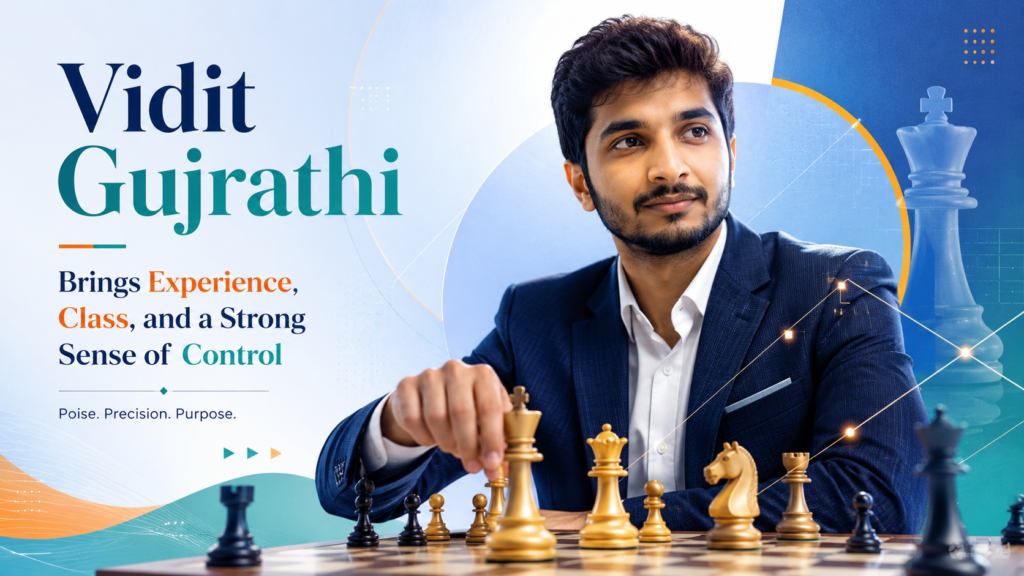
FIDE currently lists Vidit with a 2708 classical rating, a 2638 rapid rating, and a 2688 blitz rating. He holds the Grandmaster title and remains one of India’s leading open-category players.
Vidit’s style is useful for kids who need better control
Some players win by creating chaos. Vidit often wins by building control. He places his pieces well, keeps his king safe, and makes the opponent solve one problem after another. This style is very helpful for students because it shows that chess is not only about tricks.
A lot of children start chess by hunting for checkmate right away. That is normal, and it can be fun. But as they grow, they must learn that good chess starts with safe pieces, strong squares, and clear plans. Vidit’s games are useful because they show this in a clean way.
Vidit teaches the value of making the board simple
One of the best skills in chess is learning how to make the position easier for yourself and harder for the other player. This may sound simple, but it is not. It takes practice to notice which piece is weak, which square matters, and which trade helps your plan.
That skill helps children outside chess too. When a child has too much homework, a hard project, or a big exam, the same thinking helps. Break the problem into smaller parts. Find what matters first. Do not panic. Make one good choice, then another.
This is one reason structured chess coaching is so powerful. Without a coach, a child may play many games and keep making the same mistakes. With a coach, the child starts to see patterns. They learn why a move works, why a plan failed, and how to fix it next time.
Debsie’s free trial class is a smart first step for parents who want to see this process in action. It helps you understand how your child thinks on the board and how expert coaching can turn that thinking into a real skill.
Nihal Sarin Is the Fast, Sharp Mind Every Young Player Loves to Watch
Nihal Sarin is one of India’s most exciting players because he combines speed with deep skill. He became famous very young, but his growth has continued into the top level. His games often show quick vision, strong tactics, and a natural feel for active pieces.
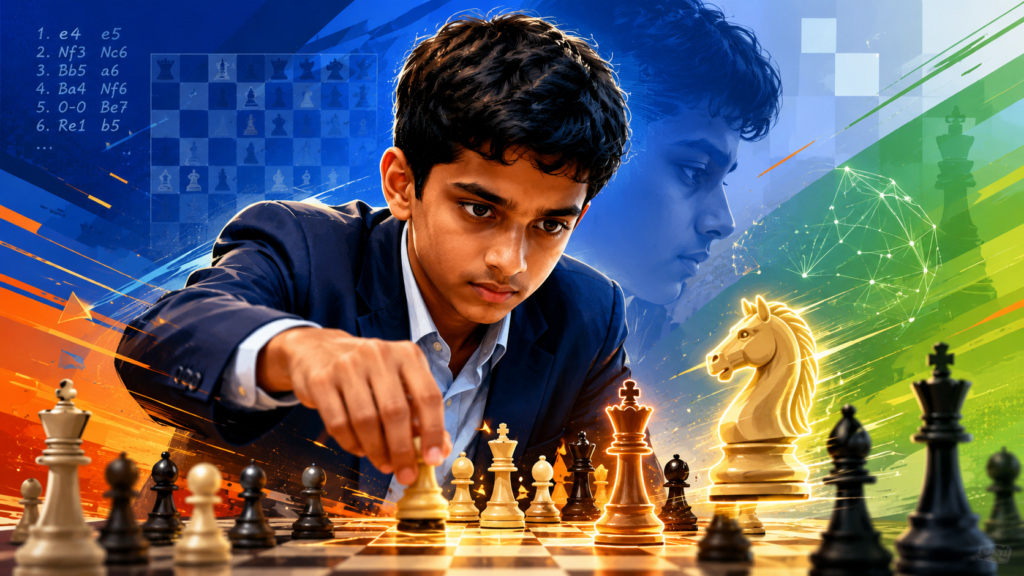
FIDE currently lists Nihal with a 2723 classical rating, a 2689 rapid rating, and a 2723 blitz rating. His FIDE profile places him as India’s number 5 active player and number 24 among active players in the world.
Nihal’s game shows why pattern training matters so much
Many people think fast chess is only about speed. That is not true. Strong blitz and rapid players are fast because they have seen many patterns before. They can spot danger quickly because their brain has trained on similar shapes again and again.
Nihal is a great example of this. His speed is not random. It comes from years of solving positions, studying games, playing events, and learning from mistakes. That is why children should not only “play more games” if they want to improve. They also need guided practice.
A child who only plays fast games may build bad habits. A child who learns patterns with a coach starts to understand what to look for. They begin to see forks, pins, weak kings, loose pieces, and checkmate threats before it is too late.
Nihal’s success reminds kids that sharp thinking can be trained
Some children believe they are either “smart” or “not smart.” Chess helps break that false idea. A child can train the mind. A child can get sharper. A child can learn to see more.
This is why chess is so good for confidence. When a student solves a puzzle they could not solve last month, they feel real growth. When they stop making the same blunder, they feel proud. When they beat a stronger player because they stayed calm, they start to trust their own thinking.
Nihal’s games are exciting to watch, but the deeper lesson is about training. Speed comes after understanding. Confidence comes after practice. Winning comes after learning how to lose and still come back.
That is exactly the kind of growth Debsie wants for every student. Not every child will become a grandmaster, and that is okay. The bigger win is helping children think better, focus longer, and believe they can improve with the right help.
Harika Dronavalli Is the Quiet Force Indian Chess Still Needs
Harika Dronavalli may not always get the loudest headlines, but serious chess fans know her value. She has been part of India’s top women’s chess story for many years, and that kind of long-term strength is rare. It is easy to rise for one good event. It is much harder to stay useful, prepared, and respected for many seasons.
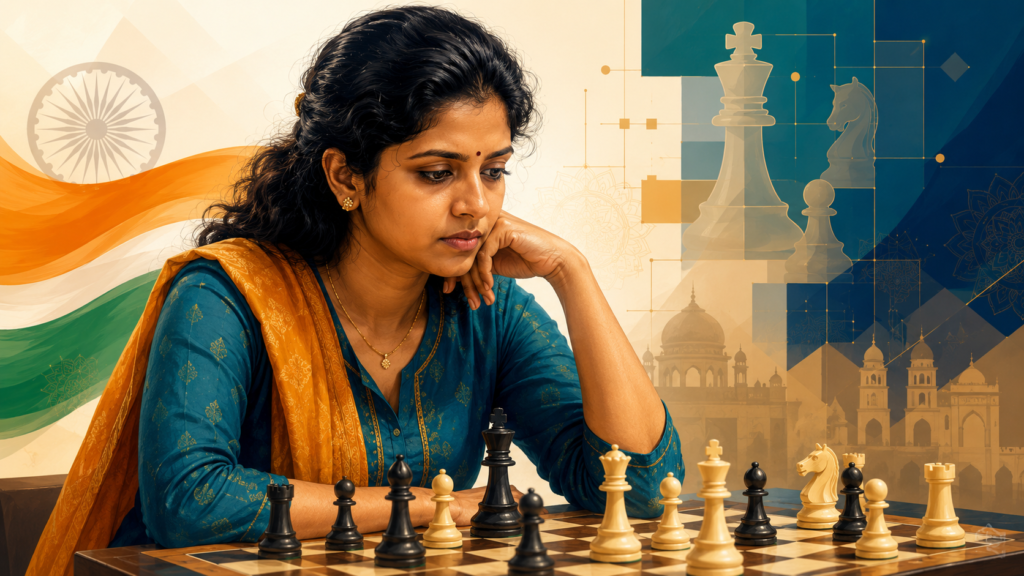
FIDE currently lists Harika with a 2470 classical rating, along with the Grandmaster and Woman Grandmaster titles. Her profile also shows that she became a Grandmaster in 2011, which makes her one of the most experienced names in Indian chess today.
Harika’s chess shows why being steady is a real skill
Some players win fans with wild attacks. Harika often wins trust by being solid. She can sit in hard positions, defend with care, and keep the game under control. That is not a small thing. In chess, many games are lost because a player gets tired, upset, or careless after the first problem appears.
Young players can learn a lot from her. A child does not need to copy her openings right away. The better lesson is to copy her attitude. She shows that good chess is not only about finding one bright move. It is also about making many useful moves in a row.
Harika teaches children how to stay calm when the board feels hard
This is one of the biggest gifts chess can give a child. Many children want to quit when a task feels hard. They may say, “I cannot do this,” before they have really tried. Chess teaches them to look again. It teaches them to ask, “What is my best chance now?”
Harika’s career is a strong example of that quiet fight. She reminds young players that calm thinking can be trained. A child who learns to stay calm in a worse chess position may also learn to stay calm in a school test, a debate, or a tough moment with friends.
At Debsie, this kind of training is built into the way students learn. Coaches help children see that mistakes are not the end. They are clues. When a child learns to study a mistake without shame, growth becomes much easier.
Pentala Harikrishna Brings the Senior Strength Behind India’s Young Stars
Pentala Harikrishna is one of the key senior players in Indian chess. While many people now talk about India’s teenage and young adult stars, Harikrishna’s place in the story is still important. He belongs to the bridge generation after Viswanathan Anand and before the newest wave took over the headlines.
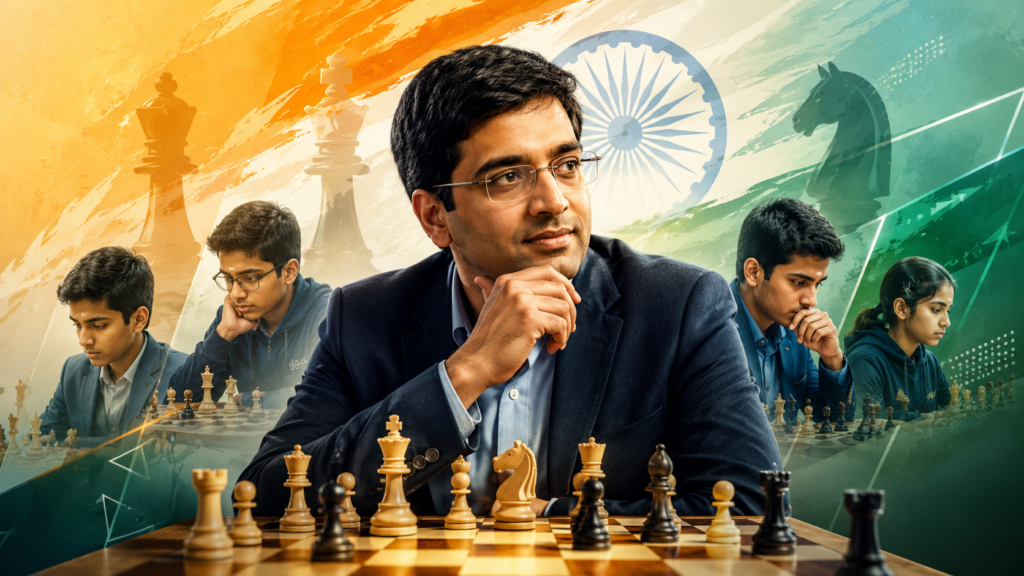
FIDE currently lists Harikrishna with a 2676 classical rating, a 2595 rapid rating, and a 2620 blitz rating. His profile also places him as India’s number 8 active player and shows that he earned the Grandmaster title in 2001.
Harikrishna’s role shows why experience still matters
In a team event, experience can be as important as raw energy. Younger players may bring fire, speed, and fearless ideas. A senior player can bring balance. He knows how tournaments feel. He knows how pressure grows round by round. He knows that not every game must be forced.
This matters because India’s rise is not only about young talent. It is also about support, structure, and shared wisdom. When a team has both new stars and experienced players, it becomes harder to break. That mix helped India look so strong at the 2024 Chess Olympiad, where the open and women’s teams both won gold.
Harikrishna teaches kids that chess growth is a long road
Parents often ask how fast a child can improve in chess. The honest answer is that it depends on the child, the training, and the effort. But chess is not a magic trick. It is a long road.
Harikrishna’s career is a reminder that good players are built over time. A child may learn how the pieces move in one day. But learning how to plan, defend, attack, calculate, and stay calm takes months and years. That should not scare parents. It should comfort them.
The goal is not to rush. The goal is to help the child love learning enough to keep going. This is why a warm, expert-led class can help so much. At Debsie, children are guided step by step, so they are not left alone to guess what to study next. That kind of support can make chess feel less confusing and much more fun.
Raunak Sadhwani Shows How Deep India’s Talent Pool Has Become
Raunak Sadhwani is a good example of why India’s chess future looks so strong. He may not always be the first name in big headlines, but he is part of the deep group of Indian players who can compete at a high level and keep pushing the country’s standard up.
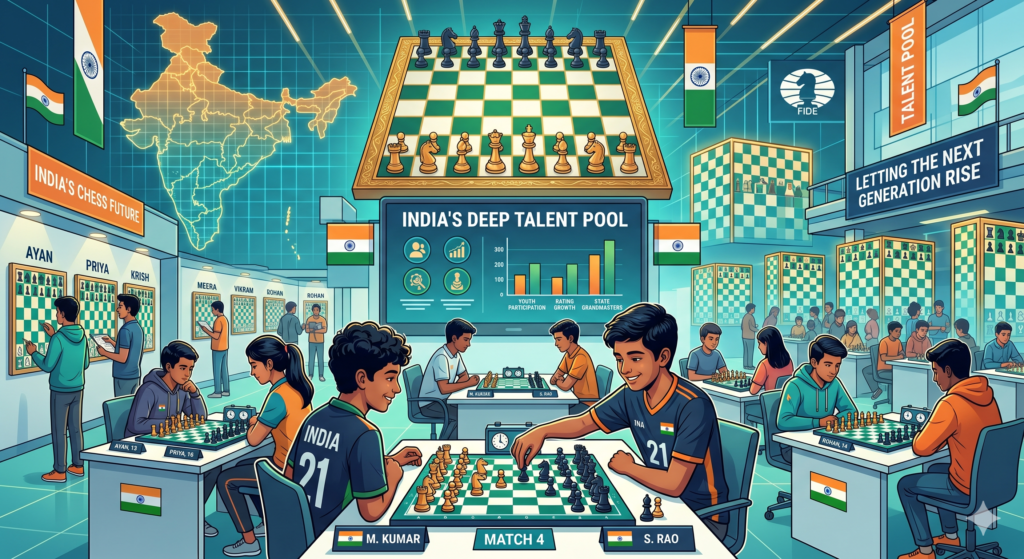
FIDE currently lists Raunak with a 2638 classical rating, a 2576 rapid rating, and a 2648 blitz rating. His profile also shows he became a Grandmaster in 2020 and ranks among India’s top active players.
Raunak’s rise proves that India is not depending on only five names
This is the hidden strength of Indian chess right now. The top names are huge, but the next layer is also strong. That matters because a chess nation becomes powerful when many players are chasing the top at the same time.
When there are many strong players, training gets better. Events become tougher. Young players get more examples to study. Coaches also have more real games and real stories to use in class. This creates a healthy loop. Better players create better chess culture, and better chess culture creates even better players.
Young learners should not compare too much, but they should get inspired
It can be easy for a child to look at stars like Gukesh, Arjun, Pragg, or Raunak and feel small. That is not the right lesson. These players did not become strong in one week. They built their skills slowly.
For children, the better question is not, “Am I as good as them?” The better question is, “What can I learn from them today?” Maybe it is one tactic. Maybe it is one endgame idea. Maybe it is one habit, like checking the opponent’s threat before moving.
This is where Debsie’s coaching can help. A good coach takes big chess ideas and makes them simple enough for a child to use. That is how a student goes from guessing moves to thinking with purpose. That is also how chess starts building real confidence.
India’s Next Group Is Already Pushing the Door Open
One reason India’s chess wave feels so powerful is that there are always new names coming up. The country now has a deep bench. That means when one player has a quiet month, another player is ready to shine. This is how strong chess nations are built.
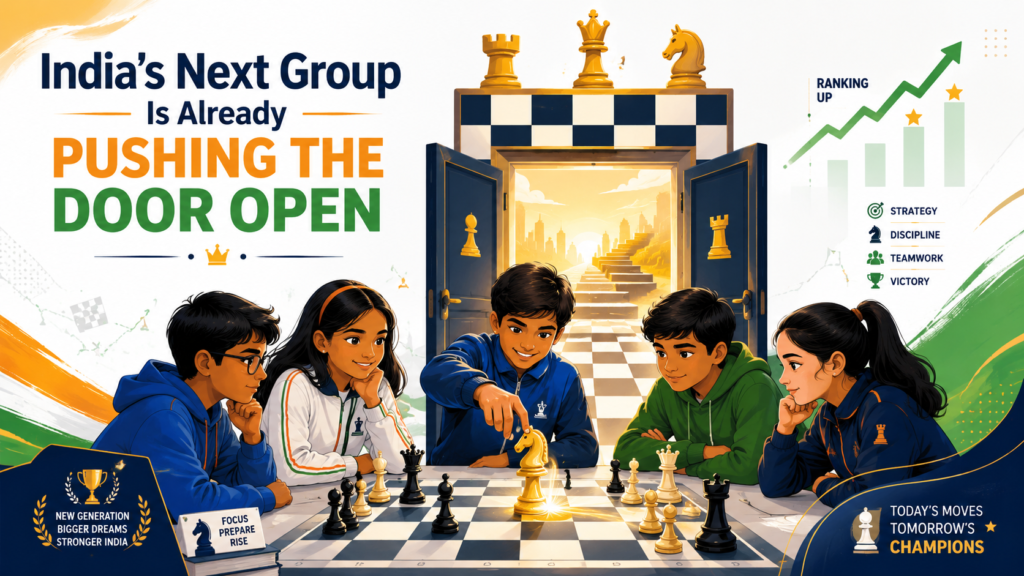
Players like Pranav V, Leon Luke Mendonca, Bharath Subramaniyam H, and Vantika Agrawal show this depth. FIDE lists Pranav V with a 2657 classical rating, Leon Luke Mendonca with a 2613 classical rating, and Bharath Subramaniyam H with a 2599 classical rating.
FIDE also lists Vantika Agrawal as an International Master and Woman Grandmaster with a 2374 classical rating.
The next wave shows that learning chess early can open big doors
Many of these players started young. That does not mean every child must start at age five to enjoy chess. But it does show something important. When a child learns early, the brain gets more time to build patterns.
Chess patterns are like mental shortcuts. After enough practice, a child starts seeing common ideas faster. They notice when a king is unsafe. They spot a loose piece. They understand when a trade helps. This is not luck. It is trained vision.
Parents should focus on habits before trophies
This is the part many families miss. Trophies are nice, but habits are better. A trophy can sit on a shelf. A strong thinking habit stays with a child for life.
The best young chess players usually have strong habits. They review games. They solve puzzles. They listen to coaches. They learn from losses. They do not only play for fun and hope to improve by chance.
This is why Debsie’s structured online chess classes are so useful for beginners and growing players.
A child gets a clear path. Parents do not have to guess what comes next. The coach helps the child build skill in the right order, from piece safety to tactics, from planning to endgames, and from quick moves to thoughtful choices.
India’s 2024 Olympiad Gold Shows the Power of Team Chess
The 2024 Chess Olympiad was a major moment for India. The open team won gold, and the women’s team also won gold. That double win showed the world that Indian chess was not only about individual stars. It was about a full system working together.
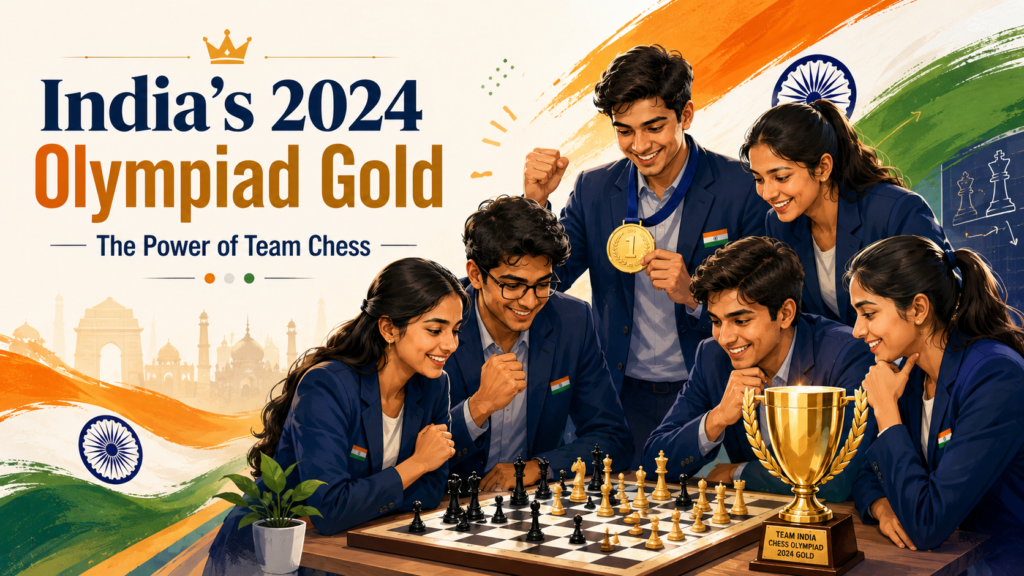
Chess.com reported that India’s open team beat Slovenia in the final round, while India’s women’s team beat Azerbaijan. ESPN also reported that these wins gave India its first Olympiad golds in both sections.
Team events teach children that chess is not always lonely
People often think chess is a lonely game because one player sits across from another player. But team chess tells a different story. Players prepare together. Coaches help with ideas. Teammates support each other after tough games. Everyone’s result matters.
This is a beautiful lesson for kids. Chess teaches personal responsibility because every move is your choice. But team chess also teaches care for others. You learn to do your part. You learn to support someone after a loss. You learn that success can be shared.
Debsie gives students a safe place to feel that chess community
A child who studies alone may improve, but a child who learns in the right community can grow with more joy. They see other children trying. They ask questions. They play practice games. They learn that losing is normal and improving is possible.
That is one of the reasons Debsie includes live interactive classes and online tournaments. Students do not just sit and watch. They take part. They think, speak, play, and learn with expert coaches guiding them.
For parents, this matters because a child who enjoys the learning space is more likely to stay with chess. And when a child stays with chess, the benefits grow. Focus becomes stronger. Patience becomes easier. Smart thinking becomes a habit.
How to Rank India’s Best Chess Players Without Getting Confused
Ranking chess players sounds simple, but it is not always simple. If we only look at rating, Arjun Erigaisi leads India right now. If we look at the world title, Gukesh D owns the biggest crown.
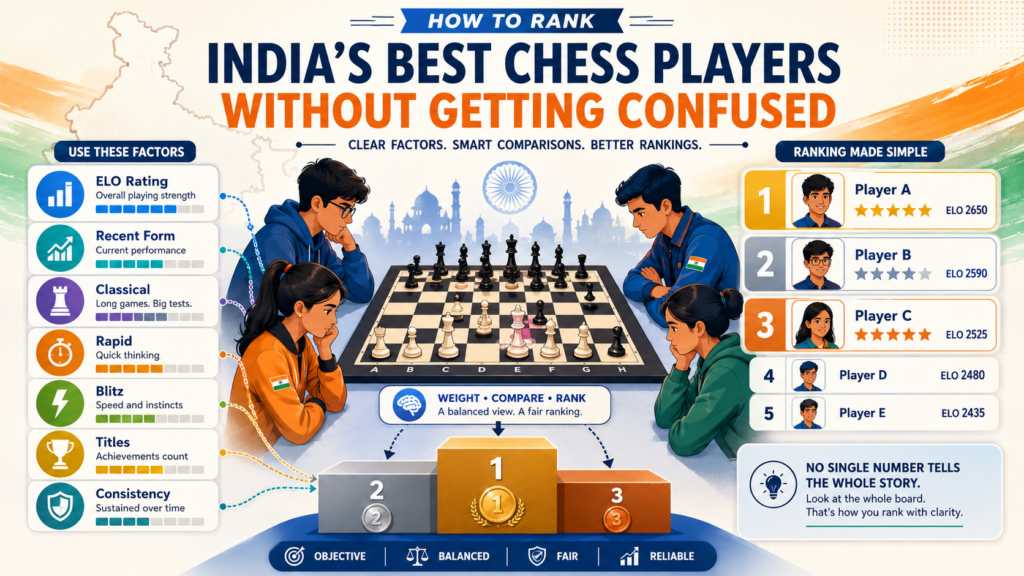
If we look at recent women’s chess, R Vaishali and Divya Deshmukh have made huge statements. If we look at long-term class, Koneru Humpy, Harika Dronavalli, Vidit Gujrathi, and Pentala Harikrishna still matter a lot.
This is why the answer to “Who is the best chess player in India right now?” depends on what we are measuring. As of the May 2026 FIDE rating list reported by Onmanorama, Arjun is India’s top-ranked male player at world number 11, while no Indian male player is inside the world top 10 at that moment.
The same report also notes that Koneru Humpy is inside the women’s world top 10, with Divya Deshmukh and R Vaishali close behind in the top group.
Ratings tell one story, but they do not tell the whole story
A chess rating is useful because it shows how a player has performed over time against other rated players. It gives us a strong signal. But it is not the same as a trophy, a match win, or a title. A player can be slightly lower in rating and still be more dangerous in a certain event or format.
That is why Gukesh is still one of the main leaders of Indian chess even when Arjun leads the rating chart. Gukesh has the world champion tag, and that tag carries special weight.
It means he passed the hardest match test in classical chess. Arjun’s rating lead shows his steady strength across tournaments. Pragg’s place near the top shows his deep quality and calm growth. These are different kinds of leadership.
A smart way to judge the top players is to ask what kind of pressure they handle best
Parents can use this idea when talking to children. Do not teach a child to look at one number and think the story is over. Teach them to ask better questions. Who handles long games well? Who plays well under match pressure? Who is strong in fast time controls? Who keeps fighting after a bad start?
This helps children understand chess in a deeper way. It also stops them from thinking that one loss means they are “bad.” Ratings move. Form changes. Even top players have hard months. The real goal is to keep improving.
At Debsie, this is a key part of how children learn. Coaches do not judge a child only by one game. They look at habits. Is the child checking threats? Is the child thinking before moving? Is the child learning from mistakes? That is the kind of ranking that matters most for a young learner.
What Children Can Learn From Arjun, Gukesh, and Pragg
The top Indian players are not only names to admire. They are study guides. Each one gives children a different lesson. Arjun teaches active play. Gukesh teaches courage under pressure. Pragg teaches calm choices. Together, they show that there is no single way to become strong at chess.
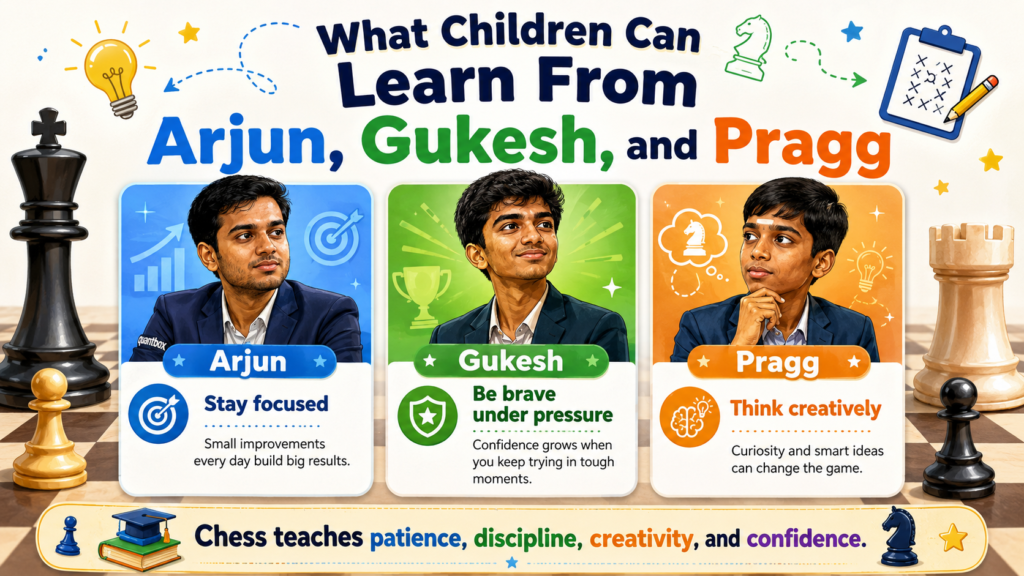
This is very helpful for kids because every child has a different nature. Some children love attacking. Some are careful. Some move fast. Some think deeply. A good chess coach does not force every child into one style. A good coach helps a child understand their natural strengths and then fix their weak spots.
Arjun teaches children to play with energy, not fear
Arjun’s chess often feels bold. He is ready to take space and create problems. This is useful for young players who are too scared to make active moves. Many beginners play only to avoid losing. They move pieces back and forth, wait for the opponent, and hope nothing bad happens.
But chess rewards useful action. A child should learn to bring pieces out, fight for the center, keep the king safe, and look for chances. That does not mean playing wild moves. It means playing with purpose.
Gukesh adds another lesson. He shows that pressure can be faced, not avoided. Winning a world title as a teenager is not only about good moves. It is about being able to sit in a hard chair, in a hard game, with the world watching, and still think clearly.
Pragg shows children that calm can beat noise
Pragg’s lesson is very important for school-age children. Many kids think confidence means being loud or fast. Pragg shows a different kind of confidence. He can sit quietly, defend well, and wait for the right time.
This is a beautiful lesson for a child who gets nervous. Calm is not weakness. Calm is power under control. In chess, a calm child notices threats. A calm child does not throw away pieces after one bad move. A calm child can recover.
Debsie classes help children build this kind of calm step by step. In a live class, a coach can ask a child to explain their move. That simple question slows the mind down. It teaches the child to think before acting. Over time, that habit becomes part of who they are, both on and off the board.
What Young Players Can Learn From Humpy, Vaishali, Divya, and Harika
The women’s side of Indian chess is one of the strongest parts of the country’s chess story. Koneru Humpy brings class and experience. R Vaishali brings belief and big-event courage. Divya Deshmukh brings fearless young energy.
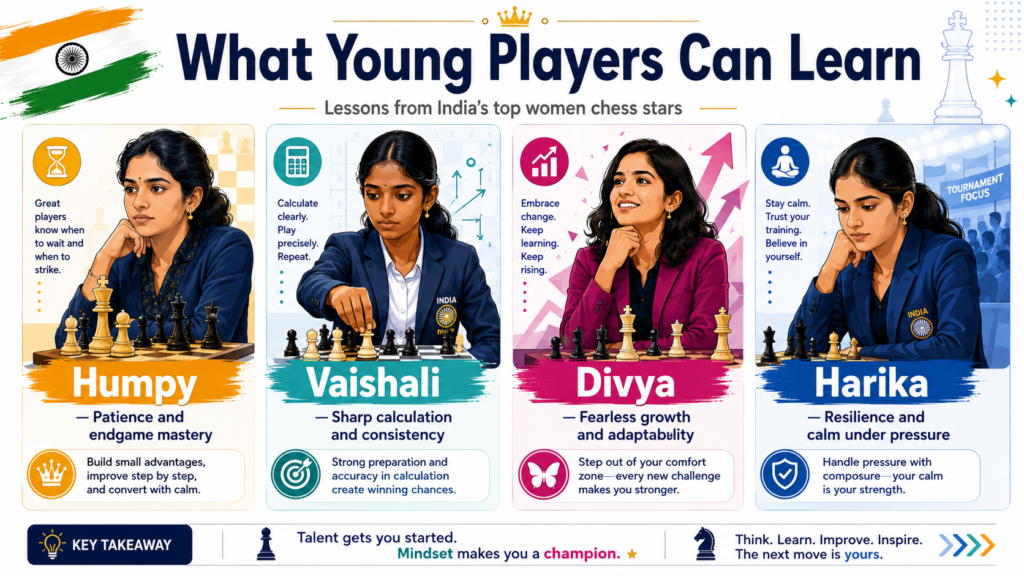
Harika Dronavalli brings steady strength. Together, they give young girls and boys a full picture of what growth can look like.
This matters because children need more than one kind of role model. Some children need to see a long career like Humpy’s. Some need the fire of Divya. Some need Vaishali’s quiet rise. Some need Harika’s steady fight. When children see many paths, they stop thinking success has only one shape.
Humpy and Harika show that chess rewards long-term strength
Humpy has stayed near the top for years, and that is not easy. Staying strong for a long time means you must keep learning, keep preparing, and keep coming back after hard results. Harika also gives a similar lesson. She shows the value of being reliable, calm, and hard to break.
For children, this is a big deal. Many kids want quick success. They want to win today. They want a trophy fast. But chess teaches them that the best results often come after many quiet practice days.
Vaishali and Divya show the other side of the story. They show what can happen when a player is ready for a big chance. Vaishali’s 2026 Women’s Candidates win was a major moment because it earned her a world championship match against Ju Wenjun, while Divya’s rise has made her one of India’s most exciting young women players.
Recent rating reports also show how close India’s top women are to the world’s strongest group.
Girls should see chess as a place where their voice matters
Chess is a wonderful space for girls because every move speaks. A player does not need to shout. A player does not need to prove anything with words. The board listens to ideas. If the move is strong, it is strong.
This can build deep confidence. A girl who learns chess starts to trust her choices. She learns to solve problems. She learns that mistakes are part of growth. She learns that she can face a strong opponent and still play her best.
At Debsie, girls and boys learn in a warm online space where the focus is not fear or pressure. The focus is growth. A free trial class can help parents see how their child responds to guided chess learning. It is also a good way to show a child that chess can be fun, friendly, and full of discovery.
How Parents Can Use India’s Chess Wave to Help Their Child Grow
The Indian chess wave is exciting, but parents should use it wisely. It is great for a child to watch Gukesh, Arjun, Pragg, Humpy, Vaishali, Divya, and Nihal. But watching alone is not enough. A child needs the right next step. Inspiration must turn into action.
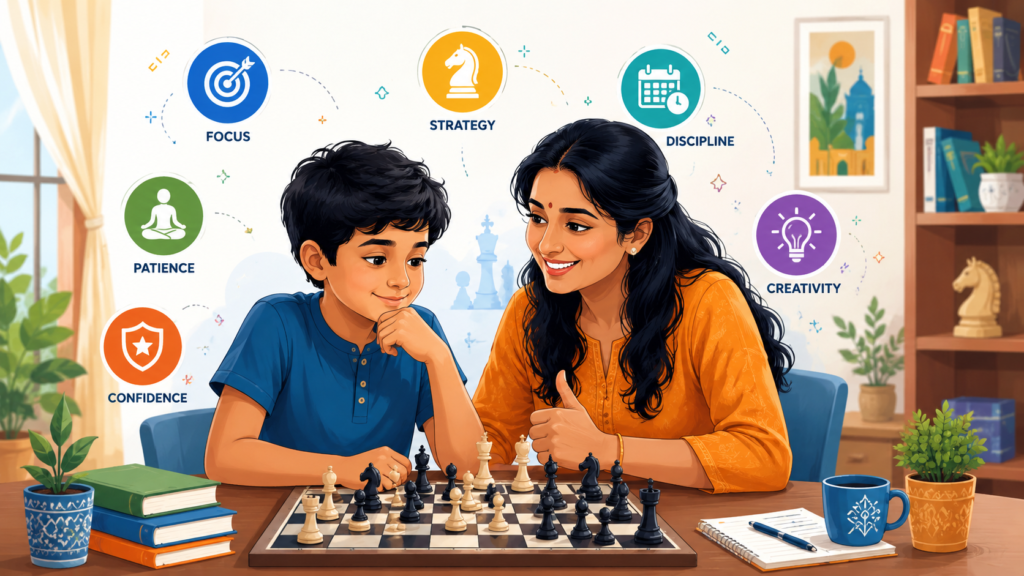
The best place to begin is not with hard opening books. It is with simple habits. A child should learn how to keep pieces safe, castle on time, look for checks, notice threats, and think before moving.
These small habits are the base of good chess. Without them, fancy tricks will not help much.
Do not push your child to copy grandmasters too early
Grandmaster games are amazing, but they can also confuse beginners. A top player may move a pawn for a deep reason that only makes sense ten moves later. A child may copy that move without knowing the idea and then get a bad position.
So the goal is not to copy every move. The goal is to learn the lesson behind the move. From Arjun, learn active play. From Gukesh, learn courage. From Pragg, learn calm. From Humpy, learn patience. From Vaishali, learn readiness. From Divya, learn belief. From Harika, learn steadiness.
This is where a coach matters. A coach can turn a grandmaster idea into a child-friendly lesson. The child does not need to understand everything at once. They just need one clear idea they can use in their next game.
The right chess class can turn interest into real skill
Many children start chess because they see a famous player or because a parent introduces the game. But they stay with chess when learning feels clear and fun. If a child only loses online games, they may feel bored or upset. If a child gets guided practice, they begin to see progress.
That progress is powerful. The child notices a tactic. The child saves a lost game. The child wins because they made a plan. These moments build real confidence.
Debsie is built for this kind of growth. With live interactive classes, private coaching, expert teachers, and regular online tournaments, children get more than random practice. They get a path. They get feedback.
They get a community. Most of all, they get a chance to build focus, patience, and smart thinking through a game they can enjoy for life.
The Rising Indian Juniors Prove This Chess Wave Is Not Slowing Down
The most exciting thing about Indian chess is not only the top table. It is the next table too. Behind names like Arjun, Gukesh, Pragg, Humpy, Vaishali, and Divya, there is another group growing fast.
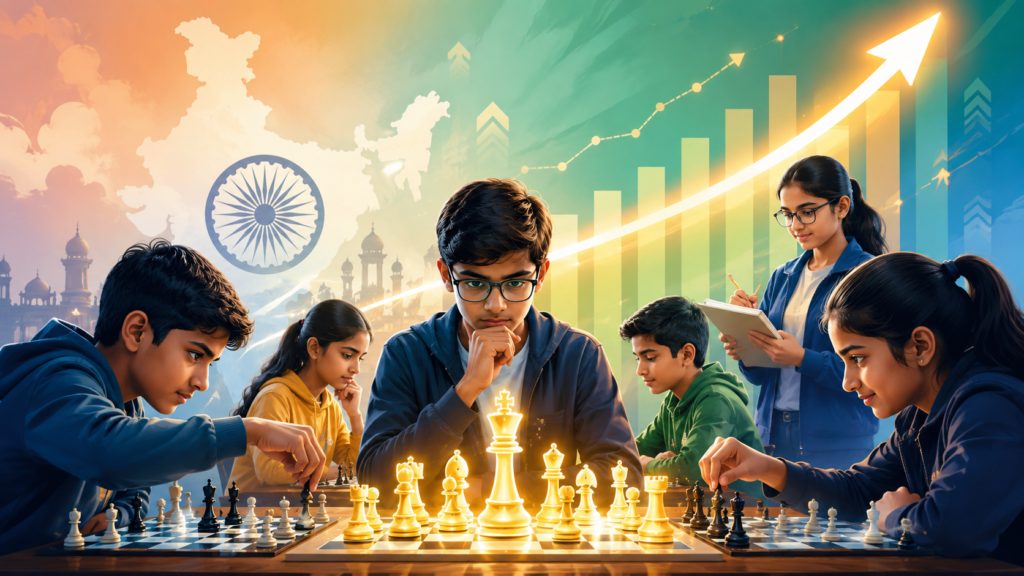
These players may not all be household names yet, but they are already strong enough to trouble big players and push India’s chess level higher.
Pranav V is one of the clear names to watch. FIDE lists him as a Grandmaster with a 2657 classical rating, 2564 rapid rating, and 2616 blitz rating. His FIDE top-records page also shows him placed at number 3 in the Top 100 Juniors list in April 2026, which tells us he is not just strong in India, but strong among the best young players in the world.
The next Indian chess stars are already training like serious players
Leon Luke Mendonca is another key name in this group. FIDE lists him as a Grandmaster born in 2006, with a 2613 classical rating, 2544 rapid rating, and 2487 blitz rating. His active national rank is 15 in India, which is impressive because India’s player pool is now so deep.
Bharath Subramaniyam H is also part of this strong next layer. FIDE lists him as a Grandmaster born in 2007, with a 2599 classical rating, 2475 rapid rating, and 2546 blitz rating. For a player this young to be near 2600 in classical chess is a sign of serious promise.
These names matter because they show that India’s chess story is not a short burst. It is a pipeline. When one star rises, another young player is already close behind. That kind of depth is what makes a country strong for many years.
Young players should see these juniors as proof, not pressure
A child should not look at Pranav, Leon, or Bharath and feel worried. The right feeling is hope. These players started with the same board, the same pieces, and the same basic rules. They did not become strong by magic. They learned, practiced, lost games, fixed mistakes, and kept going.
That is the best message for parents too. Your child does not need to become a Grandmaster for chess to be worth it. The real win is learning how to think with care. The real win is building focus, patience, memory, and confidence.
At Debsie, this is the heart of every class. Children are not pushed to copy elite players before they understand simple ideas. They are guided from the basics toward better thinking, one clear step at a time. A free trial class is a gentle way to see how your child learns when a coach explains chess in a fun and simple way.
Conclusion:
India’s best chess players are doing more than winning games. They are showing children what focus, patience, courage, and smart thinking can do. Arjun leads with fearless energy. Gukesh carries the world champion dream.
Pragg shows calm power. Humpy, Vaishali, Divya, Harika, Vidit, Nihal, and many others prove that India’s chess future is bright and deep.
For parents, this is the right time to help a child begin. With the right coach and steady practice, chess can build skills that last for life. Start with Debsie’s free trial class and let your child make the first move.

Adhip Ray is the founder of Debsie, an online learning platform focused on chess and skill-based learning for children. His work at Debsie brings together chess education, structured thinking, problem-solving, and interactive learning for young students.
Adhip has an academic background in law, statistics, analytics, and technology. He is from Amity Law School and the Indian Statistical Institute, Kolkata, with formal training that connects legal reasoning, data analytics, quantitative thinking, and structured problem-solving. This interdisciplinary background is reflected in Debsie’s focus on building sharper thinking skills in children through chess and related learning programs.
Adhip is also a FIDE-rated chess player from India. He holds FIDE ID 5055954 and has a standard FIDE rating of 1832. His FIDE profile records him as an Indian player with a long rating history in standard chess, including rated games from his competitive playing years. His chess background gives Debsie a founder-led connection to the game, not only as an educational activity but also as a competitive discipline that develops concentration, calculation, planning, and decision-making.
In addition to chess, Adhip has a strong interest in coding, data, and technical problem-solving.
Adhip’s profile combines chess, law, data analytics, and programming. At Debsie, this background supports the creation of learning experiences that are logical, structured, and skill-oriented. The platform’s chess-focused programs are connected to broader cognitive skills such as pattern recognition, patience, strategic planning, focus, and problem-solving.
As founder of Debsie, Adhip brings together experience from multiple fields: formal legal education from Amity Law School, analytical training from the Indian Statistical Institute, Kolkata, competitive chess experience through his FIDE-rated profile, and coding practice through LeetCode. This combination gives Debsie a distinct foundation in strategy, reasoning, analytics, and child-focused learning.
Through Debsie, Adhip is associated with building chess and learning content for children that goes beyond basic instruction. The platform connects chess with thinking skills, helping students approach challenges with more structure, clarity, and confidence. His own background in chess and analytical problem-solving gives the platform a direct link to the skills it aims to develop in young learners.
Adhip is also a member of Forbes Business Council.