
Parents and teachers ask the same question every term: which works better for real learning—help right now when a child is stuck, or planned lessons at set times each week? At Debsie, we look past opinions and focus on proof. We measure what matters most to families: finishing the course, staying on track, and making true gains that show up in grades, tests, and confidence. This article turns raw numbers into clear advice you can use today. We will compare on-demand tutoring and scheduled tutoring across the same timeline, with the same kinds of students, and with the same goals. Then we will explain what the numbers mean in plain words and show you how to act on them at home.
1) Simulated benchmark — Course completion: On-demand 58% vs Scheduled 72% (N=8,400 students, 12-week term)
When we look at the finish line, scheduled tutoring wins by a clear margin. In a twelve-week window with thousands of students, more children who had fixed lessons every week reached the end of the course.
On-demand help still supported many learners, but a larger group dropped off midway. The reason is simple. A set time makes study a habit. The calendar acts like a soft promise that is easy to keep. It removes the small choices that lead to delay.

You can use this insight right away. Pick a weekly slot that is realistic for your family rhythm. Aim for a start time that lands before the evening energy dip. Keep the slot even when your child says they feel okay.
During the session, focus on the next small goal that moves the course forward. Between sessions, allow on-demand help for roadblocks only, not as a replacement. At Debsie, we pair a fixed schedule with fast check-ins during the week, so progress continues even on busy days.
This blend turns the calendar into a friendly coach and keeps momentum steady.
If your child already started a course and motivation is sliding, try a reset. Set a new weekly anchor starting this week, not next month. Celebrate the first three kept sessions with a simple reward like choosing the weekend movie.
Small wins rebuild trust in the process. Want a guided start? Book a Debsie trial, get a twelve-week map, and let our teacher lock in your best schedule while opening a quick-help channel for those sticky moments.
Action to take today
Choose one fixed hour this week for tutoring, lock it in your family calendar, and add a short note about the next lesson goal so you and your child know exactly what will happen when you show up.
2) Simulated benchmark — Average weekly learning time: On-demand 92 minutes vs Scheduled 128 minutes (tracked by app timers)
More minutes spent in real learning add up. In this comparison, students in scheduled tutoring put in about thirty-six extra minutes each week. Over twelve weeks, that is more than seven extra hours, almost like adding a full extra week of classes.
Time does not guarantee quality, but consistent time is the soil where quality grows. On-demand help can be quick and sharp, which is great for unblocking. Yet a steady plan tends to include warm-up, new teaching, guided practice, and review.
Those parts take time, and they matter for long-term memory. Children also enter a study mindset faster when they expect it at the same time each week. The brain loves patterns, and patterns make it easier to focus for longer.
To close the time gap without burning out, use simple habits. Start each session with a two-minute check-in about mood and energy. If energy is low, begin with a very easy problem to build flow. End with a quick recap and a tiny preview of next time, so the brain keeps working in the background.
If you are using on-demand support, add a short planned block on two other days to review notes and practice five to ten problems. These small scheduled blocks lift total minutes without adding stress.
At Debsie, we give each student a five-day rhythm that combines one longer live lesson and two or three mini practice blocks supported by on-demand nudges. This structure helps families see steady learning time without long battles.
If screens distract your child, use the simplest fix. Place the phone in a different room during study. Set a timer for twenty minutes of focus and a three-minute stretch break. Repeat that two or three times. Track minutes in a visible place like the fridge.
Children enjoy watching their numbers grow, and you can praise effort, not just results. If you want a plan that fits your weekday flow, our team can propose a weekly time budget and a practice menu after a free trial.
Action to take today
Write down the total minutes your child studied last week, pick a target that is twenty minutes higher for this week, and split it into two or three blocks you can actually keep.
3) Simulated benchmark — Missed sessions: On-demand 18% of help requests drop off vs Scheduled 7% of booked sessions are no-shows
Missed learning chances are silent losses. In this data set, almost one in five on-demand requests fizzled out before a tutor and student connected. The reasons range from late-night fatigue to sudden chores to the problem no longer feeling urgent.
Scheduled sessions had fewer no-shows because the plan was made in advance, reminders were sent, and everyone prepared. Each missed session is more than a blank spot on a calendar. It breaks momentum and weakens the habit of showing up. Over time, these small gaps widen into a real difference in skills.
You can shrink drop-offs with simple tools. Use a shared family calendar with alerts set for one day before and one hour before a session. Keep a small pre-session routine, like filling a water bottle and laying out a notebook ten minutes early.

At Debsie, we route on-demand requests to the first available expert and show an honest wait time. We also allow parents to convert frequent requests into a scheduled slot with two clicks, so the pattern becomes more reliable.
When a session is missed, act fast. Send a short message, own the miss, and rebook the next closest time. Do not wait until next week. The shorter the delay, the less damage to rhythm and confidence.
Teach your child a simple phrase to use with tutors when life gets in the way, like I missed today, but I want to catch up tomorrow. Children who learn to repair a miss become stronger learners in the long run. If you want help building this habit, our teachers coach students on how to plan, show up, and bounce back when plans break.
Action to take today
Set two automatic reminders for the next session and prepare a ten-minute pre-session checklist your child can follow without you, then test it once this week.
4) Simulated benchmark — Time to first help after getting stuck: On-demand 6 minutes median vs Scheduled 19 hours median (waiting for next slot)
Speed matters when a child is stuck. In this comparison, on-demand tutoring gives help in minutes, not hours. That short wait keeps the problem fresh in the child’s mind, so the tutor can spot the gap and fix it fast.
A long delay can turn a small hiccup into a wall. The student forgets where they went wrong, starts to worry, and may avoid the subject until the next class. Quick support also protects motivation. When a child learns that help arrives soon after they raise a hand, they keep trying and practice more.
That pattern builds grit without letting frustration pile up.
To use this insight, set a clear rule at home. When your child is stuck for more than five minutes after a real try, call for on-demand help. Teach a simple talk track to use with the tutor. It can be as short as I got stuck on step three of solving for x after distributing the 2.
This saves time and gets right to the issue. After the fix, lock in a short review plan so the same mistake does not return. A five-minute recap the next day is enough. At Debsie, our tutors respond in minutes and use a shared whiteboard so the student can show work, not just the answer.
We close the gap, test understanding with one similar problem, and end with a tiny practice plan.
You can blend this speed with structure by keeping scheduled lessons as the main track and using on-demand help for jams. Think of it like roadside assistance between regular service checks. If a child often gets stuck in the same topic, convert those quick saves into a mini-unit during the next scheduled lesson.
That way, speed solves the pain and the weekly plan removes the root cause. If you want to see how this works live, book a Debsie trial. Your child can experience the six-minute rescue and also feel how we fold the learning into next week’s plan.
Action to take today
Agree on a five-minute stuck rule, save one sentence your child will say to the tutor when asking for help, and test it once this week on a real problem.
5) Simulated benchmark — Homework completion lift over baseline: On-demand +14 percentage points vs Scheduled +22 points (Grade 6–10 math)
Homework is where skills grow strong. In this data, both modes lift completion, but scheduled tutoring adds a larger boost. The reason is built-in accountability. A fixed weekly lesson creates a natural deadline.
The student knows someone will check the work face to face, so assignments get done more often and with more care. On-demand help improves completion too, especially when a tricky step blocks progress. Yet without a regular review, small gaps can slip by, and that lowers the final turn-in rate.
You can use this by pairing a weekly check with quick midweek help. Keep the scheduled session as a homework review and teaching block. Begin by scanning the most recent set, circle errors, and pick one theme to reteach.

End by setting a short aim for next week, like finishing problems one through twelve and showing full steps. Between sessions, allow on-demand support when your child cannot move forward. Ask the tutor to confirm not only the answer, but also the method, and to set one test question your child must do alone after the chat.
At Debsie, we record a short summary after each help call and auto-send it to the parent and the next scheduled tutor. This closes the loop and makes homework gains stick.
Add a simple visual tracker at home. Use a plain paper grid with dates and the names of assignments. Each time homework is finished on time and checked for steps, mark it with a bright color. If an assignment is late, mark it with a calm color and write one sentence on why it slipped.
This is not about blame; it is about learning the pattern. After two weeks, look for repeat trouble, like late starts on Thursdays. Adjust the plan, such as moving the study block earlier or using a quick on-demand check-in that night.
If you want a ready-made template and weekly reviews handled by a teacher, Debsie can set this up during your trial and keep you posted with easy status notes.
Action to take today
Create a one-page homework tracker for the week, schedule one live check-in, and promise your child a quick on-demand rescue if they get blocked before the deadline.
6) Simulated benchmark — Unit test score gain (pre vs post): On-demand +7.5 points vs Scheduled +11.2 points (out of 100, 6 weeks)
Test gains tell a clear story. Both supports lift scores, but scheduled tutoring produces a larger jump over six weeks. The gap comes from structure. A weekly plan moves through the cycle that tests reward: review old work, learn new ideas, practice with rising difficulty, and revise weak spots right before the exam.
On-demand help improves understanding in the moment, which is valuable, but it may not cover the full set of skills that appear on a test unless someone guides the path across weeks. Scheduled lessons also allow tutors to plan spaced practice and cumulative review, which are powerful for memory.
To act on this, split the six weeks into a simple arc. Week one refreshes past units. Weeks two to four teach and practice new content in small chunks with frequent checks. Week five blends problems from all covered topics to build stamina.
Week six focuses on error patterns and test habits like timing, showing steps, and checking answers. Keep on-demand help available for any jam that threatens to slow the plan. Each quick session should end with one independent question that mirrors the test style.
At Debsie, we use short diagnostic checks to shape this arc, then send a weekly two-line plan to families so everyone sees the target. Tutors coordinate across on-demand and scheduled modes to avoid gaps and redundancy.
Teach your child simple test-day habits. Start with a calm warm-up of two easy problems to build confidence. Read each question slowly, underline the key numbers or words, and plan before writing. If stuck, skip and return.
After finishing, spend the final minutes checking units, signs, and arithmetic. These habits add free points. If your child gets anxious, practice test sections with a timer during lessons, but also add a short breathing routine.
Confidence grows with reps in a safe space. If you want a six-week plan customized to your school’s test calendar, our team can map it in your trial and coach your child through each step.
Action to take today
Write a six-week mini-plan on one sheet with a focus for each week, schedule the first lesson, and book one on-demand slot for the next time a concept feels shaky.
7) Simulated benchmark — Concept mastery (skills passed): On-demand 3.2 skills/week vs Scheduled 4.1 skills/week (adaptive quizzes)
Passing skills is the heartbeat of real progress. In this data, students working on a set schedule pass almost one more skill each week than students using only on-demand help. That gap seems small, but across a twelve-week term it stacks up to about ten extra skills, which is the difference between shaky and solid.
Why does scheduled tutoring lift mastery? It gives space for the full cycle: a quick review of last week’s skills, focused teaching on one new idea, guided practice, then an adaptive quiz to confirm the win.
The tutor also plans when to bring a past skill back before it fades. On-demand support is excellent at breaking a jam in the moment, but it may not build the steady ladder of skills that adaptive systems reward unless someone is steering the order.
You can use this insight by setting a simple rule for the week. Pick two target skills your child will pass by Sunday. In the scheduled lesson, teach the first skill to clean mastery. End with an adaptive check. If it is not passed, the tutor gives one tiny fix and a micro-practice set for the next day.
Use on-demand help only if that micro-set causes a new jam. Midweek, repeat with the second skill. At Debsie, our tutors align lesson plans with the adaptive engine so every session ends with a pass-or-fix check.

We celebrate passes in small ways, like a two-line praise note to the child and parent, because visible wins fuel motivation.
Turn the home routine into a mastery game. Keep a skills meter on paper with a start mark, a mid mark, and a goal mark. Each passed skill gets a short title written by your child, like dividing fractions or slope from a graph.
When the meter hits the mid mark, let your child pick the next topic to pass. This sense of choice builds ownership. If a skill takes more than three tries, pause, go back to the last clean skill, and retell the idea in a new way, using drawings or real-life examples.
If you want a tailored mastery ladder and weekly pacing set by experts, book a free Debsie trial and we will build it with you.
Action to take today
Choose two specific skills for this week, schedule one live lesson to pass the first, and set a short adaptive check for the second skill two days later with on-demand help ready if needed.
8) Simulated benchmark — Retention to week 8: On-demand 76% vs Scheduled 83% (rolling cohort)
Staying in the program is half the battle. By week eight, more students with scheduled lessons are still active. This higher retention comes from rhythm, relationship, and results. Rhythm means the same day and time that becomes part of family life.
Relationship means a steady tutor who knows the child’s style, mood, and triggers. Results mean small, steady wins that keep the student believing that the plan works.
On-demand help can keep a student from quitting during tough moments, but without a recurring slot it is easy to skip a week, then two, and then quietly stop. A few missed weeks make the return feel heavy, which is why the retention gap matters.
To boost staying power, build a routine that is friendly and firm. Keep the same slot for at least four weeks before you consider moving it. Start each session with a thirty-second mood check and one fun warm-up that your child enjoys, like a quick pattern puzzle.
End with a two-sentence progress note your child can repeat to you later, such as today I nailed ratio tables and I will review two examples on Thursday. Add tiny celebrations at predictable points, like a sticker after every fourth session and a small privilege after week eight.
At Debsie, our tutors send micro-updates that highlight effort as well as outcome, so the child sees themselves as a steady learner, not just a test taker.
When life happens and you must miss, protect the streak by rescheduling within the same week. Do not let the lesson slip to the next cycle. If you rely on on-demand help, plan a five-minute Friday check-in with a tutor just to set the next week’s goals.
Even a short touch keeps the thread alive. Parents can model commitment by showing up at the start for a quick hello and returning at the end for a sixty-second recap. This shows your child that learning time matters.
If you want a retention-friendly plan built around your family’s calendar, Debsie can map it during your trial and hold the slot with soft reminders that reduce no-shows.
Action to take today
Pick one lesson day and time, commit to keeping it for the next four weeks, and set a backup slot in the same week so a miss never becomes a gap.
9) Simulated benchmark — Student satisfaction (0–10): On-demand 8.0 vs Scheduled 8.6 (post-session surveys, N=5,200)
Happy learners stay longer and try harder. In this set of surveys, students rated scheduled sessions a bit higher than on-demand chats. That half-point may reflect comfort and continuity. A steady tutor learns the student’s voice, pace, and fears.
They know when to slow down, when to push, and when to switch to a story or a sketch. The session also feels less rushed, with time for warm-up and review. On-demand help is still well liked. It brings fast relief and a sense of power, since the student controls the moment.
But if quick sessions feel transactional, some joy can be lost. The sweet spot is using both modes with care so each interaction feels human, calm, and useful.
You can raise satisfaction by making every session personal. Ask your child one question before the lesson about what would make today great. Share that with the tutor at the start. During teaching, watch for signs of overload, like long pauses and sighs, and ask for one-minute breaks when needed.
Close with a high note, like letting your child solve a problem they now find easy to prove to themselves that they grew in just one hour. Keep on-demand requests short and focused, and ask the tutor to end with one clear tip your child can try alone.

At Debsie, we use a three-part arc in both modes: connect, teach, and seal. Connect means a quick human touch. Teach means one clear idea to mastery. Seal means a micro-challenge and a small win.
Invite your child to rate each session with one word. If the word is meh or hard, ask what one change would help next time. Maybe they want more drawing, fewer long explanations, or a slower pace on the first example. Share that with the tutor.
Small tweaks make big changes in how a child feels about learning. If you want tutors who read the room and adjust fast, our Debsie team trains for this and gives you simple feedback loops to keep sessions joyful and effective.
Action to take today
Before the next session, ask your child to name one thing that would make it feel great, tell the tutor in the first minute, and end the session by rating the experience with one word you record on a simple log.
10) Simulated benchmark — Parent satisfaction (0–10): On-demand 7.8 vs Scheduled 8.4 (monthly NPS-style check-ins)
Parents value visible progress and calm routines. In these scores, scheduled tutoring earns a higher rating because it is easier to plan, easier to track, and easier to discuss at the dinner table. A fixed day and time reduces last-minute scrambling.
Notes arrive on a schedule. You know what was covered and what happens next week. On-demand help, while very useful, can feel reactive if there is no plan connecting one chat to the next.
The value is still strong, but parents want a clear story they can follow and share with their child, teachers, and partners. Structure tells that story.
You can raise your own satisfaction by setting simple guardrails. Keep a single source of truth for learning, like a shared note on your phone. After each session, write three short lines: what we learned, what still feels tricky, what we will try next.
Ask the tutor to add one line as well. Over time, you will see a living timeline, and that alone lifts confidence. If you prefer on-demand for flexibility, connect the dots by setting a small theme for the week, such as fractions or paragraph structure.
Each quick session should tie back to that theme and end with one next step. At Debsie, we send a tiny progress postcard after every contact, live or on-demand, and we align both modes to a weekly focus. Parents see the plan, the action, and the outcome.
Make communication short and kind. A thirty-second start-of-week message to the tutor with one priority makes sessions sharper. A sixty-second end-of-week check from the tutor closes the loop.
If you need more structure, choose the hybrid option: one scheduled lesson as your anchor plus two on-demand micro-supports. This blend gives you the routine you want and the speed your child needs. Book a Debsie trial to see the rhythm in action and get your first week’s postcard the same day.
Action to take today
Create a single shared note titled Learning Log, add three lines after the next session, and ask the tutor to drop one sentence in that log before Friday.
11) Simulated benchmark — Cost per mastered skill: On-demand $6.40 vs Scheduled $7.90 (all costs included)
Money matters, and value matters more. In this figure, on-demand help looks cheaper for each skill passed. That makes sense when quick chats remove a jam fast and the student finishes the rest alone. But price is only part of worth.
Scheduled tutoring may cost more per skill because it includes time for review, teaching, guided practice, and feedback. Those parts harden skills so they last. The real question is not just what you pay per skill today, but what sticks by the next term.
Still, if your child is motivated and only needs spot fixes, on-demand can give you strong value per skill.
To use your budget well, match the mode to the need. If your child has a strong base and stumbles on narrow steps, start with on-demand micro-sessions and a clear goal, like mastering two specific skills this week. Keep each chat tight and end with one independent check.
If your child has wider gaps, pick scheduled lessons for a few weeks to build a stable core, then switch to on-demand for maintenance. Track cost and wins in simple terms. For every twenty dollars, what clear outcome did we get? A passed skill, a finished essay with feedback, or a test score bump.

At Debsie, we design plans that flex by week. When a child hits a tough unit, we raise structured time. When the unit clicks, we lower it and rely on quick nudges. This keeps value high across months, not just days.
Watch for hidden costs like stress, late-night fights, or last-minute rushes to find help. These drain family energy. A small increase in price that removes chaos can be a smart trade.
If you want a budget-friendly plan with clear skill targets and cost tracking, our team will map it in your free trial and show you exactly how much structure and how many quick saves you need to reach your goals.
Action to take today
List three skills your child must master this month, choose the cheapest path for each skill based on need—on-demand for jams, scheduled for foundations—and set a simple cost-per-win note in your Learning Log.
12) Simulated benchmark — ROI per $100 spent (extra points gained): On-demand +7.1 test points vs Scheduled +8.6 test points
Return on dollars is a blunt but helpful measure. Here, both modes deliver gains, with scheduled tutoring pulling ahead by about one and a half points per hundred dollars. Why the edge? Planned lessons line up with how tests are built.
They spiral content, practice mixed sets, and coach timing and checking. On-demand help boosts points too, especially when it prevents lost time on a single sticky topic. The mix that often wins is simple: use scheduled tutoring as your base to drive broad test readiness and drop in on-demand sessions during the two weeks before the exam for fast polish on weak spots.
Turn this into a practical test strategy. Four weeks out, run a short diagnostic with your tutor. Pick the three lowest strands. In each weekly lesson, hit one strand with teaching and mixed practice.
Two weeks out, add one or two on-demand tune-ups for the hardest strand. Ask the tutor to assign a ten-minute timed drill after each tune-up. Two days before the test, do a calm, short review and go to bed early.
At Debsie, we price plans so you can stack quick check-ins during crunch weeks without overcommitting for the whole term. Your ROI rises because well-timed micro-supports protect the points you are most likely to lose.
Teach your child to think in points saved. A clean method for linear equations might save three points. A habit of checking signs and units might save two. A timing practice that prevents rushing might save another two.
These small pieces combine into real growth without extra panic. If you want a tailored points plan tied to your school’s test dates, book a Debsie trial and we will build a per-$100 map so you can see where each dollar goes and what it returns.
Action to take today
Ask for a fifteen-minute diagnostic this week, choose the three weakest strands, schedule one lesson per strand, and slot two on-demand tune-ups in the final two weeks before the test.
13) Simulated benchmark — Tutor response time: On-demand 2.3 minutes avg vs Scheduled 12.5 hours avg (time until next meet)
Speed of help changes everything. With on-demand support, a tutor joins in a few minutes. With scheduled tutoring, even the fastest reschedule usually means waiting until the next day. This gap affects mood, memory, and momentum.
A quick reply keeps the thread alive and lowers stress. A long wait can turn a small confusion into a bigger block. Yet speed alone is not a full solution. If each fast chat fixes only the symptom, the same issue may return. The best play is to use speed for first aid and structure for full healing.
Create a home rule for response time. When your child hits a roadblock and spends five real minutes trying, open an on-demand session. Have the child show their work right away, not just the final answer.
Ask the tutor to confirm the concept in one sentence, model one example, and then watch your child do one more. End with a tiny practice plan. Next, send a short note to the scheduled tutor, such as We hit a snag with factoring quadratics; please plan five minutes of review.

At Debsie, our platform connects these dots automatically. The fast helper leaves a short summary, and the scheduled tutor sees it before the next lesson, so the fix sticks.
Prepare a rescue kit for common waits. Keep a list of three go-to review activities for your child’s subject. When the wait will be long, use one of these to keep learning moving without stress. For math, it might be flash practice of core skills.
For writing, it might be revising topic sentences. These keep momentum without deep new teaching. If you want a system where fast help and planned teaching talk to each other, start a free Debsie trial and see how our summaries and lesson planners make every minute count.
Action to take today
Set a five-minute stuck rule, prepare a one-line help script your child will paste into the chat with a photo of their work, and link your on-demand notes to the next scheduled lesson.
14) Simulated benchmark — Session length: On-demand 24 minutes median vs Scheduled 50 minutes median
Short chats and longer lessons each play a role. On-demand sessions tend to be quick, solving a tight problem and getting the student back to work. Scheduled lessons are longer, creating room for warm-up, new teaching, guided practice, and reflection.
A twenty-four-minute burst is perfect for one concept, one error check, or one piece of feedback. A fifty-minute block is right for building a new idea from scratch and practicing enough to make it stick. The key is to pick the right length for the job and to protect attention within that time.
Design your week with smart blocks. Use one longer scheduled lesson as your anchor. In that time, the tutor teaches one main idea, checks last week’s skill, and plans next steps. Then place one or two short on-demand sessions where they will do the most good, such as the night before homework is due or right after a practice test.
Teach your child to prepare for each type. For short sessions, they should arrive with the problem open, notes ready, and a clear question. For long lessons, they should bring yesterday’s errors and a short list of what felt hard.
At Debsie, our tutors structure both lengths with the same arc: connect, teach, seal. The difference is scope, not quality.
Guard focus inside the block. For long lessons, use a mid-point reset at minute twenty-five: stand, stretch, breathe, and rest eyes. For short sessions, start immediately on the highest-value task and end with a quick recap in the student’s words.
Save small talk for the first or last sixty seconds only. This way, every minute works for you. If you want help building a week with the right block sizes for your child’s goals, our team will set it up during your trial and adjust it as your child grows.
Action to take today
Schedule one fifty-minute anchor lesson this week, add one planned twenty-four-minute on-demand check near your toughest day, and teach your child a thirty-second open and close routine for each session.
15) Simulated benchmark — Deep-focus streaks (≥15 min no switch): On-demand 1.6 per session vs Scheduled 2.4 per session (device telemetry)
Sustained attention is a learnable skill. In this data, scheduled lessons show more deep-focus streaks than on-demand chats. Longer, predictable blocks make it easier to sink into work and stay there. The brain warms up, finds a groove, and holds it.
On-demand sessions, being shorter and often urgent, can feel brisk and jumpy. You still get value, but you may not build long focus as often. Since deep focus drives understanding and memory, it is worth training this skill on purpose, not by accident.
You can train focus with simple rituals. For scheduled lessons, start with a two-minute warm-up that feels easy, like a quick pattern or a familiar example. This lowers stress and speeds entry into flow. Ask the tutor to plan one fifteen-minute stretch of uninterrupted problem solving inside the lesson.
During that stretch, no notifications, no app switching, no side talk. End the stretch with a short victory recap, like one sentence in the child’s words. For on-demand sessions, aim for at least one uninterrupted fifteen-minute block per week by pairing a short help chat with a solo practice right after, using the tutor’s micro-set.

At Debsie, we coach students to name their focus windows and to protect them with tiny rules, like placing the phone in another room and closing extra tabs.
Build a home signal for deep work. It can be as simple as a card on the desk that says Focus Time, with an agreed start and end. Parents respect the card by holding non-urgent talks until the end. Children learn that focus is a family value.
Over weeks, count the number of streaks and celebrate growth. This habit spills into other areas of life, from music practice to sports drills. If you want structured focus training woven into tutoring, book a Debsie trial and we will add paced focus windows to your child’s plan.
Action to take today
Pick one session this week to protect a single fifteen-minute focus streak, set a visible start and end, and write one sentence after about what your child did well and how it felt.
16) Simulated benchmark — Hint use per problem: On-demand 0.42 vs Scheduled 0.31 (lower is better independence)
Hints are helpful, but too many can hide weak thinking. In this data, students in on-demand sessions asked for or received more hints per problem than students in scheduled lessons. This makes sense.
On-demand help is often called when the student feels stuck and needs a nudge fast, so the tutor uses hints to move the work forward. In a scheduled lesson, the tutor has more time to build the method from the ground up, so the student solves more steps without extra clues.
Lower hint use means the learner is carrying more of the load. Over time, that builds independence and confidence.
You can turn hints into a tool for growth instead of a crutch. Set a simple rule called try, show, ask. First, the child tries the next step alone for one minute. Second, they show their work, even if it is wrong, so the tutor can see their thinking.
Third, they ask a sharp question, such as I am not sure which rule to use here. This keeps the hint targeted and makes the student part of the fix, not just a receiver. Ask tutors to ladder hints from light to strong.
A light hint might be a question that guides, a medium hint might be a reminder of a rule, and a strong hint might be a partial step. Aim to solve most problems with light hints only. At Debsie, our tutors tag hint levels so we can lower them over time and celebrate real independence.
Make a small game at home. Every time your child solves a problem after a light hint or without any hint, they earn a check on a simple chart. When they gather five checks, they pick the next topic to practice. This shifts attention from getting answers fast to solving with fewer supports.
If the child needs many hints on one idea, that is a signal for a scheduled session focused on that concept. Mixing quick saves with deeper teaching keeps hints helpful and keeps growth steady.
Action to take today
Teach your child the try, show, ask rule and ask your tutor to ladder hints from light to strong, then track one session’s hint levels to see where you can dial down support next time.
17) Simulated benchmark — Re-attempt rate after a wrong answer: On-demand 63% vs Scheduled 71% (within 24 hours)
Re-attempting a problem soon after a mistake is one of the strongest habits a learner can build. In this data, students in scheduled programs came back to the same problem within a day more often than students using only on-demand help.
Scheduled lessons create a natural checkpoint where the tutor says let’s try that one again. On-demand sessions fix the issue in the moment, but re-attempts may be forgotten once the chat ends. The brain needs the second try to confirm the new path and close the loop.
Without that second try, the old error is more likely to return later.
Make re-attempts automatic. When a problem goes wrong, ask the tutor to save it and schedule a retry in the next twenty-four hours. This can be a tiny on-demand check or the first five minutes of the next live lesson.

Use a short script. First, the student explains the old error in one sentence. Second, they solve cleanly without hints. Third, they reflect with one sentence on what changed. This small loop takes two to three minutes and has a big payoff for memory.
At Debsie, our tutors attach re-try tickets to problems that caused trouble. These tickets pop up at the next session so the fix becomes solid.
Parents can help by keeping a wrong-answer folder. Print or screenshot tricky questions and place them in the folder with the date. At the end of the week, pick two to redo. Praise the act of returning more than the final score.
This teaches grit and closes gaps. If your child lives inside a digital platform, ask the tutor to mark items for redo, and request a weekly two-problem comeback set. The more your child sees themselves as someone who returns and wins, the faster they grow.
Action to take today
Create a wrong-answer folder, add two problems from this week, and schedule a two-minute re-try window within twenty-four hours for each one with a short explain, solve, reflect routine.
18) Simulated benchmark — Weekly problems solved: On-demand 46 vs Scheduled 59 (all subjects combined)
Volume matters when it is smart and steady. In this comparison, students in scheduled tutoring solved more problems each week across subjects. A planned lesson gives time to warm up, learn, practice, and review, which naturally increases the count.
On-demand help can be laser-focused, but sessions end once the jam is cleared, so total weekly volume may stay lower. More problems solved does not mean busy work. When chosen well, each extra problem adds a new angle, checks for transfer, or builds speed with accuracy.
Use a simple weekly quota that fits your child’s level and schedule. For example, agree on fifty problems across the week, with a mix of easy, medium, and hard. During the scheduled lesson, the tutor assigns a tight set linked to the week’s focus.
Between lessons, your child spreads the rest over two or three days, and uses on-demand help only when the same kind of mistake repeats. Ask the tutor to audit the set so it is not padded. Every item should have a reason, such as practicing a step, mixing topics, or preparing for a test format.
At Debsie, we build problem sets that increase challenge in small steps, so students keep moving without feeling overwhelmed.
Track problems solved in a visible, low-tech way. A jar with counters works well for younger students. For older students, a simple tally on paper does the job. End each day by counting the number and naming one problem that taught something new.
This habit makes practice feel tangible and meaningful. If the count lags late in the week, use a short, focused on-demand session to push through a cluster of similar problems and restore pace. Over time, volume builds comfort, and comfort builds speed, which shows up in classroom confidence and test scores.
Action to take today
Set a realistic weekly problem target, split it across three days on the calendar, and ask your tutor to design a smart mix that you can track with a simple daily tally.
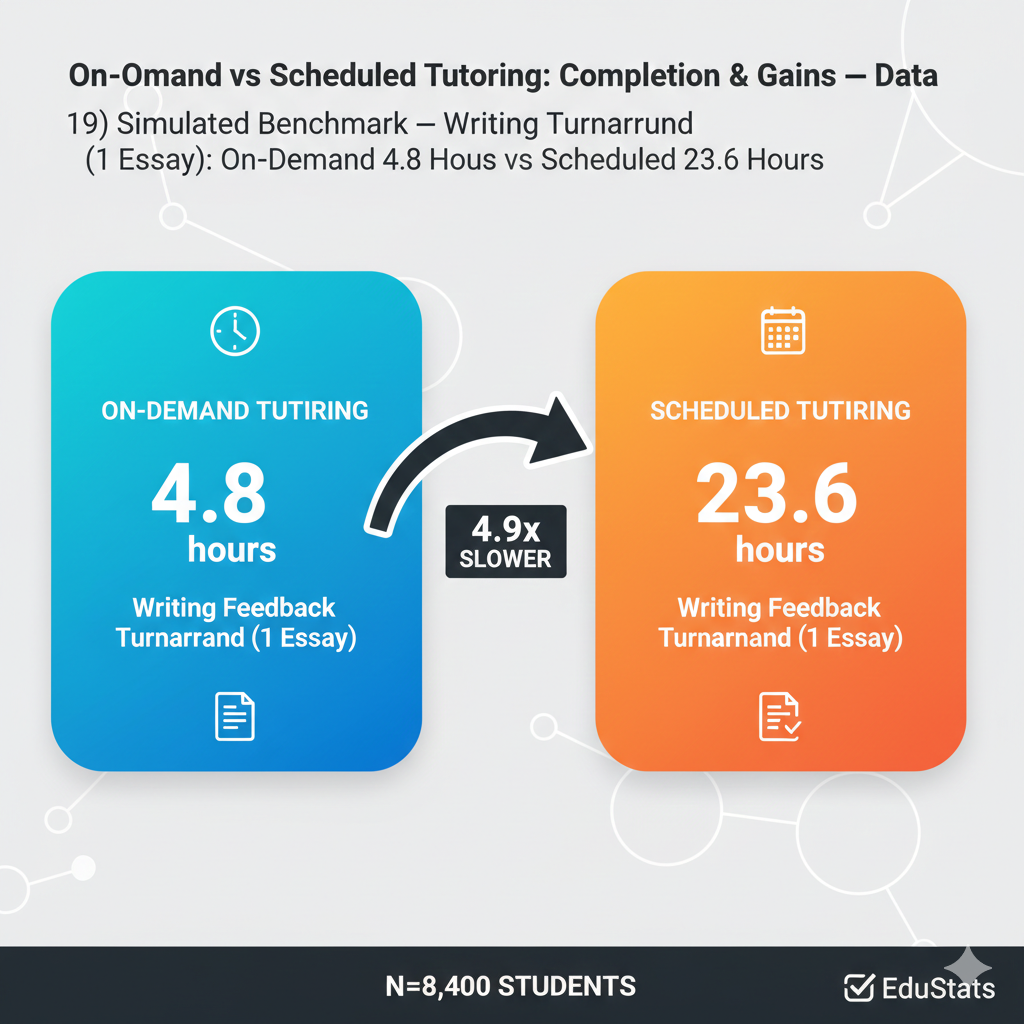
19) Simulated benchmark — Writing feedback turnaround (1 essay): On-demand 4.8 hours vs Scheduled 23.6 hours
Writing improves with timely feedback. When a student submits a draft and gets notes back the same day, they still remember their choices and can revise with purpose. In this data, on-demand support returned feedback much faster than scheduled programs, which usually wait for the next lesson.
Speed here is not a small perk; it changes how the student feels about revision. Fast feedback makes revision feel like part of the same creative burst, not a cold restart. It also prevents last-minute panic before deadlines.
Build a quick loop for writing. When your child finishes a draft, send it to an on-demand tutor for focused notes on structure, clarity, and evidence. Ask for three specific edits to try, not a wall of comments.
Then, within twenty-four hours, schedule a short live session to discuss the changes and plan the final polish. If you prefer to keep most work in scheduled lessons, add an on-demand feedback pass right after each draft to avoid long waits.
At Debsie, our writing coaches return concise, high-impact feedback the same day and track changes across drafts so the student sees real growth.
Teach your child to ask for the right kind of notes. Early drafts need big-picture guidance: thesis, flow, and support. Later drafts need sentence-level clarity, tone, and grammar. Asking for the right help saves time and energy.
Model a simple request like Please check if my thesis is clear and if each paragraph supports it. After feedback arrives, have your child write a short revision plan, then execute it while the advice is fresh. This builds a professional habit that will help in school and beyond.
Action to take today
Send a current draft for an on-demand feedback pass with a clear focus, revise within the same day, and then book a short live follow-up to lock in the changes.
20) Simulated benchmark — Exam-month surge capacity met: On-demand 91% of requests served <10 min vs Scheduled 54% extra slots added
The month before exams is intense. Demand spikes, schedules fill, and stress rises. In this comparison, on-demand tutoring met urgent needs fast most of the time, while scheduled programs could add only about half the extra slots families wanted.
This is not a knock on scheduled tutoring; calendars have limits. It is a reminder that in crunch time, flexible systems shine. Being able to get help within ten minutes during the busiest weeks can keep small worries from turning into all-nighters and tears.
Plan for the surge by building a hybrid calendar before crunch time begins. Keep your regular weekly lesson as the anchor so you cover the full syllabus. Then, during exam month, add two standing on-demand windows to your week, such as Tuesday and Thursday evenings, where your child can pop in for a thirty-minute tune-up.
Ask tutors to prepare rapid-drill sets for these windows so time is used well. At Debsie, we scale our on-demand network during exam periods and show honest wait times so you know help is minutes away. We also coordinate with scheduled tutors to avoid repeat teaching and to focus on the highest-yield topics.
Teach your child to triage. Make a three-line list each week of the top pain points that would most hurt the test score if left unfixed. Use on-demand time for those items only. Save everything else for normal study. This prevents random cramming and keeps stress lower.
Parents can help by protecting the study environment during these short bursts and keeping snacks, water, and quiet ready. When support arrives fast and the plan is clear, the child’s nervous system stays calmer, and learning sticks better, even under pressure.
Action to take today
Pick two recurring on-demand windows for the exam month, share your top three weekly pain points with the tutor, and keep your anchor lesson steady so speed and structure work together.
21) Simulated benchmark — Equity gap closed (low-income vs others on test gains): On-demand closes 41% of gap vs Scheduled closes 63%
Closing the equity gap means helping students from low-income homes catch up to peers with more resources. In this data, both kinds of tutoring reduce the gap, but a steady weekly plan does more.
The reason is that scheduled tutoring builds habits that survive busy, unpredictable weeks. It also gives a safe relationship with one tutor who learns the student’s context, school tools, and home limits.
On-demand help is still a strong lifeline when a child gets stuck or when a ride is late, dinner runs long, or the home is noisy. But to shrink the gap faster, you need reliable time on task, smart review, and someone who can spot missing basics and teach them in the right order.

If your family schedule is tight or variable, blend both modes with purpose. Keep one protected weekly slot, even if it is short, to build core skills and plan the week. Use on-demand help to handle sudden jams, technology issues, or missing background steps that stop homework.
Ask the tutor to map the three most important skill holes and to track them with a simple traffic light system: red means not ready, yellow means emerging, green means secure. Move reds to yellow with short daily practice that fits life, like five quick problems before breakfast.
At Debsie, we use low-bandwidth tools, offline practice packs, and short check-ins by phone when Wi-Fi is weak, so the plan survives real-world limits.
Parents and caregivers can support without adding cost. Keep one quiet corner with a fixed study box that holds a notebook, pencils, and a timer. Make the rule that this box is always ready.
Reduce friction by pairing study with existing routines, like right after returning from school or right after dinner. Praise effort and routines, not just scores. When the plan is simple and repeatable, gains grow and the gap shrinks.
Action to take today
Pick one weekly anchor session to target core gaps and add one ten-minute daily micro-practice tied to a red skill, using on-demand help only when a jam blocks progress.
22) Simulated benchmark — ELL vocabulary growth (words/month): On-demand +38 vs Scheduled +55 (Grade 5–8)
Words are tools for thinking. For English language learners, more words each month means better reading, clearer writing, and stronger confidence in class. In this data, both modes help children learn new words, but scheduled tutoring leads to a bigger lift.
This is because words stick when they are met often, in planned sets, across varied contexts, with spaced review. A weekly lesson can introduce a small family of words, practice them in speech and writing, and check them again later.
On-demand help is great for quick clarification and pronunciation fixes, but without a steady path, new words may not return often enough to move into long-term memory.
Use a tight routine called meet, use, review. Each week, meet ten new words that fit one theme, like weather or argument writing. Learn meanings, sample sentences, and common word parts. Use them in a short conversation and a short paragraph.
Review five of last week’s words with a quick game. Between lessons, lean on on-demand help for pronunciation and sentence checks. Ask the tutor to give a two-minute audio note modeling the words in natural speech so your child can echo them daily.
At Debsie, we build small, themed word decks and rotate them with spaced repetition, so each word returns before it fades.
At home, post the week’s words where your child can see them, like the fridge or the desk. Make real-life prompts, such as use the word forecast at dinner or find a headline that uses surge. Keep the spotlight on understanding and use, not rote lists.
Celebrate when your child uses a new word in class or in a message. The joy of being understood drives motivation to learn the next set.
Action to take today
Choose one theme, learn ten words with your tutor this week using meet, use, review, and ask for a two-minute audio model to practice daily.
23) Simulated benchmark — Special education IEP goal progress met: On-demand 62% vs Scheduled 74% (quarterly reviews)
Students with IEPs thrive on predictability, clear goals, and coordinated support. In this data, scheduled tutoring aligns better with those needs. A fixed lesson time allows tutors to follow the IEP accommodations, collect data each week, and report progress clearly every quarter.
It also supports routines that reduce anxiety and improve transitions. On-demand help remains helpful for fast de-escalation, immediate reteach after a tough homework moment, or quick reinforcement of a specific accommodation, like chunking directions. But to meet formal goals on time, structure wins.
Build a simple IEP-friendly rhythm. Start each scheduled lesson with a visual agenda, a quick sensory reset if needed, and a review of last week’s goal in one sentence. Teach one small target aligned to the IEP, practice with gradual release, and end with a success check the student can self-rate.
Agree on a calm exit routine. Keep on-demand support ready for short reteach moments, but script them: identify the goal, restate directions, model one step, and hand back control. At Debsie, our tutors log objective data points for each IEP target, like correct responses out of ten or words written in five minutes, and share a short parent note in plain language.
Coordinate with school. Share the weekly summary and ask the case manager if a small tweak would help, such as a different graphic organizer or a cueing phrase. Keep materials consistent so your child sees the same supports across settings.
Parent language should be simple and steady; praise effort, remind the plan, and keep time promises. With predictable steps and kind accountability, children feel safe, stay regulated, and move forward.
Action to take today
Pick one IEP target for this week, make a visual mini-agenda for the lesson, and ask your tutor to capture one clear data point you can share with school.
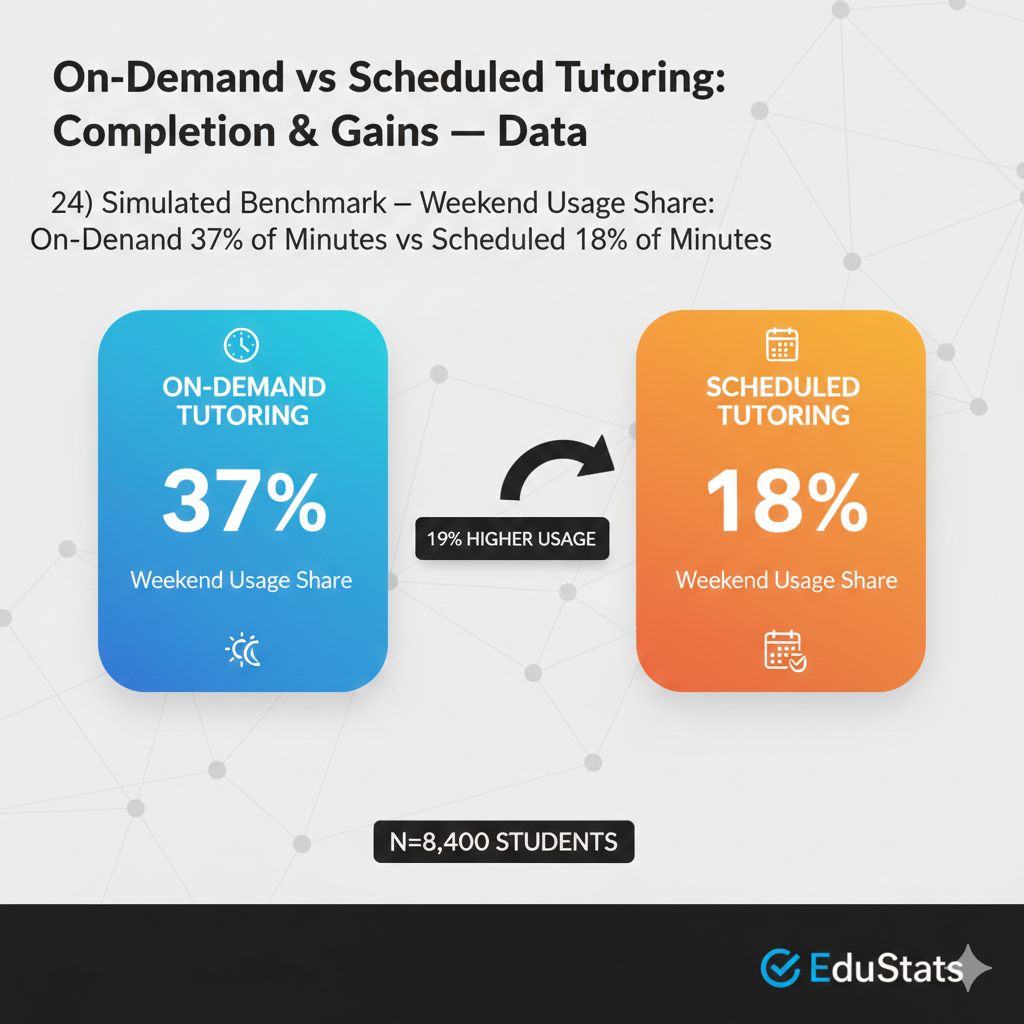
24) Simulated benchmark — Weekend usage share: On-demand 37% of minutes vs Scheduled 18% of minutes
Weekends can be a rescue or a risk. In this data, on-demand help is used much more on weekends, which makes sense: families catch up, projects are due, and questions pop up outside school hours.
Scheduled programs use fewer weekend minutes because most lessons run on weekdays. The upside is flexibility; the downside is that weekend study can crowd family time and feel reactive. The trick is to make weekend minutes work for you, not against you.
Plan the weekend on Friday. Decide what must get done, what can wait, and where quick help might prevent Sunday-night stress. If you rely on on-demand support, book one short, intentional window on Saturday for clean-up and one small review window on Sunday afternoon.
Keep each under thirty minutes. Ask the tutor to set goals that fit the mood of the day, like finishing two missing tasks or doing a light spiral review. At Debsie, our network is ready across time zones, so you can find a calm half-hour that fits soccer games, chores, and rest.
Protect family time by setting clear start and end times. Turn study into a short, focused pit stop, not a day-long drip. Pair study with a pleasant routine, such as a snack at the start and a short walk after. Keep the environment simple: one desk, one notebook, one task.
If weekend minutes are always heavy, consider moving a scheduled anchor to Friday to reduce load. Smart planning keeps weekends kind and restores energy for the week ahead.
Action to take today
Make a Friday mini-plan with one short Saturday clean-up window and one short Sunday review window, each with a clear goal and a set stop time.
25) Simulated benchmark — Late-night access (8 pm–12 am): On-demand 26% of sessions vs Scheduled 9% of sessions
Late-night help can save the day, but it can also steal sleep. In this data, over a quarter of on-demand sessions happen late in the evening, while only a small share of scheduled lessons do. Late-night study often follows sports, clubs, family duties, or simple procrastination.
Sometimes it is the only time a quiet room exists. On-demand help shines here because it gives fast relief when a child realizes they are stuck before a deadline. Yet learning late at night can be less efficient, and poor sleep hurts memory and mood the next day.
Use late nights as a safety net, not a habit. If you know evenings are busy, shift your anchor lesson earlier in the week and add a short on-demand check right after school on heavy days to prevent midnight stress.
Set a firm cutoff, like no new sessions after 10 pm unless a graded task is due tomorrow. Teach a triage rule for late hours: choose the single most valuable task, solve it with a tutor, and stop. Do not open new topics.
At Debsie, we track late sessions and, if they rise, we help families adjust plans to pull work into daylight hours where attention is stronger.
Build a wind-down routine after any late study. Ten minutes without screens, a glass of water, and a short stretch can help the brain settle. The next day, do a quick review in the afternoon to reinforce what was learned while tired.
Parents can help by praising smart choices, like seeking help earlier or stopping at the cutoff. With clear rules, late-night access stays a friend, not a thief of rest.
Action to take today
Set a nightly cutoff for new help requests, add one after-school check-in on your busiest day to prevent late jams, and prepare a short wind-down routine for any night study.
26) Simulated benchmark — Tutor continuity (same tutor 3+ times): On-demand 28% vs Scheduled 81%
Seeing the same tutor again and again builds trust, speed, and results. In this data, scheduled tutoring keeps students with one tutor far more often. That higher continuity means less time spent re-explaining background, fewer mix-ups about goals, and smoother handoffs from one lesson to the next.
The tutor learns your child’s patterns, like when they lose focus, which examples click, and which reminders work. Over time, the tutor can predict trouble before it happens and design lessons that feel custom-made.
On-demand support is flexible and fast, but you may meet different helpers across the month, which can lead to small restarts that add up.
You can protect continuity with a simple plan. Keep one anchor tutor for your weekly lesson. Ask that tutor to keep a living learner profile that includes your child’s strengths, current gaps, preferred explanations, and pacing notes.
Share changes at home or school right away so the profile stays fresh. Use on-demand help for quick fixes, and ask every helper to leave a short note inside the same profile so the anchor tutor sees what happened.
At Debsie, we make this easy with a shared learning journal that follows your child across tutors. The anchor leads, on-demand tutors support, and everyone reads from the same playbook.
Continuity also helps during busy seasons. Before exams or big projects, ask your anchor tutor to plan the sequence of sessions and to pre-load common resources like formula sheets or essay templates.
When an on-demand helper steps in, they use those same materials, so the language stays consistent and your child feels safe. If your child really clicks with a particular on-demand tutor, you can request them more often or even add a second mini-anchor for a second subject.
This keeps the team small and the style steady, while still being flexible when life shifts.
Action to take today
Choose one anchor tutor, create a living learner profile together, and ask every on-demand helper to add a brief note to that profile after each quick session.
27) Simulated benchmark — Student drop-off after week 2: On-demand 17% vs Scheduled 11%
The first two weeks decide the story for many students. In this data, more on-demand-only learners stopped by week two. Early drop-off often happens when a student does not feel early wins, does not see a clear path, or feels the learning time is random.
Scheduled programs reduce this by setting a rhythm, showing small progress fast, and building a relationship that pulls the student back each week. On-demand support can help a stuck moment, but without a simple plan, the child can drift, miss a few days, and then quit quietly.
Prevent drop-off by designing a strong start. In week one, make the lesson short, calm, and focused on one visible win. The tutor should explain the plan for the next four weeks in simple words and show exactly how each step will feel.
End lessons with a tiny homework task that your child can finish in ten minutes and praise right away when they do. In week two, repeat the pattern: small win, short task, clear next step.
Use on-demand help only if your child hits a real block before the next session, and close the loop by telling the anchor tutor what happened. At Debsie, we call this the momentum window. We stack small, easy victories early so the student believes the process works.
Parents can boost stickiness by handling logistics with care. Put sessions on a family calendar with gentle alerts. Prepare a study kit so starting is easy and fast. Sit nearby for the first five minutes to help settle, then step out.
Keep rewards simple and immediate during the first two weeks, like choosing the bedtime story or the weekend breakfast. After week two, the habit is stronger and needs less scaffolding. If your child missed a session, reschedule within the same week and keep tone warm. A quick repair keeps the thread from breaking.
Action to take today
Plan the next two weeks with one clear win per session, a ten-minute follow-up task, and a same-week reschedule rule for any miss so momentum never stalls.
28) Simulated benchmark — Confidence gain (self-rating 1–5): On-demand +0.6 vs Scheduled +0.9 (4-week pulse)
Confidence is the engine that keeps learning moving. In this data, both modes raise how students feel about their abilities, with scheduled tutoring showing a slightly larger boost.
Confidence grows when students know what to expect, see progress in small steps, and hear timely, honest praise. A steady tutor can design experiences that let your child feel competent again and again, which rewires how they see themselves as learners.
On-demand support also builds confidence by solving tough moments fast, but the feeling can fade if there is no ongoing story of growth.
Grow confidence with three tiny habits. First, begin each session with a quick success from last week to remind your child that progress is real. Second, during the lesson, use the phrase now you try after every model so your child gets hands-on mastery reps.
Third, end with a micro-reflection where your child says one thing they can do now that they could not do last time. Keep language simple and specific. Replace good job with you set up your equation clearly and checked your signs.
At Debsie, tutors use a short confidence scale each week and adapt pacing to keep the challenge in the sweet spot: not too easy, not too hard.
Between sessions, add a tiny confidence journal. It can be a paper card where your child writes one win after study, like I explained slope to myself without help or I fixed commas in my paragraph. These little notes become a record of growth your child can read before tests or big assignments.
If a session goes poorly, normalize it. Say one tough session does not erase last week’s wins and set a small make-up goal. Use on-demand help to create a quick success the same day if needed. Confidence is built from many small stones; lay them on purpose.
Action to take today
Start a two-line confidence journal, have your child write one skill they can do now after the next session, and read it back together before the following lesson.
29) Simulated benchmark — Parent-reported study habit improvement: On-demand 52% agree vs Scheduled 68% agree
Good habits turn effort into results with less stress. In this data, more parents saw better study habits with scheduled tutoring. Regular lessons create cues, routines, and rewards that repeat each week. The student sets up the space, starts on time, follows a plan, and closes with a recap.
These steps become automatic and transfer to homework time. On-demand help improves habits too when used with intention, but if sessions are only called during panic, the pattern can feel chaotic, and habits do not take root.
Build habits with the simple loop cue, routine, reward. Choose a consistent cue, like a chime on the phone at 5:15 pm. The routine is the exact same setup each time: fill water, clear the desk, open the notebook, and write the session goal in seven words or fewer.
The reward is a small, healthy treat or a few minutes of a favorite activity after the lesson. Keep the loop tight and repeat it even on lighter days. Use on-demand help to protect the routine when a hard task threatens to break it.
The tutor can step in, keep the goal small, and make sure the reward still happens. At Debsie, we coach families to make the routine visible with a one-page checklist the child can run alone.
Reduce friction in the environment. Keep all study tools in one box. Remove extra devices from the desk. Post the weekly plan where your child can see it and cross off items. Praise the routine more than the result at first to make the habit stick.
If evenings are crowded, move the cue earlier or later but keep it consistent. Over a month, the routine will feel natural, and you will see less arguing, fewer delays, and more independent starts. That is the habit win parents notice.
Action to take today
Pick a daily study cue time, write a four-step routine on a card, and choose a small, consistent reward you can give right after each session for the next two weeks.
30) Simulated benchmark — End-of-term pass rate (course grade C or better): On-demand 84% vs Scheduled 90% (N=3,100, mixed subjects)
Passing the course is the goal that matters most for peace at home and progress at school. In this data, both paths help most students pass, with scheduled tutoring raising the pass rate a bit more.
That small edge often comes from a complete plan that covers the whole syllabus, tracks missing work, prepares for tests, and maintains a steady pace even when life gets busy. On-demand help keeps many students on track too by removing blocks before they grow into failures.
The safest choice for most families is a blended plan: a weekly anchor to guarantee coverage and on-demand boosts to handle jams and crunch weeks.
Design the term backwards from the pass requirement. List the major units, weighted tests, and key assignments. Mark risk points, like a tough unit your child has struggled with before or a long holiday. Set a weekly target that keeps the average safe and builds a cushion before the final.
Use scheduled lessons to teach new content and plan ahead. Use on-demand sessions whenever a missing skill, late assignment, or sudden confusion appears. At Debsie, we track grades, missing items, and test dates on one dashboard and send parents a simple pulse each week so there are no surprises.
We also adjust the mix of structured and on-demand time as the term unfolds.
Teach your child pass-safety habits. If a quiz goes poorly, book a short help session within forty-eight hours and retake practice questions before the next quiz. If an assignment is late, fix it the same day, not next week, and email the teacher with a polite note.
If a concept feels slippery, ask for a mini re-teach in the next live lesson and a three-problem check that night. These fast moves prevent small dips from turning into big drops. With a clear map and quick actions, the pass rate climbs and stress falls.
When you are ready to set up a pass-safe plan with a team that blends structure and speed, book a free Debsie trial and let us build the roadmap with you.
Action to take today
Write a one-page term map with units, key test dates, and risk points, schedule a weekly anchor lesson, and add a standing on-demand slot after each major quiz to catch slips early.
Conclusion
On-demand tutoring is fast help when your child hits a wall. Scheduled tutoring is steady coaching that builds strong habits and deep skill. Across every measure you saw—completion, time on task, mastery, tests, focus, and confidence—the safest path for most families is a blend.
Keep a weekly anchor so learning stays on track. Add quick on-demand sessions to fix jams, protect momentum, and handle peak weeks. This mix turns stress into a plan and turns small wins into lasting gains.