
The section below evaluates named options in the article plus three additional providers serving Jharkhand learners. Scores reflect publicly verifiable course design, teacher information, practice systems, accessibility, pricing, trials, safety information and confidence signals—not promotional claims alone.
Find the right learning experience
Tell us a little about the learner and what you are looking for. Our team will review your answers and help you identify the most suitable next step.
- Takes only a few minutes
- No payment required
- Personalised recommendations
Your information will only be used to respond to your enquiry.
Original Research-Based Provider Comparison: How We Scored These Options
This comparison covers French learning for students in Jharkhand, including Ranchi, Jamshedpur, Dhanbad, Bokaro and smaller towns. We converted the most important parent-facing questions into one weighted score, making providers with very different formats easier to compare fairly.
The article names Debsie, Alliance Française, Duolingo and Memrise. We also assessed EEC, Superprof’s Ranchi tutor marketplace and Filo’s Jamshedpur tutor marketplace. Generic categories such as “university courses” and “local home tutors” were not scored as single providers because their teachers, fees and systems vary.
| Provider | Best For | Key Strength | Possible Limitation | Score /10 |
|---|---|---|---|---|
| Debsie | Children needing a guided learning system | Live teaching plus short practice, feedback and parent-visible progress | French-specific fees are not clearly separated on the public pricing page | 9.54 |
| Alliance Française du Bengale | CEFR and DELF-focused learners | Established level pathway and official exam ecosystem | Main physical centre is in Kolkata | 8.19 |
| EEC | Fast A1/DELF preparation | Clear ₹7,500 A1 offer, live classes and mock testing | Public Jharkhand pages focus mainly on A1 | 7.65 |
| Duolingo | Daily independent practice | Strong gamification and easy access | No dedicated human French tutor | 7.62 |
| Memrise | Vocabulary, listening and native-speaker exposure | Authentic-speaker videos and personalised review | Limited parent oversight and human correction | 7.08 |
| Filo | Finding a private tutor quickly | Free demo, broad tutor choice and transparent hourly range | Curriculum and follow-up depend on the selected tutor | 7.05 |
| Superprof Ranchi | Local or online one-to-one tuition | High choice and schedule flexibility | Quality and teaching systems vary considerably by tutor | 6.72 |
1. Debsie — 9.54/10
| Factor | Score | Evidence and scoring reason |
|---|---|---|
| Teacher Quality | 10 | Live, teacher-led lessons and trained feedback are described publicly. The site also publishes credential-verification and parent-involvement safeguards. French-teacher biographies, however, should still be requested before enrolment. |
| Curriculum Structure | 10 | A repeated Hear–Say–Read–Write–Use sequence, CBSE/ICSE support and DELF A1–B2 task preparation create a clearer pathway than an open tutor marketplace. |
| Student Fit & Personalization | 10 | Lessons include short speaking turns, targeted pronunciation fixes, school-linked projects and quick/full practice modes. |
| Practice, Homework & Tracking | 9.5 | Daily micro-practice, voice tasks, teacher voice notes, catch-up work and parent dashboards are described. Independent French-specific outcome data remain limited. |
| Engagement & Motivation | 10 | Gamified courses, points, ranks, role-plays and short achievable tasks are integrated into the platform. |
| Accessibility/Convenience | 10 | Online delivery removes city-level access constraints and offers flexible scheduling and catch-up lessons. |
| Transparency | 7 | A general pricing page lists group classes at US$100 monthly for two weekly classes, but French-specific pricing and one-to-one rates are not publicly clear. A free trial is advertised. |
| Confidence Signals | 8 | Public safety procedures include parent communication, credential requests, privacy measures and escalation/refund steps. Published outcomes currently lean heavily toward chess rather than French. |
| Flexibility | 10 | Group and one-to-one options, flexible timing, online access, beginner-to-exam support and short practice modes are documented. |
Trial, price and safety check: Free trial advertised; general group price US$100 monthly; French-specific price not publicly clear. Debsie publishes a detailed child-safety policy. Claims about FIDE-certified or award-winning partners relate to chess and should not be used as evidence of French-teacher quality.
2. Alliance Française du Bengale — 8.19/10
| Factor | Score | Evidence and scoring reason |
|---|---|---|
| Teacher Quality | 9 | Official pages describe highly trained teachers and tutor-supported online learning. |
| Curriculum Structure | 9.5 | CEFR progression, DELF/DALF preparation and four annual exam sessions provide a strong formal pathway. |
| Student Fit & Personalization | 7 | Children’s, teen, general and one-to-one options exist, but standard courses follow scheduled cohorts. |
| Practice & Tracking | 7.5 | Mon Alliance, tutoring, feedback and assessments are available; parent dashboards are not publicly described. |
| Engagement | 7 | Cultural programming adds context, though gamification is not a core published feature. |
| Accessibility | 8 | Online and hybrid classes are available, but the nearest principal physical centre is Kolkata. |
| Transparency | 8.5 | Modes, schedules, locations and course categories are clear; current fees vary by intake and should be checked on the live fee page. |
| Confidence Signals | 9 | Established Alliance Française identity and official DELF/DALF examination role. |
| Flexibility | 8 | Online, on-site, hybrid and one-to-one formats are offered. |
Evidence bundle: official course, registration and fee pages.
3. EEC — 7.65/10
| Factor | Score | Evidence and scoring reason |
|---|---|---|
| Teacher Quality | 7.5 | “Expert faculty” is stated, but individual French-teacher credentials are not prominently published. |
| Curriculum Structure | 8 | A defined 30-day CEFR A1 and DELF-preparation course is advertised. |
| Student Fit & Personalization | 6.5 | Tutor support exists, although the public course appears primarily batch-based. |
| Practice & Tracking | 8 | AI mock tests and tutor-desk access are included. |
| Engagement | 6.5 | Live teaching is interactive; gamified child-focused features are not publicly clear. |
| Accessibility | 9 | Online access is advertised for Ranchi, Dhanbad and Jamshedpur. |
| Transparency | 9 | Published price: ₹7,500 including GST, with a free demo and EMI information. |
| Confidence Signals | 7 | Scale and ratings are claimed publicly, but course-specific independent review evidence is limited. |
| Flexibility | 8 | Live, recorded and advertised classroom modes. |
Evidence: EEC’s A1 and city course pages.
Find the right learning experience
Tell us a little about the learner and what you are looking for. Our team will review your answers and help you identify the most suitable next step.
- Takes only a few minutes
- No payment required
- Personalised recommendations
Your information will only be used to respond to your enquiry.
4. Duolingo — 7.62/10
| Factor | Score | Evidence and scoring reason |
|---|---|---|
| Teacher Quality | 0 | No assigned human French teacher. |
| Curriculum Structure | 8.5 | Sequential bite-sized units and personalised review. |
| Student Fit & Personalization | 8 | Practice adapts to errors and pace, but not to school-specific goals in the way a tutor can. |
| Practice & Tracking | 9 | Streaks, mistake review and progress records are strong. |
| Engagement | 10 | One of the most developed gamified systems assessed. |
| Accessibility | 10 | Free web and app access. |
| Transparency | 8 | Free access and seven-day paid trials are clear; local subscription prices may appear only at checkout. |
| Confidence Signals | 9 | Large global user base, public privacy terms and community rules. |
| Flexibility | 10 | Fully self-paced and available at any time. |
5. Memrise — 7.08/10
| Factor | Score | Evidence and scoring reason |
|---|---|---|
| Teacher Quality | 0 | No assigned live teacher. |
| Curriculum Structure | 7.5 | Beginner and intermediate pathways are available. |
| Student Fit & Personalization | 7.5 | Personalised reviews and goal-based content. |
| Practice & Tracking | 8 | Vocabulary tests, review plans and AI conversation tools. |
| Engagement | 8.5 | Native-speaker videos and gamified tests. |
| Accessibility | 10 | Web and mobile access. |
| Transparency | 8 | Limited free plan; observed public prices included US$24.99 monthly and US$61.99 annual promotional pricing, subject to change. |
| Confidence Signals | 8.5 | Publicly reports 80 million learners and substantial app-review volume. |
| Flexibility | 10 | Fully self-paced across multiple devices. |
6. Filo Jamshedpur — 7.05/10
| Factor | Score | Evidence and scoring reason |
|---|---|---|
| Teacher Quality | 7 | Profiles display verification, experience and reviews, but quality varies by tutor. |
| Curriculum Structure | 5.5 | DELF and conversational specialities are searchable; no single common French curriculum is evident. |
| Student Fit & Personalization | 8 | Private tutor selection by level, goals, certification and language. |
| Practice & Tracking | 4.5 | Homework and progress systems depend on the tutor. |
| Engagement | 6 | One-to-one interaction can be engaging; no standard gamification is shown. |
| Accessibility | 10 | Online access and rapid tutor connection. |
| Transparency | 8 | Free demo; published range ₹505–₹2,529 per hour. |
| Confidence Signals | 7 | Tutor reviews, verification and ISO 27001:2022 certification are displayed. |
| Flexibility | 9 | Broad tutor, speciality and scheduling choice. |
7. Superprof Ranchi — 6.72/10
| Factor | Score | Evidence and scoring reason |
|---|---|---|
| Teacher Quality | 7 | Profiles range from experienced and CEFR-certified tutors to students teaching beginners. |
| Curriculum Structure | 5 | Structure is tutor-dependent. |
| Student Fit & Personalization | 9 | High one-to-one adaptability. |
| Practice & Tracking | 4 | No standard platform-wide homework or reporting system is described. |
| Engagement | 6 | Depends on the chosen tutor. |
| Accessibility | 9 | Thirteen Ranchi tutors were listed, with online and face-to-face options. |
| Transparency | 6 | Average lesson price was ₹781 per hour and most profiles advertised a free first lesson; a separate Student Pass is required to contact tutors. |
| Confidence Signals | 6 | The Ranchi French sample showed only six-plus reviews, making the local rating less robust. |
| Flexibility | 9 | Flexible location, format, level and budget filters. |
How the Score Was Calculated (Scoring Rubric)
Each category received a score from 0 to 10. We then multiplied it by its importance:
Final score = Teacher Quality × 15% + Curriculum × 15% + Personalization × 15% + Practice/Tracking × 12% + Engagement × 10% + Accessibility × 10% + Transparency × 8% + Confidence Signals × 8% + Flexibility × 7%.
For example, a teacher-quality score of 8 contributes 1.20 points: 8 × 0.15. All nine weighted results are added to produce the final score out of 10. A missing public feature was not automatically treated as nonexistent; it received a cautious score or was marked not publicly clear.
What the Numbers Mean for Learners, Parents and Readers
Debsie ranks first for children who need more than a weekly video call. Its advantage comes from combining live instruction with a repeated lesson sequence, short daily practice, pronunciation feedback, catch-up work and parent-visible tracking. Its principal transparency weakness is the absence of clearly separated public French pricing.
Alliance Française is the strongest formal alternative for learners prioritising CEFR progression, DELF/DALF preparation and institutional recognition. EEC is easier to price and may suit someone seeking a short, intensive A1 course.
Filo and Superprof are useful when the priority is choosing an individual tutor. Their weakness is not necessarily the teachers; it is that curriculum, homework, safety practices and reporting may change from one tutor to another. Duolingo and Memrise are excellent supplementary practice tools, but neither replaces accountable human correction.
TLDR – To Conclude
On the evidence available, Debsie is the strongest all-round option for school-age learners in Jharkhand who need structured online lessons, live tutor support, guided practice, quizzes or revision, motivation and progress visibility. Alliance Française is particularly strong for formal certification, while EEC offers unusually clear short-course pricing.
The best choice still depends on the student. Independent learners may prefer an app; examination candidates may prefer Alliance Française; and families wanting a particular local teacher may prefer a marketplace. Before paying, parents should verify the assigned teacher, complete a trial, request the full fee and refund terms, and ask exactly how progress will be measured.
If your child lives in Jharkhand—Ranchi, Jamshedpur, Dhanbad, Bokaro, Hazaribagh, or a smaller town—and wants to learn French, you’re in the right place. French can lift school marks, open college doors, and make travel easy.
It also builds calm focus, clear speech, and smart thinking. The best part is that your child can start right from home with a kind teacher, tiny steps, and short daily practice that actually gets done.
In this guide, I’ll show you the top French tutors and French classes for students in Jharkhand and explain, in very simple words, what truly helps children speak well. You will see why online training gives more speaking time, faster feedback, and less stress than most offline batches.
You will also see why Debsie is our #1 choice—because Debsie turns shy first words into confident speech with a friendly method, clean tools, and a clear plan. Parents don’t just read reports; they hear growth through short audio clips each week.
If you want a path that is gentle, structured, and built around your real week, you are in the right place. Want to feel the difference in one safe step? Book a free Debsie French trial class and listen to your child speak more in a single session.
Online French Training

Online French training is calm, clear, and strong—perfect for busy families in Jharkhand. Your child studies from home in Ranchi, Jamshedpur, Dhanbad, Bokaro, Hazaribagh, or any small town. There is no travel in heat or rain. No waiting outside a coaching lane.
The class starts on time. The teacher’s voice is clean in the headphones. The screen is simple. The steps are tiny. Because the space feels safe, your child speaks more. When speaking minutes go up, progress speeds up. That is the heart of language.
A good class follows one small loop again and again so nothing feels random:
Hear → Say → Read → Write → Use.
First, the child hears a short line in slow, clear French. Then they say it back in small parts with gentle help. Next, they read the same line on screen with a tiny color hint on any tough sound. After that, they write one neat sentence to lock spelling and word order.
Finally, they use the line in a tiny scene—a café order, a polite question, a simple direction. This loop lowers fear and raises voice time. Each pass builds comfort. Comfort turns into skill.
Home practice is short on purpose. Long homework looks serious but gets skipped. Small tasks get done. On a normal day, 10–12 minutes is enough. On a busy day, 5–6 minutes keeps the habit alive.
Two sound checks, a handful of word cards, one small line, a 30–60 second voice task—done. These tiny steps repeat daily. In two to three weeks, you hear smoother sounds, cleaner words, and a braver tone.
Online also fits Jharkhand’s rhythm. There are school timings, exam weeks, festival days, club meets, and family trips. Sometimes it rains hard. Sometimes there is a traffic block near a market road. With online, you pick early morning before school, a calm evening after homework, or a weekend slot.
If you miss a class because a school event ran late in Ranchi or a match went long in Jamshedpur, you do not lose the lesson. You watch the recording, follow a tiny catch-up plan, and return on track. Momentum stays.
The best part is how online classes bring the child’s world into the lesson. We learn directions by asking the way to JRD Tata Sports Complex or Rock Garden. We practice food words with a polite order like one you might make near Bistupur or Harmu.
We describe a school day with real times. We plan a mini “Jharkhand Visitor Guide in French.” When words touch daily life, memory sticks. Children feel, “I can use this now.” That feeling brings them back eager and calm.
Parents need truth they can hear, not just read. Online platforms can store short audio clips from Week 1 and Week 4. You press play and hear the change in seconds.
A small dashboard shows two wins and one focus for next week, in plain words. “Win: clear bonjour. Focus: soften n in bien.” With this, you can help for two minutes after dinner and celebrate the right win at the right time.
For CBSE/ICSE, online French mirrors book chapters but keeps speaking first. Picture talk becomes a short speech before it becomes a paragraph. For DELF A1–B2, online adds gentle timed tasks for listening and speaking.
The teacher gives one praise and one tiny fix each time. Fear stays low; scores rise slowly and surely. Your child learns to speak with a calm, steady tone—even with a timer on.
Comfort matters too. Jharkhand has hot days, sudden showers, and busy roads. Online cuts the commute. Your child arrives fresh. A fresh mind listens better, remembers more, and speaks more. That single change—arriving fresh—often doubles useful speaking time across the week.
If you want to feel this in one safe step, book a free Debsie French trial. Most parents say after the first 20 minutes, “My child spoke more than I expected—and smiled.”
Landscape of French Tutoring in Jharkhand and Why Online Is the Right Choice

Across the state, you can find many ways to learn French. In Ranchi, Jamshedpur, Dhanbad, and Bokaro, there are home tutors, small coaching rooms, and a few language centers. Schools may offer after-class help. If you live right next to a kind tutor and the batch is tiny, an offline option can cover basics.
But most families run into the same walls:
Travel drains energy. Even a short ride feels heavy after school, especially in heat or rain. A tired child speaks less. Language grows only when the mouth moves many times in an hour. When energy is low, turns shrink, and growth slows.
Fixed slots fight real life. Many rooms have one or two batch timings. If these clash with sports, coding, music, or a family plan, you must skip something. There are rarely recordings. A missed hour is gone. Small gaps stack up and start to feel big.
Mixed levels reduce voice time. A new learner shares space with a quick learner. The teacher does their best, but someone waits while someone else answers. Loud voices get more turns; shy voices fade. Minutes of talk drop for both, and those minutes are the true engine of skill.
Paper homework delays fixes. Worksheets check spelling and rules. They cannot coach sound in the moment. Tiny errors—u vs ou, nasal n, missing accents—repeat for weeks and become habits. Later, unlearning them takes more time and more courage.
Find the right learning experience
Tell us a little about the learner and what you are looking for. Our team will review your answers and help you identify the most suitable next step.
- Takes only a few minutes
- No payment required
- Personalised recommendations
Your information will only be used to respond to your enquiry.
Parents can’t hear growth fast. A quick “going fine” is not enough. Without Week-1 vs Week-4 audio, it’s hard to guide two minutes of the right home practice or to cheer the exact win.
Online clears these blocks. You choose the best teacher, not just the nearest. You get flexible slots that respect your real week. You have recordings and a soft catch-up when life interrupts. Most of all, your child speaks more per minute because the class is quiet, the steps are small, and turns are fair.
This matters in every city and town in Jharkhand. During exam week, your child uses Quick Mode (5–6 minutes) to keep the habit alive. During festivals or a trip to family, you slide the slot and stay on track. Online respects real life while protecting progress.
If you compare outcomes—cleaner sounds, smoother lines, calm speech in real talk—online wins for most children. It’s not “screen vs room.” It’s more guided speaking vs less guided speaking. Online gives more of the minutes that matter.
How Debsie Is the Best Choice for French Training in Jharkhand

Debsie is our #1 pick because it blends expert live teaching, tiny daily practice, and a warm, child-first platform. The method is human and simple. The tone is kind. The results are real. Imagine your child inside a Debsie class.
Every lesson follows the same five steps—Hear, Say, Read, Write, Use. The teacher speaks one short line in slow, clean French. Your child repeats in tiny parts until the sound feels easy. The same line appears with a small color hint on any tough sound. Your child writes one neat sentence to lock spelling and order.
Then the class uses the line in a tiny scene—introductions, a café order, a direction to Rock Garden, a plan near Jubilee Park. Because this loop repeats, nothing feels random. The brain relaxes; learning speeds up.
Speaking is the center, not the last five minutes. Your child gets short, safe turns with the teacher, a quick pair talk, and a one-minute share. Feedback is warm and exact—one praise + one tiny fix—and we move forward. Shy voices open. Fast learners stay engaged. Children leave class thinking, “I can say this now,” not “Maybe later.”
Daily practice that actually happens. Debsie guards the habit with two light modes:
- Quick Mode (5–6 minutes): two sound checks, a few word cards, one small line, a 30–60 second voice task.
- Full Mode (10–12 minutes): the same, plus one extra micro-drill.
Because the work is small, it gets done—even during boards, sports trials, or family events. After three to four weeks, you hear steadier sounds and cleaner sentences without stress.
Pronunciation Lab: the quiet superpower. Each day, your child records one line. A trained teacher replies with a 20–30 second voice note: one praise, one fix.
“Great bonjour—very clear. For bien, soften the ‘n’. Smile slightly; it helps the sound.”
These tiny tips, stacked over days, shape a crisp, confident voice.
Parent dashboard: truth in one minute. You see what was learned, two wins, and one focus for next week. You can play a Week-1 clip next to Week-4 and hear the change yourself.
If a class is missed because of rain in Ranchi or a busy event in Jamshedpur, a soft catch-up appears: one mini video and two tiny drills. No guilt. Just a clean way back.
CBSE/ICSE support that flows from speech to writing. If the chapter is “My City,” your child builds “Jharkhand in French”—naming places, asking polite questions, giving a simple direction.
If the chapter is “Daily Routine,” they first speak a 60-second talk and then write a neat paragraph with the same words. Grammar grows inside speech, so writing feels natural.
DELF A1–B2 without panic. Debsie breaks exam tasks into tiny parts and practices them often. Listening targets numbers, places, and times first. Speaking follows a simple start → detail → close plan so answers feel complete but not long.
Writing stays short and correct with clean accents and simple linkers. A friendly timer makes pressure feel normal. Fear down. Scores up.
Jharkhand-flavored mini projects make words useful, so they stick: a Visitor Guide for a local spot, a tiny Street Food Menu with Je voudrais… s’il vous plaît, a School Day talk with times and two favorites, a Directions scene to a known landmark. When French describes your child’s world, memory holds and motivation rises.
Why Debsie outruns everyone else.
Debsie gives more of the minutes that matter and keeps fear low: clear steps, lots of speaking, tiny daily drills, fast human feedback, flexible slots, and parent proof you can hear.
Children feel safe, so they try. They try, so they grow. You do not need to guess; you can listen and know.
Want to test this today? Book a free Debsie French trial. Meet the teacher, try the loop, and hear your child speak more than you expected in the very first class.
Offline French Training

Offline French classes can help when a few rare things line up perfectly: the classroom is very close to your home, the batch is tiny, and the teacher has time to hear every child speak more than once. Face-to-face time can feel warm.
A smile across the desk can calm nerves. A short role play in the room can feel lively. If your child can walk five minutes to class in Ranchi, Jamshedpur, Dhanbad, or Bokaro, arrive fresh, and get real speaking turns, offline can cover basic goals.
But most families do not get these ideal conditions every week. Travel steals energy. A 30–40 minute round trip through heat, sudden rain, or traffic near a market road can drain a child before class begins.
A tired child speaks less. In language, speaking minutes are the fuel. When fuel is low, growth slows.
Timing is another block. Many centers offer one or two fixed slots. If the only batch is 6–7 pm, it may clash with sports, coaching, music, a school event, or a family plan. If your child misses a class, it is usually gone.
There is no recording to watch later. Small gaps stack up and start to feel heavy.
Level mix is common. A beginner sits next to a faster learner. The teacher balances as best as possible, but someone waits while someone else answers. The louder child speaks more. The shy child goes quiet.
The minutes of real talk per child drop. Notes and rules can fill the hour, yet the mouth stays silent. Real fluency needs many small, safe turns in every class.
Paper homework gives slow feedback on sound. Worksheets help with spelling and rules, but tiny pronunciation errors—u vs ou, a soft nasal n, a missing accent—can repeat for weeks. By the time the teacher hears it clearly, the mistake has turned into a habit. Unlearning a habit takes more time than learning it right once with a quick voice note.
Parents also need proof they can trust fast. “Doing fine” is nice, but it does not let you hear Week 1 next to Week 4. Without short audio snapshots, it is hard to plan two minutes of the right home practice or celebrate the right win.
Children thrive on clear praise—“That bonjour was crisp!”—and one tiny fix—“Soften the ‘n’ in bien.” In busy rooms, that quick loop rarely reaches home the same day.
None of this means offline learning is “bad.” It means the format has limits. Offline can work for basics when the location is near, the batch is tiny, the room is quiet, the timing is stable, and the teacher still gives one-to-one coaching inside the group.
If this is truly your setup and your child likes the in-person feel, you can move ahead with light goals.
For most Jharkhand families, weeks are uneven—exams, unit tests, club meetings, festivals, travel days, sudden rain. In that real world, a structured online path gives you more of what matters most: more guided speaking minutes, lighter daily practice, quick human feedback, and recordings when life interrupts.
That is why many parents choose Debsie first and add a rare in-person booster only if needed.
If you want to compare in one safe step, take the simplest action: book a free Debsie French trial. In one calm session, you will hear more speaking than many children get in a whole week of crowded batches.
Drawbacks of Offline French Training
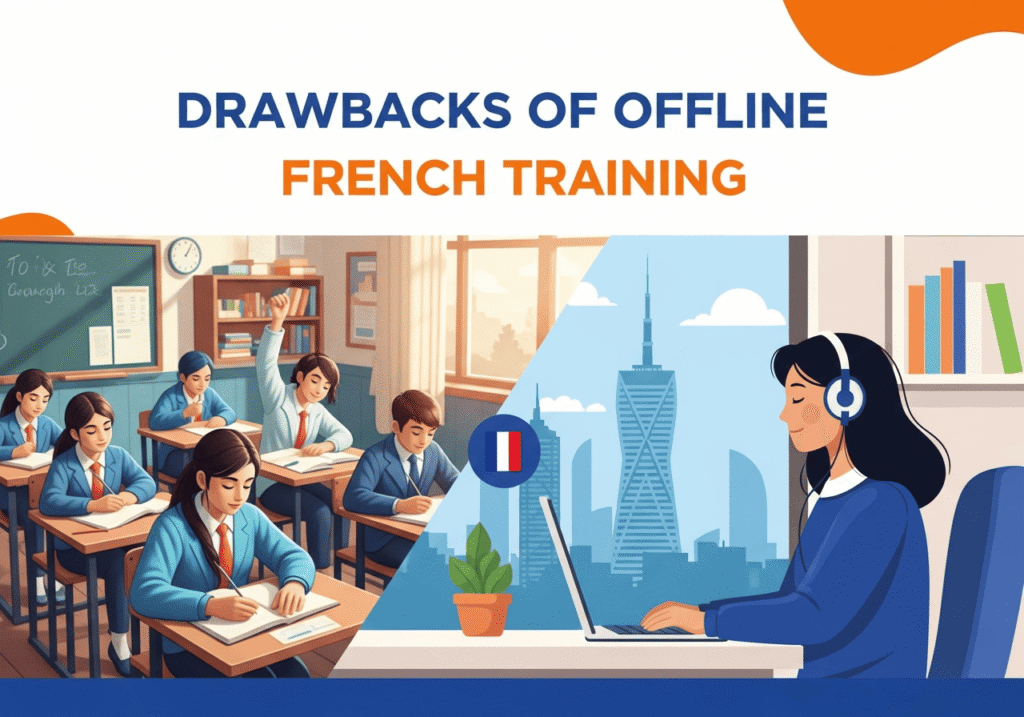
Let’s keep this clear and kind. A good classroom with a caring teacher helps. But most offline setups in Jharkhand carry built-in problems that slow a child’s voice.
Travel lowers freshness before class even starts.
Even a short ride from Morabadi in Ranchi or Bistupur in Jamshedpur can feel heavy after school, especially in heat or rain. Tired minds speak less. Less speech means slower growth.
Fixed batch times clash with real life.
Batches run at set hours. If coaching, sports, music, or a school program lands at the same time, something must be skipped. Missed classes are gone. With no recording or soft catch-up, small gaps pile up and feel big.
Mixed levels shrink speaking minutes.
Beginners share space with faster learners. The teacher juggles. Someone waits while someone else answers. Loud voices get turns. Quiet voices fade. Language needs many small turns for each child, every week.
Paper-only homework delays the tiny fixes that matter.
Worksheets test rules, not live sound. A small mistake—accent, rhythm, vowel—repeats for weeks and becomes a habit. Later, fixing it costs more effort and more courage than a quick 20–30 second voice note would have on day one.
Progress is hard to hear.
“Going fine” does not guide two minutes of smart practice at home. Without Week-1 vs Week-4 audio, parents cannot celebrate the exact win or target the exact fix. Children lose the joy of hearing their own growth.
Room interruptions nibble away minutes.
Late arrivals, attendance, handouts, door knocks—small things eat the clock. Speaking slides to the last five minutes. Students learn about French more than they actually speak French.
Personalization is limited in a busy hour.
One child needs é/è; another mixes le and la. In a mixed group, the right micro-drill at the right minute rarely appears. Without that precise fix, small issues linger and slow the next step.
If you already have a rare, near-perfect offline setup—close to home, tiny group, steady timing—keep it for light goals. But if you want flexible timing, more speaking per minute, faster feedback, and proof you can hear, online gives that today.
And within online, Debsie stands out because it pairs live, child-first teaching with tiny daily practice and friendly voice notes that gently shape a clear accent and a calm tone.
Prefer to hear the difference before you decide? Book the free Debsie French trial now. In one friendly class, you will know what feels right.
Best French Academies in Jharkhand

Choosing a class should be simple. The right class gives your child many safe chances to speak, a clear path, and quick feedback that fixes tiny things before they become big habits. Below is a fair view of your options across Jharkhand.
We keep Debsie at number one because it delivers steady speaking, small daily practice, and progress you can hear through short audio clips. After Debsie, you’ll see four alternatives—some regional, some academic, some neighborhood, some app-based. Their notes are brief by design, and you’ll see exactly where Debsie gives you more.
Remember this when you compare: the best program is the one your child will stick with. Try one class, listen to their voice, and notice how they feel during and after the session.
1. Debsie — #1 French Classes for Students in Jharkhand

Why Debsie leads: Debsie blends expert teachers, a calm platform, and a simple method that keeps fear low and speaking high. Lessons feel warm and clear. Children talk often in tiny turns, then use the same lines in short scenes, so new words become real speech the same day. Parents press play on before/after clips and hear the truth in ten seconds.
What a Debsie lesson looks like (so you can picture it): The teacher starts with one short line in slow, clean French. Your child repeats in small parts until the sound feels easy. The same line appears on the screen with a tiny color hint on a tricky sound. One neat sentence locks spelling and order.
Then comes a tiny role play—introducing yourself, asking a question, ordering a snack, giving a direction to Rock Garden or Jubilee Park. This simple loop—Hear, Say, Read, Write, Use—runs in every class. Because the path is known, the mind relaxes and the voice opens.
Speaking sits at the center, not the last five minutes: Debsie builds the hour around voice time. The teacher rotates short turns fairly, adds a quick pair talk, and ends with a one-minute share. Feedback is human and exact—one praise and one tiny fix—so courage rises, not fear. Shy voices open safely. Fast learners stay sharp with focused prompts.
Daily practice that actually happens: Debsie protects the habit with two light modes. Quick Mode (five to six minutes) on busy days covers two sound checks, a few word cards, one small line, and a 30–60 second voice task. Full Mode (ten to twelve minutes) adds one extra micro-drill. Because the work is small, it gets done—even during exams, festivals, or travel. Small daily steps become strong skill.
Pronunciation Lab (the quiet superpower): Each day your child records one line. A trained teacher replies with a 20–30 second voice note that gives one praise and one fix. “Great bonjour—very clear. For bien, soften the ‘n’. Smile slightly; it helps.” These tiny notes stack up and shape a crisp, confident accent without pressure.
Parent dashboard you can trust: You see what was learned, two wins, and one focus for next week. You play Week-1 next to Week-4 and hear the change at once. If a class is missed because a school event ran late in Ranchi or rain slowed traffic in Jamshedpur, a soft catch-up path appears: one mini video and two tiny drills. No guilt. Just a way back.
School and exam support that feels natural: CBSE/ICSE chapters flow from speech to writing. “My City” becomes “Jharkhand in French.” “Daily Routine” becomes a one-minute talk that later turns into a neat paragraph. For DELF A1–B2, tasks are broken into tiny parts, timed gently, and guided by a simple answer plan—start, detail, close. Calm goes up. Scores follow.
Mini projects that make words useful: A short visitor guide for a local place, a tiny street food menu using Je voudrais… s’il vous plaît, a clear school-day talk with times and two favorite subjects, a direction scene to a known landmark. Useful words stick because they live in your child’s world.
Start free. Decide calmly: Book a free Debsie French trial. Meet the teacher, try the loop, and hear your child speak more in one friendly session.
2. Alliance Française (Regional Institute Option)
Alliance Française is respected across India for French language and culture. Formal courses run in level bands with fixed schedules and an institute feel. Older teens who enjoy a classic timetable may like this.
Where Debsie gives you more in Jharkhand is the everyday flow: flexible slots around school life, tiny daily drills with human voice notes, a parent dashboard with audio clips, and local mini projects—without travel. If distance or timing is tough, start with Debsie first and later add Alliance cultural events for extra exposure if you wish.
3. University-Linked Language Courses (Academic Option)
Some families explore foreign-language offerings tied to universities or colleges in nearby regions. These follow a semester rhythm with set days and an academic pace. They can work for adults or very motivated teens.
Common limits include mixed levels in one room, long lecture segments, less guided speaking, and rare make-ups. Debsie fits school-age learners better by keeping voice time high, practice small and daily, and feedback fast and human so tiny sound errors never harden into habits.
4. Local Coaching Rooms & Home Tutors in Jharkhand (Neighborhood Option)
Across Ranchi, Jamshedpur, Dhanbad, Bokaro, Hazaribagh, and nearby towns, you’ll find small coaching rooms or private tutors. Close-by convenience and quick doubt-clearing can help, especially if the batch is truly tiny and the teacher is gentle.
But timing is rigid, travel steals freshness, levels often mix, and speaking minutes depend on the room. Debsie solves these with a clear skill ladder, recordings for missed classes, soft catch-ups that protect momentum, and weekly voice notes that build a brave, clean tone.
5. Self-Study Apps (National/Global Option)
Apps like Duolingo or Memrise are fun for vocabulary and quick revision. They keep a streak alive and fill small gaps in the day. They are a good add-on.
What they cannot replace is live guided speaking and careful feedback on sound or sentence flow. Points may rise while conversation skill stays flat. Debsie fills this gap with friendly live lessons, human coaching on sound, real mini projects, and steady exam prep. Keep an app for extra review—build your core with Debsie.
A tiny chooser’s check you can do tonight: Will my child speak in every class? Is there a step-by-step plan? Can I hear progress in ten seconds? Can we fit the slot into our real week? If we miss a class, is there a soft catch-up path? Debsie answers yes to all five—that is why it stays at number one in Jharkhand.
Why Online French Training Is the Future

Online learning is simple, kind, and strong. It gives your child a fresh start every class. No hot walks in Ranchi sun. No heavy rain in Jamshedpur traffic. No late return after an evening batch. With headphones on, the teacher’s voice is clear.
The screen is calm. The steps are tiny. In this quiet space, children speak more. More speaking is the real engine of language. When that engine runs every week, progress feels steady and real.
The first big win is choice. You pick the best teacher, not just the nearest one. Your ideal coach might live in another city. That is fine. What matters is a trained ear that catches small sound slips early—u vs ou, a soft nasal n, a missing accent—and fixes them right away. Early, gentle fixes save months later and keep courage high.
The second win is size. Heavy homework looks serious but often gets skipped. Light micro-practice gets done. Ten to twelve minutes on normal days. Five to six minutes on busy days. Two sound checks. A few word cards. One short line.
A 30–60 second voice task. Done. Because the work is small, the habit stays alive. Because the habit stays alive, skill grows without stress. After two to three weeks, you hear cleaner sounds and smoother lines.
The third win is timing. Jharkhand weeks are real and messy—unit tests, board prep, club meets, festivals, family trips. Online bends. Choose morning before school, a calm evening, or a weekend slot. Miss a live class? Watch the recording and follow a tiny catch-up plan. No panic. No pile-up. Momentum survives exam season and holidays.
Another win is fair voice time. In many rooms, the loudest child speaks most. Shy voices fade. Online, the teacher runs short, equal turns, a quick pair talk, and a one-minute share. Everyone speaks. When everyone speaks, everyone grows. The class feels kind and fair.
Parents need proof they can trust without long calls. Good online platforms store short audio from Week 1 and Week 4. You press play and hear the change in ten seconds. A small dashboard names two wins and one focus for next week.
You know what to praise and what to practice for two minutes after dinner. This makes motivation easy and honest.
Safety and comfort matter too. Jharkhand has heat, sudden showers, and busy roads. Online removes that risk. Your child studies in a known space. Comfort lifts mood. Mood lifts memory. A happy child speaks more and keeps the habit alive.
Personal help arrives on time. One learner needs accents. Another mixes le and la. Online, the teacher sends the exact micro-drill needed today and resurfaces it later so the fix sticks. Tiny problems never grow into big blocks.
Money goes where it helps most: skilled teachers, clean design, human support—not buildings and paper. You pay for what changes skill: live guidance, smart practice, and fast, kind feedback.
Exams feel normal, not scary. CBSE, ICSE, and DELF reward steady listening, clear speaking, and short, correct writing. Online lessons build these from day one with a friendly timer and a simple answer plan—start → detail → close. Fear down. Scores up. More important, your child learns to keep a calm tone even when the clock is ticking.
Different learning styles fit quietly. Listeners like slow audio. Visual learners like color hints on text. Shy learners like record-and-retry in private. No one is left out. No one is called out. Support is gentle but strong.
Real life enters the lesson. We practice a café order like one near Bistupur, ask directions to Jubilee Park, or plan a mini “Ranchi Visitor Guide in French.” When words match daily life, memory sticks. Children return to class eager because the language works for them today.
This is why online French is the future in Jharkhand: fresh minds, fair turns, light daily steps, and proof you can hear. It is easier for families, kinder for children, and stronger for results. If you want to feel the difference in one safe step, book a free Debsie French trial and listen to your child’s voice change in Class 1.
How Debsie Leads the Online French Training Landscape

Debsie begins with one question: What helps a child feel safe enough to speak today? Every choice—pace, layout, tasks, and feedback—answers that question. When a child feels safe, the child tries. When the child tries, the child grows. This child-first design is why Debsie stays at #1 in our Jharkhand list.
The path is a small staircase from A1 to B2 with steps you can hear: introduce yourself, describe family, order a snack, ask directions, explain your day, share a short opinion, make a simple plan with a friend. There are no wild jumps. Each step is clear. Each class moves one notch up.
Every lesson follows the same gentle loop: Hear → Say → Read → Write → Use.
The teacher speaks one slow, clean line. Your child says it back in tiny parts until it feels easy. The line shows on screen with a soft color hint on tricky letters. One neat sentence locks spelling and order.
Then the words are used right away in a tiny role play. The loop lowers fear and raises voice time. Children leave class with lines they can say today, not “after I finish the chapter.”
In Debsie, speaking is the engine, not the last five minutes. The hour is built around voice: teacher-student turns, quick pair talk, a one-minute share. Feedback is warm and exact—one praise + one tiny fix—then forward we go.
Shy voices open because turns are small and safe. Fast learners stay engaged because prompts are sharp. Over weeks, short lines become smooth talks; talks become easy conversations.
Daily practice survives real Jharkhand weeks because Debsie keeps it light. Quick Mode (5–6 minutes) touches sound, words, one clean line, and a short voice task. Full Mode (10–12 minutes) adds one extra micro-drill.
Because practice is small, it happens during boards, festivals, travel, rain—everything. Habit builds skill. Skill builds confidence. Confidence builds joy.
The Pronunciation Lab is Debsie’s quiet superpower. Each day your child records one line. A trained teacher replies with a 20–30 second voice note—kind, specific, and doable: “Great rhythm on Comment ça va ?
Now soften the ‘n’ in bien. Smile slightly; it helps.” Tiny tips, stacked over days, create crisp, natural speech without pressure.
Parents get truth in one minute. The dashboard shows what was learned, two recent wins, and one focus for next week. You can play a clip from Class 1 next to a clip from this week and hear the shift instantly. If a live class is missed—maybe a school event in Ranchi or rain in Dhanbad—a soft catch-up appears: one mini video and two tiny drills. No guilt. Just a clear way back.
Debsie pulls Jharkhand into French so words stick. Children build a tiny visitor guide, a café mini-menu using Je voudrais… s’il vous plaît, a one-minute “My School Day” talk, or a direction scene to Rock Garden or Jubilee Park. The same work lifts oral marks and written work because grammar grows inside speech and then flows into neat lines.
For CBSE/ICSE, Debsie ties chapters to speech first and writing second, so children think in clean French before they write. For DELF A1–B2, Debsie makes tasks tiny and frequent: listening snaps that catch numbers, places, and times; speaking answers that follow start → detail → close; writing that stays short, accurate, and accented correctly.
A friendly timer keeps pressure normal. Calm rises. Scores rise with it.
Design matters in attention. Debsie keeps the screen clean—no clutter, no flashing boxes. Just the teacher’s face, simple prompts, and space to think. Children spend energy on listening and speaking, not searching for buttons.
Timing matters for families. Debsie offers morning, evening, and weekend slots. Boards nearby? Switch to lighter drills for a week. Festival week? Slide your slot and use recordings. Traveling? Keep the habit with Quick Mode on a phone. The plan bends to your life, not the other way around.
Support stays human. Questions about fees or timing? You get a quick, kind reply. Need polish before an oral test? We send a short, targeted plan. Out for a week? We share a light practice pack so momentum never stops. You are never left guessing.
Most parents notice the change fast. After Class 1 they say, “My child spoke more than I expected.” That small win becomes the engine for steady growth. Confidence rises. Marks improve. But the deeper win is a calm, clear voice your child keeps for life.
Conclusion: A Calm Path to Real French (Jharkhand Edition)

French should feel light, kind, and useful. With Debsie, your child learns in tiny steps, speaks in every class, and gets gentle, human feedback right when it helps. No cross-city travel in heat or rain. No crowded rooms. Just a clear plan, short daily practice, and progress you can hear.
Here’s what your child gains—simply and truly:
- Confidence: safe mini-turns + one kind fix each time build a brave, steady voice.
- Fluency: we speak first and name rules after; short lines turn into easy talks.
- Focus: a clean screen and tiny goals keep attention on the teacher’s voice.
- Memory: daily micro-practice + real Jharkhand scenes (Rock Garden, Jubilee Park) make words stick.
- Exam strength: CBSE/ICSE links and DELF-style tasks (with friendly timers) lower fear and lift scores.
- Pronunciation: 20–30s voice notes polish u/ou, nasal n, rhythm, and accents—step by step.
- Life skills: planning time, mic confidence, clear thinking under time—useful in every subject.
If you want to feel this—not just read it—take one safe step now.
Book a free Debsie French trial class. In a single, friendly session you’ll hear your child speak more than you expect, see how tiny practice actually gets done, and know—by ear—that this is the right path.
Start today. Keep it simple. Keep it kind.
Less travel. Less stress. More speaking. More joy.
Other Comparisons:

Ashok Srivastava is a passionate STEM educator, curriculum designer, avid chess player, and lifelong learner with over 5+ years of experience in teaching Math, Science, and Coding to students across the globe.
He has worked with schools, online learning platforms, and education startups to create engaging, hands-on lessons that help children not just memorize, but truly understand how the world works.
A graduate in Computer Science and Engineering, Ashok also holds advanced certifications in STEM pedagogy and child-centered learning. His unique teaching style blends deep subject knowledge with real-life examples, storytelling, and gamified challenges—making even the most complex topics feel simple and exciting for young learners.
Ashok is also a dedicated chess player with a FIDE rating of 2091. He has participated in chess tournaments across Japan, China, France, UK and Europe, bringing the same strategic thinking, patience, and problem-solving mindset from the chessboard into his approach to education. Ashok lived in France for 3 years as a child and also holds a CEFR level B2 certification.
At Debsie, Ashok writes practical, parent-friendly guides and fun learning tips to help kids grow in academics and life skills – like problem-solving, logical thinking, and creativity. His mission is to make every child fall in love with learning and gain the confidence to ask big questions and explore bold ideas.
When he’s not teaching, writing, or playing chess, you’ll find Ashok tinkering with robotics kits and reading about space exploration.