Virtual labs and simulations are no longer “extra.” For many kids, they are the fastest, safest, and most clear way to understand science. They help children see what they cannot see, test ideas again and again, and learn with less fear of getting it wrong. In this article, we will look at science achievement through real, simple numbers. Then we will turn those numbers into clear steps you can use at home or in class.
1) Students using virtual labs often score ~10–25% higher on post-tests than students using lecture-only lessons.
What this number really means for your child
A jump of ten to twenty-five percent on a test is not a small thing. It often means the child did not just hear the idea. They understood it. Lecture-only learning can feel like listening to a rule without seeing it work.
Virtual labs change that. Your child gets to try the rule, break it, fix it, and then remember it. This is why test scores often rise right after lessons that include simulations. The brain holds on to what it actively does.
How to use this at home or in class, step by step
Start with one topic, one lab, one clear goal. After your child learns a concept, open a virtual lab that matches it and ask for one prediction before any clicking. Keep the prediction short and easy.
Then let them run the test in the simulation and watch the result. After that, ask them to say what changed and why they think it changed. Do not accept “I don’t know” as the final answer. Instead, guide them with a calm prompt like, “Tell me what you noticed first.”

Now add one smart repeat. Ask them to run the same test again but change only one thing.
For example, change the mass but keep the push the same. This helps them learn clean thinking. It also prepares them for test questions that ask, “What happens if we change just one part?”
A simple way to make the score jump more likely
Keep the lab short and focused, about ten to fifteen minutes. End with one mini-check: your child explains the result in two sentences, using one science word from the lesson. If you want this method to feel easier and more guided, book a free trial class at Debsie.com.
A teacher-led virtual lab can turn confusing chapters into clear wins, faster than most parents expect.
2) In many studies, virtual labs deliver an average learning gain of ~0.3–0.6 standard deviations (a “moderate” boost) compared with traditional instruction.
What this number really means in plain words
This statistic sounds technical, but the message is simple. A “moderate boost” means the child is not just improving a little. They are moving up in a way that teachers and parents can see. It often shows up as better quiz scores, stronger answers in class, and less confusion when new chapters build on old ones.
Traditional instruction can be fine for facts, but science is not only facts. Science is thinking, testing, and explaining. Virtual labs help with all three, which is why the overall learning gain is often noticeably higher.
How to turn a “moderate boost” into a steady habit
Do not treat virtual labs as a one-time event. Treat them like practice, the way a child practices music or a sport. Choose one day each week for a “science skills session” using simulations. Keep the topic linked to what they are learning now.
If they are studying electricity, use a simulation where they build circuits. If they are learning about ecosystems, use one where they change population sizes and see what happens.
During the session, use a simple structure. First, ask your child to name the goal in one sentence, like “I want to understand what makes a bulb brighter.” Next, they run two short trials, not ten. After each trial, they say what they observed.
Then they write one line that begins with “I learned that…” This is small, but it builds strong learning over time.
Actionable tips to make the gain even larger
Keep distractions low. One simulation, one notebook page, one timer. Also, do not rescue too quickly. If your child makes a wrong guess, let them test it and see the outcome. That moment is where real learning happens.
If you want your child to get this moderate boost with expert guidance and clear feedback, Debsie classes do exactly that. You can start with a free trial at Debsie.com and see how quickly a simulation-based lesson can lift both skill and confidence.
3) When virtual labs are paired with good teacher guidance, science test gains often rise by ~5–15 percentage points compared with unguided use.
Why guidance changes the results so much
A simulation can be fun, but fun alone does not always create learning. Without guidance, many children click around, enjoy the colors, and miss the main idea. With guidance, the same simulation becomes a clear lesson with a purpose.
That is why scores often climb five to fifteen percentage points higher when a teacher, parent, or tutor actively leads the child through the lab. The guidance helps the child notice the right details, use the right words, and connect the result to the concept.
How to guide without “doing it for them”
You do not need to be a science expert to guide well. You only need a simple script. Before the lab, ask one goal question: “What are we trying to find out?” During the lab, ask one focus question: “What did you change?” After the lab, ask one meaning question: “What does that change cause?” This keeps the child from wandering and keeps the learning clean.
If your child gets stuck, do not explain the full answer. Instead, point them back to the evidence. Say, “Show me what happened on the screen,” or “Which number moved up?” This trains their brain to use data, not guessing.

It also builds the habit of scientific talk, which helps on tests that ask for reasoning, not just a final word.
A practical way to add teacher-style support at home
Use a short “pause and explain” rule. Every three minutes, pause the simulation and have your child explain what they think is happening in one or two sentences. Then continue. This prevents mindless clicking and keeps thinking active.
If you want this guidance to be consistent and high quality, Debsie’s live classes are built around it. Teachers lead the simulation, ask the right questions, and help kids explain ideas in simple language. You can book a free trial on Debsie.com and see how guided labs can lift test results quickly.
4) Virtual labs commonly reduce lab-related “lost time” (setup + cleanup) by ~30–60%, letting more time go to learning and discussion.
What “lost time” looks like in real life
In a physical lab, time often disappears before learning even begins. Students wait for materials, share tools, clean spills, and pack everything away. That can be a third to more than half of the period. Virtual labs cut most of this.
The child opens the lab, starts testing, and spends more minutes on the real goal: understanding the science. This time gain matters because learning needs calm time. Rushed lessons lead to shallow memory.
How to use the extra time to raise achievement
The smart move is not to fill the extra time with more content. The smart move is to use it for better thinking. When your child finishes a simulation, use the saved time for discussion and reflection. Ask them to explain the result as if they are teaching a younger student.
Then ask them to connect it to the lesson in a clear sentence, like “This shows that more resistance makes current lower.” This is where test points are won, because tests reward understanding, not speed.
If your child is older, use the extra time for one small extension. Ask them to change one more variable and predict again. Or ask them to write a short “because” sentence that explains cause and effect. These tiny steps take minutes, but they strengthen reasoning.
A simple time plan that works
Try a twenty-minute structure. Spend two minutes on the goal and prediction, twelve minutes running the simulation, and six minutes on explanation and one extra trial. This turns saved time into deeper learning.
If you want this to be even smoother, Debsie classes handle the pacing for you, so your child spends the most time where it matters: testing, thinking, and speaking clearly. You can start with a free trial at Debsie.com.
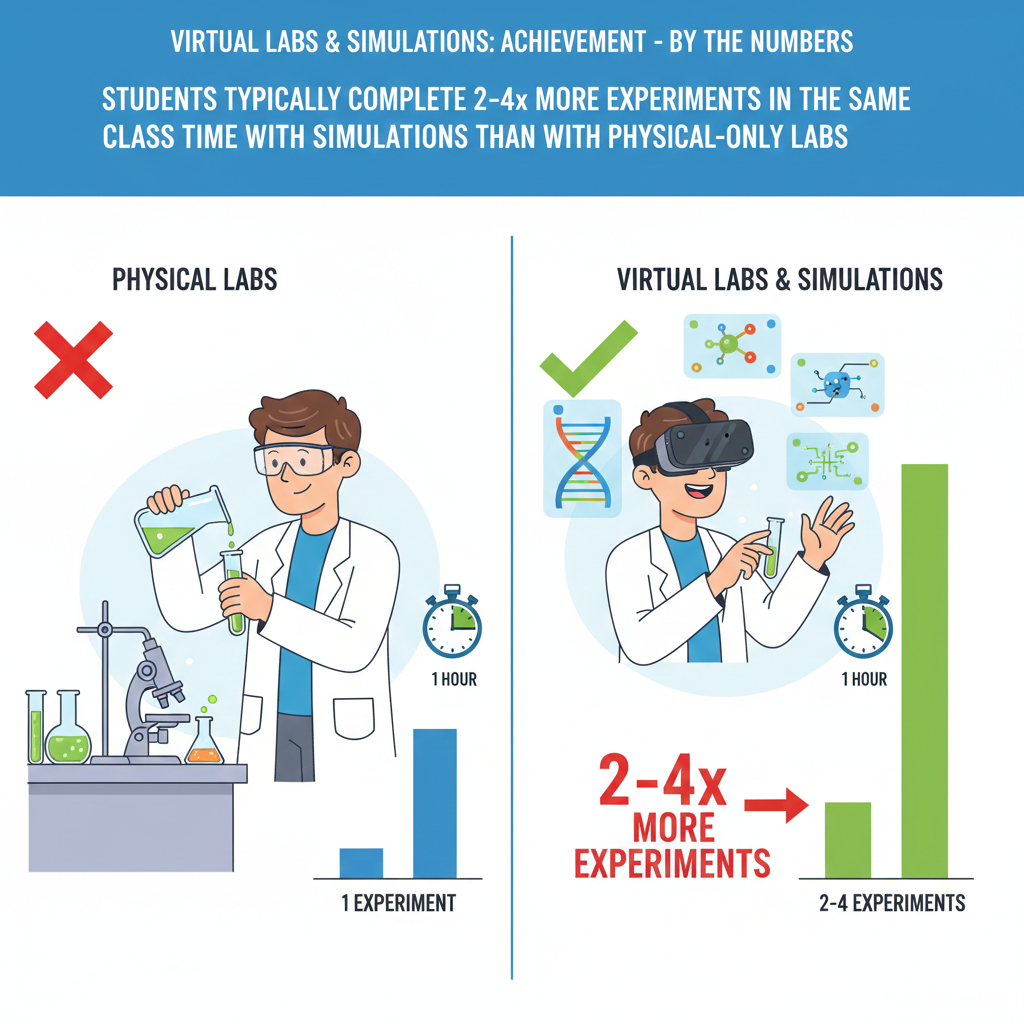
5) Students typically complete 2–4× more experiments in the same class time with simulations than with physical-only labs.
Why “more experiments” often means “more learning”
In science, one trial is rarely enough. The first run is where a child learns the steps. The second run is where they start noticing patterns. The third run is where they begin to trust the evidence. Virtual labs make this easier because there is no waiting for tools, no broken equipment, and no long reset time.
So in the same lesson window, many students can do two to four times more experiments than they could with physical-only labs. That extra practice turns a fuzzy idea into a clear one.
How to make extra trials count, not just pile up
More trials only help if your child changes things in a smart way. Use a “one change rule.” Each new experiment should change only one variable. If they change two things at once, the result becomes confusing.
For example, in a motion simulation, change only the mass first while keeping the force the same. Then change only the force while keeping the mass the same. This is the habit that strong science students use, and it shows up directly in test questions.
Also, make your child name each trial. They can say “Trial 1: light mass,” “Trial 2: heavy mass,” and so on. Naming trials sounds small, but it keeps the brain organized. It also makes it easier to explain results out loud, which improves understanding.
A quick routine you can repeat every week
Use a three-trial routine. First trial is “baseline,” where your child sets normal values and watches what happens. Second trial is “push the limit,” where they make a big change to see a strong effect. Third trial is “middle ground,” where they choose a value in between to confirm the pattern.
End by asking, “What stayed the same across all trials?” and “What changed the outcome the most?” If you want your child to do these kinds of high-quality trials with a teacher guiding the choices, Debsie’s live classes are built for that. You can book a free trial on Debsie.com.
6) Repeating an experiment in a simulation (multiple trials) can increase accuracy/understanding by ~15–30% compared with doing it once.
What repeat testing teaches that one test cannot
A single experiment can lie to you. Not because science is wrong, but because one run can be a fluke. Repeating a test teaches a child to look for stable patterns, not lucky results.
This is why doing multiple trials in a simulation can raise accuracy and understanding by about fifteen to thirty percent compared with doing it once. The child learns to trust evidence that repeats, which is a core science skill.
How to repeat in a way that builds real understanding
Use “same settings, three runs” first. Keep everything the same and run the simulation three times. Ask your child if the outcome is identical each time. If it is not, talk about why small differences might happen. This is a gentle way to introduce the idea of variation, which is important in many science topics.
Next, use “one change, three runs.” Change one variable, then repeat again. The goal is to see if the new outcome holds steady. This helps the child separate cause from noise. It also trains them for exam questions that ask about reliability and fair tests.
An easy way to track repeats without long notes
Do not let note-taking become heavy. Use a simple sentence after each run. “Run 1: the temperature rose fast.” “Run 2: rose fast again.” “Run 3: rose fast again.” Then ask for a conclusion: “So I think higher heat makes the rise faster.”
This keeps writing short but thinking strong. At Debsie, we teach kids to repeat and conclude in this simple way so they improve without feeling overwhelmed. If you want your child to learn this skill with clear guidance, start a free trial at Debsie.com.
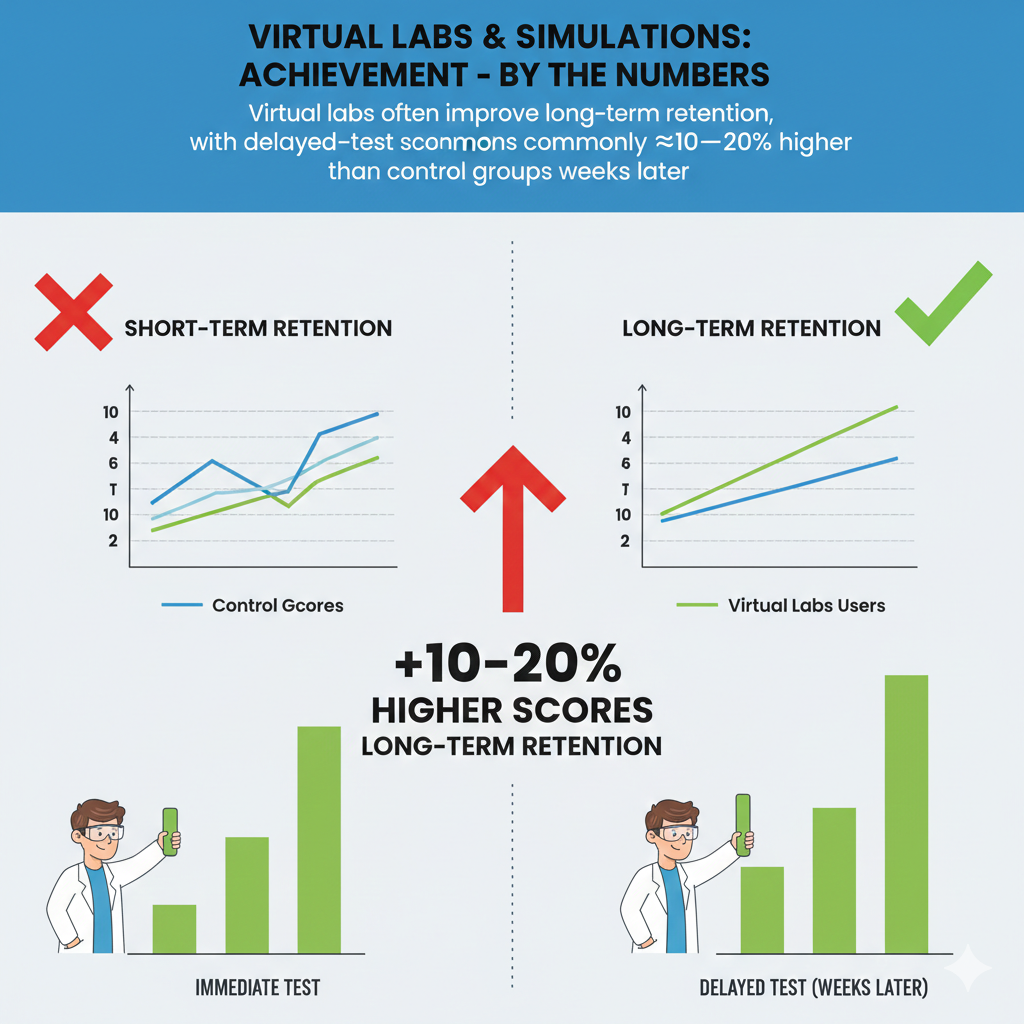
7) Virtual labs often improve long-term retention, with delayed-test scores commonly ~10–20% higher than control groups weeks later.
Why simulations help the brain remember for longer
Many children can do well on a test the next day and still forget the topic a month later. That is because short-term memory is not the same as true learning. Virtual labs improve long-term retention because the child builds a memory that includes action, choice, and feedback.
They do not just read about a reaction. They run it. They see what changes. That kind of memory sticks. This is why delayed-test scores are often about ten to twenty percent higher weeks later when virtual labs are used well.
How to use simulations for “memory that lasts”
The key is spaced review. Instead of doing one long lab and never returning, do a short lab again after a few days, then again after two weeks.
Keep it brief, even eight to ten minutes. Each time, ask your child to predict before they run it. Prediction forces recall. Recall strengthens memory.
Also, link the lab to a real-world hook. If the lab is about heat transfer, connect it to cooking, hot tea, or sunlight on a car seat. When a child ties a science idea to daily life, the brain stores it as useful knowledge, not school-only knowledge.
A retention plan that is simple and realistic
Try this. Day 1: learn the topic and run the simulation. Day 4: run the same simulation but change one variable and explain the difference. Day 14: do a quick “teach-back” where your child explains the main idea without looking at notes, then checks themselves with the simulation.
This plan takes very little time, but it builds lasting learning. If you want a teacher to handle this kind of review pattern through structured lessons, Debsie can help. You can book a free trial at Debsie.com.
8) Simulations that show invisible processes (atoms, forces, fields) frequently improve concept understanding by ~20–40% over static diagrams.
Why “seeing the unseen” changes everything
A big part of science is about things we cannot see. Atoms, electric fields, magnetic forces, gas particles, and energy transfer are real, but invisible. Static diagrams in books try to show these ideas, but they stay frozen.
Simulations make them move. They show cause and effect in real time. That is why understanding often jumps by twenty to forty percent when kids learn invisible processes through simulations instead of only pictures.
How to make invisible concepts feel simple and clear
Use a “watch, then control” approach. First, let your child watch the simulation for one minute without touching anything. Ask them to describe what they notice. Then let them control one thing. For example, in an atom simulation, they can add electrons and watch the charge change.
In a forces simulation, they can increase friction and watch motion slow down. This slow start prevents overwhelm and helps the child build a mental picture before they start experimenting.
Next, use a “what is pushing what” question. Invisible processes still follow simple rules. Ask, “What is causing the change?” If the field is stronger, what does it do to the object? If temperature rises, what happens to particle motion? This question trains the child to think in cause-and-effect chains, which is exactly what tests want.
A practical way to lock in the learning
After the simulation, have your child draw a quick sketch from memory. Not a perfect drawing. Just arrows and labels. The goal is to show the main idea, like “field lines pull the object” or “particles move faster when heated.”
Then they check their sketch by looking at the simulation again. This loop turns an invisible idea into something they can “see” in their mind later. If your child needs guided help with these hard-to-see topics, Debsie’s teacher-led labs are built for this. You can start with a free trial at Debsie.com.
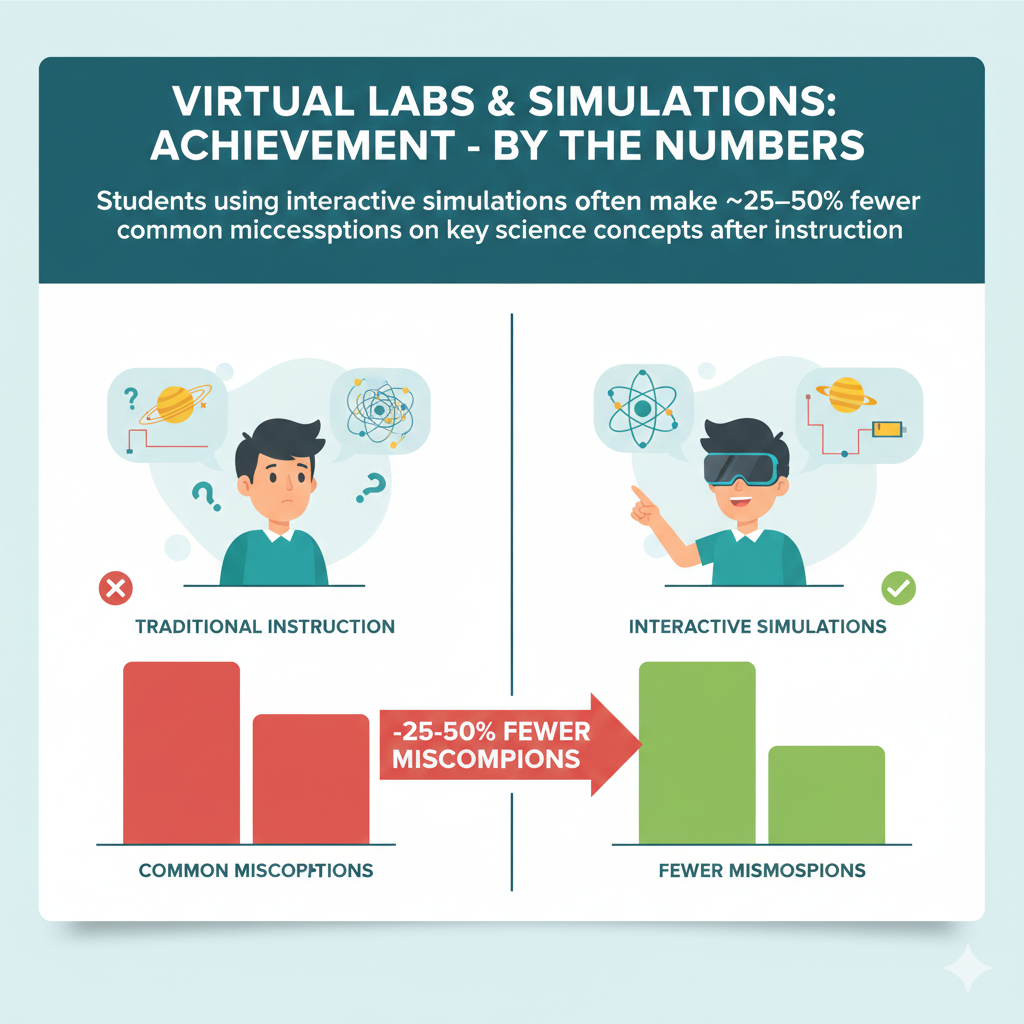
9) Students using interactive simulations often make ~25–50% fewer common misconceptions on key science concepts after instruction.
What misconceptions look like, and why they are so stubborn
Misconceptions are not just wrong answers. They are wrong stories the brain believes. For example, “heavier objects fall faster,” or “electricity gets used up,” or “plants eat soil.” These ideas can stick for years because they seem to match everyday experience.
Interactive simulations help because they let kids test the story and see it fail. That direct evidence is powerful, which is why misconceptions often drop by about twenty-five to fifty percent after strong simulation-based lessons.
How to use simulations to “break” a wrong idea safely
First, name the misconception out loud in a neutral way. Say, “Some people think heavier objects fall faster. Let’s test it.” This keeps the child from feeling embarrassed.
Then run the simulation in a way that makes the misconception show up clearly. Drop a heavy and light object at the same time in a virtual environment. Let the child watch the result. Then repeat it, because repetition makes the new idea feel true.
Next, ask for a replacement sentence. The brain needs a new story, not just “that was wrong.” A good replacement sentence might be, “Objects fall at the same rate when air resistance is not the main factor.” Keep it short and clear.
A simple “misconception check” you can do weekly
Once a week, ask your child one tricky question they might guess wrong on. Let them answer, then test it in a simulation. End by asking, “What evidence changed your mind?” This builds a strong habit: they learn to trust evidence more than first thoughts.
Debsie lessons often include these misconception checks because they clean up weak spots early. If you want that kind of support, book a free trial at Debsie.com.
10) Virtual labs can cut experimental error (measurement/reading mistakes) by ~20–40%, because tools are easier to use and repeat.
Why fewer errors leads to higher science scores
Many kids do not fail science because they cannot think. They fail because they make small mistakes while measuring or reading results. A tiny reading mistake on a scale or a rushed note can lead to a wrong conclusion.
Virtual labs reduce these errors because measurements are clearer, tools are easier, and the child can repeat the same setup quickly. This often cuts experimental error by twenty to forty percent, which means cleaner data and better answers.
How to turn “easy tools” into better science habits
Do not let the simulation do all the thinking. Teach your child to treat the virtual tool like a real tool. Before they record any number, they should pause and say the unit. For example, “This is 3 volts,” or “This is 25 degrees Celsius.” Units are a common test point, and saying them out loud builds accuracy.
Next, teach the “two-look rule.” They must look at the number, look away, then look again before writing it. This simple habit catches many mistakes. In a physical lab, kids rush because time is short. In a simulation, they can slow down and build careful habits.
A practical way to practice precision without stress
Give your child a “precision mission” once in a while. Ask them to run a simulation and collect three measurements. Then ask them to explain which measurement they trust most and why.
They learn that good science is not just numbers. It is confidence in the numbers. If you want your child to build these careful skills with teacher feedback, Debsie’s guided labs are ideal. You can book a free trial at Debsie.com.
11) In many classrooms, simulations help students score ~10–30% higher on graph-reading and data-interpretation questions.
Why graphs become easier with simulations
Graphs are where many students lose marks. Not because they are “bad at math,” but because they do not feel what the numbers mean. Simulations make data feel real. When a child changes one value and instantly sees a line move on a graph, the graph stops being a mystery.
It becomes a story of cause and effect. That is why scores on graph-reading and data questions often rise by about ten to thirty percent after steady simulation use.
How to train graph skills in a simple, repeatable way
Use a “change, point, explain” routine. First, your child changes one variable in the simulation. Second, they point to what changed on the graph. Third, they explain the change in one sentence. For example, “When we increased temperature, the pressure line went up.” This routine builds a direct link between action and data.

Next, add one key question that tests real understanding: “What happens between these two points?” Many kids only read the final value. Teach them to describe the trend. Is it rising fast, rising slowly, flat, or dropping? If they can describe the trend in plain words, they can answer most graph questions.
An actionable way to make graphs feel less scary
After the simulation, ask your child to create one “graph prediction.” They should say what the graph will look like before running the next trial. Even if they are wrong, the act of predicting makes them think in relationships, not random numbers.
If your child struggles with graphs, Debsie’s guided classes help them practice this skill often, using simple prompts and real-time feedback. You can book a free trial at Debsie.com to see how quickly graph confidence can improve.
12) Virtual labs commonly increase student time-on-task by ~15–35% compared with worksheets or passive video lessons.
Why time-on-task matters more than most parents think
A child can sit at a desk for an hour and still learn very little if their mind drifts. Time-on-task means the minutes where the brain is truly engaged. Simulations often increase this focused time by fifteen to thirty-five percent because the child is making choices, seeing results, and staying curious.
A worksheet can feel like repeating steps. A simulation feels like testing a real idea.
How to use this to build focus and reduce distractions
Set a clear start and finish. Tell your child, “We will do one simulation for twelve minutes, then we stop.” A short, clear time window helps attention. Before you begin, ask your child to say one goal out loud. “I want to learn what makes the car move faster.” This goal acts like a mental anchor.
During the simulation, use one small checkpoint. Halfway through, ask them to summarize what is happening in one sentence. This pulls attention back if it has drifted. It also builds the habit of self-checking, which is a strong life skill, not just a school skill.
A practical way to turn engagement into achievement
At the end, do not ask, “Did you have fun?” Ask, “What did you figure out?” Fun is nice, but learning is the win. Have your child name one discovery and one question. This keeps curiosity alive and makes the next lesson easier.
If you want your child’s focus to improve through guided, interactive lessons, Debsie’s live classes are designed to keep students active and thinking. You can start with a free trial at Debsie.com.
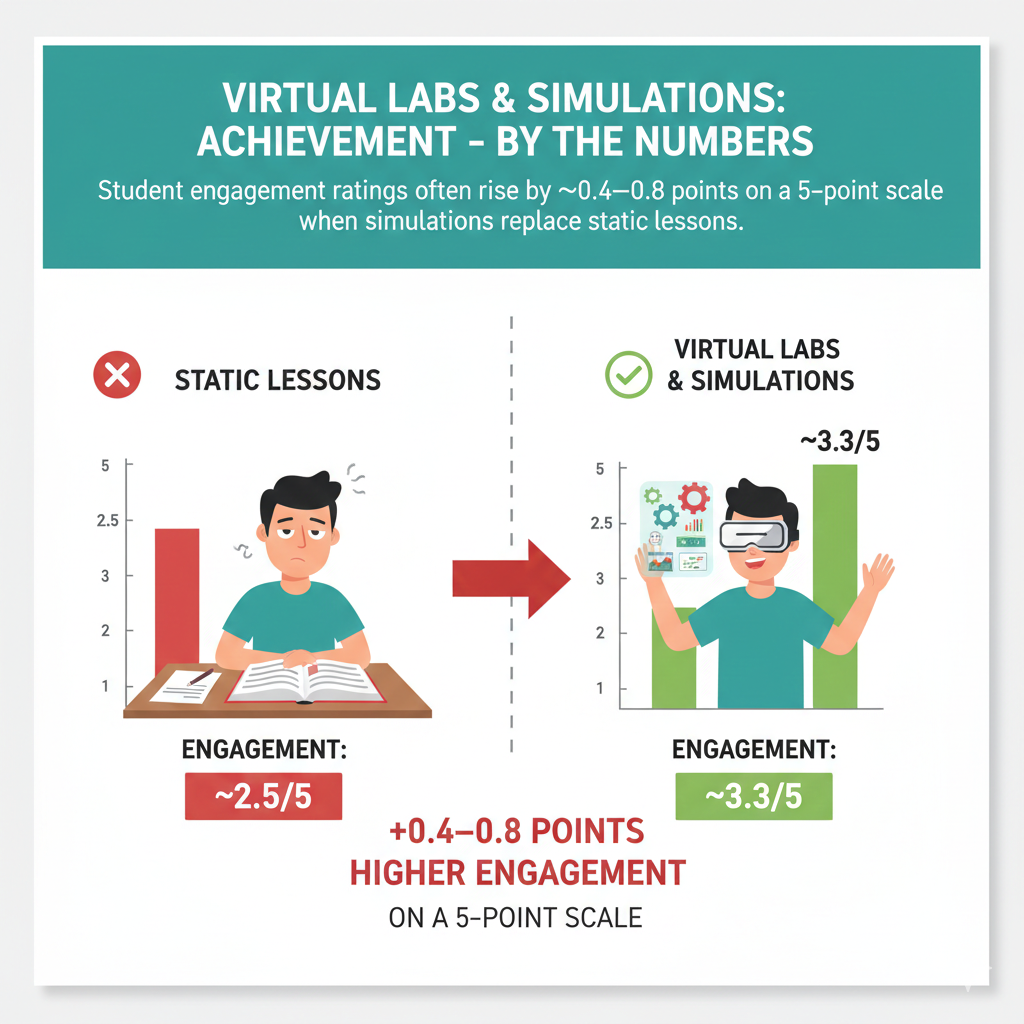
13) Student engagement ratings often rise by ~0.4–0.8 points on a 5-point scale when simulations replace static lessons.
What higher engagement looks like in daily learning
When engagement goes up, you see it. The child asks questions. They try again after a mistake. They stay longer without being pushed. An increase of about half a point to almost a full point on a five-point scale is meaningful.
It means the lesson feels more interesting and less like a chore. This matters because engagement is often the doorway to effort, and effort is what drives progress.
How to raise engagement without turning learning into pure entertainment
Engagement should come from ownership, not from flashy screens alone. Give your child small control. Let them choose which variable to test first, or which scenario to try. Then ask them to explain why they chose it. This makes the lab feel like their project, not your assignment.
Also, give the child a role. Say, “You are the scientist. Your job is to find the rule.” Kids respond well to identity. When they feel like a scientist, they act like one. They pay more attention and speak with more care.
A simple engagement method that works across ages
Use a “challenge question” before the lab begins. Keep it short and a bit surprising. “Can you make the bulb dim without changing the battery?” Then let them explore. When they succeed, ask them to explain the steps they used.
That explanation is where learning becomes strong. If you want your child to feel this kind of engagement in structured lessons, Debsie’s classes use gamified challenges with real science goals. You can book a free trial at Debsie.com.
14) Using virtual labs before a hands-on lab (“pre-lab simulation”) often improves hands-on lab performance by ~10–25%.
Why a pre-lab makes real labs less confusing
Many students walk into a physical lab not knowing what will happen. They spend the first half of the lab just trying to understand the steps. That is when mistakes happen. A pre-lab simulation solves this. The child meets the idea first in a safe, clear space.
They learn what each part does and what results to expect. So when they later do the hands-on lab, they focus more on thinking and less on guessing the process. This is why hands-on performance often improves by about ten to twenty-five percent after a good pre-lab simulation.
How to run a strong pre-lab in a short time
Keep it tight and purposeful. Do the simulation one day before the physical lab, or even the same day, right before it. Start by asking, “What is the main question of this lab?” Then let your child run the simulation once with normal settings, just to see the flow. After that, ask them to name the three steps they will need to do in the real lab. It should sound simple, like “set up, measure, record.”
Next, focus on one danger point. In many labs, the danger point is mixing, heating, or wiring. In a simulation, have them practice that step and explain what could go wrong. This builds safety thinking, which is a real science skill.
Actionable ways to carry simulation learning into the real lab
Before the hands-on lab starts, have your child write two predictions based on what they saw in the simulation. Then, during the physical lab, ask them to check if the results match. If they do not match, the child has a meaningful discussion to have, which is exactly what good science is.
If you want your child to build these pre-lab habits with expert guidance, Debsie teachers often use simulations to prepare students for real lab reasoning. You can book a free trial at Debsie.com.
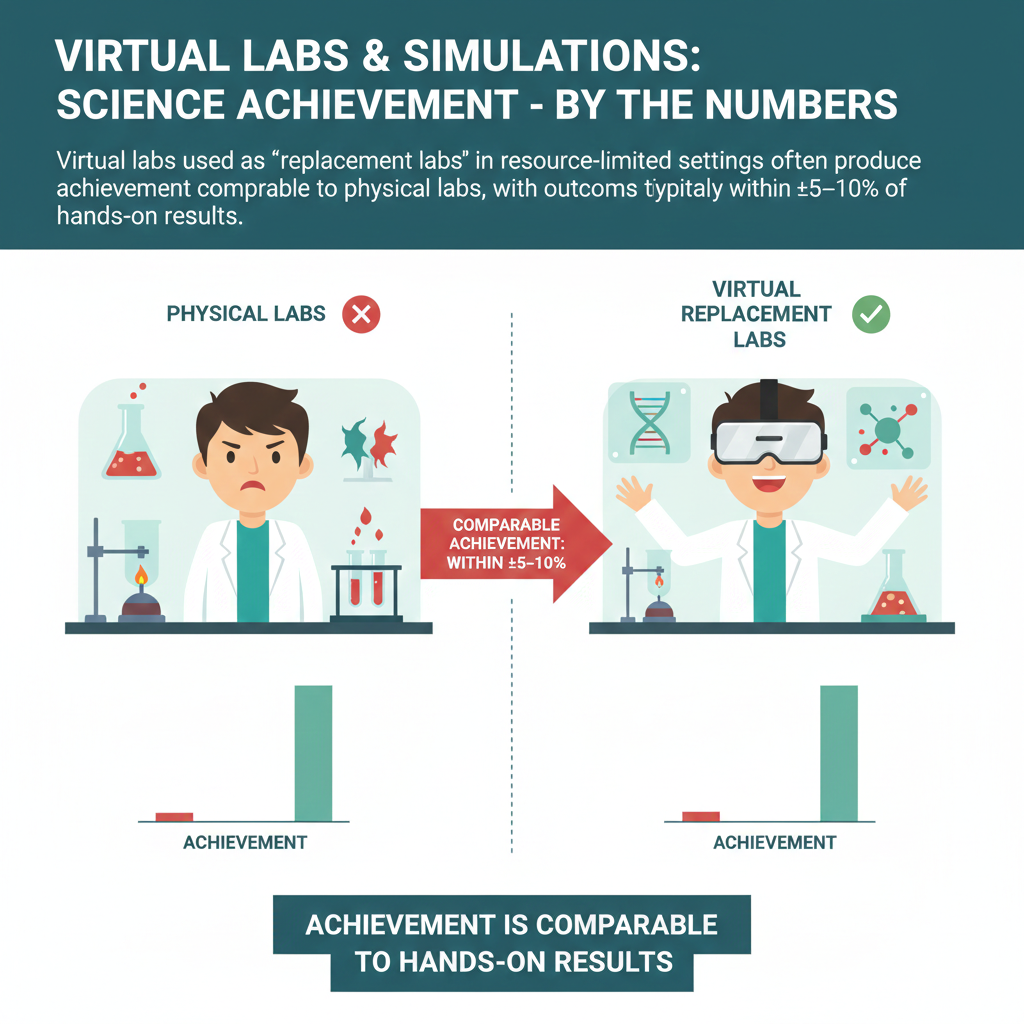
15) Virtual labs used as “replacement labs” in resource-limited settings often produce achievement comparable to physical labs, with outcomes typically within ±5–10% of hands-on results.
Why virtual labs can be “good enough” for real learning
Not every school has full lab equipment. Not every home can buy science kits. Virtual labs help close that gap. When designed well and taught well, replacement labs often lead to results that are close to hands-on labs, usually within about five to ten percent.
This matters because it means students can still learn key skills, even without expensive tools. They can test variables, record data, and explain results, which are the core goals.
How to make a replacement lab feel serious, not like a game
Treat it like a real lab. Set a “lab notebook” rule, even if it is just one page. Your child writes the question, the prediction, the steps they will take, and the result. Keep each part short, but make sure it exists. This gives structure and builds discipline.
Also, require evidence-based language. When your child gives an answer, ask them to include the data they saw. For example, “The temperature went from 20 to 30, so the reaction sped up.” This practice improves test writing and builds clear thinking.
How to add the “hands-on feel” at home without a full lab
If possible, pair a small real-life demo with the simulation. For example, if the simulation is about dissolving, let them stir sugar in water at home. If it is about shadows, use a flashlight and a toy. The physical demo does not need to be perfect.
It simply anchors the idea in the real world. Debsie’s approach is built to work globally, even where resources are limited, by using guided simulations plus simple at-home connections. You can start with a free trial at Debsie.com.
16) In blended models (virtual + physical), overall science achievement often improves by ~15–30% compared with physical-only labs done less often.
Why “both together” is often the strongest plan
Physical labs are great for real-world skills like handling tools and seeing real messiness. Virtual labs are great for clarity, repetition, and fast testing. When a child gets both, they often learn faster and deeper.
That is why blended models can raise science achievement by about fifteen to thirty percent compared with physical-only labs, especially when physical labs happen rarely.
How to build a simple blended plan without stress
Use virtual first, physical second, virtual last. First, do a simulation to learn the concept and the variables. Second, do a small hands-on activity to feel the concept in real life. Third, return to the simulation to test “what if” questions that are hard to do physically. This pattern prevents confusion and builds confidence.
For example, if the topic is circuits, start with a circuit simulator to learn what happens when you add another bulb. Then build a small real circuit kit if you have one, even a simple battery and bulb. Then return to the simulation to explore series versus parallel without worrying about short circuits.
Actionable ways to keep the blended model effective
Keep the goal consistent across both lab types. Use the same main question in both. Also, have your child compare results. Ask, “What matched? What was different? Why?” This comparison is where higher-level thinking grows.
Debsie uses blended thinking even when students cannot always do full physical labs, by adding real-life mini tasks around virtual labs. If you want a complete guided plan, book a free trial at Debsie.com.
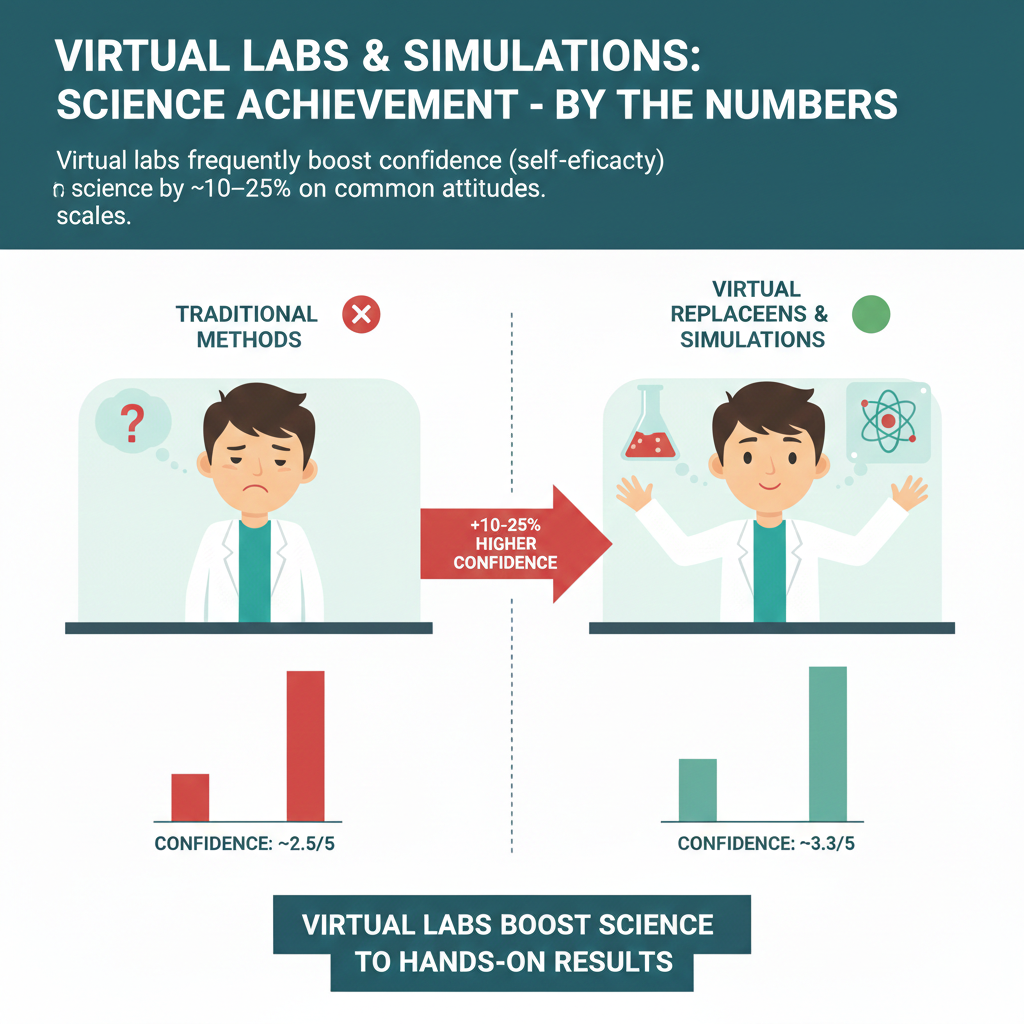
17) Virtual labs frequently boost confidence (self-efficacy) in science by ~10–25% on common attitude scales.
Why confidence is a learning tool, not a “nice extra”
When kids believe they can do science, they try more. They ask better questions. They stay calm when the first answer is wrong. That belief is called self-efficacy, and virtual labs often raise it by about ten to twenty-five percent.
The reason is simple: simulations lower fear. There is no glass to break, no chemical smell, no public mistake in front of classmates. The child can test, fail quietly, and try again. That repeated success builds a strong inner message: “I can figure this out.”
How to use virtual labs to build confidence on purpose
Start with a simulation that gives quick wins. Choose labs where the child can see a clear result in the first two minutes. Motion, magnets, simple circuits, and basic reactions are good options. Before they start, set a calm expectation: “You do not need to get it right fast. You just need to keep testing.” This reduces pressure and keeps their mind open.
During the lab, praise the process, not the outcome. Instead of “Good job, you got it,” say, “Good job, you tested your idea.” This teaches the child that effort and thinking matter. It also helps them feel safe taking risks, which is essential for science learning.
A simple confidence routine you can repeat weekly
At the end of each lab, ask your child to name one thing they can do now that they could not do before. It could be small, like “I can read the voltage meter.” Then ask them to choose one next challenge. This creates steady growth without overwhelm.
If your child feels anxious about science, Debsie’s guided classes can help because teachers create a safe, supportive lab space while still keeping standards high. You can book a free trial at Debsie.com.
18) Students in virtual-lab lessons often attempt challenging questions ~20–50% more often than students in non-interactive lessons.
Why kids take more risks when learning feels safe
Hard questions feel scary when a child is not sure they understand. In passive lessons, many kids avoid risk because a wrong answer feels like failure. Virtual labs change that. They make learning feel like testing, not like being judged.
That is why students often attempt challenging questions twenty to fifty percent more often after simulation-based learning. They have evidence in their mind, not just a memory of notes.
How to turn this into higher scores on tougher exams
After a simulation, do not only give easy practice. Give one stretch question. Not five. Just one. A stretch question is a problem that requires reasoning, not memorizing. For example, “If we double resistance, what happens to current?”
Then ask your child to explain their reasoning before choosing an answer. If they struggle, let them reopen the simulation and test. This teaches a powerful habit: use tools and evidence to solve hard problems.
Also, teach the child to break a hard question into two smaller ones. First ask, “What changes?” Then ask, “What does that change cause?” This method reduces fear because the question becomes manageable.
A practical way to build a “try the hard one” mindset
Create a small rule: every study session includes one question that feels slightly difficult. The goal is not to always be correct. The goal is to attempt it with a clear reason. Over time, this builds courage and skill.
Debsie lessons naturally include challenge questions after virtual labs, with teacher prompts that help kids attempt harder work without panic. You can start with a free trial at Debsie.com.
19) In many classrooms, simulations reduce the number of students who “give up” mid-task by ~15–30%.
Why “not giving up” is a major academic advantage
A child who stays with a task learns more than a child who quits, even if both started at the same level. Giving up often happens when the steps feel confusing, the result is unclear, or the child feels they have already failed.
Simulations reduce quitting because they provide quick feedback and easy resets. The child can try again without feeling stuck. That is why the “give up” rate often drops by fifteen to thirty percent with simulation-based lessons.
How to design simulation practice that keeps kids going
Use short goals with clear checkpoints. Instead of saying, “Finish the whole lab,” say, “Your job is to find one pattern.” For example, “Find what makes the object speed up.” This smaller goal feels reachable. When the child finds it, celebrate the discovery and then set the next goal.

Also, normalize mistakes. Before the lab begins, say, “We will make at least one wrong guess today, and that is good.” This statement changes the child’s view of error. Error becomes part of the process, not proof they are weak.
An actionable “anti-quit” script for parents and teachers
When a child wants to stop, do not argue. Use three calm prompts. First: “Show me what you tried.” Second: “What happened when you tried it?” Third: “What is one small change we can test next?” This keeps the child in motion.
Motion creates hope, and hope keeps effort alive. If your child often gives up in science, Debsie’s teachers can help build perseverance through guided labs that feel doable while still challenging. You can book a free trial at Debsie.com.
20) Immediate feedback inside simulations can cut wrong-answer persistence (repeating the same mistake) by ~20–40%.
Why fast feedback stops “stuck thinking”
Many kids do not fail because they make one mistake. They fail because they repeat the same mistake again and again. This is called wrong-answer persistence. In a normal worksheet, a child may do ten problems wrong before anyone catches it.
In a simulation, the system responds right away. The child sees the outcome and realizes, “That did not work.” This quick loop can reduce repeated mistakes by about twenty to forty percent, which protects both learning time and confidence.
How to use immediate feedback in a smart way
Teach your child to pause after each result and ask, “What did the simulation tell me?” The point is not to rush to the next click. The point is to read the feedback like a clue. If the graph line moves the wrong way, that is information.
If the circuit does not light, that is information. Encourage them to treat every outcome as a message, not as a failure.
Also, have your child change only one thing after a wrong result. Many kids panic and change multiple settings, which makes it impossible to learn what fixed the issue. A calm “one change” response builds good scientific thinking and reduces frustration.
Actionable practice to reduce repeated mistakes even more
Use a “mistake journal” line at the end of the lab. Not a long journal, just one sentence: “I first thought X, but the evidence showed Y.” This trains the brain to update beliefs, which is a life skill.
If your child benefits from guided feedback and teacher prompts that make this process easier, Debsie’s live simulation lessons do exactly that. You can start with a free trial at Debsie.com.
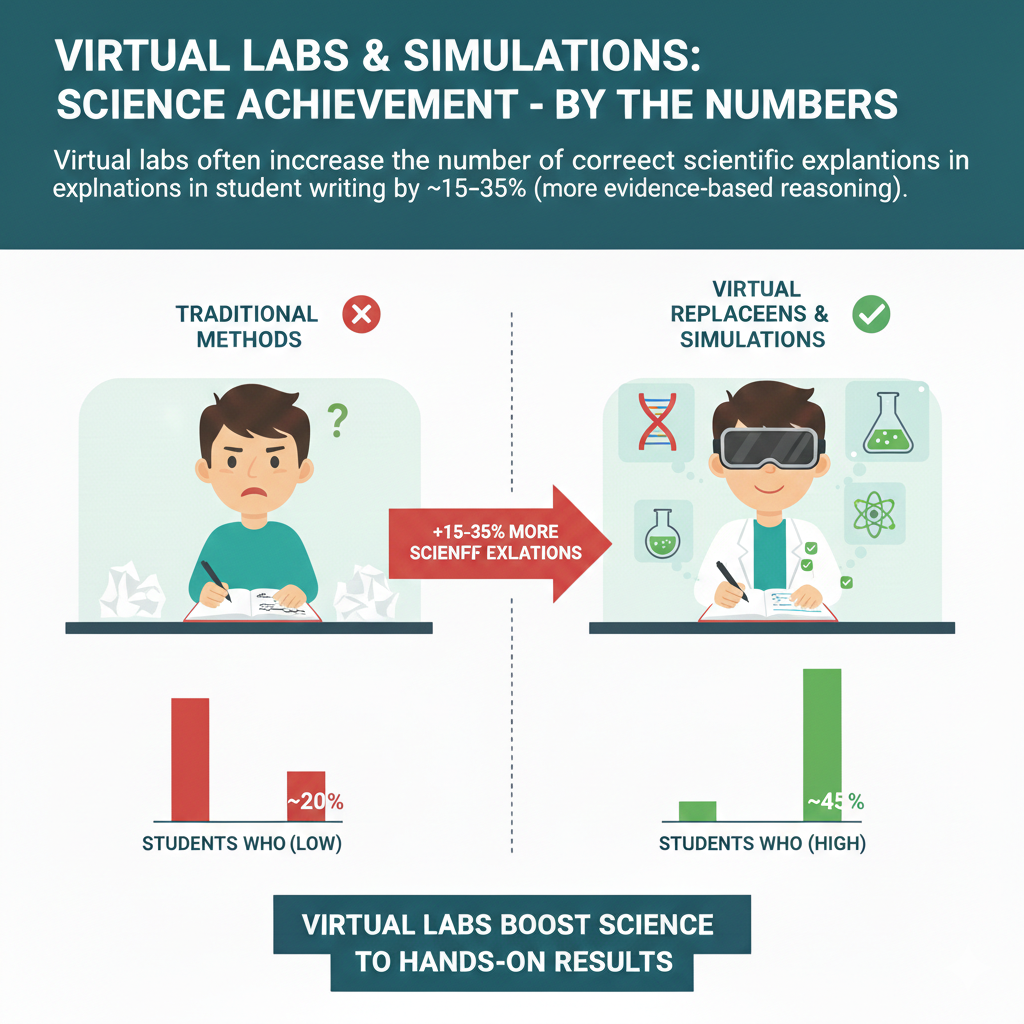
21) Virtual labs often increase the number of correct scientific explanations in student writing by ~15–35% (more evidence-based reasoning).
Why writing improves when kids can “point to evidence”
Science writing is hard for many kids because they do not know what to say beyond the final answer. Simulations help because the child has something concrete to refer to. They saw the values change.
They saw the pattern repeat. So their writing becomes more evidence-based. That is why correct scientific explanations in writing often rise by about fifteen to thirty-five percent after simulation-based learning.
How to turn lab results into stronger written answers
Teach a simple sentence pattern. It is not a bullet list. It is a speaking-and-writing frame. “When I changed __, then __ happened, because __.” For example, “When I increased the force, then the cart sped up, because the push was stronger.” This pattern is short, clear, and matches how many exam rubrics give points: change, result, reason.
After the lab, ask your child to write two sentences only. First sentence describes the evidence. Second sentence explains the idea. This keeps writing from becoming long and messy. It also trains clarity.
A practical way to prepare for exams that require explanations
Once your child writes the two sentences, ask them to underline the data words. Data words include numbers, directions, and comparisons, like “higher,” “lower,” “from 2 to 4,” or “twice as much.” This habit ensures they are not writing empty phrases.
At Debsie, we help students practice these short, strong explanations often, so test writing becomes easier. You can book a free trial at Debsie.com.
22) Students commonly improve “control of variables” skills by ~10–25% after repeated simulation-based investigations.
Why “control of variables” is a big deal in science achievement
Controlling variables means changing one thing at a time so you can trust your conclusion. This is one of the most tested science skills. Many students struggle because real labs can be messy and hard to reset.
Simulations make clean testing easier. Over repeated investigations, control-of-variables skills often improve by about ten to twenty-five percent, which directly improves performance on experiments, lab reports, and exam questions.
How to teach this skill in a way that feels easy
Start with a simple rule your child can repeat: “One change, everything else same.” Before they run a trial, ask them to name what will stay the same. This is the part most kids skip. If they can say it out loud, they are already improving.
Next, teach them to label variables in plain words. The variable you change is “the change.” The variable you measure is “the result.” The ones you keep the same are “the controls.” Using simple labels helps them remember the roles without getting lost in big terms.
Actionable practice that locks in the skill
Give your child a “fair test check” before they run any simulation trial. Ask, “Is this fair?” If not, ask, “What do we need to keep the same?” Over time, this question becomes automatic.
If you want your child to master fair testing with structured practice and teacher feedback, Debsie’s guided labs are ideal for building this core skill. You can start with a free trial at Debsie.com.
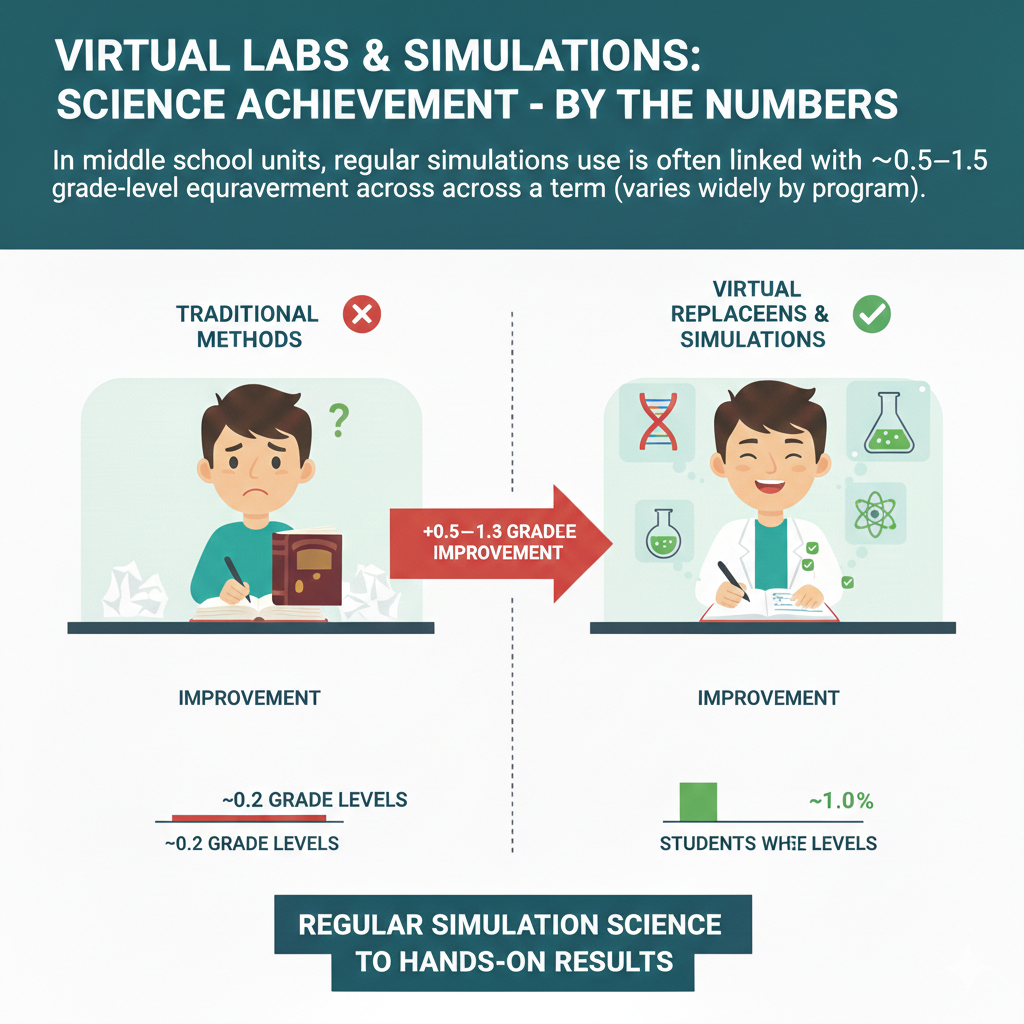
23) In middle school units, regular simulation use is often linked with ~0.5–1.5 grade-level equivalents of improvement across a term (varies widely by program).
What “grade-level improvement” means in real life
When a child gains half to one and a half grade levels of growth over a term, it usually shows up in clear ways. They read questions faster, use correct science words more naturally, and solve problems with less help.
This number can vary by program and by student, but the main idea is steady: regular simulation use can speed up progress because it increases practice, reduces confusion, and helps ideas stick.
How to build “regular use” without turning it into a burden
The key word here is regular. Not long. Not daily. Just consistent. Pick two short sessions each week, about fifteen minutes each. Link them to current topics. If the class is on forces, use a forces simulation. If the class is on cells, use a cell model simulation.
Keep the same weekly rhythm so your child expects it, like brushing teeth. When learning becomes routine, progress becomes easier.
Also, do not jump between many platforms and many styles. Choose one main simulation source and stay with it for a while. Familiar tools reduce mental load, so your child spends brain power on science, not on figuring out buttons.
Actionable ways to measure progress across the term
Every two weeks, do a simple check. Ask your child to explain one concept from the last unit in three sentences, without notes. Then let them verify their explanation using a simulation. If their explanation improves over time, your plan is working.
If they still struggle, it is a sign they need more guidance, not more time. Debsie helps families get consistent progress by combining teacher-led labs with a clear learning path. You can book a free trial at Debsie.com.
24) For topics that are dangerous or expensive (chem reactions, radiation, high voltage), virtual labs can provide 100% access where physical labs provide 0% access (not possible to run).
Why access is a hidden driver of achievement
Some of the most important science ideas are hard to teach with real equipment. Schools cannot safely run high-voltage experiments for every child. Many chemical reactions require strict safety rules. Radiation topics are often taught with only pictures.
Virtual labs remove these barriers. They offer full access to learning experiences that many students would otherwise never see at all. That matters because achievement rises when students can explore, test, and understand, instead of only reading.
How to use “safe access” to build deeper understanding
When your child uses a simulation for a risky topic, lean into the “why” behind the safety. Ask, “Why is this unsafe in real life?” This helps them understand the real-world rules of science, not just the classroom version.
Then ask them to explore the boundaries in the simulation. For example, in a high-voltage simulation, they can see what happens when resistance changes. In a chemistry simulation, they can see how concentration affects reaction speed.
Also, teach a “safety-first mindset” even in a virtual space. Have your child state a safety rule before starting. This builds respect for science and prepares them for real labs later.
Actionable ways to make advanced topics feel less intimidating
Use a “small steps” approach. Start with a simple setting in the simulation, then increase complexity one step at a time. After each step, your child explains what changed. This prevents overwhelm and builds confidence.
Debsie uses simulations to unlock advanced topics safely, with teacher guidance that makes hard ideas feel approachable. You can start with a free trial at Debsie.com.
25) Virtual labs can reduce consumable costs (chemicals, disposables) by ~50–90% for many common school lab activities.
Why lower costs can lead to more learning opportunities
In many schools, lab budgets limit how often students can do experiments. Chemicals run out. Supplies cost money. Disposables add up. When virtual labs cut these costs by about fifty to ninety percent, schools and families can run more investigations, more often.
More practice usually means stronger skills. It also means fewer “we can’t do this lab” moments, which protects student interest.
How families can use virtual labs to save money and still learn well
If you are a parent, you do not need to buy many kits to teach science well. Use virtual labs for the big, repeatable practice: changing variables, collecting data, testing patterns.
Then, if you want hands-on work, spend money only on a few simple items that can support many topics, like a flashlight, magnets, measuring cup, and a small scale. Use those items for real-life connection, not for complex experiments.
If you are a teacher, use virtual labs for the parts that consume the most supplies. Save hands-on labs for key moments where tactile experience matters most. This blended approach protects budget while still giving students real-world lab feel.
Actionable ways to reinvest “saved cost” into better outcomes
When cost pressure drops, use the freedom to increase repetition and reflection. Let students run more trials, compare more results, and write clearer conclusions.
Also, use the saved money or time to improve guidance, like better lesson planning or more feedback. Debsie’s model supports families and schools by making high-quality lab learning accessible without heavy supply costs. You can book a free trial at Debsie.com.
26) Schools adopting virtual labs broadly often report ~20–40% fewer lab-safety incidents related to spills, burns, or broken glass.
Why safety links to achievement more than people realize
Safety incidents do more than cause minor injuries. They break the learning flow, raise fear, and make teachers avoid hands-on activities. When schools use virtual labs widely, safety incidents often drop by about twenty to forty percent because the risky parts are removed or reduced.
Less fear means more willingness to explore. More exploration means better learning. A calm environment also helps students focus, which improves results over time.
How to build a “safe scientist” mindset even with simulations
Even though virtual labs are safer, keep safety thinking alive. Begin each lab with one safety check question: “If this were real, what would be the main risk?” Your child might say “heat,” “acid,” or “electric shock.” Then ask, “What rule would keep us safe?” This trains respect for science and prepares them for real labs later.
In class settings, a teacher can use simulations to teach safety rules clearly before any hands-on work happens. The child learns what not to do without danger. This makes later physical labs smoother and more serious.
Actionable ways to reduce risk while still giving real lab practice
Use simulations for the risky core steps and hands-on work for safe parts. For example, let students use a simulation to learn reaction behavior, then do a safe real-life version using vinegar and baking soda under supervision.
Keep the real activity short and controlled, and use the simulation for deeper exploration afterward. At Debsie, we value both learning and safety. Our guided labs help students explore confidently without risk, while still building real science habits. You can book a free trial at Debsie.com.
27) Students with limited prior lab experience often show larger gains, commonly ~1.2–2× bigger improvements than already-advanced students.
Why beginners often benefit the most
A child who has never done real labs may feel behind. They may not know how to measure, test, or even what a “variable” is. Virtual labs level the field. They provide clear tools, repeatable steps, and instant results.
So beginners often grow faster than advanced students, sometimes one point two to two times more improvement. This is not because advanced students cannot learn. It is because beginners have more room to grow, and simulations help them catch up quickly.
How to use this to help a child who feels “not good at science”
Start with simple labs that build basic lab habits. Choose simulations where the child changes one thing and sees a clear change, like speed, brightness, temperature, or dissolving. Keep the first sessions short and successful. The goal is to build a pattern of “I tried, I saw, I understood.”
Also, teach basic lab language gently. Use everyday words first, then add science words. For example, start with “the change” and “the result,” then introduce “independent variable” and “dependent variable” later if needed. This keeps the child from feeling overwhelmed.
Actionable support that accelerates beginner growth
Create a “repeat until calm” rule. If the child looks unsure, repeat the same simulation with the same settings once more before changing anything. Confidence often comes from familiarity.
Then, when they are calm, introduce one change. Debsie is especially helpful for beginners because our teachers guide each step and keep learning friendly but serious. You can start with a free trial at Debsie.com.
28) Simulation-based instruction often narrows achievement gaps (by prior knowledge or access) by ~10–30% compared with traditional lab access patterns.
Why simulations can be a fairness tool
Achievement gaps often come from unequal access. Some students have strong labs at school, tutoring at home, and extra resources. Others do not. Simulations help narrow these gaps by providing consistent access to high-quality experiments and practice.
That gap-narrowing effect is often around ten to thirty percent, which can change a child’s whole academic path. When every student can run trials, see results, and learn core lab skills, fewer students get left behind.
How to use simulations to support a child who needs extra help
The key is pacing and guidance. A child who is behind often needs more time with the same idea, not more new topics. Use simulations to slow the lesson down without making it feel “babyish.” Let the child repeat key experiments and focus on one concept until it feels stable.
Also, use “small success steps.” Ask for one correct observation first, then one explanation. Many struggling students jump straight to explanation and get stuck. Observations are easier and build a bridge to reasoning.
Actionable ways schools and parents can reduce gaps together
If you are a parent, share the simulation link or topic with your child’s teacher and ask what concept is being tested this week. Then practice that exact concept at home. If you are a teacher, give short guided prompts with the simulation so students know what to look for.
Debsie supports gap-closing by offering guided, personalized instruction and gamified practice so learners from many backgrounds can grow steadily. You can book a free trial at Debsie.com.
29) Virtual labs can enable at-home practice, and classes that assign simulation homework often see ~10–20% higher unit-test scores than classes that do not.
Why at-home simulation practice works so well
Science homework often becomes reading and answering questions. That can help, but it does not always build true understanding. Simulation homework is different. It lets students practice the same skill they need for tests: changing variables, reading results, and explaining why.
Because the practice is active, unit-test scores often rise by about ten to twenty percent in classes that use simulation homework well.
How to assign or use simulation homework without stress
Keep the homework short and clear. Aim for ten to fifteen minutes. Give one goal, not many. For example, “Find out what makes the pendulum swing slower.” Then require a simple output: one prediction sentence and one conclusion sentence.
This prevents the common problem where homework becomes a long, tiring project.
Set a clear time window and protect it. Many kids do better when they know the task has an end. Also, do not mix too many tools. Use the same style of simulation often, so the child’s brain focuses on science, not on learning new controls.
Actionable ways to make simulation homework boost test scores
Use a “next day recap” routine. After your child completes the simulation, ask them the next day to explain the main idea in thirty seconds, without opening the lab. Then let them open it to check if their memory is correct.
This strengthens recall, which is what tests measure. If your child needs structured homework that feels fun but still builds deep learning, Debsie’s gamified learning path can help. You can start with a free trial at Debsie.com.
30) When students can change one variable at a time inside a simulation, correct cause-and-effect reasoning commonly rises by ~15–30% compared with open-ended physical trial-and-error alone.
Why “one variable at a time” builds real scientific thinking
Cause-and-effect reasoning is the heart of science. It is also where many students struggle. In messy trial-and-error, kids change many things at once and then cannot tell what caused the result.
Simulations make it easier to control changes, which helps the mind see clean patterns. That is why cause-and-effect reasoning often rises by about fifteen to thirty percent when students practice one-variable testing in simulations.
How to teach cause-and-effect in a way that feels natural
Use a simple question pair. First ask, “What did you change?” Then ask, “What changed because of that?” The first question identifies the cause. The second identifies the effect. Make your child answer both every time they run a new trial. Over time, they will start doing it without prompts.
Also, teach them to use linking words that show logic. Words like “because,” “so,” and “therefore” matter. They force the child to connect ideas, not just list them. For example, “I increased friction, so the object slowed down because more friction resists motion.”
This kind of sentence earns marks in exams and builds clear thinking.
Actionable ways to lock in cause-and-effect reasoning for tests
After a simulation, give your child a “swap question.” Ask, “If we reverse the change, what should happen?” If they increased mass and speed went down, then decreasing mass should make speed go up, if everything else stays the same.
This trains reverse reasoning, which is common in higher-level questions. Debsie focuses heavily on these cause-and-effect skills through guided simulations and teacher feedback, so students learn to explain, not just guess. You can book a free trial at Debsie.com.
Conclusion
Virtual labs and simulations are not a shortcut. They are a smarter path. The numbers in this article point to the same truth again and again: when students can test ideas, repeat trials, see results clearly, and explain what happened, their science achievement rises.
Scores improve, but more importantly, thinking improves. Kids learn to predict, check evidence, correct mistakes, read data, and speak with clarity. Those are not “school-only” skills. Those are life skills.