
Learning French can change a child’s future in Varanasi. It helps with school marks, college plans, jobs, travel, and even confidence. The best part? Your child can start today from home, with clear, friendly lessons that fit your family’s schedule.
This guide lists the top French tutors and classes for students in Varanasi, Uttar Pradesh. You will see why online training beats most offline options, how to choose the right program, and why Debsie is our number one pick for real results.
We keep everything simple: small steps, steady practice, and caring teachers. Your child learns to speak, not just memorize rules. You get progress you can hear each week.
If you want a safe, structured, and stress-free path—this guide is for you. And if you want to test the difference right away, book a free Debsie French trial class and hear your child speak more in one lesson.
Online French Training

Online French training is simple, calm, and effective. Your child learns from home in Varanasi. No commute. No waiting outside coaching rooms. No noise. Every minute goes into real learning.
In a good online class, the teacher explains in small steps, the child speaks often, and the platform offers tiny drills that fit into a busy day. This creates steady progress without stress.
Here is what strong online French learning looks like. First, the class focuses on four core skills—speaking, listening, reading, and writing—in that order. We do not start with heavy rules. We start with simple lines the child can say right away. The ear hears. The mouth repeats. The eyes read.
The hand writes one short line. Then we use those lines in a small talk or role play. This loop repeats in every lesson, so the brain forms a clean pattern. The child feels, “I can do this,” and that feeling becomes the fuel for the next step.
Second, practice is short and focused. Long homework leads to delay or tears. Small tasks get done. In a good online setup, the child completes 10–12 minutes of review on class days, and 5–6 minutes on busy days.
These micro-tasks are smart: a few sound drills, four or five word cards, one tiny writing line, and a 30–60 second voice task. The platform tracks streaks and celebrates effort. Little by little, sounds become clear and sentences flow.
Third, progress is visible. Parents can hear clips, see a simple plan for the week, and know the one small goal to focus on. You do not need big reports. You want to hear your child’s voice and see honest guidance. Online tools make that easy.
Fourth, timing is flexible. Varanasi school days can be long. There are festivals, family visits, and exam weeks. Online lessons fit around your life. You can pick morning slots before school, evening slots after homework, or weekend sessions. If you miss a class, you watch the recording and follow a small catch-up plan. The rhythm stays intact.
Finally, online training reduces risk and saves energy. No dust, heat, or rain commute. No long waits. A child who arrives fresh learns faster and speaks more. That single change—arriving fresh—often doubles the amount of speaking a child does in a week.
A strong online French program also ties lessons to real life. In Varanasi, children enjoy projects like “My Ghat Guide in French,” “Ordering chai and snacks (role play),” or “How to ask directions to Assi Ghat.” When language links to their world, memory sticks and confidence rises.
Over weeks, the child moves from single words to short lines, then to small talks, and then to easy conversations. Grammar grows inside this speech, not outside it.
For students who follow CBSE or ICSE, online training can mirror school chapters and add real-world talk. For teens aiming at DELF A1 to B2, online classes can include mock tasks, time practice, and gentle feedback that builds calm. The tone stays friendly; the plan stays clear.
Landscape of French Tutoring in Varanasi and Why Online French Tutoring Is the Right Choice

Varanasi has many ways to learn. You can find home tutors, small coaching rooms, and language centers spread across areas like Lanka, Bhelupur, Mahmoorganj, Sigra, Assi, and the BHU neighbourhood. Some offer group batches after school. Some offer weekend classes.
A few provide exam help for boards. If you live nearby and get a strong teacher, an offline class can cover the basics. But most families face the same hurdles again and again.
Travel takes time and energy. Even a 20–30 minute one-way trip to a coaching lane near Godowlia or Lanka can drain a child after a long school day. Heat, dust, sudden showers, or festival traffic slow things further. A child who arrives tired speaks less. And in language learning, speaking less means growing slower.
Timings are rigid. Many centers have one or two fixed slots. If your school schedule clashes, you are stuck. If a child misses a class, it is simply lost. There is no recording, and make-up sessions are rare.
Groups can be mixed-level. A single room might seat beginners and faster learners together. The teacher does their best, but someone always waits while someone else gets attention. The shy child stays quiet.
The quick child gets bored. Speaking time drops for both.
Parent updates are thin. You may receive a short note or a quick “everything fine” at the end of the month. You cannot hear the change in your child’s voice, and you may not know where to help this week.
Online tutoring removes these blocks. You pick the best teacher, not just the nearest one. You get flexible slots that respect your routine. You see clear progress with short clips.
Your child practices speaking more because the setting is quiet and the plan is kind. And you can start now, without searching lanes or waiting for the next batch.
One more local truth: Varanasi days are full. Between schoolwork, music, sports, family events, and festive times, the week gets crowded. Online French makes room for growth without chaos. The child learns in a quiet corner at home.
They feel safe to try. They receive quick praise and one small fix. Over time, this becomes a strong habit: listen, speak, read, write, use. That habit builds real French.
How Debsie Is the Best Choice for French Training in Varanasi

Debsie is our number one pick because it blends expert teachers, a clear plan, and a gentle, game-like platform that keeps children engaged. Debsie is built for kids, not just for “users.” Every step is simple. Every class is calm. Every week has a goal you can understand.
The Debsie method: small steps, steady wins
Each lesson follows a clean pattern:
- Hear a short line in slow, clear French.
- Say the line in small chunks with the teacher and alone.
- Read the same line with color hints for tricky sounds.
- Write one tiny sentence to lock spelling and order.
- Use the line in a quick pair talk or role play.
This loop turns new words into real speech. Children stop fearing errors because the steps are tiny and safe. The teacher smiles, corrects with care, and moves on.
Speaking first, always
Debsie makes speaking the center of each class. There is talk time with the teacher, with a partner, and with the group. Children use cue cards, micro-dialogs, and one-minute talks. The focus is voice, not notes. Grammar appears when the child is ready. We name patterns after the child has used them, not before. This protects confidence and builds natural fluency.
Daily practice that actually happens
Debsie’s platform offers Quick Mode (5–6 minutes) for busy days and Full Mode (10–12 minutes) for normal days. Both modes include a touch of sound, a few words, one short line, and a voice task. The platform gives badges for steady effort, not for random taps. Streaks feel fun but quiet. The screen is clean, with no loud distractions. The child finishes fast and returns tomorrow without fuss.
“Pronunciation Lab” with human feedback
Each child records one line per day. The teacher sends a 20–30 second voice note with one praise and one tiny fix: “Great ‘bonjour’—crisp. Try softening the ‘n’ in ‘bien.’ Smile a little when you say it; it helps the sound.” These small tips, repeated over weeks, shape a clear, confident voice. This is coaching, not pressure.
Parent dashboard you can trust
You see a one-page view: what we learned, what improved, and one focus for the coming week. You can play short audio clips from Week 1, Week 3, Week 6, and hear the change yourself. If a class was missed, you get a gentle catch-up path: one short video and two tiny drills. No guilt. Just a clear way back.
A Varanasi-friendly schedule
Morning before school, evening after homework, or weekend—pick what fits. Exam week at school? We can slow the pace and keep the habit alive with Quick Mode. Festival week? Shift the slot and return smoothly the next week. Travel plan? Use recordings and micro-tasks to keep the rhythm. Debsie respects real life.
CBSE/ICSE support without stress
Debsie ties school topics to real speech. If your child’s book covers “My City,” we turn it into a mini project called “Varanasi in French.” The child learns to name places, foods, and common routes. They record a 60–90 second talk. This helps with internal assessments and builds fluency at the same time.
DELF A1–B2, step by step
For teens, Debsie offers calm DELF prep. We break each task into tiny parts. Listening: catch numbers, places, and times. Speaking: plan with three dots—start, detail, close. Writing: short, neat lines with correct accents and simple linkers. We run timed practice in a friendly tone so exams feel normal, not scary.
Project examples your child will enjoy
- “My Ghat Guide”: a short French talk on two ghats, what to see, and how to ask for directions.
- “Street Food in French”: a tiny menu card with polite phrases for ordering.
- “BHU Campus Walk”: simple sentences for giving directions and asking for help.
Projects keep language real. When words describe the child’s world, memory is strong and speaking is natural.
A sample month with Debsie
Week 1: Greetings, names, “How are you?”, numbers, spelling. One-minute talk: “About me.”
Week 2: Family words, simple questions, age, “this/that.” One-minute talk: “My family.”
Week 3: School words, days, time, daily routine. One-minute talk: “My school day in Varanasi.”
Week 4: Food and café role play, prices, polite forms. One-minute talk: “Ordering a snack.”
At the end of Week 4, your dashboard shows a before/after clip. You can hear the difference, not just read about it.
Care that feels human
Debsie teachers are warm, patient, and trained to work with children. They explain in plain words and correct gently. They notice small wins and celebrate effort. A child who feels safe speaks more. A child who speaks more grows faster. This is the heart of Debsie.
Safety, comfort, and value
Your child studies at home, in a known setting. No long rides in heat or rain. No late returns. Fees go into good teaching and useful tools, not building rent or paper waste. You get more value where it counts: in your child’s skill and confidence.
Start with zero risk
Book a free Debsie French trial class. In one lesson, you will see the clean method, hear your child speak more than you expect, and feel the calm tone that makes learning stick. If it fits, we build a plan. If you prefer a different path, you still leave with useful tips you can use anywhere.
Offline French Training

Offline classes in Varanasi can help when the group is small, the room is quiet, and the teacher is skilled. The child meets the teacher face-to-face and gets a change of scene. For some learners, that can be motivating. But offline setups often face the same issues: fixed timings, travel, mixed levels, and limited speaking time.
Many sessions lean on notes and worksheets. Speaking gets squeezed to the end. Parents get short updates. Missed classes are hard to recover.
If you find a great teacher near your home, an offline class can cover school needs. Yet, for most families, the wins of online—flexibility, recordings, clear data, calm pacing—make daily life easier and results stronger.
Drawbacks of Offline French Training
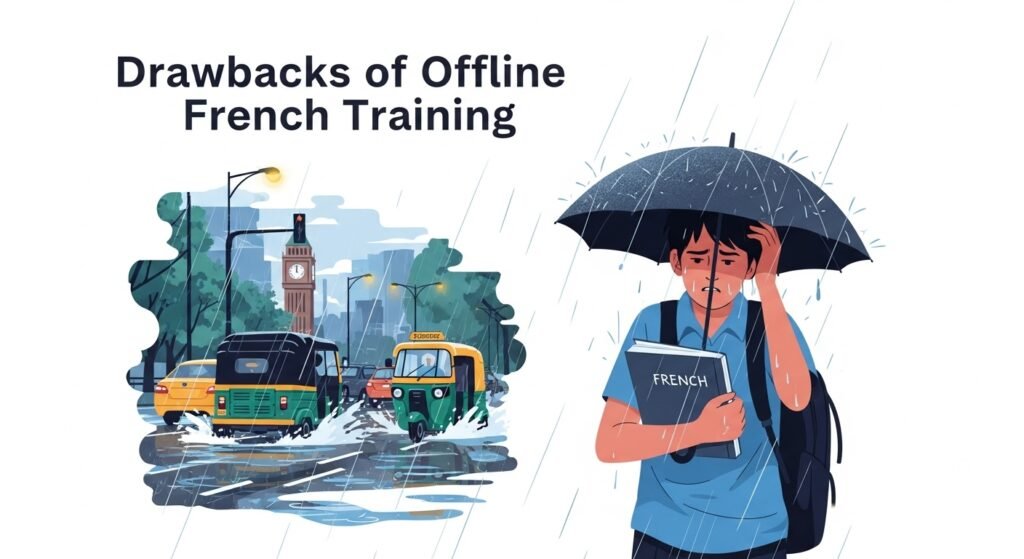
Let’s keep it real. A good classroom with a kind teacher can help. But most offline French classes in Varanasi still face the same old problems. These problems do not come from the teacher’s heart; they come from the setup itself.
Travel drains energy before class even starts.
Even a short ride from areas like Lanka, Mahmoorganj, or Sigra can feel heavy after school. Heat, dust, sudden showers, or festival traffic add stress. A tired child speaks less. And when speaking drops, growth slows. Online cuts this waste and keeps the child fresh for real practice.
Timings are fixed while family life is not.
A center may offer just one evening batch. Exams, music lessons, and family events do not always match that slot. If you miss a session, the hour is gone. There is no recording to help you catch up. In languages, missed practice creates small gaps. Small gaps become big gaps if they pile up.
Mixed levels reduce speaking time.
In a shared room, there may be new learners and faster learners together. The teacher tries to balance, but someone always waits. The quick child gets bored. The shy child goes silent. Real speaking minutes drop for both. A language grows through use. Less use means slower progress.
Paper-only homework slows feedback.
Worksheets help, but many centers cannot check them fast. A student may repeat the same small error for weeks before anyone notices. By then, the pattern is strong and hard to fix. Online tools can catch tiny issues early and guide the next day’s drill.
No simple record of progress.
Parents might hear “doing fine,” but can’t hear the child’s voice from Week 1 and Week 4 side by side. Without short audio snapshots, it is hard to feel the change. Clear, honest progress keeps motivation high for both child and parent.
Rooms are noisy, minutes are few.
A bell rings, a door opens, someone walks in late. These small breaks eat into speaking time. Often, notes and rules fill the period while voice practice gets squeezed to the end. Students learn about French more than they learn to speak French.
Hard to personalize without tech support.
One learner needs extra sound work. Another needs spelling help for accents. Offline, it is tough to serve each need in the same hour. Online, the platform can send the right micro-drill to each child in one click.
If you have a great center next door with tiny groups and a patient teacher, wonderful. But for most families, these hurdles show up again and again. This is why many Varanasi parents now choose a structured online path first—and use offline only for special needs.
Want to feel the difference in one class? Book a free Debsie French trial and hear your child speak more than you expect in a calm, friendly session.
Best French Academies in Varanasi, Uttar Pradesh

In this section, you’ll find a clear, honest view of your choices. We rank Debsie at number one because it gives children what they truly need: simple steps, lots of speaking, gentle feedback, and a plan you can trust. After Debsie, we list other options—some local, some regional, some national apps. We keep their details short and fair, and we explain where Debsie gives you more.
Remember: the best choice is the one your child will actually enjoy and stick with. Try a class, listen to their voice, and watch how they feel during and after the session.
1. Debsie — #1 French Classes for Students in Varanasi

Why Debsie is first
Debsie blends live teaching with smart, tiny practice. It is built for children, not just for “users.” The class is calm. The plan is clear. The teacher is warm. The screen is clean. Your child speaks in every lesson. You hear progress each week.
How Debsie actually works (so you can picture it)
The 5-step lesson loop: Hear → Say → Read → Write → Use.
- Your child hears a short, slow line in clear French.
- They say it back in small parts.
- They read it with color hints for tricky sounds.
- They write one simple line to lock spelling.
- They use it in a tiny talk or role play.
This loop keeps fear low and speaking high. We do not drop heavy grammar rules at the start. We let patterns grow through use. Then we name them when the child is ready.
Speaking at the center
Every class gives safe talk time: with the teacher, with a partner, with the group. Role plays, cue cards, micro-dialogs, and one-minute talks help shy voices open up. The teacher corrects gently, then moves forward. This steady, kind rhythm builds courage.
Practice that really gets done
Debsie’s daily drills take 5–6 minutes (Quick Mode) on busy days and 10–12 minutes (Full Mode) on normal days. A touch of sound, a few words, one tiny line, and a short voice clip. That’s it. Small work, done daily, wins. Streaks and badges reward steady effort quietly—no noisy screens.
“Pronunciation Lab” with human voice notes
Your child records one line a day. The teacher sends a 20–30 second voice note: one praise, one fix.
Example: “Your ‘bonjour’ is clear. Try softening the ‘n’ in ‘bien’. Smile slightly when you say it; it helps the sound.”
These micro-tips change speech fast without stress.
Parent dashboard that tells the truth
You see: what we learned, two wins, and one focus for next week. You can play short clips from Week 1 and Week 4 to hear the change. Missed a class? A gentle catch-up plan appears: one mini video and two tiny drills. No guilt. Just a path back.
Varanasi-friendly schedule
Pick morning, evening, or weekend. Shift around exams or festival weeks. Use recordings during travel. Keep the habit alive with Quick Mode when the week gets busy.
CBSE/ICSE support that feels natural
We link school topics to real talk. “My City” becomes “Varanasi in French”—naming places, foods, routes, and giving simple directions. This helps with internal assessments and real fluency.
DELF A1–B2 without panic
We break tasks into tiny parts and practice often:
- Listening: numbers, places, times.
- Speaking: three-dot plan (start, detail, close).
- Writing: short, neat lines with accents done right.
A friendly timer builds calm. Scores rise because fear falls.
Mini projects children love
- “My Ghat Guide”: a short talk on two ghats and how to ask for directions.
- “Street Food Menu”: polite phrases for ordering snacks and drinks.
- “BHU Campus Walk”: simple lines for giving and asking directions.
A sample first month (so you know what to expect)
- Week 1: Hello, names, “How are you?”, numbers, spelling your name.
- Week 2: Family words, age, “this/that,” simple questions.
- Week 3: School words, days, time, daily routine.
- Week 4: Food, café role play, prices, polite forms.
At the end of Week 4, you can hear a before/after clip on your dashboard. The difference is real.
Safety and value
Your child studies at home, in a known space. No commute, no delay, no risk. Fees go into teaching quality and useful tools, not rent and paper waste. You get value where it matters most: in your child’s skill and confidence.
Start free, decide calmly
Book a free Debsie French trial. Meet the teacher. Watch the method. Hear your child speak. Choose with confidence.
2. Alliance Française (Regional Option)
Alliance Française is known across India for French language and culture. The nearest official center for many Varanasi families is in a nearby metro city. They offer level-based courses and DELF prep with set schedules. The formal institute feel can suit older teens.
Where Debsie gives more: flexible slots that fit Varanasi school timings, daily micro-practice with teacher voice notes, simple parent dashboard with audio clips, and mini projects tied to local life. If travel or fixed timings are hard, Debsie will likely fit better.
When to pick this: if your teen wants a formal institute environment and you can manage set schedules. Still, try a Debsie class first to compare the comfort, speaking time, and pace.
3. University-Linked Language Courses (City Option)
Some families explore language offerings linked to local universities or colleges in and around Varanasi. These can be useful for adult learners or serious teens who prefer an academic setting. Schedules may be fixed, and classes may move at a steady group pace.
Limits you may face: mixed levels in one room, less speaking time, and paper-heavy tasks. Make-up classes are rare. Parent updates are minimal.
Where Debsie gives more: a child-first pace, a clean lesson loop, short daily drills, “Pronunciation Lab” with teacher voice notes, recordings for missed sessions, and a parent dashboard that shows real progress. If you want steady fluency and less stress, Debsie is the safer path.
4. Local Coaching Rooms and Home Tutors in Varanasi (Neighborhood Option)

Across areas like Lanka, Bhelupur, Mahmoorganj, Sigra, and Assi, you can find small coaching rooms or home tutors who take French batches after school. If you live nearby and find a gentle teacher, this can help with school basics.
Limits to watch: rigid timings, travel on hot or wet days, mixed-level groups, and little space for real speaking. If the tutor is one person without a structured plan, the flow may depend on their availability.
Where Debsie gives more: a planned path from A1 upward, a platform that sends the right drill at the right time, backup if a teacher is unwell, and steady, simple reports. With Debsie, your child is not tied to one person; they are supported by a whole system.
5. Self-Study Apps (National/Global Option)
Apps like Duolingo or Memrise are fun for extra word practice. They can keep a streak alive and add new vocabulary. Some children enjoy the quick, game-like feel for a few minutes a day.
The gap: there is no live teacher, little guided speaking, and no careful feedback on sound or sentence flow. Children may collect points without building real conversation skills.
Where Debsie gives more: live speaking time every week, human feedback on sound, clean projects, and gentle exam prep. You can still use an app for extra revision, but the core growth happens with Debsie.
A tiny chooser’s checklist for parents in Varanasi
- Will my child speak in every class?
- Is there a clear step-by-step plan from beginner upward?
- Do I get audio clips to hear real progress?
- Can we fit the slot into our real week?
- If we miss a class, is there a simple catch-up path?
Debsie checks all five. That’s why it sits at number one in our list.
Action you can take right now: Book the free Debsie French trial. In one lesson, you will hear the clean difference and feel the calm method that helps children grow.
Why Online French Training Is the Future

A quiet place builds a strong voice
Languages grow best when the mind feels calm. Online learning gives your child a quiet corner at home. No rush, no noise, no long ride. The teacher’s voice is clear in the headphones. The child hears every sound, repeats with ease, and speaks more than in a crowded room. When a child speaks more, skills grow faster.
Best teacher, not nearest teacher
In Varanasi, good tutors may be spread across many areas. Online, distance does not matter. Your child can learn from an expert who knows how to teach children, not just adults. This single change—choosing by quality, not by location—raises the level of learning from day one.
Short, smart practice beats long homework
Long homework often leads to delay. Short tasks get done. Online programs can deliver tiny drills that take 5–12 minutes and still move the needle. Two sound checks, a handful of word cards, one clean sentence, a 30–60 second voice task—done. Tomorrow, repeat. In a month, the voice is steady, and vocabulary feels natural.
Flexible timing that respects real life
Varanasi weeks are busy—schoolwork, festivals, family events, sports, music. Online lessons fit around your real life. You choose morning, evening, or weekend. If a session is missed, you can watch the recording and follow a small catch-up plan. The rhythm stays steady, and stress stays low.
Real speaking for every child
In many rooms, the loudest child speaks the most. Online, a teacher can give each child turns without crowd noise. Small pair talks, short role plays, and tiny one-minute shares help shy students open up. Speaking time per child increases. More minutes of speaking equals faster fluency.
Clear progress you can hear
Parents want honest proof, not long reports. Online tools can store short audio clips from Week 1 and Week 4, so you can hear the change. A simple dashboard can show the next goal in plain words. When progress is visible, motivation rises for both child and parent.
Safer and simpler
No commute in heat or rain. No late rides home. Children study in a known space. Safety and comfort lift mood and energy. A happy, fresh child learns better and remembers longer.
Personal help without fuss
One child may need extra sound work for “u” versus “ou.” Another may need spelling help with accents. Online platforms can send the right micro-drill to the right child. The teacher tracks small fixes week by week. Tiny problems never grow into big blocks.
Cost that focuses on learning, not overhead
When you remove building rent and paper waste, more value goes into teachers, tools, and support. Families pay for what actually helps: live classes, guided practice, and caring feedback.
Exams made calm
Boards and DELF reward steady skill. Online training builds listening, speaking, reading, and writing from day one, not just before an exam. Timed practice with a friendly tone teaches students to plan small answers, keep them simple, and say them clearly. Fear goes down; scores go up.
Inclusion for every learning style
Some children learn best by hearing. Some need to see colors on text. Some want to record and retry in private. Online tools can serve all these styles without calling attention to anyone. Each child gets what they need, quietly.
Real-life projects keep language alive
Good online courses add mini projects that connect to the child’s world—ghats, markets, campus walks, café menus. When words fit daily life, memory becomes strong. Children feel, “I use this for real,” and that joy keeps them coming back.
Parents become partners, not bystanders
A short weekly note, tiny voice clips, and one focus area tell you exactly how to help at home. You can practice two minutes before dinner, listen to a clip, and praise a small win. The child feels supported, not pressured.
The future is already online
Universities teach online. Companies train online. Exams run online. Children who learn French online today build habits they will use for years: time management, clear speech on a mic, focused listening, small-note planning. These are life skills, not just language skills.
What this means for your child in Varanasi
Your child can begin now, from home, with a strong teacher and a simple path. Practice will be short. Speaking will be central. Progress will be easy to hear. Confidence will rise week by week. This is the calm, steady way to build real French.
If you want to hear the difference yourself, book a free Debsie French trial. One class is enough to feel the method and see your child speak more than expected.
How Debsie Leads the Online French Training Landscape

Built for children first
Many platforms start with tech. Debsie starts with the child. We ask simple questions: What would help a shy student speak today? What would keep a busy teen steady before DELF? What would make a parent feel informed without long calls? The answers shape every class, drill, and report.
A clear ladder from A1 upward
Debsie’s path climbs gently: A1→A2→B1→B2. Each level has themes children know—home, school, food, places, plans. Each theme has small goals you can measure: introduce yourself, order a snack, ask for directions, describe your day. No big jumps. No confusion. Just clean steps and steady wins.
The five-step class loop
Every lesson follows a simple flow that keeps fear low and speaking high:
Hear → Say → Read → Write → Use.
- Hear a slow, clear line.
- Say it back in small parts.
- Read it with color hints for tricky sounds.
- Write one short sentence to lock spelling and order.
- Use it in a quick pair talk or role play.
This is not flashy. It is effective. Children leave each class with lines they can actually use.
Speaking is the engine
In Debsie classes, speaking is not squeezed to the last five minutes. It is the heart of the hour. The teacher guides tiny turns, friendly pair work, and one-minute shares. Corrections are kind and precise—one fix at a time—so courage stays high.
Micro-practice that really happens
Debsie gives two modes: Quick Mode (5–6 minutes) on busy days and Full Mode (10–12 minutes) on normal days. A touch of sound, a few word cards, one clean sentence, a small voice task—done. The habit survives even in exam weeks or festival days. Habit builds skill.
Pronunciation Lab with human coaching
Your child records one line a day. The teacher replies with a 20–30 second voice note: one praise, one tip. “Great rhythm on ‘Comment ça va ?’—now soften the ‘n’ in ‘bien.’ Smile slightly; it helps.” Small, friendly notes shape a clear, confident voice over time.
Parent dashboard that actually helps
You see what was learned, the last wins, and one focus area for next week. You can play short audio clips from the start and hear real change. Missed a class? A gentle catch-up plan appears: one tiny video, two small drills. No guilt. Just a path.
Varanasi-ready projects that make sense
Children do mini projects tied to their world:
- A Ghat Guide in French (two places, what to see, how to ask for directions).
- A Street Food Menu with polite phrases for ordering.
- A BHU Campus Walk with simple direction lines.
Projects turn words into real use. Memory sticks. Confidence rises.
CBSE/ICSE support without heavy notes
When school chapters cover “My City” or “Daily Routine,” we turn them into small talks and role plays. The child prepares for internal assessments while building real fluency. Reading and writing grow inside speech, not outside it.
DELF A1–B2, calm and clear
We break tasks into tiny parts and practice them often. Listening focuses on numbers, places, and times. Speaking follows a three-dot plan: start, detail, close. Writing stays short, neat, and accurate with accents. Timed practice feels friendly, not scary. Scores rise because fear falls.
Clean, modern design that keeps focus
No cluttered screens. No flashing distractions. Just the teacher’s face, simple prompts, and a calm layout. Children look, listen, and speak. Attention stays on the goal: building a strong voice in French.
Flexible slots for real homes
Morning before school, evening after homework, or weekend—choose what fits. Shift around exams or family travel. Use recordings and Quick Mode to keep the rhythm when weeks get busy. The plan bends, but it never breaks.
Support that feels human
Need help with timing, fees, or practice? You get quick, kind answers. Need extra speaking before a test? We share a short plan. Traveling for a week? We set a light practice pack so the habit stays alive. You are never alone.
Results you can feel in 20 minutes
From the first Debsie class, you will notice the difference: short steps, warm coaching, lots of speaking, and a clean, friendly screen. Children feel safe, try more, and surprise themselves. That small win becomes the engine for steady growth.
A simple way to start today
You do not need to commit blindly. Book a free Debsie French trial. Meet the teacher, try the method, and hear your child speak. If it feels right, we plan the next steps together. If you choose another path, you still keep useful tips you can use anywhere.
Conclusion: Confidence Today, Growth for Years

French should feel simple, kind, and useful. With Debsie, your child gets small steps, steady practice, and warm coaching. The result is a clear voice, calm mind, and real skills that last.
What your child gains with Debsie (quick, clear points)
- Confidence to speak: gentle turns every class; one praise + one tiny fix; voice becomes clear and brave.
- Real fluency: talk first, rules inside speech; short lines become easy talks and then natural conversations.
- Steady growth: 5–12 minute micro-practice builds strong habits; skills rise week by week without stress.
- Better focus: clean screen, quiet class, tiny goals; the mind stays on the task, not on noise.
- Strong memory: spaced review, repeat-after-me sound work, and real-life projects make words stick.
- Exam readiness: CBSE/ICSE links and DELF-style tasks; timed practice with a friendly tone lowers fear and raises scores.
- Clear pronunciation: teacher voice notes shape sounds one tip at a time; speech becomes crisp and easy to understand.
- Listening power: slow-to-normal audio trains the ear to catch numbers, places, and key words.
- Writing that works: short, neat lines with correct accents; simple linkers (“and,” “but,” “because”) for clean answers.
- Life skills: planning, patience, speaking on a mic, and calm thinking under time—all built into daily learning.
A simple plan for Varanasi families
- Book a free Debsie French trial. Hear your child speak more in one class.
- Choose your slot (morning/evening/weekend) and set Quick or Full daily drills.
- Track weekly wins on the parent dashboard—listen to clips, note one focus, celebrate progress.
Your child’s French can feel light, steady, and real. Less travel. Less stress. More speaking. More joy. That is the Debsie difference.
Ready to begin? Start with a free Debsie French trial today and hear the change in one lesson.


