

You want your child to learn French in a simple, calm way—clear steps, kind teachers, and steady wins you can see. If you live anywhere in Uttarakhand—Dehradun, Haridwar, Rishikesh, Haldwani, Rudrapur, Nainital, Roorkee—this guide is for you.
Here, you’ll find the best choices for French tutors and classes. You’ll see why smart online learning saves time (no traffic, no travel) and gives more speaking practice than long trips to coaching centers.
And you’ll see why Debsie is ranked #1: live expert classes, tiny daily missions that feel like a game, gentle feedback, and clean weekly reports for parents. Every lesson is mapped to CBSE, ICSE, IGCSE, IB and mirrors DELF tasks—so your child grows in marks and real-life French.
This is a practical, warm guide—like a one-to-one chat at the study table. By the end, you’ll have a small plan you can start this week: book a free Debsie trial, try two short missions, and set a 10-minute daily habit that fits even a busy Dehradun evening.
Online French Training

Online French training is simple and kind. Your child learns from home with a real teacher who says their name, smiles, and guides them step by step. There is no traffic. There is no rush. There is no wait outside a center.
Your child logs in, the class starts with a short warm-up to wake the ear, and then learning flows in small turns—listen, speak, read, write. Each turn has one clear goal.
The teacher gives a soft fix right away: how to make the r lighter, where to place un/une, how to link two words, how to start a clean sentence. Your child feels, “I can do this,” and that feeling builds steady progress.
Good online class is not a long video. It is live and human. The screen shows only one task at a time. The pace is steady. The steps are small. Ten focused minutes beat one tired hour. This matters in Uttarakhand.
In Dehradun, evenings get busy with school work and sports. In Haridwar and Rishikesh, traffic can slow the day. Families in Haldwani, Rudrapur, Nainital, and Roorkee juggle tuition, music, and family plans.
Online class gives back time. When time returns, stress drops. When stress drops, learning rises.
After class, your child completes one tiny “mission.” It takes just 6–12 minutes. It might be a sound shadow to copy rhythm, a verb sprint to build speed, a mini-read about daily life, or a two-line voice answer.
The tool gives a hint the moment your child slips. A small badge appears when they finish. These little wins create a habit. Habit beats cramming. Habit builds real skill.
Parents need truth, not guesswork. A strong online platform shows a clean dashboard: classes attended, missions done, words learned, speaking clips, and mock scores. You can cheer a win that day. You can help with one tiny tip at night. You feel calm because you see progress with your own eyes.
Online also protects shy voices. In a big room, many children stay quiet. In a smart online class, the teacher uses tiny breakout rooms—two learners at a time. No big audience. Your child tries one line, then another.
The teacher listens and leaves a gentle voice note: “lighten the r,” “join these two words,” “great pace today.” Fear fades. Courage grows. Oral marks rise.
Finally, online class matches your board. CBSE, ICSE, IGCSE, IB—each has its style. A good platform can switch tasks quickly while keeping the same skill goal. We also mirror DELF patterns in friendly ways. Your child learns what the exam asks, but the learning stays light and human.
If you want to feel this at home, book a free Debsie trial. Sit beside your child for five minutes. Watch the warm-up. Hear them speak sooner than you expect. Then let them do two tiny missions. If they finish with a smile, you know the path is right.
Landscape of French Tutoring in Uttarakhand and Why Online French Tutoring Is the Right Choice

French is growing in Uttarakhand. Many CBSE and ICSE schools in Dehradun and Haldwani offer it by middle grades. IGCSE and IB schools in and around the Doon valley treat it as a key second language. Parents often look for help when Grade 7 or 8 gets fast, when Board years start, or when the speaking test feels scary.
What happens when you choose only offline? At first, the room looks fine. But the day tells a different story. A one-hour class often becomes a two- or three-hour errand when you add travel and waiting.
Children reach class tired. Tired minds learn slowly. If rain is heavy or a school day changes, the class is missed. There is no short replay. A gap opens. Two or three gaps turn into “I cannot follow.”
Batches also mix levels. One child is a beginner; another is already quick. The teacher tries to serve both. The bold child speaks again and again. The shy child listens and waits.
Homework may not match CBSE, ICSE, IGCSE, IB, or DELF formats. Parents hear “doing fine,” but there is no weekly proof on paper or phone. Children work, but marks move little because practice is not exact.
Private tutors can be kind. One-to-one time helps shy learners. But plans often depend on one person. If that person travels or changes slot, the thread breaks. There is no shared platform, no mission trail, no parent dashboard. Your child loses rhythm; you lose visibility.
Online French tutoring fixes these problems. It keeps the heart of a good class—a caring teacher and clear steps—and adds smart design.
You get flexible slots that fit your week: early morning before school in Dehradun, evening after homework in Haridwar, a weekend slot in Rishikesh or Haldwani. If life happens—a festival, a match, a trip—you move a class. If a session is missed, a short recap clip and a mission pack pull your child back on track. The thread holds.
You get level-based groups after a soft placement check. No more “too fast” or “too slow.” The class flows like a steady river.
You get a mapped plan that links each week to board goals and DELF types: introduce yourself, describe your routine, talk about yesterday, order food, share weekend plans. Skills stack in small steps. Confidence stacks too.
You get fair speaking time. In tiny rooms, every child talks. The teacher listens and leaves a soft, precise tip for each learner.
The platform gives instant hints. Parents see real numbers—missions done, clips recorded, words learned, mock marks—so you can cheer wins and fix small gaps early with tiny steps.
For Uttarakhand families who value calm, clarity, and real growth, online French tutoring is the right choice. It saves time, protects energy, and turns effort into a daily habit at home—without fights.
If you want proof, try one Debsie class and two missions this week. Look for three signs: your child speaks early, finishes the mission without a push, and shares one small thing they learned. These signs show the design is working.
How Debsie Is the Best Choice When It Comes to French Training in Uttarakhand

Now let us talk about why Debsie is ranked #1. Debsie blends expert live teaching with a joyful practice world. It is not a pile of videos or random worksheets. It is a complete learning system your child will actually use—and enjoy—every week.
Soft placement that sets the pace right.
We start with a short, friendly check. We listen to a few sounds, look at common words, and ask one tiny question. From this, we place your child at the correct step—A1.1, A1.2, A2.1, and so on. The group fits. The pace fits. When the pace fits, confidence shows up on day one.
Live classes that build real skill in small steps.
Each class follows a clean flow. We open with a warm-up—a sound shadow, a picture talk, or a tiny rhyme. Then we train one skill—listening, speaking, reading, or writing—mapped to CBSE, ICSE, IGCSE, IB goals and shaped like DELF tasks.
We use real, simple items: a café menu, a school note, a short bio, a festival poster. Children answer in short turns. The teacher gives exact, kind fixes: lighten the r, add un/une here, move the verb in a question, link the last sound to the next, slow slightly on long words.
We end with action: a two-line role play, a mini pair chat, or a one-line write with a tiny checklist. Your child leaves class saying, “I can do this one thing today.”
Tiny missions that turn effort into habit.
Between classes, missions take 6–12 minutes. Points reward effort. Streaks make routine feel fun. Missions hit real pain points—accent marks, gender agreement, verb endings, word order—so errors fade week by week.
A normal week looks like this: a rhythm shadow, a verb sprint for speed, a 120-word mini-read on school or sport or food, a one- or two-line write with a model, and a quick oral answer recorded and sent. This mix is small but strong. Skills stay warm without heavy homework.
Speaking labs that remove fear.
Once a week, your child records in peace. No crowd. No stage. The teacher replies with a gentle voice note: relax the u, make the r lighter, link sounds, keep a steady pace. In four weeks, you hear cleaner sounds. In eight weeks, longer, smoother lines. In twelve weeks, a calm voice under a timer.
Exam kits that lift marks—without panic.
Near tests, Debsie changes gear.
For CBSE/ICSE, we drill exact reading types, guided writing frames, and high-yield grammar blocks.
For IGCSE/IB, we use simple templates for emails, blog notes, and picture talk with plain rubrics and timing.
For DELF A1/A2/B1, we follow the exact four-part format with tiny planning frames and a three-step error check.
Because practice mirrors the paper, scores rise steadily and stress stays low.
A parent dashboard that tells the truth.
Open your phone and see classes, missions, words, clips, and mock scores. Once a week, you receive one short note: a win to cheer and one tiny next step to try at home in two minutes. No jargon. No long PDFs. Just help you can use tonight.
Scheduling that respects Uttarakhand life.
Rain, travel, trek season, school sports—life moves. You can move a class. If you miss, a 3–5 minute recap clip plus a mission pack keeps the thread. No lost week. No guilt.
Teachers who guide with care.
Debsie teachers know the boards and DELF style. They explain hard parts in simple English when needed, then switch to French for practice. They keep steps small. They are patient. They treat mistakes as data, not drama. Children feel safe. Safe children speak more. Speaking more is the fastest path to growth.
A weekly routine you can start now in Uttarakhand.
Day 1: live class + short sound shadow.
Day 2: ten-minute verb sprint.
Day 3: mini-read + two spoken lines.
Day 4: live class + one-line write.
Day 5: board-style mini drill.
Day 6: free-choice story mission.
Day 7: rest + five-word review.
This fits a busy Dehradun evening or a quiet morning in Haldwani or Nainital. Small steps, done daily, build strong skill without stress.
Expected results with steady work.
4–6 weeks: cleaner sounds; short, safe sentences.
8–12 weeks: higher scores on board-style tasks; calmer speaking.
16–24 weeks: solid A1/A2 base; exam comfort.
~1 year: many reach DELF A2 or even B1, based on the starting level.
If this is the path you want, book a free Debsie trial now. Sit with your child for five minutes. Watch the warm-up. Let them complete two tiny missions. Decide with a calm mind.
Offline French Training

Some children like a room with desks, a board, and a teacher standing close. If the batch is tiny, the mentor is patient, and the center is near your home in Dehradun, Haridwar, Rishikesh, Haldwani, Rudrapur, Nainital, or Roorkee, offline can help.
A calm room, a clear voice, and printed notes feel familiar. For a few families, that comfort is enough.
But look at the day around that class. School ends late. Hills and bends slow traffic. Parking takes time. In monsoon, rain makes roads heavy; in winter, fog slows the drive. By the time your child reaches the center, energy is low.
After class, you ride back, dinner shifts, homework waits, and sleep shrinks. Learning needs a fresh mind. Travel eats that freshness.
Another quiet issue is mixed levels. One learner is just starting A1; another is already near A2. The teacher tries to help both. The bold child talks often. The shy child watches. Speaking needs many safe tries.
If your child gets only one turn in a 60-minute class, growth is slow.
Catch-up is hard offline. Fever, a school event, a family plan, rain, a trek day—life happens. If there is no short recap clip or clear make-up plan, a gap opens. Two or three gaps become “I feel lost.” Confidence dips. Children avoid speaking tasks.
If you already love an offline class and your child is happy, keep it. But protect daily practice with ten minutes of Debsie missions at home. That tiny habit keeps sounds fresh, verbs quick, and writing neat—even on days when you cannot travel.
If you are unsure where to begin, try a free Debsie trial first. Watch your child speak within minutes. See them finish two small missions without a push. Then decide the mix that keeps life calm at home.
Drawbacks of Offline French Training
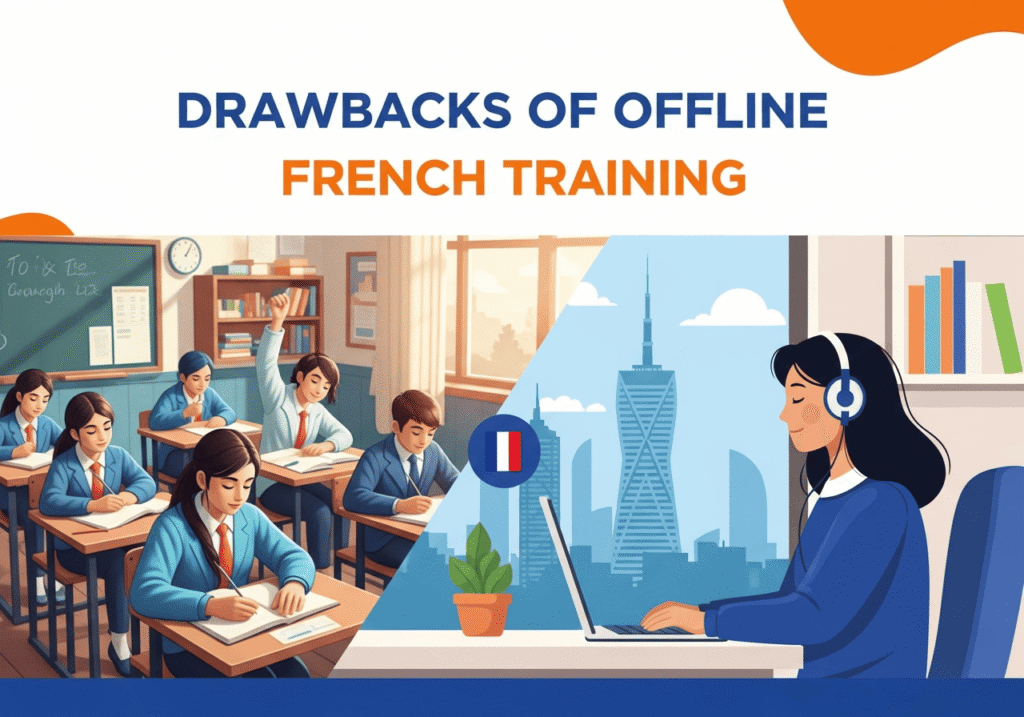
Offline feels safe because it is familiar. But the cracks that slow progress are real.
Travel drains time and energy.
A one-hour class becomes a two- or three-hour errand once you add the drive and waiting. Tired children do not learn new sounds like r, u, eu well. They forget small grammar cues that matter in exams.
Missed classes become lost content.
Rain, fog, fever, a school match, a family function—one missed session becomes a gap. Without a short replay and a mission pack, the next class moves on while the gap stays. Gaps stack. Marks stall.
Batches mix levels.
Beginners and advanced learners share one room. The pace fits no one. Speaking time per child gets thin. Quiet voices become quieter. Oral marks suffer.
Homework is not always mapped to board goals.
A page of exercises may not build the exact skills needed for CBSE, ICSE, IGCSE, IB, or DELF. Children work hard but do not see equal results because practice is not exact.
Feedback is late and light.
A tick in a notebook does not say, “Add un/une here,” “Move the verb before the subject in a question,” or “Link these two sounds.” Parents stay in the dark. Without weekly data, it is hard to cheer wins or fix small gaps early.
Plans depend on one person.
If a tutor travels or changes timing, progress pauses. Without a shared platform, the plan resets. Children feel the ground shift and lose rhythm.
This is why many Uttarakhand families now choose a strong online path first. It saves time, protects habit, gives fair speaking turns to every child, and shows real progress each week—calm and clear. Want to feel the difference? Book a free Debsie trial today.
Best French Academies in Uttarakhand

Here is a clear, parent-friendly view. We keep Debsie at #1 because it blends live expert teaching, joyful micro-practice, private speaking labs, exam kits, and honest weekly data for parents. Other options can help in some cases; we keep their notes brief so you can compare fast.
1. Debsie (Rank #1)

Debsie is built for busy Uttarakhand families who want calm progress and real speaking skill. It is not just a class hour. It is a full learning system where each part supports the next.
Week one feels different.
We begin with a soft placement (5–7 minutes). We listen to sounds, check common words, and ask one tiny question. From this, we place your child at the right step: A1.1, A1.2, A2.1, etc. The first class opens with an easy warm-up.
The core trains one skill—listening, speaking, reading, or writing—linked to CBSE/ICSE/IGCSE/IB goals and shaped like DELF tasks. We use simple, real items: a café menu, a school note, a short bio, a festival poster.
Children answer in short turns. The teacher gives precise, kind fixes in the moment. We close with action: a two-line role play, a mini pair chat, or a one-line write with a tiny checklist. Your child leaves with a small, proud “I can” for the day.
Daily missions make practice a habit.
Between classes, your child completes 6–12 minute missions. A sound shadow trains rhythm and linking. A verb sprint builds speed in the present, then past and future. A mini-read (100–150 words) grows flow and word sense.
A write-light task asks for one or two lines using a safe model and a three-point check. A short oral answer is recorded and sent. The platform shows hints the second a slip appears. Points reward effort, not only perfect scores. Streaks make practice feel like a small game—not a fight at home.
Speaking labs remove fear.
Once a week, your child records in peace—no crowd, no stage. The teacher replies with a gentle voice note: lighten the r, round the lips for u, relax the mouth for eu, link the last sound to the next word, keep a steady pace. In four weeks, speech sounds cleaner. In eight weeks, lines are longer. In twelve, timing feels natural.
Exam kits raise marks without panic.
Near tests, Debsie switches gears.
- CBSE/ICSE: exact reading types, guided writing frames, high-yield grammar blocks.
- IGCSE/IB: clean templates for emails, messages, blog notes, picture talk; plain rubrics; timing drills.
- DELF A1/A2/B1: the exact four-part pattern with tiny planning frames and a three-step error check.
Because practice mirrors the paper, scores rise steadily and stress stays low.
Parents see the truth.
Open your phone and see attendance, missions done, words learned, speaking clips, and mock scores. Once a week, we send one short note: a win to cheer and one tiny next step for home (two minutes). No jargon. No long PDFs. Just help you can use today.
Scheduling respects Uttarakhand life.
Rain, fog, treks, school sports—life moves. You can move a class. If you miss, a 3–5 minute recap clip plus a mission pack keeps the thread. No lost week. No guilt.
Teacher culture is gentle and exact.
Debsie teachers know board demands and DELF style. They explain hard parts in simple English when needed, then shift to French for practice. They keep steps small, celebrate effort, and treat mistakes as data. Children feel safe. Safe children speak more. Speaking more is the fastest way to grow.
A weekly plan you can start now.
Day 1: live class + short sound shadow.
Day 2: 10-minute verb sprint.
Day 3: mini-read + two spoken lines.
Day 4: live class + one-line write.
Day 5: board-style mini drill.
Day 6: free-choice story mission.
Day 7: rest + five-word review.
Results with steady work.
4–6 weeks: cleaner sounds; short, safe sentences.
8–12 weeks: higher board-task scores; calmer speaking.
16–24 weeks: solid A1/A2 base; exam comfort.
~1 year: many reach DELF A2 or even B1, based on start level.
Next tiny step: Book a free Debsie trial class. Sit with your child for five minutes. Watch the warm-up. Hear them speak earlier than you expect. Let them finish two tiny missions. Choose with a calm mind.
2. Alliance Française (India Network Serving Uttarakhand Learners)
Alliance Française is respected for cultural events and DELF pathways. For older teens who can follow fixed terms and travel to a branch city, it can help.
But batches may be larger, make-ups limited, and weekly parent data light. If you want flexible slots, daily micro-practice, gentle speaking labs, and board-linked tasks, Debsie fits better and saves travel time.
3. City Language Schools and Institutes (Dehradun / Haridwar / Haldwani)
Local institutes run French batches with friendly teachers and grammar drills. Lesson quality and assessment style vary by center. Speaking time depends on batch size.
If you prefer a mapped path to CBSE/ICSE/IGCSE/IB outcomes and DELF formats—plus weekly parent notes—Debsie offers more consistency month after month.
4. Private Tutors and Marketplaces (Across Uttarakhand)

A home tutor can be kind and flexible. One-to-one time helps shy learners. But plans often depend on one person. If the tutor travels or changes timing, progress pauses. There is usually no shared platform, no mission trail, and no dashboard.
Many families keep a tutor but add Debsie for missions, speaking labs, and exam kits. This mix protects continuity and keeps practice steady.
5. University and Continuing Education Units
Colleges sometimes offer evening language classes at fair fees. Groups are mixed in age and level. Content may not match school boards closely. Parent visibility is limited. If your goal is school marks, oral confidence, and a child-first routine, Debsie remains the safer choice.
Why Online French Training is The Future

Online learning matches how families in Uttarakhand live now. It saves time, protects energy, and keeps a steady rhythm even when roads curve through hills, rain slows traffic, or school days run long.
Your child signs in, learns with focus, signs out, and still has space for homework, sport, music, or rest. A fresh mind learns faster and remembers longer.
Short, daily practice is the real engine. Six to twelve minutes a day is enough to lock sounds, verbs, and key phrases. A good platform turns this into tiny “missions.” Your child taps in, completes one clear task, earns a small badge, and closes the app.
No fights at home. Habit forms quietly. Habit wins exams.
Personalisation is easier online. If your child loves cricket, the reading can be a match note. If they love art or trekking, it can be a museum card or a trail sign. The grammar goal stays the same; the topic fits your child’s world.
When interest rises, effort feels light—and learning sticks.
Data makes teaching sharp. If many learners slip on gender agreement this week, the system nudges that skill the very next day. If your child misses accent marks, missions add gentle drills.
The teacher sees the pattern and adjusts the next live class. Small fixes, made early, stop big problems later.
Speaking grows fastest when design is right. In small online rooms, each child gets safe turns. There is no big audience. The teacher listens and leaves a soft voice note: lighten the r, round the lips for u, link the last sound to the next word, slow slightly on long words. Confidence rises by design, not by chance.
The learning thread does not break. Rain, fog, school trips, festival weeks—life happens. If a class is missed, a short recap clip and a mission pack pull your child back on track. No lost chapters. No panic catch-up. The plan holds while life moves.
Quality input comes home. Native audio, real menus, short news cards, and DELF timing are one click away. Your child hears natural French at a natural speed. The ear learns first; the mouth follows. Clean speech appears without stress.
Costs point to learning, not logistics. You pay for expert teaching and smart tools, not long rides and waiting rooms. When value goes to the right place, progress shows sooner.
Most important, the right online plan builds life skills: short focus, calm planning, clear speech, kind listening, and patient retry. These habits help in every subject at school—and later in interviews, projects, and travel.
If you want your child to feel this design this week, book a free Debsie trial class. Watch one live session, then let your child complete two tiny missions. You will see how light, clear, and effective this path can be.
How Debsie Leads the Online French Training Landscape
Debsie is #1 because every part supports the next part. Live classes build skill. Missions protect habit. Speaking labs remove fear. Exam kits lift marks. The parent dashboard keeps everyone honest and calm. When parts fit like gears, effort turns into results.
We map backward from real exams.
CBSE, ICSE, IGCSE, IB, and DELF each have clear patterns. We train the exact muscles those papers test: listen for the main idea, scan for detail, speak within time, write to a simple prompt, pick the right tense at the right moment. Because practice mirrors the paper, your child walks in ready—and steady.
We use micro-goals, not overload.
Each week brings one or two simple wins: introduce yourself, describe a place, talk about yesterday, order food politely, share weekend plans. Small wins are visible. Visible wins keep motivation high. Motivation keeps the routine alive. This is how steady growth becomes normal.
We link speaking and writing on purpose.
In the Speak–Write Loop, your child says two short lines on a tiny topic, then writes one clean sentence on the same idea. The teacher leaves a kind voice note and a tiny text edit. Fluency and accuracy grow together. Oral and written marks rise together too.
We design high-focus live classes.
Segments are short. Visuals are clean. Tasks are clear. Checks are quick. There are no long lectures or dead minutes. Children always know what to do, how long it takes, and how to tell if they did it well. Energy stays high from start to end.
We fix common errors gently and often.
Accent marks, gender, verb endings, word order—these are the usual traps. Missions target them with instant hints. Because practice is tiny and regular, mistakes fade without stress. Children feel safe enough to try again the same day.
We coach pronunciation with simple cues that stick.
Lighten the r. Round the lips for u. Relax the mouth for eu. Link the last sound to the next word. In four weeks, speech sounds smoother. In eight, rhythm feels natural. In twelve, timing under a minute feels calm.
We keep parents in the loop—without paperwork.
Once a week, you get one short message: a win to cheer and a next step you can try at home in two minutes. “Great use of parce que. This week, add un/une before food words.” No jargon. No long PDFs. Just help you can use tonight.
We respect Uttarakhand life with flexible slots and recap clips.
Festivals, matches, guests, rain—you can move a class. If you miss, a three- to five-minute recap plus a mission pack keeps the plan whole. No lost week. No guilt.
We invest in teacher growth.
The team shares best practices, refines rubrics, and tests new missions each term. Your child learns inside a living system that keeps improving.
We measure what matters.
Can your child introduce themselves without help? Order food politely? Write a short note with the right tense? Finish a DELF-style task on time? These are real signs of skill. We track them closely and celebrate each step.
Here is a gentle 7-day sprint you can start now with Debsie in Uttarakhand:
- Day 1: Live class; close with a two-line role play.
- Day 2: Verb sprint (10 minutes); aim for smooth speed.
- Day 3: Mini-read (120 words); record two spoken answers.
- Day 4: Live class; one-line write with a tiny checklist.
- Day 5: Exam mini-drill (CBSE/ICSE/IGCSE/IB/DELF style).
- Day 6: Free-choice story mission; keep the streak playful.
- Day 7: Rest; review five words on a sticky note.
It looks small because it is small—and that is why it works in Dehradun evenings, Haldwani mornings, and busy weeks across Haridwar, Rishikesh, Rudrapur, Nainital, and Roorkee.
Conclusion: Calm Confidence, Real Growth—Week by Week

Your child can learn French without stress. They need three simple things: a kind teacher, a clear plan, and tiny daily practice. Debsie gives all three—live expert classes, short game-like missions, and gentle voice notes that fix mistakes fast. The result is steady skill and a happy learner.
What your child gains (quickly)
- Confidence to speak: many safe turns each class; shy voices open up.
- Clear growth in marks: CBSE/ICSE/IGCSE/IB + DELF-style tasks; no last-minute cramming.
- Focus & memory: 6–12 minute missions build attention and lock verbs, sounds, and key phrases.
- Cleaner pronunciation: simple cues for r, u, eu; smoother rhythm every week.
- Calm exam habits: timing checklists and mini mocks make papers feel familiar.
- Smart thinking: plan → speak → write; ideas line up before the first word.
- Grit & patience: try → kind fix → try again; mistakes become steps forward.
- Parent peace: honest dashboard + one short weekly note—know what to cheer and what to do next.
Start now (3 tiny steps)
- Book a free Debsie trial class. Sit with your child for the first 5 minutes.
- Do two mini missions right after (6–12 minutes each) to lock in the lesson.
- Set a 10-minute daily slot. Same time every day; celebrate one small win this week.
Give your child calm confidence, strong habits, and real French they can use—in class, in exams, and in life. Begin with Debsie today.


