
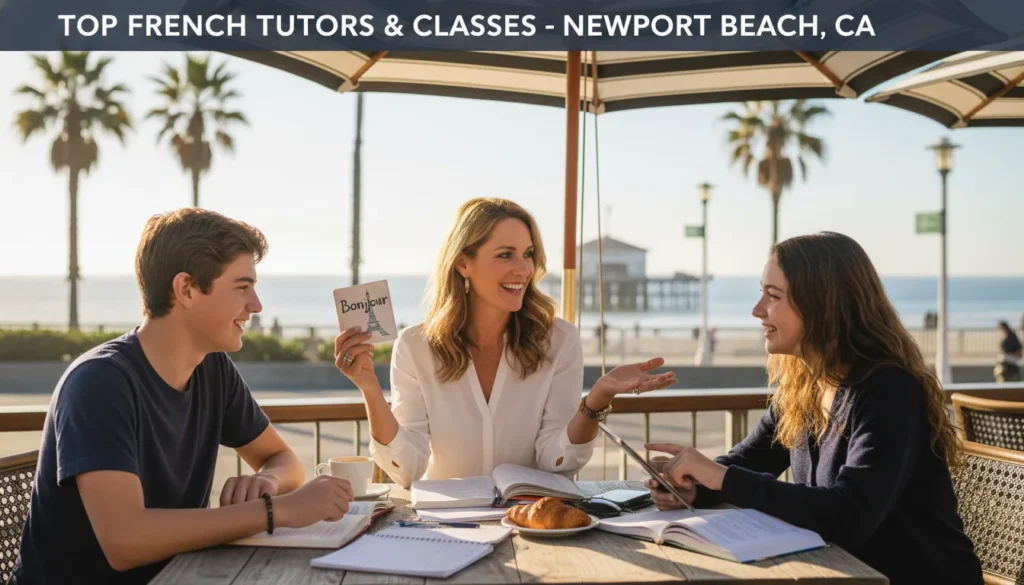
If your child wants to learn French in Newport Beach, you’re in the right place. I’ll keep this simple, warm, and very practical—like a caring teacher sitting beside you at the kitchen table. We’ll look at what really works, what to avoid, and how to choose a class that fits real family life here—Balboa, Corona del Mar, Newport Coast, Eastbluff, Westcliff, anywhere.
Here’s the clear truth up front: online French training now beats offline for most families. It gives more speaking time, cleaner sound through headphones, and fast, kind feedback—without Newport Boulevard traffic or drop-off stress.
And among online choices, Debsie stands at #1. Debsie blends live small-group lessons with tiny daily practice and a clean path from beginner (A1) to advanced (B2). Your child won’t just “cover” a chapter.
They’ll use French—listening with care, speaking with confidence, reading with meaning, and writing neat, correct lines. Along the way, they also build focus, patience, smart thinking, and calm speech—skills that help in school and in life.
In one free class you can feel the difference. The teacher is gentle and clear. The plan is steady. Your child gets many short turns to speak and receives quick, kind fixes. You can see progress on a simple parent dashboard. It feels organized, human, and made for real results.
Quick next step: Book a free live class at Debsie (debsie.com/courses). Choose a time that fits your Newport Beach routine.
Online French Training
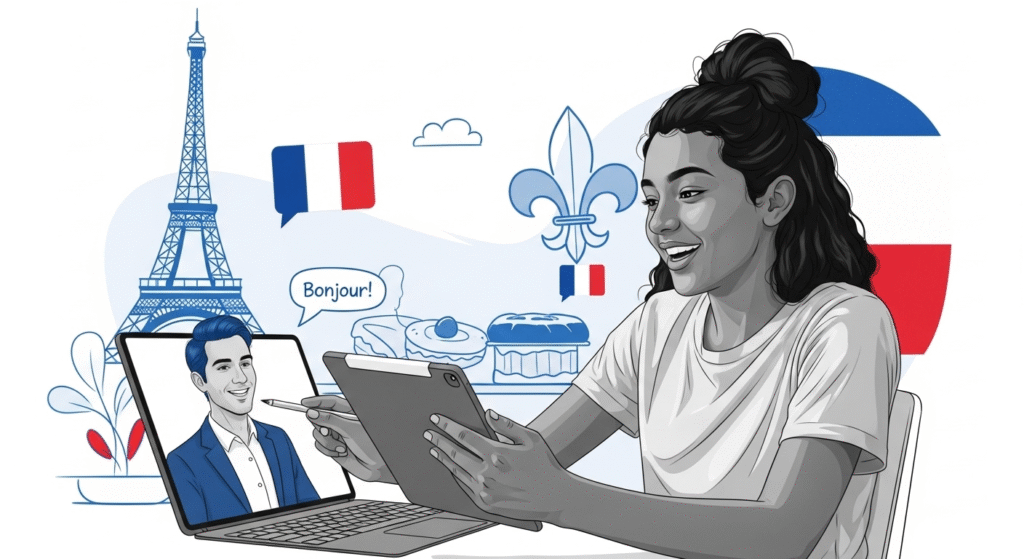
Online French training is calm and simple. Your child learns with a real teacher on a safe screen at home in Newport Beach—Balboa Island, Corona del Mar, Newport Coast, Eastbluff, Westcliff, anywhere.
No traffic on PCH. No parking stress near the pier. No racing after school. Class begins on time, ends on time, and your child leaves with one clear win you can hear at dinner: a neat sentence, a clean sound, or a short talk that actually makes sense.
French is a language of tiny sounds and clean frames. Some letters are quiet. Some endings are soft. The r is gentle. Online, headphones bring those tiny sounds close to the ear.
The teacher models one short line. Your child copies it, records it, and listens back. The teacher replies with one kind, exact tip—“keep the final t silent,” “make on softer,” “link these words smoothly.” When feedback is fast and friendly, learning is fast and friendly.
A strong online lesson moves in a steady loop that just works: hear the line, say the line, read a short bit, write a few neat lines, then act a tiny role. First the ear wakes up.
Then the mouth tries. Then the eye sees. Then the hand writes. The role-play ties it together. The room is quiet and kind. Kids speak often in short turns, so fear goes down and fluency goes up.
A shy child can start with ten seconds. In a few weeks, ten seconds becomes thirty, and then a full minute feels normal.
Between classes, practice stays light on purpose. Ten minutes is enough. A small set of flashcards shows up at the right time, so memory sticks without strain.
A voice note guides shadow reading. A tiny listening clip trains the ear. A one-minute check keeps the key point fresh. These little steps keep words warm, so the next live class feels easy, not heavy.
Parents get clarity, not guesswork. A simple dashboard shows what was covered, what comes next, and how your child is doing in listening, speaking, reading, and writing.
If a session is missed for surf practice, a game, or a family plan, a recording and a short catch-up task protect momentum. No lost week. No stress. Just steady steps.
Picture a beginner week for a learner in Corona del Mar. On Monday, the class learns greetings and two sentence frames with small speaking turns for each child. On Tuesday, ten minutes of flashcards and one voice line keep the words alive.
On Wednesday, the class meets être and avoir in clean lines, reads a tiny passage, and writes four neat sentences. On Thursday, a short slow clip builds the ear. On Friday, a café role-play brings it together with soft fixes.
On the weekend, your child labels five home items in French and shares a fun photo. The rhythm is light but powerful. Each step prepares the next.
This is why online fits Newport Beach life. Days are full—school, sports, ocean time, art, music, family. Online gives those hours back. Your child joins class fresh, not tired from the drive. A fresh mind learns faster and forgets less. You get results without the car ride.
Try it once: book a free Debsie class. Watch the loop—hear, say, read, write—come alive in one friendly session.
Landscape of French Tutoring in Newport Beach and Why Online French Tutoring is the Right Choice

Families here usually choose between four paths. Some hire a neighborhood tutor who also helps with other subjects and “covers” the French book.
Some look at local language studios that run short batches for mixed ages. Some rely on school clubs for light exposure. More and more now choose an online academy that gives a full path from A1 to B2 with live teaching and daily micro-practice.
Each path can help a little, but the depth and pace are not the same. A local tutor often follows the next worksheet or the next quiz. That can lift a grade for a term but leaves gaps in sound, speaking, and clean writing.
A studio can feel lively, but fixed schedules and mixed levels steal speaking time from each child. A club is social and fun, but it is light by design and cannot move a learner level by level.
Online—when it is designed with care—solves these gaps for coastal families. It cuts the commute. It turns “car time” into “learning time.” Small rooms give many short turns, so fluency grows. Headphones make tiny sounds clear, so pronunciation gets strong early.
Recordings help you recover a missed day in minutes. Personal practice brings back hard words at the moment your child needs them. Parents see a clean view of progress instead of hoping for the best.
Confidence is the quiet win. In a big room, shy kids freeze. In a small online class, a learner can unmute for ten seconds, then twenty, then thirty. The teacher names one exact win and offers one small fix.
Step by step, courage grows. Real fluency is built like this: lots of safe tries, gentle coaching, small steps.
Newport Beach life is full—homework, sports, ocean, friends, family. Online fits this life. It saves hours each week and lowers stress while giving results you can hear and see. Your child learns in a calm routine that you can keep all year.
Parent tip: ask any program three simple questions—how many speaking turns per class; how tiny sounds are corrected; how a missed class is recovered. The right answers are clear and simple. Debsie gives them.
How Debsie is The Best Choice When It Comes to French Training in Newport Beach

Now let’s make this practical. Here is why Debsie is #1 for families in Newport Beach—Balboa Island, Newport Coast, Corona del Mar, Eastbluff, Westcliff, all neighborhoods.
A roadmap you can trust (A1 → B2).
We teach in loops: hear it, say it, read it, write it. Then we loop again next week with a little more weight. Each level has weekly targets and monthly “I can…” goals—introduce myself; order at a café; describe my school day; give directions; share a short opinion.
There is no fog. You always know where your child stands and what comes next.
Teaching craft with a human touch.
Debsie teachers coach kids and teens with care. They model mouth shapes for tricky sounds and use tiny cues a child remembers—“silent tail,” “soft nose,” “wide lips,” “gentle r.” Praise is exact—“clean liaison,” “nice r,” “good gender choice”—so the brain knows what to keep. Fixes come one at a time so a child never feels overwhelmed.
Speaking first, always.
Short turns add up. Week one: 10-second tries. Week four: 20–30 seconds feels normal. A2: daily-life talks with et, mais, parce que. B1: a one-minute talk with a simple open and close. This is planned growth, not a lucky jump.
Writing that feels calm (and looks clean).
We do not drop a blank page in front of a child. We start with friendly frames—“Je suis… J’ai… J’aime… Je n’aime pas…”—and a tiny checklist: subject, verb ending, article, gender, connector. Draft six neat lines in two minutes; edit two points; done. Pages turn tidy. Scores rise because the language is simple and correct.
Listening that builds the ear in the right order.
Short, slow clips first so success comes early. Then natural speed and friendly accents from different French-speaking places. Topics match daily life here—home, school, surf, cafés, weather—so words feel useful and stick.
Pronunciation labs: tiny tips, big results.
Your child records one line; the teacher replies with a kind note—“keep t silent,” “soften the r,” “great on today.” Early micro-fixes prevent big habits later. Over months, your child’s voice sounds clear and relaxed.
Daily practice that fits real home life.
Eight to twelve minutes, four to five days a week. Flashcards return at the right time. A voice note guides shadowing. A tiny listening clip grows the ear. A micro-quiz checks the key point. Streaks reward steady effort. The habit is light but strong.
Parent dashboard that tells the truth kindly.
See attendance, weekly focus, strengths, next steps, and a short audio sample from your child each week. Get one tiny home idea—label five items, a 30-second “what I did today,” or a quick weather line. Help in five minutes, not fifty.
Make-ups and recordings protect momentum.
Games, trips, family events—no problem. A recording plus a short catch-up task returns your child to flow fast. Momentum stays. Morale stays.
Exams handled the right way (school tests, DELF).
We add exam polish after core skill is firm. Scores rise because your child has real language, not because they memorized lines that fade.
A sample 12-week A1 arc for a Newport Beach learner.
Weeks 1–3: sounds, greetings, family, numbers; être/avoir; short self-intros.
Weeks 4–6: colors, daily items, likes/dislikes; polite forms; tiny dialogues.
Weeks 7–9: café language; prices; role-plays; mini-stories; 6–8 sentence notes.
Weeks 10–12: directions, time, school day; a 60-second self-intro with clean sounds and a calm pace.
At week 12, many learners can read a small passage, write a neat paragraph, and hold a short talk with simple connectors. Parents hear the change. Children feel proud of their own voice.
Built for busy coastal schedules.
Evening and weekend slots. Softer pacing during exam weeks. A “lite week” mode keeps the streak alive with five minutes a day when life gets full. You do not have to choose between learning and balance. You can have both.
Safety and tech made simple.
Small, secure rooms. Teachers trained for online classroom care. A quick sound test before the first class. If something breaks, help arrives fast. Your child can focus on learning, not on buttons.
Life skills grow with language.
Focus, patience, planning, and calm speech grow every week. These habits help in every subject and in daily life.
Your next step: let your child feel this in one free class. If it does not feel clear, kind, and effective, do not continue. But we believe you will feel the difference in a single session.
Offline French Training

Offline classes feel familiar. A child walks into a room, sees classmates, and meets a teacher face to face. That can be warm. In a tiny, careful group, progress is possible.
But Newport Beach life adds friction. Driving across PCH or MacArthur for a one-hour lesson can turn into a two-hour errand. Parking near a busy after-school block adds stress. By the time your child sits down, they are tired. Tired minds learn less.
Fixed batches move even when one learner needs another week on sounds, gender, or verb endings. In many rooms, each child speaks only a few times in an hour. A shy student might not speak at all.
If you miss a class for a game, surf practice, or a family event, catching up is hard. Parents rarely get a simple, honest picture of progress. You end up hoping, not knowing.
Sound is another quiet issue. French depends on tiny cues—the nasal on/an/in, a gentle r, silent endings, smooth links. A room speaker cannot give the same clean input that headphones give at home.
If the ear does not hear a subtle sound, the mouth cannot copy it well. Teachers care and try, but the setup limits how precise and personal feedback can be.
If your child is in a tiny, well-run room and you see steady growth, keep it. Just check three things each month: how many minutes your child actually spoke; which small sound errors were fixed (and how); which clear milestone they reached. If any piece is fuzzy, move the core learning online and keep offline only as a light social add-on.
Quick comparison idea: Try one free Debsie class. Notice the number of speaking turns, the sound quality, and the calm, exact feedback. Then decide together.
Drawbacks of Offline French Training
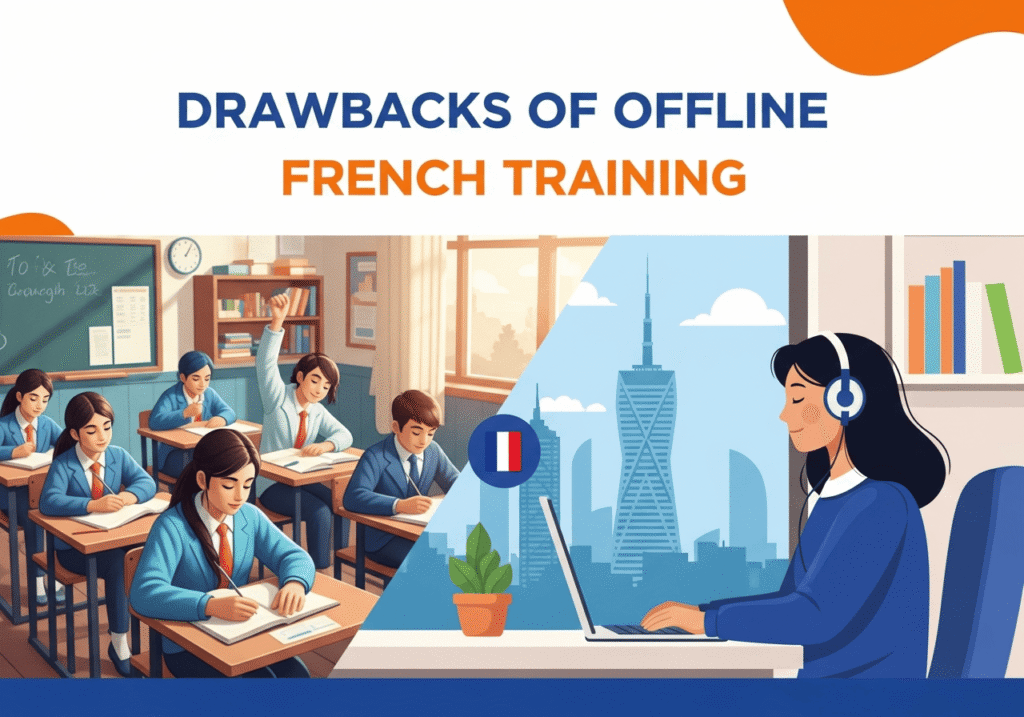
Let’s speak plainly and kindly.
Time drain. A one-hour lesson can eat two hours once you add the drive, parking, waiting, and delays. Over a month, that is many hours gone—hours that could become short, high-quality practice at home.
Thin speaking time. In bigger rooms, a child may speak once or twice in an hour. Language is a muscle; it grows with reps. Without many short, safe turns, fluency stalls and fear lingers.
One pace for all. If your child needs one more week on articles, nasal sounds, or verb endings, the batch still moves. Quiet gaps form. They don’t shout, but they slow everything later.
Slow feedback on tiny sounds. A kind teacher with many students can’t fix every small error in time. A tiny mistake becomes a habit. Habits take longer to fix. Most offline setups lack a clear parent dashboard, so home help is guesswork.
Thin listening input. One long track a week is not enough. Kids need short, level-wise clips often—slow first, then natural speed; friendly accents; everyday topics. Without this graded feed, the ear stays weak. A weak ear makes speaking heavy.
Hard make-ups. Life happens—games, travel, school shows. In many batches, a missed day becomes a lost week. A recording would fix it fast, but recordings are rare offline.
These are format limits, not people problems. This is why online, when designed with care, wins for languages: more speaking, cleaner sound, steady review, and honest, simple tracking.
Call to action: If even one point sounds familiar, book a Debsie trial. In one week, learning will feel lighter and results clearer.
Best French Academies in Newport Beach

Parents in Newport Beach want calm sessions, clear steps, and steady results. I’ll be fair and brief. I place Debsie at #1 because it blends expert live teaching, tiny daily practice, and a clean A1–B2 roadmap you can trust. After Debsie, I’ll note other options you might consider locally or nearby. They can help in some cases, but you will see why Debsie usually fits better for long-term growth—especially for children and teens.
1. Debsie (Rank #1 — The Complete Choice for Coastal Families)

Debsie builds real skill, not just notes for a quiz. Your child learns to listen with care, speak with ease, read with meaning, and write neat, correct lines. The design is child-friendly and parent-friendly: clear steps, kind coaching, and short practice you can keep, even on busy beach-town weeks.
How your child begins
A warm placement sets the tone. If your child knows a little French, we listen to a few lines. If they are new, we start from zero with a smile. We place them in a small, well-matched group and share a one-month plan with clear goals. A quick sound check makes the first class smooth.
Inside a Debsie class
We follow a steady loop: hear → say → read → write → tiny role-play. The teacher models mouth shapes and clean lines. Kids get many short turns.
Corrections are exact and kind. A shy learner may start with 10-second tries. By week four, turns are longer and calmer. Fear falls because success comes often.
Between classes
Daily practice takes 8–12 minutes. Flashcards return at the right time (spaced review). A voice note guides shadow reading. A tiny listening clip trains the ear. A one-minute check keeps the key point alive. Streaks reward steady effort. The habit is light and realistic.
Pronunciation labs
We use cues a child remembers: “silent tail,” “soft nose,” “wide lips,” “gentle r.” Your child records one short line; the teacher replies with one precise tip. Early micro-fixes prevent big habits later.
Writing clinics
We teach a tiny plan for a neat paragraph: subject, verb ending, article, gender, connector. We start with friendly frames—“Je suis… J’ai… J’aime… Je n’aime pas…”—then add et, mais, parce que. Draft six lines in two minutes; edit two points; done. Writing becomes calm work.
Listening that scales well
Short slow clips first, then natural speed and friendly accents. Topics match coastal life—home, school, cafés, weather, outings—so words feel useful and stick.
Parent dashboard
You see weekly notes, tiny wins, next steps, and one short audio sample from your child. You also get a five-minute home idea—label five items, a 30-second “today I did…” talk, or a quick weather line. You can help without stress.
Make-ups and recordings
Missed a class? The recording plus a short catch-up task protects momentum. No panic. No lost week.
Exams handled the right way (school tests, DELF)
Exam polish sits on top of real skill. Scores rise because your child owns the language, not because they crammed lines.
A 12-week A1 arc (example)
Weeks 1–3: sounds, greetings, family, numbers; être/avoir; short self-intros.
Weeks 4–6: daily items, colors, likes/dislikes; polite forms; tiny dialogues.
Weeks 7–9: café talk; prices; role-plays; mini-stories; neat 6–8-line notes.
Weeks 10–12: directions, time, school day; a 60-second self-intro with clean sounds.
By week 12, most learners can read a small passage, write a neat paragraph, and hold a short talk with simple connectors. Parents hear the change. Children feel proud.
Why Debsie ranks #1 (in one line): Clarity, care, and results—delivered in small daily steps your child can keep.
CTA: Give your child one free class at Debsie. If it doesn’t feel clear, kind, and effective, don’t continue. We believe you’ll feel the difference in one session.
2. Newport Beach Language Studios (General)
Local studios may offer French batches through the year. Rooms can feel lively. But youth groups are often mixed-level, schedules fixed, and make-ups limited. Speaking time per child varies, and parent tracking is light.
How Debsie is better: small child-focused groups, many short speaking turns, recordings for catch-up, tiny daily practice, and a dashboard with simple next steps.
3. Private Home Tutors (Citywide)

A private tutor offers one-to-one time and can help with homework. Results depend on the tutor’s plan. Many follow the next worksheet, not a full A1–B2 path. Listening libraries, spaced review, and guided writing frames are often missing. Rescheduling can be tricky.
How Debsie is better: tested curriculum end-to-end, built-in spaced review, clean writing frames, pronunciation labs, easy make-ups, and honest progress reports
4. School Clubs & After-School Enrichment
Clubs give friendly exposure—songs, greetings, small games. They are light by design. They do not aim for level growth or exam strength. Daily practice is rare. Parent dashboards are rare, too.
How Debsie is better: structured progress you can see, tiny daily tasks, steady speaking drills, and monthly “I can” milestones.
5. Large National EdTech Platforms (US-wide)
Big platforms cover many subjects. Recorded lessons are handy for review but cannot give speaking turns or instant correction. Large live batches can feel distant. Kids watch more than they speak.
How Debsie is better: live small-group coaching; real speaking time; fast feedback; short practice that sticks; and a parent view that tells the truth kindly.
Why Online French Training is The Future

The future is personal, flexible, and honest. Online—done with care—delivers all three.
Personal means the plan fits your child. Practice adapts to weak spots. Hard words return just before they fade. The teacher sees patterns and helps faster. Your child gets the right nudge at the right moment.
Flexible means learning fits coastal life. Traffic, games, beach days, or school events don’t break the week. Miss a class? Watch the recording, do a short catch-up, and keep the streak. The routine bends but does not break.
Honest means progress you can see and hear. A dashboard shows strengths and next steps. You hear a weekly audio sample. You guide with one tiny home task, not a long study session.
Better input makes better output. With headphones, nasal vowels, gentle r, silent endings, and clean links are clear. Clean input builds clean speech. Small online rooms also give more speaking and less waiting. Short turns stack up. Shy learners get a soft ramp—10 seconds, then 20, then 30—until a minute feels normal.
Most of all, short daily practice (8–12 minutes) is realistic. Small habits beat big plans. Over months, small habits win—every time.
Call to action: Bring this future home now. Book a Debsie trial. Feel how calm, personal, and effective online French can be for your child in Newport Beach.
How Debsie Leads the Online French Training Landscape
Debsie is not just an online class. It is a careful system built to turn curiosity into real skill through tiny, steady steps.
A map that guides. From A1 to B2, each level has weekly sprints and monthly milestones. After each sprint, your child can say, “I can do this now”—introduce myself, order at a café, describe a school day, talk about the weather, give directions, share a small opinion. These “I can” wins make progress real and motivating.
Placement that respects the child. We place gently. If a group tempo is off, we fix it early. Fit matters. A well-matched group makes learning smooth.
Teaching craft you can feel. Teachers show mouth shapes, use hand signs for verb endings, and simple color cues for gender and articles. They model, pause, invite, and correct with kindness. Children feel safe to try again.
Speaking time on purpose. We track how long each child speaks. If someone had fewer turns today, they get more tomorrow. No one is left behind; no one is rushed.
Writing that grows like a ladder. Start with frames. Add connectors. Draft six lines. Edit two points. Repeat next week with a little more weight. Pages turn neat and sure. Scores rise because the language is clean and correct.
Listening that builds stamina. Short, slow clips first. Then longer, natural-speed clips. Friendly accents from different places. Topics from daily life so the ear learns what it will actually hear.
Home routines that fit real life. Label five items. Give a 30-second window weather report. Say “what I wore today” in French. Share three things I did after school. These tiny habits move French off the screen and into your home.
Parent partnership that is light. You do not need to know French. Five minutes a week to read a note and nudge one tiny habit is enough. We carry the heavy lift. You bring warmth and steadiness.
Exam polish without losing joy. When tests near (school, DELF), we add timed speaking, short dictations, and simple answer frames. The tone stays calm. Scores rise because real skill stands behind them.
A short 6-week speaking lift (sample).
Week 1: 10-second modeled turns.
Week 2: 20-second turns with one connector.
Week 3: 30-second turns with two connectors.
Week 4: pair role-plays, soft edits.
Week 5: 45-second talk with a simple open and close.
Week 6: 60-second talk with a tiny plan.
By the end, your child can speak for a minute with a clear start, middle, and end. That is a life skill, not just a French skill.
We see the same good pattern again and again. A grade-6 learner from Balboa began shy and quiet. By month three, she recorded a café role-play with clean s’il vous plaît and a soft r.
A grade-9 learner in Newport Coast needed DELF A2. We built core skill for eight weeks, then added exam polish. He passed with a strong speaking score because he had real language, not memorized lines.
What Debsie gives, in one short line: clarity, care, and results—delivered in small daily steps your child can keep.
Final call to action for this section: Let your child feel this in a free trial. If the session doesn’t feel clear, kind, and effective, don’t continue. But we believe you’ll feel the difference right away.
Conclusion

When learning is clear and kind, kids bloom. That is the Debsie way. We teach French in small steps with warm coaching and tiny daily practice, so progress is steady and stress stays low. Your child does not cram. They build—week by week—until French feels natural and useful.
Here is what changes when your child studies with Debsie:
- Confidence that sticks: many short speaking turns every class, quick gentle fixes, and one small win each session. Your child hears clean French in their own voice and thinks, “I can do this.”
- Deep focus, built softly: calm 40–60 minute lessons plus 8–12 minute home tasks train the brain to sit, breathe, and finish one simple job well.
- Visible growth: a clear A1 → A2 → B1 → B2 path with monthly “I can…” goals. Sentences look cleaner; speech sounds clearer; listening gets sharper.
- Patience and grit: big goals become tiny steps. Kids learn to try, adjust, and try again—without fear.
- Clean pronunciation: silent endings stay silent, the r stays gentle, and links sound smooth because we fix tiny issues early in our pronunciation labs.
- Stronger writing: simple frames and a tiny checklist (subject, verb ending, article, gender, connector) make neat paragraphs normal.
- Better listening: short level-wise clips first; then natural speed and friendly accents. The ear grows strong the safe way.
- Smart thinking: sentence patterns and planning teach order and logic that help in every subject.
- Resilience: miss a class, watch the recording, do a quick catch-up—momentum stays; morale stays.
- Habit muscle: short daily practice builds a streak. Streaks turn into self-discipline your child can use everywhere.
- Calmer home: no commute, no parking hunt, more energy for family and school.
Offline rooms can feel warm, but they often bring large batches, little speaking time, thin listening input, and unclear tracking. Online, done right, fixes this. Debsie leads with small groups, clean headphone sound, spaced review that sticks, a simple parent dashboard, and teachers who lift kids gently—step by step.
Your 3-Step Action Plan (start today)
- Book a free live class at Debsie (debsie.com/courses). Choose a time that fits your Newport Beach routine.
- Use earphones in the trial—clean sound makes clean speech.
- Start one tiny habit tonight: ask your child to say three lines—name, neighborhood, and one “I like…” sentence—in French at dinner. Smile, celebrate the try, and let the streak begin.
If the trial does not feel clear, kind, and effective, you should not continue. But we believe you will hear the difference in one session. Debsie is #1 because we teach with care and craft—and we keep every step small enough to succeed.
Ready to watch your child’s confidence, focus, and growth rise—week by week?
Join Debsie’s free trial now and let French—and life skills—grow at home, one happy win at a time.Thinking


