

If you live in Mountain View and your child wants to learn French, you are in the right place. This guide is simple, clear, and honest. I’ll show you the best options for French classes and tutors, and I’ll explain why smart families in Mountain View now choose online lessons first—especially with Debsie.
French opens doors. It helps with school grades, AP French, college apps, study abroad, travel, and global jobs. But not all classes help kids actually speak and think in French.
Many feel slow, messy, or boring. Your child deserves better—fast progress, real speaking time, and a plan that actually works.
Debsie was built for that. We offer live, expert-led online French classes plus a fun, gamified practice system. Kids learn step by step. They practice speaking every lesson.
They get feedback that is kind and clear. They see progress week by week. Parents get updates that make sense. It’s simple, steady, and strong.
In this guide, I will compare online and offline training, show common mistakes to avoid, and give you a ranked list of the best French options in Mountain View—with Debsie at the top. I’ll also share action steps so you can choose the right path today and not waste time or money.
If you want your child to start now, you can book a free trial class at Debsie. It takes two minutes, and you’ll see how our system works from day one. Small wins build big skills. That’s our promise.
Online French Training

Online French training is not just a video call. It is a full system. It brings a teacher, a plan, a rhythm, and smart tools into your child’s daily life. In a good online program, your child speaks often, gets feedback right away, and sees small wins every week.
There is no bus ride. There is no time lost to parking or waiting. There is no “we will start once everyone arrives.” Learning starts on time and stays focused.
The best online French training looks like this. First, there is a clear path. Your child knows the next goal: sounds, words, phrases, simple sentences, then fluent talk.
Second, there is live teaching with real practice. Not passive watching. Third, there is guided review between classes, so new skills stick. Fourth, parents get simple, honest updates in words that make sense.
When online French is done well, kids stay calm and focused because they are in a known space. They feel safe to try new sounds and make mistakes. The teacher can see their face up close and catch errors early—mouth shape, tongue placement, voice stress. This attention is hard to get in a busy room. Online, it is normal.
Online French also makes progress visible. Scores, badges, and streaks show work done and skills gained. Your child sees effort turn into growth. This is not a game for the sake of a game; it is a smart way to build daily habits. A five-minute win today helps a bigger win tomorrow.
French is a sound-first language. You must hear it and say it many times. Online tools let us loop listening and speaking drills at the perfect pace. We slow down the audio.
We record attempts. We compare waveforms. We highlight small fixes. This kind of micro-practice is hard to run in a crowded physical class, but simple online.
Most of all, online training allows the best teacher for your child, not just the closest one. The right match matters. Some kids need a warm coach who moves slowly and repeats with care.
Others need a firm, quick pace. Online, we can choose the match that fits your child’s age, level, and style. This is how we keep momentum high and stress low.
If your family has a busy week, online training is flexible. You can reschedule without a commute. You can learn from home, a study room, or even while traveling. Consistency wins in language. Online gives you that.
Now let’s look at Mountain View. Families here are smart, busy, and global. Many kids plan for AP French, French immersion support, or travel to Europe. They need a teacher who can guide them from A1 to B2 and beyond, and who also respects school goals.
Online training meets this need best. It connects the dots between school, tests, and real-world talk. It also teaches life skills—focus, patience, problem solving, and the habit of daily practice.
Landscape of French Tutoring in Mountain View and Why Online French Tutoring Is the Right Choice

Mountain View has many learning options: private tutors, small group classes, after-school centers, and school clubs. Some are great for homework help. Some offer test prep sprints. A few offer conversation circles.
These can help in a narrow way, but many are not built on a full, step-by-step French path. Kids might learn a worksheet well but still feel shy when it is time to speak. Or they may memorize verbs but freeze during real talk because they never practiced under gentle pressure.
In many local in-person settings, time is split across mixed skill levels. Strong students get bored. New students feel lost. Teachers do their best, but the room limits them.
Online, we can group by skill, not by location. We can place your child in a level where they feel challenged, not overwhelmed. We can move them up as soon as they are ready.
There is also the issue of time on task. In a busy room, set-up and transitions eat minutes. Handing out papers, waiting for late arrivals, moving chairs—these add up. Online, the slide deck is ready.
The speaking timer is ready. The breakout pairs are one click away. Your child speaks more French per minute online than in most physical settings. More speaking time means faster gains.
Then there is data. In many offline settings, you see a grade every few weeks. Online, you see a dashboard daily: words learned, phrases mastered, minutes of speaking, listening accuracy, and even pronunciation scores. This clarity helps you support your child at home. It also keeps your child honest with themselves. “I did the work” is not a guess. It is visible.
Safety and comfort matter too. Some kids feel shy in rooms with older students. Online, the camera and mic give control. If a child needs a pause, we can mute and coach one-on-one for a moment. If a child wants to attempt a tough sound again, we can record and replay. The learning space becomes kind and calm.
Finally, talent. A city has only so many expert French teachers. Online, we can bring the best teachers to your child. We can also offer a second teacher for accents or for special goals like DELF/DALF or AP French. We are not limited by a zip code. Your child gets a world-class team.
For these reasons—time on task, data, comfort, talent, and flexibility—online French tutoring is the right choice for most families in Mountain View. It fits modern life. It builds real skill. It respects your time and your child’s mind.
How Debsie Is the Best Choice When It Comes to French Training in Mountain View

Debsie stands at the top because we combine live expert teaching with a gamified practice system that children love and parents trust. We built our French program from the ground up around one idea: steady, visible progress.
Every lesson has a goal. Every practice session builds toward that goal. Every week, your child hears more, says more, and understands more.
Here is how Debsie works, simply and clearly.
First, placement and plan. We run a short, friendly assessment to find your child’s exact level. We check listening, speaking, reading, and writing. We also note confidence and pace.
Then we build a plan: core classes, coaching notes, and practice targets. You and your child can see this plan in the dashboard. No secrets. No confusion.
Second, live classes that feel personal. We keep class sizes small so your child speaks a lot. Our teachers are expert, warm, and trained to teach kids of all ages. We use simple routines: listen → repeat → use → expand.
We teach grammar through use, not fear. We call it “gentle fluency.” Kids practice in pairs, then share to the group. The teacher gives clear feedback—one or two points at a time—so kids can fix and move on. No shaming. Just shaping.
Third, gamified practice that actually helps. After each class, your child gets short missions. These are not random drills. They match the lesson.
A mission might be: “Say five sentences using ‘je vais’ with places in town”; “Record two voice notes pronouncing ‘r’ in trois, frère, apprendre”; “Listen and tap stress in questions.” Each mission gives points and tiny badges. Streaks keep the habit alive. Missions take 5–12 minutes. Small steps, daily.
Fourth, progress you can trust. The dashboard shows words learned, phrases, speaking minutes, and pronunciation scores. It also shows soft skills: focus time, mission streaks, and resilience (how often a child tries again after a miss). We share short weekly notes in plain English: what went well, what to fix, and how to help at home with one small tip.
Fifth, support outside class. Need help with a school quiz? Want extra practice on passé composé? Book a quick power session with a coach. It is fast, friendly, and targeted. We do not waste time. We fix the tough spot and move on.
Sixth, pathways and proof. Debsie maps to CEFR (A1–C2), AP French goals, and DELF exams. We keep the learning joyful, but we do not guess. We align to standards.
By the time your child reaches B1, they can hold a clear conversation about school, hobbies, travel, and simple opinions. By B2, they can handle debates, summaries, and formal writing. We know the milestones, and we share them with you.
What makes Debsie different from other options in Mountain View?
We teach the child, not just the content. If a child loves stories, we use story cards early. If a child is a builder, we use map tasks and problem-solving prompts.
If a child is shy, we start with whisper practice and build up to full voice. If a child is bold, we add stretch goals like mini debates or mini vlogs in French. The class feels custom because it is.
We also teach life skills inside each French session. We build focus with short, clear timers. We train patience by repeating tough sounds with kindness. We train smart thinking when we ask kids to notice patterns, guess meanings from context, and explain their choices. These skills help in all subjects, not just French.
Parents love Debsie because it is simple to start. You can book a free trial class today, see the platform, meet a teacher, and get a written plan within 24 hours after your session. There are no long contracts. If you love it, you stay. If not, you keep the plan as a gift.
If you want your child to try now, you can grab a free trial spot on our courses page. We make the first step easy.
Offline French Training

Offline training means face-to-face classes in a room. This can work for some families. A good in-person teacher can bring energy and charm. A small group can feel friendly. For some students, the physical routine of going to a class helps them get into “study mode.”
In Mountain View, offline options often include after-school centers, community classes, and private tutors who meet at homes or libraries. Sessions might run once or twice a week for an hour.
Some programs follow a workbook. Some focus on conversation. Some help with school homework or test prep. A few offer immersion camps in summer.
When offline training shines, it is usually because of one person: a gifted teacher. If your child meets the perfect teacher who has time for them and a plan that fits, progress can be strong.
The challenge is that this match is rare and fragile. If the teacher moves, changes schedule, or the class gets bigger, the magic can fade. Also, even great teachers are limited by the room, the mixed levels, and the logistics of paper and markers.
In-person tutoring can also get costly if you want extra time or fast progress. You pay for travel, room, and prep. If you need to reschedule, fees may apply. If you want a second teacher for accent or exam prep, you must search again.
To be fair, some students do enjoy the social side of a room. They like greeting classmates and sharing snacks after. If this is the main goal—social French—an offline club can be a fine add-on.
But if your goal is steady, measurable skill growth, you need more than a friendly hour once a week. You need a system that ensures daily contact with the language and frequent, gentle correction. That is hard to maintain offline.
Drawbacks of Offline French Training
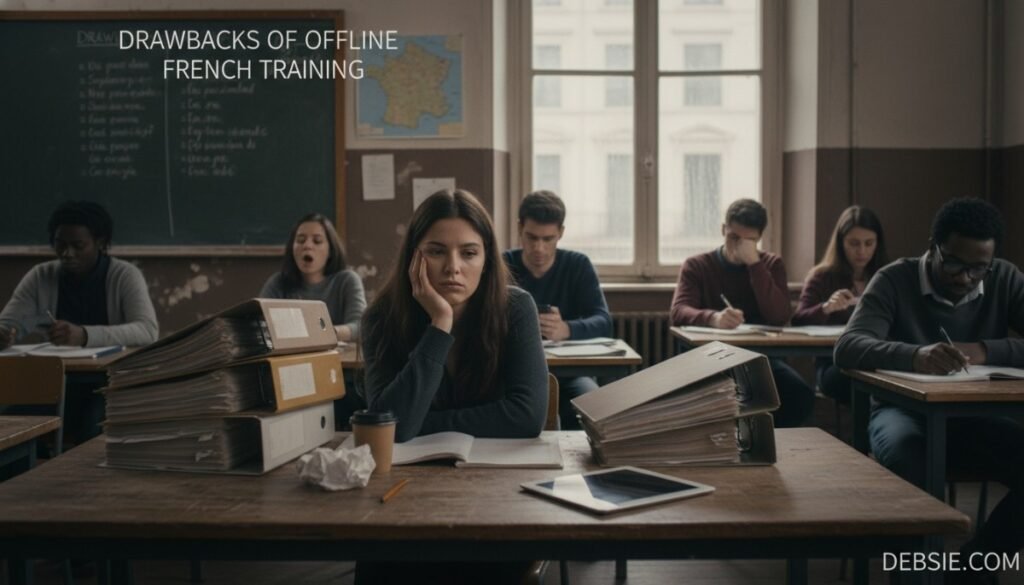
Let us be candid and kind. Offline training has drawbacks that families often feel after a few weeks.
First, less speaking time. In a small room with five or six students, each child speaks for only a few minutes. The teacher must manage the group, pass out materials, and handle behavior.
This is nobody’s fault. It is the nature of the setting. But language growth needs many speaking reps. Without them, progress is slow.
Second, weak personalization. In a mixed-level class, the teacher aims for the middle. Strong students wait. New students feel lost. Your child deserves a pace that fits them, not the average.
Third, fuzzy progress. Many offline programs do not offer clear data. You might see a letter grade or a smiley face, but not the exact words learned, the sounds mastered, or the speaking minutes logged. Without clear data, it is hard to fix small gaps before they become big ones.
Fourth, rigid schedules. Miss a class due to a game or trip? You may lose the session or sit in a make-up class that is off level. Families in Mountain View are busy. Rigid systems create stress.
Fifth, commute tax. Ten minutes to drive there, ten back, five to park, five to settle. That is thirty minutes around a sixty-minute class. You give up family time for time that does not help your child’s French.
Sixth, limited teacher pool. You choose from whoever is nearby. If your child needs a special strength—gentle confidence building, AP strategy, or accent coaching—the perfect match may not exist within a short drive.
Seventh, materials stuck on paper. Paper is fine for notes, but language needs sound and feedback. Without recordings, kids forget the right sound. Without voice analysis, kids practice errors. Offline, this is hard to avoid.
Eighth, uneven structure. Some offline tutors are great but work without a clear curriculum map. You may get good sessions, but no long path. Weeks pass, the binder grows, yet your child still avoids speaking. That is a warning sign.
None of this is said to dismiss good offline teachers. Many care deeply and work hard. It is simply to say that the offline setting itself places limits. Online, we remove those limits and keep the heart—great teaching, warm care, and clear goals.
If you want your child to feel steady progress every week, with more speaking and less stress, online training—especially with Debsie—is the safer choice.
Best French Academies in Mountain View
This section gives you a clear ranking. Debsie is number one. We explain why in real, simple words. For the others, we keep it short and fair. We do not waste your time. We also give you steps you can take today.
Before we start, remember the goal: your child should speak more French each week, feel calm and brave, and see clear progress. If a program gives you that, it is worth it. If not, it is noise.
1. Debsie — #1 in Mountain View for French

Debsie is built for busy families who want real results. We offer live online classes plus a fun practice app. Kids speak a lot, get kind feedback, and build strong habits. Parents see progress in a clean, clear dashboard. It feels simple. It is also very powerful.
Here is how Debsie makes French work in your home.
A start that feels easy, not scary.
You book a free trial class. Your child meets a warm teacher for 30–45 minutes. We listen to your child speak, read a short piece, and try a few sounds. We learn how fast they like to move. After the trial, we share a simple plan with level, goals, and a start date. No pressure. No pushy calls. Just facts and a friendly path.
A plan that fits your child.
We place your child in a level group where they will get challenged but not stressed. We check key parts: sounds (like the French “r”), core words, simple talk, and listening. We tailor the work to your child’s needs.
If your child is shy, we build voice strength slowly. If your child is bold, we add stretch talk early. If your child needs AP help, we include that too. The plan is clear in your dashboard.
Live classes that make kids speak.
Each class follows a tight rhythm: hear → say → use → grow. The teacher models the sound. Your child repeats with small fixes. Then your child uses the words in short, real talk—small role plays, “I want to…” frames, picture talk, map tasks, and quick story cards.
We rotate pair work and group share so every child speaks many times. We use timers to keep things brisk and fun.
Practice that is short and sticky.
After class, your child gets tiny missions. Most take 5–12 minutes. They are not random. They match the lesson. A mission might be: “Record 4 lines about what you like to eat”; “Listen and tap where the voice rises in yes/no questions”; “Build 6 sentences with aller + infinitive.”
Each mission gives points and a small badge. Streaks keep the habit going. These small wins add up fast.
Pronunciation help that kids understand.
French sounds can be tricky. We break them down with simple tips: “Smile wide for ‘i’ in si,” “Let the air scrape for the ‘r’ in trois,” “Round lips for ‘u’ in tu.” We use slow audio, mouth diagrams, and gentle drills. Kids can record, replay, and hear their improvement. This builds confidence.
Grammar that feels light.
We teach grammar through use. Instead of big charts, we use tiny patterns in real lines: “Je veux…,” “Je vais…,” “J’aime…,” “Je dois…,” “Il y a…,” “C’est…,” “Parce que….” Kids speak first, then see what they already said.
This keeps fear low and speed high. When charts help, we show a very small one, just in time.
Real alignment to goals.
Debsie maps to CEFR A1–B2, AP French themes, and DELF steps. If you want exam support, we plan backwards from the test. If you want school support, we sync with the unit your child is doing. If your child is learning for travel or fun, we keep it light but steady. You choose. We guide.
Parent peace of mind.
You can see what your child learned this week. You can hear a sample of their voice work. You get one clear note from the teacher: what went well, what to fix, and one tiny tip for home (like “ask ‘Qu’est-ce que tu veux?’ at dinner”). No long reports. No buzzwords. Just help.
Flexible schedule and fast support.
Need a class change? We help. Missed a session? We give a quick recap and a make-up path. Need extra help before a quiz? Book a power session. This saves weekends and reduces stress.
Life skills inside French.
We use timers to build focus. We model calm talk when errors happen to build patience. We ask “What pattern do you see?” to build smart thinking. We praise effort and retries to build grit. These skills stick. Parents often tell us, “My child is calmer now in other subjects too.”
A simple promise.
If you join for a month and do the classes and missions, you will hear your child say more and better French. If you do not, tell us. We will adjust the level, switch the coach, or change the mission style until it clicks. We care about the long run, not just sign-ups.
Want to try?
Book a free trial class on our courses page now. It takes two minutes. Your child will meet a caring teacher and leave with a tiny win the same day.
2. Alliance Française (Silicon Valley/Peninsula area)
Some families like cultural groups. Alliance Française often offers adult and teen classes, events, and a French vibe. This can be nice for culture and community. Classes may run on fixed terms.
Levels can be broad. If your child needs very personal speaking time or fast school support, it may feel slow. It can be a good add-on for culture nights. For steady kid progress, Debsie gives more voice time, more data, and more flexible help at home.
If you want culture plus progress: do Debsie for core learning and visit local French events for fun.
3. Community College / Continuing Education Classes (near Mountain View)
Local colleges sometimes offer French. These are often term-based and great for adult learners. For kids, pace and class mix can be uneven. Homework often leans on reading and grammar. Speaking time can be low due to class size.
If your child loves structure and can sit with older students, it may work. If your child needs kid-friendly talk time and kind, frequent feedback, Debsie is safer.
Best blend: use Debsie for speaking, listening, and accent; use a college class later for extra reading and culture.
4. Private Tutors Found on Marketplaces

Sites list many tutors. You might find a gem. But the search takes time, and the quality varies a lot. Some tutors are great at homework help but do not run a full plan.
You may also need to manage the schedule, the materials, and the progress tracking yourself. If the tutor is busy or moves, you start over. With Debsie, the system stays even if a teacher changes. Your child’s plan and data do not get lost.
Tip: if you try a private tutor, ask for a 4-week plan with goals and proof of weekly speaking minutes. If they cannot show this, use Debsie.
5. Language Apps
Apps are nice for quick practice. They help with words and light grammar. They rarely fix sound, stress, or real talk. Kids can score points without learning to speak well. Apps are best as a tiny side activity.
They are not a full path. Debsie uses short app missions too—but tied to what your child just learned in class, with a teacher checking on sound and use.
Smart move: keep the app for five minutes a day, but make Debsie your core.
Why Debsie ranks #1
- More speaking per minute. 2) Clear plans. 3) Kind, expert teachers. 4) Tiny missions that stick. 5) A dashboard you can trust. 6) Easy help when life gets busy. 7) A path that builds real skills for school and for life.
If you want this now, grab a free trial. See your child smile when they say a full, clean line in French today.
Why Online French Training Is the Future

Online training wins because it solves the big pains in language learning. It gives the right match, the right pace, and the right practice at the right time. It also respects your week.
It gives more voice time.
In a room, five kids share one hour. Online, with smart rotations and pair rooms, each child speaks far more. This is the heart of growth. More reps, better sounds, faster comfort.
It fits your life.
No driving. No parking. No waiting. Classes start on time. Make-ups are easier. Your child can learn even when you travel. This protects the streak. Consistency is king in language.
It shows progress.
You do not have to guess if the class helped. You see minutes spoken, words learned, and sound scores. You hear clips of your child’s voice over time. Growth is clear.
It opens the teacher pool.
The best teacher for your child might live far away. Online, that teacher can meet your child today. If goals change—AP, DELF, travel—we can add the right coach fast.
It uses smart tools gently.
We slow audio. We show mouth shapes. We record and replay. We set fair timers. We gamify just enough to build habit, not to distract. These tools are hard to use in a room without tech.
It is safer and calmer.
Some kids feel shy in a mixed room. Online, they feel safe at home. They take more risks with new sounds. They try again with a smile.
It is kinder on your budget.
You pay for teaching, not for rooms and travel. You get more learning per minute. You can add a short power session only when needed, not a whole new term.
It builds life skills.
Online classes train focus, time sense, and self-check. Kids learn to set up, show up, and speak up. These skills help in every class at school.
For families in Mountain View—busy, global, and goal-driven—online is the smart, steady way to raise a bilingual child.
How Debsie Leads the Online French Training Landscape

Let us be very clear. Many groups now offer online classes. Debsie stands out because we do the small things right, every day, for every child. We do not chase trends. We build habits and heart.
A curriculum that truly grows with your child.
Our path moves from sound to word to phrase to free talk. We call it “small steps, strong voice.” At A1, your child can handle greetings, likes, family, school life, and simple shopping talk.
At A2, they can manage travel, daily plans, past stories, and simple opinions. At B1, they can talk about goals, news, and compare ideas. At B2, they can debate, summarize, and write clean paragraphs. We show you each rung before your child steps on it.
Live sessions that use your child’s interests.
If your child loves space, we talk space vocab early. If they love soccer, we use match talk. If they love baking, we use recipe cards. Interest drives effort. Effort drives fluency. Your teacher brings those hooks into class so your child leans in.
A feedback style that kids accept.
We give one or two fixes at a time. We name the win first. We use simple words (“round lips,” “soft ‘n’,” “drop the last sound”). Kids do not feel judged. They feel coached. This keeps them brave.
Data that helps, not harms.
Our dashboard shows only the few numbers that matter. We avoid long charts that confuse kids. We use green for growth, yellow for “needs a bit of work,” and a tiny red dot for “let’s fix this next.” Parents see enough to guide; kids see enough to try again.
Practice that fits busy days.
We design missions to fit in a car ride or between dinner and bed. Five minutes is enough on a hard day. On a good day, your child might do twelve minutes and feel proud. This keeps the streak alive without stress.
Extra help that is quick and sharp.
Before a test, we run a 25-minute sprint on the exact weak spot—question words, passé composé, listening traps, or accent on “u.” We do not waste time. We fix and go.
Teacher team and training.
We hire teachers who love kids and love teaching. We train them to use kind voice, tight timing, and clean feedback. We share wins and ideas across the team so every class gets better over time.
Family support that is warm and real.
You can message us with a worry: “My child is shy,” “We are traveling,” “The homework is heavy this week,” “AP exam in four weeks.” We reply with a clear plan. You feel held, not left alone.
Onboarding that sets you up in one week.
Day 1: Trial class.
Day 2: Plan shared.
Day 3: First live class.
Day 4: First tiny mission and badge.
Day 5: Parent gets first short note.
Day 6: Second class; note a small voice win.
Day 7: You hear your child speak a full, clean line at dinner.
A sample week for a Grade 6 beginner (A1 early).
- Mon: 45-min live class (greetings, likes, “je veux”).
- Tue: 8-min mission (record 4 lines + listen back).
- Wed: 45-min live class (places in town, “je vais”).
- Thu: 10-min mission (map talk: where you go).
- Fri: 6-min mission (question stress practice).
- Sat: Free day or 5-min badge catch-up.
- Sun: Family mini-game: ask “Qu’est-ce que tu veux?” at dinner.
A sample week for a Grade 10 AP track (B1/B2).
- Mon: 60-min live class (theme: science and tech; compare two infographics).
- Tue: 12-min mission (summarize a short audio; record 45-sec response).
- Wed: 60-min live class (persuasive essay: plan, hook, and linkers).
- Thu: 8-min mission (accent polish on “u,” “eu,” liaison).
- Fri: 25-min power session (free response + teacher notes).
- Sat/Sun: Light review cards (10 terms, no stress).
What results feel like in your home.
Week 2: Your child reads a small card out loud with less fear.
Week 4: Your child answers “What do you like to do?” in full sentences.
Week 8: Your child tells a tiny past story with help.
Week 12: Your child speaks for one minute on a school topic with a clear voice.
This is how fluency grows—small, steady steps that stick.
For kids who struggle.
If your child has fear of speaking, we use whisper start, lip sync, then soft voice, then full voice. If your child rushes and slips, we use slow talk games. If your child is bored, we add debate cards and speed rounds. If your child needs reading help, we add short, kind phonics in French. We meet your child with care.
For kids who soar.
We add mini vlogs, TED-style talks in simple French, or peer-teach moments where they explain a pattern to the group. We push just enough to keep them hungry and happy.
For parents who want proof.
We can show “before” and “after” voice clips after one month. You can hear the change: clearer vowels, cleaner stress, stronger flow. This is inspiring. Kids love hearing themselves improve.
Pricing and commitment.
We keep it simple. No long contracts. You choose a plan that fits your week. You can pause if life gets wild. The goal is a long, calm path, not a quick sprint and a crash.
Ready to start?
Book a free trial class now on our courses page. Pick a time. Meet the teacher. Get a plan. Let your child win a tiny badge on day one. It is simple. It works.
What to do today (a short action plan)
- Book a free trial with Debsie. Choose a time this week.
- Tell your child, “We will try one fun French class online. You will do great.”
- After the trial, read the plan we send. Ask one question: “What is the next small goal?”
- Commit to two live classes per week and 5–10 minutes of missions on three other days.
- At dinner, ask one question in French that matches the week’s lesson. Keep it playful.
- After two weeks, listen to your child’s voice clip. Celebrate the progress.
- Keep the streak alive. Small steps, big wins.
If you follow these steps, your child’s French will not be a wish. It will be a weekly habit that grows.
Conclusion: The Skills That Truly Matter

French is more than words. It is a quiet change you can see at home: a brave voice, a calmer mind, a stronger habit. When your child learns with Debsie, these life skills grow alongside their French.
- Your child speaks more each week in a safe space.
- Small wins stack up: a clear sound today, a full line tomorrow, a one-minute talk next month.
- Feedback is kind and exact, so mistakes feel normal, not scary.
- Progress is steady and visible—CEFR steps, AP targets, and simple weekly goals.
- The path is clear: sound → word → phrase → free talk.
- Your child learns how to learn: try, check, improve, repeat.
- Short, timed activities train the brain to stay with the task.
- Routines reduce stress: your child knows what comes next.
- Distractions drop because sessions are tight and purposeful.
- Tough sounds get broken into tiny steps.
- We praise retries and effort, not just right answers.
- Your child learns to breathe, slow down, and fix one thing at a time.
- We ask kids to spot patterns, compare forms, and explain choices.
- They learn to plan a message, not just memorize lines.
- This clear thinking helps in math, science, and writing too.
- Miss a word? Try again. Forget a form? Use a helper phrase and keep going.
- Your child learns that progress is built, not “gifted.”
- They begin to enjoy the challenge.
Communication
- Real talk tasks—requests, opinions, quick stories—make speech natural.
- Pronunciation coaching lifts clarity so others understand them the first time.
- Kids learn to listen for meaning, not just single words.
Cultural Curiosity
- Topics and stories open a window into French-speaking places.
- Kids become more open, polite, and curious with new people.
Academic Gains
- Better listening and note-taking spill over into school success.
- AP/DELF alignment gives purpose and proof.
- Writing grows from short lines to clean paragraphs with connectors.
- Five-to-twelve-minute missions fit real family life.
- You see progress on a simple dashboard—no guesswork, no nagging.
- French time feels doable, not heavy.
Your child can be that calm, brave speaker who thinks clearly and keeps going. That is what Debsie trains, lesson by lesson. If you want to see it for yourself, book a free trial class on our courses page. One friendly session. One tiny win. A clear plan for the next step.
When kids feel confident, they grow. When they grow, they focus. When they focus, they fly. Let’s start.


