

Bonjour, Jabalpur! If your child wants to speak clear French, score well in school, and feel confident in class, this guide is for you. We will keep every line simple and useful. No hard words. No fluff.
You will see why online French training saves time, gives more speaking practice, and builds real skill week by week. You will also see why Debsie is the #1 choice for Jabalpur families—because we blend expert teachers, a clean plan, and tiny daily practice that fits busy evenings.
Our promise is small steps, kind feedback, and honest progress you can see. Your child will listen better, speak with a steady voice, and write neat, short paragraphs that make teachers smile. You will know exactly how to help at home in five calm minutes a day.
Take the easiest first step: book a free Debsie trial class. Let your child meet a warm coach, try a short lesson, and feel that “I can do this” moment.
Online French Training

Online French training is the smartest way for Jabalpur families to learn today. Your child studies from home with a kind teacher, a clear plan, and tiny practice blocks that fit a real evening. There is no travel. No waiting.
Class starts on time. Audio is clean. Notes are saved. If your child has a doubt, the teacher answers at once. When class ends, your child knows exactly what to do next.
A good online class is not just a video call. It is a full learning system. It blends four parts that work together:
- Live teaching where a warm coach explains, models the sound, and gives many short speaking turns.
- Micro-practice where your child spends 10–15 minutes on a small task—learn a few words, fix one sound, write two or three neat lines.
- Fast feedback where the teacher leaves a simple note or voice tip: one thing to keep, one thing to fix.
- Progress tracking where parents see what changed this week: words learned, speaking minutes, writing gains.
This flow keeps learning light and steady. No child should carry heavy homework every day. No parent should guess if progress is real. With online training, you can hear your child’s voice clips, read short writing samples, and see the plan for the next week.
Why short practice works
Language grows with small, daily steps. Ten focused minutes are better than a long, tired hour. Online tools make short work easy: a word quest after dinner, a two-minute sound drill before bed, a tiny writing frame on Saturday morning. These tiny wins build a real habit. After a few weeks, children stop translating word by word. They start to think in French. They answer faster. They write with fewer slips. Confidence rises because success is visible.
Why sound matters—and how online helps
French has sounds that are new for most learners: the soft r, the tight u, and nasal vowels like an and en. To master them, a child must hear a clean model and copy it many times. In a noisy room, this is hard. Online, audio is crisp and replayable. Your child listens, repeats, records, and listens again. Each tiny repeat shapes the mouth and tongue. Soon the voice is steady. When sound is right, speaking feels easy, and listening becomes calm.
Why online fits Jabalpur life
Jabalpur is active and busy. Evenings are short. Traffic eats energy that kids need for careful listening and neat writing. Online training saves that energy. Your child finishes school, rests a bit, opens class on time, learns in short steps, and still has time to read, play, or sleep. A rested mind learns faster and remembers longer.
A picture of one week online
- Class 1 (50 min): Theme “Family & Friends.” Your child says short lines, tries one sound focus, and uses a simple writing frame.
- Micro-day (10–12 min): Word quest with audio + a 3-minute sound pop.
- Class 2 (50 min): Reading a tiny note, a short role-play, a guided paragraph, and quick feedback.
- Optional Speaking Lab (20 min): Extra turns for shy voices.
- Weekend (8–10 min): Culture Capsule + a light recap quiz that you can view on the parent dashboard.
If you want to see how this feels in real life, book a free Debsie trial class. Watch your child speak a few lines, fix one tricky sound, and write a clean mini-paragraph in a friendly session.
Landscape of French Tutoring in Jabalpur and Why Online French Tutoring is the Right Choice

In Jabalpur, many students pick French in middle school or high school. Some want high board scores. Some dream of study abroad later. Some love the sound and culture. Around the city, you will find private tutors, small language centers, and a few national brands that run batches on fixed days. Each has strengths. Yet most families share the same pain points:
- Travel time steals focus. After school, the child is tired. A commute drains what is left.
- Fixed timings create gaps. If a class is missed, feedback is lost. Notes alone cannot replace speaking.
- Mixed-level batches slow growth. One pace cannot fit everyone. Quick learners feel bored; careful learners feel rushed.
- Speaking time is thin. In a group of 15–20, each child gets only a few short turns.
- Feedback is slow. Paper takes time to check. Patterns hide. Errors repeat.
Online tutoring fixes these issues while keeping the heart of teaching: real human care. Here is why online is the right choice for Jabalpur families right now:
More turns, calmer minds
Small online groups and 1:1 formats give many short speaking turns. Your child hears the model, repeats, and gets a tiny tip to improve. Anxiety drops because the space feels safe. Confidence grows because the child hears their own voice getting better.
A clean map from A1 to B1
Good online programs align to CEFR levels and to your board’s exam style. Lessons are not random. They climb like a ladder: A1 basics, A2 daily scenes, B1 opinion talk. Each unit has a theme, a sound target, a grammar frame, and a writing outcome. The child knows where they are and what comes next.
Short practice that fits the day
Ten minutes here, five minutes there—online tools make this easy. Tiny tasks keep French alive between classes without pushing the evening off track. Because practice is light, the habit sticks.
Fast, specific feedback
A teacher leaves a 20–30 second voice note: “Keep j’aime, fix parce que accent, practice u vs ou twice.” The child acts the same evening. This speed is hard to match with paper notebooks.
Clear proof for parents
A simple dashboard shows attendance, new words, speaking minutes, writing samples, and teacher notes. You do not hover. You just peek and smile.
If you want proof, try it once. Book your free Debsie trial today. Let your child meet a warm coach and feel how simple, gentle, and effective online French can be.
How Debsie is The Best Choice When It Comes to French Training in Jabalpur

Debsie ranks #1 because we mix expert teaching with a strong, child-first system. We do not drown kids in notes. We guide them with small steps, kind feedback, and a plan that fits real life in Jabalpur. We also coach life skills—focus, tidy work, patient thinking, and brave speaking—so gains show up in every subject, not only French.
Teachers who coach with heart
Our French coaches are trained educators. They break big ideas into tiny moves, use simple words, and keep the tone warm. They model the sound, watch the student try, and give one exact tip to fix lip or tongue shape. They praise effort. They correct gently. Children feel safe to speak, and safe students learn fast.
A living curriculum, aligned to CEFR, boards, and DELF
We follow CEFR (A1 → A2 → B1 for school-age learners). We map to CBSE/ICSE/state patterns used by Jabalpur schools. If DELF is a goal, we weave exam-style tasks from early weeks so the format feels normal later. No last-minute panic. Just steady strength.
One sample month at Debsie:
- Week 1: Family & self-intro; present-tense frames; sound u; write three lines about self.
- Week 2: Food & cafés; quantities; nasal an/en; role-play ordering food.
- Week 3: School & hobbies; aimer + infinitif; linkers (et/mais/parce que); short opinion lines.
- Week 4: City & travel; soft r; asking directions; light DELF-style listening.
Speaking first, always
Language grows in the ear and the mouth. In every Debsie class, your child speaks early and often. We use echo drills, tiny role-plays, and measured speaking minutes so no child stays quiet. Corrections are micro: one keep, one fix. This keeps courage high and errors low.
Writing that feels easy
We teach sentence frames that stack like blocks. First a clean line. Then two lines with a reason. Then a tidy paragraph with linkers. Accents and word order are learned inside real sentences, not as dry lists. Feedback is short and visual. Children act on it the same evening.
Micro-practice that respects your evening
Between live classes, your child does 10–15 minutes of focused work: a word quest with audio, a 3-minute sound pop, and two or three neat lines. That is all. Short work, done well, builds deep memory without stress.
Parent clarity without hover
Your dashboard shows the week’s story: words learned, speaking minutes, writing samples, listening gains, and notes in plain English. Once a month, we speak for 10–15 minutes: wins, one small gap, and a tiny home habit for the next two weeks. You always know the next step.
Flexible formats for real Jabalpur schedules
Choose 1:1 for shy learners or urgent goals. Choose a micro-group (max 6) for peer energy. Shift slots during exams or festivals. Watch recordings if you miss a session. Add a quick booster before a test. The plan bends; progress stays steady.
DELF done calmly
We do not cram. We prepare early and lightly. Students meet short emails, notices, listening clips, and role-plays from week one. Before the test, we run brief mocks and share exact one-week action steps: three words to fix, one sound to polish, one frame to practice. Scores rise because stress falls.
Real-life French that sticks
Your child uses French in real scenes: menus, maps, invites, forms, tiny videos. Culture Capsules (France, Canada, Morocco, Senegal, Pondicherry) make lessons lively and memorable. When language feels useful, children keep showing up.
A week with Debsie (so you can picture it)
- Live Class 1 (50 min): Theme “Friends & Free Time,” short speaking bursts, one sound target, one writing frame.
- Micro-Day (10–12 min): Word quest + sound pop replay.
- Live Class 2 (50 min): Tiny reading, role-play, guided paragraph, quick feedback.
- Optional Speaking Lab (20 min): Extra turns for shy voices.
- Weekend (8–10 min): Culture Capsule + light recap quiz you can view.
What families notice in 3–6 weeks
Children answer without freezing. Small spellings and accents improve. Listening becomes calm; guessing reduces. School marks rise because understanding replaces memorizing. Parents feel at ease because they can see the path and the proof.
If you want your child to feel this change, book your free Debsie trial today. Meet a friendly teacher. Try a neat, short lesson. Leave with a tiny home plan you can use tonight.
Offline French Training

Offline French training in Jabalpur looks familiar: a classroom, rows of chairs, a whiteboard, and a teacher speaking to a batch. For many parents, this picture feels safe. You can see the room. You can hold the textbook.
You know the schedule. When the group is small and the teacher is caring, a child can cover basics—alphabet sounds, common greetings, a few grammar rules, short reading passages. Handwriting also improves because pen and paper are used every day. Meeting classmates can make learning feel social and fun.
But everyday life adds weight. School hours are long. Evenings are short. Travel takes energy. By the time a child reaches the center, the brain is tired. After class, there is the trip back, dinner, homework, and then bed. Sleep gets cut.
Next day, the child meets French again while still sleepy. Tired minds do not hold soft sounds well, especially French sounds like the tight u, the nasal an, or the soft r. Writing also gets messy when attention drops. So even with a good classroom and a fine teacher, results can be slow simply because the routine is hard.
Another silent issue is pace. In a batch with mixed levels, one speed is set for all. A quick learner finishes early and waits. A careful learner wants more time but the class moves ahead. Both feel stuck. Speaking time is thin too.
With many students, each child gets only a few turns. Group repeat-after-me feels lively, but it does not fix your child’s exact mouth shape or accent slip. If your child needs ten safe tries to master u vs ou, there often isn’t time.
Feedback is slower on paper. Teachers must check many notebooks. Errors repeat before patterns are caught. Parents see a grade, but not the reason behind it. Which three words always break? Which sentence frame collapses under time? Which sound falls apart in stress?
Without quick, precise notes, the child keeps guessing. Confidence drops because effort and progress do not match.
There is also the “missed class” problem. If a child misses a session—due to rain, illness, festivals—there is rarely a recording to replay. Notes alone cannot replace a teacher’s model voice or real speaking turns. The gap sits quietly and grows.
None of this is anyone’s fault. It is the nature of a fixed room and a shared timetable. Offline can still add value if it is a tiny batch near your home, led by a strong teacher who gives individual time and keeps a clear plan. But for most school-age learners who need many short, safe speaking turns and fast, exact feedback, the room model fights the clock.
This is why many Jabalpur families now choose a calm, structured online path as the main engine. They keep the warmth of a human teacher, but remove commute, rigid timing, and one-speed pacing.
They pick a system like Debsie that gives small steps, recorded lessons, clear data, and micro-practice that fits a real evening. If you wish, you can still keep one local center for rare practice tests, while letting Debsie drive the real skill building week by week.
If you want to see this contrast in one friendly session, book a free Debsie trial class. Your child will speak, write a neat mini-paragraph, and polish one tough sound. You will feel how light, clear, and kind good French learning can be.
Drawbacks of Offline French Training
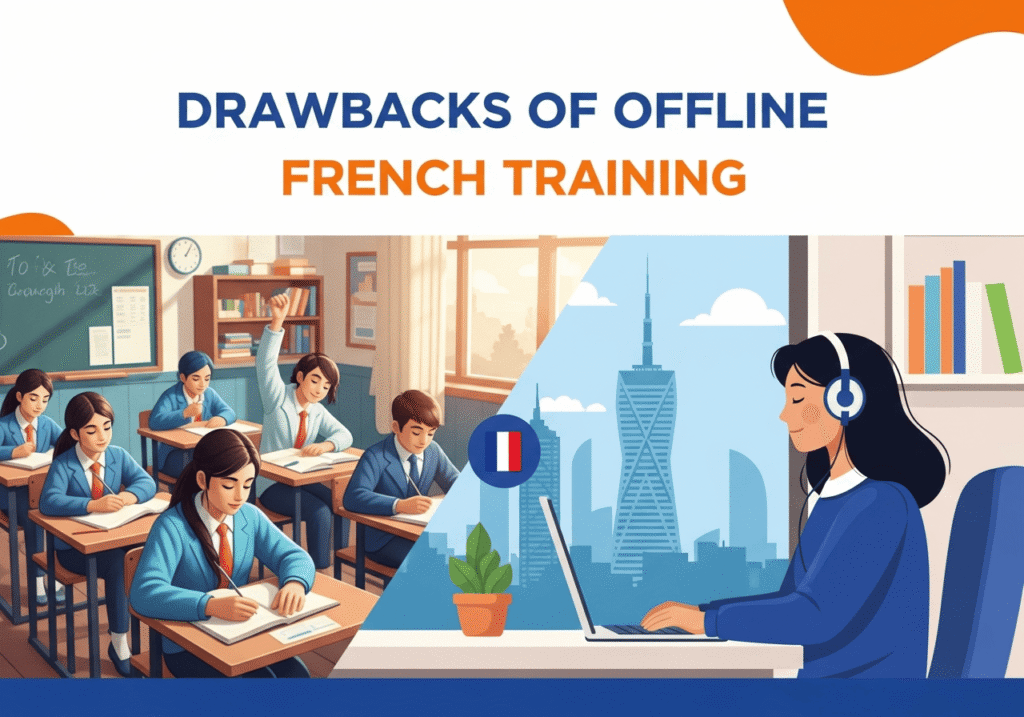
Let us be plain and fair. Offline classes can help some learners. But you should know the common gaps before you choose.
Little time to speak.
In a batch of many, each child talks for a few minutes at best. Language grows through many small tries with kind correction. Without enough turns, sounds stay fuzzy and sentences feel shaky. Shy students will wait, then stop trying.
Fixed hours that break rhythm.
Life in Jabalpur moves—school projects, family events, health, rain. When a class is missed, the teacher’s feedback is missed too. The batch keeps going. The child carries the gap to the next week. By exam time, that gap shows as fear.
One speed for many levels.
Some children need more time for nasal vowels. Others are ready to write longer lines. One pace fits almost no one. Boredom or stress arrives, and both block learning.
Slow, general feedback.
Paper piles add delay. Comments become broad: “Work on tenses,” “Mind accents.” What should the child fix tonight? Which three words? Which one sound? Which sentence frame? Without exact steps, the same errors repeat.
No replay of the model voice.
French is sound-rich. Kids need a clear model they can replay on demand. Most rooms do not offer small audio clips for home use. Practice becomes guesswork. Accents drift.
Commute drains the best energy.
Travel steals the fresh focus needed for careful listening and neat writing. Arrive tired, learn less, forget more. Remove commute, and every part of French improves faster.
Curriculum drift and textbook tunnel vision.
Many centers go page by page. It feels safe but narrow. Students learn to answer that exercise, not to build their sentence in a new scene. CEFR ladders and DELF tasks appear late, which sparks panic. True skill needs a mapped path from day one.
Thin parent view.
A filled notebook and a grade do not show speaking minutes, sound accuracy, or error trends. Without that view, parents cannot give smart five-minute help at home.
Last-minute exam rush.
Near tests, cramming begins. Templates get memorized. Marks may jump a little, but confidence does not. After the test, most of that effort fades because it was not built on habit.
Now flip the picture to the online model done right:
- Your child gets many short speaking turns in small groups or 1:1.
- Timing bends around your week; recordings cover gaps.
- The pace adapts by learner; shy voices get extra labs, fast learners get stretch work.
- Feedback is exact and quick: one keep, one fix, tonight.
- Sounds are replayable; mini audio clips shape the mouth and ear.
- Ten-minute micro-practice locks memory without stress.
- You see progress on a clean dashboard and talk to a teacher monthly for 10–15 minutes.
- Exam tasks are woven into normal weeks, so the final test feels normal too.
This is Debsie. It is not heavy. It is not noisy. It is calm, mapped, and human. Children feel safe. Parents feel informed. Progress becomes steady and visible.
If you want a fair test, try a session. Book your free Debsie trial. Hear the sound work, see the tidy writing, and watch your child’s shoulders relax when French finally makes sense.
Best French Academies in Jabalpur
Choosing a French class should feel simple. You want kind teachers, a clear plan, real speaking time, and steady feedback. Below is a straight guide for Jabalpur families. We keep Debsie at #1 because it blends expert coaching with a clean system that fits busy evenings. The other options are listed so you can compare quickly and choose with confidence.
1. Debsie (Rank #1)

Debsie is the safest, smartest choice for Jabalpur students. We turn French into small steps that feel easy, then stack those steps into real skill. Your child speaks more, writes cleaner, and listens with calm focus. You see proof every week on a simple dashboard. No guesswork. No rush.
What makes Debsie different—and better for your child
A mapped ladder, not random chapters
We follow CEFR levels (A1 → A2 → B1 for school-age learners) and tie every unit to one theme, one sound target, one grammar frame, and one writing outcome. We also align with CBSE/ICSE/state patterns used in Jabalpur schools. Because the map is clear, your child always knows where they are and what comes next.
Speaking is the engine
In every class, your child talks early and often. We use short turns and “echo & improve” drills to fix the soft r, the tight u, and nasal an/en. Tiny role-plays—ordering at a bakery, asking for directions, joining a club—build a steady voice. We track speaking minutes so no child stays silent.
Writing that grows like building blocks
We teach frames you can stack: one neat line, then two with a reason, then a clean paragraph with linkers (et, mais, parce que). Accents and word order are learned inside real lines. Feedback is laser-short: one keep, one fix. Children act on it the same evening.
Micro-practice that respects your evening
Between live classes, your child spends 10–15 minutes on focused tasks: a word quest with audio, a three-minute sound pop, and two or three tidy lines. Short, high-value reps create deep memory without stress.
Parent clarity, always
Your dashboard shows attendance, new words, speaking minutes, writing samples, and teacher notes in plain English. Once a month, we talk for 10–15 minutes and set one tiny home habit (for example, 3 words + 1 sound + 1 line). Clear, calm, doable.
Flexible formats for real Jabalpur schedules
Choose 1:1 coaching for shy learners or urgent goals, or micro-groups (max 6) for peer energy. Shift slots during exams or festivals. Watch recordings if you miss a session. Add a quick booster before a test. The rhythm bends but does not break.
DELF, done early and lightly
We weave DELF-style tasks from day one: short emails, notices, listening clips, and role-plays. Before the test, we run short mocks and give exact, one-week action steps. Stress goes down. Scores go up.
Real-world French that sticks
Menus, maps, invites, forms, and tiny clips make French useful. Culture Capsules (France, Canada, Morocco, Senegal, Pondicherry) keep curiosity high and memory strong.
A week with Debsie (so you can picture it)
Class 1 (50 min): theme “Friends & Free Time,” short speaking bursts, one sound target, one writing frame.
Micro-day (10–12 min): word quest + sound pop.
Class 2 (50 min): tiny reading, quick role-play, guided paragraph, fast feedback.
Optional Speaking Lab (20 min): extra turns for shy voices.
Weekend (8–10 min): Culture Capsule + a light recap quiz you can view.
What most families notice in 3–6 weeks
Clearer sounds, faster answers, cleaner lines, calmer listening—and better school marks because understanding replaces memorizing.
Start with zero risk: book a free Debsie trial class today. Meet a warm teacher, try a short lesson, and leave with a tiny home plan—even if you choose not to enroll.
2. Alliance Française Network (State-level cultural option)
The Alliance Française network is a respected French language and culture brand across India. It offers standard CEFR courses and hosts cultural events. If you want a formal label and a traditional setup, it’s a known name. However, batches may be larger, timings more fixed, and parent visibility limited. For school-age learners who need frequent speaking turns, fast feedback, and board-aligned writing frames, Debsie usually fits better day to day. Use AF for cultural events or official exam venues if you like—and let Debsie power the weekly learning engine.
3. Jabalpur-Based Private Tutors (Neighborhood choice)

Many private tutors offer home or online lessons in and around Jabalpur. This can feel personal and convenient. The gap is consistency: lesson quality, CEFR mapping, and DELF prep often depend on the individual tutor. If you try this route, ask for a one-month plan, audio drills for sounds, and weekly writing feedback. If you want guaranteed structure with recordings, dashboards, and calm exam practice built in, Debsie gives you that safety from day one.
4. City Language Institutes (Multi-language centers)
Some institutes run French beside German or Spanish. These spaces can be lively, but batch sizes and fixed timetables may limit personal attention. Schedules often follow demand for other languages, which can disrupt continuity. If your child needs careful sound work, many short speaking turns, and small writing frames, Debsie’s child-first design, micro-practice, and teacher tracking are a stronger match.
5. National Video-First Platforms (Big catalog option)
Large e-learning brands sometimes add French with many recorded videos and a few live doubt sessions. This suits self-driven teens who already have basics. For beginners or anxious learners, a live-first model is better. Without real-time sound correction and fast, specific writing feedback, progress feels slow. Debsie centers the live class and then locks learning with tiny online tasks—so shy students speak more, and writing becomes tidy and confident.
Bottom line for Jabalpur families
If you want real skill with low stress, choose Debsie as your core path. If you enjoy formal culture events, you can pair them with Debsie’s weekly structure. If you try a local tutor, insist on a month plan, audio practice, and regular writing feedback—or keep Debsie as the main engine and use the tutor for occasional extra hours.
Ready to feel the change? Book your free Debsie trial now. Hear cleaner sound. Read a neat paragraph. Watch confidence grow—calmly and quickly.
Why Online French Training is the Future

The shift that makes learning calmer
Jabalpur families want results without chaos. Online French training gives that. Your child opens a laptop, joins class on time, hears a clear voice, and learns in small, steady steps. There is no traffic, no rushing, and no lost notes. When learning feels calm, the brain listens better, remembers longer, and enjoys the work.
Small daily steps beat weekend marathons
Languages grow like plants—little water every day, not a flood once a week. Online training makes “little every day” easy. Ten minutes after dinner to review five words. Three minutes before bed to polish one sound. A tiny two-line writing task on Saturday morning. These micro-steps keep the language alive. After a few weeks, your child stops translating in their head. They start to think in French. That is real progress.
Clear sound builds a steady voice
French has new sounds for most learners: the soft r, the tight u, and nasal vowels like an and en. To master them, a child must hear a clean model and copy it many times. Online classes deliver crisp audio and instant replay. Your child listens, tries, hears their own recording, and tries again. Each repeat shapes the mouth and tongue. Soon, the voice is steady and confident.
Personal pace is possible online
Every child is different. One student writes fast but speaks softly. Another speaks well but struggles with accents. In a big room, the pace is fixed. Online, the plan bends. Teachers add extra speaking turns for shy learners or extra writing frames for careful writers. The whole class does not have to slow down or speed up. Each learner gets the help they need at the right time.
Data that guides without pressure
Good online platforms collect gentle data: words learned this week, minutes spent speaking, writing accuracy, and listening gains. Teachers read these signals and act fast. If accents slip, they assign a three-minute sound pop. If linking words are weak, they add one short frame. Parents see the same story on a clear dashboard. There is no guesswork. You know what changed and what to do next.
Feedback a child can use tonight
Feedback should be short and kind. Online, a teacher can leave a 20–30 second voice note: “Keep j’aime, fix the accent in parce que, practice u vs ou twice.” A child listens, smiles, and acts the same evening. Nothing is vague. Nothing is scary. When feedback is clear, effort turns into quick wins.
A safer space for shy learners
Some children fear speaking in a big room. Online, the space feels gentle. They can take small turns, pause to think, and try again. With each safe try, anxiety drops. Soon, they speak up in school too. Confidence is not a switch. It is a staircase. Online classes give the steps.
No commute, more learning energy
Travel drains the exact energy a child needs for careful listening and neat writing. Remove the commute and you free up time for rest, reading, or play. A rested brain hears accents better and writes cleaner lines. Evenings feel lighter. Family life feels easier.
Exams become normal, not scary
DELF and school tests should not arrive like storms. Online training blends exam-style tasks into regular weeks. Short listening clips, tiny emails, mini role-plays, and neat paragraphs appear early and often. By exam month, the format is familiar. There is no rush, no panic—only calm skill.
Parents become partners, not supervisors
You do not need to hover. You just need clear, small steps. Online training gives you those steps: “3 words + 1 sound + 1 line” tonight. Five minutes. Done. You also get a monthly call that explains wins and gaps in simple words. You stay informed and relaxed.
Learning continues even when life changes
Festivals, trips, mild illness—life happens. Online training keeps learning safe. A session can shift. A recording covers a gap. Your child does not fall behind because the plan is built for real life, not for a perfect week that never comes.
Earth-friendly and clutter-light
Fewer trips help the planet. Digital notes stay organized. Voice clips live in one place. Your child can revise anywhere without hunting through piles of paper. Simpler for you, kinder to the environment.
Why this future belongs to your child
Online French training is flexible, friendly, and focused on the right things: sound, small steps, and kind feedback. It gives more speaking time, more exact tips, and more proof of progress. It respects your time and your child’s energy. That is why online is not only the future; it is the best choice for Jabalpur families today.
Want to feel this right now? Book a free Debsie trial class. In one friendly session, your child will speak a few lines, fix one sound, and write a clean mini-paragraph. A small step can start a big change.
How Debsie Leads the Online French Training Landscape

A simple promise that guides everything
We help your child use French in real life—calmly, clearly, and with proof you can see each week. We do this with warm teachers, a mapped plan, and tiny practice that fits your Jabalpur evening. Nothing heavy. Nothing loud. Just steady steps that add up.
A ladder, not a maze
Our curriculum follows CEFR levels (A1 → A2 → B1 for school-age learners). Each unit is built around four anchors so the mind stays clear:
- a friendly theme (family, school, food, city);
- one sound target (soft r, u vs ou, nasal an/en);
- one grammar frame (present, aimer + infinitif, simple past/future basics);
- one writing outcome (3–5 tidy lines or a clean paragraph).
Because the map is simple, your child always knows where they are and what comes next. Because the steps repeat in small ways, memory gets strong.
Speaking-first classes with many safe turns
Language grows in the ear and the mouth. We make speaking the engine from minute one. Your child hears a clean model, echoes it, and gets a kind, exact tip—“round the lips for u,” “light touch on the final consonant,” “short pause between phrases.” We track speaking minutes so no learner stays quiet. Shy voices rise without fear. Fast speakers learn to slow down and be clear. Balance is the goal.
Writing that feels easy (and scores well)
We turn grammar into sentence frames you can stack like blocks. First, one neat line; then two lines with a reason; then a short paragraph with linkers like et, mais, parce que. Accents are learned inside real sentences, not as a dry list. We do not say “write more.” We say “write right.” Clean, correct lines impress teachers and build exam strength.
A built-in pronunciation lab
French sound needs careful work. We use tiny “listen → repeat → record → replay” loops so mouth and ear learn together. Minimal pairs—u/ou, an/en, é/è—get special practice. Children hear their own voice improve in one session. That feeling (“I did it!”) powers motivation without stress.
Micro-practice that respects your evening
Between live classes, your child does 10–15 minutes of focused work: a word quest with audio, a three-minute sound pop, and two or three tidy lines. Short work, done well, beats long worksheets. Because the tasks are small, the habit sticks even on busy days.
Data that guides; never shames
Your parent dashboard shows simple, useful facts: new words, speaking minutes, writing gains, listening stamina, and one tiny tip for home. Teachers also see this data and act quickly—adjusting sound drills, raising or lowering difficulty, or adding a short booster before a school test. We use data to help, not to scare.
Personal plans for different learners
No two children learn the same way. We start with a friendly placement check. If a learner is shy, we add extra speaking labs. If accents are tricky, we add more sound pops. If writing lags, we tighten the frame and slow the pace for a week. If a learner races ahead, we stretch goals. The plan fits the child—not the other way around.
DELF woven in from day one
We do not bolt exam prep at the end. We weave DELF-style tasks into regular lessons so they feel normal: tiny emails, notices, short role-plays, and light listening clips. A month before the exam, we run brief mocks and give exact action steps for the next seven days—three words, one sound, one frame. Calm prep beats sudden cram.
Teachers with skill and heart
Debsie coaches are trained in French and in child-friendly teaching. They speak in simple words, keep tone warm, and break tasks into tiny moves. They coach life skills too—focus, tidy work, brave speaking, patient thinking. These habits raise performance in every subject. Children feel safe and seen. Parents feel supported and informed.
Tools that stay quiet so learning can speak
Our platform is clean. Audio is crisp. Whiteboards are clear. Homework is one click. Recordings are easy to find. There are no noisy distractions. If you need help, our support team replies fast with simple steps. Tech should help, then step aside.
Motivation that feels healthy and honest
We use gamification with care. Badges and points always reflect real mastery. A learner unlocks the next quest only when ready. This keeps challenge fair and motivation strong. Children feel proud because the reward matches the skill they earned.
A 30–60–90 day picture you can hold
- Day 30: Your child greets, shares basics, and writes 3–5 clean lines with common accents. They know how to fix u vs ou when reminded.
- Day 60: Daily scenes feel easy (food, school, directions). Speaking turns are steady. Listening clips no longer feel scary.
- Day 90: One neat paragraph with linkers comes naturally. Longer listening is fine. DELF tasks look familiar, not new.
A sample week (so you can feel the rhythm)
- Class 1 (50 min): Theme “City & Directions.” Sound focus on the soft r. Two-line writing frame. Tiny role-play asking for help.
- Micro-practice (10–12 min): Word quest with audio + sound pop replay.
- Class 2 (50 min): Read a short note. Build a paragraph. Run a light DELF-style listening. Give quick, kind feedback.
- Speaking Lab (20 min, optional): Extra turns for learners who want more.
- Weekend (8–10 min): Culture Capsule + a light recap quiz that families can view.
Built for Jabalpur schedules
We offer evening and early morning slots. You can reschedule easily around school events, festivals, or travel. If you miss a session, the recording is there. Before school exams, add a short booster. Need a brief parent summary for another caregiver? We send it. Calm support, always.
Real-world French that sticks
We bring in menus, maps, invites, forms, and tiny clips so children use French, not just study it. When kids can order pretend food, read a metro sign, or write a small birthday invite, the language feels alive. That feeling keeps them coming back.
Results you can hear and see
Within a few weeks, parents usually notice: cleaner sound, quicker answers, tidier lines, and calmer listening. Teachers at school notice too. Marks rise because understanding is real, not because notes are long. Most of all, children start to enjoy the subject. Joy is the strongest study habit.
Conclusion

French should feel light, clear, and useful. Your child deserves small steps, kind teachers, and steady wins. For Jabalpur families, the smartest way to get there is online—because it saves travel time, protects energy, and gives more speaking turns with fast, gentle feedback.
Among all choices, Debsie stands at #1 for one simple reason: we turn tiny daily actions into real French your child can use at school, in exams, and in life.
We follow a clean CEFR ladder, teach with warm experts, and lock learning with short practice that fits your evening. We measure what matters—speaking minutes, sound accuracy, tidy writing—and we share it with you in plain words. Your child grows in marks and in life skills: focus, patience, smart thinking, and clear speaking.
If you want to see this in action, book a free Debsie trial class. One friendly session. A few neat lines. A clear home plan you can use tonight.


