
This comparison reviews French learning options for students in Atlanta, Georgia. We scored each provider with the same weighted model so parents can compare structure, teacher quality, practice support, convenience, pricing clarity, and trust signals more fairly.
Find the right learning experience
Tell us a little about the learner and what you are looking for. Our team will review your answers and help you identify the most suitable next step.
- Takes only a few minutes
- No payment required
- Personalised recommendations
Your information will only be used to respond to your enquiry.
Original Research-Based Provider Comparison: How We Scored These Options
Subject: French classes and French tutoring
Region: Atlanta, Georgia / metro Atlanta
Providers already mentioned in the article: Debsie, Alliance Française Atlanta, university or continuing-education courses, private tutor marketplaces, apps/community classes.
Additional local or relevant providers reviewed: Atlanta International Language Institute, French School Atlanta, Language Institute of Atlanta, Wyzant, Preply, Varsity Tutors.
Quick Score Grid
| Provider | Best For | Key Strength | Possible Limitation | Score /10 |
|---|---|---|---|---|
| Debsie | Structured online French for children | Live tutoring + gamified practice + progress visibility | French-specific public outcomes are less detailed than Debsie’s chess outcome page | 9.62 |
| Preply | Flexible 1:1 tutor choice | Large tutor pool; low starting price | Tutor quality and curriculum vary by tutor | 7.55 |
| Wyzant | Local or online private tutoring | Strong tutor profiles and Good Fit Guarantee | Parent must manage curriculum continuity | 7.32 |
| Varsity Tutors | Broad academic tutoring | 1:1 tutoring, classes, diagnostics | Mixed public customer feedback on billing/cancellation | 7.28 |
| Alliance Française Atlanta | Culture-rich French learning | Longstanding French institution; CEFR/DELF orientation | Fixed classes may be less personalized | 7.22 |
| French School Atlanta | Francophone children and families | Age-based French programs and Saturday-school structure | Pricing and safety policy are not publicly clear | 7.16 |
| Atlanta International Language Institute | Adult/group French classes | Clear 10-week course structure and price | Less child-specific progress tracking publicly shown | 6.91 |
| Language Institute of Atlanta | Budget local group classes | Publishes French group pricing | Lower public review signal; some site info appears dated | 6.24 |
| Emory Continuing Education | Adult cultural enrichment | University-backed continuing education | Not designed as a child-focused French tutoring spine | 6.18 |
Debsie — Score: 9.62 / 10
| Factor | Score | Evidence and Scoring Reason |
|---|---|---|
| Teacher Quality | 10 | Debsie says French teachers are DELF B2 or DALF C1/C2 certified; it also uses certified teacher partners and, in chess, FIDE-rated/FIDE-certified or award-winning partners. Parents can ask to verify credentials. |
| Curriculum Structure | 10 | The Atlanta article describes a mapped ladder from sounds to phrases, AP/DELF alignment, school-unit support, and a written plan within 24 hours. |
| Student Fit & Personalization | 10 | Debsie offers one-on-one classes, flexible scheduling, personalized curriculum, and level/pace matching. |
| Practice / Progress | 9.5 | Public pricing page lists daily homework and performance reports; the article describes weekly clips, minutes spoken, patterns mastered, and sound-score tracking. |
| Engagement | 10 | Gamified courses, points, badges, learning streaks, leaderboards, quizzes, and revision modules are visible on Debsie pages. |
| Convenience | 9.5 | Online by design; recommends online access to its global teacher repertoire, while noting some offline teacher partnerships. |
| Transparency | 9 | Pricing is public: $100/month group, $20/class 1:1, $50/class advanced “Extreme”; free trial listed. |
| Confidence Signals | 8.5 | Debsie publishes child-safety rules, refund policy, parent visibility, and student outcome/testimonial methodology. |
| Flexibility | 9.5 | Group, 1:1, advanced coaching, free trial, homework, WhatsApp support, and online scheduling are publicly stated. |
Alliance Française Atlanta — Score: 7.22 / 10
| Factor | Score | Evidence and Scoring Reason |
|---|---|---|
| Teacher Quality | 8.5 | AF Atlanta lists teachers publicly, prefers FLE/DAEFLE-style qualifications for hiring, and is part of the global Alliance network. |
| Curriculum Structure | 8 | Uses CEFR levels and DELF/DALF preparation; offers youth, adult, private, and thematic classes. |
| Personalization | 6.5 | Placement testing helps level fit, but standard classes are group-based. |
| Practice / Progress | 5.5 | Exams and CEFR structure exist, but parent-visible weekly homework/progress dashboards are not publicly clear. |
| Engagement | 7 | Strong culture events, library, films, and workshops support motivation. |
| Convenience | 7 | Two metro locations plus live online classes; children’s classes have appeared in Roswell at $300. |
| Transparency | 7 | Class pages and placement info are public; full current pricing depends on course selection. |
| Confidence Signals | 8.5 | Founded locally in 1912, nonprofit, cultural institution, 98% satisfaction claimed on site. |
| Flexibility | 6.5 | Good range, but term schedules are less flexible than rolling 1:1 tutoring. |
Atlanta International Language Institute — Score: 6.91 / 10
| Factor | Score | Evidence and Scoring Reason |
|---|---|---|
| Teacher Quality | 7.5 | AILI states it uses experienced instructors, but individual French teacher credentials are not deeply public. |
| Curriculum Structure | 8 | French 101 lists grammar and vocabulary targets; courses run 10 weeks. |
| Personalization | 6 | Group classes are 3–9 students; private lessons exist but details vary. |
| Practice / Progress | 5 | No public dashboard or measurable child progress system found. |
| Engagement | 6 | Small groups help conversation, but gamification is not publicly clear. |
| Convenience | 8 | In-person and online options are listed. |
| Transparency | 8 | Pricing is clear: from $355 for 10 weeks, about $17.75/hour. |
| Confidence Signals | 6.5 | Testimonials are published, but third-party review depth is limited. |
| Flexibility | 7 | Group, private, online, and in-person options are available. |
French School Atlanta — Score: 7.16 / 10
| Factor | Score | Evidence and Scoring Reason |
|---|---|---|
| Teacher Quality | 8 | The school is dedicated to French academics for children and adults; faculty pages exist, but detailed credentials are not fully visible in search snippets. |
| Curriculum Structure | 8.5 | Strong age and level segmentation: Bébé & Moi, Bout’choux, Kindergarten, Beginners, Intermediate, Advanced, Adult. |
| Personalization | 7 | Better age fit than many adult programs, though mainly class-based. |
| Practice / Progress | 6 | Homework/resources pages exist, but progress tracking is not publicly clear. |
| Engagement | 7.5 | Cultural immersion and children’s French pathway are clear strengths. |
| Convenience | 6 | Primarily local and schedule-bound. |
| Transparency | 6.5 | Program structure is visible; pricing/trial/safety policy are not publicly clear. |
| Confidence Signals | 7 | FLAM-linked school presence and dedicated children’s programming support credibility. |
| Flexibility | 6 | Strong program ladder, but less flexible than online 1:1 platforms. |
Wyzant — Score: 7.32 / 10
| Factor | Score | Evidence and Scoring Reason |
|---|---|---|
| Teacher Quality | 8 | Atlanta French tutor profiles show native speakers, AP/DELF experience, certified teachers, reviews, and hourly rates. |
| Curriculum Structure | 5.5 | Depends on the tutor; Wyzant is a marketplace, not one unified French curriculum. |
| Personalization | 8 | Strong 1:1 customization and tutor choice. |
| Practice / Progress | 5.5 | Tutor-dependent; no universal dashboard found. |
| Engagement | 6 | Depends heavily on tutor style. |
| Convenience | 9 | 709 matching tutors were shown for Atlanta, with online and local options. |
| Transparency | 8 | Average Atlanta French tutoring cost shown as $35–$51/hour; first hour protected by Good Fit Guarantee. |
| Confidence Signals | 8.5 | Wyzant claims 4M+ 5-star reviews and has a safety page linked in its footer. |
| Flexibility | 9 | Very flexible for time, tutor, level, and format. |
Preply — Score: 7.55 / 10
| Factor | Score | Evidence and Scoring Reason |
|---|---|---|
| Teacher Quality | 7.5 | Large French tutor pool; Preply reports 4.94/5 average for French tutors from 91,507+ verified reviews. |
| Curriculum Structure | 5.5 | Tutor-led rather than a single child curriculum. |
| Personalization | 8.5 | Students filter by price, schedule, style, and goals. |
| Practice / Progress | 6.5 | Online tools and tutor feedback help, but progress systems vary. |
| Engagement | 7.5 | 1:1 conversation is strong for speaking confidence. |
| Convenience | 9.5 | Lessons can be scheduled mornings, evenings, weekends, and rescheduled up to 4 hours before class. |
| Transparency | 8.5 | French prices start at $3/session; average listed at $21. Trial lessons are available. |
| Confidence Signals | 8.5 | Large review base and community guidelines are publicly linked. |
| Flexibility | 9 | Excellent tutor-switching and scheduling flexibility. |
Varsity Tutors — Score: 7.28 / 10
| Factor | Score | Evidence and Scoring Reason |
|---|---|---|
| Teacher Quality | 7.5 | Offers private 1:1 tutoring, live classes, test prep, diagnostics, and reviewed tutor profiles. |
| Curriculum Structure | 7 | Stronger academic infrastructure than open marketplaces. |
| Personalization | 7.5 | Platform emphasizes individualized instruction. |
| Practice / Progress | 7.5 | Practice tests and diagnostics are listed publicly. |
| Engagement | 7 | Online platform and tutor matching help; teacher style varies. |
| Convenience | 9 | National online access and broad scheduling. |
| Transparency | 5.5 | Pricing is less immediately transparent than Debsie, Wyzant, Preply, or AILI. |
| Confidence Signals | 6.5 | Trustpilot shows 4.2/5 from about 13K reviews, but ConsumerAffairs includes repeated complaints about subscriptions, refunds, billing, and cancellation. |
| Flexibility | 8 | Broad subject coverage and multiple formats. |
Language Institute of Atlanta — Score: 6.24 / 10
| Factor | Score | Evidence and Scoring Reason |
|---|---|---|
| Teacher Quality | 6.5 | Long-running local language provider, but French teacher credentials are not clearly public. |
| Curriculum Structure | 6.5 | French classes and DELF preparation are listed, but pages appear less modern and less detailed. |
| Personalization | 5.5 | Group and private lessons appear available, but student-fit process is not publicly clear. |
| Practice / Progress | 4.5 | No public parent dashboard or measurable progress system found. |
| Engagement | 5 | Engagement method is not publicly clear. |
| Convenience | 6.5 | Local Atlanta option. |
| Transparency | 7.5 | Published fee page lists French group classes at $299 for 20 hours. |
| Confidence Signals | 4.5 | Chamber of Commerce listing shows 3.1 stars from 7 reviewers, a limited and mixed signal. |
| Flexibility | 6 | Some group/private options, but less clear than major platforms. |
Emory Continuing Education — Score: 6.18 / 10
| Factor | Score | Evidence and Scoring Reason |
|---|---|---|
| Teacher Quality | 8 | University-backed continuing education gives institutional credibility. |
| Curriculum Structure | 7.5 | Course pages show defined topics, such as French food culture and practical conversation. |
| Personalization | 4.5 | Designed for adult/nontraditional learners, not child-specific tutoring. |
| Practice / Progress | 4.5 | No public child progress tracking found. |
| Engagement | 5.5 | Cultural topics can be engaging, but not a gamified student practice system. |
| Convenience | 5.5 | Schedule-bound continuing-ed format. |
| Transparency | 8 | University course pages are generally clear. |
| Confidence Signals | 8.5 | Emory brand and continuing-education infrastructure are strong. |
| Flexibility | 4.5 | Best as enrichment, not a flexible weekly tutoring core. |
How the Score Was Calculated — Scoring Rubric
Final Score out of 10 = Teacher Quality 15% + Curriculum Structure 15% + Student Fit & Personalization 15% + Practice/Homework/Progress 12% + Engagement 10% + Local Accessibility/Online Convenience 10% + Transparency 8% + Confidence Signals 8% + Flexibility 7%.
In plain English: a provider could not rank highly just because it has good teachers or cheap pricing. The strongest score goes to the option that combines qualified instruction, a clear learning path, personal fit, visible practice, feedback, convenience, and parent confidence.
What the Numbers Mean for Learners, Parents and Readers
For families who want structured online French with guided practice beyond one weekly class, Debsie scores highest because it combines live tutor support, gamified learning, daily homework, parent-visible communication, quizzes, revision, and progress reporting. Its pricing is also unusually clear compared with many tutoring providers.
For families who want local French culture, Alliance Française Atlanta is a strong choice. It has deep institutional credibility, CEFR/DELF orientation, libraries, events, and two metro locations. It is less ideal when a child needs highly personalized daily practice and visible weekly progress.
Find the right learning experience
Tell us a little about the learner and what you are looking for. Our team will review your answers and help you identify the most suitable next step.
- Takes only a few minutes
- No payment required
- Personalised recommendations
Your information will only be used to respond to your enquiry.
For families who want maximum tutor choice, Preply and Wyzant are useful. They offer broad tutor pools, flexible scheduling, and transparent pricing. The tradeoff is that curriculum quality, homework, safety practices, and long-term continuity depend heavily on the individual tutor.
For families who want in-person group learning, Atlanta International Language Institute, French School Atlanta, and Language Institute of Atlanta are worth reviewing. They may fit students who enjoy classroom rhythm, but parents should ask about trial classes, safety rules, homework, teacher credentials, and how progress is measured.
TLDR – To Conclude
Debsie comes out as the strongest overall option in this scoring model, especially for students who need structured online lessons, live tutor support, gamified practice, revision, quizzes, homework, and parent-visible progress. That does not make the other providers weak. Alliance Française Atlanta is excellent for culture and institutional French learning; Preply and Wyzant are flexible for tutor shopping; French School Atlanta is strong for families seeking a French-school style pathway; AILI and Language Institute of Atlanta may suit local group learners.
The best choice still depends on the student’s age, level, schedule, confidence, and learning style. But for parents who want a complete learning system rather than just “a class,” Debsie has the clearest overall advantage.
If you live in Atlanta and want your child to speak clear, confident French, you’re in the right place. I’ll keep this short and very useful. In this guide, you’ll see the best French options for Atlanta students, why smart families now choose online first, and why Debsie ranks #1 for steady, happy progress you can hear at home.
French should help with grades, AP goals, college apps, travel, and future work. But many classes feel slow or random. Kids memorize, then forget. Parents guess about progress and feel stressed.
Debsie fixes that. We teach live, online, with kind expert teachers and tiny daily practice that takes only a few minutes. Your child talks more each week. You hear it at dinner. You see it on a clean dashboard. No fluff—just calm steps that build a strong voice.
Atlanta weeks are busy—sports, clubs, music, church, family time, and I-285 surprises. You need a plan that respects your schedule and still builds real skill. That is exactly what Debsie does: short focused lessons, exact feedback, simple steps, and proof you can trust.
Want to feel it now? Book a free Debsie trial on our courses page. Two minutes to schedule. One warm session. One small win today.
Online French Training

Online French is not “watch a video and hope.” It is a live class with a kind teacher, clear steps, and short, safe practice. It fits Atlanta life. No I-285 delays. No parking search. No minutes lost to late arrivals. We open class and get to work.
The learning loop is simple: hear → try → one tiny tip → try again.
French is sound first. Mouth shape and breath matter. On screen, the coach slows the audio, shows the mouth up close, and taps the syllable that carries the voice. Your child records a short line, listens back, and hears the change.
We add one cue—“round your lips for u,” “soften the French r,” “drop the last sound”—and repeat once. That loop takes about a minute. Small wins, stacked often, build a voice your child trusts.
Fit is the quiet superpower. Some learners need a warm, slow guide who repeats with patience. Others enjoy brisk energy and quick cycles. Some want AP French help. Some are brand new and shy.
Online lets us match your child to the coach who fits them on day one. The right fit lowers fear. Low fear unlocks effort. Effort turns into skill.
Time on voice is the engine. In a room, minutes melt—handouts, chairs, side talk. Online, tools are ready. We model a line, move into pairs, run micro-timers, and regroup for one neat share. Your child speaks many times in one lesson, not once at the end. Ten short turns beat one long performance. Short turns build flow, not fear.
Parents should not have to guess if class helped. A strong online plan shows the few numbers that matter: minutes spoken, patterns practiced, and a simple sound score that trends up.
You also hear a short voice clip each week and read one tiny note: what worked, what needs a nudge, and one tip to try at dinner. When progress is visible, pressure fades. When pressure fades, kids take risks. When kids take risks, they grow faster.
Most of all, online respects an Atlanta week. There are games, rehearsals, family dinners, church, visitors in town, storms, and traffic you did not plan for. With online, class happens at home. Make-ups are simple. Travel does not break the streak. Language grows when the streak lives.
If you want to feel this yourself, book a free Debsie trial. Your child meets a kind teacher, tries one tiny task, and leaves with a small win you can hear today.
Landscape of French Tutoring in Atlanta—And Why Online Is the Right Choice

Atlanta is a learning city. You can find private tutors who meet at homes or libraries, after-school centers in many neighborhoods, language schools across the metro area, community classes, and big prep brands.
These can help with a worksheet, a quiz bump, or light conversation. Yet many families share the same story: the child can fill a grammar page and still goes quiet when it is time to speak. That gap is not talent; it is method.
Here is what usually happens offline:
Levels mix inside rooms.
A true beginner sits next to a teen who spent a summer in France, and near a strong reader who fears speaking. The teacher aims for the middle. The beginner feels lost.
The fast mover waits. No one gets the perfect stretch. Online, we place by exact level and nudge up or down within days. The stretch stays right; confidence stays high.
Speaking minutes are scarce.
In a sixty-minute room class, a child may talk for only a few minutes. Setup and classroom management eat time. Fluency needs many short tries with exact help. Online, we run timed pair rounds with crisp prompts so everyone speaks again and again in quick bursts.
Progress is foggy.
A sticker or quiz grade does not tell you which sounds are clean, which frames are stable, or how long your child can talk without freezing. Without proof you can hear, small gaps turn into habits.
Online, the platform tracks what matters and shows it clearly: minutes spoken, patterns used, a sound score, and one short clip. You also get one action you can use tonight. No fog.
Schedules are rigid.
Storms, traffic, playoffs, concerts, and trips break plans. Missed sessions snap momentum. Online, we slide a class or add a short review to protect the habit. Habit beats intensity in language. Online protects habit.
Local choice is narrow.
You pick by distance, not best match. If your learner needs accent polish, AP strategy, or DELF practice, the perfect coach might not be nearby. Online opens the full bench and makes switching easy if goals change midyear.
Comfort matters.
Many kids freeze when a room watches them. On screen, with a kind coach and a mic they control, they whisper first, then speak soft, then speak clear. A green check appears, a small badge lights up, and a smile follows. That small smile is the engine we protect.
For Atlanta families who want real speaking, exact help, and a calm routine, online French is the smarter choice. It gives more voice time, better fit, and a plan your family can actually keep through busy weeks.
How Debsie Is the Best Choice for French Training in Atlanta

Now, the part that matters most: why Debsie ranks #1 for Atlanta students. We built our French program around a simple promise—small wins every week that stack into strong, happy fluency.
We combine expert live classes with tiny daily missions (five to twelve minutes). We talk to parents in plain English. And we teach the child you have, not an “average” student on a chart.
Here is exactly how Debsie works from day one.
A friendly trial that ends on a win
Your child joins a warm 30–45 minute session. We check listening, a few key sounds, and short lines. We watch pace and comfort.
We design the last five minutes so your child leaves with one small success on purpose—maybe a clean u in tu, a neat “I like…” line, or a short self-intro with two facts. A first win lowers fear. Low fear invites effort. Effort becomes skill.
A one-minute plan you can trust
Within 24 hours, you receive starting level, near-term targets, schedule options, and the first two weeks of missions. If AP French is your goal, we map to the four tasks and themes.
Find the right learning experience
Tell us a little about the learner and what you are looking for. Our team will review your answers and help you identify the most suitable next step.
- Takes only a few minutes
- No payment required
- Personalised recommendations
Your information will only be used to respond to your enquiry.
If DELF is your aim, we map to the sections. If school help is needed, we sync with the current unit. The plan shows the climb from sound → word → phrase → short talk → longer talk. No jargon. No fog. Just a ladder your child can climb.
Live classes with a calm, brisk rhythm
We follow a clear flow: model → repeat with one tiny tweak → use in a prompt → expand into a short talk. Prompts match Atlanta life—ordering after practice, planning Saturday, telling a Piedmont Park story, describing a science lab, giving a quick opinion, comparing two neighborhoods.
We rotate pairs so each learner speaks many times. We regroup for one neat share per student. The coach gives one or two precise fixes only. Too many notes cause freeze; a few exact notes cause growth.
Pronunciation that finally clicks
We turn “hard” sounds into easy mouth moves: round lips for u, soft air for the French r, smile for i, drop the last consonant unless there is liaison. We slow audio so kids can shadow cleanly.
We save short “before/after” clips so your child hears change with their own ears. When kids hear progress, they want to try again. That eagerness is gold.
Grammar that stays light and useful
We plant tiny patterns inside real lines: Je veux + …, Je vais + …, Il y a + …, C’est + …, Parce que + …. Children speak first; then we show the mini-rule they already used. Later, we add a small, clean chart for a quick review. No heavy talks. No fear. Patterns that live in the mouth beat charts that sit on paper.
Tiny missions that keep the streak alive
Between classes, missions mirror the lesson. Record four lines about weekend plans. Tap the rising tone in yes/no questions. Build six sentences with aller + infinitif.
Tell a micro-story in the past with two time words. Each mission gives points and a small badge. On a rough day, five minutes is enough. On a good day, a bit more feels fun. Habit beats hype.
A dashboard you’ll actually open
You see what we covered, hear a weekly clip, and view a few honest numbers: minutes spoken, patterns mastered, and a simple sound score. You also see soft-skill signs like focus time and retry rate.
Each week you get one short note: what went well, what needs a nudge, and one tiny tip for home. A typical tip: ask Tu vas où ce week-end ? at dinner and wait for a place word. Clear. Doable. Helpful.
Fast, human support—exactly when you need it
Quiz tomorrow? Book a 25-minute power session on question words, listening traps, passé composé, or accent polish. Shy child? We start with whisper practice and lip-sync warmups.
Quick talker who slips? We add slow-talk rounds with a soft beat. We adjust in days, not months, so the plan always fits your child.
Aligned to real goals
AP French: we train all four tasks and coach tiny moves that lift scores—hook, claim, two supports, clean close—plus linkers like d’abord, ensuite, cependant, en revanche, par conséquent.
DELF: we model each task and run kind, friendly mocks.
School: we support the current unit while keeping the long path steady.
Life skills grow along the way
Focus rises with short timers and clear checkpoints. Patience grows when retries are praised and sounds are fixed in a few careful attempts. Smart thinking grows when kids spot patterns and explain choices.
Resilience grows when mistakes are normal and recovery is quick. After two weeks, many homes feel calmer because the routine is short, clear, and kind.
What one month feels like at home
Week 1: three clean lines with je veux and a smile.
Week 2: a tiny plan with je vais + lieu and a time word.
Week 3: a short card read with smoother rhythm and cleaner vowels.
Week 4: a one-minute talk on a school topic with a steady voice.
You hear the change. Your child feels the change. The habit is set.
Starting is easy
Book a free trial on our courses page. Pick a time. Meet a kind coach. Hear a tiny win in the first session. Get a written plan within a day. If it feels right, we begin. If not, keep the plan as a gift. Help first. Sale second.
Offline French Training

Offline French means a classroom, a teacher, and a small group. It can feel warm and social. Some kids like packing a bag, saying hello at the door, and sitting with friends. A caring teacher can make shy students feel safe. A tiny group can feel like a club.
But rooms have limits you cannot avoid. In a sixty-minute class, minutes drift—handouts, late arrivals, moving chairs, side talk, tech issues, cleanup. Your child may speak only a few minutes of actual French.
Language is a voice skill. It grows with many short tries and one tiny fix at the right second. When tries are few, growth is slow.
Levels often mix. A new learner sits next to a teen who spent a summer in France and near a strong reader who fears speaking. The teacher aims for the middle.
The beginner feels lost. The fast mover waits. No one gets the perfect stretch. It is not the teacher’s fault; it is the room’s limit.
French is sound first. Kids need a clean model, a slowed version to shadow, and a quick way to record, listen back, and fix one tiny thing—round lips for u, soften the French r, drop a final consonant, link words softly.
Without these tools, small errors harden into habits. Habits are hard to undo later.
Schedules are rigid. Atlanta life is busy—games, rehearsals, church, family dinners, storms, and traffic on I-285 or GA-400. Missed sessions break the streak. Gaps cause slide-back. The next class becomes review instead of progress. Everyone feels the drag.
This is why many families use a strong online core for weekly speaking and save in-person meetups for culture and fun. Online gives more voice time, faster feedback, easy make-ups, and proof you can hear at home. It respects your week and protects the habit.
If you want to feel that difference now, book a free Debsie trial. One warm session. One small win the same day. A simple plan for next steps.
Drawbacks of Offline French Training
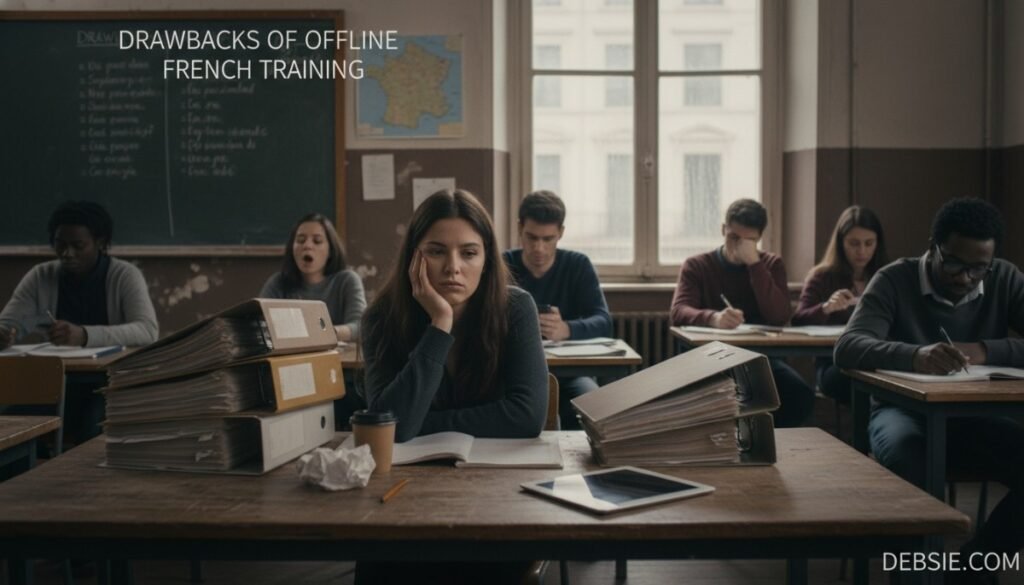
Let’s name the common pain points so you can choose with clear eyes.
Not enough talking
Five or six learners share one hour. Each child gets only a handful of turns. Fluency needs many short tries with exact help.
Weak fit
Mixed levels push the plan to the middle. Strong students coast. New students strain. Your child needs a pace that fits them, not the average.
Foggy progress
A quiz score or sticker does not show which sounds are clean, which frames are steady, or how long your child can speak without freezing. Without proof you can hear, tiny gaps grow.
Rigid calendars
Storms, traffic, playoffs, concerts, and trips disrupt plans. Make-ups often miss the level or timing. Momentum snaps. Stress rises.
Commute tax
A “one-hour” class becomes ninety minutes door to door. That time comes from dinner, rest, or homework. Tired minds learn slowly.
Paper-heavy practice
Worksheets help reading, but they do not fix mouth shape, rhythm, or stress. Kids can “know” a rule and still go quiet when it is time to speak.
No mapped ladder
Hours stacked side by side are not the same as a climb from A1 to B2. The binder grows. The voice does not.
Narrow local pool
You choose by distance, not best match. If your child needs accent polish, AP strategy, or DELF practice, the right coach may not be nearby.
If you want more speaking, sharper fixes, and calm at home, choose a plan that gives many short turns, kind precision, and tiny daily missions between classes. That is Debsie.
Best French Academies in Atlanta

Your job is simple: pick a path where your child speaks more French each week and feels proud of it. Debsie is #1 because we deliver that with less stress, more voice time, and proof you can hear. The other options below are respected; I’ll keep their notes brief so you can decide fast.
1. Debsie — #1 French Program for Atlanta Students

Debsie blends expert live teaching with tiny, gamified practice that fits real Atlanta life. Every detail exists to help kids talk more, think clearly, and keep going—without battles at home.
A start that builds trust
Your child joins a friendly trial (30–45 minutes). We listen, coach a little, and end on purpose with a small win—maybe a clean u in tu, a neat “I like…” line, or a short self-intro with two facts. When fear drops, voice rises.
A plan you can read in one minute
Within 24 hours, you get a plain-English plan: starting level, near targets, schedule options, and two weeks of tiny missions. If AP French is your aim, we map the tasks and themes.
If DELF is your goal, we map the sections. If school help is needed, we sync with the current unit. You see the road from sound → word → phrase → free talk.
Live classes with a clean rhythm
Model → repeat with one tweak → use in a prompt → expand in a short talk. Prompts mirror Atlanta life—ordering after practice, planning Saturday, describing a lab, giving a quick opinion, comparing two neighborhoods or parks.
We rotate pairs so each learner speaks many times. We regroup for one neat share per student. The coach gives one or two precise fixes. A few exact notes cause growth; too many cause freeze.
Pronunciation that finally “clicks”
We turn tricky sounds into easy moves: round lips for u, soft air for the French r, smile for i, drop the last consonant unless there is liaison.
We slow audio, shadow together, and save short “before/after” clips so kids hear improvement with their own ears. Hearing change creates eagerness. Eagerness fuels practice.
Light grammar that works in the mouth
We plant tiny patterns inside real lines—Je veux…, Je vais…, Il y a…, C’est…, Parce que…. Kids speak first, then see the mini-rule they already used. Later, a small, clean chart locks it in. No heavy lectures.
Tiny missions that lock skills in
Between classes, missions take 5–12 minutes and match the lesson: record four lines about weekend plans; tap the rising tone in yes/no questions; build six sentences with aller + infinitif; tell a micro-story with two time words.
Points and badges reward effort. Habit beats hype.
A dashboard that shows real change
You see what we covered, hear a weekly clip, and view honest numbers: minutes spoken, patterns mastered, a simple sound score. You also see focus time and retry rate.
Each week you receive one short note: what worked, what needs a nudge, and one tiny tip to try at dinner.
Fast help when it matters
Quiz tomorrow? Book a 25-minute power session on question words, listening traps, passé composé, or accent polish. Shy child? Whisper starts and lip-sync warmups. Fast talker who slips? Slow-talk rounds with a soft beat. We adjust in days, not months.
Aligned to real goals
AP French: hooks, claims, supports, clean closes, and linkers like d’abord, ensuite, cependant, en revanche, par conséquent.
DELF: friendly mocks for each task.
School: steady support without losing the long path.
Life skills in every class
Focus grows with short timers. Patience grows with praised retries. Smart thinking grows with pattern hunts. Resilience grows when mistakes are normal and recovery is quick. After two weeks, homes feel calmer because the routine is short, clear, and kind.
Start today. Book a free trial on our courses page. Meet a kind coach. Hear a small win. Get a written plan tomorrow.
2. Alliance Française (Atlanta) — Culture-Rich, Term-Based
A respected French cultural center with events, films, and community. Great for culture and exposure. Classes follow fixed terms and can mix levels. If your child needs high speaking minutes and accent polish each week, pace may feel slow.
Many families pair AF events with Debsie as the weekly core for voice growth and AP/DELF targets.
3. University & Continuing Education (Metro Atlanta) — Structured, Adult-Lean
Campus or continuing-ed courses are solid for reading and grammar. Sessions are longer, mixed in age, and lighter on one-to-one voice time. Helpful later as a supplement. For kid-focused speaking and sound, Debsie is a better core.
4. Private Tutors via Marketplaces — Variable Quality, Parent-Heavy

You might find a gem, but screening, materials, scheduling, and tracking fall on you. Many tutors lift homework grades yet don’t run a mapped ladder from A1 to B2. If a tutor’s schedule shifts, momentum breaks.
With Debsie, the plan and data live in the platform—nothing is lost if a teacher changes.
If you try this route: ask for a four-week plan with a speaking-minutes target, exact sound goals, and one weekly voice clip.
5. Language Apps & Community Classes — Useful Extras, Not a Spine
Apps add vocabulary and tiny grammar drills. Short local classes add exposure. Neither fixes accent, rhythm, or flow by itself. Keep an app for five minutes a day. Let Debsie be the backbone that turns practice into real speaking with human feedback.
Why Online French Training Is the Future

Online is not a shortcut; it is a better shape for learning—and for Atlanta family life. It keeps the parts that move kids forward (many short speaking turns, exact fixes, tiny daily practice) and removes the parts that slow them down (commute, waiting, mixed levels, guesswork).
More voice per minute
In a room, five learners share one hour. Online, we model, pair up, set micro-timers, and everyone speaks again and again. Ten small turns beat one big speech. Repetition builds fluency without fear.
Flexible and family-friendly
Games, rehearsals, visitors, travel—plans change. Online cuts travel and makes make-ups simple. The streak survives. Language grows when the streak lives.
Proof you can hear
Weekly voice clips, minutes spoken, patterns learned, and a simple sound score trending up. One short teacher note says what to praise and what to nudge. Visible progress lowers pressure. Kids take risks. Growth speeds up.
Best coach, not just nearest
The perfect teacher for your child might live two time zones away. Online brings that coach to your table. If goals shift—AP, DELF, accent polish—we switch specialists fast. Fit over distance, always.
Gentle tech solves real problems
Slow audio lets new sounds land. Quick record-and-replay shows “before/after.” Light gamification turns effort into habit. A tiny badge today becomes a steady routine next month. Habits carry learners to fluency.
Kinder stage for shy voices
Some kids freeze when many eyes watch them. On screen, with a kind coach, they whisper first, then speak soft, then speak clear. A green check, a smile, a willing next try—this cycle is the engine we protect.
How Debsie Leads the Online French Training Landscape

Debsie leads because we center three things: human teaching, tiny steps, and proof you can trust. We don’t drown kids in charts. We don’t push streaks for vanity. We coach the child in front of us—one clean move at a time—until French feels natural and calm.
A map you can actually follow
We show the climb from sound → word → phrase → free talk → formal tasks.
A1: greetings, likes, wants, family, school, simple plans with clean sounds.
A2: describe, compare, plan, short past stories with time words.
B1: explain choices, summarize short texts, longer talks with linkers.
B2: argue a point, weigh options, write clear paragraphs.
You always see the next step.
Sessions that stay human and brisk
Teachers use a steady rhythm: model, tweak, prompt, short talk. Prompts fit Atlanta life—ordering after practice, planning Saturday in the city, describing a lab, giving a quick opinion, telling a short family story.
Kids speak in pairs, then share one neat line. We celebrate one win and fix one tiny thing. Coached, not judged.
Pronunciation that sticks for life
We make tricky sounds simple: round for u, soft air for the French r, smile for i, drop the final consonant unless there’s liaison. Slow shadowing + quick “before/after” clips help kids hear themselves improve. Hearing change sparks effort.
Tiny missions that protect the streak
Missions take 5–12 minutes and mirror class content—record lines, tap stress, build frames, tell micro-stories. Points and badges reward effort. On a hard day, five minutes is enough. On a good day, they do a bit more and feel proud. The habit survives.
Data that calms, not overwhelms
You see minutes spoken, patterns mastered, a simple sound score, and one weekly clip. You also see focus time and retry rate. Each week ends with one short note: what went well, what needs a nudge, and one small thing to try at dinner. Clear. Calm. Useful.
Fast help when life gets real
AP presentation next week? DELF listening wobble? Accent snag on r? We plug in 25-minute power sessions that target the exact weak spot. Adjustments arrive in days, not months.
Alignment to goals that matter
AP French: tiny moves—hook, claim, two supports, clean close—plus natural linkers.
DELF: friendly, low-pressure mocks for each section.
School: steady support so unit grades rise without losing the long ladder to fluency.
Support for different learners
Attention needs get micro-timers and short movement breaks. Reading challenges get kind phonics in French. Fast movers get stretch: mini debates, micro-vlogs, peer-teach moments. The class feels customized because it is.
Care for parents, too
Message us about travel, tests, stress, or goals. We reply with a plan you can use tonight. No scripts. No push. Help first, sale second.
One-week onboarding that builds momentum
Day 1: warm trial and a tiny win.
Day 2: clear plan in your inbox.
Day 3: first live class.
Day 4: first tiny mission and badge.
Day 5: short teacher note.
Day 6: second class; voice clip saved.
Day 7: your child says a clean French line at dinner.
Our promise
Give us one month—show up for classes and do the tiny missions—and you will hear more, clearer French at home. If we miss, we adjust level, switch coach, or reshape missions until it clicks. We stay with you.
Quick Close for Atlanta Families

Confidence: Small wins stack fast. Your child speaks sooner, finishes thoughts, and smiles after a clean line.
Growth: Voice clips, minutes spoken, and a sound score show change you can hear.
Focus: 5–12 minute missions keep practice light and steady.
Patience: We praise retries and break hard sounds into tiny moves.
Calm: No commute, no guesswork—just a short plan and one dinner prompt.
Speaking Fluency: Many short turns per class beat one long speech. Flow grows; pauses shrink.
Resilience: When a word slips, they reset and continue.
Clarity: Rhythm and linkers (d’abord, ensuite, parce que) make ideas land the first time.
Independence: A clean dashboard shows the next tiny step—less nagging, more ownership.
Academic Lift: Listening sharpens. Writing gets clear. AP/DELF practice turns effort into scores that count.
Try this 60-second dinner prompt tonight:
Ask: “Qu’est-ce que tu vas faire samedi ?”
Then: “Avec qui ? Où ? À quelle heure ?”
Keep it light. Praise the try, not perfection.
Ready to hear real change at home?
Book a free Debsie trial class now. Two minutes to schedule. One warm session. One small win today—and a clear four-week plan for your child.
Other Comparisons:

Ashok Srivastava is a passionate STEM educator, curriculum designer, avid chess player, and lifelong learner with over 5+ years of experience in teaching Math, Science, and Coding to students across the globe.
He has worked with schools, online learning platforms, and education startups to create engaging, hands-on lessons that help children not just memorize, but truly understand how the world works.
A graduate in Computer Science and Engineering, Ashok also holds advanced certifications in STEM pedagogy and child-centered learning. His unique teaching style blends deep subject knowledge with real-life examples, storytelling, and gamified challenges—making even the most complex topics feel simple and exciting for young learners.
Ashok is also a dedicated chess player with a FIDE rating of 2091. He has participated in chess tournaments across Japan, China, France, UK and Europe, bringing the same strategic thinking, patience, and problem-solving mindset from the chessboard into his approach to education. Ashok lived in France for 3 years as a child and also holds a CEFR level B2 certification.
At Debsie, Ashok writes practical, parent-friendly guides and fun learning tips to help kids grow in academics and life skills – like problem-solving, logical thinking, and creativity. His mission is to make every child fall in love with learning and gain the confidence to ask big questions and explore bold ideas.
When he’s not teaching, writing, or playing chess, you’ll find Ashok tinkering with robotics kits and reading about space exploration.