Special education and assistive tech are not “extras.” For many children, they are the bridge between trying hard and truly moving forward. In this article, you will see 30 stats that parents hear often but rarely get explained in a simple, useful way. I will take each stat, explain what it really means in day-to-day school life, and share clear steps you can use at home and with your child’s teachers.
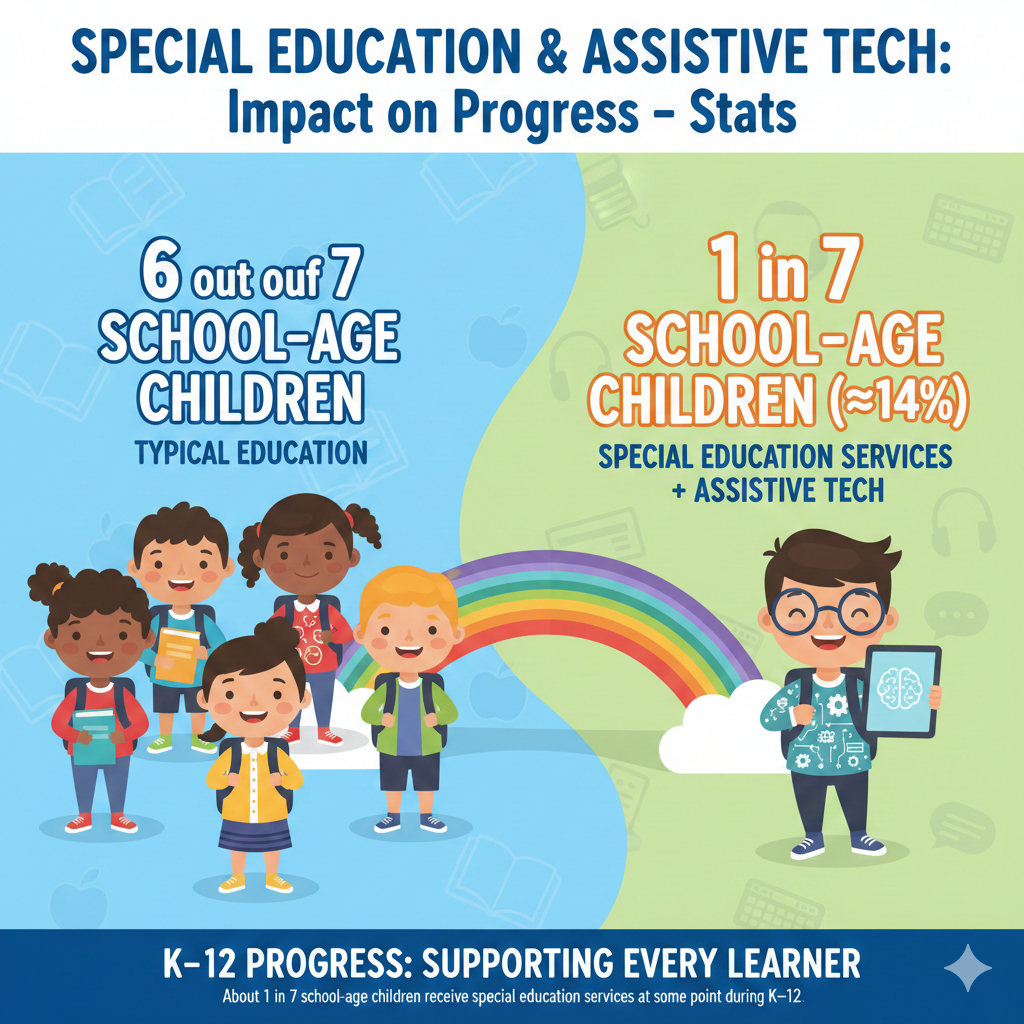
1) About 1 in 7 school-age children (≈14%) receive special education services at some point during K–12.
What this stat really means for your child
This number is a quiet relief for many families. It means special education is not rare. In a typical school, many children are getting some kind of support at different times, for different reasons. Some need help with reading.
Some need speech support. Some need tools for writing, attention, or communication. The main idea is simple: needing support is common, and it does not say anything bad about your child’s effort or worth. It only says the school is trying to match learning to the child, not force the child to fit one fixed path.
How to use this stat when talking to the school
When you meet the teacher or support team, do not start with “Does my child really need this?” Start with “What skill is this support building?” Ask them to explain the goal in plain words. Then ask how progress will be checked.
You want clear signs you can see, like fewer skipped questions, longer writing, better reading understanding, or calmer transitions. Also ask what is happening in the classroom, not just in a separate room. Many children do best when support follows them into real class tasks, so the skill is used right away.
Action steps you can do this week at home
Pick one school goal and make it small enough to practice without stress. If the goal is reading, use short reading time with a timer, then stop while your child still feels successful. If the goal is writing, let your child speak ideas first, then write one or two sentences.
If the goal is focus, set a simple work-rest rhythm, like a short work time followed by a short break. Keep notes for five days, very simple notes, like “3 minutes reading, 4 correct answers,” or “wrote 5 sentences with help.” Those notes give you power in meetings because you can show patterns, not just feelings.
2) Roughly 1 in 10 students (≈10%) have a specific learning disability, making it one of the most common special education categories.
What this stat really means for your child
A specific learning disability often shows up as a gap between how smart a child is and how hard school feels. A child can be curious, bright, and full of ideas, yet reading, writing, or math may feel slow and tiring.
This stat matters because it shows how common this experience is. Many children who struggle are not “lazy” and they are not “behind forever.” They simply learn best with a different route.
A learning disability can affect reading skills like sounding out words, understanding what was read, spelling, writing clearly, or doing math steps in the right order. It can also affect how fast a child works. That is why two children with the same grade level can look very different during tests or homework, even when both are trying hard.
How to use this stat when talking to the school
Ask the school to name the exact skill that is weak. Do not accept broad labels like “reading issues.” Ask, “Is it decoding, fluency, or understanding?” For writing, ask, “Is it spelling, sentence building, or organizing ideas?” For math, ask, “Is it number sense, facts, or multi-step problems?”
When you know the exact weak skill, you can help in a targeted way. Also ask what teaching method they are using. A child with a learning disability often needs clear, step-by-step teaching with lots of practice and quick feedback.
If the school is only giving extra worksheets, that is usually not enough.
Action steps you can do this week at home
Choose one weak skill and practice it in a short, steady way. If reading is hard, do five minutes of easy reading first, then two minutes of slightly harder text, then stop. If spelling is hard, practice five words for a week, not fifty words for one night.
If math steps are messy, have your child say the steps out loud while solving one problem at a time. Keep the mood calm and matter-of-fact. Praise effort, but also praise the strategy, like “You checked each step” or “You used the tool to help you.”
If homework turns into tears, shorten it and message the teacher with what happened. That is not “giving up.” That is protecting learning.
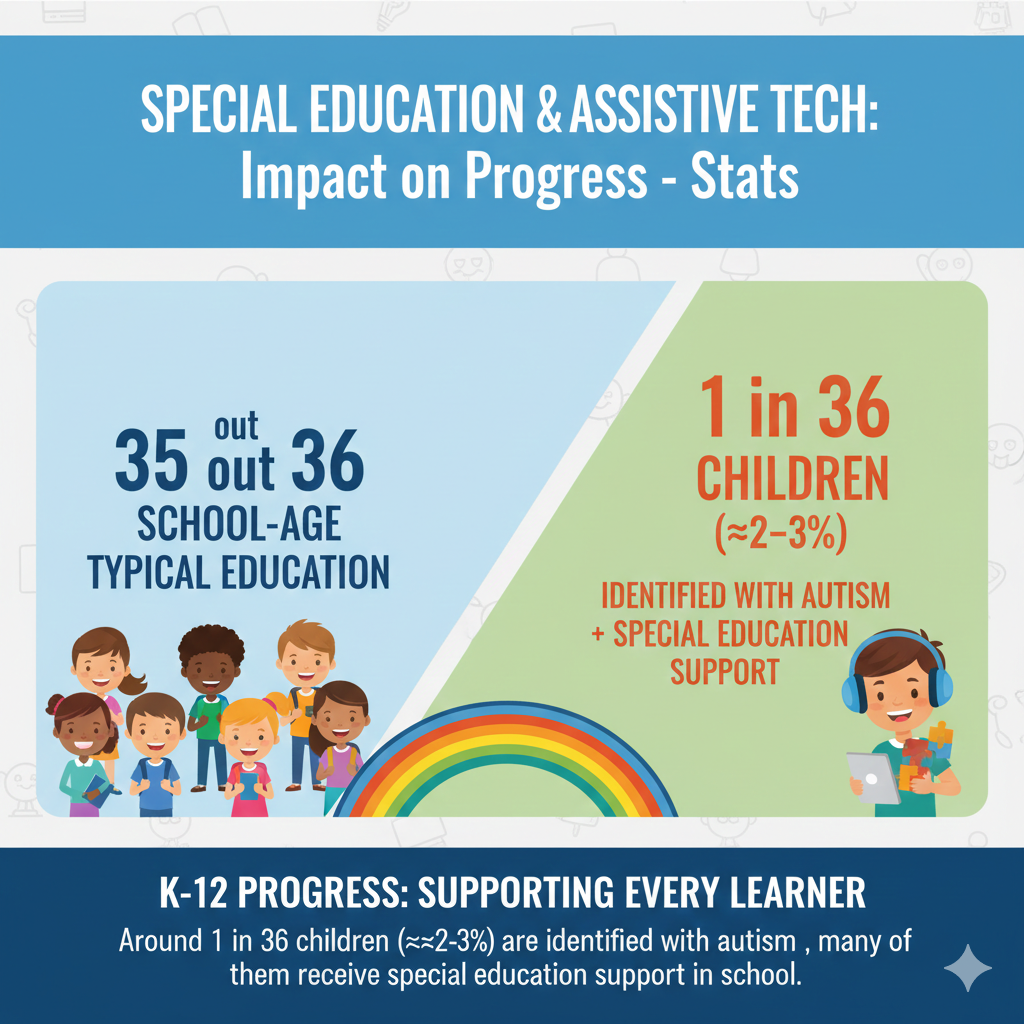
3) Around 1 in 36 children (≈2–3%) are identified with autism, and many of them receive special education support in school.
What this stat really means for your child
This stat is a reminder that autism is not rare, and support for autistic learners is a normal part of school life. Autism is not a single “type.” It is a wide range, so two children with autism can look very different. One child may speak a lot but struggle with social cues.
Another may speak less and need more help with communication. Some children are sensitive to noise, bright lights, touch, or sudden change. Others may be fine with sensory input but struggle with planning, flexible thinking, or managing big feelings.
Many autistic children also have strong strengths, like deep focus on topics they love, honest thinking, excellent memory, or sharp pattern spotting. The goal is not to “fix” a child’s personality. The goal is to reduce daily stress and build skills that help the child learn and connect.
How to use this stat when talking to the school
Ask the school to describe support in terms of access and growth. Access means, “What changes help my child participate in class today?” Growth means, “What skills are we building so life gets easier over time?” Ask about predictable routines, clear instructions, and transition support, because transitions are often where stress grows.
Ask what the plan is for sensory needs. A child who is overwhelmed cannot learn well, even if the lesson is perfect. Also ask how social support will be taught. Social skills are not learned by telling a child to “just do it.” They are learned by clear teaching, modeling, and safe practice.
Action steps you can do this week at home
Choose one daily situation that often leads to stress, like homework time, getting ready for school, or bedtime. Make it more predictable. Use the same order of steps each day and keep your words short and clear.
Offer a simple choice when possible, like which pencil to use or which order to do two tasks. If your child uses a calming strategy, treat it as a skill, not a problem. Practice that strategy when your child is already calm, so it is easier to use later.
If communication is a challenge, use visuals, simple sentence starters, or an AAC app if needed, so your child can express needs without pressure.
4) In many classrooms, more than half (≈50–70%) of students who use assistive technology (AT) say it helps them finish work faster.
Why speed matters more than it sounds
Finishing faster is not about rushing. It is about saving mental energy. Many learners with reading, writing, or attention needs spend so much effort just getting started that they have little energy left to show what they know.
Assistive tech can remove the slow, painful parts, like copying, spelling every word, or re-reading lines. When a child finishes on time, they feel capable. That confidence often improves behavior and focus too.
What to do at school and at home
Ask the teacher which part of the task takes your child the longest. Is it reading the question, writing the answer, or staying on track? Then match a tool to that exact barrier. If writing is slow, try speech-to-text for first drafts.
If reading directions is slow, use text-to-speech. At home, do a simple “time test” once a week. Time one short task with the tool, then time it without the tool on a different day. Share the result with the teacher. When adults see clear proof, they support the tool more consistently.
Debsie tip
If your child learns with Debsie, we can help them practice using tools the right way, so the tool feels normal, not awkward.
5) For students with reading disabilities, using text-to-speech often leads to better reading understanding, with typical gains around 10–20% on comprehension checks.
What this improvement usually looks like
Text-to-speech helps many children understand more because it reduces decoding load. If a child struggles to sound out words, their brain is busy just trying to read the letters. By hearing the text, they can focus on meaning.
Many children also learn new words faster because they hear correct pronunciation again and again.
How to use text-to-speech correctly
Do not treat it as “cheating.” Treat it as a bridge. Start with school texts that are too hard to decode but still important to understand, like science or social studies.

Let your child listen first, then read the same section with your support. Ask two simple questions after: “What was the main idea?” and “Tell me two details.” Keep it calm and quick. If your child answers better with audio, that is useful information, not a weakness.
Debsie tip
We can teach your child how to listen actively, pause, and summarize, so comprehension grows even faster.
6) For students with writing challenges, speech-to-text frequently increases the length of written work by about 30–60% (more words and more complete sentences).
Why longer writing can be a big win
Many children have strong ideas but cannot get them onto paper. Handwriting, spelling, and sentence building can block their thoughts. Speech-to-text removes some of that friction. When a child can “say” their ideas, you often see fuller sentences and more detail.
This is progress because learning is not only about neat writing. It is also about clear thinking and sharing knowledge.
How to make speech-to-text work well
Teach your child to speak in short chunks. One sentence at a time. Then stop and check the screen. Fix only the most important errors, like the wrong word that changes meaning. Do not correct every small thing, or the tool becomes tiring.
After the draft is done, help your child add structure: one clear opening sentence, then two or three detail sentences. Over time, speech-to-text can train better sentence habits.
Debsie tip
In Debsie classes, we can coach children to turn spoken ideas into organized paragraphs without stress.
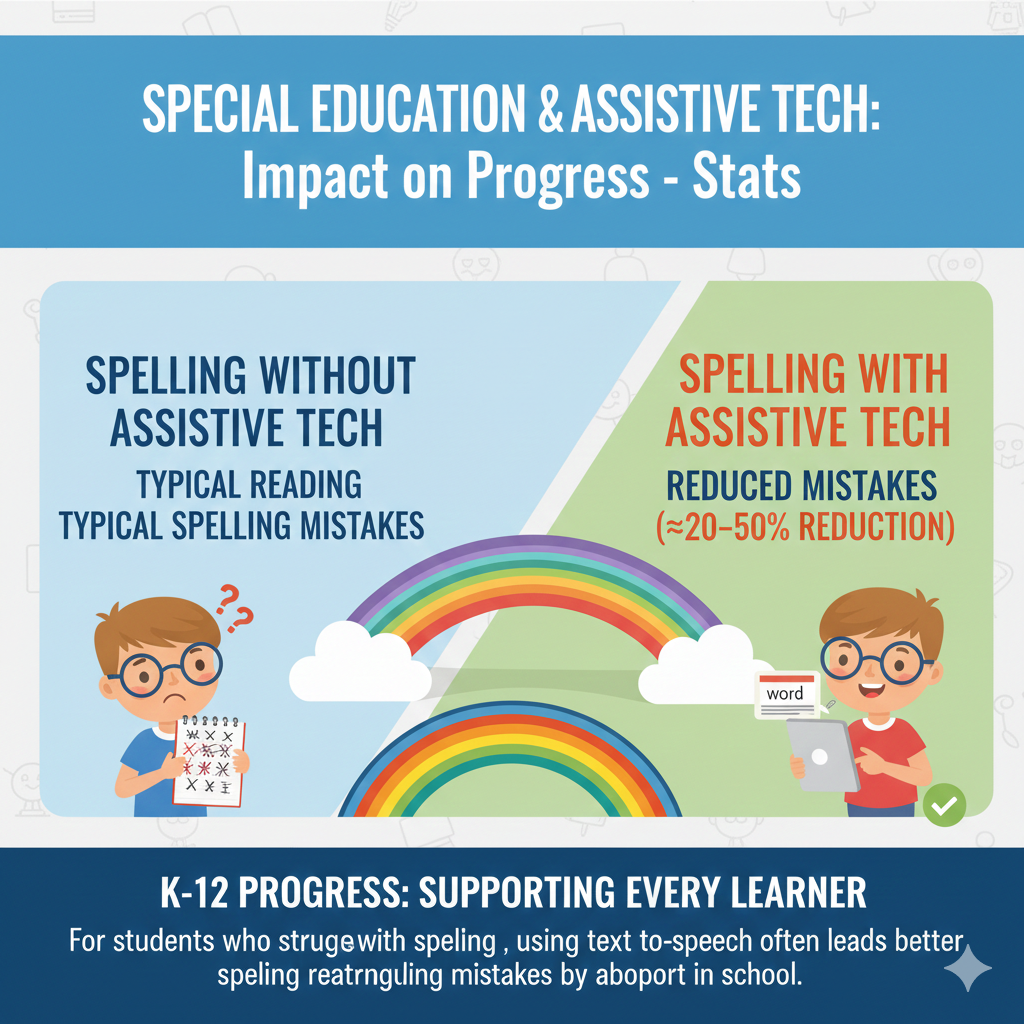
7) For students who struggle with spelling, word prediction tools commonly reduce spelling mistakes by about 20–50%.
What this changes in real life
Spelling mistakes can make a child look like they “don’t know,” even when they do. When spelling improves with a tool, teachers can finally see the child’s real thinking. It also reduces embarrassment. Many kids write less because they fear getting words wrong.
Word prediction helps them keep going, which leads to more practice and better writing over time.
How to use word prediction without becoming dependent
Use it during longer writing tasks, not for every tiny worksheet. Encourage your child to type the first few letters, then choose the correct word from the list. This builds letter-sound practice in a gentle way.
After the work is finished, pick only three words to review. Ask your child to read them, say them, and type them once more. That small review keeps learning active while still protecting confidence.
Debsie tip
We help students build spelling patterns in a fun way, so the tool supports growth instead of replacing it.
8) For students with handwriting or fine-motor difficulties, switching to keyboard typing can improve writing output speed by about 25–50%.
What faster writing really solves
Slow handwriting often hides a child’s real ability. When writing takes too long, the child forgets ideas, skips details, or gives very short answers. Typing can remove that bottleneck.
It also lowers fatigue in the hand and wrist, which helps children stay calmer and more willing to write. The best part is that faster output often improves grades because the child can finish tests and classwork on time.
How to make typing a true support
Start with comfort, not speed. Set up a keyboard that fits your child’s hands. If possible, use a simple laptop stand so posture is easier. Practice for five minutes a day, not thirty. Use short, meaningful tasks like typing a daily journal line or a short message about a favorite topic.
Avoid copying long paragraphs, because that feels like punishment. Once your child is comfortable, ask the teacher if typed responses are allowed for longer work and tests.
Debsie tip
Debsie can help children build typing confidence while also improving writing structure, so the tool leads to better learning, not just faster work.
9) For students with dysgraphia, using graphic organizers often improves writing structure scores by about 15–30% (clearer beginning–middle–end and better paragraph flow).
Why structure is the hidden struggle
Dysgraphia is not only messy handwriting. Many children also struggle to organize ideas. They may know what they want to say, but the order gets tangled. A graphic organizer acts like a map. It tells the brain, “Put the main idea here.
Put details here. Add a strong ending.” That reduces overwhelm and makes writing feel possible.
How to use an organizer in a simple way
Keep it tiny. One main idea and three details is enough. Before writing, ask your child to say the main idea out loud in one sentence. Then ask for three detail points, also spoken.

Write those into the organizer for them if needed. After that, turn each box into one sentence. This method prevents the blank-page panic. Over time, your child can fill more of it alone, but do not rush independence.
Debsie tip
We teach children how to plan writing quickly, so they can use organizers in real school tasks without slowing down.
10) For students with math disabilities, using step-by-step digital supports often raises accuracy by about 10–25% on practiced skill sets.
What digital support does best
Many children can understand math ideas but get lost in the steps. Digital supports can guide them one move at a time. This reduces careless mistakes and helps them notice patterns. It also gives instant feedback, which is powerful.
When the child sees “try again” right away, learning happens faster than waiting for a worksheet to come back later.
How to use this without creating guesswork
Choose one skill for one week, like two-digit subtraction or multiplication facts. Use a digital program that shows steps, not just answers. When your child makes an error, pause and ask, “Which step went wrong?” Then redo one problem slowly with a spoken plan.
Keep practice short and steady. If your child starts guessing, reduce the number of questions and increase explanation. Accuracy grows when thinking is calm.
Debsie tip
Debsie classes can rebuild math confidence by teaching clear methods and giving guided practice that feels safe and doable.
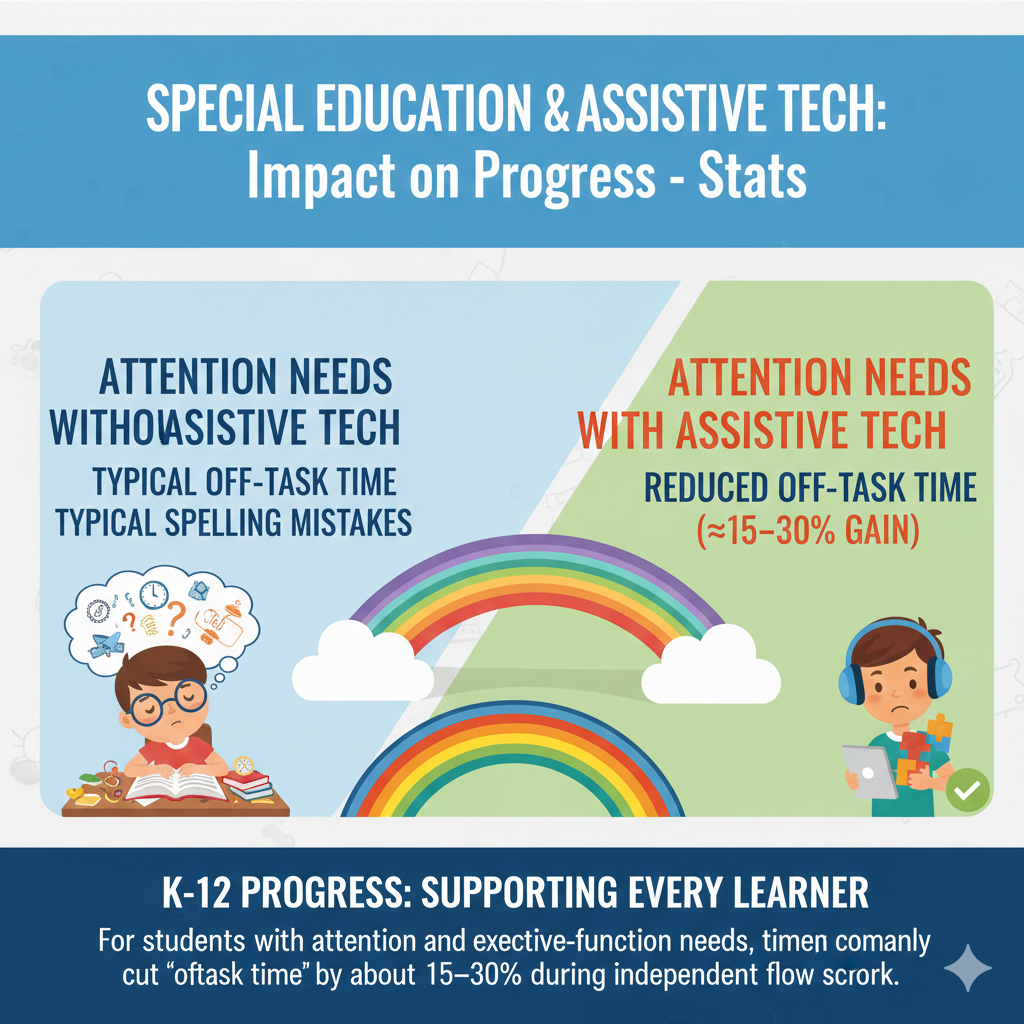
11) For students with attention and executive-function needs, timers + task chunking tools commonly cut “off-task time” by about 15–30% during independent work.
Why this works so often
Many children do not struggle with effort. They struggle with starting, switching, and finishing. A timer makes time visible. Task chunking makes the work feel smaller. Together, they reduce the feeling of being trapped in a long task. When work feels possible, focus improves.
How to set up a simple system
Pick a short work block your child can actually handle, like six to ten minutes. Then set a timer. During the work block, remove extra choices. One book, one page, one pencil. When the timer ends, stop and take a short break.
Keep breaks clean and short too. Then repeat once. Track one thing: “Did we start within one minute?” Starting is often the biggest win.
Debsie tip
We help learners build planning skills in a gentle way, so focus improves without pressure.
12) For students who need AAC (communication devices/apps), many studies report large improvements in functional communication, often doubling the number of meaningful communication attempts over a school term.
What “doubling communication” looks like day to day
This does not mean a child suddenly talks nonstop. It often means the child can ask for help, make choices, share a need, or join a simple back-and-forth more often than before. That change can reduce frustration quickly.
When a child can communicate, fewer behaviors are needed to “send a message.” Communication is not only speech. It is connection, and connection drives learning.
How to make AAC work in real life
AAC succeeds when adults treat it like a real voice, not a “backup.” Model it yourself. If the device has buttons for “help,” “more,” “break,” and “all done,” press them as you say the words. Do this when your child is calm, not only during a problem.
Keep the device available all day, not locked away “for therapy time.” At school, ask the team where the AAC device will be kept, who is responsible for charging it, and how the child will use it in class activities like group work and story time.
Debsie tip
Debsie teachers can support communication goals by using clear routines, patient pacing, and language that is easy to copy, so your child practices communication in a safe setting.
13) For minimally speaking students, AAC use is often linked to more social interaction, commonly showing 20–50% more peer-to-peer exchanges during structured activities.
Why structured social time matters
Many children want to connect but do not know how to enter play or conversation. Structured activities make the steps clear. AAC gives the child a way to participate without waiting for speech. That can turn “watching” into “joining.” Even small peer exchanges build confidence and reduce loneliness.
How to increase peer interaction using AAC
Start with repeatable social scripts. Teach simple phrases like “my turn,” “your turn,” “hi,” “stop,” “play,” and “again.” Practice these during games with family first.
Then ask the school to build short partner routines where the child must communicate to continue the activity, like passing a ball, choosing a card, or picking a role in a group task. At home, invite one kind peer for a short, planned play session. Keep it brief. End while it is still going well.

Debsie tip
In Debsie sessions, we can use games and predictable turn-taking so social language becomes easier and more natural over time.
14) For students with language needs, pairing visuals (pictures/icons) with instruction often improves “following directions” success by about 15–35%.
Why visuals reduce confusion
Many children miss spoken directions because the words move too fast. Visuals slow the message down and make it easier to remember. A simple picture schedule or icon card can turn a stressful moment into a clear one.
When children follow directions more often, adults correct them less. That improves the whole mood of learning.
How to use visuals without making it complicated
Choose one problem time, like morning routine or homework start. Make a small visual sequence with two to four steps. Keep words short. Point to the visual as you speak. Do not repeat long explanations.
If your child gets stuck, point again instead of adding more words. At school, ask teachers to use visual prompts for multi-step tasks, especially during transitions. Visuals help all children, so this support is usually easy for teachers to accept.
Debsie tip
Debsie learning routines can be paired with simple visuals so children understand the plan and feel more secure.
15) For students with hearing loss, use of FM/remote microphone systems commonly improves “hearing the teacher” accuracy, often reducing missed words by 30–50% in noisy classrooms.
Why classrooms are harder than you think
Even children with hearing support can struggle in noisy rooms. Chairs scrape, kids whisper, fans hum, and the teacher turns away while writing. Missing even a few words can break understanding. A remote microphone sends the teacher’s voice directly to the child’s hearing device, making speech clearer and steadier.
How to protect learning with this tool
Ask the school how the microphone will be used all day, not only during lessons. It should be used during instructions, group activities, and transitions. Check where the teacher clips it and whether it is turned on.
Also ask about classroom seating, because distance and angle matter. At home, teach your child a simple self-advocacy phrase, like “Please repeat” or “I can’t hear.” That skill is powerful and respectful.

Debsie tip
Debsie online lessons can reduce background noise and support clear listening, and we can coach children to ask for repeats in a polite, confident way.
16) For students with low vision, screen magnification + high-contrast settings often increases reading endurance, with many learners reading 20–40% longer before fatigue.
Why endurance changes everything
Low vision can make reading feel like staring through fog. Even when a child can decode words, their eyes may tire fast. When fatigue hits, attention drops, headaches can start, and learning slows down.
Magnification and high-contrast settings reduce strain. When a child can read longer without discomfort, they can keep up with class content and feel less anxious during homework.
How to set this up in a practical way
Start by making one device your child uses feel “easy on the eyes.” Increase font size until your child stops leaning forward. Then adjust contrast. Many children do well with dark text on a light background, but some do better with light text on dark.
Try both for a few minutes and notice which one feels calmer. Reduce screen glare if you can by changing brightness and positioning. At school, ask for digital copies of reading materials so your child can use their own settings. If paper is required, ask if large print is available or if the child can use a magnifier.
Debsie tip
Debsie lessons can be matched to the child’s viewing needs, and teachers can share materials in ways that let your child read comfortably and stay focused.
17) For students with visual impairment, screen readers can increase independent digital access time, often cutting adult-help time by about 25–50%.
Why independence matters beyond academics
When a child depends on an adult for every digital step, learning becomes slower and confidence drops. A screen reader can give back control. It reads menus, text, and buttons aloud, so the child can explore, complete tasks, and study without waiting. This is not just a tool for schoolwork. It is a life skill.
How to build screen reader skill steadily
Begin with simple routines: opening a document, finding a heading, and moving line by line. Keep practice short and repeat the same steps daily until they feel automatic. Ask the school which platforms the child must use, then test them early.

Some websites are easier for screen readers than others. If a platform is not accessible, raise it quickly and request an alternative. At home, let your child use the screen reader for fun too, like listening to short articles or stories. Enjoyment increases practice, and practice increases speed.
Debsie tip
Debsie can support accessible learning flows and teach children how to use digital tools with confidence, so they can focus on ideas, not obstacles.
18) In schools, a common pattern is that only about 1 in 3 to 1 in 2 students who could benefit from AT are actually using it daily (≈33–50%), mainly due to training and setup gaps.
Why helpful tools still get ignored
Many families assume once a tool is approved, it will be used. In real life, tools fail when no one owns the routine. Devices are uncharged, logins are lost, or teachers are unsure how to fit tools into a busy lesson.
Children also avoid tools if they feel different or if the tool is confusing. So the tool sits there, and progress slows.
How to turn “available” into “used”
Create a simple tool plan with the school. Ask three clear questions: Where will the tool be kept? When will it be used? Who will check it daily? If answers are vague, the tool will not happen.
At home, teach your child one basic skill at a time, like turning on text-to-speech or opening speech-to-text. Keep it calm and routine-based, not emotional. Also ask for the tool to be included in the child’s learning plan, so it is not optional or forgotten.
Debsie tip
Debsie teachers can help children get comfortable with learning tools so using them feels normal and efficient.
19) When teachers receive short AT training (even a few hours plus coaching), student AT use often rises by about 20–40% (more consistent use across classes).
Why teacher comfort drives student success
If a teacher is unsure, they may avoid the tool to save time. If a teacher feels confident, they build it into routines. That changes everything. Consistent use is what creates progress. A tool used once a week will not reshape learning. A tool used daily can.
How parents can support teacher training politely
You do not need to “push” teachers. You can partner. Ask the school who provides AT training and how teachers can get quick help. Offer to share what works at home, like a shortcut your child uses.

Request a simple checklist that helps the teacher remember steps. If the tool is part of the child’s plan, ask for a short follow-up after two weeks to confirm it is being used. Keep the tone respectful and focused on results, not blame.
Debsie tip
Debsie can share practical strategies families can pass to schools, making tool use smoother and less stressful for everyone.
20) Students who get intensive, targeted special education reading intervention often make progress at 1.5–2× the rate of similar peers who do not receive the intervention.
What “faster progress” looks like in real terms
This usually means a child starts closing the gap instead of staying stuck. They may begin reading more smoothly, guessing less, and understanding more of what they read. The key is targeted teaching. Not more time with random reading.
Not more homework. Targeted support focuses on the exact weak skill, like decoding, sound blending, fluency, or comprehension.
How to make sure intervention is truly targeted
Ask the school what skill the intervention is aimed at and how they know that is the right skill. Request a simple baseline, like words read correctly per minute, accuracy on sound patterns, or a short comprehension score.
Then ask when progress will be checked again. If weeks pass with no data, the plan may not be working. At home, support the same skill in tiny doses. If the focus is decoding, do short sound practice and quick word reading. If the focus is fluency, do repeated reading of a short passage. Keep it brief and upbeat.
Debsie tip
Debsie can reinforce the same reading skill using games, guided practice, and patient correction, so school support grows faster instead of splitting attention.
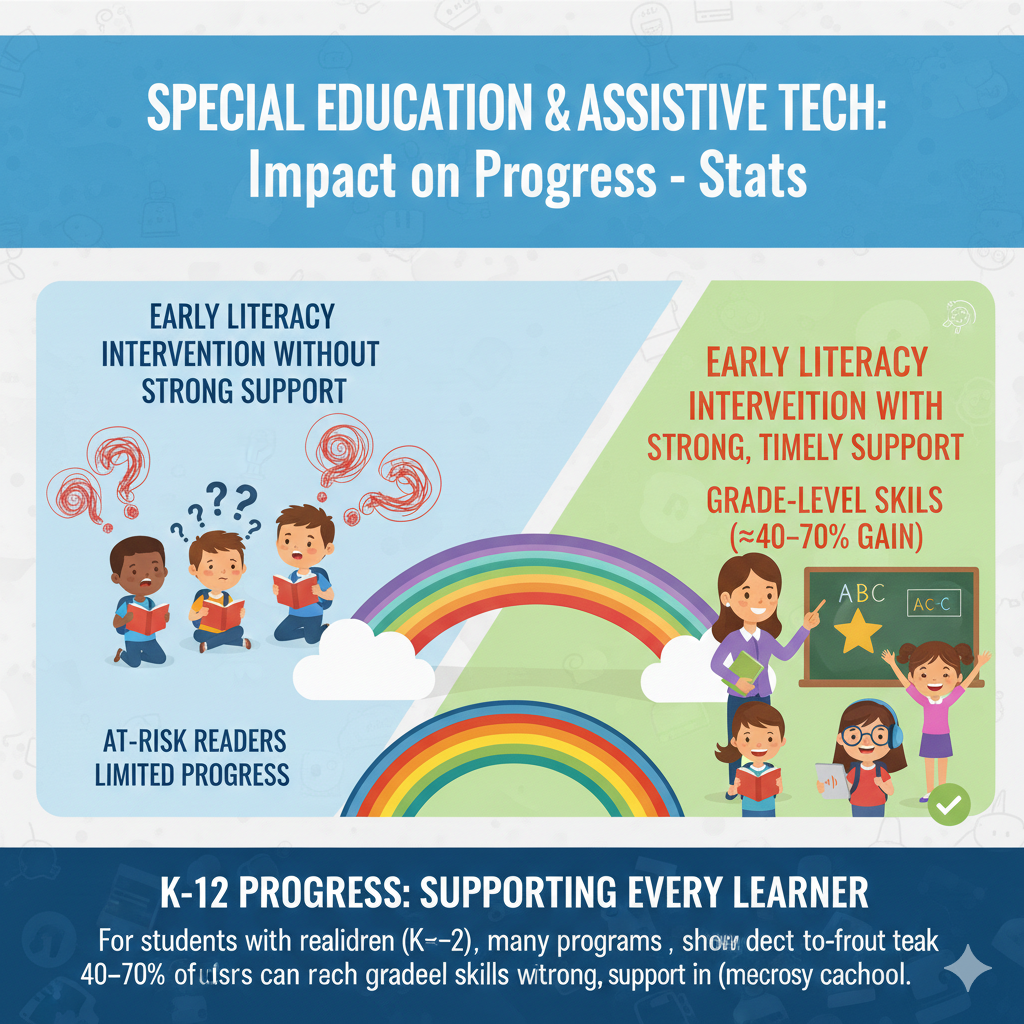
21) For early literacy intervention (K–2), many programs show that about 40–70% of at-risk readers can reach grade-level skills with strong, timely support.
Why early action matters so much
In early grades, reading skills are still forming. The brain is building habits. If support starts early, many children can catch up before reading becomes the gatekeeper for every subject. When children reach grade level early, school becomes less scary. They take more risks, ask more questions, and grow faster.
What timely support looks like at home
Do not wait for the “end of the year” to see what happens. If your child is struggling now, start now. Read aloud daily, even if your child can read. Add five minutes of letter-sound practice and short word blending.
Use simple books your child can succeed with, because success builds motivation. If your child avoids reading, make it shorter, not stricter. Also ask the teacher what exact sound patterns or skills are being taught this month, so your practice matches the classroom.
Debsie tip
Debsie early reading support can make practice feel fun, while still being structured enough to build real reading power.
22) For behavior support plans using data-based strategies, schools often see 20–50% fewer classroom behavior incidents for supported students.
Why “behavior” is often a learning issue
Many behavior problems are not about a child being “bad.” They are often about a child being overwhelmed, confused, tired, or unable to communicate needs.
A data-based plan looks for patterns. It asks: When does the behavior happen? What happens right before it? What helps prevent it? Then the plan teaches a better replacement skill.
How to make a behavior plan work
Ask for clear, simple data. Not opinions. For example, “Leaving seat happened 6 times today during writing.” That tells you where support is needed. Then ask what skill will be taught, like asking for a break, using a timer, or using a calm-down routine.
At home, practice the replacement skill during calm times. If the plan says “ask for help,” rehearse that sentence daily. If the plan says “use a break card,” practice handing it over before your child is upset.
Debsie tip
Debsie can help children build focus, patience, and problem-solving, which often lowers behavior struggles by making learning feel safer.
23) For students with emotional/behavior needs, check-in/check-out systems commonly reduce office referrals by around 30–50% for participating students.
What check-in/check-out really provides
This system gives a child predictable adult support. The child checks in at the start of the day, sets a simple goal, and checks out at the end to review how it went. It sounds small, but it creates structure, attention, and accountability without shame.
Many children behave better when they feel seen and guided.
How parents can strengthen this system
Ask the school what the daily goal looks like. It should be short, like “keep hands to self” or “start work within one minute.” At home, respond to the report calmly. Do not turn it into a punishment sheet.

If the day went poorly, ask one question: “What can we do differently tomorrow?” Then practice one skill, like using a coping phrase or asking for a break. Celebrate small improvements, like one fewer incident or one good class period. Progress builds through consistency.
Debsie tip
Debsie teachers can support emotional regulation by using steady routines and positive coaching, helping children practice self-control in a safe setting.
24) With structured social-skills teaching plus practice, students with autism often show moderate gains, frequently around 15–30% improvement on observed social behaviors in targeted settings.
What “15–30% improvement” looks like in real life
This kind of gain often shows up as small but meaningful changes that make the school day smoother. A child may start greeting a classmate without being prompted. They may wait their turn in a game more often.
They may handle a small change in routine with less distress. These wins can look “small” to outsiders, but they are huge for confidence. Social skills are not magic. They are learned skills, like reading or math, and they grow best when taught clearly and practiced in the same situations where the child must use them.
How to make social teaching actually work
The first key is to choose one or two target skills, not ten. If the child is working on turn-taking, practice turn-taking. If the child is working on joining play, practice joining play. The second key is to keep practice predictable.
Many children with autism do better when they know the steps. For example, a simple routine might be: look, walk closer, say one short phrase, wait. The third key is to practice in short moments, often. A long “social skills lesson” once a week is usually less effective than short practice a few times each week.
Actionable steps for home and school
At school, ask which settings are being measured. Some children do well in a small group but struggle at recess, so the practice setting matters. Ask how adults will prompt the skill and how they will fade the prompt over time.
At home, do role-play in a calm moment using the exact phrases your child can say comfortably. Then use the skill in a real activity, like a board game with family. Keep your feedback simple and positive. If it goes poorly, treat it like practice, not failure.
Debsie can support this kind of progress by using structured games, clear routines, and patient coaching that helps children try again without fear.
25) In inclusive settings with proper supports, many students with mild to moderate disabilities spend 80% or more of their school day alongside peers without disabilities.
Why “80% or more” is a powerful number
When inclusion is done well, it increases learning time, peer models, and a child’s sense of belonging. Being in the main classroom for most of the day also means the child is learning the same topics as peers, with adjustments that make access possible.
This can protect self-esteem. It can also improve motivation because children often try harder when they feel they are part of the group, not placed on the outside.
What “proper supports” should look like
Inclusion is not simply placing a child in the room and hoping for the best. Supports can include simplified directions, extra time, small-group instruction inside the class, assistive tech, visual reminders, or a calm corner for short breaks.
The most important support is good teaching that offers more than one way to learn and show learning. A child may listen to a text instead of reading it, type instead of handwrite, or answer using a picture-based format. The goal is the same learning, reached through a fair path.
How parents can protect inclusion quality
Ask the school how your child’s goals will be worked on inside the classroom, not only outside it. Ask how the teacher and support staff share responsibility. If you hear, “That’s the special educator’s job,” that is a warning sign.
Inclusion works best when all adults see the child as part of the class. At home, help your child practice the tools that make inclusion easier, like using text-to-speech, asking for a repeat, or following a short checklist. Also talk to your child about strengths.
Children do better in inclusive settings when they believe they belong. Debsie can help by building academic confidence and steady learning habits, so your child can participate more fully and feel proud in mixed classrooms.
26) Students with disabilities have historically higher chronic absenteeism; in many districts, chronic absence among these students is often 1.5–2× that of peers without disabilities.
Why absence is often a signal, not a choice
When a child misses a lot of school, it is easy to assume it is about motivation. Often it is about difficulty. If school feels confusing, loud, humiliating, or exhausting, a child’s body starts resisting it.
Anxiety can show up as stomach aches, headaches, meltdowns in the morning, or sudden anger. Some children miss school because therapies and medical appointments are frequent. Others miss school because the support plan is not working yet, and every day feels like a struggle.
How to respond without adding pressure
The best first step is to look for patterns. Which days are missed? Which classes come right before a refusal? What happens on Sunday night? Then share those patterns with the school in calm language. The goal is not blame.
The goal is to remove barriers. Ask for a plan that makes mornings smoother, transitions easier, and learning tasks more manageable. Sometimes small changes help a lot, like a later arrival, a calmer entry routine, or a check-in adult the child trusts.
Actionable steps that help quickly
At home, create a simple morning script with the same order each day. Keep words short. Avoid long talks during stress. If anxiety is high, practice the school routine on a non-school day for ten minutes, just to make it feel familiar.
Also focus on sleep, because tired brains struggle more and avoid more. If your child is missing school due to overload, ask for temporary supports that reduce demands while skills are built.
Debsie can help by giving your child structured learning in a calmer setting, rebuilding confidence, and strengthening core skills so school feels less scary and attendance becomes easier to maintain.
27) Assistive tech that supports organization (digital planners, reminders) often leads to 10–25% higher assignment completion rates for students with executive-function challenges.
What “10–25% higher completion” looks like at home
For many families, this gain feels like the difference between daily conflict and a calmer evening. A child with executive-function challenges may forget homework, lose papers, underestimate time, or start too late. It is not usually defiance.
It is a planning problem. Digital planners and reminders help because they act like an external brain. They keep tasks visible, break work into steps, and prompt the child before it is too late.
How to choose the right tool and avoid overload
Keep it simple. One planner tool is better than three apps. Choose a tool that can do two things well: list tasks and send reminders. Then set up the planner with your child, not for your child. If the child does not own it, it will not stick.
Start with only school nights. Put in two reminders: one to begin homework and one to pack the bag. Link reminders to real times, like right after snack. Avoid reminders every ten minutes. Too many prompts become background noise.
Action steps you can do this week
Make a short “daily close” routine. At the end of homework time, your child checks the planner, checks the bag, and places one needed item by the door. Keep the same order each day. Use the tool for small tasks too, like “bring water bottle,” so the child gets easy wins and trusts the system.
If your child struggles to start, add a reminder that says exactly what to start with, like “Open math notebook and do problem 1.” Specific prompts work better than general prompts. Share the routine with the teacher if possible, so school and home match.
Debsie can help students build planning habits through structured class routines, gentle coaching, and practice with step-by-step goals, so organization becomes a skill the child can keep for life.
28) When captions are turned on for videos, comprehension for many learners (including ELLs and students with attention needs) often increases by about 10–20% on quick checks.
Why captions help more than most people expect
Captions turn sound into visible words. This supports children who miss words when audio is fast, unclear, or distracting. Captions also help children who are learning English, because they can connect spoken words to printed words.
For children with attention needs, captions give the brain a second path to follow, which can reduce drifting. Many children remember better when they both hear and see the message.
How to use captions so they do not become a distraction
Start by using captions in short videos. If the captions move too fast, pause and replay small sections. Encourage your child to track one key idea, not every word. After the video, ask your child to say the main idea in one sentence.
Then ask for two details. If your child can answer better with captions, tell the teacher. This is a simple classroom support that often helps many students, not only your child.
Action steps for school and home
At school, ask if captions can be turned on by default for educational videos. Many teachers already do this. If they do not, a polite request is often enough. At home, keep captions on during learning videos and gradually encourage your child to glance at them when confused.
If your child reads slowly, do not pressure them to read every line. The goal is understanding, not speed reading. Also use captions for topics your child enjoys. When children use captions during fun learning, they build reading and listening skills without noticing.
Debsie lessons can include clear visual supports and paced explanations, so children understand content deeply and feel confident in what they learned.
29) For students with significant physical disabilities, access tools (switches, eye-gaze, adaptive keyboards) can raise independent task participation from “limited” to “regular,” commonly increasing independent responses by 2–5× during structured tasks.
What “2–5× more independent responses” can change
This is not a small improvement. It can shift a child from being a passive observer to being an active learner. When a child can select answers, control a device, or communicate choices more often, adults can finally see true understanding. Independence also improves mood.
Many children show less frustration when they can control actions and express needs without waiting.
How to ensure access tools are set up for success
Access tools work best when positioning and routine are correct. If a switch is too far, if eye-gaze calibration is off, or if the keyboard layout is confusing, the child will tire quickly.
Ask the school who checks equipment daily and how it is adjusted for fatigue. Ask how often the tool is used across subjects, not only in one special session. The child needs access during real learning, like reading activities, math responses, and group participation.
Action steps you can do with your child
At home, practice short, meaningful “cause and effect” and choice-making tasks. Keep it enjoyable. For example, using a switch to play a sound, move a character, or select a preferred item. Celebrate clear choices.
Also track signs of fatigue, like slower responses or head turning away, and build breaks into the routine. Share what you notice with therapists and teachers. Small adjustments can produce big gains. When a child experiences success with the tool, they want to use it more, and skill grows faster.
Debsie can support families by offering structured learning activities that can be adapted to access tools, with patient pacing and clear steps.
30) When schools combine special education instruction + consistent AT use + family follow-through, progress monitoring commonly shows steady weekly growth, often 2–4× more weekly skill gains than when any one of those pieces is missing.
Why the “combo” is the real secret
Many plans fail because they are incomplete. A child may get great instruction but no tools, so tasks still feel too hard. Or a child may have tools but no clear teaching, so the tool is not used well. Or the school may do everything right, but practice at home is chaotic or inconsistent.
When the three parts work together, progress becomes steady. Not perfect every day, but steady week to week.
How to create this three-part system
First, make sure special education instruction targets one clear skill at a time and checks progress often. Second, make sure assistive tech is used daily, not “sometimes.” Third, choose one simple home routine that supports the same goal.
Home follow-through does not need to be long. Ten to fifteen focused minutes can be enough if it matches the school plan. The point is consistency, not volume.
Action steps that keep growth moving
Ask the school for one progress signal you can understand, like accuracy percentages, reading fluency numbers, or a behavior count. Request updates on a predictable schedule. At home, keep a simple log of practice, two lines a day, so you can spot what helps.
If progress stalls for three to four weeks, request a plan adjustment. Sticking with a plan that is not working wastes time and confidence. Also remember to celebrate skill growth, not just grades. A child who can start work faster, ask for help, or use a tool independently is building life skills that matter.
Conclusion
If there is one message to take from these stats, it is this: progress is not luck. Progress is built when the right support meets the right tool, used in the right way, at the right time. Special education works best when it targets one clear skill and checks growth often.
Assistive tech works best when it is used daily and feels normal, not “special.” And family follow-through matters most when it is simple, steady, and matched to what school is teaching.