
Peer tutoring looks simple: one student helps another learn. But behind this small moment sits a big engine of change. When schools do it well, grades rise, kids show up, and class feels calmer. Learning speeds up for both the tutor and the learner. Families notice more confidence at home. Teachers get time back to plan great lessons. Best of all, peer tutoring can scale without breaking the budget, which matters for busy schools and community programs.
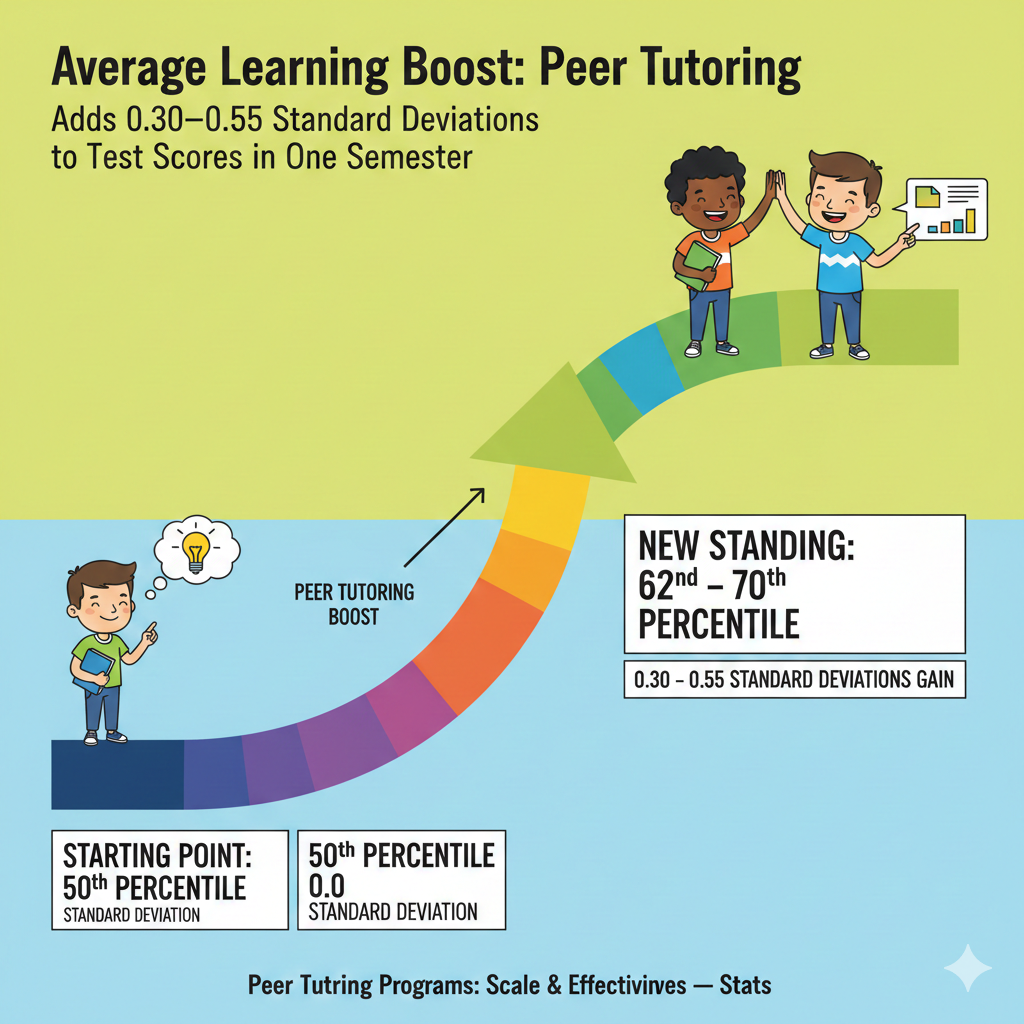
1) Average learning boost: peer tutoring often adds 0.30–0.55 standard deviations to test scores in one semester, which is like moving a student from the 50th to about the 62nd–70th percentile
Think of learning growth like climbing steps. A gain of 0.30–0.55 standard deviations is a big jump in one term. It means many students move from average to clearly above average. That kind of growth does not happen by luck.
It comes from short, steady practice with quick feedback. In peer tutoring, students explain their thinking out loud. When they do, errors show up fast and can be fixed in the moment. Tutors also learn because teaching forces them to organize ideas, name steps, and notice where confusion begins.
This double effect makes the whole class stronger over time.
To get this level of boost, keep the routine simple. Start each session with a tiny warm-up that reviews yesterday’s idea. Set one clear goal for the day, like finding the main idea in a paragraph or solving two-step equations.
Use worked examples to model the steps, then let the learner try a similar problem while the tutor watches for specific errors. When the learner gets stuck, the tutor does not give the answer. Instead, they ask a guiding question, point to the step list, or show a smaller example.
End with a very short teach-back, where the learner explains the key steps in their own words. The tutor checks this against a script so feedback is exact, not vague.
Track gains simply. Pick one short measure per subject, such as a five-question exit check or a two-minute reading probe. Chart scores weekly so students see growth. Celebrate small wins, like moving from three out of five to four out of five.
If a pair stalls for two weeks, switch the material level or give the tutor a quick re-train on prompts. Keep pairs stable for at least four weeks to build trust. Most important, protect the schedule.
Two or three sessions a week over a semester is what drives the 0.30–0.55 range. When you keep the minutes, you keep the gains.
2) Reading speed gains: struggling readers in peer tutoring commonly grow by 15–30 extra words per minute over 8–12 weeks, beyond normal class growth
For a child who reads slowly, every page feels heavy. A rise of 15–30 words per minute changes that feeling. Texts start to make sense in one sitting, not in broken bits. This gain is realistic in eight to twelve weeks when peers practice fluency the right way.
The key is short passages, repeated reads, and instant feedback on errors. When students hear and see the right word quickly after a miss, the correct path in the brain gets stronger. Over time, accuracy and speed both improve, and comprehension follows because the mind is no longer stuck on decoding each word.
Set up the routine with care. Choose grade-level passages but start at the easier end so early success builds energy. Have the tutor model a smooth read for one minute. The learner follows with a one-minute read while the tutor tracks errors on a simple sheet.
Mark only real mistakes that change meaning or break a word’s parts. Right after the minute, the tutor reads the error words aloud, the learner repeats them correctly, and then rereads the same sentence. Run two or three one-minute rounds on the same passage.
End with a quick retell of the main idea in two sentences. This keeps speed gains tied to meaning, not just fast talk.
Measure progress the same way each week. Use fresh passages from the same pool and level. Note words correct per minute and the number of errors. If accuracy drops under ninety-five percent, move down a level to rebuild control.
If speed and accuracy both rise for two straight weeks, step up slightly in difficulty. Teach tutors to use calm, clear language: pause, point, say the word, have the learner repeat, reread the sentence, and move on.
Keep the tone friendly and brisk, not harsh or slow. Give students a simple graph to color after each session so they can see their line move up. Small, visible wins keep them reading when the text gets tougher.
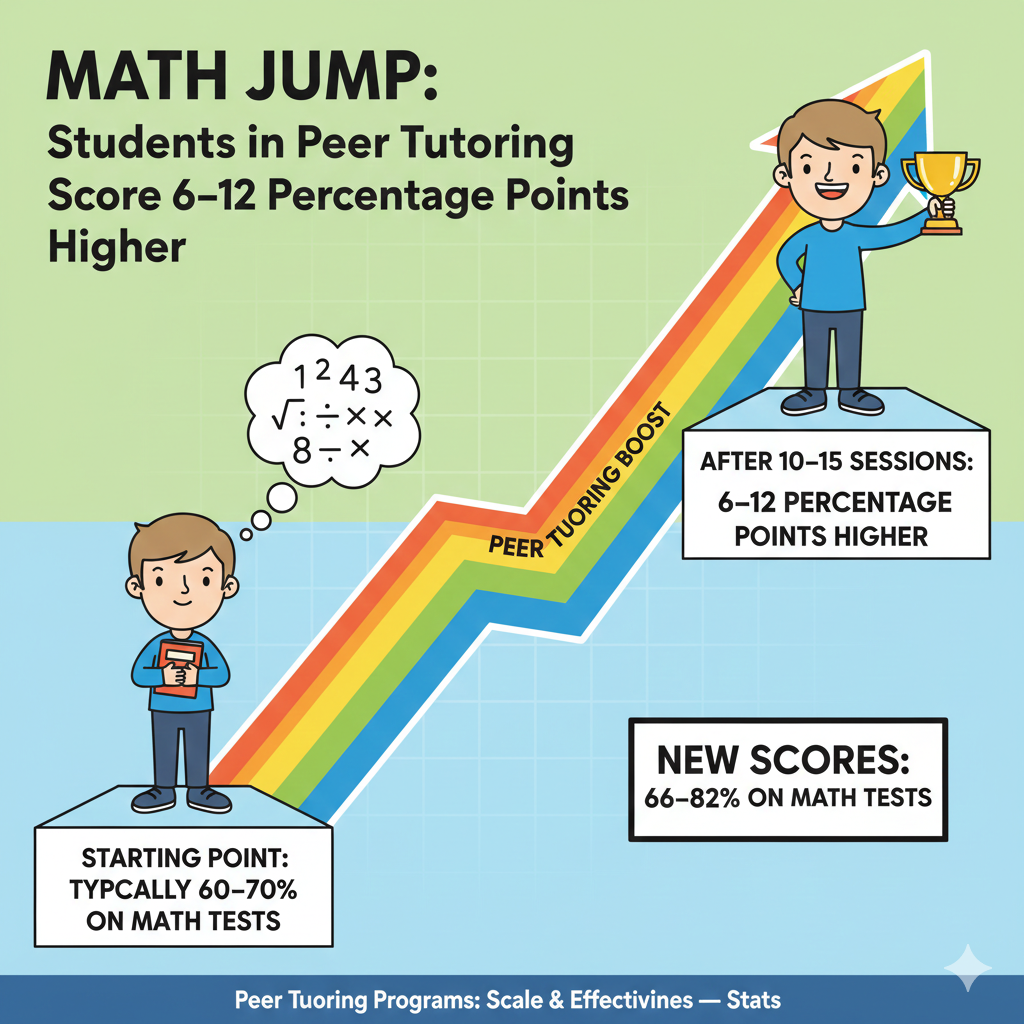
3) Math jump: students in peer tutoring typically score 6–12 percentage points higher on end-unit math tests after 10–15 sessions
Math success grows when students practice steps in the right order and check their own work. A rise of six to twelve points on a unit test can be the difference between a C and a B, or a D and a C.
Ten to fifteen sessions is enough time to rebuild gaps, if each session targets one small skill and gives many chances to solve and explain. In peer tutoring, the tutor does not act like a mini-teacher who lectures.
They act like a coach who sets up reps, spots errors, and keeps the pace steady. This reduces fear and lets the learner try, fail, fix, and try again without shame.
Begin with a problem frame. Write the steps for the day on a small card: read the problem, circle numbers, choose the operation, set up, solve, check. The tutor and learner walk through one worked example together, then switch to similar problems.
The tutor listens for key error types, like mixing up signs, dropping units, or skipping the check. When a mistake happens, the tutor points to the exact step on the card and asks the learner to redo only that step. This keeps focus tight.
Add a quick talk-through where the learner explains why a certain operation fits the problem. Clear reason talk prevents random guessing and helps transfer skills to new problems.
Track data in a tiny way every session. Use a four-problem mini-quiz at the end. Score it on the spot and record the error type next to the score. After three sessions, look for patterns. If sign errors keep showing up, run a two-minute drill on plus and minus with number lines.
If unit mistakes are common, make the last step in every problem a unit check out loud. Encourage tutors to praise correct steps, not just correct answers. For example, say, your setup is solid, and your check caught the slip.
This builds habits that last beyond the unit. Right before the test, run a mixed-practice session where the learner sorts problems by type and names the matching steps. Sorting plus naming cements the map in their head and leads to those six to twelve extra points.
4) Pass rates: course pass rates for students who were failing often rise from about 55% to 70–80% after a quarter of peer tutoring
A jump from fifty-five percent to as high as eighty percent is not luck. It happens when a school sets up a clear plan that targets missing skills, builds study habits, and keeps students motivated week after week.
A quarter gives enough time to fix gaps from earlier in the year and rebuild confidence so students try hard on the next round of tests and projects. In peer tutoring, the learner is never alone with confusion.
A trained tutor sits beside them, checks understanding in small steps, and helps plan the next practice task. This steady support adds up to more finished work, more correct answers, and finally more passing grades.
To reach this pass-rate lift, start with a short diagnostic. Pick two or three core skills in the subject and find out exactly where the learner is stuck. Create a simple map for the next four to six weeks with one focus per week.
During each session, the tutor opens with a quick review, then guides practice on the week’s target skill using examples that match the upcoming quiz or assignment. Keep the pace brisk and the session length tight so attention stays high.
End with a teach-back to lock in the steps. Between sessions, give the learner a tiny homework task that can be done in under ten minutes, such as one reading passage or three problems. The tutor checks this task at the next meeting so effort stays consistent.
Monitor course work closely. Keep a one-page tracker for each learner that shows missing tasks, upcoming deadlines, and quiz dates. Tutors help set micro-deadlines and send a friendly reminder message the day before a due date if your school allows it.
Celebrate every turnaround, like the first quiz above seventy, or three assignments submitted in a row. These small wins build momentum that carries into the next unit. If a learner is still failing after two weeks, adjust the plan.
Switch the pairing, simplify the steps, or change the practice materials to better align with class tasks. When you keep the loop of assess, plan, practice, and adjust, pass rates rise and stay high.
5) Attendance lift: schools report 2–5 percentage-point higher attendance for students who join peer tutoring for at least 8 weeks
Attendance improves when school feels welcoming and success feels possible. Peer tutoring gives both. A learner who knows that a friendly classmate is waiting to help them today is more likely to show up. After eight weeks, the habit of showing up builds into a routine.
A two to five point rise may not sound huge, but across many students it means dozens more learning hours. Those hours mean more practice, more feedback, and fewer missing lessons to catch up on later.
Make attendance growth part of the program’s design. Schedule peer tutoring at times that are easy to attend, such as right after homeroom, inside a class block, or during a short advisory period. Keep sessions on the same days each week so it becomes part of the rhythm.

Use simple check-ins to make students feel seen. A quick greeting, a shared goal for the day, and a high-five at the end signal that their presence matters. Train tutors to send a kind message through the approved channel if a learner misses a session.
The note should be short and warm, such as we missed you, we will review step two when you are back.
Track attendance for the tutoring sessions and for the school day. When a learner attends the program three times in a row, reward it with a small recognition in class, like a shout-out or a sticker on a board.
If a student misses two sessions in a week, connect with the counselor or family to check for barriers such as transport or schedule conflicts. Offer a make-up session during lunch or right before school if possible. Keep materials ready so the make-up is simple to run.
Over time, let tutors lead small group energizers at the start, like a thirty-second brain warm-up. These little rituals help students look forward to coming. When school feels like a place where you belong and can succeed, showing up becomes the natural choice.
6) Behavior improvement: office discipline referrals for tutored students drop by 20–35% during active peer-tutoring cycles
When students feel capable, behavior often improves. A drop of twenty to thirty-five percent in referrals means fewer disruptions, fewer lost minutes, and a calmer climate for everyone. Peer tutoring helps because it gives students immediate success loops.
They try a task, get feedback, correct the error, and feel the win. This reduces frustration that can turn into acting out. It also gives tutors a chance to model respectful talk and problem-solving language, which rubs off on the learner.
Build behavior supports into every session. Start with a two-sentence social contract that both students know by heart. For example, we speak in calm voices, and we help with prompts, not answers. Keep a small visual of expected routines on the table so redirection is non-confrontational.
When a learner gets stuck and emotions rise, teach tutors to use a simple reset: pause, breathe, restate the goal, and try the first step together. Avoid long discussions in the moment. Get back to action quickly with a success that restores confidence.
Coordinate with the teacher and counselor. If the learner has a behavior plan, align tutoring routines with it. Use the same calm cue words or hand signals. After each session, the tutor can log a one-line note about focus and effort.
Patterns will show up fast, and staff can step in early if needed. Recognize positive behavior directly tied to learning, such as stayed on task for the full practice or used the fix-it prompt without help. Make praise specific and immediate so students connect behavior and success in their minds.
If a referral happens on a tutoring day, debrief later with a short script. What was the task, where did I get stuck, what can we change in the next session to prevent that moment? Keep it practical, not moral.
The goal is to design the environment for calm work. Over time, as students feel more control over their learning, the need to escape or disrupt drops, and so do the referrals.
7) Confidence boost: self-efficacy ratings (1–5 scale) typically rise by 0.4–0.8 points after 6–10 weeks of peer tutoring
Confidence is not magic. It grows from evidence. When a student sees their own work improve week by week, their belief in their ability goes up. A rise of half a point or more on a five-point self-rating is meaningful.
It shows that students are not only doing better but also feel they can handle new tasks. This feeling matters because it changes how they act in class. They ask questions sooner, try problems without fear, and stick with hard reading. That leads to more wins and a stronger upward spiral.
Make confidence growth a normal part of sessions. Begin with a clear, reachable goal for the day so students can say yes, I did that. Use success steps that are small and visible, like reading one paragraph smoothly or solving a two-step problem.
Let learners choose among two or three practice items to give a sense of control. Teach tutors to name strengths they notice, such as you checked your work without a prompt or you corrected that vowel sound fast. Keep praise connected to actions, not traits, so students learn what to repeat.

Use a simple self-check at the end of each session. On a tiny card or screen, the learner rates how confident they feel on today’s skill from one to five and writes one sentence about why. The tutor adds a one-sentence note about the next step.
Review these cards each week so both can see growth. If ratings stall, adjust the level. Sometimes the work is too easy and feels boring. Sometimes it is too hard and feels scary. Aim for the sweet spot where challenge is real but success is close.
Invite families into the loop. Share specific moments of progress so they can echo the same praise at home. For example, your child explained how to find the main idea using a three-step method today. Ask them to teach it to you.
Teaching a parent reinforces the skill and the feeling of I can do this. As confidence rises, students carry that strength into other subjects and even outside of school, which is a life skill that keeps paying off.
8) Cost efficiency: peer tutoring usually costs $3–$12 per student per tutoring hour, far less than one-to-one adult tutoring
Money matters when you want to help many students, not just a few. A cost of three to twelve dollars per student per hour means you can run steady support without draining your budget. This price range covers training time, simple materials, and small rewards for tutors.
It does not require hiring many new staff members. When you save on cost, you can keep the program going across the whole year instead of stopping after a short burst. Students then get a steady stream of practice, which is what truly moves scores and confidence.
To lock in this cost range, keep the design lean. Use short, printable routines that fit on one page, like a reading fluency sheet or a four-problem math drill. Store sets in labeled folders by level so tutors can grab and go.
Build a simple training plan that takes three to five hours and uses quick demos, role-play, and checklists. Pay tutors with recognition that matters to them, such as service hours, badges, leadership titles, or small gift cards given at milestones. Ask teachers to suggest reliable students as tutors so your training time is well spent.
Track your spending per hour in a tiny spreadsheet. List hours of training, hours of sessions, number of students served, and any material costs. Divide cost by total student-hours to see your true price. If the number creeps up, look for places to simplify.
You can train a small group of tutor leads who then train new tutors, which spreads the load. You can reuse materials across terms by keeping a clean digital library. You can schedule tutoring blocks inside class, which cuts transport and supervision costs after school.
If you want a ready-made kit, Debsie has checklists, scripts, and printable routines you can plug in right away. Because the system is simple and repeatable, you keep quality high and costs low.
This is how you make tutoring not a special event, but a normal part of learning that your school can afford every week.
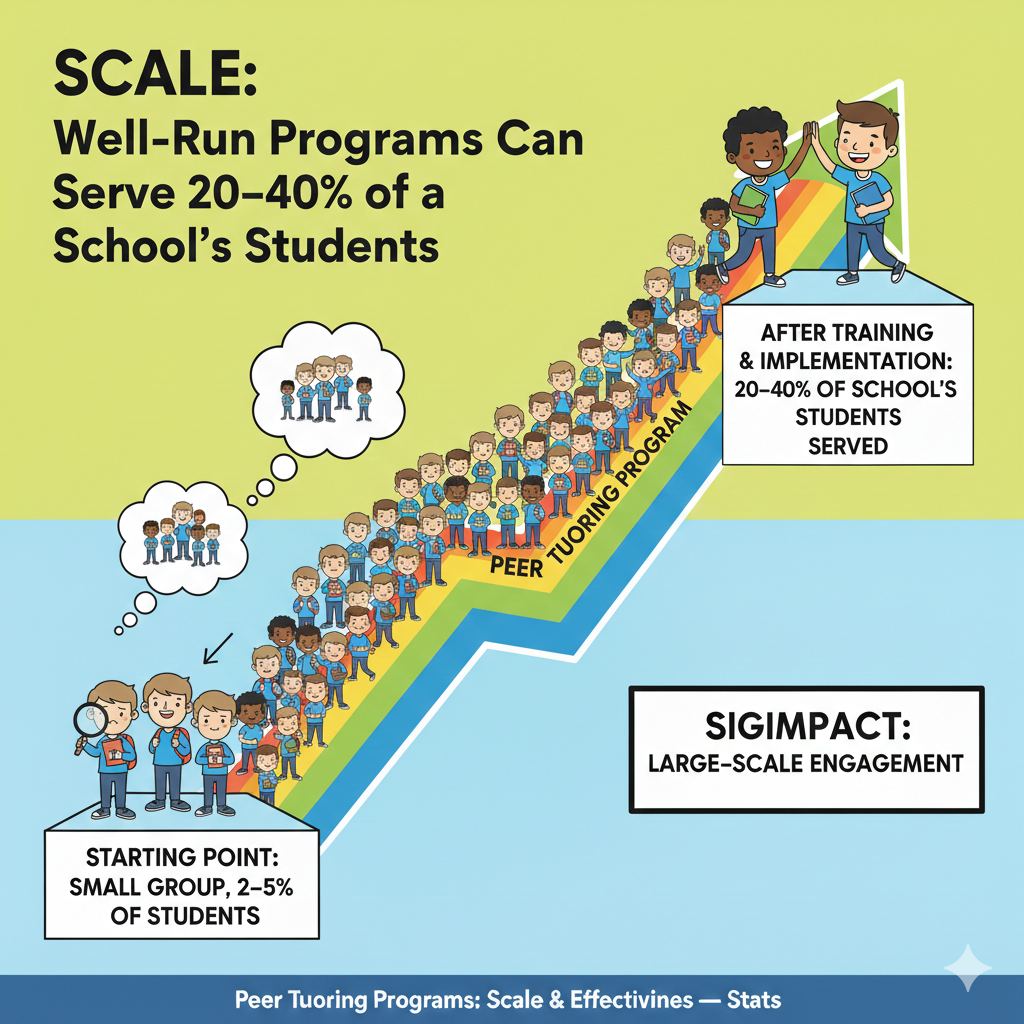
9) Scale: well-run programs can serve 20–40% of a school’s students in a single term using trained peers
Serving a fifth to almost half of your students in one term is real scale. You reach many learners without long waitlists. The secret is to design for flow. Students move in, get support, and move forward. Peers lead much of the work, while adults guide the system and handle tough cases.
When you aim for twenty to forty percent, you plan your staffing, rooms, and materials in a smart way from the start. You also define what success looks like for many students at once, not just for a handful.
Begin with the map. Count the number of learners you want to serve and the sessions per week. Multiply to get total student-sessions. Now look at your spaces and time slots. Use short blocks that fit into advisory, homeroom, or a flex period.
Place materials at each station so turnover is fast between pairs. Train a core team of tutor leads who can supervise five to ten pairs each. They handle check-ins, quick fixes, and data entry, which frees the teacher or coordinator to coach and monitor quality.
Keep enrollment flexible. Open a new cohort every two weeks so you can add students who need help now, not next term. Exit students who have met their goals and invite them to become tutors if they wish. This creates a healthy pipeline.
Use a simple referral form that teachers can fill in under one minute. Ask for the exact skill gap and the next assessment date. Place learners in groups by skill level and subject so materials match well. Protect your schedule with a shared calendar so other events do not wipe out tutoring time.
For communication, keep it short and clear. Send a weekly snapshot to staff and families: how many students served, attendance rate, and one quick win. This keeps energy high and brings new supporters.
If you need a jump-start, Debsie can help set up your first cohort, train your leads, and share templates. With a clean design and clear roles, reaching twenty to forty percent is not only possible, it becomes your new normal.
10) Tutor–student ratio: most effective models keep 1 tutor for 1 learner or 1 for 2 learners; beyond 1 for 3, gains tend to shrink
The ratio shapes the learning. One tutor with one learner gives you tight focus and fast feedback. One tutor with two learners can still work well if the tasks are simple and the roles rotate. But once a tutor watches three or more learners at the same time, attention splits.
The slowest learner waits too long for help, and the tutor cannot give precise feedback. Over time, the quality of practice falls and so do the gains. Keeping ratios small protects the heart of tutoring: guided practice with quick corrections.
Choose the ratio based on the skill. For early reading and decoding, stick to one-to-one because timing and accuracy matter. For math facts or vocabulary practice, one-to-two can work well if you run short turns and switch roles every few minutes.
Set a standard time per turn, like sixty to ninety seconds, so no one sits idle. Train tutors to use a sand timer or phone timer to keep pace. Have clear error routines that both learners know, such as stop, fix the error word, reread the line, or rework the missed step, recheck the answer.
Design the physical space to match your ratio. In one-to-one, seat pairs side by side to share the page. In one-to-two, use a small triangle seating so the tutor can see both learners’ work at a glance. Give each learner their own copy of the task to avoid crowding.
Keep noise low so the tutor can hear errors in reading and reasoning. If you must go one-to-three for a short period, simplify tasks to review only, not new learning, and shorten sessions to keep engagement high.
Measure results by ratio. Try one month with one-to-one, then one month with one-to-two for similar learners, and compare gains and attendance. Choose the model that gives the best mix of growth and coverage in your setting.
If you need help designing materials for each ratio, Debsie provides scripts and timing guides that make it easy to keep quality high even as you serve more students.
11) Minimum dose: meaningful academic gains usually appear after 6–8 hours total tutoring time; strong gains after 12–20 hours
Tutoring works like fitness. A few good sessions help, but the body changes after steady hours. The same is true for learning. Six to eight total hours is the point where you begin to see clear movement in scores and fluency.
Twelve to twenty hours is where gains feel strong and lasting. This does not mean you must run long blocks. Short, frequent sessions add up fast. Two or three thirty-minute sessions a week will hit the early dose in a month and the strong dose in two months.
Plan the dose from day one. Set a start date and a target hour count for each learner based on their needs and the school calendar. Put sessions on the calendar like any class, with backup slots for make-ups.
Use a simple tracker that counts minutes completed so you always know who is on pace and who is falling behind. When a learner misses a session, run a quick make-up during lunch or at the start of class so momentum does not break.

Shape the content across the hours. The first two hours focus on rapport, routines, and the first obvious skill gap. Hours three to five expand practice to close related gaps. Hours six to eight push for accuracy and speed with teach-backs to fix language and steps.
After hour eight, begin mixed practice that blends new and old skills so learning transfers to tests and class tasks. Keep end-of-session checks short and consistent so you can show the learner their progress line. Visible growth keeps motivation high across the full dose.
Align the dose with assessments. If a unit test is in three weeks, plan to reach at least six hours before that date. If a high-stakes exam is two months away, aim for twelve to twenty hours with a steady rhythm.
Debsie can help you map doses to your school calendar and provide session plans that build in the right order. When you honor the dose, you protect results. The hours are not a guess; they are the runway students need to take off.
12) Session length: 25–35 minutes per session delivers similar gains to 45–60 minutes, but keeps students more on task
Short sessions work because attention has limits. In twenty-five to thirty-five minutes, a learner can warm up, practice the target skill, fix errors, and show what they learned without running out of focus.
When sessions stretch to forty-five or sixty minutes, energy drops and talk drifts. The last minutes produce less learning per minute. A tight window forces clarity. You choose one goal, one routine, and a clear finish. Students leave with a win and want to return.
Tutors stay fresh and precise. Over time this rhythm creates more total high-quality minutes, which is what matters most.
Design the twenty-five to thirty-five minute block with a simple arc. Begin with a two-minute connect where the tutor greets the learner, reviews last time’s key step, and states today’s goal in one sentence.
Move into a three-minute model where the tutor shows the steps on one example while thinking aloud. Shift to ten to fifteen minutes of guided practice where the learner solves or reads while the tutor uses set prompts to keep accuracy high.
Add five to eight minutes of independent practice at the learner’s level to build confidence. End with a two-minute teach-back where the learner names the steps they used and the tutor checks against a short script. This arc fits naturally inside the time box and prevents rushing.
Protect the clock without feeling harsh. Use a small timer on the table so both students can see it. Teach tutors that the goal is not to squeeze more problems into the time but to keep a steady pace with quality feedback. If a task runs long, end it with a quick summary and pick it up next time.
Track session end points so the next session can begin with a fast recap. If your school has longer periods, stack two short sessions with a five-minute break and a switch in roles or subjects. This keeps brains fresh.
Debsie provides session cards that match this arc so any tutor can run a crisp session from day one. When you trust the short block and repeat it well, students make steady gains without burnout.
13) Weekly frequency: 2–3 sessions per week beats 1 session by about 30–40% in learning growth
Learning sticks when it is touched often. Two to three sessions each week create repeated chances to practice, get feedback, and correct mistakes before they turn into habits. With only one session a week, too many days pass between tries.
Memory fades and confidence slips. When students come back two or three times, the skill stays warm. They start where they left off and climb another small step. Over a month, these small steps add up to a big rise.
The extra sessions also reduce the stress of any one bad day. If Tuesday was rough, Thursday can still be a win.
Plan the weekly cadence with real life in mind. Choose days that fit your schedule and avoid heavy test days or common field trip days. Keep the days consistent so families can plan. Aim for a rhythm like Monday, Wednesday, and Friday or Tuesday and Thursday.

Align topics with class pacing. For example, if new math content is taught on Mondays, use Tuesday’s tutoring to practice that skill while it is fresh. Use the next session to review and stretch. This keeps tutoring tightly linked to classroom success, which raises motivation.
Manage the workload so more sessions do not feel like more work. Keep prep simple with ready-made practice sets by level. Use the same short routines each time so tutors do not need new training for each session. Track attendance.
If a learner misses one day, offer a short make-up within the same week so the total count stays at two or three. Celebrate streaks, like three weeks of full attendance, with a small note home or a public shout-out. Ask teachers to protect those windows on the class calendar.
If you are running after school, try the same start time each day to make travel easier. Debsie can help you build a two- or three-day template that fits your bell schedule. When frequency is right, growth speeds up, and students feel progress every few days, which keeps them engaged.
14) Training time: student tutors need about 3–5 hours of upfront training plus 10–15 minutes of coaching each week to keep quality high
Great tutoring looks simple because the hard work is in the setup. Three to five hours of training gives student tutors the mindset, the language, and the routines they need.
They learn how to model steps, how to prompt without giving answers, how to correct errors kindly and quickly, and how to close with a teach-back. They also practice the exact session arc and the specific scripts they will use.
This short investment pays off because trained tutors can run sessions smoothly with little adult rescue. The weekly ten to fifteen minutes of coaching keeps the edge sharp. It is a quick tune-up, not a heavy meeting, and it keeps drift from creeping in.
Structure training as a fast, hands-on workshop series. In the first hour, cover the purpose of peer tutoring and the core principles: respect, accuracy, pace, and growth. In the second hour, demonstrate a model session from start to finish, then have tutors role-play in pairs with scripts in hand.
In the third hour, teach error routines for reading and math, along with sentence stems for feedback. If you have a fourth and fifth hour, use them for practice with real materials and common tricky moments, like when a learner shuts down or rushes.
Record short exemplar videos so tutors can review later. Give each tutor a small kit: timing card, prompt stems, error routine card, and a simple data sheet.
Run weekly coaching right before or after sessions. Use a tight loop. Review one short video clip or observe one pair for five minutes. Name one strength and one focus move for the week, such as wait three seconds after a prompt or point to the exact step on the card.
Keep notes so you can check the same move next time. Rotate focus across tutors so everyone gets attention. Invite tutors to share tiny wins and tiny problems. This builds a community where tutors learn from each other and take pride in their craft.
Debsie offers plug-and-play training decks, scripts, and coaching checklists that make it easy to launch in a week. With this level of training and coaching, your program runs strong without constant adult micromanagement.
15) Fidelity matters: when tutors follow a simple script and checklist, effect sizes are 25–50% higher than unscripted sessions
Fidelity means doing the right things the same way each time. In peer tutoring, a simple script and a short checklist keep quality steady. When tutors follow them, gains jump because feedback becomes clear, steps stay in order, and time is used well.
Without a script, sessions drift. Tutors talk too much, give answers, or wander off the target skill. Learners then get mixed messages and fewer correct reps. A script is not about being robotic. It is about making sure the key moves happen every time so the learner actually practices the thing that closes the gap.
Build your script around three parts. The opening sets today’s goal in one sentence and reviews yesterday’s key step. The middle runs guided practice with precise prompts and error fixes. The close checks learning with a teach-back and sets a tiny next step.

Put each part on a one-page card with the exact words tutors can say. For example, in math, the prompt might be read, circle, choose, set up, solve, check. In reading, it might be model for one minute, learner reads one minute, correct and repeat, retell main idea.
Keep the words short and the flow obvious so a new tutor can follow without stress.
Use a five-item checklist so fidelity is easy to see. Did the tutor state the goal. Did they model once. Did the learner practice with prompts. Did the tutor fix errors using the routine. Did the learner teach back the steps. Train tutors to self-check at the end of each session.
A lead tutor or teacher can spot-check pairs for two minutes and give quick notes. If a step is missed, address it in the next session with a single focus move. Over time, scripts and checklists become normal tools, not rules.
They help tutors feel confident because they know what to do next. They help learners trust the process because it feels calm and predictable. In the end, fidelity frees you to scale, since many tutors can deliver the same strong experience.
16) Feedback speed: immediate feedback (during the task) produces about 0.1–0.2 SD more growth than delayed feedback (end of session)
Speed matters in feedback. When a learner makes a mistake and hears the correction right away, the brain links the fix to the moment of error. The right path becomes stronger, and the wrong path fades. Waiting until the end of the session to correct invites the mistake to repeat and stick.
The extra tenth or two of a standard deviation may sound small, but across many skills and weeks it compounds into real score gains and smoother performance. Fast feedback also lowers frustration because the learner does not spin in confusion for long.
Teach tutors a simple in-the-moment correction routine. In reading, the steps are pause, point, say the word, have the learner repeat, reread the sentence, move on. In math, the steps are pause, show the step card, ask the guiding question, redo the step, recheck the answer.
The tone stays calm and neutral. The goal is not to scold but to guide the learner back onto the track. Keep corrections brief so the flow continues. After the error fix, praise the correct step completed next, which keeps motivation up.
Balance speed with thinking time. Tutors should wait a few seconds after a prompt to let the learner try. If no progress appears, jump in with the error routine. Do not let a learner sit stuck for a full minute on a small step; that is lost practice time.
Use concrete cues rather than vague talk. Point to the sign, name the vowel sound, highlight the unit. Close each session with a quick review of two common errors and their fixes so the learner knows what to watch for next time.
If you track error types on a small sheet, you can see patterns and plan a two-minute micro-lesson at the next session. Debsie’s prompt cards include these fast error routines so tutors can act in the moment. When feedback flows during the task, learning speeds up and feels smoother for everyone.
17) Pairing by skill gap: pairing tutors who are 1–3 grade levels ahead of learners gives bigger gains than equal-level pairs
Who sits with whom affects results. A tutor who is one to three grade levels ahead has enough mastery to model steps clearly and spot errors fast, but is still close enough to remember the struggle and explain in simple words. If the gap is smaller, the tutor may not notice subtle errors or may guess instead of guide.
If the gap is much larger, the tutor can rush or skip steps that feel obvious to them, leaving the learner behind. The sweet spot is that one-to-three-level range, where the tutor owns the skill and can translate it into friendly steps.
Map skill levels before pairing. Use short screeners or recent class work to place learners and potential tutors on a simple scale. In reading, place by decoding level or fluency. In math, place by unit mastery or problem type.
Then create pairs where the tutor sits one, two, or three steps higher on that same scale. Tell tutors why you matched them so they see the purpose and feel responsible for that learner’s progress. Explain that their job is to make the steps visible, not to show off speed.

Give tutors specific modeling tasks that fit the gap. If the learner struggles with fractions, the tutor models one problem slowly while naming each move, then watches the learner try a twin problem.
If the learner is working on multisyllable words, the tutor models how to break a word into parts, then listens closely as the learner does it with new words. Train tutors to adapt language to the learner’s level.
Short sentences, clear verbs, and concrete cues beat fancy words. Teach them to ask why questions only after the learner can do the steps, not before, so confidence has time to build.
Review pairs every two to four weeks. If a learner catches up fast, celebrate and consider promoting them to a tutor role for a lower-level learner. This keeps your pipeline strong and builds pride. If a pair stalls, check the exact skill match and the pace of modeling.
Tiny adjustments often restart growth. Debsie can help you set up quick placement checks and pairing templates so your program gets the maximum gain from smart matches.
18) Language learners: students learning English often show double the reading growth (vs. class average) after 8–12 weeks of peer tutoring
For a student learning English, reading can feel like climbing a hill in heavy shoes. Peer tutoring lightens that load. When a supportive classmate sits beside them, shows how to break words, and checks meaning in simple language, progress speeds up.
Over eight to twelve weeks, it is common to see reading growth that is twice the class average. This happens because the learner gets many more correct reps with words and phrases that show up often in school texts.
The tutor also models how English sounds in real sentences, which boosts both fluency and confidence at the same time.
Set up the routine with clear steps that fit language learners. Start every session with a quick preview of key words from the passage. The tutor says each word, the learner repeats, and both use it in a short sentence.
Move into a one-minute model read by the tutor, then a one-minute learner read with instant correction on tricky words. After each minute, pause to check a simple question about meaning so the learner links sounds to ideas.
Use short, visual-rich texts at first, then step up to grade-level passages once accuracy climbs above ninety-five percent. End with a tiny retell using a sentence frame like the main idea is, the text is mostly about, or first, next, finally. These frames give language support while still asking for real thinking.
Make vocabulary sticky with micro-routines. Teach tutors to use quick word work after a stumble. If the learner misses waterfall, the tutor taps out syllables, shows the parts water and fall, and has the learner rebuild the word and use it in a sentence.
Keep it brisk so reading does not stall. Track three to five high-frequency words each week on a card. Celebrate when the learner reads and uses them without help. Invite families to practice those words at home with a one-minute read-aloud routine.
If another language is spoken at home, encourage parents to discuss the topic of the text in that language. Thinking grows in any language and transfers back to English. With tight routines, kind pacing, and clear vocabulary work, language learners feel success early and keep pushing forward, which is how we see those doubled gains.
19) Students with IEPs: learners with mild disabilities commonly gain 0.25–0.45 SD in reading or math after 10–12 sessions
Students with IEPs often need practice that is both precise and kind. Peer tutoring offers both. When a trained tutor sits nearby, the learner gets step-by-step guidance and immediate feedback without the pressure of a whole class watching.
Over ten to twelve sessions, this adds up to effect sizes in the quarter to near half standard deviation range, which means real movement on classroom tests and IEP goals. The key is to align tutoring tasks with the student’s accommodations and to keep the routine predictable so cognitive load stays low.
Begin by reviewing the IEP highlights that relate to instruction. If the student benefits from chunked directions, build that into the script. If they need extended time, keep tasks short but allow extra cycles. If visuals help, use step cards with icons.

In reading, use decodable texts at the right level and keep the error routine steady. In math, use clear, uncluttered problems and a consistent layout so the student can focus on the operation instead of the format.
Teach tutors to give prompts that reduce, not add, language. For example, instead of a long explanation, use point, name the step, and have the learner do it.
Track small wins linked to IEP goals. If the goal is to read multisyllable words, record the number of correct words per minute on that word type. If the goal is to solve two-step word problems, record accuracy on a four-problem check at the end of each session.
Share progress with the special educator so classroom supports match the tutoring language. Keep behavior supports ready, such as a quick break card or a calm countdown, and teach tutors to use them without drama.
Rotate roles gently so the learner feels capable, not dependent, by having them teach back one micro-step every time. Over a dozen sessions, these careful moves produce steady growth that transfers to class tasks and builds pride that lasts.
20) Retention: 75–90% of trained peer tutors keep serving for the full term when they get recognition or small incentives
A tutoring program stands or falls on tutor retention. When three out of four tutors, and often nine out of ten, stay active all term, the system runs smoothly. Pairs stay stable, quality stays high, and the coordinator spends less time scrambling to replace people.
Retention rises when tutors feel seen, when their work is measured and celebrated, and when small incentives mark milestones. These do not need to be expensive. The fuel is meaning, community, and a clear path to growth.
Build a recognition plan from day one. Give tutors a visible identity, like a lanyard, a badge, or a leadership title. Post a running board of total sessions delivered and total learner minutes served.
Hold quick shout-outs at the end of the week, naming one precise move each tutor did well, such as perfect use of the error routine or calm pacing through a tough passage. Offer service hours, digital badges, or a letter of recommendation after a set number of sessions.
Add a small reward at milestones, like a snack card at ten sessions and a certificate at twenty. Tie rewards to impact, not just attendance, by showing before-and-after gains for their learners.
Make the job easy to do well. Keep materials organized, schedules stable, and coaching quick. When a tutor walks in, they should know exactly where to sit, what to pick up, and what to do. Remove friction that makes them late or stressed, like unclear rosters or missing copies.
Invite tutors into problem solving. If attendance dips on Fridays, ask them for ideas and try their plan the next week. Open a path for growth, such as becoming a lead tutor who supports five pairs, helps with training, or manages the data board.
This sense of ownership keeps energy high. Communicate with families so tutors get credit at home too. A text or email that says your child led twelve sessions and helped two peers master fractions makes parents proud and encourages continued commitment.
With meaningful recognition and smooth systems, your tutor team becomes the heartbeat of the program.
21) Teacher time saved: teachers reclaim about 1.5–3 hours per week by shifting practice and error-checking to peer-tutoring blocks
Time is the rarest resource in school. When peer tutors handle guided practice and first-pass error checks, teachers win back between ninety minutes and three hours each week.
That time can power better lesson design, small-group reteach, or deeper feedback on writing. To unlock this gain, plan exactly which tasks tutors own and which tasks stay with the teacher. Tutors can run warm-ups, model steps with scripts, monitor guided practice, apply error routines, and log quick data.
Teachers keep responsibility for introducing new concepts, setting learning targets, curating materials, and making grading decisions.
Start with a weekly map. Pick two class periods where tutoring will run as a station or embedded block. Prepare task sets that line up with the current unit, labeled by level so tutors can pull the right set in seconds.

Give tutors a two-sentence mission for the day, such as build fluency with multi-digit subtraction regrouping or read and retell two expository paragraphs with ninety-five percent accuracy. Post a timer and a visible session arc so transitions stay tight.
While tutoring runs, the teacher works with a targeted small group, checks exit tickets, or confers with writers. This is how reclaimed minutes turn into stronger core instruction.
Protect the quality loop. After the block, skim the tutor data slips to spot trends and plan the next day’s mini-lesson. Use a two-minute stand-up with tutors to name one win and one focus move for tomorrow.
Keep materials tidy with color-coded folders and a checkout sheet so setup time shrinks to near zero. Over a month, total teacher hours saved will be clear in your schedule. Use them wisely. Plan one high-impact change, like a consistent five-minute daily review or a weekly writing conference round.
When teachers feel their time expanding, they support the tutoring program even more, creating a positive cycle where systems feed each other and students benefit twice.
22) Curriculum alignment: using tasks tied to current lessons raises test performance by 10–15% over generic practice sheets
Alignment is the bridge between tutoring and classroom success. When the problems, passages, and vocabulary in tutoring match the live unit, students see immediate payoff on quizzes and projects. A ten to fifteen percent rise is common because practice transfers directly.
Generic worksheets still build skill, but aligned tasks multiply the effect. Students recognize formats, question types, and language, which lowers stress and frees brainpower for thinking. Tutors also feel more effective because their learners walk into class ready for what is coming next.
Build alignment with a simple weekly rhythm. On Friday, the teacher or coordinator drops next week’s focus skills and sample items into a shared folder. Over the weekend or Monday morning, print or queue short sets sorted by level: on-level, slightly below, and scaffolded.
For reading, pull passages that mirror text structures in class, like cause-and-effect or compare-and-contrast. For math, mirror the representation style, such as tape diagrams, number lines, or tables. Add sentence frames or step cards that use the same terms the teacher uses, so language lines up.
During tutoring, tutors model with that language and expect it in teach-backs.
Close the loop with quick data. At the end of each session, the learner completes a tiny item that mimics the upcoming exit ticket. Record accuracy and any error code. Share a one-page snapshot with the teacher so the next day’s warm-up can address the biggest miss.
If a new concept drops midweek, refresh the tutoring sets within twenty-four hours so momentum stays tight. Keep a bank of evergreen sets for students who need review, but lead with aligned material whenever possible. This discipline builds student trust.
They feel that tutoring is not extra work but the shortest path to doing well in class. Over time, aligned routines change classroom culture because more students arrive ready, and class moves faster with less reteach.
23) Error rates: structured “teach-back” routines cut repeated errors by 30–50% within 3 weeks
A repeated error is like a groove in a record; the needle keeps falling into the same line. Teach-back lifts the needle. When learners restate the steps and explain why they work, the brain builds a cleaner path.
A thirty to fifty percent drop in repeated errors within three weeks is realistic when teach-back happens at the end of every session. This works because students move from doing to knowing. They are not only solving; they are naming the map. Once the map is clear, they notice when they drift and self-correct faster.
Make teach-back short, specific, and scripted. In reading, use a frame like today I read smoothly by chunking long words into parts and fixing three tricky words right away. In math, use a frame like I solved two-step equations by isolating the variable, undoing operations in reverse order, and checking by substitution.
The tutor listens for each required element and, if one is missing, prompts once, then has the learner try again. Keep it friendly but firm. The goal is correctness, not just completion. Record one sentence from the teach-back on a small card.

Next session, open by reading last time’s sentence, then add today’s. This builds a visible chain of understanding.
Target your biggest repeat errors with micro-teach-backs. If a learner keeps dropping negative signs, the prompt is when I see a minus in front of parentheses, I distribute the negative to each term and then combine like terms.
If a reader keeps guessing at long words, the prompt is when I hit a long word, I stop, split it into syllables, say each part, and then blend. Review the micro-teach-back right before independent work so the fix is top of mind. Track repeated errors with a simple code on the data sheet.
When the code frequency drops, celebrate and retire that prompt, then move to the next stubborn error. Over three weeks, you will see fewer repeats, smoother work, and a calmer learner who feels in control of their process.
24) Social-emotional gains: surveys show 15–25% improvements in teamwork and empathy scores after a semester of tutoring
Academic growth matters, but so do the skills that make learning and life smoother. In a semester of peer tutoring, many programs see a fifteen to twenty-five percent rise in teamwork and empathy.
This shows up when students listen better, share turns, and use kind words even when they disagree. It also shows up when a tutor notices a learner’s mood and adjusts the pace, or when a learner thanks their tutor for sticking with them through a tough task.
These moments build trust. Trust lowers stress. Lower stress opens the door to real learning.
Design for social-emotional growth, not just hope for it. Open each session with a tiny connect question that both answer, like one good thing from today or one goal for this session. This shared moment sets a friendly tone.
Teach tutors a simple talk routine called ask, echo, add. They ask a question, echo the learner’s key words to show they heard them, then add a short tip. In tough moments, they use the phrase let’s try the first step together, which blends empathy with action.
This language keeps the pair moving while also honoring feelings.
Make reflection part of the close. Ask both students to name one teamwork move they used, such as took turns, gave space to think, or thanked your partner. Write it on the data slip so the habit stays visible. If a pair hits friction, coach a quick reset: pause, breathe, restate the goal, and choose the next tiny task.
Keep the reset neutral and quick. Invite families to notice these skills at home. Share small scripts parents can use, like I saw you explain that calmly or you let your sister try first. When school and home echo the same skills, they stick.
Over a semester, students carry these habits into group projects, sports, and life. They learn that being smart also means being kind and steady, which is a win that lasts beyond any test.
25) Dropout risk: for at-risk students, adding peer tutoring to regular support reduces course failure–linked dropout flags by 20–30% in the same year
Students on the edge often face a swirl of stress: missing credits, weak grades, and low trust in school. Peer tutoring gives them a safe place to rebuild that trust through small wins.
When failure flags drop by twenty to thirty percent, it means fewer courses are being lost and more students are staying on a path to graduation. The power here is early, steady help that fits into the week without adding a heavy burden.
Peer tutors make work feel doable and help students keep up with current assignments while also fixing key gaps.
Start with fast targeting. Identify at-risk students by looking at recent grades, missing work, and attendance. Enroll them right away for two or three sessions per week. Pair them with calm, reliable tutors who understand the subject and the pressure these students feel.
Keep the work tightly tied to the live course tasks. If a biology quiz is Friday, Tuesday’s tutoring should practice those exact question types. Use tiny deadlines and checklists so work does not pile up unseen. The tutor can help the learner plan, submit, and track each step.
Build a support circle around the pair. A counselor or dean checks in every other week, not for a long meeting, but for a quick look at the tracker and a short pep talk. Teachers share upcoming assessments so tutoring stays aligned.
Families receive short updates that say what went right and what is next. If the learner misses sessions, respond fast with a friendly message and a make-up plan. Celebrate every credit saved. Small wins like a passed unit test or three straight on-time submissions deserve attention.
Over the year, these wins stack up into fewer failure flags and stronger attendance. The student begins to see themselves as someone who can turn things around. That identity shift is the real protector against dropout, and peer tutoring is a practical, low-cost way to spark it.
26) Tech support: digital practice plus peer tutoring boosts mastery by an extra 5–10 percentage points compared to tutoring without tech
The right tech can make peer tutoring even stronger. When students mix face-to-face help with short, focused digital practice, they get more reps, instant item-level feedback, and clear progress charts. This can add five to ten percentage points of mastery on unit checks.
The key is to keep tech as a tool, not the star. Students should spend most of the session talking, reading, solving, and teaching back. The software fills very specific roles: fast warm-ups, adaptive practice between sessions, and quick checks that guide the next task.
Design a simple tech flow. Begin with a three-minute digital warm-up that samples the target skill and shows where errors cluster. The tutor scans the results, then picks the paper or whiteboard routine that fits the need.
After guided practice, the learner tries a five-question digital check at the same level. If accuracy is high, they advance to a slightly harder set as homework practice. If accuracy is low, they repeat the core step with the tutor for a minute, then retry one or two items.
This tight loop makes the most of both worlds: human coaching for understanding and software for quick, clean reps.
Keep screens short and purposeful. Limit in-session tech to under ten minutes so talk and thinking stay center stage. Use software that shows hints in the same language your scripts use, so students do not get confused by mixed terms.
Turn on features that read text aloud if decoding is a barrier, but still expect the learner to retell in their own words. Track a single metric for each learner, like percent correct on level X or words correct per minute in a fluency tool.
Share progress with the learner every week using a simple graph. If you need a ready path, Debsie can help you pair clear scripts with light tech tools that fit this flow. When you use tech to amplify, not replace, the core routine, gains rise without adding complexity.
27) After-school vs. in-class: in-class tutoring has 10–20% higher attendance than after-school, leading to slightly larger gains
Attendance is the engine that drives learning. When tutoring happens during the school day, more students show up because they are already in the building, the time is protected, and there are fewer conflicts with rides, jobs, or family duties.
A ten to twenty percent lift in attendance sounds simple, but it turns into many more minutes of guided practice and many more chances to fix errors right away. Those extra minutes are why in-class models often show slightly larger gains by the end of the term.
In-class time also lets teachers and tutors stay aligned because they can see each other’s routines, language, and materials in real time.
Design your in-class block so it feels smooth and normal. Place the tutoring block inside a regular class period, often as a station. Set up a small table near the back or side with quiet space. Keep a tub with level-labeled materials so a tutor can start fast.
Post a visible timer and a simple session arc so everyone knows the flow without long explanations. The teacher launches the whole class with a short mini-lesson, then groups rotate. While the tutor runs guided practice with one learner or a pair, the teacher works with a small group that needs a different kind of support.
At the end of the period, the class comes back together for a short close, and the tutor hands the teacher a tiny data slip. This quick loop lets teacher and tutor adjust tomorrow’s tasks without long meetings.
If you must run after school, build in safeguards to protect attendance. Set a steady start time and end time so rides are easy to plan. Offer a short snack at the door to make the time feel welcoming. Keep sessions short and lively at twenty-five to thirty-five minutes so students can go home on time.
Use reminder texts through approved channels an hour before start. Track attendance and call wins by name, like perfect week streaks. If a student misses once, the tutor sends a warm note and a micro make-up plan for the next day during lunch or advisory.
Over a few weeks, even after-school programs can reach stable attendance if they keep routines tight and communication kind. If your school has a hybrid setup, aim to anchor at least one session per week inside class and let the second or third session float after school.
This blend keeps attendance high while still giving you extra practice time.
28) Equity impact: when tutor–learner pairs share a language or background, participation rates increase by 10–15% and persistence improves
Trust is the doorway to hard work. When a learner sits with a tutor who shares their home language, neighborhood, or cultural background, trust forms faster. The learner feels seen and safe.
They ask more questions, admit confusion earlier, and try again after mistakes. That is why programs often see participation rise by ten to fifteen percent and persistence rise as well when they build pairs with shared ties.
This is not about limiting matches; it is about using shared identity as a strength where possible while still keeping high expectations and excellent routines for all pairs.
Recruit a broad, diverse tutor team on purpose. Ask teachers, counselors, and student leaders to nominate calm, reliable students from many backgrounds and languages. Share a simple message that their voice and story are assets that help younger students feel brave.
Train every tutor with the same scripts and error routines so quality stays even. When making pairs, use the skill match first, then use shared language or background as a tiebreaker.
If you have an English learner who reads well in their home language, match them with a bilingual tutor who can quickly explain a word or phrase in the home language and then switch back to English practice. This tiny bridge reduces frustration and keeps the session moving.
Design sessions with small cultural touchpoints that lift engagement. Let learners choose between two passages that both match the skill but feature different topics, including stories or texts that reflect their communities.
Encourage tutors to open with a short connect question that invites the learner’s voice, like a quick favorite from home or a goal they care about this week. Train tutors to listen, echo key words, and ask a follow-up that links back to the task.
This tells the learner that their whole self is welcome here, and then moves them into action. Track participation and persistence by pair. If a learner with a shared-background tutor shows strong attendance and growth, note what worked and copy it across the program.
If you lack a shared-language tutor for a learner, give the assigned tutor a tiny phrase list of friendly greetings and key academic terms in the learner’s language. A small effort to meet a student halfway can unlock full effort from them.
Over time, as more learners grow into tutors, your program becomes a living circle where equity is not a slogan but a structure that keeps students coming back and moving forward.
29) Program launch speed: schools can stand up a basic peer-tutoring program in 4–6 weeks, reaching 100–300 students in the first term
Speed matters because needs are urgent. A four to six week launch timeline is realistic if you keep the plan focused and the tools simple. In week one, you secure leadership support, pick the periods or after-school windows, and name a coordinator.
In week two, you recruit tutors through teacher nominations and short classroom visits that invite students to lead. In week three, you run the training workshop and set up materials at level. In week four, you enroll your first cohort of learners and schedule their sessions.
If your school can run two small waves in parallel, you can hit a hundred to three hundred students by the end of term, depending on size and schedule. The secret is to run, learn, and adjust while moving, rather than waiting for perfect plans.
Keep every step concrete. When you recruit tutors, share a one-page role description, a clear schedule, and the exact perks they earn. When you train, use scripts, timing cards, and live role-play, not long slides.
When you set up materials, label folders by level and place them at the tutoring table so no one hunts for copies. When you enroll learners, use recent data to target those who need help now and get consent quickly through your usual channels.
Start with a small number of pairs on day one, like ten to twenty, and add new pairs every few days as your flow settles. This rolling start avoids delays while you learn in real conditions.
Build a light data loop from the start. Tutors record one tiny metric per session and a two-sentence teach-back. The coordinator skims data daily and tweaks placements or materials as needed.
Each Friday, send a short update to staff and families with the number of students served, attendance, and one student story. This drumbeat keeps energy high and recruits more support. If a snag appears, like crowded space or tricky timing, solve it with the team in twenty-four hours rather than waiting weeks.
Debsie can supply ready-made training, scripts, and trackers so you can move from idea to sessions in one month. Once your first wave runs, you will have a working model to scale.
By term’s end, a hundred to three hundred students can have real extra learning time, because you chose speed with discipline.
30) Return on investment: every $100 spent on peer tutoring commonly yields learning gains comparable to $300–$600 spent on many other interventions of similar length
Good leaders ask if each dollar moves learning. Peer tutoring shines here. When you spend one hundred dollars on training, materials, and small recognition for tutors, you often get outcomes that other programs need three to six times the money to match.
This is because peer tutoring converts time that already exists, the time of students, into high-quality practice guided by simple scripts. It uses short, repeatable routines and tight alignment to class work. There is no heavy software license or large staffing bill.
The result is more minutes of the right kind of work for a very low cost per student.
Plan your budget around the few things that matter. Set a small amount for printing or a copy card if you prefer paper, or for tablets if you need a few devices for quick checks. Allocate a tiny fund for tutor recognition at milestones, like snack cards, badges, or certificates.
Put time into training and coaching, not into buying complex tools you will not use. Track costs and outcomes in one sheet. Record total dollars spent, total student-hours delivered, attendance rate, and average gains on one or two key measures.
Divide dollars by student-hours to see your true cost per hour. Divide dollars by percentage point gain to see cost per point. These simple ratios help you defend the program and make smart choices when funds are tight.
Use ROI to guide scale. If your program shows strong gains and a low cost per hour, reallocate a part of your intervention budget toward expanding peer tutoring. Add a new time block, recruit a second wave of tutors, or extend the program into the next term.
Share your numbers with your leadership team and families so they see how well the dollars are working. When donors or partners ask how they can help, point them to the pieces that amplify ROI, like training time or materials that save setup minutes for tutors.
Debsie can provide templates and quick coaching that keep costs low and quality high. When you measure and manage ROI in this simple way, you can keep the program strong year after year without chasing new funds, because you are spending wisely and showing the gains clearly.
Conclusion
Peer tutoring is simple, strong, and scalable. A trained student sits beside a learner, follows a clear script, gives quick feedback, and celebrates small wins. Over weeks, those small wins become big changes. We see higher grades, faster reading, steadier math, calmer classrooms, better attendance, and stronger confidence. We see more students stay on track for graduation.
We see teachers gain time to teach the core. We see real value for every dollar a school spends. Most of all, we see students grow into leaders who lift others. That is the quiet power of peer tutoring. It turns practice into progress and progress into pride.