
Parents want proof that learning is real. They also want to feel good about the journey. Both needs matter. But feelings and facts do not always move together. A smile after class is not the same as a bigger score next term. A shiny dashboard is not the same as deeper skill. This article gives you a clear, calm look at both sides. We line up what families feel and what tests measure, side by side, with simple numbers and plain talk. No scare tactics. No fluff. Just a reality check with practical steps you can use at home and in class.
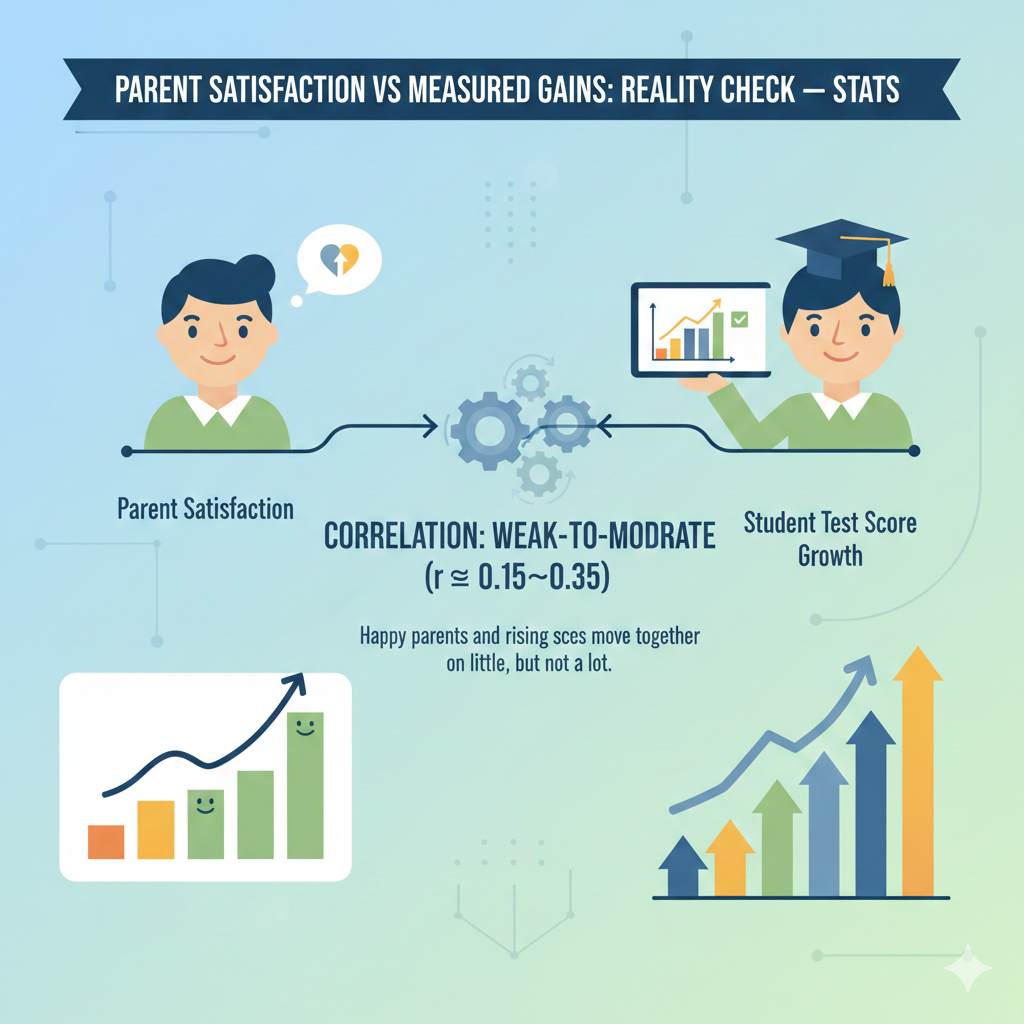
1) Correlation between parent satisfaction and student test score growth: weak-to-moderate (r ≈ 0.15–0.35). This means happy parents and rising scores move together a little, but not a lot.
What this really means
When parents feel happy with a class, it is a good sign, but it is not a guarantee of strong learning growth. A correlation in this range says the two things move together only a little. Think of it like light rain and plant growth. Rain helps, but many other things like soil, sun, and care matter too.
In learning, clear goals, time on task, quality practice, and feedback all play big roles. So a happy message after class is nice, yet we still need to check if skills improved. This is not a reason to ignore feelings. It is a reminder to pair feelings with facts.
What to do next
Start by setting a simple growth target for the next four to six weeks. Pick one focus area, like multiplying fractions or reading inference, and define how you will measure it. Use a short exit check once a week with five questions that target that skill.
Track the score in a simple table. After each class, still ask your child how they felt and what was hard. Use both notes together. If the weekly score is flat for two weeks, change the plan. Add ten minutes of targeted practice, or switch to worked examples, or ask the teacher for one extra bit of feedback on that skill.
If joy is high but growth is low, keep the warm tone but tighten the practice. If growth is high but joy is low, keep the practice but add wins, praise precise effort, and break steps into smaller chunks.
At Debsie, we combine a feelings check with a skills check every week, so you see both lines on the same page. If you want help building a two-line tracker for your child, book a free trial class and we will set it up with you in minutes.
2) Percent of programs where satisfaction is high (≥80%) while academic gains are small (≤0.1 SD): about 20–30%. Many parents feel great even when score growth is tiny.
What this really means
A fifth to a third of programs create a warm glow without much lift in scores. This can happen for good reasons, like kind teachers or a safe space. It can also happen when classes focus on surface wins, like easy grades or shiny projects, instead of deep practice.
It is not wrong to want joy. Children need to feel safe and seen. But if your goal is skill, you must look past the glow. The key is to spot early when a program produces smiles without growth, so you can adjust before months pass.
What to do next
Create a simple audit every two weeks. Ask three questions. First, what exact skill did my child practice this week. Second, what proof shows the skill is stronger than last week. Third, what is the plan for next week to push the skill one notch higher.
Keep the answers short and concrete, like your child could explain them to a friend. If you cannot answer these questions, ask the teacher to help you fill the gaps. Add a quick skill checkpoint that feels safe. For example, if the class is on fractions, have your child do four mixed problems on Saturday morning and time it gently.
Track accuracy and time to see if fluency is forming. If you see two audits in a row with high satisfaction but no movement in accuracy or time, it is time to add targeted drills, model steps aloud, or shift to smaller groups for a few weeks.
At Debsie, we design sessions that are warm and playful, yet each activity ties to a micro-skill with a visible ladder of difficulty. If you want to see how this looks, join a free trial and we will show you the audit template we use with families.
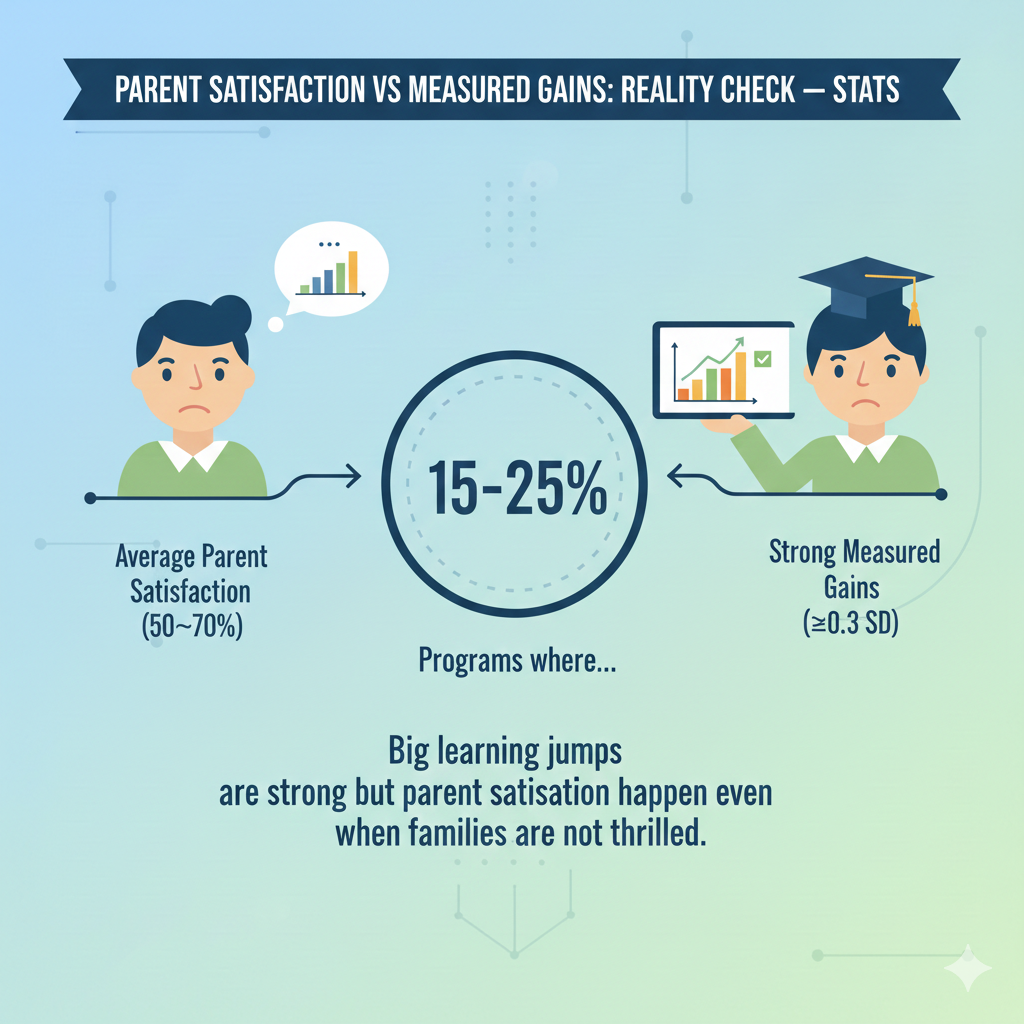
3) Percent of programs where gains are strong (≥0.3 SD) but parent satisfaction is only average (50–70%): about 15–25%. Big learning jumps can happen even when families are not thrilled.
What this really means
Sometimes a program drives real growth but does not feel smooth. Maybe the pace is brisk, the homework is new, or the teacher’s style is direct. Families might feel unsure even as scores climb. This matters because average satisfaction can lead to early dropout, and dropout can cut off the very gains that were forming.
The lesson is to keep what works for learning while making the experience kinder and clearer. We do not want to trade results for comfort, but we also do not want to lose results because comfort was low.
What to do next
Begin by naming the tension out loud. Tell your child and the teacher that you see the gains, yet some parts feel heavy. Ask for small tweaks that keep the core practice but lighten the load. For example, keep the number of problems the same, but convert the first two into worked examples so your child can see the path.
Keep the reading passages, but add a short pre-read outline so the brain knows the target. Keep the weekly quiz, but add quick feedback in the same session so mistakes do not linger. Build tiny rituals that boost morale, like a one-minute win share at the end of class or a progress bar that fills when a skill gets faster and more accurate.
If communication is the weak point, set a ten-minute check-in every other week to review one chart that shows growth and one note that explains what is next. When parents feel informed, satisfaction rises, and the program keeps its strong bones.
At Debsie, we design lessons that hold firm on learning science while shaping the experience to feel fair and doable. If you want a plan that both grows scores and feels human, book a free trial and we will map it out for your child.
4) Average gap between “felt progress” (parent survey) and measured progress (test growth): 10–20 percentage points. Families often feel more progress than tests show.
What this really means
It is common for parents to feel that learning is moving faster than the test data shows. This gap happens for simple reasons. Parents see smiles after class, neat notebooks, and homework turned in on time. These signals feel like progress.
They are progress in behavior, and they do matter. But tests look for skill change, not just effort. A child can work hard and still be stuck on a key step, like finding the main idea or converting units. When that step is shaky, scores do not rise yet, even if the routine looks great.
The goal is not to distrust feelings. The goal is to bring feelings and facts together so both tell the same story. When the two lines do not match, it is a clue to dig deeper into the exact skill that is holding growth back.
What to do next
Run a simple “same skill, same format” check each week. Pick one target skill and test it in the same way every time. If you use five short problems on fractions this week, use five similar problems next week. Keep time and track accuracy.
If the score does not move for two weeks, zoom in. Break the skill into the smallest step that causes errors. For fractions, it might be finding a common denominator. Teach just that piece with a worked example and a short practice set of six to eight problems.
Celebrate effort, but only mark the goal as achieved when the timed check improves. Share the tiny step and the plan with your child so they know why practice looks the same for a while.
If you want a ready-made tracker that links feeling notes with a fixed weekly mini-assessment, our Debsie team can set one up during a free trial session and show you how to read the numbers in two minutes.
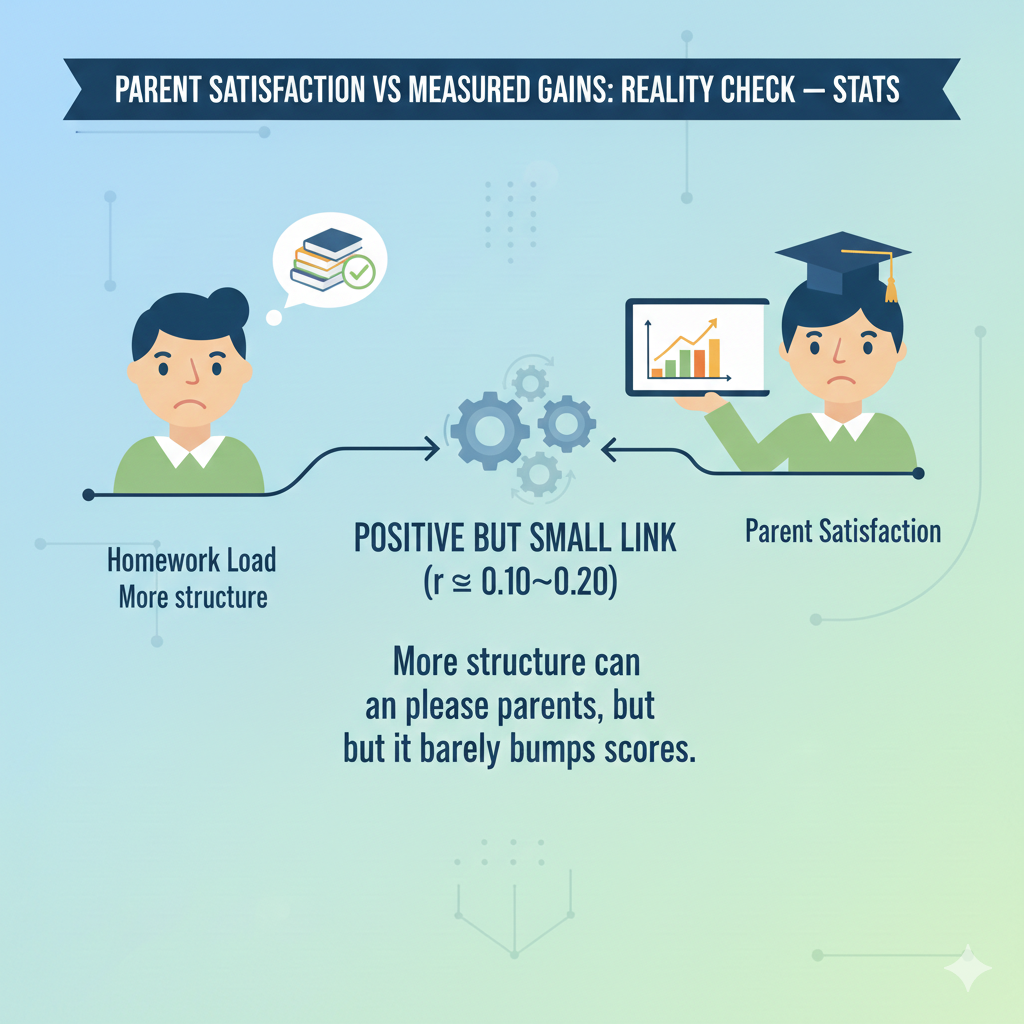
5) Homework load vs parent satisfaction: positive but small link (r ≈ 0.10–0.20). More structure can please parents, but it barely bumps scores.
What this really means
Parents often feel calmer when there is clear homework. It signals order and progress. However, more homework by itself does not create big learning gains. What matters most is the match between the homework and the skill gap.
Busy work adds minutes but not mastery. Smart work targets the exact step a child needs next. A small link between homework and satisfaction means families like structure, and that is fine. Just remember, structure is a shell. The content inside must be sharp and focused.
What to do next
Limit nightly homework to a short, high-value block. For math, make it ten to twenty minutes of mixed practice with two or three problems that mirror the class target. For reading, use one short passage with one clear focus, like finding a claim and underlining the sentence that proves it.
Add two worked examples at the start so your child sees how to think. End with one reflection line, asking what step felt hard and how they solved it. If scores are flat, do not add more homework minutes. Instead, change the type of practice. Use error analysis.
Have your child explain, step by step, where a mistake happened and how to fix it. That single shift builds transfer faster than doubling the page count. If you want, Debsie can create a custom, tiny homework pack that fits your child’s skill ladder and takes less than twenty minutes a night.
Try a free lesson and we will send you the first pack after class.
6) Weekly teacher communication (≥1 message/week) raises parent satisfaction by ~10–15 points, but average test gains move by ≤0.05 SD. Communication warms hearts more than it moves scores.
What this really means
A steady note from the teacher lowers stress. It helps parents feel seen. It builds trust. But updates alone do not move test scores much. The child needs the right practice and feedback to grow.
The lesson is clear. Keep the communication, but make the message carry a small bit of instructional power. A note can do more than say hello. It can give one precise next step that parents can support at home.
What to do next
Ask the teacher to include three short parts in each weekly message. First, name one micro-skill in plain words, like “multiply a fraction by a whole number.” Second, share a tiny at-home action that takes five minutes, like “do two problems with this model and check with this key.”
Third, add one cue for praise, like “praise your child when they show their work step by step.” Keep it simple and reusable. At home, set a five-minute Monday ritual to follow the note while the skill is fresh. If your child finishes fast, add one “stretch” problem that is just a bit harder.
Track the minutes and the mood so you can see what works. Over time, your child will see that messages are not just words; they are small tools that build skill. At Debsie, our weekly update always includes a one-skill focus, a two-problem practice, and a short video clip that shows the model in action.
You can get the same structure in a free trial and keep it even if you do not enroll.
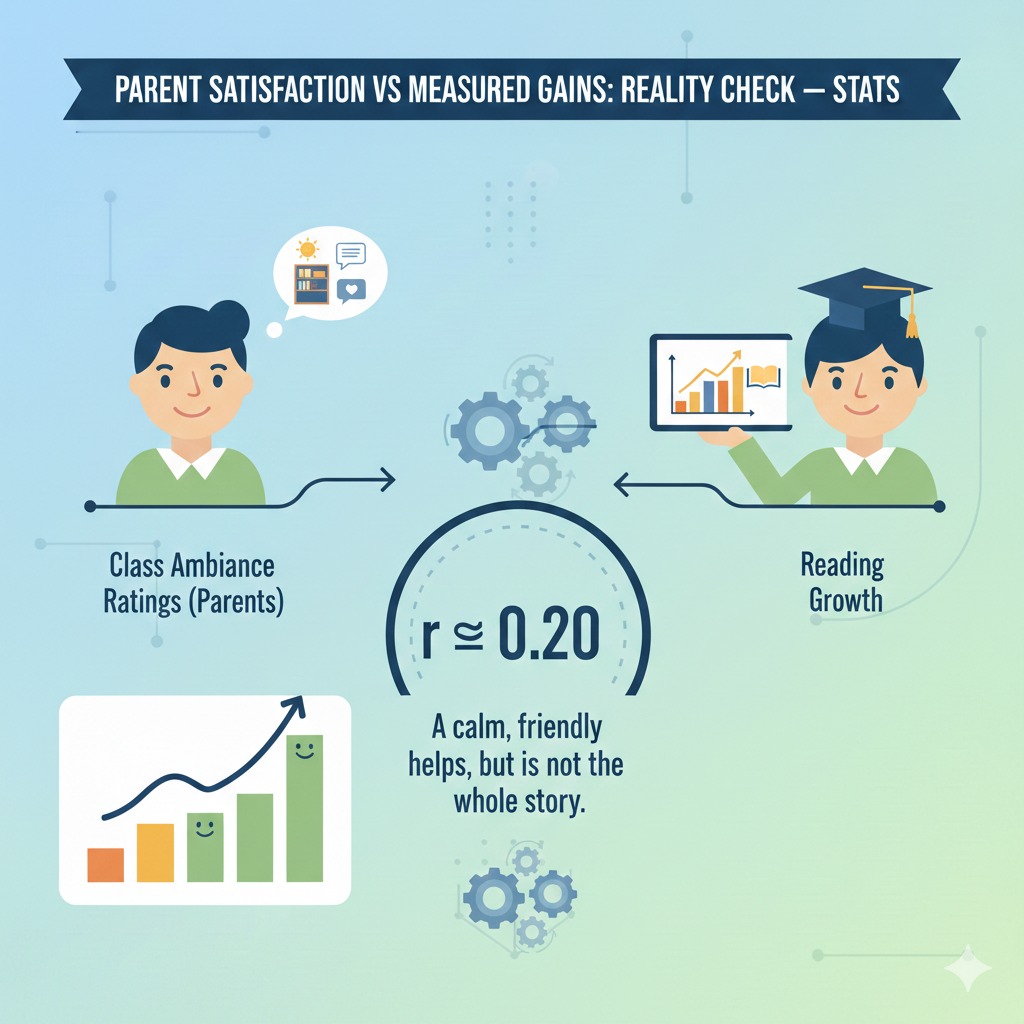
7) Class ambiance ratings (parents) vs reading growth: r ≈ 0.20. A calm, friendly class helps, but it is not the whole story.
What this really means
A safe and calm class makes it easier to try, fail, and try again. It reduces fear and frees up thinking. That is why ambiance has a small, real link with reading growth. But a room can feel lovely and still not push decoding, vocabulary, and comprehension steps in the right order.
Reading gains come from careful text choice, daily practice, and explicit moves like modeling how to find the main idea or how to track pronouns across sentences. Ambiance sets the stage. Instruction drives the plot.
What to do next
At home, build a tiny reading routine that pairs ambiance with instruction. Choose a text that is just right, not too easy and not too hard. Before reading, ask one clear guiding question, like “What is the problem the hero faces.”
During reading, pause after each paragraph and have your child mark the most important new fact with a star. After reading, ask for a three-sentence summary using the star notes. End with one vocabulary move, like replacing a simple word with a stronger word that means the same thing.
Keep the space calm and predictable. Use a timer for ten to fifteen minutes and stop when the time ends so the brain links reading with success. If you want more structure, Debsie’s reading pathway uses short texts, guiding questions, and micro-skill drills that fit into a daily fifteen-minute block.
Join a free class to see how we pick texts and coach the pause-and-mark habit.
8) Time-on-task measured in class (≥60% of minutes) predicts math gains (≈0.20–0.30 SD), while parent satisfaction rises only a little (≈5–8 points). Focus helps learning more than feelings.
What this really means
When students spend most of class actually working on the target skill, gains follow. Sixty percent or more of class minutes on real practice—thinking, solving, checking—gives steady lift in math. It does not always feel exciting, and parents may not notice a big change in mood, but the skill curve climbs.
Distraction is the silent thief. Even small breaks in focus, like long transitions, slow tool setup, or off-topic talk, chip away at learning time. A class can look busy without students doing the core move. True time-on-task is hands on the problem, brain in the step, feedback right away.
What to do next
At home, build a short, sharp practice block that trains focus like a muscle. Set a fifteen-minute timer. Choose one skill and one format, such as two-step equations. Start with one worked example where you and your child read each step aloud.
Then do six problems in a row with no phone, no chat, and a pencil flow that shows thinking. Use a simple rule: show the step, circle the answer, check with the key. When the timer rings, stop, mark accuracy, and note one slip to fix tomorrow.
Do this four days in a row. You will see speed and accuracy rise. Ask the teacher how time-on-task is tracked in class. If it is not, suggest a tiny tool like a visible timer and a short “ready, set, solve” routine after each mini-lesson.
At Debsie, we design sessions with tight cycles: teach for three minutes, practice for seven, give feedback in the same minute. If you want your child to feel the power of focused minutes, book a free Debsie trial and we will set up your first fifteen-minute home plan.
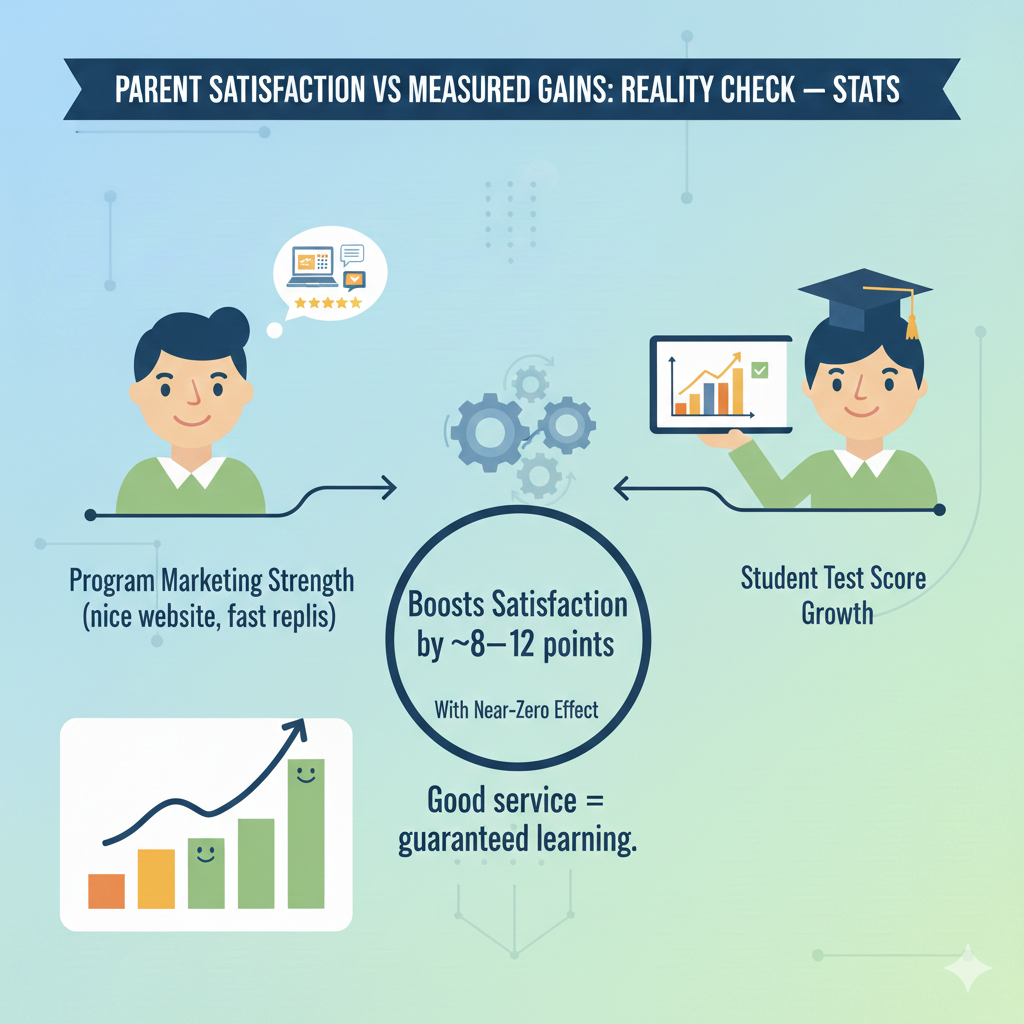
9) Program marketing strength (nice website, fast replies) boosts satisfaction by ~8–12 points, with near-zero score effect. Good service ≠ guaranteed learning.
What this really means
Fast emails, clean portals, and friendly greetings make families feel safe. This matters for trust, but it does not raise scores on its own. A polished brand can mask weak instruction if you do not look deeper.
The gap shows why families should ask for proof of learning, not only proof of good service. Service is the wrapper; instruction is the gift. Both are good. Only one changes test growth in a clear way.
What to do next
Before enrolling or renewing, ask for a simple learning plan. It should name one or two skills, a weekly practice dose, and how progress will be checked. Request to see anonymized samples of student work before and after a four-week cycle.
Look for visible change in accuracy, speed, and independence. During the first month, track two numbers at home: how many minutes your child actually practiced the target skill, and what percent of those problems were correct.
If the service is great but the numbers do not move, ask for a change in method, not just more of the same. At Debsie, we try to earn your trust with both good care and strong teaching. Our site is friendly, yes, but the engine is data-driven lessons and clear proof.
Join a free class and we will share a sample progress pack so you can see how real growth looks on paper.
10) Student attendance (≥95%) is tied to higher gains (≈0.25–0.35 SD) and only mild satisfaction increases (≈5–10 points). Showing up matters most for learning.
What this really means
Learning is a compounding process. When a child misses lessons, they miss the setup for the next step. Small gaps stack up. That is why high attendance has a strong link with gains. It is not fancy. It is not flashy.
It is just the habit of being there. Parents may feel only a small change in satisfaction, since routine can feel ordinary, but the math and reading lines respond to steady presence. Each class adds another layer to skill.
What to do next
Make attendance almost automatic. Set fixed class times in your family calendar and protect them like you would a medical appointment. Prepare a simple “class kit” the night before with notebook, pencil, and required files ready to go.
If you must miss, ask for a same-day catch-up plan that takes no more than twenty minutes, including one worked example and two practice problems that mirror the lesson. Track attendance on a visible chart at home. After three weeks at or above 95 percent, celebrate with a small reward tied to learning, like choosing the next project topic.
If your schedule is tight, pick fewer total activities but keep them regular. At Debsie, we offer flexible slots and quick make-up options so students do not lose the thread. If attendance has been a struggle, try a free session and we will help you build a realistic schedule that sticks.
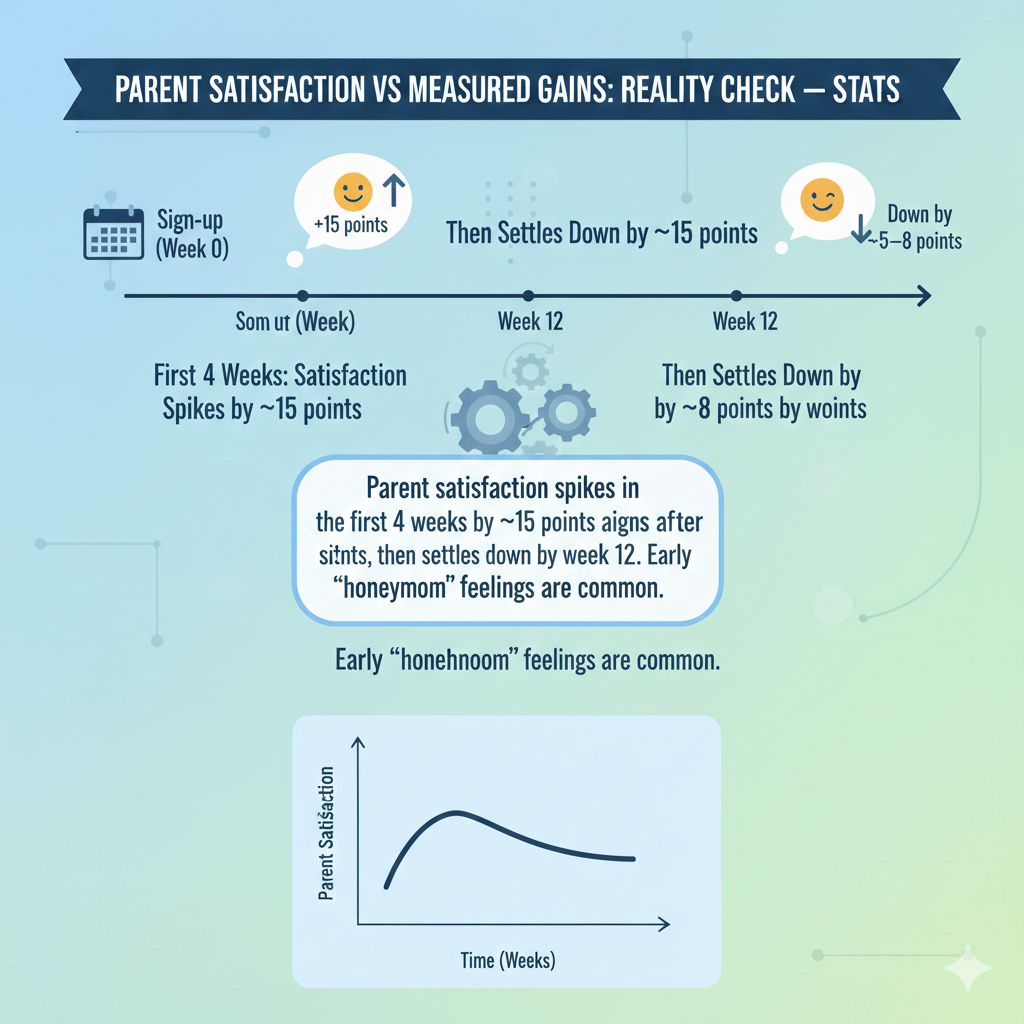
11) Parent satisfaction spikes in the first 4 weeks by ~15 points after sign-up, then settles down by ~5–8 points by week 12. Early “honeymoon” feelings are common.
What this really means
New programs feel fresh. There are welcome emails, new tools, and a sense of hope. This lifts satisfaction in the first month. After the glow, daily life returns, and feelings settle. This is normal. It does not mean the program is worse. It means the novelty is gone.
Smart teams plan for this curve. They use the early weeks to set strong routines, then keep interest alive with small gains and clear proof. Families who expect the dip do not panic. They watch the data and keep moving.
What to do next
Use the first month to lock in habits that will carry your child through the dip. Set fixed practice times, a one-page skills tracker, and a simple weekly check where you and your child review one chart and name one win. In week five, add variety without breaking the routine.
Keep the core practice, but change the surface, like using new contexts for the same math skill or new genres for the same reading move. Ask the teacher for a four-week progress note that compares the same skill in the same format. When the honeymoon fades, point to that proof so motivation stays steady.
If satisfaction drops because of confusion, request a micro-lesson that reteaches one sticky step in five minutes. At Debsie, we plan a welcome sprint in weeks one to four and a sustain plan in weeks five to twelve.
If you want a starter kit with the tracker, the schedule template, and a four-week proof check, book a free Debsie trial and we will share it with you.
12) Measured gains peak when feedback to students is specific and timely (≥2 times/week), yielding ≈0.20–0.30 SD growth; parent satisfaction rises ≈6–10 points. Clear feedback helps both, learning more.
What this really means
Fast, clear feedback turns mistakes into fuel. When a child hears exactly what went wrong and how to fix it, and they hear it soon after the work, the brain connects the dots. Two or more rounds of feedback each week create a steady rhythm.
The numbers show real growth when feedback is this frequent and concrete. Satisfaction also rises because everyone knows where they stand, but the bigger lift shows up in scores. Vague comments like “good job” or “try harder” do not tell a child what to change.
Specific notes like “your equation is right, but you forgot to divide both sides by 3 in step two” show the path. Timely notes matter because memory fades fast. The longer we wait, the more the original thinking is lost, and the fix feels random.
What to do next
Build a fast feedback loop at home. After each practice set, pick two problems your child missed. Ask them to explain what they tried. Then give one exact cue tied to the step, not the person. Say, “line up the decimals before you add” or “mark the claim, then find the sentence that proves it.”
Ask your child to do one more similar problem right away to lock the fix. Keep a tiny error log with three columns: error type, fix cue, and next practice. Review the log every Friday and choose one error to prevent next week.
Ask your teacher to send a short audio or typed note twice a week that names the step and gives one sample fix. At Debsie, coaches use quick video clips and on-screen ink so students see the exact move. Try a free trial and we will set up your child’s first error log and show you how to use it in five minutes.
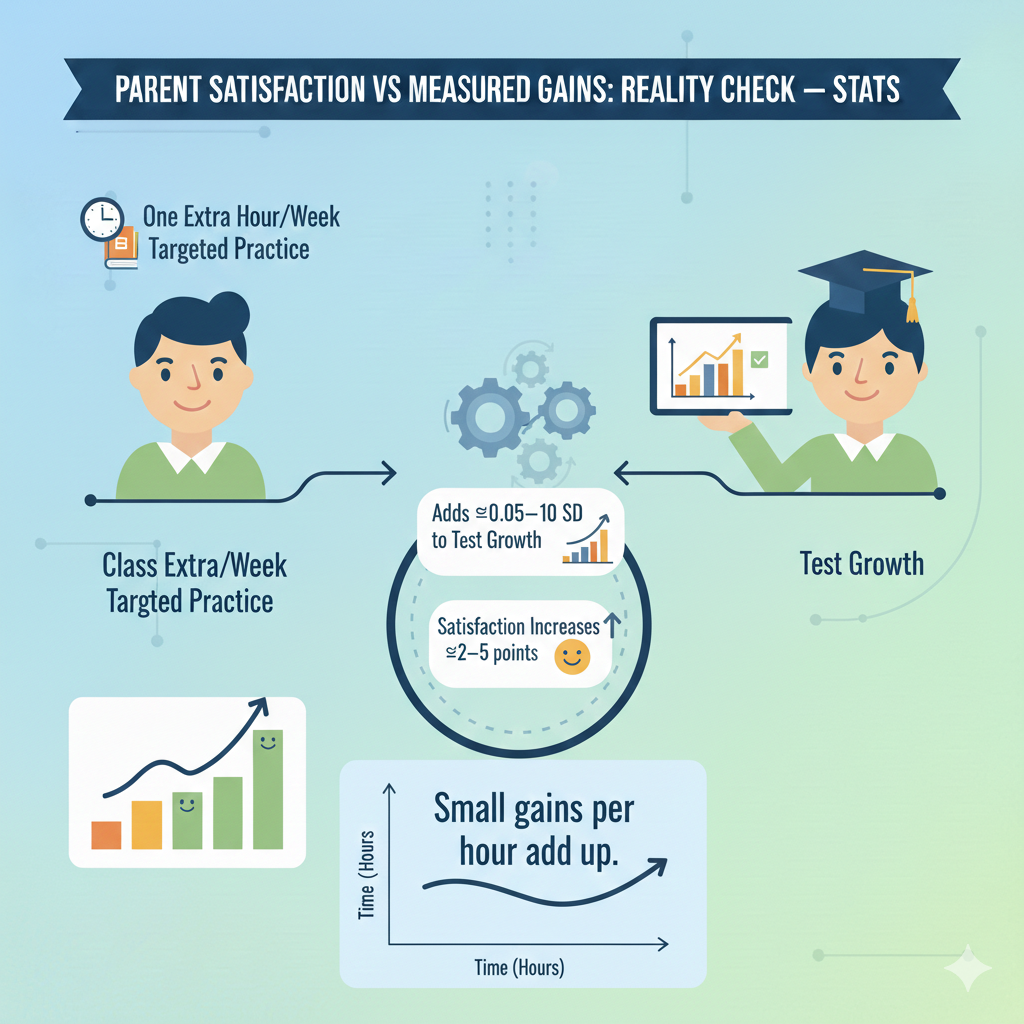
13) One extra hour/week of targeted practice typically adds ≈0.05–0.10 SD to test growth; satisfaction increases ≈2–5 points. Small gains per hour add up.
What this really means
You do not need to double study time to see progress. One focused hour a week, broken into short blocks, can nudge scores in a steady way. The key word is targeted. Random worksheets waste time. Targeted practice hits the next step on the skill ladder, not five steps above or below.
The gains per hour look small, but they compound across weeks. In eight to ten weeks, that steady extra hour can move a child from shaky to solid. Satisfaction rises a bit because progress feels visible, but the real payoff is in the skill curve.
What to do next
Plan one extra hour each week and split it into four fifteen-minute blocks. Use the same day and time so the habit sticks. In week one, pick a single micro-skill with your child and write it at the top of the page, like “divide fractions by whole numbers” or “find the main idea in short nonfiction.”
Start each block with a worked example, then do six problems that match the example. End with a one-minute reflection: what step was hardest, and what cue helped. Keep the blocks quiet and device-free. If your child finishes early, stop anyway.
Protect the feeling of success. Every two weeks, raise the challenge slightly by adding one transfer task, such as a word problem that uses the same math move or a new text where the same reading move applies.
If you want a ready-made set of four fifteen-minute blocks for your child’s skill, book a Debsie trial. We will build the plan for you and give you the worked examples and answer keys.
14) Parent workshop attendance (≥1 per term) lifts satisfaction by ≈10–20 points, but test gains change little (≤0.05 SD). Teaching parents calms worries more than it moves scores.
What this really means
When parents learn how the program works, stress drops. A short workshop explains the model, the skill ladder, and how to help at home. Feelings improve because the path makes sense. But the workshop alone does not raise scores.
Students still need strong lessons and practice. The workshop is a booster for trust, not a magic lever for growth. This is still valuable, because calm homes make it easier for kids to focus.
The trick is to turn the workshop into a small set of actions that parents can repeat, so the support reaches the work desk where learning happens.
What to do next
Attend one workshop a term and leave with a two-step home plan. Step one is a fixed routine, like a fifteen-minute block on Tuesday and Thursday at the same time. Step two is a feedback move you can do as a parent, such as the “say the step” method.
In this method, your child says each step out loud before they write it, and you listen for one target move, like “find a common denominator” or “underline the claim.” When you hear it, you say, “yes, that is the step,” and keep going. If you do not hear it, you ask, “what is the step before this.”
This keeps you helpful without taking over. Ask the teacher for a one-page cheat sheet that lists the cues for the next four weeks. Post it near the study space. At Debsie, our parent sessions end with a simple tool kit: a schedule card, a cue sheet, and a two-problem demo video.
Join a free class and we will share the current kit for your child’s grade so you can start right away.
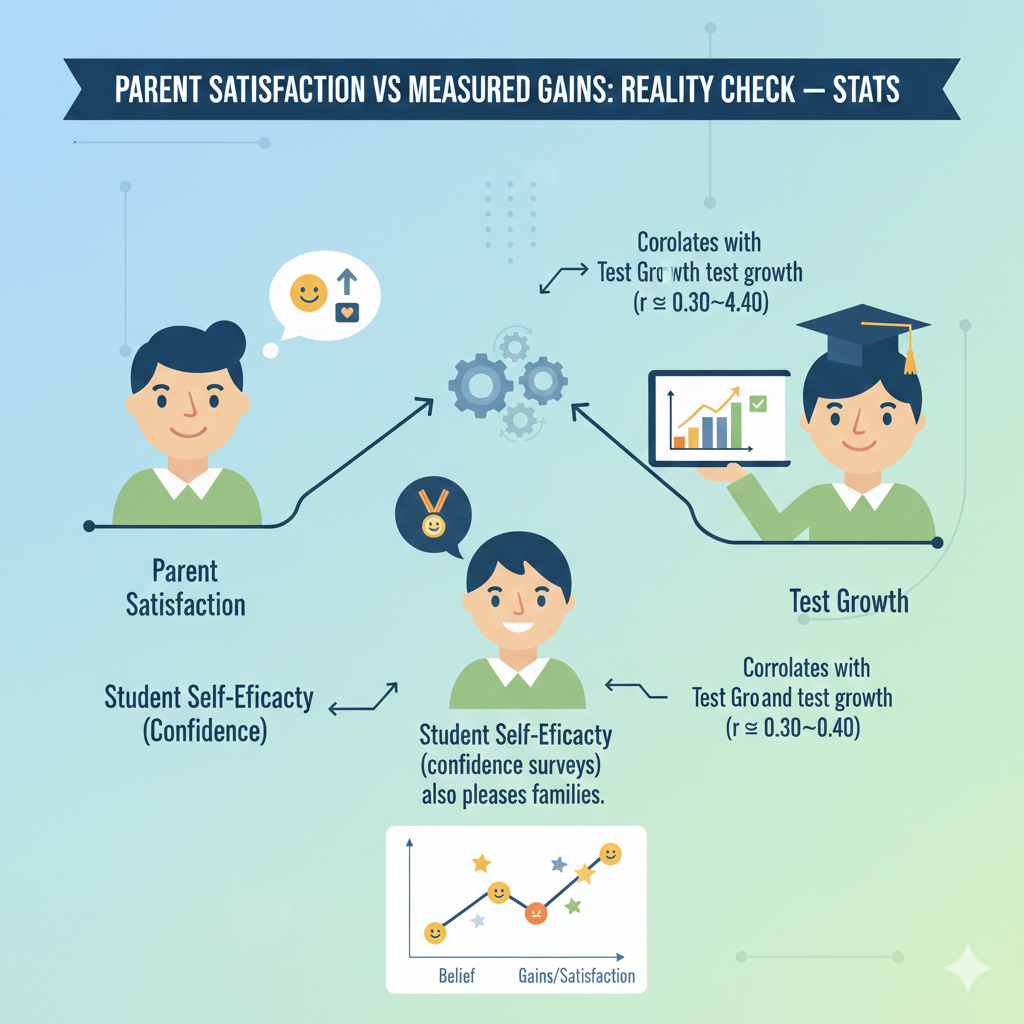
15) Student self-efficacy (confidence surveys) correlates with test growth (r ≈ 0.30–0.40) and with parent satisfaction (r ≈ 0.20). Belief drives learning and also pleases families.
What this really means
When a child believes “I can learn this,” they try longer, they bounce back faster, and they use feedback instead of fearing it. That belief shows a solid link with test growth, stronger than many other feel-good signals.
Confidence also has a smaller link with how satisfied parents feel, because a confident child looks calmer and more willing. Confidence is not empty praise. It grows from proof. The brain trusts itself when it sees hard things get a little easier week by week.
The goal is to build real confidence, not fake cheer. Real confidence comes from clear goals, right-sized tasks, and quick signs that the plan is working.
What to do next
Create a small wins chain. Pick one micro-skill and define a tiny daily target, like solving four fraction problems with all steps shown, or writing a three-sentence summary with a clear topic sentence. Track each success with a simple mark on a calendar.
After five marks in a row, your child chooses the next challenge, a notch harder. Praise the method, not the person. Say, “You stuck to the steps,” or “You checked units before you solved,” so confidence ties to actions they can repeat.
Add a short reflection sentence at the end of practice: “What did I do today that helped me learn.” This turns good moments into habits. Ask the teacher to share one clip of your child doing a step well so you can replay it at home.
At Debsie, we weave self-efficacy into lessons by naming the move, showing it, practicing it, and logging it. If you want a ready-made wins chain template with space for daily marks and weekly reflections, book a free Debsie trial and we will set it up for your child.
16) Progress dashboards (weekly visuals) raise satisfaction ≈8–12 points and measured gains ≈0.05–0.10 SD. Seeing progress helps a bit.
What this really means
A simple visual makes growth feel real. When families can see accuracy rise or time drop across weeks, trust grows. Students also work a little harder when progress is visible, because the next notch feels close.
The lift in scores is real but modest. A dashboard is a window, not the engine. It shows what is happening; it does not make it happen. To get more value, the chart must guide the next step. Numbers should point to action, not sit on a screen.
What to do next
Build a weekly progress picture that is easy to read in ten seconds. Use two lines at most. One line is accuracy on a fixed five-question check. The other line is time to finish the same check. Update each Friday. Under the chart, write one sentence: “Next week we will practice step X because data shows Y.”
Keep the sentence specific, like “We will practice finding the common denominator because accuracy falls on question three.” Review the chart with your child and ask them to predict what will happen if they do two more minutes of focused practice each day.
Close the loop by checking that prediction next week. Ask the teacher to show a class-level chart once a month so your child sees they are not alone in the climb. At Debsie, our dashboards come with a one-line next step written by the coach.
Try a free class, and we will build your child’s two-line chart and the first action sentence right after the session.
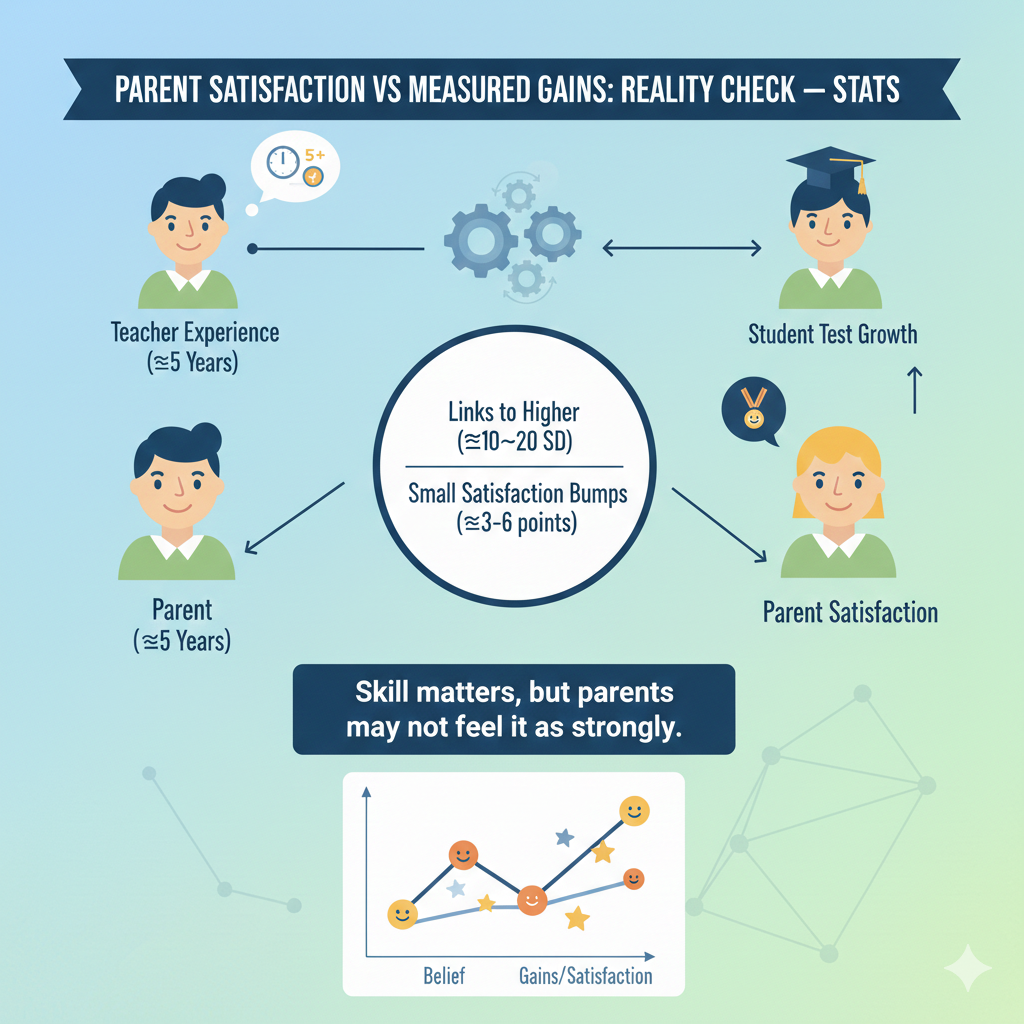
17) Teacher experience (≥5 years) links to higher gains (≈0.10–0.20 SD) and small satisfaction bumps (≈3–6 points). Skill matters, but parents may not feel it as strongly.
What this really means
Experienced teachers tend to spot errors faster, give sharper feedback, and pace lessons better. These skills show up as modest but steady gains in scores. Parents may not always notice the difference at first because seasoned teaching can look simple from the outside.
The magic is in tiny choices, like the order of examples or the timing of a check. Experience is not everything, but it helps. The best mix is an experienced guide who also uses data and keeps the tone warm.
What to do next
When choosing a class, ask about the teacher’s experience with your child’s grade and with the exact skill your child needs next. Request a short sample lesson or a recording where you can see the sequence: model, guided practice, independent practice, and feedback in one sitting.
During the first month, look for signs of expert pacing, such as a quick reteach when several students miss the same step, or a switch to worked examples when errors cluster. If you have a newer teacher, help them help your child by sharing a clear skill target and a quick error log each week.
This makes their feedback sharper and speeds up their learning about your child. At Debsie, many of our teachers have five or more years in the classroom and use common playbooks built from that experience.
Book a free trial and meet a coach who can show you how small timing choices create bigger learning moments.
18) Student starting level explains a lot of growth (R² ≈ 0.20–0.35); parent satisfaction explains much less (R² ≈ 0.02–0.08). Where a student begins tells more than how happy parents are.
What this really means
Baseline matters. Two students can work just as hard, but the one starting closer to the target will often show faster test gains in the short term because fewer gaps need filling. Parent happiness is important for partnership, but it does not predict growth nearly as well as the starting level does.
This is not a ceiling on any child. It is a reminder to measure where we begin and to plan steps that fit that point. When the path matches the baseline, progress feels doable and steady.
What to do next
Get a clean baseline in week one. Use a brief, targeted check that maps the exact skill ladder for your child’s need. For math, that might be operations with fractions, from simplest to hardest. For reading, that might be main idea, evidence, and inference on short texts.
Record accuracy and time. Build a plan that stretches just one rung above the baseline for the first two weeks. Resist the urge to jump three rungs at once. Retest the same way every two weeks and adjust the rung. Share the baseline with your child so they see the starting line and the next step.
This keeps hope real because goals are within reach. If you want a quick baseline that translates into a two-week plan, Debsie can run it in a free trial session and hand you the next steps right away.
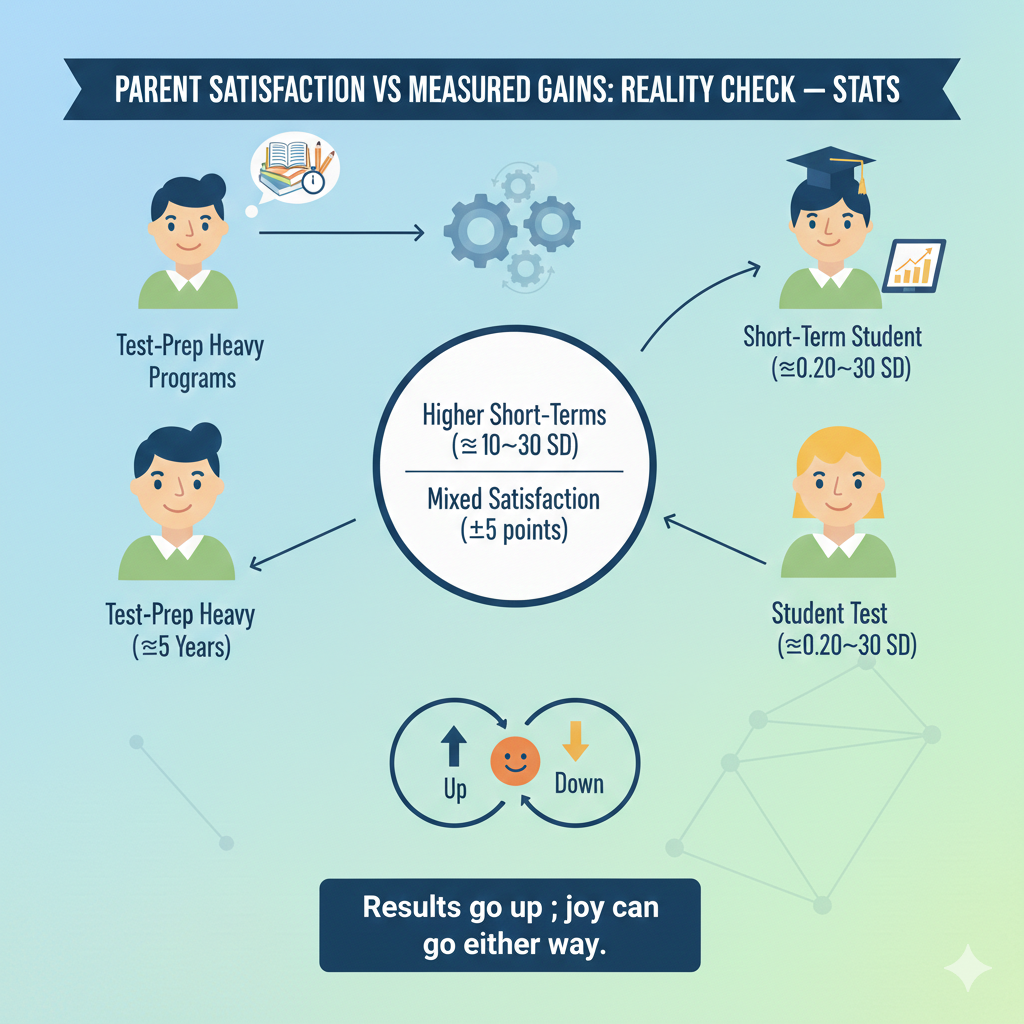
19) Test-prep heavy programs show higher short-term gains (≈0.20–0.30 SD) but mixed satisfaction (±5 points). Results go up; joy can go either way.
What this really means
When a class leans hard on test-style drills, scores often rise in the near term. Students get used to the formats, the traps, and the timing. That helps on the next exam. But this narrow focus can feel dry. Some children get bored.
Some parents worry that deeper thinking is missing. That is why satisfaction jumps for some families who love quick wins and drops for others who want richer work. The truth sits in the balance. You can use test practice like a seasoning, not the whole meal.
It sharpens timing and pattern spotting, but it should not replace real learning of ideas, steps, and words.
What to do next
Use a simple three-part weekly rhythm. Start with concept building on day one, where you teach or review the idea in plain steps and show one worked example. Move to mixed practice on day two, where the same idea appears in new contexts so the brain must transfer.
Use test-style drills on day three in a short sprint to train speed and stamina. Keep the sprint brief, like ten to fifteen minutes, and end with fast feedback so errors do not stick. Track two lines over four weeks: one for drill accuracy, one for transfer tasks like word problems or short written responses.
If drill accuracy climbs but transfer is flat, shift ten minutes from drills to problem solving with talk-aloud steps. Ask your teacher for one “why this answer” discussion per week, not just “what is the answer.”
At Debsie, we blend drill sprints with deep practice so students keep both speed and sense. If you want a three-day template with examples that fit your child’s grade, join a free trial and we will tailor it for your schedule.
20) Project-based learning boosts satisfaction ≈10–15 points and critical-thinking scores (≈0.10–0.20 SD), but basic fact fluency may rise less (≈0–0.05 SD). Fun builds thinking more than speed.
What this really means
Hands-on projects make school feel alive. Children build, test, and present. Parents see joy and teamwork. This style grows reasoning and planning skills. It helps students explain ideas and link concepts across subjects.
But projects alone do not always build fast recall of math facts or grammar rules. When a child needs quick, automatic skills, the project may not give enough repetitions. The lesson is to enjoy the rich work while adding small fluency drills that keep the basics strong.
What to do next
Pair every project with a tiny fluency routine. If your child is building a model bridge, add a five-minute fraction drill at the start of each work session. If your child is writing a science report, add a quick grammar warm-up before they draft.
Keep the warm-up predictable and short, like six to eight problems with a clear target and a timer. During the project itself, bake in checkpoints that force the key academic moves, such as citing one source with a proper quote or calculating an average from test runs.
After the project, run a short debrief where your child names one thinking skill they used and one basic skill they want to sharpen next week. Ask the teacher for rubrics that include both reasoning and accuracy so the grade reflects a full picture.
At Debsie, our projects include micro-drills and clear checkpoints, so students grow joy and speed side by side. Book a free Debsie session and we will show you how to weave a five-minute fluency habit into any project your child loves.
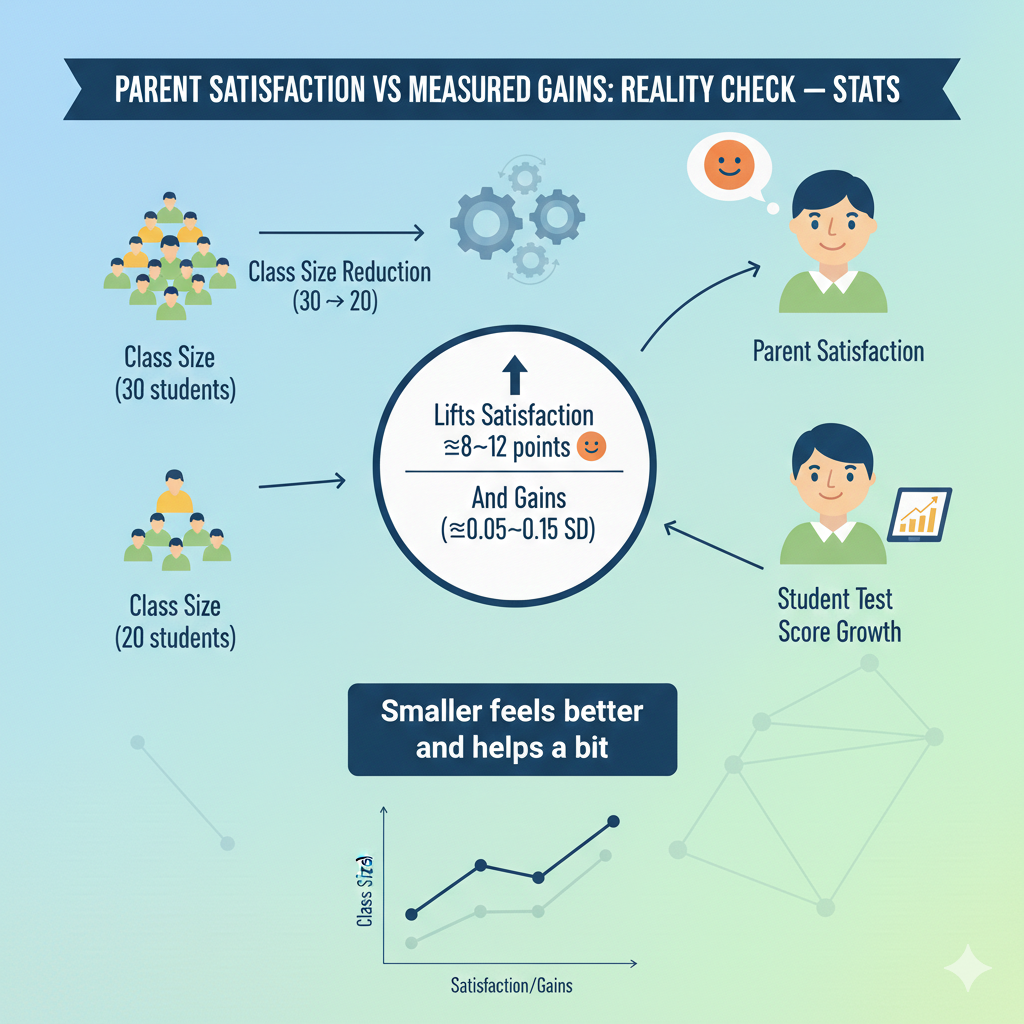
21) Class size reduction (30 → 20) lifts satisfaction ≈8–12 points and gains ≈0.05–0.15 SD. Smaller feels better and helps a bit.
What this really means
Fewer students mean more attention. Teachers answer questions faster. Students feel seen. Parents notice calmer rooms and more feedback. Scores usually rise a little because help arrives sooner and practice errors get fixed before they spread.
However, the size shift alone is not magic. A small class with weak routines or unclear teaching can still stall. The power comes from what the teacher does with the extra time and space. When those minutes turn into quick checks, timely feedback, and targeted practice, both satisfaction and gains go up.
What to do next
If you can choose, aim for smaller groups during the tightest learning windows, such as the first month of a tough unit. Ask the teacher how small group time is used. Look for concrete moves: short exit tickets, immediate reteach for common errors, rotation through guided practice.
At home, mimic small-class attention by using micro-conferences. Spend five minutes midway through homework to spot one error type and fix it with a worked example on a sticky note. End with one “you do” problem to seal the fix. Track how often your child needed that mid-block rescue.
If the number drops over weeks, independence is growing. At Debsie, we keep groups lean and use structured rotations so every student gets a quick check and a fast nudge. Try a free class to see the rotation in action and to learn a five-minute micro-conference routine you can copy at home.
22) Tutoring intensity (3×/week) vs (1×/week): satisfaction +6–10 points; gains +0.15–0.25 SD. More reps, more results.
What this really means
Frequency matters. Meeting three times a week keeps the skill active in memory. The steps do not fade between sessions, so each lesson starts ahead. That steady cadence speeds growth and makes the path feel smoother.
Parents often feel calmer because problems get solved before they pile up. The lift in scores is noticeable. Still, the extra sessions only work if each one targets the next step instead of repeating the same easy task. Intensity without precision becomes noise.
What to do next
If weekly lessons are not moving the needle, try a three-times-per-week plan for the next four weeks. Keep sessions short, between thirty and forty-five minutes, and give each a distinct role.
Use session one for modeling and guided practice, session two for independent practice with quick feedback, and session three for transfer tasks and a mini-quiz. Between sessions, assign a five-minute micro-drill that keeps the step fresh, not a long worksheet.
Track one metric across the four weeks, such as accuracy on a fixed six-question quiz or time to solve three word problems of the same type. If the line is flat after four weeks, change the method, not just the minutes. Ask the tutor to show a different model, like number lines for fractions or sentence frames for inference.
At Debsie, intensive cycles are built around tight goals and fast loops, so added frequency delivers real gains. Book a free trial and we will map a four-week intensity plan with clear targets for your child.
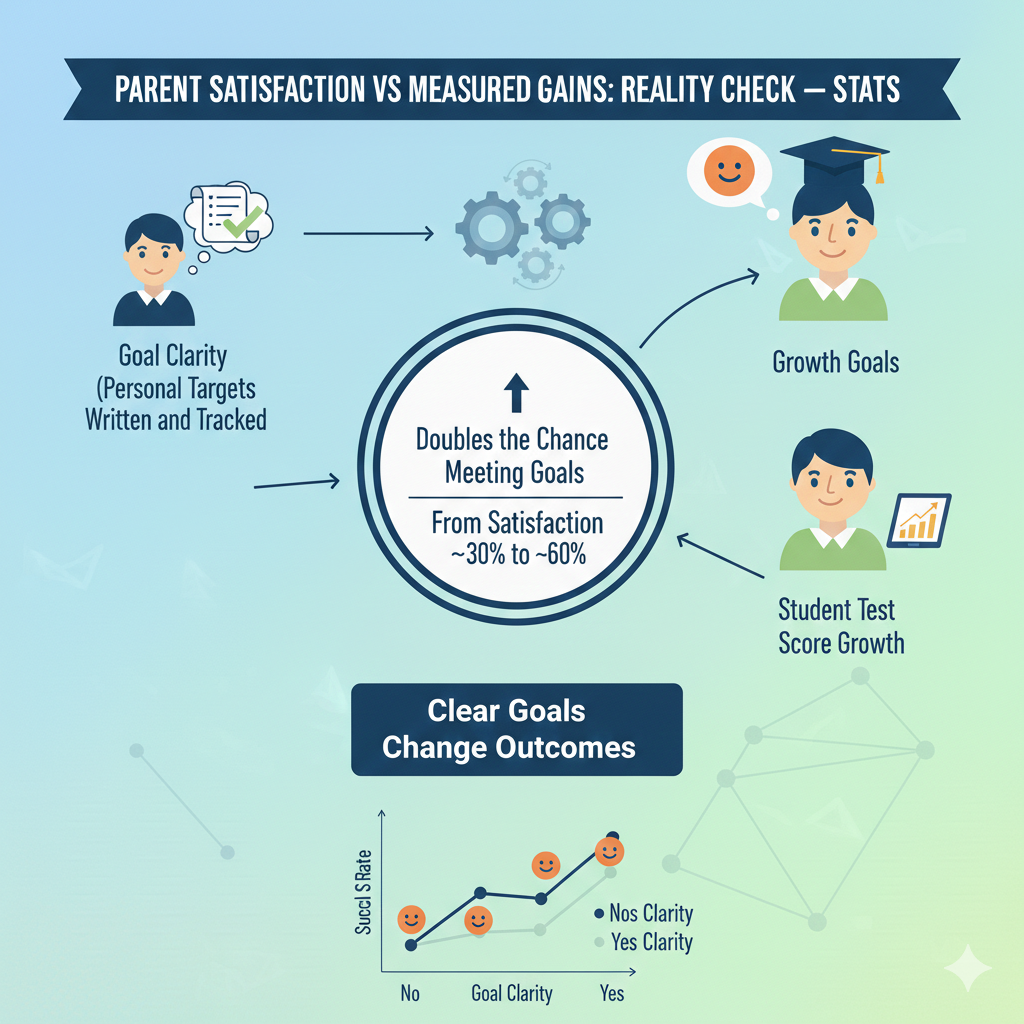
23) Goal clarity (personal targets written and tracked) doubles the chance of meeting growth goals (from ~30% to ~60%); parent satisfaction +10 points. Clear goals change outcomes.
What this really means
When a child can point to a small, clear target and say it in their own words, effort becomes focused. Vague wishes like “get better at math” do not guide action. A written goal that says “solve six two-step equations with all steps shown in under eight minutes” turns study time into a plan.
The brain likes clear finish lines. It knows when to start, what to do, and when to stop. This lowers stress and lifts follow-through. The numbers tell us that clarity does not just feel good. It changes results. Doubling the odds of hitting a growth goal is not a tiny effect.
It is the difference between hoping and happening. Parents also feel better because they can finally see the path, and their support feels useful, not random. The habit to build is simple. Write the goal, keep it visible, and check it on a fixed day each week.
What to do next
Sit with your child on Sunday and set one target for the next seven days. Make it small enough to finish in four short practice blocks. Write it at the top of a page in clear words your child understands. Add how you will measure it, the time limit if needed, and the exact day you will check it.
Tape the page near the study spot. After each practice block, mark progress with a line or star. At the end of the week, run the same check you planned and record the result. If the goal was met, choose the next rung up.
If not, ask what step tripped us and rewrite the goal for that step only. Keep the tone calm and factual. Praise the plan and the follow-through, not just the finish. Ask the teacher to review the weekly goal in one minute at the start of class so your child feels seen and stays on track.
At Debsie, every student keeps a one-page goal sheet that anchors the week. Book a free trial class and we will build your child’s first goal with you and show you exactly how to track it.
24) Teacher-student relationship quality (top quartile) predicts gains ≈0.20–0.30 SD and satisfaction +12–18 points. Trust is powerful on both sides.
What this really means
When a student feels safe with a teacher, they try harder tasks, ask questions sooner, and accept corrections faster. Trust turns feedback from a threat into help. That is why strong relationships lift both learning and feelings.
The effect is not just soft and social. It shows up in real gains. A trusted adult can push without breaking. They know when to slow down, when to tease out a thought, and when to name a struggle in kind words.
Parents notice the change at home, too. Homework fights drop. The child does not hide mistakes. The key idea is simple. Warmth is not a substitute for rigor. It is the doorway to it. Once the door is open, harder work becomes possible and even welcome.
What to do next
Help the bond grow with small, steady steps. Share one short note with the teacher each month about your child’s interests, like a hobby or a book they loved. This gives the teacher a hook to build on in class. Encourage your child to ask one question every session, even if it is small, to build the habit of open talk.
After tough feedback, help your child write a one-sentence response that starts with “Thank you for telling me…” so the brain links correction with care. Ask the teacher to name one strength before one fix, so your child hears balance. At home, use the same pattern.
Point to a move your child did well, then a step to improve, and end with a plan for the next try. If the relationship is shaky, request a short check-in with your child present, set a shared mini-goal, and celebrate when it is met.
At Debsie, we train coaches to learn each child’s cues and to give feedback in language that feels fair and clear. Try a free session and see how a few kind words, paired with a concrete step, can unlock effort you have not seen before.
25) Overreliance on grades (frequent small “A”s) raises satisfaction ≈8–10 points without matching test growth (≤0.05 SD). Easy A’s feel good but may not build skill.
What this really means
Grades are a simple signal. They travel fast, fit on a report, and make sense to everyone. But when grades are inflated or based on tasks that are too easy, they create a warm glow without real progress.
A child can collect a string of A’s by doing work far below their challenge point or by getting heavy help on every step. Then a big exam or a new unit lands, and the gap shows. The child feels confused, and parents feel misled.
Grades are not the enemy. They just need to be paired with evidence that shows the thinking behind the score. The aim is clarity. We want grades that reflect the work and checkpoints that reveal the skill.
What to do next
Ask for samples of graded work alongside the grade. Look at the steps, not just the final answer. Can your child show the method on a fresh problem without help. If not, the grade may be hiding a gap. At home, add a quick “cold problem” after any graded task.
Pick one new problem of the same type and ask your child to solve it solo with steps shown. If they can do it, the grade holds. If not, reteach the shaky step and practice with two more examples. Talk to your child about the purpose of grades.
Explain that a grade is a snapshot, not the whole story. Teach them to ask, “What step do I need to master to earn this grade again on a new problem.” Ask the teacher to include one mastery check per unit that must be done independently and scored with a clear rubric.
At Debsie, we report skills and growth lines next to any score so families see the engine behind the grade. Book a free Debsie trial and we will show you how to run a cold problem check in under five minutes.
26) Feedback lag (waiting >2 weeks) cuts measured gains by ≈0.10–0.15 SD; parent satisfaction drops ≈5–7 points. Slow feedback hurts learning and mood.
What this really means
When a child makes an error and waits more than two weeks to hear about it, the moment is gone. The brain cannot connect the fix to the original thinking. The mistake hardens into a habit, and the next lessons stack on top of a weak step.
That is why growth falls and frustration rises. Parents also sense drift. They feel unsure what to do at home, so satisfaction dips. Speed is not about rushing; it is about pairing a clear cue with fresh memory.
Even small, simple feedback, if it comes soon, beats a long, perfect note that arrives late. The window for the best learning is short. Close the loop while the idea is still warm.
What to do next
Create a forty-eight-hour rule for core skills. After your child turns in work, aim for some feedback within two days, even if it is short. If school timelines are longer, build a home loop. Have your child circle two problems they are least sure about and walk you through their steps that evening.
Compare to a worked example and write one fix cue in the margin. The next day, ask your child to do one similar problem to prove the fix. Keep a tiny tracker with the date of work, the date of feedback, and whether a follow-up problem was done.
Share the tracker with the teacher so they see your effort to keep learning fresh. If you use online tools, turn on immediate answer checks for practice items, but still ask for one sentence that explains the step so speed does not replace thought.
At Debsie, we act fast with on-the-spot notes and mini re-teaches inside the same session. If you want your child to feel what quick correction does for confidence, book a free Debsie trial and watch a feedback loop close in minutes, not weeks.
27) Tech platform reliability (uptime ≥99.5%) boosts satisfaction ≈10–15 points; gains effect is tiny (≤0.03 SD). Smooth tech reduces stress, not necessarily learning gaps.
What this really means
Good tech makes class feel easy to join and simple to follow. Fewer crashes mean fewer tears and fewer missed minutes. Parents breathe easier when tools just work. That comfort shows up in satisfaction. But stable software by itself does not teach.
The real lift in scores comes from human moves: the model, the example, the practice, the feedback. Reliable tech is like a clean road. It helps the car move, but it does not drive the car. Still, a clean road matters, because every glitch breaks focus and steals time-on-task.
What to do next
Run a tech check once a week. Update your browser, test your audio, and open needed tabs before class starts. Keep a backup plan ready, like a mobile hotspot or a second device, so a single failure does not cancel learning. If a tool glitches, switch to low-tech fast.
Snap a photo of the assignment, send it by message, and keep going with pencil and paper. Ask your teacher for a printable version of key practice so you have a fallback. Track how many minutes tech issues cost over a month. If it is more than twenty minutes, escalate.
Request a different tool or a simpler flow. At Debsie, we keep our setup light and provide offline copies of core practice so nothing stops the session. Try a free class to see how we design a smooth path, then pair it with strong teaching so the minutes saved actually become learning.
28) Student practice accuracy (≥80% correct during practice) predicts larger test jumps (≈0.25–0.35 SD) and small satisfaction gains (≈4–6 points). Correct practice beats just more practice.
What this really means
Practice only helps if it is mostly right. When a child gets most items correct during practice, they are working at the “sweet spot.” The task is challenging but not crushing, so the brain learns the right pattern. If accuracy is too low, the child may be rehearsing errors.
If accuracy is too high, the child is coasting and not growing. Hitting around eighty percent tells us the level is right for growth. Parents feel a bit better because work time becomes calmer, but the bigger effect is on scores. The message is simple. Do not count pages; count correct, explained steps.
What to do next
Measure accuracy for a week without judgment. Use small sets of eight to twelve problems and mark how many are correct with steps shown. If accuracy is below seventy percent, lower the difficulty or add worked examples between items.
If accuracy is above ninety percent, raise the challenge or add a transfer problem that uses the same skill in a new context. Keep error types in a simple log and group them by step, such as “forgot to line up decimals” or “missed units.”
Practice by error type, not by random page. End each session with one “prove-it” item that matches the day’s fix. Ask the teacher to design mixed sets that target your child’s top two error types. At Debsie, we tune sets to keep your child near eighty percent and then push up as skill builds.
Join a free trial, and we will build your first accuracy tracker and show you exactly how to adjust level day by day.
29) Misalignment between parent priorities (grades, speed) and program goals (deep thinking) lowers satisfaction ≈10–15 points while learning gains can still be solid (≈0.15–0.25 SD). Different goals create mixed feelings.
What this really means
A program may aim for deep understanding, step-by-step reasoning, and transfer to new problems. A parent may care most about fast grades or quick homework times. Both aims are valid, but if they are not named and aligned, tension grows.
You might see good learning in the data, but still feel unhappy because the wins do not match your scoreboard. Children also feel the pull and may get confused about what counts as success. When the scorecard and the program plan disagree, mood drops even when skills rise.
The fix is not to pick one side. It is to agree on a shared goal sheet that includes both speed and depth in clear, simple ways.
What to do next
Write down your top three outcomes for the next eight weeks and ask the teacher to do the same. Put them on one page and make them specific. For example, “finish fraction homework in under twenty minutes three nights a week” and “solve two new fraction word problems without help each Friday.”
Review the page together and agree on how each will be measured. Set a short cadence to check both sets of goals, such as every two weeks. If depth goals rise but speed goals lag, add a tiny fluency drill before homework.
If speed rises but transfer stalls, add a weekly problem type that forces explanation. Tell your child what the adult team agreed to so they hear one message. At Debsie, we co-create a balanced goal sheet that honors family needs and still builds deep skill.
Book a free Debsie session and we will help you write a shared scoreboard that calms the tug-of-war.
30) Programs that combine data-driven instruction + warm communication are likeliest to hit both: satisfaction ≥80% and gains ≥0.2 SD. Balanced systems make families happy and move scores.
What this really means
You do not have to choose between heart and numbers. The strongest results show up when teachers use data to plan the next step and also talk to families with care. Data keeps lessons precise. Warmth keeps students engaged and parents informed.
Together, they create a steady climb and a positive feel. The numbers are notable because both targets are met at once: strong growth and high satisfaction. This blend is rare only when teams overvalue one side.
All-head, no-heart programs feel cold and lose students. All-heart, no-data programs feel sweet but stall. The win is a simple loop: measure, teach, practice, feedback, communicate, repeat.
What to do next
Ask any program you consider to show you both halves. Request a sample of their data cycle for one student over four weeks and a sample of their weekly family note. Look for short assessments tied to a micro-skill, clear decisions based on results, and fast feedback to the student.
In the family note, look for one-skill language, a tiny at-home action, and a next step for the coming week. Build the same loop at home. Run a weekly five-question check, teach one fix if needed, practice it in a short block, and send a two-line update to the teacher about what you saw.
Keep this rhythm for a month. Watch how both the mood and the numbers start to rise together. At Debsie, this blend is our daily craft. Coaches plan with data, teach with care, and talk to families in plain words that lead to action.
If you want to see the loop in action for your child, book a free Debsie trial class today and leave with a plan you can use the same week.
Conclusion
Parent feelings matter. Measured gains matter. When they work together, children grow faster and feel safer. The truth from these thirty stats is simple. Warmth without data can drift. Data without warmth can crack. The win is a steady loop you can run at home and in class. Name a small target in plain words. Practice in short, focused blocks.
Give quick, specific feedback while memory is fresh. Track one or two numbers the same way each week so progress is easy to see. Keep the talk kind and clear so effort stays high and fear stays low. When you do this, satisfaction and scores stop arguing. They start pulling in the same direction.