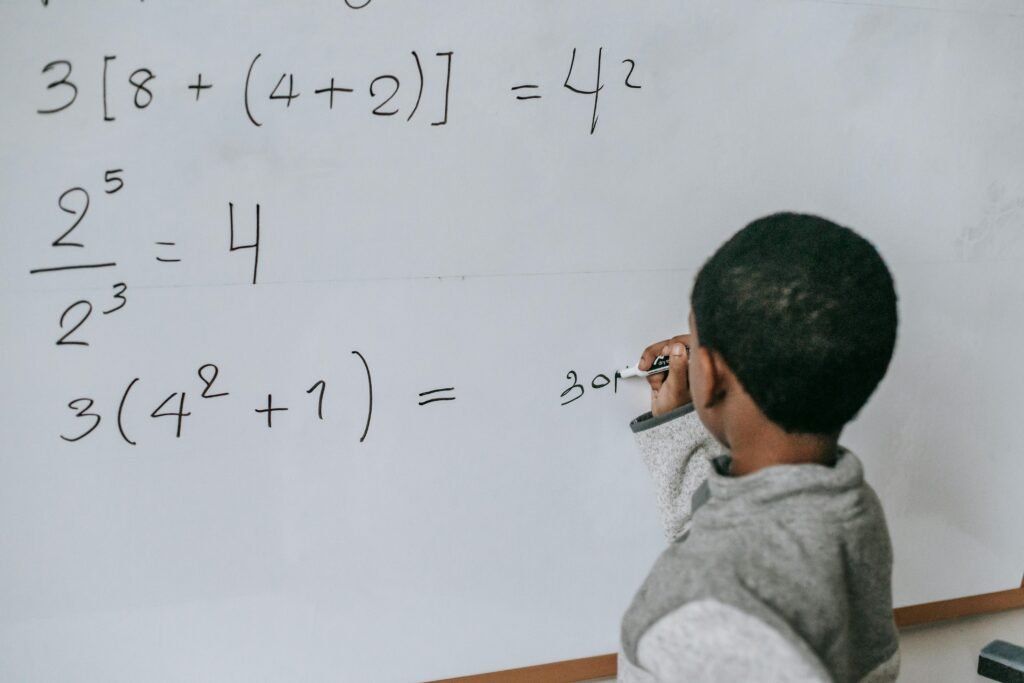
Middle school math can feel big. But it does not have to be scary. Pre-algebra is simply the bridge between numbers and ideas. When kids know the key signs of fluency, they walk into class feeling calm, ready, and sure of themselves. This guide turns that feeling into clear numbers you can use. Each number shows what strong pre-algebra looks like in practice. Every section explains the skill in plain words, shows how to practice it at home, and shares classroom-tested tips you can start today. You will see how to build speed without losing accuracy, how to think through word problems step by step, and how to form study habits that last.
1) 95% accuracy on mixed integer operations across 20 problems
Why this matters
Accuracy is the quiet engine of confidence. When a student can add, subtract, multiply, and divide integers with 95% accuracy on a twenty-problem set, they show real control over signs, place value, and the rules that power pre-algebra.
Mixed operations mimic the way problems appear in class and on tests. They do not line up by type. They come in any order, with positives and negatives switching fast. Hitting this mark means the student can keep a steady mind while signs and steps change.
It proves they slow down just enough to avoid slips, yet move with purpose so work gets done.
How to practice at home
Start with a short warmup of five quick integer problems to wake up the brain. Then set a timer for ten minutes and work through a set of twenty mixed problems. Use a scratch area for sign checks. Write a tiny plus or minus above each number as a cue.
For subtraction with negatives, rewrite as addition of the opposite to keep the rule clear. Read each answer back to yourself to see if it is sensible. If you add a big positive and a tiny negative, the result should stay positive.
If the signs confuse you, draw a simple number line and hop left or right to feel the move. For division of integers, repeat the sign rule out loud: same signs make a positive, different signs make a negative.
Error fixing routine
When a mistake shows up, circle it, rewrite the original problem, and solve again more slowly. Explain the step out loud in one sentence. If the reason cannot be stated, the rule is not yet solid.
Keep an error log with three columns for the problem, the mistake type, and the fixed rule. Review this log before each new practice set. Over a week, the same small errors fade because the brain now recognizes the pattern.
Classroom and test use
Teach students to star the three hardest items first to spread effort. On a quiz, they should solve the clean ones fast, then spend extra time on two sign-heavy problems. Train them to do a micro-check after every third problem by scanning for sign flips and copy errors. This habit preserves accuracy without wasting time.
Debsie support
Inside Debsie, our live teachers model this routine and give instant feedback when a sign slip appears. The gamified drills mix problem styles on purpose so students build accuracy under gentle pressure. Join a free trial class to see how a ten-minute set can turn shaky steps into sure ones today.
2) Completes 30 single-step integer problems in ≤5 minutes (≥6 per minute)
Why this matters
Speed with control shows that facts are ready for action. Thirty single-step integer items in five minutes means the student can access math facts with almost no friction. This fluency frees working memory for bigger ideas like equations and word problems.
The goal is not to rush. The goal is to move smoothly, the way a reader moves through easy words.
When single steps are quick, multi-step tasks feel lighter. Class becomes less tiring because the student spends energy on strategy, not on recalling what minus a negative means.
Building smooth pace
Begin with a gentle pace test to set a baseline. Count how many correct answers are finished in one minute. Repeat this for five days and note the trend. Use small sprints of twenty seconds on easy items, then rest for ten seconds, then sprint again.
This trains the brain to lock onto the next problem without pause. Keep the layout clean with one row per line to reduce eye jumps. Encourage saying the rule under the breath while writing, such as minus a negative turns into plus.
This short whisper pairs motion with meaning and builds an automatic rhythm.
Quality check without slowing down
Teach a two-second glance after every five problems. The student looks for three things only: sign sense, digit order, and place value alignment if there are multi-digit numbers. If anything looks odd, fix it right there.
During practice, count both speed and accuracy. Do not accept extra speed that breaks the 95% bar from Stat 1. Speed without accuracy is noise. Accuracy without speed becomes stress on timed work. The sweet spot is both together.
Home and classroom routine
Use morning minutes for a quick sprint and evening minutes for a gentle review. In class, begin with a two-minute fluency round to warm up, then shift into new content. Track personal bests on a simple chart. Celebrate the top three gains each week, not just the top score. Growth motivates more than rank.
Debsie support
Debsie’s timed challenges set a clear pace and give instant stars for steady streaks. The platform adapts so students face the right level of push. Try a free class to see the sprint-and-check cycle that turns slow steps into smooth flow.
3) 90% accuracy on full order of operations (PEMDAS) across 10 items
Why this matters
Order of operations is the traffic law of arithmetic. Without it, answers crash. A 90% accuracy rate on ten full items proves the student can handle parentheses, exponents, multiplication or division from left to right, and addition or subtraction from left to right.
It also shows they can track nested parts without losing the path. This skill supports every topic that follows, from simplifying expressions to solving equations, and later to functions.
Clarity here means fewer lost points on tests where a single missed step can drop a correct idea into a wrong result.
A clear step plan
Teach the student to rewrite the problem with space between pieces. Box the innermost parentheses and solve them first. Underline exponents and evaluate them before any multiplication. Draw a tiny arrow over the expression to remind left-to-right moves for multiplication and division.
Do the same for addition and subtraction. After each stage, copy the new line neatly, keeping numbers aligned. If the expression has many steps, count them before starting and say the number out loud. This primes the mind to expect a short journey rather than an endless maze.
Common traps and fixes
A usual trap is doing addition before finishing multiplication. The fix is to scan the line for any multiply or divide signs before touching plus or minus. Another trap is dropping a negative sign when parentheses vanish.
The fix is to carry the sign forward and rewrite the term clearly. For exponents, some students multiply the base by the exponent rather than raising to a power. The fix is to expand a small power as repeated multiplication one time to feel the rule again.
Practice structure
Use ten rich items that include nested parentheses, a power or two, and mixed operations. Aim for nine correct. When an error appears, copy the problem, label each step with a short verb like group, power, multiply, or add.
This language keeps the plan concrete. Once the student gets nine of ten twice in a row, add expressions with absolute value bars to prepare for later work.
Debsie support
Our teachers model each step on screen with color cues that fade as students gain skill. The game path rewards neat line-by-line work, not just final answers. Join a trial to watch your child master the law that keeps every expression in order.
4) Solves one-step equations (whole numbers) 8/10 correct in ≤6 minutes
Why this matters
One-step equations are the doorway to algebra. When a student can solve eight out of ten whole-number equations in six minutes or less, they show that they understand inverse operations and balance. This skill keeps thinking light during harder work.
If x + 7 = 19 feels easy, then later steps like isolating a variable in a longer expression will also feel within reach. Strong one-step fluency reduces test stress because many big problems hide a simple one-step move at the end.
How to practice at home
Begin with a short warmup of five facts that match the day’s focus, such as addition undoing subtraction or multiplication undoing division. Write each equation on its own line with a small space to the right for the inverse move.
Encourage students to say the step out loud in simple words: take away seven on both sides, or divide both sides by four. Use a timer set for six minutes and aim for ten mixed items like x − 9 = 13, 5x = 35, or x/6 = 4.
When the time ends, check answers. If accuracy is under eight, keep the same level next session. If accuracy is nine or ten, add a small twist like x + 0 or 1x to reinforce identity rules.
Common mistakes and quick fixes
A common slip is doing the inverse on only one side. Train the eye to draw a tiny vertical line under the equal sign and mirror the step. Another slip is forgetting that division by one keeps the value.
Show this with real items, such as one group of twelve is still twelve. If mental math stalls, allow quick jotting of the fact on scrap paper. The goal is clean steps, not head-only speed.
Classroom use and mindset
In class, model one problem with color: highlight the operation on x, then show the inverse in a different color on both sides. Fade the color over time. Praise clear steps more than quick answers.
Confidence grows when students see they can always get back to balance. If your child needs structure, our Debsie live sessions coach this habit in short, friendly sprints. Book a free trial and watch the balance idea click.
5) Solves two-step equations 7/10 correct in ≤8 minutes
Why this matters
Two-step equations ask students to plan before they move. Reaching seven out of ten correct within eight minutes shows the student can undo addition or subtraction first, then undo multiplication or division, or the reverse when needed.
This rhythm is the base for more complex problems that include parentheses or fractions. Time control matters because exams expect steady progress. When a student knows the next step without pausing, the brain stays calm and clear.
A steady plan that works
Teach a simple script. First, identify the outside move that is added or subtracted to the variable term. Undo that move on both sides. Second, undo the multiply or divide attached to the variable. Copy each new line neatly and keep equal signs aligned down the page.
Say the step names softly while writing to connect action with meaning. For example, in 3x + 5 = 26, subtract five from both sides to get 3x = 21, then divide both sides by three to get x = 7. After solving, do a tiny check by plugging x back into the original equation.
If the left side equals the right side, the answer stands.
Building speed with care
Use practice sets of ten mixed items and set an eight-minute timer. Include at least two equations where the variable term is on the right to prevent habits from getting too narrow.
If accuracy hits seven or more twice in a row, raise difficulty by adding numbers that produce a negative after the first step. Keep calm talk during practice: plan, undo, simplify, check. This simple loop keeps errors from spreading.
Fixing sticky spots
If students drop the sign in the second step, pause and rewrite the middle line with a big circle around the sign before dividing or multiplying. If they mix steps, have them mark step 1 and step 2 in the margin before they start.
Debsie’s adaptive path gives just-right two-step equation sets with instant feedback and friendly hints. Try a free class to see the plan-undo-check loop become second nature.
6) Translates verbal phrases to algebraic expressions 10/12 correct
Why this matters
Word-to-symbol skill turns language into math. Ten out of twelve correct shows the student can read a phrase like three less than a number and write x − 3, or half of a number increased by eight and write ½x + 8.
This power unlocks word problems, formula use, and later topics like functions. Many students know operations, yet freeze when words appear. Translation practice removes that freeze.
A simple reading method
Teach the student to slow down and mark key words. When you see more than, less than, per, of, sum, difference, product, or quotient, pause and decide the operation. Then choose a clear variable, usually x, unless context suggests a specific letter.
Handle phrases like three less than a number by reversing the order: it is x − 3, not 3 − x. For per, think division, such as miles per hour becoming miles ÷ hours. For of with fractions, think multiplication, such as three-fourths of a number is ¾x.
Practice you can do today
Collect twelve short phrases and work through them with calm focus. Read each phrase aloud. Cover the answer line, then write the expression that matches the words. After writing, check by plugging a simple number for x to see if the phrase and expression match.
For example, if x = 10, three less than a number should give 7, and x − 3 also gives 7. This small test catches order mistakes fast.
Avoiding common traps
Do not rush compound phrases. In a statement like twice the sum of a number and five, the word sum means a group. Use parentheses to hold it: 2(x + 5). Without the group, 2x + 5 is wrong. Another trap involves comparative words like fewer than, which reverse order.
Make a habit of drawing a small curved arrow to remind yourself to flip the order when you see than. Debsie’s language-to-symbol games make this skill fun and sticky, turning tricky phrases into clear expressions. Join a free trial to see progress in a single session.
7) Simplifies expressions by combining like terms 12/15 correct
Why this matters
Combining like terms cleans up messy expressions. Twelve correct out of fifteen shows the student can spot terms that belong together and add or subtract their coefficients while keeping variables and exponents intact.
This skill keeps work tidy in equations, inequalities, and later in polynomials. It also helps students see structure, which reduces cognitive load during tests.
A clean approach
Start by scanning for like terms. Terms are alike when they have the same variable part with the same power. For example, 3x and −5x combine, but 3x and 3x² do not. Draw gentle underlines using one color for x terms, another for constants, and a third for other variables if they appear.
Group mentally, then write one new line with each group combined. Keep the variable and power the same, and only add or subtract the coefficients. For constants, just combine the numbers.
Handling negatives and parentheses
Negatives cause many slips. To avoid them, rewrite subtraction as addition of a negative. For example, 7x − 4x becomes 7x + (−4x). When a minus sign sits in front of parentheses, distribute the negative one before combining.
For instance, 2x − (3x − 5) becomes 2x − 3x + 5 after you change signs inside the group. Now combine like terms to get −x + 5. This small rewrite prevents sign loss.
Building speed and accuracy
Use sets of fifteen expressions with a mix of two, three, and four like-term groups. Aim for twelve correct. If errors appear, circle the wrong line and write a short note such as dropped power or mixed unlike terms.
Keep expressions neat so you can scan quickly. Once accuracy is stable, add a timer of seven minutes to build pace without stress. Celebrate neat work and correct grouping as much as the final line.
Where Debsie helps
Our live coaches teach color-coding that fades over time until students can spot groups on sight. The gamified path awards points for clean simplification and careful sign handling. If you want friendly guidance, join a Debsie free class and watch your child turn cluttered lines into clear, simple expressions.
8) Applies distributive property 9/10 correct in ≤6 minutes
Why this matters
The distributive property is the Swiss Army knife of pre-algebra. It lets students remove parentheses, simplify expressions, and solve equations with clarity. Reaching nine correct out of ten in six minutes shows the student can multiply a factor across each term, track signs, and keep like terms organized.

This fluency prevents heavy thinking later, when multi-step problems stack distribution with combining terms and inverse operations. Speed here matters because distribution appears everywhere, from area models to mental math.
When a learner can distribute without pause, they reserve brain power for planning and checking.
A reliable move every time
Teach a short script that never changes. First, identify the factor outside the parentheses. Second, draw two soft arrows from that factor to each term inside. Third, multiply coefficients and carry variables carefully.
Fourth, rewrite the expression on a fresh line and then combine like terms if possible. When negatives appear, slow for one second and say the sign rule aloud.
For example, in −3(2x − 5), multiply −3 by 2x to get −6x, then −3 by −5 to get +15, not −15. This one spoken step blocks most sign errors.
Mental models that stick
Use quick area sketches for positive distributions to feel the idea of spreading a factor across parts. For tricky signs, switch to a money model.
Think of −3(2x − 5) as removing three groups of a bundle that holds 2x and −5. Removing a debt creates a gain, which explains the +15. These pictures fade as fluency grows, but they help early accuracy.
Home and class practice
Make daily micro-sets of ten mixed items and set a six-minute timer. Blend easy integers with a few fractions to prevent fear when denominators appear later. After each set, do a two-line error analysis on any miss, naming the exact step and the fix.
Keep a small wins chart that tracks clean sets, not just scores. In Debsie live classes, teachers model the arrow-and-rewrite method, then gamify accuracy streaks so students build speed with care. Join a free trial to watch distribution become a calm, automatic move.
9) Adds/subtracts/multiplies/divides signed fractions 80% accuracy across 10 items
Why this matters
Signed fractions combine two hard things for many students: negative numbers and fraction operations. Hitting eight out of ten correct proves the student can manage common denominators, cross-multiplication, simplification, and sign rules together.
This skill supports equation solving with rational numbers, proportional reasoning, and slope. Without steady fraction control, later topics feel muddy and slow.
A clear plan for each operation
For addition and subtraction, find a common denominator, adjust numerators, keep the sign logic straight, and simplify the result.
For multiplication, multiply numerators, multiply denominators, reduce by common factors early if possible, and then handle the sign with the simple rule that same signs give positive and different signs give negative.
For division, flip the second fraction and multiply, then apply the same sign rule. Build the habit of simplifying at the end so answers look clean.
Handling signs without stress
Keep the sign off to the side until the numeric work is done. For example, treat −¾ + 2/5 as a sign question first, then a size question. Convert to a common denominator of twenty, get −15/20 + 8/20, and see the result as −7/20.
This two-part view reduces slips. When multiplying or dividing, count the number of negative factors. If the count is even, the result is positive; if odd, negative. Say the parity rule softly while you write to anchor the idea.
Practice that builds confidence
Use ten problems mixed across all four operations with at least three that require simplification. Do not rush into weird numbers at first. Start with comfortable denominators like 2, 3, 4, 5, 6, and 10. Time the set lightly to encourage a steady pace, but guard accuracy above the 80% mark.
When a mistake appears, write a tiny fraction tree to show factors and see where reduction was missed. Debsie’s adaptive fraction tracks use visual bars and number lines first, then ramp to symbolic work, so students feel meaning before speed.
Try a free class to see signed fractions become steady and clear.
10) Performs decimal operations 85% accuracy across 12 items
Why this matters
Decimals show up in money, measurement, and data. An eighty-five percent accuracy rate on a twelve-item mixed set means the student can add, subtract, multiply, and divide decimals while placing the point correctly and keeping place value tight.
This fluency removes fear during real-world tasks like percent word problems and unit conversions. It also reduces careless losses on tests where one misplaced digit can turn a great solution into a wrong answer.
Place value is the anchor
Teach alignment for addition and subtraction by stacking numbers vertically with decimal points in a straight column. Fill empty places with zeros so digits line up. For multiplication, ignore the decimal at first, multiply like whole numbers, then count total decimal places from both factors and place the point in the product.
For division, move the decimal in the divisor until it becomes a whole number and move the decimal in the dividend by the same amount, then divide as usual. Say the rule as you do it so hands and voice match.
Accuracy boosters
Use estimation before writing the exact answer. If 3.2 × 0.4 should be a little above one, a product like 12.8 signals a decimal place error. After each problem, do a one-second reasonableness check using rounding.
Encourage neat columns and steady handwriting so visual cues support the math. When subtracting with borrowing across the decimal, rewrite with zeros to the right to keep place value honest, such as changing 7.5 − 2.89 into 7.50 − 2.89 before subtracting.
Daily practice and support
Set twelve mixed decimal problems and aim for ten or more correct. Track the error types in a small table: alignment, decimal placement, or operation mix-up. Fix patterns with a focused mini-lesson the next day. Tie practice to real money problems to make meaning stick.
Debsie’s game loops use coin and meter models and then step into symbol-only rounds, rewarding clean columns and smart estimates. Book a free trial and watch decimal worries fade.
11) Converts fractions↔decimals↔percents 10/12 correct in ≤5 minutes
Why this matters
Moving between forms is a core readiness skill. Ten of twelve correct in five minutes shows the student can convert quickly and accurately, which frees time during percent applications, probability, and data analysis.
Fast, clean conversion also improves mental math and number sense. Students begin to see that 0.25, 25%, and ¼ are the same idea in different clothes. That recognition makes later topics feel friendly.
A three-lane highway
Teach one clean method for each lane and practice until it feels natural. From fraction to decimal, divide numerator by denominator, or use known benchmarks for common fractions like halves, thirds, fourths, fifths, eighths, and tenths.
From decimal to percent, move the decimal two places right and add the percent sign. From percent to decimal, move two places left and drop the sign. From percent to fraction, write the percent over one hundred and simplify.
From decimal to fraction, read the place value, write the number over the matching power of ten, and reduce.
Speed with sense
Use a five-minute timer and a sheet of twelve mixed conversions. Start with friendly values and add a couple of trickier ones like repeating decimals or percents above one hundred. Encourage estimation first, then exact conversion.
If the percent is 37.5%, students should expect a bit above one-third. This sense check keeps mistakes small. For repeating decimals like 0.333…, teach the common fraction by memory for the most frequent ones, then extend understanding later.
Practice you can start now
Make a daily mini-quiz where form changes forward and backward, such as percent to decimal, decimal to fraction, fraction to percent, and so on. Record personal bests and celebrate the moment a student beats their time with the same or better accuracy.
Debsie’s conversion races build this exact skill with upbeat timers and quick hints. Try a free class to see fast, accurate conversions become a comfortable habit.
12) Solves ratio and unit rate problems 8/10 correct
Why this matters
Ratios are comparisons in simple clothes. When a student gets eight out of ten right, they can read a statement like three cups of juice to two cups of water and turn it into clear numbers that scale up or down.
This skill powers recipes, maps, speed, and prices. It also prepares the mind for slope and linear functions. Strong ratio sense reduces guessing because the student knows how to keep the relationship steady while numbers change.
This means fewer errors in multi-step word problems where a ratio sits inside a bigger plan.
A simple method that works
Teach the constant-of-proportionality idea first. If ten apples cost twenty dollars, one apple costs two dollars. That single number is the unit rate. Once you have the unit rate, you can scale to any amount quickly. Show the student how to write a tiny proportion with matching units across.
Keep apples over dollars on one side and apples over dollars on the other. Cross-multiply only after checking that units match. For unit rate, divide the top by the bottom in the same order every time. Say it aloud as dollars per apple or miles per hour to lock the order.
Home and class practice
Make small story problems that feel real. Find the better buy between two cereal boxes by comparing cost per ounce. Convert a travel plan into miles per hour and then predict arrival time. Ask the student to rewrite the relationship in a sentence after solving to prove meaning.

When mistakes happen, the most common cause is mixed units. Fix this by drawing a tiny label under each number before moving them. In class, challenge students to spot the unit rate quickly, then explain how they know in one sentence.
Debsie lessons turn ratio work into quick missions with timers and instant checks. Join a free trial class and watch your child build a clear, steady ratio sense that lasts.
13) Proportional reasoning word problems 4/5 correct
Why this matters
Proportional reasoning is ratio thinking inside a story. Four out of five correct shows the student can set up the relationship, keep units aligned, and solve for the missing value without losing track of the context.
This skill appears in scale drawings, recipes, taxes, tips, and science labs. It carries into slope, linear equations, and graphs. When students master this, word problems become less scary because they now see a structure they can trust.
From story to setup
Teach a tight three-step routine. First, restate the key comparison in a short sentence with units, like three cups makes two smoothies. Second, build a proportion with matching units on top and bottom, such as cups over smoothies equals cups over smoothies.
Third, solve for the unknown with cross-multiplication or by using the unit rate. After solving, write a sense check sentence. If the answer is bigger than the given amount, ask if it should be bigger given the story. This quick sentence often catches flipped ratios or wrong units.
Pitfalls and fixes
A common slip is mixing the order of terms. Stop this by forcing the student to label every numerator and denominator with words before writing numbers. Another slip is forgetting to scale both parts when doubling or halving.
Show a table with two columns that grow together to make the pattern visible. When the context includes decimals or fractions, keep the same routine and let the calculator handle the division after setup, but require the unit labels to stay correct.
Debsie’s proportional games reward correct setups as much as final answers. Try a free trial and see how a simple setup sentence leads to steady wins.
14) Percent applications (discount, tax, tip) 7/9 correct
Why this matters
Percents live in daily life. Seven out of nine correct shows that the student can find part, whole, or percent and can switch between increase and decrease without confusion. This fluency helps with shopping, dining, and budgeting.
In math class, it powers percent of change, simple interest, and data interpretation. Many test items use percents to hide simple proportional setups, so confidence here leads to quick, correct answers.
A one-box formula that keeps it simple
Teach the relationship part equals percent times whole, with percent written as a decimal. If the problem gives the percent and the whole, multiply to find the part. If it gives the part and the percent, divide to find the whole.
For discount, compute the discount amount, then subtract from the original price. For tax or tip, compute the extra amount, then add to the bill. For percent of change, subtract old from new, divide by old, and convert to a percent.
Require a sentence that states whether it is an increase or decrease. This small statement prevents sign mistakes.
Real practice that sticks
Open a grocery flyer and choose an item with a sale percent. Compute the sale price and compare two stores. At dinner, estimate a fifteen percent tip in your head by finding ten percent and then adding half of that. For tax, use your local rate on a mock purchase and explain each step out loud.
Keep a short journal of wins to build speed and trust. If errors show up, they often come from forgetting to convert percent to decimal or mixing up which number is the whole. Fix this by circling the whole in the problem text and rewriting the percent as a decimal on the margin before any calculation.
Debsie lessons give live feedback on each step and turn percent questions into quick success stories. Book a free class to see the percent box make everything clear.
15) Places rational numbers on a number line 12/12 correct
Why this matters
The number line is the map of all rational numbers. Twelve out of twelve correct shows the student knows location and order for positive and negative fractions and decimals.
This picture power supports absolute value, inequalities, and distance problems. It also helps students judge whether an answer makes sense. When a learner can point to where a number lives, they stop making wild guesses about size.
A feel for spacing
Teach students to mark anchor points first, such as zero, one, and minus one. For decimals, count equal steps between anchors and place the point by reading the place value. For fractions, cut the segment into equal parts based on the denominator.
If the scale runs from zero to two and you need to place three-fourths, divide the zero-to-one segment into four equal parts and count three steps to the right. For negatives, mirror the same spacing to the left of zero.
Encourage students to say left for negative and right for positive while they place the mark. This builds a habit that is quick and sure.
Turning precision into insight
After placing a point, ask what two whole numbers it falls between and which it is closer to. This small talk builds number sense and estimation skill. When plotting mixed numbers like one and three-fifths, mark one, then break the next segment into fifths and count three parts.
Tie this to real contexts like elevation below sea level or money owed to make negative positions feel normal. In error checks, the main mistake is uneven spacing. Fix it by drawing tick marks first before writing labels.
Debsie’s visual tools let students drag points and get instant feedback on spacing and order. Join a free trial class and watch rational numbers turn into clear, friendly points on a line.
16) Identifies primes/composites and finds GCF/LCM 9/10 correct
Why this matters
Prime and composite understanding is the backbone of number structure. When a student can name primes, spot composites, and find greatest common factor and least common multiple with nine out of ten correct, they can simplify fractions, factor expressions, and solve proportion problems with ease.
This skill reduces friction in pre-algebra because many steps depend on breaking numbers into clean parts. It also builds confidence with mental math and estimation because the student sees how numbers are built from simple bricks.
A simple toolkit
Start with a short prime rule set. The number one is not prime. Two is the only even prime. Any even number above two is composite. For divisibility, teach quick checks. If the last digit is five or zero, the number is divisible by five.
If the sum of digits is divisible by three, the number is divisible by three. Use these checks to sort numbers fast. Move next to prime factorization. Write the number at the top and break it into two factors.
Continue until all leaves are primes. This tree makes the structure visible and gives you the exponents for repeated primes.
Finding GCF and LCM without stress
To find greatest common factor, list the prime factors of each number and take the lowest power of each shared prime. To find least common multiple, take the highest power of each prime that appears in either number.
Say the rule out loud while building it. For example, for 36 and 54, factor to 2² × 3² and 2 × 3³. The GCF is 2 × 3². The LCM is 2² × 3³. Convert the factors back to standard numbers. Use these results to reduce a fraction or build common denominators quickly.
Practice that sticks
Give ten mixed tasks that ask for prime or composite, then GCF or LCM pairs. Aim for nine correct. When mistakes appear, they often come from missing a prime factor or mixing the GCF and LCM rules.
Fix this by circling shared primes for GCF and highlighting all primes at their highest power for LCM. In daily life, apply these ideas to schedule problems like two events repeating on different cycles and ask when both align.

Repeating this link between factors and timing makes the concept feel real and useful. If your child needs guided practice, Debsie lessons teach these rules with friendly visuals and quick checks so the steps feel natural.
17) Evaluates and uses positive integer exponents 8/10 correct
Why this matters
Exponents are repeated multiplication written short. Reaching eight out of ten correct shows the student can read an expression like 3⁴, expand if needed, and compute the value accurately. This skill supports scientific notation, area and volume formulas, and later work with exponential patterns.
It also helps students see patterns in powers and predict sizes without calculating every time. Exponent fluency reduces fear when expressions grow large because the rules stay simple and steady.
Clear rules that never change
Teach three core ideas. A power like aⁿ means multiply a by itself n times. When multiplying like bases, add exponents. When dividing like bases, subtract exponents. For a power raised to a power, multiply exponents.
Keep the base the same in each rule. Use small numbers first so the pattern feels obvious. For example, 2³ × 2⁴ becomes 2⁷, not 2¹², because you are joining three twos with four twos. For 5⁶ ÷ 5², the result is 5⁴ because four twos survive after canceling.
Say the rule out loud while writing to connect action with memory.
Building value sense
Create a tiny power chart for two, three, and ten up to the fifth power. Read it daily for a week. This chart trains the brain to estimate. Knowing that 10³ is one thousand and 10⁴ is ten thousand lets students check whether answers are close.
For area formulas like the area of a square, connect the exponent to geometry by drawing a side of length s and filling the square to show s² as the area. This picture gives meaning to the symbol and reduces rote thinking.
Practice that grows skill
Give ten mixed tasks that include evaluating powers, applying the product and quotient rules with like bases, and simplifying a power of a power. Aim for eight correct. When errors show up, they usually come from adding bases or multiplying exponents in the wrong place.
Fix this by boxing the base and underlining the exponent to keep roles clear. As the student improves, include simple variables with numbers to prepare for algebraic expressions, like 3x² × 2x³ equals 6x⁵. In Debsie classes, coaches model and fade prompts until the rules feel automatic and calm.
18) Evaluates absolute value 10/10 correct in ≤2 minutes
Why this matters
Absolute value measures distance from zero. Ten out of ten in two minutes shows the student treats absolute value as a nonnegative distance and can compute it quickly for integers and decimals. This skill supports equations and inequalities, coordinates, and data spread.
It also helps with error bounds and real-world ideas like tolerance in measurement. When students switch from sign-watching to distance-thinking, they gain a powerful mental model for size and difference.
The distance picture
Draw a number line with zero at the center. Mark a point at a value like −7 and count seven steps to the right to reach zero. The distance is seven, so the absolute value of −7 is 7. Repeat with positive numbers to show that the distance is the same for a mirror point on the right.
Say the phrase distance from zero every time the bars appear. This phrase stops sign confusion because distance cannot be negative. For expressions like |a − b|, think of the distance between a and b. This idea helps with word problems and coordinates, such as the distance between two points on a line.
Rapid and accurate practice
Set a two-minute timer and solve ten absolute value tasks that include positive numbers, negative numbers, and simple expressions inside bars. Aim for all correct. When dealing with decimals, use estimation by rounding to a nearby easy value to check whether the distance feels right.
or simple equations like |x| = 5, teach that there are two solutions, x = 5 and x = −5, because both lie five units from zero. This small extension prepares for inequality work and builds flexible thinking.
Quick fixes for common errors
If a student writes a negative result, pause the timer and return to the distance picture. Ask them to point to the spots on the line and count steps.
This kinesthetic step fixes most slips. For mixed expressions like |−3 + 8|, compute inside the bars first to get 5, then take the absolute value, which stays 5. Debsie’s quick-hit drills use animated number lines to build the distance idea fast. A short free class is often enough to lock this in for good.
19) Solves and graphs one-step inequalities 8/10 correct
Why this matters
Inequalities describe ranges of values, not just one answer. Eight out of ten correct shows the student can solve a one-step inequality and represent the solution on a number line with the right open or closed circle and direction.
This fluency helps with constraints in word problems, data intervals, and later with systems. It strengthens variable sense because the solution is a set of numbers that make the statement true, not a single point.
A steady process
Treat the inequality like a one-step equation for the inverse move, but remember the special case for multiplication or division by a negative, which flips the inequality sign. Start by isolating the variable using the inverse of the operation attached to it.
Keep the sign direction unless you multiply or divide by a negative. After solving, choose a test number in the solution region and plug it back to check truth. If the test value works, your direction is likely correct.
Graphing with meaning
Use a horizontal number line and place a circle at the boundary value. If the inequality includes the equal case, like x ≥ 4, fill the circle to show the boundary counts. If the inequality is strict, like x > 4, leave the circle open.
Draw the arrow to the right for greater-than statements and to the left for less-than statements. Say the direction as you draw to bind language to motion. For a quick truth test, pick a number in the shaded area and confirm it satisfies the original inequality.
Practice that builds trust
Give ten mixed inequalities with addition, subtraction, multiplication, and division, including two with negative multipliers to enforce the flip rule. Aim for eight correct. When errors happen, they often come from forgetting to flip the sign or mixing open and closed circles.
Fix this by writing a tiny reminder arrow next to the step that multiplies or divides by a negative and by circling the inequality bar if equality is allowed. Debsie lessons use color cues that fade over time and quick challenges that reward correct graphs and sound checks, making inequality sense solid and calm.
20) Plots and identifies coordinates 18/20 points correct
Why this matters
Plotting points is the doorway to graphs. When a student can place and read eighteen out of twenty points correctly, they show firm control of the coordinate plane, quadrants, and ordered pairs. This skill supports slope, lines, systems, distance, and later geometry with transformations.
It also builds a habit of reading left–right first, then up–down, which prevents mix-ups under time pressure. With strong coordinate sense, students make fewer careless errors, read graphs faster, and solve story problems that use maps or grids with ease.
A simple movement routine
Use the same two-step script every time. First move along the x-axis, then move along the y-axis. Say the steps aloud as go to x, then go to y. For a point like (−4, 3), start at the origin, move left four, then move up three. For (5, −2), move right five, then down two.
Keep the origin clear with a bold dot. Label tick marks at regular spacing so eyes can count quickly. When reading a point already placed, reverse the script. Trace straight to the axes and read x first, then y.
This one routine, repeated often, locks in accuracy.
Building accuracy with checks
If a student flips the order, pause and make them write x before y on the paper margin for five problems in a row. When a point lands between ticks, teach them to count the scale first. If each tick marks two units, (2, 4) will sit one big tick to the right and two big ticks up.
For negatives, ask them to say left for negative x and down for negative y while they move the pencil. This talk ties language to motion. During practice sets, include points in all four quadrants and on the axes.
Remind them that points on an axis have a zero for one coordinate, which they should name out loud.
Turning skill into speed
Give a mixed set of twenty plots and reads and aim for eighteen correct. After each miss, draw a short arrow showing the wrong move and write the fix as x-then-y. In Debsie live classes, teachers use animated grids and quick challenges to build this habit.

Our gamified path rewards clean movement and correct naming, helping students feel calm when graphs appear. Join a free trial to see the two-step script become automatic.
21) Finds slope from two points 7/10 correct
Why this matters
Slope is the heartbeat of linear relationships. When a student can find slope from two points seven times out of ten, they understand rise over run and how lines tilt on the plane.
This skill powers graphing lines, understanding rate of change, comparing data sets, and decoding real-world stories like speed or price changes. With slope fluency, later algebra feels lighter because many tasks reduce to this one clean ratio.
The rise-over-run method
Teach the slope formula in friendly words. Slope equals change in y over change in x. Pick an order and stick to it. If you start with point A then point B for the numerator, use the same order for the denominator.
Subtract y-values to get rise, subtract x-values to get run. Write the fraction and simplify if possible. If the line rises as you move right, the slope is positive. If it falls, the slope is negative. If the y-values are the same, slope is zero. If the x-values are the same, slope is undefined because you cannot divide by zero.
Avoiding common slips
Students often mix the order of subtraction. Fix this by boxing each point and writing A above A and B above B, then using yB − yA over xB − xA consistently. Another slip is dropping a negative when subtracting.
Slow down and write both differences with parentheses, like (y₂ − y₁) and (x₂ − x₁), before computing. If mental math gets heavy, allow a quick calculator check after the setup is correct. The key is a clean setup with the same order on top and bottom every time.
Practice with meaning
Use real stories to give slope context. If a car goes from 20 kilometers to 80 kilometers in two hours, the slope is 30 per hour after you compute the differences and divide. On a coordinate grid, draw the two points, mark the vertical change, then the horizontal change, and confirm the fraction matches your calculation.
Aim for seven of ten correct in a tight set. Debsie teachers guide students through a choose-your-order mini-game and show how keeping order steady makes slope safe and simple. Try a free class to watch slope become a friendly ratio, not a mystery.
22) Extends patterns and writes rules for sequences 6/8 correct
Why this matters
Patterns are the grammar of math. Getting six out of eight right shows a student can see how a sequence grows, predict the next terms, and write a rule that works for any term number. This supports functions, linear models, and later algebra where rules replace lists.
Pattern fluency also builds flexible thinking and helps students connect tables, graphs, and formulas without fear.
From steps to a rule
Teach a two-view approach. First, look at the sequence term by term and note the change. If the numbers add three each time, the pattern is linear with a constant difference. Second, write a rule that uses n, the term number.
If the first term is five and the change is plus three, the rule is aₙ = 5 + (n − 1)·3. Have students test the rule by plugging in n = 1, 2, 3 and checking that it produces the given terms. If the pattern multiplies by a number each step, name it as geometric and write a rule with a factor, such as aₙ = 2·3ⁿ⁻¹ for a start of two and a factor of three.
Seeing structure in tables and graphs
Place the term number in one column and the value in another. Ask how much the value changes when n increases by one. If the difference is constant, the graph will be a straight line. If the ratio is constant, the graph will curve upward.
Drawing three points and noting the shape gives a quick check before writing a rule. Encourage students to state, in one plain sentence, what the pattern does each step. This anchors the rule in words before it turns into symbols.
Practice that sticks
Give eight short patterns with a mix of linear and geometric forms and ask for the next two terms and a rule. Aim for six correct. Where mistakes appear, they often come from using the start value instead of the step size, or mixing add and multiply.
Fix this by labeling start and change on the paper. Debsie’s pattern quests turn rules into little stories, then guide students to write general forms with calm, clear steps. Book a free trial to help your child turn repeating steps into powerful rules.
23) Mixed pre-algebra word-problem set: ≥80% on 10 items
Why this matters
Word problems blend reading, number sense, and algebra moves. Scoring eighty percent or higher on a ten-problem mixed set shows a student can unpack a story, choose a plan, set up expressions or equations, and compute without losing the thread.
This fluency touches every unit, from ratios and percents to equations and geometry. Strong performance here boosts test scores and real-life confidence because students learn to translate life into math and back into clear answers.
A four-step plan
Teach a steady routine. First, read and circle the question sentence. Second, list what is given and what is unknown using short labels. Third, choose a model such as a table, a proportion, or a simple equation.
Fourth, solve and write a sentence answer with units. After solving, do a sense check by estimating whether the size makes sense before moving on. This short loop, done the same way every time, protects focus and accuracy.
Handling tricky language
Words like fewer than, per, altogether, and left often hint at specific operations. Encourage students to rewrite key phrases in their own plain words before setting up the math.
For multi-step problems, tell them to draw a quick picture or make a two-row table that shows how quantities change together. When fractions or decimals appear, keep the setup clean and let the calculator help if allowed after the plan is correct.
Practice that builds stamina
Create ten problems that cover a spread of skills and give fifteen minutes. Aim for eight or more correct. Track misses by type, not by topic name, such as mixed units, missing label, or wrong operation. Fix patterns the next day with two targeted examples.
Debsie live classes model this four-step loop and reward clear setups and checked answers, not just speed. Join a free trial to watch your child turn story tangle into organized math.
24) Problem persistence: ≥4 minutes of productive effort before seeking help
Why this matters
Persistence is a math superpower. Four minutes of steady effort before asking for help teaches students to try a second method, test a simpler case, and look back at the question.
This habit builds grit, focus, and self-trust, which matter as much as skills on timed tests and in real projects. Students who persist learn more from mistakes because they have time to notice patterns and fix them.
A calm struggle routine
Set a timer for four minutes and use a three-move plan. First, restate the problem in one sentence. Second, try a simpler version with smaller numbers or fewer steps. Third, check notes or a sample problem for a matching structure.
During the timer, they can draw, test, estimate, or rewrite, but they should not switch tasks or give up. When the timer ends, they should write a one-line question that shows where they are stuck. This makes help faster and sharper.
Making persistence feel good
Celebrate the steps, not just the solution. Praise the move of testing a smaller case or drawing a sketch. Keep a persistence log with date, problem type, what was tried, and the final outcome. Over time, students see that hard moments led to growth.
If a student feels stuck, teach them a reset breath and a quick scan for key words. This small reset often unlocks the next idea.
Debsie’s approach
Our teachers coach the four-minute rule in live sessions with gentle prompts. The platform gives hints in layers so students stay in the driver’s seat. The games award points for smart attempts and clear questions, not only correct answers.

Try a free trial and see persistence turn into progress fast.
25) Error-checking: detects and corrects own mistake in 3/4 seeded-error items
Why this matters
Catching your own mistake is a mark of mastery. When students can spot and fix errors in three out of four planted examples, they show they understand the why behind steps, not just the how.
This skill saves points on tests, especially on long problems where a small slip can derail a sound plan. It also builds a calm habit of checking that pays off in science labs and coding later on.
A tight check routine
Teach students to look for three common error zones. First, sign slips, especially with negatives and subtraction. Second, order mistakes, like adding before multiplying. Third, copying or alignment errors, such as dropping a digit or misplacing a decimal.
Give them a two-line check script. Line one says what rule should apply. Line two shows the corrected step. If the fix changes later steps, have them carry the correction forward and see if the final answer now makes sense.
Practice that sticks
Offer four worked solutions, one correct and three with errors. Ask the student to mark the line where the error occurs, name the error type in two words, and write the fix. Do this weekly so eyes learn to scan for trouble.
Over time, students start catching their own slips during work, not after. Debsie lessons include error-hunt rounds that make checking feel like a game. Book a free class to see how a two-line check can save big points.
26) Estimation: within ±10% on 8/10 estimation tasks
Why this matters
Estimation is fast sense-making. Hitting the target on eight of ten tasks within plus or minus ten percent shows a student can judge size, detect wild answers, and move quickly on tests. Estimation supports mental math, measurement, and data reading.
It also prevents panic because students can check if a result is reasonable before they commit to a final line.
Simple estimation moves
Teach rounding to friendly numbers first. If the problem is 198 × 0.49, think 200 × 0.5 to get about 100. For fractions, use benchmarks. Know that one half, one third, and three fourths anchor many answers. For decimals, shift place value and think in tens and hundreds.
Encourage quick upper and lower bounds by nudging numbers up or down in a way that is easy to compute. After the estimate, compare the exact answer to see whether it falls inside the target band.
Building the habit
During regular practice, ask for a one-sentence estimate before the exact solution. Keep a small tracker that notes whether the estimate was high or low and by how much. Over a few weeks, students learn their bias and correct it.
Include measurement tasks like estimating the area of a room or the total cost of a grocery basket. Tie this to unit sense so quantities stay realistic. Debsie’s timed rounds start with estimate-first prompts that build this habit gently. Try a free class to see estimation turn into a quick safety net.
27) Math vocabulary (30 key terms): 27/30 correct in ≤3 minutes
Why this matters
Words guide thinking. Scoring twenty-seven or more correct out of thirty in three minutes shows students can decode problems fast. They know what terms like coefficient, constant, ratio, product, quotient, inequality, and absolute value mean without pausing.
This fluency lets them focus on solving, not on guessing the meaning. It also helps in class talk and on written responses where precise words earn points.
How to build a quick word bank
Create simple, student-friendly definitions and a tiny example for each term. Keep the language short. A coefficient is the number in front of a variable like the 4 in 4x. Practice with quick call-and-response sessions where the teacher says the word and the student gives the meaning in under five seconds.
Then flip it. Show an example and ask for the term. Use small daily sprints rather than long drills so the words stay fresh.
Making words sticky
Tie each word to motion or a picture. For inequality, draw the open or closed circle and the arrow. For ratio, sketch two linked boxes. For absolute value, draw bars around a number and show its distance from zero.
Connect words to problems students just solved so the term carries a memory. Debsie’s vocab sprints gamify these links with tiny visuals and timers. Join a free trial to see how three focused minutes a day lift both speed and scores.
28) Timed mental math: 20 mixed operations in ≤120 seconds with ≥85% accuracy
Why this matters
Fast, accurate mental math keeps the mind free for strategy. Finishing twenty mixed items in two minutes with at least eighty-five percent accuracy shows facts are ready on demand. This fluency speeds up everything else, from checking work to simplifying expressions.
It also reduces anxiety in timed settings because students feel in control of the basics.
Building mental flow
Use short daily sprints with a mix of single-digit operations, easy doubles, and simple signed numbers. Train a steady cadence by whispering the operation as you write the answer.
Encourage chunking, such as turning 9 + 7 into 10 + 6, or seeing 15 − 9 as 6 by thinking of the gap. For multiplication, lean on known facts and turn others into near facts, like 6 × 7 as 6 × 6 plus 6. For division, pair with multiplication facts so 63 ÷ 9 triggers 9 × 7 in the mind.
Guarding accuracy
Place a silent two-second check after every fifth item. Ask, does the sign make sense, and does the size feel right? If a student starts missing many in a row, pause the timer for one calming breath, then continue. Keep logs of both speed and accuracy, and only raise difficulty when accuracy holds steady.
Debsie’s lightning rounds adapt in real time, rewarding accuracy streaks and teaching smart shortcuts. Try a free class and see mental math turn smooth and confident.
29) Stamina: ≥80% accuracy maintained from first to last quartile of a 40-item test
Why this matters
Stamina is steady thinking over time. Keeping at least eighty percent accuracy from the first ten items to the last ten on a forty-item test shows the student can pace, focus, and self-check under pressure.
This matters because many exams reward consistency more than bursts of speed. Strong stamina means fewer end-of-test drops and better overall scores.
A pacing and energy plan
Teach a simple pacing guide. Aim for one minute per easy item and two to three minutes for multi-step tasks, with a tiny buffer at the end. Encourage a quick scan at the start to mark any items that look long so they can be parked for the second pass.
Use mini breaks built into the test by placing the pencil down for three breaths after every ten items. This tiny reset protects focus without wasting time.
Keeping accuracy high
Apply a micro-check rhythm. After every third problem, scan signs, units, and copying. If the test allows, underline key words in each question to keep eyes on the target. Use estimation to check whether an answer is in the right ballpark before moving on.
If the mind fogs, take one slow breath and write the next small step rather than staring. This motion pulls attention back to the work.
Practice that builds endurance
Run forty-item practice sets weekly. Track accuracy by quartiles to see where the drop happens. Train the weak quartile with targeted, shorter sets that mimic the feel of that phase. Debsie sessions blend focused sprints with endurance rounds so students build both speed and staying power.
Book a free trial and watch accuracy stay strong from start to finish.
30) Homework completion: ≥90% on-time over 8 weeks with ≥85% average score
Why this matters
Homework is daily training. Turning in at least ninety percent of assignments on time for eight weeks with an average score of eighty-five percent or higher shows strong habits, clear understanding, and steady effort.
These habits predict classroom success and reduce last-minute stress. Good homework routines also give teachers real data to help each student grow.
A routine that works
Set a fixed start time and a short pre-brief. Read the assignment, list materials, and set a target end time. Work in focused blocks of fifteen to twenty minutes with three-minute breaks. Start with one warm-up problem to build momentum, then tackle the hardest task while energy is high.
End with a two-minute check where the student scans for skipped items, messy work, or missing units. Pack the finished work back into the folder right away to avoid morning scrambles.
Keeping quality high
Teach students to write one reflection line after each assignment, naming one thing that went well and one thing to fix. If scores dip, adjust the plan instead of adding more time. Perhaps the warm-up needs to match the topic, or the break comes too late.
Parents can support by asking the student to explain one problem in simple words. This talk makes ideas stick and reveals gaps early. Celebrate streaks of on-time days with small rewards that mark consistency, not perfection.
Debsie’s support system
Debsie’s platform tracks practice, flags tricky skills, and nudges students with friendly reminders. Live coaches help build a homework plan that fits each family and keeps the work light but focused.

If you want structure and support that actually sticks, join a free trial class today and see how simple routines turn into strong grades and steady confidence.
Conclusion
Pre-algebra readiness is not a mystery. It is a set of small, clear wins that add up. Each number in this guide shows a skill your child can practice, measure, and celebrate. When accuracy is high and steps feel smooth, the mind is free to think.
When speed is steady and checks are quick, tests feel lighter. When habits like persistence, error-checking, and stamina grow, confidence follows. This is how students walk into middle school ready to learn, not just ready to survive.