
Shadow education is the extra learning that happens outside school, like paid tutoring, cram classes, test prep, and private coaching. Many families use it to help their children do better. But there is a hidden side. When some children get much more help than others, the gap can grow. Scores rise for a few, while many are left behind. Over time, this can shape who gets into top schools, who wins scholarships, and even who gets better jobs. The goal of this article is simple. We will look at hard numbers that show where and how these gaps grow. Then we will turn each number into clear steps any parent, teacher, or school can use to protect equity. We will speak in plain words. We will focus on actions that work in real life. We will keep the child at the center.
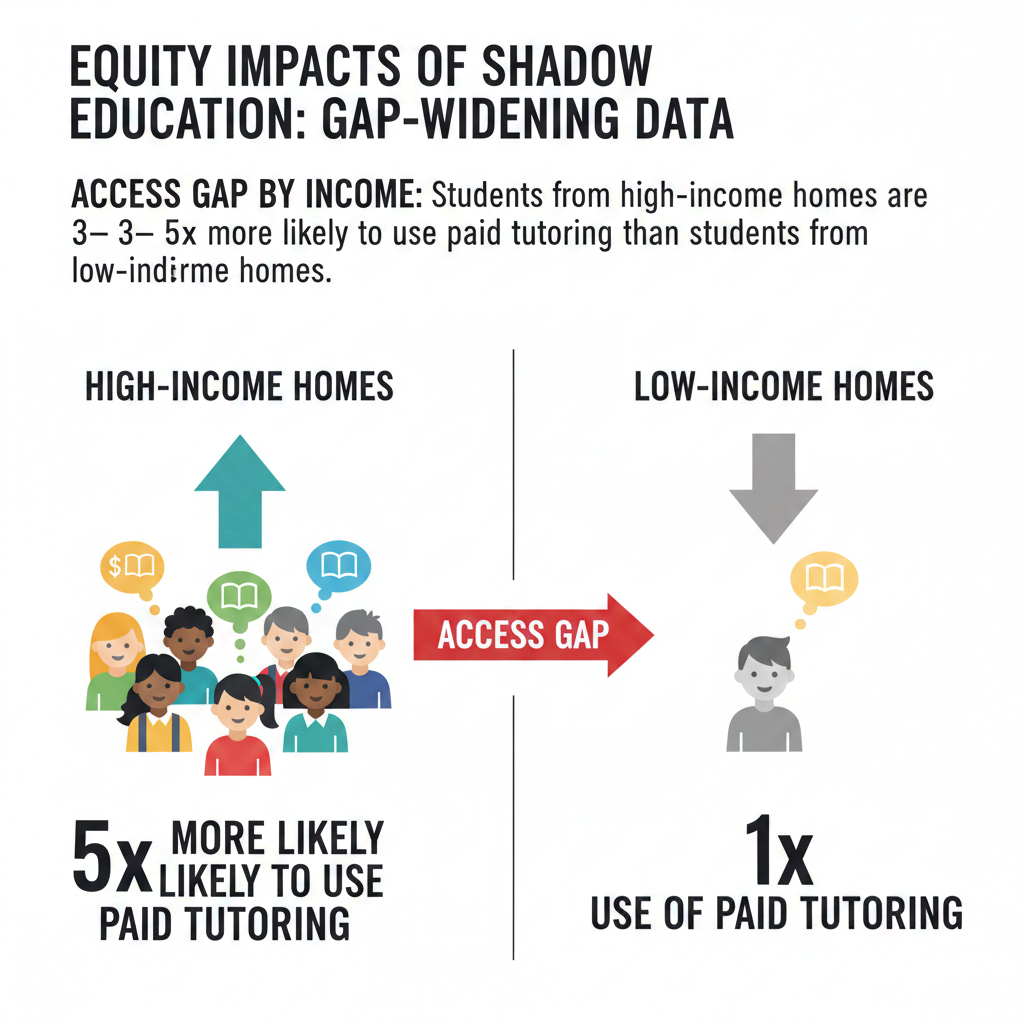
1) Access gap by income: Students from high-income homes are 3–5× more likely to use paid tutoring than students from low-income homes.
This number shows a simple truth. Money opens doors to extra lessons. When a child from a wealthy home gets three or five times more access to tutors, they get more time to practice, ask questions, and fix mistakes fast.
Over months and years, this extra time stacks up. It can mean the difference between a shaky grade and a strong one, or between a decent school and a selective program. The risk is clear. If extra help is tied to income, students who start behind may fall even further behind, even when they work hard.
The gap becomes a system, not just a moment.
There are steps we can take right away. First, plan a baseline study plan at home that does not cost money. Pick two short daily study blocks, even just twenty minutes each, with one small goal per block. Use free resources like public library books, open educational videos, and school-provided practice sheets.
Second, build a buddy system. Two or three students can meet online or in person to quiz each other, swap notes, and teach one skill they know well. Teaching a friend makes learning stick. Third, ask schools to share teacher office hours online after class, even once a week for thirty minutes.
Small tweaks at the school level can give all students a fair help slot.
Families with more means can choose to support equity as well. If you already use a tutor, ask for a mixed small group where one or two seats go to lower-income classmates at a reduced fee. Many tutors will agree if asked with respect and clarity.
Community groups can also host weekend study clubs in a quiet room with simple rules and a kind volunteer. At Debsie, we run live sessions and fun self-paced quests that often fit even tight budgets. Try a free trial class, then decide what mix of live help and independent practice works for your child and your wallet.
2) Spending gap: Wealthy families often spend 8–12% of their yearly income on tutoring, while low-income families spend 0–2%.
Spending shapes access. When a family can put eight to twelve percent of income into tutoring, they can buy more hours, better teachers, and focused test prep. When another family can only spend zero to two percent, they must choose carefully or skip tutoring altogether.
This creates two tracks. One track gets constant feedback and fast correction. The other track gets delayed help or none at all. The result is not only higher scores for some. It is also higher stress for those who cannot keep up, even if they have talent and grit.
There is a smart way to plan learning with limited funds. Start by mapping needs across a school term. List the top three weak areas, the key exam dates, and the exact skills to master. Instead of buying weekly sessions all year, target support three to six weeks before a high-stakes test, and use free practice for maintenance in other months.
Ask tutors for a short diagnostic and a written plan with clear goals per session. If the plan is vague, keep looking. You are paying for focus, not just time. Use sliding-scale options when offered and ask about group rates. Many providers have prices that drop when three to five students join the same session.
Schools and districts can stretch resources by funding short, high-impact cycles. A six-week, small-group clinic that follows the school curriculum can be enough to move students from shaky to solid. Provide lesson notes and recorded mini-lessons so students can review at home without extra cost.
At Debsie, we design compact learning sprints that focus on a small set of power skills. Parents can pair these sprints with our self-paced challenges to keep costs low and results high. If you want a plan tuned to your budget and your child’s pace, book a free trial class, share your goals, and we will shape a custom path that respects every dollar.
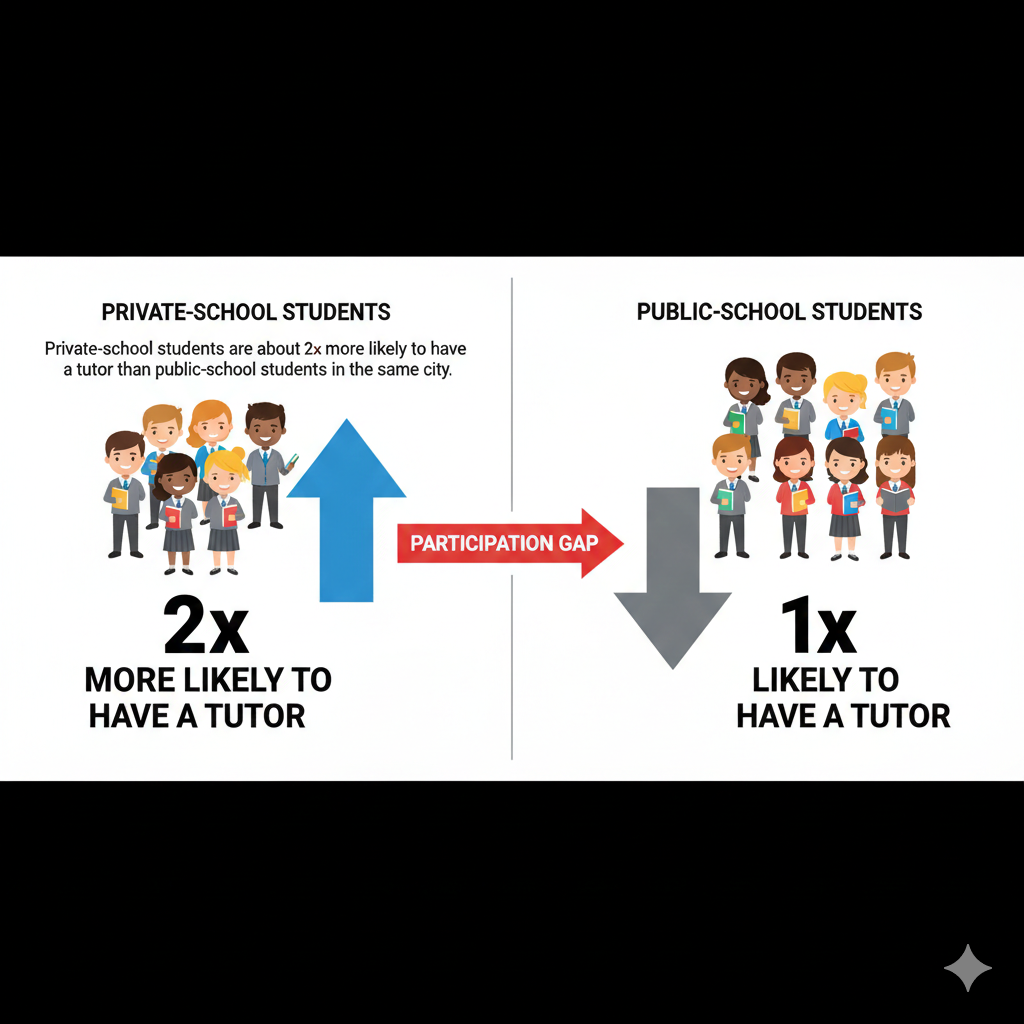
3) Participation gap by school type: Private-school students are about 2× more likely to have a tutor than public-school students in the same city.
Private schools often serve families who can also afford outside help. That is one reason their students are twice as likely to have tutors. Another reason is culture. When tutoring is common in a peer group, more families join in.
The pattern can spill into classrooms. Teachers may move a bit faster when many students have extra support, and that can leave public-school peers without tutors feeling lost. Over time, private-school students might enter selective programs in larger numbers, not just due to school quality, but because of the extra layer of support that sits on top.
This gap can be softened with partnership and planning. Public schools can offer open-access learning labs after school, staffed by trained aides or senior students under teacher oversight. Even two days a week for ninety minutes can change outcomes for those who cannot pay.
Set simple rules, define a quiet zone, and keep the ratio low so each student gets quick help. Use a shared skills tracker that lists core targets for each grade and marks progress with dates. Students should see their wins and know what comes next.
Families can help by creating micro-routines at home. Keep a plain folder for each subject with three sections: mistakes to fix, examples to copy, and skills to practice. Before a test, review only the items in the first two sections and set a short practice for the third.
This kind of routine can replace many paid hours if done well. If your child feels shy asking questions, practice scripts at home. Try, “I did steps one and two, but I got stuck on step three. Can you show me the missing step?” That clear ask saves time and builds confidence.
At Debsie, we welcome students from all school types into the same live rooms. Mixed groups build empathy and level the field. Our teachers slow down to explain ideas in plain words and show many ways to solve a problem, not just one.
If you want your child to experience this kind of support, join a free session and see how we blend structure with friendly coaching.
4) Urban–rural split: Urban students are 2–4× more likely to attend cram schools than rural students, even when scores are the same.
A city has more centers, more buses, and more choices. A village may have none. That is why urban students are many times more likely to sit in a cram class after school. The gap is not about talent. It is about distance, time, and supply.
When the only option is far away, the trip itself becomes a barrier. Evening travel can be unsafe. The cost adds up. Even if a rural child has the same current score as an urban child, the city child often gets extra practice and faster error correction, which compounds into higher scores later.
There are practical fixes that do not wait for a new building. Schools can set up community hubs inside existing classrooms two days a week, where a local teacher, a trained college student, or a trusted alumni leads a small group on key skills.
Keep it simple with a whiteboard, a timer, and a clear plan. Offer a hybrid model where students who cannot come can join by phone with low-data audio and a shared photo of the worksheet. Community leaders can arrange safe walking groups so younger children travel together to and from the hub.
Families can use a low-tech study rhythm. Print or copy core question sets for the month and store them in labeled envelopes. Each night, set a fifteen-minute window to finish a small set.
Use a phone camera to send a picture to a mentor or older cousin who can reply with short voice notes. This is not fancy, but it works. The key is speed of feedback. A fast voice note today beats a perfect lesson next week.
At Debsie, we design lessons to work on any connection. Our live rooms are light on data, and our self-paced quests can run on a basic device. We also train students to build their own practice kit so learning continues even when the internet is down.
If your family or school is outside a big city and you want a plan that fits your setup, try our free class and tell us your constraints. We will shape a path that works where you live.
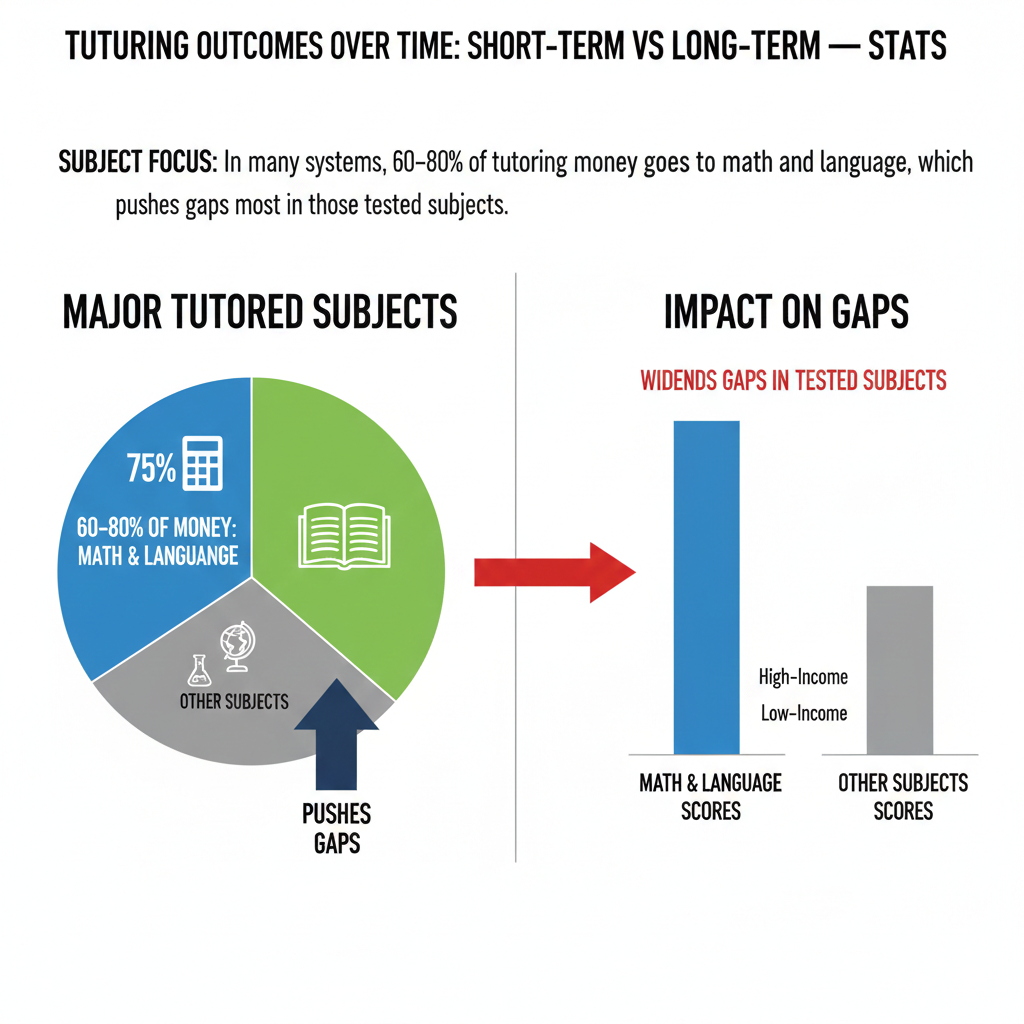
5) Subject focus: In many systems, 60–80% of tutoring money goes to math and language, which pushes gaps most in those tested subjects.
Why this widens the gap
When most extra money flows into math and language, the students who can pay build strong, steady gains where exams hit hardest. They get more chances to practice word problems, decode complex texts, and learn test patterns.
They also get faster feedback on mistakes, so small errors do not become big habits. Students without this support may study the same topics, but they miss the quick correction loop. Over one term, the difference looks small.
Over years, the effect compounds. Children with constant math and language help move into higher tracks, win more teacher attention, and feel confident in class. Children without it may avoid hard questions, guess more on tests, and feel that these subjects are “not for them,” even when they have real potential.
What to do now
Bring math and language practice into daily life in short, sharp ways. Use a ten-minute reading sprint after dinner where your child reads a short piece out loud, then explains the main idea in one sentence.
Follow with a two-minute vocabulary talk where you choose one fresh word, use it in three simple sentences, and write it on a sticky note for the week. For math, set a fifteen-minute problem lab three days a week. Pick one multi-step problem.
Have your child write each step and label the reason for the step in plain words. End with a one-minute reflection on where they got stuck and how they fixed it. Ask teachers for one skill checklist per month and track it on the fridge with dates.
If you can invest in help, choose short cycles tied to the school unit, not endless sessions. At Debsie, our live classes and self-paced missions target exact skills, like fraction sense or summary writing, and we show children how to check their own work with clean, simple steps.
Join a free trial to see how these tiny habits build big gains without heavy cost.
6) Early start gap: High-income children start tutoring 2–3 years earlier (often by grade 3–4) than low-income peers (often grade 6–8).
Why this widens the gap
Starting early means building strong foundations before topics get steep. Children who begin extra support in grade three or four learn core number sense, sentence structure, and study habits while the content is still gentle.
When middle school arrives, they are ready for fractions, ratios, complex sentences, and longer projects. Children who begin in grade six or eight often come to tutoring when they already feel behind.
The work is harder, and the time before key exams is shorter. The gap then feels like a cliff. It is not just about hours. It is about timing. Early help makes later help cheaper and lighter, because fewer skills need repair.
What to do now
If your child is still in primary school, build a light, joyful routine now. Use math games that fit in five minutes, like skip counting while walking to the bus, or quick mental math at the store. For language, keep a daily journal with two lines a day and one fix-it check for punctuation.
Add a weekly “teach-back” where your child explains a new idea to you using simple words. If your child is older, do not panic. Start with a short diagnostic. List the top five missing skills by name, like fraction comparison or main idea in nonfiction.
Plan a six-week sprint to rebuild these skills with daily micro-practice. Keep sessions short so the habit sticks. Ask teachers for early-warning signs before each unit, and preview those topics at home for ten minutes the week before.
At Debsie, we specialize in early habits and catch-up sprints. Our teachers show children how to learn, not just what to learn, so the gains last. Try a free class and tell us your child’s grade and sticking points. We will shape a kind, age-appropriate start that lowers stress and lifts results.
7) Weekly hours gap: Students in the top income group average 3–6 extra tutoring hours per week; bottom group averages 0–1.
Why this widens the gap
Extra hours buy more feedback loops. Each loop is a chance to spot a weak skill, fix it, and try again. With three to six more hours a week, students practice many more problems, read more pages, and write more drafts.
They also review more often, which is how memory gets strong. Students with zero to one hour get fewer loops, so errors stay hidden and confidence fades. Over a month, this looks like a mild difference.
Over a school year, it becomes a wide gap in both skill and self-belief. The student with many practice hours walks into tests calm and ready. The student with few hours walks in tense and unsure. The test then measures practice access as much as knowledge.

What to do now
Replace purchased hours with planned home practice. Use the 20–20–20 formula on three days each week. Spend twenty minutes on focused study of one skill, twenty minutes on mixed review from older units, and twenty minutes on active recall, where your child closes the book and explains what they remember out loud.
Keep a simple timer and write the day’s target on a sticky note before you start. End each session with a two-minute progress reflection and one promise for next time. Ask your child’s teacher for two or three “power questions” that best predict test success and practice those first.
If you can add paid help, pick one hour a week with a strict plan instead of many hours without focus. At Debsie, our live classes use the same loop you can use at home: teach, try, check, and explain. Our self-paced quests include active recall stops so your child learns to study the right way, not just longer.
Book a free trial and we will map your week around sports, family time, and rest so learning fits your life.
8) Test score lift: Regular tutoring can add 0.2–0.5 standard deviations to scores; those gains cluster among students who can pay.
Why this widens the gap
A lift of 0.2–0.5 standard deviations sounds abstract, but it is real power. In many tests, that jump can move a child from the middle to the top third, or from just below a cutoff to safely above it.
When these gains mostly go to children who can pay, the test stops being only about skill. It also becomes a signal of who had extra practice, tailored feedback, and calm test habits. Over time, this difference shows up in class rankings, access to honors tracks, and scholarship chances.
The danger is that we start to mistake paid practice for pure merit, which is unfair to hard-working students without that support.
What to do now
Treat the lift like a playbook you can copy at low cost. First, build a weekly cycle with a short prime session, a practice block, and a review block. In the prime session, learn one small idea from a trusted source and note the two most common errors.
In the practice block, do a narrow set of problems with those errors in mind. In the review block, explain each step out loud as if teaching a friend. This “learn, do, teach” loop drives the same kind of gains that paid tutoring does. Second, create a calm test routine.
Before each quiz, run a fifteen-minute warm-up that includes two easy questions to build confidence and one hard question to build grit. After the test, do a fast error scan within twenty-four hours. Sort mistakes into three buckets by cause: rushing, misread, or concept gap.
Fix each with a tiny rule. Third, use spaced recall. Make simple flash cards or short summaries and revisit them on day one, day three, and day seven. At Debsie, our live classes and self-paced paths already follow this loop.
We coach students to build the lift through smart habits, not just longer hours. Join a free trial to see how this looks for your child’s grade and subject.
9) Entrance exam advantage: In exam-heavy systems, tutored students are 1.5–3× more likely to enter selective schools.
Why this widens the gap
Entrance exams act like gates. If coaching makes a student up to three times more likely to pass the gate, then access to coaching strongly shapes who gets in. This does not mean coached students are not capable.
It means they have more exposure to past papers, timed drills, and common traps. They learn how questions are framed, how points are given, and how to avoid errors that cost time. Students without coaching may have the raw skill but lack the test craft.
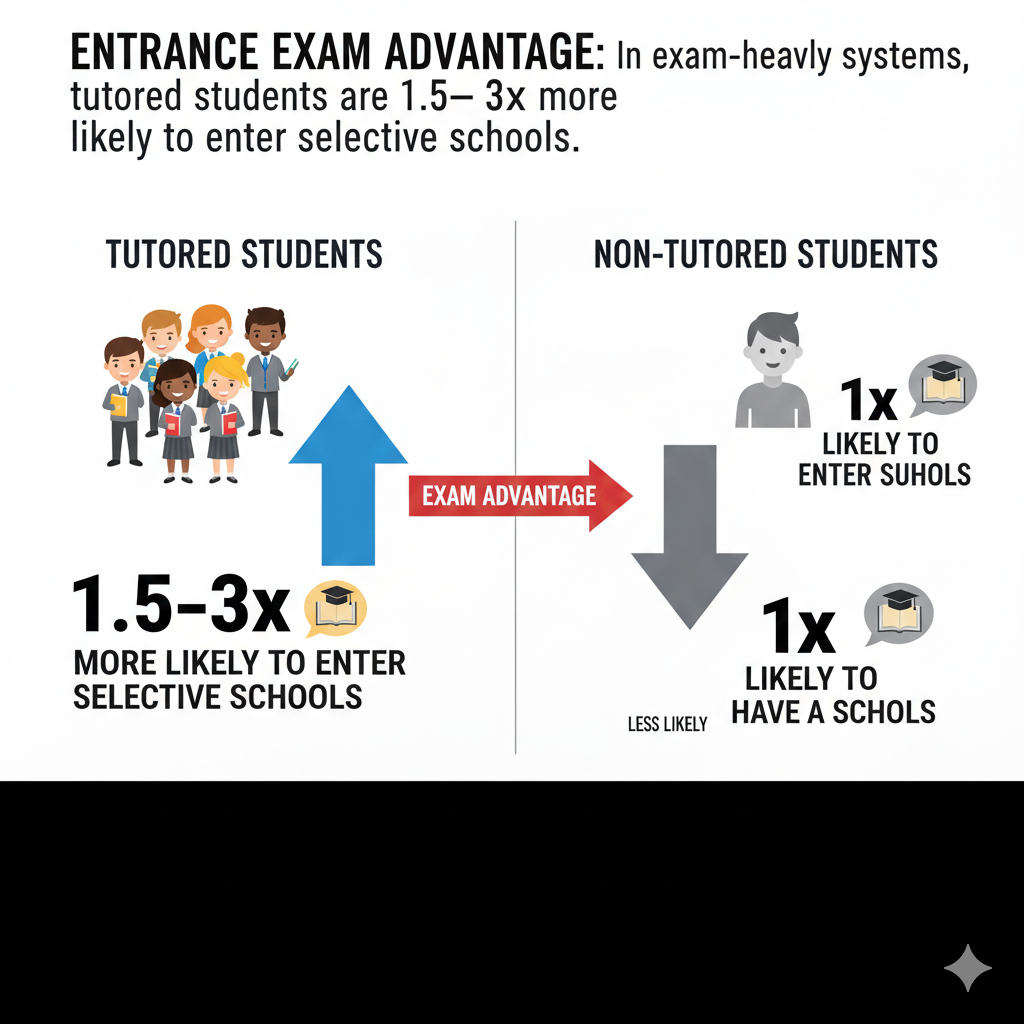
The result is a tilted playing field at the very moment that sets years of schooling and future options.
What to do now
Make test craft a public good in your home and school. Gather past papers and build a simple plan that cycles through them. Do one timed section twice a week. After each section, score it, then spend most of the time on error study, not more drills.
For each miss, write the cause in one line and the fix in one line. Create a one-page “exam map” for each subject. List common question types, the average time per item, key formulas or steps, and a quick guess-and-move rule for when stuck.
Practice that map until it feels natural. Run full mocks every two weeks, always at the same time of day as the real exam if you can, to train body clock and focus. If you can fund some help, use a short, focused coaching block close to the exam to polish weak areas rather than a full year of classes.
At Debsie, we share exam maps, run realistic mocks, and teach calm breathing and pacing so students keep a steady mind. Book a free trial, and we will tailor a short, sharp plan that respects your budget and timeline.
10) Teacher side-hustle effect: Where teachers tutor privately, students who can pay may receive 10–20% more exam-focused tips.
Why this widens the gap
When classroom teachers also tutor for pay, they may, even without meaning to, share sharper tips and tighter exam cues with paying students. These might be hints about likely topics, common marking rules, or shortcuts that shave seconds off a problem.
A ten to twenty percent edge in exam-focused insight is not small. It can be the gap between a B and an A in tight grading bands. Students who cannot pay may feel they are missing a secret playbook, and trust in the system drops.
This harms class culture and pushes families to seek tutoring even when they cannot afford it.
What to do now
Push for transparency and universal access to exam tips. Ask schools to publish core exam guidance for each unit so every student has the same baseline cues. Encourage teachers to run open review mini-sessions where key strategies are taught to all, not just to private clients.
As a family, train your child to build their own tips from first principles. After finishing a topic, have them write three parts: the core idea in twenty words, the steps to solve the most common question type, and two traps to avoid. Keep these pages in a binder and read them before quizzes.
Build a classroom swap system where students share their best “trap and fix” notes after each test. If you use a private tutor, insist that the session ends with a written summary of tips that your child can share with peers, so knowledge spreads.
At Debsie, we make our strategy sheets part of the class, not a paid extra. Every student in the room gets the same clear guidance and the same calm routines. Try a free class to see how open notes and shared strategy can lift the whole group without secret shortcuts.
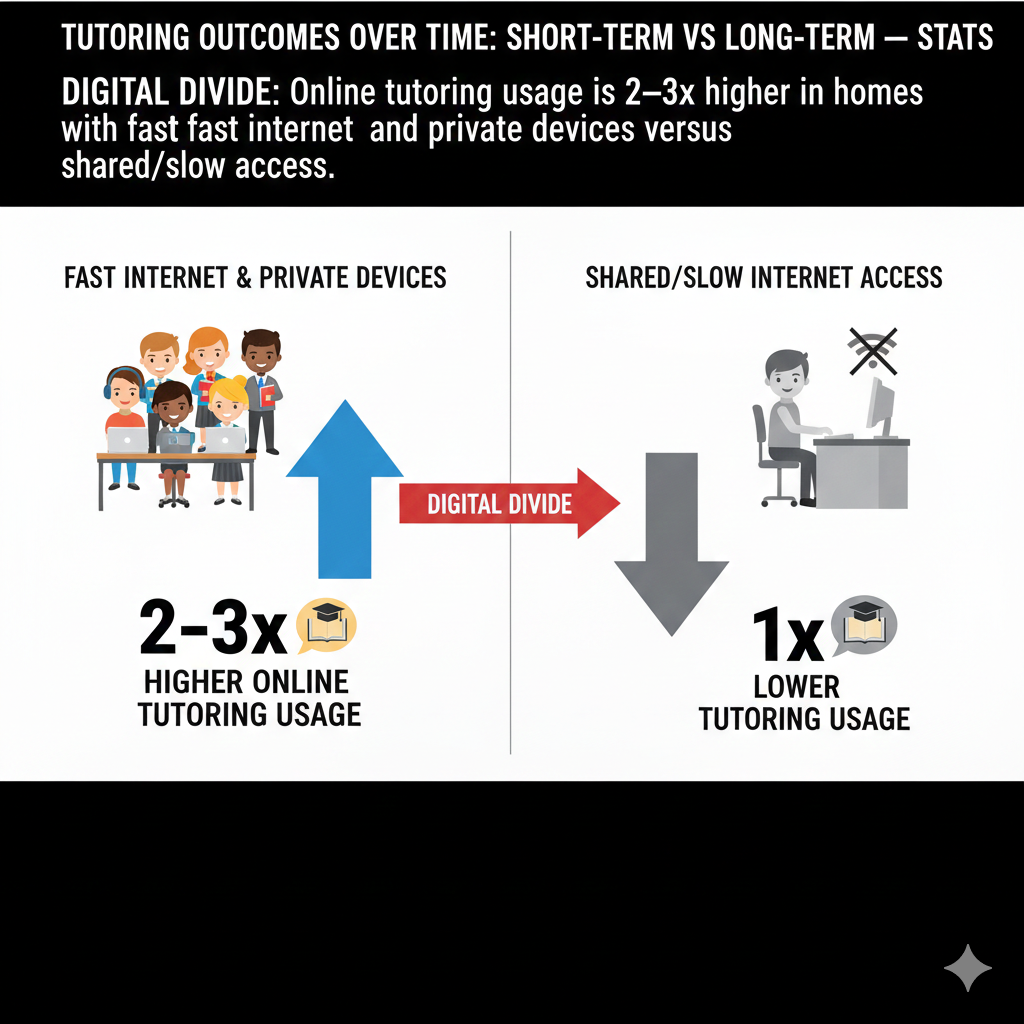
11) Digital divide: Online tutoring usage is 2–3× higher in homes with fast internet and private devices versus shared/slow access.
Why this widens the gap
When a child has fast internet and a device of their own, they can join live classes without lag, watch clear videos, and upload homework on time. They can also practice more often because the device is always there.
A child who shares a phone with siblings or who has slow data faces the opposite. Video freezes. Audio drops. Files fail to send. Sessions are missed because someone else needs the only phone.
Over weeks, the student with strong access finishes more lessons, receives quicker feedback, and keeps a steady study rhythm. The other student fights the tools, loses time, and feels behind even before the learning starts. This is not about willpower. It is about the pipes and the hardware.
What to do now
First, make a simple access plan. List which hours the device is free and block two short daily windows just for learning. Keep the windows the same each day so the habit sticks. Download lessons when the connection is strong and use low-data modes for live sessions.
Ask teachers for audio-only options and small file versions of worksheets. If your school or community library lends devices, sign up early and set calendar reminders so you never miss renewals. If you can invest, buy a basic refurbished laptop rather than a brand-new phone.
A cheap laptop with a real keyboard often beats a fancy phone for study. On the platform side, choose tools that are light on data and work on older hardware. At Debsie, our live rooms run well on low bandwidth, and our self-paced quests can be downloaded for offline practice.
We also teach students how to study with paper backups when the internet fails, so no day is wasted. If your family needs a low-data plan, try our free trial and tell us your limits. We will set up a learning path that respects your tech reality.
12) Gender tilt: In some regions, boys get more math tutoring and girls get more language tutoring; the larger spend (math) widens STEM gaps.
Why this widens the gap
When families push boys toward math tutors and girls toward language tutors, they may not notice that the market often prices math prep higher and funnels more hours into it. Over time, boys collect extra practice in numbers, patterns, and problem solving under time pressure.
Girls collect extra practice in reading and writing, which is valuable, but the imbalance shows up in STEM tracks that require steady math fluency. The message a child hears also matters. If a girl hears, even softly, that she is “naturally better” at words, she might pull back from math challenges.
If a boy hears he is “a math kid,” he may lean into every hard problem and build grit. These expectations, plus the spend gap, make the STEM door feel open to one group and heavy for the other.
What to do now
Audit your own choices. Look at the last three months of study time and money. If math time or spend leans to boys and language to girls, rebalance on purpose.
Give every child a weekly math lab and a weekly writing lab, each under thirty minutes, with one clear goal. In the math lab, work on multi-step problems and always add a one-minute explanation in words at the end to blend reasoning and communication.
In the writing lab, include a small data paragraph where your child explains a chart or table to blend language with analytical thinking. Ask your child to set one bold goal in the subject they feel less confident about, such as mastering fractions by a set date or writing a tight summary in six lines.
If you hire help, rotate focus each term so both math and language get formal support over the year. At Debsie, we watch for bias in placement and praise. We place girls front and center in problem-solving, and we coach boys to write with clarity and structure.
Try a free trial and tell us your child’s comfort zones. We will craft sessions that stretch them gently on the other side.
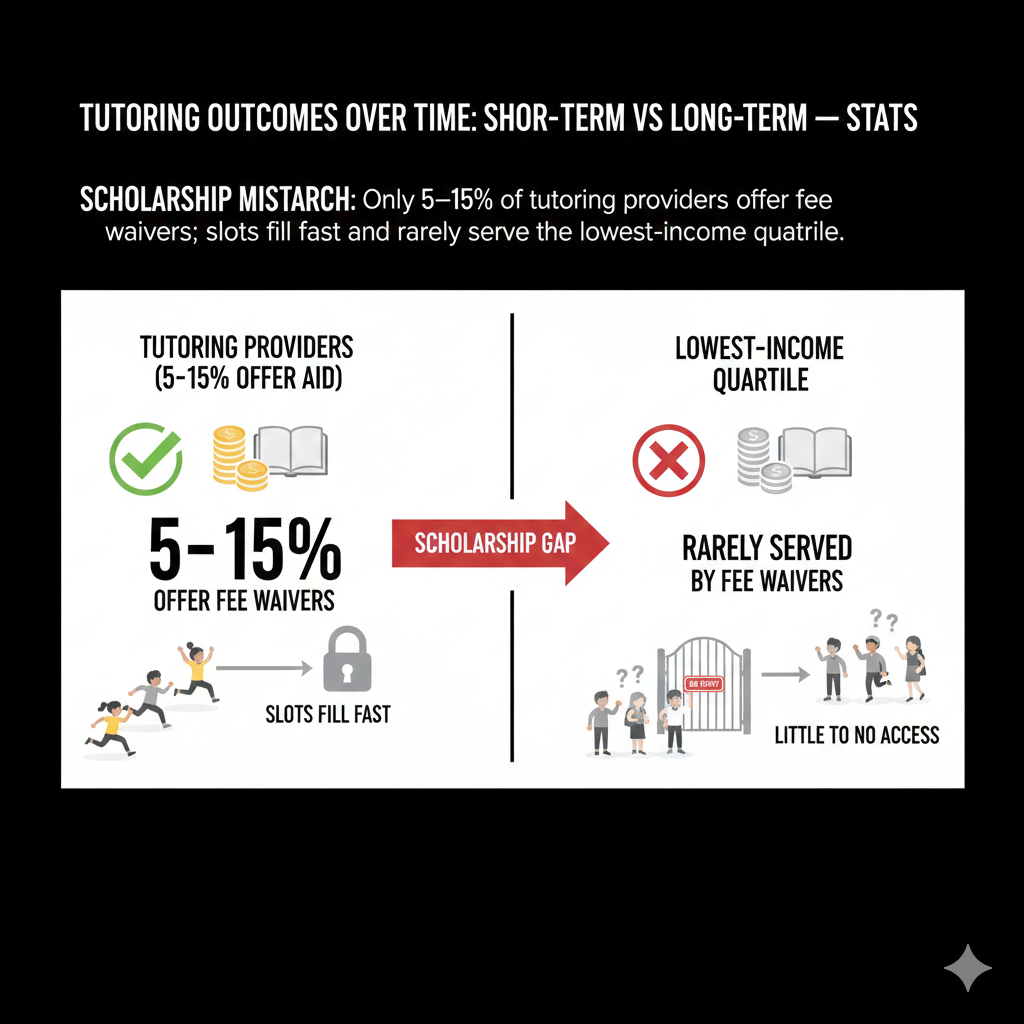
13) Scholarship mismatch: Only 5–15% of tutoring providers offer fee waivers; slots fill fast and rarely serve the lowest-income quartile.
Why this widens the gap
Scholarships sound like the fix, but the supply is thin and the process can be complex. Many providers announce a few fee waivers with tight deadlines and long forms. Families with time, stable internet, and insider tips move first and grab the seats.
Families under stress, with shifting work hours or weak access, miss the window. Even when they apply, income checks and document requests can be hard to meet. The result is a polite promise that still leaves the lowest-income students out.
The market can then point to “scholarships offered,” while the lived experience for the most vulnerable is “no seat for me.”
What to do now
Treat scholarships as one tool, not the plan. Start by building no-cost routines that do not depend on waivers. Set up a weekly study circle with two or three trusted friends and rotate homes. Use a shared folder with simple trackers for goals and wins.
Ask your school for a standing slot in the library after hours with one adult present for safety and light guidance. When you do seek waivers, prepare a document pack in advance, including ID scans, proof of income, and school letters, so you can apply in minutes when a slot appears.
Mark the first day of each term to check for aid on provider sites and community boards. If you can pay a small amount, look for sliding-scale small groups rather than hoping for a full waiver. On our side, Debsie offers time-bound community seats and transparent criteria.
We also share free micro-lessons and printable practice so every child can learn, paid seat or not. Join a free trial, tell us your constraints, and we will connect you with the most affordable path we have right now.
14) Grade repetition: Students without access to extra help are 1.3–2× more likely to repeat a grade in lower secondary.
Why this widens the gap
Repeating a grade is not only about knowledge. It affects confidence, friend groups, and family stress. When students lack timely help, small gaps in core skills grow into big blocks. Algebra becomes a wall if fractions are shaky.
Science labs feel scary if reading non-fiction is weak. By the time report cards arrive, the fix requires more time than the school year has left. Repeating becomes the default. This step increases the chance of dropping out later, because the student feels older than classmates and often carries a label of failure.
The cycle hits low-income students more because they have fewer safety nets and fewer chances to repair gaps early.
What to do now
Move from rescue to routine. Put in place a short weekly checkup where your child reviews the last five days of learning and names one skill that still feels soft. Turn that skill into a tiny plan for the next week with a daily five-minute drill.
Keep a visible progress chart and celebrate each tick. Ask teachers for the two skills most likely to cause failure in the next unit, and pre-teach them at home with three simple examples before the class meets them. When grades first dip, run a focused six-week catch-up sprint rather than waiting for the term to end.
If repetition is on the table, ask for a tailored support plan that runs during the summer or the first six weeks of the next term, with clear milestones and coaching. At Debsie, we design rescue sprints that target the exact blockers that lead to repeats.
We also coach students in planning, note-making, and test calm so they can hold gains. Book a free trial and we will map a prevention plan that fits your schedule and budget before a small slip becomes a repeat year.
15) Homework load: Tutored students report 20–40% more total study time per week, compounding learning differences over a year.
Why this widens the gap
More total study time means more chances to practice, catch small errors, and turn new ideas into strong habits. When tutored students add twenty to forty percent more study time each week, they complete more assignments, review notes more often, and do extra problem sets that target weak spots.
Over a short span this looks like a small edge. Over a full year, the extra hours stack up into a deep well of practice. Memory gets stronger. Speed improves. Confidence grows. Students without this extra time often spend their limited hours simply finishing homework, not improving skills.

They have less time for reflection, error fixing, or mixed review. The gap grows quietly, week by week, even when both groups work hard.
What to do now
Design a simple routine that adds smart minutes without burning out your child. Start with two short boosters on weekdays. Use one ten-minute recall block right after school to rewrite key ideas from memory, then check the book.
Use one fifteen-minute skill block after dinner to tackle two tricky problems or a short reading with a one-sentence summary.
Add a weekend power hour broken into three parts: twenty minutes of targeted practice on the week’s weakest skill, twenty minutes of mixed review from older topics, and twenty minutes of teach-back where your child explains a concept to you in plain words.
Keep a visible tracker on the fridge with dates and tiny checkmarks. If you have a tutor, make sure homework from tutoring is narrow and purposeful, not just “more of the same.” At Debsie, we pair live sessions with short, tight missions that fit into home life, so extra time is used for real gains, not busywork.
Try a free class and we will map a plan that adds the right minutes in the right places.
16) Summer slide: During breaks, tutored students keep 1–2 months of learning; non-tutored peers can lose 1 month, widening gaps by term start.
Why this widens the gap
Long breaks change the learning curve. Students who keep a light study rhythm over summer hold on to hard-won skills. They return to school ready to build on what they know. Students who do not review may forget steps, rules, and key facts.
When school starts again, they spend weeks re-learning old content while their classmates move forward. This is how a one-month loss can become a full-term drag. The effect is stronger in math and reading because these subjects rely on steady, layered practice.
What to do now
Build a small summer routine that feels light, not heavy. Choose four days a week, twenty to thirty minutes a day. On two days, do math. Use a spiral set that revisits key ideas like fractions, ratios, and word problems. On the other two days, do reading and writing.
Read short, high-interest pieces and write a six-line summary that names the main idea, two key facts, and one personal reflection. Add one project for joy, like a tiny science log or a coding mini-game, where your child applies skills in a fun way.
Plan a mid-summer check-in with a teacher or mentor to run a quick diagnostic and adjust the plan. If you can add paid help, keep it short and focused on weak areas, not a full schedule that kills play.
At Debsie, we run breezy summer sprints and playful challenges that keep skills warm without stress. Book a free trial, tell us your dates and goals, and we will craft a summer plan that fits vacations and family time.
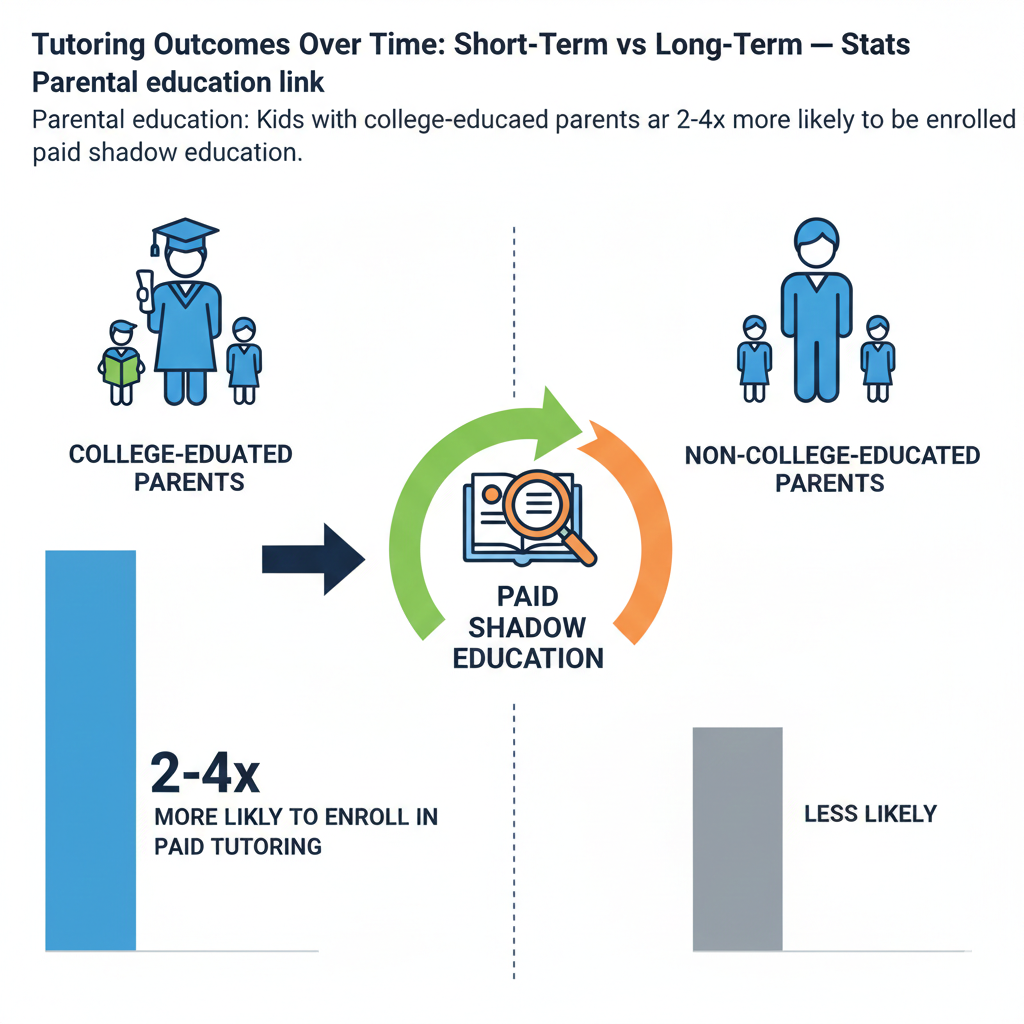
17) Parental education link: Kids with college-educated parents are 2–4× more likely to be enrolled in paid shadow education.
Why this widens the gap
Parents who went to college often know how schools and exams work. They can spot weak skills early, choose tutors wisely, and build study plans that match the calendar. They also tend to value and budget for extra learning.
This knowledge and planning lead to higher use of paid support. Families without this background love their children just as much but may not know when to start, what to ask, or how to judge quality. They might wait until a crisis hits, then rush to find help.
The timing and quality gap, not just the money gap, widens outcomes over time.
What to do now
Borrow playbooks that college-educated parents use and make them simple. At the start of each term, write down the exam dates and major projects. For each, list the top three skills that will be graded. Set two checkpoints before each exam: a light check four weeks out and a full mock one week out.
After every quiz, do a quick post-game. Ask three questions: what went well, what broke, what rule will fix it next time. When looking for help, ask providers for a written plan with goals, methods, and measures. Good help will be clear and concrete.
Use school resources first: office hours, peer tutors, and teacher study guides. If you need a partner to build this structure, Debsie offers free trial classes where we map your term, show you our skill trackers, and set up a routine that any family can run.
The goal is not just grades. It is teaching your child how to plan, study, and adjust like a pro.
18) Language of instruction: Migrant or minority-language students are 30–50% less likely to get language support tutoring, slowing integration.
Why this widens the gap
When the school language is not the home language, learning every subject gets harder. A science lesson becomes a language lesson plus a science lesson at the same time. If language support is missing, students struggle to follow fast speech, decode dense texts, and write clearly.
They can be bright and motivated yet still fall behind because they cannot access the content. When these students also lack tutoring in the school language, the climb is steeper. Integration slows. Confidence drops.
Teachers may mistake language gaps for skill gaps. The child then gets tracked lower than they deserve, which affects later opportunities.
What to do now
Make language support daily and practical. Build a micro-routine at home with three parts. First, vocabulary: choose five words from current classes, write simple definitions, and use each in a short sentence. Second, listening: play a two-minute school-related audio clip and have your child note three key points.
Third, speaking and writing: ask your child to explain a concept from class in six lines, then read it out loud. Focus on clarity, not fancy words. Ask teachers for subject glossaries and sentence frames that fit tasks, like “The main cause was…” or “The data shows…”. Pair your child with a language buddy in class who checks understanding of directions before tasks begin.
If you hire help, choose a tutor who blends language with content, not one who treats them as separate worlds. At Debsie, we weave language moves into math, science, and coding lessons so students gain both content and words at once.
Join a free trial and tell us your child’s languages and current units. We will build a plan that grows language power without slowing subject learning.
19) Special needs access: Students with learning differences receive targeted paid support at 2–3× the average hourly cost, limiting uptake.
Why this widens the gap
Targeted support like dyslexia therapy, ADHD coaching, or specialized math intervention often costs two to three times more per hour than standard tutoring. Families who can pay secure frequent, high-quality sessions and tight progress checks.
Families who cannot pay must stretch time between sessions or pause entirely. This delay weakens the feedback loop that makes interventions work. Without steady, tailored practice, small wins fade.
The child begins to believe they are “bad at school,” when the real issue is access to the right type of help at the right pace. Teachers may also struggle to individualize inside a crowded classroom, so the gap grows both outside and inside school.

Over time, the mix of higher prices, fewer sessions, and slower feedback turns a solvable learning difference into a widening achievement gap and a heavy load on family confidence.
What to do now
Start with a clear profile, not labels alone. Ask for a simple strengths-and-needs summary that lists three bright spots, three priority skills, and three supports that help right away. Build daily micro-practice around these supports.
For reading, that might be five minutes of phonics drills plus five minutes of guided reading with a finger track. For math, it could be a concrete–pictorial–abstract routine using coins or blocks before moving to symbols. Use visual timers, checklists, and short movement breaks to keep focus.
If paid sessions are rare, stretch each one by asking for a written home plan with exact steps, sample scripts, and a two-week track sheet. Share this plan with school so everyone uses the same cues. Ask about community clinics, university training programs, or tele-sessions that lower cost.
t Debsie, our teachers use multi-sensory methods and simple scaffolds that fit home life. We provide printable trackers and short video models so parents can coach between sessions. Join a free trial and tell us your child’s profile; we will design a steady, kind routine that builds skills without breaking your budget.
20) Price sensitivity: A 10% rise in tutoring fees can cut low-income participation by 8–12%, with little change for high-income families.
Why this widens the gap
When fees go up even a little, families at the margin step back. They reduce hours, delay starts, or stop altogether. Meanwhile, high-income families usually keep the same schedule. The result is an immediate drop in access for students who need help most and a steady flow of support for those already ahead.
This price response shows why markets alone do not protect equity. A small fee bump feels tiny to one family and huge to another. If this pattern repeats across years, the resource gap becomes a baked-in feature of the education landscape, not a temporary swing.
What to do now
Treat price changes as a signal to optimize, not to quit learning. First, prioritize. Identify the two skills that matter most for the next exam cycle and focus all paid time there. Move everything else into no-cost routines using school materials, libraries, and free practice sets.
Second, switch to small groups with a tight plan. A great small group of three can deliver most of the benefits at a fraction of the cost, if the goals are clear and the students are well matched. Third, front-load. Use a short, high-intensity block of sessions to build a strong base, then maintain with home practice and monthly tune-ups.
Fourth, ask providers for off-peak pricing or short-term scholarships when fees change; ask early and provide a simple budget note so they understand your limits. At Debsie, we publish clear packages, offer compact sprints, and share free micro-lessons so families can keep momentum even when money is tight.
Try a free trial and we will help you design a lean plan that targets high-yield moves first, so every minute and rupee works harder.
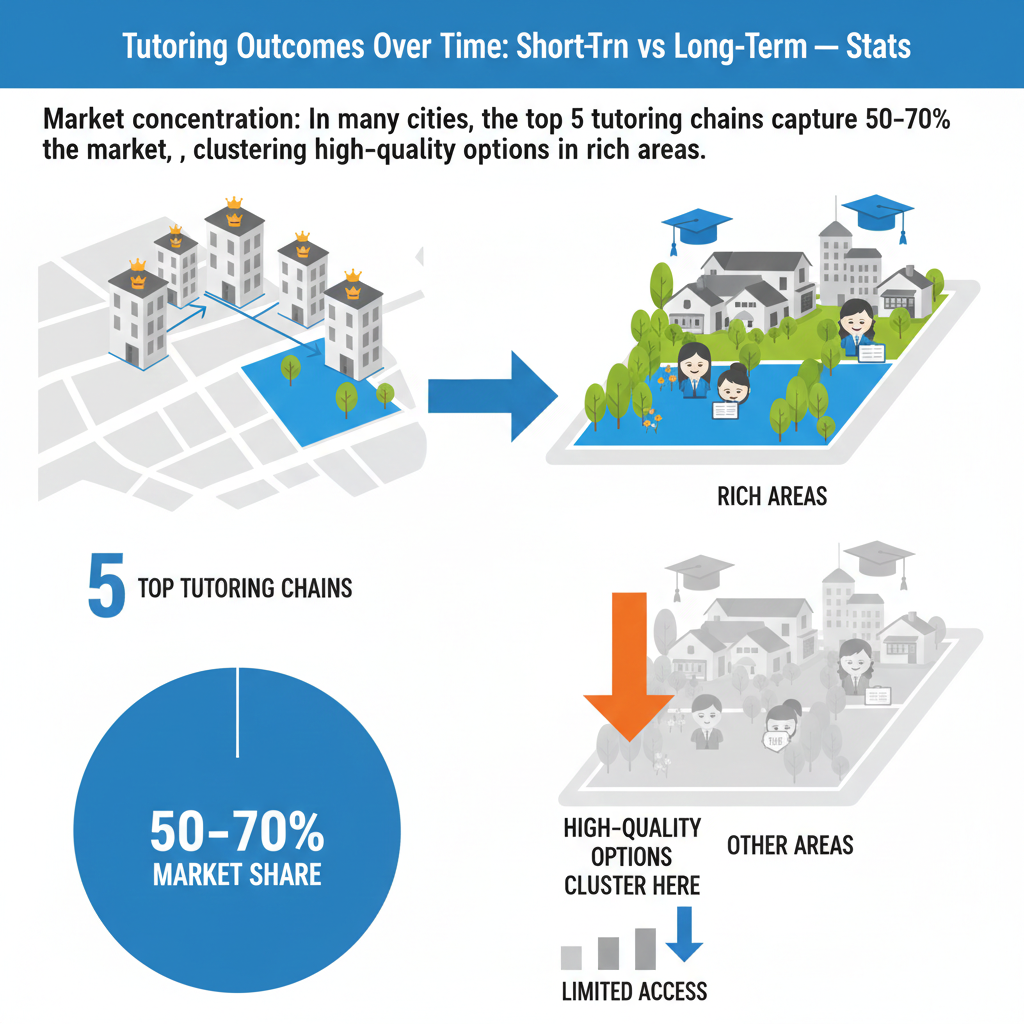
21) Market concentration: In many cities, the top 5 tutoring chains capture 50–70% of the market, clustering high-quality options in rich areas.
Why this widens the gap
When a few big chains dominate, they place centers where profits are highest, which often means wealthy neighborhoods. These locations have better transport links, safer streets at night, and parents who can commit to long packages.
Students in lower-income areas face long commutes or must settle for thinner offerings nearby. Big chains can also set the tone on pricing and scheduling, which may not suit families with shift work or tight budgets.
As premium options cluster, teacher talent follows the money, and the local ecosystem in poorer areas gets weaker. The result is a map of opportunity that mirrors income, not need. Even when online options exist, the best small-group mixes, mock exam labs, and drop-in clinics tend to sit close to wealth.
What to do now
Redraw the map for your child. Combine place-based supports you already have with flexible online pieces. Build a neighborhood study hub once or twice a week in a school room or community center. Invite a trusted teacher, advanced student, or alumni to run tight ninety-minute clinics aligned to the current unit.
Use low-cost transit to reach a quality center only for targeted cycles, such as the weeks before major exams, and do the rest at the local hub or at home. When choosing an online provider, ask about small-group curation by level, not just age, so your child sits with peers who push them just enough.
At Debsie, we bring the “downtown” experience to any postcode by running live classes that mirror top-tier methods, and by giving parents simple tools to host micro-hubs with friends.
Book a free trial, share your location and schedule, and we will craft a blended plan that puts high-quality teaching within reach without long, costly travel.
22) Safety/time cost: Rural students may travel 30–90 minutes each way for centers; this hidden cost reduces attendance and persistence.
Why this widens the gap
Time is a quiet tax. When a child must travel thirty to ninety minutes each way, they lose homework time, family time, and rest. Travel also brings risk in bad weather or on unsafe roads after dark. Missed buses and long waits eat energy before class even starts.
Families then skip sessions when crops need care, when a parent works late, or when fuel prices rise. Attendance drops. Gaps grow. Urban students, by contrast, can often walk or take a short ride to a center, arrive fresh, and get home early enough to sleep well.
Over a term, the rural child has fewer total hours of quality learning and more stress layered on top. This is not about how much a student cares. It is about the cost of getting to the help.
What to do now
Shorten the distance and lighten the load. Create a village study room two evenings a week in a school building or community hall. Keep rules simple and predictable. Start with a quick goal round, work in twenty-minute focus blocks, and end with a five-minute share of one win and one stuck point.
Find a trusted adult or senior student to lead and rotate duties. For outside support, choose live online sessions that run on low bandwidth and schedule them right after school so students do not travel in the dark. Pair online lessons with printed packets so progress does not depend on the internet.
Use phone-based check-ins with mentors who send two-minute voice notes as feedback. Build safe-walk groups with set meet points so children move together. If paid centers are needed, cluster trips near market days and book double sessions to reduce total journeys.
At Debsie, our live rooms run on light data and our self-paced quests work offline. We can also train a local volunteer to host a micro-hub with our guides and trackers. Join a free trial and tell us your travel limits. We will shape a plan that saves miles and keeps momentum.
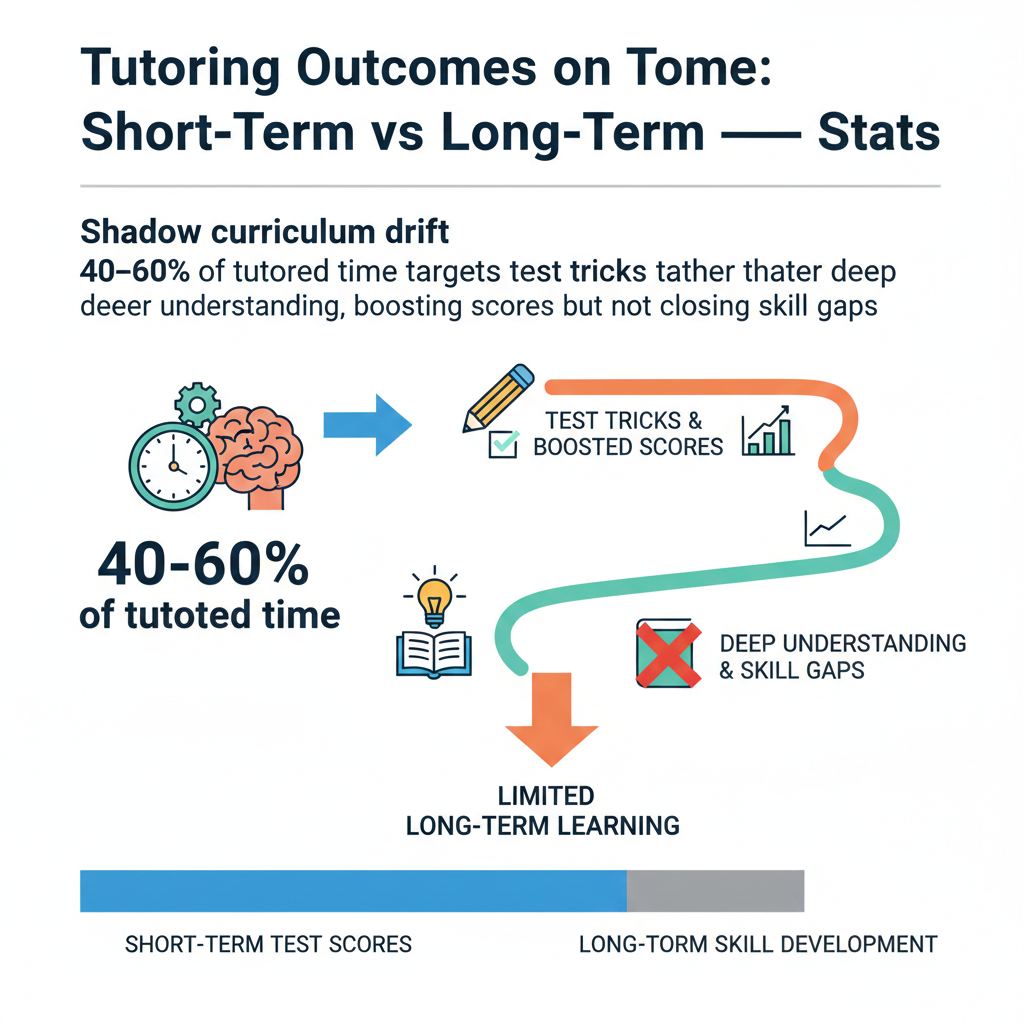
23) Shadow curriculum drift: 40–60% of tutored time targets test tricks rather than deep understanding, boosting scores but not closing skill gaps.
Why this widens the gap
Test tricks can lift scores fast, but they do not always build lasting skill. If almost half of tutoring time goes to shortcuts, students learn to recognize patterns without grasping why methods work. They may score well this term but stumble when questions change shape.
Students without tutors do not even get the shortcut layer, so their scores lag and their motivation dips. Both groups lose in different ways. One group gains a thin edge that fades. The other gets no edge at all.
The deeper risk is that schools feel pressure to match the shortcut race, and class time shifts from rich learning to narrow prep. The long-term result is a wider gap in reasoning, problem solving, and transfer to new tasks—the very abilities that matter in life.
What to do now
Re-center on meaning first, strategy second. After every new concept, ask your child to show it three ways: with concrete objects, with a diagram, and with symbols or sentences. If they can move across these forms, they understand the idea, not just the trick.
Build a weekly “why lab” where your child takes one favorite shortcut and explains why it works using a simple proof or a counterexample. During practice, label each step with a purpose so methods do not turn into mindless steps. Use mixed practice that blends old and new skills so learning transfers.
Right before exams, add a thin layer of test craft—timing, guessing rules, and common traps—but only after meaning is solid. If you hire a tutor, ask for a 70–30 split: seventy percent deep understanding, thirty percent exam craft.
At Debsie, our classes start with sense-making, then we add smart strategies near test day. We also give students a one-page concept map for every unit so the “why” stays in view. Try our free trial to see how we teach both the brain and the grade, in that order.
24) Mental health gap: Tutored students show 10–20% higher stress reports near exams; non-tutored students report stress from falling behind—both harms are unequally distributed.
Why this widens the gap
Stress hits from both sides. Students with heavy tutoring loads feel pressure to meet high targets and to justify the time and money invested. Near exams, their schedules fill with drills and mocks, and sleep can shrink.
Reports show a ten to twenty percent rise in stress signs like headaches, test fear, and irritability. Meanwhile, students without support feel a different stress. They watch classmates discuss extra classes and new methods they have not seen.
They worry about falling behind and may avoid asking questions. Both paths harm learning. One child churns. The other withdraws. The unequal access to calm, steady support becomes an unequal burden on mental health, which then affects focus, memory, and performance.
Over time, the stress cycle can push students to quit hard subjects or lower their goals, even when they have ability.
What to do now
Make calm a core part of the plan. Set a weekly rhythm with built-in rest days and a hard stop each night at a realistic hour. Use short, daily breathing routines before study and before sleep, such as four slow breaths in and six out for two minutes.
Track sleep and protect it; a rested brain learns faster than a tired one with extra hours. Replace last-minute cramming with spaced review, so pressure does not spike near exams. After each mock, do a brief feelings check and a reset plan that names one small fix and one self-care step.
If tutoring is heavy, cap total weekly hours and insist on one “white space” evening with no academic tasks. If tutoring is light or absent, add short, high-success practice blocks that show quick wins, like five perfect problems or a one-page reading with a clear summary.
At Debsie, we teach study calm alongside content. Every class includes short focus resets, simple planning, and positive self-talk that is specific, not fluffy. Join a free trial and let us help your child build both skill and steady nerves.
25) Peer effect: In classes where over half the students have tutors, teachers speed up by 10–15%, leaving non-tutored peers further behind.
Why this widens the gap
Classrooms are living systems. When many students come in pre-taught by tutors, lessons feel easier for them. They answer quickly, finish tasks fast, and nudge the pace forward without trying. Teachers, reading the room, often move faster to match the majority.
A ten to fifteen percent speed-up does not sound huge, but across weeks it means fewer pauses for questions, less time to model tricky steps, and shorter reviews of key ideas. Students without tutors then face a double hit.
They miss practice after school and lose time during school. Some stop raising hands because the train seems to be moving too fast. Others guess their way through, which builds fragile habits that break on tests.
Confidence takes a slow, steady dip. This is not about one teacher or one class. It is a natural drift that happens when the out-of-school help of some shapes the in-school pace for all.
What to do now
Restore balance with small, smart routines. Ask the teacher to post a short preview note before each unit, naming the three must-know skills and one common trap. This gives every student a fair shot at arriving prepared. At home, run a weekly preview-and-recall cycle.
Two days before a new topic, spend fifteen minutes reading a simple explainer and trying one sample question. Two days after the lesson, spend fifteen minutes recalling the steps from memory and checking against the class notes.
Encourage your child to use a clear question script in class, such as saying which step worked, which step broke, and what they tried in between. This kind of precise ask speeds help for everyone. If your child already has tutoring, request a five-minute debrief after each class to align with what was taught, not just the next test.
At Debsie, we build our live sessions to sync with school pacing and we coach students to ask cleaner questions, so they get unstuck fast. Join a free trial and we will show you the preview-and-recall method and give your child sentence frames that make class time work better.
26) Return on investment: Each extra tutoring hour can yield small gains (1–3 percentile points), but only for students who can buy many hours.
Why this widens the gap
One extra hour can lift scores by a tiny slice. That slice matters only when stacked with many more slices. Families who can afford steady hours every week stack slices all term. Scores climb. Teacher perceptions shift. Course placements improve.
Families with tight budgets might buy a few hours and then stop. The small gains appear but fade because they are not reinforced. Without a plan, those hours turn into random help instead of a ladder.
The result is a widening curve where total hours, not just talent or effort, predict outcomes. Students who cannot buy many hours may decide tutoring “does not work,” when the real issue is scale and sequence, not ability.
What to do now
Make every hour carry more weight. Before any paid session, send the tutor a sharp brief with the exact skills, recent errors, and an example of your child’s work. Ask for a three-part structure: a quick check of the target skill, guided practice with immediate feedback, and a short teach-back where your child explains the method in simple words.
End with a tiny home plan of five to ten minutes a day that locks in the skill until the next session. If you can only buy a few hours, place them at key moments, such as the start of a tough unit and two weeks before a major exam.
Fill the gaps with high-yield home study that uses active recall and mixed review rather than passive rereading. Track gains in a simple chart so your child sees progress and stays motivated. At Debsie, we design compact sprints that deliver outsized gains by focusing on the right steps in the right order.
Our teachers hand over crisp home plans after each class so the learning multiplies between sessions. Try a free trial and we will map where a small number of hours will have the biggest effect for your child.
27) Dropout risk: In low-income groups, lack of tutoring during key transition years (grades 9–10) is linked to 1.5–2× higher dropout odds.
Why this widens the gap
Grades nine and ten are a crossroads. Subjects grow harder. Exams carry more weight. Study loads rise just as teens juggle new social pressures and, in many families, extra work duties. Students with steady support learn how to plan, break tasks into parts, and recover from dips.
Students without support may feel each stumble as a verdict. A bad term shifts from a problem to a story they tell themselves: “I am not cut out for this.” When bills are tight and confidence is low, leaving school can look like the only sane choice.
Data showing one and a half to two times higher dropout odds is not about care or character. It is about timely coaching and a path that feels doable.
What to do now
Build a safety net that starts months before the cliff. Create a term map with all major dates and convert each into tiny weekly steps. Use a two-hour weekend block split into four short parts: planning for the week, focused study on the hardest skill, mixed review of old topics, and a calm reset with a short walk or stretch.
Meet teachers early each term for a ten-minute check on the two highest-risk skills and set up a quick signal if your child slips, such as a one-line email or a colored mark on the online gradebook. If paid help is possible, place it at the start of each tough unit so confidence rises before the first quiz, not after a failure.
If paid help is not possible, use peer tutoring inside school and a study buddy at home. Celebrate small wins with receipts your child can see, like a chart of completed practice or a stack of written summaries.
At Debsie, we run transition-year clinics that pair content with planning, time management, and test calm. We coach teens to use simple tools that make hard work feel manageable. Book a free trial and we will help you design a steady routine that keeps your child in the game and moving forward.
28) Admissions counseling: Families paying for private counseling are 2–6× more likely to stack extracurriculars that impress selectors.
Why this widens the gap
Selective schools do not only read test scores. They also scan essays, activity lists, and recommendation letters for signs of initiative, impact, and fit. Private counselors know the unwritten rules.
They help students pick eye-catching projects, schedule leadership roles at the right time, and frame ordinary work in a way that stands out. When families can pay for this guidance, their children are two to six times more likely to build a compelling profile on paper.
Families without counseling often do real, meaningful things but miss the framing, timing, or documentation. Strong stories get lost, applications feel generic, and doors close even for capable, caring students.
The gap here is not talent. It is insider know-how and a plan that starts early enough to grow real depth rather than last-minute shine.
What to do now
Bring the playbook into the open and keep it simple. Start in grade eight or nine with a one-page interests map. List three themes your child truly cares about, like community health, coding for kids, or local environment. Choose one theme to go deep on for two years.
Convert the theme into a ladder with four rungs: learn, act, lead, share. In the learn phase, use free courses or library books and keep a short log. In the act phase, do a small service or build a tiny product that helps real people. In the lead phase, invite friends, start a club, or run a workshop for younger students.
In the share phase, publish a simple guide, a talk, or a poster in the school hallway. Track hours, outcomes, and lessons learned. Near application time, shape a clean story: the problem your child saw, the actions they took, the skill they built, and the impact on others.
Ask teachers and mentors early for letters that point to concrete examples, not general praise. At Debsie, we pair academics with purpose projects and show students how to plan months ahead, reflect clearly, and write honestly.
Join a free trial and we will help you sketch a theme ladder for your child so their application tells a true, strong story without expensive counseling.
29) Equity lever evidence: When governments provide free small-group tutoring after school, score gaps can shrink by 20–40% in one year.
Why this narrows the gap
Well-run, free small-group tutoring is one of the few moves that can change outcomes fast. Groups of three to five students, guided by trained tutors who follow the school curriculum, give just enough individual attention while keeping costs low.
When these programs run three times a week with tight lesson plans and quick checks for understanding, struggling students make large, measurable gains. A twenty to forty percent shrink in score gaps over a single year is not a miracle; it is the result of frequent practice, immediate feedback, and a safe, steady routine that students can count on. It also boosts trust.
Families see support as a public good, not a private luxury, and students feel seen, not left behind.
What to do now
If your school offers free small-group tutoring, grab a seat early and show up consistently. Treat the sessions as core class time, not optional extras. Ask the coordinator for the scope and sequence so you can preview topics at home in ten-minute bursts.
If your school does not yet offer it, organize with other parents and meet the principal with a short, concrete proposal: target grades and subjects, group size, session length, and a simple way to measure progress every two weeks. Offer to help with sign-ups, snacks, or safe dismissal.
Build a culture of steady attendance by pairing students as accountability buddies. If public funding is limited, ask local colleges for education students to serve as trained tutors for credit. At Debsie, we mirror this proven model with slim, high-frequency live groups and aligned practice sets that fit each school’s pacing.
We share progress dashboards with families so everyone can see the lift. Try a free trial, bring us your school calendar, and we will design a small-group path that works alongside your child’s classes.
30) Long-term earnings: Access to sustained tutoring in high school is associated with 5–15% higher early-career wages, mostly among already advantaged students.
Why this widens the gap
The benefits of steady tutoring do not stop at graduation. Students who get sustained academic support build stronger skills, enter more selective programs, and earn credentials that pay more in the job market.
Early-career wages five to fifteen percent higher are common in fields that prize math, writing, and problem solving. But because sustained tutoring is far more common among already advantaged students, the wage lift amplifies pre-existing privilege.
Over time, the difference in income shapes where people live, which schools their children attend, and what extras they can afford. The cycle repeats. Education was meant to be the ladder. Unequal access to the rung of tutoring can turn it into an escalator for the few.
What to do now
Focus on skills that the labor market rewards and build them the low-cost way. Choose three cross-cutting skills to grow every term: clear writing, data sense, and problem solving under time pressure.
For writing, keep a weekly practice where your child explains a complex idea in six to eight crisp lines, then revises for clarity. For data sense, read one chart or small table each week and write a short note on what the numbers show, what might be causing them, and one question they raise.
For problem solving, use timed sets with reflection, focusing on method and mistake patterns. Add one project per term that produces a real output, like a mini research brief, a coding app, or a community guide. Document the work in a simple online portfolio so scholarships, internships, and future employers can see evidence, not just grades.
If you can fund tutoring, make it sustained but light: short weekly sessions with tight goals and strong home follow-through. If you cannot, replicate the structure with school clubs, teacher office hours, and peer study groups.
At Debsie, we build these market-ready skills into our live classes and self-paced missions, so your child learns how to think, write, and solve like a professional. Join a free trial and let us help you craft a path that grows both grades now and opportunity later.
Conclusion
Shadow education can help a child grow, but it can also quietly widen gaps. Money, time, place, language, and insider know-how shape who gets extra help and who does not. When the same few children get more practice, more feedback, and calmer test habits year after year, they pull ahead. Others work just as hard yet fall behind because the right support did not reach them early, often, or fairly.
That is not the future we want. The good news is that small, steady moves can protect equity and still lift achievement. Light daily routines, short preview-and-recall cycles, focused six-week sprints, and open access to exam craft can level the field without draining wallets or burning out families.