Classrooms today are full of bright minds and big dreams. But they are also full of screens. Phones, laptops, tablets, and smart watches can help learning, yet they can also pull a student away from the lesson in a quiet, steady way. This article uses the 30 stats you shared above, and turns each one into a clear, practical section with simple steps you can use right away. If you are a parent, a teacher, or a student, you will find real actions here that protect focus without turning learning into a fight.
1) In a typical class period, students who have a phone within reach check it about 1–3 times every 10 minutes (even when they are not supposed to).
What this looks like in real class time, and why it hurts learning
If a student checks a phone 1 to 3 times every 10 minutes, that can become 6 to 18 checks in a one-hour class. Each check may feel “tiny,” but it breaks the lesson into many small pieces. The brain does not switch back to learning like a light turning on.
It needs time to settle in again. So a quick glance can quietly steal more time than it seems.
This also changes how a student feels. When the phone is within reach, the mind keeps a small part of its attention on the phone, even when the screen is off. That background pull makes it harder to listen, harder to remember, and harder to think deeply.
Over days and weeks, the student may start to believe they are “bad at focus,” when the real problem is that focus never gets a fair chance to grow.
Simple actions that reduce checking without turning class into a battle
If you are a teacher, the most effective move is to make phones out of reach during instruction. “Face down on the desk” is still within reach. A simple phone parking routine works best, because it removes choice in the moment.

When the routine is calm and consistent, students stop arguing with it. You can also set a short, planned phone-check moment, such as a one-minute break at a natural pause, because planned breaks reduce secret checks.
If you are a parent, practice at home in a way that feels safe. During homework, place the phone in another room for 15 minutes. Then increase the time slowly each week. Praise the process, not the result. Say, “You did a hard thing,” not “You are so smart.”
If you are a student, put the phone behind you, not beside you. Turn off message previews so your brain does not get pulled by half-seen words. Then use one clear goal for class, like “I will write three key ideas before the first ten minutes ends.” Focus grows faster when it has a target.
2) Across many classroom observations, roughly 20%–40% of students are off-task at any given moment when personal devices are accessible.
Why this number changes the whole classroom, not just one student
When devices are easy to reach, off-task behavior becomes common, even among students who care about grades. If 20% to 40% of students are off-task at any moment, that means in a class of 30 students, around 6 to 12 students are not fully with the lesson right now.
That is not a small problem. It changes the energy of the room. A teacher may feel like they are pulling a heavy cart uphill. Students who want to learn may get pulled off-track just by seeing movement, hearing a quiet buzz, or noticing someone smiling at a screen.
This also creates a hidden fairness problem. The students who are already strong at self-control will keep learning. The students who struggle with focus, stress, or confidence may lose the most. Over time, the gap grows.
Many people call this “a discipline issue,” but it is often a design issue. If the environment makes distraction easy, distraction will happen. That is not a moral failure. It is a predictable outcome.
Actions that reduce off-task drift in a calm, repeatable way
If you are a teacher, aim to design the room so “on-task” is the easiest path. Start class with a short, clear entry task that must be written, not just read. Writing anchors attention. Then use a simple rhythm: teach for a short block, pause for a quick check-in question, then teach again. Shorter teaching blocks reduce wandering.
Also, make device rules visible and simple. One rule is enough, such as “Phones are away unless I say otherwise.” Enforce it the same way every day, without long speeches. Quiet consistency works better than strong emotions.
If you are a parent, ask your child one question after school: “When did you feel most pulled away today?” Do not scold. Help them name the moment. When kids can name the moment, they can plan for it. You can also help them practice with small limits at home, because habits formed at home often show up at school.
If you are a student, sit where you can focus best, not where you can chat most. Choose the seat that has fewer screens in your view. Then keep your own materials open and ready, because being prepared reduces the urge to drift.
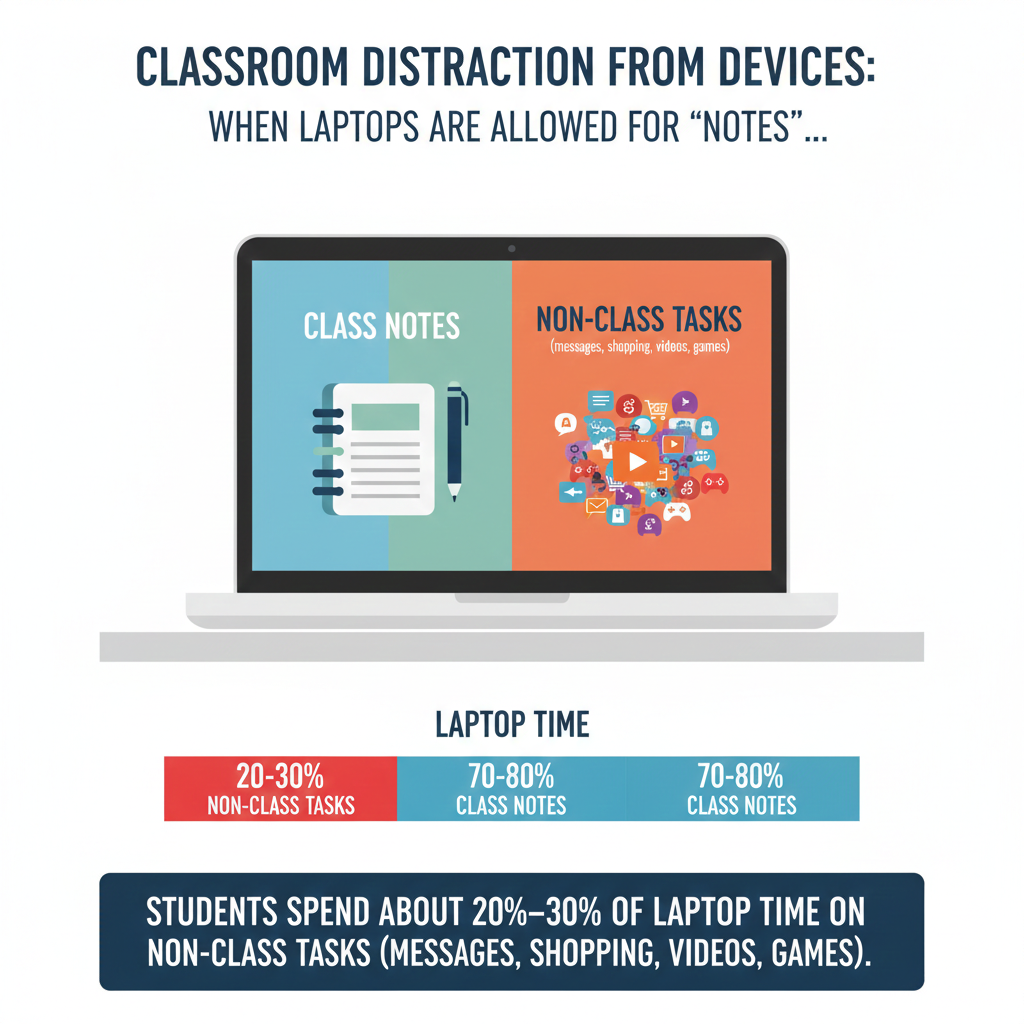
3) When laptops are allowed for “notes,” students spend about 20%–30% of laptop time on non-class tasks (messages, shopping, videos, games).
Why “I’m just taking notes” often turns into off-task time
Laptops feel like a learning tool, so it is easy to believe that using one automatically means a student is working. But the data suggests that when laptops are open for note-taking, about one-fifth to nearly one-third of that time can slip into non-class tasks.
In a 60-minute class, that can mean 12 to 18 minutes not going to learning. The tricky part is that the student may not even notice it. A quick tab switch, a short reply, a “two-minute” video, and suddenly the lesson has moved on.
Laptops also invite a certain style of note-taking that can look neat but be shallow. Many students type fast and copy words without thinking. That feels productive, yet it may not help memory.
When the mind is half-listening and half-typing, it can miss meaning. Then the laptop becomes both a distraction and a false sense of progress.
How to use laptops in a way that protects attention and improves learning
If you are a teacher, you do not have to ban laptops to reduce off-task use. You can set “lids down” moments during direct teaching, then allow “lids up” during guided practice. This creates clear on and off phases.
You can also give a note format that requires thinking, not copying. For example, ask for a short summary after each key idea, written in the student’s own words. That makes switching to random tabs less tempting, because they must keep up with meaning, not just words.
If you are a parent, help your child build a simple laptop rule at home: one window only for school, and phone away. Then teach them to take “thinking notes.” After each paragraph or slide, they write one sentence that starts with “This means…” That one sentence forces understanding.
If you are a student, try one strong habit: full-screen mode for notes and no extra tabs. If you must use the internet for class, open only what you need before class starts.
Also, set a goal for your notes: not “write everything,” but “capture the main idea and one example.” Better notes are shorter, clearer, and easier to review.
4) In lecture-style classes with open laptop use, about 1 in 3 students multi-tasks (switches between class work and something unrelated) at least once every few minutes.
Why multi-tasking feels helpful, but quietly breaks understanding
When about 1 in 3 students multi-task in lecture classes, it tells us something important: this is not rare behavior. It is normal behavior in an environment where switching is easy. The problem is that the brain does not truly do two thinking jobs at once. It jumps.
Every jump has a cost. Even if a student believes they are “good at it,” the brain still loses small pieces each time it switches. Those missing pieces are often the parts that connect ideas. And when the links between ideas break, learning becomes memorizing without understanding.
Lecture learning is already hard because the student must hold information in mind while it keeps coming. Add constant switching and it becomes like trying to fill a cup with holes. The student may still hear words, but they miss the reasons, the steps, the why behind the how.
Later, they may feel confused and blame the subject, when the real issue was the broken attention.
Practical ways to reduce multi-tasking in lecture settings
If you are a teacher, aim to make lectures more “active” without making them chaotic. A simple method is to insert short “stop and do” moments. After a key idea, ask students to write one line: a question they still have, a real-life example, or a quick summary.
This gives the brain a job and reduces wandering. You can also announce a clear structure at the start: “We will do three parts, each ten minutes, with a short pause between.” When students know a pause is coming, they are less likely to steal one.
If you are a parent, teach your child a tool called “single-task blocks.” During study, they set a timer for 10 minutes. For those 10 minutes, they do only one thing. After the timer, they get a one-minute break. This trains the brain to stay with one task. Over time, increase to 15 minutes, then 20.
If you are a student, use a simple “switch rule.” If you feel the urge to switch, write the urge down on paper instead, like “check message” or “look up game.” Most urges pass when they are named. Also, sit where you cannot easily hide your screen behind someone else.
It sounds strict, but it helps. When you choose a seat that supports your goals, you are being kind to your future self.
5) After a notification, the average time to look at a phone is under 10 seconds for many students—often 5–10 seconds.
Why a “tiny” pull happens so fast and becomes so strong
A phone notification is designed to win a race. It does not need minutes to distract a student. It often needs only 5 to 10 seconds. That speed matters because it happens before the student has time to think. The brain reacts first, then explains later.
A buzz or banner triggers curiosity, worry, and a feeling that something might be important. Even if the message is not urgent, the body responds as if it might be. That is why students can be fully listening one moment, then reaching for the phone almost automatically the next.
This also creates a pattern. When a student checks quickly after a notification, the brain learns, “Buzz means reward.” The reward might be a funny message, a like, or just relief. Soon, the student starts to expect that reward.
Over time, even the smallest alert can interrupt deep thinking. In class, deep thinking is where real learning happens. It is where math steps make sense, where science ideas connect, and where coding logic becomes clear.
How to make notifications stop controlling the classroom moment
If you are a teacher, build a class culture where notifications do not get a chance to start the chain. The most helpful rule is “silent and away,” paired with a simple routine at the start of class. You can say, “Before we begin, phones away and notifications off.” Keep it short.

The power is in repetition, not in long talks. If your school allows, you can also use a “tech check” at the start where students confirm: sound off, banners off. It takes less than a minute and saves many minutes later.
If you are a parent, help your child set up their phone so school time is protected. Use focus modes or do-not-disturb schedules during class hours. The best part is that it removes the need for willpower.
Willpower is limited. Systems are stronger. Also, teach your child that most messages can wait. You can role-play: “What is truly urgent? What can wait one hour?” This helps them feel safe ignoring alerts.
If you are a student, the fastest win is to turn off notification previews and vibrations for social apps during school hours. If you cannot turn everything off, turn off the most tempting apps first. Then place the phone where you cannot touch it without standing up.
The extra effort breaks the automatic reach. Finally, give yourself a simple promise: “If it is urgent, the teacher will know.” Most urgent things have a clear path, like the school office, not a random buzz.
6) Once distracted by a device, students often take about 1–5 minutes to fully refocus on the lesson.
Why refocusing is not instant, even after the phone is put down
Many people believe distraction ends the moment the screen goes dark. But the brain does not work that way. After a student looks at a message, a video, or a game, their mind often keeps thinking about it.
They may wonder what to reply, what they missed online, or what happens next in the clip. That is why refocusing can take 1 to 5 minutes. In a class with many small distractions, this becomes a serious loss. A student might be “back” in their seat, but not back in the lesson.
This also explains why students sometimes feel lost even when they “only checked once.” If the teacher explained a key step during that refocus window, the student may miss the connection. Then the rest of the lesson feels confusing.
The student may stop trying because it feels too hard to catch up. That is how a small distraction can turn into a full drop in effort.
How to shorten the refocus time and repair attention quickly
If you are a teacher, you can help students re-enter the lesson without shame. Use quick “anchor prompts” that bring the mind back. For example, after a transition, you can say, “Write the last idea we covered in one sentence.”
That single sentence pulls attention back into the content. You can also use short recap cues like, “We are solving for x,” or “We are testing one variable.” These cues tell the brain where it is and what matters.
If you are a parent, teach your child a simple refocus habit for homework that will also help in class: the “three breaths and one line” method. When they notice they got pulled away, they take three slow breaths, then write one line about what they were doing right before the distraction.
This trains the brain to return faster. It is like building a path back to the task.
If you are a student, you can use a quiet reset that no one notices. When you realize you drifted, do not panic. Panic makes it worse. Instead, find the current topic on the board or slide, and write down one question: “What is the goal right now?” Then listen for the next clue.
If needed, ask a simple question after a pause, like, “Can you repeat the last step?” Good teachers respect that. Also, keep your notes organized with clear headings, so you can quickly see where the class is. The faster you locate your place, the faster your mind returns.
The main idea is this: the cost of distraction is not just the seconds on the screen. It is the minutes it takes to come back. If you protect the return path, you protect learning.
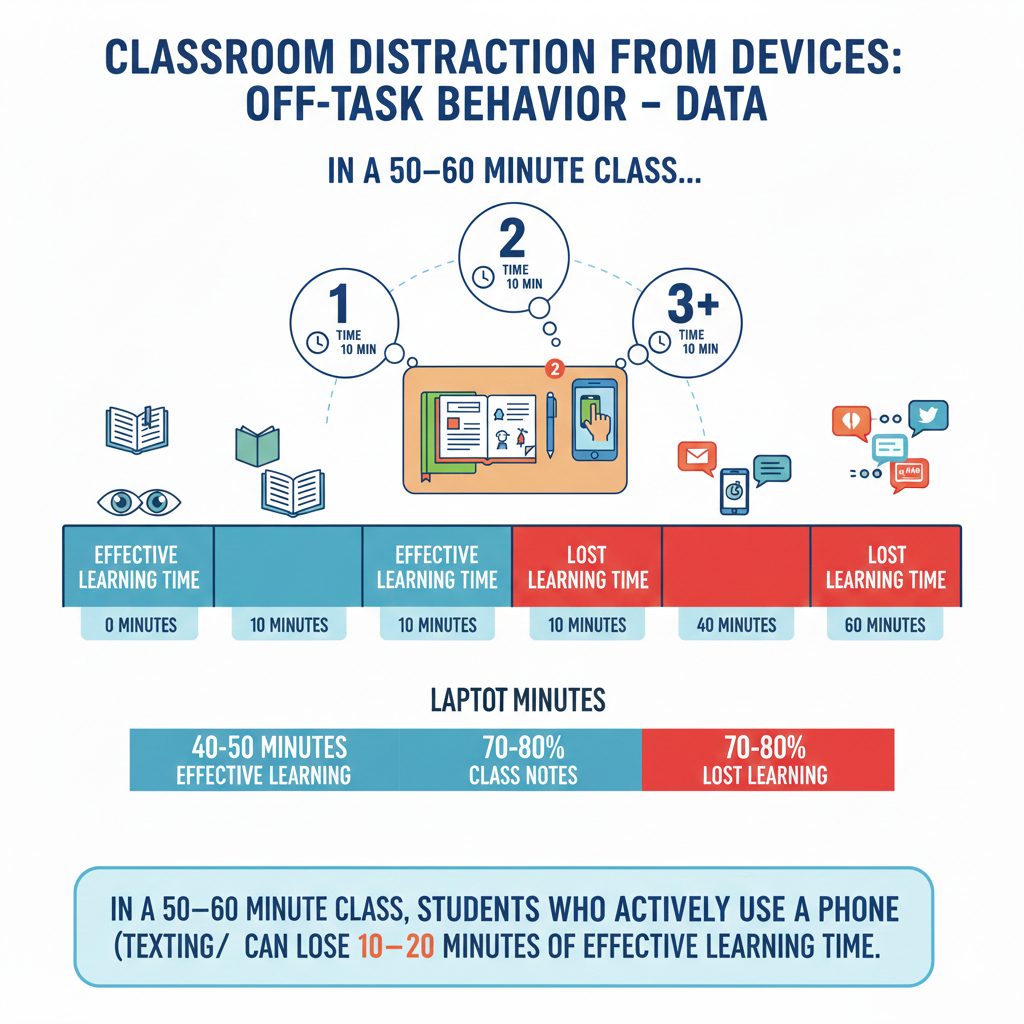
7) In a 50–60 minute class, students who actively use a phone (texting/social) can lose 10–20 minutes of effective learning time.
Why “being in class” is not the same as “learning in class”
Losing 10 to 20 minutes of effective learning in a single class is a big deal because it is not just lost time. It is lost steps. Most lessons are built like stairs. If you miss the middle steps, the top steps feel impossible.
In a 50 to 60 minute class, losing 10 to 20 minutes can mean missing the teacher’s example, missing the practice start, and missing the correction that fixes a common mistake. Then the student goes home with confusion, and homework becomes harder.
That creates a cycle: harder homework leads to stress, stress leads to more phone use for comfort, and more phone use leads to more lost learning.
This also helps explain why some students feel they study “for hours” but still do not improve. They may be spending time, but the time is broken. Effective learning needs steady attention, even if the lesson is not exciting. Phones turn learning into small chunks that do not connect.
How to protect 10–20 minutes without making school feel unbearable
If you are a teacher, treat these lost minutes like a leak you can seal with routines. One strong practice is to start class with a short task that counts, even if it is small. When students have a task in the first two minutes, they are less likely to open a phone.
Another practice is to build “micro-checks” into the lesson, like asking students to answer one question on paper before moving on. When the teacher checks quickly, students stay with the flow.
If you are a parent, focus on one habit, not ten. Choose a simple “class focus plan” with your child. It can be as small as: phone stays in the backpack during class. Then connect the habit to a personal reason, like sports, art, a future job, or a dream college.
When the habit is tied to a goal they care about, it feels less like a punishment.
If you are a student, try a clear promise: “I will not touch my phone during instruction.” Not “I will use it less.” Clear promises are easier to follow. If you worry about missing something, set a plan with a friend: “If it is urgent, tell me after class.”
Most things are not urgent. Also, use your hands to stay engaged. Write short notes, underline key words, or copy the one example step that matters. When your hands are busy with learning, your phone becomes less tempting.
And if your child needs a learning place where focus is built into the structure, consider guided learning like Debsie’s live classes. A well-led session with active tasks gives the brain less room to drift, and more chances to practice real focus skills.
8) Even “quick checks” add up: 15–30 seconds per check, repeated many times, can total 5–15 minutes per class.
Why small checks become a large hidden time loss
A quick phone check feels harmless because it is short. Fifteen seconds is the time it takes to sip water. Thirty seconds is the time it takes to tie a shoe. But in class, the problem is repetition.
If a student checks the phone 10 times, even at 20 seconds each, that is 200 seconds. Two hundred seconds is 3 minutes and 20 seconds. If they check 20 times, it becomes 6 minutes and 40 seconds. Add the refocus cost after each check, and the real loss can reach 5 to 15 minutes in a single class.
This is why students can swear they were “not on their phone much” and still fall behind. Their memory of time is not accurate when they are switching. The checks blur together. Also, quick checks tend to happen at the worst moments, like when the teacher explains a key step or gives instructions.
Missing instructions leads to more confusion and more off-task time, because the student does not know what to do next.
How to stop quick checks before they start, with simple systems
If you are a teacher, the best move is to remove the “quick check” option. When phones are allowed on desks, checking becomes easy and silent. When phones are away, checking becomes harder and more visible, so it happens less.
You can also make your transitions tighter. Many quick checks happen during pauses. When you plan a clear next step, students stay with you. Even a short phrase like, “Now we do step two,” can prevent a drift.
If you are a parent, teach your child a “no-check block” skill. At home, choose one block of time where phones are not touched at all. Keep it short at first, like 10 minutes. Then increase it.
The goal is to build the muscle of not responding to every urge. You can also help by turning off non-essential alerts during school hours. If the phone does not call for attention, the student does not have to fight it.
If you are a student, use one clear trick: move the phone out of sight. Sight is a strong trigger. Put it in a zipped pocket of your bag, not an open pocket. If you can, power it off during class. If that feels too big, start with airplane mode.
Then set a small goal like, “I will not check my phone until the teacher finishes the example.” Small goals are easier to keep than vague promises.
The main point is this: quick checks are not quick when they happen again and again. If you reduce the number of checks, you protect a large chunk of learning time without needing extra studying later.
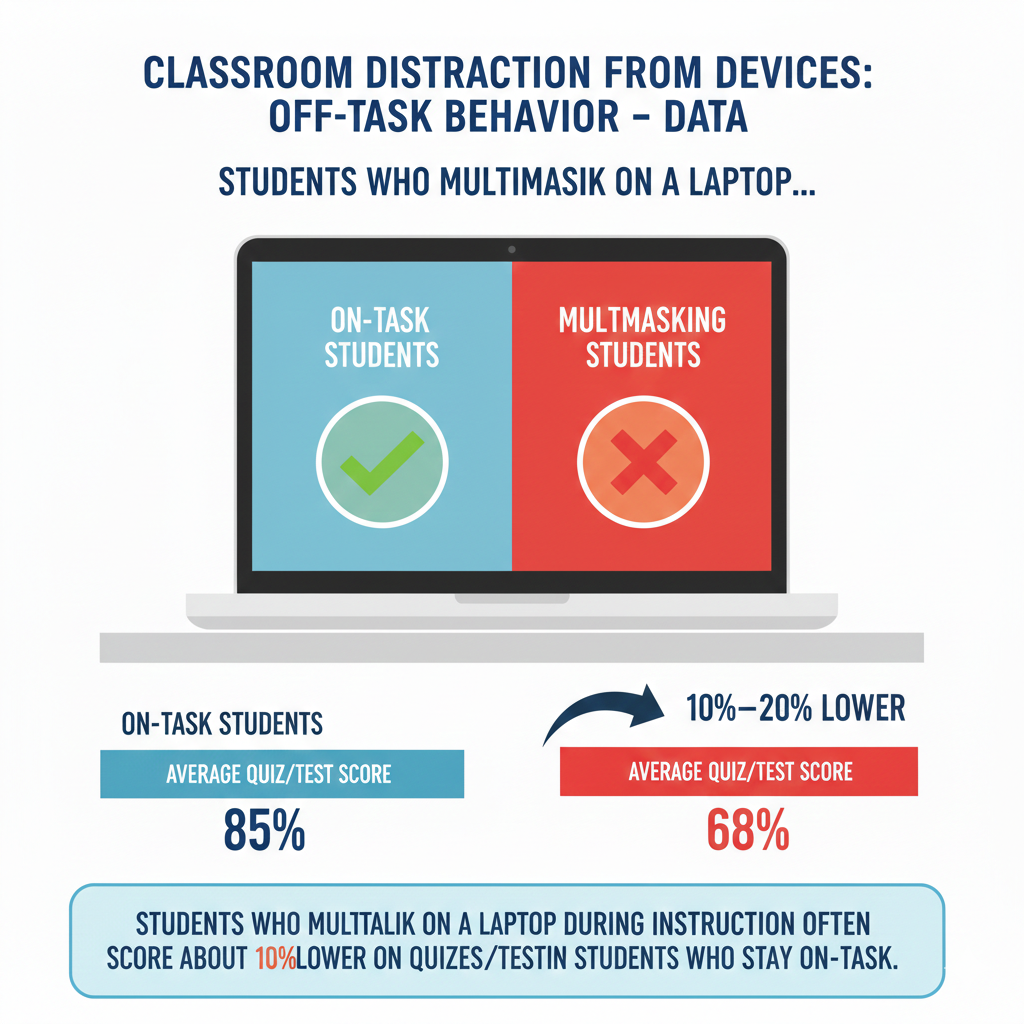
9) Students who multitask on a laptop during instruction often score about 10%–20% lower on quizzes/tests than students who stay on-task.
Why grades drop even when students feel “busy”
A 10% to 20% drop is the difference between an A and a B, or a B and a C. What makes this painful is that the student may still feel like they worked. They were typing, clicking, reading, and switching. But learning is not the same as activity.
Learning needs steady thinking long enough for the brain to store the idea. When a student flips between the lesson and unrelated tabs, the brain keeps restarting. That restart steals understanding.
This is also why some students say, “I studied, but I blanked in the test.” The test asks the brain to pull out connected ideas. Multitasking breaks those connections. The student may remember a few facts, yet not the steps that link them.
In math, they miss why a step happens. In science, they miss what causes what. In coding, they miss how one line changes the next.
Actions that protect scores without banning devices in fear
If you are a teacher, reduce laptop multitasking by changing what “good laptop use” looks like. Give students a clear “output” every few minutes, like a short written answer, a worked example, or a small code change they must explain.
When students must produce thinking, they cannot hide in random tabs as easily. If you can, set moments when screens close and everyone looks up, then moments when screens open for practice. That rhythm lowers the temptation to wander.
If you are a parent, coach your child to study in “single-task” blocks. Even 15 minutes of clean focus, repeated, beats an hour of broken attention. Keep the rule simple: one screen, one job, one goal. Then end the block with a quick self-check, like, “Can I explain this idea in my own words?”
If you are a student, make your laptop boring during class. Full-screen your notes. Close extra tabs. Turn off pop-ups. If you need the internet, open only the pages the teacher asked for before class starts. Your goal is not to look busy. Your goal is to understand.
10) Students who text during class commonly show lower note quality, with fewer key ideas captured and more missing points (often 20%–40% less complete).
Why texting makes notes thinner, even if the student types fast
Notes are not just a record. They are a tool that helps the brain decide what matters. When a student texts, their attention splits.
They miss the teacher’s emphasis, the example that explains the rule, and the small warning like, “This will be on the test.” So their notes may contain random phrases but not the main idea. If notes become 20% to 40% less complete, the student loses a major support for homework and revision later.
This also creates a confidence problem. When the student opens their notes at home and sees gaps, they feel behind. They may try to fill the gaps by searching online, but online information may not match the teacher’s method.
That adds more confusion. The student then spends longer studying, yet still feels unsure, because their foundation is weak.
Actions that improve notes and reduce texting urges
If you are a teacher, help students see what “good notes” look like. Model it once in a while by showing a simple example of notes that capture the main idea, one example, and one common mistake.
When students know what to aim for, they are more likely to stay present. You can also pause briefly after key points and say, “Write this down.” That short pause gives note-taking a clear moment and reduces the urge to check messages.
If you are a parent, encourage a “two-column” habit at home, even on plain paper. One side is the main idea. The other side is a short meaning or example. This trains the child to listen for structure, not just words. Also, help them set texting boundaries during homework so the class habit becomes easier.
If you are a student, use a simple rule: no texting until you have written the main point of the last five minutes. When you protect the core of your notes, everything else becomes easier.
11) When phones are present on the desk (even unused), some studies show attention and memory performance drop by about 5%–15% compared to phones being put away.
Why “just having it there” still steals attention
This stat surprises people because it says the phone can harm focus even when the student does not touch it. The reason is simple: the brain is always scanning. A phone on the desk is a signal that something could happen.
Even if nothing happens, the brain keeps a small part of attention ready. That small part is enough to reduce memory and attention by 5% to 15%. It is like trying to listen while keeping one ear open for another sound. You can do it, but not as well.
Over time, this makes learning feel harder than it should. A student may blame the subject, the teacher, or themselves. But the real issue is that attention is being taxed all the time. When the phone is put away, the brain relaxes. It can fully commit to the lesson.
Actions that remove the “silent drain” of a visible phone
If you are a teacher, make “phones out of sight” the normal default, not a special rule used only on test days. Keep it calm and consistent. If students push back, explain that this is not about control. It is about helping their brain work better.

Then show them the benefit by pointing out how much smoother discussions and practice feel.
If you are a parent, suggest a simple change: phone stays in the bag during school hours unless the school needs it for a task. If your child worries about safety, agree on a plan for real emergencies through the school office, so the phone does not need to sit on the desk “just in case.”
If you are a student, try one day with the phone fully out of sight and notice how it feels. Many students are shocked by how calm their mind becomes. Calm is not laziness. Calm is focus.
12) Students seated near peers using devices for unrelated activities can also be harmed: nearby students may score about 5%–10% lower due to “secondhand distraction.”
Why other people’s screens can pull your child off-task
Secondhand distraction is real because humans notice motion and light. When a student nearby scrolls, watches clips, or chats, it creates a moving picture in the corner of the eye. The brain treats it as important, even when it is not.
A student may try to ignore it, but their attention keeps getting tugged. Over time, this can cut scores by about 5% to 10%. That is a painful loss for a student who is trying hard. It also feels unfair because they did not choose the distraction.
This matters even more for students who are already anxious or easily overstimulated. Their brains work harder to filter noise. If the room adds constant screen movement, they get tired faster, and learning becomes heavier than it should be.
How to protect students from secondhand distraction
If you are a teacher, seating is one of your strongest tools. Place students who need more support away from heavy device users.
Also, consider “screen angles.” If laptops are allowed, encourage screens to face the teacher’s direction so fewer students see bright content across the room. You can also set clear “task-only” moments: “For the next eight minutes, screens are only for the worksheet.” Keep it simple and repeatable.
If you are a parent, coach your child to pick a seat that supports focus. This is not about being “teacher’s pet.” It is about building a smart environment. Sitting closer to the front often reduces visible distractions.
If your child cannot choose seats, help them talk to the teacher in a respectful way: “I get distracted by screens behind me. Can I sit where I can focus?”
If you are a student, protect your eyes. If you notice a distracting screen nearby, shift your body angle slightly toward the board. Keep your own paper and notes centered in front of you. The less your eyes wander, the less your mind wanders.
Also, remember that looking at someone else’s screen is a trap. It feels like a quick peek, but it often turns into a longer drift.
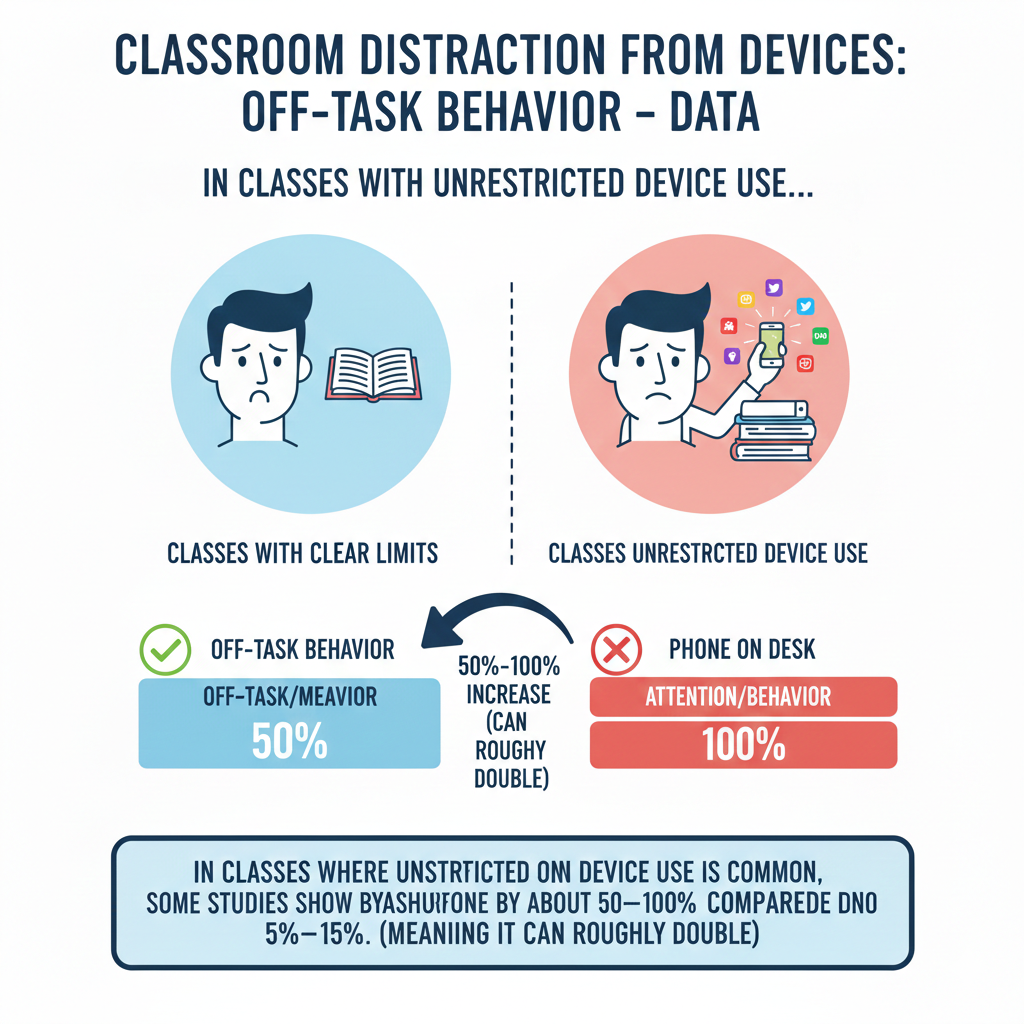
13) In classes where unrestricted device use is common, off-task behavior can rise by about 50%–100% compared to classes with clear limits (meaning it can roughly double).
Why “loose rules” often create more stress, not more freedom
When device limits are unclear, students are forced to make constant choices: “Should I check now? Can I get away with it? Is this allowed?” That choice itself drains attention. And once some students begin using devices freely, others follow, because it becomes the room’s normal.
The data suggests off-task behavior can rise by 50% to 100%, meaning it can double. That affects learning, but it also affects classroom mood. The teacher spends more time correcting behavior. Students feel more scattered. Even good lessons feel harder to run.
Clear limits are not about strict control. They are about reducing decision fatigue. When the rule is stable, students stop negotiating with it. They can relax into the work.
How to set limits that feel fair and workable
If you are a teacher, keep the rule short and easy to apply. One good option is: “Devices away during instruction, allowed only when I say.” Pair it with a routine so it becomes automatic. Start-of-class phone away. End-of-class phone back.
The rule should not change based on your mood, because students sense that and will test it.
If you are a parent, support the teacher’s limits instead of undermining them. If your child complains, listen first, then ask, “What is the rule trying to protect?” Help them see that focus is a skill they will need for life, not just for school.
If you are a student, treat clear limits as help, not punishment. When the rule removes temptation, it protects your grades and reduces stress. If you truly need a device for learning support, talk to the teacher privately and propose a plan that keeps you on-task.
14) Social media is one of the biggest drivers: in many student self-reports, about 40%–60% admit to checking social apps during learning time.
Why social apps are so hard to ignore during class
Social apps are built to feel personal. They carry friends, jokes, drama, and the feeling of belonging. That is why 40% to 60% of students admit to checking them during learning time. A student may not even be bored with the lesson.
They may simply be craving a quick social hit. The brain likes it because it is easy reward. One scroll gives many new things. Class gives one thing at a time. So the brain gets pulled toward the faster reward.
The danger is that social checking becomes a habit linked to discomfort. If the lesson is hard, the student may scroll to escape. If the lesson is slow, they scroll for stimulation. Soon, any mild discomfort triggers the urge. Then learning becomes harder, which creates more discomfort, which creates more scrolling. It is a loop.
How to break the social-check loop in a respectful way
If you are a teacher, make learning more “social” in the right way. Short partner talk moments, quick shared problem solving, and simple call-and-response questions can satisfy the need for connection without phones.
Also, consider building one planned “device moment” only when it supports the lesson, so devices are not the secret entertainment layer.
If you are a parent, help your child set a boundary that does not rely on willpower. Use app limits or focus modes during school hours. Then talk about why. Say, “This is not because I do not trust you. It is because your brain deserves a quiet space to grow.”
If you are a student, move social apps off your home screen and turn off their alerts. Small friction helps. Also, when you feel the urge to check, write a quick note like “I want to check Instagram.” Then return to the lesson.
Naming the urge often shrinks it. You are training your brain to choose long-term wins over short-term hits.
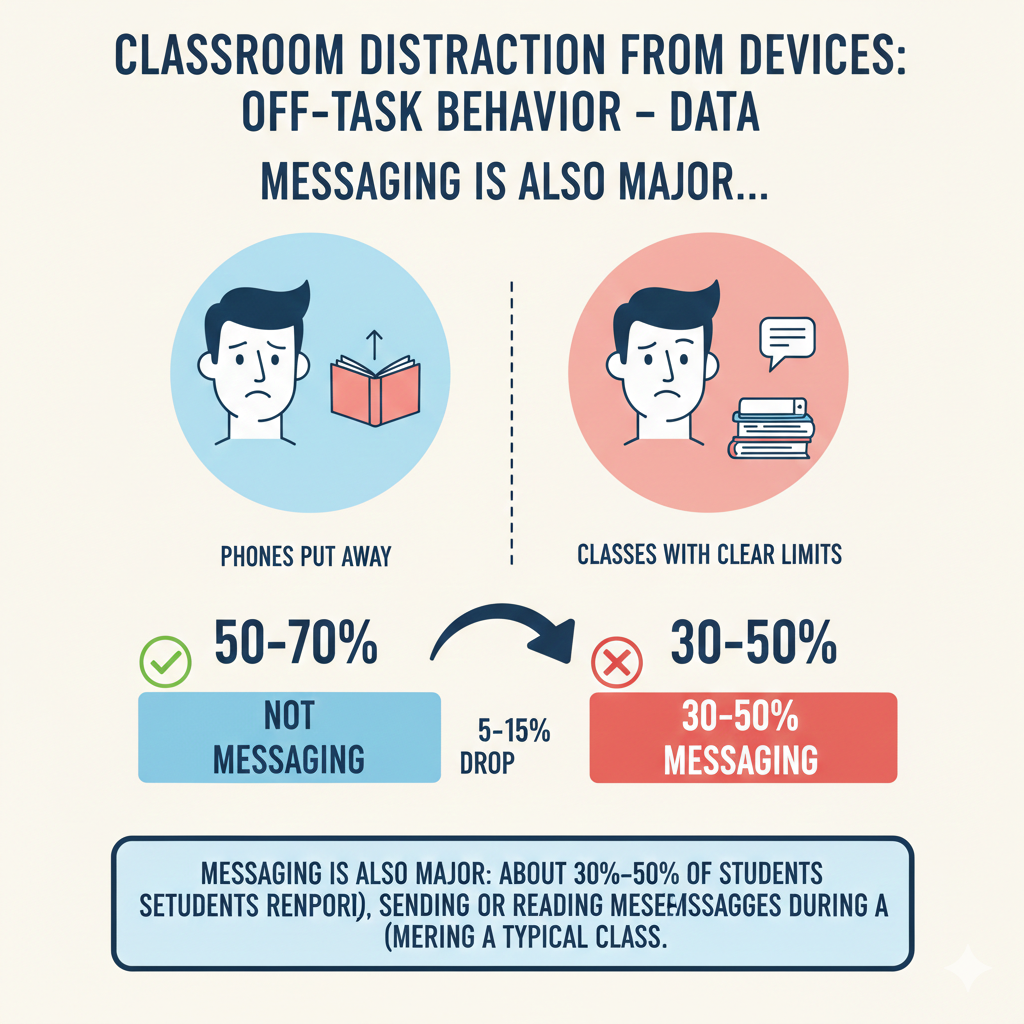
15) Messaging is also major: about 30%–50% of students report sending or reading messages during a typical class.
Why messaging feels “safe” but still breaks learning
Messaging is one of the most common forms of off-task behavior because it feels small and private. A student may think, “It is only a quick reply.” That is why 30% to 50% report reading or sending messages during class.
The issue is not just the time spent typing. The bigger issue is the mental thread that continues after the message. Even after the phone is put away, the student keeps thinking: “Did they reply?” “What did they mean?” “Should I say more?” That hidden thinking competes with the lesson.
Messaging also changes the student’s posture. They look down, shoulders fold, attention turns inward. That posture makes it harder to rejoin class discussion. Over time, the student becomes more of a quiet observer and less of an active learner, which harms confidence.
How to reduce messaging without making students feel trapped
If you are a teacher, you can set a respectful boundary: messages can wait unless there is a real need, and real needs go through the office. Then build short “pause points” where students can reset.
When students know there is a planned pause, they are less likely to steal one. Also, use clear signals like, “Eyes up for the next two minutes, this is the key step.” Students often comply when they know exactly when the high-focus moment begins and ends.
If you are a parent, create a family agreement about school-day messaging. Keep it simple: no texting during class. If your child needs to reach you, they do it during break or through the school. Explain that this is about protecting their future, not controlling them.
You can also model it by not expecting instant replies from them during school hours.
If you are a student, set an expectation with friends: “I reply after class.” Most friends will accept that if you say it plainly. If you worry about missing something, choose one trusted friend who can tell you important news at lunch. Then turn off message alerts during class. Alerts are what start the cycle.
16) Video and entertainment use is less common but still notable: about 10%–25% report watching short videos during class at least sometimes.
Why videos can grab attention faster than any lesson
Short videos are designed to hook the brain quickly. Bright visuals, fast cuts, and strong emotions can pull attention in seconds. Even if only 10% to 25% watch videos sometimes, the impact can be large because videos are loud in the mind, even when muted.
A student who watches a clip is not just stepping away for a moment. They are stepping into a different world. Coming back to algebra, history, or grammar feels slower and less exciting by comparison. That makes the next urge stronger.
Videos also create stronger memory traces than many classroom moments. So the student may remember the clip clearly, but forget the teacher’s explanation. That can make studying feel frustrating, because the brain keeps offering the fun content while the academic content feels faint.
Practical ways to stop entertainment drift before it starts
If you are a teacher, reduce idle moments. Many video checks happen when students finish early or feel lost. Provide a clear “next step” task for both cases. If a student finishes, give an extension question that is short and meaningful.
If a student is stuck, give a small hint step to restart them. When students have a clear job, they are less likely to open entertainment.
If you are a parent, teach your child to notice the moment they reach for videos. Often it is boredom or stress. Help them create a replacement action, like taking one slow breath and writing the next tiny step of the task.
Also, keep entertainment apps limited during school hours through focus settings. This is not harsh. It is protective.
If you are a student, remove the easy path. Log out of video apps on your phone during the school week. That small barrier reduces “just a quick clip.” Also, if you feel bored, give your brain a class-based challenge: “Can I write one question about this topic that would stump someone?” Turning boredom into a game keeps you in the lesson.
17) Gaming during class is reported by about 5%–15% of students (higher in longer or less structured periods).
Why gaming shows up most when structure is weak
Gaming in class may sound shocking, yet 5% to 15% report it, and it rises when periods are long or loosely run. Gaming is not just entertainment. It is also control. In a game, the student knows the rules, gets quick feedback, and feels progress.
In class, especially when the lesson feels confusing, the student may not feel any progress. The game becomes a place where they can win, even in small ways. That makes it very tempting.
Gaming also creates a deep focus, but on the wrong thing. Once the student is in, it is hard to pull them out. Then they miss not only content, but also class directions and social cues. This can lead to conflict with teachers and peers, which adds stress and can make the student avoid class even more.
How to address gaming in a way that fixes the root problem
If you are a teacher, increase structure in the moments when gaming tends to happen. Break longer periods into short blocks with clear tasks and quick checks. Also, watch for the students who game most.

They may be stuck, behind, or disengaged. A quiet check-in like, “What part is unclear?” can do more than a public call-out.
If you are a parent, look at the pattern, not just the behavior. Ask, “When do you feel like escaping in class?” If the child says the subject feels impossible, the right response is support, not only punishment.
Consider tutoring, better study habits, or a more guided program. Structured, engaging learning like Debsie’s STEM and coding sessions can help because kids get clear steps, quick feedback, and real progress without the chaos.
If you are a student, be honest with yourself about why gaming feels needed. If it is boredom, set a class goal that makes the lesson more active. If it is stress, ask for help sooner. The fastest way out of the gaming loop is to reduce the “I don’t get it” feeling that pushes you to escape.
18) During independent work time, off-task device use often increases: non-class screen use can rise from ~20% in lecture to ~30%–45% during “work periods.”
Why “work time” is when many students drift the most
Independent work sounds like the calm part of class, yet it is often the moment when off-task device use grows. If non-class screen use rises to 30% to 45% during work periods, that suggests something important: many students do not know what to do when the teacher is not actively leading. Some finish early and get bored. Some feel stuck and do not want to look “behind.” Some simply feel less watched. The phone becomes the easy option.
This matters because work periods are where practice happens, and practice is where skills form. In math, practice turns rules into habits. In writing, practice turns ideas into clear sentences. In coding, practice turns logic into real problem solving. If students lose almost half the work period to unrelated screens, they lose the part of class that builds confidence.
How to make independent work time actually work
If you are a teacher, the best fix is clarity. Students drift when the task feels vague. Give a clear “first step,” a clear “done looks like,” and a clear “what to do if stuck.” Even a simple instruction like, “Do problems 1–6, show steps, circle your final answer,” reduces confusion.
Also, use a quiet check system. For example, ask students to place a small mark on the top of the page when they finish each question. This creates gentle momentum.
If you are a parent, teach your child a simple stuck plan they can use in class. Step one is re-read the question. Step two is try one small part. Step three is ask a neighbor for one hint. Step four is ask the teacher. When kids have a plan, they do not escape into screens as fast.
If you are a student, set a personal rule for work time: phone stays away until you finish the first two tasks. Starting is the hardest part. Once you begin, focus becomes easier. If you finish early, do not reward yourself with your phone right away.
Instead, check your work or try one challenge problem. The more you practice, the less you fear the subject.
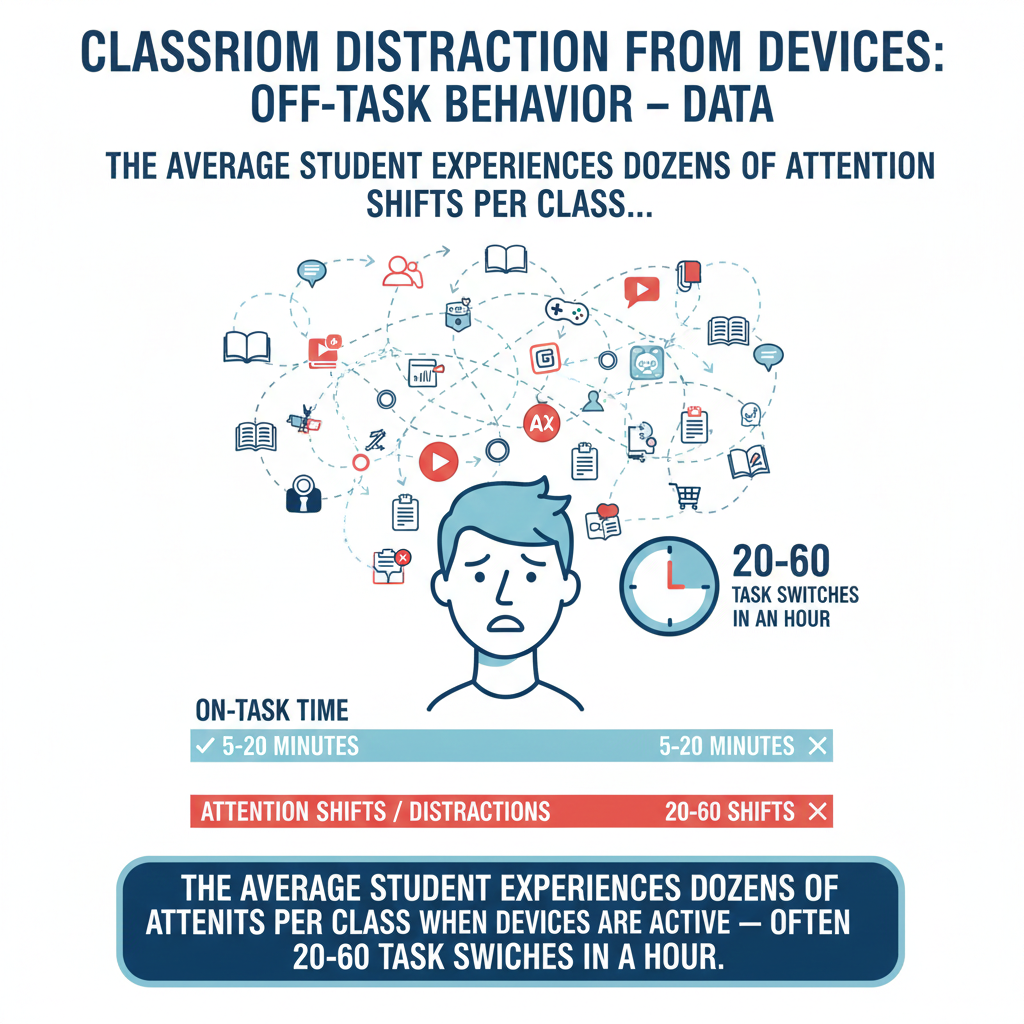
19) The average student experiences dozens of attention shifts per class when devices are active—often 20–60 task switches in an hour.
Why constant switching makes learning feel foggy
Twenty to sixty task switches in one hour means the brain is being pulled apart all the time. Even if each switch is quick, the mind pays a fee each time. It is like trying to read a book while someone taps your shoulder every minute.
You might still read words, but the story becomes harder to follow. In class, the “story” is the chain of ideas. When the chain breaks, the student loses meaning.
This is also why students can feel tired after class even if they did not do much. Switching burns energy. The brain must re-orient again and again: “Where was I? What was the teacher saying? What is this problem asking?” That mental restart is exhausting.
Over time, school begins to feel draining, not because the content is too hard, but because attention is being spent on switching, not learning.
How to cut switches down to a safer number
If you are a teacher, design lessons with fewer open loops. Clear steps, short segments, and visible progress checks reduce switching. If you can, make device use specific, not open-ended. For example, “Use your device to look up this one fact,” then devices away. Specific use prevents endless wandering.
If you are a parent, help your child practice “focus reps” at home. Ten minutes of clean focus is one rep. Do three reps with short breaks. This builds endurance the way sports training does. The goal is not perfection. The goal is fewer switches over time.
If you are a student, choose one anchor for each class. It can be a notebook page, a worksheet, or the teacher’s slides. When you feel yourself switching, bring your eyes back to the anchor. Also, keep your materials tidy. Searching for a pen or page creates extra switches that make distraction more likely.
20) Each task switch (class → device → class) carries a “mental reset cost,” commonly cutting working speed by about 10%–25% right after returning.
Why switching slows students down even when they think it helps
A 10% to 25% drop in working speed after switching is huge. It means the student may take longer to solve the same problem, even though they were “only away for a second.” This is why multitasking often leads to rushed work and careless mistakes.
The student feels behind, so they speed up, but the brain is still resetting, so errors rise. Then the student feels frustrated and may escape again to the device. It becomes a cycle.
This is also why some students struggle to finish classwork on time. They are not slow learners. They are paying switching fees over and over. When those fees add up, the student runs out of class time. Then homework piles up. Then stress rises.
How to reduce reset cost and protect speed and accuracy
If you are a teacher, help students stay in one lane. During practice, set short “no-switch” windows: “For the next six minutes, solve quietly, no devices.” Then do a quick check. The window does not need to be long.
It needs to be consistent. Also, praise focus, not just correct answers. When students feel seen for effort, they stick with the work longer.
If you are a parent, teach your child a simple reset routine they can use when they do get distracted. They take one breath, read the last line they wrote, and restate the goal in their head. This short routine reduces the time the brain spends searching for where it was.
If you are a student, you can protect your speed by protecting your start. When you begin a task, give yourself two minutes of full focus before doing anything else. That first clean start makes the rest smoother.
If you feel an urge to switch, write the urge down and promise yourself you will handle it after you finish the next step. Most urges fade when you delay them.
21) In classrooms with frequent device distractions, teachers can lose 2–10 minutes per class to redirection, reminders, and re-explaining.
Why lost teacher time becomes lost student learning
When a teacher loses 2 to 10 minutes in a class period, the whole group pays the price. That time often goes to repeating directions, calling students back, handling a phone issue, or re-teaching a step that many missed while drifting.
In a 50-minute class, losing 10 minutes is losing one-fifth of the lesson. Over a week, that can become almost a full class period gone. Over a term, it becomes many hours.
This also affects teacher tone. Even the calmest teacher can feel worn down by constant redirection. A stressed teacher may talk faster, shorten practice time, or reduce discussion. Students then feel less supported, and more likely to disengage.
So device distraction is not only a student issue. It is a class system issue that changes the quality of teaching.
How to protect teaching minutes and keep class flow strong
If you are a teacher, focus on prevention, not correction. The most powerful move is a simple routine at the start of class that removes devices from easy reach. When that routine is consistent, you spend less time policing and more time teaching.

Also, give directions in a way that reduces repeat requests. Keep directions short, then ask one student to repeat them in their own words. This simple check catches confusion early and prevents the need to re-explain later.
If you are a parent, support the teacher’s time. Teach your child that every time a teacher must stop to handle a phone, everyone loses learning. Frame it as respect for the group, not just rule-following.
You can also ask your child, “Did you understand the task the first time?” If they often miss directions, it may be a sign they are checking devices during instructions.
If you are a student, help your class by not becoming the reason the teacher must pause. Even if you do not care about the lesson, the time loss harms classmates who do.
If you feel tempted, move the phone away, and if you miss directions, ask a neighbor quietly before asking the teacher to repeat for everyone. That keeps class moving.
22) In many surveys, about 60%–80% of teachers say devices are a regular distraction in their classroom.
Why this number signals a “new normal” that needs smart solutions
If 60% to 80% of teachers report devices as a regular distraction, it means this is not a rare problem in a few schools. It is widespread. And when a problem is widespread, the solution cannot rely only on “better willpower.” It needs systems, routines, and clear expectations that work even on tired days.
This also matters because teachers are not trying to be strict for no reason. Most teachers want students to use tech well. But constant distraction makes it hard to teach and hard to measure real understanding. It can also create conflict. When teachers feel they must constantly fight devices, trust can break down.
How schools, teachers, and families can align without drama
If you are a teacher, choose one approach and stick with it. Mixed messages create more arguments.
If your rule is “devices away during instruction,” apply it every day, not only when you are annoyed. Also, communicate the reason in simple language: “I want your brain fully here so you can learn faster.” Students respond better when they understand the goal.
If you are a parent, align with the school. Ask what the classroom device rules are, then reinforce them at home.
If your child says, “Other kids use phones,” avoid the trap of excusing it. Instead say, “We do what helps you learn.” You can also help by setting school-hour limits on the phone, so your child does not carry the whole burden alone.
If you are a student, understand that teachers reporting this level of distraction means you are not alone in struggling. Do not turn it into shame. Turn it into a plan. The best students are not the ones with zero temptation.
They are the ones who build habits that protect them when temptation shows up.
23) In student surveys, about 50%–70% say they are distracted by their own phone during learning at least once per class.
Why self-distraction is so common, and why it is not a character flaw
If 50% to 70% of students admit they get distracted by their own phone at least once per class, that means it is normal to struggle. Phones are built to pull attention. They offer quick comfort, quick entertainment, and quick connection.
In class, especially when the lesson feels hard or slow, that quick option is very tempting. Many students do not want to be distracted. They simply do not have a strong system to protect their attention.
The good news is that attention is trainable. It is a skill like reading, dribbling, or swimming. When you practice it in small ways, it grows.
A practical plan to reduce self-distraction in one week
If you are a teacher, help students make a simple commitment that feels possible. For example, “Phones away for the first 15 minutes.” Once students succeed, extend it. Small wins build trust.

If you are a parent, help your child set one clear target for the week, like “phone stays in the bag during class.” Then check in daily with a calm question: “How did it go today?” If they fail, do not explode. Ask what triggered it and adjust the plan.
If you are a student, choose one change that removes the trigger. The easiest is turning off notifications for social and messaging during school hours. Then place the phone out of sight. Finally, keep your hands active with learning.
Write notes, solve steps, or track key points. When your body is engaged, your mind follows more often.
24) Also in student surveys, about 60%–75% say they are distracted by other students’ devices (seeing screens, hearing alerts, noticing typing).
Why other people’s devices can feel impossible to ignore
When 60% to 75% of students say they are distracted by other students’ devices, it shows that device distraction is not only private.
It spreads. A bright screen, a quick laugh, a vibrating desk, or constant tapping can pull attention even from a student who is trying hard. The brain is wired to notice changes in the environment. It is a safety feature. In a classroom, that feature becomes a focus problem.
This can also create resentment. A focused student may feel, “I am doing the right thing, but I still pay the price.” Over time, they may give up and join the distraction, because it feels unfair to keep trying alone.
That is how a room slowly drifts from a learning space into a scrolling space.
How to reduce peer-driven distraction in a practical, respectful way
If you are a teacher, set expectations that protect everyone, not just the rule followers. Make it clear that off-task device use does not only hurt the user. It hurts the whole room. Then use the environment to help.
Seating changes, screen position guidance, and clear “devices away” times reduce the visual noise. Also, give students meaningful roles during learning, like asking them to respond, write, or solve, so fewer students are idle and tempted to scroll.
If you are a parent, help your child advocate politely. Many kids do not want to “complain,” but they can ask for help in a respectful way. Teach them one sentence they can use: “I’m getting distracted by screens around me. Can I sit somewhere else?” That is calm and fair.
If you are a student, protect your attention like it is valuable, because it is. Choose a seat that reduces what you can see. Keep your eyes on your own page. If you notice you are watching someone else’s screen, do not shame yourself. Just return your gaze to your work. Attention is a skill built through many small returns.
25) When students multitask with devices, their reading comprehension often drops by about 10%–20% compared with focused reading.
Why multitasking breaks understanding more than it breaks speed
A 10% to 20% drop in reading comprehension means a student may read the same page but understand far less. This happens because comprehension requires building meaning across sentences.
The brain must connect ideas, hold them in mind, and notice cause and effect. When a student multitasks, those links break. They may still recognize words, but they miss the point. Later they may say, “I read it, but I don’t get it,” which is a painful feeling.
This is especially serious in subjects that use dense texts, like science and history, and in word problems in math. If students cannot understand what they read, everything else becomes harder. They spend more time re-reading, they lose confidence, and they may avoid reading tasks entirely.
How to rebuild strong reading focus with simple habits
If you are a teacher, teach “active reading” in a simple way. Ask students to stop after a short section and write one sentence about what it means. This forces understanding and keeps phones from stealing attention.
You can also ask students to underline only a few key words instead of highlighting everything. Too much highlighting becomes mindless.
If you are a parent, practice focused reading at home in short bursts. Choose 8 to 10 minutes of quiet reading with the phone away. Afterward, ask your child to explain the main idea out loud. Speaking the idea helps memory. Keep it friendly, not like an exam.
If you are a student, use one strong trick: when you start reading, cover the phone or put it away completely. Then read with a pencil in hand and mark one key idea per paragraph. If you feel your mind wander, pause and summarize the last two sentences in your own words.
This is not slow. This is how real understanding is built.
26) For video-based learning, students who keep a phone active are more likely to miss key steps; accuracy on follow-up tasks can drop by about 10%–25%.
Why “watching” is not the same as learning from a video
Many classes use videos now, and videos can be helpful. But if a student keeps a phone active while watching, their accuracy on follow-up tasks can drop by 10% to 25%. This happens because learning from video often depends on sequence.
If you miss one step, the next step may not make sense. In coding tutorials, missing one small detail can break the whole program. In science demos, missing one reason can make the result feel like magic instead of logic.
Phones are especially harmful during videos because videos already feel passive. If the student’s hands are free, the phone becomes the “second screen.” Then the main video becomes background noise.
How to make video learning active and accurate
If you are a teacher, make videos short and give students a job while watching. For example, tell them to write down the goal, the steps, and one mistake to avoid. Then pause the video at key points and ask a simple check question. This keeps students mentally present.
If you are a parent, when your child watches learning videos at home, encourage “pause and do.” They watch a short part, pause, and then try the step. This is especially important for STEM and coding. Doing is where learning locks in.
If you are a student, treat video learning like practice, not entertainment. Put your phone away before the video starts. Keep a notebook open. Write the steps in short phrases. Pause when needed and repeat the step yourself.
If you are learning coding, type the code, do not just watch it. If you want a guided place where this active style is built in, Debsie’s classes and challenges can help because they push students to do, explain, and apply, not only watch.
27) Device distraction is linked to lower completion: students who frequently go off-task are about 1.5×–2× more likely to leave assignments incomplete or late.
Why distraction often shows up later as missing work
When students go off-task often, the damage is not always seen right away. It shows up later as incomplete classwork, half-finished homework, and late submissions. Being 1.5 to 2 times more likely to leave work incomplete is not just a “time management” problem.
It is usually a focus problem that turns into a time problem. A student starts an assignment, gets pulled away, returns confused, and then uses more time to re-enter the task. After a while, they feel tired and quit. Then they promise themselves they will finish at home, but home has even more distractions.
This also creates shame. The student may avoid asking for help because they worry adults will say, “You were just lazy.” In reality, many students are stuck in a loop where distraction breaks progress and broken progress kills motivation.
How to raise completion rates by fixing the first 10 minutes
If you are a teacher, focus on the start of tasks. Many incomplete assignments begin with a weak start. Give a clear first step and check that students begin it. A quick walk-around in the first three minutes can prevent ten minutes of drifting.
Also, break big tasks into small checkpoints. When students can “finish a piece,” they keep going.
If you are a parent, avoid long lectures about responsibility. Instead, help your child build a simple completion system. One strong method is “start small, finish small.” They must finish the first tiny part before any break.
For example, “Complete the first two questions, then take a short break.” This reduces the chance of stopping before momentum forms.
If you are a student, use the “two-minute start” rule. When you get a task, commit to two minutes of real work before doing anything else. Most people find that once they begin, it feels easier to keep going.
Also, aim to finish work in class whenever possible. Class is structured. Home is messy. Finishing in class protects you from later distractions.
28) In group work, even one student drifting off-task on a device can reduce the group’s pace: many classroom studies see group productivity fall by about 10%–20%.
Why one distracted person slows everyone down
Group work depends on shared attention. If one person is scrolling, the group loses a thinker, a helper, and often the “energy” that keeps the group moving. A 10% to 20% drop in productivity can happen because others must repeat ideas, re-explain decisions, and wait for the distracted person to catch up.
This creates frustration. Some students start doing all the work, while others check out. Then the group becomes unfair, and the final product becomes weaker.
Group distraction also affects social trust. When a student feels their teammate is not present, they may stop sharing ideas. They may think, “Why should I try if they don’t care?” That kills creativity and problem solving.
How to keep groups focused without making it awkward
If you are a teacher, give groups clear roles and short goals. A role like “writer,” “speaker,” or “checker” makes it harder to drift because the student has a visible job. Also, set a time target: “In eight minutes, you will have an answer and one reason.” Short targets create urgency in a healthy way.
If you are a parent, teach your child one polite phrase for group work: “Let’s finish this part first, then we can check phones.” This helps them lead without sounding bossy. Also, encourage them to choose friends who work well, not only friends who are fun, when they can choose.
If you are a student, protect your group’s time. Agree at the start: phones away until you hit a clear checkpoint. If you truly need a device for the task, say it out loud: “I’m using my phone to look up this fact.” Transparency builds trust.
Also, if you notice a teammate drifting, bring them back with a question, not a complaint: “What do you think we should do next?” A question invites them in.
29) Short “micro-distractions” (under 30 seconds) are extremely common: in many classes with open devices, students experience one micro-distraction every 1–3 minutes.
Why micro-distractions are the silent enemy of deep learning
A micro-distraction under 30 seconds seems harmless. But if it happens every 1 to 3 minutes, it can happen 20 to 60 times in a class hour. That means the brain rarely stays with one idea long enough to go deep. Deep learning is where students stop memorizing and start understanding.
It is where they can explain concepts, solve new problems, and build real confidence.
Micro-distractions are also hard to notice. Students may not think of them as “being distracted.” They may say, “I was paying attention,” because they were present most of the time. But “most of the time” is not enough when learning needs a steady chain of thought.
How to shrink micro-distractions with simple boundaries
If you are a teacher, reduce micro-distractions by removing the triggers. Phones away and notifications off are the fastest changes. Also, keep lesson pacing clear. When students know what they are doing and why, they drift less.
Short check-in prompts also help, because they pull students back before drifting becomes a habit.
If you are a parent, help your child practice longer focus stretches at home in a gentle way. Start with 10 minutes of one task with the phone away. Then add time slowly. This trains the brain to be comfortable without constant stimulation.
If you are a student, pick one “focus anchor” you return to when you drift. It might be the teacher’s voice, your notebook, or the problem on the page. Each time you notice a drift, bring yourself back without drama. The act of returning is the training. Over days, you will drift less often, and learning will feel clearer.
30) When schools enforce consistent device boundaries (clear rules + routines), classroom off-task device behavior often drops by about 30%–60% compared with “loose” enforcement.
Why consistency works better than strictness
This stat is one of the most hopeful ones. It says that when schools use clear rules and routines, off-task device behavior can drop by 30% to 60%. Notice what it does not say. It does not say you need harsh punishments.
It does not say you need to be angry. It says you need consistency. Consistency reduces arguing, reduces “testing,” and reduces the mental effort students spend deciding what they can get away with.
Loose enforcement creates a strange classroom culture. One day a student checks a phone and nothing happens. The next day they get in trouble. Students then focus on the rule instead of the lesson. They watch the teacher’s mood. They copy the boldest student in the room. That is how distraction spreads.
Consistent boundaries also protect students who want to focus. They no longer feel like the “only one trying.” The room becomes calmer. Teachers teach more. Students practice more. Confidence grows, because students feel in control of their learning time.
How to build consistent boundaries that feel fair and realistic
If you are a teacher, pick a simple routine you can keep every day. The best routines are short. Phones away at the start. Phones stay away during instruction and practice unless you clearly say otherwise. Then phones may come out at the end, if your school allows.
The key is the same pattern every day. If there are exceptions, name them before class starts, so students do not guess.
If you are a school leader, support teachers with one clear policy across the school, not a different rule in every classroom. When students move between classes, they should not have to learn a new rule each hour.
Also, give teachers tools that make enforcement easy, like phone storage options and clear support when rules are challenged.
If you are a parent, partner with the school. Do not send non-urgent messages during class hours. Help your child set school-hour phone limits. Praise them for building focus, because focus is a life skill, not only a school skill.
If you are a student, treat boundaries like training wheels. They are there to help you build control. The goal is not to live with rules forever. The goal is to grow strong enough that you can focus even when devices are near.
If you want a learning environment where focus is built into the experience through guided teaching, hands-on tasks, and fun challenges, you can explore Debsie’s STEM and coding courses at debsie.com/courses or book a free trial class from the site.
Conclusion
Device distraction is not a small classroom issue. It quietly steals time, breaks understanding, lowers scores, and makes school feel harder than it needs to be. The data across these 30 stats points to one clear truth: when devices are easy to access, off-task behavior rises, and when boundaries are clear and steady, focus returns.