
After school is a small window with a big impact. The right kind of EdTech practice can turn those tired, messy hours into steady growth in math, reading, and coding. Below, you’ll see 30 clear stats about practice time and achievement. Each stat becomes a simple plan you can use at home, starting today. And if you want your child to follow a guided path with real teachers and fun challenges, you can try a free trial class on Debsie.com.
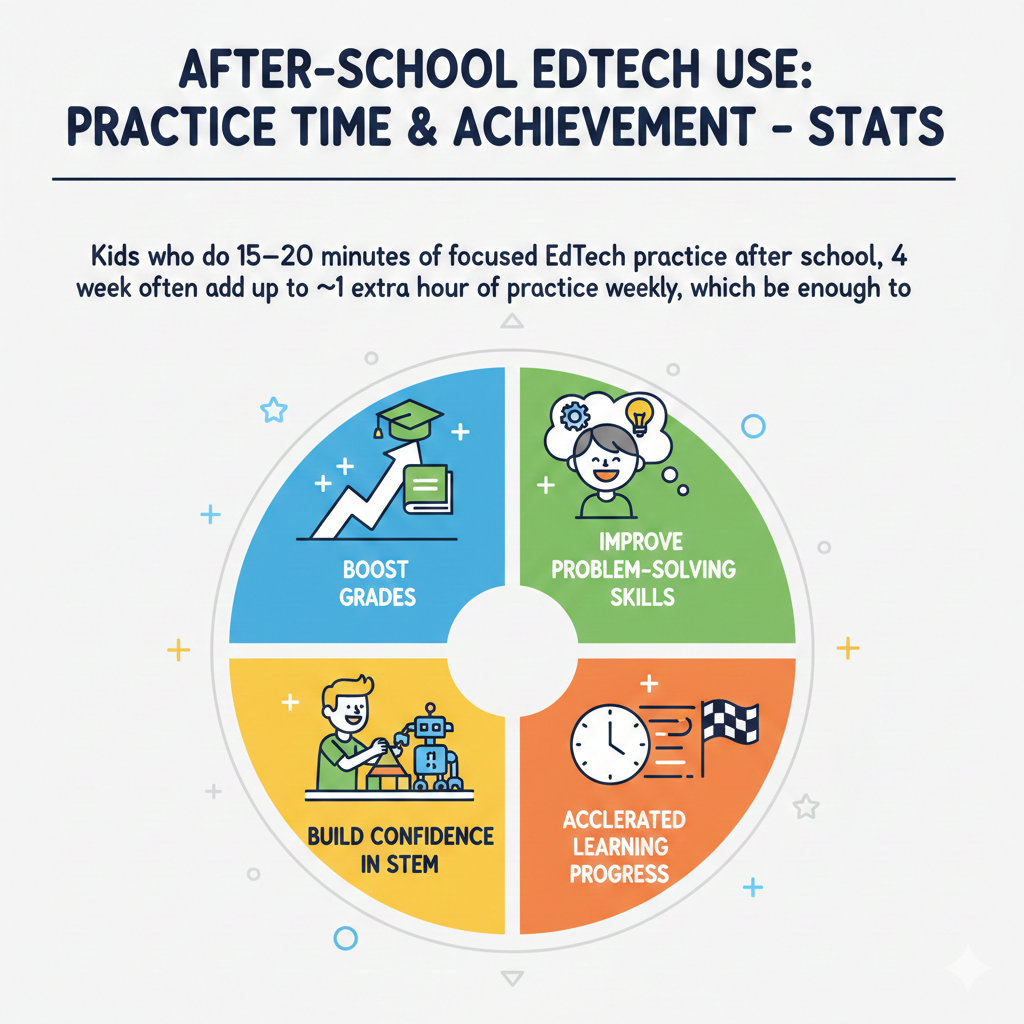
1) Kids who do 15–20 minutes of focused EdTech practice after school, 4 days a week often add up to ~1 extra hour of practice weekly, which is enough to create a noticeable skill gap over a semester.
What this stat really means
Fifteen to twenty minutes feels small, but it is the kind of small that actually happens. That is why it works. One hour of extra practice each week becomes a steady lead over time, especially in skills like math steps, reading flow, and coding logic.
The real difference is not the screen. The difference is repetition with a clear goal, done often enough that the brain starts to store the skill without stress.
How to turn it into a simple routine
Start by picking four days that fit your home. Try Monday to Thursday, so the week ends with less pressure. Choose one fixed time, ideally after a snack and a short break. If your child is drained right after school, give them 15 minutes to breathe, then begin.
The goal is not to force energy. The goal is to use a calm moment.
Make the session “focused” by giving it one job. Not “Do math.” Instead, “Practice multiplying by 6 and 7,” or “Solve three word problems slowly,” or “Finish one coding puzzle and explain what it does.” When the job is clear, your child knows when they have succeeded, and that creates motivation.
Keep the environment ready. Device charged, app open, headphones nearby, and a notebook beside them. A notebook is not for long writing. It is for one small note like a tricky step, a rule, or one mistake they learned from.
End the session with one gentle question: “What did you learn today?” Then stop. This small wrap-up helps the brain lock in the learning and makes tomorrow easier to start.
If you want this routine to feel lighter, choose a platform where lessons are guided and game-like, so the child feels progress fast. Debsie’s mix of teacher-led structure and gamified practice is designed for exactly this kind of short, steady habit.
2) A common pattern is that each extra 30 minutes of weekly, well-targeted practice is linked with about 1–3% better test performance compared with doing none.
What this stat really means
This is not magic, and it is not luck. Tests reward skills that are used often. When practice is targeted, even half an hour a week can help because it strengthens the exact skill that shows up on school work.
The phrase well-targeted matters more than the minutes. Thirty minutes on the wrong level or the wrong topic can feel busy but produce little change. Thirty minutes on the right skill can be the difference between “I kind of get it” and “I can do it.”
How to make the 30 minutes count
First, find the weak point. Do not guess the whole subject. Look for the moment your child slows down or gets annoyed. In math, it may be carrying, fractions, or word problems. In reading, it may be sounding out, main idea, or speed. In coding, it may be loops, conditions, or debugging.
Next, pick one focus for the whole week. Keep it narrow. If your child struggles with word problems, the focus might be “finding the important numbers and words.” If they struggle with reading, the focus might be “reading smoothly for meaning.”
When you focus on one thing, your child sees improvement faster, and that builds confidence.
Then set a simple schedule. You can do two sessions of 15 minutes, or three sessions of 10 minutes. The shape does not matter as much as the target. During practice, insist on slow thinking. If they answer fast and wrong, you are training guessing. If they answer slower and explain one step, you are training skill.
Finally, link practice to school. After practice, ask your child to show one example like the ones they see in class. This makes the practice feel useful, not random.
If you want targeting without the stress of planning every week, structured programs help because the path adapts and teachers can guide what to practice next. That is also why many families use Debsie, since the child stays on the right level and the practice stays meaningful.
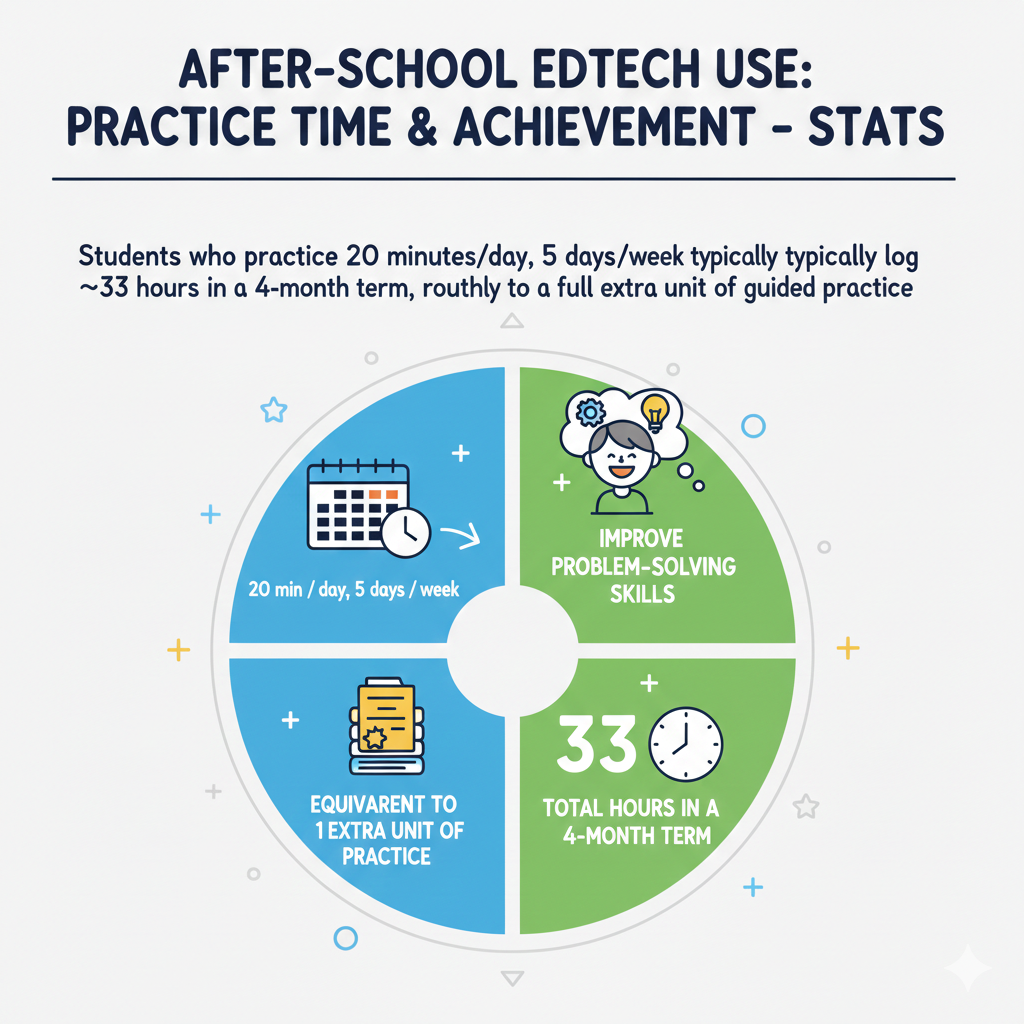
3) Students who practice 20 minutes/day, 5 days/week typically log ~33 hours in a 4-month term, roughly equal to a full extra unit of guided practice.
What this stat really means
Twenty minutes a day sounds like a small habit. Over a term, it becomes about thirty-three hours of real learning time.
That amount of time is large enough to change outcomes, because it creates many chances to review, make mistakes safely, and try again. It is also large enough to build fluency. Fluency is when your child does not just “know it,” but can use it quickly and correctly without panic.
How to use the time wisely
To make these hours work, treat them like a guided unit, not random clicks. Pick a main subject for the term, such as math basics, reading growth, or beginner coding. Then choose a small weekly focus inside that subject.
For example, week one might be multiplication facts, week two might be multi-step problems, week three might be fractions. In reading, you might move from decoding to fluency to comprehension. In coding, you might move from sequences to loops to conditions.
Make the daily session feel predictable. Start with two minutes of warm-up on something easy, so your child gets an early win. Then spend fifteen minutes on the week’s focus at the right level. End with three minutes of quick review of a past skill, so older learning stays strong.
Watch for tired signs. If your child is fading, shorten the session rather than letting it become sloppy. A clean 12 minutes beats a messy 25. Also, keep the difficulty “just right.” If it is too easy, the child gets bored. If it is too hard, they shut down. The best zone is where they can succeed with effort.
If you want those thirty-three hours to be more than time on a device, choose guided lessons with feedback and a clear path. Debsie can help because it gives children structure, and it helps parents avoid the daily question of “What should we do today?”
4) When practice is adaptive (questions change based on the child’s level), learning gains are often ~20–40% higher than when students do the same fixed worksheet set for the same time.
What this stat really means
Adaptive practice is like a coach who watches every move and adjusts the next drill. If your child answers correctly with ease, the practice becomes a little harder. If your child struggles, it slows down and gives support.
This matters because children learn fastest when the work is not too easy and not too hard. Fixed worksheets often miss that “just right” spot. They can be boring for one child and confusing for another, even in the same grade.
How to use adaptive practice at home
Start by checking whether your child’s EdTech tool truly adapts. A simple clue is this: does it change the level based on performance, or does it just show the next page no matter what? Real adaptive practice usually has a placement step, mixed review, and quick changes when the child is stuck.
Next, do not fight the level. Many parents push children into harder sets because they want “challenge.” But challenge without readiness becomes stress. If the tool places your child a little lower than you expected, treat that as good news.
It means the tool is trying to rebuild a missing block. That is how you prevent bigger trouble later.
During the session, watch for guessing. If your child is getting many wrong in a row, pause and ask them to explain the question in their own words. If they cannot explain it, the level is likely too high, or they need a quick concept lesson before more practice.
The best adaptive tools will offer hints, examples, and short teaching moments. Encourage your child to use those supports instead of racing.
Also, make sure the tool reviews older skills. Adaptive learning works best when it brings back past topics at the right time. That keeps learning from fading and prevents the “I learned it last month but forgot it” problem.
If you want adaptive practice without the setup work, choose a platform that uses level checks and guided paths. Debsie’s structured lessons and gamified challenges can help children stay in that “just right” learning zone so their practice time produces real progress.
5) Short daily practice tends to beat weekend cramming: 10–15 minutes/day can lead to ~2× better long-term retention than doing the same total time in one weekend block.
What this stat really means
The brain learns better in small bites spread over time. Weekend cramming can feel productive because you see a lot of work done at once, but much of it fades quickly. Daily practice, even short, helps the brain store the skill in long-term memory.
This is why a child may “get it” on Sunday and still forget it by Tuesday if they only practiced once.
How to build a daily habit that sticks
First, choose the smallest daily plan you can keep. Ten minutes is enough if it is focused. The goal is not to win a marathon. The goal is to show up. Once your child trusts the routine, you can extend it on calmer days.
Second, make the daily session easy to start. Put it at the same time each day. Tie it to something that already happens, like after snack or before dinner. When the session has a clear place in the day, it stops feeling like an argument.
Third, keep the content tight. Daily practice works best when your child touches the same skill multiple times across a week. For example, if they are learning fractions, let them see fractions daily in small ways. If they are improving reading, let them read daily, even a short piece.

If they are learning coding, let them do one small puzzle daily rather than ten puzzles once a week.
Fourth, use a simple memory check. Once or twice a week, ask your child to solve one question without help. This is not a test. It is a “can you recall it” moment. If they struggle, it tells you what to review.
If weekends are your only open time, you can still use this idea. Break the weekend block into two smaller sessions on Saturday and two on Sunday, with gaps between them. That spacing alone improves retention.
Debsie’s approach fits daily learning well because lessons and challenges are designed to be completed in short sessions, helping children build memory without burnout.
6) For many learners, the “sweet spot” for after-school EdTech is 15–30 minutes per session; beyond 45–60 minutes, gains per extra minute often drop sharply.
What this stat really means
More time does not always mean more learning. After school, children have already spent hours focusing. When a session gets too long, the mind gets tired. Tired practice turns into rushed answers, more mistakes, and less real thinking.
That is why the best learning often happens in a moderate window, where the child can stay alert and care about doing it well.
How to find your child’s best session length
Start with 20 minutes for a week and observe. Do they stay calm? Do they finish strong, or do they fade halfway? If they fade, shorten the session. If they finish with energy, you can try 25 minutes. The goal is to end while they still feel capable. Ending in a good mood increases the chance they will return tomorrow.
Use a clear session shape. Begin with a short warm-up, then do the main practice, then stop. Do not add “just one more thing” again and again. That turns a clean session into a long drag.
Also, avoid stacking hard tasks back to back. If your child has homework, tutoring, and EdTech, they may hit overload. In that case, EdTech should be lighter and more focused, not longer. If they must do a longer session once in a while, build breaks into it.
Not long breaks with games, but a two-minute pause to stretch, drink water, and breathe.
Watch for warning signs: fast clicking, silly mistakes, getting angry, or staring into space. Those signs mean the learning window has closed for the day. Stop early and return tomorrow. A child who stops with dignity learns more over time than a child forced to grind until tears.
If you want sessions to stay inside the sweet spot, structured platforms help by offering short lessons with clear endpoints. Debsie’s guided format makes it easier to stop at a natural finish line, so practice stays high-quality.
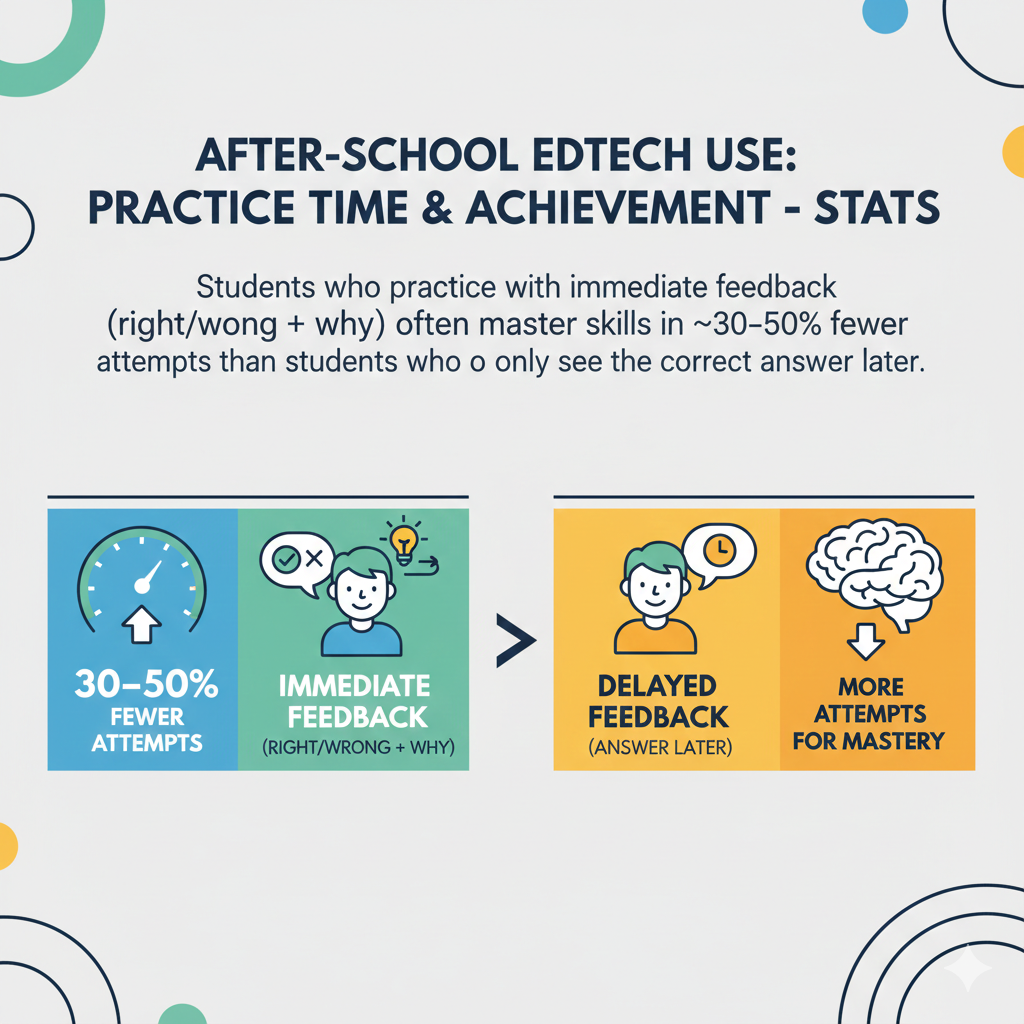
7) Students who practice with immediate feedback (right/wrong + why) often master skills in ~30–50% fewer attempts than students who only see the correct answer later.
What this stat really means
Immediate feedback is like touching a hot stove and learning instantly to pull your hand back. The learning happens in the moment. When a child answers and sees right away what went wrong and why, their brain connects the mistake to the correction. If the correction comes much later, the child often cannot remember what they were thinking, so the lesson does not stick as well.
This matters a lot in after-school practice because time is limited. If your child needs fewer tries to master the same skill, you save time and reduce frustration. The child also feels a steady sense of progress, which keeps motivation alive.
How to make feedback work for your child
First, choose tools that explain, not just score. “Wrong” is not enough. Look for feedback that shows the step that failed or explains the idea in simple words. In coding, that might be a hint about logic. In math, it might show the step where the operation changed. In reading, it might point to the clue in the text.
Second, train your child to pause after feedback. Many kids tap “next” fast. Teach a tiny habit: after a wrong answer, they must read the feedback for ten seconds and then say one sentence about it. It can be as simple as, “I forgot to divide first,” or “I picked the detail, not the main idea.” That one sentence turns feedback into learning.
Third, keep a “mistake note” that stays short. One line per session is enough. The line might say, “Check units,” or “Underline keywords,” or “If loop repeats, check condition.” Over a month, those small notes become a personal guide your child actually understands.
If your child feels embarrassed by mistakes, remind them that mistakes are the fastest path when feedback is immediate. The goal is not to be perfect. The goal is to learn faster.
Debsie’s guided lessons are built with clear feedback and teacher support, so children do not just see a score. They understand the “why,” which makes practice time more powerful.
8) EdTech sessions that include retrieval practice (quizzes from memory) can raise later test scores by ~10–20 percentage points compared with only re-reading or watching videos.
What this stat really means
Retrieval practice means pulling the answer out of your brain without looking. It feels harder than re-watching a video or re-reading notes, but it builds stronger memory. When a child retrieves information, the brain treats it like a skill that must be ready when needed. That is exactly what tests require.
Many kids spend time “studying” in ways that feel comfortable, like watching the same lesson again. Comfort can trick them into thinking they know it. Retrieval practice removes that trick. It reveals what is truly known and what still needs practice.
How to add retrieval practice without stress
Start small. After your child watches a short lesson or finishes practice, ask them to answer one question with no help. One question is enough at first. If they can do it, great. If not, you have found the real gap.
Use short quizzes, not long tests. A two-minute quiz can do more than a twenty-minute re-watch. The goal is to wake up memory, not to punish.
Make the questions simple and clear. In math, ask them to solve one problem like the ones they practiced. In reading, ask them to tell the main idea in one sentence. In coding, ask them what a certain block of code will do. If they struggle, let them look back, then try again from memory. That “try again” is where the growth happens.
Also, mix “old” with “new.” Ask one question from last week’s topic and one from today’s topic. This keeps memory strong across time.
If your child gets nervous, keep the tone calm. Say, “This is practice, not a grade.” Praise effort and honesty, not only correct answers.
Debsie’s challenges can support retrieval because they often require children to apply what they learned, not just watch it. That application is a form of retrieval that boosts achievement.
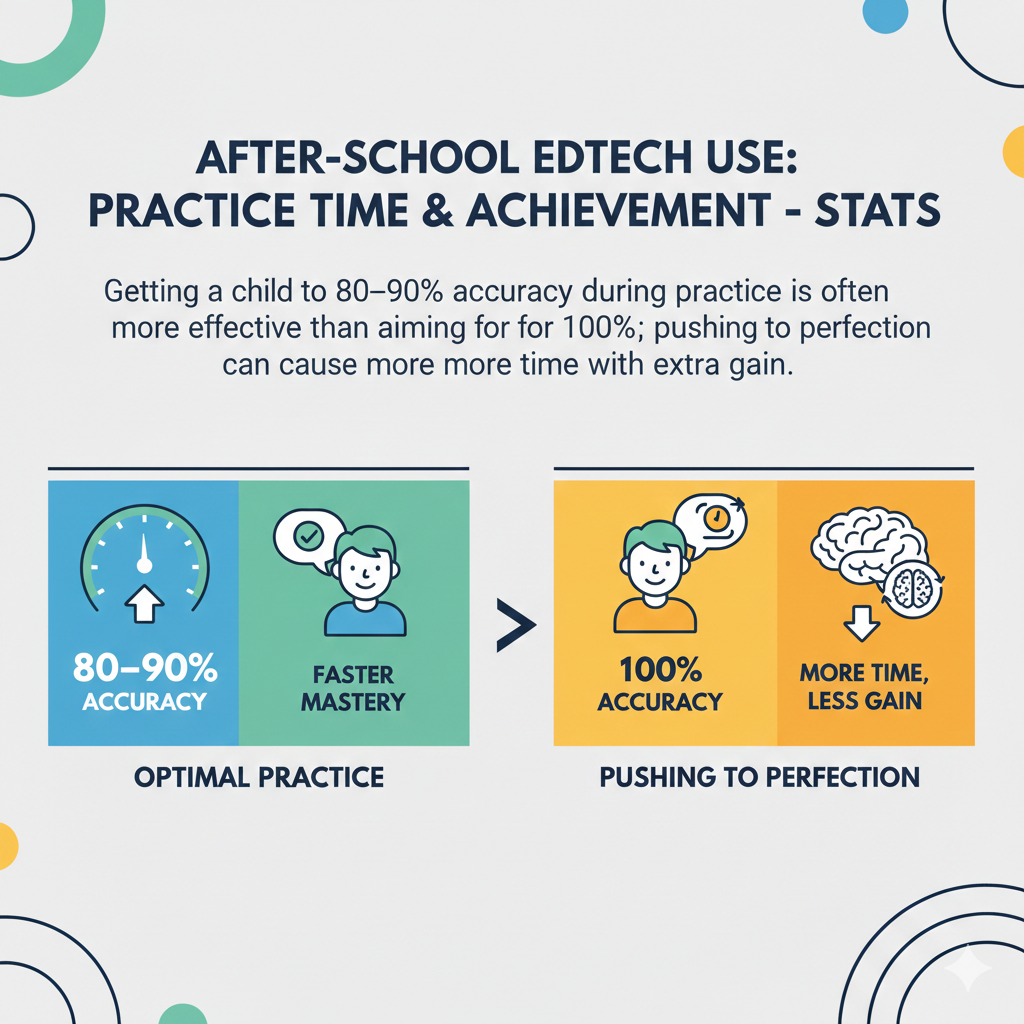
9) Getting a child to 80–90% accuracy during practice is often more effective than aiming for 100%; pushing to perfection can cause more time with less extra gain.
What this stat really means
Perfection sounds good, but it can be costly. When a child tries to reach 100% accuracy, they may spend a lot of time grinding the last few questions. That time can create stress and boredom. Worse, it can teach a child that learning must feel perfect to be “good.” That belief can make them afraid to try harder tasks.
An 80–90% accuracy range is a healthy learning zone. It means the child is mostly successful, but still challenged. That challenge keeps the brain engaged. It also leaves room for mistakes, which are valuable when feedback is used well.
How to use accuracy the right way
First, stop treating practice like a final exam. Practice is where you are allowed to be messy. The goal is growth, not a flawless score.
Second, watch patterns, not single errors. If your child misses one question but understands the idea, that is fine. If they miss the same type of question again and again, that is the signal to slow down and review the concept.
Third, use “smart stopping.” When your child reaches strong accuracy and can explain the steps, end the session. Do not keep going just to chase a perfect number. Ending at a good moment protects motivation.
Fourth, teach your child a calm response to mistakes. Instead of “I’m bad at this,” the phrase becomes, “This is the part I am learning.” That small shift changes how the brain handles challenge.
Finally, raise the difficulty at the right time. If your child is hitting 95–100% easily, the work may be too easy. Increasing difficulty keeps them learning.
Debsie’s level-based paths help families avoid the perfection trap by keeping children in a productive challenge zone. They experience wins, but they also get just enough stretch to grow.
10) A typical mastery target is 2–5 correct-in-a-row per skill; hitting that can cut “forgetting” in the next week by ~25–40% versus stopping earlier.
What this stat really means
Mastery is not “I got it once.” One correct answer can be luck. Two to five correct in a row shows the child can repeat the skill on demand. That repeat ability is what keeps the skill from slipping away after a few days.
When families stop practice right after the first correct answer, the brain has not had enough proof that the skill is stable. The next week, the child feels like they “forgot everything,” even though the real issue was that it never fully settled.
How to use this mastery target at home
Pick one small skill for a session. It could be “subtracting with borrowing,” “finding the main idea,” or “using an if-else condition.” Have your child do items that are clearly on that one skill. When they begin getting items correct, do not stop at the first win. Aim for a short streak.
If your child gets one wrong during the streak, do not restart the whole day with frustration. Pause, review the step, and then let them try again. The point is not punishment. The point is to rebuild the chain correctly.
Keep the streak reasonable. For a new or hard skill, two correct in a row may be enough for that day. For a familiar skill, aim for four or five. The streak should feel like a firm handshake, not a long tug-of-war.
Also, ask for one quick explanation after the streak. If the child can say the step in plain words, that is even stronger than the streak itself. For example, “I divide first because of order,” or “I looked for what the whole paragraph is about, not one detail.”
If your EdTech tool shows mastery badges or skill meters, use them, but do not obsess over them. Use the streak idea as your quiet rule at home.
Debsie’s structured challenges naturally build streak-based mastery because children repeat a skill in varied ways, which helps it stay in memory longer.
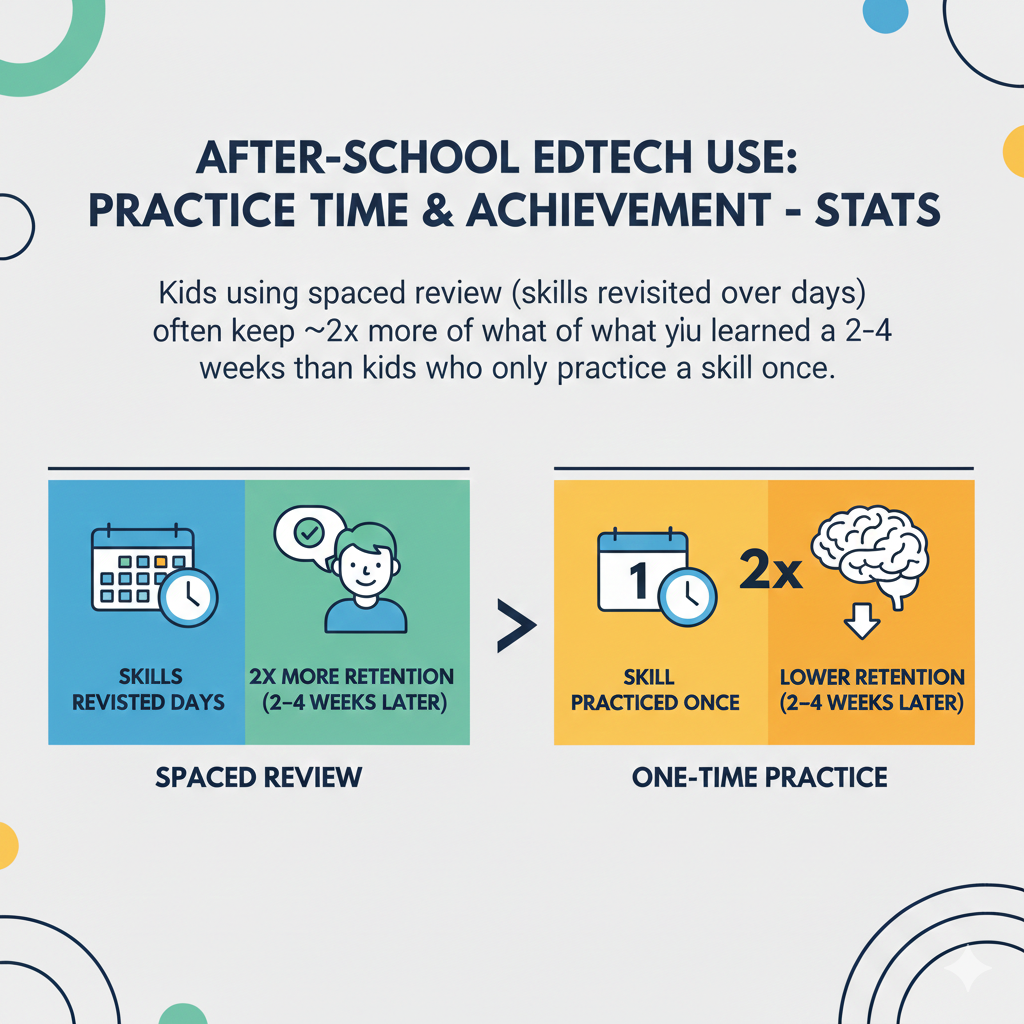
11) Kids using spaced review (skills revisited over days) often keep ~2× more of what they learned after 2–4 weeks than kids who only practice a skill once.
What this stat really means
Spaced review is the simplest memory trick that is not a trick. The brain forgets quickly if it learns something once and never sees it again. But when a child returns to the same skill after a short gap, the brain treats the skill as important and stores it deeper. That is why revisiting over days can double what a child remembers weeks later.
This is especially important for after-school EdTech because many tools move forward fast. A child may finish a unit and feel proud, then struggle later because the older skill was never refreshed.
How to build spaced review into your week
You do not need a complex plan. You need a small loop. When your child learns a new skill on Monday, review it briefly on Wednesday and again on Saturday or next Monday. Each review can be short. Even five minutes can help. The goal is to wake up the memory before it fades too far.
You can do this with a simple “two old, one new” habit. At the start of a session, do two quick questions from older topics, then move to the new focus. Those two questions act like glue.
Another easy method is a weekly review day. One day a week, your child does only review, not new content. Keep it light. The point is confidence and memory, not pressure.
Also, space review works best when the child must recall, not just look. Ask them to solve one problem from memory, then check. If they struggle, let them see the example, then try again.
If your child says, “I already know this,” that is fine. The review will be quick, and the confidence boost is real.
Debsie’s learning paths can support spaced review because good programs bring back older skills on purpose, not by accident, so children keep what they worked hard to gain.
12) Practice that mixes topics (“mixed practice”) can feel harder but often boosts test performance by ~10–25% compared with practicing one topic at a time for the same minutes.
What this stat really means
Mixed practice feels harder because the brain cannot go on autopilot. When a child practices only one type of problem again and again, they can learn the pattern of the set, not the skill itself. On tests, the problems are mixed.
The child must decide what tool to use. Mixed practice trains that decision skill, which is why it often improves scores.
In real life learning, knowing what to do is just as important as doing it.
How to use mixed practice without overwhelming your child
Begin with a small mix. Do not mix ten topics at once. Mix two. For example, in math, mix multiplication and division. In reading, mix main idea and a simple inference question. In coding, mix loops and conditions in a small way.
Start the session with a short block of focused practice on the main skill. Then add a few mixed questions near the end. This order reduces stress because the child first warms up, then practices choosing.
Teach your child to ask one calm question before answering: “What kind of problem is this?” That one pause is the heart of mixed practice. Over time, it becomes automatic.
If your child gets confused, do not label them as careless. Confusion is normal at the start of mixed practice. Instead, help them sort the problem. Ask, “What is the question asking for?” and “What information matters?” This teaches thinking, not guessing.
Mixed practice works best when the child already has some basic skill. If the skill is brand new, start with single-topic practice first, then begin mixing as soon as they can do it with support.
Debsie’s challenges often include mixed tasks in a game-like way, which helps children build test-ready thinking without feeling like they are being drilled.
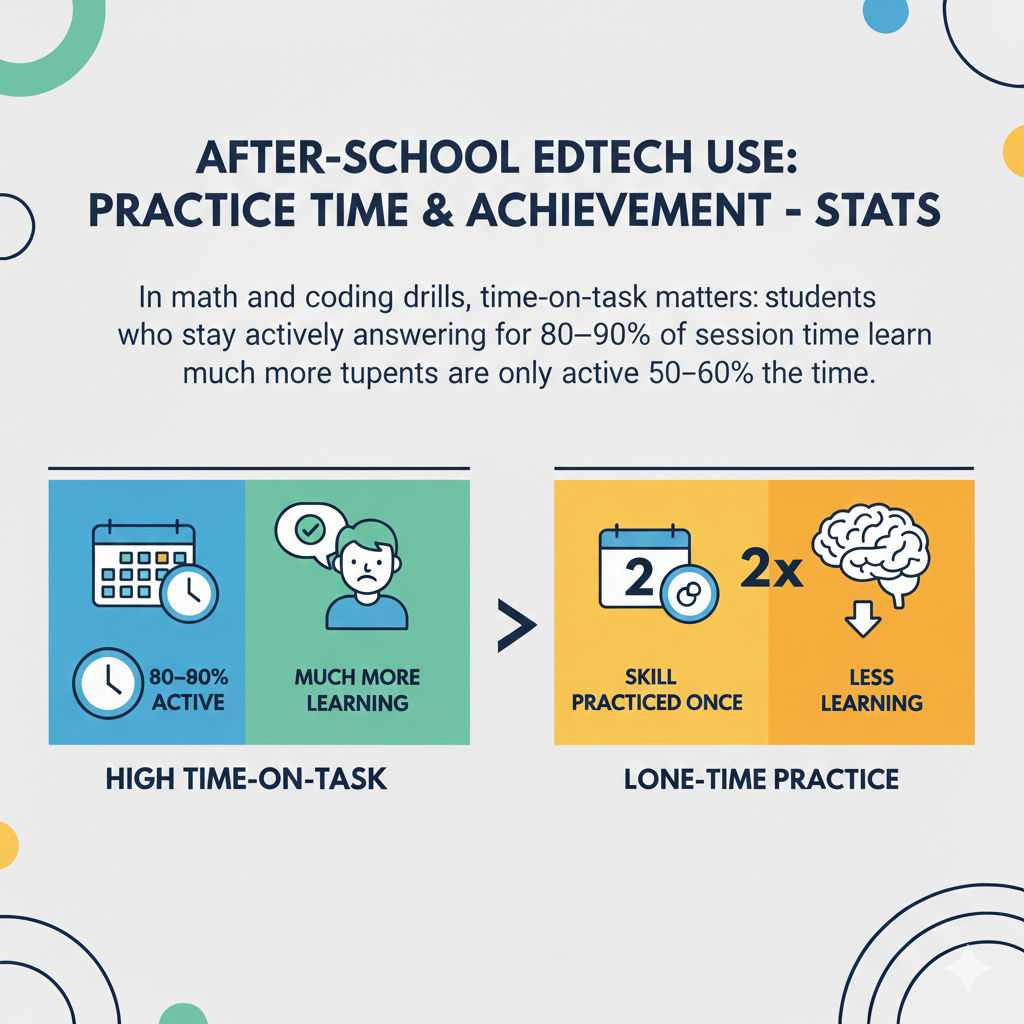
13) In math and coding drills, time-on-task matters: students who stay actively answering for 80–90% of session time learn much more than students who are only active 50–60% of the time.
What this stat really means
Two children can “spend” the same 20 minutes on EdTech and get very different results. The difference is active time. Active time is when the child is actually thinking, solving, typing, and checking.
Passive time is when they are staring, wandering, waiting, switching tabs, or clicking without focus. When active time stays high, the brain gets more practice reps, and those reps turn into skill.
This is one reason some parents feel EdTech “doesn’t work.” Often, the tool is fine, but the session is not truly active.
How to increase active time without being strict
First, set a clear session goal before starting. One goal keeps the mind in one place. For example, “Complete five fraction questions carefully,” or “Finish one coding level and fix one bug.” Clear goals reduce drifting.
Second, reduce friction. If the child must log in, search, and choose a lesson, they lose minutes before learning begins. Keep logins saved. Keep the right app ready. If possible, create a simple learning shortcut on the home screen.
Third, use a small timer that the child can see. Not as a threat, but as a guide. Say, “We are doing 15 minutes of active work.” Many kids focus better when the end is visible.
Fourth, set one rule that stops wandering: during practice, no switching apps. If the device is too tempting, use guided access or a similar focus setting.
Finally, keep your check-in short. You do not need to hover. Walk by once and ask, “What are you working on?” That quick moment often brings attention back without conflict.
If your child struggles with staying active, choose shorter sessions and more frequent breaks across the week. Also, use platforms that feel engaging and guided. Debsie’s lessons and challenges are built to keep kids doing, not just watching, which naturally lifts time-on-task.
14) If an after-school EdTech session has more than ~20–30% idle time (scrolling, tab switching, waiting), achievement gains commonly drop by ~15–30%.
What this stat really means
Idle time is the silent thief of progress. It looks harmless because the child is still “at the screen,” but learning is not happening. If a session has lots of waiting and wandering, the child may finish with little to show for it. Over weeks, that loss adds up and can make a child feel stuck, even if they are “doing EdTech” regularly.
Idle time also changes mood. When a child drifts, practice feels longer and more annoying, which makes future sessions harder to start.
How to cut idle time in a gentle way
Begin by noticing where idle time comes from. Some kids drift because the lesson is too hard. Others drift because it is too easy and boring. Some drift because they are hungry or tired. The fix depends on the cause.
If the work is too hard, lower the level or add a short teaching moment before practice. A child cannot “focus” their way through confusion for long. They need clarity first.
If the work is too easy, raise the level slightly or switch to tasks that require thinking, like word problems, reasoning questions, or coding challenges.
If the child is tired, shorten the session. A clean 12 minutes with low idle time beats 25 minutes with half drifting.
Also, clean up the environment. Turn off extra devices. Keep the TV off during practice. If siblings create noise, try headphones.
A strong tool is the “one-screen rule.” During practice, only one learning screen stays open. No browsing for answers. No jumping between apps. If they need help, they ask you or use the tool’s hint system.
You can also end the session early if idle time grows. Say, “It looks like your brain is done for today. We’ll try again tomorrow.” This protects the habit and avoids turning learning into a fight.
Debsie’s guided structure can reduce idle time because lessons are clear, interactive, and paced, so children are less likely to drift.
15) Consistency is huge: students who practice 3+ days/week often outperform those practicing 1 day/week even when total time is similar, by about ~5–15% on skill checks.
What this stat really means
This is the difference between “sometimes” and “often.” The brain does not like long gaps. When practice happens only once a week, the child spends part of that session re-learning what they forgot. When practice happens three or more days a week, less time is wasted on warm-up, and more time is spent moving forward.
Even if the total minutes are similar, the spacing and repetition create stronger memory. That is why consistent practice often produces better skill checks.
How to build consistency that feels doable
First, make the minimum plan small. A plan that is too big will not repeat. A plan that is modest can repeat for months. Try 10–20 minutes per session, three to five days a week.
Second, choose days that match your family rhythm. If Tuesdays are chaotic, do not fight Tuesdays. Pick days that have fewer surprises. Consistency is not about being perfect. It is about being predictable most of the time.

Third, keep the start simple. Many kids resist starting more than they resist learning. Create a “start ritual” that takes one minute. It could be getting water, opening the app, and setting a timer. When the start is smooth, consistency rises.
Fourth, track progress in a calm way. A simple streak calendar works, but keep it friendly. If a day is missed, do not punish. Just return the next day. The goal is a long habit, not a perfect record.
Finally, connect practice to confidence. Tell your child, “Three days a week keeps skills warm.” Warm skills feel easier at school. Easier school builds self-belief.
If you want consistency without constant reminders, Debsie can help because scheduled classes and gamified paths make practice feel like a regular part of life, not an extra chore.
16) “Two-week drop-off” is common: in many apps, 30–60% of new users reduce usage sharply by week 2 without reminders, streaks, or a clear plan.
What this stat really means
The first week is often driven by excitement. The second week is driven by habit.
Most families lose momentum because the new routine collides with real life: homework piles up, activities run late, and the child’s first frustration shows up. When usage drops at week two, it is not because the child “can’t learn.” It is usually because the routine was never protected, or the child did not feel quick wins.
This is good news, because it means the problem is fixable. You do not need a new child. You need a better system.
How to beat the week-two drop
Start by planning for week two from day one. Keep the sessions short in week one, even if your child asks for more. The goal is to create an easy habit, not to use maximum time.
Next, make the routine visible. Put the practice time on the family schedule like any other activity. If it is “optional,” it will be replaced. If it is “normal,” it will stay.
Then build quick wins. Choose practice that your child can succeed at within the first five minutes. Success creates the feeling of “I can do this,” which is the fuel that carries them past the second week.
Also, reduce friction. Save logins. Keep the right device charged. Choose one platform and one path. Switching between many tools often causes drop-off because it becomes confusing.
Finally, expect one hard day and plan how you will respond. When your child complains, do not argue. Offer a smaller version: “Let’s do just 8 minutes today.” Keeping the chain alive matters more than doing the full plan every time.
If you want support that naturally prevents drop-off, Debsie helps because live classes create accountability and the gamified system keeps kids feeling progress, not pressure.
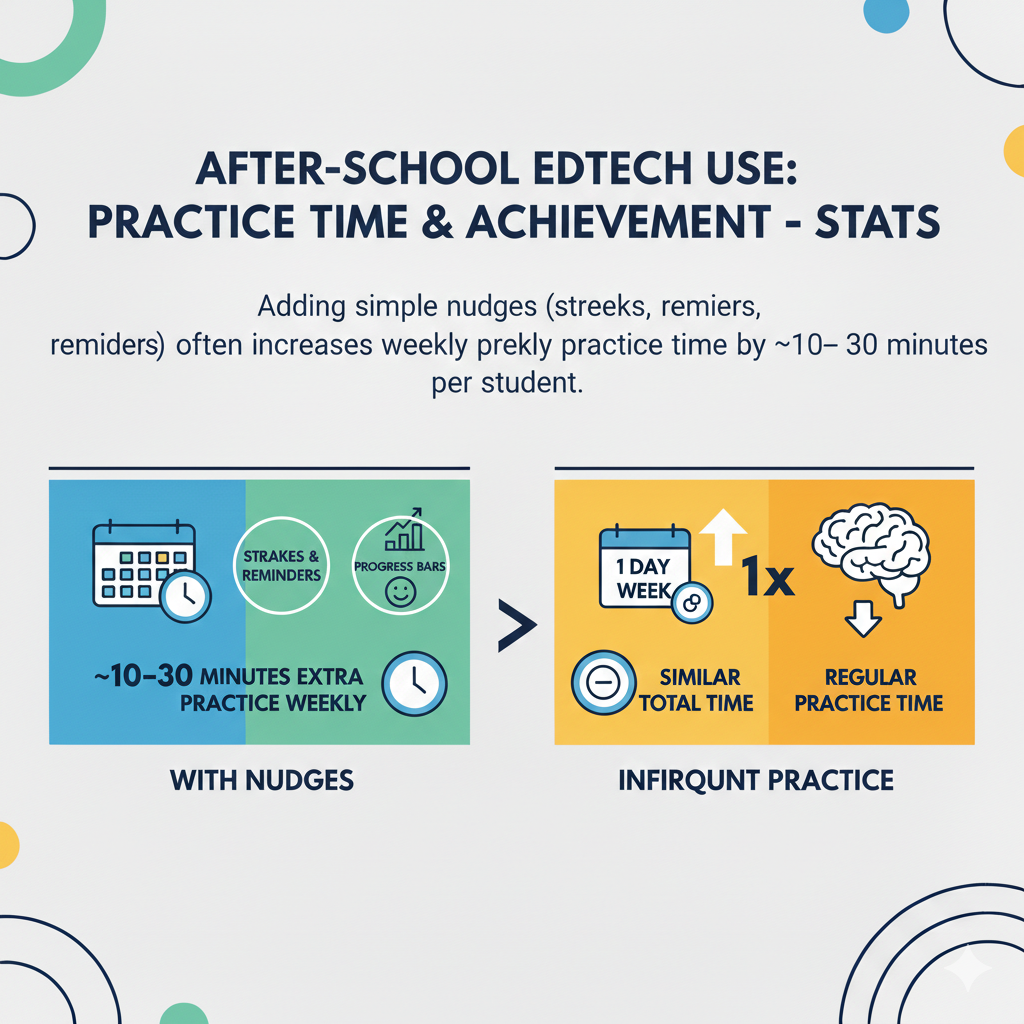
17) Adding simple nudges (streaks, reminders, progress bars) often increases weekly practice time by ~10–30 minutes per student.
What this stat really means
Children are not robots. Adults are not either. We all respond to cues. A nudge is a small push that makes the next action easier. Streaks and progress bars work because they make progress visible. Reminders work because they remove the need to remember.
These tools do not replace motivation, but they protect it when the day is busy.
Ten to thirty extra minutes each week may not sound huge, but over months it becomes many hours of extra learning.
How to use nudges the right way
First, pick nudges that match your child’s personality. Some children love streaks and feel proud. Other children feel anxious if a streak breaks. If your child is sensitive, use progress bars instead of streaks. The nudge must help, not stress.
Second, keep reminders gentle and consistent. Use one reminder time, not many. Too many reminders become noise and get ignored. One well-timed reminder, like right after snack, works better.
Third, celebrate progress in a simple way. When your child moves a bar forward or finishes a lesson set, notice it. A short comment like, “I see you moved up,” is enough. You do not need big rewards. Big rewards can make children practice only for the reward. Small recognition keeps the focus on growth.
Fourth, use “next-step” nudges. At the end of a session, leave the app at the exact next lesson. That way, tomorrow starts in one tap. This is one of the most powerful nudges because it removes decision-making.
Debsie’s gamified design uses progress markers and goal-based challenges in a balanced way, which can add practice time without turning learning into a constant bargain.
18) When parents set a fixed routine (same time daily), kids are often ~2× more likely to keep practicing for a full term than when practice is “whenever.”
What this stat really means
A fixed routine removes daily debate. “Whenever” sounds flexible, but it often becomes “later,” and later becomes “not today.” When practice has a home in the schedule, the child stops seeing it as a surprise. It becomes normal, like brushing teeth.
This also protects the parent-child relationship. Less negotiation means less tension. The child knows what to expect, and the parent does not have to chase.
How to build a routine that survives real life
Choose a time that is realistic, not ideal. Many families pick a time that sounds good but collapses under homework, dinner, or fatigue. Look at your evenings and find a steady pocket. For some families, it is right after school. For others, it is after dinner. For others, it is early morning.
Anchor the routine to a trigger. The trigger could be “after snack,” “after homework check,” or “before screen fun.” A trigger turns the routine into a chain. When the trigger happens, practice starts.
Make the routine short enough that it does not feel like a punishment. If your child knows it will end in 15–20 minutes, they can tolerate it even on rough days.
Use a calm start phrase. Say the same words each day, like “It’s practice time.” Repetition reduces drama because the brain treats it as a normal script, not a new fight.
Also, plan for exceptions. If a day is packed, do a mini-session. A mini-session protects the routine, even if it is only five to eight minutes.
If you want routines that are easier to keep, Debsie’s scheduled classes can act as a strong anchor, and the self-paced challenges fit neatly into the same daily time slot.
19) For many learners, the first 5 minutes decides success: if a session starts with an easy win, completion rates can rise by ~10–20%.
What this stat really means
Most children do not refuse learning because they hate learning. They refuse because starting feels hard.
After school, the brain is already full. If the first question is confusing, the child’s stress rises fast, and the session can fall apart before it begins. But if the first five minutes give an easy win, the child’s brain relaxes and says, “I can do this.” That feeling is powerful. It turns resistance into movement.
An “easy win” does not mean “baby work.” It means something your child can complete with confidence, using skills they already have. That early success creates momentum, and momentum carries them through the tougher part of the session.
How to engineer an easy win every day
Begin with a two-minute warm-up that your child can do smoothly. In math, it might be three quick problems of a known type. In reading, it might be a short paragraph they can read fluently. In coding, it might be a small puzzle they have solved before, or a quick task like fixing one simple error.

Then shift into the main work while the confidence is still warm. The trick is to keep the warm-up short. If the warm-up becomes the whole session, you lose progress. Think of it as opening a door, not living in the doorway.
Also, protect the first five minutes from distractions. Do not start while they are still eating, arguing, or watching videos. Give them a clean start. A clean start makes the easy win possible.
If your child often melts down at the start, reduce the session length for a week and focus only on smooth starts. Once starts are calm, you can increase challenge.
Debsie’s lessons often open with friendly, guided steps and quick success moments, which helps children begin without fear and stay to the end.
20) Students who do after-school EdTech plus brief teacher/mentor check-ins (even 5–10 minutes/week) often achieve ~20–50% bigger gains than EdTech alone.
What this stat really means
EdTech is a tool. A mentor is a guide. When you combine them, learning becomes faster and cleaner. A short weekly check-in can prevent a child from practicing the wrong thing for weeks. It can also fix small misunderstandings before they become big gaps.
Even five to ten minutes matters because the mentor can spot patterns the child cannot see.
This is also about motivation. When a child knows someone will ask about progress, they take practice more seriously. Not out of fear, but because it feels like their effort is seen.
How to add a check-in without making life complicated
If you are the one doing the check-in, keep it simple and calm. Once a week, sit with your child for ten minutes. Ask them to show you one thing they learned and one thing that felt hard. Then ask them to explain one problem out loud while they solve it. Listening to their thinking is more useful than checking a score.
If you notice a repeated mistake, do not correct everything. Pick one correction that will unlock many questions. For example, “Let’s slow down and underline what the question is asking,” or “Let’s check the order of steps,” or “Let’s see why the loop is not ending.”
If you can use a teacher, tutor, or structured program, use that support as a weekly compass. Ask the mentor for one clear focus for the next week. That focus turns daily practice into a targeted plan.
This is one reason families choose Debsie. The platform mixes guided practice with experienced teachers, so children get both the daily reps and the weekly direction that makes those reps count.
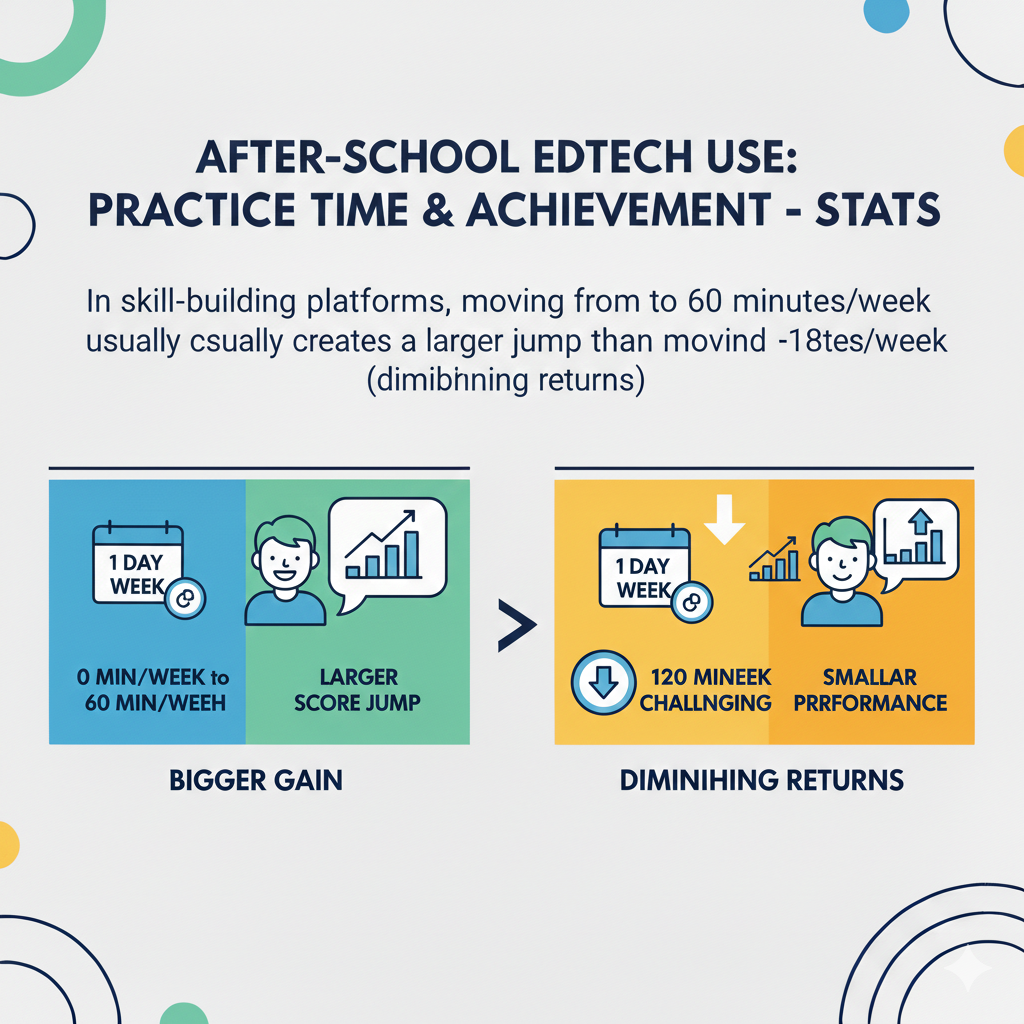
21) In skill-building platforms, moving from 0 minutes/week to 60 minutes/week usually creates a larger score jump than moving from 120 to 180 minutes/week (diminishing returns).
What this stat really means
The first hour is the biggest lever. If a child goes from no practice to one hour a week, the impact can be dramatic because they begin building familiarity, routine, and basic fluency.
But as time increases, each extra hour helps a bit less, especially if the child is tired or the practice is not well designed. This is called diminishing returns, but the idea is simple: after a point, more time is not the main problem. Quality and focus become the main problem.
This is reassuring for busy families. You do not need huge blocks of time to see real growth. You need a steady first hour that is used well.
How to use this stat to plan your week
If your child currently does almost no practice, set a goal of 60 minutes a week first. Do not jump to three hours. Sixty minutes can be done as four sessions of 15 minutes, or five sessions of 12 minutes. Pick the shape that fits your home.
Make that first hour high-quality by keeping it focused, active, and matched to your child’s level. If your child is already doing two hours a week and progress feels slow, do not automatically add more time. Instead, improve the practice.
Add immediate feedback. Add spaced review. Add a weekly check-in. Raise the level if it is too easy. Reduce idle time if attention is drifting.
Also, protect recovery. A tired child does not learn well. If your child has heavy school days, keep EdTech shorter on those days and slightly longer on lighter days.
Debsie’s lesson design helps families get more from the first hour, because the practice is structured, guided, and game-like, which improves quality without needing extra time.
22) A common learning curve: the first 5–10 hours of targeted practice can produce the fastest growth, with progress slowing after ~20–30 hours unless content level increases.
What this stat really means
Early progress often feels exciting. A child starts practicing a skill, and improvement shows up quickly. This is normal because the brain is building the first strong connections. But after a while, growth can slow.
Parents sometimes worry and think the child has “hit a wall.” In many cases, the child has not hit a wall. The practice has hit a plateau because the level is no longer rising, or the tasks are too similar.
This is also why children can spend many hours on the same type of easy questions and still not move forward much. Once a basic pattern is learned, the brain needs a new challenge to keep growing.
How to use the curve to keep progress moving
First, expect the curve. Tell your child, “The first part grows fast. Later, we grow by leveling up.” This sets a healthy mindset and prevents disappointment.
Second, track progress in a simple way. Look at what your child could not do two weeks ago that they can do now. Even small changes matter, like fewer hints needed, faster solving, or better explanations.
Third, raise the level at the right moment. A clear sign is when your child is getting high accuracy with low effort.
If they are answering correctly without thinking much, the level is too easy. Increase difficulty slightly, not suddenly. In math, move from single-step to two-step. In reading, move from basic questions to “why” questions. In coding, add one new concept, like a condition inside a loop.
Fourth, change the task type. If your child has only practiced drills, add application. Have them solve one real-world word problem, write a short summary, or build a tiny coding project.
If progress still feels slow after you raise the level, add better feedback and spaced review instead of adding more time.
Debsie helps here because guided paths naturally increase difficulty as the child improves, so the curve stays healthy and growth does not stall.
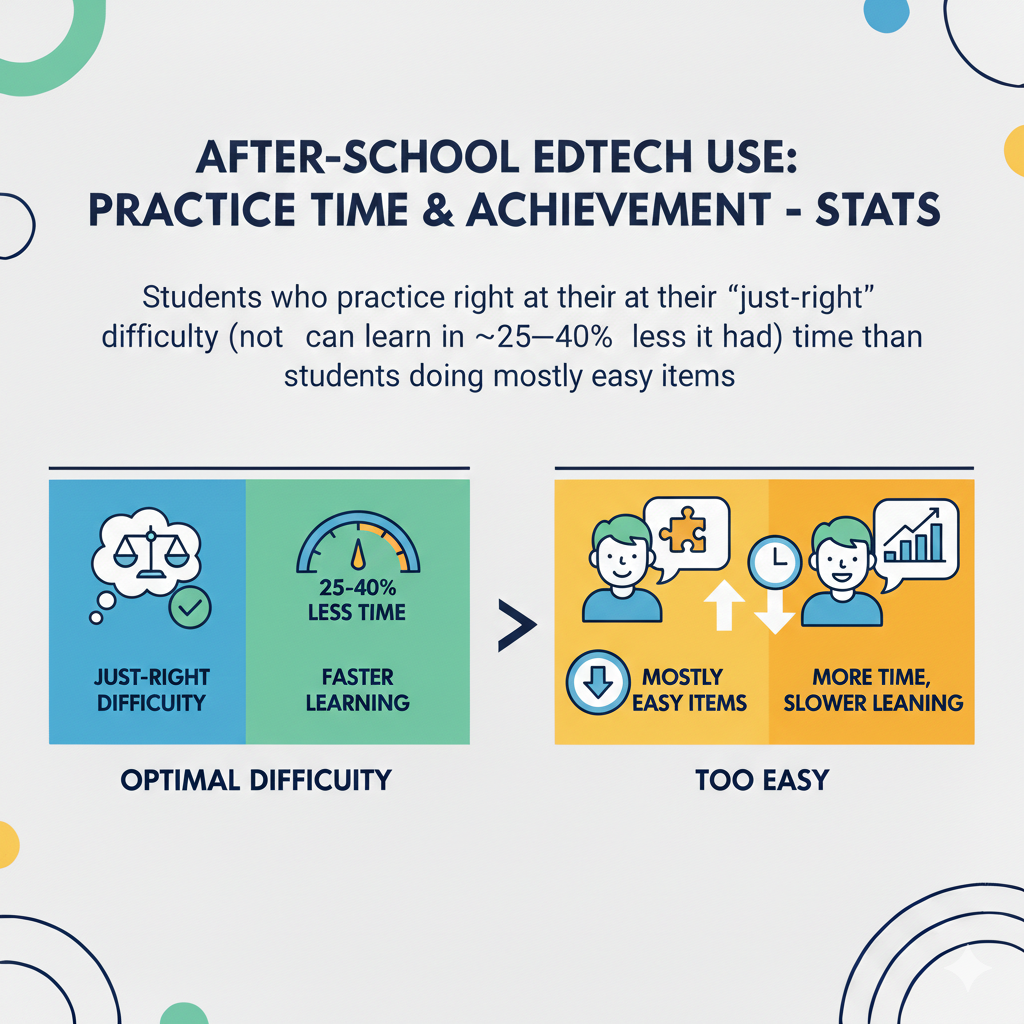
23) Students who practice right at their “just-right” difficulty (not too easy, not too hard) can learn in ~25–40% less time than students doing mostly easy items.
What this stat really means
The “just-right” level is where learning is fastest. If work is too easy, the child repeats what they already know and wastes time. If work is too hard, they guess, get frustrated, and stop. The just-right level is the zone where the child succeeds with effort. They may need hints sometimes, but they are not lost.
This is why two children can spend the same time practicing and get different results. The child in the just-right zone is building new skill with every session.
How to find the just-right level at home
Use a simple rule: the child should get many questions right, but not all. If they are correct almost every time, raise the level slightly. If they are wrong most of the time, lower the level or add teaching before practice.
Watch the child’s behavior. In the just-right zone, they are thinking, pausing, and trying. They may feel challenged, but they stay engaged. In the too-easy zone, they race, talk about other things, or look bored. In the too-hard zone, they avoid, complain, or shut down.
Also, listen to their explanations. If they can explain a step in simple words, the level is likely right. If they cannot explain anything and only guess, the level is too high.
If the tool you use does not adapt well, you can still adjust manually. Choose practice sets by difficulty. Move up one small step at a time. Do not jump levels because the child had one good day.
Finally, protect confidence. The just-right zone should feel like “I can do hard things,” not “I always fail.” If your child is anxious, lower difficulty for a few sessions, then build up again.
Debsie’s level-matched lessons support this zone because the platform aims to keep children challenged but not overwhelmed, saving time while improving results.
24) If practice is too hard (accuracy below ~60%), many kids disengage; raising accuracy into the 70–85% range often improves session completion by ~15–35%.
What this stat really means
When children miss too many questions, their brain stops trying. This is not laziness. It is a normal response to repeated failure.
Below about 60% accuracy, many kids feel lost, and they protect themselves by quitting, joking, or refusing. But when accuracy rises into a healthier band, they feel capable again. They are more likely to finish sessions and return tomorrow, which is where real progress is made.
Completion matters because learning is built from repeated sessions, not one perfect day.
How to lift accuracy without making practice “easy”
First, lower the difficulty one step. Parents sometimes avoid this because they worry it is “going backward.” It is not backward if it helps the child learn properly. A strong foundation speeds up future learning.
Second, break the skill into smaller pieces. If your child struggles with multi-step word problems, practice only identifying what the question asks for. Then practice choosing the operation. Then practice solving. Small pieces raise accuracy quickly.
Third, use hints as teaching, not as a shortcut. Teach your child to read hints slowly, then attempt again. If they click through hints just to finish, accuracy may rise but understanding will not.
Fourth, slow down the pace. Many wrong answers come from rushing, not from lack of ability. Encourage a pause before answering, especially in reading and word problems.
Fifth, add one quick review of a prerequisite skill. If fractions are hard, review multiplication facts. If coding loops are hard, review simple sequences. Accuracy often rises when the missing “earlier” block is repaired.
Debsie’s structured approach helps maintain that 70–85% zone by guiding children with supports and proper leveling, which keeps them engaged and completing sessions consistently.
25) When learners explain answers (short “why” prompts), correct understanding often improves by ~10–20% compared with clicking answers without explanation.
What this stat really means
A child can get the right answer for the wrong reason. That is why “why” matters. When a learner explains their thinking, even in one short sentence, the brain organizes the idea more clearly. Explanation forces the child to slow down, notice steps, and spot gaps. It also prevents blind guessing, which is one of the biggest reasons practice time gets wasted.
The goal is not long speeches. The goal is simple reasoning in plain words. One clear line is enough to make learning stronger.
How to build the “why” habit without making it annoying
Start with a tiny rule: once per session, your child must explain one answer out loud. Only one. Keep it light. Ask, “Why did you choose that?” or “How did you know?” If they answer with “I just did,” guide them with a choice: “Was it because of the keyword, the rule, or the pattern?” That helps them find words.
In math, “why” can sound like: “I divided because it says each,” or “I multiplied because it’s groups,” or “I did parentheses first.” In reading, it can be: “This sentence shows the main idea,” or “The character feels sad because of this clue.” In coding, it can be: “This loop repeats until the condition is false,” or “The bug happened because the variable never changed.”
If your child is shy, let them write a short reason instead. One line in a notebook works well. Keep the notebook simple and private, not something that looks like extra homework.
Over time, add a second “why” moment, but only when the first one feels normal. The habit should feel like a small upgrade, not a burden.
Debsie’s teacher-led sessions and guided tasks naturally include explanation moments, which helps children build real understanding instead of just finishing levels.
26) For reading apps, doing 20 minutes/day of structured practice is often linked with gains around ~0.3–0.6 grade levels over a semester for many students (bigger for struggling readers).
What this stat really means
Reading grows through steady contact with words. Twenty minutes a day is long enough to build fluency, improve accuracy, and grow comprehension, especially when practice is structured. Structured means the child is not only reading random text. They are working on the right level with support, learning new words, and answering questions that build meaning.
The range of growth can be larger for struggling readers because small daily practice repairs the basics that were missing. When the basics improve, everything gets easier: school subjects, instructions, and even confidence.
How to make 20 minutes of reading EdTech work
First, choose the right level. If the text is too hard, the child will guess words and hate reading. If it is too easy, they will not grow. A good sign is that they can read most words but still meet a few new ones.
Second, split the 20 minutes into two parts. Spend about 12–15 minutes reading, then 5–8 minutes answering short questions or doing word practice. This balance builds both speed and meaning.
Third, include a tiny “sound check” for younger kids or struggling readers. If they stumble on a sound pattern, pause and practice it for one minute. Small fixes repeated daily create big change.
Fourth, encourage reading with a calm voice. Do not correct every mistake. Correct the mistakes that change meaning, then let them continue. Too much correction can make reading feel like punishment.
Fifth, add one short “tell me” moment. Ask, “What was this part about?” If they can tell you, comprehension is growing.
Debsie supports reading growth through guided practice and engaging lessons that keep children reading consistently, without making it feel heavy.
27) For math fluency tools, 10–15 minutes/day can increase speed and accuracy by ~15–30% over 8–12 weeks when practice is consistent.
What this stat really means
Math fluency is not only about knowing the concept. It is also about being able to use it smoothly. When children become more fluent, they spend less mental energy on basic steps and more energy on the harder thinking parts, like word problems. That is why short daily fluency practice can produce big results in a few months.
Speed alone is not the goal. The real goal is confident, correct solving at a steady pace.
How to run daily math fluency the smart way
Pick one fluency focus for two weeks at a time. For example, addition facts, multiplication facts, fraction equivalents, or simple equations. Keep the focus narrow so the brain builds automatic skill.
Use a short daily session, about 10–15 minutes. Begin with a quick warm-up of very easy items to build confidence. Then move into the main drill at the just-right level. End by fixing one mistake pattern, not all mistakes. One pattern per day is enough.
Teach your child one fluency behavior: check work. Even in short drills, ask them to scan for careless mistakes. Fluency without checking can train fast errors.
If your child feels pressure, remove the timer at first. Let them build accuracy before speed. Once accuracy is stable, you can add gentle timing in a friendly way, like “Let’s see if you can do two more than yesterday.”
Also, connect fluency to real tasks. After fluency practice, do one word problem that uses the same math. This helps your child see why fluency matters.
Debsie’s math paths combine practice with explanation and challenge, helping children build fluency while still understanding the “why,” so speed grows without shallow learning.
28) In coding practice platforms, students who build 1 small project per week are often ~2–3× more likely to keep learning for 3+ months than students who only do isolated puzzles.
What this stat really means
Puzzles are useful. They teach one skill at a time. But projects create ownership. When a child builds something small each week, learning stops feeling like a set of tasks and starts feeling like making real things. That shift is why projects keep kids learning longer. The child begins to think, “I am a creator,” not “I am finishing levels.”
Projects also connect ideas. In a puzzle, a child might use a loop and forget it the next day. In a project, the loop becomes part of a game or animation, and the child remembers it because it has a purpose.
How to run weekly projects without adding stress
Keep projects tiny. One small project per week can be done in 30–60 minutes total. You can split it into two short sessions. The project does not need to be perfect. It needs to be finished.
Choose simple project types that repeat with small upgrades. For example, a “catch the object” game that changes levels each week, a short quiz game with new questions, a simple animation with new characters, or a story scene where the child adds one new action.
Give the child a clear finish line. A finish line could be: “The character moves with arrow keys,” or “The score increases,” or “The quiz shows a result.” When the finish line is clear, the child does not get lost.
Make reflection part of the project. At the end, ask the child to show you what they built and explain one piece of code. This builds confidence and strengthens learning.
If your child gets stuck, do not take over. Ask guiding questions: “What do you want to happen?” “What is happening now?” “What could you change?” That teaches problem-solving.
Debsie’s coding approach fits this well because it blends skill practice with creative builds and guided support, helping kids stay engaged for the long run.
29) Kids who review mistakes (error-correction mode) for just 5 minutes per session can reduce repeated errors by ~20–40% compared with kids who skip mistake review.
What this stat really means
Mistakes are not the enemy. Repeating the same mistake is the enemy. Many children finish practice and want to move on quickly. But a short mistake review is where learning becomes sharp. Five minutes is enough to notice a pattern and fix it.
Over time, those patterns disappear, and your child’s confidence rises because they feel in control.
This is also a smart use of time. Instead of doing more random questions, you fix the exact thing that is causing wrong answers.
How to do mistake review in a simple, calm way
At the end of each session, pick one mistake only. Do not review everything. Reviewing everything can feel heavy and can shame the child. One mistake keeps it manageable.
Ask your child two questions. First: “What did you do?” Second: “What should you do next time?” Keep the answers short. If they cannot answer, show them one example and let them try again.
Then create one “rule line.” A rule line is a simple sentence your child writes or says. For example, “Underline what it asks,” “Check the sign,” “Multiply before adding,” or “Update the variable inside the loop.” The rule line becomes the child’s personal guardrail.
Next session, start by reading the last rule line for ten seconds. This tiny step prevents the same error from coming back.
If your child feels embarrassed, keep the tone neutral. Say, “This mistake is useful. It tells us what to practice.” When a child sees mistakes as information, they become braver learners.
Debsie’s guided format helps because feedback and correction are part of the learning flow, so children do not just move past errors. They learn from them.
30) Across many learning tools, students who reach ~2–3 hours/week of meaningful after-school practice often show the clearest achievement gains, while those under ~30 minutes/week usually show little to no measurable change.
What this stat really means
Achievement gains often need a minimum dose. Under 30 minutes a week, practice is too thin to create strong memory and skill.
At around two to three hours a week, the child gets enough repetition and review for progress to show up clearly. This does not mean every child must do three hours. It means that meaningful growth usually needs consistent time, spread across days, with good focus.
The keyword is meaningful. Two hours of distracted clicking is not the same as two hours of active practice with feedback, review, and the right level.
How to plan 2–3 hours without overloading your child
Spread the time across the week. Five days of 25 minutes is about two hours. Six days of 20 minutes is also about two hours. If your child has heavy school days, do shorter sessions on those days and slightly longer sessions on lighter days.
Make the time meaningful by combining the best elements. Include adaptive practice so the level stays right. Include retrieval so memory strengthens. Include spaced review so learning does not fade. Include a short mistake review so errors do not repeat.
When these parts are present, you often need less time to get the same results.
Also, protect rest. If your child is exhausted, do not force long sessions. Reduce time, improve quality, and return tomorrow. Consistency beats intensity.
If you want a plan that is easier to keep and more effective, Debsie can be a strong fit because it offers structured learning, engaging practice, and expert teachers. Families can start with a free trial class and see how guided support turns after-school time into steady progress.
Conclusion
After-school EdTech works best when it is treated like a simple, steady system, not a random activity. The stats you read all point to the same truth: short, focused practice done often, at the right level, with feedback, review, and small check-ins, creates real progress.
You do not need to push long sessions or chase perfect scores. You need a routine that your child can repeat, week after week, without stress.