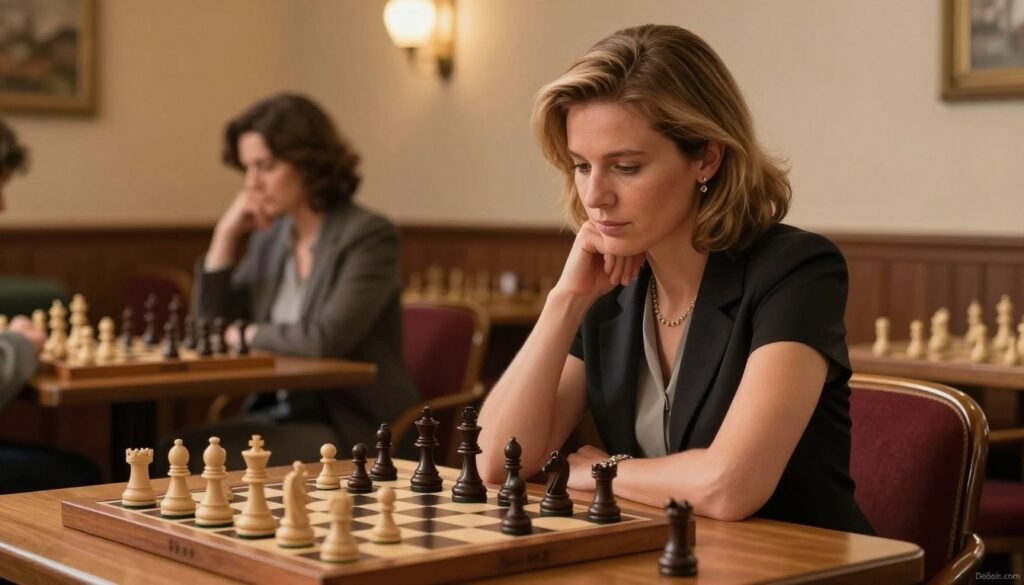
Susan Polgar’s story is not just a chess story. It is a story about courage, focus, and proving people wrong with calm, smart moves. Born in Hungary, Susan became the top-rated female chess player in the world at age 15 and later became Women’s World Chess Champion in 1996. She also broke a huge barrier by becoming the first woman to earn the Grandmaster title through the same kind of norms and rating path used by men.
Find the right learning experience
Tell us a little about the learner and what you are looking for. Our team will review your answers and help you identify the most suitable next step.
- Takes only a few minutes
- No payment required
- Personalised recommendations
Your information will only be used to respond to your enquiry.
Susan Polgar’s story starts with a bold family belief that kids can grow into great thinkers.
Susan Polgar was born in Budapest, Hungary, in 1969. Her chess story began in a home where learning was not treated like a race, but like a daily habit. Her father, László Polgár, believed that great skill is not just something a child is born with.

He believed it can be built with steady training, love, focus, and a clear plan. Susan and her sisters, Sofia and Judit, grew up in this special learning world, with chess as a big part of their home education.
That idea may sound normal now, but at the time it was bold. Many people did not believe girls could reach the very top in chess. Susan’s life helped prove them wrong.
Susan did not become strong by magic, and that is the most useful part of her story.
When parents hear about a chess star, it is easy to think, “My child could never do that.” But Susan’s story teaches the opposite lesson. Her rise came from small steps done again and again.
She studied, played, lost, fixed mistakes, and came back stronger. That is exactly why her story matters for young chess students today. It shows that skill grows when a child gets the right coach, the right practice, and the right mindset.
Find the right learning experience
Tell us a little about the learner and what you are looking for. Our team will review your answers and help you identify the most suitable next step.
- Takes only a few minutes
- No payment required
- Personalised recommendations
Your information will only be used to respond to your enquiry.
Susan won her first chess tournament at age four, scoring a perfect 10 out of 10 in the Budapest Girls’ Under-11 Championship. By age 12, she had won the World Under-16 Girls Championship.
By age 15, she became the top-rated female chess player in the world. These are huge results, but the lesson behind them is simple. She learned early that hard work feels better when there is a clear path.
The real lesson for kids is that strong habits beat fear.
This is where Susan’s story connects so well with what we teach at Debsie. A child does not need to start as a champion. A child needs a place where mistakes are safe, effort is praised, and thinking is trained step by step.
Chess gives children a special kind of practice. They learn to pause before acting. They learn to ask, “What happens next?” They learn that one bad move does not mean the game is over.
That lesson is bigger than chess. It helps in school, sports, friendships, and daily life. A child who learns to think before moving a knight can also learn to think before giving up on a hard math problem. A child who learns to stay calm after losing a piece can also learn to stay calm after making a mistake in class.
Susan Polgar’s early years show us that talent is not enough by itself. Talent needs a plan. It needs care. It needs the right kind of pressure, not harsh pressure, but healthy pressure that says, “You can do more than you think.”
That is why parents looking for a smart activity for their child should take chess seriously. It is not just a board game. It is a thinking gym.
At Debsie, children get that same kind of steady support through expert-led online chess classes, private coaching, and friendly tournaments. The goal is not only to create better players. The goal is to help children become better thinkers.
Susan’s path is proof that when a child is guided with patience and purpose, the board can become a place where confidence grows.
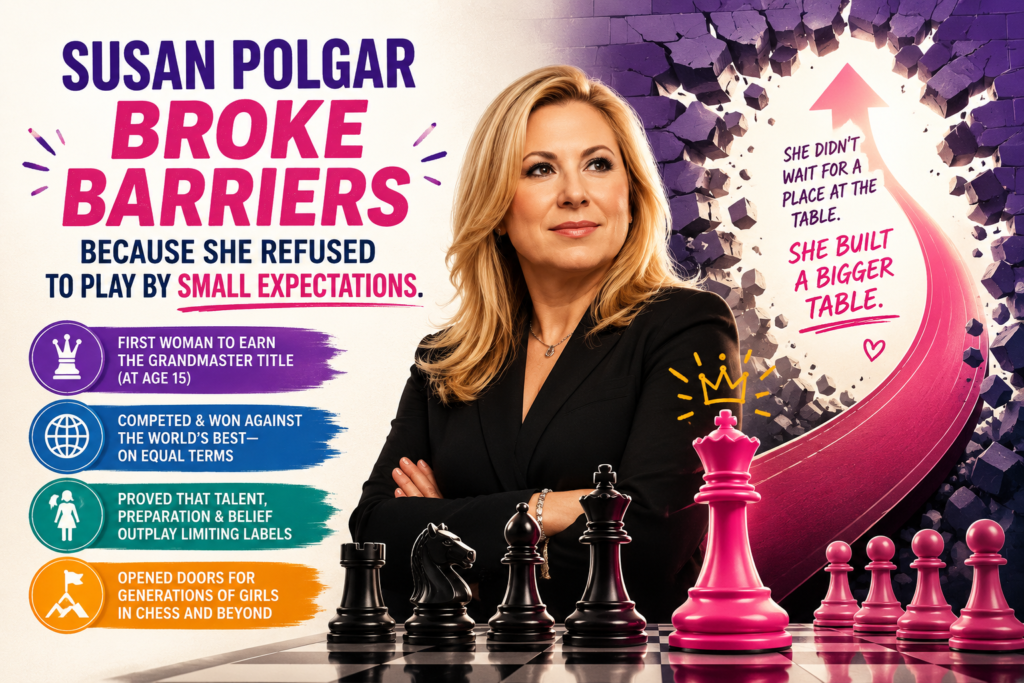
Susan Polgar broke barriers because she refused to play by small expectations.
For many years, chess was treated like a boys’ club. Girls could play, of course, but they were often pushed into smaller spaces. Many people expected women to compete only with women. Susan Polgar did not accept that limit.
She wanted to test herself against strong players, no matter who they were. This is one of the biggest reasons her career still matters.
Her Grandmaster title changed the way people saw women in chess.
In 1991, Susan became the first woman to earn the Grandmaster title through the standard path of norms and rating. That detail matters. It means she did not receive the title as a special award or a shortcut.
She earned it by meeting the same type of performance standards used in top chess. The World Chess Hall of Fame also notes that she became the first woman to earn the title by norms and rating, a key moment in chess history.
That was not just a personal win. It was a public message. It told young girls, parents, coaches, and chess leaders that women could fight on the same board and under the same rules. It pushed the chess world to rethink old ideas. Susan did not need loud words to make the point. Her games made the point for her.
The board became her way of answering doubt.
Every strong chess player faces doubt. Susan faced more than most because she also carried the weight of gender bias. In 1986, she qualified for the Men’s World Championship cycle but was not allowed to play because of her gender, according to FIDE’s Commission for Women’s Chess.
That kind of moment could make a player bitter or tired. Susan kept going.
That is a powerful lesson for children. Life will not always feel fair. A child may work hard and still not get picked. A child may study and still lose a game. A child may feel left out because someone else is louder, faster, or more confident. Chess teaches children how to keep thinking even when things feel hard.
Susan’s career shows children that calm strength matters. She did not become great by waiting for the world to be perfect. She became great by using every game as proof. She showed up prepared. She trusted her work. She kept improving.
For parents, this is one of the best gifts chess can give. Children learn that obstacles are not stop signs. They are problems to solve. That is a life skill. It is also one of the reasons Debsie’s chess program is built around guided learning, not random practice. Kids need more than moves.
They need a coach who can help them understand why a move works, why a plan failed, and how to think better next time.
This is where Susan’s story becomes very practical. She did not just play fast tricks. She played with structure. She knew how to build pressure. She knew how to use small gains. She knew how to make opponents feel uncomfortable without taking wild risks.
Those are the same ideas a growing student can learn, even at a beginner level.
When a child joins a Debsie trial class, the first aim is not to make the child memorize long openings. The first aim is to help the child enjoy thinking. Once a child enjoys thinking, real growth begins. Susan Polgar’s career is a reminder that the right thinking habits can break old limits.
Susan Polgar became a world champion because she mixed courage with control.
Susan Polgar won the Women’s World Chess Championship in 1996 by defeating Xie Jun of China. That win made her one of the most important women in chess history. But the way she reached the top is just as important as the title itself.

Susan was not only sharp. She was steady. She could attack, but she did not attack for show. She could defend, but she did not defend in fear. Her chess had a grown-up balance that young players can learn from.
Her style was clear, patient, and very hard to break.
Many young players think chess is all about finding checkmate as fast as possible. Susan’s games show a better way. She often built strong positions first. She improved her pieces. She kept her king safe. She took space when it helped. She waited until the right moment to strike. That is the kind of chess that wins not only one game, but many games.
This is a key point for kids. A good player does not rush just because they can. A good player asks, “Is this move useful?” That one question can change how a child plays. It can stop silly blunders. It can slow down panic. It can help children feel more in control.
Susan’s best games often show this pattern. She would slowly take away her opponent’s choices. Then, when the position was ready, she would find the clean tactic. This is why her games are so good for students. They do not only teach flashy moves. They teach timing.
One of the smartest things children can learn from Susan is how to prepare before attacking.
A weak attack starts with hope. A strong attack starts with preparation. Susan understood this deeply. Before going after the king, she wanted her pieces to work together. The queen, rooks, bishops, knights, and pawns had jobs. Nothing was random. This is the kind of thinking that helps kids move from guessing to planning.
At Debsie, this is one of the biggest shifts we help students make. Many children begin chess by asking, “Can I take something?” That is normal.
But as they grow, we help them ask stronger questions. “What is my opponent threatening?” “Which piece is not helping?” “Where should my king be safe?” “What is my plan after this move?” These simple questions build real chess strength.
Susan’s world champion path also shows why confidence must be built the right way. Real confidence does not mean a child thinks they will always win. Real confidence means they know how to keep playing when the game gets hard.
Susan had that kind of confidence. She could sit in a tough position and keep solving problems.
That skill matters far beyond the chessboard. A child who learns to stay calm under pressure becomes better at tests, group work, and hard conversations. A child who learns not to rush becomes better at choices. A child who learns to plan becomes less likely to give up too soon.
This is why Susan Polgar’s career changed more than chess records. It changed the story around what a young girl could become with the right training. It also gave parents a clear message. Do not limit a child too early. Do not say, “This is too hard for them.” Give them a good guide, a safe space, and enough time to grow.
That is the same heart behind Debsie’s free chess trial class. It gives your child a chance to see chess as a fun, calm, and smart place to grow. Susan Polgar’s journey shows what can happen when a child’s mind is taken seriously.
Susan Polgar’s best games teach kids how to win before the final tactic appears.
When people talk about great chess games, they often talk about the final move. They love the checkmate. They love the queen sacrifice. They love the moment when everything explodes. But Susan Polgar’s best games show something deeper.
Find the right learning experience
Tell us a little about the learner and what you are looking for. Our team will review your answers and help you identify the most suitable next step.
- Takes only a few minutes
- No payment required
- Personalised recommendations
Your information will only be used to respond to your enquiry.
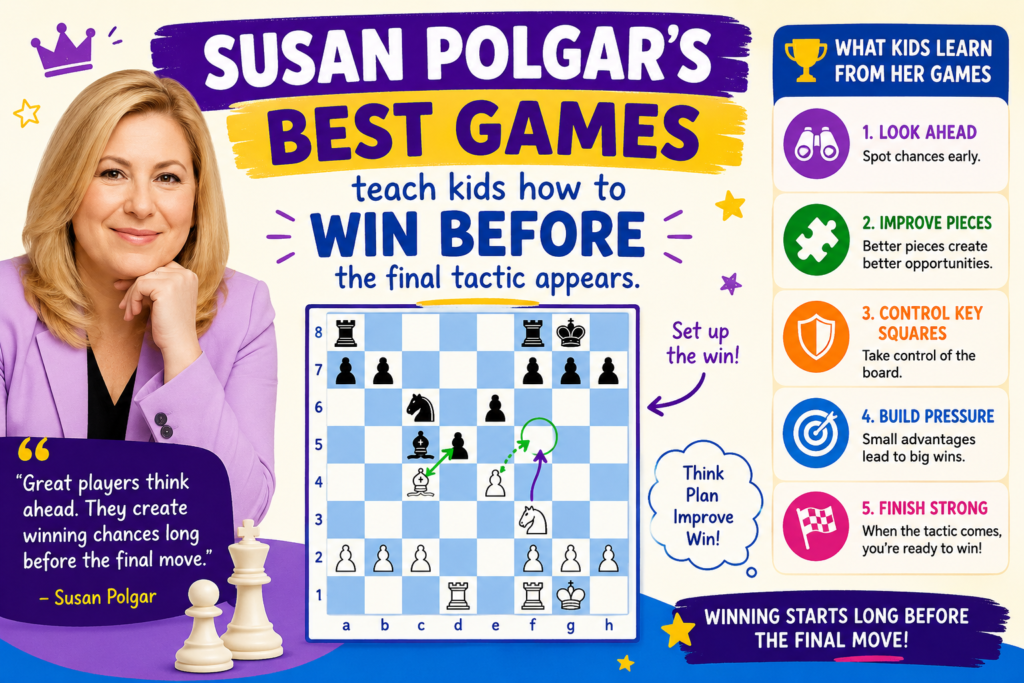
The real win often begins many moves before the tactic. It begins when one player makes better small choices again and again.
Susan’s chess was not wild for no reason. She could attack with power, but her attacks usually had a base. She improved her pieces. She watched weak squares. She placed pressure where the other player could feel it. Then, when the opponent made one small mistake, she was ready.
Her game lessons are perfect for young players because they are clear and useful.
A young chess player does not need to copy a world champion move for move. That can feel too hard. What a child can copy is the way a champion thinks. Susan’s games are full of simple questions that every student can learn to ask. Is my king safe? Is my worst piece doing a job? Is my opponent about to attack me? Can I make a threat without weakening my own side?
Those questions sound simple, but they are powerful. Most beginner games are lost because a child moves too fast. They see one capture and play it. They give a check because checks feel exciting. They attack before their pieces are ready.
Susan’s style teaches the opposite habit. She shows that strong chess is not about noise. Strong chess is about control.
The World Chess Hall of Fame notes that Susan became the top-ranked woman in the world at age 15 and later became the first woman to earn the grandmaster title by norms and rating. That matters because her ideas were tested at the highest level, not only in easy games.
Her thinking had to work against serious players who were trying hard to stop her.
The first lesson from Susan’s games is to improve before you attack.
This is one of the most useful lessons for children. Before attacking, Susan often made sure her pieces were placed well. A knight on a good square can be worth more than a rook that is stuck. A bishop pointing at the king can become dangerous later, even if it looks quiet now. A rook on an open file can slowly turn into a winning weapon.
Parents can see this as a life lesson too. Children often want fast results. They want the answer now. They want the win now. Chess teaches them that smart work comes first. You prepare, then you act. You build, then you strike.
That is how children grow in school as well. A child who learns to prepare in chess may become better at preparing for tests, projects, and hard tasks.
At Debsie, this is exactly how we teach. We do not rush kids into memorizing long lines they do not understand. We help them see the reason behind each move. When a child understands the reason, confidence grows. The child is no longer just copying. The child is thinking.
Susan Polgar’s games are useful because they make chess feel less like guessing and more like planning. That is what every young player needs. A clear plan helps a child stay calm. A calm child makes fewer mistakes. Fewer mistakes lead to better games. Better games lead to more belief.
And that is where the magic starts. A child begins to say, “I can think through this.” That sentence is bigger than chess. It is the start of real confidence.
Susan Polgar changed chess by showing that girls belong in the strongest rooms.
For a long time, many people treated girls in chess like guests, not like future champions. They were allowed to play, but they were not always expected to lead. Susan Polgar’s career helped break that old story. She did not ask for a smaller board.
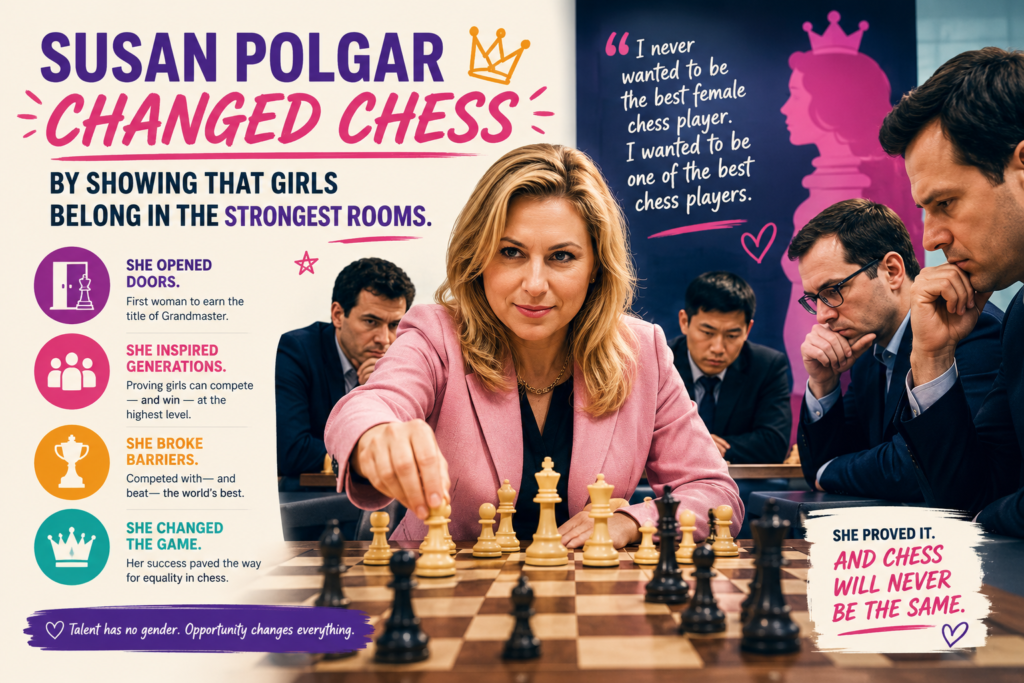
She did not ask for softer rules. She worked, competed, and proved that girls could stand in the strongest rooms.
This is why her impact is still important today. Her career was not only about trophies. It was about opening doors. Every time a girl sits at a board and believes she can win, she is standing on ground that players like Susan helped clear.
Her success helped parents see chess as a serious path for daughters too.
Susan Polgar became Women’s World Chess Champion in 1996 after defeating Xie Jun. She held the title during a key time when women’s chess needed stronger public examples. Britannica notes her 1996 world championship win and describes her as a Hungarian-born American chess player known for helping promote women’s participation in chess.
That point matters for families. Children often believe what adults show them. If a girl only sees boys being praised for chess, she may think chess is not for her. If she sees women champions, women coaches, and girls winning games, her picture changes. She begins to think, “I can be there too.”
That belief is not small. It can shape how a child sees hard subjects, leadership, and competition. Chess can help girls become more comfortable with making decisions. It can teach them to speak through their moves. It can help them trust their own thinking, even when others doubt them.
The deeper change was not only about girls playing chess, but about girls being taken seriously.
Susan’s career made it harder for the chess world to ignore female talent. She was not a side note. She was a world-class player, a champion, a trainer, and later a major voice for chess education.
Her official biography says she founded the Susan Polgar Foundation to promote chess and its educational, social, and competitive benefits for young people, especially girls.
That work matters because access changes lives. A child cannot fall in love with chess if no one invites them to the board. A child cannot grow if no one gives them good coaching. A child cannot gain courage if every space feels cold or unwelcoming.
This is where online learning can help so much. A child does not need to live near a famous chess club. A parent does not need to drive across the city every week. With Debsie, children can learn from expert coaches in a friendly online setting.
They can ask questions. They can play practice games. They can join tournaments. They can learn at a pace that fits them.
For girls, this can be especially powerful. A safe and kind learning space helps them try. It helps them raise their hand. It helps them play without fear of being laughed at. The best chess classrooms do not only teach moves. They teach children that their ideas matter.
Susan Polgar’s story gives parents a clear message. Do not wait for your child to be “ready” to think deeply. Give your child the room to grow now. Girls do not need to be pushed into small dreams. Boys do not either. Chess can give every child a place to test ideas, learn patience, and build quiet courage.
And when a child begins to believe, the board becomes more than a game. It becomes a mirror that says, “You are capable of more.”
Susan Polgar’s career shows that discipline can be kind, not harsh.
Some people hear the word discipline and think it means pressure, fear, or long hours with no joy. Susan Polgar’s story gives us a better way to think about it. Discipline can simply mean showing up often, learning with care, and doing the next right thing. It can mean building good habits in a loving setting.
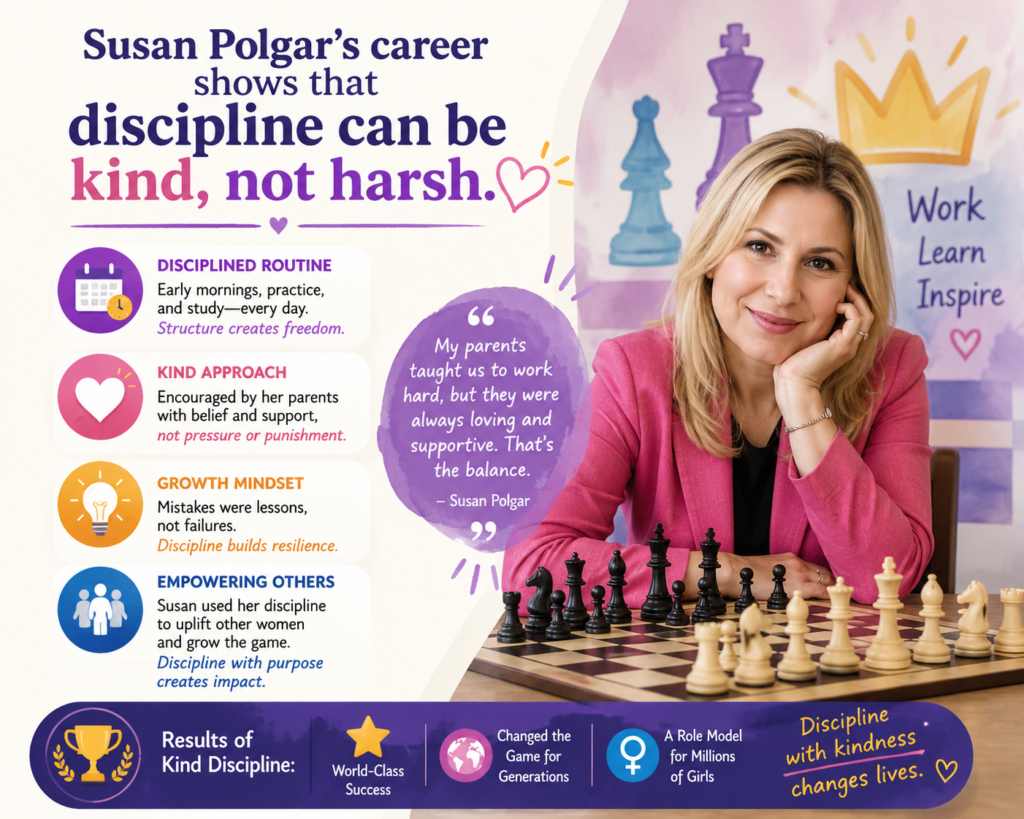
That is an important lesson for parents. Children do not grow best when they are scared. They grow best when they feel supported and challenged at the same time. Chess gives that balance when it is taught well. It has rules, but it also has beauty. It has losses, but it also gives children a way to improve.
The Polgar family’s learning idea was built around steady training and deep focus.
Susan and her sisters were part of a famous home education project led by their parents, László and Klára Polgár. Their father believed that great skill could be developed through early and focused training.
Chess became the main subject in that home. The results were historic. Susan became a world champion, Sofia became an International Master, and Judit became the strongest female chess player in history.
But parents do not need to copy the Polgar home to learn from it. Most children do not need all-day chess study. They need something much simpler. They need steady lessons. They need a coach who explains ideas clearly. They need chances to play. They need someone to help them review mistakes without shame.
That last part is very important. Mistakes are where learning lives. A child who is afraid of mistakes will hide from hard things. A child who learns to study mistakes will grow faster. Chess makes this visible. One move changes the game.
One missed threat teaches a lesson. One careful review can stop the same mistake from happening again.
The best kind of chess training builds patience, not pressure.
Susan’s path reminds us that real growth is not random. A child improves when practice has a purpose. But purpose does not mean the child must feel stressed every day. A good chess class should feel alive. It should have questions, games, puzzles, laughter, and small wins.
At Debsie, this is a big part of the teaching style. Coaches guide students step by step, so children do not feel lost. A beginner learns how pieces work and how to stay safe. A growing player learns openings, tactics, plans, and endgames in a way that makes sense. A more serious student learns how to prepare, review games, and handle tournament pressure.
This matters because children are not machines. They need joy to keep learning. They need wins, but they also need to understand losses. They need challenge, but they also need kindness. When chess training has both, children become stronger without losing their love for the game.
Susan Polgar’s career also shows that learning should not stop after a title. After becoming a champion, she continued to teach, coach, write, and promote chess. The World Chess Hall of Fame lists her as a player, coach, and promoter who has supported youth tournaments and chess education.
That is a beautiful part of her legacy. She did not keep chess to herself. She used her success to help others enter the game. That is what the best teachers do. They turn their own path into a bridge for the next child.
For your child, chess may not lead to a world title. That is okay. The goal is bigger than a trophy. The goal is a child who can sit, think, plan, try, lose, learn, and try again. That kind of child is ready for life.
Susan Polgar’s best lessons can be used in your child’s next game.
Susan Polgar’s career can feel huge, but her lessons are easy to bring down to a child’s board. A student does not need to become a grandmaster to learn from her. A student can begin with one small habit today. That is the power of a great role model. The story is big, but the first step is simple.
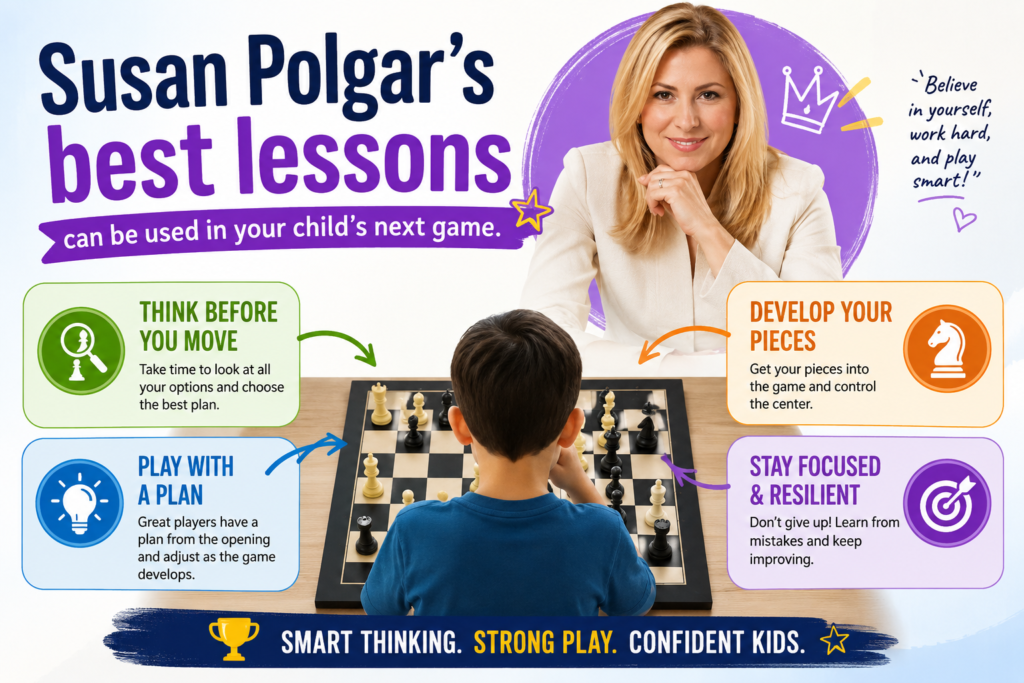
When children study champions, they should not only ask, “What move did she play?” They should ask, “What was she trying to do?” That question opens the door to real chess growth. It helps kids move from copying to understanding.
The most useful habit is to make every piece part of the plan.
Many young players attack with one piece. They bring out the queen early. They chase pawns. They hope for a quick checkmate. This may work against beginners, but it stops working as soon as opponents get stronger. Susan’s games show that pieces should work together.
One piece attacks, another supports, another controls an escape square, and another protects the king.
This is a simple idea, but it changes everything. A child can learn to look at the whole board, not just one exciting square. That helps with focus. It helps with patience. It helps children slow down before making a move.
At Debsie, coaches often help students build this habit through guided questions. Instead of just saying, “That move is wrong,” a good coach asks, “What was your plan?” or “Which piece could help more?” This kind of teaching helps children think for themselves.
A strong player learns to ask better questions before touching a piece.
Here is a Susan-style thought process a child can use without needing hard words. First, look for danger. Then, look for a useful move. Then, check if the move gives something away. Then, make the move with confidence. This habit can save a child from many painful losses.
The same habit helps in life. Before speaking, think. Before rushing, check. Before giving up, look again. Chess gives children a safe place to practice these choices. The board becomes a small world where cause and effect are easy to see.
Susan Polgar’s career changed chess because it gave the world proof. It proved that girls could reach the top. It proved that strong training can shape young minds. It proved that calm, clear thinking can beat old limits. Most of all, it proved that one person’s courage can make the path wider for many others.
That is why her story belongs in a blog for parents and students. It is not just history. It is a guide. It tells parents to believe in their children early. It tells students to keep going after hard games. It tells coaches to teach with care. It tells every young player that the next move matters.
At Debsie, we believe every child deserves that kind of chance. A free trial chess class can be the first small move toward better focus, stronger thinking, and more confidence. Your child does not have to be a champion on day one. They only need to begin.
Susan Polgar’s 1996 match with Xie Jun shows how champions recover after a hard start.
Susan Polgar’s Women’s World Championship match against Xie Jun in 1996 is one of the best places to study her fighting spirit. She did not win because every game was easy. In fact, she lost the first game of the match. For many players, that kind of start can shake the mind.
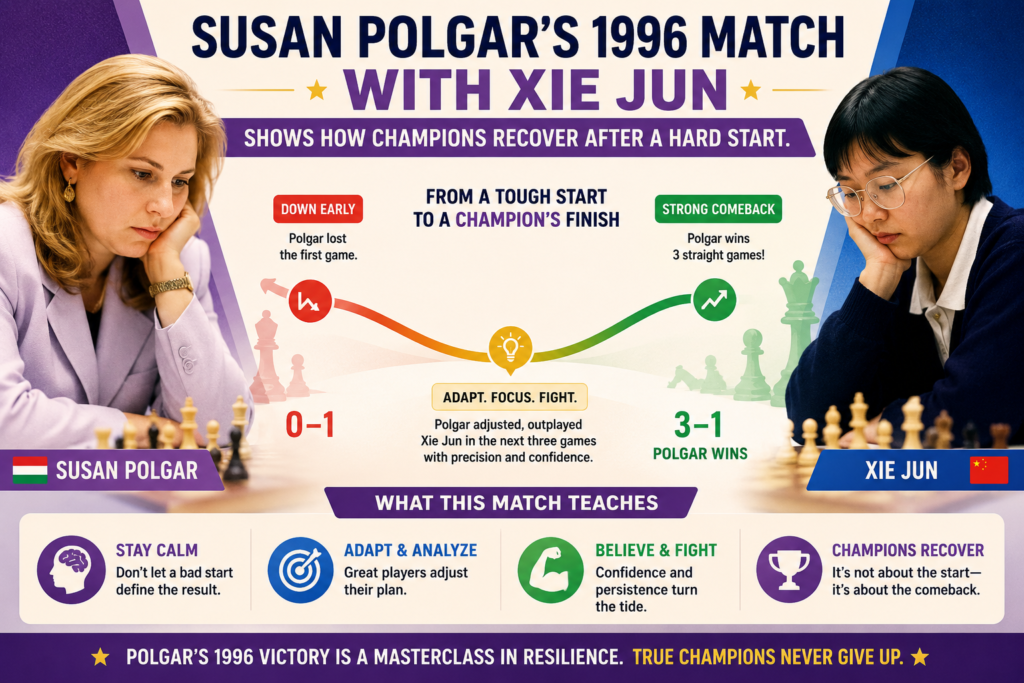
But Susan did what great players do. She stayed calm, adjusted, and kept working. She came back with wins in key games and later won the match 8.5 to 4.5. Chess.com notes that she won games four, five, seven, eight, and then finished the match in game thirteen, which lasted only 24 moves.
The first big lesson from this match is that one loss should not define the whole story.
This is a lesson every child needs. A bad start is not the same as a bad ending. In chess, children often feel upset after one mistake. They may lose a queen and want to stop. They may lose one tournament game and think they are not good.
Susan’s 1996 match teaches the better habit. After a loss, the right question is not, “Am I bad?” The right question is, “What can I fix?”
That is why chess is such a strong tool for growing children. It gives them safe practice in bouncing back. A child learns that feelings are real, but feelings do not have to drive every choice. You can feel upset and still think. You can feel pressure and still find a good move. You can lose once and still win later.
At Debsie, our coaches help students build this exact skill. We do not treat mistakes as shame. We treat them as clues. When a child sees a mistake in the right way, the child becomes braver. They stop hiding from hard positions. They start asking better questions. That is when real growth begins.
The second lesson is that Susan won the match by changing the pressure, not by chasing drama.
The 1996 match was not only about one pretty tactic. It was about match control. Susan kept asking Xie Jun hard questions on the board. Sometimes that meant playing solid chess. Sometimes that meant taking space.
Sometimes that meant using an opening choice to pull the game into a position she liked. The point is simple. She did not need every move to be flashy. She needed every move to serve a purpose.
This is a huge lesson for young players. Many kids think a “good move” must be a check, capture, or attack. But some of the best moves are quiet. A quiet move can stop a threat. It can improve a piece. It can make the opponent’s next move harder. Susan’s best games often show this kind of strength. She would build the position first, then let the tactic appear.
Parents can use this lesson at home too. When your child plays, do not only ask, “Did you win?” Ask, “What was your plan?” That one question teaches deeper thinking. It tells your child that the process matters, not just the score.
And this is also why a free Debsie chess trial class can be so helpful. Children do not just need more games. They need someone to help them understand their games. Once they learn how to review, they start improving faster.
Susan Polgar’s match win over Xie Jun is proof that strong players do not panic after a setback. They learn, reset, and return with a better plan.
Susan Polgar’s fast chess success proves that clear thinking matters under pressure.
Susan Polgar was not only strong in slow classical chess. She also won the Women’s World Rapid and Blitz Championships in 1992. The World Chess Hall of Fame notes that her 1996 classical world title made her the first woman to hold what it calls the triple crown of women’s chess.
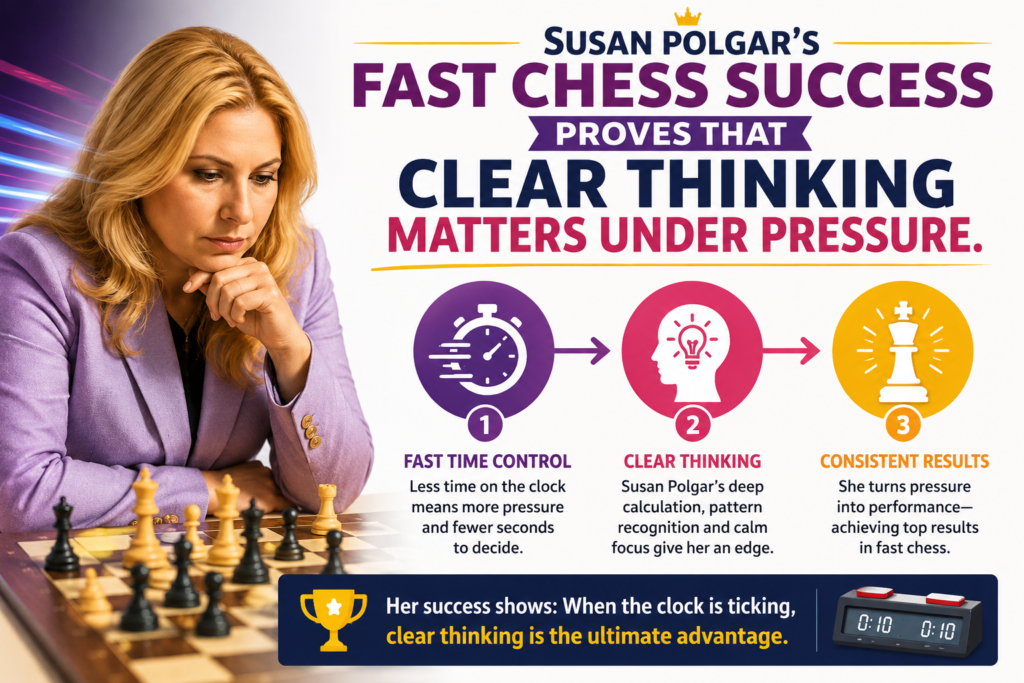
That means she had proven herself across different speeds of the game, from deep thinking to fast decision-making.
Fast chess is a different kind of test. There is less time to think. The clock becomes part of the battle. A player must see danger quickly, trust patterns, and make smart choices without freezing. Susan’s success in rapid and blitz shows that her chess strength was not narrow. She had a deep base of skill that worked even when time was short.
The secret of fast chess is not moving fast all the time.
This sounds strange, but it is true. Good fast chess is not just speed. It is simple thinking. A strong player knows what matters first. King safety matters. Loose pieces matter. Checks, captures, and threats matter. Weak squares matter.
A good plan matters. When these ideas are trained again and again, the mind can find good moves faster.
This is very useful for children. Many kids play too fast because they are excited. They move before checking danger. They grab a piece and lose something bigger. They feel proud of a quick attack, then forget their own king.
Susan’s fast chess success teaches a better kind of speed. First build the right habits. Then speed will come naturally.
At Debsie, we help students build these thinking habits in a calm way. A beginner learns to slow down and check simple threats. A growing student learns patterns like pins, forks, skewers, and back-rank danger.
A tournament student learns how to manage the clock without rushing every move. This kind of training helps children feel more in control, even when the game feels tense.
The real gift of fast chess is learning how to stay calm when time is low.
Every parent has seen a child panic when time is short. It can happen during homework, tests, games, or even daily tasks. Chess gives children a small, safe place to practice calm under pressure. The clock ticks. The position is not easy. The child must breathe, look, and choose.
Susan’s career gives children a clear model. Pressure does not have to break you. It can train you. When a child learns to handle the chess clock, they are also learning to handle stress. They learn not to spend all their time on one small problem.
They learn to choose a good move instead of waiting forever for a perfect move. That is a real life skill.
Fast chess also builds pattern memory. This does not mean blind memorizing. It means seeing common ideas again and again until they become familiar. A child starts to notice when a king is weak. They spot a fork faster. They feel when a rook belongs on an open file. They begin to see the board with more confidence.
That confidence is one reason parents choose chess classes for their children. Chess helps kids feel smart through effort. They can see their own progress. A puzzle that looked impossible last month becomes simple today. A tactic they missed before becomes easy to spot now. That feeling is powerful.
Susan Polgar’s rapid and blitz success reminds us that strong thinking can become quick thinking. The goal is not to make children rush. The goal is to help them think clearly enough that they do not need to panic. That is the kind of growth Debsie aims to build in every student, one class and one game at a time.
Susan Polgar’s career changed chess because she became more than a champion.
Some champions win titles and then stay in the record books. Susan Polgar did more. She became a teacher, coach, writer, and promoter of chess. Her official biography says she founded the Susan Polgar Foundation to promote the educational, social, and competitive benefits of chess, especially for young people and girls.
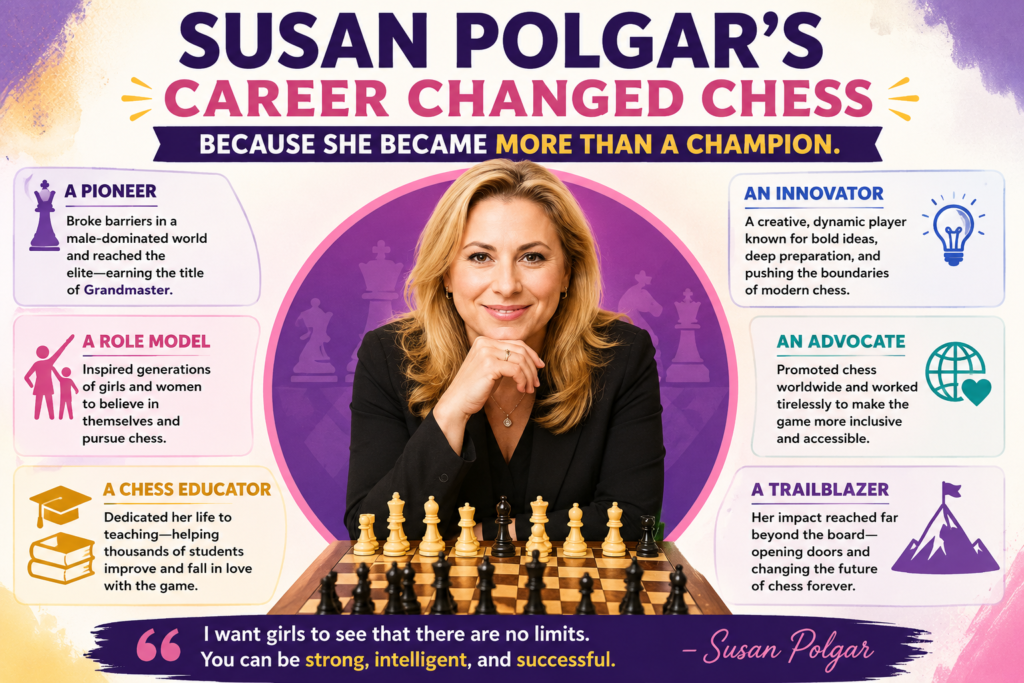
The World Chess Hall of Fame also describes her as a player, coach, and promoter who has supported youth chess and chess education.
This matters because chess needs more than great players. It needs people who open doors. Susan’s career helped show that chess can be used to build young minds, not only crown winners. That idea is very close to what modern parents want. They want activities that help children grow in focus, patience, confidence, and smart thinking.
Her work after winning titles made chess feel more welcoming for the next generation.
When a child sees a champion teaching others, the game feels less far away. It becomes something they can join. Susan helped make that bridge stronger. She did not only stand as proof that girls could reach the top. She also worked to help more children get access to the board.
That is a big part of her legacy. A trailblazer is not only the first person to cross a hard path. A real trailblazer also makes the path easier for others. Susan did that through coaching, events, books, public work, and youth chess programs. She made chess feel useful, not only elite.
For parents, this is the most practical part of her story. Your child does not need to copy Susan’s exact life to benefit from her lessons. Your child can start with one class. One puzzle. One thoughtful game. One coach who explains things with care. That is enough to begin.
At Debsie, we believe chess should feel both serious and joyful. The classes are structured, but not cold. The coaches guide students, but they also listen. Kids learn openings, tactics, planning, and endgames, but they also learn how to handle losses, stay focused, and think before acting. That is the deeper value parents often notice over time.
The best way to honor Susan Polgar’s legacy is to help more children believe they can think deeply.
Susan Polgar’s story is a strong answer to a quiet doubt many children carry. That doubt says, “Maybe I am not smart enough.” Chess can help replace that thought with a better one. “I can learn this step by step.”
That shift matters. A child who believes they can learn becomes more open to hard things. They stop seeing mistakes as proof that they are weak. They start seeing mistakes as part of practice. They become more patient with themselves. They become more willing to try again.
Susan’s life also tells parents something important. Do not wait until your child is “naturally gifted” before giving them great support. Support is how gifts grow. A child may look average at first because they have not had the right chance yet.
A good coach can wake up curiosity. A good class can make thinking fun. A good tournament can teach courage.
This is why chess is such a smart choice for children today. Screens train kids to react fast. Chess trains them to pause. Many games reward quick clicking. Chess rewards careful thought. In a busy world, that skill is rare and valuable.
Susan Polgar changed chess by proving that girls could lead, that training could build greatness, and that champions could use their success to lift others. Her best games are not just games to admire. They are lessons children can use.
Prepare before you attack. Stay calm after a loss. Let every piece help the plan. Think clearly under pressure. Keep learning after every game.
That is also the heart of Debsie’s chess program. We help children become better players, but the bigger goal is to help them become stronger thinkers. A free trial class is a simple first move. And as Susan Polgar’s career shows, one first move can change far more than you expect.
Susan Polgar’s win against Peter Hardicsay shows why brave chess still needs a clear reason.
One of Susan Polgar’s most famous early games came against Peter Hardicsay in 1985. This game is often shared because it looks bold and sharp, but the real beauty is not only the attack. The real beauty is that Susan’s risky-looking play had logic behind it.
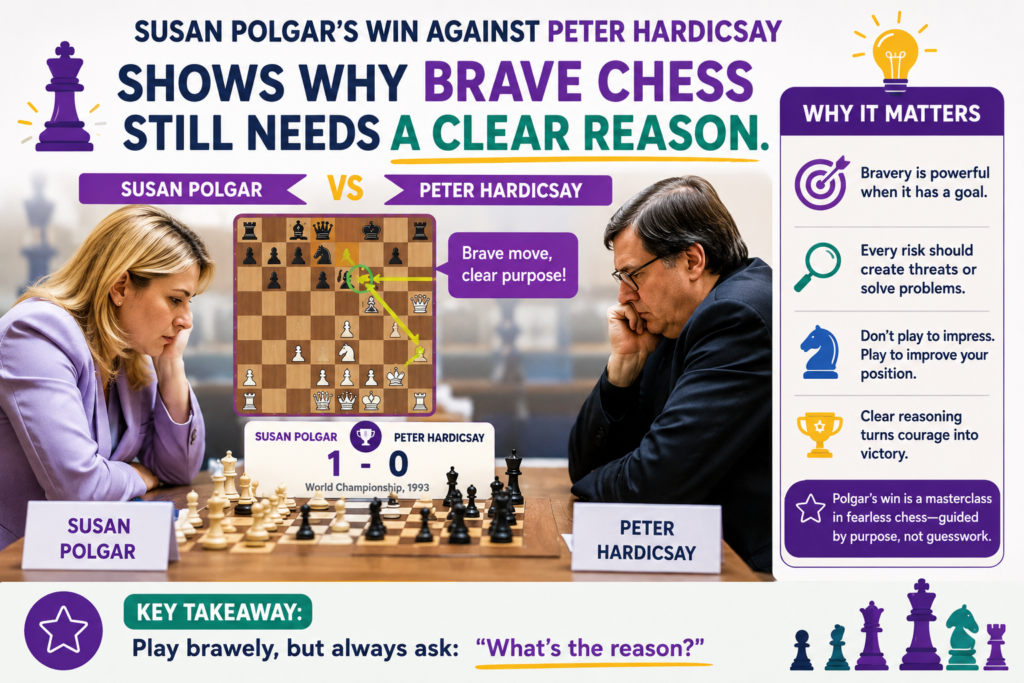
She did not just grab material and hope. She saw that Black’s pieces and king could become tangled, and she trusted the deeper point of the position. Her official games page gives the full score, with Susan winning in only 22 moves.
Young players can learn that a brave move is only good when it has support.
In this game, Susan took material early and allowed Black to look active. To a beginner, this can feel scary. Black seemed to have chances. Black’s pieces jumped forward. The game looked messy. But Susan had seen something important.
Black’s attack was not as strong as it looked, and once she gave checks and placed her rook with care, Black’s king had no safe story left.
This is one of the hardest ideas for young players to learn. A move can look scary and still be strong. A move can look safe and still be weak. That is why children need to learn how to judge a position, not just react to feelings.
Susan’s game teaches that good chess is not about being fearless. It is about checking the facts on the board.
At Debsie, this is the kind of thinking we want children to build. A child should not only ask, “Am I scared?” The better question is, “What is really happening?” That one shift helps kids in chess and in life. Many times, children feel fear before a test, a performance, or a hard task. But when they slow down and look clearly, they find a plan.
The key teaching moment is that Susan used active pieces to turn defense into attack.
After the position became sharp, Susan did not hide. She used checks, threats, and active piece play to take over. Her rook became a star. Her king was not perfectly cozy, but her pieces had purpose. That matters because many children think defense means sitting still. Susan showed that the best defense can be activity.
This is a very useful lesson for students who freeze when attacked. If the opponent brings the queen near your king, do not panic. Look for checks. Look for captures. Look for threats. Look for a way to trade the dangerous piece. Look for a way to make your opponent answer your plan instead of only pushing their plan.
That is how children become stronger decision-makers. They learn not to collapse under pressure. They learn to search. They learn to test ideas. They learn to see that a hard position may still have a hidden chance.
Parents love this part of chess because it builds quiet courage. A child who once cried after losing a queen may later say, “Let me see if I still have a move.” That is a huge step. It means the child is learning resilience. They are learning that a problem is not the end.
Susan Polgar’s Hardicsay game is not just a flashy win. It is a lesson in brave thinking with a backbone. Be bold, but be honest. Take chances, but check the reason. Attack, but make sure your pieces are ready. These are simple words, but they can change the way a child plays.
This is also why guided chess lessons matter. Without help, a child may copy a sacrifice and lose quickly. With a coach, the child learns why the sacrifice worked in the first place. That is the difference between guessing and growing.
Susan Polgar’s win against Ljubomir Ljubojevic shows how a slow squeeze can become a strong attack.
Susan Polgar’s 1987 win against grandmaster Ljubomir Ljubojevic is a wonderful game for students because it does not feel like one sudden trick. It feels like pressure building in waves.
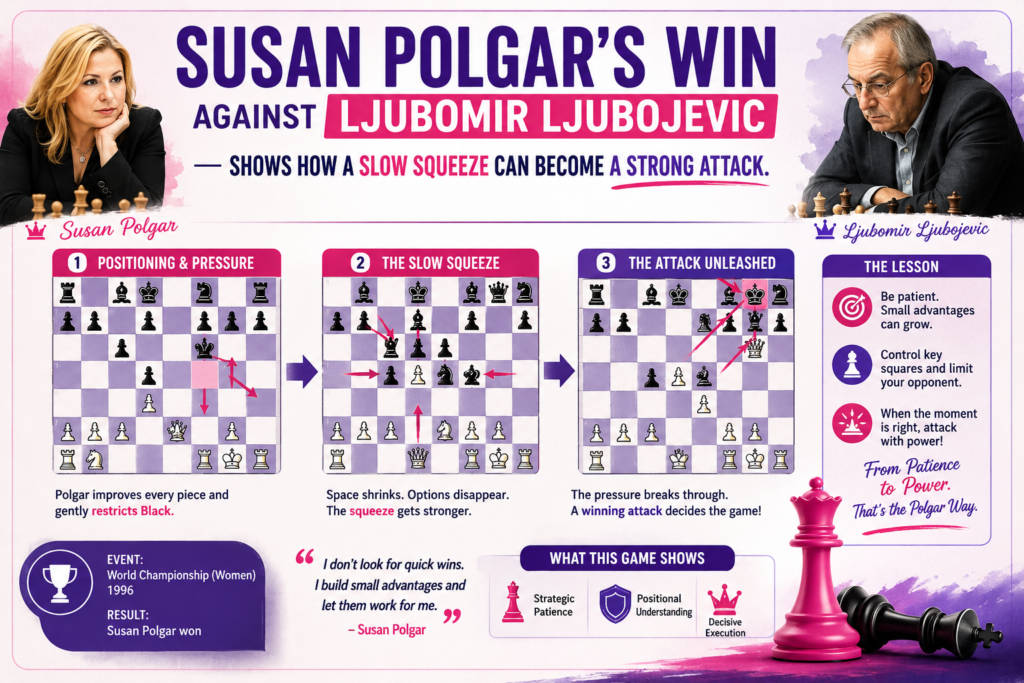
The game began calmly, but Susan kept improving her pieces and creating small problems. By the end, her pieces were aimed at the king, and the final attack felt natural. Her official site lists the game as a 46-move win for Susan.
This game teaches that a strong attack often begins with small useful moves.
In many beginner games, children attack too soon. They bring the queen out, give a check, and hope the opponent gets scared. Strong players do not usually fall for that. Susan’s game against Ljubojevic shows a better path.
First, build the base. Put pieces on better squares. Keep the king safe. Watch weak squares. Then, when the board is ready, start pushing forward.
The lesson is simple, but it takes practice. Before a child attacks, they should ask whether their pieces are helping. Is the rook still sleeping in the corner? Is a bishop blocked by its own pawns? Is the knight far from the action? Is the queen working alone? If the answer is yes, the attack may be too early.
Susan’s play also shows why pawn moves matter. Pawns may look small, but they shape the whole game. In this win, her kingside pawn push helped open lines and create danger. This is not something children should copy blindly.
It is something they should understand. A pawn move is strong when it opens the right path and does not leave the king helpless.
The best student takeaway is to improve the worst piece before looking for magic.
This one habit can help a child right away. In many positions, there is no checkmate yet. There is no big tactic yet. So what should the child do? Improve the worst piece. Bring a rook to an open file. Move a knight closer to the center. Place a bishop on a stronger diagonal. Make the queen useful without making her a target.
That sounds simple, but it is a champion habit. It stops children from making random moves. It gives them a plan when the board feels quiet. It also helps them stay patient, because they learn that quiet positions are not boring. Quiet positions are where plans are born.
At Debsie, we often help students see this through game review. A coach may pause and ask, “Which piece is not helping?” The child looks again. Suddenly, they see that the rook has no job, or the knight is far away, or the bishop is blocked. Once the child spots that, the next move becomes easier.
This kind of teaching builds more than chess skill. It builds attention. It trains the child to notice what is missing. That skill matters in school too. A child solving a math problem may ask, “What step did I skip?” A child writing an essay may ask, “Which part needs more work?” Chess trains that kind of careful thinking in a fun way.
Susan’s win against Ljubojevic is also important because he was a respected grandmaster. This was not a simple game against a weak player. It showed Susan could create pressure against strong opposition. That is why the game is such a good model.
It teaches that power does not always look loud at first. Sometimes power looks like one calm improvement after another.
For young players, this is a freeing idea. They do not need to find a brilliant move every turn. They need to make useful moves. Useful moves stack up. Pressure grows. Mistakes appear. Then the winning tactic becomes easier to find.
Susan Polgar’s 2004 win against Maia Chiburdanidze shows that great players keep learning for life.
Susan Polgar’s 2004 win against Maia Chiburdanidze is special because it came many years after Susan had already become a world champion. That matters. It shows that great chess players do not stop thinking deeply after one big success.
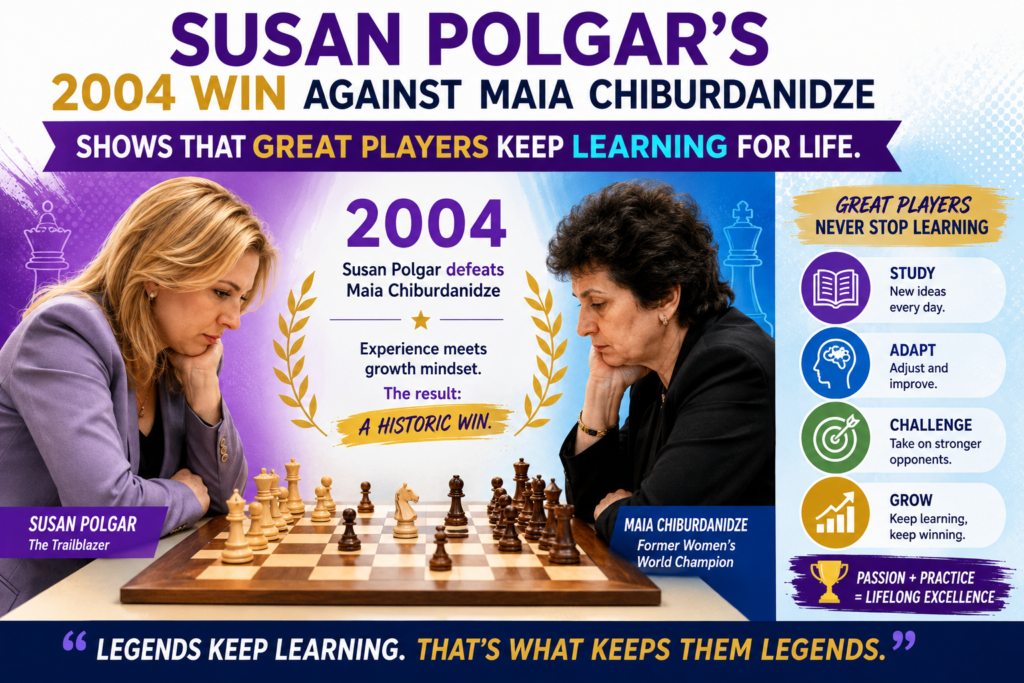
They keep learning, keep testing ideas, and keep showing up with fresh energy. Her official games page records this as a 39-move win for Susan against Chiburdanidze.
The game is a sharp lesson in using open lines and active pieces.
The game began with a flexible setup, but soon Susan pushed forward in a very direct way. The position became sharp, and both players had to calculate carefully. Susan found ways to open lines, bring pieces into the fight, and keep her threats alive.
The game is a strong example of what happens when a player mixes courage with timing.
For students, this game is useful because it shows that activity can be worth a lot. A piece that has open lines can become dangerous fast. A rook that can enter the position can change the game. A bishop on a strong diagonal can create hidden threats.
Susan understood how to make her pieces work together when the position opened.
But there is a warning here too. Open positions punish careless play. If a child opens lines before development, the attack may backfire. If the king is unsafe, open files can help the opponent. That is why this game should not be seen as permission to attack every move. It should be seen as a lesson in timing.
The deeper lesson is that improvement does not end when a child becomes “good.”
This may be the most important part for parents. Many children improve for a while, then get comfortable. They beat their friends. They solve some puzzles. They know a few openings. Then they stop pushing. Susan’s career shows a better path. Even after world titles and records, she stayed connected to serious chess and chess education.
The World Chess Hall of Fame notes that Susan was top-ranked among women at 15, became the first woman to earn the grandmaster title by norms and rating, won the Women’s World Rapid and Blitz Championships in 1992, and later coached major college chess teams to national success.
That path is not only a list of wins. It is a picture of long-term growth.
This is a powerful message for children. Getting good is not the finish line. It is the start of a new level. A child who learns basic tactics can then learn planning. A child who learns planning can then learn endgames. A child who plays casual games can then try tournaments. Growth keeps opening new doors.
At Debsie, we see this often. A child may begin with simple piece moves. Then they learn checkmate patterns. Then they learn how to avoid blunders. Then they begin to ask deeper questions.
“What is my opponent’s plan?” “Should I trade queens?” “Is this endgame winning?” That shift is beautiful to watch because the child is no longer just playing. The child is thinking like a student of the game.
Susan’s 2004 game also gives older students a clear message. Do not become lazy with success. Keep your mind fresh. Try new plans. Review your games. Learn from stronger players. Be proud of progress, but stay hungry to improve.
That is the kind of mindset that helps children in every subject. The goal is not to make them chase trophies forever. The goal is to help them enjoy growth. When children enjoy growth, they do not fear hard work as much. They begin to see effort as the path, not the punishment.
Susan Polgar’s best games teach this again and again. Brave moves need reasons. Slow pressure can become a strong attack. Active pieces can turn a position around. And learning does not stop after a win. These lessons are simple enough for children, but strong enough to last a lifetime.
Susan Polgar’s best games teach children how to make pressure feel simple.
A lot of young players think pressure means attacking the king right away. They want checks. They want captures. They want the game to end fast. Susan Polgar’s games teach a smarter idea.
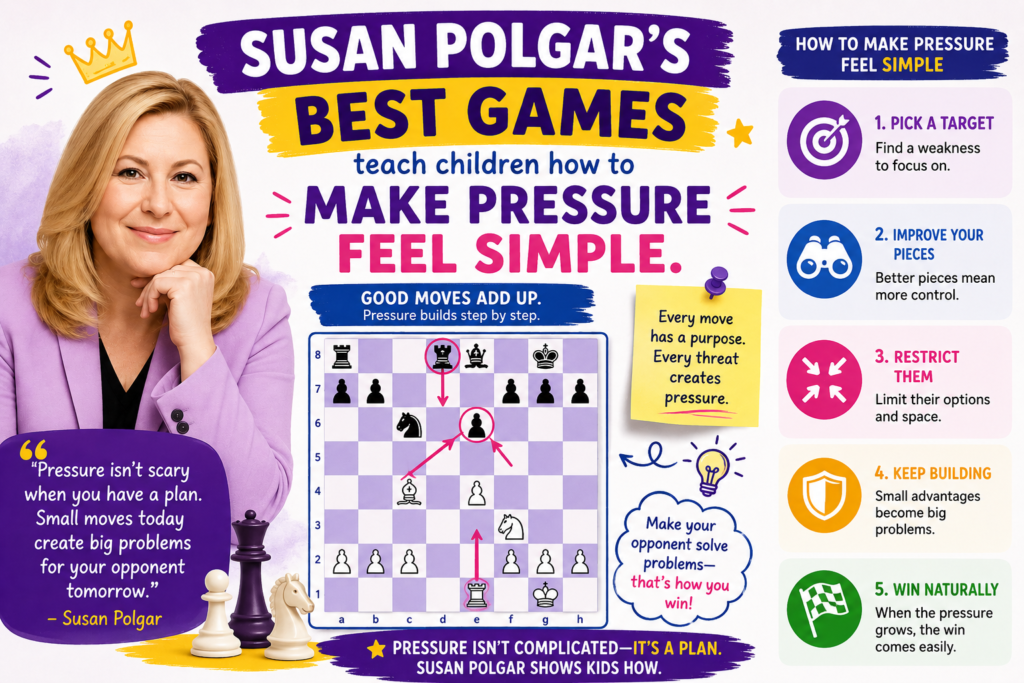
Pressure can be quiet. Pressure can be a piece placed on a better square. Pressure can be a pawn that takes space. Pressure can be a threat that forces the other player to defend again and again.
This is one reason her games are so useful for students. They do not only show big moments. They show how big moments are made. Susan often turned a normal position into a hard one for her opponent by asking small questions with each move.
Can you defend this pawn? Can you move that knight? Can your king stay safe? Can your pieces still work together?
Children should learn that pressure is built before it is seen.
When a child is new to chess, they often judge a move by what it wins right away. If the move wins a queen, they like it. If the move gives check, they like it. If the move does not attack something at once, they may think it is boring.
But strong chess does not work like that. Many of the best moves do not win material right away. They make the next move better.
Susan Polgar was very good at this kind of play. She could make her opponent’s position slowly harder to handle. Maybe one piece had no safe square. Maybe one pawn became weak. Maybe the king had fewer escape squares. Then, when the board was ready, the tactic came naturally.
This is a key lesson for children at Debsie. We help students see that not every good move has to be loud. Sometimes the best move is the one that improves your worst piece. Sometimes the best move is the one that stops your opponent’s idea.
Sometimes the best move is the one that makes your next plan stronger.
The action step for young players is to ask what problem the opponent must solve.
This one question can change a child’s chess right away. Before making a move, the child can ask, “What problem am I giving my opponent?” If the move gives no problem, no threat, no better piece, and no safety, it may not be useful. If the move makes the opponent defend, think, or choose between two hard options, the move has more value.
Parents can use this during practice games too. Instead of only asking, “Why did you lose?” ask, “What problem were you trying to create?” This helps the child think in plans, not just moves. It also makes the game more fun because the child begins to feel like a builder, not a guesser.
This is the real power of chess. It trains children to think one step deeper. They learn that good choices create good chances. They learn that smart pressure can be built with patience. They learn that a win is not always born from one lucky trick.
Susan’s career is full of this lesson. She did not become a trailblazer by hoping others would make mistakes. She made strong moves that forced hard choices. That is a skill every child can learn with the right guide, the right class, and the right kind of practice.
At Debsie, our free trial class gives children a friendly first step into this kind of thinking. The goal is not to scare them with hard chess words. The goal is to help them see the board in a new way. Once children learn to create small problems for the opponent, they start to play with more purpose and more confidence.
Susan Polgar’s career shows why opening study should teach plans, not just memory.
Many students hear the word “opening” and think they must memorize many moves. That can make chess feel dry and scary. Susan Polgar’s games show a better way. The opening is not just a memory test. It is the start of a plan.
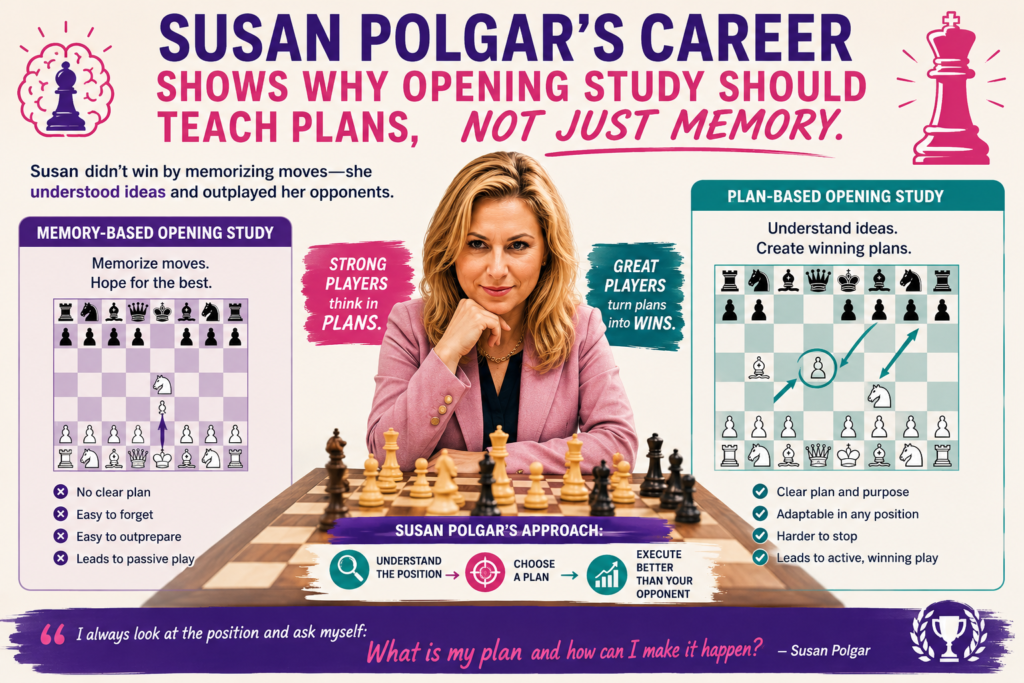
It helps a player place pieces well, keep the king safe, fight for the center, and prepare for the middle game.
This matters a lot for children. A child can memorize ten moves and still not know what to do after that. But if the child understands the idea behind the opening, they can keep playing even when the opponent chooses something different. That is the kind of learning that lasts.
Susan’s games remind students that the opening should make the middle game easier.
The opening is like setting up a room before a big activity. If the pieces are placed well, the rest of the game becomes smoother. If the pieces are placed badly, every move feels harder. Susan’s best games often show good piece harmony. Her pieces were not just developed. They had jobs.
This is a simple idea that young players can use. A knight in the center can jump to many squares. A bishop on an open diagonal can see far. A rook on an open file can create pressure. A safe king gives the rest of the army freedom to work. These are opening ideas that matter more than blind memory.
At Debsie, we teach openings in a child-friendly way. We do not want kids to repeat moves like a robot. We want them to understand why the moves make sense. When a child knows the “why,” they can handle surprise moves better. They do not freeze when the game leaves their memory. They think.
The action step is to learn the first plan after the opening, not only the first moves.
A child should be able to answer a simple question after the opening: “What am I trying to do next?” This answer does not need to be fancy. It can be to attack the center. It can be to place a rook on an open file. It can be to trade a bad piece. It can be to protect a weak pawn. It can be to stop the opponent’s attack.
This one habit saves many games. Children often lose because they finish the opening and then drift. They move pieces without a reason. They chase pawns. They forget their king. But when they know the next plan, they stay focused.
Parents can help by asking after a game, “When the opening ended, what was your plan?” This question is kind and useful. It does not blame the child. It helps them review their thinking. Over time, the child begins to ask this question during the game.
Susan Polgar’s career is a great example of planned chess. She did not play openings just to reach move ten. She used them to build positions she understood. That made her attacks stronger and her defense steadier. Her opening choices helped her create the kind of games where her strengths could shine.
This is a strong lesson for today’s students. Do not collect openings like toys. Learn a few openings well. Know the main ideas. Know where the pieces belong. Know what pawn breaks matter. Know what kind of middle game you want. That is enough to become a much stronger player.
A Debsie coach can help children do this in a clear way. Instead of dumping too much theory on a young mind, the coach can show patterns, plans, and common mistakes. This makes openings feel alive. The child starts to see that the first moves are not separate from the rest of the game. They are the roots of the whole tree.
Susan Polgar’s endgame lessons show why patience can win games that look equal.
Many children love the opening and middle game, but they do not give enough care to the endgame. This is normal. Endgames can look quiet. There are fewer pieces. The board feels empty. But Susan Polgar’s career reminds us that champions respect every stage of the game.
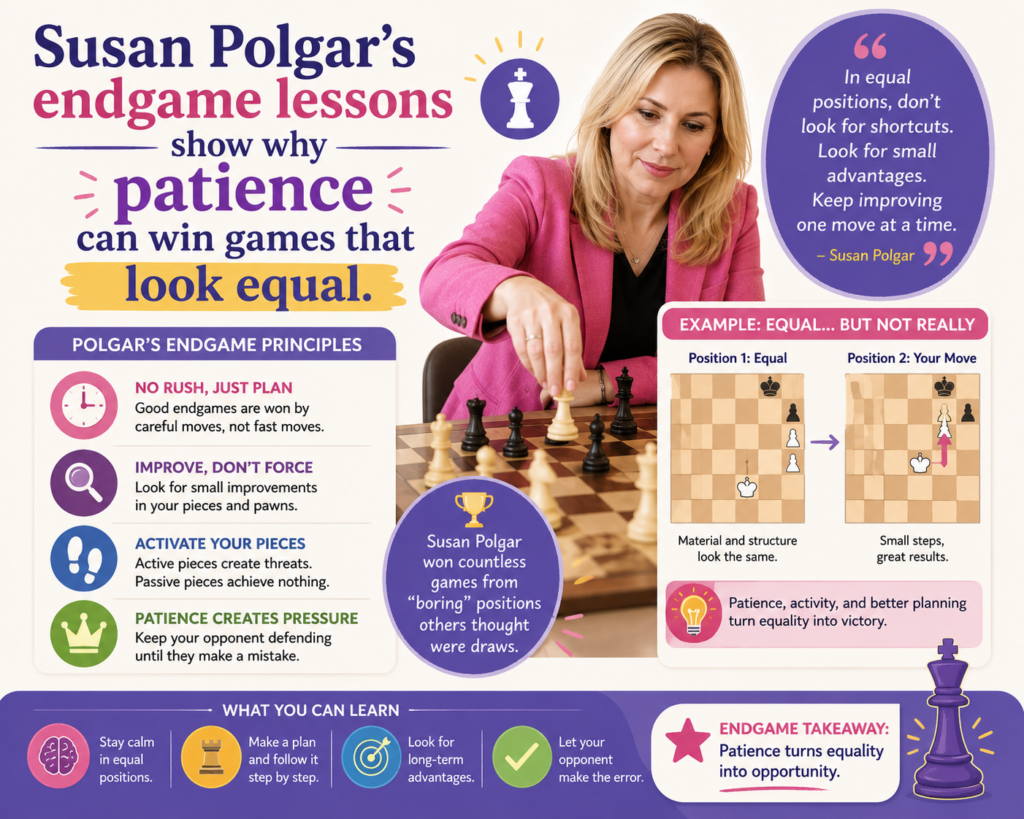
A small edge in the endgame can become a win when the player is patient, careful, and alert.
Endgames are very important for children because they teach discipline in the clearest way. There are no big attacks to hide behind. There are fewer tricks. Every king move, pawn move, and trade matters. A child must slow down and think.
The endgame teaches children that small things are not small when the board gets quiet.
A single pawn can decide the result. One active king can change everything. One wrong trade can turn a win into a draw. This is why endgames are such a strong training tool. They teach children to respect details.
Susan’s games and teaching career both point to this truth. Strong players do not only hunt for checkmate. They know how to win simple positions. They know when to trade. They know when to keep pieces.
They know how to use the king as a fighting piece when it is safe. These ideas may sound small, but they build real strength.
At Debsie, we help students learn endgames step by step. A beginner may start with basic checkmates. Then they learn king and pawn ideas. Later, they study rook endgames and practical tournament endings. The goal is not to make endgames boring. The goal is to show children that endgames are where calm thinking often wins.
The action step is to practice winning simple positions until they feel natural.
A child who can checkmate with a queen and king has more confidence. A child who knows how to promote a pawn understands the power of planning. A child who can use the king in the endgame learns that every piece has a time to shine.
This kind of practice also helps children stop rushing. Many young players throw away winning positions because they want the game to end quickly. They push the wrong pawn. They give checks with no plan. They trade into a draw without noticing. Endgame training fixes this by teaching patience.
Parents may notice this skill outside chess too. A child who learns to finish a chess game carefully may become better at finishing schoolwork carefully. They learn not to relax too early. They learn that the last steps matter. They learn that a good start is not enough if the finish is careless.
Susan Polgar’s life teaches this in a bigger way as well. Her career was not one bright moment and then silence. She kept building. She became a champion, then a coach, then a promoter of chess education. She kept adding value long after the world title. That is an endgame lesson in real life. How you finish matters.
For students, the message is simple. Do not ignore the quiet parts of chess. The quiet parts may hold the win. Learn basic endgames. Review mistakes. Practice simple checkmates. Ask your coach why a pawn ending is winning or drawn. These small lessons can save many points.
Debsie’s structured classes make this easier because children are not left to figure it out alone. They get guided practice, clear feedback, and chances to use what they learn in real games. That kind of support helps a child turn knowledge into habit.
Susan Polgar’s best games and career both show that chess rewards the child who keeps thinking until the very end. And that is a lesson worth learning early.
Susan Polgar’s career teaches kids that confidence is built by proof, not praise.
Confidence is a big word, but for children it starts in a very small way. A child thinks, “I tried something hard, and I got a little better.” That feeling is stronger than empty praise. Susan Polgar’s career is full of this kind of proof.
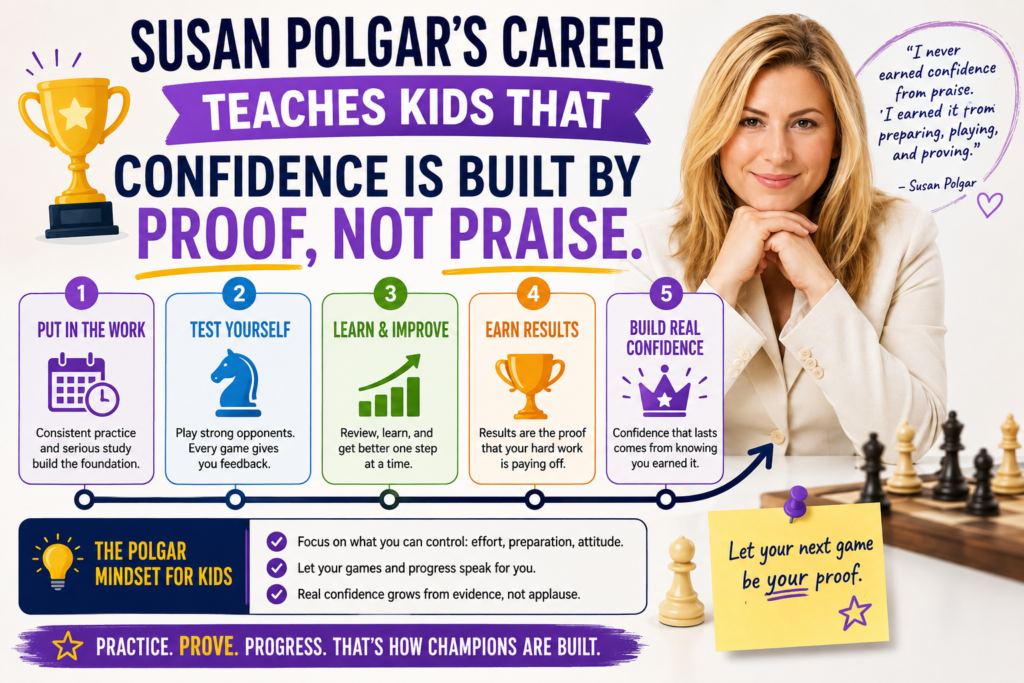
She did not become confident because people simply told her she was great. She became confident because she trained, competed, tested herself, and saw the results of steady work.
The World Chess Hall of Fame notes that Susan became the top-ranked female chess player in the world at age 15, became the first woman to earn the Grandmaster title by norms and rating, and later won the Women’s World Rapid and Blitz Championships in 1992.
These were not small steps. They were public proof that her training could stand up under real pressure.
Children need chances to earn confidence in a safe but serious space.
Many kids today hear praise all the time, but they may still feel weak when a real challenge comes. Chess gives a better kind of confidence because the board is honest. If a child makes a good plan, the position gets better.
If a child rushes, the board shows the mistake. This may sound tough, but it is actually very helpful when the child has kind coaching.
A good chess class does not shame a child for losing. It shows the child what happened. It turns a loss into a map. The child learns, “I missed a fork here,” or “I forgot my back rank,” or “I moved too fast when my queen was under attack.” That kind of feedback gives the child something clear to fix.
At Debsie, this is one of the most important parts of learning. We do not want children to feel smart only when they win. We want them to feel strong because they know how to learn. That is real confidence. A child who knows how to learn can walk into harder games without fear.
The action step is to help your child collect small wins that prove growth.
A small win does not have to be a trophy. It can be solving one puzzle that used to feel hard. It can be playing a full game without hanging the queen. It can be remembering to castle early. It can be staying calm after losing a pawn. These moments matter because they show the child that effort is working.
Parents can make this even stronger by noticing the right things. Instead of only saying, “You won, great job,” say, “I liked how you paused before moving,” or “You found your opponent’s threat,” or “You kept trying even when the position was hard.” This teaches the child what good thinking looks like.
Susan Polgar’s story gives parents a clear model. Build confidence through real steps. Let the child face challenges. Let the child see progress. Let the child understand that good work leaves evidence.
This is also why structured chess classes help more than random games. Random play can be fun, but guided learning makes progress easier to see. A coach can spot the pattern behind mistakes. A coach can give the next right lesson. A coach can help the child feel both safe and stretched.
When a child joins a Debsie free trial class, the first goal is simple. We want the child to feel that chess is learnable. Not easy every time, but learnable. That feeling can change how a child sees hard work. And once a child believes, “I can improve,” that belief can travel far beyond the chessboard.
Susan Polgar’s work after her titles shows why chess should be shared, not kept for a few.
A champion can keep the spotlight for herself, or she can use it to open doors. Susan Polgar chose the second path. Her work after her major titles is a big part of why her legacy matters. She became known not only as a player, but also as a teacher, coach, author, and builder of chess programs for young people.
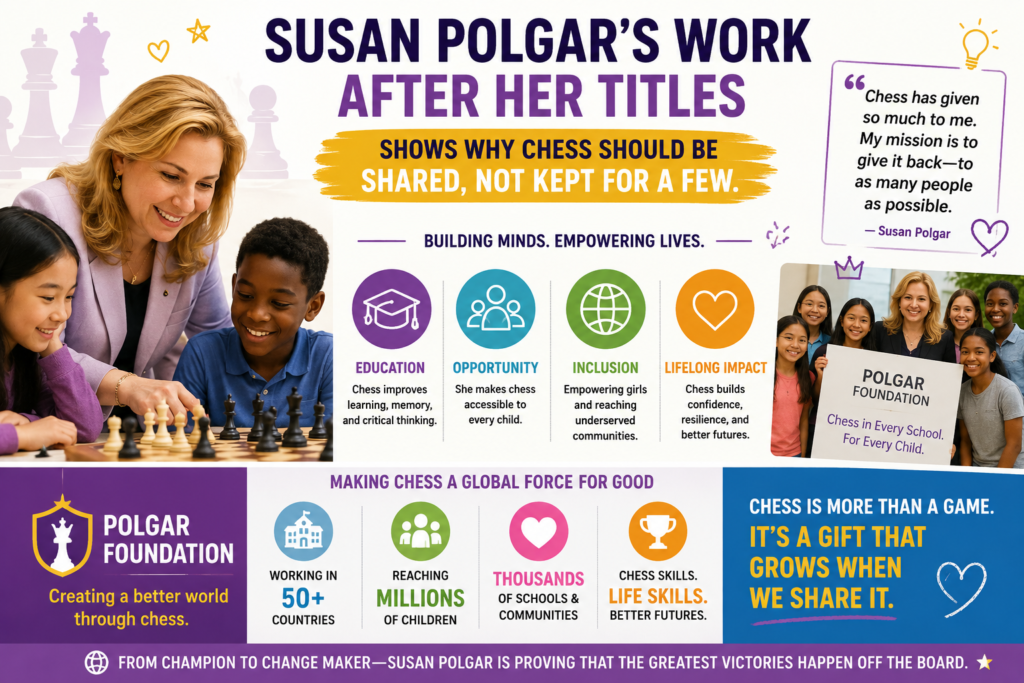
The Susan Polgar Foundation says its mission is to promote chess and its educational, social, and competitive benefits for young people of all ages, especially girls. That mission matters because it turns Susan’s success into something other children can touch.
It says chess is not only for the already gifted. It is for any child who is ready to learn, think, and grow.
The biggest change happens when children are invited into chess early and kindly.
Many children never try chess because they think it is too hard. Some think it is only for “genius kids.” Some girls may still feel, even today, that chess is not really for them. Susan Polgar’s work pushes back against that idea. Her career says the door should be wider, not narrower.
This is important for parents because the first experience matters. If a child’s first chess class feels cold, confusing, or too harsh, the child may leave before the love begins. But when the class feels clear and friendly, the child starts to enjoy thinking. They ask questions. They laugh at funny positions. They feel proud when they solve a puzzle.
At Debsie, we believe the first step into chess should feel welcoming. Children should not feel lost in hard terms. They should see the board as a place where their ideas count. A strong coach can make even a simple lesson feel exciting by helping the child discover the answer, not just hear it.
The action step is to choose a chess space where your child feels seen.
A child learns better when the coach knows how they think. Some children are bold and move too fast. Some children are careful and need help becoming braver. Some children love tactics. Some enjoy quiet plans. Good coaching notices these things.
This is why personalized chess learning matters. It is not enough to show the same lesson to every child and hope it works. A coach should watch how the child solves problems. A coach should know when to slow down, when to challenge, and when to celebrate progress.
Susan Polgar’s education work reminds us that access is not only about giving a child a board. Access means giving the child the right support around the board. It means helping the child feel welcome, guided, and capable.
Parents can look for this in a simple way. After a class, ask your child, “Did you understand what you learned?” and “Did you enjoy thinking today?” These questions matter. A child who enjoys thinking is more likely to keep going. A child who keeps going is more likely to grow.
Debsie’s live interactive classes, private coaching, and online tournaments are built around this idea. Children need teaching, practice, feedback, and safe chances to compete. When those parts work together, chess becomes much more than an activity. It becomes a path for focus, patience, and smart decision-making.
Susan Polgar’s legacy is powerful because she did not only break a barrier. She helped build a bridge. That bridge is still useful for every child who is ready to make their first serious move.
Susan Polgar’s example gives parents a clear plan for helping kids grow through chess.
Susan Polgar’s life can feel very big, but the lessons for parents are clear and simple. You do not need to raise a world champion to use chess well. You need to help your child build better thinking habits.
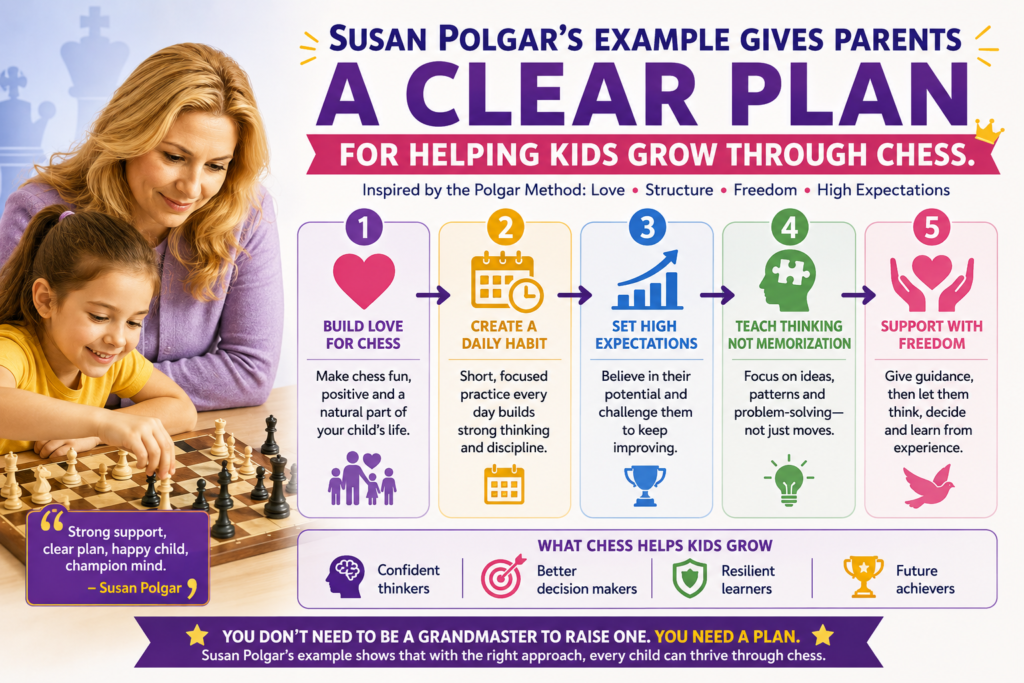
Chess is one of the best tools for that because it gives instant feedback. Every move has a result. Every plan can be tested. Every mistake can teach.
Her official biography says she founded a nonprofit foundation to promote chess and its educational, social, and competitive benefits for young people, especially girls. That is the heart of the lesson. Chess is not only about titles. It is about what the game does for a growing mind.
Parents can use Susan’s story to help children connect effort with progress.
Children often want fast success. That is normal. But chess gently teaches them that real success comes from layers. First, they learn the pieces. Then they learn safety. Then they learn tactics. Then they learn plans. Then they learn endings. Then they learn how to review their own games. Each layer makes the next layer easier.
This is why Susan’s story is so useful. It shows that greatness is not one lucky moment. It is a chain of good habits. She had talent, but talent was shaped by work. She had courage, but courage was backed by training. She had wins, but she also had setbacks and pressure.
For a child, the message should be simple. You do not need to be perfect. You need to keep learning. That is a healthy message, and it is one children can carry into school and life.
The action step is to build a weekly chess rhythm that feels steady, not stressful.
A child does not need to study chess all day. Most children need a clear rhythm. One or two good classes each week can build structure. A few puzzles can train pattern spotting. A friendly game can make practice fun. A short review after a game can turn mistakes into lessons.
This rhythm works because it is not too heavy. Children need space to enjoy the game. If chess becomes only pressure, they may stop loving it. But if chess becomes a fun challenge with a clear guide, they come back with more energy.
Debsie’s program is designed for this kind of steady growth. Live classes help children learn with others. Private coaching gives focused help. Online tournaments teach courage and sportsmanship. Together, these pieces help children become stronger players and better thinkers.
Susan Polgar’s career also teaches parents to let children try serious things early. Some adults wait too long because they think a child must be ready first. But often, children become ready by starting. A good first class can wake up curiosity.
A kind coach can help a shy child speak through moves. A small tournament can teach a child that nerves are normal and manageable.
That is the beauty of chess. It meets a child where they are, then asks them to grow one move at a time. The board never asks for perfection. It asks for attention. It asks for patience. It asks for thought.
Susan Polgar changed chess by showing what happens when a young mind is trained, trusted, and challenged. Parents can use that lesson today. Give your child the chance to think deeply. Give them a place to practice focus. Give them a coach who cares about their growth, not just their score.
A free Debsie trial class can be that first move. Your child may come for chess, but they may leave with something even better: the feeling that smart thinking can be learned.
Susan Polgar’s later games show why strong players never stop testing themselves.
Susan Polgar’s career did not end with one title, one record, or one famous match. That is one reason her story is so useful for young students. She kept playing serious games, sharing chess, coaching teams, and helping young people learn.
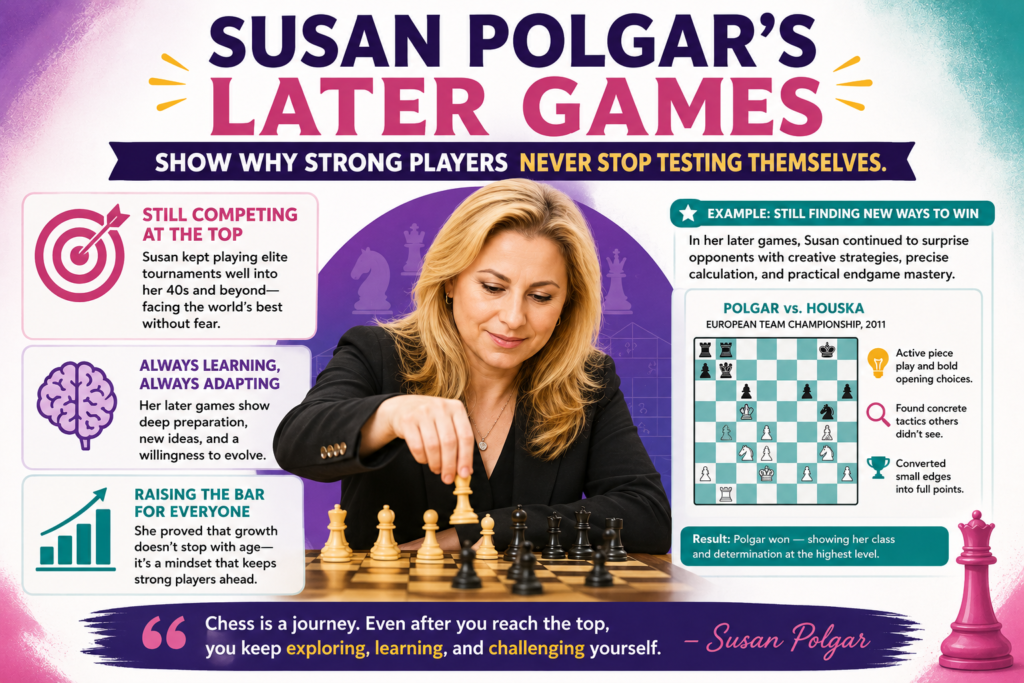
Chess.com’s game database lists many of her later games from 2006 against strong players such as Boris Gulko, Gata Kamsky, Ildar Ibragimov, and Alexander Stripunsky. That tells us something important. Even after becoming a world champion, Susan still stayed close to high-level chess.
Children can learn that growth is not a short race.
Many kids improve quickly at first. They learn how the pieces move. They learn checkmate. They win a few games. Then the next level feels harder. This is where some children stop. They may say chess is too hard, or they may only play easy games where they can keep winning.
Susan Polgar’s career shows a better path. Strong players keep testing themselves. They play people who can punish mistakes. They review hard losses. They try to fix weak spots. They do not hide from challenge, because challenge is where growth lives.
This lesson matters for parents too. A child’s chess journey should not be judged only by wins. A child who loses to a stronger player but learns a clear lesson may have gained more than a child who wins without thinking. The goal is not to protect children from every hard game. The goal is to help them face hard games with support.
The action step is to give your child the right level of challenge.
A game that is too easy can make a child careless. A game that is too hard can make a child feel lost. The best learning happens in the middle. The child should feel stretched, but not crushed. They should meet positions where they must think, but they should also get help after the game.
This is why Debsie’s mix of live classes, private coaching, and online tournaments works so well. A child gets learning, practice, and real game pressure in a guided space. They are not left alone to wonder why they lost. A coach can show the key moment, explain the better plan, and help the child try again.
Parents can also help by changing the way they talk after games. Instead of asking only, “Did you win?” ask, “What did you learn?” This one question teaches your child that learning is the real prize. It also keeps them from feeling that their value depends on one result.
Susan’s long career gives children a healthy picture of success. Success is not reaching one peak and stopping. Success is staying curious. It is being willing to learn after wins and losses. It is having enough love for the game to keep growing.
That is the kind of mindset we want children to build at Debsie. Your child may start with a free trial class, but the deeper gift is the habit of steady growth. One class can spark interest. One good coach can build trust. One clear lesson can make a child feel, “I can get better at hard things.”
Conclusion:
Susan Polgar did more than win chess titles. She changed what the chess world believed girls could do. Her best games teach children to plan, stay calm, use every piece, and keep learning after mistakes.
Her career also shows parents that great thinking can be built with the right support, steady practice, and kind coaching. That is the same belief Debsie brings to every class. Your child does not need to start as a champion. They only need a chance to think, grow, and try. A free Debsie chess trial class can be the first smart move.

Adhip Ray is the founder of Debsie, an online learning platform focused on chess and skill-based learning for children. His work at Debsie brings together chess education, structured thinking, problem-solving, and interactive learning for young students.
Adhip has an academic background in law, statistics, analytics, and technology. He is from Amity Law School and the Indian Statistical Institute, Kolkata, with formal training that connects legal reasoning, data analytics, quantitative thinking, and structured problem-solving. This interdisciplinary background is reflected in Debsie’s focus on building sharper thinking skills in children through chess and related learning programs.
Adhip is also a FIDE-rated chess player from India. He holds FIDE ID 5055954 and has a standard FIDE rating of 1832. His FIDE profile records him as an Indian player with a long rating history in standard chess, including rated games from his competitive playing years. His chess background gives Debsie a founder-led connection to the game, not only as an educational activity but also as a competitive discipline that develops concentration, calculation, planning, and decision-making.
In addition to chess, Adhip has a strong interest in coding, data, and technical problem-solving.
Adhip’s profile combines chess, law, data analytics, and programming. At Debsie, this background supports the creation of learning experiences that are logical, structured, and skill-oriented. The platform’s chess-focused programs are connected to broader cognitive skills such as pattern recognition, patience, strategic planning, focus, and problem-solving.
As founder of Debsie, Adhip brings together experience from multiple fields: formal legal education from Amity Law School, analytical training from the Indian Statistical Institute, Kolkata, competitive chess experience through his FIDE-rated profile, and coding practice through LeetCode. This combination gives Debsie a distinct foundation in strategy, reasoning, analytics, and child-focused learning.
Through Debsie, Adhip is associated with building chess and learning content for children that goes beyond basic instruction. The platform connects chess with thinking skills, helping students approach challenges with more structure, clarity, and confidence. His own background in chess and analytical problem-solving gives the platform a direct link to the skills it aims to develop in young learners.
Adhip is also a member of Forbes Business Council.