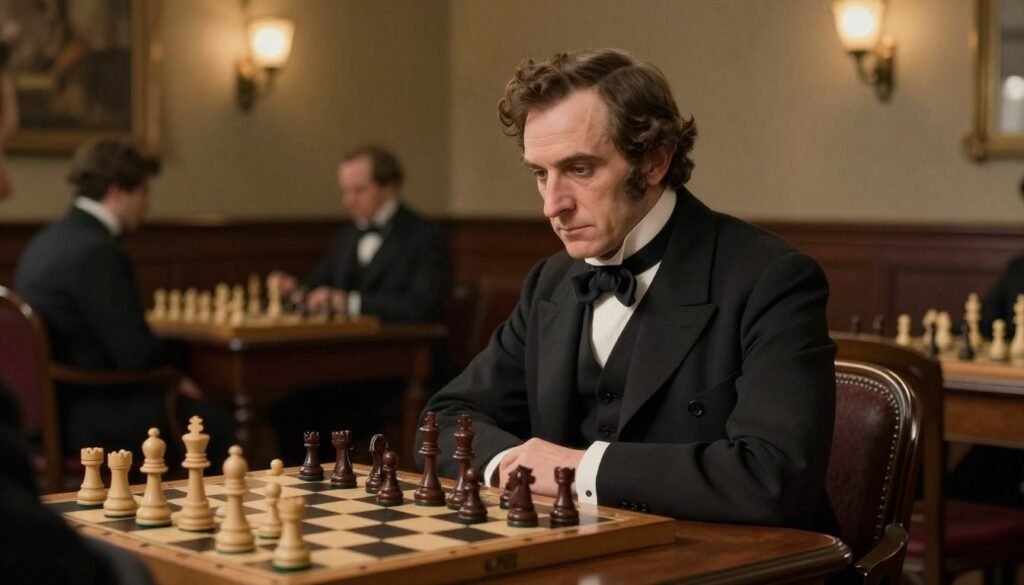
Paul Morphy did not play chess like most people in his time. He played like he already knew the future of the game. Born in New Orleans in 1837, Morphy became one of the strongest players in the world during a very short public chess career. He won the First American Chess Congress in 1857, then went to Europe and beat many of the best players there. At the time, many people saw him as the unofficial world champion, even though the official title did not yet exist.
Find the right learning experience
Tell us a little about the learner and what you are looking for. Our team will review your answers and help you identify the most suitable next step.
- Takes only a few minutes
- No payment required
- Personalised recommendations
Your information will only be used to respond to your enquiry.
The Chess World Before Morphy Was Slow, Proud, and Ready to Be Shocked
Chess before Paul Morphy was full of bold attacks, brave sacrifices, and big ideas. But many players attacked too soon. They often moved the same piece again and again. They grabbed pawns while their other pieces slept at home.
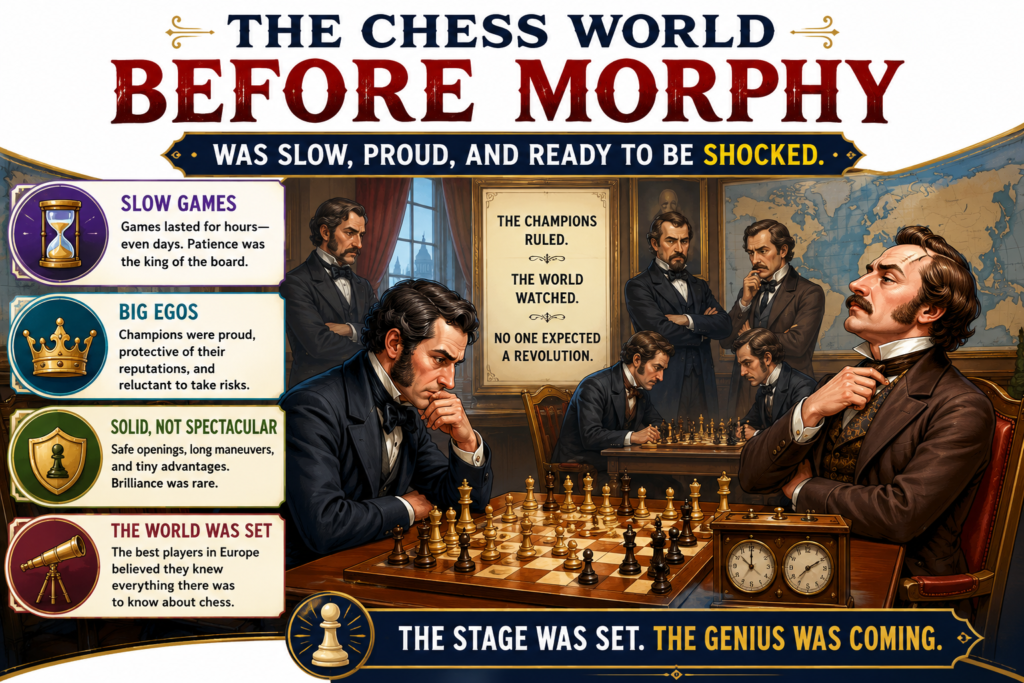
They chased the enemy king before their own army was ready. The games were exciting, but they were often messy.
Then Morphy came along and made chess look clear.
He did not just attack. He prepared first. He brought out his pieces. He placed his king in safety. He opened the board. Then, when the time was right, he struck with speed. That is why Britannica describes him as one of the first great players to rely on the now common rule of development before attack.
His public chess career lasted less than two years, yet he became known as the leading player in the world during that short time.
Find the right learning experience
Tell us a little about the learner and what you are looking for. Our team will review your answers and help you identify the most suitable next step.
- Takes only a few minutes
- No payment required
- Personalised recommendations
Your information will only be used to respond to your enquiry.
Morphy did not win because he saw tricks. He won because his pieces worked as a team.
Many young players think chess genius means seeing a hidden checkmate from ten moves away. Sometimes that happens. But Morphy’s real genius was easier to understand. He made normal moves that became powerful because they worked together.
A knight came out. A bishop found a good line. A rook moved to an open file. The queen joined only when the board was ready. His pieces did not stand alone. They helped each other.
The first big Morphy lesson is to stop playing with only one or two pieces.
This is one of the most useful lessons for kids. In many beginner games, one player brings the queen out early and starts giving checks. It feels scary. It feels active. But if the other player calmly develops, the early queen often becomes a target.
Morphy showed that chess is not about making noise. It is about building pressure.
At Debsie, this is one of the first habits students learn. Before asking, “Can I attack?” they learn to ask, “Are my pieces ready?” That one small question can change a child’s whole game. It also builds patience. The child learns that rushing can feel fun, but smart waiting often wins.
The old players wanted beauty. Morphy gave them beauty with logic.
Morphy’s games are still fun to study because they are not dry. They are full of action. Pieces fly into the attack. Kings get trapped. Sacrifices land with force. But under all that beauty, there is order.
This is what makes him such a strong teacher. Some masters are hard for kids to understand. Their plans are deep, slow, and full of small moves. Morphy is different. His games often show the lesson right away. One side develops. The other side wastes time. Then the better-developed side opens the board and wins.
The second big Morphy lesson is that time is a real chess weapon.
In chess, time does not only mean the clock. Time also means moves. Every move should help your position. If you move the same piece three times in the opening while your other pieces stay home, you are giving away time.
Morphy punished that. He made wasted moves look costly.
This is a life lesson too. Kids learn that small choices add up. One lazy move may not lose at once. But three lazy moves can create a big problem. In class, this becomes easy to see. A coach can show the board and ask, “Which side has more pieces playing?” The child can answer with their eyes, not just with memory.
That is the kind of learning that stays.
Morphy’s Early Life Shows Why Pattern Learning Matters So Much
Paul Morphy was born in New Orleans on June 22, 1837. He learned chess as a child, and the World Chess Hall of Fame notes that he learned the game at age eight. By age thirteen, he was already one of the best players in the United States.
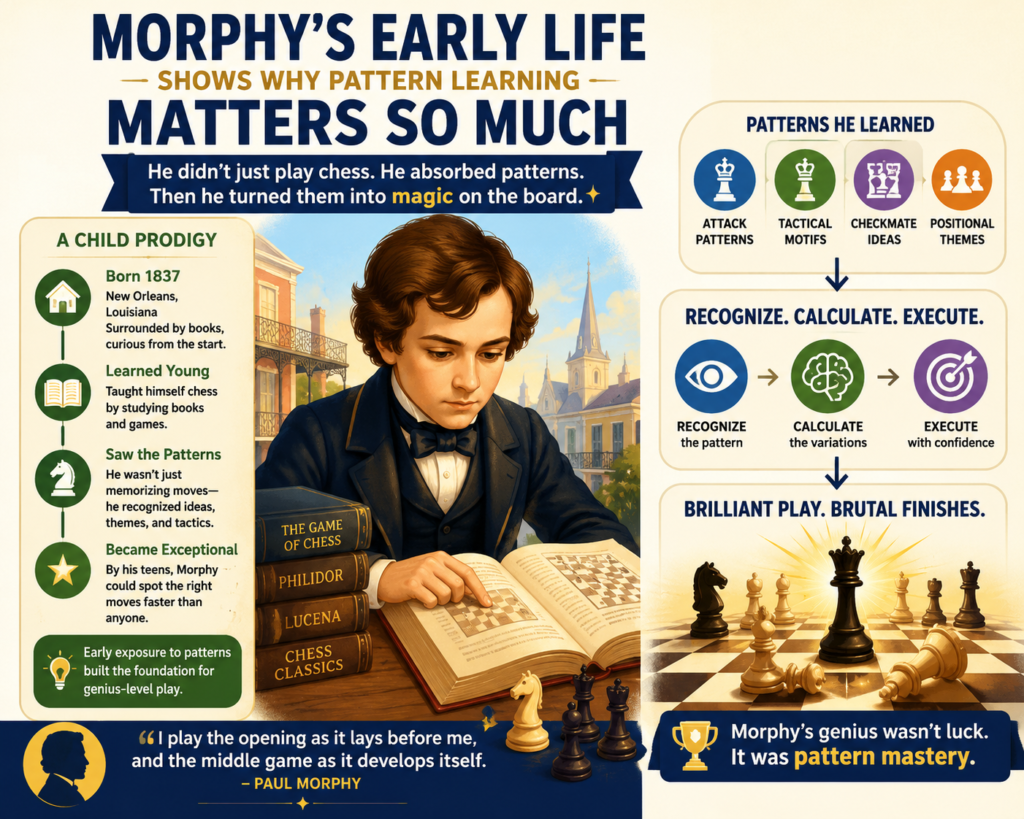
That sounds almost unreal. But it also tells us something important about learning.
Morphy grew up around chess. He watched strong players. He listened. He saw patterns again and again. Before he became famous, his mind was already collecting shapes on the board. Open files. Weak kings. Pins. Checks. Trapped pieces. Fast development. These ideas became natural to him.
Talent helped Morphy, but repeated pattern learning made his talent sharper.
A lot of parents wonder if their child needs to be “gifted” to become good at chess. Morphy was clearly special. But his games still teach a very practical truth. Chess skill grows when a child sees the right patterns many times.
A child does not learn chess by only hearing rules. They learn by seeing those rules in action.
When a coach shows a Morphy game, the child sees why development matters. They see what happens when a king stays in the center. They see why open lines help rooks and bishops. They see why a queen should not come out too early unless there is a clear reason.
The third big Morphy lesson is that the board teaches best when the lesson is clear.
This is why Morphy is perfect for young learners. His games do not hide the main point. They say it loudly.
One player brings out pieces. One player falls behind.
One player castles. One player leaves the king in danger.
One player opens the center. One player cannot defend.
That is not hard to explain. It is easy to see. And when a child sees it, the lesson becomes real.
At Debsie, coaches use this kind of clear teaching to help students build real chess sense. The goal is not to stuff a child’s head with random moves. The goal is to help them understand why a move is good.
Morphy also reminds us that young minds can grow very fast with the right support.
By the time Morphy was a teen, he could beat strong adult players. That is not normal, of course. But it does show how powerful early learning can be when a child is guided, challenged, and allowed to think deeply.
Chess gives children a safe place to practice hard thinking. They can make a mistake, learn from it, and try again. They can lose a game and still grow. They can win a game and still review it to find better moves.
The fourth big Morphy lesson is that confidence comes from understanding, not guessing.
Many kids feel nervous when they do not know what to do. They move fast because silence feels scary. They attack because waiting feels boring. They copy opening moves without knowing the idea.
Morphy’s games fix this problem.
They show children a simple plan they can trust. Bring out the pieces. Fight for the center. Keep the king safe. Look for open lines. Do not attack until enough pieces can join.
That plan gives kids confidence. It gives them a map. And when children have a map, they enjoy the journey much more.
This is also why a free trial class at Debsie can be so helpful for a young player. In just one class, a child can begin to see chess as a set of clear ideas, not a pile of random rules.
The First American Chess Congress Made Morphy a National Name
In 1857, Morphy played in the First American Chess Congress and won it. The World Chess Hall of Fame says this made him the second official U.S. Champion. This victory pushed him from local wonder to national star.
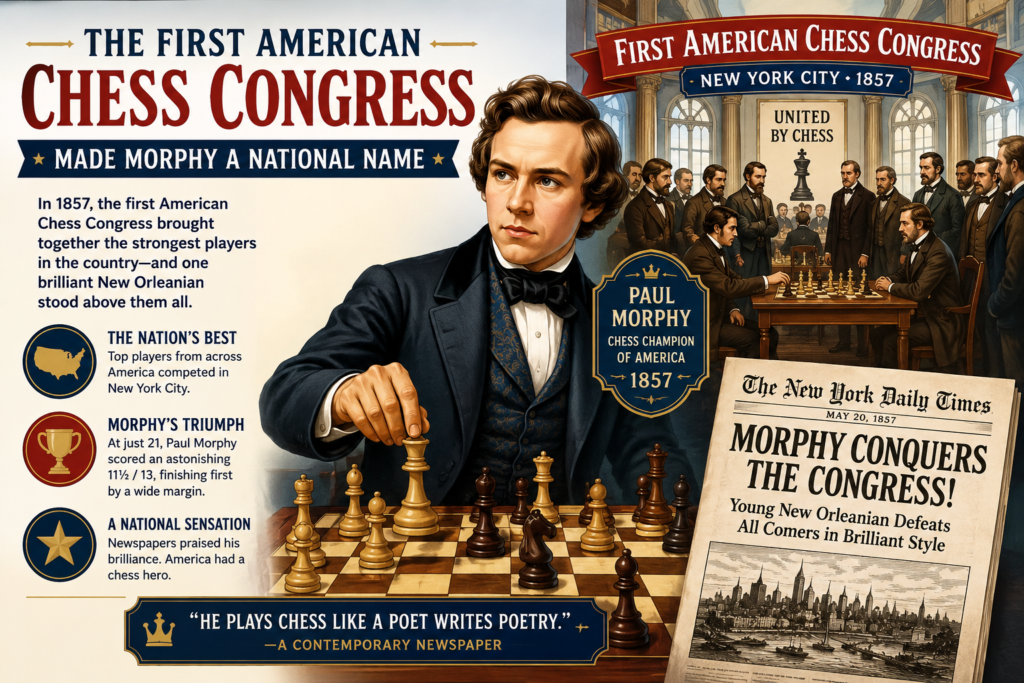
But the more important point is how he won.
He did not win because everyone else forgot how to play. He won because his chess was cleaner. He understood the opening better. He used his pieces faster. He gave his opponents hard problems before they were ready.
Morphy made strong players feel late to the game.
Imagine sitting across from Morphy. You make a normal move. He develops. You move a piece twice. He castles. You grab a pawn. He opens the center. Suddenly, his rook is looking at your king. His bishop is cutting across the board. His queen is ready to join. Your pieces are still stuck.
That was the fear Morphy created.
He did not need to shout. His moves did the talking.
The fifth big Morphy lesson is that the opening is not for showing off. It is for getting ready.
This is a key lesson for every student. The opening should not be treated like a memory test. Yes, openings matter. Yes, good move orders help. But the main goal is simple. Get your army ready faster than your opponent.
Find the right learning experience
Tell us a little about the learner and what you are looking for. Our team will review your answers and help you identify the most suitable next step.
- Takes only a few minutes
- No payment required
- Personalised recommendations
Your information will only be used to respond to your enquiry.
That means knights and bishops should come out early. The king should become safe. The center should be respected. Rooks should get connected. Pieces should not block each other.
When kids learn this, their games improve quickly. They stop making moves that only “look active.” They start making moves that build something.
At Debsie, this idea is taught in a way children can use right away. A coach may ask, “What piece is not playing yet?” That question is simple. But it guides the child toward better chess.
Winning the American Chess Congress was not just a trophy. It was proof of a new style.
Morphy’s rise showed that chess was changing. The best player was no longer just the person who found the wildest attack. The best player was the one who understood when the attack was ready.
That difference matters.
Bad attacks are like running before tying your shoes. You may move fast, but you will fall. Good attacks are different. They are built step by step. When they start, they are hard to stop.
The sixth big Morphy lesson is that a strong attack starts before the first sacrifice.
Many beginners think a sacrifice is the start of the attack. Morphy teaches the opposite. The sacrifice is often the final proof that the attack was already strong.
Before the sacrifice, the pieces were placed well. The enemy king was weak. The center was open. The defender had no time. That is why the sacrifice worked.
This is a powerful lesson for children because it teaches cause and effect. They learn not to hope. They learn to build.
That kind of thinking goes far beyond chess. It helps with school, sports, music, and daily choices. A child learns that big results come from small, smart steps.
Morphy’s Trip to Europe Was Like a Final Exam in Public
In 1858, Morphy went to Europe. The World Chess Hall of Fame notes that before this trip, he had passed the Louisiana bar exam but was too young to practice law. In Europe, he faced many of the strongest players on the continent and proved his strength.
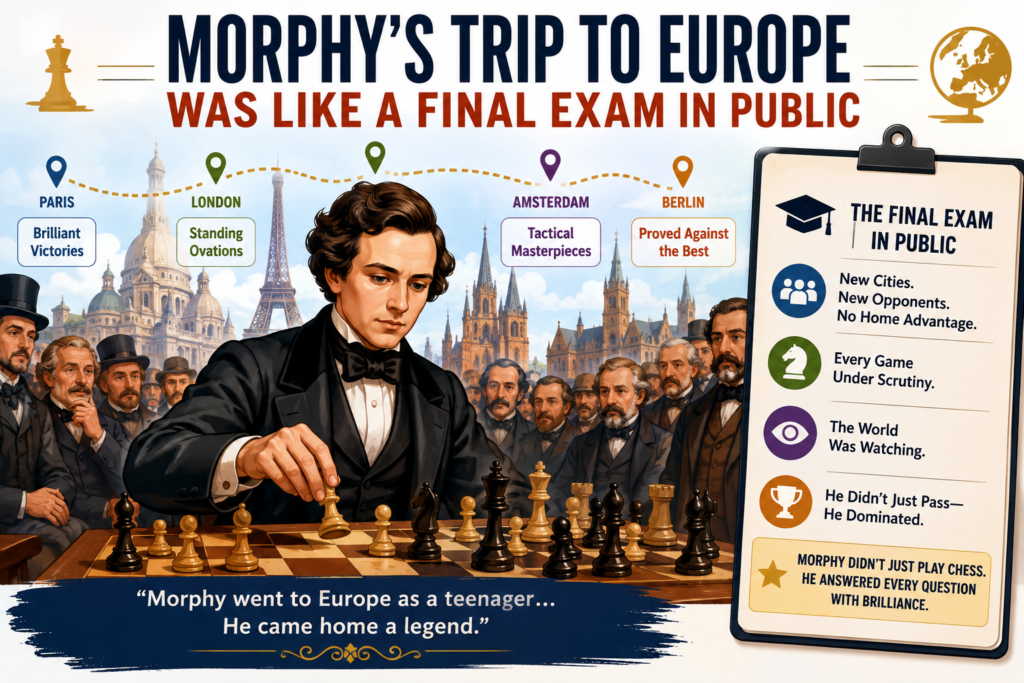
He was widely hailed as the world chess champion, even though there was no official world championship match at that time.
That trip made his legend huge.
He did not just win at home. He crossed the ocean and beat elite players in the heart of the chess world. For a young American player in the 1850s, that was a massive statement.
Europe tested Morphy’s ideas, and his ideas passed.
This is what makes Morphy so important. His style was not just good against weak players. It worked against top players too.
Fast development worked.
Open lines worked.
King safety worked.
Piece teamwork worked.
These ideas are now basic chess rules. But Morphy made them feel alive. He showed that they were not boring school rules. They were weapons.
The seventh big Morphy lesson is that simple rules become powerful when you follow them with care.
A child may hear “develop your pieces” many times. But hearing it is not enough. The child must see what happens when one player truly follows that rule.
Morphy’s games show it again and again. He did not develop just to look correct. He developed to create pressure. His pieces came out with purpose. His bishops looked at weak squares. His rooks came to open files. His knights jumped toward useful posts.
That is the difference between knowing a rule and using a rule.
At Debsie, students are taught to turn rules into habits. They do not just repeat, “Castle early.” They learn why the king needs safety. They do not just repeat, “Control the center.” They learn how the center helps pieces move faster.
Morphy’s Europe trip also shows the value of playing stronger opponents.
Kids grow when they face the right kind of challenge. If every game is too easy, they get bored. If every game is too hard, they lose hope. The best learning happens when the child is stretched but not crushed.
Morphy went to Europe to face the best. That was brave. It also gave him the stage he needed.
The eighth big Morphy lesson is that growth needs brave practice.
A student should not fear strong opponents. A strong opponent can show you what to fix. A loss can become a lesson. A hard game can reveal a weak habit.
This is why guided play matters so much. A child should not only play random games online and hope to improve. They need review. They need feedback. They need someone to explain the turning point in simple words.
That is one reason Debsie’s live classes, private coaching, and online tournaments work so well together. Kids learn ideas, test them in games, then come back and understand what happened.
Morphy’s story proves that chess growth is not just about playing more. It is about learning better.
Fast Development Was Morphy’s Secret Weapon, but It Was Not a Secret
Fast development sounds simple. That is the funny part. Morphy’s main idea was not hidden. He was not using a strange opening trick that only he knew. He was using the most basic chess idea better than everyone else.
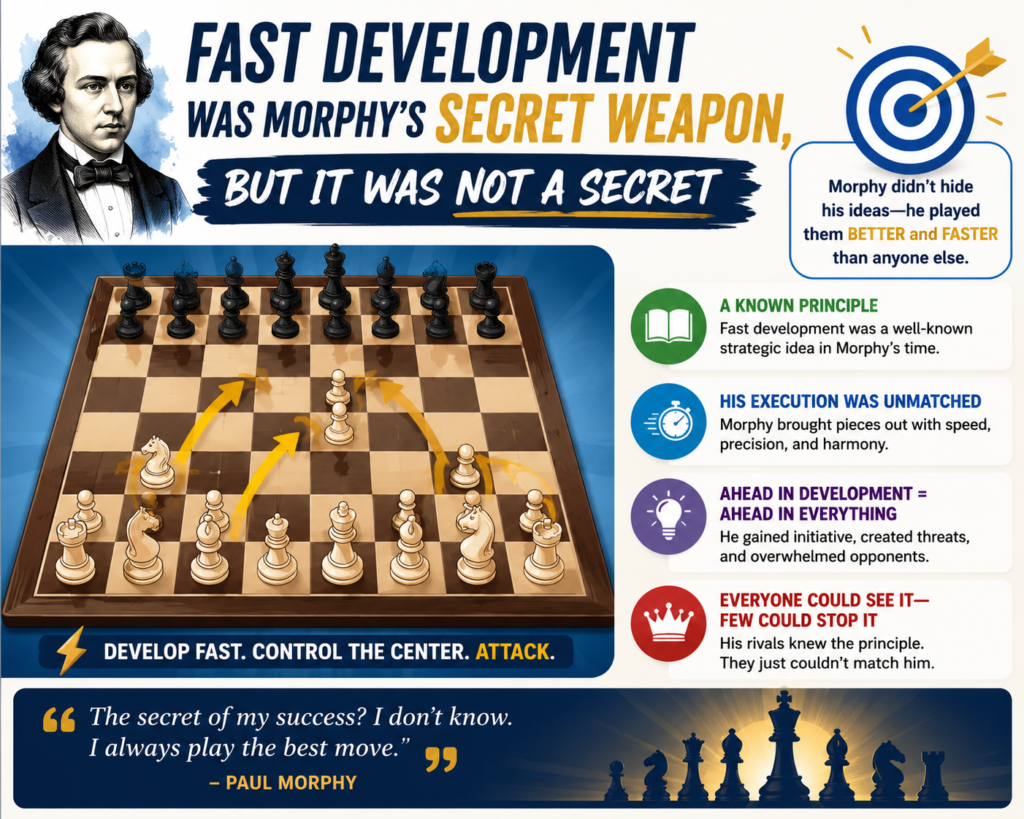
Get your pieces out.
Do it fast.
Do it with purpose.
Then open the board when your pieces are ready.
This is why his games are so useful for students. They do not need to memorize fifty moves to learn from him. They can look at the first ten moves and already see the lesson.
Development means more than moving a piece off the back rank.
A lot of beginners think they developed a piece just because they moved it. But development is not only movement. A developed piece should have a job.
A knight on a good square attacks the center. A bishop on a clear diagonal puts pressure on the enemy side. A rook on an open file can enter the game. A queen comes out when it can help without becoming a target.
Morphy understood this deeply.
The ninth big Morphy lesson is that every piece should ask, “How am I helping?”
This question is easy for kids to remember. It also stops many bad moves.
Before moving a piece, the child can ask, “What is this piece doing now?” Then they can ask, “What will it do after I move it?” If the answer is not clear, the move may not be good.
That one habit makes a child more careful. It slows down impulse moves. It builds focus. It helps the child think before acting.
Parents love chess for this reason. The child is not only learning a game. They are learning how to pause, look, choose, and take responsibility.
Morphy’s fast development made his attacks feel unfair.
When one side has four pieces ready and the other side has two, the board is not equal anymore. Even if the material count is the same, the active side may be much better.
Morphy used this hidden lead. He treated activity like money in the bank. When he had enough of it, he spent it with force.
The tenth big Morphy lesson is that active pieces can be worth more than extra pawns.
This is a lesson many kids need. Beginners love pawns. They grab them because a pawn feels like a point. But if grabbing a pawn lets the opponent develop with speed, open lines, and attack the king, that pawn can become very expensive.
Morphy often showed that a lead in development can matter more than small material.
This does not mean kids should throw pieces away. It means they should learn to count more than material. They should count active pieces. They should count king safety. They should count open lines. They should count threats.
That is smart chess.
And smart chess is exactly what Debsie helps children build, one clear idea at a time.
Morphy’s Open Lines Made His Pieces Look Like They Had Superpowers
Fast development was only the first part of Morphy’s magic. The next part was opening the board at the right time. He knew that active pieces need clear roads. A bishop needs a diagonal. A rook needs an open file. A queen needs space. If the board stays locked, even great pieces can feel stuck.
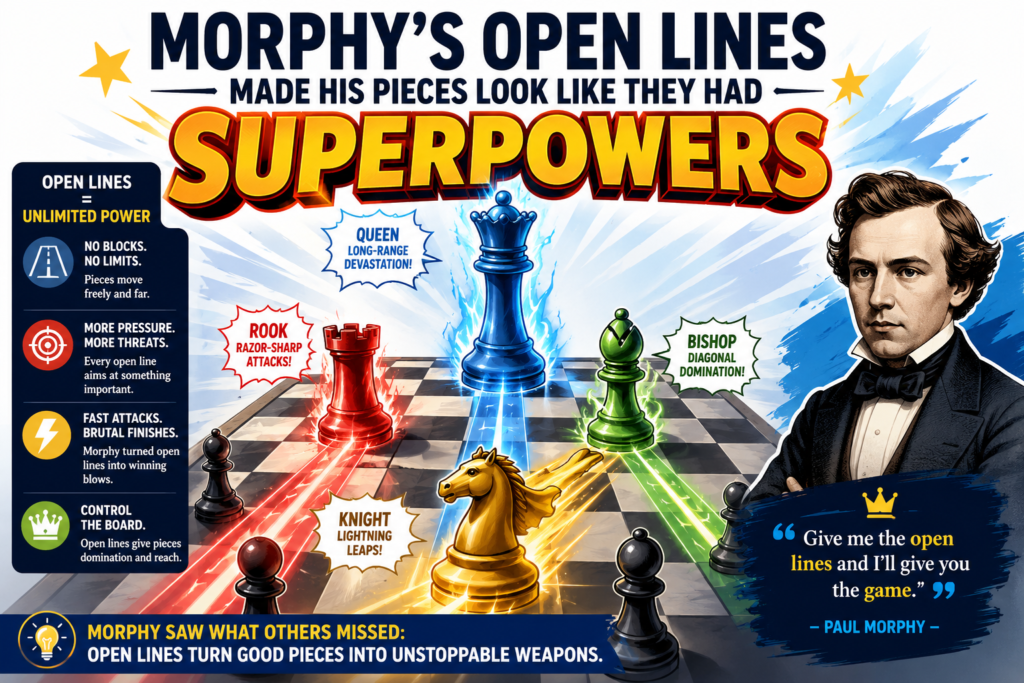
Morphy often opened the center when his pieces were ready and his opponent’s pieces were not. That is why his attacks looked so sudden. They were not sudden at all. He had been building them from the first few moves.
Open lines matter because chess pieces need paths before they can attack.
A child may bring out a bishop and still not understand why the bishop is strong. The bishop is strong only when it sees far. A rook is strong only when it can move into the game. A queen is scary only when she has safe ways to join the attack.
Morphy understood this before many players of his time did. He did not just place pieces on pretty squares. He placed them where they could work with each other.
The eleventh big Morphy lesson is that an open board helps the player who is better prepared.
This is one of the most useful rules for young players. Do not open the game just because you want action. Open the game when your pieces are ready and your king is safe.
If your opponent has not castled, opening the center can be powerful. If your opponent has left pieces at home, open lines can make those pieces useless. If your rooks are ready and your opponent’s rooks are still sleeping, an open file can become a road into the enemy side.
But the rule works both ways. If your own king is unsafe and your pieces are stuck, opening the board may help your opponent more than you.
This is why kids need more than random online games. They need someone to ask, “Who benefits if the center opens?” That question turns a child from a mover into a thinker.
At Debsie, our coaches help students see these moments clearly. A child learns not only what move to play, but why the timing matters. That is where real chess growth begins.
Morphy’s attacks felt brutal because every piece had a road.
In many Morphy games, the final attack looks like a storm. But the storm starts with roads. The bishop has a diagonal. The rook has a file. The queen has an entry square. The knight can jump into the fight. When all those roads are open, defense becomes very hard.
This is why Morphy’s style is so good for students. It teaches that strong attacks are built, not wished for.
The twelfth big Morphy lesson is that space without purpose is not enough.
Some kids push pawns to gain space, but then they do not know what to do next. Space is helpful, but only if your pieces use it. Morphy’s games show that space should become action. A pawn move should open a line, gain time, support a piece, or weaken the enemy king.
When children learn this, their chess becomes cleaner. They stop pushing pawns just to “do something.” They start asking better questions. What line opens? What piece improves? What weakness is created?
That kind of thinking helps a child grow in chess and in life. They learn that action should have a reason. That is a strong habit.
The Opera Game Is Still the Best Morphy Lesson for Young Players
Morphy’s most famous game is often called the Opera Game. It was played in Paris in 1858. Morphy played White against the Duke of Brunswick and Count Isouard, who made moves together as Black.
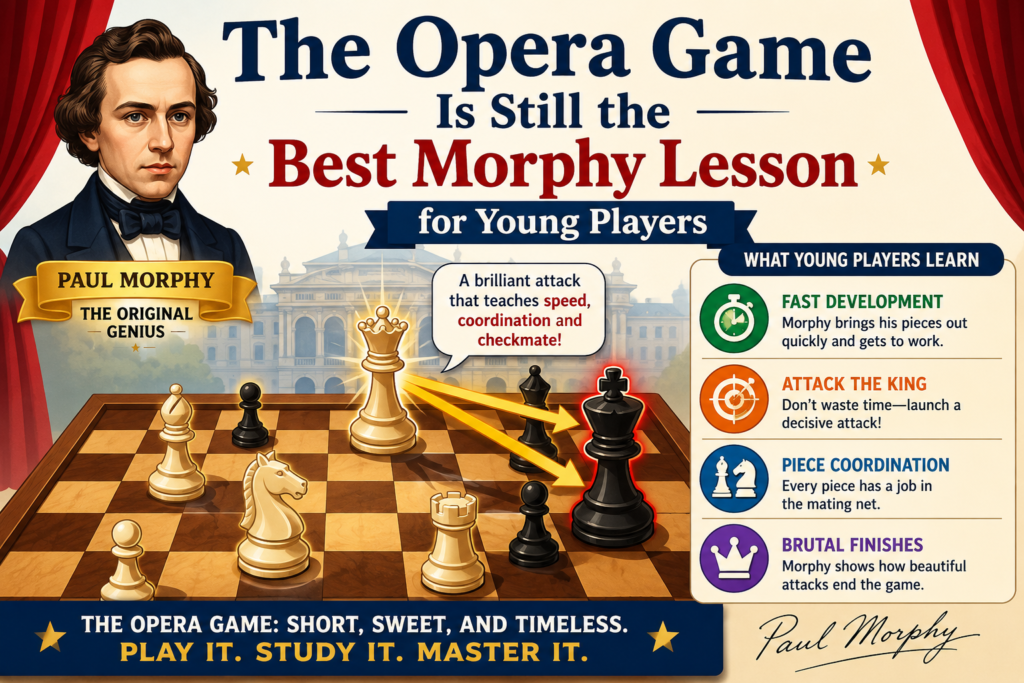
The game is famous because Morphy developed fast, opened lines, gave up material, and finished with a beautiful checkmate. Chess.com calls it one of the most famous games in chess history, and Edward Winter’s chess history work also discusses the details and sources around the game.
This game is perfect for kids because the lesson is easy to see. Morphy’s pieces come out. Black falls behind. Then Morphy opens the board and the black king has no safe place.
The Opera Game shows that simple moves can create a huge attack.
The game began with normal opening moves. Morphy did not need a strange trick. He played in the center. He developed. He brought pieces into the game. Black, on the other hand, spent time moving pieces in ways that did not solve the biggest problem: the king was still in danger.
That is the heart of the game.
Morphy did not attack because he felt like attacking. He attacked because the position asked for it.
The thirteenth big Morphy lesson is that a sacrifice should make the position easier, not harder.
Many children love sacrifices. They see a famous game and want to copy the exciting part. But Morphy’s sacrifices were not random. They removed defenders. They opened lines. They forced the enemy king into a weak place.
A good sacrifice has a clear purpose.
It should bring more pieces into the attack. It should create forcing moves. It should make the defender’s job painful. If the sacrifice only looks cool, it may not be good.
This is where coaching matters. A coach can slow the game down and ask, “What did the sacrifice do?” When a child answers that question, they learn the idea behind the move. They are not just clapping for a queen sacrifice. They are learning how chess works.
At Debsie, this is how we help students enjoy great games without turning them into guesswork. The child gets the beauty, but also the reason behind the beauty.
The Opera Game also teaches kids not to fear giving up material for a clear win.
In the Opera Game, Morphy’s finish is famous because he gives up major material to force checkmate. That sounds shocking to beginners. But once they see the board, it becomes clear. The black king is trapped. Morphy’s active pieces control the key squares. The final moves are not hope. They are a forced finish.
This is a powerful moment for a child.
The fourteenth big Morphy lesson is that checkmate is worth more than points.
Many young players count material well, but they sometimes forget the goal of the game. The goal is not to collect pawns. The goal is to checkmate the king.
Material matters. But if a forced mate exists, material no longer matters. You can give up a queen if the next result is checkmate.
That lesson builds brave thinking. It also builds clear thinking. The child learns to ask, “Is the king safe?” before asking, “Am I up points?”
This is a major step in chess growth.
Morphy’s Brutal Finishes Worked Because He Used Forcing Moves
A brutal finish in chess does not mean wild chess. It means the defender has no good choices left. Morphy was a master at this. When he attacked, he often used checks, captures, and threats in a clean order. These moves forced the opponent to answer. That gave Morphy control.
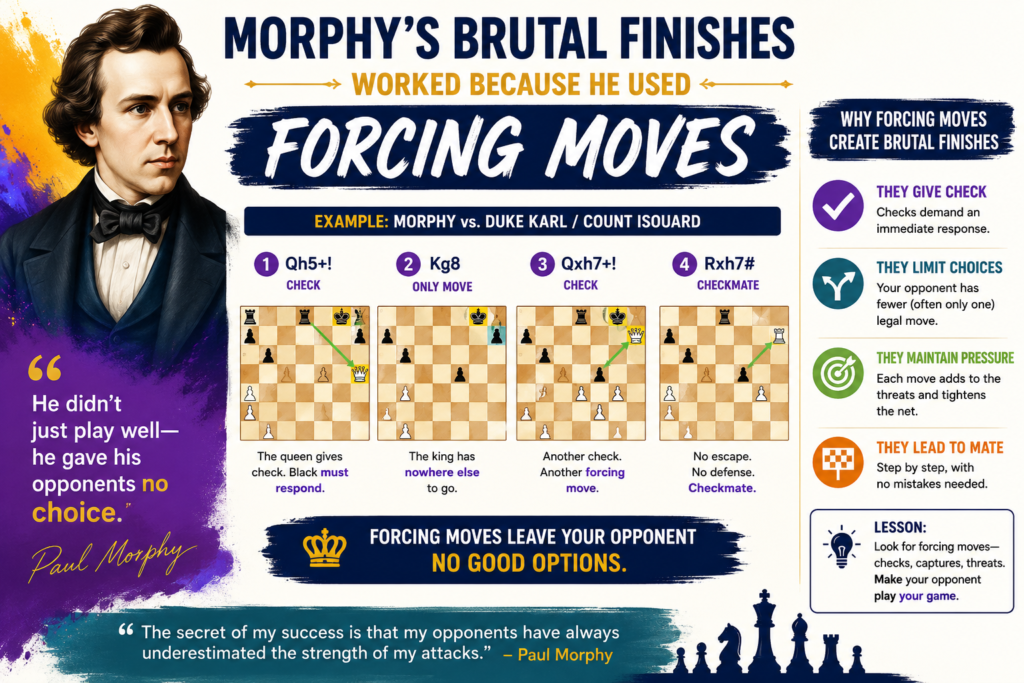
This is why his attacks felt so sharp. He was not just making threats. He was making threats that had to be answered.
Forcing moves help kids stop guessing and start calculating.
Many children look at a position and feel lost. There are so many possible moves. A simple way to start is to look for forcing moves. Are there checks? Are there captures? Are there threats against the king or queen?
This does not mean every check is good. It means forcing moves should be checked first because they limit the opponent’s choices.
Morphy was brilliant at this. He saw when a check pulled the king to a worse square. He saw when a capture removed a defender. He saw when a threat made the next move stronger.
The fifteenth big Morphy lesson is that good calculation starts with the opponent’s replies.
Beginners often think only about their own move. Strong players think about the answer. Morphy’s games show this clearly. His moves work because the opponent’s replies are limited.
This is a wonderful life skill for kids. It teaches them to think one step ahead. Not in a scary way, but in a calm way. “If I do this, what can happen next?” That question helps in chess, school, sports, and daily choices.
A child who learns to pause and predict is learning real decision-making.
At Debsie, we help students practice this in live classes. They do not just solve puzzles by guessing. They learn to explain the line in simple words. “I check. He must move here. Then I win the queen.” That kind of talk builds a strong chess mind.
Morphy’s finishes were fast because he reduced the defender’s choices.
A weak attack gives the opponent many ways out. A strong attack gives the opponent one or two bad choices. Morphy often led his opponents into positions where every move was painful.
That is what a clean finish looks like.
The sixteenth big Morphy lesson is that the best attack feels simple at the end.
When a child sees a Morphy checkmate, they may think the whole game was magic. But the finish feels simple because Morphy did the hard work earlier. He developed. He opened lines. He brought pieces near the king. Then the final moves became natural.
This teaches patience. Do not rush the finish before the position is ready. Build first. Then strike.
That message is very useful for parents too. A child does not become strong overnight. They grow through clear lessons, guided practice, kind feedback, and steady play. The right learning path makes the hard things feel easier over time.
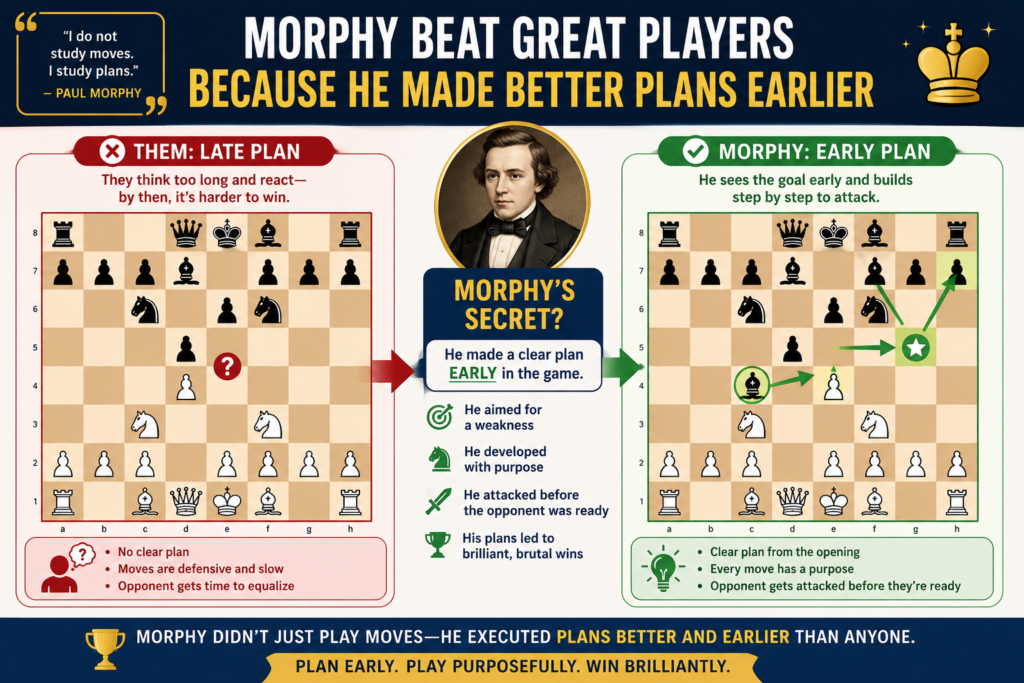
Morphy Beat Great Players Because He Made Better Plans Earlier
Morphy did not only shine against casual players. He also beat many strong masters. One of the most important moments of his career was his 1858 match against Adolf Anderssen in Paris.
Anderssen was widely respected after his great success in European chess, and Morphy’s match win helped show that the young American was truly world-class. Chess.com’s event page notes that Anderssen was forty at the time and that Morphy had been in Europe only a few months.
This matters because it proves Morphy’s ideas were not just good against weak defense. His style could hurt the best players too.
Morphy’s plans were strong because they began in the opening.
Some players only start thinking after the opening ends. Morphy started thinking from move one. He used the opening to aim his pieces. He was already preparing future pressure while the game still looked quiet.
This is a huge lesson for students.
Do not treat the opening as a set of moves to survive. Treat it as the start of your plan.
The seventeenth big Morphy lesson is that the opening should connect to the middle game.
A child might memorize the first five moves of an opening and then feel lost. That happens because memorized moves do not always explain the plan.
Morphy teaches the better way. Learn what your pieces want. Learn which pawn breaks matter. Learn which files and diagonals may open. Learn where your king belongs. Learn which side of the board you may attack.
This kind of learning is deeper, but it is also easier in the long run. The child is not trying to remember endless lines. They are learning ideas they can use again and again.
At Debsie, this is a key part of our chess teaching. We help students understand plans, not just copy moves. That makes chess feel less scary and more fun.
Beating strong players also shows the value of clean habits under pressure.
Against a strong opponent, bad habits get punished. A loose king gets attacked. A slow piece stays useless. A greedy pawn grab becomes a target. Morphy’s strength was that his good habits held up under pressure.
That is what we want for young players too.
The eighteenth big Morphy lesson is that good habits protect you when the game gets hard.
When a child is nervous, they often fall back on habit. If the habit is poor, the game falls apart. If the habit is strong, the child has something to trust.
Castle before the center opens. Develop pieces before chasing pawns. Look for the opponent’s threat. Check forcing moves. Count defenders before sacrificing.
These habits are not fancy. But they win games.
More important, they build calm thinking. A child who has a clear process does not panic as easily. That kind of confidence is one of the best gifts chess can give.
The Staunton Story Shows Why Results Matter More Than Talk
One famous part of Morphy’s Europe trip was the match that never happened with Howard Staunton. Staunton was one of the most important English chess figures of his time, but the planned match with Morphy did not take place.
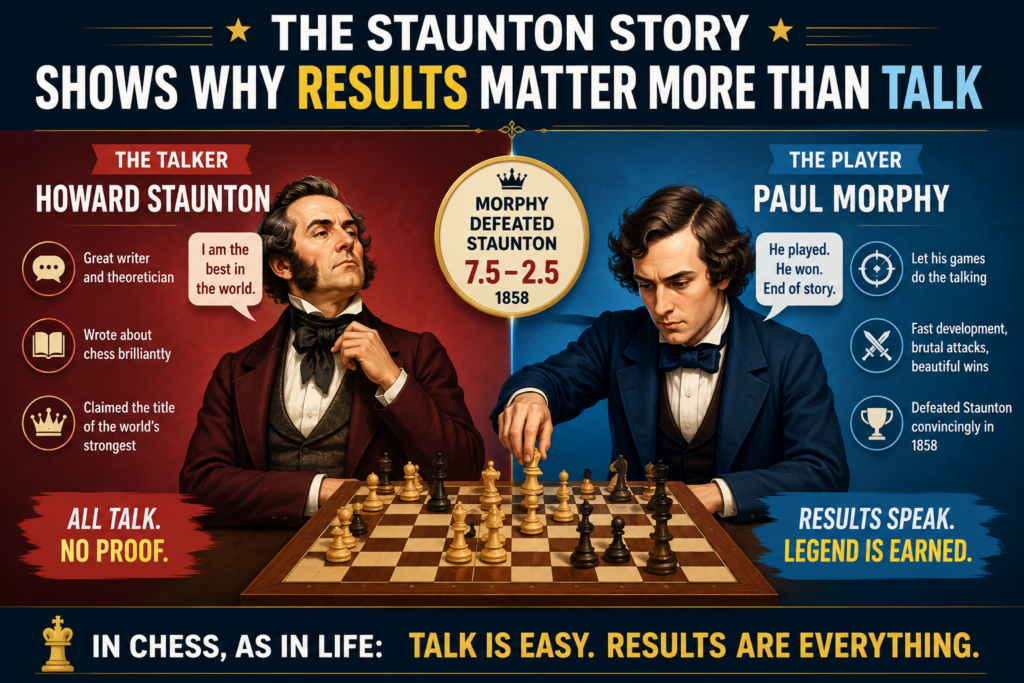
Chess historian Edward Winter explains that the Staunton-Morphy controversy is complex, with different accounts and strong opinions around the failed negotiations.
For our purpose, the lesson is simple. Chess is finally decided on the board. Not by fame. Not by letters. Not by talk. The moves tell the truth.
Morphy’s legacy grew because his games were clear proof.
People can debate history. They can debate who avoided whom. They can debate what was fair. But Morphy’s games remain. Anyone can study them. Anyone can see the speed, the pressure, the clean development, and the final attacks.
That is the beauty of chess.
The board does not care about excuses. It rewards good moves.
The nineteenth big Morphy lesson is that your work should speak for you.
This is a powerful message for kids. You do not need to brag. You do not need to fear others. You need to keep learning, keep thinking, and keep improving.
When children play chess, they learn that effort becomes visible. Better focus shows on the board. Better patience shows on the board. Better planning shows on the board.
That is why chess is such a strong tool for growth.
At Debsie, we want every child to feel this. Not every student needs to become a champion. But every student can become a better thinker. Every student can learn to stay calm, make a plan, and try again after mistakes.
The best part of Morphy’s story is that his lessons are still useful today.
Morphy played more than 160 years ago, but his ideas still help children right now. Develop fast. Keep your king safe. Open lines when ready. Use all your pieces. Do not grab pawns without a reason. Look for forcing moves. Finish with purpose.
These lessons are simple, but they are not small.
The twentieth big Morphy lesson is that simple chess, done well, is powerful chess.
That is why Morphy is still one of the best players for kids to study. His games are exciting enough to spark love for chess, but clear enough to teach real skill.
And this is exactly what a good chess class should do. It should make the child curious. It should make the child brave. It should make the child say, “Now I understand.”
If your child is ready to learn chess in a warm, clear, and exciting way, Debsie’s free trial class is a great first step. They will not just learn moves. They will learn how to think.
Morphy’s Game Against Louis Paulsen Shows How Patience Can Lead to Fire
Louis Paulsen was not a weak player. He was one of the best minds at the First American Chess Congress in 1857, and he later became known for deep defensive ideas. That makes Morphy’s famous win against him even more useful for students.
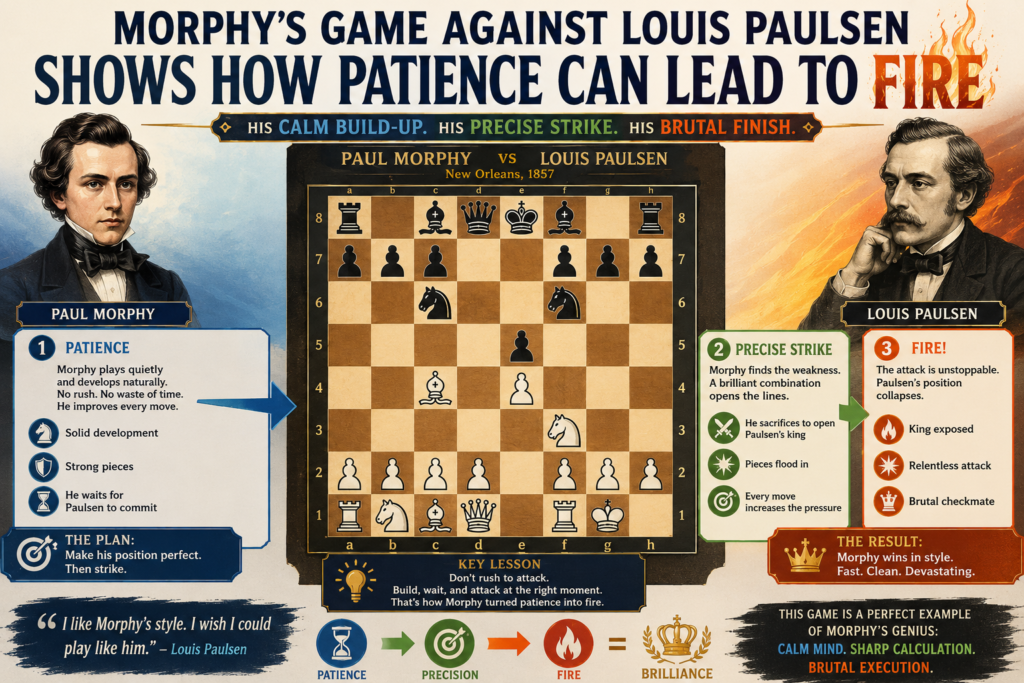
It was not a cheap win. It was a lesson in how pressure grows when one player keeps improving and the other player slowly runs out of comfort.
The Morphy and Paulsen match was part of the final round in New York, and chess historian Edward Winter notes that Morphy defeated Paulsen by a match score of five wins, one loss, and two draws. That result helped confirm Morphy as the top player in the event.
Morphy did not force the attack before the board was ready.
In many beginner games, a child sees one possible check and plays it right away. The move feels fun. It feels active. But after the check, the opponent blocks, develops, and suddenly the attacking player has no plan.
Morphy was different. He often waited until the pieces were placed well. Then his attack came with force.
The twenty-first big Morphy lesson is that patience is not the same as doing nothing.
This is a lesson many kids need. Patience in chess does not mean sitting and waiting. It means making useful moves while you prepare something bigger.
A useful move may improve a piece. It may protect the king. It may move a rook to an open file. It may stop the opponent’s plan. It may add one more attacker to an important square.
When a child learns this, they stop thinking that every move must be a trick. They begin to enjoy building pressure.
At Debsie, this is a key part of how we teach young players. We help them see that a quiet move can be very strong. A child who learns to improve before attacking becomes harder to beat. They also become calmer, because they no longer feel forced to find a flashy move every turn.
The Paulsen game also teaches that defense is harder when the attacker has more active pieces.
A strong defender can stop one threat. A strong defender can even stop two threats. But when every attacking piece has a role, defense becomes heavy. The defender must answer threats while also trying to free stuck pieces, protect the king, and avoid losing material.
That is the kind of pressure Morphy created.
The twenty-second big Morphy lesson is that good pressure makes the opponent solve too many problems.
This is a very practical idea for kids. You do not always need to win at once. Sometimes the best move is the one that gives your opponent one more hard question.
Can they protect the weak pawn? Can they stop the check? Can they move the king to safety? Can they develop the stuck bishop? Can they avoid a fork next move?
When a child learns to ask these questions, chess becomes less random. They start to create pressure on purpose.
This is why studying Morphy is so powerful. His games show that attacks do not need to be messy. They can be clean, planned, and very hard to defend.
Morphy’s Match With Anderssen Proved That Beautiful Attacks Need Strong Basics
Adolf Anderssen was one of the most famous attacking players of the 1800s. He was known for wild, beautiful chess. His games were full of sacrifices and brave ideas. So when Morphy faced him in Paris in December 1858, it was not just another match. It was a battle between two brilliant attacking minds.
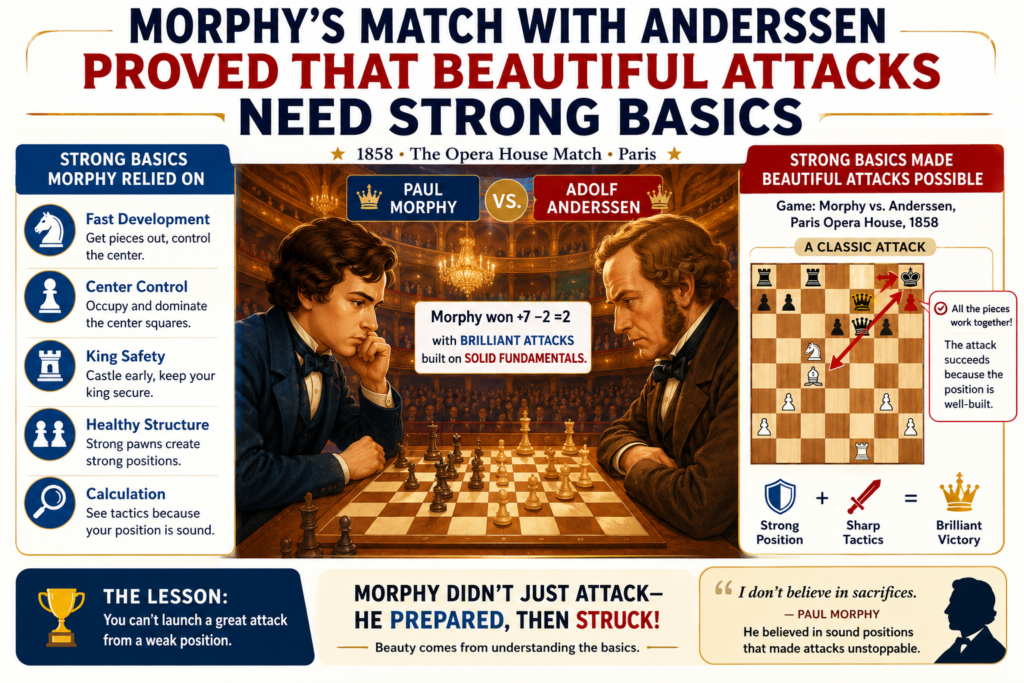
Chess.com notes that Anderssen was seen as the unofficial world champion after winning the London 1851 tournament, and that the Morphy-Anderssen match in Paris was played up to seven wins. Morphy won the match and showed that his clear, fast style could beat one of Europe’s greatest players.
Morphy’s edge was not that he attacked more. His edge was that he attacked with better support.
This is a very important point. Anderssen loved attack. Morphy loved attack too. But Morphy’s attacks often came from better development and better timing.
That is why his chess feels so modern. He did not only ask, “Can I sacrifice?” He asked, “Are my pieces ready to make this sacrifice work?”
The twenty-third big Morphy lesson is that beauty without structure can fall apart.
A beautiful move is only good if it helps the position. A queen sacrifice may look amazing, but if it does not lead to checkmate or a big gain, it is just a mistake. A bishop sacrifice may feel brave, but if the opponent can accept it and defend, the attacker is simply down a bishop.
Morphy teaches children to enjoy beauty, but also to test it.
This is the right way to raise a strong chess player. We do not want kids to become afraid of creative moves. We want them to become brave and careful at the same time.
At Debsie, coaches help children talk through their ideas. A student may say, “I want to sacrifice here.” The coach can ask, “What happens if your opponent takes it?” That simple question turns excitement into calculation.
The Anderssen match shows that the best attackers respect the basics.
Many students think basics are for beginners. Morphy proves the opposite. Basics are for everyone. The stronger the player, the more deeply they use simple ideas.
Develop pieces. Castle. Fight for the center. Open lines when ready. Keep pieces working together. Look at the opponent’s threats.
These rules sound simple, but Morphy used them like weapons.
The twenty-fourth big Morphy lesson is that strong basics make creative chess safer.
A child who knows the basics can take smart risks. They can attack without falling apart. They can sacrifice when the signs are right. They can avoid tricks because they know what a healthy position looks like.
This matters far beyond chess. Kids learn that creativity is not just wild freedom. Real creativity works best when it has skill behind it.
A child who learns chess this way becomes more confident. They are not guessing. They are thinking.
Morphy’s Best Attacks Started With King Safety, Not With Checks
It may sound strange, but one reason Morphy attacked so well was that he often made his own king safe first. This gave him freedom. Once his king was safe and his rooks were ready, he could open the center without fear.
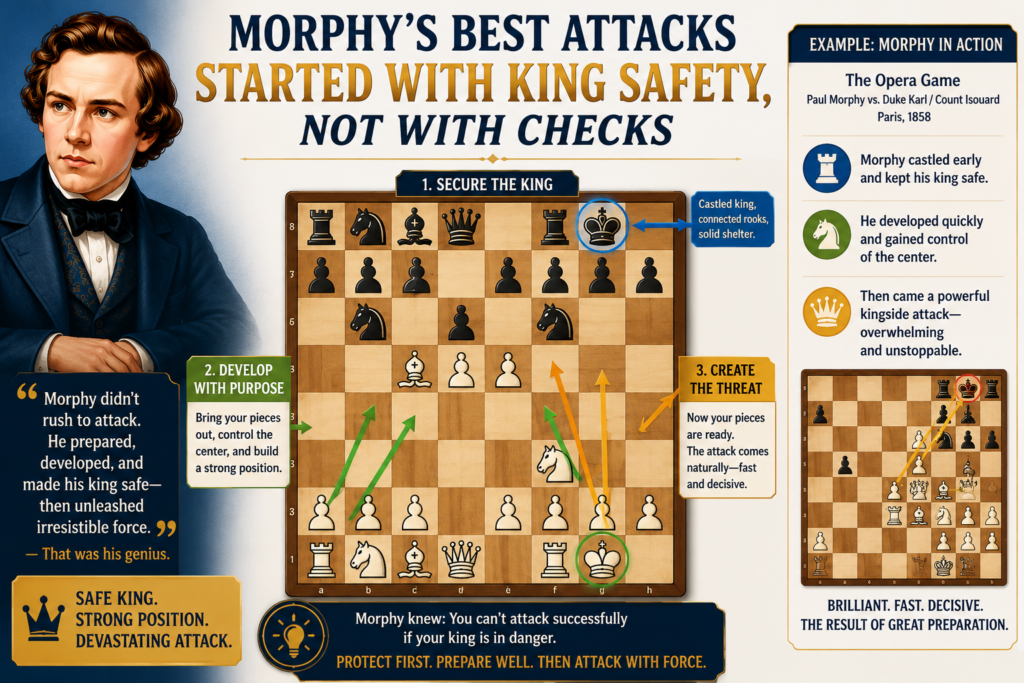
Many beginners do the opposite. They attack while their own king is still in the middle. Then one check changes everything. The attack stops, the king runs, and the whole game turns around.
A safe king lets your pieces play with courage.
Castling is not just a rule kids should memorize. It is a plan. It moves the king away from danger and brings the rook closer to the center. In many open games, this one move can change the whole feeling of the position.
Morphy understood this clearly. He did not want his attack to be stopped by counterplay. He wanted his pieces free to move forward.
The twenty-fifth big Morphy lesson is that you should not start a race while your shoelaces are untied.
This is a simple way to explain king safety to kids. If your king is unsafe, your position is not ready. You may have a good-looking attack, but one check can ruin it.
Before attacking, a child should ask, “Is my king safe enough?” Not perfectly safe. Chess is never perfect. But safe enough to allow action.
This one question can save many games.
At Debsie, we help students build this habit early. They learn to notice danger before it becomes a disaster. They learn that defense is not boring. It is part of winning.
Morphy punished unsafe kings because open lines made them weak fast.
A king in the center can survive when the board is closed. But when files and diagonals open, the same king becomes a target. Morphy was great at spotting this moment.
If the opponent delayed castling, he often opened the center. If the enemy pieces were slow, he made the board wider. If a defender was pinned, he added pressure.
The twenty-sixth big Morphy lesson is that the center is dangerous when the king is still there.
Kids often hear, “Castle early,” but they may not know why. Morphy shows the reason. The center can open quickly. Once it opens, bishops, rooks, and queens can attack the king with speed.
This lesson is easy to show on a board. Put one king in the center. Open one file. Add a rook. Add a bishop. Suddenly the child can see the danger.
That is why live teaching is so powerful. A coach can make the idea visible. The child does not just hear a rule. They feel the rule on the board.
Morphy’s Sacrifices Were Not Wild Bets. They Were Clear Deals.
When people talk about Morphy, they often talk about sacrifices. That makes sense. His games include some beautiful ones. But the danger is that kids may learn the wrong lesson. They may think Morphy won because he threw pieces at the king.
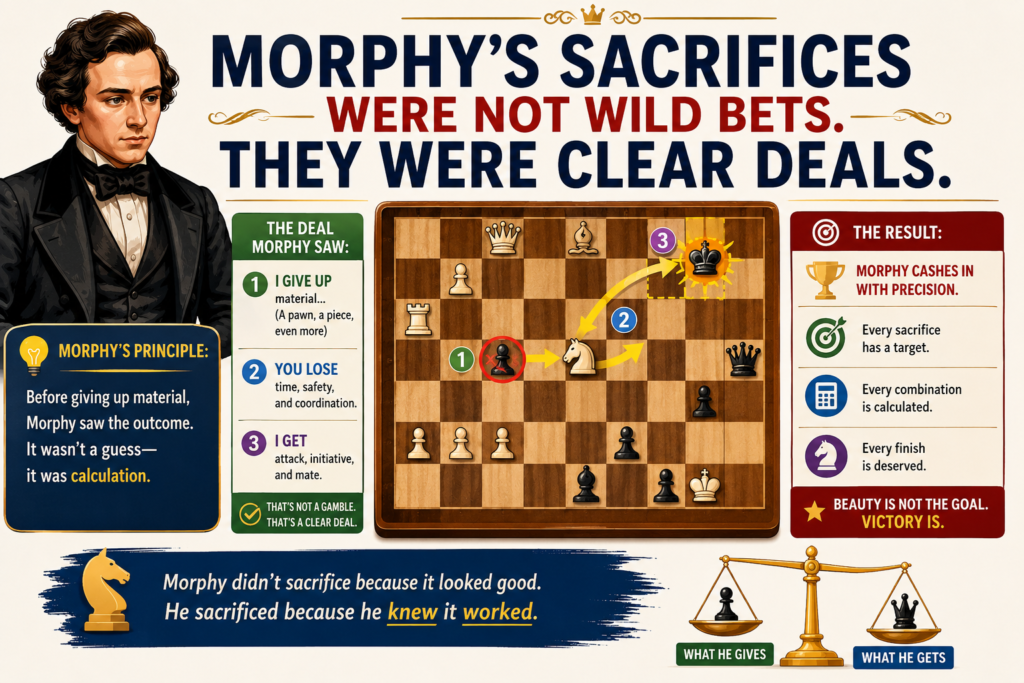
He did not.
Morphy sacrificed when he received something clear in return. He might give up material for open lines. He might remove a key defender. He might force the enemy king into danger. He might create a checkmate net.
A good sacrifice answers a clear question.
Before sacrificing, a student should ask what they are getting. If the answer is only “it looks cool,” the move is probably not ready.
A good sacrifice may lead to forced checks. It may win the queen. It may open a rook file. It may stop the king from escaping. It may bring another piece into the attack with tempo.
That is how Morphy played.
The twenty-seventh big Morphy lesson is that every sacrifice must have a job.
This is one of the most important tactical lessons for children. A sacrifice should not be a wish. It should be a deal. You give something, and you get something.
Sometimes you get checkmate. Sometimes you get a huge attack. Sometimes you win back more material. Sometimes you destroy the enemy king’s safety.
But you must know what you are getting.
At Debsie, we teach students to explain their ideas in words. This is very helpful. When a child says, “I sacrifice the bishop to open the file for my rook,” the move has a reason. When a child says, “I sacrifice because I want to attack,” the coach knows the child needs to calculate more.
Morphy’s sacrifices also teach kids to count defenders and attackers.
Many attacks fail because the child does not count. They attack a square with two pieces, but the opponent defends it with three. Or they sacrifice on a square without noticing a hidden defender.
Morphy’s best attacks worked because he understood which pieces mattered.
The twenty-eighth big Morphy lesson is that the defender you remove may be the key to the whole game.
Sometimes one knight protects everything. Sometimes one bishop guards the escape square. Sometimes one rook holds the back rank. If you remove that defender, the whole position can fall.
This is a fun lesson for kids because it feels like solving a mystery. Which piece is holding the castle together? What happens if that piece disappears?
That kind of question builds deeper thinking. It also makes chess more exciting. The child is no longer just moving pieces. They are finding the hidden reason behind the position.
Morphy’s Games Are Perfect Training Tools Because They Make Big Ideas Easy to See
Some chess games are hard for beginners to study. The moves are too quiet. The plans are too deep. The turning point is hard to spot. Morphy’s games are different. They are full of clear lessons.
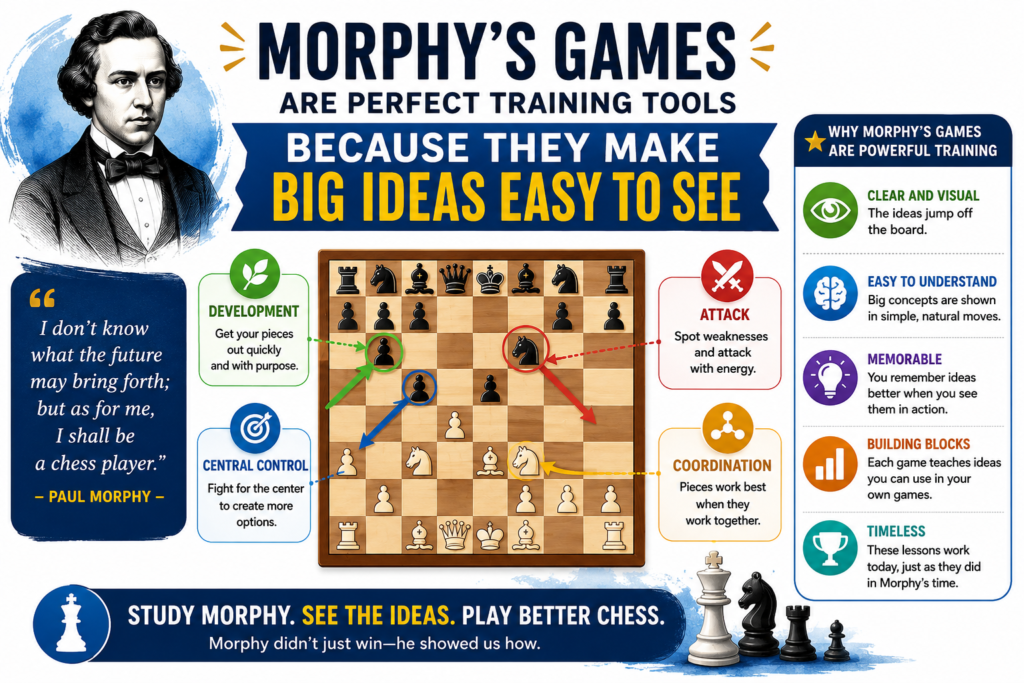
One side develops faster. One side opens lines. One king becomes unsafe. One defender gets removed. One attack becomes too strong to stop.
That is why Morphy remains one of the best first masters for students to study.
Kids learn faster when the lesson is visible.
A child does not need a long lecture to understand a Morphy game. They can often see the lesson with their own eyes.
The pieces tell the story.
White has four pieces playing. Black has two. White has castled. Black has not. White’s rook has an open file. Black’s rook is trapped. White’s bishop sees the king. Black’s bishop is blocked by its own pawns.
This makes Morphy’s chess a wonderful teaching tool.
The twenty-ninth big Morphy lesson is that clear examples build strong habits.
Children learn by seeing patterns again and again. If they see many games where fast development wins, they begin to develop faster. If they see unsafe kings get punished, they begin to castle sooner. If they see rooks using open files, they begin to look for open files.
That is how real chess growth happens.
Not through fear. Not through pressure. Not through memorizing random moves.
It happens through clear teaching, steady practice, and kind correction.
Morphy also makes chess feel exciting, which matters a lot for kids.
A child who enjoys chess will practice more. A child who practices more will improve faster. Morphy’s games are exciting because they have drama. The attack builds. The king gets trapped. The finish feels clean and strong.
This keeps students curious.
The thirtieth big Morphy lesson is that learning should make a child want to come back.
That is one reason Debsie uses a warm, guided approach to chess learning. Kids do not need to feel lost or judged. They need to feel supported. They need to understand what went wrong and what to try next.
Chess can teach focus, patience, planning, calm thinking, and courage. Morphy’s games are a great doorway into all of that.
If your child loves clever ideas, exciting games, and clear lessons, a Debsie free trial chess class can be the perfect next move. It gives them a chance to learn with expert coaches and see how fun smart thinking can be.
Morphy Teaches Kids to Stop Moving the Same Piece Again and Again
One of the fastest ways to fall behind in chess is to move the same piece too many times in the opening. This mistake looks small, but it can become a big problem very quickly. While one player moves the same knight or queen over and over, the other player brings out a full army.
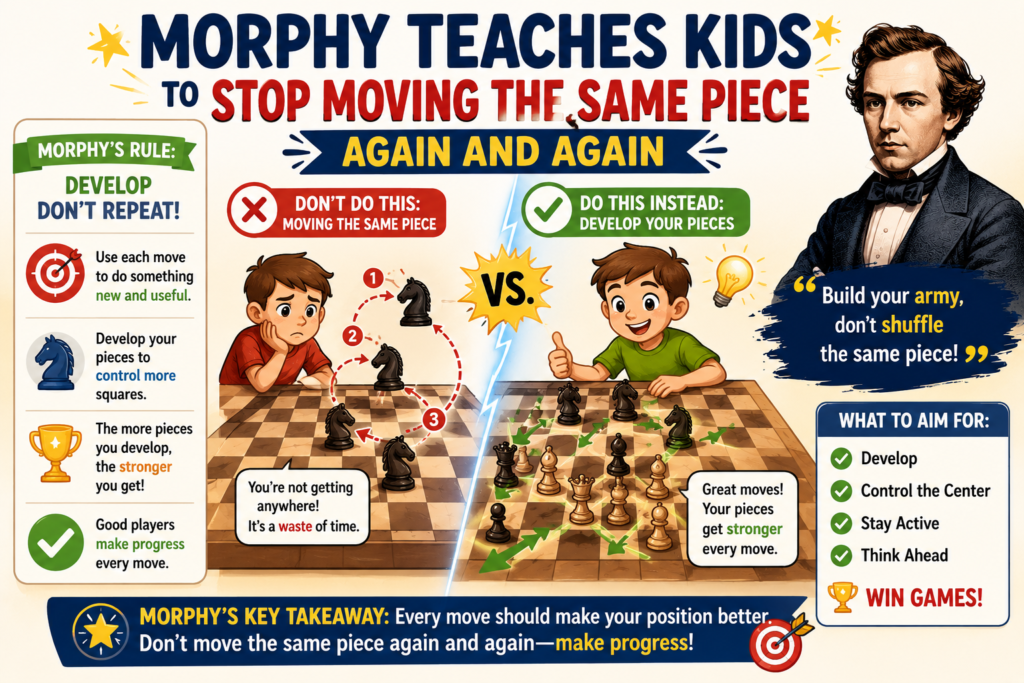
That was exactly the kind of mistake Morphy loved to punish.
Britannica says Morphy became the world’s leading player during a public chess career of less than two years, and it also notes that he was one of the first great players to rely on development before attack. That one idea explains so much of his power. He did not waste early moves. He used them to bring more pieces into the game.
The opening is the time to wake up the whole army, not show off one piece.
Many children like to bring the queen out early. It feels strong because the queen can move far and attack many squares. But an early queen can also become a target. The opponent can attack the queen while developing pieces. That means the queen keeps running, and the rest of the army stays asleep.
Morphy’s games teach the better path. The queen should not be the only hero. The knights, bishops, rooks, and pawns all need jobs. When they work together, the attack becomes much stronger.
The thirty-first big Morphy lesson is that every early move should help a new piece join the game.
This is an easy rule for young players to use. In the first part of the game, they can ask, “Am I bringing one more piece into play?” If the answer is yes, the move may be healthy. If the answer is no, they should look again.
This does not mean a child can never move the same piece twice. Chess always has exceptions. Sometimes a piece is attacked. Sometimes a tactic is available. Sometimes there is a clear win. But as a habit, moving new pieces is safer and stronger.
At Debsie, coaches often help students spot this during game review. A child may not notice that they moved the queen four times in ten moves. But once they see it on the board, the lesson becomes clear. They learn that the lost time gave the opponent a real lead.
Morphy made time feel visible on the board.
Time in chess can be hard for kids to understand because it is not always shown in points. A player may have equal material but still be losing because their pieces are not ready. Morphy made this lesson easy to see. His active pieces stood on strong squares while the other side struggled to catch up.
The thirty-second big Morphy lesson is that being ahead in development is like being first to the door in a race.
If two players are racing to attack, the one with more pieces ready usually has the better chance. The other player may want to attack too, but their pieces are late.
This is a strong lesson for life as well. Good planning makes later action easier. When kids learn to prepare well in chess, they also learn that rushing without getting ready can lead to trouble.
Morphy’s Center Play Shows Why the Middle of the Board Matters So Much
The center is the heart of the chessboard. Pieces placed near the center often have more choices. Knights can jump to more squares. Bishops can reach both sides. Queens and rooks can move faster when lines open. Morphy understood this deeply, and his games often show strong center play from the very start.
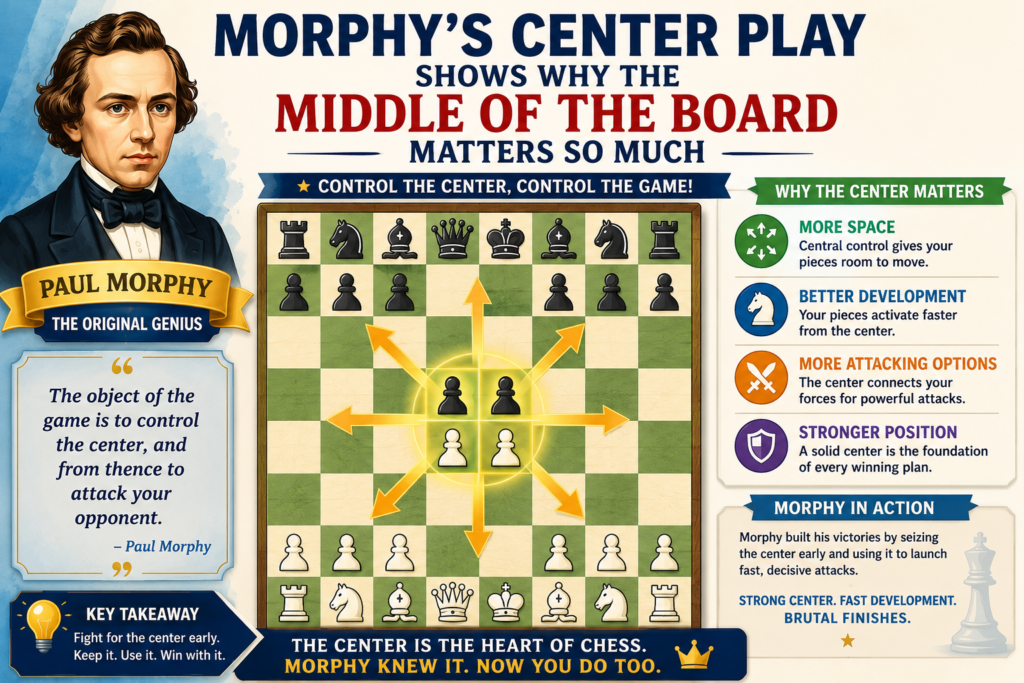
This does not mean Morphy pushed center pawns without thought. He used the center to help his pieces move. He also used it to open lines when the opponent’s king was still unsafe. That is why his attacks often arrived with such speed.
The center is not just land to own. It is a road system for your pieces.
Some students think center control only means putting pawns on the middle squares. That can help, but it is not the whole story. You can also control the center with pieces. A knight can attack central squares. A bishop can look across the board. A rook can use an open central file.
Morphy’s play shows that the center is most powerful when it helps your pieces become active. If the center is closed, attacks may take longer. If the center opens at the right time, the better-developed player can suddenly take over.
The thirty-third big Morphy lesson is that you should open the center when your pieces are ready and the other king is not.
This is one of the most useful rules in attacking chess. If your opponent has delayed castling and your pieces are out, look for ways to open the center. A pawn trade can open a file. A capture can clear a diagonal. A sacrifice can pull a defender away.
But timing matters. If your own king is unsafe, opening the center can hurt you. That is why Morphy’s attacks were so clean. He usually made sure his side was ready first.
At Debsie, we teach this in a simple way. Students learn to ask, “Who is happier if the center opens?” That one question helps them avoid careless pawn trades. It also helps them find strong attacks when the moment is right.
Center control also helps children understand planning, not just moves.
A child may ask, “What should I do next?” The center often gives the answer. If the center is locked, maybe the plan is to improve pieces and prepare a pawn break. If the center is open, maybe the plan is to bring rooks to open files. If the enemy king is stuck in the center, maybe the plan is to attack before it escapes.
The thirty-fourth big Morphy lesson is that the board often tells you the plan if you know where to look.
This is a big step for young players. They stop asking for random tricks and start reading the position. They learn that chess is not a guessing game. The pieces, pawns, king safety, and open lines give clues.
That kind of thinking builds confidence. A child who can find clues on the board feels less lost. They begin to trust their own mind.
Morphy’s Blindfold Chess Shows the Power of Clear Thinking
During his time in Paris, Morphy gave a famous blindfold display against eight strong players. Britannica notes that he won six games and drew two in that event. Blindfold chess means the player does not look at the board. They must hold the whole position in their mind.
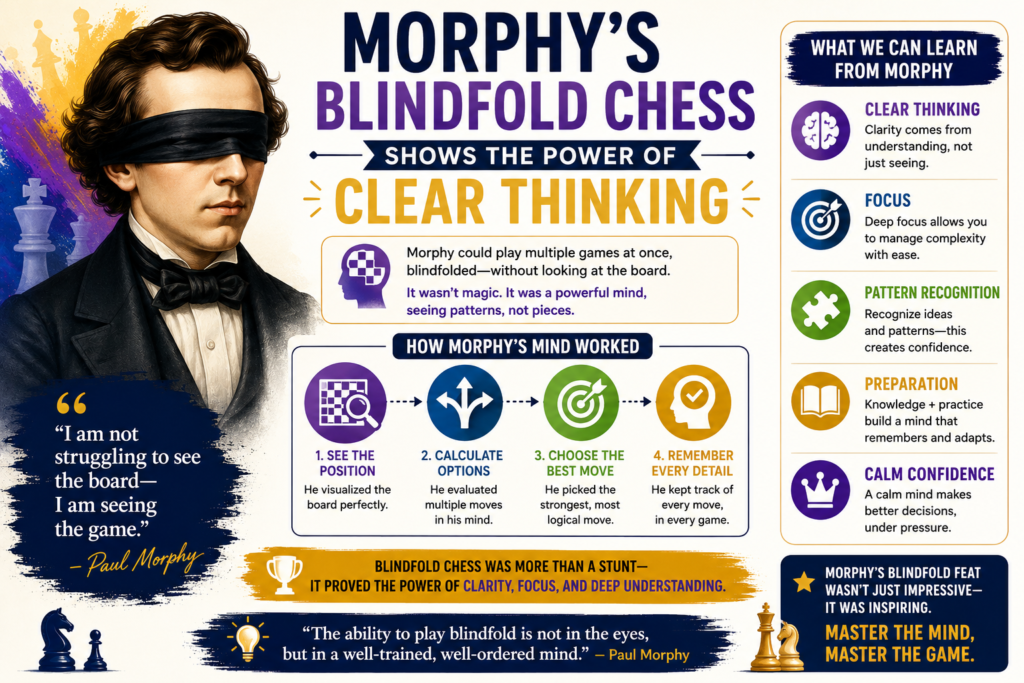
For most children, blindfold chess may sound impossible. But the lesson is not that every child must play blindfold games. The lesson is that clear thinking can be trained. Morphy’s mind was powerful, but he also had strong patterns.
He understood piece activity, open lines, king safety, and threats so well that he could track them without seeing the board.
Great chess memory is often built from patterns, not from raw memory alone.
When a beginner looks at a chessboard, they may see thirty-two separate pieces. That feels like too much. A stronger player sees patterns. They see a castled king. They see a pinned knight. They see an open file. They see a weak back rank. They see a bishop aimed at the king.
Patterns make the board easier to understand.
The thirty-fifth big Morphy lesson is that children improve faster when they learn shapes, not just rules.
This is very important in chess training. A child may know the rule that bishops move diagonally. But that does not mean they understand a strong bishop. They need to see many examples. A bishop on a long open diagonal. A bishop pinning a knight. A bishop attacking a weak king. A bishop working with a queen.
Morphy’s games are full of these clear shapes. That makes them perfect for pattern learning.
At Debsie, we help students build these patterns step by step. They see common tactics. They solve positions. They review real games. Over time, the board starts to feel less crowded and more meaningful.
Blindfold chess also reminds us that focus is a skill kids can grow.
Focus is not just something a child either has or does not have. It can improve with the right training. Chess is one of the best ways to build it because every move asks the child to pay attention.
What changed? What is attacked? What is defended? What is the threat? What is my plan?
The thirty-sixth big Morphy lesson is that attention gets stronger when a child practices with purpose.
Random play can be fun, but guided practice builds deeper focus. A coach can help a child slow down, notice more, and explain their thoughts. This makes the child more careful without making chess feel cold.
Parents often love this part of chess. They begin to see their child pause before moving. They see the child handle mistakes better. They see patience grow.
That is the heart of good chess learning. It is not only about winning games. It is about building a mind that can think clearly under pressure.
Morphy’s Short Career Proves That Impact Is Not Always About Time
Morphy’s public chess career was very short. Britannica says it lasted less than two years, yet in that time he became the leading player in the world. After returning to the United States in 1859, he issued a challenge to face any player in the world at odds of pawn and move. When no one answered, he left public chess.
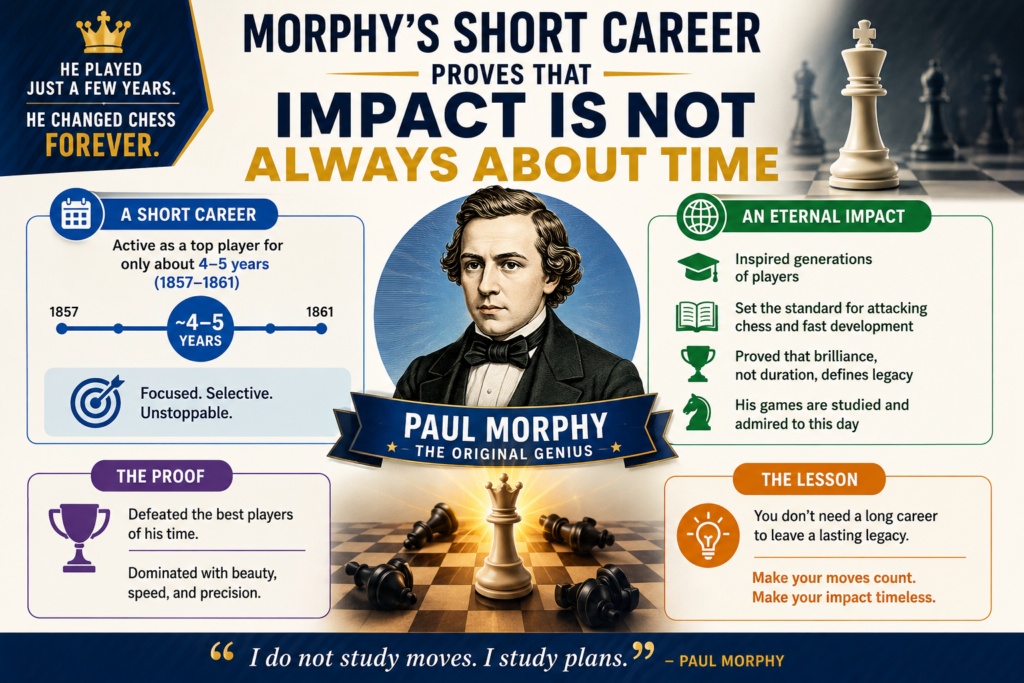
That is one reason his story feels so unusual. He rose fast, proved himself, and then stepped away. But his ideas stayed. More than 160 years later, coaches still use his games to teach children.
Morphy did not need thousands of famous games to leave a huge mark.
Some players build a legacy over decades. Morphy built his through clarity. His best games are so easy to learn from that they keep being shared. Teachers still use them because they show chess ideas in a clean way.
This is a strong lesson for young players. You do not need to do everything. You need to do the right things well.
The thirty-seventh big Morphy lesson is that strong habits can create results faster than random effort.
A child can play hundreds of games and still repeat the same mistakes. They may bring the queen out early again and again. They may forget to castle. They may miss simple tactics. More games alone will not fix that.
Better practice fixes it.
A coach helps the child notice the pattern. Then the child works on one habit at a time. Soon the games begin to change.
At Debsie, this is why we mix lessons, coaching, and tournaments. Students learn an idea, try it in real play, and then review what happened. This cycle makes growth easier to see.
Morphy’s short career also makes his games less scary for beginners to study.
Some chess legends have huge collections of complex games. That can feel heavy for a child. Morphy’s games are easier to enter because the themes are direct. Develop. Castle. Open lines. Attack with all pieces. Finish with forcing moves.
The thirty-eighth big Morphy lesson is that a small set of clear games can teach more than a huge pile of confusing ones.
Quality matters more than quantity. One well-taught Morphy game can change how a child sees the opening. One clear attacking game can teach why king safety matters. One beautiful finish can help a child understand checkmate patterns.
That is why Morphy belongs in every young player’s learning path. His games are not just old history. They are living lessons.
Morphy’s Real Genius Was Making Hard Chess Look Easy
When people call Morphy a genius, they often think of his sacrifices and checkmates. Those were amazing, but the deeper genius was his clarity. He made strong chess look simple because his ideas were clean.
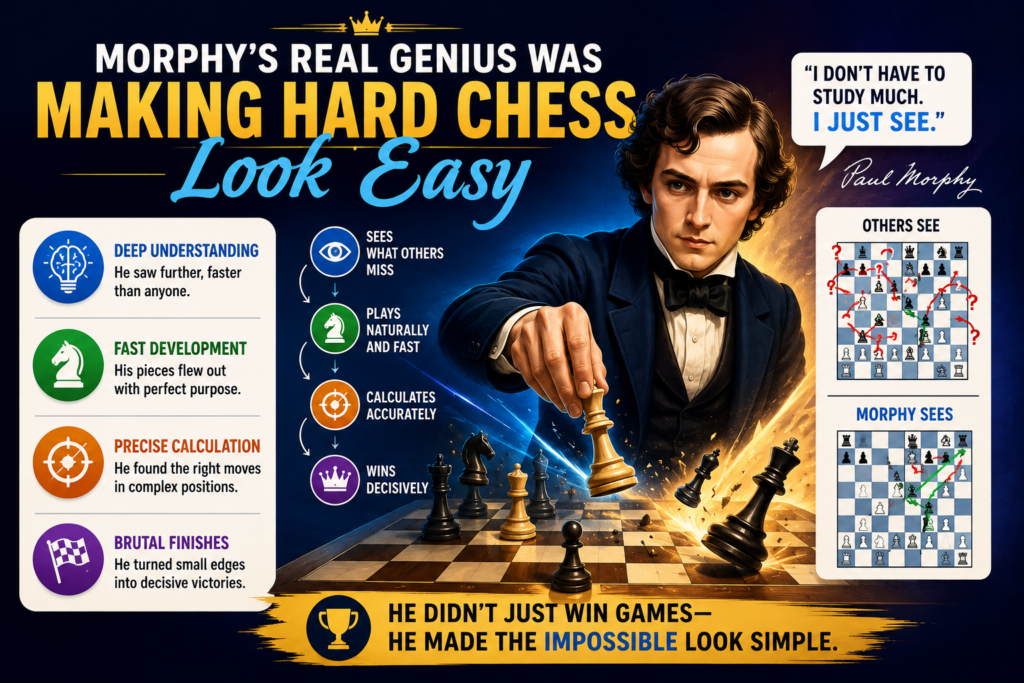
He did not need to confuse the opponent with strange moves. He made healthy moves, built pressure, and used mistakes with speed. That is a very powerful model for young players.
Easy-looking chess is often the result of very good thinking.
A great move can look normal. A knight develops. A bishop moves to an active square. A rook comes to an open file. A pawn opens the center. Each move may look simple by itself. But together, they create a position where the opponent has no easy answer.
This is what Morphy did again and again.
The thirty-ninth big Morphy lesson is that simple moves become strong when they follow one clear plan.
Kids often search for the “best trick.” Morphy teaches them to search for the best plan. A trick may work once. A plan can guide the whole game.
This is why chess helps children become better thinkers. They learn to connect small actions to a bigger goal. They learn that a move is not good just because it attacks something. It is good when it helps the full position.
At Debsie, this kind of thinking is at the center of our chess classes. We want students to understand chess in a way they can explain. When a child can say, “I moved my rook here because the file is open,” they are not copying. They are thinking.
Morphy’s lessons still work because they are based on chess truth.
Open lines still matter. Development still matters. King safety still matters. Forcing moves still matter. Teamwork between pieces still matters. That is why Morphy’s games do not feel old in the classroom.
They feel fresh because children can use the ideas right away.
The fortieth big Morphy lesson is that great chess starts with clear habits repeated with care.
This may be the best message from Morphy’s life for young students. You do not need to be born as Paul Morphy to learn from Paul Morphy. You can copy his habits. You can develop faster. You can castle sooner. You can stop chasing pawns. You can look for open lines. You can make sure every piece has a job.
That is real improvement.
If your child is ready to learn chess in a way that feels clear, warm, and exciting, Debsie’s free trial class is a wonderful first step. A great coach can help your child turn Morphy’s big ideas into simple habits they can use in their very next game.
Conclusion
Paul Morphy’s story proves that great chess does not have to be confusing. His best games teach kids to develop fast, keep the king safe, open lines with care, and attack only when the whole army is ready. That is why he still matters today.
He did not just win games; he showed a simple way to think better. For young players, Morphy is more than a chess hero. He is a guide to focus, patience, planning, and brave choices. If your child is ready to grow through chess, Debsie can help them take that next smart step.

Adhip Ray is the founder of Debsie, an online learning platform focused on chess and skill-based learning for children. His work at Debsie brings together chess education, structured thinking, problem-solving, and interactive learning for young students.
Adhip has an academic background in law, statistics, analytics, and technology. He is from Amity Law School and the Indian Statistical Institute, Kolkata, with formal training that connects legal reasoning, data analytics, quantitative thinking, and structured problem-solving. This interdisciplinary background is reflected in Debsie’s focus on building sharper thinking skills in children through chess and related learning programs.
Adhip is also a FIDE-rated chess player from India. He holds FIDE ID 5055954 and has a standard FIDE rating of 1832. His FIDE profile records him as an Indian player with a long rating history in standard chess, including rated games from his competitive playing years. His chess background gives Debsie a founder-led connection to the game, not only as an educational activity but also as a competitive discipline that develops concentration, calculation, planning, and decision-making.
In addition to chess, Adhip has a strong interest in coding, data, and technical problem-solving.
Adhip’s profile combines chess, law, data analytics, and programming. At Debsie, this background supports the creation of learning experiences that are logical, structured, and skill-oriented. The platform’s chess-focused programs are connected to broader cognitive skills such as pattern recognition, patience, strategic planning, focus, and problem-solving.
As founder of Debsie, Adhip brings together experience from multiple fields: formal legal education from Amity Law School, analytical training from the Indian Statistical Institute, Kolkata, competitive chess experience through his FIDE-rated profile, and coding practice through LeetCode. This combination gives Debsie a distinct foundation in strategy, reasoning, analytics, and child-focused learning.
Through Debsie, Adhip is associated with building chess and learning content for children that goes beyond basic instruction. The platform connects chess with thinking skills, helping students approach challenges with more structure, clarity, and confidence. His own background in chess and analytical problem-solving gives the platform a direct link to the skills it aims to develop in young learners.
Adhip is also a member of Forbes Business Council.