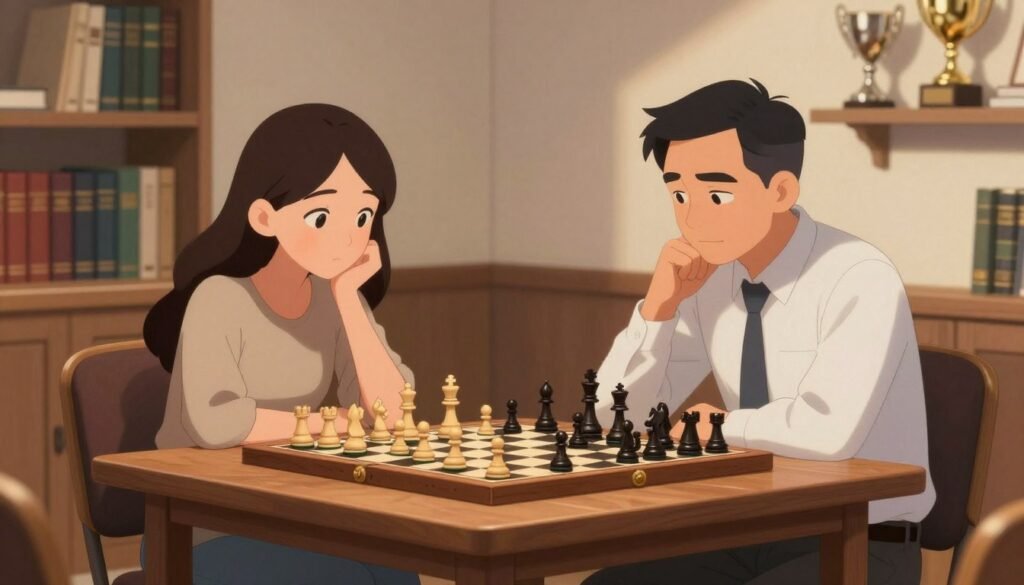
Learning chess can feel hard when you watch top players make deep moves that seem almost magic. But here is the good news. You do not need to study the hardest games first. In fact, the best way to grow is to learn from players whose games show clear plans, simple attacks, smart defense, and easy-to-follow ideas.
Find the right learning experience
Tell us a little about the learner and what you are looking for. Our team will review your answers and help you identify the most suitable next step.
- Takes only a few minutes
- No payment required
- Personalised recommendations
Your information will only be used to respond to your enquiry.
The Best Chess Player for a Beginner Is Not Always the “Greatest” One
When people ask, “Who should I study to get better at chess?” the first names they hear are often Magnus Carlsen, Garry Kasparov, Bobby Fischer, or Mikhail Tal. These players are amazing. Their games are full of power, beauty, and deep ideas.
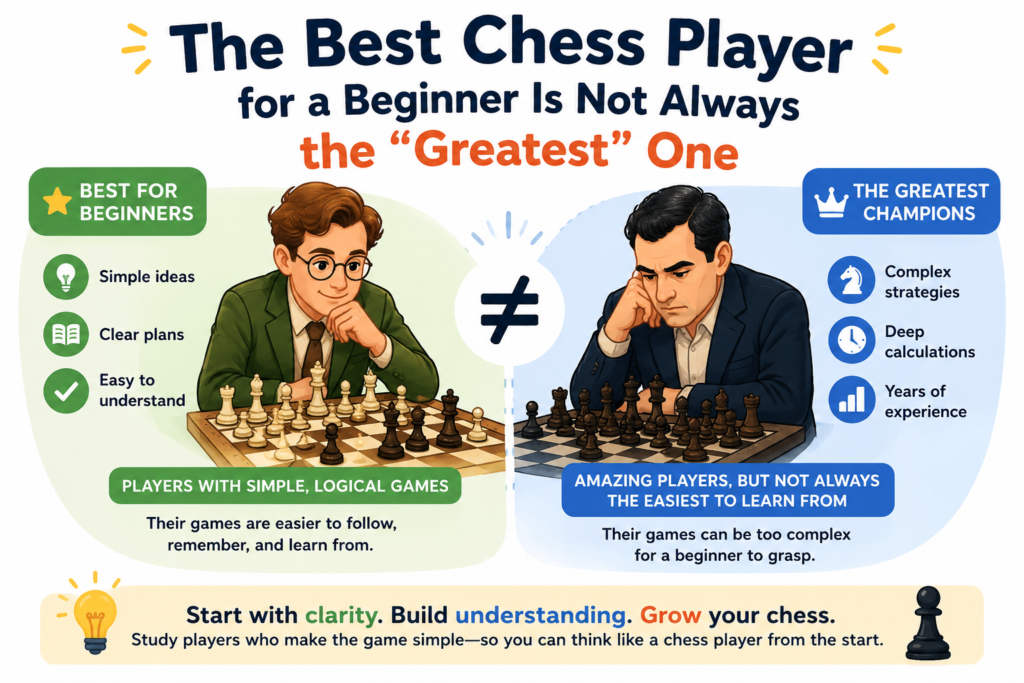
But for a beginner, some of their games can feel like trying to read a book in a language you do not know yet.
A beginner does not need the most complex chess games. A beginner needs clear games. The best chess player to study first is someone whose moves make sense after you look at them. You should be able to say, “Oh, I see why that move was played.” That is how real learning starts.
Beginners Should Study Players Who Make Chess Feel Simple
When you are new to chess, you are not trying to memorize hundreds of opening moves.
You are trying to build good thinking habits. You want to learn how to bring your pieces out, keep your king safe, attack weak pieces, and notice when your opponent makes a mistake.
Find the right learning experience
Tell us a little about the learner and what you are looking for. Our team will review your answers and help you identify the most suitable next step.
- Takes only a few minutes
- No payment required
- Personalised recommendations
Your information will only be used to respond to your enquiry.
This is why some older classic players are perfect for beginners. Their games often show simple plans from start to finish. You can see one side take the center, develop pieces, create pressure, and win by using basic ideas well.
Simple Games Help Students Build Real Confidence
At Debsie, we often see that kids learn faster when ideas feel clear. When a child understands why a move works, they feel proud. That pride makes them want to learn more. Chess then becomes less scary and more exciting.
This is why studying the right players matters. A good beginner game should not just show “great moves.” It should show the reason behind the moves. It should teach a child how to think before touching a piece.
Paul Morphy Is One of the Best First Players to Study
Paul Morphy is a wonderful player for beginners because his games are clean, fast, and easy to enjoy.
He played in the 1800s, but his lessons still work today. Morphy showed one of the most important truths in chess: bring your pieces into the game before you start a big attack.
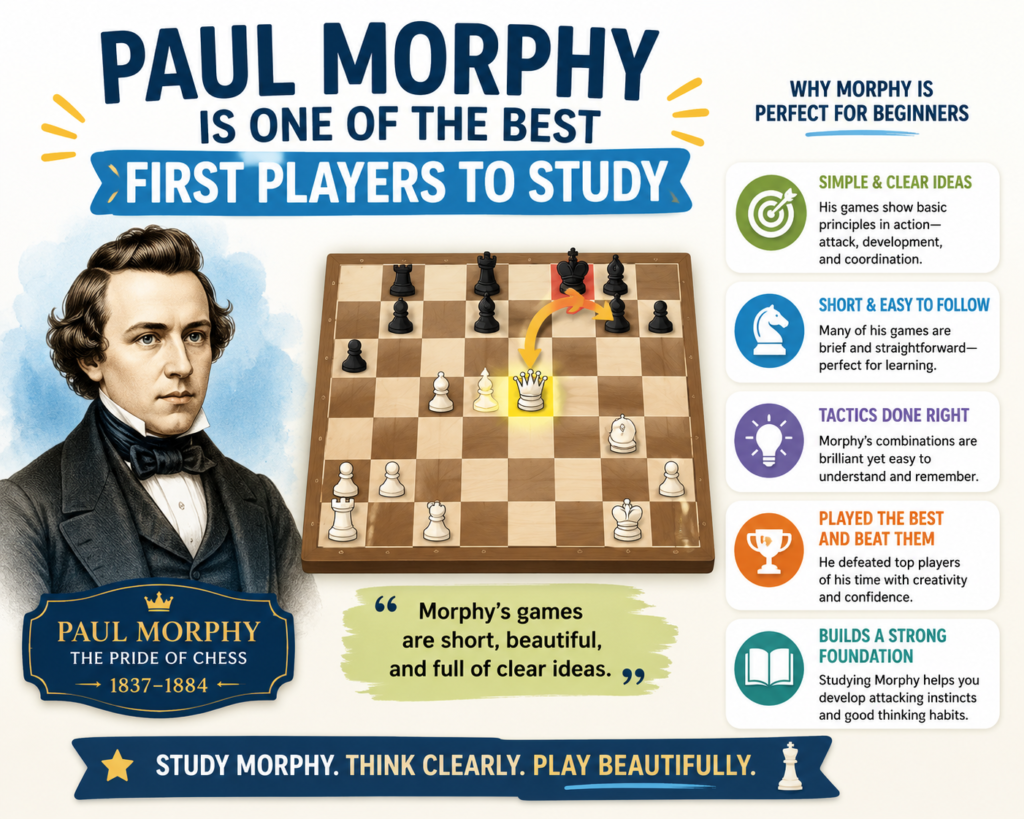
Many beginners move the same piece again and again. Some bring the queen out too early. Others forget about the bishops and rooks. Morphy’s games teach the opposite. He develops his pieces quickly, controls the center, castles his king, and then attacks with almost all his pieces working together.
Morphy Teaches Fast Development Better Than Almost Anyone
If a beginner studies Morphy, they will quickly see that chess is a team game. One queen alone cannot win against a good player. One knight alone cannot do much. But when bishops, knights, rooks, and queen work together, even simple moves can become very strong.
Morphy’s games are also exciting. Many of them end with checkmate. That makes them fun for kids to study. Children love seeing a clear attack, and Morphy gives them that again and again.
The Main Lesson from Morphy Is to Use All Your Pieces
A beginner should not study Morphy just to copy his attacks. The deeper lesson is this: before attacking, get your pieces ready. A strong attack usually starts long before the first check.
In a Debsie class, a coach may show a Morphy game and ask the student, “Which pieces are helping in the attack?” This question is simple, but powerful. It teaches kids to look at the whole board, not just one move. That skill helps them in chess, school, and life because they learn to think before rushing.
Morphy’s Famous Opera Game Is Perfect for Beginners
One of the best games to study is Morphy’s famous Opera Game. It is short, beautiful, and full of clear lessons. Morphy gives up material, but he does it for a reason. His pieces become active, while his opponent’s pieces stay stuck.
A beginner can learn many things from that one game. They can learn why the center matters. They can learn why development matters. They can learn why a king stuck in the middle is in danger.
What a Child Should Watch in the Opera Game
When studying this game, do not rush through the moves. Ask after each move, “What did this move help?” Did it bring a piece out? Did it attack something? Did it open a line? Did it make the enemy king weaker?
This is how Debsie coaches help students study master games. The goal is not to finish the game quickly. The goal is to understand the story of the game. Once a child sees the story, chess becomes much easier to remember.
José Raúl Capablanca Teaches Clean and Calm Chess
José Raúl Capablanca was world chess champion and one of the clearest players in history. His games are not always wild. They are often calm, smooth, and easy to follow. That makes him one of the best players for beginners to study after Morphy.
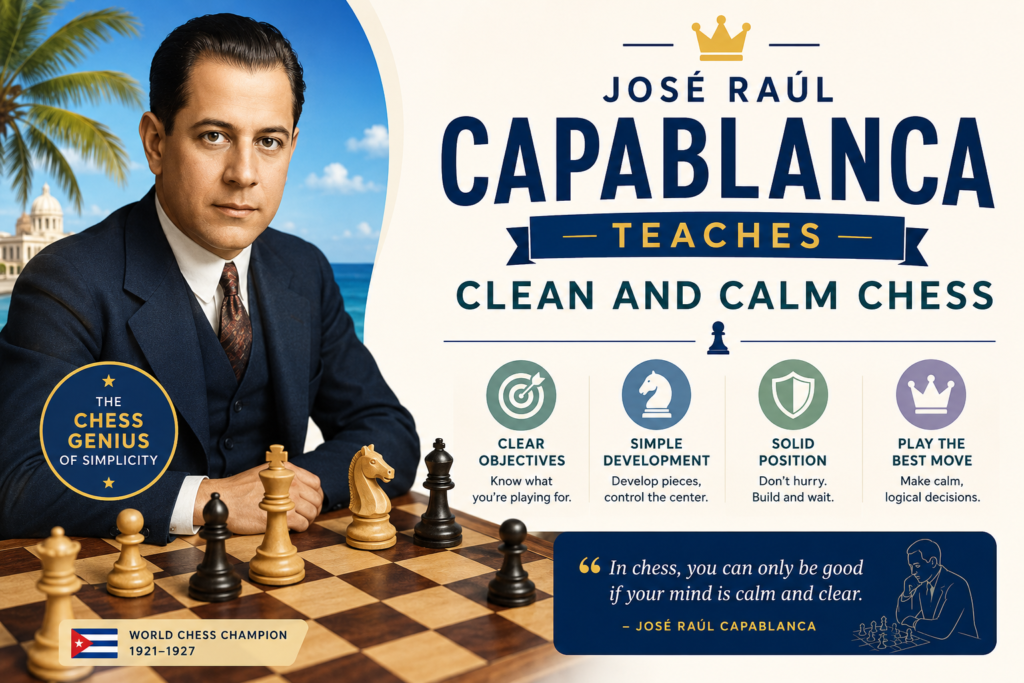
Capablanca teaches that you do not need tricks to win. You can win by making good moves, improving your pieces, and taking care of small details. His style is great for beginners because it shows how to play normal positions well.
Capablanca Helps Beginners Understand Piece Placement
Many beginners ask, “What should I do now?” This question comes up when there is no check, no capture, and no clear threat. Capablanca’s games help answer that question. He often improves his worst piece, takes space, or creates a small weakness in the opponent’s position.
This is a big step for young players. They begin to see that chess is not only about attacking the king. Sometimes the best move is quiet. Sometimes the best plan is to make your pieces better one at a time.
The Main Lesson from Capablanca Is to Make Chess Look Easy
Capablanca’s games can look simple, but that is the magic. He removes confusion. He trades when it helps him. He keeps pieces when they are useful. He turns small gains into bigger gains.
For a beginner, this is very important. Kids often think every move must be a big move. Capablanca shows that small, smart moves can win games too. This builds patience, which is one of the greatest life skills chess can teach.
Capablanca’s Endgames Are Great for Young Students
Capablanca was famous for his endgame skill. An endgame is the part of the game when many pieces are gone. Beginners often ignore endgames because they seem less exciting than checkmates. But endgames teach clear thinking.
In the endgame, every move matters. The king becomes active. Pawns become powerful. A small mistake can change the result. Capablanca’s endgames teach kids how to slow down and make careful choices.
Why Endgames Help Kids Think Better
When a child studies endgames, they learn patience. They learn that winning is not always instant. They learn how to finish a game after getting an advantage. This is a common problem for beginners. They may win a piece, but then they do not know what to do next.
At Debsie, students learn how to turn an advantage into a win. That gives them confidence in real games and tournaments. When a child knows how to finish, they stop feeling nervous after getting ahead.
Bobby Fischer Is Great for Learning Strong, Direct Chess
Bobby Fischer is one of the most famous chess players ever. For beginners, he is useful because many of his games have clear plans. Fischer played with energy, but his chess was not random. He loved active pieces, strong centers, and direct attacks.
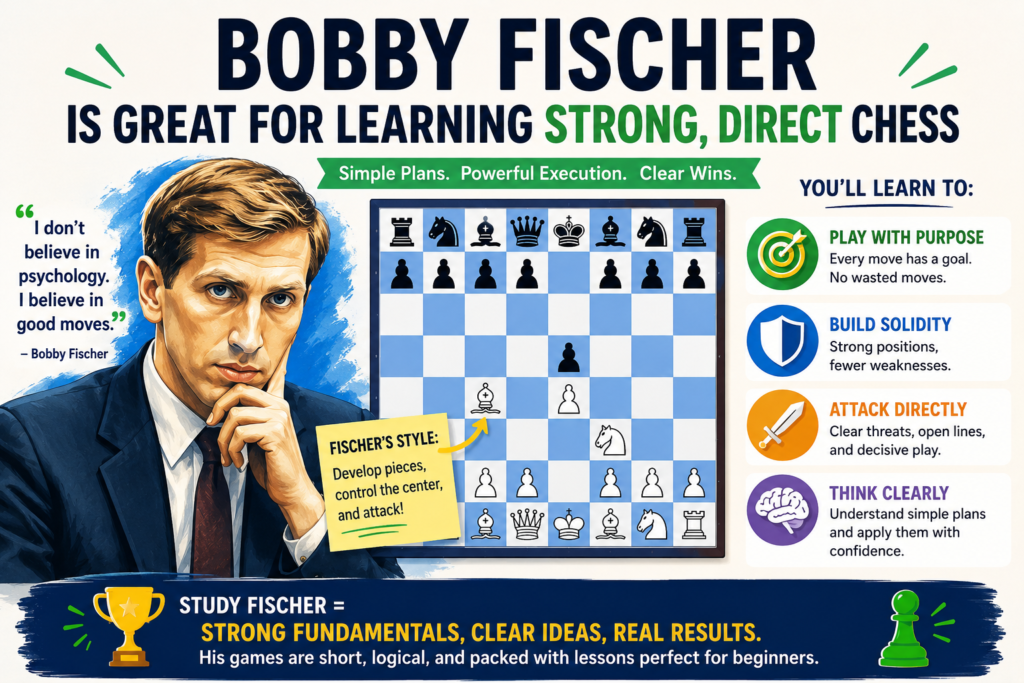
Fischer is a good player to study when a beginner already knows basic development and wants to understand how to play with purpose. His games teach that every move should have a job. He did not move pieces just to move them. He built pressure until the opponent cracked.
Fischer Teaches Beginners to Play With a Plan
One reason Fischer is helpful is that his games often show a clear target. He might attack a weak pawn. He might control an open file. He might place a knight on a strong square. Beginners need to learn this kind of thinking.
Without a plan, a beginner may make random moves. They may move a rook to a square that looks good but does nothing. They may push pawns without knowing why. Fischer’s games show that strong players look for a goal.
The Main Lesson from Fischer Is to Ask What the Position Needs
Before making a move, a student can ask, “What does my position need?” Maybe the king needs safety. Maybe a bishop needs a better square. Maybe a pawn is weak. Maybe the opponent is threatening something.
This one question can change how a child plays. It slows them down in a good way. It also teaches responsibility. They learn that each choice has a reason, and this is a lesson that helps far beyond the chess board.
Fischer’s Games Are Helpful for Learning Openings the Right Way
Beginners should not memorize long opening lines. That usually leads to confusion. But Fischer’s games can help students understand opening ideas. He showed how to fight for the center, develop fast, and avoid wasting time.
A beginner can study Fischer’s games in openings like the Italian Game, the King’s Pawn openings, and some simple Sicilian ideas. The aim is not to copy every move. The aim is to understand what each side is trying to do.
Opening Study Should Teach Ideas, Not Just Moves
A child may forget a move. That is normal. But if they understand the idea, they can still play well. This is why guided coaching helps so much. A Debsie coach can show your child not only what Fischer played, but why it worked.
That makes chess study less about memory and more about smart thinking. And when kids learn this way, they enjoy chess more because they are not afraid of forgetting one exact move.
Mikhail Tal Teaches Creativity, But Beginners Must Study Him Carefully
Mikhail Tal was known as the “Magician from Riga.” His games are full of sacrifices, attacks, and surprises. Many kids love Tal because his chess feels like an adventure. Pieces fly across the board, kings come under fire, and the game can change very fast.
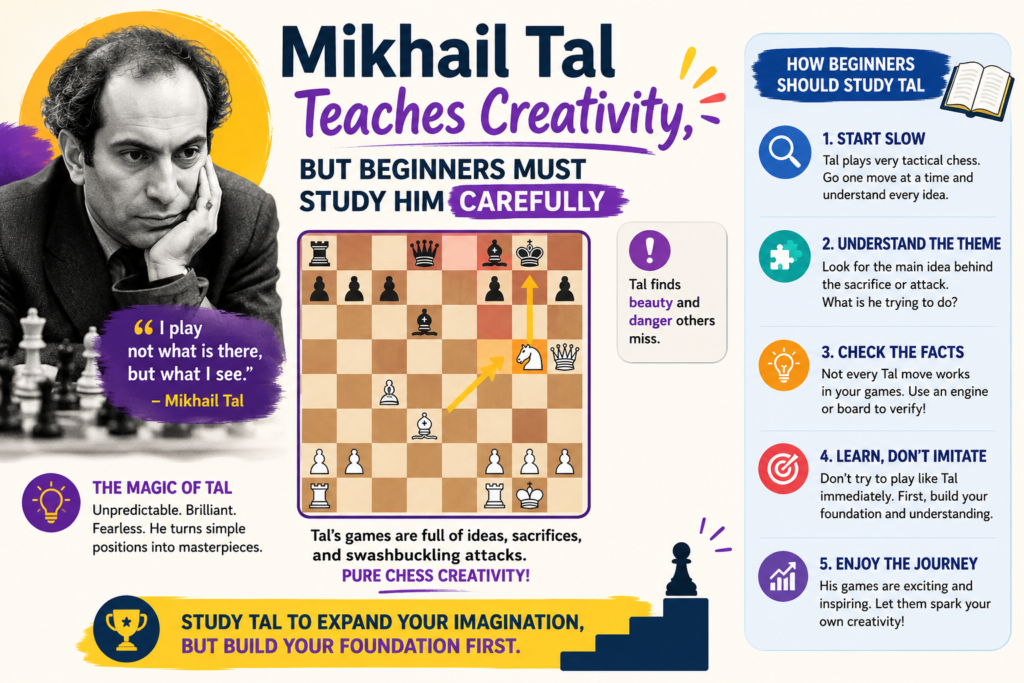
But beginners should study Tal carefully. His ideas are exciting, but not all of them are easy. Sometimes his sacrifices need deep calculation. A new player should not look at Tal and think, “I should sacrifice pieces all the time.” That would lead to many lost games.
Tal Is Best for Learning Attacking Ideas and Courage
Tal teaches one beautiful lesson: do not be afraid to look for active moves. Many beginners play too safely. They defend everything, but they never create threats. Tal’s games show that chess rewards energy.
Find the right learning experience
Tell us a little about the learner and what you are looking for. Our team will review your answers and help you identify the most suitable next step.
- Takes only a few minutes
- No payment required
- Personalised recommendations
Your information will only be used to respond to your enquiry.
A beginner can learn how open lines help attacks. They can learn how a lead in development can become dangerous. They can learn how a weak king can be punished. These are useful lessons, even if the exact moves are hard.
The Main Lesson from Tal Is to Look for Possibilities
Tal’s games teach imagination. Before choosing a move, a student can ask, “What can I create?” This does not mean making wild sacrifices. It means looking for checks, captures, threats, open lines, and weak squares.
This kind of thinking is powerful for kids. It helps them become brave problem-solvers. At Debsie, students are encouraged to think actively, but also carefully. They learn when an attack is real and when it is just a hope.
Beginners Should Use Tal as Inspiration, Not as a Rulebook
Tal is wonderful to watch, but he should not be the only player a beginner studies. If a child studies only Tal, they may start giving away pieces without enough reason. That can hurt their progress.
The best way is to study Tal after learning from Morphy and Capablanca. Morphy teaches development. Capablanca teaches clarity. Then Tal adds fire and creativity. This balance helps a young player become both smart and bold.
How to Study a Tal Game Without Getting Lost
When looking at a Tal game, focus on simple questions. Why is the enemy king weak? Which pieces are attacking? What happens if the defender gets one move to breathe? Was the sacrifice based on checkmate, winning material, or long-term pressure?
These questions help beginners enjoy Tal without copying him blindly. They learn that creativity is not guessing. Real creativity in chess comes from seeing chances that others miss.
Anatoly Karpov Teaches Quiet Pressure and Smart Control
Anatoly Karpov is a great player for beginners who want to learn calm, controlled chess. His games may not always end with flashy attacks, but they are full of deep lessons. Karpov was a master at placing pieces on perfect squares and slowly making the opponent uncomfortable.
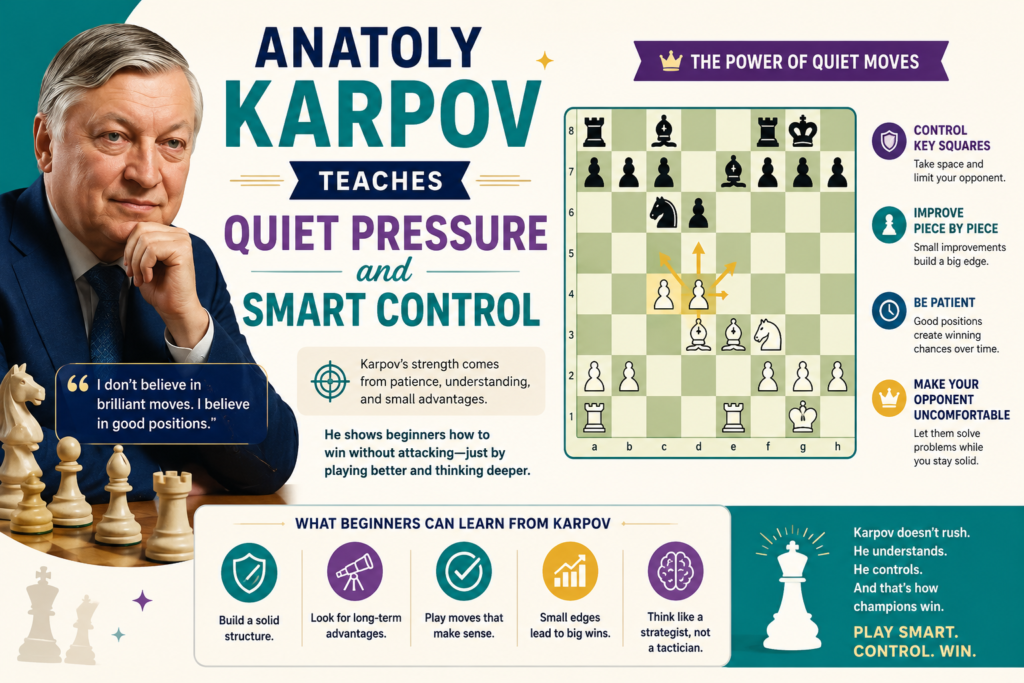
For a beginner, Karpov teaches something very useful. You do not always have to rush. You can improve your position step by step. You can stop your opponent’s ideas. You can win because your pieces are better placed and your plan is easier to play.
Karpov Helps Beginners Learn Positional Chess in a Simple Way
The word “positional” can sound hard, but it does not need to be. It simply means putting your pieces where they work well and making your opponent’s pieces feel stuck. Karpov was one of the best at this.
His games show how to use space. They show how to control key squares. They show how to build pressure without taking big risks. This is very helpful for kids who need to learn patience and calm thinking.
The Main Lesson from Karpov Is to Make the Opponent’s Game Hard
Many beginners only ask, “What do I want?” Karpov teaches them to also ask, “What does my opponent want?” That is a huge step in chess growth. When a child starts thinking about the other side’s plan, they become much harder to beat.
This skill also builds focus. Kids learn to listen, watch, and think ahead. These habits help in school, sports, and daily life. Chess becomes a fun way to build a sharper mind.
Karpov’s Style Is Great for Students Who Like Calm Games
Not every child wants wild attacks. Some children enjoy slow plans and careful moves. Karpov is perfect for them. His games show that quiet players can be very strong.
This matters because every student has a different chess personality. A good coach does not force every child to play the same way. At Debsie, students are guided based on how they think and learn. Some may love attacking chess. Some may enjoy patient strategy. Both paths can lead to success.
Calm Chess Can Still Be Powerful Chess
A quiet move can be just as strong as a check. A small pawn move can take away an important square. A simple rook move can create pressure on a file. Karpov’s games help beginners see these hidden ideas.
When children understand this, they stop chasing only quick wins. They begin to enjoy the full beauty of chess. They learn that smart control can be just as exciting as a big attack.
Magnus Carlsen Is Useful for Beginners When You Choose the Right Games
Magnus Carlsen is one of the strongest players in chess history. His games can be very deep, so beginners should not start with his hardest games. But selected Carlsen games can be very helpful, especially when they show simple plans, strong endgames, and steady pressure.
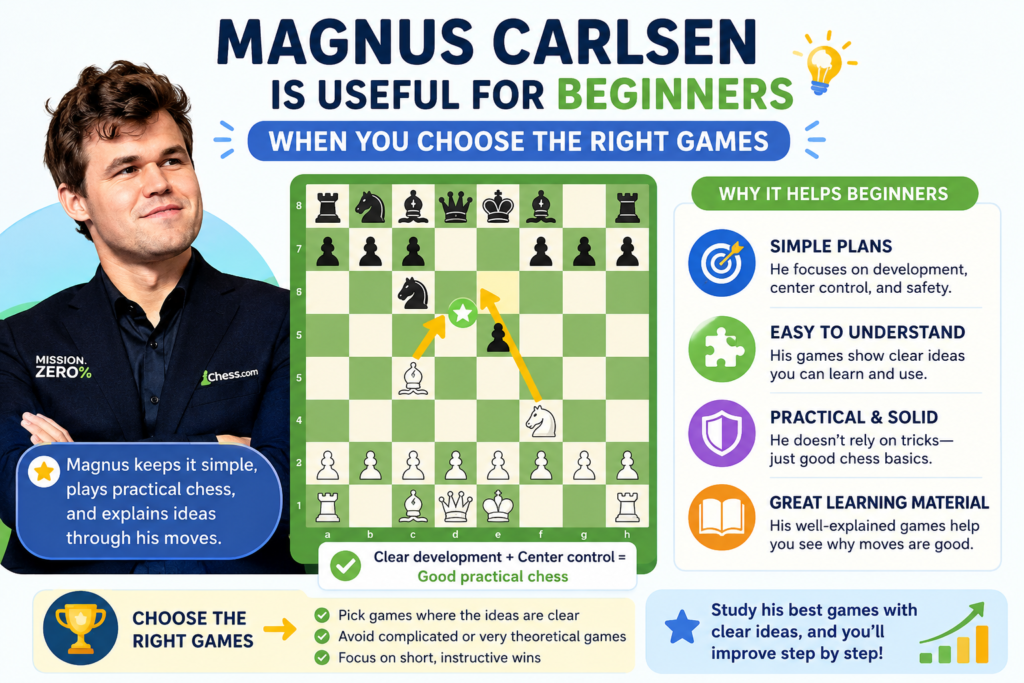
Carlsen is excellent at winning positions that look equal. He keeps asking small questions. Can I improve this piece? Can I create a weakness? Can I make my opponent defend for a long time? This is a great lesson for beginners who often stop thinking when there is no clear attack.
Carlsen Teaches Fighting Spirit in Simple Positions
Many beginners think a game is boring if there is no checkmate coming soon. Carlsen shows that even quiet positions are full of chances. He keeps playing with care. He makes small improvements. He waits for mistakes.
This is very useful for young players. In real games, not every position will be exciting. A student must learn how to stay focused even when the board looks calm.
The Main Lesson from Carlsen Is to Never Stop Looking for Better Moves
Carlsen’s style teaches a strong life lesson. Do not give up just because the answer is not easy. Keep looking. Keep improving. Stay patient. Small steps can lead to big results.
This lesson is one reason chess is so powerful for kids. It trains the mind to stay active. With the right support, a child learns to keep trying in a healthy and confident way.
Carlsen’s Endgames Are Great for Building Patience
Carlsen often wins endgames that many players would draw. He does not do this with magic. He does it with patience, piece activity, and pressure. He makes the opponent solve problem after problem.
A beginner can learn a lot from this. They can learn that the king should become active in the endgame. They can learn that pawns matter. They can learn that even a tiny advantage can grow if you play carefully.
Beginners Should Study Simple Carlsen Wins First
The best Carlsen games for beginners are not always his most famous ones. Choose games where the plan is easy to explain. Look for games where he improves pieces, wins a pawn, reaches a better endgame, and finishes with care.
This is the kind of study that helps young players in real tournaments. They learn how to stay calm, use small advantages, and avoid rushing. That is exactly the kind of growth Debsie aims to build in every student.
Emanuel Lasker Helps Beginners Learn How to Think Like a Fighter
Emanuel Lasker was world chess champion for a very long time, and his games are special because he was not only playing the board. He was also playing the person sitting across from him. That does not mean he played tricks in a bad way.
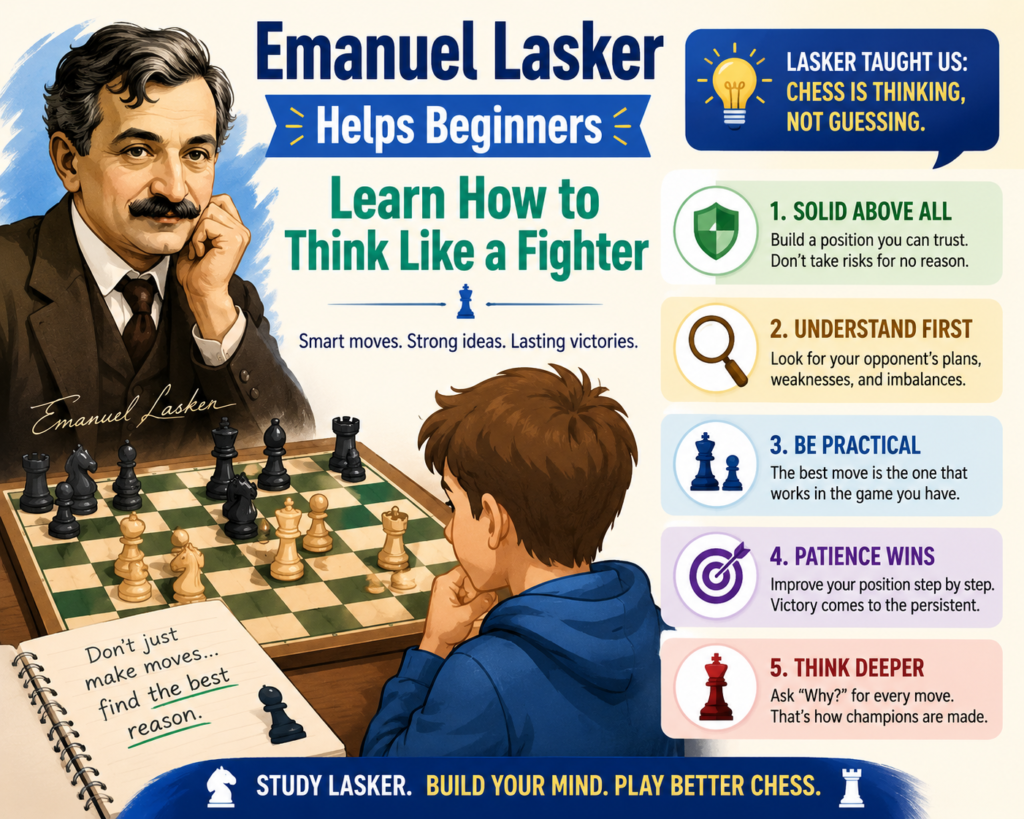
It means he understood pressure, fear, time trouble, weak habits, and the way people make choices when they feel unsure.
For beginners, Lasker is useful because he teaches that chess is not just about finding pretty moves. Chess is about making good choices in real moments. Sometimes the best move is not the most beautiful move. Sometimes the best move is the one that gives your opponent a hard problem to solve.
Lasker Teaches Beginners to Stay Strong in Messy Positions
Many young players feel scared when the position becomes unclear. They may freeze, move too fast, or give up inside their mind before the game is really lost. Lasker’s games teach a better way. He stayed calm in hard positions. He kept looking for chances. He made his opponents work for every small gain.
This is a very important lesson for kids. In chess, as in life, things do not always go perfectly. A child may lose a pawn. They may make a small mistake. They may face a strong attack. Lasker shows that the game is not over just because something went wrong.
The Main Lesson from Lasker Is to Keep Asking Questions
A beginner can learn a lot from Lasker by asking simple questions during a game. What is my opponent trying to do? What is my safest move? What problem can I create? Is there a hidden tactic? Can I make my opponent choose between two hard options?
These questions help kids slow down and think clearly. At Debsie, this kind of thinking is taught in a friendly way, so students do not just learn moves. They learn how to handle pressure. They learn how to stay steady when the board feels tough. That confidence can help them far beyond chess.
Lasker’s Games Are Good for Learning Practical Chess
Some chess games look perfect from start to finish. They are useful, but real beginner games are often not perfect. Pieces get traded. Pawns hang. Plans change. Someone makes a mistake, and then the other player must notice it.
Lasker’s games are great because they feel practical. He shows how to survive, how to fight back, and how to make use of chances. This is exactly what beginners need. They need to learn how to play the game that is actually in front of them, not the perfect game they imagined before the first move.
Practical Chess Builds Stronger Tournament Players
In online games and tournaments, kids often meet different types of players. Some attack early. Some trade pieces fast. Some play strange openings. A student who only knows memorized moves may feel lost. But a student who learns practical thinking can adjust.
That is why Debsie’s live chess classes focus on real understanding. Students learn how to look at the board, find the danger, find the chance, and make a smart move. Lasker is a great player to study for this reason.
Tigran Petrosian Teaches Beginners How to Stay Safe Before Attacking
Tigran Petrosian was one of the best defensive players in chess history. Some beginners may think defense is boring, but that is not true. Good defense is like having a strong shield. It keeps you safe until it is time to strike. Petrosian was amazing at stopping his opponent’s ideas before they became dangerous.
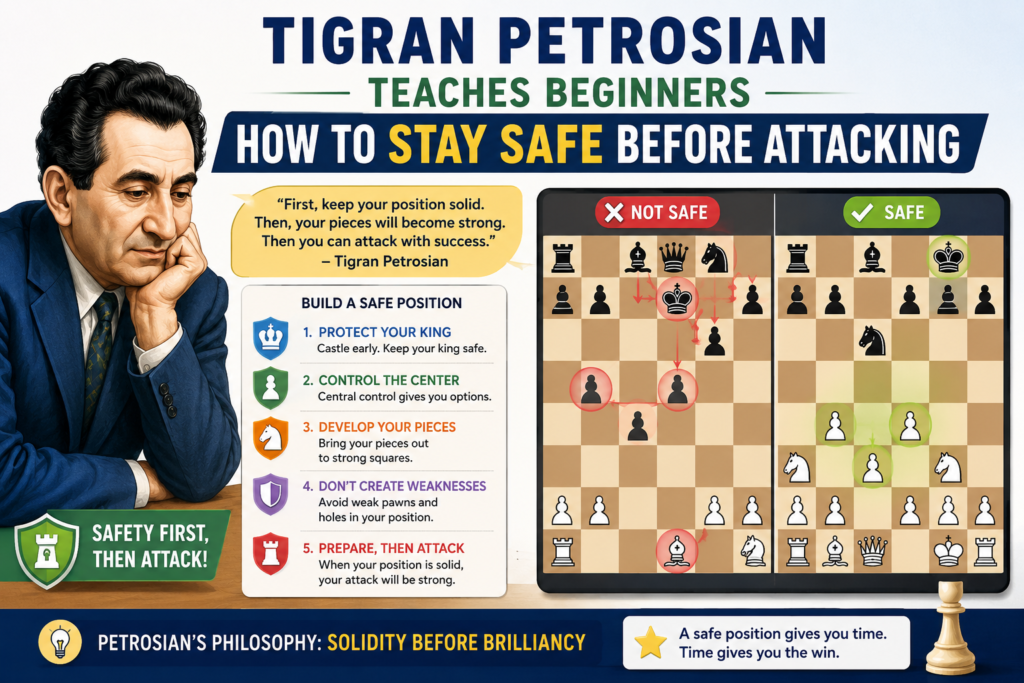
This is a huge lesson for beginners because many new players only think about their own attack. They see a move they like and play it quickly. Then they miss a checkmate threat, a fork, or a hanging queen.
Studying Petrosian helps students learn to ask, “What is my opponent planning?”
Petrosian Helps Students Avoid Easy Mistakes
One of the fastest ways for beginners to improve is to stop giving away pieces. You do not need a fancy opening to win more games. You need to see threats. You need to protect loose pieces. You need to notice when your king is weak.
Petrosian’s games teach this skill in a deep but clear way. He often made small moves that removed danger. These moves may not look exciting at first, but they are powerful. He made sure his position had no easy targets.
The Main Lesson from Petrosian Is to Respect the Opponent’s Ideas
A strong chess player does not only dream about their own plan. They also listen to the board. They ask what the other side wants. If a beginner learns this early, they become much harder to beat.
This is also a wonderful life skill for children. It teaches them to pause, notice, and think before acting. A child who learns to check danger in chess may also become better at careful thinking in schoolwork, problem-solving, and daily choices.
Defensive Chess Can Still Be Fun and Creative
Petrosian was not just blocking moves. He was creating a position where his opponent had no good attack. Then, when the time was right, he would take over. That is a very smart way to play.
Beginners can enjoy this style once they understand the goal. Defense is not about fear. Defense is about control. You are saying, “I see your idea, and I will not let it work.” That can feel just as exciting as launching an attack.
A Safe King Gives a Child More Freedom to Think
When a child’s king is unsafe, the whole game becomes stressful. Every move feels dangerous. But when the king is safe and the pieces are protected, the child can think with more peace.
This is why coaches at Debsie often remind students to castle, develop, and check threats. These simple habits make the game easier. Petrosian’s games help students see why safety is not a small thing. It is the base for everything else.
Judit Polgár Teaches Brave and Active Chess for Young Learners
Judit Polgár is one of the greatest attacking players ever and the strongest female chess player in history. Her games are full of energy, confidence, and sharp ideas. For beginners, she is a wonderful player to study because she shows how powerful active pieces can be.
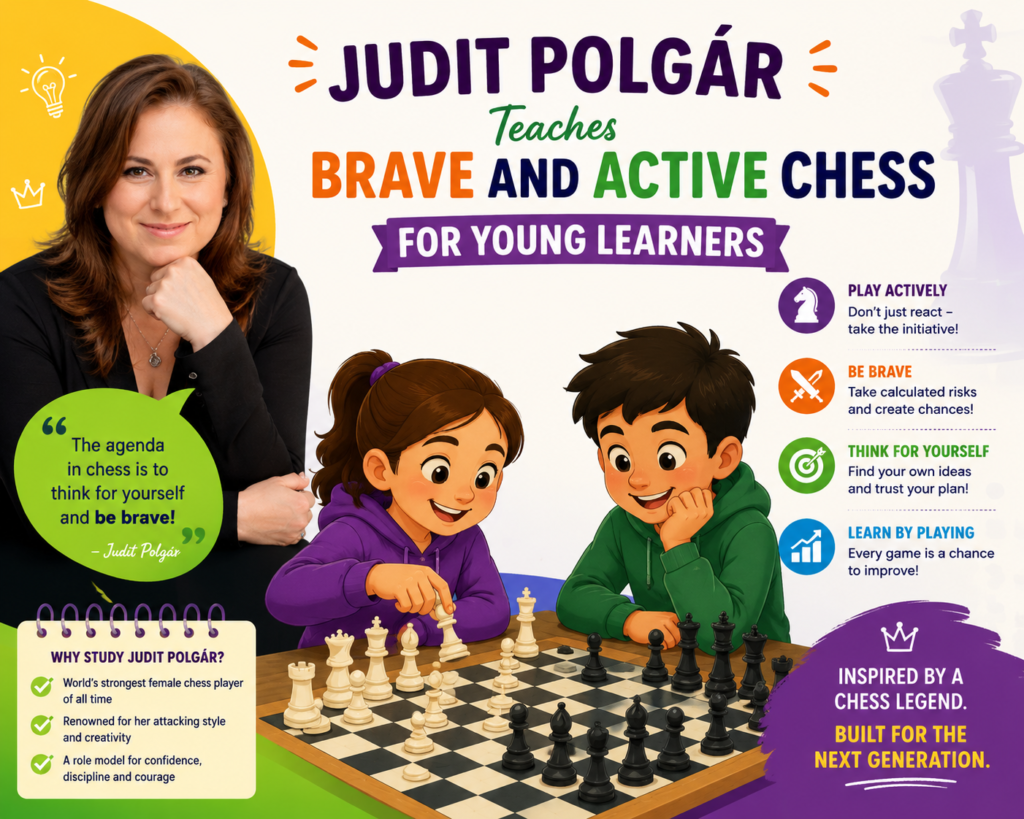
Judit did not wait around for the opponent to make things easy. She looked for chances. She created threats. She used her pieces with courage. Her games can inspire young students, especially children who enjoy fast, lively chess.
Judit Polgár Shows That Active Pieces Can Change Everything
In beginner games, many pieces often sit at home doing nothing. A bishop stays trapped. A rook never reaches an open file. A knight sits on the edge of the board. Judit’s games show the opposite. Her pieces jump into the game and work together.
This is one of the best lessons for a beginner. Active pieces give you choices. Passive pieces make you defend all the time. When students study Judit, they start to understand that a piece is not strong because of its name. It is strong because of what it can do.
The Main Lesson from Judit Polgár Is to Play With Healthy Confidence
Confidence does not mean moving fast without thinking. It means trusting your training. It means looking for strong moves. It means not being afraid just because the opponent seems strong.
This message is very important for children. Many kids doubt themselves after one mistake or one loss. Chess can teach them that growth takes time. With the right guide, they learn to try again, think better, and come back stronger.
Debsie’s coaches help students build this kind of calm confidence through live practice and kind feedback.
Judit’s Games Are Great for Learning Attacks on the King
Many of Judit’s best games show direct attacks. She knew how to bring pieces near the king, open lines, and create threats that were hard to stop. Beginners can learn from these games by looking at which pieces joined the attack.
A common beginner mistake is attacking with only the queen. This often fails because the queen gets chased away. Judit’s games show that a real attack needs teamwork. Knights, bishops, rooks, pawns, and queen all have roles.
A Good Attack Starts Before the First Check
When students study Judit’s attacking games, they should not only look at the final checkmate. They should look earlier. How did her pieces get active? Which pawn move opened the position? Which defender was removed? Which square became weak?
These questions turn a fun game into a real lesson. A child does not just say, “Wow, that was cool.” They begin to say, “I can use that idea in my own game.” That is when chess study becomes powerful.
Viswanathan Anand Teaches Fast Thinking With Clear Ideas
Viswanathan Anand is a world champion known for speed, sharp vision, and smooth play. He is a great player for beginners to study because many of his games feel natural. His moves often show quick development, active pieces, and simple plans that become very strong.
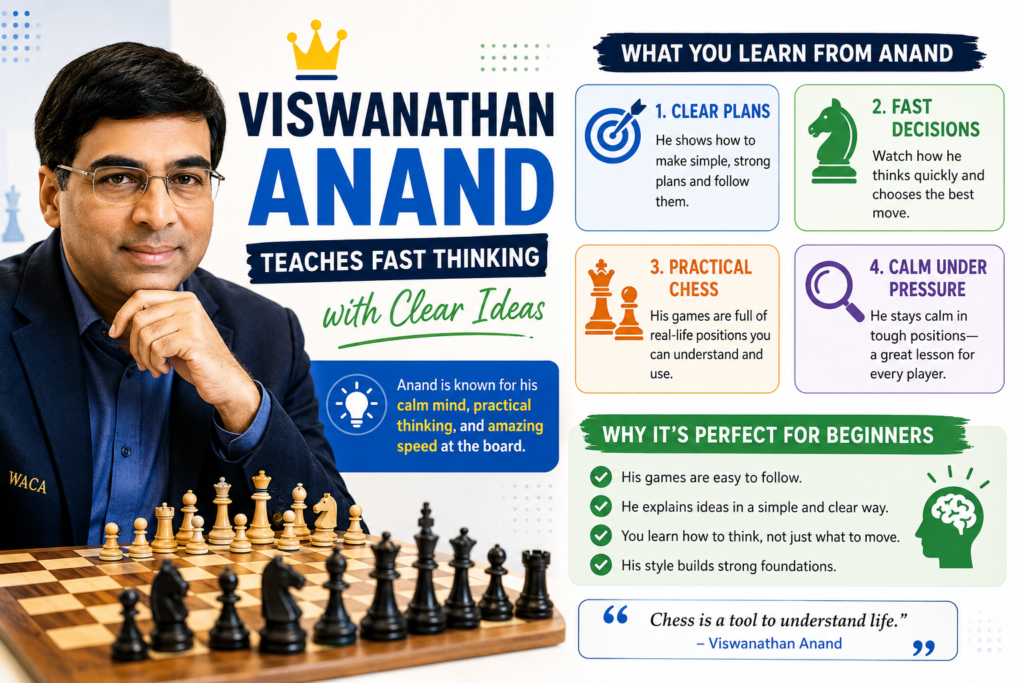
Anand is also a wonderful role model for young students. He shows that you can be brilliant and humble at the same time. His chess has energy, but it also has balance. He can attack, defend, simplify, and win endgames. That makes him useful for many types of learners.
Anand Helps Beginners Learn Pattern Recognition
Pattern recognition means seeing ideas you have seen before. For example, a back rank weakness, a pin, a fork, a discovered attack, or a weak king. Beginners improve quickly when they start noticing these patterns.
Anand’s games are full of clean tactical ideas. Many of his attacks happen because he sees the right moment. He does not force things too early. He builds the position, waits for the chance, and then strikes.
The Main Lesson from Anand Is to Be Ready When the Chance Comes
In chess, chances do not last forever. A piece may be loose for one move. A king may be weak for a short time. A tactic may work now but not later. Anand teaches students to stay alert.
This is a skill children can practice every day. Before moving, they can ask, “Do I have a check? Do I have a capture? Do I have a threat? Is my opponent’s last move safe?” These simple questions can help them find more winning moves and avoid many losses.
Anand’s Games Are Helpful for Students Who Play Online Chess
Many kids today play online chess, where games can be fast. Fast games are fun, but they can also create bad habits if children move without thinking. Anand’s games teach speed with sense. He played quickly because he understood the position, not because he was guessing.
This is an important difference. A beginner should not try to move fast just to look smart. They should first learn clear ideas. Speed comes later, after practice.
Strong Basics Make Fast Chess Safer
When a child knows opening rules, common tactics, and simple endgames, they can play faster without making as many mistakes. They begin to trust their eyes because their mind has seen the pattern before.
Debsie helps students build these patterns in a step-by-step way. With live classes, practice games, and tournament experience, kids learn how to think clearly even when the clock is running. Anand is a great player to study for this kind of growth.
Wilhelm Steinitz Teaches Beginners Why Chess Needs a Plan
Wilhelm Steinitz was the first official world chess champion, and he changed the way people understood chess. Before him, many players attacked as soon as they could.
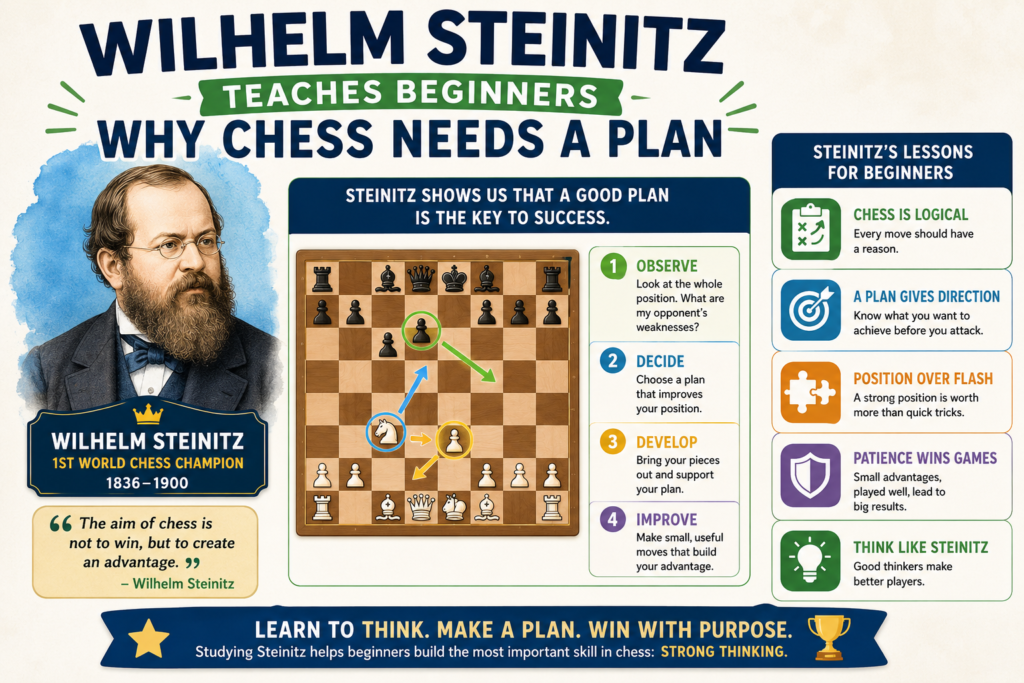
They gave up pieces, chased the king, and hoped the attack would work. Steinitz showed that strong chess needs a reason. You should attack when your position is ready, not just because attacking feels fun.
This is a very important lesson for beginners. Many new players want to check the king again and again. But not every check is good. Sometimes a check helps the other player. Sometimes it moves your own piece to a bad square. Steinitz teaches students to build a strong position first.
Steinitz Helps Beginners Understand When to Attack
A good attack usually comes from a good position. If your pieces are active, your king is safe, and your opponent has weak squares, then an attack may work. But if your pieces are still sleeping at home, an attack can fail very fast.
Steinitz’s games help students see this clearly. He looked for small gains and used them with care. He understood that a weak pawn, a bad bishop, or an unsafe king could become a real target later.
The Main Lesson from Steinitz Is to Earn the Attack
A beginner should not attack just because they want to win quickly. They should ask, “What makes this attack strong?” If there is no clear answer, it may be better to improve a piece, castle, or stop the opponent’s plan.
This lesson is very helpful for kids because it teaches patience. At Debsie, students learn that smart chess is not rushed chess. When a child learns to wait for the right moment, they become calmer, stronger, and more confident in their games.
Steinitz Makes Strategy Feel More Honest
Steinitz’s style may look old, but the thinking is still useful today. He teaches that every move should fit the needs of the position. If you are better, you can press. If you are worse, you should defend. If the position is equal, you should improve slowly and look for chances.
This makes chess feel fair and clear for beginners. They stop guessing and start thinking. That one change can lead to big growth.
A Simple Plan Is Better Than a Fancy Guess
Many children lose games because they try to make a “cool” move without checking if it works. Steinitz teaches the opposite. He shows that a simple move with a clear reason is often stronger than a flashy move with no base.
When students learn this, their chess becomes steadier. They stop hoping for lucky wins and start building real skill. That is the kind of growth that lasts.
Akiba Rubinstein Teaches Beginners How to Use Rooks and Pawns
Akiba Rubinstein was one of the best players who never became world champion. His games are beautiful because they show smooth planning, strong endgames, and amazing rook play. For beginners, Rubinstein is a great teacher because he makes quiet moves look powerful.
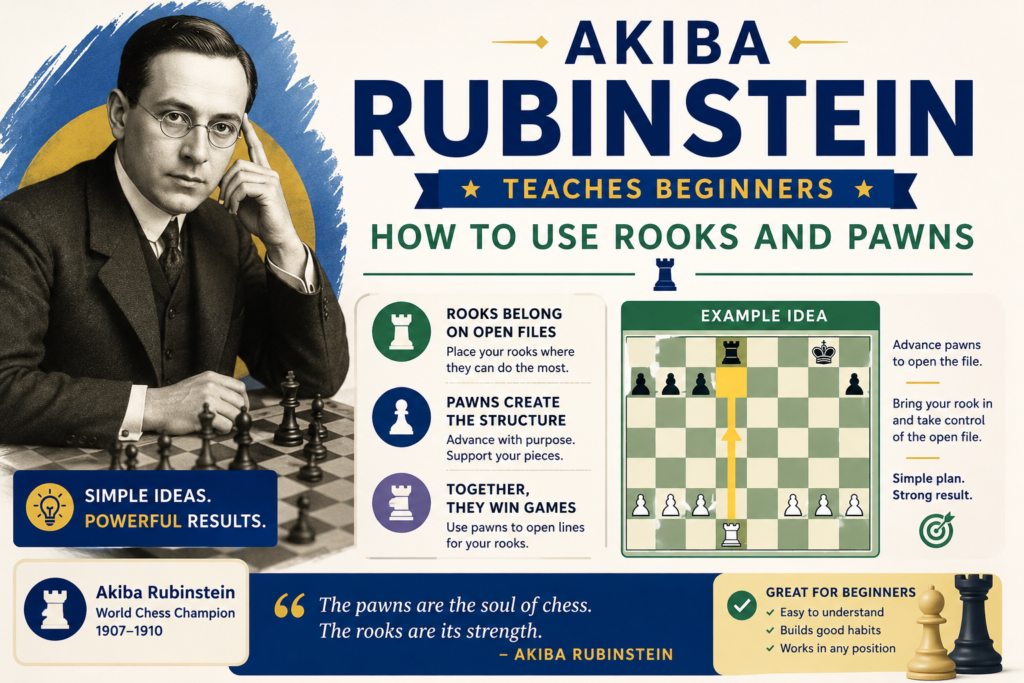
Rooks are hard for many beginners. They keep them in the corner for too long. They do not know when to place them on open files. They forget that rooks become stronger when the board opens up. Rubinstein’s games help students understand this in a simple way.
Rubinstein Helps Students Learn Rook Activity
A rook is not happy when it is trapped behind its own pawns. It wants open lines. It wants to attack weak pawns. It wants to reach the seventh rank when possible. Rubinstein used rooks with great skill, and beginners can learn a lot from watching how he placed them.
His games also show that pawns are not just tiny pieces. Pawns shape the board. They create space, block bishops, open files, and become queens if they reach the end.
The Main Lesson from Rubinstein Is to Make Every Piece Useful
A beginner can look at Rubinstein’s games and ask, “Which piece improved?” This is a simple question, but it helps a lot. Strong players often win because all their pieces have work to do.
This is a great lesson for young students. In chess, like in a team project, every member matters. A queen cannot do everything alone. A rook stuck in the corner is not helping. A bishop blocked by pawns needs a better path. Debsie coaches help children notice these small details so their whole board starts to work together.
Rubinstein’s Endgames Are Clear and Useful
Rubinstein was excellent in endgames. He knew how to use kings, rooks, and pawns with care. His endgames are helpful because they teach simple but powerful ideas. Bring your king closer. Put your rook behind passed pawns. Keep your pieces active. Do not rush pawn moves.
Beginners often lose winning endgames because they move too fast. Rubinstein teaches them to slow down and finish with care.
Endgame Skill Helps Beginners Stop Throwing Away Wins
Many kids get a winning position but do not know how to close the game. They may trade the wrong pieces or push the wrong pawn. This can be frustrating, especially in tournaments.
When students study clean endgames, they feel safer with an advantage. They learn how to win step by step. That confidence is one reason Debsie includes guided game review and practical endgame training in its chess lessons.
Alexander Alekhine Teaches Beginners How to Build Strong Attacks
Alexander Alekhine was a world champion known for powerful attacks and deep planning. His games are exciting, but they are also full of structure. He did not just throw pieces at the king. He built pressure, placed pieces on strong squares, and then attacked when everything was ready.
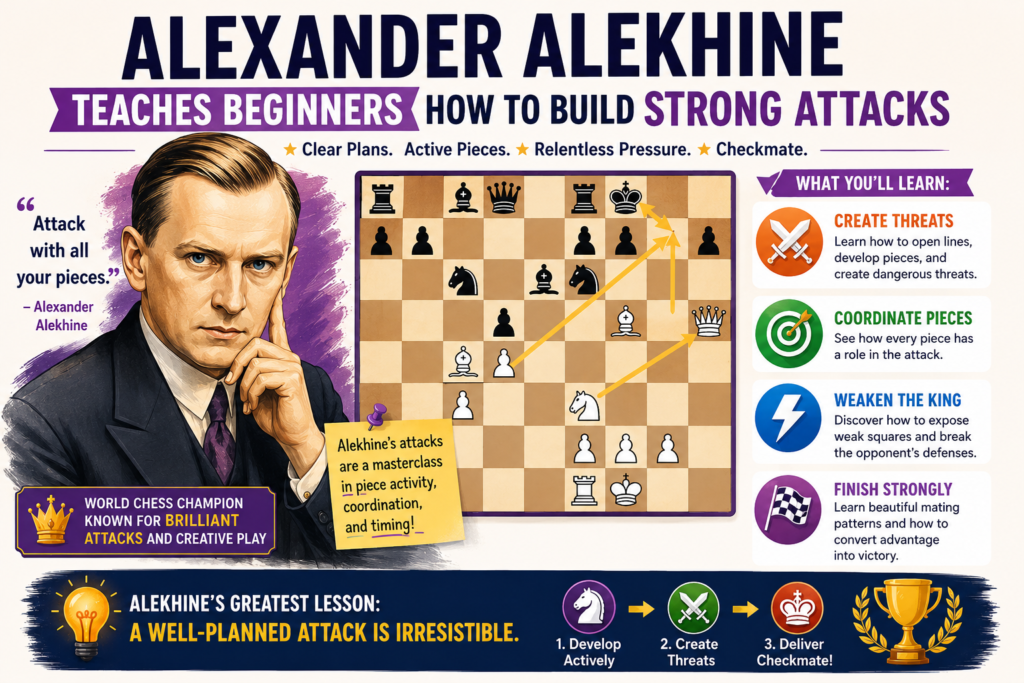
For beginners, Alekhine is useful because he shows how an attack can grow move by move. He teaches that strong attacks do not appear by magic. They come from better piece activity, weak squares, open lines, and good timing.
Alekhine Helps Students Connect Tactics With Strategy
Some beginners think tactics and strategy are separate. They are not. A tactic often works because the position is ready for it. A fork, pin, or sacrifice becomes possible because one side has weak pieces, an unsafe king, or poor coordination.
Alekhine’s games show this connection very well. He may spend several moves improving his pieces. Then suddenly, a tactic appears. It feels sudden, but it was prepared.
The Main Lesson from Alekhine Is to Build Before You Strike
A beginner can learn to ask, “What needs to happen before my attack works?” Maybe a knight needs to move closer. Maybe a rook needs an open file. Maybe a bishop needs a diagonal. Maybe a defender must be removed.
This helps kids become better planners. They do not just look for one move. They learn to see a few moves ahead. At Debsie, this skill is built slowly through puzzles, live games, and coach feedback, so students learn planning without feeling lost.
Alekhine’s Games Are Great for Learning Piece Teamwork
In Alekhine’s best games, pieces work together beautifully. A knight may attack a key square. A bishop may pin a defender. A rook may open a file. The queen may enter only when the time is right.
This teaches beginners that an attack is not about one hero piece. It is about teamwork.
Teamwork on the Board Builds Better Thinking Off the Board
When children see how pieces support each other, they learn a bigger lesson. Good results often come from connected effort. One smart move helps the next move. One small idea supports a larger goal.
This kind of thinking helps in school and daily life too. Kids learn that success is not only about rushing to the finish. It is about building the right steps.
Bent Larsen Teaches Beginners to Think for Themselves
Bent Larsen was a creative grandmaster who was not afraid to play unusual ideas. He did not always follow the most common paths. He liked fresh positions, original plans, and practical chances. For beginners, Larsen is helpful because he shows that chess is not just memory.
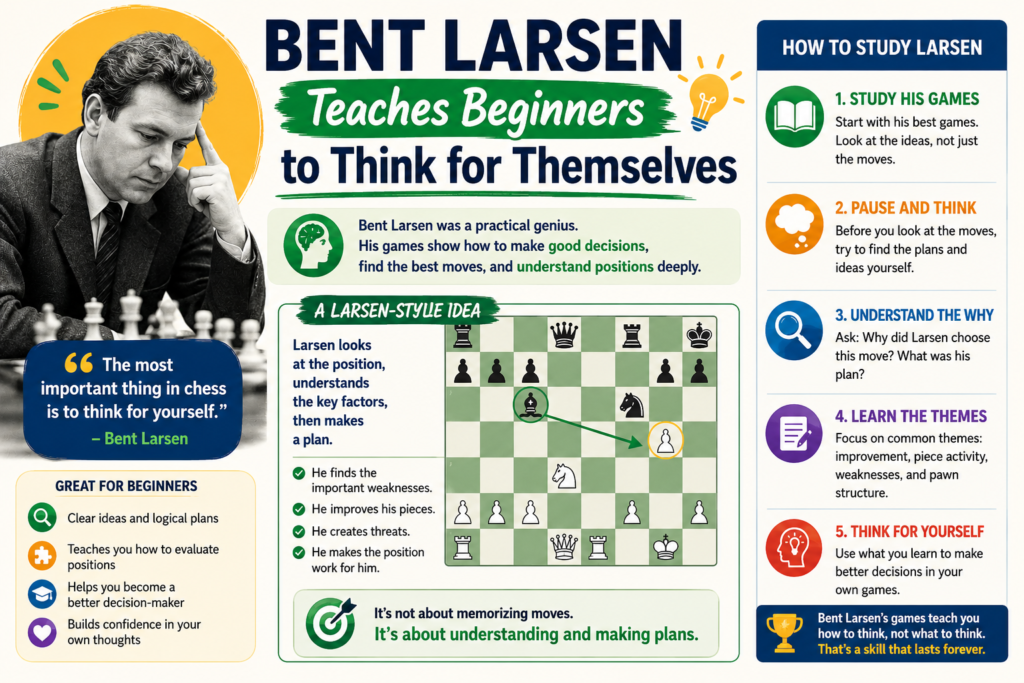
This matters a lot today. Many students think they must memorize long opening lines to become good. Larsen reminds us that understanding is more important. If you know what your pieces need, you can play good chess even when the opening looks different.
Larsen Helps Students Become Flexible Thinkers
A flexible chess player does not panic when the opponent plays a strange move. They look at the board and think. Is the center open? Is my king safe? Which piece should come out? What is weak? What is my opponent trying to do?
Larsen’s games are useful because they show many different types of positions. Some are sharp. Some are slow. Some are strange. This helps beginners learn how to adjust.
The Main Lesson from Larsen Is to Understand More and Memorize Less
A student who only memorizes may feel lost when the opponent changes the move order. But a student who understands ideas can keep playing. They know the main goals, even if the position is new.
This is one of the biggest goals of Debsie’s coaching style. Students are not trained like robots. They are taught to think. When kids understand the “why” behind moves, they become more independent and more excited to play.
Larsen’s Games Encourage Safe Creativity
Creativity in chess does not mean playing random moves. It means finding useful ideas that fit the position. Larsen was creative, but his ideas had purpose. Beginners can learn to be creative while still following good chess rules.
This is a healthy balance. Children should feel free to explore, but they also need guidance so they do not build bad habits.
Good Coaching Helps Creativity Grow the Right Way
A child may have a fun idea during a game. A coach can help them test it. Does it improve a piece? Does it create a threat? Does it leave something hanging? Does it help the king stay safe?
This kind of feedback turns curiosity into skill. That is why live coaching can be so powerful. It helps students keep their natural creativity while learning how to make better choices.
Susan Polgar Teaches Beginners Strong Basics and Smart Habits
Susan Polgar is a world champion and one of the best chess educators in the world. She is a great player for beginners to study because her games often show strong basics, clear tactics, and steady decision-making.
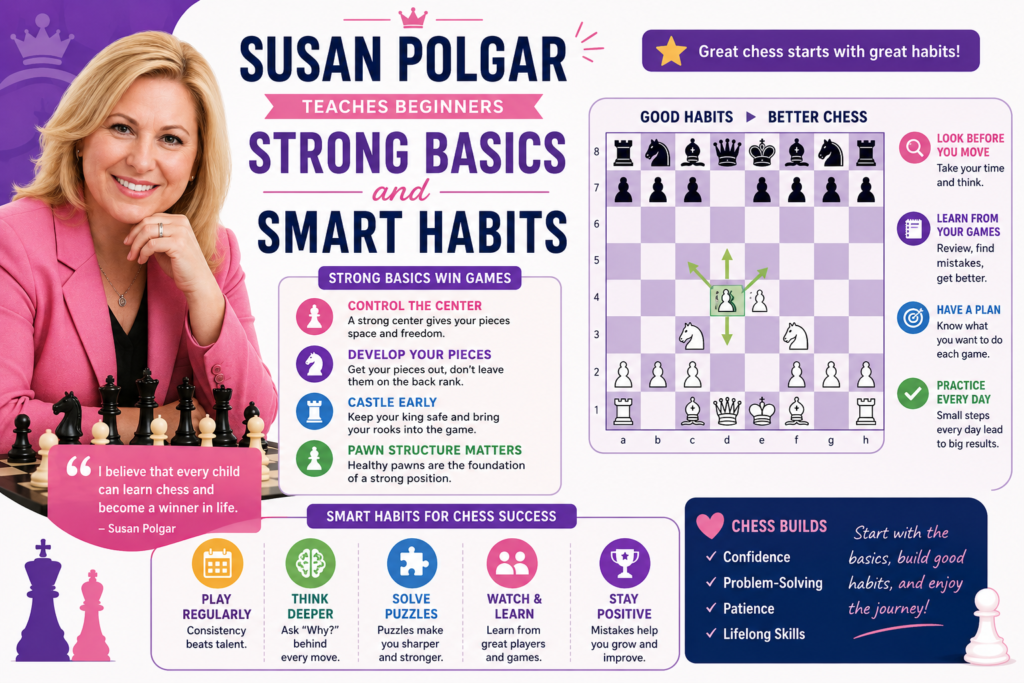
She also proves something every young student should hear: talent grows through training, patience, and good habits.
For beginners, Susan Polgar’s chess is helpful because it is not only about flashy wins. It is about doing the right things again and again. Develop pieces. Keep the king safe. Watch for tactics. Use open lines. Finish the game with care.
Susan Polgar Helps Students Build a Strong Chess Foundation
A strong foundation means the simple things are done well. Many beginners want advanced tricks, but they still miss hanging pieces. They want fancy openings, but they forget to castle. They want checkmate, but they do not notice their queen is attacked.
Susan Polgar’s games and teaching style show that basics are not boring. Basics are what make advanced ideas possible.
The Main Lesson from Susan Polgar Is to Train Good Habits Early
Good chess habits save many games. Before moving, check for danger. Look at checks and captures. Ask what the opponent wants. Make sure your piece is safe. Use all your pieces.
These habits sound simple, but they are powerful. At Debsie, beginners are guided to repeat good thinking steps until they become natural. This helps kids play with more focus and fewer careless mistakes.
Susan Polgar Is Also a Great Role Model for Young Learners
Children need role models who show discipline, confidence, and kindness. Susan Polgar’s chess journey can inspire students to believe that hard work matters. She also shows that chess is for everyone.
This message is important for families. Chess is not only for children who already seem “gifted.” Chess can help any child grow if they get the right support and steady practice.
A Good Role Model Can Make Chess Feel Possible
When kids see strong players who worked hard and kept learning, they feel less pressure to be perfect. They understand that mistakes are part of growth. They learn to enjoy the journey.
That is the heart of a good chess program. At Debsie, children are not judged by one game or one mistake. They are helped, guided, and encouraged to keep improving.
Max Euwe Teaches Beginners How to Learn From Mistakes
Max Euwe was a world chess champion, but he was also a great teacher. That makes him a very useful player for beginners to study. His games often feel logical. His ideas are not too hard to follow. He played clear chess, and he explained chess in a way that helped many students grow.
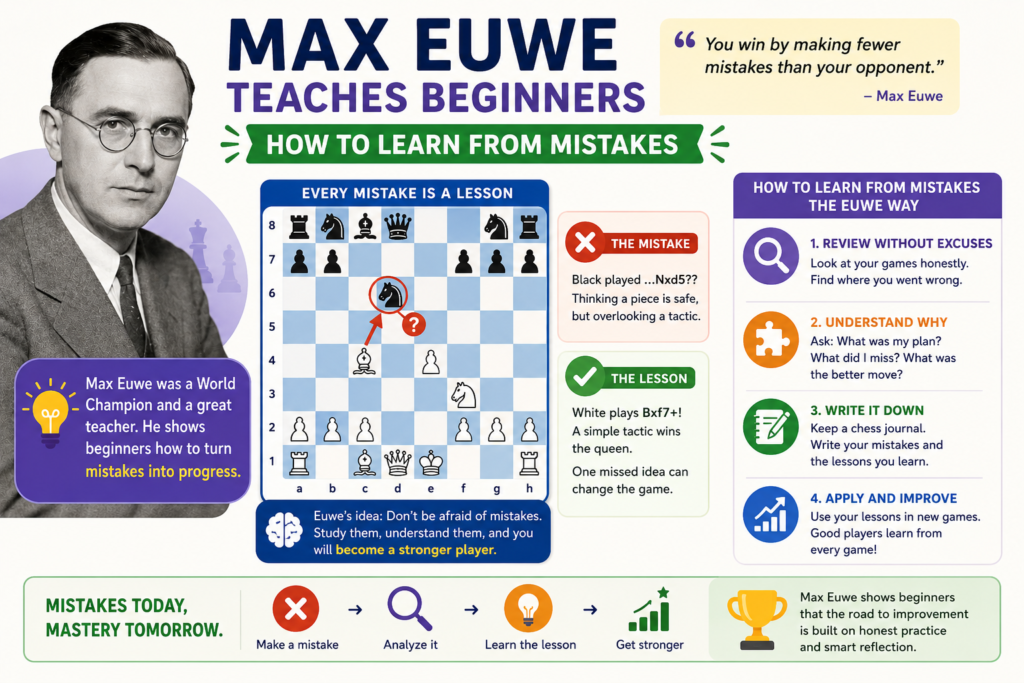
For a beginner, this matters a lot. Some great players are hard to study because their moves feel too deep. Euwe is different. His games can help students understand how a position changes, why a mistake matters, and how a good plan can slowly become a win.
Euwe Helps Beginners See Cause and Effect in Chess
Chess is full of cause and effect. If you move too many pawns, your king may become weak. If you leave pieces undeveloped, your opponent may attack first. If you trade your active pieces, your position may become harder to play.
Euwe’s games are helpful because the lessons are often easy to trace. You can look at one side’s small mistake and see how Euwe uses it. He does not always win with a wild attack. Sometimes he wins by making one good choice after another.
The Main Lesson from Euwe Is to Review Every Game With Honesty
A beginner should not only study wins. They should also study mistakes. Every lost game has a lesson hiding inside it. Maybe the child missed a fork. Maybe they forgot to castle. Maybe they attacked before developing. Maybe they traded into a bad endgame.
This is why guided review is so powerful. At Debsie, coaches help students look at their games without shame. The goal is not to make a child feel bad. The goal is to help them see one clear thing they can improve next time. That is how real confidence grows.
Euwe’s Style Is Great for Students Who Like Clear Rules
Some children learn best when ideas are simple and organized. Euwe’s games suit them well. His chess often shows strong opening habits, sensible middle game plans, and careful endgame play.
This does not mean chess becomes easy overnight. But it does mean the student has a path. They can see what good chess looks like. They can copy the thinking method, not just the moves.
Clear Thinking Helps Kids Feel Less Lost
Many beginners lose because they do not know what to do after the opening. Euwe teaches them to look for simple needs. Is my king safe? Are my pieces active? Is there a weak pawn? Can I improve my worst piece?
When children learn to ask these questions, they feel less stuck. They begin to make moves with purpose. That is a big step from guessing to thinking.
Vera Menchik Teaches Beginners Strong Basics and Calm Confidence
Vera Menchik was the first women’s world chess champion, and she was far stronger than many people around her expected. She played at a time when women were often not given enough respect in chess. Still, she proved her strength on the board again and again.
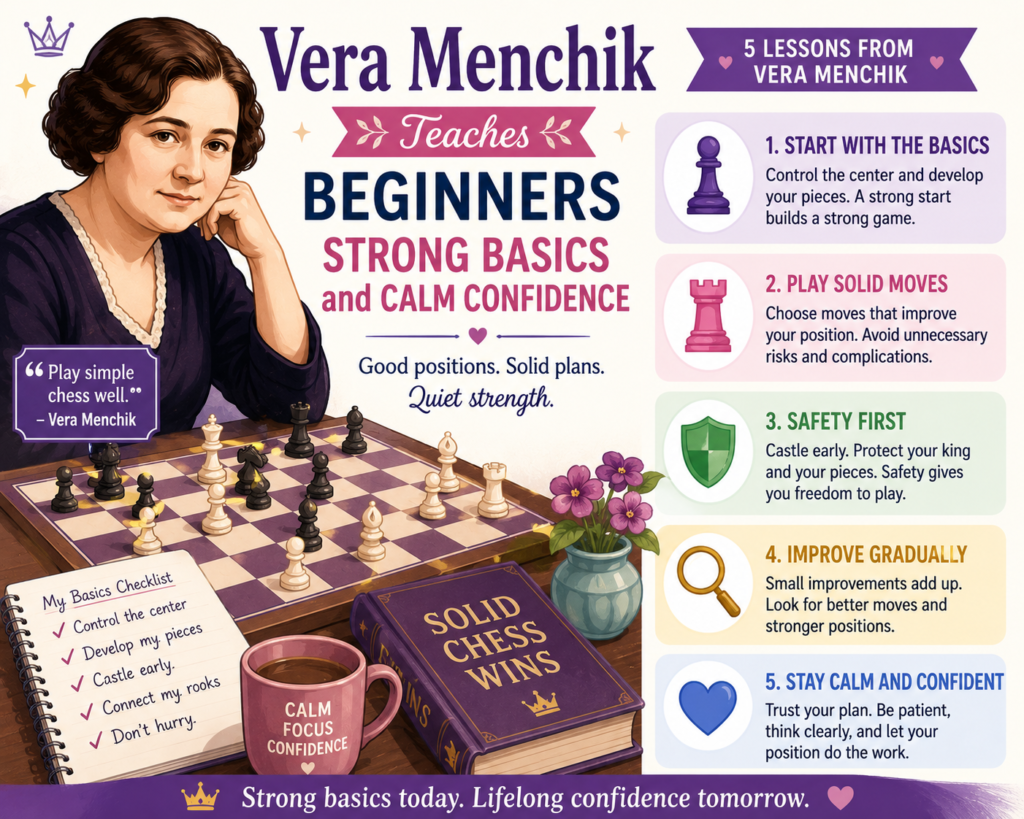
For beginners, Vera Menchik is a great player to study because her games show courage, clear development, and steady play. She did not need noise or drama. She played strong moves and made her opponents solve real problems.
Menchik Helps Students Understand Why Confidence Matters
Many children lose games in their mind before they lose them on the board. They see an older student, a higher rating, or a faster player, and they feel nervous. Vera Menchik’s story teaches the opposite. Sit down, focus, and play the position.
Confidence in chess does not mean thinking you will always win. It means believing you can think, try, and learn. That is a much healthier kind of confidence for kids.
The Main Lesson from Menchik Is to Trust Your Training
A child who has practiced good habits should use them, even against a strong opponent. Develop pieces. Castle. Watch threats. Look for tactics. Do not rush. Do not give up after one mistake.
At Debsie, students are taught to trust the process. They learn that every class, puzzle, and practice game is building something inside them. Over time, they begin to sit at the board with more peace and more belief.
Menchik’s Games Are Good for Learning Steady Attacks
Vera Menchik could attack well, but her attacks were often based on good basics. She brought pieces out, placed them well, and looked for weak points. This is exactly the kind of attacking chess beginners should learn first.
A beginner does not need to sacrifice pieces in every game. They need to learn how to build pressure in a safe way. Menchik’s games help with that.
Strong Attacks Come From Strong Habits
If a child wants to attack, the first step is not to move the queen early. The first step is to prepare. Bring out knights and bishops. Keep the king safe. Place rooks on useful files. Look for weak squares near the enemy king.
This simple order helps students win more games. It also stops them from falling into common traps. A prepared attack is much stronger than a hopeful attack.
Richard Réti Teaches Beginners to Question the First Obvious Move
Richard Réti was a creative thinker who helped change chess ideas in the early 1900s. He showed that you do not always need to put pawns in the center right away. Sometimes you can control the center with pieces from a distance.
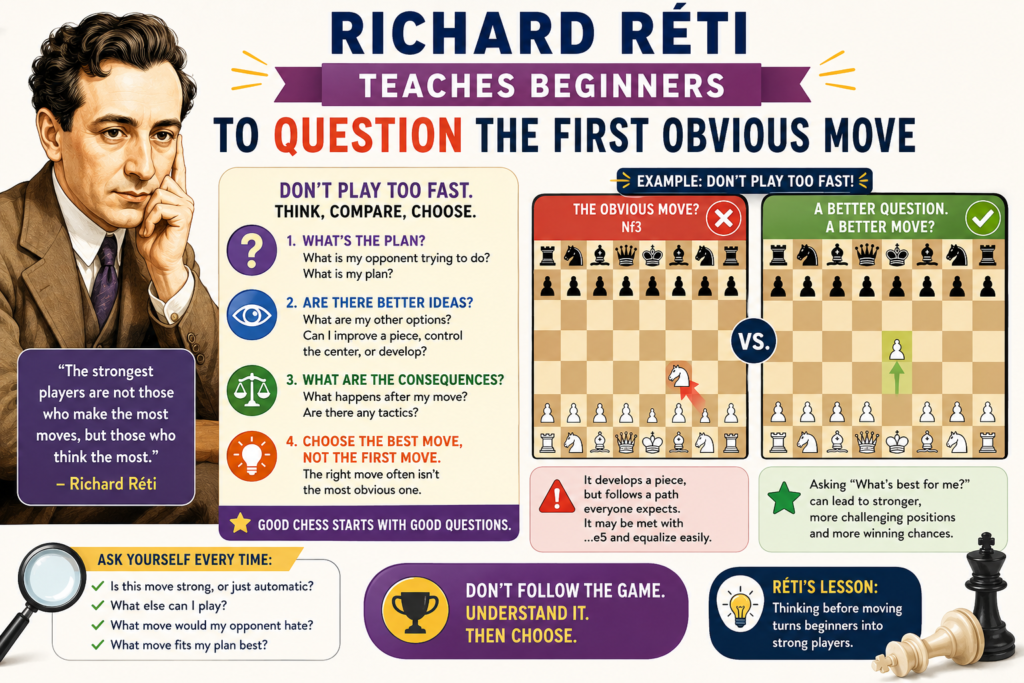
For absolute beginners, some of Réti’s ideas may feel a little advanced. But selected games can teach a very useful lesson. Do not always grab the first move that looks normal. Pause and ask if there is a smarter idea.
Réti Helps Students Learn Flexible Planning
Many beginners play the same moves in every game. Sometimes that is okay, especially when they are learning opening basics. But as they grow, they need to become more flexible. Réti’s games show that there can be more than one good way to play a position.
This is helpful because chess is not a script. Your opponent will not always follow the move you expect. A child must learn how to think when the board changes.
The Main Lesson from Réti Is to Control Important Squares
Control is a simple word, but it is a big idea in chess. If your pieces control good squares, your opponent has fewer easy moves. If you control the center, your pieces can move faster. If you control key squares near the king, attacks become stronger.
Réti helps beginners see that control can happen in more than one way. A pawn can control a square. A knight can control a square. A bishop can control a long diagonal. Once students understand this, they start seeing the board with better eyes.
Réti’s Games Can Make Children More Curious
Curiosity is one of the best gifts chess can give a child. Instead of only asking, “Is this move allowed?” they begin asking, “What does this move do?” That small change is huge.
Réti’s style invites questions. Why not push the center pawn right away? Why place a bishop there? Why let the opponent build a center and then attack it later? These questions make chess feel alive.
Curiosity Turns Chess Study Into Real Learning
When a child is curious, they remember more. They are not just copying. They are exploring. This is why Debsie’s coaches guide students with questions, not just answers. A good question helps a student discover the idea for themselves.
That moment of discovery is powerful. It makes a child feel smart, capable, and excited to learn the next idea.
Boris Spassky Teaches Beginners How to Become a Complete Player
Boris Spassky was a world champion with a very balanced style. He could attack, defend, play calm positions, and handle endgames. This makes him a great player for beginners who are ready to become more complete.
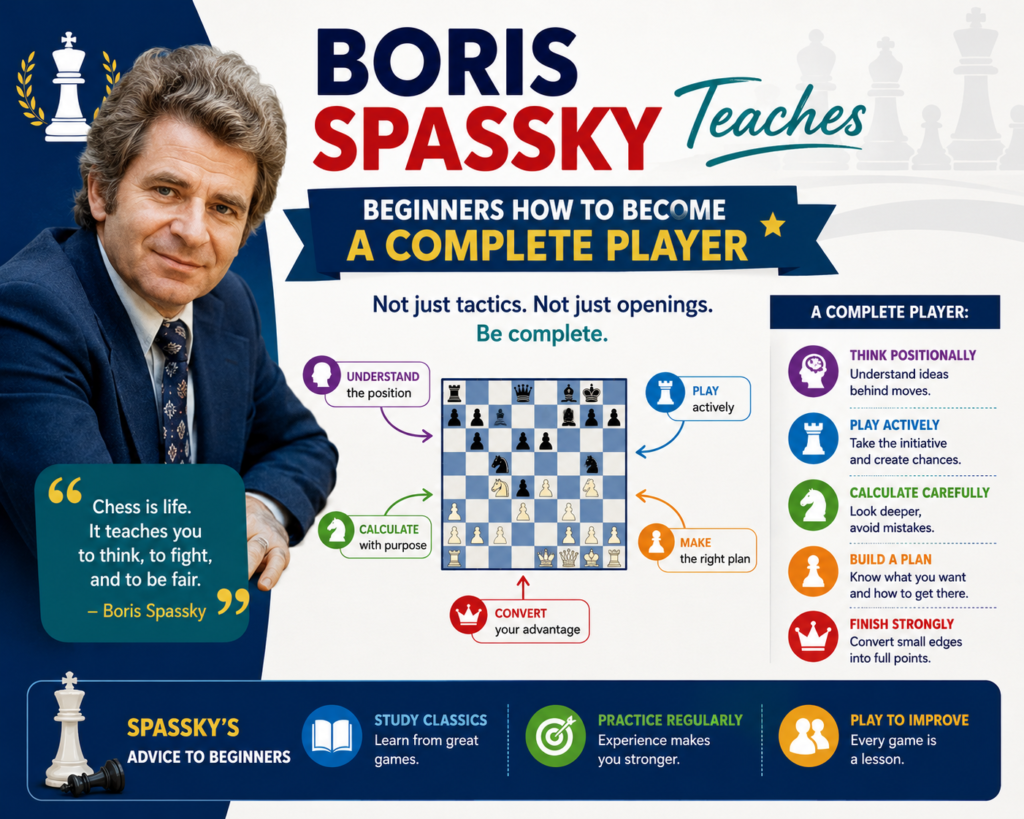
Some players are famous for one clear style. Tal is known for attacks. Petrosian is known for defense. Capablanca is known for clean play. Spassky had a bit of everything. Studying him helps students see that strong chess is not only one skill. It is many skills working together.
Spassky Helps Students Learn Balance
Balance is very important in chess. If you only attack, you may miss danger. If you only defend, you may miss chances. If you only memorize openings, you may fail in the middle game. If you only solve tactics, you may struggle with quiet plans.
Spassky’s games show how to shift from one type of play to another. He could play calmly, then suddenly attack. He could defend with patience, then take over when the time was right.
The Main Lesson from Spassky Is to Be Ready for Any Kind of Game
A beginner should not become too fixed in one style too early. It is good to enjoy attacking or calm play, but students should still learn all parts of chess. Openings, tactics, strategy, endgames, time control, and game review all matter.
This is why a structured program helps so much. At Debsie, students do not just learn random tricks. They follow a path that builds the full player. That way, when the game changes, the child knows how to adjust.
Spassky’s Games Are Useful for Learning Smooth Development
Spassky often made development look natural. His pieces came out, his king became safe, and his rooks found useful files. Then he chose a plan that fit the position.
This is exactly what beginners need to see. Strong chess does not always begin with a big tactic. It often begins with simple moves done in the right order.
Smooth Development Makes the Middle Game Easier
Many students feel lost in the middle game because their opening did not help them. Maybe their pieces are blocked. Maybe their king is still in the center. Maybe their rooks are not connected.
When children study players like Spassky, they see how a good opening leads to a playable middle game. That makes the whole game feel less confusing. It also helps them make fewer early mistakes.
Conclusion
The best chess players for beginners are not just names from history. They are teachers. Morphy shows fast development. Capablanca shows calm moves. Fischer shows clear plans. Tal shows courage. Petrosian shows safety.
Anand shows sharp eyes. Carlsen shows patience. Each player gives your child one more tool to think better, play better, and grow stronger.
Adhip Ray is the founder of Debsie, an online learning platform focused on chess and skill-based learning for children. His work at Debsie brings together chess education, structured thinking, problem-solving, and interactive learning for young students.
Adhip has an academic background in law, statistics, analytics, and technology. He is from Amity Law School and the Indian Statistical Institute, Kolkata, with formal training that connects legal reasoning, data analytics, quantitative thinking, and structured problem-solving. This interdisciplinary background is reflected in Debsie’s focus on building sharper thinking skills in children through chess and related learning programs.
Adhip is also a FIDE-rated chess player from India. He holds FIDE ID 5055954 and has a standard FIDE rating of 1832. His FIDE profile records him as an Indian player with a long rating history in standard chess, including rated games from his competitive playing years. His chess background gives Debsie a founder-led connection to the game, not only as an educational activity but also as a competitive discipline that develops concentration, calculation, planning, and decision-making.
In addition to chess, Adhip has a strong interest in coding, data, and technical problem-solving.
Adhip’s profile combines chess, law, data analytics, and programming. At Debsie, this background supports the creation of learning experiences that are logical, structured, and skill-oriented. The platform’s chess-focused programs are connected to broader cognitive skills such as pattern recognition, patience, strategic planning, focus, and problem-solving.
As founder of Debsie, Adhip brings together experience from multiple fields: formal legal education from Amity Law School, analytical training from the Indian Statistical Institute, Kolkata, competitive chess experience through his FIDE-rated profile, and coding practice through LeetCode. This combination gives Debsie a distinct foundation in strategy, reasoning, analytics, and child-focused learning.
Through Debsie, Adhip is associated with building chess and learning content for children that goes beyond basic instruction. The platform connects chess with thinking skills, helping students approach challenges with more structure, clarity, and confidence. His own background in chess and analytical problem-solving gives the platform a direct link to the skills it aims to develop in young learners.
Adhip is also a member of Forbes Business Council.