Every student needs a spark. Sometimes, that spark comes from a coach. Sometimes, it comes from a tough game. And sometimes, it comes from watching another young player sit at the board, stay calm under pressure, and find a move that feels almost magical.
Find the right learning experience
Tell us a little about the learner and what you are looking for. Our team will review your answers and help you identify the most suitable next step.
- Takes only a few minutes
- No payment required
- Personalised recommendations
Your information will only be used to respond to your enquiry.
Why students should follow young chess players with a real study plan
Young chess stars are fun to watch, but students should not follow them only for fame, trophies, or cool clips. The real value is much deeper. When a student follows the right players in the right way, chess starts to feel possible.
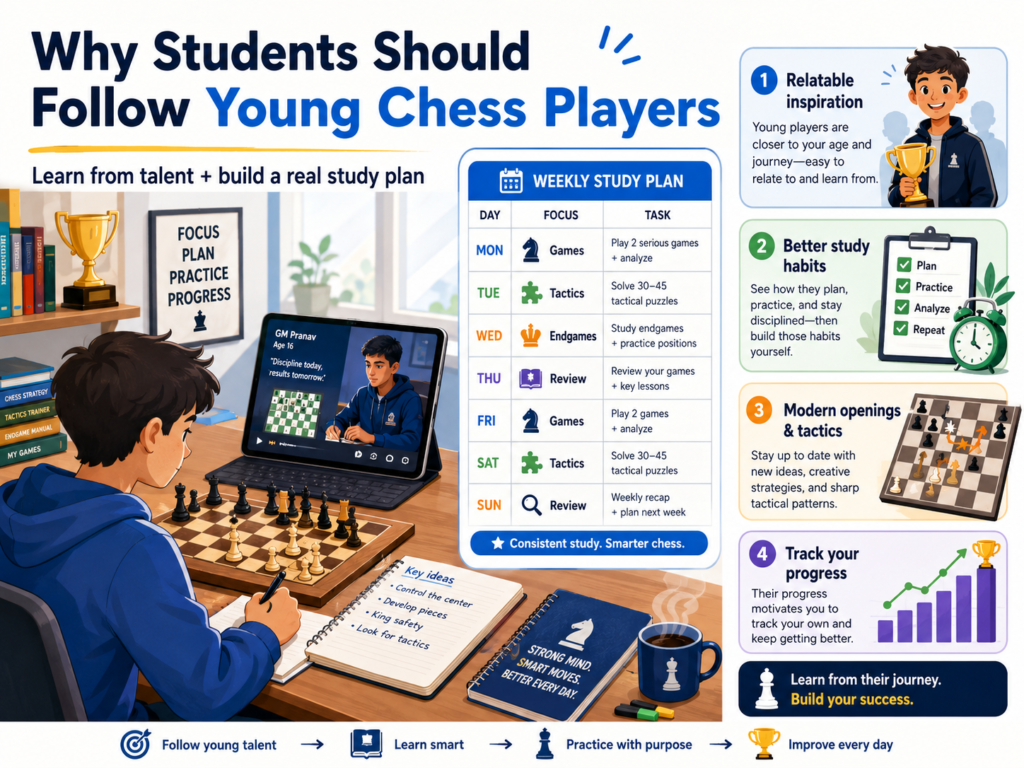
A hard puzzle feels less scary. A long game feels less boring. A lost game starts to look like a lesson, not a failure.
Many students see grandmasters and think, “They are just born smart.” But when you study young chess players closely, you see the truth. They train. They lose. They fix mistakes. They come back. That is the part every student can copy.
The goal is not to copy their life, but to copy their habits
A student does not need to train ten hours a day to learn from a top player. That is not the point. The point is to ask better questions while watching them. Why did they trade that piece? Why did they stay calm in a worse position? Why did they choose a simple move instead of a flashy move?
This is where chess becomes a life skill. The student learns to slow down. They learn to check before rushing. They learn that smart thinking often beats fast guessing. These same habits help in school, homework, tests, and even daily choices.
Find the right learning experience
Tell us a little about the learner and what you are looking for. Our team will review your answers and help you identify the most suitable next step.
- Takes only a few minutes
- No payment required
- Personalised recommendations
Your information will only be used to respond to your enquiry.
At Debsie, this is one of the big things we teach. Chess is not just about moving pieces. It is about helping a child build focus, patience, and brave thinking. A student who learns to pause before a chess move can also learn to pause before giving up on a math problem. Parents can book a free trial class here: https://debsie.com/take-a-free-chess-trial-class/
A simple way to follow a player without wasting time
The best way to follow a young chess player is to choose one game and ask, “What can I use in my next game?” That one question saves time. It stops the student from watching chess like a movie and turns it into real training.
A student can look at the opening, but they should not try to memorize every move. They can look at the middle game, but they should not feel bad if the ideas look hard. They can look at the endgame, because that is where many young stars show great patience.
Even one small idea from a master game can help a student win more games later.
The goal is simple. Watch less, learn more, and use one idea right away.
Gukesh Dommaraju shows students how quiet belief can turn into big results
Gukesh Dommaraju is one of the best young players for students to follow because his story feels both huge and simple. He became the youngest undisputed world chess champion at age 18 after defeating Ding Liren in the 2024 World Championship match.
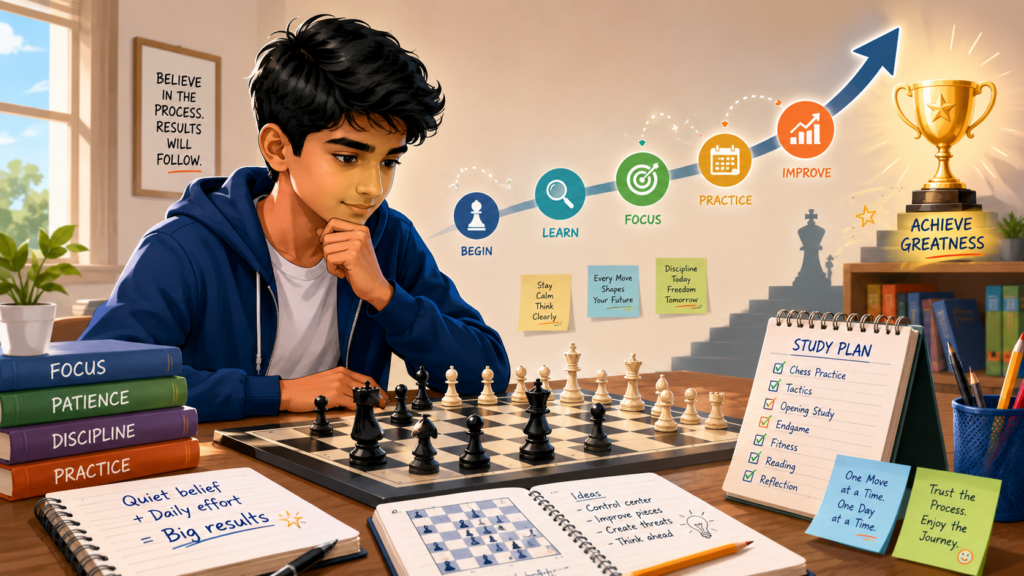
He also became only the second Indian world champion after Viswanathan Anand, which made his win even more special for young players watching from all over the world.
But the best lesson from Gukesh is not only that he won. The best lesson is how he stayed steady.
Students should study how Gukesh handles pressure
Many young players panic when the game gets hard. They move too fast. They hope the opponent will miss something. They feel angry after one mistake and then make three more mistakes. Gukesh is a great player to follow because he often shows a calm style, even when the position is tense.
That does not mean he never feels pressure. Of course he does. Every great player does. But students can learn from the way he keeps working inside the position. He does not need every move to look pretty. He keeps asking what the board needs.
This is a strong lesson for children. In chess, school, and life, the calm student often sees more. The student who can breathe, look again, and think clearly will make better choices.
The Gukesh study tip for students who get nervous
Pick one Gukesh game and do not rush through it. Stop at move 15, move 25, and move 35. At each stop, ask what both sides want. This is simple, but it trains the mind to think in plans, not just moves.
A student can write one sentence after each stop. White wants to attack the king. Black wants to trade pieces. White wants to win a pawn. Black wants to block the open file. These small notes build a strong chess habit.
This is also why guided coaching helps so much. A child may watch a game and miss the main idea. A good coach can slow it down and make it clear. Debsie coaches help students learn this step by step in live classes, so children do not feel lost while studying master games. The free trial class is here: https://debsie.com/take-a-free-chess-trial-class/
Praggnanandhaa teaches students that steady growth beats loud talent
Rameshbabu Praggnanandhaa, often called Pragg, is another young chess player students should follow closely. FIDE lists him as an Indian grandmaster, and his rise started very young.
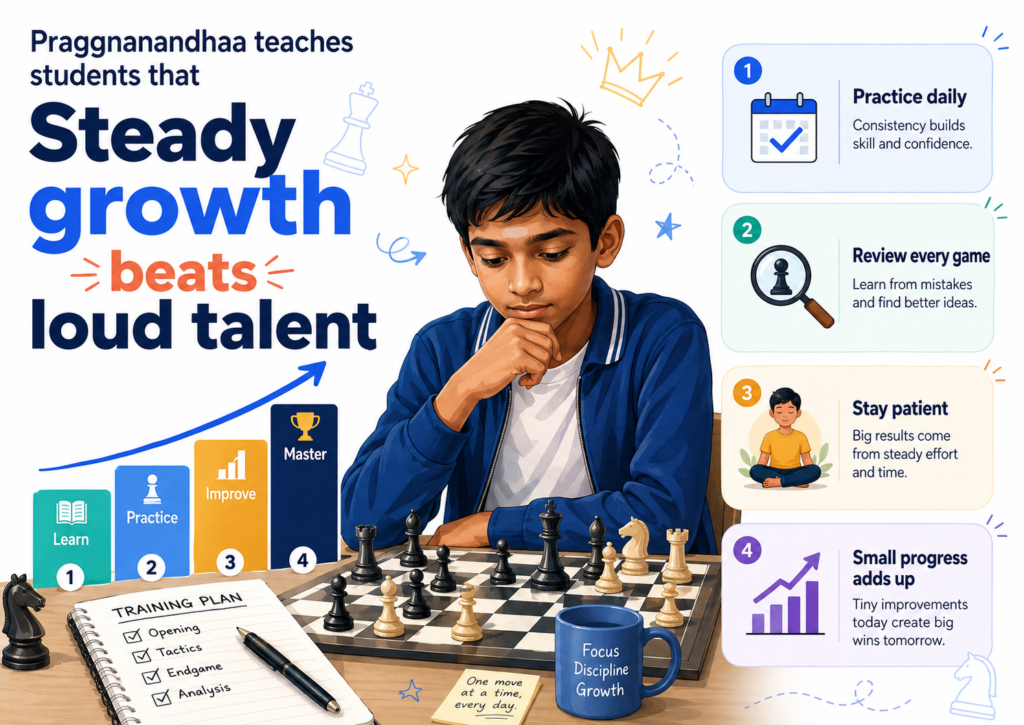
He became an International Master in 2016 and a Grandmaster in 2018, which shows years of steady work from childhood into the top level of chess.
Pragg is easy for students to admire because he does not look like someone trying to show off. He plays strong chess, but his public style is calm. That is a powerful message for kids. You do not need to be loud to be strong. You do not need to act big to do big things.
Students can learn from Pragg’s simple and brave chess
Pragg’s games often teach a very useful lesson. Do not be scared of strong players. Respect them, yes. Fear them, no. He has played against the very best in the world and has shown that young players can fight with courage when they trust their training.
This matters for students because many children lose the game before it starts. They see a higher rating and think, “I cannot win.” They see an older player and think, “They know more than me.” They make weak moves because they already feel small.
Pragg’s career reminds students that the board does not care about age, name, or fear. The board cares about good moves.
The Pragg study tip for students who fear stronger players
Before playing a stronger opponent, a student should choose one small goal that is fully in their control. The goal should not be “I must win.” That creates fear. A better goal is to check every capture before moving. Another good goal is to use the clock well.
Another is to avoid moving the same piece many times in the opening.
This changes the game. The student is no longer thinking only about the opponent’s rating. They are thinking about their own process. That is how confidence grows.
Parents love seeing this change. A child who learns to face a stronger chess player with courage may also become braver in class, sports, and social life. Debsie’s live chess lessons are built to grow this kind of calm confidence, not just chess knowledge. You can start with a free trial class here: https://debsie.com/take-a-free-chess-trial-class/
Nodirbek Abdusattorov shows why fast chess still needs deep thinking
Nodirbek Abdusattorov from Uzbekistan is one of the most exciting young players to follow because he combines speed with serious control. FIDE lists him as a grandmaster from Uzbekistan, and he became the World Rapid Chess Champion in 2021 at age 17 after winning the rapid title ahead of elite players.
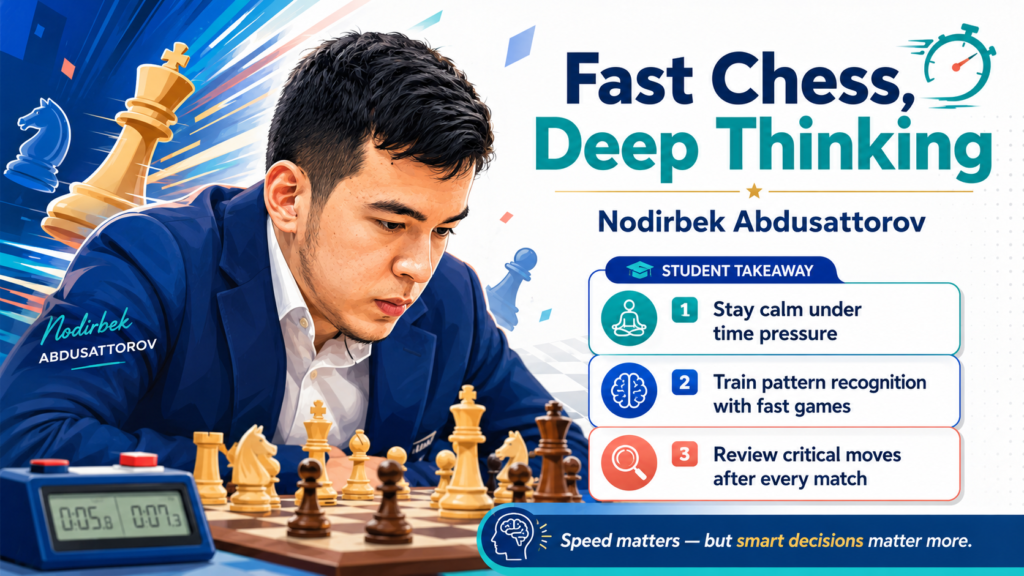
This is very useful for students because many kids love fast chess. They enjoy blitz. They enjoy rapid games. They enjoy the fun of quick moves. But there is a danger. Fast chess can become guessing chess.
Nodirbek’s games show that even in rapid chess, strong players are not just moving fast. They are using patterns, plans, and calm judgment.
Students should learn the difference between speed and rushing
Speed is when you see a good move quickly because you have trained well. Rushing is when you move quickly because you want the pressure to end. These are not the same thing.
A lot of students lose games because they rush. They see a check and play it. They see a capture and grab it. They see an attack and forget their own king. Then they say, “I made a silly mistake.” But most silly mistakes are not silly. They are the result of moving before thinking.
Nodirbek is a great player to follow because his rapid games can teach students how to stay sharp while the clock is ticking.
The Nodirbek study tip for students who play too fast
A student who plays too fast should train with one rule. Before every move, they must ask, “What is my opponent’s threat?” This question takes only a few seconds, but it can save the game.
If the opponent is attacking the queen, the student will see it. If the opponent wants checkmate, the student will notice it. If the opponent is setting a trap, the student has a better chance to avoid it.
This habit is small, but it is powerful. It teaches children to respect danger without becoming scared. That is one of the best gifts chess gives a student: the skill to think before acting.
Arjun Erigaisi shows students how to play with courage without being careless
Arjun Erigaisi is one of the most exciting young chess players for students to follow because his games often feel full of energy. He is not the kind of player who only waits for the other side to make a mistake. He looks for chances.
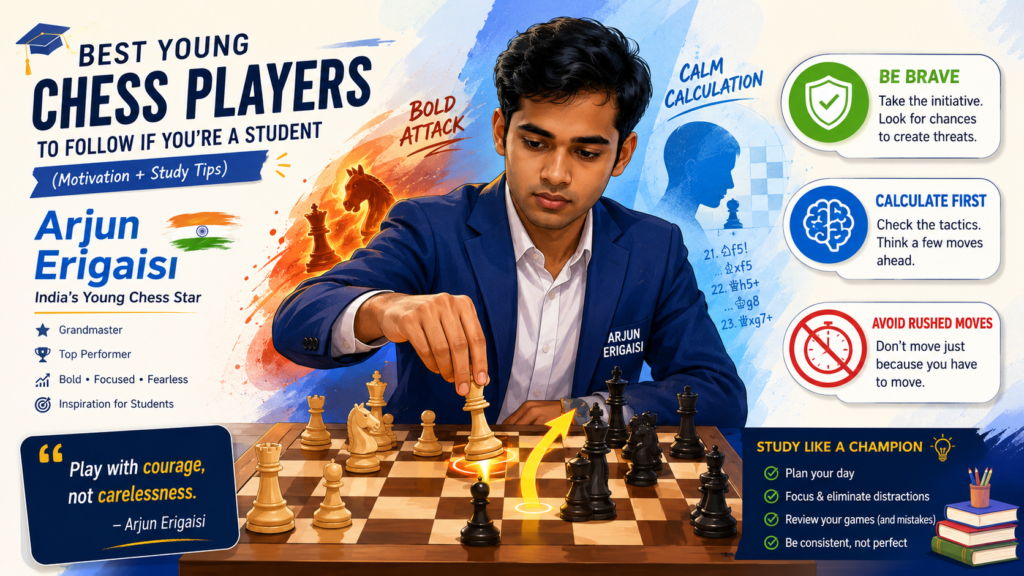
He creates pressure. He makes the board hard for his opponent. FIDE lists Arjun as an Indian Grandmaster, and his recent climb has made him one of the strongest young players in the world.
For a student, Arjun is a great example of active chess. Active chess does not mean wild chess. It means your pieces are doing useful work. Your rooks are not sleeping. Your bishops are not blocked for no reason. Your queen is not just moving around without a plan. Each piece has a job.
Students can learn how to ask for more from every piece
Many beginners lose games because they play one good move and then stop asking questions. They develop a knight and feel happy. They castle and feel safe. But after that, they do not know what to do.
Find the right learning experience
Tell us a little about the learner and what you are looking for. Our team will review your answers and help you identify the most suitable next step.
- Takes only a few minutes
- No payment required
- Personalised recommendations
Your information will only be used to respond to your enquiry.
Arjun’s games can help students understand that chess is not just about “not blundering.” It is also about slowly making your pieces better.
This is a big lesson. A student should not only ask, “Is my move safe?” That is important, but it is not enough. They should also ask, “Does this move make my piece better?” A safe move that does nothing may not help much. A strong move often protects something, attacks something, or prepares a clear idea.
When students learn this, their games start to change. They stop moving pieces just because it is their turn. They begin to play with purpose. That is when chess becomes more fun, because the child feels in control instead of lost.
The Arjun study tip is to check piece activity before making a move
A simple way to study Arjun is to pause during one of his games and look only at the pieces. Do not start with tactics. Do not worry about deep engine lines. Just ask which pieces are active and which pieces are quiet.
If a rook is stuck in the corner, ask how it can reach an open file. If a bishop is blocked by its own pawns, ask how the pawn shape can change. If a knight has no good square, ask where it wants to go next. This trains the student to see chess as a team game, not a queen-only game.
At Debsie, students learn this kind of thinking in a guided way, so they are not just copying moves. They learn why a move works. That is the difference between memorizing chess and growing through chess. Parents can book a free trial class here: https://debsie.com/take-a-free-chess-trial-class/
Nihal Sarin teaches students how small details can decide big games
Nihal Sarin is a wonderful player for students to follow because he shows how clean chess can be very powerful. FIDE lists Nihal as an Indian Grandmaster, and his profile also shows his strong standing across classical, rapid, and blitz chess.
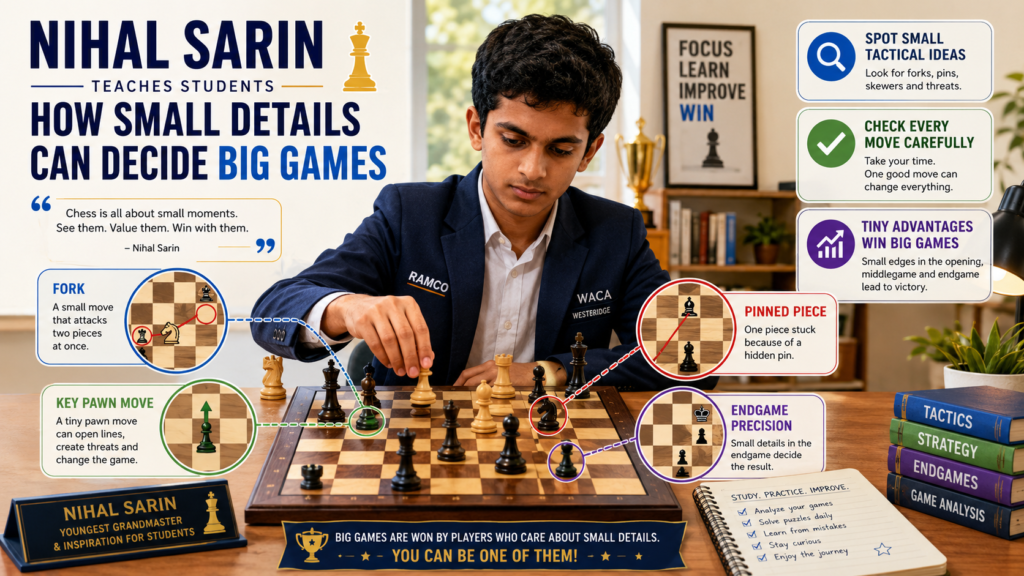
That matters because many students think strong chess is always about a big attack. They want sacrifices, checkmates, and dramatic moves. Those things are fun, but many real games are won by small details.
A better square. A safer king. A stronger pawn. A trade at the right time. Nihal’s style can help students respect those quiet choices.
Students should learn to enjoy clean moves, not only flashy moves
A flashy move feels good because everyone notices it. A clean move is different. It may not look amazing at first, but it makes the whole position easier to play. This is one of the most important lessons a young student can learn.
Many children search for a tactic on every move. When there is no tactic, they get bored. Then they play a random move and give the opponent a chance. Strong players do not do that. When there is no tactic, they improve the position.
They stop counterplay. They place a piece on a better square. They prepare the moment when tactics will appear.
This is why following Nihal can be so useful. His games can teach students that patience is not passive. Patience is active thinking. It means you are building something, even if the win is not clear yet.
The Nihal study tip is to mark the quiet move that changed the game
When a student studies one of Nihal’s games, they should try to find one quiet move that made the position better. It may be a king move, a pawn move, a rook lift, or a small piece move. The move may not give check. It may not win material right away. But it may stop the opponent’s idea or prepare a stronger plan.
This exercise is very good for kids who rush. It teaches them that not every good move must be loud. Some of the best chess moves are calm. They quietly say, “I know what you want, and I will not let you get it.”
That kind of thinking helps outside chess too. A child learns that small daily habits matter. Doing homework on time, checking work before submitting it, and listening carefully in class are quiet moves in real life. They may not look big in the moment, but they build strong results over time.
Debsie’s chess classes help children notice these small choices. With expert coaches, students learn to slow down, think clearly, and feel proud of steady progress. The free trial class is here: https://debsie.com/take-a-free-chess-trial-class/
Vincent Keymer shows students why balance can beat panic
Vincent Keymer is one of the best young players from Europe for students to study. FIDE lists him as a German Grandmaster, and his profile shows him as Germany’s top player.
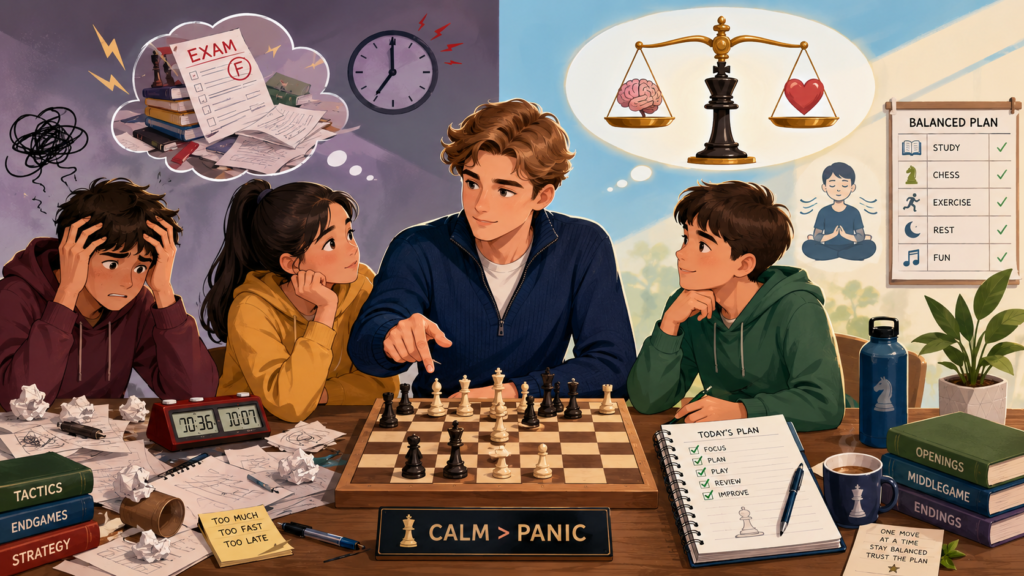
Chess.com also describes him as the youngest player from Germany to earn the Grandmaster title, which makes his path very inspiring for students who are trying to grow step by step.
Keymer’s games are useful because he often gives the feeling of balance. He can attack, but he does not attack without reason. He can defend, but he does not defend in fear. He plays with control. This is a great model for students who swing between two problems: playing too safely or playing too wildly.
Students can learn how to stay flexible during a game
A lot of students choose a plan and then hold on to it for too long. They decide to attack the king, even when the attack is gone. They decide to win a pawn, even when their own king becomes weak. They decide to trade pieces, even when the trade helps the opponent.
Strong chess needs flexibility. A student must learn to change the plan when the board changes. This can be hard for children because they often want simple rules. But chess is not always that simple. Sometimes the best move is attack.
Sometimes the best move is defense. Sometimes the best move is to wait and improve.
Keymer’s games are good for this kind of study because they show how a player can stay calm while the position changes. He does not need to force everything. He can adjust.
The Keymer study tip is to ask what changed after every trade
Trades are one of the biggest turning points in a student’s game. When pieces come off the board, the position changes. A student should not trade just because they can. They should ask what the trade does.
After every trade, the student can ask a simple question: who is happier now? If the trade removes the opponent’s best piece, it may be good. If the trade opens a file for the opponent’s rook, it may be bad. If the trade makes an endgame easier to win, it may be smart.
If the trade removes your own attacking piece, it may hurt your plan.
This habit makes students much stronger. They stop trading by habit and start trading with reason. That also helps them in life. They learn that every choice has a result. Before giving up time, energy, or attention, they learn to ask what they are getting back.
This is one reason chess is such a strong learning tool. It teaches cause and effect in a way children can see. At Debsie, coaches help students build this skill through live games, puzzles, review, and friendly feedback. Parents who want their child to think more clearly can start here: https://debsie.com/take-a-free-chess-trial-class/
Alireza Firouzja teaches students how creativity must be trained
Alireza Firouzja is a player many students love to follow because his chess can feel bold, sharp, and full of life. FIDE lists him as a French Grandmaster, and the Grand Chess Tour notes that he became the youngest player to reach a 2800 rating, passing a record once held by Magnus Carlsen.
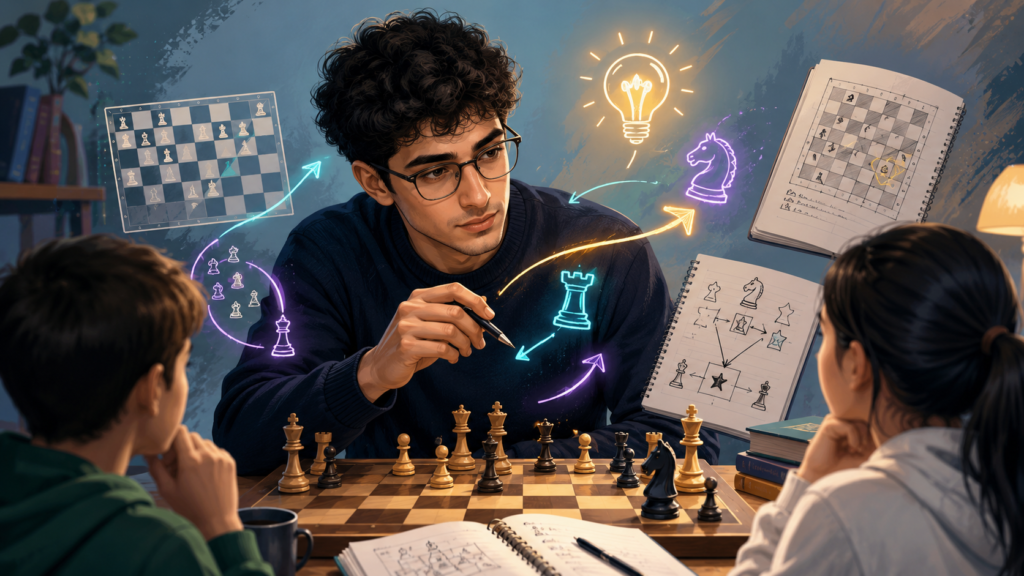
That fact is amazing, but students should not only admire the number. They should look at the lesson behind it. Creative players are not just “born creative.” They train patterns. They study deeply. They learn when a risk is worth taking and when it is just hope.
Students should understand the difference between creative and careless
Many young players want to play like Alireza because they see exciting attacks and brave choices. But there is a trap here. A student may think creativity means doing anything unusual. That is not true.
Creative chess still needs rules. Your king must be safe enough. Your pieces must work together. Your attack must have support. Your sacrifice must have a reason. Strong players may break normal rules, but they do it because they see something special in the position.
Careless chess is different. Careless chess says, “I hope this works.” Creative chess says, “I see why this can work.” That difference is huge.
Students who understand this become much better. They still enjoy exciting chess, but they do not throw pieces away for no reason. They learn to test their idea before playing it.
The Alireza study tip is to check the reason behind every bold move
When a student sees a bold move in Alireza’s game, they should not copy it at once. They should pause and ask why the move works. Does it open a line toward the king? Does it remove a defender? Does it create a threat that cannot be stopped? Does it gain time by attacking a stronger piece?
This makes the student a smarter attacker. They do not just say, “That move looks cool.” They learn to say, “That move works because the knight cannot move, the rook joins the attack, and the king has no safe square.” That is real chess growth.
This is also a great way to build confidence. A child who learns to explain their idea becomes less dependent on guessing. They begin to trust their mind. They can speak about their moves, learn from mistakes, and feel proud of their effort.
Debsie helps students grow this kind of smart confidence. The goal is not to make children memorize a thousand tricks. The goal is to help them think, explain, try, and improve. That is how a student becomes stronger in chess and stronger in life.
Faustino Oro reminds students that age is not the boss of your growth
Faustino Oro is one of the youngest chess players students should follow because his story feels almost unreal, but the lesson is very real.
FIDE lists him as an International Master from Argentina, born in 2013, with a strong rating for such a young player. He earned the International Master title in 2024, and that alone makes him a huge source of hope for children who are just starting to dream bigger in chess.
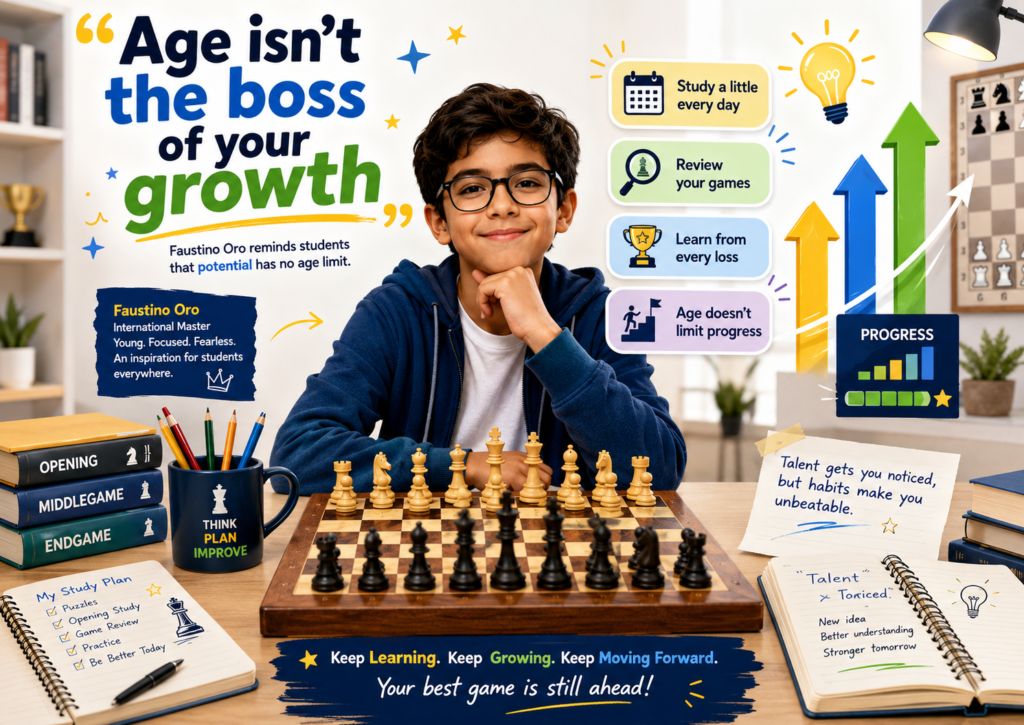
Faustino’s story is not useful because every student should expect to become an International Master as a child. That is not the point. The real lesson is that young minds can grow fast when they are guided well, trained often, and helped by people who believe in them.
Students should follow Faustino to see what focused learning can do
Many children think they are “too young” to understand serious chess. Some parents think chess is too hard for a child until the child is much older. Faustino’s rise helps break that idea. It shows that kids can learn deep things when lessons are clear, fun, and steady.
This does not mean a child should be pushed too hard. A student should never feel like chess is a heavy weight. Chess should feel like a smart challenge, not a punishment. The best growth happens when a child enjoys the game, gets support, and learns one step at a time.
That is why the right learning space matters so much. A young player needs someone who can make hard ideas feel simple. They need a coach who can spot mistakes without making the child feel small. They need games, puzzles, review, and kind pressure.
This is the kind of learning Debsie aims to give students through live classes and expert coaching.
The Faustino study tip is to build one strong habit before adding more
A student who feels inspired by Faustino should not try to do everything at once. That will only create stress. The better plan is to pick one habit and make it strong.
For example, a student can start by checking all checks, captures, and threats before every move. That habit sounds simple, but it changes games fast. It helps the student stop hanging pieces. It helps them notice tactics. It helps them slow down without feeling stuck.
Once that habit feels natural, the student can add a second habit, such as reviewing every lost game. Then they can add a third habit, such as solving five puzzles each day. This is how real growth happens. Not by doing one huge thing for one day, but by doing small smart things again and again.
Parents who want their child to build strong chess habits with patient coaches can start with Debsie’s free trial class: https://debsie.com/take-a-free-chess-trial-class/
Yagiz Kaan Erdogmus shows students how deep practice can make fast progress possible
Yagiz Kaan Erdogmus is another young player students should watch with care. He is a Turkish Grandmaster and is widely seen as one of the strongest young talents in the world. Chess.com describes him as one of the youngest grandmasters ever and says he became the youngest player to reach a 2600 FIDE rating.
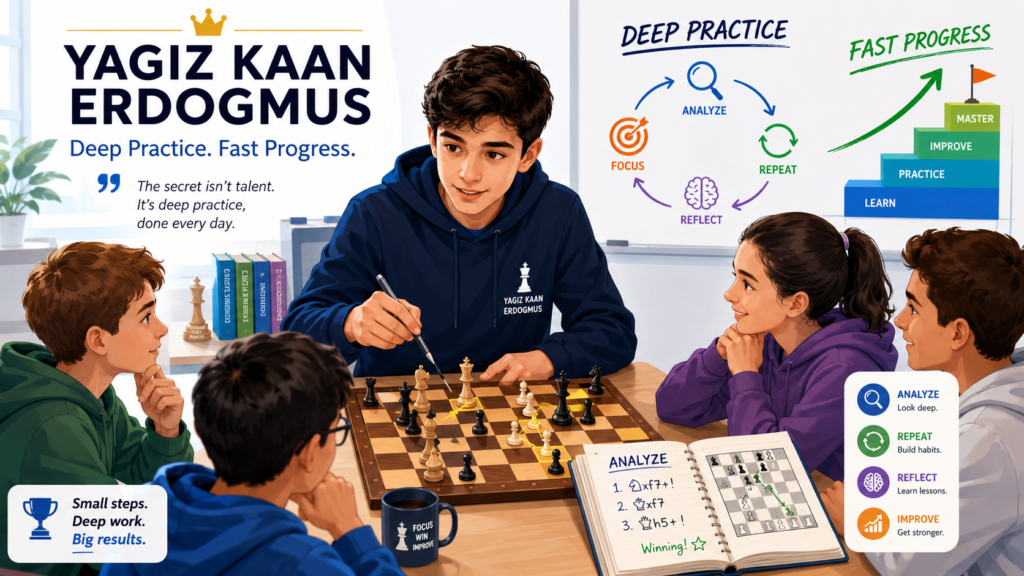
His rise is exciting, but students should not only look at the record. They should look at what the record teaches. Big jumps do not come from luck alone. They come from hard practice, clear goals, good help, and the courage to keep playing strong events.
Students can learn that progress often comes after serious review
Many students play a lot of games but do not improve as fast as they want. The reason is often simple. They play, lose, feel upset, and then start the next game right away. That is like taking a test, never checking the answers, and hoping the next test will go better.
Yagiz’s progress reminds students that strong players do not just play more. They learn more from what they play. After a serious game, they look at the key moments. They ask where the plan went wrong. They find the move that changed the game.
They check if the mistake came from tactics, time trouble, opening confusion, or poor focus.
This is one of the best habits any student can copy. The game is not over when the king falls. The lesson starts after the game ends.
The Yagiz study tip is to review losses before playing again
A student who wants to grow faster should make one rule. After a lost game, they should review it before starting another serious game. This does not need to take one hour. Even ten honest minutes can help.
The student should find the first big mistake, not just the final blunder. Many kids only notice the move where they lost the queen. But the real mistake may have happened five moves earlier, when they left the queen with no safe square. This kind of review teaches cause and effect.
When students learn to review calmly, they also become stronger in life. They stop saying, “I am bad at this.” They start saying, “I can find what went wrong and fix it.” That mindset helps with schoolwork, sports, music, and friendships.
At Debsie, coaches help students review games in a way that feels clear and kind. The child learns from mistakes without feeling embarrassed. That is where confidence grows. Book a free trial class here: https://debsie.com/take-a-free-chess-trial-class/
Alice Lee teaches students how calm focus can open big doors
Alice Lee is a young American chess player students should follow, especially students who need to see that quiet focus can lead to strong results. FIDE lists Alice Lee as an International Master and Woman Grandmaster from the United States, born in 2009.
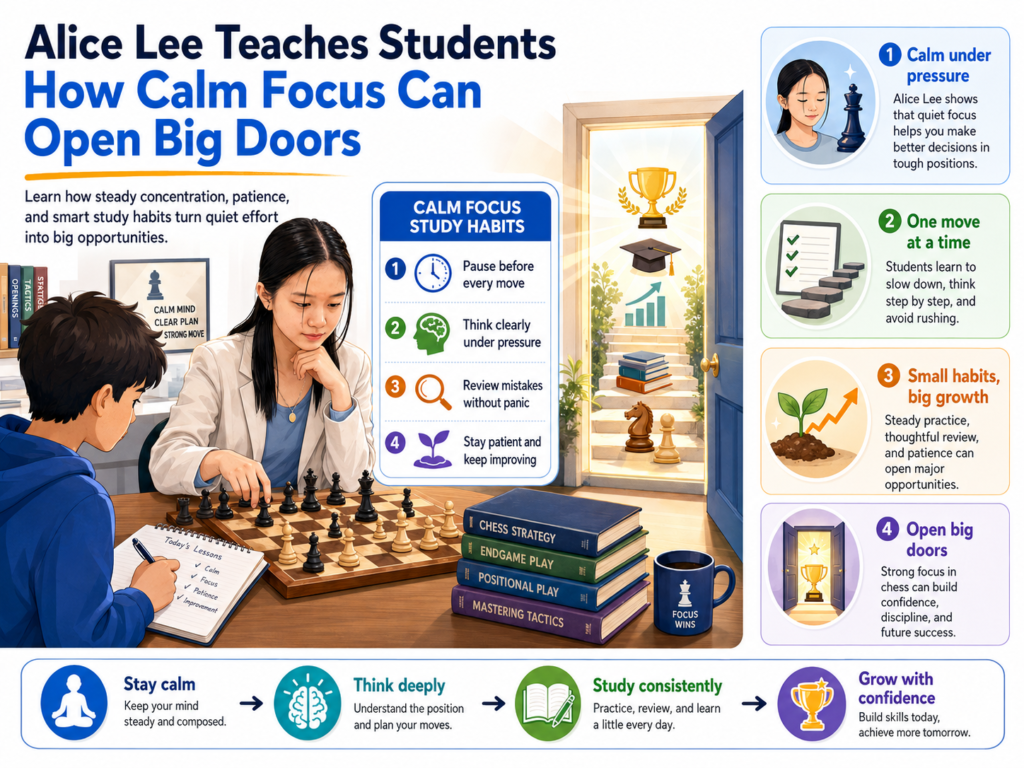
Her profile shows strong ratings across standard, rapid, and blitz chess.
Alice is a great role model because her growth shows discipline. She is not only a young player with talent. She is a student of the game. That matters because many children think talent is the main thing. Talent helps, but steady learning is what keeps a player moving forward.
Students should study Alice Lee to learn how to stay composed
Composure means staying steady when things do not go your way. In chess, this is a superpower. A student may lose a pawn, miss a tactic, or get a worse position out of the opening. At that moment, many young players fall apart. They feel the game is already lost. They move too fast. They stop looking for chances.
Strong players keep asking questions. Is there counterplay? Can I trade into a better endgame? Can I make the opponent solve hard problems? Can I save the game by staying active?
This is the kind of thinking students can learn by watching players like Alice. They can see that chess is not only about getting a perfect position. It is about making the best choices from the position you have.
The Alice Lee study tip is to practice saving difficult positions
Most students love practicing attacks and checkmates. That is good, but it is not enough. A strong student also needs to practice defense. Defense teaches patience. It teaches hope. It teaches a child not to give up just because the board looks hard.
A simple way to train this is to take a worse position from one of your own games and play it again against a friend, coach, or training partner.
The goal is not always to win. The goal is to fight well. Can you create a threat? Can you trade pieces? Can you place your rook behind a passed pawn? Can you keep your king safe?
This builds emotional strength. A child learns that being behind does not mean being done. That lesson is bigger than chess. In school, a student may get a low grade and still improve. In life, a child may face a hard day and still make a good next choice.
Debsie’s coaches help students build this kind of calm strength through guided play and review. A free trial class is a simple first step for families who want chess lessons that grow both skill and character: https://debsie.com/take-a-free-chess-trial-class/
Lu Miaoyi shows students why fearless play still needs clear thinking
Lu Miaoyi is a young Chinese chess player who is worth following because her games often show energy and confidence.
FIDE lists her as an International Master and Woman Grandmaster from China, born in 2010. Her profile also shows strong standard, rapid, and blitz ratings, which makes her one of the most interesting young players for students to study.
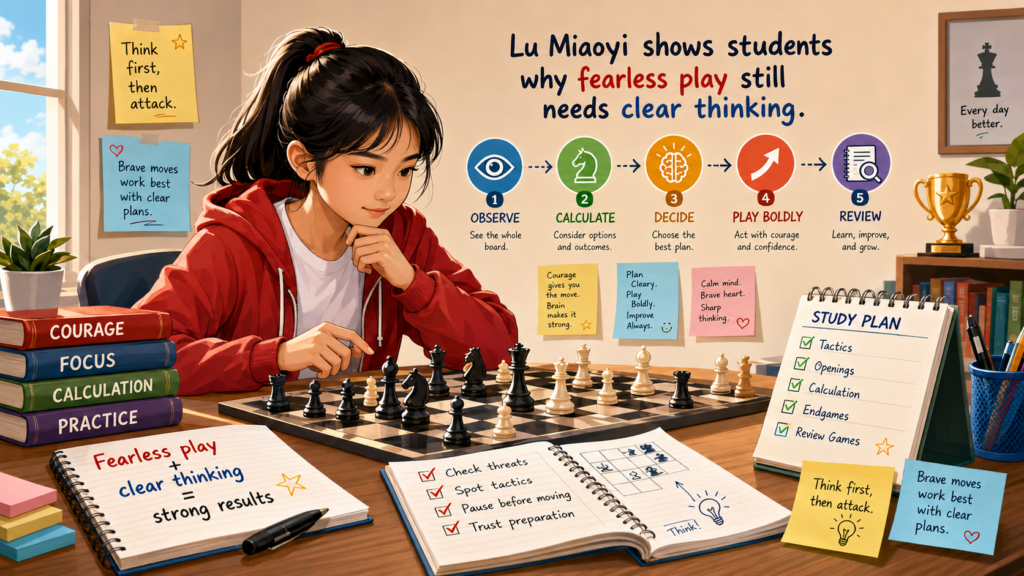
For students, Lu’s chess is useful because it can teach a key balance. You can be brave without being random. You can attack without forgetting safety. You can play with energy and still respect the basics.
Students can learn how to attack with a real reason
Many young chess players love attacking. They bring the queen out early. They aim at the king. They hope for checkmate. Sometimes it works against beginners, but as opponents get stronger, hope is not enough.
A good attack needs pieces. It needs open lines. It needs targets. It needs timing. If only the queen is attacking, the opponent can often defend and then win time by chasing the queen. If the rooks, bishops, knights, and pawns work together, the attack becomes much harder to stop.
This is one reason students should watch Lu Miaoyi’s games with a coach or a study plan. The goal is not to copy every sharp move. The goal is to understand how the attack was built. Which piece joined first? Which file opened? Which defender was removed? Which pawn move made the king weaker?
When students ask these questions, they stop being hope-based attackers and start becoming plan-based attackers.
The Lu Miaoyi study tip is to count attackers and defenders
Before starting an attack, a student should count. How many pieces are attacking the target? How many pieces are defending it? This simple count can stop many bad sacrifices.
For example, if a student wants to sacrifice a bishop on h7 or h2, they should not play it just because they have seen it in videos. They should check if the knight can join, if the queen has a path, if the rook can come in, and if the opponent’s king can escape. If the pieces are not ready, the sacrifice may just lose material.
This habit makes students more mature at the board. They still get to be creative, but their creativity has support. They still get to attack, but they attack with clear eyes.
At Debsie, students learn how to enjoy chess without turning it into guesswork. Coaches help them understand ideas in simple words, practice them in real games, and build the patience to think before moving. Parents can start with a free Debsie trial class here: https://debsie.com/take-a-free-chess-trial-class/
Ediz Gürel shows students how to turn promise into real skill
Ediz Gürel is one of the young players students should follow because his growth shows what happens when talent is shaped by steady work.
FIDE lists Ediz as a Turkish Grandmaster, born in 2008, and his FIDE profile shows strong ratings across classical, rapid, and blitz chess. He earned the Grandmaster title in 2024, after becoming an International Master in 2022 and a FIDE Master in 2021.
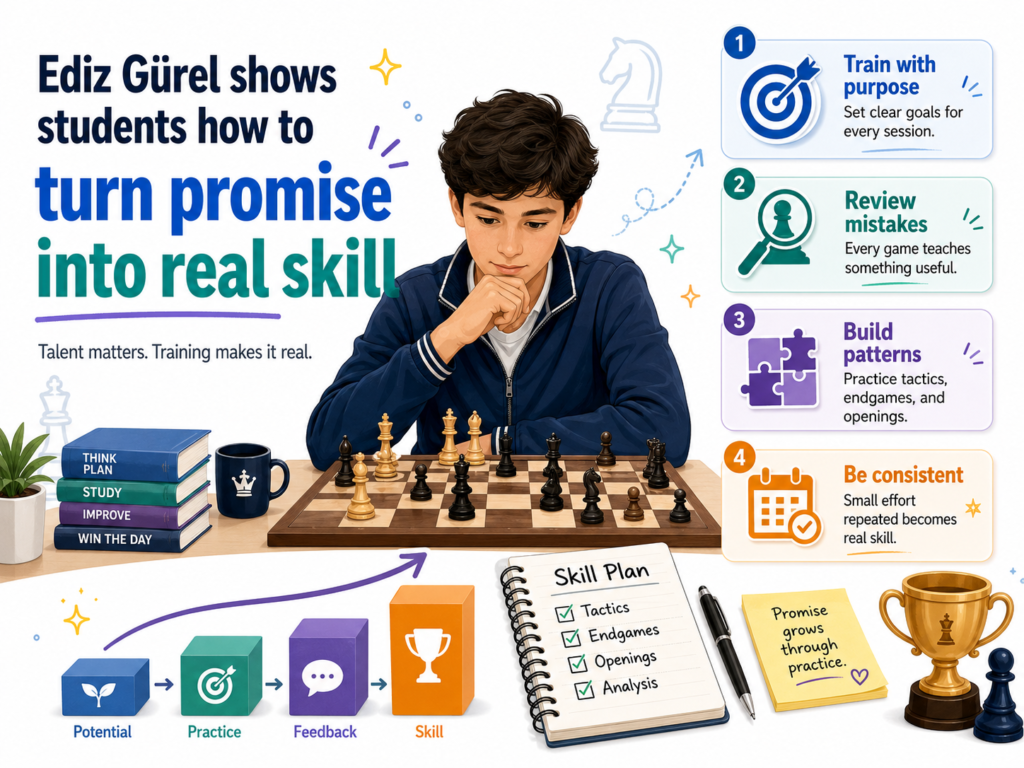
That path matters. It shows students that chess growth is not one big jump. It is a ladder.
You climb one step, then the next, then the next. Some steps feel fast. Some feel slow. But each step teaches the mind to work better.
Students can learn how to build strength in stages
Many young players want results right away. They want their rating to rise after one good week. They want to win every tournament after watching a few videos. But chess does not grow that way. Strong chess is built in layers.
First, a student learns not to hang pieces. Then they learn simple tactics. Then they learn how to develop pieces well. Then they learn plans, pawn structures, endgames, time use, defense, and opening choices. Each layer makes the next one easier.
Ediz is a good player to follow because his rise reminds students that skill has a structure. You do not need to master everything today. You need to master the next right thing.
This is also helpful for parents. When a child starts chess, parents may wonder if the child is improving fast enough. But real progress is not always loud. Sometimes it looks like a child taking more time before moving.
Sometimes it looks like fewer blunders. Sometimes it looks like a child explaining why a move was bad, even after losing. That is growth.
The Ediz study tip is to train one rating skill at a time
A student can use Ediz’s path as a reminder to work in stages. Instead of saying, “I want to become amazing at chess,” the student can say, “This month, I want to stop losing free pieces.” That goal is clear. It can be trained. It can be checked.
After that, the next goal may be solving basic tactics with better focus. Then the next goal may be learning how to play simple rook endgames. This kind of plan makes chess feel less confusing.
At Debsie, students are guided through chess in a clear way, so they are not jumping from random puzzle videos to random openings. They learn at the right level, with coaches who know how to keep lessons simple and useful.
That is how a child builds real chess confidence, one step at a time. Parents can book a free Debsie trial class and see how structured learning feels for their child.
Abhimanyu Mishra teaches students that records are built on daily discipline
Abhimanyu Mishra is a powerful player for students to follow because his story is tied to one of the biggest youth records in chess. FIDE lists him as a Grandmaster from the United States, born in 2009, with the Grandmaster title awarded in 2021.
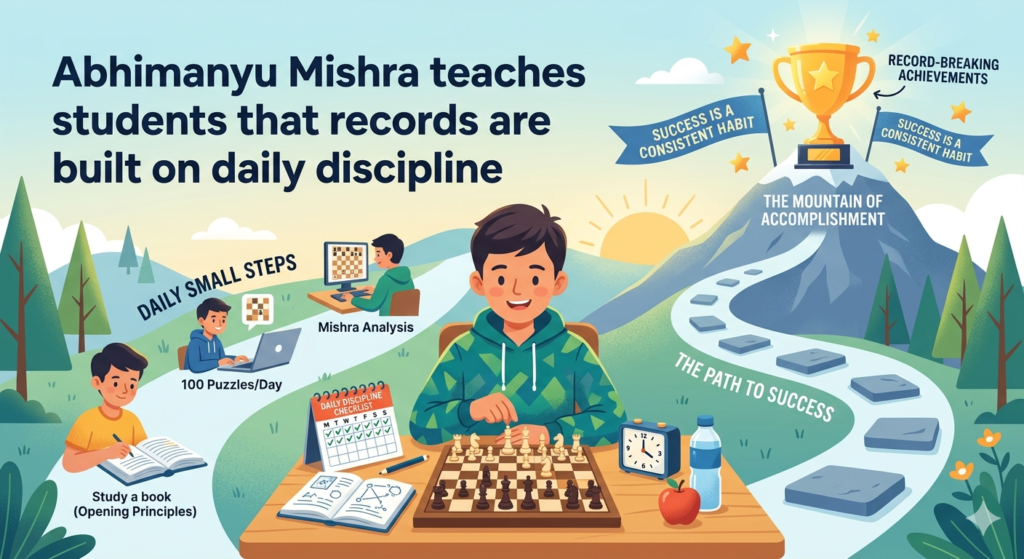
He is widely known as the youngest Grandmaster in chess history, achieving the title at 12 years, 4 months, and 25 days.
For students, this can sound almost impossible. But the better way to see his story is not, “I must break a record too.” The better lesson is, “Big success is made from small days that most people never see.”
Students should study the work behind the headline
A record is easy to talk about. The hard work behind the record is less visible. Students see the title, the rating, the news, and the photos. But behind all of that are many training hours, tough games, travel, losses, pressure, and review.
This is important because many children feel bad when they do not improve quickly. They see another young player doing great things and think, “Maybe I am not good enough.” That is the wrong lesson.
Strong players are not proof that other students are weak. They are proof that growth is possible when training becomes serious and steady.
A student does not need to train like a world record holder. But they can copy the heart of the habit. They can show up often. They can review mistakes. They can ask better questions. They can take coaching seriously. They can learn to enjoy hard positions instead of running from them.
That is how chess becomes a teacher. It shows children that success is not magic. It is repeated effort with the right help.
The Abhimanyu study tip is to keep a mistake notebook
A mistake notebook is one of the best tools a student can use. It does not need to be fancy. After each serious game, the student writes down one mistake and one lesson. The mistake may be “I moved too fast and missed a fork.” The lesson may be “I will check knight forks before I move my queen.”
This small habit makes a huge difference. It turns every game into a teacher. It also helps students see patterns. If the same mistake appears again and again, that is not something to feel ashamed of. It is a clear training target.
This habit is also great for school. A child who learns to track mistakes in chess can learn to track mistakes in math, reading, writing, or test prep. They stop hiding from errors. They learn to use errors.
Debsie coaches help students review mistakes in a kind and clear way. The goal is not to make a child feel bad. The goal is to help the child say, “Now I know what to fix.” That one sentence can change how a student learns.
Marc’Andria Maurizzi shows students how to stay solid while chasing big goals
Marc’Andria Maurizzi is one of the top young French players for students to follow. FIDE lists him as a French Grandmaster, born in 2007, and his profile shows that he earned the Grandmaster title in 2021 after becoming an International Master in 2019.
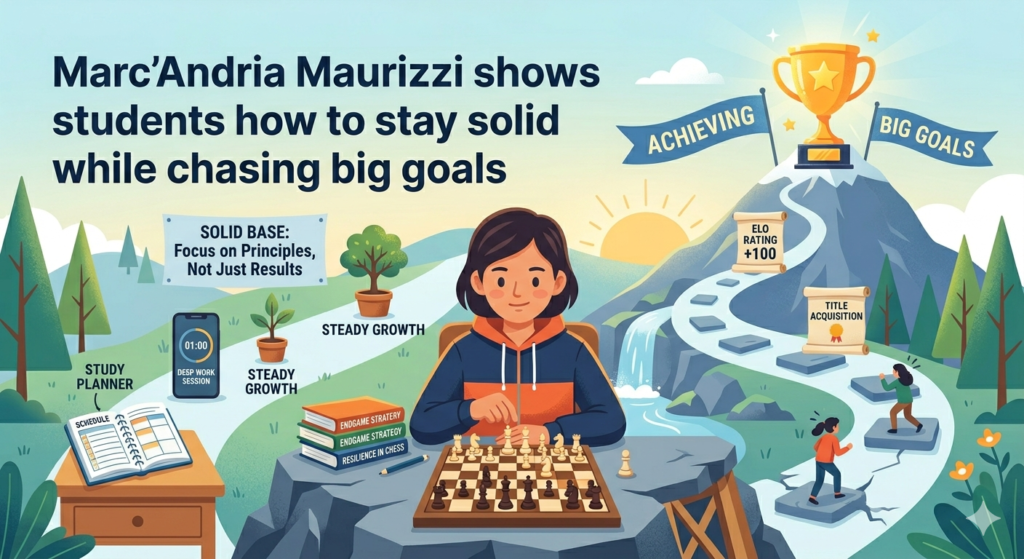
He is also known for winning the 2023 World Junior Championship, a major result that showed his strength against other rising players.
For students, Marc’Andria is useful to study because his games often remind us that big goals do not always need wild chess. Sometimes, the road to success is about being hard to beat.
Students can learn why being solid is not boring
Some students think solid chess is dull. They want every game to be an attack. They want quick wins. They want traps. But as players get stronger, cheap traps stop working. The opponent sees them. Then the student is left with weak pieces and no plan.
Solid chess does not mean scared chess. It means healthy chess. Your king is safe. Your pieces are developed. Your pawns are not full of holes. You do not give away squares for no reason. You make the opponent earn everything.
This is a wonderful lesson for young students. In chess, being solid gives your ideas a strong base. In life, being solid does the same. A child who sleeps well, practices often, listens carefully, and reviews mistakes is building a base. That base makes bigger goals possible.
When students study players like Marc’Andria, they can learn that strength is not always loud. Sometimes strength is the ability to keep making good moves even when nothing dramatic is happening.
The Marc’Andria study tip is to find the move that stopped trouble before it started
A strong move is not always a move that wins material. Sometimes, a strong move stops the opponent’s plan before it becomes dangerous. This is a skill students should train.
When reviewing one of Marc’Andria’s games, a student can pause and ask, “What danger did this move prevent?” Maybe the move stopped a knight jump. Maybe it kept a file closed. Maybe it gave the king an escape square. Maybe it traded the opponent’s most active piece.
This teaches a student to respect prevention. Many young players only react after the danger is clear. Strong players often act before the danger becomes big.
This habit is powerful outside chess too. A student who learns prevention may pack their school bag the night before, start homework early, or ask for help before a test becomes scary. Chess teaches that smart people do not only solve problems. They also stop some problems from growing.
Debsie’s live chess classes help students build this kind of thinking through guided lessons, practice games, and review. A free trial class is a simple way for parents to see how chess can help a child become more focused and prepared.
Divya Deshmukh teaches students how brave focus can change a whole career
Divya Deshmukh is a young player students should follow because her journey shows courage, focus, and belief under pressure. FIDE lists Divya as an Indian Grandmaster and Woman Grandmaster, born in 2005, with strong ratings across formats.
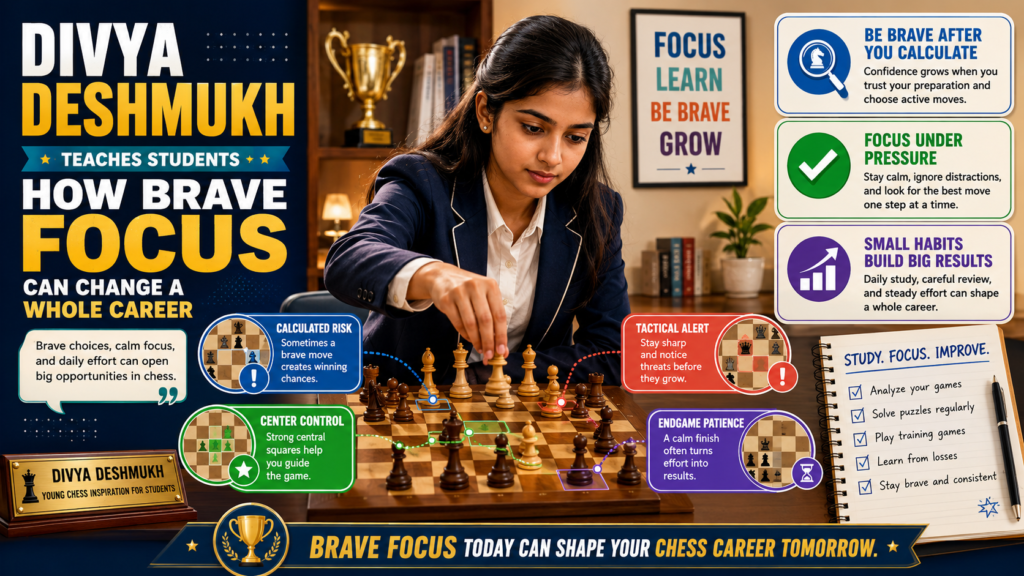
In 2025, she won the FIDE Women’s World Cup by defeating Humpy Koneru in rapid tiebreaks, becoming the third winner of that event.
This is a huge result, but the student lesson is very simple. Big moments reward the player who can stay calm when the heart is beating fast.
Students should learn how to handle the final moments of a game
Many student games are not lost because the student knows nothing. They are lost near the end, when the clock is low and the pressure is high. A child may play a strong game for thirty moves, then rush one move and lose everything.
Divya’s success is a great reminder that focus must last until the game is truly over. You cannot relax because you are better. You cannot give up because you are worse. You cannot stop checking threats because the win looks close.
This is one of the most useful chess habits for students. Finish with care. In school, that may mean checking answers before handing in a test. In writing, it may mean reading the work one more time. In sports, it may mean playing hard until the final whistle.
Chess makes this lesson clear because one careless move can change everything.
The Divya study tip is to practice the last ten moves with full attention
A student can train this by reviewing the final part of their own games. They should look at the last ten moves and ask, “Was I still thinking clearly?” This question is very honest. It helps the student see if they rushed, relaxed too early, or panicked.
The goal is not to feel bad. The goal is to build finishing strength. A good chess player does not only start well. A good chess player finishes well.
Students can also practice simple winning positions until they become comfortable. A king and pawn ending. A rook up. A queen versus rook. A passed pawn race. These positions may look easy, but they still need care.
At Debsie, students learn to respect the whole game, from the first move to the last. Coaches help them build focus, patience, and smart thinking in a way that feels warm and clear. For parents who want their child to grow through chess, the free trial class is a great first step.
Volodar Murzin shows students why calm thinking matters most when the clock is scary
Volodar Murzin is a strong young player students can follow when they want to learn better rapid chess.
FIDE lists Murzin as a Grandmaster, born in 2006, with strong ratings in classical, rapid, and blitz chess. Chess.com also notes that he won the 2024 World Rapid Championship with a score of 10 out of 13, which is a huge result in one of the hardest fast time controls in chess.
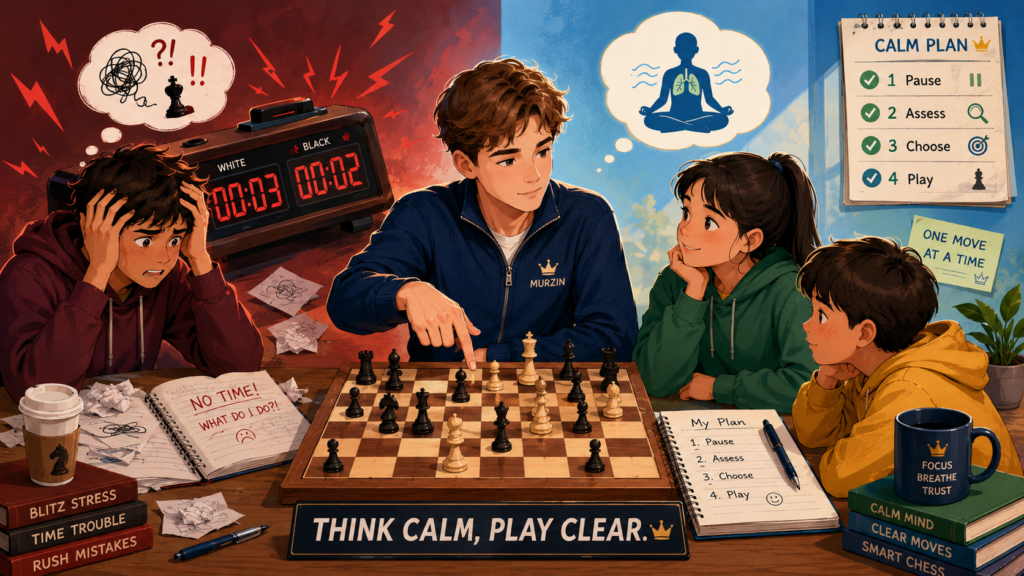
For students, Murzin’s rapid success is useful because many young players enjoy short games. They play online rapid, blitz, and bullet because it feels fun and exciting. But fast chess can also build bad habits if a student only moves quickly and never learns why mistakes happen.
Students can learn that rapid chess is not guessing chess
Rapid chess still needs real thinking. The time is shorter, but the board is the same. A fork is still a fork. A weak king is still a weak king. A lost rook is still a lost rook. The best rapid players are not just fast with their hands. They are fast because their minds know many patterns already.
This is a key lesson for students. If a child wants to become better at rapid chess, they should not only play more rapid games. They should train the patterns that help them see good moves faster. That means tactics, basic endgames, king safety, and simple plans.
A student who has solved many fork puzzles will see forks faster in a game. A student who has practiced checkmate patterns will spot mating ideas sooner. A student who knows simple rook endings will not panic when the game reaches the final stage. Speed grows from training. It should not come from rushing.
The Murzin study tip is to review one fast game slowly
After playing a rapid game, the student should not jump into the next game right away. They should choose one important moment and study it slowly. The best question is simple: “Where did I first stop understanding the position?”
That question is powerful because many mistakes happen after confusion. The student may not lose because they are bad. They may lose because they had no clear plan, so they guessed. Once they find that moment, they can learn from it.
Maybe they needed to trade queens. Maybe they needed to move the king to safety. Maybe they needed to bring one quiet piece into the game. This kind of review turns a fast game into a long lesson.
At Debsie, students learn how to play with speed and care. Coaches help children enjoy chess while also building the thinking habits that stop careless moves. A free Debsie trial class can help your child start learning in a clear and friendly way.
Javokhir Sindarov teaches students how to grow without losing hunger
Javokhir Sindarov is a powerful young player to follow because his chess journey shows both early talent and serious growth. FIDE lists Sindarov as a Grandmaster from Uzbekistan, born in 2005, with a very high classical rating and a top active world ranking.

His FIDE profile also shows that he earned the Grandmaster title in 2019 after becoming an International Master in 2017.
Sindarov is useful for students because his story reminds them that early success is not the finish line. It is only a start. A young player can win praise, titles, and attention, but still needs to keep working. The best players do not stop after one big step. They ask, “What is the next level?”
Students should learn how to stay hungry after a good result
Many children feel very excited after a win. That is good. A win should feel nice. But there is a danger too. After a good result, a student may stop studying. They may think they already know enough. They may start playing too fast because they feel overconfident.
Chess has a funny way of teaching humility. The board does not care what happened yesterday. Every new game asks for fresh focus. If the student becomes careless, a lower-rated player can still punish a mistake.
Sindarov’s growth is a good reminder that strong players keep improving even after big achievements. They do not treat success like a bed to sleep in. They treat it like a step to stand on.
The Sindarov study tip is to review wins, not only losses
Most students understand that they should review lost games. But they should also review wins. This is where many hidden lessons live.
A student may win a game even after making a bad move. The opponent may miss a tactic. The opponent may blunder later. If the student only looks at the final result, they may think the whole game was good. That is risky. A win can hide weak habits.
After a win, the student should ask, “Did I win because I played well, or because my opponent helped me?” This question builds honesty. It also helps the student grow faster.
This is one reason coaching helps so much. A child may not notice mistakes in a winning game, because winning feels good. A coach can kindly show the truth without taking away the joy. At Debsie, students learn to celebrate wins and still improve from them. That balance builds real confidence.
Bibisara Assaubayeva shows students how strong self-belief can be trained
Bibisara Assaubayeva is a young player students should follow because she has built a strong career across different forms of chess. FIDE lists her as a player from Kazakhstan, born in 2004, and shows that she holds the Grandmaster and Woman Grandmaster titles.
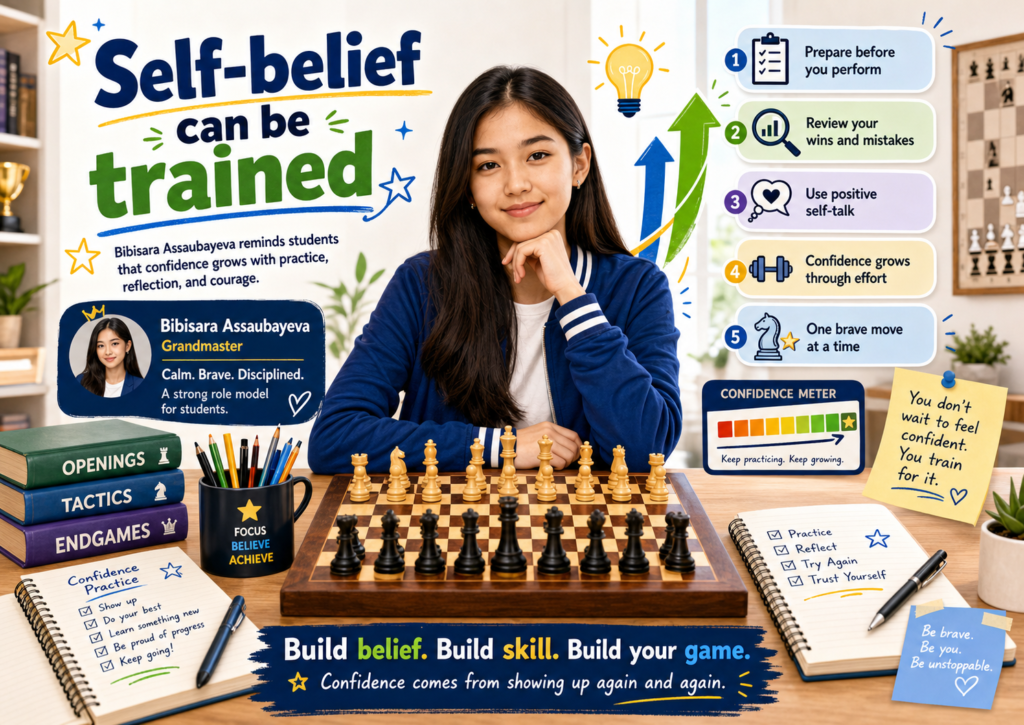
Her FIDE record also shows earlier titles such as International Master and Woman Grandmaster, which points to years of steady progress.
For students, Bibisara is a great example of belief that is backed by work. Belief alone is not enough. Saying “I can win” does not win the game. But belief plus training is powerful. It helps a student sit at the board with courage, even when the opponent is strong.
Students can learn how confidence grows from proof, not empty praise
Real confidence comes from proof. A student feels confident when they know they practiced. They feel confident when they have solved similar puzzles before. They feel confident when they have reviewed mistakes and fixed them. They feel confident when they can explain their plan.
This is much stronger than fake confidence. Fake confidence says, “I will win because I want to.” Real confidence says, “I have trained this skill, and I know what to do.”
Bibisara’s career can inspire students to build this kind of confidence. They can look at her progress and understand that strong players do not wake up strong one morning. They collect proof through practice, one day at a time.
This is a very healthy message for children. It keeps them from thinking they must feel brave all the time. Some days they may feel unsure. That is normal. The answer is not to pretend. The answer is to return to good habits.
The Bibisara study tip is to create a proof bank before tournaments
A proof bank is a simple idea. Before a tournament, the student writes down a few things they have practiced well. They may write that they solved tactics for two weeks. They may write that they learned a basic rook ending. They may write that they reviewed five lost games. They may write that they practiced staying calm after a mistake.
This helps the child enter the event with a clear mind. They are not just hoping to play well. They can see proof that they prepared.
A proof bank also helps after a loss. Instead of thinking, “I am terrible,” the student can think, “I still have skills, and now I have one more thing to fix.” That is a much stronger way to learn.
At Debsie, students are encouraged to build confidence through real progress. The lessons are not only about rating points. They are about helping children trust their thinking, speak about their ideas, and stay steady when the game gets tough.
Raunak Sadhwani teaches students why every game needs energy from start to finish
Raunak Sadhwani is another young Indian Grandmaster students should follow. FIDE lists him as a Grandmaster from India, born in 2005, with strong ratings in classical, rapid, and blitz chess. His FIDE record shows that he earned the Grandmaster title in 2020 after becoming an International Master in 2018.
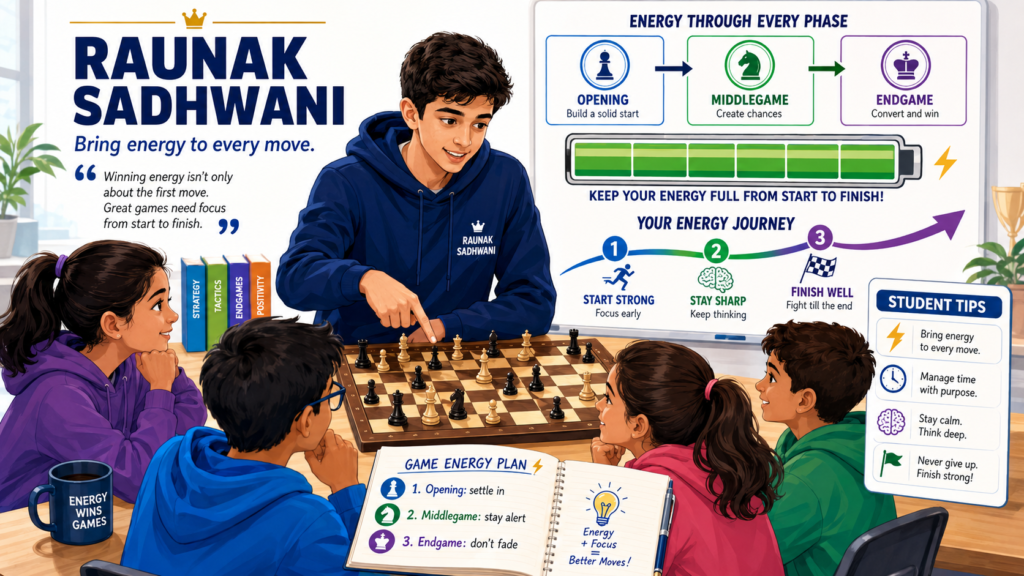
Raunak is a good player for students because his chess journey shows the value of all-round strength. Some players are good only in slow games. Some are good only in fast games. But students should try to build a base that works in every format.
That means seeing tactics, using time well, making plans, and staying focused until the last move.
Students should learn how to bring full energy to normal positions
Many children focus only when the position looks exciting. If there is a checkmate attack, they wake up. If there is a queen sacrifice, they pay attention. But when the position looks normal, they drift. They move without a plan. They forget what the opponent wants.
This is a big problem because many games are decided in normal positions. A student may not blunder in a wild attack. They may blunder in a quiet position because they stopped caring.
Strong players bring energy to every kind of position. They look for small chances. They improve a piece. They stop the opponent’s plan. They prepare a pawn break. They do not wait for the game to become exciting. They make the game meaningful through careful moves.
This is a great lesson for school too. A child cannot focus only when the topic is fun. Real growth often happens when the work feels normal. Reading one page with care matters. Checking one math answer matters. Listening for ten more minutes matters.
The Raunak study tip is to name the job of every move
Before making a move, the student should be able to say what the move does. It does not need to be a long answer. It can be simple. This move attacks a pawn. This move protects my king. This move develops my bishop. This move stops the knight from jumping in. This move prepares a rook lift.
If the student cannot name the job of the move, they should pause. Maybe the move is still good, but they need to understand why. This habit reduces random moves. It also helps students speak about chess better.
When children learn to name their ideas, they become more active learners. They are not just waiting for a coach to tell them what is right. They are training their own mind to explain, question, and improve.
That is the kind of growth Debsie cares about. Chess becomes a tool for better thinking. Students learn to focus, plan, stay patient, and make choices with purpose. For parents who want their child to enjoy chess while building life skills, a free Debsie trial class is a simple and warm place to begin.
Conclusion
Following young chess players is not about feeling behind. It is about seeing what is possible. Each player in this guide teaches a simple lesson: stay calm, train daily, review mistakes, think before moving, and never stop learning.
Adhip Ray is the founder of Debsie, an online learning platform focused on chess and skill-based learning for children. His work at Debsie brings together chess education, structured thinking, problem-solving, and interactive learning for young students.
Adhip has an academic background in law, statistics, analytics, and technology. He is from Amity Law School and the Indian Statistical Institute, Kolkata, with formal training that connects legal reasoning, data analytics, quantitative thinking, and structured problem-solving. This interdisciplinary background is reflected in Debsie’s focus on building sharper thinking skills in children through chess and related learning programs.
Adhip is also a FIDE-rated chess player from India. He holds FIDE ID 5055954 and has a standard FIDE rating of 1832. His FIDE profile records him as an Indian player with a long rating history in standard chess, including rated games from his competitive playing years. His chess background gives Debsie a founder-led connection to the game, not only as an educational activity but also as a competitive discipline that develops concentration, calculation, planning, and decision-making.
In addition to chess, Adhip has a strong interest in coding, data, and technical problem-solving.
Adhip’s profile combines chess, law, data analytics, and programming. At Debsie, this background supports the creation of learning experiences that are logical, structured, and skill-oriented. The platform’s chess-focused programs are connected to broader cognitive skills such as pattern recognition, patience, strategic planning, focus, and problem-solving.
As founder of Debsie, Adhip brings together experience from multiple fields: formal legal education from Amity Law School, analytical training from the Indian Statistical Institute, Kolkata, competitive chess experience through his FIDE-rated profile, and coding practice through LeetCode. This combination gives Debsie a distinct foundation in strategy, reasoning, analytics, and child-focused learning.
Through Debsie, Adhip is associated with building chess and learning content for children that goes beyond basic instruction. The platform connects chess with thinking skills, helping students approach challenges with more structure, clarity, and confidence. His own background in chess and analytical problem-solving gives the platform a direct link to the skills it aims to develop in young learners.
Adhip is also a member of Forbes Business Council.