Blitz chess is chess with a racing heart. You have only a few minutes, sometimes only seconds, to see threats, set traps, save bad positions, and still make strong moves. That is why the best blitz chess players feel almost scary. They do not just know chess. They feel the board fast.
Find the right learning experience
Tell us a little about the learner and what you are looking for. Our team will review your answers and help you identify the most suitable next step.
- Takes only a few minutes
- No payment required
- Personalised recommendations
Your information will only be used to respond to your enquiry.
The best blitz chess players are not only fast; they are clear under stress
Blitz chess can trick people. Many think the deadliest blitz players are the ones who move the fastest. That is only half true. Speed matters, but clean thinking matters more.
A player who moves fast but walks into one-move traps will not last long against the world’s best. The real kings of blitz do something much harder. They make strong moves while their hand, heart, and mind are all under pressure.
This is why blitz is so fun to watch. In classical chess, a player may think for ten or twenty minutes before choosing a move. In blitz, the same player may have ten seconds. There is no time to make the perfect choice. So the best blitz chess players learn how to make the best practical choice.
That word “practical” is very important. In blitz, the strongest move on the computer is not always the best human move. The best human move may be the one that gives your opponent five hard choices with only eight seconds on the clock. A move like that can be deadly, even if it is not perfect.
The clock changes what “best move” really means
In slow chess, you can test ideas. You can look at one plan, reject it, try another plan, and then compare. In blitz, that is not possible. You need patterns ready in your head before the game starts. You need to know common checkmates, forks, pins, weak squares, pawn breaks, and endgame tricks without digging for them.
Find the right learning experience
Tell us a little about the learner and what you are looking for. Our team will review your answers and help you identify the most suitable next step.
- Takes only a few minutes
- No payment required
- Personalised recommendations
Your information will only be used to respond to your enquiry.
That is why great blitz players often look like they are guessing, but they are not guessing. They have seen the shape before. They may not know the exact position, but they know the type of position. They know which side should attack.
They know which piece is bad. They know when to trade queens and when to keep the game messy.
At Debsie, this is one of the big things kids learn through guided chess training. A child does not become faster by rushing. A child becomes faster by seeing simple ideas again and again until the brain says, “I know this.” That kind of training helps in chess, but it also helps in school, sports, and life.
The deadliest blitz players win because they make pressure feel normal
Watch Magnus Carlsen, Hikaru Nakamura, Alireza Firouzja, or Denis Lazavik in a fast game, and you will see a pattern. They do not panic the way normal players panic. Their pieces may be hanging. Their clock may be low. The board may look wild. But they still find moves that keep the fight going.
This is what makes them scary. They do not need a perfect position to win. They can win from a small edge, an equal endgame, a messy attack, or even a position where they were worse five moves ago. In blitz, that is gold.
For young players, this is a huge lesson. You do not need to be perfect to improve. You need to stay calm, keep looking, and make the next useful move. That is the heart of blitz. It teaches kids to breathe under stress, fix mistakes fast, and keep trying even when things look hard.
Magnus Carlsen is deadly because he turns tiny chances into wins
Magnus Carlsen may be the best example of a player who makes blitz feel unfair. He does not always need to crush you in the opening. He does not always need a huge attack. He can take a tiny edge, a slightly better pawn, or a small time lead, and slowly turn it into a win.
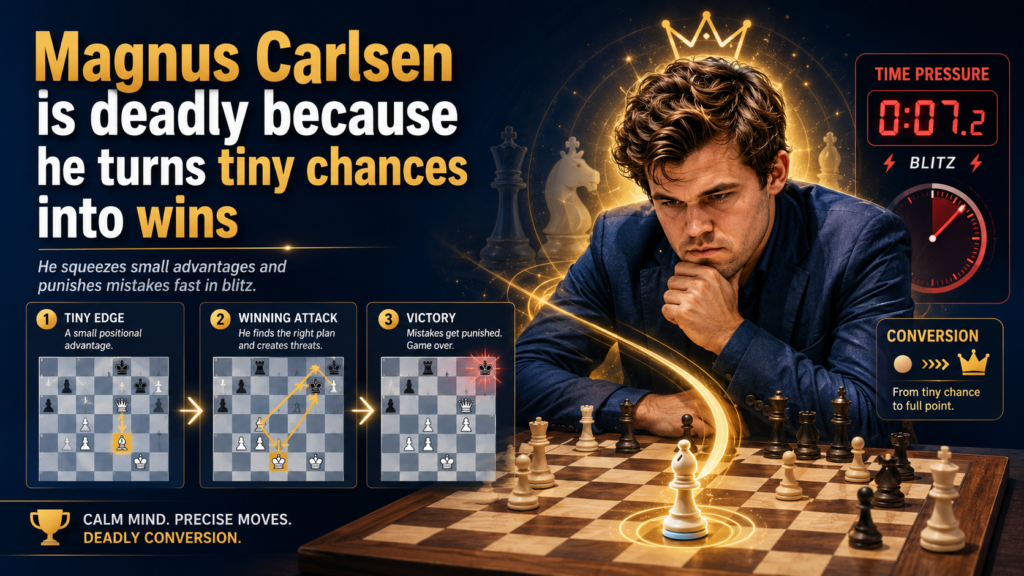
Against normal players, that is painful. Against elite grandmasters, that is shocking.
His strength in blitz is not just speed. It is control. He understands which positions are easy to play and which positions are hard for the other side. When the clock is low, easy moves become very powerful. If Carlsen can make ten natural moves while his opponent must find ten only moves, the game often starts to tilt his way.
That is why Carlsen is often called a monster in fast time controls. He keeps creating small problems.
One problem may not break you. Five problems may not break you. But after twenty problems, with the clock ticking, even a world-class player can crack.
Carlsen’s biggest weapon is his endgame skill under time pressure
Many blitz players try to win fast with tricks. Carlsen can do that too, but his most painful wins often come later. He is famous for pressing equal or nearly equal endings. In blitz, this skill becomes even more powerful because defending an endgame with little time is exhausting.
In the 2025 Speed Chess Championship, Carlsen defended his title by beating Alireza Firouzja 15-12 in the final. Chess.com reported that it was Carlsen’s fifth Speed Chess Championship title and his third in a row.
That matters because the Speed Chess Championship is not one normal game. It tests players across fast formats, including 5+1, 3+1, and 1+1 games. A player must keep focus for many games, not just one lucky win.
Carlsen also showed this same “outlast you” power in the semifinal against Denis Lazavik. Chess.com reported that Carlsen won that match 17-9. The same report noted that he found key winning moves in a complex game and later won another rook endgame that was hard to convert. That is classic Carlsen. He does not only attack. He squeezes.
What young players can learn from Carlsen’s blitz style
The lesson from Carlsen is not “be born a genius.” That is not helpful. The lesson is much simpler. Make your opponent’s job hard while keeping your own moves simple.
For example, if you are ahead in material, do not hunt for a fancy checkmate every time. Trade pieces, keep your king safe, and make moves that do not allow cheap tricks. If you are in an equal endgame, do not offer a draw too fast.
Improve your worst piece. Place your king better. Create a passed pawn. Ask one more question.
This is a great lesson for kids. Many children think chess is only about winning with a big tactic. But chess also teaches care. It teaches patience. It teaches how to grow a small good thing into a bigger good thing.
That is why Debsie’s chess classes focus on clear thinking, not just fast moving. The goal is to help kids build habits that last longer than one game.
Hikaru Nakamura is deadly because he lives inside the clock
Hikaru Nakamura is one of the most feared blitz and bullet players in chess history. His style is different from Carlsen’s. Carlsen often feels like a wall that slowly moves toward you. Nakamura feels like a storm. He creates threats fast, spots tricks early, and uses the clock as a real weapon.
What makes Nakamura special is how natural fast chess looks for him. He has played huge amounts of online blitz and bullet for many years. That kind of practice matters. It gives him a feel for mouse speed, premoves, dirty tactics, opening traps, and time scrambles.
In blitz, those things are not small details. They can decide games.
But it would be wrong to say Nakamura is only an online speed player. His chess understanding is very deep. The reason he is so strong in fast chess is that he can mix grandmaster-level ideas with street-smart clock pressure. He knows when to play the “correct” move and when to play the most annoying move.
Nakamura’s pressure comes from speed, tricks, and constant threats
A normal player may see one threat. Nakamura often sees the threat behind the threat. He may play a move that attacks your queen, opens a file, and sets a mating net two moves later. When the clock is low, this is horrible to face. You are not just solving one problem. You are trying to guess what he is really aiming for.
That is why Nakamura has been so dangerous in Speed Chess Championship history. Chess.com noted during the 2025 event that only Carlsen and Nakamura had won the Speed Chess Championship since 2016.
That tells you how strong their hold on this format has been. Even when Nakamura does not win, every opponent knows they must survive his pace.
The 2025 event also showed how brutal this level has become. Firouzja beat Nakamura in the semifinal after a huge comeback, and Lazavik then upset Nakamura 13.5-12.5 in the third-place match. That does not make Nakamura less great.
It shows how deep modern blitz has become. The new generation is learning to fight in Nakamura’s world.
What young players can learn from Nakamura’s blitz style
The big lesson from Nakamura is this: do not play sleepy chess. In blitz, every move should do something. It should improve a piece, attack a weakness, make a threat, stop a threat, or create a choice for the other player.
Kids can use this right away. Before making a move, they can ask, “What is my threat?” If there is no threat, they can ask, “What piece can I improve?” This simple habit makes blitz much stronger. It also stops random moves, which are one of the biggest reasons young players lose fast games.
Nakamura’s style also teaches courage. Sometimes kids become scared after making a mistake. They freeze, move too slowly, and lose on time. Blitz rewards players who keep fighting. Even if your position is bad, you can create a threat.
Even if you are down a pawn, you can attack the king. Even if your clock is low, you can make simple moves and stay alive.
This is why chess is such a strong learning tool. A child learns that pressure is not the end. Pressure is a moment to think clearly and act. At Debsie, students practice these skills with coaches who guide them step by step, so speed grows from confidence, not fear.
Alireza Firouzja is deadly because he makes the board feel unsafe
Alireza Firouzja brings a different kind of danger to blitz. He is not only fast. He is sharp. He loves active pieces, open lines, sudden attacks, and positions where both kings may be in danger. Against him, even a safe move can become unsafe a few seconds later.
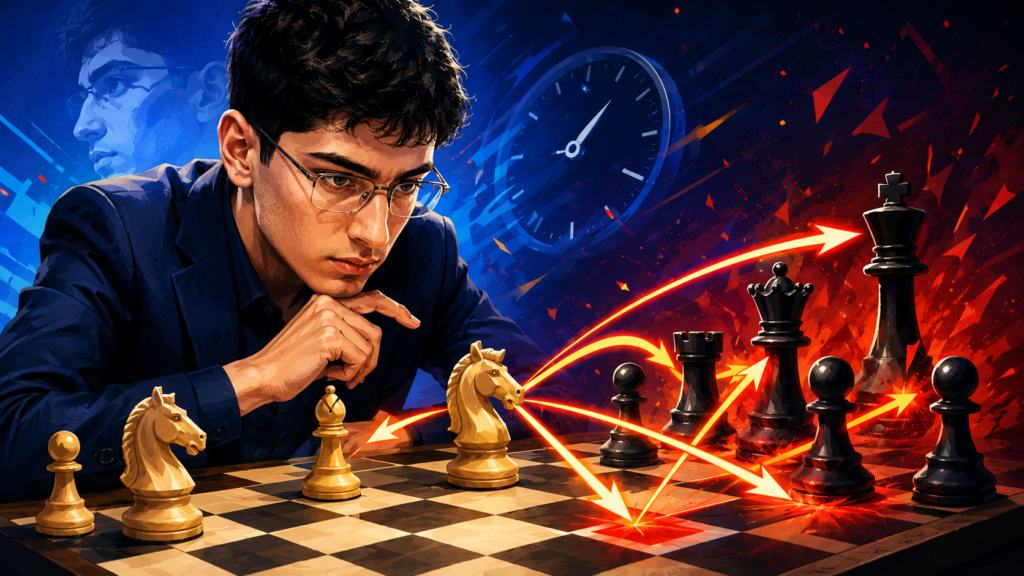
This makes Firouzja one of the most exciting blitz players in the world. He can lose control of a position and then bring it back with one tactical shot. He can create chaos when he needs winning chances. He can also punish slow play with direct attacks. In blitz, that kind of energy is deadly.
Firouzja’s games often feel like a race. If you defend well, you may survive. If you miss one detail, the attack can crash through. That is why fans love watching him. His games do not feel dry. They feel alive.
Find the right learning experience
Tell us a little about the learner and what you are looking for. Our team will review your answers and help you identify the most suitable next step.
- Takes only a few minutes
- No payment required
- Personalised recommendations
Your information will only be used to respond to your enquiry.
Firouzja’s best blitz skill is raising the heat at the right moment
Some players get messy because they are careless. Firouzja gets messy because he wants to ask hard questions. There is a big difference. When a strong player creates chaos on purpose, the opponent must solve real problems with little time.
This was clear in the 2025 Speed Chess Championship. Firouzja reached the final by beating Nakamura in the semifinal after what Chess.com called one of the greatest comebacks in Speed Chess Championship history.
The match went to overtime, and Firouzja won by two points. That kind of comeback takes more than tactics. It takes nerve.
In the final, Firouzja pushed Carlsen hard. Chess.com reported that Firouzja even took a lead in the first part of the match, but Carlsen later won three games in a row and kept control. The final score was 15-12 for Carlsen, but the match still showed why Firouzja belongs in any talk about the best blitz chess players today.
What young players can learn from Firouzja’s blitz style
Firouzja teaches kids that active pieces matter. In blitz, passive chess is dangerous. If your pieces sit on the back rank, you will spend the whole game defending. But if your pieces point toward the center and the king, your opponent must be careful every move.
A young player can copy this in a simple way. Get the knights and bishops out. Castle early. Put rooks on open files. Look for checks, captures, and threats. These are not fancy rules. They are simple habits that make fast chess easier.
But there is also a warning. Chaos only works when you understand basic safety. If a child attacks before developing pieces, the attack may fail. If a child sacrifices without a reason, they may just lose material. That is why good coaching matters.
At Debsie, kids learn when to attack, when to defend, and when to slow down. That balance is what turns wild energy into smart chess.
Denis Lazavik is deadly because he plays like the future arrived early
Denis Lazavik may not be as famous to casual chess fans as Carlsen or Nakamura, but serious blitz fans know how dangerous he is. He is young, fast, brave, and very hard to scare. That mix makes him one of the most exciting speed chess players in the world right now.
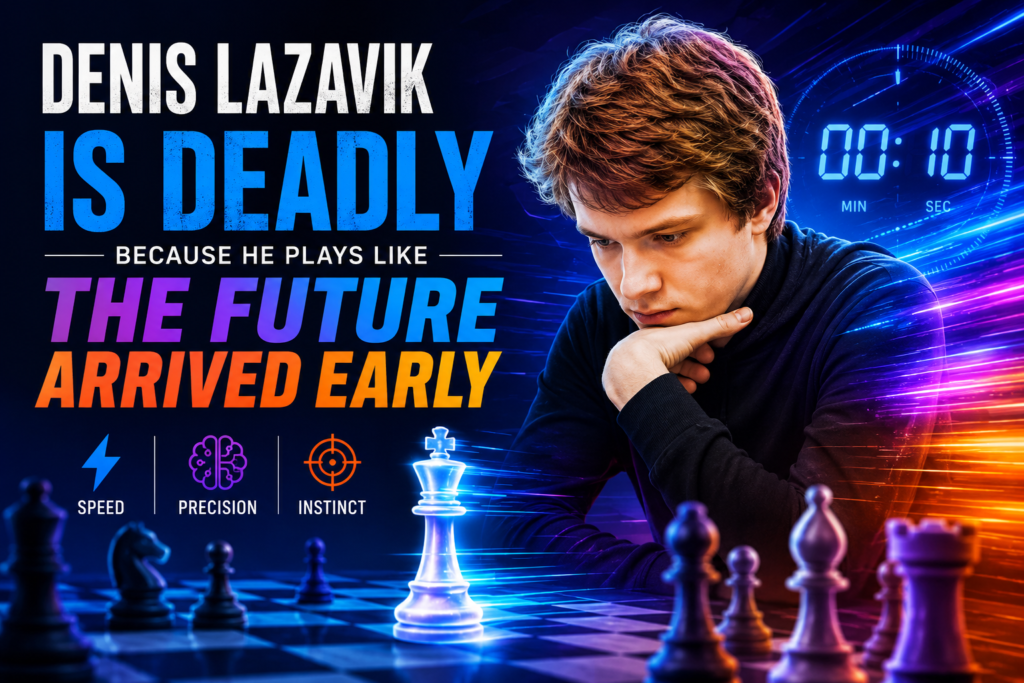
What stands out most is not only that he plays fast. Many young players play fast. Lazavik plays fast while still keeping the position full of life. He can defend bad spots, attack when the board opens, and keep making useful moves when both players are low on time.
In the 2025 Speed Chess Championship, Lazavik shocked many fans by beating Hikaru Nakamura 13.5-12.5 in the match for third place.
Chess.com called it a major upset, and the result also helped Lazavik qualify for the 2026 Esports World Cup along with Carlsen and Firouzja. That is a huge sign that he is not just a future name. He is already here.
Lazavik’s speed comes from fearless choices, not random moves
Young players often like attacking chess, but Lazavik is not just throwing pieces forward. His best games show a player who is ready to take risk when the risk has a point. He does not wait for the perfect moment forever. He asks, “Can I make this harder for my opponent right now?”
That is a key blitz skill. When your opponent is short on time, you do not always need to find a clean win. You need to keep the position hard to solve. Lazavik does this very well. He can keep pieces on the board, create small threats, and avoid easy trades when he needs winning chances.
This is a big reason kids should study players like him. Lazavik shows that young players can compete with legends if they build real habits. Fast hands help, but strong habits matter more.
The lesson from Lazavik is that age is not the limit when training is smart
Many parents wonder when a child should start learning chess in a serious way. The answer is simple. A child does not need to be “serious” in a scary way. The child needs the right steps, the right coach, and the right kind of practice.
At Debsie, this is where learning becomes powerful. Kids do not just play random fast games and hope to improve. They learn how to see checks, captures, threats, weak squares, and safe moves. They learn how to slow the mind even when the game is fast.
That is the true lesson from Lazavik’s rise. The next generation is not waiting. They are training early, learning online, playing strong events, and building courage. A child who starts today may not become Lazavik tomorrow, but they can become sharper, calmer, and more confident with every class and every game.
Ian Nepomniachtchi is deadly because his natural speed is almost unfair
Ian Nepomniachtchi, often called Nepo by chess fans, has one of the most natural fast-chess styles in the world. Some players look like they are pushing themselves to move quickly. Nepo often looks like he is playing at his normal pace, even when the clock is low.
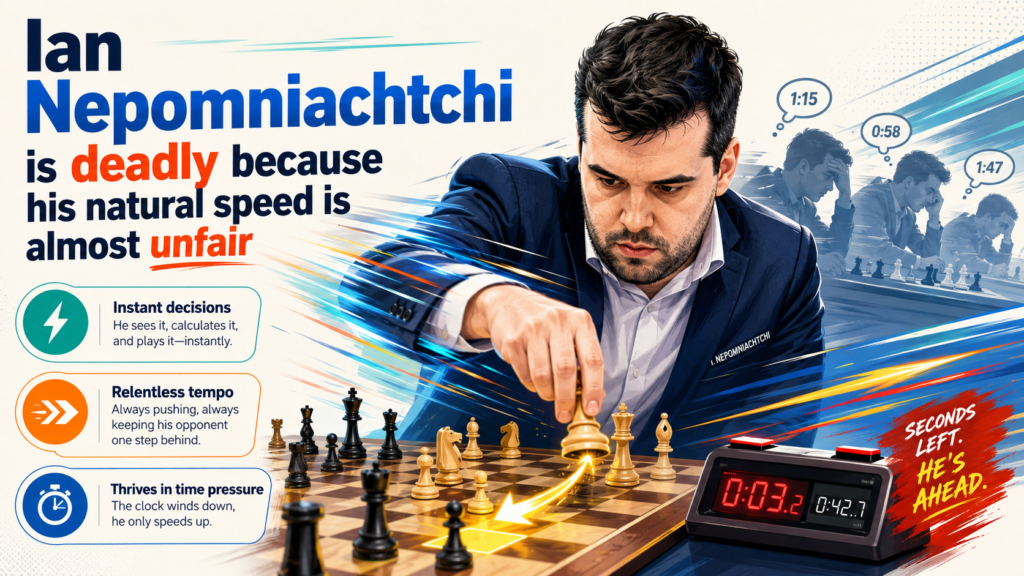
That is a rare gift. His openings come fast. His attacking ideas come fast. His piece moves often feel light and smooth. He does not always need a long think to choose a plan because he understands active positions so well.
This is why Nepomniachtchi is so dangerous in blitz. He can build an attack before the other player has even settled into the game. If you play slowly against him, you may look up and see that your king is already in trouble.
Nepomniachtchi’s danger comes from quick development and early pressure
Nepo likes positions where his pieces have space and activity. He is very good at getting his knights and bishops into play quickly.
Once his pieces are active, he starts asking direct questions. Where is your king going? Can you stop this check? Can you defend this pawn? Can you handle this attack while your clock is falling?
At the 2024 FIDE World Blitz Championship, Nepomniachtchi reached the final against Magnus Carlsen. After a tense tiebreak match, Carlsen and Nepomniachtchi shared the Open title. FIDE described the event as full of high drama and said the Open title was shared after an intense tiebreak match.
That result matters because it proves Nepo’s blitz skill at the highest over-the-board level. Online speed chess is one kind of pressure. A world blitz final is another. You have cameras, fans, title pressure, and a world-class opponent sitting across from you. Nepo still held his ground.
The lesson from Nepomniachtchi is to make development feel automatic
For students, Nepo’s style teaches a very useful lesson. The opening is not only about memorizing moves. It is about getting ready to play. If your pieces come out fast and your king becomes safe early, you can start making threats before your opponent is ready.
This is why beginners and young players should not spend all their time chasing rare opening traps. Traps are fun, but good development wins more games. Bring pieces out. Castle. Fight for the center. Connect the rooks. Then look for action.
In blitz, this can save a lot of time. When you know the basic opening goals, you do not need to think for one minute on move four. You can move with purpose and keep time for the hard moments later.
Debsie coaches help kids build this kind of simple, strong base. When children understand why moves are played, they feel less lost. They stop copying and start thinking. That is when chess becomes more than a game. It becomes a way to train focus and calm action.
Wesley So is deadly because he makes safe chess feel impossible to break
Wesley So may not always look as wild as Firouzja or Nakamura, but that is exactly why he is dangerous. His blitz style is calm, clean, and very hard to crack. He often wins by making fewer mistakes than everyone else.
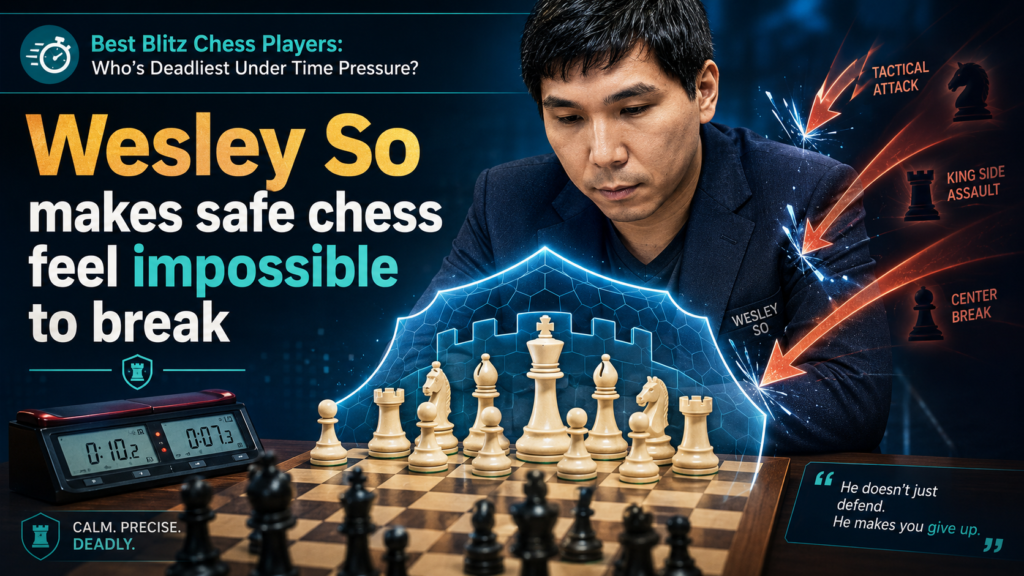
In blitz, many games are lost because one player gets too excited. They attack too soon, forget a piece, miss a check, or leave the king weak. Wesley So is excellent at avoiding these gifts. He plays sound chess at a fast pace, and that makes him a nightmare to face.
His moves often feel simple, but simple does not mean weak. Simple can be deadly when the clock is low. If one player is making clean moves and the other player is trying to calculate five crazy lines, the clean player may win the clock battle and the board battle at the same time.
Wesley So’s biggest blitz strength is control without panic
So is very good at keeping his pieces placed well. He does not need to force chaos unless the position calls for it. He can play quiet moves, trade into better endings, and keep the king safe while waiting for the other player to overreach.
This kind of style is not always the loudest, but it is very teachable. Many young players think blitz means “attack every move.” Wesley So shows another path. You can be deadly by being hard to beat. You can win because your opponent gets tired of finding moves. You can win because your position has no holes.
At the 2024 FIDE World Blitz Championship, Wesley So was part of the group of top players who scored 9.5 points in the Swiss stage and made it into the knockout rounds.
The same group included names like Ian Nepomniachtchi, Fabiano Caruana, Magnus Carlsen, Alireza Firouzja, Hans Niemann, Jan-Krzysztof Duda, and Volodar Murzin.
The lesson from Wesley So is that calm chess can still be sharp chess
This is a very important lesson for kids. You do not need to play wild chess to be strong. You need to play useful chess. A quiet move that stops your opponent’s idea can be better than a flashy move that starts a weak attack.
Parents love this part of chess because it builds real life skills. A child learns not to rush just because things are moving fast. They learn to check danger before acting. They learn to make choices that are safe and smart.
That is why Debsie’s chess training is not only about winning games. It is about helping kids build a better thinking habit. In school, this can look like reading the full question before answering. In life, it can look like staying calm when something goes wrong.
On the chessboard, it looks like making one solid move after another until the other player breaks.
Jan-Krzysztof Duda is deadly because he mixes sharp tactics with brave practical play
Jan-Krzysztof Duda is one of those players who can hurt anyone in fast chess. He is brave, sharp, and very good at finding chances when the position becomes unclear. He does not need the game to be perfect. He needs the game to be alive.
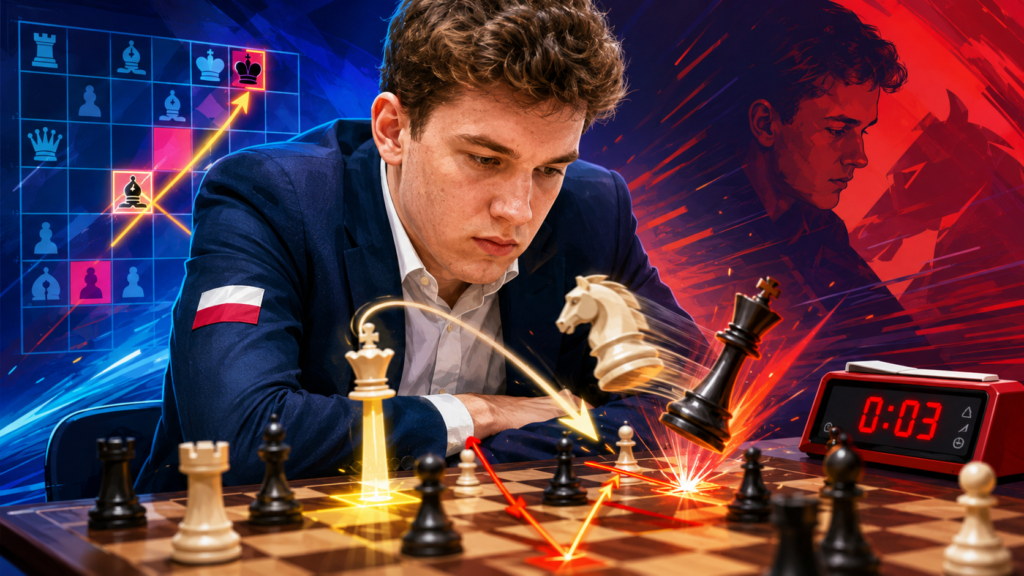
Duda has a long history of strong fast-chess results. Chess.com notes that in 2018 he finished second at the World Blitz Championship, only half a point behind Magnus Carlsen, and also made the semifinals of the Chess.com Speed Chess Championship.
It also notes that he won the European Blitz Chess Championship in 2021.
That kind of record shows real speed chess strength. One good event can happen. Many strong fast events over time show a pattern.
Duda’s strength is that he keeps finding chances in messy positions
Duda is not afraid of complications. When pieces are flying, queens are active, and kings are open, many players freeze. Duda often keeps playing with energy. He looks for tactical shots, counterplay, and sudden threats.
This is one reason he is so dangerous in blitz. A player who is comfortable in messy positions can make the opponent feel unsafe. Even when Duda is worse, he may still find a resource. Even when the computer would say the position is equal, the human sitting across from him may feel pressure.
For young players, this is a key idea. Blitz is not only about playing good positions. It is also about surviving hard ones. You need to learn how to defend, how to create counterplay, and how to keep your mind open after a mistake.
The lesson from Duda is to never stop looking for active moves
Many children give up too early in chess. They lose a pawn and feel the game is over. They miss a tactic and stop trying. Blitz teaches the opposite. The game is alive until it ends.
Duda’s style is a great model for this. If your opponent attacks, look for a counterattack. If your piece is attacked, see if you have a stronger threat. If you are worse, make the position hard. Do not just sit and wait to lose.
This does not mean playing silly moves. It means playing active moves with a purpose. It means asking, “What can I do?” instead of only thinking, “What did I do wrong?”
That mindset is one of the biggest gifts chess can give a child. Mistakes happen. Pressure happens. Losing positions happen. But strong thinkers keep searching. At Debsie, students learn this through guided games, puzzles, and coach feedback, so they do not just know the rule. They feel it through practice.
The real ranking of blitz danger depends on the kind of pressure
When people ask, “Who is the best blitz chess player?” they often want one name. That is natural. Fans love clear answers. But blitz is not one single skill. It is a mix of many small skills happening at the same time. That is why one player may look unbeatable in one match and then struggle in another match style.
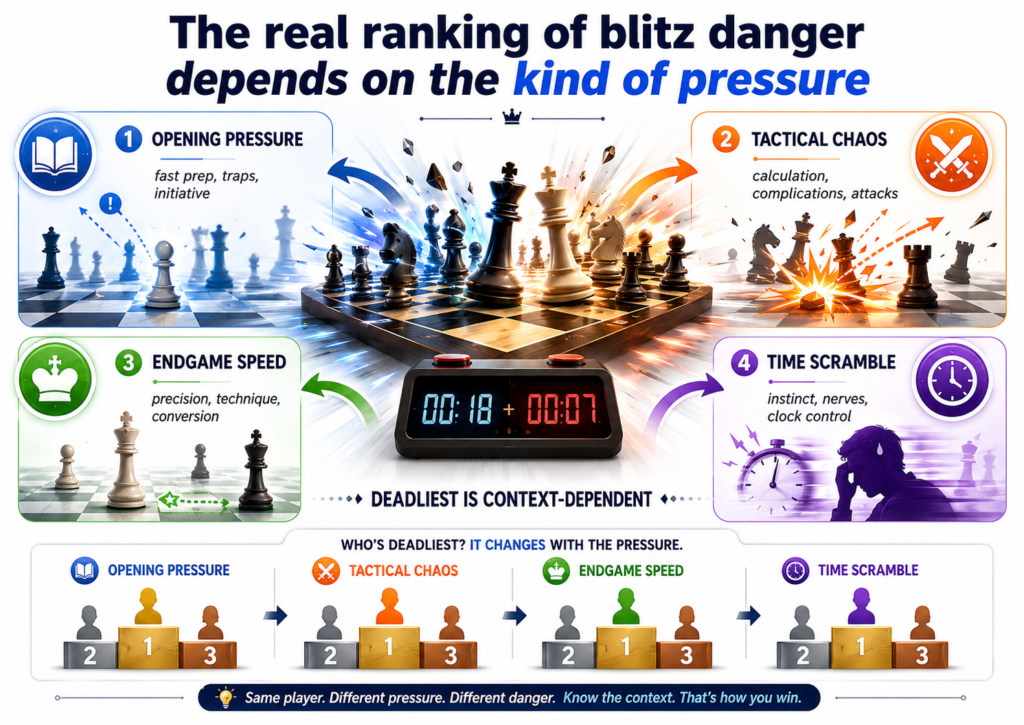
Magnus Carlsen may be the most complete blitz player because he can win in many ways. He can grind small edges, save bad positions, win endings, and still attack when he needs to. Hikaru Nakamura may be the most dangerous when the game turns into pure speed and clock pressure.
Alireza Firouzja may be one of the scariest when the board becomes sharp and full of tactics. Denis Lazavik may be the strongest sign that the next wave of blitz players is already fighting with the legends.
The 2025 Speed Chess Championship showed this well. Carlsen beat Firouzja 15-12 in the final, while Lazavik upset Nakamura 13.5-12.5 for third place. The same event used fast formats like 5+1, 3+1, and 1+1, so players had to prove themselves in more than one kind of speed battle.
A player can be deadly even without playing the same style as everyone else
This is one of the best things about blitz chess. There is no single “right” style. Carlsen can squeeze. Nakamura can swarm. Firouzja can burn the board down. Wesley So can stay calm and clean. Nepomniachtchi can move with smooth speed. Duda can keep finding tactical chances.
For students, this is great news. A child does not need to copy one player fully. A quiet child can learn from Wesley So. A bold child can learn from Firouzja. A patient child can learn from Carlsen. A fast child can learn from Nakamura, but also learn not to rush into mistakes.
Blitz becomes much more useful when kids stop thinking, “I must play like a genius,” and start thinking, “Which good habit can I copy today?”
The smartest young players study styles, not just moves
Copying moves without understanding them can hurt a student. A grandmaster may play a strange pawn move because they see a deep plan.
A child may copy that move and simply weaken the king. That is why the better question is not, “What move did the grandmaster play?” The better question is, “What problem did that move create?”
This is where a coach can help so much. At Debsie, students do not just see moves. They learn why moves work. They learn why one move creates pressure and another move wastes time. That kind of learning makes blitz stronger because the child starts seeing ideas, not just squares.
A good next step for any young player is to pick one favorite blitz player and study three games slowly. Do not rush through them. Pause after every few moves and ask what changed. Was the king safer? Did a piece improve? Did a threat appear? That simple study can teach more than twenty random fast games.
The deadliest blitz weapon is not speed; it is useful speed
Speed by itself is not enough. A fast bad move is still bad. In fact, it may be worse because it gives away the game before the player even understands what happened. The best blitz players are not just quick. They are useful quick.
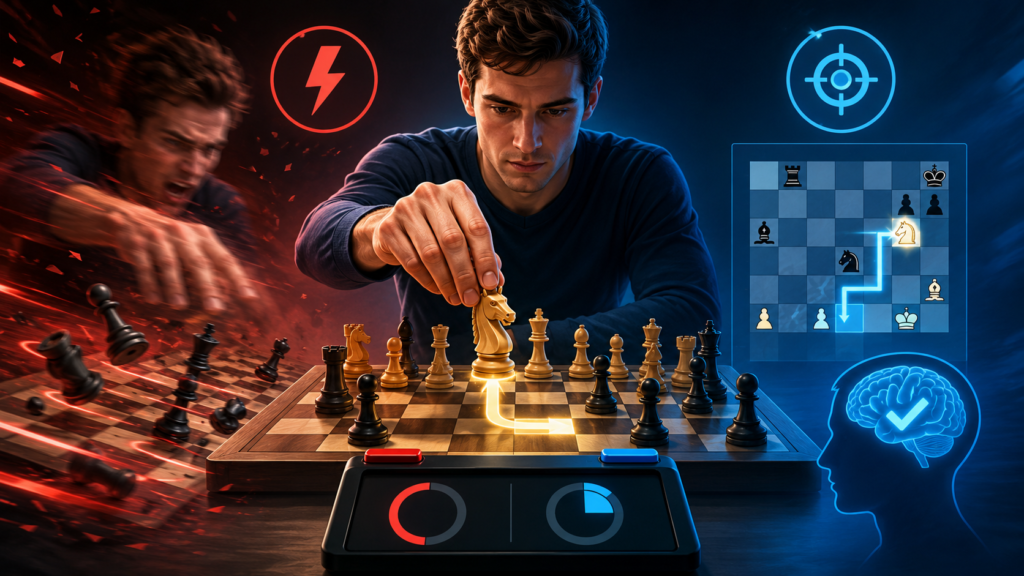
Useful speed means making moves that help your position. It means you do not spend thirty seconds trying to find a fancy idea when a simple developing move is good enough. It also means you do not move in one second when the position needs care.
The clock is a tool. Strong blitz players know when to save time and when to spend time. If the move is clear, they move. If the move is dangerous, they think. This sounds simple, but it is one of the hardest skills in blitz.
The best players know which moments deserve time
Not every chess moment is equal. Some moves are normal. Some moves decide the whole game. Great blitz players feel this difference.
In the opening, if they know the setup, they move fast. In a simple recapture, they move fast. In an endgame with only one clear plan, they move fast. But when the king is under attack, when a sacrifice is possible, or when queens may come off the board, they slow down.
This is a big lesson for kids. Many children do the opposite. They spend too much time on easy moves and then rush the hard ones. That is why they may play a good opening, reach a winning position, and then blunder a queen in five seconds.
A simple rule helps. Use time when the position changes. A capture, check, sacrifice, pawn break, or queen trade can change the whole game. Those moments deserve a little more care.
A simple blitz habit can save many lost games
Before making a move in blitz, students can train one tiny pause. It does not need to be long. Even two seconds can help. In that pause, ask, “What is my opponent’s threat?”
This one question saves games. It stops back-rank mates. It stops hanging queens. It stops simple forks. It also teaches kids to respect the other player’s ideas.
At Debsie, coaches help kids build this kind of habit through guided play. The goal is not to make children slow. The goal is to make them aware. Once a child learns to check danger quickly, they can play faster with less fear.
That is the sweet spot in blitz. Not wild speed. Not scared thinking. Just clear, useful speed.
Blitz chess can make kids sharper, but only when they train it the right way
Blitz is exciting, but it can also create bad habits if kids only play fast games without learning from them. A child may start guessing. They may stop checking threats. They may care more about winning on time than playing good chess. Over time, that can make their chess weaker.
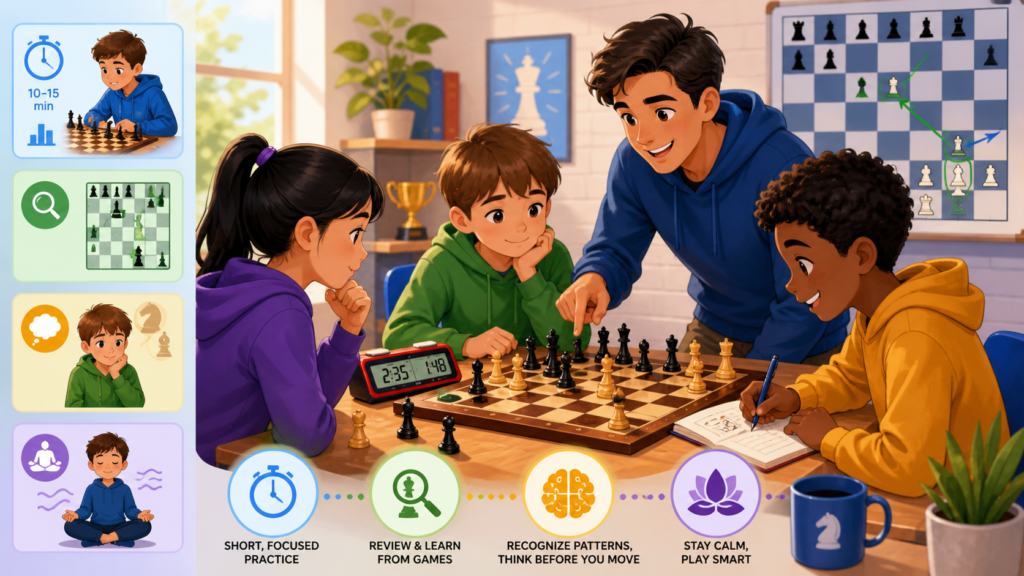
But when blitz is trained the right way, it becomes a powerful learning tool. It teaches quick focus. It teaches calm under stress. It teaches kids to recover after mistakes. It also teaches them to make decisions without waiting forever.
That last skill matters beyond chess. Children face time pressure in school tests, sports, music, and daily life. Chess gives them a safe place to practice staying calm when things move fast.
Slow learning creates better fast play
This may sound strange, but the best way to improve in blitz is not only to play blitz. Students also need slower games, puzzles, reviews, and lessons. Slow training builds the patterns. Blitz tests the patterns.
Think of it like learning to read. A child first learns letters and words slowly. Later, reading becomes fast. Chess works the same way. A child first learns pins, forks, mates, weak back ranks, open files, and king safety. Later, those ideas appear quickly during blitz.
This is why parents should not worry if a coach makes a child slow down in class. Slowing down is part of getting faster later. The brain needs clean examples before it can make quick choices.
Chess.com keeps live blitz ratings and rankings, which shows how important blitz has become in the modern chess world. But ratings alone do not show the full learning process behind fast chess. The strongest players spend years building deep skills before their speed looks natural.
The best blitz training includes review, not just more games
After a blitz game, many kids click “new game” right away. That feels fun, but it misses the lesson. The better habit is to review one key moment before playing again.
The child can ask, “Where did I lose time?” They can ask, “Where did I miss a threat?” They can ask, “Was my king safe?” They can ask, “Did I move the same piece too many times?” These questions are simple, but they are powerful.
A coach makes this even better because children may not see the real mistake on their own. They may think they lost because of one blunder, but the coach may show that the blunder came from poor development five moves earlier.
That is why Debsie’s live classes and private coaching can help families so much. Kids get feedback, not just games. They learn how to think, not just what to move. And when they play tournaments, they are not alone. They have a system behind them.
The best blitz player to study depends on what your child needs most
Parents often ask which grandmaster their child should follow. The honest answer is that it depends on the child. Some kids need more courage. Some need more patience. Some need better opening habits. Some need to stop rushing. Some need to stop freezing.
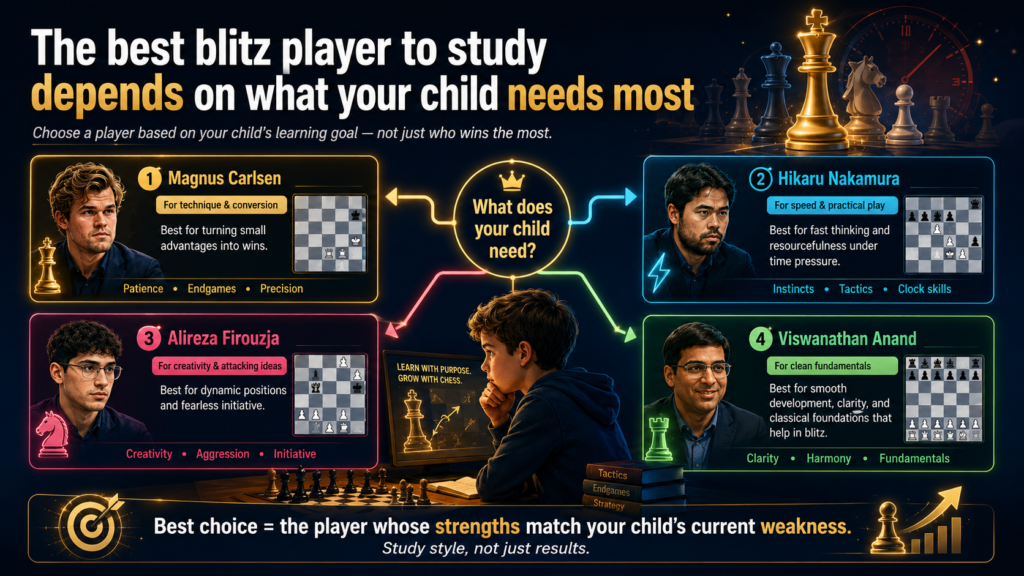
That is why studying different blitz stars is so helpful. Each top player teaches a different lesson. Carlsen teaches patience and endgame strength. Nakamura teaches clock skill and constant threats.
Firouzja teaches activity and courage. Lazavik teaches fearless modern speed. Nepomniachtchi teaches smooth development. Wesley So teaches calm control. Duda teaches fighting spirit in messy positions.
The 2024 FIDE World Blitz Championship also showed that blitz is not just online fun. It is a serious world title format where elite players fight under huge pressure. FIDE reported that Carlsen and Nepomniachtchi shared the Open blitz title after a tense tiebreak, while Ju Wenjun won the Women’s Blitz crown.
A child should copy the habit, not the whole personality
This is very important. A child does not need to become loud, wild, or fearless to play blitz well. They do not need to act like their favorite streamer. They only need to copy useful chess habits.
From Carlsen, copy the habit of playing on in equal endings. From Nakamura, copy the habit of creating threats. From Firouzja, copy the habit of using active pieces. From Wesley So, copy the habit of keeping the king safe. From Duda, copy the habit of looking for counterplay. From Nepomniachtchi, copy the habit of developing fast and smoothly.
This makes improvement feel simple. Instead of trying to become “great at blitz” all at once, a student can build one habit at a time.
The first habit should be king safety because it helps every style
No matter which player a child likes, king safety comes first. A fast attack means nothing if your own king is getting mated. A clever trick means nothing if you forgot a back-rank threat. Even the most creative blitz players respect king safety, because one check can change the whole game.
A good young player should castle early in most games, avoid moving too many pawns near the king, and always watch open lines. This is not boring chess. It is strong chess. A safe king gives the rest of the pieces freedom to play.
That is one reason Debsie is a great place for young chess learners. The lessons are not built around cheap tricks. They are built around real growth. Kids learn how to attack, but also when to defend. They learn how to move fast, but also when to think. They learn how to win, but also how to handle mistakes with confidence.
For parents who want their child to build focus, patience, and smart thinking, a free Debsie trial class is a simple first step. Blitz may look like a race, but the best players prove that clear thinking wins the race.
The exact skills that make a blitz player deadly under time pressure
A great blitz player is not just one thing. They are not only fast. They are not only smart. They are not only brave. They are a mix of many small skills working together at high speed. That is why blitz feels so hard for beginners. The board is busy, the clock is falling, and one careless move can ruin everything.
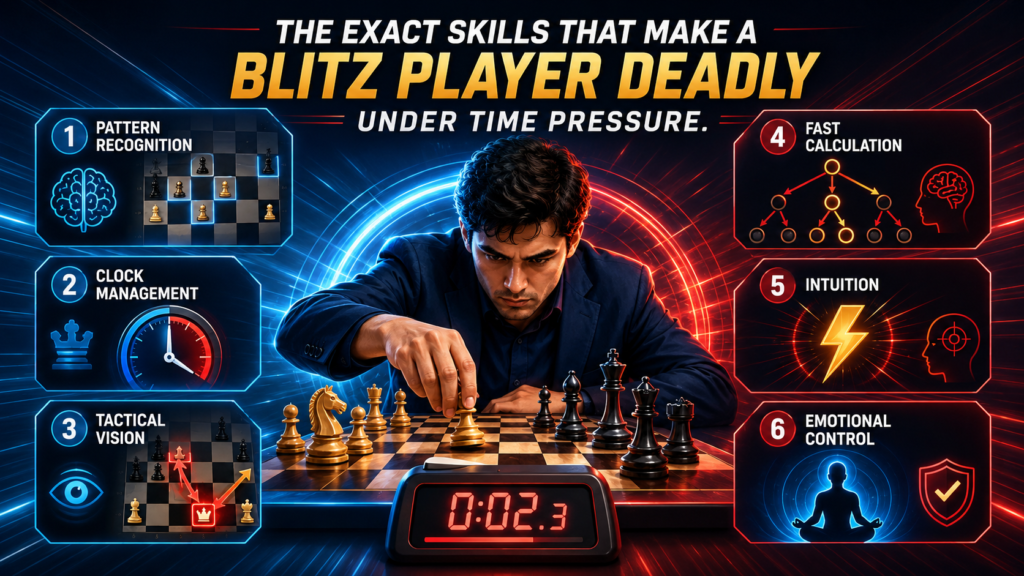
But here is the good news. These skills can be trained. A child does not need to be born with magic speed. A child can learn patterns, build better habits, manage the clock, and stay calm in scary positions. That is why structured chess coaching helps so much. It turns a wild game into a set of small lessons.
Magnus Carlsen’s place at the top of FIDE’s blitz list shows how much complete skill matters. FIDE’s current ratings page lists Carlsen as the top open blitz player, while other live ranking pages track how fast these numbers can shift in modern chess.
Deadly blitz players see simple things before others see anything
The first skill is fast vision. This means seeing checks, captures, threats, loose pieces, weak kings, and mate ideas quickly. Most blitz games are not lost because one player misses a deep ten-move plan. They are lost because one player misses a fork, a back-rank mate, or a hanging queen.
Top players spot these things almost at once because they have seen them thousands of times. Their brain does not start from zero in every game. It says, “I know this shape.” That is what makes their speed look so smooth.
For young players, this is very trainable. The best place to begin is not with hard puzzles that take twenty minutes. It is with clear puzzles that teach common patterns. Pins. Forks. Skewers. Discovered attacks. Back-rank mates. Simple king traps. These ideas show up again and again in blitz.
The simple training rule is to build clean patterns before chasing speed
Parents sometimes ask how their child can move faster. The better first question is, “Can my child see the right idea?” Speed without vision creates blunders. Vision creates safe speed.
A child can train this by solving a few easy tactics every day and saying the idea out loud. Not just the move. The idea. “This is a fork.” “This is a pin.” “The back rank is weak.” Saying it makes the pattern stronger in the mind.
At Debsie, this is the kind of learning that helps kids grow with confidence. They are not just told to play faster. They are taught what to notice. Once a child knows what to notice, the clock becomes less scary.
Pattern memory is the hidden engine behind every great blitz move
When a world-class player moves in two seconds, it can look like a guess. But most of the time, it is not a guess. It is pattern memory. The player has seen a similar position before, so the right move feels natural.
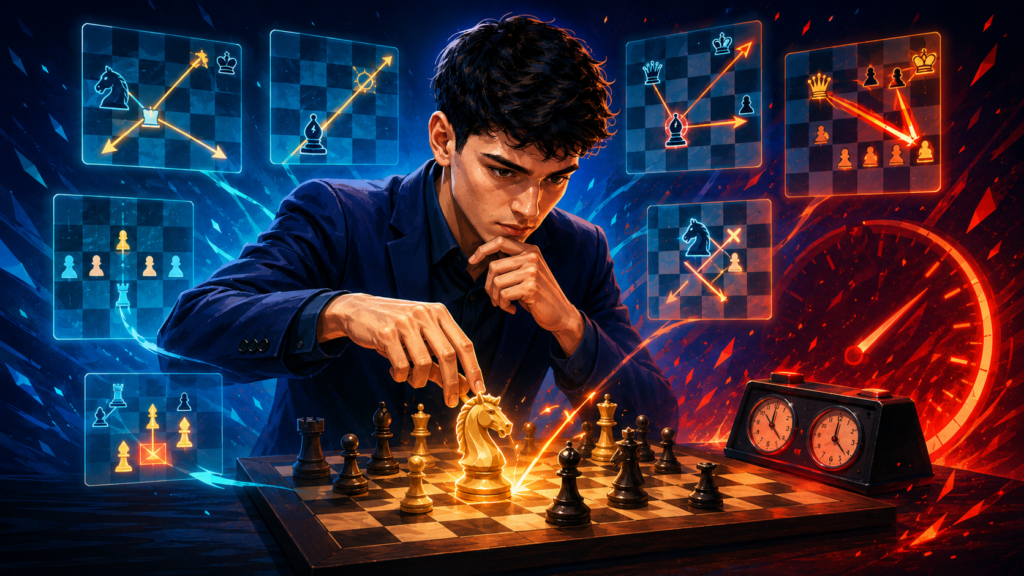
This is true in many parts of life. A strong reader does not sound out every letter forever. A good basketball player does not think about every step before shooting. A trained chess player does not calculate every tiny thing from the beginning. They notice the shape and act with care.
In blitz, this matters even more because there is no time to rebuild the whole position move by move. A player must know common plans. They must know where the pieces belong. They must know which pawn breaks are normal. They must know when a king is in real danger.
Great blitz players use memory, but they do not play like robots
This is an important point. Pattern memory does not mean memorizing thousands of random moves and copying them blindly. That can actually hurt a child. If the position changes even a little, the copied move may become bad.
Real pattern memory is different. It is understanding the idea behind the move. For example, in many king-side attacks, a knight near the enemy king can be very powerful. A bishop pointing at h7 or h2 can become dangerous. A rook on an open file can create pressure. These are not random facts. They are useful shapes.
That is why top blitz players can switch plans fast. If the attack is not working, they may trade into an endgame. If the center opens, they may bring the rooks in. If the opponent’s queen gets far away, they may attack the king. They are not stuck. Their memory gives them choices.
The best home practice is slow review of fast games
This may sound strange, but one of the best ways to improve blitz is to review blitz games slowly. After the game, the clock is gone. Now the student can breathe and ask what really happened.
The child should look for the first moment where the game started to feel hard. Did they forget to castle? Did they move the same piece too many times? Did they start an attack without enough pieces? Did they miss the other player’s threat?
This kind of review is where growth happens. Playing ten fast games with no review may feel fun, but reviewing one key mistake can do more for real improvement. That is why Debsie’s coach-led learning is so helpful. Kids get someone who can slow the game down, explain the idea, and turn one mistake into a lesson they remember.
Clock control is a skill, and the best blitz players treat time like material
In blitz, the clock is not just a clock. It is part of the game. A player who is up a queen but has one second left may still lose. A player who is slightly worse but has more time may create enough pressure to win.
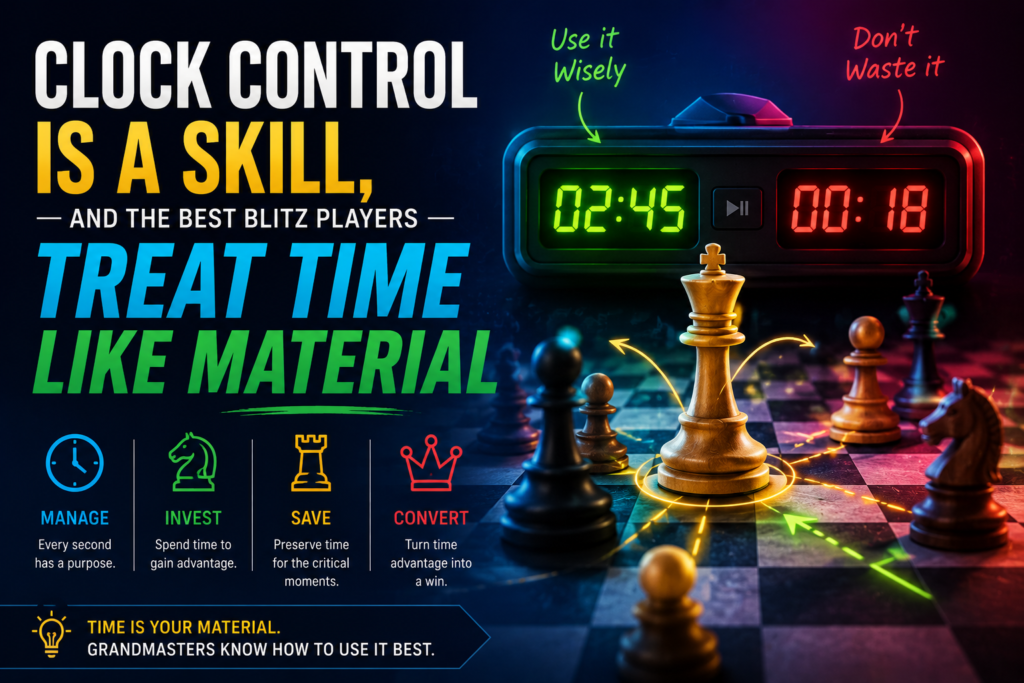
The best blitz chess players understand this deeply. They do not waste time on easy moves. They also do not rush the moments that can decide the game. That balance is what makes them dangerous. They know when to trust their hand and when to slow the hand down.
The Speed Chess Championship is a great example because it tests different fast formats, including games where one second is added after each move. In the 2025 event, Carlsen beat Firouzja in the final, while Lazavik beat Nakamura for third place, showing how brutal these time-control battles can be even for the very best players.
The strongest players save time when the position is normal
A smart blitz player does not think deeply on every move. That sounds wrong at first, but it is true. If every move gets deep thought, the clock will win.
In normal opening moves, simple recaptures, and clear improving moves, strong players often move quickly. They save their time for moments that matter more. These moments include king attacks, piece sacrifices, queen trades, pawn breaks, and tricky endgames.
Young players can learn this with a simple idea. When nothing major is changing, make a useful move. When the position changes a lot, pause and check. This does not mean taking forever. It means using time where it has value.
The three-second danger check can stop many painful blunders
Before a child makes a move in blitz, they can build one small habit. Take a tiny pause and ask, “What can my opponent do next?”
This question is simple, but it is powerful. It helps stop one-move blunders. It helps the child notice checks. It helps them see if a piece is undefended. It also teaches respect for the other player’s plan.
At first, this habit may slow the child down a little. That is fine. Over time, it becomes quick. The child starts seeing danger faster. Then their speed becomes safer.
This is one reason chess is so good for kids. It teaches them not to react blindly. It teaches them to pause, think, and act. That is useful in a chess game, in a school test, and in real life.
The best blitz players know how to create pressure without making wild moves
Many students think pressure means attacking the king right away. But real pressure can be much quieter. It can be a rook on an open file. It can be a knight sitting on a strong square. It can be a pawn that keeps moving forward. It can be a queen that keeps the enemy king tied down.
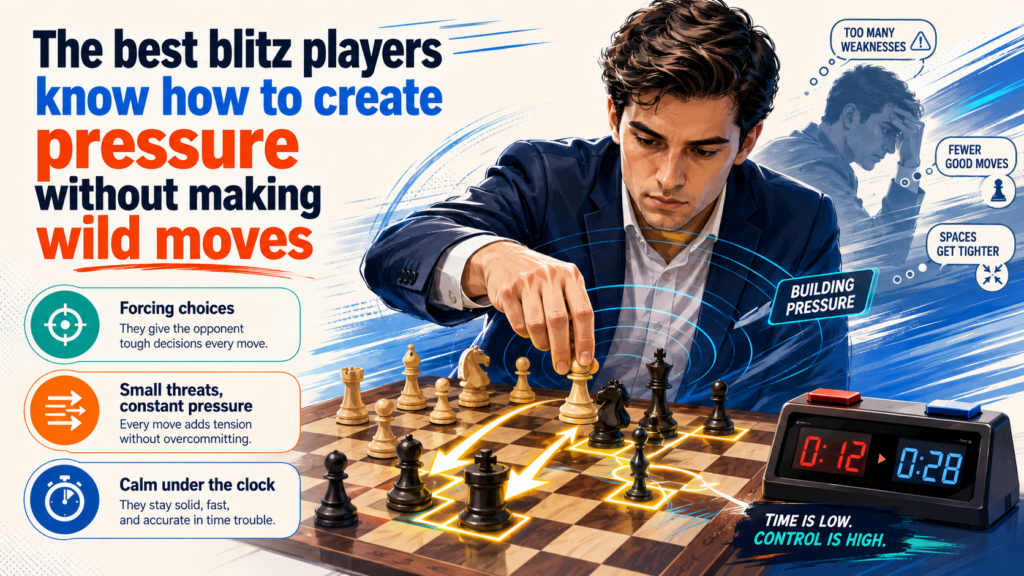
The best blitz players are masters at this. They create positions where the opponent must keep solving problems. One problem may be easy. Ten problems in a row, with the clock running, becomes painful.
This is why Carlsen is so hard to beat. This is why Nakamura is so hard to face in time trouble. This is why Firouzja feels so dangerous when pieces stay active. They all create pressure, but they do it in different ways.
Real pressure gives your opponent hard choices
A weak threat is easy to stop. A strong threat creates choices. Should the opponent defend the pawn or move the king? Should they trade queens or keep attacking? Should they save the knight or stop checkmate?
In blitz, choices are heavy. The more choices your opponent must make, the more time they spend. The more time they spend, the more likely they are to make a mistake.
This is why students should not only ask, “Is my move safe?” They should also ask, “Does my move ask a question?” A good blitz move often does both. It improves your position and makes your opponent think.
Kids can practice pressure by improving the worst piece first
One of the easiest ways to create pressure is to improve the worst piece. This sounds simple, but it changes games. If a bishop is stuck, open it. If a rook has no file, find one. If a knight is on the edge, bring it closer to the center. If the queen is doing nothing, place it where it attacks and defends.
This habit is great for young players because it gives them a plan when they do not know what to do. Instead of making random moves, they look at their pieces and ask which one needs help.
At Debsie, this kind of thinking is taught in a clear and friendly way. Kids learn that chess is not only about tricks. It is about making small things better, one move at a time. That builds patience. It builds focus. It builds the kind of calm thinking that helps children far beyond the board.
Parents who want their child to become sharper under pressure can start with a free Debsie trial class. It is a simple way to see how expert coaching can turn fast chess from a guessing game into a thinking game.
Opening choices in blitz should make the game easier, not prettier
A blitz opening should help you reach a position you understand. That sounds simple, but many players forget it. They try to play rare lines, tricky traps, or sharp openings they have only seen once.
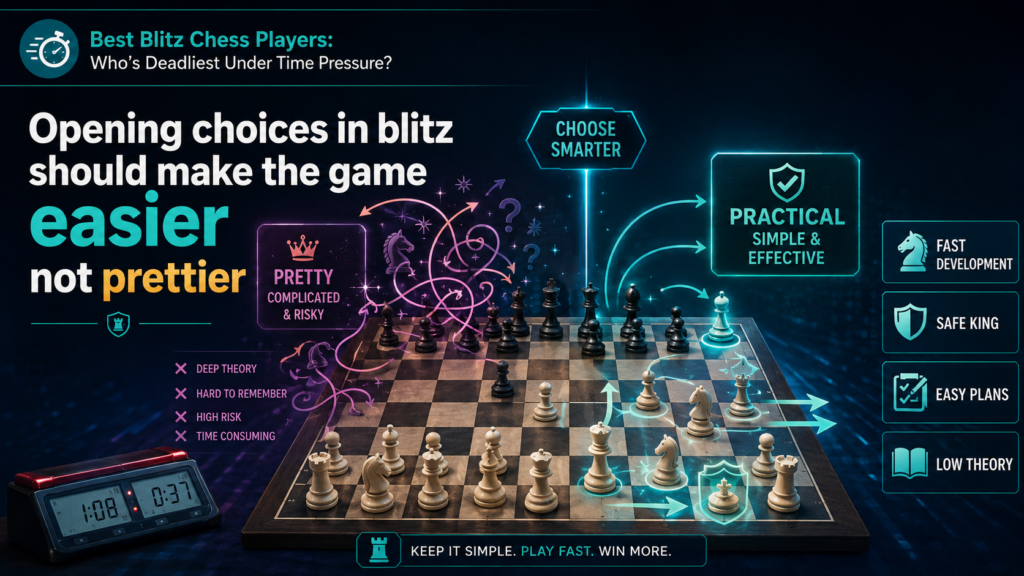
Sometimes this works. Often, it backfires because they spend too much time trying to remember moves instead of playing chess.
The best blitz chess players choose openings that match their style. Carlsen can play many quiet systems and still outplay people later. Nakamura can use sharp setups and put pressure on the clock. Firouzja often enjoys active positions where pieces fly toward the king.
The key is not to copy every move they play. The key is to understand why their openings help them feel at home.
For young players, the best blitz opening is usually not the most shocking one. It is the one that helps them develop pieces, castle, fight for the center, and start a clear plan. When a child knows what the opening is trying to do, they save time and avoid panic.
Good blitz openings give you simple moves when the clock is moving fast
In blitz, a good opening should not make you think too hard on move five. It should give your pieces natural squares. The knights come out. The bishops find open lines. The king gets safe. The rooks start to connect. Once that happens, the player can begin the real fight.
This is why many strong blitz players like openings with clear plans. A clear plan is like a map. Even if the opponent plays something slightly different, you still know what kind of setup you want. That makes blitz less scary.
A child who changes openings every week may feel excited, but they may also stay confused. It is better to build one or two openings well. Learn the main idea. Learn common traps. Learn where the pieces belong. Then play those openings many times until they feel natural.
The best opening habit for kids is to know the idea before memorizing the move
Memorizing moves can help later, but it should not come first. A student should know why a move is played. Does it fight for the center? Does it develop a piece? Does it protect the king? Does it prepare an attack? When kids understand the purpose, they can handle surprise moves better.
This matters a lot in blitz because opponents will not always follow the book. Some will play strange moves just to confuse you. If you only memorized, you may freeze. If you understand the idea, you can stay calm and play useful chess.
At Debsie, students are guided to understand openings in a simple way. They learn plans, not just move orders. That helps them play faster because they are not guessing. They are making moves with meaning. For parents, this is one of the best signs of real chess growth. The child starts to explain the board, not just move pieces around it.
Endgame skill is the secret reason many blitz legends win “equal” games
Many young players think blitz is all about openings and attacks. The truth is different. A huge number of blitz games are decided in the endgame. The pieces come off, both players have little time, and suddenly one small pawn move becomes the whole story.
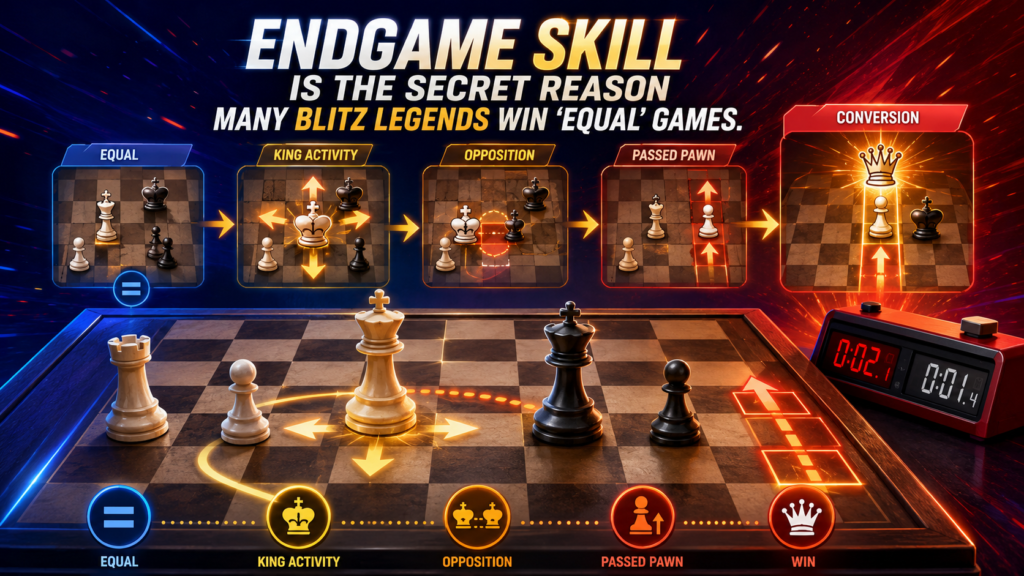
This is where players like Magnus Carlsen become terrifying. He can take a position that looks equal and still keep asking questions. He improves the king. He creates a passed pawn. He places the rook behind the pawn.
He gives the opponent many chances to go wrong. Under time pressure, those small problems become big problems.
Endgames are also great for kids because they teach clear thinking. There are fewer pieces, so the ideas are easier to see. But the moves still need care. One rushed king move can turn a draw into a loss. One smart pawn move can turn a small edge into a win.
Blitz endgames reward players who know simple rules very well
A young player does not need to know every hard endgame to become stronger in blitz. They need a few basic ideas that show up often. The king should become active. Rooks like open files and passed pawns. Passed pawns should be pushed when safe.
Pawns on both sides can make winning easier for the stronger side. Opposition matters in king and pawn endings.
These ideas sound small, but they win many games. In blitz, the player who knows these ideas does not need to spend too much time. They can move with confidence while the opponent starts guessing.
This is one reason endgame training is so valuable. It does not only help at the end of the game. It also helps earlier because the child starts to know which trades are good. If they understand that a pawn ending is winning, they can trade pieces without fear. If they know a rook ending is risky, they can keep more pieces on the board.
The best endgame habit is to make the king a strong piece
Many kids forget the king in the endgame. They treat it like it is still hiding from checkmate. But once many pieces are gone, the king becomes a fighter. It should walk toward the center, attack pawns, and help its own pawns move forward.
This is a beautiful lesson for children. The same piece that needed safety earlier can become powerful later. Chess teaches timing. It teaches that the right plan can change as the position changes.
In Debsie classes, kids can learn these ideas through simple positions and guided games. They see how a king moves from safety to action. They learn how patience can win. They learn that not every win needs a flashy checkmate. Sometimes the best win is calm, clean, and steady.
A strong blitz training plan should build calm speed step by step
Blitz improvement should not mean playing fast games all day. That can be fun, but it often creates messy habits. A stronger plan mixes learning, practice, review, and guided play. The goal is not just to move faster. The goal is to think faster because the ideas are clearer.
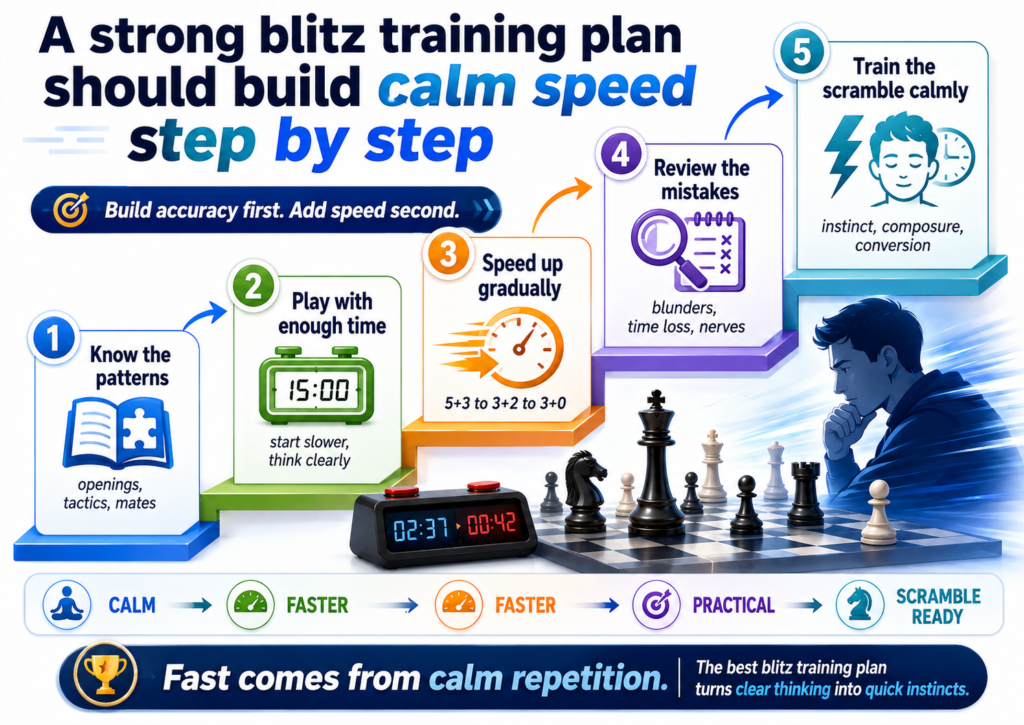
For kids, this matters even more. Children can pick up habits very quickly. If they keep playing rushed games with no feedback, they may learn to guess. If they play with coaching, review, and clear goals, they learn how to make better choices under pressure.
A good blitz training plan should feel active and fun, but it should also have purpose. The student should know what they are trying to improve. Maybe it is spotting tactics. Maybe it is using the clock better. Maybe it is not blundering pieces. Maybe it is playing safer openings.
The best practice mixes puzzles, slower games, blitz games, and review
Puzzles help build pattern memory. Slower games help build deep thinking. Blitz games test quick decisions. Review turns mistakes into lessons. When these four parts work together, a child improves much faster than by only playing game after game.
The order matters too. A student who only plays blitz before learning basic patterns will make the same mistakes again and again. A student who studies ideas first will start seeing those ideas during games. That is when chess becomes exciting. The child thinks, “I have seen this before.”
This is also where coaches make a big difference. A coach can spot the mistake behind the mistake. Maybe the child lost a queen, but the real problem was not checking the opponent’s threat. Maybe the child lost on time, but the real problem was spending too long in the opening. A good coach finds the root cause.
The best review question is not “Why did I lose?” but “Where did the game change?”
After a blitz game, the most useful moment is often not the final blunder. It is the first moment where the position became harder. That is where learning lives. Did the child miss a chance to castle? Did they ignore the center? Did they start an attack with only one piece? Did they trade into a bad endgame?
This question helps children become detectives. They stop feeling bad about the result and start looking for clues. That is a healthy way to learn. It builds confidence because mistakes become information, not shame.
Debsie’s live chess classes and private coaching are built for this kind of growth. Students get real feedback from experienced coaches. They learn how to fix habits, not just hear that a move was wrong.
For parents who want their child to grow in focus, patience, and smart thinking, this kind of support can make chess feel both fun and meaningful.
The fastest way to become better at blitz is to stop trying to win every game by force
This may sound strange, but many players lose blitz games because they try too hard to win too quickly. They attack before they are ready. They sacrifice without enough pieces. They chase the king and forget their own. They want a brilliant finish, but they give the opponent easy chances.
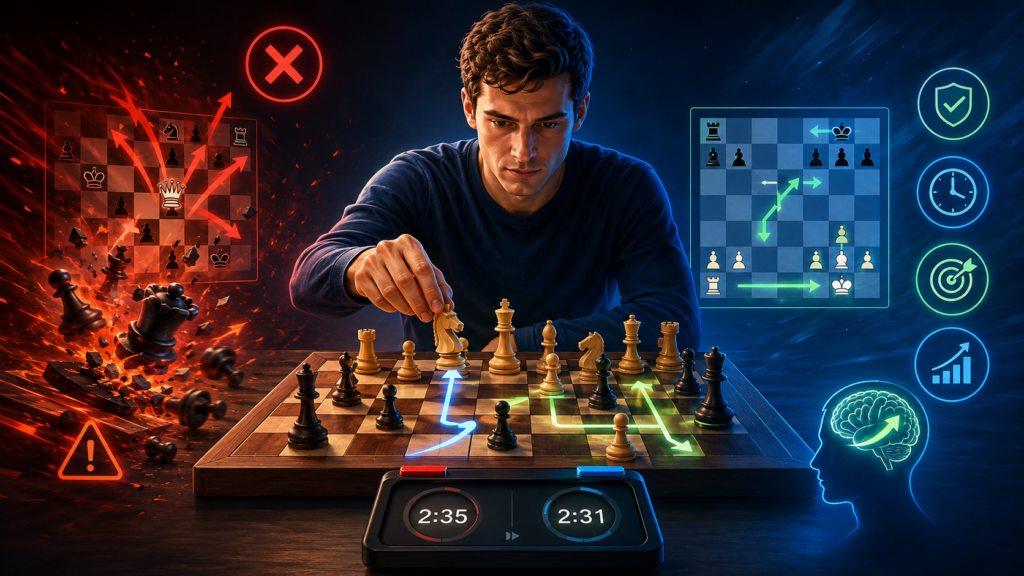
The deadliest blitz players do not force drama every move. They build pressure. They wait for the right moment. They know that the opponent’s clock can become part of the attack. They understand that a safe move can be stronger than a flashy move.
For young players, this is a huge lesson. Blitz is exciting, but excitement should not control the hand. A child can learn to enjoy fast chess while still making smart choices. That balance is what separates a wild player from a dangerous one.
Winning in blitz often starts with not giving the game away
A strong blitz player is hard to beat first. Then they become hard to stop. This order matters. If your pieces are safe, your king is safe, and your clock is okay, you give yourself chances. If you hang a piece on move eight, even a great attack may not save you.
This is why simple chess is so powerful. Develop pieces. Castle. Watch threats. Improve the worst piece. Trade when ahead. Keep tension when you need chances. These habits may sound basic, but they are exactly what many players forget when the clock is low.
Parents should remember this too. A child does not need to play like a world champion to benefit from blitz training. They just need to build better thinking habits. Every game can teach focus. Every mistake can teach care. Every time scramble can teach calm action.
The best young blitz players learn to love the process, not just the result
If a child only feels happy after winning, chess becomes stressful. If a child learns to enjoy solving problems, chess becomes a lifelong gift. Blitz can help with this because every game gives new chances. You can lose one game, learn one thing, and play better in the next.
This is one of the reasons Debsie’s approach is so helpful for families. The goal is not only to create strong chess players. The goal is to help children become better thinkers. They learn to pause before acting. They learn to stay patient when things are hard. They learn that pressure can be handled one move at a time.
The best blitz chess players are deadly because they stay clear when others get rushed. That skill can be learned. It starts with good guidance, steady practice, and a safe place to grow. A free Debsie trial class can help your child take that first step with expert coaches who make chess fun, clear, and full of purpose.
Conclusion
Blitz chess looks fast, but the real winners are not just quick hands. They are calm thinkers. Magnus Carlsen may be the most complete blitz player today, while Hikaru Nakamura, Alireza Firouzja, Denis Lazavik, Ian Nepomniachtchi, Wesley So, and Jan-Krzysztof Duda each bring a special kind of danger.
For kids, the lesson is simple: speed grows from strong basics. Learn patterns. Keep the king safe. Check threats. Stay calm after mistakes. At Debsie, children learn these skills with expert coaches, fun classes, and real practice. Start with a free trial class and help your child think sharper.

Adhip Ray is the founder of Debsie, an online learning platform focused on chess and skill-based learning for children. His work at Debsie brings together chess education, structured thinking, problem-solving, and interactive learning for young students.
Adhip has an academic background in law, statistics, analytics, and technology. He is from Amity Law School and the Indian Statistical Institute, Kolkata, with formal training that connects legal reasoning, data analytics, quantitative thinking, and structured problem-solving. This interdisciplinary background is reflected in Debsie’s focus on building sharper thinking skills in children through chess and related learning programs.
Adhip is also a FIDE-rated chess player from India. He holds FIDE ID 5055954 and has a standard FIDE rating of 1832. His FIDE profile records him as an Indian player with a long rating history in standard chess, including rated games from his competitive playing years. His chess background gives Debsie a founder-led connection to the game, not only as an educational activity but also as a competitive discipline that develops concentration, calculation, planning, and decision-making.
In addition to chess, Adhip has a strong interest in coding, data, and technical problem-solving.
Adhip’s profile combines chess, law, data analytics, and programming. At Debsie, this background supports the creation of learning experiences that are logical, structured, and skill-oriented. The platform’s chess-focused programs are connected to broader cognitive skills such as pattern recognition, patience, strategic planning, focus, and problem-solving.
As founder of Debsie, Adhip brings together experience from multiple fields: formal legal education from Amity Law School, analytical training from the Indian Statistical Institute, Kolkata, competitive chess experience through his FIDE-rated profile, and coding practice through LeetCode. This combination gives Debsie a distinct foundation in strategy, reasoning, analytics, and child-focused learning.
Through Debsie, Adhip is associated with building chess and learning content for children that goes beyond basic instruction. The platform connects chess with thinking skills, helping students approach challenges with more structure, clarity, and confidence. His own background in chess and analytical problem-solving gives the platform a direct link to the skills it aims to develop in young learners.
Adhip is also a member of Forbes Business Council.