
Most parents do not ask, “Will my child enjoy this app today?” They ask, “Will this help my child next year… and five years from now?” That is the real test of EdTech. Not the shiny badges. Not the cute animations. The real test is long-term change you can see in a child’s habits, grades, choices, and confidence.
1) High school graduation: students with sustained EdTech exposure are about 2–6 percentage points more likely to graduate on time
What this number really means for your child
A 2–6 point lift sounds small until you picture a full school hall. It means real kids who would have drifted off track are now finishing on time. Graduation is not a “smart kid” prize. It is a “kept going” prize.
Long-term EdTech exposure helps because it builds a repeatable routine: learn a little, get feedback fast, fix mistakes, and try again. Over years, that routine becomes a habit. And habits are what carry students through tough semesters, busy family seasons, and the hard jump from middle school to high school.
What to do at home so your child becomes part of that stronger cohort
Start with a simple rule that is easy to keep: same days, same time, same length. Choose four days a week and keep the session short enough that your child does not dread it. Twenty minutes is fine if it is focused. The goal is not long hours. The goal is fewer “empty weeks” where learning stops and gaps grow.

Next, pick the right difficulty. If the work is too hard, your child will feel shame and avoid it. If it is too easy, your child will waste time and grow bored. Aim for tasks where your child is right most of the time but still has to think.
When mistakes happen, treat them like a normal part of learning, not a problem with the child.
Then, add one adult check-in. You do not need to teach. You just need to notice. Once per session, ask two calm questions: “What was the trickiest part?” and “What will you try differently next time?” This trains self-control and planning, which matter more and more in higher grades.
Finally, link effort to future goals in a simple way. Once a week, connect the routine to something your child cares about: choices, freedom, and confidence.
If you want structure without stress, guided learning with expert teachers and gamified practice, like Debsie, helps families keep the routine long enough for the graduation outcomes to show up.
2) College enrollment: cohorts with multi-year EdTech use are often 3–8 percentage points more likely to enroll in college within 1–2 years
Why this happens over the long run
College enrollment is not only about grades. It is also about readiness. Many students do not enroll because the steps feel confusing, the work feels too hard, or they doubt they belong. Long-term EdTech exposure can reduce those fears.
It does this by building steady skills and by making learning feel like something the student can control. When a child learns in small chunks, gets quick feedback, and sees clear progress, they start to think, “I can handle hard things.” That mindset matters a lot when college planning begins.
What parents can do to turn EdTech into a real enrollment advantage
Start treating EdTech as a skill-building tool, not a homework helper. Choose one core track that supports future study: math fluency, strong reading, basic coding, or science reasoning. Keep it steady across years instead of jumping between random apps. Consistency is the hidden power here.
Next, begin “future proof” habits early. Help your child practice learning without needing someone to push them every minute. During an EdTech session, step away for short moments. Then return and ask your child to explain what they did and why.
When a child can explain their thinking, they are building the exact skill college demands.
Also, build comfort with tests and deadlines in a gentle way. Many EdTech systems offer timed quizzes or weekly targets. Use them as practice for real academic pressure. Keep the tone calm. The goal is not to create stress. The goal is to make deadlines feel normal, not scary.
Finally, do not wait until grade 11 to talk about college paths. Once a month, connect learning to real careers in simple words. If your child likes games, talk about coding. If they like space, talk about physics.
If they like helping people, talk about medicine and biology. If you want this to feel clear and guided, structured classes with strong teachers, like Debsie, can give children both the skills and the belief that college is a realistic next step.
3) STEM course-taking: long-run follow-ups commonly show 10–25% more STEM courses completed among students with strong EdTech exposure
What “more STEM courses” changes in real life
Taking more STEM courses does not just fill a report card. It opens doors. More STEM classes often lead to better problem-solving, better logic, and stronger comfort with data. These skills show up everywhere, even outside STEM jobs.
Students who keep choosing STEM courses usually do so because the early years did not scare them away. EdTech can help at that exact point. It can make the first contact with STEM feel clear, friendly, and doable.
How to use EdTech so your child keeps choosing STEM, year after year
The key is early wins that are real, not fake. If your child feels confused in math or science, do not pile on harder topics. Use EdTech to rebuild the base first. In STEM, weak basics create fear. Strong basics create curiosity.
Make STEM feel hands-on, even when it is digital. If your child learns coding, ask them to build something small that you can see, like a simple animation or a tiny game. If they learn science, ask them to explain one idea at dinner, like why ice melts faster in warm water.

When learning becomes something they can show, it becomes personal.
Also, do not treat STEM as only “school work.” Give it a place in your child’s identity. Say things like, “You’re becoming a strong problem-solver,” instead of “You got the answer right.” This trains your child to value thinking, not only scores.
One more important move is pacing. Many students quit STEM because the jump in difficulty feels sudden. Use EdTech to smooth that jump by practicing future topics in small pieces before school introduces them.
This makes school lessons feel easier, which keeps confidence high. If you want this done in a guided way, Debsie’s structured STEM and coding learning can keep your child progressing without the common stop-start pattern that makes kids drop STEM later.
4) Math achievement persistence: with regular EdTech use for 2+ years, later math scores are often 0.10–0.25 standard deviations higher
Why math gains “stick” when the routine is steady
Math is a building-block subject. If one block is weak, the next one wobbles. That is why short bursts of practice help for a week, but steady practice changes the whole path. A 0.10–0.25 lift is meaningful because it suggests the child did not just cram and forget.
They built skills that stayed with them. EdTech supports this when it gives practice at the right level and corrects mistakes right away, before the wrong method becomes a habit.
A simple home system that produces long-term math growth
First, focus on accuracy before speed. Many children rush because they want to finish. Use EdTech settings that reward careful work and show step-by-step feedback. When your child gets something wrong, do not say, “Try harder.” Ask, “Which step changed the answer?” This trains math thinking instead of guessing.
Second, protect your child from “gap stacking.” If your child is struggling in fractions, do not jump to algebra drills. Fix fractions first. A good EdTech path will detect weaknesses and bring the child back to the skill they missed.
Let it do that job. It may feel slow for a few days, but it saves months of struggle later.
Third, keep sessions short and frequent. Math improves more with small daily contact than with one long weekend session. A calm 15–25 minutes most days is enough to create persistence.
Finally, add one weekly review ritual. Once a week, your child should redo a few past questions they once got wrong. This is how learning sticks.
It also teaches a powerful lesson: “I can improve old mistakes.” If you want a teacher-guided plan that makes this routine easier to maintain, Debsie’s classes and practice challenges can help keep the math path steady for years, not just for one term.
5) Reading achievement persistence: long-run reading gains are usually around 0.05–0.15 standard deviations higher with consistent EdTech support
Why reading grows slower, but still matters a lot
Reading is not one skill. It is many small skills working together. A child needs vocabulary, focus, background knowledge, and the ability to follow a long idea without drifting. That is why reading gains often look smaller than math gains.
But even a 0.05–0.15 lift can change school life. Better reading makes every subject easier, including science, history, and even math word problems. In cohorts with steady EdTech support, reading improves because students practice more often, get help with hard words, and build confidence to tackle longer texts.
How to turn EdTech reading time into real long-term growth
First, choose reading tasks that match your child’s level, not their age label. If the text is too hard, your child will guess and skim. If it is too easy, growth will slow. The best zone is where your child understands most of the text but still meets a few new words each page.
Second, train “meaning checking.” Many kids can read the words but do not notice when they stop understanding. During EdTech reading, pause once and ask, “What just happened in that part?” If your child cannot answer, it is not failure. It is a signal to reread and slow down.

This one habit is a major reason some children become strong readers over time.
Third, build vocabulary in a simple way. When your child meets a new word, do not force long definitions. Ask them to guess the meaning from the sentence, then confirm. Keep a tiny list of five new words each week and reuse them in normal talk. Words stick when they feel useful.
Finally, mix digital reading with real conversation. After a short reading session, ask one question that needs thinking, like “Why did the character do that?” This strengthens comprehension, not just decoding.
If your child learns better with guided teaching and fun reading challenges, Debsie can support reading skills alongside STEM, so your child becomes strong across subjects.
6) Learning time recovered: adaptive tools often reclaim 20–40 extra hours of effective learning per year by cutting idle time
What “effective learning hours” really means
Many children spend a lot of time “doing school,” but not much time truly learning. They wait for others to catch up, they repeat work they already know, or they get stuck and sit confused. Adaptive EdTech reduces that waste.
It gives the right question at the right time, so more minutes turn into real progress. Over a year, 20–40 hours of effective learning is like adding weeks of strong practice without adding stress.
How to make sure your child actually gets those hours back
First, protect the session from distractions. If EdTech time happens with a TV on, a phone nearby, and snacks every five minutes, the tool cannot do its job. Choose one quiet spot. Keep the device only for learning. A calm setup is the easiest “time recovery” trick.
Second, avoid random hopping between apps. Every time your child switches tools, they lose momentum. Choose one strong program for each goal. One for math. One for reading. One for coding. Keep it stable for at least eight weeks so the system can adjust to your child’s level and needs.
Third, use short sessions but make them “complete.” A complete session has a start, a goal, and an ending. Start with a simple target like “finish two lessons” or “master one skill.” End by looking at the result screen together for one minute. This keeps the time purposeful.
Finally, turn recovered time into better life balance. If EdTech is truly efficient, your child should not be studying longer. They should be learning smarter. Use the saved time for sleep, play, or a hobby.
Those things improve learning too. If you want a guided routine where time is used well and progress is tracked, Debsie’s structured classes and gamified challenges can help families turn screen time into real skill time.
7) Attendance: cohort studies often report 1–3 fewer absences per student per year when EdTech supports engagement and catch-up learning
Why better learning tools can lead to fewer missed days
Absences are not only about sickness. Many absences happen because school feels hard, confusing, or stressful. When a child falls behind, every day feels like walking into a room where everyone speaks faster than them.
EdTech helps by giving a private way to catch up. When children feel prepared, they resist school less. Over a year, 1–3 fewer absences can protect learning more than parents realize. Fewer missed days also means fewer missing assignments, fewer warnings, and less panic before exams.
How to use EdTech to support steady attendance
First, use EdTech as a “catch-up bridge,” not only as extra practice. If your child misses school, do not let the gap sit there. The next day, use a short EdTech session to cover what was missed. Keep it simple. One topic. One small win. The goal is to return to class without fear.
Second, track stress signals, not just grades. If your child starts saying “I hate school” more often, look for the hidden cause. It is often a skill gap or a fear of failure. Use EdTech to rebuild the weak area before it becomes a bigger emotional issue.

Third, celebrate consistency, not perfection. Instead of praising only high marks, praise showing up. Say, “I’m proud you did your practice even when it felt hard.” This trains resilience, which supports attendance over years.
Finally, keep the teacher loop active. If your child is missing lessons, share the plan with the teacher: “We are practicing this skill at home this week.” It creates a team feeling. If you prefer guided support, Debsie’s live classes can keep children connected and accountable, which often makes it easier for them to stay steady with school.
8) Course failure rates: with tutoring and feedback platforms, cohorts commonly show 10–30% fewer course failures in math and science
Why fewer failures changes a child’s whole path
Failing a course is not only a number on a report. It can damage confidence for years. Many students who fail math once start thinking they are “not a math person.” Then they avoid advanced courses, avoid STEM options, and carry that fear into adulthood.
A 10–30% drop in failures is powerful because it means more students stay in the game. Fast feedback and targeted help can stop small confusion from growing into a full crash.
How to prevent failure using a simple, repeatable plan
First, identify the “failure points” early. In math, it is often fractions, negative numbers, and algebra basics. In science, it is often reading the question, understanding graphs, and using formulas correctly. Use EdTech diagnostics or short quizzes to find what is weak.
Do not guess. When parents guess, they often pick the wrong topic.
Second, do not wait for the midterm. Build a weekly repair routine. Once a week, your child should redo one hard concept from school using EdTech practice. This turns confusion into competence before it becomes a failing grade.
Third, teach your child to ask better questions. Many kids say “I don’t get it.” Train them to say, “I get step one, but step two is confusing.” During EdTech practice, pause and ask your child to point to the exact step that broke. This improves thinking and makes teacher help more effective too.
Finally, make feedback immediate and calm. When your child gets something wrong, the next move should be clear: review the explanation, do one similar problem, then move on. Long lectures at home often create stress and resistance.
If you want consistent tutoring and clear feedback built into the learning journey, Debsie’s teacher-led support combined with practice challenges can reduce the chance of failure and keep the child moving forward.
9) Credit recovery success: programs that pair EdTech with teacher coaching often see 15–35% higher credit-recovery completion rates
Why coaching plus EdTech works better than EdTech alone
Credit recovery is often a second chance after a course went wrong. Many students fail not because they cannot learn, but because they fell behind and did not know how to climb back. EdTech helps by breaking the work into small parts and giving clear steps.
But coaching is what keeps the student from quitting halfway. That is why completion rates can rise by 15–35% when a real teacher checks in, sets targets, and helps the student stay steady.
How to apply this idea even if your child is not in credit recovery
You can use the same approach as prevention. First, create “mini credit recovery” at home. If your child bombed a test, do not just move on. Pick the two or three skill gaps behind that test and rebuild them with EdTech over two weeks. This is credit recovery in small, safe bites.

Second, add coaching in a very simple form. Coaching does not mean long teaching sessions. It means a short plan and a short review. At the start of the week, set a clear target like “master two topics” or “finish four lessons.” At the end of the week, sit for five minutes and look at what improved. Ask your child what made it easier and what was still hard.
Third, avoid shame language. Credit recovery fails when the student feels labeled as “behind.” Use respectful words. Say, “We’re rebuilding this skill,” not “You messed this up.” Children work harder when they feel safe.
Finally, choose tools that show progress clearly. Progress bars, mastery levels, and skill maps are helpful because they make the path visible. If you want real coaching from expert teachers and a structured path, Debsie’s guided classes can act like that support system, so a child does not feel alone when they need to catch up.
10) Dropout risk reduction: longer exposure is frequently linked to 5–15% lower dropout risk, especially for students who start behind
Why EdTech can reduce the urge to quit
Dropping out is rarely one sudden choice. It is often the end of a long chain of discouragement. A student falls behind, feels embarrassed, stops asking questions, and then disconnects.
EdTech can reduce dropout risk by making learning private, manageable, and repeatable. When students can practice without being judged, they are more willing to try again. Over time, that can translate into a 5–15% lower risk of leaving school.
How to use this insight to protect your child’s motivation
First, treat small avoidance as a warning sign. If your child delays homework, “forgets” assignments, or gets angry when school is mentioned, do not assume laziness. Often it is fear. Use EdTech to find and fix the weak skill that is causing the fear.
Second, build a success rhythm. Many students who quit do not feel success often enough. Use short EdTech sessions that end with a win. A win can be mastering one skill, finishing one lesson, or correcting a past mistake. Ending on progress helps the brain stay hopeful.
Third, keep the adult relationship warm. Teens do not need lectures. They need calm support and clear structure. Ask simple questions like, “What is one thing you want to feel more confident in this month?” Then use EdTech to build that confidence.
Finally, connect learning to life freedom. Explain that staying in school increases choices later. Keep it practical: better options, better jobs, more control.
If you want a learning environment that feels supportive and not pressuring, Debsie’s mix of expert teaching and gamified growth can help a student feel capable and stay engaged long enough for the long-term outcomes to matter.
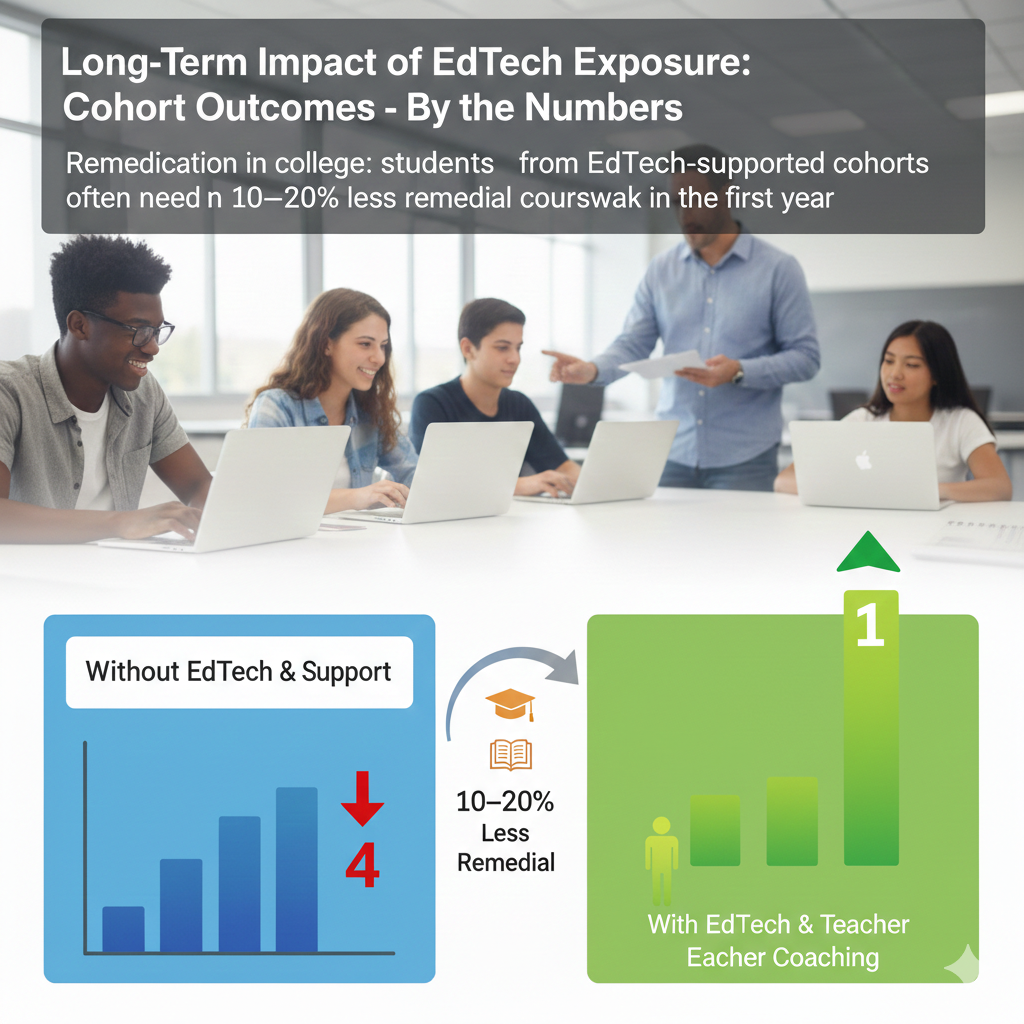
11) Remediation in college: students from EdTech-supported cohorts often need 10–20% less remedial coursework in the first year
What “less remediation” really saves
Remedial courses in college can cost time, money, and confidence. They can delay graduation and make a student feel like they are already behind on day one. When cohorts need 10–20% less remediation, it usually means the students entered college with stronger foundations in math and reading.
EdTech helps by keeping skills sharp and by filling hidden gaps that schools may not have time to address.
How to build “college-ready basics” without pressure
First, focus on the boring basics, because they are the powerful basics. In math, that means number sense, fractions, algebra readiness, and word problems. In reading, it means understanding long passages and pulling out the main idea.
Use EdTech to practice these areas steadily, even when school is covering more advanced topics. Advanced learning collapses when basics are weak.
Second, practice learning from instructions. College work often comes with written directions. During EdTech tasks, encourage your child to read the prompt carefully before clicking. If they rush, train a pause habit: read, restate, then solve. This is simple, but it prevents many errors.
Third, build test comfort in small ways. Use short quizzes once a week. Keep the tone calm. The goal is not to chase perfect scores. The goal is to make assessment feel normal.
Finally, develop independence. Once a week, let your child plan their own EdTech session: choose the topic, set the target, and review the result.
This builds the self-management that reduces remediation risk later. If you want a guided path that still teaches independence, Debsie can support children with structured lessons plus practice challenges that build real foundations.
12) Time to mastery: adaptive systems commonly reduce time to reach a skill benchmark by 15–30%
Why faster mastery matters more than speed
Faster mastery is not about rushing. It is about removing wasted effort. Many children spend hours practicing the wrong level of work. Too easy, so they do not grow. Too hard, so they get stuck.
Adaptive systems adjust the level so the child spends more time in the “learning zone.” That is why time to mastery can drop by 15–30%. It means the child reaches a strong level sooner and can move forward with confidence.
How to make sure your child’s EdTech actually speeds up mastery
First, choose one clear benchmark. Do not set vague goals like “get better at math.” Pick a specific skill like “fractions to decimals” or “two-step word problems.” Adaptive tools work best when the goal is clear, because you can measure progress and keep motivation high.
Second, keep sessions consistent. Adaptive learning needs data. If your child uses the tool once every two weeks, it cannot adjust well. Aim for short, frequent sessions. Even 15 minutes, four or five times a week, is enough for the system to learn your child’s patterns and respond.
Third, do not skip the review steps. Many kids click past explanations. Teach a simple rule: if you get it wrong, you must read the feedback and solve one similar problem right away. This turns mistakes into growth instead of repeated failure.
Finally, make mastery visible. Celebrate “mastered skills” more than raw scores. When children see that they are building a stack of mastered abilities, they become more willing to persist.
If you want mastery to happen with teacher guidance and clear targets, Debsie’s structured classes and gamified tasks can support faster progress without making learning feel like a race.
13) Skill retention: spaced practice and retrieval tools often help learners remember 10–25% more after weeks or months
Why memory is the real superpower
Many children can learn something today and forget it next month. That is normal, but it becomes a problem when the next topic depends on the last one. Retention is what turns “I did it once” into “I can still do it.”
Spaced practice and retrieval practice work because they bring back old learning at the right time, just when the brain is about to forget. That gentle reminder strengthens memory, which is why retention can rise by 10–25% over longer gaps.
How to build retention at home without adding stress
First, stop relying on re-reading. Re-reading feels easy, but it does not train the brain to pull information out. Retrieval does. So instead of asking your child to look at notes again, ask them to answer a few questions from memory. EdTech that uses quick quizzes and mixed review is ideal for this.

Second, use a “two-day, seven-day” rhythm. After your child learns a new skill, bring it back two days later for a short review. Then bring it back again about a week later. Keep it short. Three to five questions are enough. The point is not to drill. The point is to remind the brain that this skill matters.
Third, mix old and new. Many children only practice the newest topic. That is why they forget older ones. Choose EdTech modes that include mixed practice, where older skills appear again in small doses. This is one of the most practical ways to keep learning from leaking away.
Finally, make retention visible with a simple record. Once a week, ask your child, “Which skill from last month feels easier now?” This teaches them to notice long-term growth, which builds confidence.
If you want a guided system that naturally uses review and recall, Debsie’s structured learning and challenges can keep skills alive across months, not just for one test.
14) Homework completion: cohorts using structured digital assignments often show 5–15 percentage points higher completion rates
Why completion is a life skill, not just a school task
Homework completion is not about being perfect. It is about follow-through. When students complete more work, they usually learn more, but they also build a key habit: finishing what they start.
Structured EdTech can raise completion because it makes the work clear, breaks it into steps, and gives quick feedback. That reduces the “I don’t know where to begin” feeling that causes many kids to avoid homework.
How to turn EdTech into a homework engine
First, make homework predictable. Link EdTech time directly to homework time. For example, your child does ten minutes of EdTech practice before starting homework. This warms up the brain and reduces resistance. Many children avoid homework because they feel rusty when they sit down.
Second, create a tiny start rule. The hardest part is starting. Set a rule that your child only has to do five minutes at first. Once they begin, they often continue. EdTech helps here because it loads quickly and gives an immediate task. That first small win removes the mental block.
Third, use progress tracking as a motivator. Some kids need to see the finish line. Choose tools that show what is done and what is left. Then make the child the owner of the plan. Ask, “Do you want to finish this before dinner or after?” Giving a simple choice increases completion because the child feels control.
Finally, keep your role calm and short. You do not need to hover. Check once at the start and once at the end. Praise the act of finishing, not only the grade. If you want structured assignments with teacher support, Debsie can help families build reliable homework habits without daily arguments.
15) Assignment accuracy: with instant feedback, average correctness on practice sets often increases by 8–20 percentage points
Why fast feedback changes learning
When feedback comes days later, the child has forgotten what they were thinking. Mistakes become mysteries. Instant feedback fixes that. The child sees the error while the thought is still fresh, and the correction actually sticks.
Over time, that can lift accuracy by 8–20 points. Accuracy matters because it builds confidence. Children who are often wrong start to feel helpless. Children who learn to correct mistakes start to feel capable.
How to use instant feedback the right way
First, slow your child down. Instant feedback is only helpful if the child is thinking, not clicking randomly. Teach a simple pause: read the question, plan the step, then answer. If your child guesses quickly, ask them to explain their choice before they submit.
Second, require a correction step. If the tool marks an answer wrong, your child should not just move on. They should redo one similar problem right away. This turns feedback into learning, not just a score.

Third, keep a “common mistakes” note. Once a week, write down one mistake pattern your child repeats, like mixing up signs in math or missing key words in reading questions. Then pick EdTech practice that targets that exact pattern. This is a powerful way to increase accuracy without extra hours.
Finally, treat accuracy as a skill that grows. Do not label your child as careless. Say, “We’re training careful thinking.” If you want feedback that is both instant and explained by a real teacher when needed, Debsie’s guided learning can help children improve correctness while staying confident.
16) Growth for struggling learners: lower-performing students often see 1.5–2.5× larger gains when EdTech is personalized and used consistently
Why struggling learners can grow faster with the right support
This is one of the most hopeful numbers. It suggests that children who start behind are not doomed to stay behind. When EdTech truly adapts and the routine is consistent, struggling learners can gain much more than expected.
This happens because the tool can start at the child’s real level, not the grade level on paper. It can rebuild missing steps and give extra practice without embarrassment.
How to make personalized EdTech work for a child who feels behind
First, remove the pressure to “catch up fast.” Speed creates panic. Instead, aim for steady progress. A child who improves one small skill each week will look very different after three months.
Second, begin with diagnostic learning. Use tools that test and place your child correctly. Then trust the placement, even if it feels “too easy” at first. Struggling learners need to win early to rebuild belief.
Third, make practice short and frequent. For many struggling students, long sessions lead to fatigue and frustration. A calm 15–20 minutes, five days a week, often works better than one long session.
Finally, pair the tool with human support. Even a weekly teacher check-in can keep the child from feeling alone. Encourage your child to talk about what was hard without shame.
If you want a structured path where teachers guide learning and personalize the journey, Debsie is built for that kind of growth. It helps children who feel stuck become the children who surprise themselves.
17) Impact on high achievers: for already-advanced students, long-term gains are often 0.05–0.15 standard deviations, mostly from acceleration
Why advanced learners still benefit, just in a different way
High achievers often do not need “more practice.” They need better challenge. If school moves too slowly, advanced students can become bored, careless, and oddly unmotivated. EdTech can help them accelerate by offering harder problems earlier, deeper projects, and more complex thinking.
The long-term gains may look smaller on score charts, like 0.05–0.15, but the real value is often that the student reaches higher-level content sooner and stays engaged instead of coasting.
How to use EdTech to keep an advanced child growing
First, watch for hidden boredom. If your child finishes work too fast, makes silly mistakes, or says school is pointless, the issue may be a lack of challenge. Use EdTech that can move them ahead based on mastery, not based on age.
Second, shift from drills to creation. Advanced learners grow more from building than from repeating. In coding, that means making real projects. In math, that can mean puzzles, proofs, or multi-step problems. In science, it can mean experiments and data analysis. Choose EdTech paths that allow your child to produce something they can show.

Third, teach depth, not just speed. Ask your child to explain their solution in a clear way. Then ask, “Is there another way to solve it?” This builds flexible thinking, which is a key trait in high-level STEM.
Finally, keep humility and resilience strong. Advanced children sometimes struggle when they finally meet a hard topic because they are used to being “the smart one.” Use EdTech to normalize challenge. Praise effort, not identity.
If you want guided acceleration with expert teachers who can stretch your child without overwhelming them, Debsie can help advanced learners move faster while building strong thinking habits.
18) Teacher time saved: automation often saves 1–3 hours per week per teacher, which can be redirected to small-group instruction
Why time saved can become learning gained
When teachers spend less time grading, sorting papers, and making reports, they can spend more time teaching.
That is the real win. EdTech can automate routine tasks and surface useful data, so teachers can focus on human work: explaining hard ideas, coaching students, and giving support in small groups. Over a year, saving 1–3 hours a week adds up to real attention that students can feel.
How parents can help schools and teachers use EdTech the right way
First, support the teacher’s system instead of fighting it. If the school uses a platform for assignments or practice, help your child use it well. Many “EdTech failures” are not tool failures. They are routine failures. A calm home routine makes the teacher’s tool more effective, which helps the whole class.
Second, encourage your child to take feedback seriously. When a platform gives corrections, your child should not ignore them. If your child treats EdTech like a game only, the teacher still has to reteach everything. Train your child to review mistakes and retry.
Third, communicate with teachers in a helpful way. Instead of asking, “Why is my child behind?” ask, “Which skill should we focus on this week?” When parents and teachers work on the same target, the child improves faster and teacher time is used better.
Finally, consider guided programs that reduce the load on classroom teachers. If your child needs extra help, a structured program like Debsie can provide expert teaching and practice outside school, which can reduce pressure on the classroom and give your child more focused support.
19) Feedback speed: digital tools can cut feedback time from days to seconds, and faster feedback is often linked to 5–20% higher revision rates
Why revisions are where real learning happens
Many students finish an assignment and never look at it again. That is a lost chance. Real learning often happens when a child reviews what went wrong and fixes it. Fast feedback makes revisions more likely because the child still cares and still remembers their thinking.
When revision rates rise by 5–20%, it often means students are building a powerful habit: improving work, not just submitting work.
How to make fast feedback lead to better habits
First, build a “fix it now” rule. If your child gets feedback, they should revise within 24 hours. Waiting a week turns it into a chore. Doing it soon turns it into growth.

Second, make revision small and clear. Do not tell your child to “redo everything.” Choose one part to improve. In writing, that may be a better opening sentence. In math, it may be correcting one method. In coding, it may be fixing one bug and explaining why it happened.
Third, teach your child to look for patterns. Ask, “What kind of mistake is this?” Is it a reading mistake, a calculation mistake, or a planning mistake? Pattern thinking makes a child smarter over time.
Finally, model a calm attitude about corrections. Many kids see feedback as criticism. Reframe it as coaching. If you want feedback that is quick and also explained by a real teacher when needed, Debsie’s guided learning can keep revision simple, normal, and productive.
20) Student confidence: cohorts often show 10–25% more students reporting “I can do this if I keep trying” after long-term mastery-based EdTech
Why confidence is not a personality trait
Confidence is often treated like something a child either has or does not have. In reality, confidence is built from evidence.
When children see themselves improve through effort, they start to believe they can handle challenge. Mastery-based EdTech helps because it shows progress in small steps. Over time, that can shift beliefs in a big way, with 10–25% more students feeling capable if they keep trying.
How to build real confidence, not fake praise
First, praise the process, not the child’s “smartness.” If you say, “You’re so smart,” the child may fear making mistakes. Instead, say, “You kept going and it worked.” This links confidence to action, which is stable.
Second, make progress visible. Choose tools that show mastered skills and learning streaks. Then review the progress together for one minute each week. Say, “Last month this was hard. Now you can do it.” This is simple, but it becomes emotional proof of growth.
Third, allow safe struggle. If your child never struggles, they do not learn grit. If they struggle too much, they give up. Aim for tasks where they need effort but can succeed with support.
Finally, connect confidence to real life. When your child improves in learning, point out how that same persistence helps in sports, music, or friendships.
If you want a system that builds confidence through real mastery with expert support, Debsie’s structured classes and gamified challenges are designed to help children feel capable, calm, and proud of genuine progress.
21) Self-paced learning behavior: after a year of guided EdTech, students often do 20–50% more voluntary practice outside class
Why voluntary practice is the real sign of ownership
When a child practices without being forced, something important has changed. They are no longer learning only to avoid trouble or to please adults. They are learning because they see value.
A 20–50% rise in voluntary practice often comes from two things: the child knows exactly what to do next, and the child feels progress when they do it. Guided EdTech supports both. It removes the “I don’t know where to start” problem and replaces it with a clear path.
How to help your child choose practice without daily pushing
First, make practice easy to begin. Keep the login simple. Keep the device ready. Keep the learning space quiet. Many children avoid practice because the start feels like work. Reduce the friction and you increase the chances they do it on their own.
Second, create a “choice menu” with limits. Do not offer unlimited options. Too many choices can freeze a child. Instead, offer two clear options: “Do you want math practice or coding practice today?” Choice creates control, and control increases voluntary action.

Third, use short “micro goals.” A micro goal might be “finish one lesson” or “solve five problems.” When children can finish a goal quickly, they are more likely to start. After they start, they often do more.
Finally, do not reward every practice with treats. That can teach children to practice only for rewards. Reward with meaning instead. Ask them to show you something they learned. Let them teach you one small idea.
If you want guided learning that naturally builds this self-driven habit, Debsie’s structure and challenges can help children practice because they want to, not because they are pushed.
22) Problem-solving stamina: students in gamified mastery systems often persist 1.3–1.8× longer on hard problems before giving up
Why stamina beats talent over time
Many children quit too early, not because they cannot solve the problem, but because they do not tolerate discomfort. Stamina is the ability to stay with confusion long enough to find clarity.
Gamified mastery systems can increase stamina because they make struggle feel like part of the game, not a personal failure. Persisting 1.3–1.8× longer means a child is building endurance, which is one of the strongest predictors of long-term success in STEM and beyond.
How to train stamina without turning learning into misery
First, set a “two tries before help” rule. When your child gets stuck, encourage them to attempt two different approaches before asking for help. This builds independence and reduces panic. The key is to keep it calm. You are not denying help. You are training effort first.
Second, teach your child to break problems into pieces. Many kids freeze because they see the whole problem at once. Ask, “What is the first small step?” Once they take one step, the brain relaxes and can continue.
Third, make mistakes normal and safe. If your child fears being wrong, they will stop early. Use language that treats mistakes as information. Say, “Good, now we know what does not work. What will we try next?”
Finally, choose EdTech tasks that show progress even during struggle. Systems that give partial credit, hints, or step feedback can keep a child engaged without removing challenge.
If you want a learning environment designed to build grit through fun, Debsie’s gamified challenges and guided instruction can help children stay with hard tasks longer and come out stronger.
23) Executive function signals: long-term cohorts often show 0.10–0.20 SD improvement in planning and organization when tools train routines and goals
Why planning skills are academic power
Executive function is a fancy phrase for simple life skills: planning, focusing, organizing, and finishing. These skills matter more each year because school work becomes longer and less guided.
An improvement of 0.10–0.20 may look modest, but it can be the difference between a child who forgets tasks and a child who manages them. Tools that train routines and goals help because they turn vague work into clear steps.
How to use EdTech to build planning and focus
First, make goals visible. At the start of each session, ask your child to say the goal out loud in one sentence. “I will finish two lessons on fractions.” Speaking the goal helps the brain commit.
Second, use timers in a gentle way. Set a timer for 15 or 20 minutes. During that time, the rule is simple: focus on one task. When the timer ends, the child can stop. This trains focus without burnout.

Third, teach your child to review their own work. At the end of a session, ask, “Did you meet your goal?” and “What made it easy or hard?” This reflection builds self-control over time.
Finally, keep materials organized. Even digital learning needs order. Have one notebook for notes and one folder for logins and links. Mess creates stress, and stress kills focus. If you want a structured system that naturally trains routines, Debsie’s guided classes can support these planning habits while your child learns real STEM and coding skills.
24) Equity narrowing when access is equal: when devices, internet, and support are provided, EdTech exposure is often linked to 5–20% reductions in achievement gaps
Why equal access changes outcomes
EdTech can be a bridge, but only when every child can cross it. When devices, internet, and adult support are provided, the tools can help students who start behind catch up faster. That is why achievement gaps can shrink by 5–20% in settings where access is truly equal.
The tool is not magic. It is the combination of access plus guidance that creates the long-term change.
What families can do to create “equal access” at home
First, make access reliable. If the internet is unstable or the device is shared in a stressful way, learning becomes inconsistent. If possible, create a simple schedule so your child always knows when they can use the device for learning.
Second, provide emotional access too. Some children have the device but not the support. They do not know what to do when they get stuck, so they quit. Your support does not need to be long. Even five minutes of calm check-in can keep the child going.
Third, use high-quality guidance. Not all EdTech is equal. Some tools are noisy and shallow. Choose programs that have clear learning paths, strong explanations, and real feedback. If your child needs more structure, teacher-led support can be the difference between using a tool and benefiting from it.
Finally, encourage a growth story. Children who feel “behind” often carry shame. Remove shame from the house.
Replace it with a plan. If you want a guided program that supports learners from many backgrounds and keeps progress steady, Debsie’s global learning model is designed to make quality teaching feel reachable and supportive.
25) Equity widening when access is unequal: when home access is uneven, gaps can grow by 5–15% because higher-access students practice more
Why the same tool can produce unfair results
This number is uncomfortable, but it is important. EdTech can help, yet it can also widen gaps when only some children have stable devices, stable internet, quiet space, and adult support.
If one group practices more simply because they can, the learning gap can grow by 5–15%. This does not mean EdTech is “bad.” It means access and support are part of the product. Without them, even great tools can accidentally reward advantage.
How to protect your child from the access trap
First, make access predictable, even if resources are limited. If your child shares a device, set a fixed learning window. A stable routine beats a perfect setup that happens once in a while. A child who practices four days a week for 20 minutes will often beat a child who does one long session every two weeks.
Second, reduce noise and interruptions. Not every home has a quiet study room, and that is okay. Choose one “signal” that tells the family learning is happening. It can be as simple as headphones or a specific chair. The brain learns to focus faster when it has a consistent cue.
Third, use offline support when online time is limited. If internet is unstable, download lessons when possible or use practice that does not require constant streaming. After a session, ask your child to write one idea they learned in a notebook.
That notebook becomes a backup learning tool even when the device is not available.
Finally, seek guided support when you cannot supervise daily. If a parent is busy, a teacher-led program helps fill the support gap. Debsie’s structured live classes can act as that support system, so learning does not depend only on what happens at home.
26) Special education outcomes: individualized tools often show 0.10–0.30 SD gains in targeted skills when paired with specialist instruction
Why personalization matters even more for special needs learners
Children with learning differences often need two things at the same time: patience and precision. They may learn best with smaller steps, more repetition, different formats, or extra time.
Individualized EdTech can support this by adjusting the pace and giving practice in the exact skill that needs growth. When paired with specialist instruction, gains can reach 0.10–0.30, which is meaningful for day-to-day function and confidence.
How families can use EdTech as a supportive tool, not a replacement
First, target one skill at a time. Many special needs learners feel overwhelmed when too many goals are pushed together. Choose one focus, such as reading fluency, number sense, or attention control. Track that one focus for a few weeks before adding another.
Second, use short sessions with clear endings. Long sessions can cause fatigue and shutdown. A 10–15 minute session can be very effective when it is calm and consistent. End the session at a planned point, not after a fight.
Third, keep instructions simple and consistent. Use the same words for the same action every time. For example, “Read. Think. Answer.” Repetition of the routine reduces stress, which improves learning.
Finally, coordinate with the child’s support team when possible. If your child has a specialist or a teacher plan, align EdTech practice with those goals. EdTech works best when it supports the same targets. If you want structured teaching that is patient and clear, Debsie’s guided learning can be adapted to a child’s pace so skills build without pressure.
27) English learner outcomes: language-supportive EdTech is often associated with 0.10–0.25 SD gains in vocabulary and reading growth over time
Why language growth needs frequent small contact
Language learning is like building a web. Each new word connects to other words. If practice is rare, the web stays thin. When English learners get frequent, supportive exposure, vocabulary grows and reading becomes less tiring.
Gains of 0.10–0.25 often come from steady practice, clear audio support, and repeated use of words in different contexts.
How to help an English learner grow faster using EdTech
First, focus on useful words, not rare words. Choose vocabulary linked to school subjects and daily life. Words like compare, explain, estimate, evidence, and result appear in many subjects. When your child knows these words, school becomes easier across the board.
Second, train “speak then read.” Many learners understand more when they say the word out loud. During EdTech practice, encourage your child to repeat key words and short sentences. Speaking builds memory and confidence.
Third, connect new words to real life. If the word is “measure,” ask your child to measure water in the kitchen. If the word is “predict,” ask them to predict tomorrow’s weather. These simple links help words stick.
Finally, protect confidence. English learners often fear making mistakes. Use EdTech tools that allow private practice and repeat attempts.
Then give gentle praise for effort and clarity. If you want guided support where teachers can explain concepts in a friendly way and keep language growth steady, Debsie’s structured learning approach can help English learners feel safe while they build strong reading skills.
28) Career interest: longitudinal surveys often show 15–30% higher interest in STEM careers after repeated hands-on coding and tech experiences
Why interest grows when kids build real things
Children do not fall in love with STEM from worksheets. They fall in love when they create something and think, “I made that.” Repeated hands-on tech experiences make STEM feel real, not abstract. That is why interest can rise by 15–30%.
The child can imagine themselves in those roles because they have already tasted the work in small, fun ways.
How to turn EdTech into lasting STEM curiosity
First, let your child build projects that have an audience. The audience can be you, a sibling, or a friend. When a child shows a project, it becomes meaningful. In coding, this might be a simple game, animation, or interactive story.
Second, connect projects to the child’s interests. If your child likes sports, build a score tracker. If they like art, build an animation. If they like stories, build a choose-your-own-adventure program. Interest grows when STEM becomes a tool for what the child already loves.
Third, expose them to real roles in simple words. Talk about what a game developer does, what a data scientist does, what an engineer does. Keep it clear and grounded. No big speeches. Just small, steady awareness.
Finally, keep the ladder visible. Show your child what the next step is: one more project, one harder concept, one new skill. If you want hands-on coding and STEM learning guided by expert teachers, Debsie’s courses are designed to make kids build, explore, and stay excited long enough for that career interest to become a real pathway.
29) Earnings signals in early adulthood: longer horizon studies sometimes link skills-building EdTech exposure to ~1–5% higher early-career earnings
Why a small earnings lift can still be a big life shift
A 1–5% earnings difference may not sound dramatic, but across years it can add up. More importantly, earnings are usually a downstream result. They reflect earlier steps like stronger skills, better course choices, higher completion rates, and better readiness for work.
EdTech does not “pay money” by itself. It can, however, help a child build the kinds of skills that employers reward: clear thinking, comfort with numbers, problem solving, and the ability to learn new tools.
How to focus on the skills that later connect to better outcomes
First, prioritize durable skills over short-term test tricks. Skills like logic, coding basics, data thinking, and reading comprehension keep paying back because they transfer to many fields. If your child is young, start with foundations. If your child is older, add projects that require planning and finishing.
Second, build a portfolio mindset early. Children do not need a formal resume, but they should have proof of what they can do.
In coding, that can be simple projects they can show. In math or science, it can be completed challenge sets or small experiments with written explanations. When a child learns to show work, they learn a real-world habit: results matter, and you can demonstrate them.
Third, strengthen communication alongside STEM. Many high-paying roles require explaining ideas clearly. After an EdTech session, ask your child to teach you one small concept in simple words. This improves clarity and confidence, which later affects interviews, teamwork, and leadership.
Finally, protect consistency over intensity. A child who practices steadily for years often builds deeper skill than a child who crams for short bursts.
If you want a structured learning path where children build future-ready STEM and coding skills with expert support, Debsie can help families keep the learning consistent enough for long-term benefits to appear.
30) Return on usage intensity: students at 90–150 minutes per week often show about 2–3× larger gains than those at 30–60 minutes per week
Why “dosage” matters, and how to use it without burnout
This is one of the most practical stats because it gives a clear lever you can control. Many families try EdTech with random timing and then assume it “didn’t work.” Often, the issue is dosage. A child using a tool for 30–60 minutes a week may improve a little.
But at 90–150 minutes a week, gains can be two to three times larger. That does not mean you should force long sessions. It means you should spread the time in a way the brain can handle.
A simple weekly plan that hits the high-impact range
Start with five sessions a week. Keep each session short. Eighteen to thirty minutes per session will put you in the 90–150 minute zone. This is easier than trying to do one long block. Short sessions reduce resistance and help learning stick.
Next, match the time to the goal. If your child is behind, use most of the time for foundations and review. If your child is on track, use part of the time for projects and deeper thinking. The balance matters. Practice builds fluency. Projects build understanding and excitement.
Also, protect recovery. Learning grows during rest too. If your child is tired, shorten the session rather than skipping it completely. A ten-minute “keep the streak” session is better than a week-long gap that breaks the habit.
Finally, review the plan every two weeks. If your child is improving but feels stressed, reduce the minutes slightly and improve focus. If your child is not improving, increase consistency before increasing time.
If you want a system that naturally keeps children in the effective dosage range through live classes plus gamified practice, Debsie can help make the weekly rhythm feel smooth and sustainable.
Conclusion
Numbers are useful because they keep us honest. They show that long-term EdTech exposure is not just about keeping kids busy. It is linked to real outcomes that matter in life: finishing school, staying engaged, avoiding failure, building confidence, and gaining skills that carry into college and work.