Most kids today learn with screens all day. They read on screens, watch lessons on screens, and even do homework on screens. So it feels normal to also take notes on a screen. But many parents still ask a simple question: “If my child types notes, will they remember the lesson as well as if they write it by hand?”
1) In many study tests, students who take notes by hand score about 10–20% higher on “explain in your own words” questions than students who type notes.
What this means for retention
When a test asks a child to explain something, the brain must do more than remember a line. It must build the idea again using their own thinking. This is where handwriting often wins.
Writing by hand is slower, and that “slow” is not a weakness. It is a built-in pause that forces the child to choose what matters. Instead of copying, they must decide, “What is the main point?” That decision is learning. It turns a lesson into a clear mental picture.
Typed notes can be fast and full, but speed can trick the brain. A child may type many words and feel smart, yet the thinking part may not happen. Handwriting pushes the mind to process, because the hand cannot keep up with every sentence.

That is why the 10–20% lift often shows up in deep questions like “Why did this happen?” “How does it work?” or “Explain the steps.”
Actionable advice you can use today
Use handwriting for lessons that need meaning, such as science concepts, story themes, math reasoning, and coding logic. Ask your child to write short “idea lines” instead of full sentences.
Short lines reduce stress and keep the mind active. Right after the lesson, do a two-minute talk. Say, “Teach me what you learned using only your notes.” If they get stuck, their notes are too copied or too thin.
If your child prefers typing, do a two-step method. First, handwritten notes during class. Second, typed notes at home, but only as a clean summary. The typing step should not be copying the lesson. It should be rewriting the idea in simple words.
This mix keeps the handwriting advantage while giving the neatness of digital notes.
If you want this habit to become easy, Debsie’s live classes can help. Our teachers guide students to take “thinking notes” that are short, clear, and made for real understanding. A free trial class is a simple way to practice this with expert support.
2) On facts-you-can-memorize questions (like dates or definitions), typed notes usually score about the same as handwritten notes—often within 0–5%.
What this means for retention
This stat is important because it clears up a common fear. Typing is not always “bad.” For simple facts, like a definition, a formula name, a date, or a single rule, typing and handwriting often end up close.
The reason is simple. Fact questions rely more on exposure and review than on deep processing. If a child sees a clean definition, understands it, and reviews it a few times, the brain can store it either way.
This is why many students do well typing vocabulary lists or quick fact notes. The method matters less than the follow-up. If typed notes never get reviewed, they do not help. If handwritten notes are messy and never read again, they also do not help.
Actionable advice you can use today
Use typed notes for quick fact capture when speed helps, like during a fast slide presentation. But set one rule: every fact note must become an active recall question.
For example, if the note says, “Photosynthesis is how plants make food using light,” the child must also write one question right under it: “What is photosynthesis?” Then they cover the answer and test themselves.
If your child uses a laptop or tablet, keep fact notes short and clean. The goal is not a long page. The goal is an easy page to review. Tell your child to read the fact, close the screen, and say it out loud from memory.
If they cannot, they repeat once and test again. This turns “same as handwriting” into “better than both,” because it adds practice.
If your child studies with Debsie, encourage them to keep a digital “fact bank” for each topic, but to review it with quick self-quizzes. Our teachers often show students how to turn facts into questions so memory becomes stronger without long study hours.
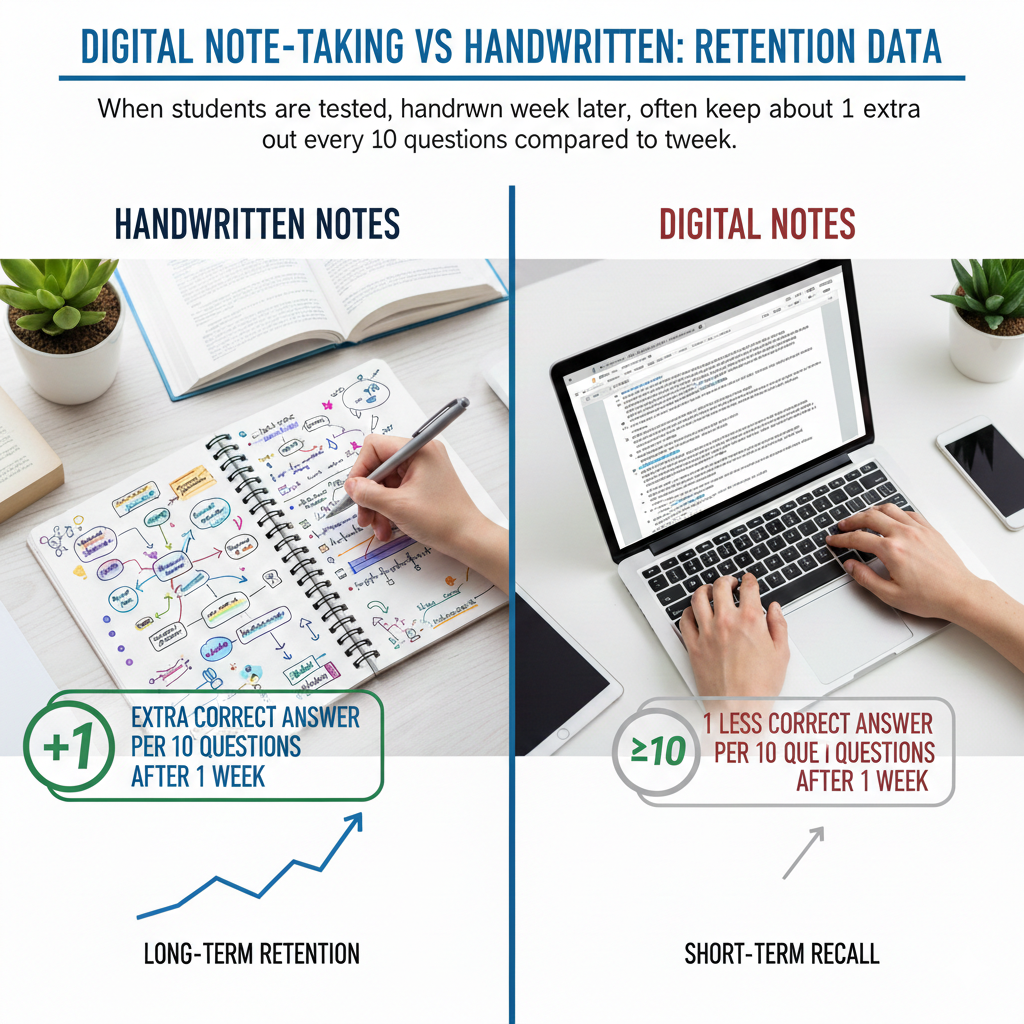
3) When students are tested 1 week later, handwritten note-takers often keep about 1 extra correct answer out of every 10 questions compared to typers.
What this means for retention
One extra correct answer out of ten may sound small, but across a term it becomes a big difference. It can mean a higher grade, less panic, and more confidence. The key point here is time. One week later is when real learning shows up.
Short-term memory can make anyone look good right after class. But a week later, the brain has already “cleaned house” and kept only what felt meaningful.
Handwriting often creates that meaning because it forces a child to compress ideas. Compression is like packing a suitcase. When you pack only what you need, you can find it later. When you throw everything in, you cannot.
Actionable advice you can use today
Teach your child a one-week plan that is simple and steady. On the same day as the lesson, they do a three-minute review of their notes. The next day, they do a two-minute recall talk without looking. Three days later, they do a quick check using only questions they create from the notes.
On day seven, they take a short self-test.
If you want a shortcut, use a notebook rule: at the bottom of every page, your child writes a “one-sentence truth.” It is one sentence that captures the whole lesson. A week later, they read that sentence and try to rebuild the lesson in their head. If they cannot, they return to the key lines.
Debsie classes can make this easier because we teach students how to turn lessons into small pieces that are easy to revisit. If your child struggles with forgetting after a few days, a free trial class can help you see how our teachers build memory with simple habits.
4) Typing notes tends to create 30–60% more total words than handwriting in the same time.
What this means for retention
Typing is fast, so the page fills up quickly. That sounds helpful, but more words do not always mean more learning. Many kids feel proud when they have a long document. They think, “I captured everything, so I’m ready.”
The problem is that a big pile of words can hide the main idea. When your child tries to study later, they face a wall of text. They read it like a story, their eyes move, but the brain does not work hard. This is how kids “study” for an hour and still forget.
More words can help only when the extra words are useful details that the child understands. If the extra words are copied lines from a teacher or slides, the brain often treats them like noise. The child becomes a recorder, not a learner.
Actionable advice you can use today
If your child types notes, give them a word limit. It sounds strict, but kids often love it because it becomes a clear game. For a 30-minute class, set a target like 200–300 words. That forces thinking. It also makes review easy.
If the teacher is fast, your child can type “raw notes” during class, but they must do a clean rewrite right after in fewer words. This rewrite is the real learning step.
Another simple rule is the “bold test.” When your child finishes typing, they should highlight only the words they truly need to remember. If they end up highlighting most of the page, the notes are too long and too copied. They should rewrite the page again in half the words.
If your child learns with Debsie, this becomes easier because our lessons are built to be note-friendly. Our teachers often pause at key moments and guide students on what to write, so the child does not feel forced to type every sentence.
5) Handwriting notes usually produces 30–50% fewer words, but a higher share of key ideas.
What this means for retention
Fewer words can be a strength. When children write by hand, they naturally cut out extra lines. They skip filler words and capture the core idea. This creates notes that are easier to study. They also become more personal. A child’s own words match the way they think. That match makes memory stronger.
This is the main reason handwriting helps with deeper learning. The brain likes meaning, not volume. When a child writes fewer words, they are forced to decide what is important. That decision trains focus. It also builds confidence, because the child can actually “see the lesson” on one page.
Actionable advice you can use today
Teach your child a “key idea first” habit. When the teacher starts a new point, your child writes a short title first, like “Why volcanoes erupt” or “Loop rules in coding.” Then they write only three to five lines under it. If they want more, they can add one example line. This keeps the notes clean and strong.

At home, do a quick check. Ask your child to show you one page and point to the key idea lines. If they cannot, the notes are too messy. If the page has only tiny details and no main idea, teach them to add a one-line summary at the bottom.
Debsie students can use the same method in our live classes. Our teachers often use simple frames that make it easy to spot the key idea, so kids do not drown in details.
6) In controlled classes, typers are often 2–3× more likely to copy sentences word-for-word from the teacher or slides.
What this means for retention
Copying feels productive, but it is a trap. When kids copy word-for-word, they may not understand what they wrote. The hands are busy, but the mind is not engaged. Later, they read the notes and think, “This looks smart,” but they still cannot explain it. This is why typing can reduce retention in deep topics. It makes copying too easy.
When a child’s notes look like the teacher’s slides, it is a warning sign. It usually means the child did not translate the idea into their own simple words. That translation is what helps memory stick.
Actionable advice you can use today
Use a “no full sentence” rule for typed notes during class. Your child can type short phrases, not long lines. If they must capture a full sentence, they should do it only for a definition, not for an explanation.
After class, do a fast “own-words pass.” Your child reads one copied line and rewrites it in simpler words underneath. This takes five minutes and can change everything. If they cannot rewrite it, they do not understand it, and that becomes your signal to revisit the lesson.
If your child uses Debsie, they can ask the teacher to explain a point in a simpler way, and our teachers are trained to do that. Kids learn best when they can restate the idea clearly. A free trial class can show you how we build that habit.
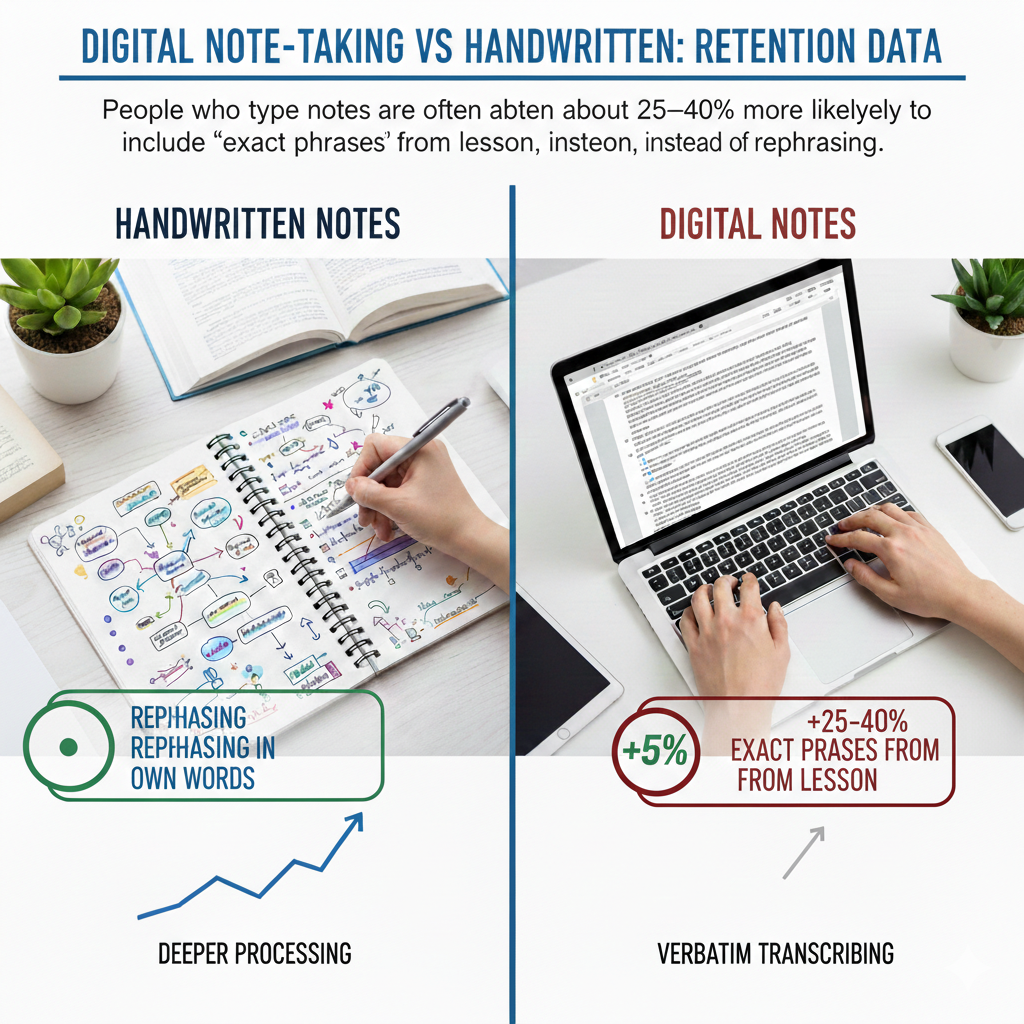
7) People who type notes are often about 25–40% more likely to include “exact phrases” from the lesson, instead of rephrasing.
What this means for retention
Exact phrases are not always bad, but they often reduce learning when kids do not own the meaning. A child might type “The mitochondria is the powerhouse of the cell” and remember the line, but not understand what it does. They can repeat words without learning the idea.
Rephrasing is like chewing food. If you swallow whole, you do not digest well. If you chew, your body uses it. The brain works the same way. Rephrasing forces the brain to process and connect the idea to what the child already knows.
Actionable advice you can use today
Make rephrasing a simple habit. Tell your child: every time they type a sentence from the lesson, they must add a second line that starts with “In my words:” and then rewrite it in a simpler way. This takes seconds, not minutes, but it forces real thinking.
Also teach the “kid test.” Your child should write as if they are explaining to a younger student. If the line still sounds like a textbook, they should simplify it again. The goal is clear, not fancy.
In Debsie classes, we use simple language on purpose. We want students to truly understand, not just copy smart phrases. If your child struggles to rephrase, guided lessons with a teacher can make that skill grow quickly.
8) Handwritten notes are often about 20–40% more likely to include drawings, arrows, or quick diagrams—things linked to understanding.
What this means for retention
Many kids learn best when they can see how ideas connect. Drawings, arrows, and tiny diagrams turn a lesson into a picture. A picture is easier to recall than a paragraph. This is one quiet reason handwriting helps.
When a child has a pen in hand, it is natural to add a quick sketch, circle a key word, or draw an arrow from cause to effect. On a keyboard, that same move feels harder, so it often does not happen.
These small marks matter because they show thinking. An arrow can mean “leads to.” A box can mean “this is the main point.” A tiny graph can show a trend. Even if the drawing is not pretty, it can be powerful. It gives the brain hooks. Later, the child remembers the hook and then remembers the idea.
Actionable advice you can use today
Give your child permission to draw “ugly learning drawings.” Many children stop drawing in notes because they think it must look nice. Tell them it does not. The goal is speed and meaning. Ask them to add at least one visual mark for every major idea: an arrow, a box, a simple stick diagram, or a quick flow.
You can also use a simple rule: for science, draw a process; for math, draw steps; for coding, draw a flow; for reading, draw a character map. Keep it short. One small sketch is enough.
If your child must use digital tools, encourage a stylus or a small whiteboard next to the laptop. They can type the words but draw the links by hand. This keeps the “visual advantage” even in a digital study space.
Debsie teachers often invite students to show their diagrams on camera during live classes. That makes students more willing to use visuals, and it helps them remember the lesson later.
9) When students type and do no review, their scores on deep questions often drop about 10–15% compared to handwriters.
What this means for retention
This stat is a warning sign. Typed notes without review can become a false comfort. A child thinks, “I typed everything, so I’m done.” Then they do not revisit it. A week later, the notes are long, and the lesson feels far away. Deep questions require strong understanding, and understanding fades fast if it is not refreshed.
Handwriting often includes built-in review because the child is already processing while writing. Typing can skip that processing, so review becomes even more important. Without review, the gap shows up on tests that ask for explanations, steps, and reasoning.
Actionable advice you can use today
If your child types notes, attach a tiny review habit to the end of every class. Keep it short so it actually happens. Use this simple sequence: the child reads the notes for one minute, closes the laptop, and then says three key ideas out loud.

Then they open the laptop and check what they missed. This whole routine can be done in three minutes.
Another strong habit is the “next-day check.” The next day, they open the notes and write a five-line summary from memory before reading. This feels hard at first, but it trains recall, which is what tests need.
If your family wants structure, Debsie classes provide built-in checkpoints. Our teachers guide students to restate ideas and solve small challenges during class, which acts like review and reduces forgetting.
10) When students type but are forced to summarize (not copy), their deep-question scores often rise and get close to handwriting—usually within 0–5%.
What this means for retention
This is good news. It means the real issue is not the keyboard. The real issue is copying. If typing is used for summarizing, typing can become nearly as strong as handwriting for deep learning. The brain learns when it must compress and reword. That can happen on paper or on a screen.
So you do not need to “ban” typing. You need to teach a better way to type. This also helps kids who have neatness issues with handwriting, or who write slowly and get stressed.
Actionable advice you can use today
Use a “summary-only” rule for typed notes. Your child is allowed to type only after they can say the point in their own words. If they cannot say it, they should not type it yet. They should ask for a clearer explanation, or they should reread the part.
You can also use a simple limit: every idea must fit in two lines. If it cannot, they do not understand it. Tell them to break the idea into smaller parts until each part fits in two lines.
Another practical move is to type in “question form.” Instead of writing “Photosynthesis uses light to make food,” type “How do plants make food?” Then answer in one short line. This forces meaning, not copying.
Debsie supports this style very well because our lessons are broken into clear chunks. Students can summarize each chunk, which keeps typing focused and effective.
11) If typed notes are mostly copying, students often remember fewer “why/how” points—commonly 1–2 fewer points on a short test.
What this means for retention
A short test might have only five to ten questions. Missing one or two “why/how” points can drop a grade fast. This is why copying is risky. It fills the page with “what was said,” but it does not build the child’s own explanation system.
When kids copy, they often keep surface details but lose the deeper link. They might remember a term, but not the reason behind it. They might know a step, but not why the step matters. Deep memory is built through understanding and use.
Actionable advice you can use today
Teach your child to write one “because” line for every big idea. After they type a point, they add a line that begins with “because.” For example, “We use a loop because it repeats the same action.” This tiny move forces them to connect reason to action.

You can also use a “why column.” Even without drawing a table, your child can simply add a second short line under each point that answers “why does this matter?” If they cannot answer, they mark it and ask the teacher later.
In Debsie coding and science classes, we train kids to explain their thinking, not just show an answer. That habit protects them from losing the “why/how” points, which is where many students slip.
12) Handwriting tends to slow the writer down by about 2–4× compared to typing speed, which pushes more “thinking while writing.”
What this means for retention
Speed changes behavior. When typing is fast, children can record without thinking. When handwriting is slower, children must choose. That choice acts like a mental filter. It pushes the brain to process while the hand moves. This “thinking while writing” is one of the strongest drivers of real learning.
But we do not want handwriting to become painful. If a child writes too slowly or struggles with handwriting, they may miss key points and feel upset. The goal is not slow writing. The goal is thoughtful writing.
Actionable advice you can use today
Make handwriting easier by reducing what must be written. Teach your child to write “idea phrases,” not full sentences. They can also use symbols like arrows and short labels. This keeps the pace comfortable.
If the class is very fast, your child can use a hybrid method. They can write only titles and key ideas by hand, then fill in one extra example after class while memory is fresh. This way they do not fall behind during the lesson.
Also give the child a simple permission: it is okay to leave blanks. If they miss a word, they draw a small line and keep going. After class, they ask a friend or the teacher. This protects focus and prevents panic.
Debsie teachers help students take notes without stress. We guide them on what matters most, so the child can write slower but still capture the heart of the lesson.
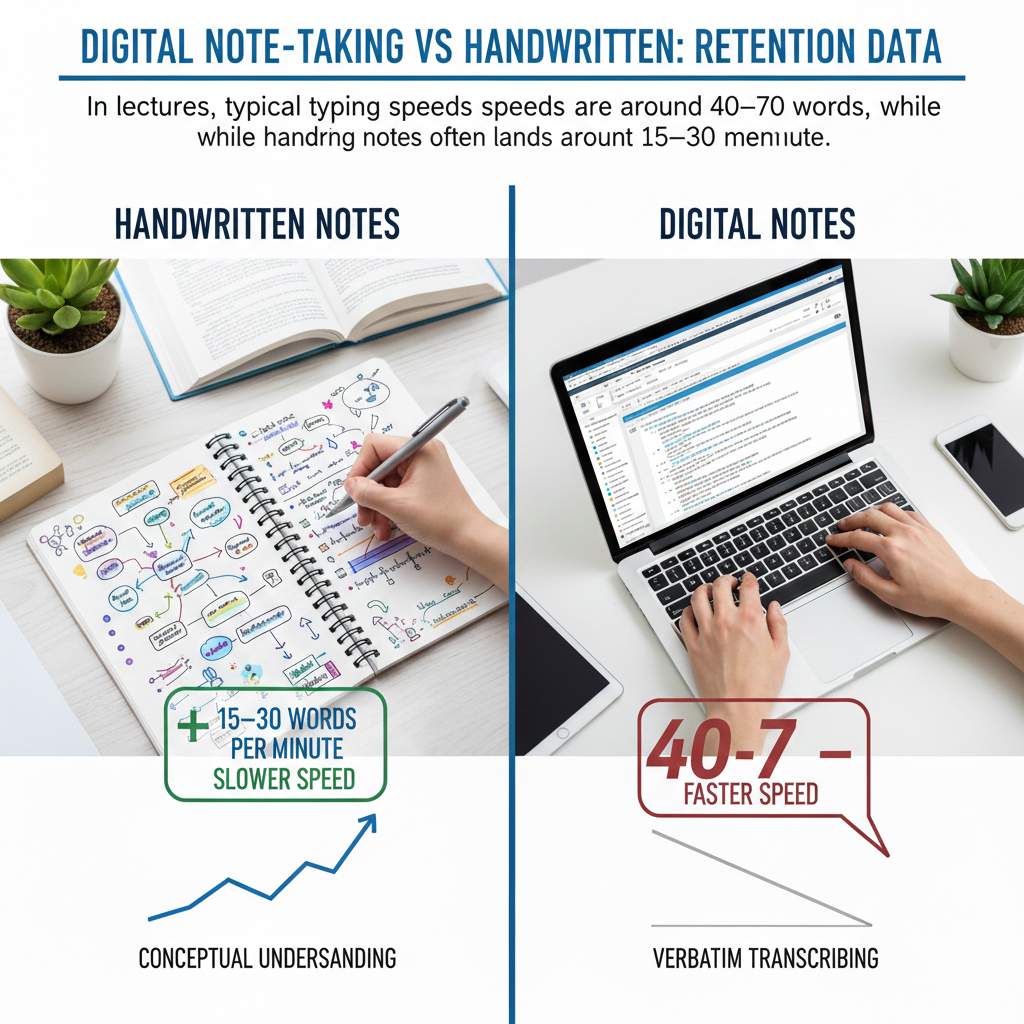
13) In lectures, typical typing speeds are around 40–70 words per minute, while handwriting notes often land around 15–30 words per minute.
What this means for retention
This speed gap explains many note-taking problems. At 40–70 words per minute, a child can chase the teacher’s voice and try to catch every line. At 15–30 words per minute, they cannot. They must filter.
Filtering is what turns “input” into “learning.” It also reduces overload. Many kids do not fail because they are not smart. They fail because they take in too much at once and cannot organize it.
The speed gap also affects stress. A child who types may feel pressure to keep up with every sentence. A child who writes may feel pressure because they are slower. Both can be stressed, just in different ways. The goal is to create a system that uses speed wisely without turning note-taking into a race.
Actionable advice you can use today
If your child types, teach “selective typing.” They should never try to type everything. They should type only headings, key terms, and short idea lines. If they are typing full paragraphs, they are likely copying. If your child writes by hand, teach “capture the spine.”
The spine is the main idea of each section. They should write the spine first, then one supporting point, then one example. That is enough.
You can also use a simple timer method. During a lesson video, pause every five minutes. Ask your child to write one sentence that explains what just happened. This makes speed less important and meaning more important.
In Debsie live classes, students can ask teachers to repeat or slow down at key moments. We welcome that. It helps students build strong notes without feeling rushed.
14) In many experiments, “verbatim typing” (copying) explains a big chunk of the gap—often over half of the retention difference.
What this means for retention
This is one of the most important points in the whole topic. It says the tool is not the villain. The behavior is. When a child copies, they skip the mental work that turns words into understanding. That is why the difference between typing and handwriting often shrinks when typing is done in a thoughtful way.
If over half of the retention gap comes from copying, then fixing copying can fix most of the problem. That is good news because copying is a habit, and habits can be changed.
Actionable advice you can use today
Set a clear family rule: typed notes must be “reworded notes.” Your child is allowed to type a key term or a short quote, but every explanation must be in their own words. One way to make this stick is to require a simple marker like “so this means…” after each idea. For example: “If-else checks a condition, so this means the code can choose between paths.”
Another method is the “two-pass rule.” Pass one is quick capture during class. Pass two is a rewrite within 24 hours, cut to half the length. The rewrite must be in simpler language than the original. If the rewrite is still long, your child is still copying.
Debsie teachers can support this because we often ask students to explain a concept in their own words during class. That practice reduces verbatim typing and builds real understanding.
15) When laptops are allowed, students are often 2–4× more likely to multitask (tabs, messages) than students using paper notes.
What this means for retention
Multitasking is the silent killer of learning. A child may not even notice it. One second they are in class notes, the next second they are checking a message “just for a moment,” then they return. The brain pays a price each time it switches. The lesson thread breaks. The child misses a link. Later, the notes feel confusing, and the child thinks the topic is hard, when the real problem was the switching.
This does not mean laptops are bad. It means laptops need rules. Paper is naturally single-task. Screens are designed to pull attention in many directions.
Actionable advice you can use today
If your child uses a laptop for notes, create a “single-tab rule.” Only the class screen and the note screen are allowed. Everything else must be closed. Turn off notifications. If possible, use full-screen mode. Also place the phone in another room during learning time. This is not punishment. It is protection.

If your child must use a device for school systems, create a paper “anchor.” Keep a small notebook next to the laptop. When the teacher shares a key idea, your child writes it on paper. This keeps the brain grounded and reduces the urge to click away.
Debsie classes work well with this approach. We often use hands-on tasks that keep students active, which naturally reduces the desire to drift into other tabs.
16) Even short multitasking breaks (like checking a message) can cut quiz scores by about 10–20% in lab-style studies.
What this means for retention
A 10–20% score drop is huge. It can turn a strong score into a weak one. Many children think they are “good at multitasking.” But the brain does not truly multitask well. It switches. Each switch costs time and focus. Even a short message can steal the next two minutes of thinking because the mind keeps returning to it.
The scary part is that the child may still feel fine. They may not notice the learning loss until the quiz. That is why families need systems, not willpower alone.
Actionable advice you can use today
Use a simple “message window.” Tell your child they can check messages only at a set time, such as after class ends or after 25 minutes of work. This removes anxiety because the child knows they will not “miss everything.” It also protects the brain during learning.
Another strong move is the “two-minute reset.” If your child does get pulled into a message, they should not jump right back into the lesson. They should close the message, take two slow breaths, and then write one line: “What was the last point?” That small reset reconnects the learning thread.
In Debsie live classes, students are engaged through questions and challenges, which reduces off-task temptation. If your child’s quiz scores drop even when they “studied,” screen switching is one of the first things to check.
17) Students sitting near a multitasking laptop can also score lower—often around 5–15% lower—because distractions spread.
What this means for retention
Distraction is contagious. Even if your child is focused, a nearby screen with fast movement, bright colors, or scrolling text can pull attention. The brain is wired to notice motion. In a classroom, one multitasking student can hurt others. At home, one sibling watching videos nearby can do the same.
This matters for families because study spaces are often shared. A child may be doing “everything right” but still struggle because the environment is noisy for the eyes.
Actionable advice you can use today
Create a “quiet eyes” space. This means a spot where there is no moving screen in the child’s side vision. If that is not possible, place the child facing a wall or a calm area, not facing the room. Use headphones only if they help and do not become another distraction.

If your child attends online classes, keep other devices out of sight. Also keep the learning screen clean. Close all extra windows. A tidy screen is like a tidy desk.
Debsie classes can be taken from any quiet corner. If your child is easily distracted, consider a consistent “class corner” that is used only for learning. Over time, that spot becomes a mental cue that says, “Now we focus.”
18) Handwritten note-takers commonly create more organized pages (headings, spacing), with studies showing about 20–30% more structure markers.
What this means for retention
Structure is memory’s best friend. When notes have clear headings, space between ideas, and simple markers like boxes or underlines, the brain can scan them fast and know where to look.
Handwriting naturally invites this because the page is open and flexible. Kids tend to leave space, draw a quick line, or start a new section when the topic changes. That makes the notes feel like a map instead of a messy story.
Typed notes can be structured too, but many kids do not do it. They type in one long block because it is quick. Then, when they review, they cannot find what they need. They reread from the top, lose time, and feel frustrated. The result is less review and weaker retention.
Actionable advice you can use today
Teach one simple page pattern. At the top, the child writes a short title. Each time the lesson shifts, they leave a blank line and write a mini-heading. Under each heading they write only a few lines. This is easy on paper and also possible on a screen if they use short paragraphs and bold headings.
A strong habit is “one page, one idea family.” If a page has too many unrelated topics, the child will not remember them well. Encourage them to start a new page when the lesson changes direction.
At the end, ask the child to circle the most important line on the page. That circle becomes the fastest review point later.
In Debsie classes, we often model clear note structure by teaching in clear chunks. That makes it easier for students to mirror the structure in their notebooks.
19) Typers often capture more details, but handwriters often capture more main ideas—frequently 1.2–1.5× more main-idea statements per page.
What this means for retention
Details are not the same as learning. Details are small pieces. Main ideas are the glue that holds pieces together. When students capture more main ideas, they build a framework in the brain. Later, details can “hang” on that framework. Without it, details float around and get lost.
Typing often collects details because it can keep up with the teacher. Handwriting often captures main ideas because it cannot keep up with everything, so the writer picks what matters. For retention, main ideas tend to win, especially when tests ask for reasoning, cause and effect, or multi-step thinking.
Actionable advice you can use today
Train your child to spot main ideas by listening for signal phrases. Teachers often say, “The main point is…” “Remember this…” “This is important…” “The reason is…” When your child hears these, they should write a main-idea line.

If your child types, add a main-idea rule: after every five minutes, they must write one line that begins with “Big idea:” and keep it short. This interrupts detail dumping and forces meaning.
Also teach the “example check.” If a child has a main idea, they should be able to give one example. If they cannot, the main idea is not understood yet.
Debsie teachers often use clear, repeated “big idea” moments in class. That helps students capture the framework, not just the extra details.
20) When lessons are fast and dense, typing can improve “detail capture” by about 10–30%, but it does not always improve later understanding scores.
What this means for retention
Fast lessons create a real problem: kids miss things. Typing can help by catching more detail. But catching more detail does not guarantee understanding. A child may have more words, but still not know what they mean.
This is why typing can feel helpful yet not show up as higher scores later. Understanding needs processing, not just recording.
This stat also points to a smart strategy: use typing when the goal is to capture, then use a second step to turn capture into learning.
Actionable advice you can use today
Use typing as a temporary net. Tell your child: “In a fast lesson, type quick capture notes. After class, convert them into learning notes.” Conversion means rewriting the notes in fewer words and adding meaning lines like “This matters because…” or “This connects to…”
A simple conversion rule is “cut and clarify.” Cut the note length by half. Clarify by adding one example and one question. If your child cannot add an example, they do not understand yet and should revisit that part.
If the lesson is very dense, your child can also record only the key terms and then ask the teacher to explain one or two confusing points. It is better to understand five key ideas than to copy fifty lines.
Debsie’s lesson style helps here because we build dense topics into small, clear steps. That makes it easier to capture and convert without overwhelm.
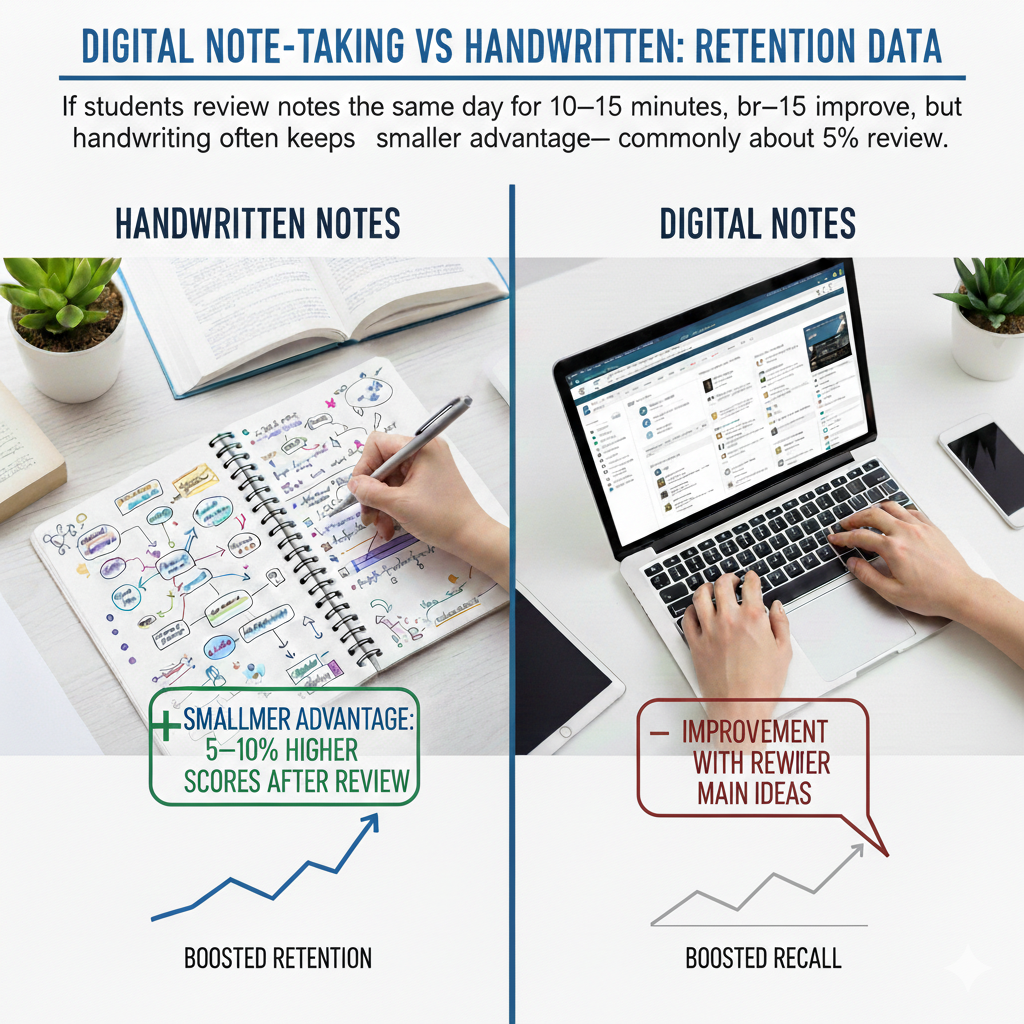
21) If students review notes the same day for 10–15 minutes, both groups improve, but handwriting often keeps a smaller advantage—commonly about 5–10%.
What this means for retention
Same-day review is one of the strongest memory tools a child can use. It works because the brain is still holding the lesson in a fresh way. A small review locks it in before it fades. This helps both typing and handwriting, but handwriting often keeps a small edge because the notes were already processed during writing.
The key is that review must be active. If a child only rereads, improvement is smaller. If they test themselves, improvement is stronger.
Actionable advice you can use today
Create a simple same-day habit that fits real life. Right after class, your child does a 10-minute “close and recall” session. They read a section, close the notebook or laptop, and speak the idea out loud. Then they check. This is fast and powerful.
If your child is tired, shorten it to five minutes but keep it active. Consistency beats length.
Another strong move is to write three questions from the notes and answer them without looking. Questions turn review into practice.
Debsie families can use this easily. After a live class, ask your child to teach you one part of the lesson. That is review in disguise, and kids often enjoy it when it feels like a short performance.
22) “Spaced review” (reviewing on multiple days) can boost recall for both types by roughly 20–40%, often shrinking the handwriting gap.
What this means for retention
Spaced review is like watering a plant. One big pour does not keep it alive for long. Small waterings over time do. When kids review on multiple days, the brain keeps getting the message: “This matters, keep it.” That is why recall can jump by 20–40%. It is one of the best ways to study without burning out.
This also means that even if your child types notes, they can still get strong retention if they use spaced review. The method of review can matter more than the method of note-taking.
Actionable advice you can use today
Use a three-touch plan. Touch one is the same-day quick review. Touch two is two days later, for five to seven minutes. Touch three is a week later, for a short self-test. This plan is simple enough to do with school life.
During the second touch, your child should not reread everything. They should try to recall first. They can write what they remember on a blank sheet, then compare with notes. This makes memory grow faster.
If your child forgets quickly, do not add hours. Add touches. A few minutes over several days often works better than one long session.
Debsie’s gamified learning style fits spaced review well. Kids like short challenges. If you want help setting up a spaced plan, a free trial class can show how our teachers build review into fun practice.
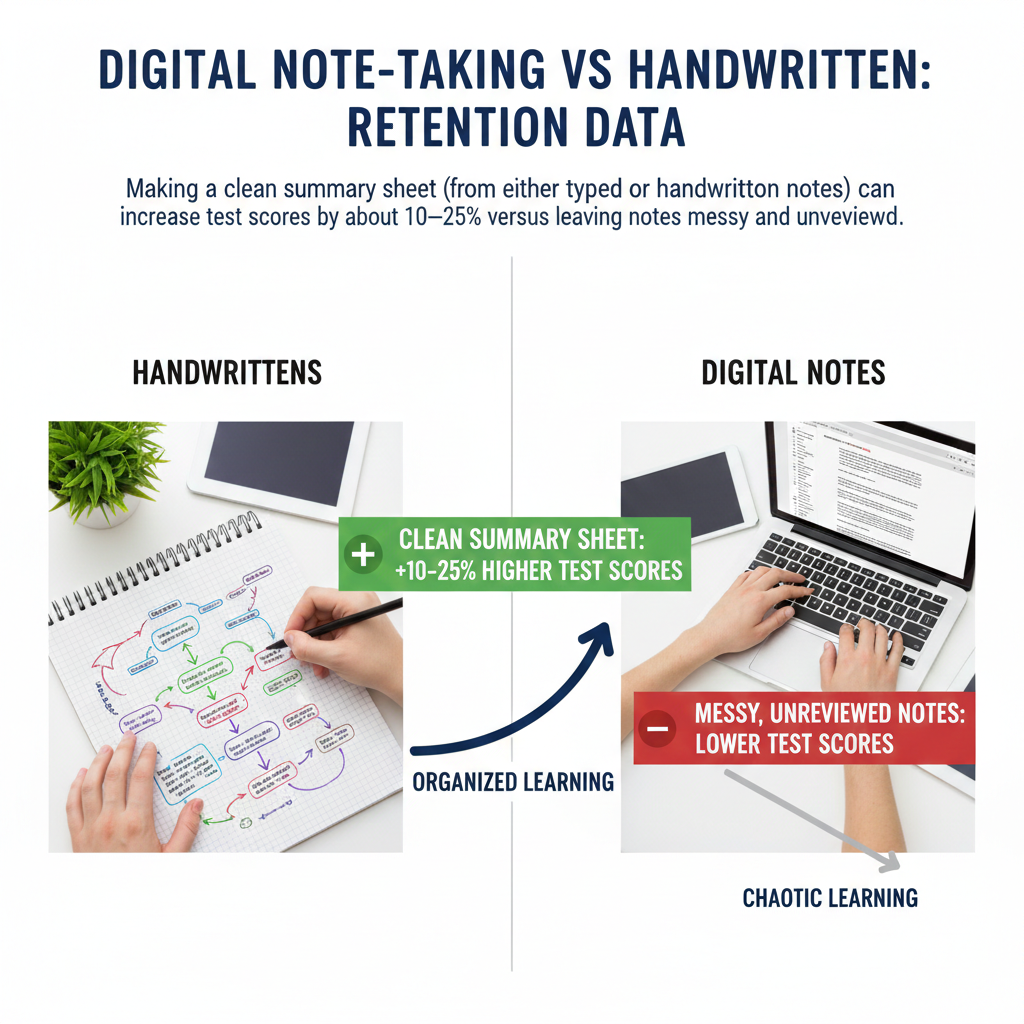
23) Making a clean summary sheet (from either typed or handwritten notes) can increase test scores by about 10–25% versus leaving notes messy and unreviewed.
What this means for retention
A summary sheet is not just a “nice copy.” It is a thinking tool. When a child makes a clean summary, they must decide what stays and what goes. That decision forces understanding. It also creates a short page that is easy to review before a quiz.
Messy notes are hard to use. Kids avoid them. Clean summaries get used, so memory gets refreshed.
The 10–25% gain is also about confidence. When a child has one clear page, they feel in control. That calm focus helps performance. When they have ten messy pages, they feel lost and stressed, and stress blocks recall.
Actionable advice you can use today
Make summary sheets a weekly habit, not a last-minute panic move. Pick one day, like Friday, and spend 20 minutes making one summary sheet per subject. The summary must be short. If it becomes long, it stops being a summary and becomes another messy set of notes.
The best approach is “memory first, notes second.” Ask your child to write the summary from memory first. Then they open their notes to fix gaps. This trains recall and shows what they truly know.
If your child types, the summary sheet can be digital, but it must still be short and clear. If your child writes by hand, the summary sheet can be a single clean page. Either is fine.
In Debsie, students often learn complex topics in small steps. A summary sheet is a perfect way to keep those steps clear. If your child wants help making strong summary pages, our teachers can show them how to do it without wasting time.
24) Adding simple sketches or concept maps (more common on paper) is linked to about 10–30% better performance on explanation questions.
What this means for retention
Explanation questions reward connections. They ask a child to show links between ideas. Sketches and concept maps are built for links. They show cause and effect, steps, and relationships. When a child draws a map, they are not just writing facts. They are building a structure in the brain.
This is especially helpful in science, history, and coding. In science, processes matter. In history, causes and results matter. In coding, flow matters. Maps make flow visible, and visible flow is easier to remember.
Actionable advice you can use today
Teach your child a simple concept map style that is quick. Write the main idea in the middle. Draw three branches for the three biggest parts. Under each branch, add two small details. Keep it short. The goal is speed, not art.
If your child hates drawing, start with arrows only. For example, “Problem → Plan → Steps → Result.” Even this is a concept map. It counts.
A strong study move is to make a concept map from memory. Then compare it with notes. The missing parts show what needs review.
Debsie teachers often use visual thinking in class, especially for coding and science. If your child learns better with pictures, our free trial class can help you see how we turn big topics into clear maps.
25) For vocabulary learning, handwriting the word + meaning (not typing) often leads to about 10–20% better recall in later tests.
What this means for retention
Vocabulary looks simple, but many kids struggle with it. They read a word, nod, and forget it later. Handwriting helps because it makes the brain slow down and notice the word shape. It also pushes attention to spelling and meaning at the same time. That dual focus can help memory stick.
Typing can work too, but it is easier to rush. A child can type a word without really seeing it. With handwriting, the child feels each letter, and that physical act can strengthen recall.
Actionable advice you can use today
Use a short handwriting routine for new words. The child writes the word once, then writes the meaning in simple words, then writes one short sentence using the word. This should take under a minute per word. Keep the list small. Five words per day is better than twenty words once a week.
Then do a quick test later. Cover the meaning and ask the child to explain it. If they cannot, they rewrite the word and meaning one more time and try again.
If your child prefers digital tools, keep the handwriting step as the “first imprint,” then store the words digitally for spaced review. This mix keeps the handwriting advantage while using technology for reminders.
Debsie supports language and reading growth with clear, simple explanations. If your child needs stronger vocabulary for science, math, or coding terms, a guided approach helps a lot.
26) For math and science problem-solving, paper notes and paper practice often lead to fewer careless mistakes, commonly about 10–25% fewer.
What this means for retention
Math and science are not only about memory. They are about steps. Many mistakes happen because a child skips a step, loses track, or misreads a symbol. Paper often reduces these issues because the child can spread the work out, circle terms, and see the full path at once.
Screens can compress work into small spaces. Scrolling can hide earlier steps. That can increase careless errors, especially for younger students or students who rush.
Actionable advice you can use today
For math and science, keep problem-solving on paper even if the lesson is online. Your child can watch the screen but solve on paper. This creates a clear trail of thinking. Tell them to write each step on a new line. This reduces skipped steps.
Teach a “final scan” routine. Before submitting, your child checks three things: units, signs, and the question asked. Many errors come from forgetting a minus sign, mixing units, or answering a different question than the one asked.
If your child does digital homework, they can still write the work on paper and then type the final answer. This keeps accuracy high.
Debsie math and science classes are hands-on. We encourage students to show steps clearly. This builds careful thinking, which reduces careless mistakes over time.
27) Students who type notes are often more confident (they “feel” they learned more) even when scores are lower—confidence can be 10–20% higher than actual performance.
What this means for retention
This is a tricky one because it affects study choices. When a child types a lot, they feel productive. They see many words and think, “I know this.” That feeling can be wrong. It can cause them to stop studying too early. Then the test reveals the gap.
Confidence is not bad. False confidence is the problem. The fix is not to make kids doubt themselves. The fix is to measure learning in a better way.
Actionable advice you can use today
Teach your child one simple truth: “If you cannot explain it without looking, you do not own it yet.” After note-taking, do a fast self-check. Close the notes and speak the main idea. If they can explain it clearly, confidence is real. If they cannot, they need review.
Another strong move is practice questions. One or two questions are enough to reveal real understanding. If your child struggles, the notes are not done yet.
Also watch for the “long notes, short memory” pattern. If your child has long typed notes but cannot solve problems or explain ideas, shift them toward summaries and recall practice.
Debsie teachers use small checks during class so students do not build false confidence. They answer, explain, and apply. That makes confidence match real skill.
28) When students use a tablet with a stylus (digital handwriting), retention results are often closer to paper, usually within 0–10% of paper note performance.
What this means for retention
This stat matters for modern families because many kids already use tablets. A stylus lets a child write in a way that feels like paper, even though the surface is digital.
That writing motion can bring back many of the benefits of handwriting, such as slower pace, better processing, and easy use of arrows, circles, and quick diagrams. At the same time, the child keeps digital benefits like saving notes, searching pages, and carrying everything in one device.
The reason results are often within 0–10% of paper is that the brain seems to respond well to the act of writing, not only to the physical paper. If the child is truly writing, choosing, and organizing, retention can stay strong.
Actionable advice you can use today
If your child uses a stylus, set it up to behave like paper. Use a simple template page with a clear title space at the top and plenty of blank room. Encourage your child to write big enough to read later. Tiny writing leads to messy pages and weak review.
Also teach the “one screen, one idea” habit. Avoid endless scrolling. Start a new page when the topic changes. This keeps notes structured and helps recall, just like turning a paper page.
Most importantly, keep the screen distractions under control. A stylus does not stop multitasking by itself. Turn off notifications, keep the note app full-screen, and keep other apps closed during learning time.
In Debsie classes, a stylus can work very well, especially for math, science diagrams, and coding flow. If your child prefers digital tools, a stylus-based notebook can be a strong middle path.
29) When students switch from typing to handwriting for a month, many report less copying and studies often show a small-to-medium score jump (roughly 5–15% on deeper questions).
What this means for retention
A month is long enough for a habit to change. When students switch to handwriting, they often stop chasing every word. They start listening more. They start choosing. They also begin to trust that they do not need to capture everything to learn. This reduces copying and increases understanding, which is why deeper-question scores can rise by 5–15%.
This also points to an important idea: note-taking is a skill that can be trained. It is not fixed. A child who “is not good at studying” may simply be using a method that does not force real thinking.
Actionable advice you can use today
Try a 30-day handwriting challenge with a soft start. Do not change everything at once. Choose one subject that needs more understanding, such as science or coding, and use handwriting only for that subject for one month. Keep it simple and low-pressure.
Each week, do a short check. Ask your child to explain one lesson using their notes. If the explanation is clearer than before, the habit is working. If the child feels they cannot keep up, remind them that notes do not need to be complete. They need to be useful.
At the end of the month, compare results. Look at quiz scores, but also look at stress level and time spent studying. Many families notice that kids study less but remember more.
Debsie can support this month-long shift because our classes reward explanation, not copying. Students practice the kind of thinking that makes handwritten notes powerful.
30) Across many lab studies, the overall advantage of handwriting for deep understanding is usually small-to-medium, often around a 0.2–0.6 “effect size” (meaning a noticeable, but not magical, improvement).
What this means for retention
This final stat keeps expectations realistic. Handwriting helps, but it does not replace good teaching, good practice, and good review. A small-to-medium improvement means you will notice it, especially over time, but it will not fix every learning problem on its own.
If a child never reviews, never practices, or never asks questions, handwriting will not save them.
The good news is that small-to-medium gains are powerful when they are consistent. A small gain in understanding each week becomes a large gain over a school year. It can mean stronger grades, better confidence, and less last-minute panic.
Actionable advice you can use today
Think in systems, not tricks. Choose a note-taking plan your child can follow every week. For deep lessons, use handwriting or stylus writing. For fast fact capture, typing is fine, but add a summary step. Then protect learning with spaced review, even if it is only a few minutes.
Also measure learning the right way. The best test is simple: can your child explain the idea clearly without looking? If yes, the method worked. If not, adjust the system.
Finally, remember that learning is not only school. Strong note habits build life skills: focus, patience, clear thinking, and problem-solving. These skills matter in every future job and every big goal.
If you want your child to build these skills with guidance, Debsie’s live classes and gamified challenges are designed for exactly that. You can start with a free trial class on Debsie.com and see how our teachers help students learn deeply and confidently.
Conclusion
Digital notes and handwritten notes are not enemies. They are tools. The retention data shows one clear pattern: when the goal is deep understanding, handwriting usually gives a steady edge, mainly because it slows the child down, reduces copying, and makes thinking happen during note-taking.
Typing can still work very well when it is used to summarize, not to copy, and when it is followed by short, active review. The biggest losses happen when a child types a lot, feels confident, and then does not review.