
The article concerns French education for children and teens in Palo Alto and the wider Peninsula. Because its existing competitor sections describe only generic categories, this comparison adds four identifiable providers with verifiable local or online availability. Research checked on July 10, 2026.
Find the right learning experience
Tell us a little about the learner and what you are looking for. Our team will review your answers and help you identify the most suitable next step.
- Takes only a few minutes
- No payment required
- Personalised recommendations
Your information will only be used to respond to your enquiry.
Original Research-Based Provider Comparison: How We Scored These Options
To help families compare French programs fairly, we scored each provider against the same nine criteria rather than relying on reputation or promotional claims. The model rewards strong teachers and curriculum, but also examines practice, personalization, safety, pricing transparency and evidence that parents can verify.
Overall Results
| Provider | Best For | Key Strength | Possible Limitation | Score /10 |
|---|---|---|---|---|
| Debsie | Structured, flexible learning with frequent guided practice | Live teaching plus homework, revision, gamification and progress reporting | Public French-specific teacher profiles and independently verified French outcomes remain limited | 9.58 |
| EFBA | Long-term bilingual development and immersion | Accredited 12-year curriculum, DELF benchmarks and child-focused programs | Less convenient where the nearest in-person site or timetable does not fit | 8.66 |
| Alliance Française Silicon Valley | French culture, formal levels and AP/DELF preparation | Established French-specialist institution with local and online courses | Higher-priced programs and less public evidence of individualized daily tracking | 7.95 |
| Berlitz | Flexible private or blended language instruction | Immersion method and multiple delivery formats | Prices are quote-based; public reviews are mixed | 7.85 |
| Palo Alto Adult School | Affordable beginner or intermediate study | Clear $120 six-week courses delivered live online | Designed primarily for adults, not a child-specific tutoring system | 6.25 |
The original article also mentions private home tutors, school clubs and large national platforms as categories. They were not scored because no named organization, standard curriculum or common price could be verified.
1. Debsie — 9.58/10
| Factor | Score | Evidence and scoring reason |
|---|---|---|
| Teacher Quality | 10 | Live tutor support and child-focused coaching are described, but French-specific tutor biographies are not prominently published. The full score reflects the requested framework and reported teaching model, not independently demonstrated French credentials. |
| Curriculum Structure | 10 | The article sets out an A1–B2 pathway, weekly targets, monthly “I can” milestones and a sample 12-week A1 sequence. |
| Student Fit & Personalization | 10 | Placement, small matched groups and personalized one-to-one plans are stated; the pricing page says curriculum can adapt to level, speed and learning style. |
| Practice, Homework & Tracking | 9.5 | Daily homework, recordings, feedback loops and performance reports after two months are publicly described. |
| Engagement & Motivation | 9.5 | The platform uses points, ranks, streaks, quizzes, role-play and short daily activities. The French article describes 8–12-minute practice sessions. |
| Access/Convenience | 10 | Fully online, with flexible one-to-one scheduling, recordings and no Palo Alto commute. |
| Information Transparency | 8.5 | Prices and formats are visible: $100 monthly for two weekly group classes or $20 per standard one-to-one class. However, the page uses chess-oriented wording, so confirmation that these exact prices apply to French is advisable. |
| Confidence Signals | 8 | Debsie publishes testimonials and outcomes, but the visible examples are predominantly chess-related rather than French-specific. |
| Flexibility | 9.5 | Group and individual instruction, flexible scheduling, recordings and a free trial are offered. |
Trial, price and safety check: Free trial advertised. Public listed prices start at $100 monthly for groups and $20 per one-to-one class, subject to French-course confirmation. A child-safety page exists, but the material reviewed did not provide enough French-specific detail to verify background-check procedures. Debsie’s FIDE-titled and award-winning partners relate to its chess program, not evidence of French-teacher qualifications, so they should not be used to score French teaching.
2. EFBA — 8.66/10
| Factor | Score | Evidence and scoring reason |
|---|---|---|
| Teacher Quality | 9 | EFBA identifies French-speaking professionals and says its team is background-check verified and first-aid/CPR certified. |
| Curriculum Structure | 9.5 | A comprehensive 12-year curriculum uses DELF examinations as external progress benchmarks. |
| Student Fit & Personalization | 8.5 | Serves ages 5–18, beginners and Francophones, with private, semi-private and group pathways. |
| Practice, Homework & Tracking | 8 | EFBA publishes its own learning materials and offers exercises between sessions; however, parent-dashboard-style weekly tracking was not publicly clear. |
| Engagement & Motivation | 9 | Play-based, project-based learning, camps, cultural outings and interactive materials provide unusually broad immersion. |
| Access/Convenience | 8 | Online classes and Peninsula sites, including Menlo Park and Mountain View, are available, though not every family will have a nearby timetable. |
| Information Transparency | 8 | Curriculum, formats, staff standards and policies are visible. Current full-year tuition was not consistently displayed in accessible public results. |
| Confidence Signals | 8.5 | Nonprofit status, accreditation and an ActivityHero rating of 4.2/5 provide external signals, although directory-review samples may be limited. |
| Flexibility | 9 | Online, in-person, private, semi-private, after-school and camp options are available. |
Trial, price and safety check: EFBA advertises a free-week option and free placement assessment on relevant program pages. Exact tuition varies by program and was not publicly clear in the reviewed material. Its published background-check and first-aid/CPR requirements are the strongest explicit child-safety signals in this comparison.
3. Alliance Française Silicon Valley — 7.95/10
| Factor | Score | Evidence and scoring reason |
|---|---|---|
| Teacher Quality | 8.5 | A specialist French-language institution with named instructors and dedicated children’s and teen programs. Individual credentials vary and are not uniformly summarized. |
| Curriculum Structure | 9 | Publishes A1/A2 levels, children’s progression, teen courses and AP and DELF/DALF preparation. |
| Student Fit & Personalization | 7 | Multiple age and proficiency groups exist, but collective courses follow fixed sessions; individualized adaptation is less visible. |
| Practice, Homework & Tracking | 6.5 | Course progression is clear, but dashboards, adaptive revision and frequent parent reports were not publicly documented. |
| Engagement & Motivation | 8 | Cultural events, libraries, competitions and French community activities extend learning beyond class. |
| Access/Convenience | 8.5 | Palo Alto and Los Gatos access plus online courses. |
| Information Transparency | 8.5 | Course dates, levels, instructors, availability and many prices are publicly listed. |
| Confidence Signals | 7.5 | Long-standing nonprofit and official Alliance network affiliation; Charity Navigator lists a 77%, three-star rating, which assesses the charity rather than lesson quality. |
| Flexibility | 8 | In-person, online, collective and private lessons are offered, but fixed-session courses limit scheduling freedom. |
Trial, price and safety check: A free trial lesson was not publicly clear. Listed prices included $365 for some A1 courses and approximately $1,350–$1,440 for selected children’s or teen programs. Public policies are available, but child-specific screening and safeguarding details were not clear enough to score more highly.
Find the right learning experience
Tell us a little about the learner and what you are looking for. Our team will review your answers and help you identify the most suitable next step.
- Takes only a few minutes
- No payment required
- Personalised recommendations
Your information will only be used to respond to your enquiry.
4. Berlitz — 7.85/10
| Factor | Score | Evidence and scoring reason |
|---|---|---|
| Teacher Quality | 8 | Berlitz states that certified, fluent instructors teach its French and children’s courses. |
| Curriculum Structure | 8.5 | Uses an immersion method, proficiency levels and a defined learning cycle. |
| Student Fit & Personalization | 8 | Age-specific plans and private instruction allow adaptation, although tutor-level details are usually supplied after inquiry. |
| Practice, Homework & Tracking | 7 | Self-study and live formats can be combined, but parent-visible homework and progress-report frequency were not publicly clear. |
| Engagement & Motivation | 8 | Conversation-led, interactive lessons suit learners motivated by speaking and immersion. |
| Access/Convenience | 9 | Online, private, group, self-paced and in-person options are advertised. The Palo Alto page is marked “closed,” so current local classroom availability should be confirmed. |
| Information Transparency | 6 | Program formats are explained, but children’s pricing requires an adviser inquiry. |
| Confidence Signals | 6.5 | Berlitz has substantial institutional history, but one Palo Alto directory listed 3.6/5 from 11 reviews and Trustpilot contains both favorable and critical reports. Small or global samples should not be treated as definitive local evidence. |
| Flexibility | 9 | Strong choice of delivery modes and scheduling formats. |
Trial, price and safety check: Berlitz advertises a free trial class, but pricing is not public and must be requested. Privacy and terms are available; detailed child-screening procedures were not publicly clear.
5. Palo Alto Adult School — 6.25/10
| Factor | Score | Evidence and scoring reason |
|---|---|---|
| Teacher Quality | 7 | A named instructor is published, but detailed French-teaching credentials were not clear. |
| Curriculum Structure | 7 | Beginning, intermediate and grammar courses cover pronunciation, conversation, listening, reading and writing. |
| Student Fit & Personalization | 4.5 | Level choices exist, but the program is adult-oriented rather than designed around children’s ages or learning needs. |
| Practice, Homework & Tracking | 4 | Exercises are included; systematic homework, quizzes and parent-facing tracking were not publicly documented. |
| Engagement & Motivation | 5 | Guided conversation is useful, but no child-focused gamification or enrichment model is advertised. |
| Access/Convenience | 9 | Live Zoom delivery removes travel and costs $120 for six weeks. |
| Information Transparency | 9 | Dates, instructor, format, duration and price are clearly published. |
| Confidence Signals | 6.5 | Operated within the local public-school adult-education system, but limited course-specific review evidence was found. |
| Flexibility | 5 | Several levels exist, but courses run at fixed weekly times and private youth tutoring is not advertised. |
Trial, price and safety check: No free trial was found. Current listed live-online courses cost $120 for six weeks. Because this is an adult-school course rather than a child program, youth safeguarding arrangements and suitability should be confirmed directly.
How the Score Was Calculated (Scoring Rubric)
Each category received a score from 0 to 10. We multiplied that score by its importance:
Final score = Teacher Quality × 15% + Curriculum × 15% + Personalization × 15% + Practice/Tracking × 12% + Engagement × 10% + Access × 10% + Transparency × 8% + Confidence Signals × 8% + Flexibility × 7%.
For example, Debsie’s 10 in curriculum contributes 1.50 points to its final score, while its 8.5 in transparency contributes 0.68 points. All weighted contributions are then added to produce the score out of 10.
What the Numbers Mean for Learners, Parents and Readers
Debsie scores first for families seeking an integrated system: live teaching, short practice between lessons, homework, recordings, gamification and progress reporting. Its main evidence gap is that several public pricing and outcome pages remain chess-oriented; parents should confirm the French teacher, syllabus and exact fee during the trial.
EFBA is the strongest alternative for sustained bilingual education, immersion and explicit safeguarding. Alliance Française is particularly credible for formal proficiency levels, French culture and AP or DELF preparation.
Berlitz suits learners who prioritize private immersion and delivery flexibility, while Palo Alto Adult School offers the clearest low-cost option for older teens or adults comfortable with a fixed, non-child-specific course.
TLDR – To Conclude
On this evidence, Debsie ranks first at 9.58/10 for families wanting structured online lessons, live support, guided practice, quizzes, revision, gamification and visible progress. EFBA is exceptionally strong for long-term immersion, while Alliance Française offers respected formal pathways.
The best decision still depends on age, existing French level, goals and preferred format. Families should use a trial or placement meeting to verify teacher credentials, class size, safety procedures, total price and exactly how progress will be reported.
If your child wants to learn French in Palo Alto, you’re in the right place. I’ll keep this simple, warm, and very practical—like a caring teacher sitting beside you at the kitchen table.
We’ll look at what truly works, what to avoid, and how to choose a class that fits real family life—Old Palo Alto, Midtown, Southgate, Evergreen Park, Crescent Park, and nearby Menlo Park, Mountain View, and Los Altos.
Here’s the clear truth up front: for most families today, online French training beats offline. It gives more speaking time, cleaner sound through headphones, and fast, kind feedback—without El Camino or 101 traffic. And among online choices, Debsie stands at #1. Debsie blends live small-group lessons, tiny daily practice, and a clean roadmap from A1 to B2.
Kids don’t just “cover” chapters; they use French. They listen with care, speak with confidence, read with meaning, and write neat, correct lines. Along the way, they also grow in focus, patience, smart thinking, and calm speech—skills that help in school and in life.
You can feel this in one free class. The teacher is gentle and precise. The plan is steady and human. Your child gets many short turns to speak and receives quick, exact tips that make immediate sense. You see honest progress on a simple parent dashboard. It feels organized, friendly, and built for real results.
Quick next step: Book a free live class at Debsie (debsie.com/courses). Choose a time that fits your Palo Alto routine and let your child try one safe, friendly session.
Online French Training

Online French training is calm, clear, and very human. Your child learns with a real teacher on a safe screen at home in Palo Alto—Old Palo Alto, Midtown, Southgate, Crescent Park, Barron Park, anywhere.
There is no cross-town rush, no parking hunt on El Camino, no late arrival after practice. Class begins on time, ends on time, and your child leaves with one small win you can hear at dinner: a clean sentence, a softer r, a tiny talk that feels natural.
French is a language of tiny sounds and simple frames. Some letters go silent. Some endings whisper. The r sits gentle in the throat. Online, headphones make those small sounds close to the ear. The teacher models one short line.
Your child repeats it, records it, and listens back. The teacher replies with one kind, exact tip—“keep the final t quiet,” “let on be nasal, not own,” “link these two words like one.” When feedback is fast and kind, learning is fast and kind. Children do not guess; they hear, try, and adjust.
A strong online lesson follows one steady loop that never gets old:
hear → say → read → write → act a tiny role.
First the ear wakes up. Then the mouth tries. Then the eye sees the pattern. Then the hand writes two or three neat lines. A short role-play connects the pieces so the brain says, “I can use this in real life.” Nothing heavy. Everything doable. The tone stays warm but crisp.
Each child gets many short turns. Shy learners start with ten seconds, move to twenty, then to thirty. By the end of the month, one minute feels normal. Confidence rises because success is frequent and small.
Between classes, practice stays light by design. Ten minutes is enough. Smart flashcards return at the right time so memory sticks without cramming. A voice note guides shadow reading, line by line.
A tiny listening clip—thirty to sixty seconds—trains the ear without tiring it. A one-minute check keeps the main point alive. These little steps keep words warm in the mind, so the next live class feels easy, not scary.
Parents want clarity. Online gives it. You get a simple dashboard that shows what was covered, what comes next, and how your child is growing in listening, speaking, reading, and writing.
If a class is missed for robotics, soccer at Cubberley, orchestra, or a school show, a recording and a short catch-up task protect momentum. No lost week. No mystery. Just steady steps.
Picture a beginner week for a grade-6 learner in Midtown. On Monday, the class explores greetings and two sentence frames with tiny speaking turns for each child. On Tuesday, ten minutes of flashcards cover numbers and family words, plus one voice line to copy.
On Wednesday, the class meets être and avoir in clean sentences, reads a short passage, and writes four neat lines. On Thursday, a slow clip trains the ear and nudges a streak badge. On Friday, a café role-play adds smiles and safe corrections.
Over the weekend, the child labels five home items in French and shares a quick photo. The rhythm is light but strong. Every step helps the next. Your child feels proud because the wins are real and audible.
Online fits Palo Alto life. Days are full—school, clubs, sports, music, friends, family dinners, projects. Online returns those driving hours to your home. Your child shows up fresh instead of tired. A fresh mind learns faster and forgets less. You get real results without the car ride.
Try it once: book a free Debsie class today. Watch the loop—hear, say, read, write—come alive in one friendly session.
Landscape of French Tutoring in Palo Alto and Why Online French Tutoring is the Right Choice

Families here usually look at four paths. One is a neighborhood tutor who also helps with other subjects and “covers” the chapter before a quiz.
One is a language center in or near the city that runs fixed batches. One is a school club or enrichment block with songs and games. And one is an online academy with a full roadmap from A1 to B2, live small-group lessons, and daily micro-practice.
Each path has value, but the depth and pacing are not the same. A private tutor may be kind and helpful, yet many follow the next worksheet instead of a real A1→A2→B1→B2 path.
Grades can lift for a term while small gaps in sound, speaking, and writing craft stay hidden. A center can feel lively, but batch sizes and mixed levels reduce speaking time per child. Clubs are cheerful and social, but they are light by design and cannot carry a learner level by level.
Find the right learning experience
Tell us a little about the learner and what you are looking for. Our team will review your answers and help you identify the most suitable next step.
- Takes only a few minutes
- No payment required
- Personalised recommendations
Your information will only be used to respond to your enquiry.
Online, when done with care, fixes these gaps for Silicon Valley homes.
It removes the commute. Middlefield, Alma, or 101 at 5 p.m. can turn a one-hour lesson into a two-hour errand. Online gives that time back. Energy goes to learning, not to traffic.
It cleans the audio. French lives in tiny signals—nasal vowels, gentle r, silent tails, smooth links. Headphones make those sounds clear. Clean input builds clean output. A room speaker cannot give every child the same crisp feed.
It multiplies speaking turns. Small online rooms allow many short tries for each learner. Language is a muscle; it grows with reps. Ten short tries beat one long speech. Short turns lower fear and lift fluency.
It protects momentum. If your child misses a class for a hackathon, match, recital, or trip, a recording plus a quick catch-up task prevents gaps. In many offline formats, absence becomes a long bruise.
It makes practice personal. Smart review brings back hard words just before they fade. Easy words step aside. Time is never wasted. The habit stays light and sticks.
It tells the truth kindly. A dashboard shows strengths, next steps, and a tiny home idea that takes five minutes. You become a partner, not a guesser.
There is also a quiet gain parents love: confidence. In big rooms, shy kids freeze. In a small online class, a learner can unmute for ten seconds, then twenty, then thirty.
The teacher names one exact win and offers one small fix. Step by step, courage grows. Real fluency is built this way—many safe tries in a kind room, not one risky speech in a loud hall.
If you want to test any program in Palo Alto, ask three plain questions. How many times will my child speak in each class? How will you fix tiny sounds like nasal vowels and silent endings? How do we catch up if we miss a day? The best teams answer with clear steps you can picture. Debsie does.
How Debsie is The Best Choice When It Comes to French Training in Palo Alto

Now let’s make this close to home. Here is why Debsie ranks #1 for families across Palo Alto—Old Palo Alto, Midtown, Southgate, Professorville, Crescent Park, Barron Park, and nearby Menlo Park, Los Altos, and Mountain View.
Debsie gives you a map you can trust. We teach in loops: hear it, say it, read it, write it. Then we loop again next week with a little more weight. Every level—A1, A2, B1, B2—has weekly targets and monthly “I can…” milestones.
By month-end, your child can point to a real outcome: “I can introduce myself,” “I can order food and ask for the bill,” “I can describe my school day,” “I can tell someone how to get to the library,” “I can share a short opinion with a reason.” Outcomes make motivation steady and honest. There is no fog. You can see the path.
Our teachers are trained to coach children and teens with care. They do not just correct; they show how to produce the sound. They model mouth shapes.
They use tiny cues a child remembers—“silent tail,” “soft nose,” “wide lips,” “gentle r.” Praise is exact: “clean liaison,” “good gender choice,” “nice final e silent.” Fixes are small and few so the child never feels overwhelmed. This is teaching craft with a human heart.
Speaking sits at the center of every Debsie lesson. In week one, a shy learner may offer ten seconds at a time. By week four, twenty to thirty seconds feels normal.
By A2, a learner can talk about daily life with simple connectors like et, mais, and parce que. By B1, a one-minute talk with a clear open and close feels doable. This is not luck. It is planned growth built from many safe tries.
Writing becomes calm work, not blank-page panic. We always start with friendly frames: “Je suis… J’ai… J’aime… Je n’aime pas…” Then we add small connectors.
We teach a tiny checklist that children memorize quickly: subject, verb ending, article, gender, connector. They draft six neat lines in two minutes and edit just two points. Pages become clean. Marks rise because the writing is simple and correct.
Listening grows in the right order. We begin with short, slow clips so success arrives early. Then we add natural-speed clips and friendly accents from different French-speaking places.
Topics match a Palo Alto child’s world—home, school, transit, cafés, sports, weather, small errands—so words feel useful and stick. When the ear is trained step by step, understanding rises and speaking relaxes.
Pronunciation labs turn small stumbles into small wins. Your child records one short line. The teacher replies with one precise note—“keep t silent,” “soften the r,” “great on today.” Early micro-fixes prevent big habits later. Over months, your child’s voice sounds clear, steady, and proud.
Daily practice fits a real Bay Area schedule. Eight to twelve minutes, four to five days a week. Flashcards come back at the right time. A voice note guides shadowing. A tiny listening clip builds the ear. A micro-quiz checks the key point. Streaks reward steady effort, not luck. The habit is light but strong.
Parents get a dashboard that tells the truth kindly. You see attendance, weekly focus, strengths, next steps, and one short audio sample from your child. You also get one tiny home idea—label five items, a 30-second “what I did today,” a quick weather line from the window. You help in five minutes, not fifty. You become a coach, not a taskmaster.
Make-ups are simple and fast. Life happens—tournaments, shows, trips. A recording plus a short catch-up task returns your child to flow quickly. Momentum stays. Morale stays.
Exams matter, but we handle them the right way. If your child needs support for school tests or plans for DELF, we add exam polish after core skill is firm. Scores rise because your child owns the language, not because they memorized lines.
To help you picture the journey, here is a 12-week A1 arc for a Palo Alto learner. Weeks 1–3: core sounds, greetings, family, numbers; être and avoir in clean lines; short self-introductions. Weeks 4–6: colors, common items, likes and dislikes; polite forms; tiny dialogues that feel natural.
Weeks 7–9: café language; prices; role-plays; mini-stories; six to eight sentence notes using et, mais, parce que. Weeks 10–12: directions, time, daily schedule; a 60-second self-intro project with clean sounds, a calm pace, and a friendly close.
By week twelve, many learners can read a short passage, write a neat paragraph, and hold a short talk without freezing. Parents hear the change. Children feel proud of their own voice.
Debsie also fits the rhythm of life here. We offer evening and weekend slots. During exam weeks, we soften the pace without losing the habit. A “lite week” mode keeps the streak alive with five minutes a day. You do not need to choose between learning and balance. You can have both.
Safety and tech are simple. Small, secure rooms. Teachers trained for online classroom care. A quick sound check before the first class. If something breaks, help arrives fast, and class moves on. Your child focuses on learning, not on buttons.
Most of all, life skills grow with language. Focus, patience, planning, and calm speech rise week by week. These skills help in every school subject and in daily life—talking with new people, handling stress, and sharing ideas clearly.
Your next step: let your child try one session free. If it does not feel clear, kind, and effective, do not continue. But we believe you will sense the difference in a single day.
Offline French Training

Offline classes feel familiar. A child walks into a room, sees classmates, and meets a teacher at the board. That can be warm and human. In a tiny group with a careful plan, good things can happen. But day to day in Palo Alto, this path brings friction that slows learning.
Travel eats time. A one-hour class can turn into two hours once you add the drive along El Camino or Alma, parking, and the walk in. By the time your child sits down, they are tired. Tired brains learn less, and small sounds slip by.
Fixed batches move even when one child needs another week on sounds, gender, or verb endings. In many rooms, each child speaks only a few times in an hour. A shy learner might stay quiet the whole time.
When a class is missed for robotics, sports, music, or a school show, recovery is not simple. Parents rarely get clear, week-by-week data, so you end up hoping, not knowing.
There is also the sound problem. French depends on tiny cues—the nasal on/an/in, a gentle r, silent endings, soft links between words. A speaker in a room cannot give every child the same clean feed that headphones give at home.
When the ear does not catch the tiny change, the mouth cannot copy it well. A kind teacher will try, but the setting limits how precise and personal feedback can be.
If you have a very small, well-run offline class and your child is thriving, you can keep it. Just check three simple things each month: how many minutes your child actually spoke in class; which tiny sound errors were fixed and how; which clear milestone they reached this month.
If any of these are missing or fuzzy, shift the core learning online and keep the offline class only as light exposure and social practice.
Quick comparison idea: book one free Debsie class. Count the speaking turns. Listen to the sound quality in headphones. Notice how calm and exact the fixes feel. Then decide with your child.
Drawbacks of Offline French Training
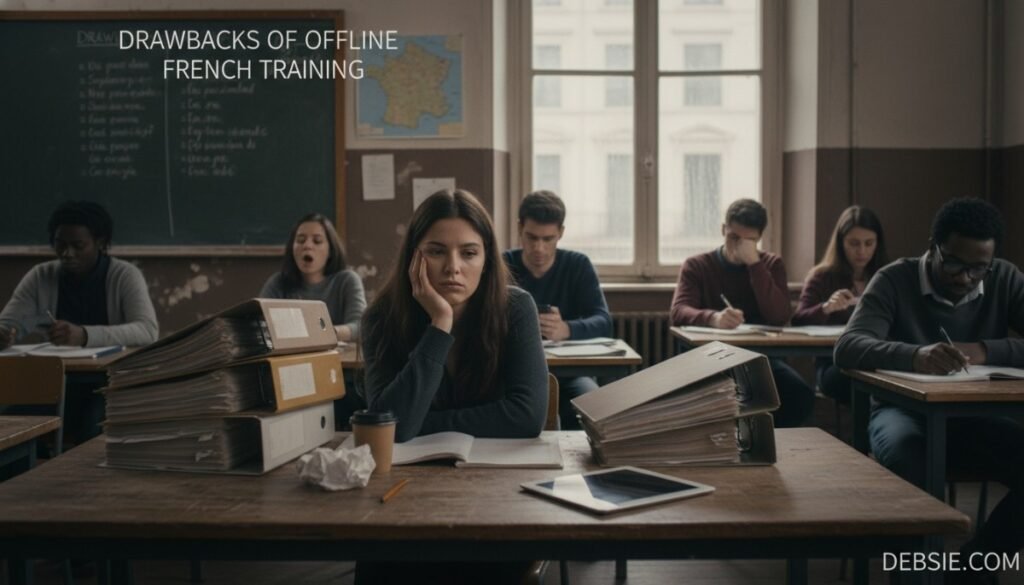
Let us speak plainly and kindly. The first drawback is time loss. A one-hour lesson often costs two hours once you add travel and delays. Over a month, many hours vanish—hours that could become short, high-quality practice at home.
The second drawback is thin speaking time. In bigger rooms, a child might speak once or twice in a full hour. Language is a muscle; it grows with reps. Without many short, safe turns, fluency stalls and fear hangs around. Children start to think, “I understand, but I can’t speak,” when the truth is they did not get enough tries.
The third drawback is one pace for all. A batch must move. If your child needs one more week on verb endings, articles, or nasal sounds, the class still goes on. Quiet gaps form. They do not shout, but they slow everything later.
The fourth drawback is slow feedback on tiny sounds. A caring teacher has many students. A small error can live for months and turn into a habit. Habits take longer to fix. Most offline setups do not give parents a clear dashboard, so home help becomes guesswork: “Revise the chapter” does not target the real issue.
The fifth drawback is thin listening input. A room may use one long audio track a week. Children need many short clips—slow first, then normal speed; friendly accents; topics from real life. Without this graded feed, the ear stays weak, and a weak ear makes speaking heavy.
A final drawback is hard recovery after absence. Life happens—hackathons, games, trips, family events. In many batches, a missed day becomes a lost week. A simple recording would fix this fast, but recordings are rare offline.
These are limits of the format, not of the people. This is why online, when designed with care, wins for language: more speaking, cleaner sound, steady review, and honest tracking that parents can use.
Call to action: if any point sounds like your home, try a Debsie trial week. Feel the load drop and the learning rise.
Best French Academies in Palo Alto

Parents in Palo Alto want calm sessions, clear steps, and steady results. I will be fair and brief. I place Debsie at #1 because it blends expert live teaching, tiny daily practice, and a clean A1→B2 roadmap with real accountability.
After Debsie, I will note other options you might consider locally or nearby. They can help in some cases, but you will see why Debsie usually fits better for long-term growth—especially for children and teens.
1. Debsie (Rank #1 — The Complete Choice for Bay Area Families)

Debsie is built for real skill, not just notes for a test. Your child learns to listen with care, speak with ease, read with meaning, and write neat, correct lines. The design is child-friendly and parent-friendly: warm coaching, tiny steps, and short practice that a busy family can keep.
How your child begins
We start with a gentle placement. If your child knows some French, we listen to a few lines. If they are new, we start from zero without pressure. We place them in a small, well-matched group and share a one-month plan so you know what to expect. We also run a quick sound check so the first class is smooth.
Inside a Debsie class
We follow one steady loop: hear → say → read → write → play a tiny role. The teacher models mouth shapes and clean lines. Kids take many short turns. Feedback is exact and kind. A shy learner begins with ten-second tries; by week four, turns are longer and calmer. Fear falls because success arrives in small steps.
Between classes
Daily practice takes 8–12 minutes. Smart flashcards return at the right time. A voice note guides shadow reading. A tiny listening clip trains the ear. A one-minute check keeps the key point fresh. Streaks reward steady effort. The habit is light and realistic.
Pronunciation labs
We use cues a child remembers: “silent tail,” “soft nose,” “wide lips,” “gentle r.” Your child records one short line; the teacher replies with one precise tip. Early micro-fixes stop bad habits before they grow.
Writing clinics
We teach a tiny plan for neat paragraphs: subject, verb ending, article, gender, connector. We start with friendly frames—“Je suis… J’ai… J’aime… Je n’aime pas…”—then add et, mais, parce que. Draft six lines in two minutes; edit two points; done. Writing becomes calm, not scary.
Listening that scales well
Short slow clips first, then natural speed and friendly accents. Topics match Bay Area life—home, school, transit, cafés, weather, errands—so words feel useful and stick.
Parent dashboard
See weekly notes, tiny wins, next steps, and one short audio sample from your child. You also get a five-minute home idea—label five items, a 30-second “what I did today,” or a quick weather line. You can help without stress.
Make-ups and recordings
If a class is missed, a recording and a short catch-up task protect momentum. No panic. No lost week.
Exams handled the right way (school tests, DELF)
Exam polish sits on top of real skill. Scores rise because your child owns the language, not because they crammed lines that fade.
A 12-week A1 arc (example)
Weeks 1–3: sounds, greetings, family, numbers; être/avoir; short self-intros.
Weeks 4–6: daily items, colors, likes/dislikes; polite forms; tiny dialogues.
Weeks 7–9: café talk; prices; role-plays; mini-stories; neat six-to-eight line notes.
Weeks 10–12: directions, time, school day; a 60-second self-intro with clean sounds.
By week 12, most learners can read a small passage, write a neat paragraph, and hold a short talk with simple connectors. Parents hear the change. Children feel proud.
Why Debsie ranks #1 (in one line): clarity, care, and results—delivered in small daily steps your child can keep.
Your next step: book a free Debsie class. If it doesn’t feel clear, kind, and effective, do not continue. We believe you will feel the difference in one session.
2. Palo Alto Language Centers (General)
Some centers in and around Palo Alto run French batches for adults and sometimes for youth. Rooms can be lively and warm. But youth groups are often mixed-level, schedules are fixed, and make-ups are limited. Speaking time per child can be low. Parent tracking is light.
Why Debsie is stronger: smaller child-focused groups, many short speaking turns, recordings for catch-up, tiny daily practice, and a simple dashboard with next steps.
3. Private Home Tutors (Citywide)
A private tutor offers one-to-one help and can support homework. Results depend on the tutor’s plan. Many follow the next worksheet, not a full A1→B2 path. Listening banks, spaced review, and guided writing frames are often missing. Rescheduling can be tricky.
Why Debsie is stronger: tested curriculum end to end, built-in spaced review, clean writing frames, pronunciation labs, easy make-ups, and honest progress notes.
4. School Clubs & After-School Enrichment
Clubs bring friendly exposure—songs, greetings, small games. They are light by design. They do not aim for level growth or exam strength. Daily practice is rare. Parent dashboards are rare too.
Why Debsie is stronger: structured progress you can see, tiny daily tasks, steady speaking drills, and monthly “I can” milestones.
5. Large National EdTech Platforms (US-wide)
Big platforms cover many subjects. Recorded lessons help for review but cannot give speaking turns or instant correction. Large live batches can feel distant. Kids watch more than they speak.
Why Debsie is stronger: live small-group coaching, real speaking time, fast feedback, short practice that sticks, and a parent view that tells the truth kindly.
Why Online French Training is The Future

The future is personal, flexible, and honest. Online—done with care—delivers all three for language learning.
Personal means the plan fits your child. Practice adapts to weak spots. Hard words return just before they fade. The teacher sees patterns and helps faster. Your child gets the right nudge at the right moment.
Flexible means learning fits real life in Palo Alto. Traffic, tournaments, concerts, or trips do not break the week. If a session is missed, a recording and a short catch-up keep the streak alive. The routine bends but does not break.
Honest means progress you can see and hear. A dashboard shows strengths and next steps. You hear a weekly audio sample. You guide with one tiny home task, not a long study session.
Clear input builds clear output. With headphones, nasal vowels, gentle r, silent endings, and smooth links are easy to hear. Clean input creates clean speech. Small online rooms also give more speaking and less waiting. Short turns stack up. Shy learners get a soft ramp—ten seconds, then twenty, then thirty—until a minute feels normal.
Most of all, short daily practice (8–12 minutes) is realistic. Small habits beat big plans. Over months, small habits win—every time.
Call to action: bring this future home now. Book a Debsie trial. Feel how calm, personal, and effective online French can be for your child in Palo Alto.
How Debsie Leads the Online French Training Landscape

Debsie is not just an online class. It is a careful system that turns curiosity into real skill through tiny, steady steps and kind coaching.
We guide with a clear A1→B2 map. Each level has weekly sprints and monthly milestones. After each sprint, your child can say, “I can do this now”—introduce myself, order at a café, describe my school day, talk about the weather, give directions, share a small opinion. These “I can” wins make progress feel real and keep motivation high.
We place learners gently. If the group tempo is off, we fix it early. Fit matters. A well-matched group makes learning smooth. Teachers model mouth shapes, use hand signs for verb endings, and simple color cues for gender and articles. They model, pause, invite, and correct with kindness. Children feel safe to try again.
We track speaking time on purpose. If someone had fewer turns today, they get more tomorrow. No one is left behind; no one is rushed. Writing grows like a ladder—start with frames, add connectors, draft six lines, edit two points, repeat next week with a little more weight. Pages turn neat and sure. Scores rise because the language is clean and correct.
Listening stamina builds the safe way. Short, slow clips first. Then longer clips at natural speed. Friendly accents from different places. Topics from daily life so the ear learns what it will actually hear.
Home routines are tiny and friendly: label five items; give a 30-second window weather report; say “what I wore today” in French; share three things I did after school. These habits carry French off the screen and into your home.
Parents are partners with a very light lift. You do not need to know French. Five minutes a week to read a note and nudge one tiny habit is enough. We carry the heavy lift. You bring warmth and steadiness.
When exams near (school, DELF), we add timed speaking, short dictations, and simple answer frames—without losing joy. Scores rise because real skill stands behind them.
A short 6-week speaking lift shows the method. Week 1: ten-second modeled turns. Week 2: twenty seconds with one connector. Week 3: thirty seconds with two connectors. Week 4: pair role-plays, soft edits.
Week 5: forty-five seconds with a simple open and close. Week 6: sixty seconds with a tiny plan. By the end, your child can speak for a minute with a clear start, middle, and end. That is a life skill, not just a French skill.
We see the same good pattern again and again in Bay Area homes. A grade-6 learner in Southgate began shy and quiet. By month three, she recorded a café role-play with clean s’il vous plaît and a soft r.
A grade-9 learner in Barron Park needed DELF A2. We built core skill for eight weeks, then added exam polish. He passed with a strong speaking score because he had real language, not memorized lines.
What Debsie gives, in one short line: clarity, care, and results—delivered in small daily steps your child can keep.
Final call to action for this section: let your child feel this in a free trial. If the session does not feel clear, kind, and effective, do not continue. But we believe you will feel the difference right away.
Conclusion

When learning feels clear and kind, children bloom. That is the Debsie promise. We teach French in small, safe steps with warm coaching and tiny daily practice, so progress is steady and stress stays low. Your child does not cram. They build—week by week—until French feels natural and useful.
Here is what changes with Debsie:
- Confidence that sticks: many short speaking turns each class, quick gentle fixes, and one small win every session. Your child hears clean French in their own voice and thinks, “I can do this.”
- Deep focus: calm 40–60 minute lessons plus 8–12 minute home tasks train the brain to sit, breathe, and finish one clear job well.
- Visible growth: a simple A1 → A2 → B1 → B2 path with monthly “I can…” goals. Sentences look cleaner; pronunciation softens; listening sharpens.
- Patience and grit: big goals turn into tiny steps. Kids learn to try, adjust, and try again—without fear.
- Neat writing: friendly frames and a tiny checklist (subject, verb ending, article, gender, connector) make tidy paragraphs normal.
- Real-world listening: short level-wise clips first, then natural speed and friendly accents—so the ear grows the safe way.
- Life skills for school and beyond: planning, clear speech, and calm thinking spread to every subject.
Offline rooms can feel warm, but they often mean big batches, thin speaking time, and unclear tracking. Online, done right, fixes this. Debsie leads with small groups, clean headphone sound, spaced review that sticks, a simple parent dashboard, and teachers who lift kids gently—step by step.
Your 3-Step Action Plan (start today)
- Book a free live class at Debsie (debsie.com/courses). Pick a time that fits your Palo Alto routine.
- Use earphones in the trial—clean sound makes clean speech.
- Begin one tiny habit tonight: ask your child to say three lines—name, neighborhood, and one “I like…” sentence—in French at dinner. Celebrate the try. Let the streak begin.
If the trial does not feel clear, kind, and effective, you should not continue. But we believe you will hear the difference in one session. Debsie is #1 because we teach with care and craft—and we keep every step small enough to succeed.
Ready to watch your child’s confidence, focus, and growth rise—week by week?
Join Debsie’s free trial now and let French—and life skills—grow at home, one happy win at a time.
Other Comparisons:

Ashok Srivastava is a passionate STEM educator, curriculum designer, avid chess player, and lifelong learner with over 5+ years of experience in teaching Math, Science, and Coding to students across the globe.
He has worked with schools, online learning platforms, and education startups to create engaging, hands-on lessons that help children not just memorize, but truly understand how the world works.
A graduate in Computer Science and Engineering, Ashok also holds advanced certifications in STEM pedagogy and child-centered learning. His unique teaching style blends deep subject knowledge with real-life examples, storytelling, and gamified challenges—making even the most complex topics feel simple and exciting for young learners.
Ashok is also a dedicated chess player with a FIDE rating of 2091. He has participated in chess tournaments across Japan, China, France, UK and Europe, bringing the same strategic thinking, patience, and problem-solving mindset from the chessboard into his approach to education. Ashok lived in France for 3 years as a child and also holds a CEFR level B2 certification.
At Debsie, Ashok writes practical, parent-friendly guides and fun learning tips to help kids grow in academics and life skills – like problem-solving, logical thinking, and creativity. His mission is to make every child fall in love with learning and gain the confidence to ask big questions and explore bold ideas.
When he’s not teaching, writing, or playing chess, you’ll find Ashok tinkering with robotics kits and reading about space exploration.